1. Introduction
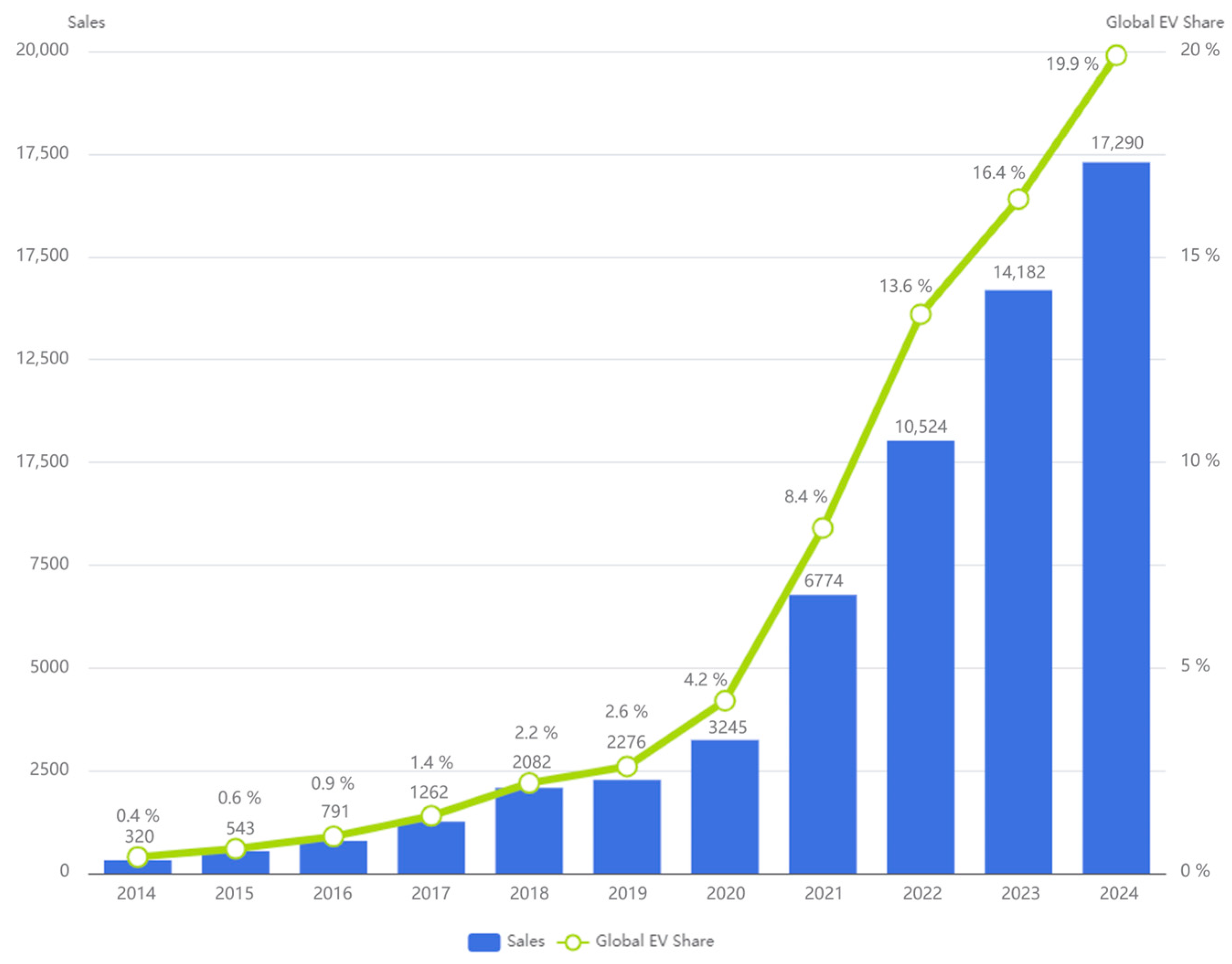
The past decade has witnessed an unprecedented and accelerating transformation within the global automotive industry, marked by a profound shift toward electrified mobility. According to data from EV Volumes (2024) and the International Energy Agency (IEA, 2024), worldwide sales of electric vehicles (EVs), including both battery electric vehicles (BEVs) and plug-in hybrid electric vehicles (PHEVs), have skyrocketed from approximately 320,000 units in 2014 to around 17.29 million units in 2024, achieving a compound annual growth rate (CAGR) exceeding 40% [
1]. Concurrently, the market share of EVs in the global new car market has surged from a mere 0.4% to approximately 20% in 2024, undoubtedly establishing electrification as the primary driver of growth in the automotive sector (see
Figure 1) [
2]. This milestone transformation not only reflects a fundamental shift in consumer awareness and purchasing preferences but also signifies the systemic penetration of clean energy technology into the core of the automotive landscape.
Within this global landscape, China has emerged as the pivotal force propelling the electrification process. In 2023, China accounted for approximately 60% of global EV sales, and this leading position was further consolidated in 2024, with its global market share rising from about half in 2021 to nearly two-thirds [
3]. According to data from the China Association of Automobile Manufacturers (CAAM), China’s new energy vehicle (NEV) market penetration rate continued its rapid ascent, reaching 40.9% in 2024 and climbing further to 44% in the first half of 2025 [
4]. At the policy level, the Chinese government has established explicit EV sales targets and emissions reduction commitments, providing a solid foundation for the industry’s long-term development. Forecasts suggest that EVs will account for approximately 60% of total domestic automobile sales by 2025 and are expected to surpass 95% by 2040, underscoring the market’s vast potential and growth prospects.
However, while this sweeping industrial transformation has created a vast market scale, it has also posed unprecedented challenges to the industry’s talent structure. First, the rapid expansion of the sector has led to an overall talent shortage. Data from Zhaopin.com (a leading Chinese recruitment platform) shows that recruitment demand across the automotive industry chain increased by 5% year-on-year in 2023, reflecting strong market demand for talent. More critically, significant structural mismatches have emerged between talent supply and demand. This challenge is not only evident in technical positions but has become particularly acute in sales and marketing positions. For emerging new energy vehicle enterprises, recruitment focus has shifted markedly toward market-oriented positions. Sales and marketing roles account for as much as 57% of total postings, which far exceed technical or managerial roles.
The underlying cause of this talent gap lies in the paradigm shift driven by digitalization and intelligent transformation within the NEV industry. The global automotive sector is rapidly advancing toward the “Four New Trends” which are fostering an emerging ecosystem of smart mobility. Within this context, the competency models required for sales and marketing roles in the NEV industry are likely to be redefined. The skill sets cultivated in the traditional internal combustion engine (ICE) automotive sector have become increasingly inadequate to meet the demands of a new industrial paradigm characterized by digital user operations, personalized service experiences, and diversified marketing channels.
Despite this urgent practical demand, existing competency frameworks in the automotive industry remain largely rooted in the traditional ICE vehicle sales ecosystem. There is a clear lack of systematic identification and definition of the core competencies required for NEV marketing personnel in the digital intelligence era. To address this critical gap between theory and practice, this study focuses on several key research questions: What constitutes the fundamental competency framework for sales and marketing roles in the NEV sector? What methodology should be adopted to systematically identify and define these core competencies? How can we derive key teaching priorities from a competency framework and then design corresponding instructional models for vocational education and training?
In response to these questions, this paper aims to develop a data-driven competency framework for NEV sales and marketing, specifically tailored to the era of smart mobility. The proposed framework seeks to provide both a theoretical foundation and practical roadmap for designing industry-specific training programs, optimizing vocational education curricula, and ultimately cultivating a new generation of high-quality, multidisciplinary professionals capable of advancing the sustainable development of the electric vehicle industry.
This study is structured as follows: In
Section 2, we review the existing literature, identify the gaps in current research, and thereby clarify the core direction of this study.
Section 3 elaborates on the methodology of this study in detail, including survey design, data collection process, data preprocessing, and data analysis.
Section 4 summarizes the research findings and maps the job competency profile based on the results of data analysis. Finally,
Section 5 presents the key insights obtained from this study and discusses how the research findings provide theoretical implications and practical guidance for job training in the NEV industry, as well as the design of vocational education curriculum and the future research directions.
2. Related Work and Research Gaps
2.1. Modeling Job Competency: Theoretical Foundations and Educational Applications
The academic exploration of job competency traces its origins to Bloom’s (1956) theoretical groundwork for the concept of “skills” in education [
5]. His seminal work provided significant inspiration for subsequent curriculum design and assessment practices [
6]. Drawing on this foundational framework, Parry (1998) and Campion et al. (2011) advanced the conceptualization of “competency” into a composite concept encompassing knowledge, attitudes, skills, and other personal traits, defining it as a measurable level of performance that can be enhanced through training and development [
7,
8]. This theoretical evolution laid the academic foundation for constructing specialized competency classification frameworks suited to specific positions and work contexts [
9]. As competency research advanced, numerous theoretical models emerged to analyze their intrinsic structure. Among these frameworks, the “Iceberg Model” proposed by Spencer & Spencer (1993) gained widespread recognition: it categorizes competency into observable, easily cultivable surface-level elements (e.g., knowledge and skills) and deeper, more stable underpinning factors (e.g., self-concept, traits, and motives) [
10]. This framework illuminates the distinctions between explicit and implicit components of competency, as well as their combined effects on performance. Additionally, the KSAO model (Knowledge, Skills, Abilities, and other characteristics) serves as another prevalent framework [
11]. This four-dimensional categorization not only reinforces the model’s explanatory power but also provides a robust analytical tool for deconstructing, assessing, and cultivating job competency.
The competency model, as a core instrument of Competency-Based Education (CBE), is fundamentally aimed at supporting learners in achieving superior performance [
12]. Within the context of higher education, the model serves as a critical bridge between academic training and labor market demands. Its significance has extended beyond the traditional scope of human resource management tools to become an essential reference for curriculum reform. To effectively address the “curriculum–skills gap,” curriculum development guided by competency models is supposed to systematically integrate the perspectives of multiple stakeholders (including students and industry experts) to accurately delineate the core capabilities required of graduates [
13]. In practice, this process often involves expert panels, focus group discussions, or interviews with incumbent professionals, through which the key competencies associated with specific positions are systematically identified [
14]. By subsequently mapping these required competencies against existing curricular content, higher education institutions can identify and address critical gaps in their training systems [
15]. Building upon this foundation, deeper cooperation between universities and industry can significantly enhance the alignment between educational content and actual organizational needs [
16]. Ultimately, through the integration of diversified instructional approaches (theoretical instruction, project-based learning, case analysis, and internship or practicum experiences), higher education institutions can strengthen graduates’ job readiness and professional competitiveness.
While competency modeling approaches hold substantial implications for the design, education, and training of sales roles, they have nonetheless received insufficient attention in both academic research and industry practice within the sales domain [
6]. While research on sales education has identified the types of activities that should be incorporated into curricula, the skills that should be taught [
17], and the importance of integrating experiential learning [
18], the implementation of competency-oriented, multi-stakeholder approaches in sales education remains relatively underdeveloped [
19,
20]. This gap becomes further amplified by the accelerating pace of digital transformation, which underscores an urgent need for the continuous refinement and updating of sales competency models and their corresponding curricular frameworks.
2.2. Cultivating EV Talent: Evolving Competency and Educational Pathways
Current literature widely indicates that while technological research and product commercialization in the electric vehicle sector are advancing rapidly, the development of education and training systems has lagged significantly behind, often exhibiting a temporary and reactive pattern of response [
21]. To address this gap, researchers have proposed multi-level and multi-dimensional educational implementation pathways. At the higher education level, the establishment of specialized degree programs is regarded as a key measure for cultivating high-caliber engineering talent. For instance, some scholars have advocated for the introduction of postgraduate programs such as a Master of Science in Electric Vehicles (MScEV), aimed at delivering cutting-edge knowledge in electric vehicle design, operation, and management, while integrating research training through topic-specific projects. Such programs are intended to enhance students’ professional competitiveness within a rapidly evolving industry context [
22]. As a crucial component of fostering students’ engineering capabilities, practical teaching has garnered widespread attention. Project-Based Learning (PBL), represented by the design and fabrication of EV prototypes, is recognized as a comprehensive educational approach that enables students to gain direct hands-on experience and become familiar with component functions, system architectures, and design processes [
23]. Through an iterative optimization process, this approach effectively hones students’ ability to solve practical engineering problems, laying a foundation for their future engagement in EV R&D. Additionally, other studies emphasize the need to systematically transform frontier research outcomes into education content, proposing three transformation directions: individual EV education, classroom EV education and professional EV education [
21]. Such transformation is deemed fundamental to supporting the sustainable development of the industry.
Alongside these advances in EV education and curriculum design, scholarly attention is increasingly turning to the development of competencies among automotive professionals. Dahm et al. (2025) investigated the European automotive industry and identified the five most significant competency gaps across multiple domains including R&D, production, and management [
24]. In terms of professional competencies, the key gaps include sustainable operating in the circular economy, connectivity, responsible handling of high voltage, application of additive and generative manufacturing procedures, and electrochemical principles. Regarding non-professional competencies, the major gaps are self-regulated learning, virtual planning and installation, data processing, software proficiency, and IT application. This study establishes a foundation for competency research in the context of the automotive industry’s transformation; However, its analytical approach, which does not focus on clearly defined job clusters, diminishes the practical value of its conclusions [
24]. For technical positions, Yu et al. (2025) [
25] developed a competency framework for electric vehicle maintenance technicians in response to the environmental, social, and governance (ESG) requirements of the battery electric vehicle (BEV) industry. This framework not only emphasizes technical competencies such as high-voltage system safety, fault diagnosis, and maintenance skills, but also incorporates professional attitudes related to environmental responsibility [
25]. Notably, the industry transformation has also imposed new competency requirements on non-technical positions. For example, Liao et al. (2025) employed the Delphi method and identified key competency indicators for battery electric vehicle (BEV) sales personnel, highlighting that beyond technical knowledge, greater emphasis should be placed on soft skills and professional qualities such as customer service orientation [
26]. The representative related work discussed above is summarized in
Table 1.
2.3. Research Gaps and Direction of This Study
Drawing on these two literature streams, it is evident that a relatively comprehensive methodological system has been established across competency theory and educational practice, spanning competency model development to curriculum design. In the context of talent cultivation for the electric vehicle industry, scholars have also recognized the lag in educational responses and have begun to explore solutions through higher education program design, practical training approaches, and competency framework construction. However, a notable research gap remains: current discussions on NEV talent development are overwhelmingly centered on back-end technical positions: such as system designers, R&D engineers, and maintenance technicians. In contrast, systematic research is largely absent for front-end positions in sales and marketing, which directly interact with the market and serve as the crucial link between products and consumers. Existing research on the competencies of electric vehicle sales personnel remains at a preliminary stage. Significant gaps still exist in core issues such as the identification of digital skill components and especially the mapping between competency frameworks and curricula, which calls for further in-depth investigation.
This research gap represents a potential bottleneck for industry development. It is imperative to recognize that the commercial success of new energy vehicles is a systemic endeavor that relies not only on technological breakthroughs, but also on widespread market acceptance. In this process, sales and marketing personnel play a critical role, functioning as the key intermediaries who guide consumers through the profound transition from a “fuel-vehicle mindset” to an “electric-vehicle mindset”. However, NEVs, especially BEVs, are not merely substitutes for traditional automobiles. Instead, they represent a paradigm shift across multiple dimensions, including technological principles (e.g., the “three-electric” system), usage patterns (e.g., charging versus refueling), consumer value orientations (e.g., environmental sustainability), and after-sales service (e.g., battery warranties). Consequently, the knowledge base and sales rhetoric traditionally relied upon by automotive sales personnel are no longer sufficient to address these new challenges. Therefore, developing a scientific and systematic competency framework for sales and marketing positions in the new energy vehicle sector is not merely an academic pursuit. Rather, it is an urgent and indispensable task that bridges cutting-edge technological innovation and ultimate market success. This framework is crucial for resolving the “last mile” challenge in industry advancement and for promoting the healthy and sustainable development of the sector.
More importantly, at the industry level, such transformations have been extensively discussed in the literature on digital business transformation, particularly through the lenses of ecosystem competition and open innovation [
27,
28,
29]. These studies highlight fundamental shifts in value creation logics, inter-organizational relationships, and competitive boundaries. However, existing discussions largely remain at the macro or organizational level and rarely explicate how these industry-wide dynamics translate into concrete competency configurations at the level of individual roles. Consequently, it remains unclear which competencies are expected of front-line sales and marketing personnel as these transformations unfold in practice. From this perspective, ecosystem competition and open innovation provide a useful interpretive lens for understanding competency clusters related to boundary-spanning activities, cross-organizational coordination, and ecosystem-oriented market engagement, which are examined in detail in the subsequent analysis.
Against this background, the present study adopts an exploratory and data-driven approach to inductively identify the competency landscape of NEV sales and marketing roles based on large-scale recruitment data. Rather than prespecifying theoretical constructs or competency dimensions, the study allows patterns to emerge from empirical evidence and subsequently draws on relevant theoretical perspectives as interpretive references to make sense of the observed competency clusters. Thus, the study establishes an empirically grounded foundation for talent development, curriculum design, and industry–education alignment in the new energy vehicle sector.
3. Methodology
3.1. Survey Design
This study aims to explore the essential competencies required for sales and marketing roles in the rapidly evolving NEV sector amid the digital intelligence era. To address this core objective, this study adopts an exploratory sequential mixed-methods design and proposes a big data-driven competency framework construction approach. This approach aims to overcome the limitations of traditional approaches that rely solely on literature reviews or small-scale interviews. By integrating the big data analysis with practical insights from domain experts, it systematically constructs a competency framework that features cutting-edge, validity, and practicality.
The entire research process comprises two core phases. In the first phase, web crawler technology was adopted to systematically collect recruitment information related to the NEV industry in more than 20 major cities in China. Subsequently, the Latent Dirichlet Allocation (LDA) topic model method was employed to construct a list of core competencies for positions, thereby forming a preliminary skill framework. The second phase employed a multi-dimensional consensus scoring procedure based on the Nominal Group Technique (NGT). A panel of nine senior industry practitioners, corporate managers, and vocational education experts participated in two rounds of structured consultation to assess and refine the competency framework.
3.2. Data Collection
3.2.1. Data Source Selection
Zhaopin.com (
www.zhaopin.com) was selected as the primary data source for three critical reasons, ensuring the reliability and representativeness of the dataset: Firstly, as the longest-standing and pioneering online recruitment platform in China, Zhaopin.com possesses a substantial user base and extensive coverage of nearly all automotive enterprises. These characteristics ensure the data’s accessibility and availability, thereby establishing its high quality and suitability for research purposes. Secondly, the platform’s advanced search functionality enables precise data collection and yields job descriptions with a highly standardized structure and professional terminology. This was achieved by utilizing the platform’s advanced search filters, which were set to specific parameters such as the job category and the industry. This search protocol is critical as it facilitates the LDA model in accurately identifying skill-related thematic patterns while effectively minimizing noise interference. Thirdly, Zhaopin.com focuses more on mature enterprises, enabling it to truly reflect the current market’s demand for mainstream and practical skills in sales and marketing positions.
Notably, most companies post identical job vacancies across multiple platforms simultaneously. Therefore, sourcing data from a single, well-established platform constitutes an effective approach for collecting a representative dataset. Acquiring job information from multiple platforms concurrently would introduce substantial data redundancy, necessitating extensive deduplication efforts without significantly improving the coverage or quality of the unique job postings under examination.
3.2.2. Data Collection Process
To ensure data quality and target alignment, the data collection was implemented in two sequential phases, covering more than 20 major Chinese cities (e.g., Shanghai, Nanjing, Hangzhou, Suzhou, Changchun, and other cities).
- (1)
Phase 1: Data Extraction
Selenium is a suite of tools for automating web browsers. It is primarily employed for the automated testing of web applications and other browser-based tasks. Its core functionality enables the simulation of user interactions within a browser, such as clicking buttons, entering text, and navigating pages. This allows for the creation of scripts that programmatically replicate these user actions. Therefore, Selenium was employed to automatically access the Zhaopin.com website and collect its recruitment information. This approach enabled the reliable extraction of key fields such as job title, company information, work location, and job description. Such a crawling method has been widely validated in both academic and industry applications, including customer demand analysis, product feature description, and business intelligence collection [
30,
31,
32].
- (2)
Phase 2: Job Position Filtering
Building upon the dataset acquired in the first phase, this phase focused on identifying valid jobs to narrow down target positions. The screening process was conducted based on predefined rules, primarily focusing on excluding positions whose job titles or descriptions significantly deviated from “sales” and “marketing” domains. For instance, technical roles such as “NEV Maintenance Engineer” and “Battery R&D Engineer” were removed. Parameters such as company size and salary expectation were deliberately left unrestricted to maximize sample inclusivity. Initially, 2346 jobs related to NEV marketing were crawled from the platform. These jobs then underwent deduplication (to remove duplicate postings) and relevance validation (to exclude non-target roles, e.g., technical positions). After filtering, 1886 valid jobs were retained, forming a reliable foundation for subsequent detailed data extraction.
3.3. Data Preprocessing
Data preprocessing is a critical step for improving the quality of raw data, standardizing text formats, and enhancing its compatibility with analytical methods. This section systematically elaborates on the processes of cleaning and feature construction process for job posting data in the new energy vehicle industry, aiming to enhance the consistency of text data quality and semantic interpretability. By sequentially implementing standardized operations such as Chinese text segmentation, stop-word filtering and domain-specific dictionary construction, as well as text vectorization and tokenization, unstructured text is converted into structured features, thereby providing high-quality input for semantic feature extraction based on the LDA model.
3.3.1. Text Segmentation
In this study, the widely used Jieba 0.42.1 segmentation tool is adopted for word segmentation of Chinese recruitment texts. This tool constructs a directed acyclic graph (DAG) of Chinese characters based on a prefix dictionary structure and employs a dynamic programming algorithm to solve for the maximum probability path. This enables Chinese word segmentation that balances efficiency and accuracy, making it suitable for processing recruitment texts containing many professional terms [
33,
34,
35].
Prior to segmentation, regular expression technology is used to clean the raw text. The re.sub() function in Python 3.13.5 is employed to systematically remove numbers, punctuation marks, and other non-Chinese characters, retaining only pure Chinese content. This ensures the consistency and accuracy of subsequent language processing. Notably, unlike inflected languages such as English, Chinese text processing does not require case folding or lemmatization, which stems from the fundamental differences in writing systems and grammatical structures between Chinese and English. In this study, the jieba.cut() method of Jieba is directly applied to complete the segmentation task, resulting in a concise and efficient processing workflow.
3.3.2. Stop-Word Filtering and Domain-Specific Dictionary Construction
To adapt to the characteristics of texts in the new energy vehicle field, this study constructs dictionary resources and a stop-word library tailored to the research theme. Specifically, it includes the following types:
User Dictionary Expansion: To prevent the mis-segmentation of domain-specific terms, we expanded the user dictionary with fixed collocations like “potential users”, “driving experience”, and “test drive” etc. This expansion was critical for ensuring conceptual integrity, preventing semantic information loss, and improving the accuracy of topic representation.
Stop-Word List Expansion: Based on the Harbin Institute of Technology Stop-Word List (hit_stopwords), the stop-word list is further expanded in line with the research objectives to filter out words that contribute little to competency analysis. Specific additions include the following categories: Recruitment-related noise words, e.g., “salary”, “welfare benefits”, “five insurances and one fund”. Brand names, e.g., “AITO”, “NIO”, “BYD”, to eliminate the interference of brand factors on topic modeling. Through the stop-word library, text noise is effectively reduced, ensuring that topic modeling focuses on semantic content related to job competencies.
3.3.3. Text Vectorization and Tokenization
For the numerical representation of text, TfidfVectorizer and CountVectorizer from the scikit-learn library are used to implement text vectorization. CountVectorizer constructs a document-term matrix based on term frequency, reflecting the distribution of vocabulary. TfidfVectorizer applies term frequency-inverse document frequency (TF-IDF) weighting to highlight feature words with discriminative power. These two methods characterize text from different perspectives, providing a basis for subsequent feature extraction. As the final step of preprocessing, tokenization splits the cleaned text into independent vocabulary units (tokens), converting continuous text into minimum semantic units. This provides structured input for subsequent tasks such as feature extraction, semantic analysis, and document clustering. This process establishes a standardized text representation, laying a foundation for the LDA topic model to effectively identify latent semantic patterns. In summary, this phase achieves the systematic conversion from raw recruitment texts to structured features through a domain-adaptive text processing strategy, providing a high-quality data foundation for subsequent LDA topic modeling.
3.4. Data Analyze
LDA is selected as the topic modeling approach using Scikit-learn (sklearn) module due to its proven effectiveness and interpretability in uncovering the latent semantic structure of unstructured text corpora [
36]. LDA is a generative probabilistic model based on the Bayesian framework, it assumes that a document is represented as a probabilistic mixture of latent topics, with each topic characterized by a multinomial probability distribution over words. Sklearn is a machine learning module for Python built on SciPy. It is a straightforward and effective tool for data mining and data analysis, enabling quick deployment of methods such as CountVectorizer and LatentDirichletAllocation.
The development environment for this study was set up on a Windows 10 operating system, equipped with an Intel i7-class CPU and 16 GB of RAM, utilizing Anaconda for package and environment management. The core programming language was Python 3.13.5. Key dependency libraries included scikit-learn 1.6.1, NumPy 2.1.3, pandas 2.2.3, Selenium 4.20.0, and Jieba 0.42.1. No specific hardware acceleration was employed. Crawling approximately 2300 job postings took about 2.5 h. Text preprocessing and Jieba segmentation were completed within 5 min, while LDA topic modeling took approximately 20 min.
In the expert consultation phase, this study introduces a multi-dimensional consensus scoring process based on the NGT to systematically integrate the opinions of domain experts. This method controls group decision-making biases through structured steps, enhancing the scientific rigor and consensus level of the evaluation results [
37]. The specific implementation includes: (1) experts independently completing the initial scoring of the competency list across three dimensions: operational frequency, importance level, and mastery difficulty; (2) a sequential speech and clarification session to ensure a shared understanding of competency definitions and collect open-ended supplements; (3) focused discussions on items with significant scoring discrepancies to promote information integration and perspective expansion; (4) experts conducting final independent scoring based on the discussion outcomes, forming multi-dimensional evaluation data representing collective consensus.
During the initial scoring stage, expert opinions exhibited relatively pronounced divergence on several competency indicators. For instance, within the importance dimension, items C6-1 to C6-5, C7-4, and C8-5 showed comparatively high score dispersion, as indicated by larger standard deviations (ranging from 0.83 to 1.17); within the operational frequency dimension, the most notable discrepancies were observed for C4-3, C4-5, and C9-1, with standard deviations between 0.94 and 1.25; and in the difficulty of mastery dimension, C1-5 demonstrated the greatest variation, with a standard deviation of 1.42. In the subsequent focused discussion stage, the expert panel prioritized these indicators with larger initial divergences and engaged in in-depth discussions to clarify the underlying meanings of the evaluation dimensions. For example, “importance” was collectively defined as the relative criticality of a competency at the level of the position cluster, rather than its short-term contribution to individual sales performance; similarly, “difficulty” was explicitly anchored in the complexity of applying the competency in routine work contexts, as opposed to the difficulty associated with training or assessment procedures.
Following these discussions, expert opinions on the aforementioned indicators exhibited a consistent convergence trend, with the dispersion of ratings for all related items decreasing to below 0.8. For instance, the standard deviation of C6-1 decreased from 0.99 to 0.67, C6-2 from 1.17 to 0.67, C9-1 from 0.94 to 0.63, and C1-5 from 1.42 to 0.79, indicating that the consensus-building process effectively reduced initial differences in interpretation.
Accordingly, the core function of the NGT in this study served to facilitate rational convergence of expert opinions by clarifying evaluation criteria and cognitive boundaries, not to systematically correct experts’ initial judgments. On this basis, the study ultimately developed a competency model that integrates large-scale text-mining insights with expert domain judgments, thereby providing a more robust foundation for identifying training priorities and informing instructional design.
4. Results
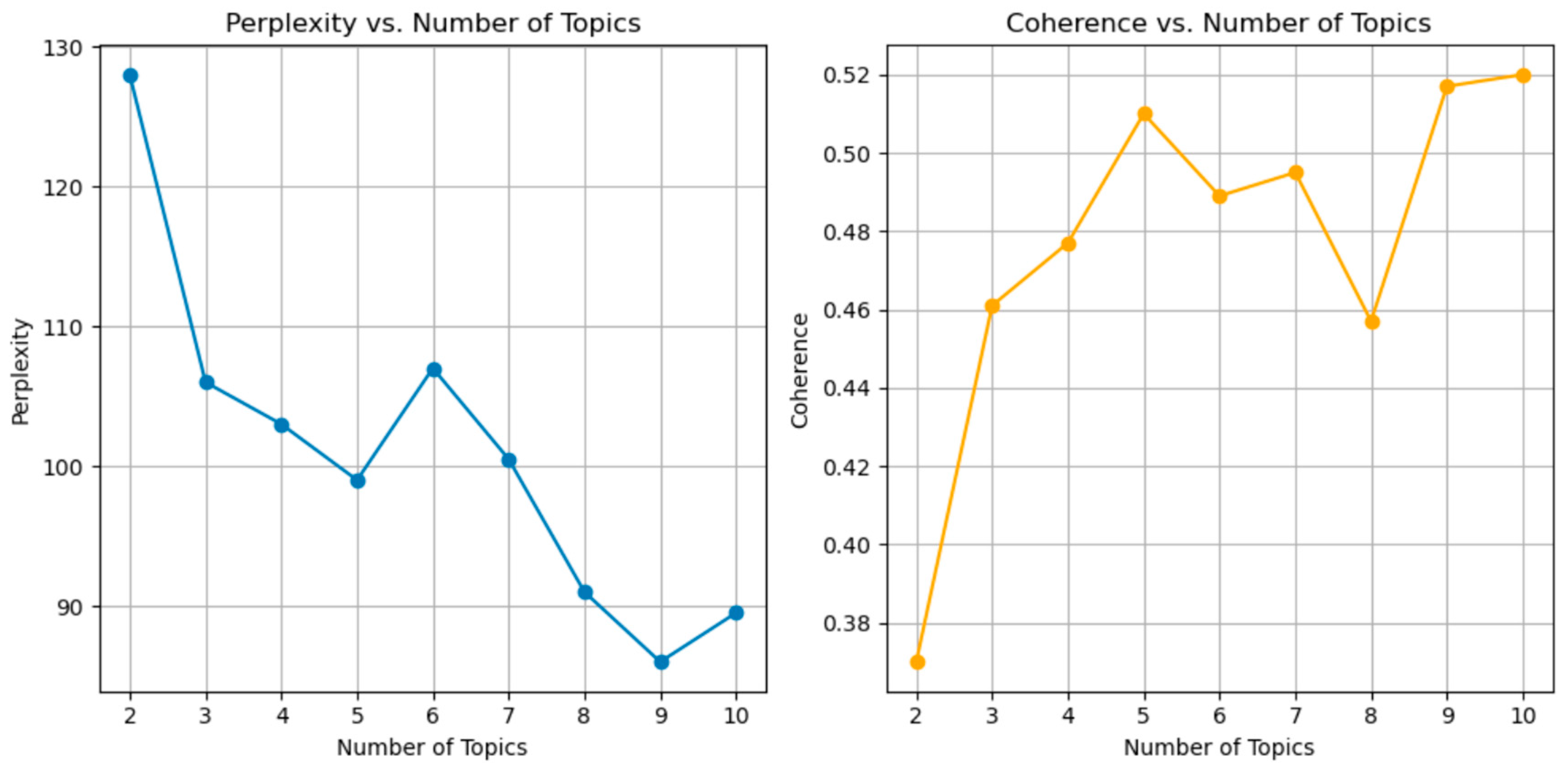
To determine the optimal number of topics, a multiple criteria method is employed, including model perplexity, topic coherence score, and manual evaluation of semantic interpretability. The perplexity and coherence scores under different numbers of topics are shown in
Figure 2. Based on the aforementioned evaluation criteria, the number of topics was ultimately determined to be nine. This number of topics not only achieves the lowest perplexity and the highest coherence score but also ensures clear conceptual differentiation between topics and semantically meaningful keyword features, thereby deriving a preliminary competency list for subsequent analysis.
The results of LDA topic modeling are presented in
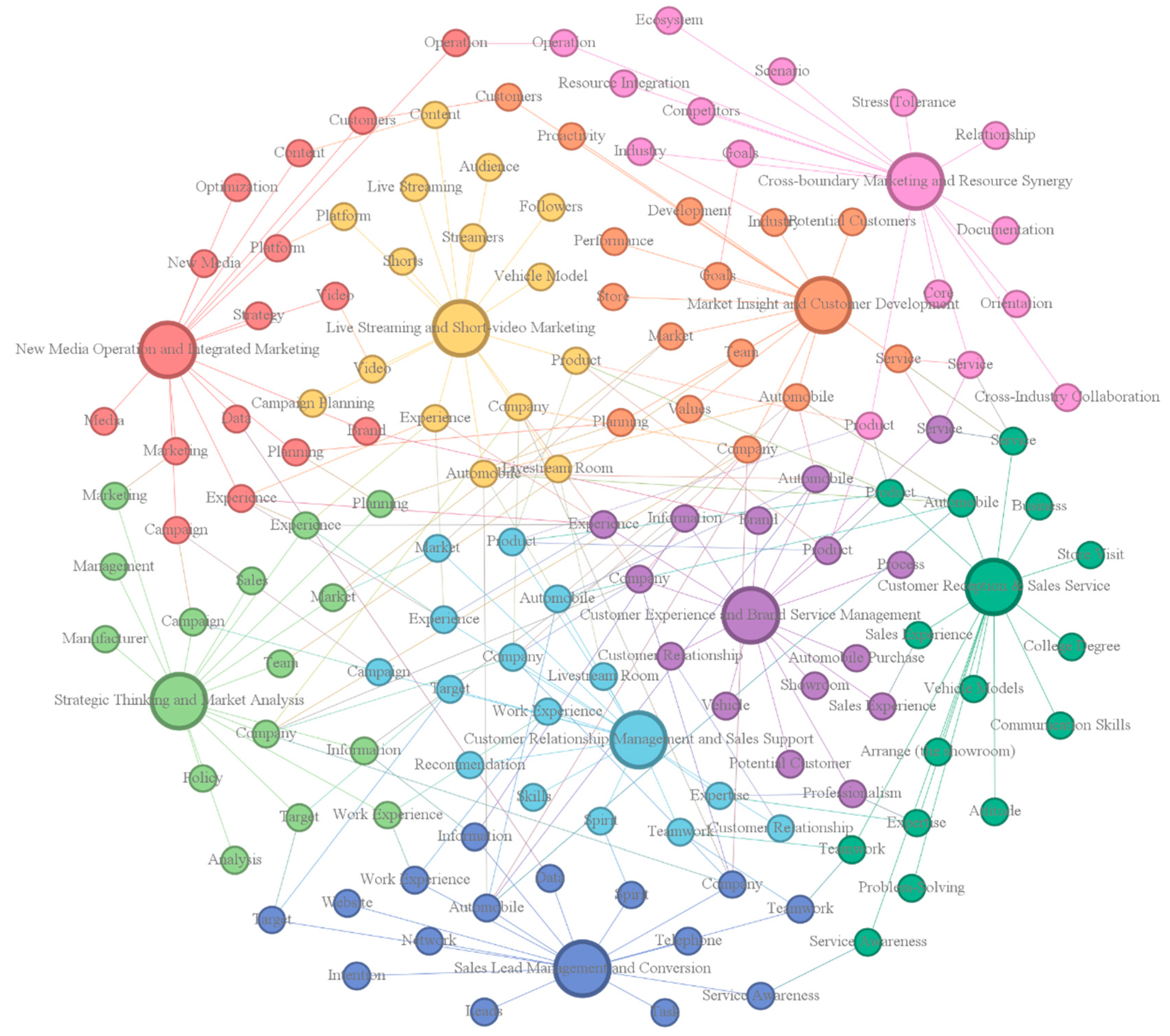
Table 2, which lists the top 15 keywords with the highest weights under each topic. These terms form the semantic basis for topic identification and labeling. Based on an in-depth analysis of the connotations of these keywords, this study assigns names to each topic that aligns with the practical context of the new energy vehicle marketing field, thereby accurately summarizing the characteristics of their core content. In addition, the relationships between keywords and their corresponding topics have been visualized in the form of a network graph, which further reveals the topic structure and the internal semantic connections (see
Figure 3).
The following sections elaborate on the nine key thematic clusters identified by the LDA model, which offer critical analytical foundations and theoretical insights into the dynamic evolution of skill compositions required for professionals in NEV marketing positions.
4.1. Cluster 1: Customer Reception and Sales Service
This cluster highlights the central role of customer experience, professional services, and sales conversion in marketing positions within the NEV sector. Keywords such as “vehicle models” and “store visits” precisely define the core scenario of this position: the offline showroom where work commences with professional in-store customer reception and needs identification. Keywords like “professionalism” and “problem-solving” directly point to the core skills required in this scenario: on the one hand, employees are expected to possess in-depth professional capabilities in explaining vehicle models to address inquiries about these technology-intensive products; on the other hand, they need to have excellent sales communication and persuasive interaction skills, while effectively handling customer objections and advancing business progress. Keywords related to professionalism and team collaboration (such as “teamwork” and “service awareness”) further indicate that enterprises aim to enhance overall customer satisfaction and sales efficiency by fostering collaborative team cooperation and service awareness.
4.2. Cluster 2: Market Insight and Customer Development
This cluster lies in identifying potential customer segments through systematic market insights and customer analysis, formulating effective market expansion strategies, and driving team execution to achieve sales targets and brand development. The keywords “customer”, “market” and “industry” outline the macroscopic perspective and analytical orientation of this position. Its operations commence with in-depth analysis of customer needs, identification of potential customers, as well as data-based market trend analysis and industry insights.
4.3. Cluster 3: Live Streaming and Short-Video Marketing
This cluster defines the new-type functions of user reach and brand building centered on cutting-edge digital content in NEV marketing. The keywords “live streaming”, “short video”, “followers” and “platform” depict a content-centric and user-focused digital communication matrix. The work of this cluster starts with live streaming planning and on-site execution, as well as the capability of short video content creation and production. In contrast, terms such as “streamers”, “audience” and “content” point to the core skills required for the position. On one hand, it is reflected in the ability to present vehicle models vividly with scenario-based demonstrations, transforming complex technologies into intuitive experiences. On the other hand, it emphasizes converting audience into brand advocates through fan community relationship management and interaction. The terms “platform”, “content” and “campaign planning” highlight the omni-channel operation mindset: the capability of cross-platform content distribution and brand exposure enhancement requires formulating differentiated content strategies based on the characteristics of different platforms.
4.4. Cluster 4: Cross-Boundary Marketing and Resource Synergy
This cluster defines the strategic expansion function within NEV marketing, centered on cross-boundary resource integration and ecological synergy. The keywords “scenario”, “cross-industry collaboration”, and “ecosystem” describe a three-dimensional marketing system that takes user scenarios as the core and resource integration as the means. The work of this cluster commences with scenario-driven demand analysis and solution design, as well as cross-boundary collaboration and resource integration. Terms such as “competitors”, “industry”, and “relationship” point to the key links in strategic analysis and collaboration building. This reflects in the keen ability to conduct competitive analysis and identify opportunities, discovering differentiated advantages in cross-industry fields, while also emphasizing building a win-win collaborative network through continuous development of ecosystems and relationship management. The terms “core”, “orientation” and “service” reflect the strategic value of this function, that is, continuously expanding the extended value of brands through ecological collaboration and opening new growth tracks in the red ocean competition.
4.5. Cluster 5: Sales Lead Management and Conversion
This cluster defines the core competency in sales lead management, encompassing multi-channel acquisition and processes of lead cleansing, classification, follow-up, and analysis to drive sales target achievement. The keywords “information”, “data”, and “intention” reflect the professional capabilities of lead screening and customer purchase intention assessment, which serve to identify high-value potential customers. Meanwhile, they emphasize the standardized entry of customer data and information management to lay a foundation for subsequent transaction conversion. Furthermore, “team collaboration”, “service awareness”, and “professionalism” embody the collaborative nature of the position, emphasizing the need to improve lead conversion rates and customer satisfaction through efficient team communication and information-sharing mechanisms.
4.6. Cluster 6: New Media Operation and Integrated Marketing
This cluster defines the core functions responsible for digital ecosystem construction and integrated marketing implementation in NEV marketing. The keywords “operation”, “new media”, and “platform” outline the work domain of this position centered on the digital ecosystem. Its work commences with strategic digital marketing strategy and project planning, as well as multi-platform media ecosystem management. Terms such as “content”, “campaign”, and “video” point to the ability to design and execute innovative integrated marketing activities. Additionally, it emphasizes building a brand content matrix with continuous output through professional content marketing. The terms “data”, “optimization”, and “customer” directly correspond to the refined requirements of digital marketing. They require marketing personnel to possess in-depth data-driven marketing effect analysis and optimization capabilities, enabling continuous iteration of marketing activities and precise user reach.
4.7. Cluster 7: Customer Relationship Management and Sales Support
This cluster defines the key functions focused on full-life cycle customer value management and sales support in NEV marketing. The keywords “customer relationship”, “product”, “live streaming room”, and “marketing campaign” delineate a customer-centric customer relationship management (CRM) system featuring online-offline integration. In contrast, terms such as “live streaming room”, “professionalism”, and “skills” highlight the new requirements of the digital era: the ability to address customer needs through emerging channels.
4.8. Cluster 8: Strategic Thinking and Market Analysis
This cluster defines the functions that undertake strategic planning and systematic analysis in NEV marketing. “Management”, “team”, and “target” emphasize the transformation of strategic planning into action plans through efficient team coordination, organizational management, and professional OEM (Original Equipment Manufacturers) resource coordination and management. In this process, “information” and “policy” serve as key decision-making bases, highlighting the need to dynamically optimize marketing strategies through continuous market intelligence collection and policy interpretation. Furthermore, the terms “manufacturer”, “company”, and “work experience” require marketing personnel to not only understand the strategic intentions of OEMs but also promote localized marketing practices in line with the actual situation of the store.
4.9. Cluster 9: Customer Experience and Brand Service Management
This cluster defines the core functions focused on end-to-end customer journey experience management and brand service value delivery in NEV marketing. The keywords “experience”, “service”, and “brand” describe the experience-centric value creation logic of this position. Terms such as “showroom”, “product”, “experience” and “process” point to the links in experience implementation. It emphasizes the ability to design immersive test drive experiences and conduct scenario-based demonstrations, transforming technical parameters into perceivable vehicle usage scenarios. The terms “customer relationship”, “potential customer”, and “vehicle purchase” correspond to the business goals of experience management. They require sales consultants to possess professional capabilities in experience value communication and sales conversion, translating high-quality experiences into business outcomes.
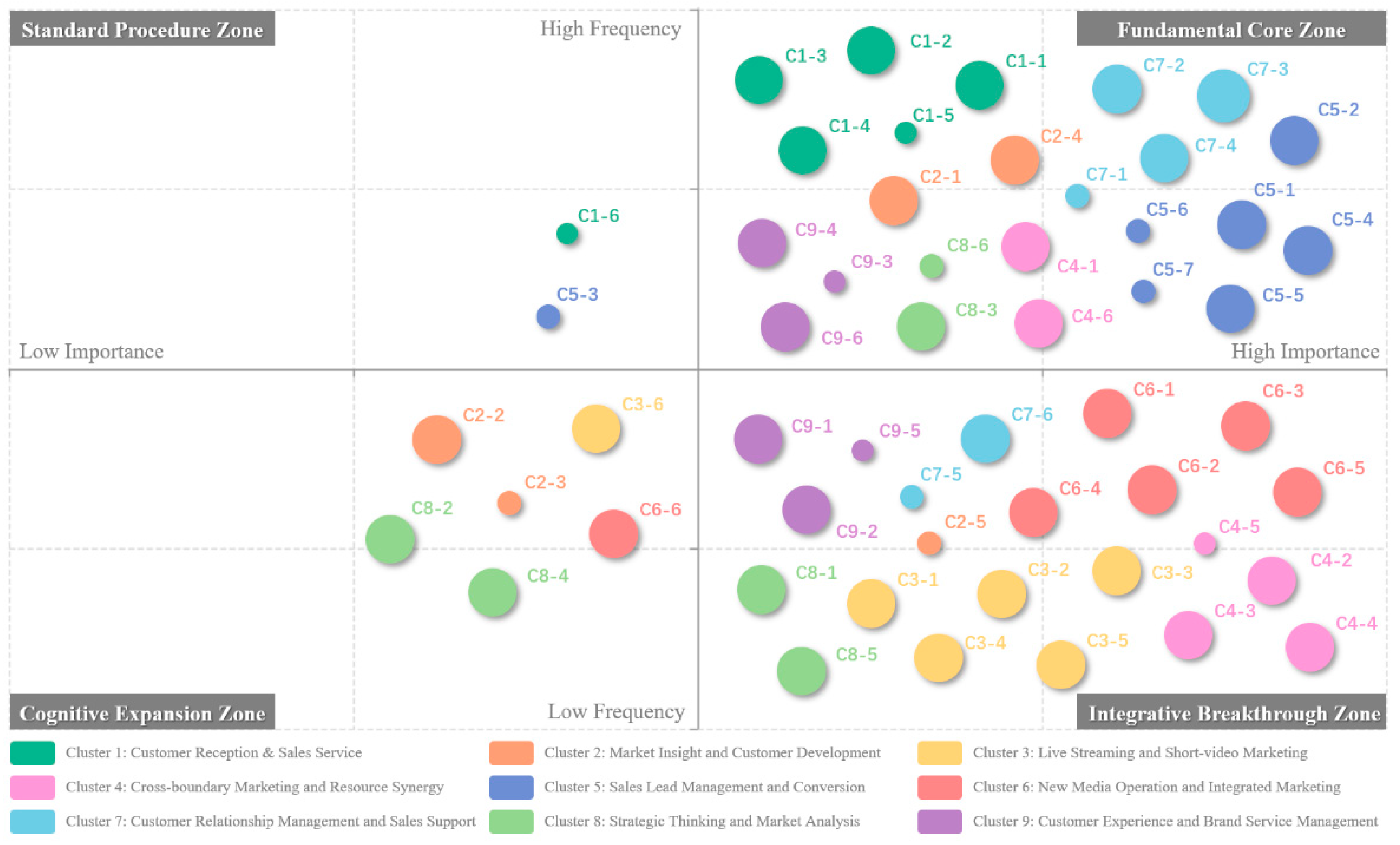
The previously mentioned nine competency clusters collectively constitute the competency framework for NEV marketing positions based on recruitment big data. On this basis, this study further defined the key attributes of each competency through expert consensus and developed a comprehensive job competency map. As shown in
Table 3, this competency map is evaluated from three dimensions: “operational frequency”, “importance level”, and “mastery difficulty”, providing significant references for identifying key content and setting teaching priorities in NEV talent cultivation.
(1) Quadrant I (Fundamental Core Zone): This quadrant contains competencies with high operational frequency and high importance, representing the core professional capabilities and performance determinants of sales positions. These competencies span the entire sales process: from customer engagement, needs identification, product presentation, and deal conversion to relationship maintenance and demonstrate inherent commonalities across both ICE and NEVs.
(2) Quadrant II (Standard Procedure Zone): This quadrant comprises competencies with high operational frequency but relatively low importance, typically characterized by a high degree of standardization, repetitiveness, and substitutability. Although these competencies do not directly generate core value, they serve as essential support for ensuring smooth business operations and maintaining a professional corporate image.
(3) Quadrant III (Cognitive Expansion Zone): This quadrant includes competencies with low operational frequency and low importance. Although these abilities do not directly contribute to short-term sales performance, they play a crucial role in broadening strategic vision and enhancing long-term development potential. Representative competencies include market trend analysis, strategic goal formulation, and digital marketing planning. While their immediate contribution to performance outcomes is limited, these competencies expand practitioners’ cognitive depth and professional breadth, serving as value-added capabilities that drive both role evolution and individual career growth.
(4) Quadrant IV (Integrative Competency Zone): This quadrant focuses on competencies with low operational frequency but high importance, serving as a critical domain for business breakthroughs. The competency structure within this quadrant can be summarized along two key orientations: the digital orientation, which involves utilizing digital tools for content creation, user engagement, and marketing analytics; and the ecosystem orientation, which emphasizes cross-boundary integration and ecosystem expansion capabilities to extend the service boundary of “vehicle life” and create new value-added business opportunities. These orientations constitute the core competency matrix that differentiates NEV sales positions from traditional sales positions (see
Figure 4).
5. Discussion
To address the competency challenges posed by the digital and intelligent transformation of the NEV industry, this study adopts a mixed methodological approach that integrates LDA topic modeling of large-scale job postings with a structured expert consensus procedure based on the NGT. Through this approach, we develop and validate a competency model comprising nine thematic clusters: customer reception and sales service, customer insight and market development, live streaming and short-video marketing, cross-boundary marketing and resource synergy, sales lead management and conversion, digital media operation and integrated marketing, customer relationship management and sales support, strategic thinking and market analysis, customer experience and brand service management. The model not only deepens the understanding of traditional core competencies such as customer reception and sales service, Customer Relationship Management and Sales Support, but also highlights the growing importance of emerging dimensions including live-streaming and short-video marketing, digital media operation, and ecosystem-oriented resource collaboration. Furthermore, through multi-dimensional evaluations (frequency, importance, difficulty), this study constructs a four-quadrant matrix, providing actionable guidance for curriculum design in vocational education and corporate training. Drawing on these findings, the following discussion will address the theoretical and practical implications through the lens of relevant literature, as well as the study’s limitations and promising avenues for future work.
5.1. Interpretation of Key Findings and Theoretical Implications
Our findings indicate a shift in the competency requirements of NEV marketing positions, extending beyond the traditional skill structure associated with ICE vehicle sales. This transformation not only enriches the understanding of conventional core competencies such as customer reception, sales service, customer relationship management (CRM), and sales support, but also highlights a set of emerging capability domains, including live-streaming and short-video marketing, digital media operations, and ecosystem-oriented resource collaboration.
Compared with existing research on traditional automobile sales models [
38,
39,
40], the competencies represented by Cluster 3 (Live-Streaming and Short-Video Marketing) and Cluster 6 (New Media Operation and Integrated Marketing) constitute new dimensions. Although prior studies focusing on NEV-related competency requirements (citations needed) have generally emphasized the importance of digital skills, they have not specified their internal structure. In contrast, this study explicitly identifies these competencies as including Digital Content Creation, Live-Streaming Planning and On-site Execution, and Fan Community Relationship and Engagement Management, which collectively form the core competitive capabilities for contemporary user acquisition and brand building. This finding corroborates the central proposition of digital transformation theory, namely that marketing professionals must master competencies related to content creation, platform algorithms, and data-driven optimization [
41,
42]. More importantly, our research not only supports this proposition but also anchors these abstract requirements within the specific context of NEV marketing, clarifying the concrete forms of its key competencies.
Moreover, the emergence of Cluster 4 (Cross-boundary Marketing and Resource Synergy) highlights a strategic expansion of the sales role. NEVs are not merely products, but critical nodes in the networks of mobility services, energy services, and digital ecosystems. This requires sales to possess the ability to identify cooperation opportunities, integrate external resources, and create value beyond the vehicle itself. This finding echoes the theories of ecosystem competition and open innovation [
27,
28,
29], indicating that NEV marketers need to act as a “boundary spanner” who connects the organization with external partners to co-create value [
43,
44].
Finally, the four-quadrant matrix provides a sophisticated lens for understanding the structure of these competencies. Quadrant I (Fundamental Core Zone) encompasses core competencies with high frequency and high importance, such as customer demand analysis, potential customer identification, customer reception, as well as team collaboration and service awareness. These competencies form the foundation of the automotive sales process, and their content aligns closely with the requirements of traditional ICE vehicle sales roles. This result supports previous studies that have identified similar core competencies in automobile sales [
38,
39,
40,
45]. It indicates that despite the technological paradigm shift in the industry, the customer-centric sales process and its corresponding skill requirements continue to retain a stable foundational value. However, for NEV marketing positions, mastering these basic competencies only represents the entry requirement for job competency. The key finding of the study is that the essential difference between NEV marketing and traditional ICE vehicle sales is not merely reflected in the update of product technical knowledge such as three-electric systems. Rather, the deeper distinction arises from transformations in the marketing model and value creation logic, which is prominently reflected in the competency elements of Quadrant IV (Integrative Competency Zone). Although the competencies in this quadrant, such as digital content creation and ecological resource collaboration, are triggered relatively infrequently in daily work, they often play a decisive role in critical business opportunities (e.g., new product launches and ecological cooperation expansion). These competencies drive discontinuous business breakthroughs and redefine the competency structure of NEV marketing professionals.
Ultimately, this study advances three key theoretical contributions as follows. First, it develops a comprehensive, data-driven competency framework for NEV sales and marketing positions in the era of intelligent mobility, thereby extending competency theory into an emerging and critical industrial field. Second, it proposes a competency-modeling approach that integrates big data analytics with expert consensus, offering a replicable and rigorous research pathway that addresses the limitations of purely qualitative or traditional methodologies. Third, it theoretically redefines the identity of automotive sales practitioners in the digital age, positioning them as core actors in user experience co-creation and ecological value integration rather than mere product sellers, which enriches the theoretical discourse on the evolution of sales roles.
5.2. Practical Implications
The competency framework and four-quadrant analytical model provide actionable guidance for strategic human resource development and VET. For Corporate Talent Management, the framework can serve as a benchmark for managing the full employee life cycle, informing talent selection based on competency maps, the design and implementation of targeted training programs, and the development of performance management. For VET, the four-quadrant model provides a theoretical foundation and structured instrument for curriculum design, and the selection of teaching strategies, which helps promote the precise alignment between vocational education offerings and industry competency requirements.
Quadrant I (Fundamental Core Zone) serves as the cornerstone of the curriculum and is recommended to account for 40–50% of total instructional time. A “tiered training + task-oriented” approach is proposed: for low-difficulty skills, SOPs and situational drills are prioritized, and for high-difficulty skills, deliberate practice with multiple rounds of feedback and intensive training is advocated. Assessment should be checkpoint-based, verifying competence against quantitative metrics (e.g., ≥80% success rate in objection-handling) to ensure competency development translates into measurable performance improvements.
Quadrant II (Standard Procedure Zone) competencies, while less critical, are vital for operational fluency. Training should emphasize accuracy and efficiency via micro-learning formats (e.g., 5 min SOP videos), visual guides, and checklists. Assessment should focus on speed and precision in executing standardized tasks.
Quadrant III (Cognitive Expansion Zone) competencies aim to build strategic vision for high-potential personnel. A modular, case-based approach is recommended, using expert lectures and strategic workshops to convert theoretical knowledge into actionable cognitive frameworks for innovation and long-term growth.
Quadrant IV (Integrative Competency Zone) contains the competencies that most distinctly differentiate NEV from traditional sales roles. Instruction must transcend conventional course structures and adopt a “capstone project–driven” approach, where learners tackle integrative, real-world projects (e.g., designing a full brand experience campaign with ecosystem partners). Competency certification should be directly tied to demonstrable outcomes, such as generating a target number of qualified leads from a live-streaming event or defending a viable cross-industry partnership proposal. This structured approach enables VET institutions to efficiently align their programs with industry needs, creating a seamless “classroom-to-career” pipeline and cultivating professionals who are both digital conversion experts and innovative ecosystem collaborators.
5.3. Limitations and Future Research
First, this study primarily collects data from major Chinese cities, a design choice that enhances the contextual relevance of the findings within mainstream, relatively mature market environments. Accordingly, the proposed competency framework should be interpreted as a context-specific standard, grounded in the institutional settings, industrial structure, and market dynamics typical of China’s leading urban regions. While this contextual embeddedness strengthens practical applicability, it also implies limitations in external generalizability. The findings may not be directly transferable to rural markets at earlier stages of industrial development, nor to overseas regions characterized by different regulatory regimes, consumer preferences, and industrial ecosystems. To extend the framework’s external validity, future research may adopt a structured cross-cultural validation framework. Such a framework could proceed in two steps: first, examining the structural robustness of the competency dimensions across diverse national or regional contexts; and second, analyzing contextual differentiation to identify how the content and salience of specific competency elements adapt to variations in industrial maturity and market environments. Distinguishing between generalizable and highly context-dependent competencies would not only refine the theoretical boundaries of the model but also provide more actionable guidance for multinational firms developing global talent strategies.
Second, the competency framework is developed based on cross-sectional data, which enables the study to accurately capture the immediate talent requirements of the NEV industry at the time of data collection. However, the sector is undergoing rapid technological transformation, particularly in areas such as autonomous driving and vehicle-to-everything (V2X) connectivity. As these technologies mature, competency requirements are likely to evolve accordingly. Consequently, periodic re-validation of the framework is necessary to maintain its relevance. Future research should prioritize longitudinal designs to empirically track how the frequency, importance, and difficulty of the identified competency clusters shift in response to technological breakthroughs, thereby ensuring that vocational education and training guidance remains aligned with the industry’s dynamic trajectory.
Third, this study constructs the competency framework through an extensive analysis of job descriptions, which primarily reflect organizational-level expectations and normative role definitions. While this approach effectively captures general entry criteria and responsibility boundaries for NEV sales positions, it provides limited insight into the deeper, implicit attributes that underpin sustained individual excellence, such as motivations, value orientations, and cognitive patterns emphasized in the competency iceberg model. To address this limitation, future research may focus on individual-level investigations of exemplary performers. Building on the explicit framework established in this study, qualitative methods such as in-depth interviews can be employed to uncover tacit knowledge and distinctive traits of high-performing marketing professionals, followed by cross-methodological validation and theoretical integration. This line of inquiry would contribute to a more comprehensive competency model and offer richer guidance for cultivating future-oriented senior marketing talent.
Finally, although the present study identifies a structured set of competency elements, the empirical relationship between these competencies and actual job performance has yet to be formally validated. Establishing such links represents a critical next step for demonstrating the framework’s practical utility. Future research may operationalize the identified competencies into observable behavioral indicators and examine their associations with key performance indicators (KPIs), such as sales outcomes, project execution quality, or customer satisfaction. Employing multivariate analytical techniques, including hierarchical regression or structural equation modeling while controlling for relevant covariates, would allow for robust tests of predictive validity. Such empirical validation is essential for transforming the framework from a conceptual model into an evidence-based instrument applicable to recruitment, training, and performance evaluation practices.