Research on the Energy-Efficient Non-Uniform Clustering LWSN Routing Protocol Based on Improved PSO for ARTFMR

Abstract
1. Introduction
2. Wireless Sensor Network System Model
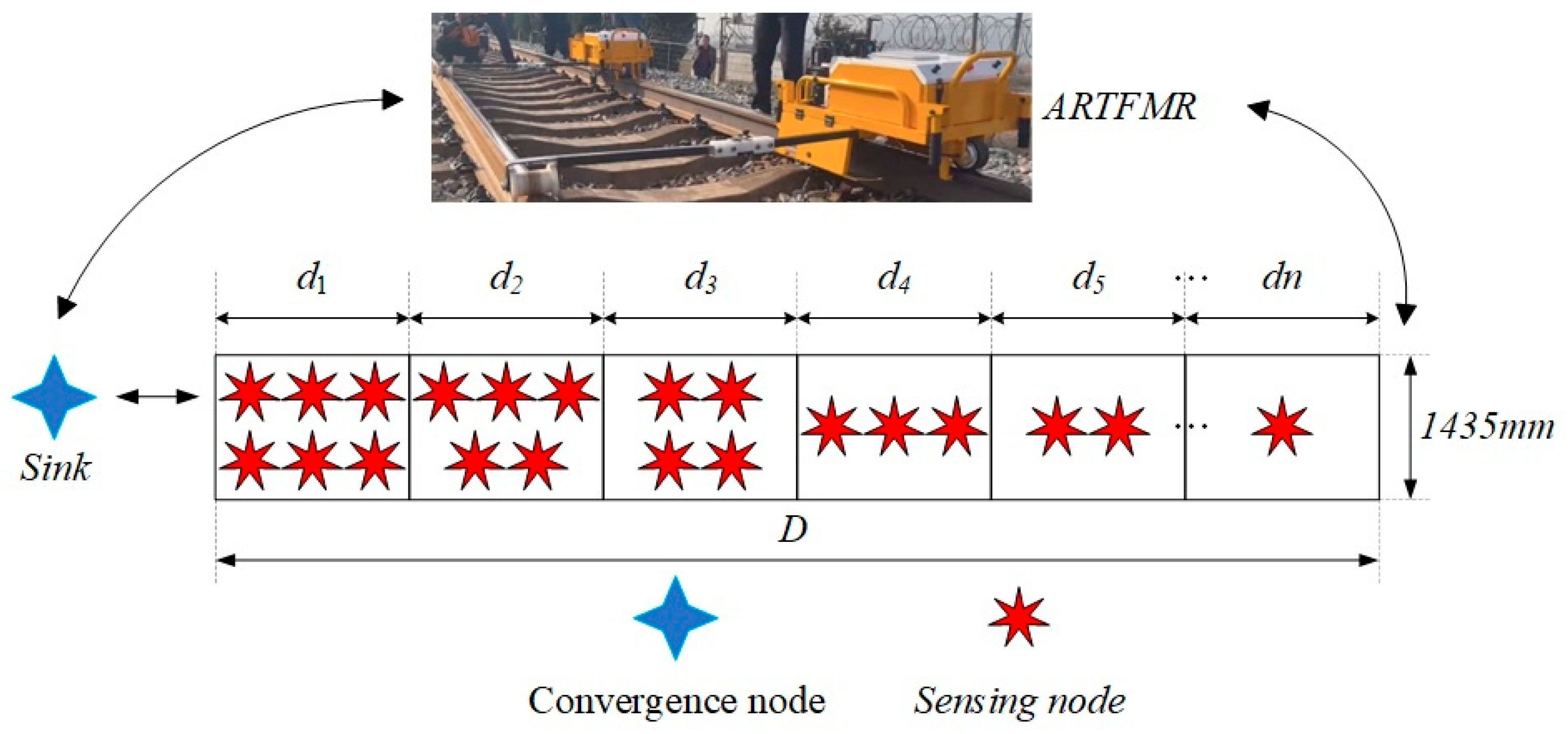
2.1. Network Model
- (1)
- Base stations are assumed to possess unlimited communication and computational capabilities, whereas sensor nodes operate under constrained resources [33].
- (2)
- Sensor nodes are capable of autonomously adjusting their wireless transmission power [34].
- (3)
- Wireless communication links are assumed to be symmetric.
2.2. Energy Consumption Model
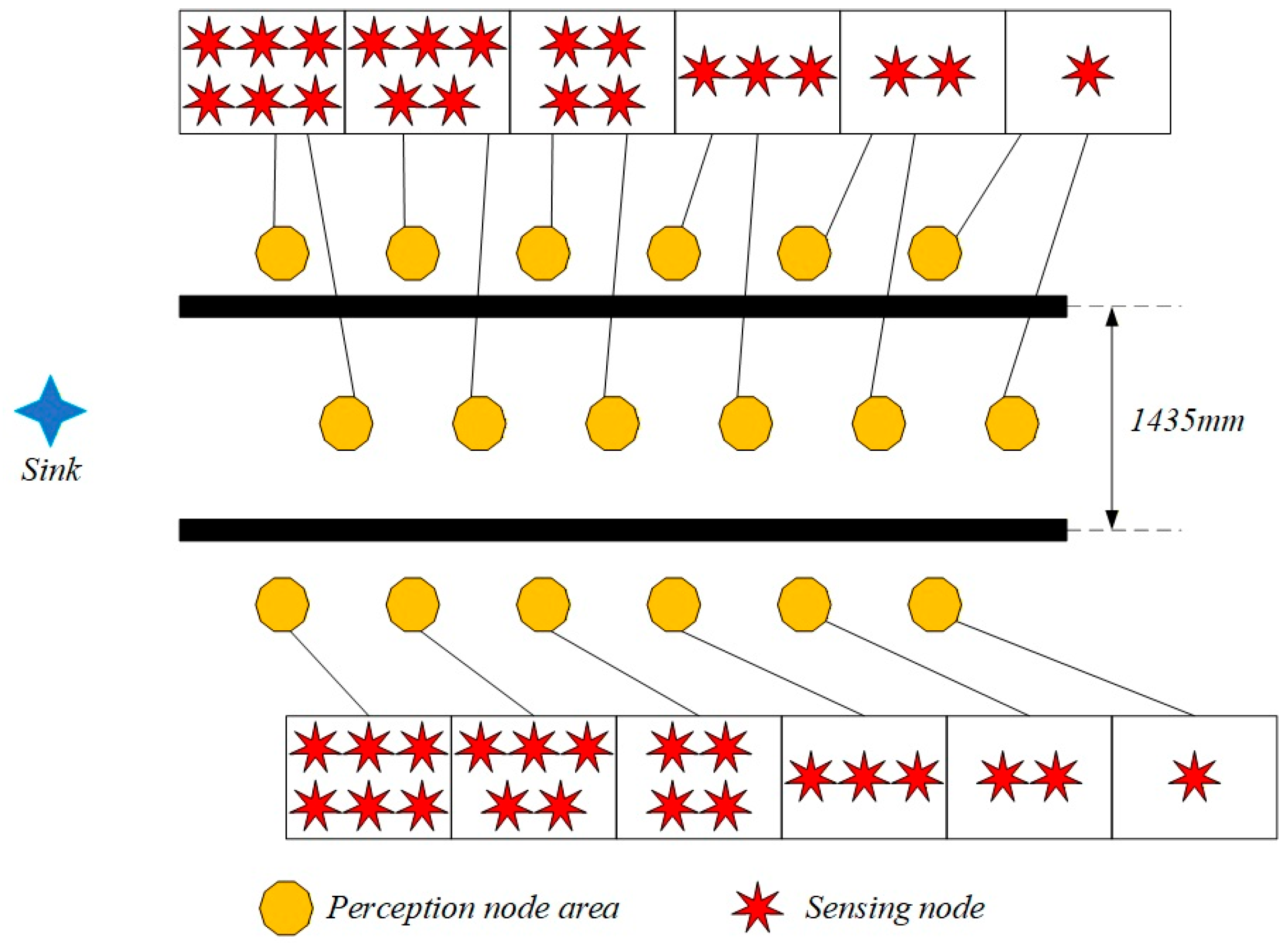
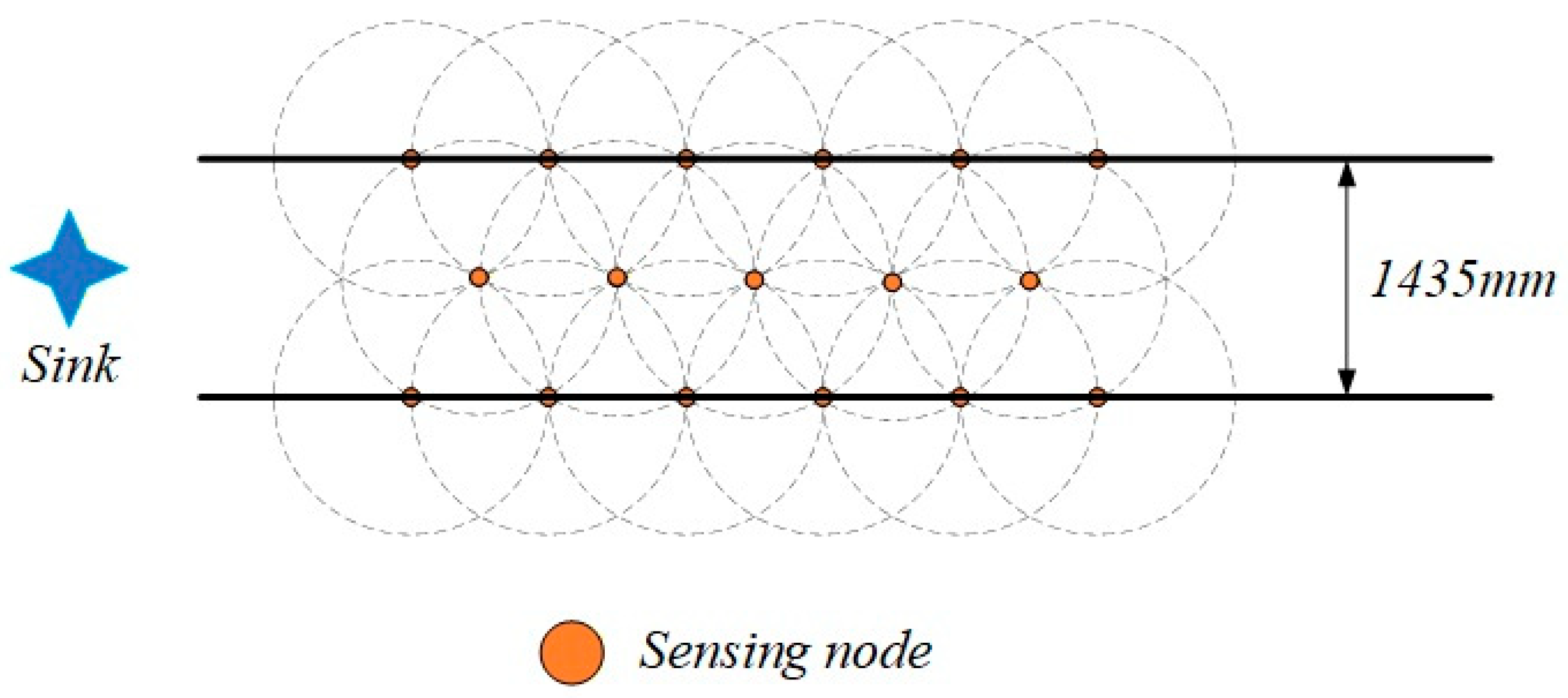
2.3. Network Node Model
3. LEACH Routing Protocol Based on Improved PSO Algorithm
3.1. Particle Swarm Optimization Algorithm
3.2. Energy-Balanced Non-Uniform Clustering
3.3. PSO-Optimized Cluster Head Election
3.4. Dispatch Improvement
4. Experimental Simulation and Analysis
4.1. Simulation Parameter Settings
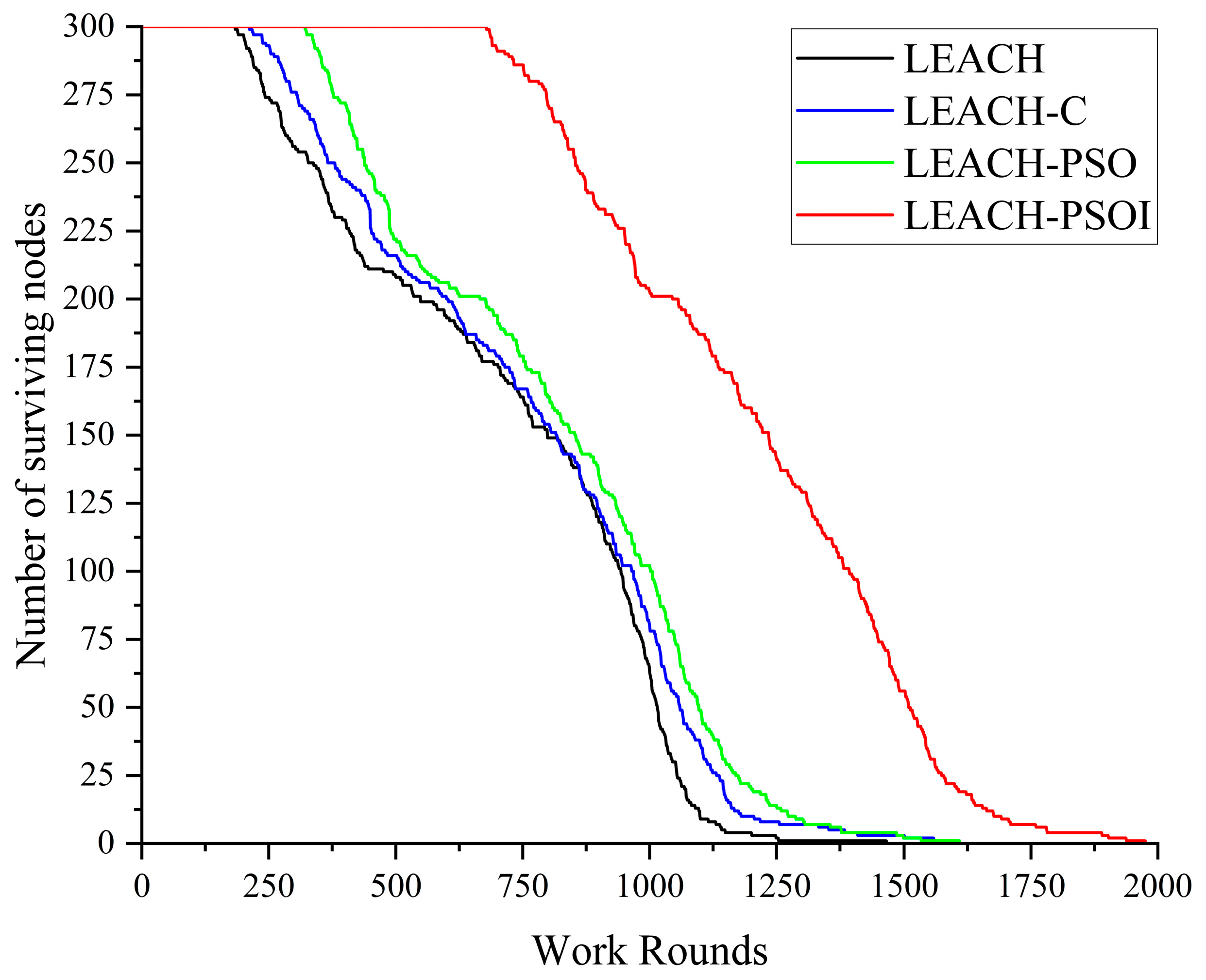
4.2. Network Lifespan
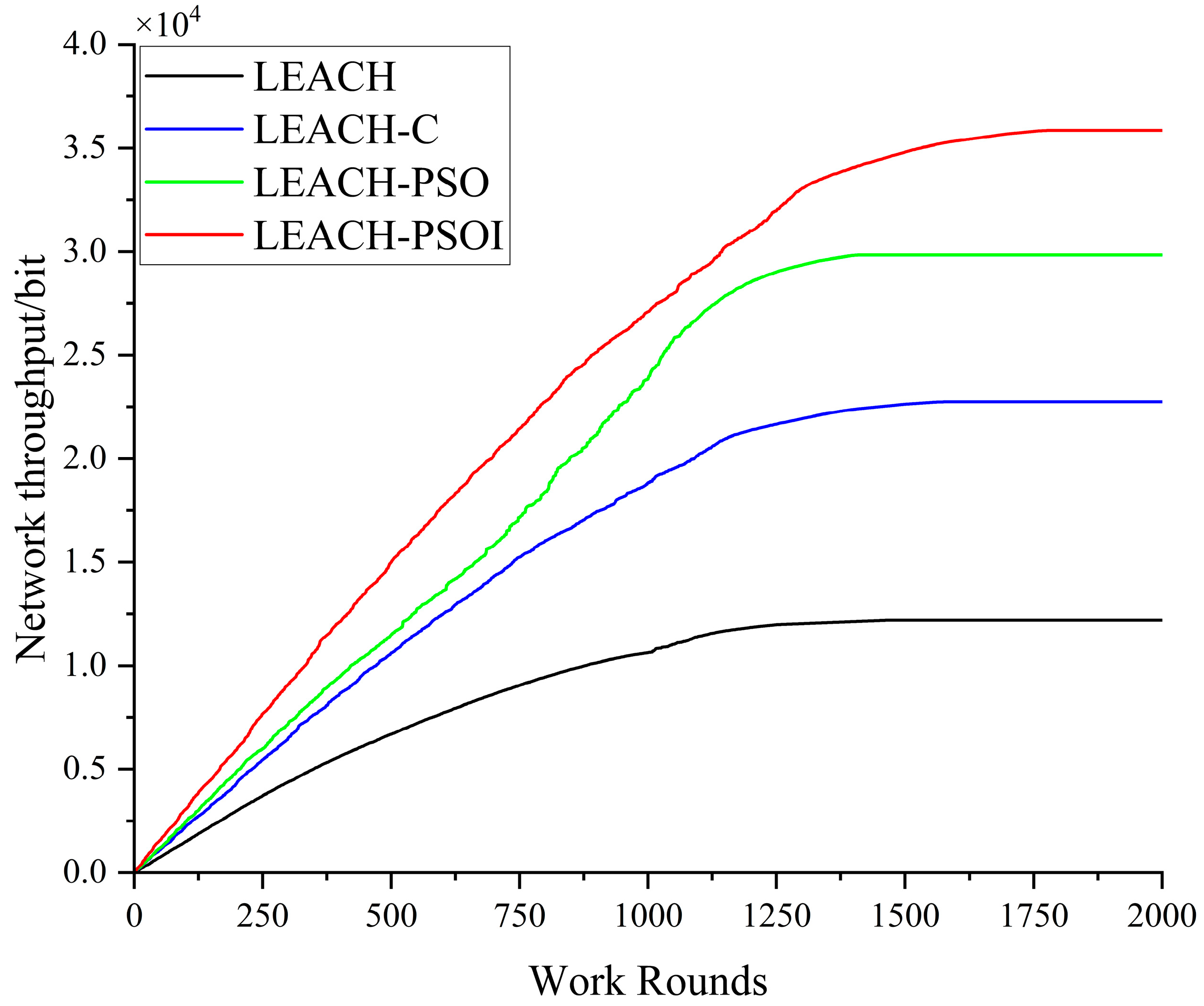
4.3. Network Throughput
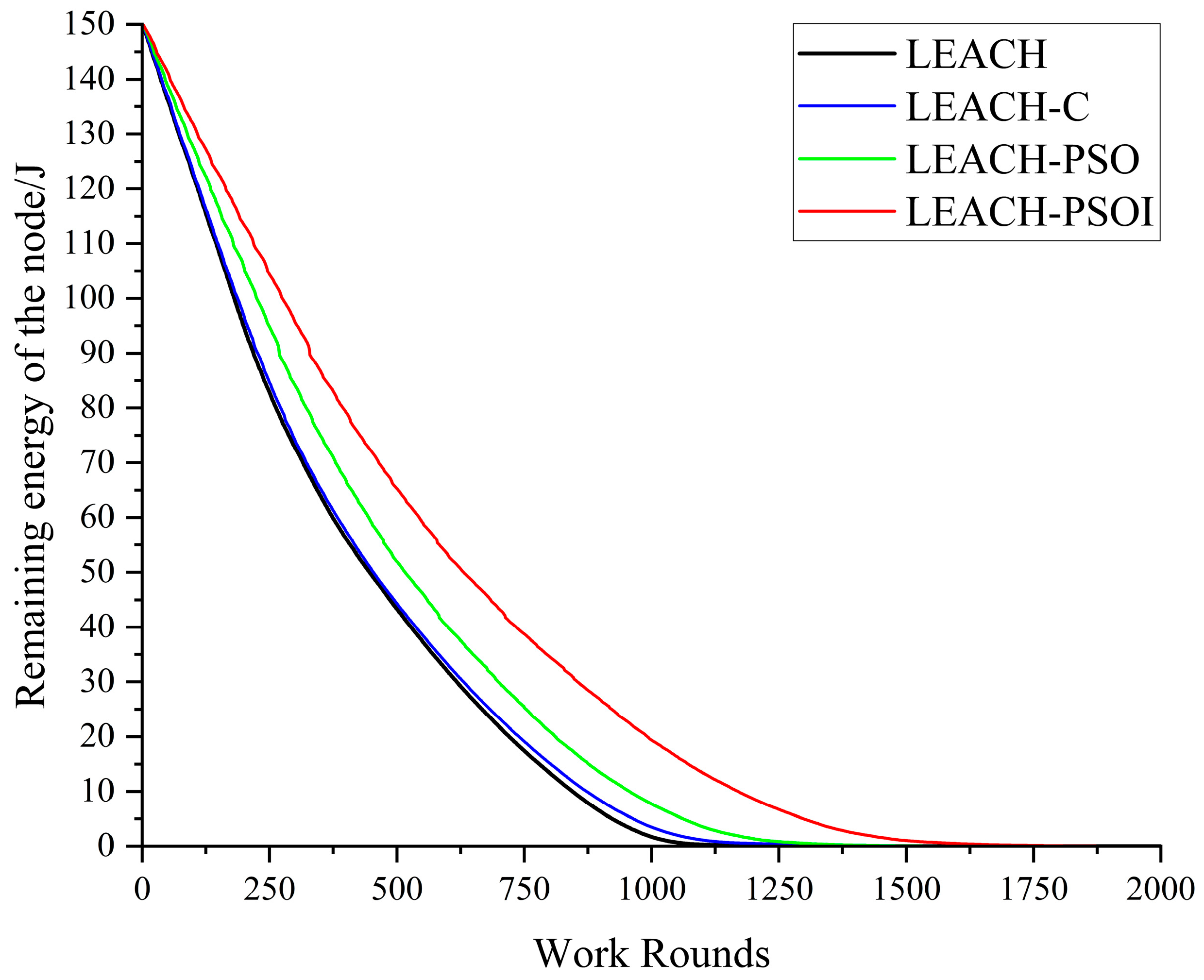
4.4. Energy Consumption Efficiency
5. Conclusions
Author Contributions
Funding
Data Availability Statement
Acknowledgments
Conflicts of Interest
References
- Zhao, X.; Cui, Y.; Guo, Z.; Liu, M.; Li, X.; Wen, T. Energy-efficient clustering routing protocol for WSNs based on virtual force. J. Softw. 2022, 33, 622–640. [Google Scholar]
- Hou, J.; Qiao, J.; Han, X. Energy-Saving Clustering Routing Protocol for Wireless Sensor Networks Using Fuzzy Inference. IEEE Sens. J. 2022, 22, 2845–2857. [Google Scholar] [CrossRef]
- George, A.M.; Kulkarni, S.Y.; Kurian, C.P. Gaussian Regression Models for Evaluation of Network Lifetime and Cluster-Head Selection in Wireless Sensor Devices. IEEE Access 2022, 10, 20875–20888. [Google Scholar] [CrossRef]
- Ajith Kumar, S.A.; Ovsthus, K.; Kristensen, L.M. An Industrial Perspective on Wireless Sensor Networks—A Survey of Requirements, Protocols, and Challenges. IEEE Commun. Surv. Tutor. 2014, 16, 1391–1412. [Google Scholar] [CrossRef]
- Hu, C.; Yuan, S. Adaptive Energy-efficient and Energy Consumption Balanced Data Collection Method for Mine WSN. J. Beijing Univ. Posts Telecommun. 2018, 41, 86–91. [Google Scholar]
- Ren, J.; Zhang, Y.; Zhang, K.; Liu, A.; Chen, J.; Shen, X.S. Lifetime and Energy Hole Evolution Analysis in Data-Gathering Wireless Sensor Networks. IEEE Trans. Ind. Inform. 2016, 12, 788–800. [Google Scholar] [CrossRef]
- Sun, A.; Li, S.; Zhang, Y. PSO-Optimized Fuzzy C-Means-Based Clustering Routing Algorithm for WSN. J. Commun. 2021, 42, 91–99. [Google Scholar]
- Yu, X.; Liu, Q.; Li, X.; Zhang, K.; Xiao, R. BP Neural Network WSN Data Fusion Algorithm Based on Improved Ant Colony. J. Beijing Univ. Posts Telecommun. 2018, 41, 91–96. [Google Scholar]
- Lv, X.; Li, J.; Shi, T.; Jia, X. Topology analysis based on linear wireless sensor networks in monitoring of high-speed railways. In Proceedings of the 2016 Chinese Control and Decision Conference (CCDC), Yinchuan, China, 28–30 May 2016; pp. 1797–1802. [Google Scholar]
- Fu, J.; Zhang, Z.; Liu, Y. Research and Simulation of a New Energy-Efficient Coverage Algorithm RTST for Wireless Sensor Networks in Rail Transit. J. China Railw. Soc. 2014, 36, 49–55. [Google Scholar]
- Khalil, E.A.; Ozdemir, S. Reliable and energy efficient topology control in probabilistic Wireless Sensor Networks via multi-objective optimization. J. Supercomput. 2017, 73, 2632–2656. [Google Scholar] [CrossRef]
- Abidi, W.; Ezzedine, T. Effective clustering protocol based on network division for heterogeneous wireless sensor networks. Computing 2020, 102, 413–425. [Google Scholar] [CrossRef]
- Yu, D.; Xia, Y.; Li, L.; Zhai, D.H. Event-triggered distributed state estimation over wireless sensor networks. Automatica 2020, 118, 109039. [Google Scholar] [CrossRef]
- Zhu, B.; Bedeer, E.; Nguyen, H.H.; Barton, R.; Henry, J. UAV Trajectory Planning in Wireless Sensor Networks for Energy Consumption Minimization by Deep Reinforcement Learning. IEEE Trans. Veh. Technol. 2021, 70, 9540–9554. [Google Scholar] [CrossRef]
- Ahmed, S.; Gupta, S.; Suri, A.; Sharma, S. Adaptive energy efficient fuzzy: An adaptive and energy efficient fuzzy clustering algorithm for wireless sensor network-based landslide detection system. IET Netw. 2021, 10, 1–12. [Google Scholar] [CrossRef]
- Rathee, M.; Kumar, S.; Gandomi, A.H.; Dilip, K.; Balusamy, B.; Patan, R. Ant Colony Optimization Based Quality of Service Aware Energy Balancing Secure Routing Algorithm for Wireless Sensor Networks. IEEE Trans. Eng. Manag. 2021, 68, 170–182. [Google Scholar] [CrossRef]
- Poonguzhali, P.K.; Ananthamoorthy, N.P. Improved energy efficient WSN using ACO based HSA for optimal cluster head selection. Peer-to-Peer Netw. Appl. 2020, 13, 1102–1108. [Google Scholar] [CrossRef]
- Pavani, M.; Trinatha Rao, P. Adaptive PSO with optimised firefly algorithms for secure cluster-based routing in wireless sensor networks. IET Wirel. Sens. Syst. 2019, 9, 274–283. [Google Scholar] [CrossRef]
- Rajeswari, K.; Neduncheliyan, S. Genetic algorithm based fault tolerant clustering in wireless sensor network. IET Commun. 2017, 11, 1927–1932. [Google Scholar] [CrossRef]
- Shafiabadi, M.H.; Ghafi, A.K.; Manshady, D.D.; Nouri, N. New Method to Improve Energy Savings in Wireless Sensor Networks by Using SOM Neural Network. J. Serv. Sci. Res. 2019, 11, 1–16. [Google Scholar] [CrossRef]
- Yao, Y.; Xie, D.; Li, Y.; Wang, C.; Li, Y. Routing Protocol for Wireless Sensor Networks Based on Archimedes Optimization Algorithm. IEEE Sens. J. 2022, 22, 15561–15573. [Google Scholar] [CrossRef]
- Qi, H.; Lin, C.; Gao, Y.; Xiong, W.; Jiao, Y. An energy-efficient non-uniform clustering routing protocol based on improved shuffled frog leaping algorithm for wireless sensor networks. IET Commun. 2021, 15, 374–383. [Google Scholar]
- Panchal, A.; Singh, R.K. EEHCHR: Energy Efficient Hybrid Clustering and Hierarchical Routing for Wireless Sensor Networks. Ad Hoc Netw. 2021, 123, 102692. [Google Scholar] [CrossRef]
- Singh, S.K.; Kumar, P.; Singh, J.P. A Survey on Successors of LEACH Protocol. IEEE Access 2017, 5, 4298–4328. [Google Scholar] [CrossRef]
- Gou, P.; Li, F.; Li, Z.; Jia, X. Improved LEACH protocol based on efficient clustering in wireless sensor networks. J. Comput. Methods Sci. Eng. 2019, 19, 827–838. [Google Scholar] [CrossRef]
- Li, X.; Hu, X.; Zhang, R.; Yang, L. Routing Protocol Design for Underwater Optical Wireless Sensor Networks: A Multiagent Reinforcement Learning Approach. IEEE Internet Things J. 2020, 7, 9805–9818. [Google Scholar] [CrossRef]
- Lahane, S.R.; Jariwala, K.N. A Novel Cross-Layer Cross-Domain Routing Model and It’s Optimization for Cluster-Based Dense WSN. Wirel. Pers. Commun. 2021, 118, 2765–2784. [Google Scholar] [CrossRef]
- Martinaa, M.; Santhi, B.; Raghunathan, A. An energy-efficient and novel populated cluster aware routing protocol (PCRP) for wireless sensor networks (WSN). J. Intell. Fuzzy Syst. 2020, 39, 8529–8542. [Google Scholar] [CrossRef]
- Ali, S.; Ashraf, A.; Qaisar, S.B.; Afridi, M.K.; Saeed, H.; Rashid, S.; Felemban, E.A.; Sheikh, A.A. SimpliMote: A Wireless Sensor Network Monitoring Platform for Oil and Gas Pipelines. IEEE Syst. J. 2018, 12, 778–789. [Google Scholar] [CrossRef]
- Kong, P.-Y.; Wang, J.-C.; Tseng, K.-S.; Yang, Y.-C.; Wang, Y.-C.; Jiang, J.-A. An adaptive packets hopping mechanism for transmission line monitoring systems with a long chain topology. Int. J. Electr. Power Energy Syst. 2021, 124, 106394. [Google Scholar] [CrossRef]
- Duan, J. Research on Routing Protocol for Linear Wireless Sensor Networks along Railway Lines. Railw. Stand. Des. 2019, 63, 158–164. [Google Scholar]
- Lv, A.; Li, C.; Xie, J.; Duan, B. Non-uniform Optimization Clustering Algorithm for Railway Monitoring WSN Network. J. China Railw. Soc. 2019, 41, 72–78. [Google Scholar]
- Li, C.; Wang, X.; Xie, J.; Lv, A. Railway Monitoring Linear Wireless Sensor Network Routing Algorithm Based on Improved PSO. J. Commun. 2022, 43, 155–165. [Google Scholar]
- Maheshwari, P.; Sharma, A.K.; Verma, K. Energy efficient cluster based routing protocol for WSN using butterfly optimization algorithm and ant colony optimization. Ad Hoc Netw. 2021, 110, 102317. [Google Scholar] [CrossRef]
- Zhao, X.; Ren, S.; Zhai, Y.; Quan, H.; Yang, T. Routing Protocol for Heterogeneous Wireless Sensor Networks Based on Simulated Annealing Algorithm and Improved Grey Wolf Optimizer. J. Internet Things 2021, 5, 97–106. [Google Scholar]
- Duan, J.; Shi, T.; Lv, X.; Li, Z. Optimal node deployment scheme for WSN-based railway environment monitoring system. In Proceedings of the 2016 Chinese Control and Decision Conference (CCDC), Yinchuan, China, 28–30 May 2016; pp. 6529–6534. [Google Scholar]
- Yang, J.; Liu, F.; Cao, J. Greedy discrete particle swarm optimization based routing protocol for cluster-based wireless sensor networks. J. Ambient. Intell. Humaniz. Comput. 2024, 15, 1277–1292. [Google Scholar] [CrossRef]
- Huynh, T.T.; Dinh-Duc, A.V.; Tran, C.H. Delay-constrained energy-efficient cluster-based multi-hop routing in wireless sensor networks. J. Commun. Netw. 2016, 18, 580–588. [Google Scholar] [CrossRef]
- Azharuddin, M.; Jana, P.K. Particle swarm optimization for maximizing lifetime of wireless sensor networks. Comput. Electr. Eng. 2016, 51, 26–42. [Google Scholar] [CrossRef]
- Daanoune, I.; Abdennaceur, B.; Ballouk, A. A comprehensive survey on LEACH-based clustering routing protocols in Wireless Sensor Networks. Ad Hoc Netw. 2021, 114, 102409. [Google Scholar] [CrossRef]
- Rodríguez, A.; Del-Valle-Soto, C.; Velázquez, R. Energy-Efficient Clustering Routing Protocol for Wireless Sensor Networks Based on Yellow Saddle Goatfish Algorithm. Mathematics 2020, 8, 1515. [Google Scholar] [CrossRef]
- Wu, X.; Zhang, C.; Zhang, R.; Sun, Y. Clustering Routing Protocol Based on Improved Particle Swarm Optimization Algorithm in WSN. J. Commun. 2019, 40, 114–123. [Google Scholar]



| Parameter Symbol | Parameter Description | Value Assignment |
|---|---|---|
| Initial energy | ||
| data | ||
| Unit energy consumption | ||
| Power consumption coefficient | ||
| l | Packet size | 1024 |
| Communication distance threshold | 87 m | |
| D | Length of railway track | 180 m |
| N | Total nodes | 300 |
| Inertial weight | 0.4~0.9 | |
| Cognitive parameters | 1.5~2.0 | |
| Social parameters | 1.8~2.2 | |
| Particle swarm size | 30 | |
| Maximum number of iterations | 50 | |
| p | Expected proportion of cluster heads | 0.05 |
| r | Number of running rounds | 2000 |
| Routing | FND | HND | AND |
|---|---|---|---|
| LEACH | 184 | 799 | 1466 |
| LEACH-C | 212 | 816 | 1577 |
| LEACH-PSO | 322 | 853 | 1610 |
| LEACH-PSOI | 679 | 1235 | 1976 |
Disclaimer/Publisher’s Note: The statements, opinions and data contained in all publications are solely those of the individual author(s) and contributor(s) and not of MDPI and/or the editor(s). MDPI and/or the editor(s) disclaim responsibility for any injury to people or property resulting from any ideas, methods, instructions or products referred to in the content. |
© 2025 by the authors. Published by MDPI on behalf of the World Electric Vehicle Association. Licensee MDPI, Basel, Switzerland. This article is an open access article distributed under the terms and conditions of the Creative Commons Attribution (CC BY) license.
Share and Cite
Shen, Y.; Meng, J. Research on the Energy-Efficient Non-Uniform Clustering LWSN Routing Protocol Based on Improved PSO for ARTFMR. World Electr. Veh. J. 2026, 17, 17. https://doi.org/10.3390/wevj17010017
Shen Y, Meng J. Research on the Energy-Efficient Non-Uniform Clustering LWSN Routing Protocol Based on Improved PSO for ARTFMR. World Electric Vehicle Journal. 2026; 17(1):17. https://doi.org/10.3390/wevj17010017
Chicago/Turabian StyleShen, Yanni, and Jianjun Meng. 2026. "Research on the Energy-Efficient Non-Uniform Clustering LWSN Routing Protocol Based on Improved PSO for ARTFMR" World Electric Vehicle Journal 17, no. 1: 17. https://doi.org/10.3390/wevj17010017
APA StyleShen, Y., & Meng, J. (2026). Research on the Energy-Efficient Non-Uniform Clustering LWSN Routing Protocol Based on Improved PSO for ARTFMR. World Electric Vehicle Journal, 17(1), 17. https://doi.org/10.3390/wevj17010017