Article

A Hybrid Lagrangian Relaxation and Adaptive Sheep Flock Optimization to Assess the Impact of EV Penetration on Cost

by
Sridevi Panda
1,
Sumathi Narra
1 and
Surender Reddy Salkuti
2,*
1
Department of Electrical and Electronics Engineering, University College of Engineering Kakinada, JNTU Kakinada, Nagamallithota, Kakinada 533003, India
2
Department of Global Railways, Woosong University, Daejeon 34606, Republic of Korea
*
Author to whom correspondence should be addressed.
World Electr. Veh. J. 2026, 17(1), 11; https://doi.org/10.3390/wevj17010011
Submission received: 1 November 2025 / Revised: 14 December 2025 / Accepted: 18 December 2025 / Published: 24 December 2025
(This article belongs to the Section Vehicle Management)

Abstract

The increasing penetration of electric vehicle (EV) fast-charging stations (FCSs) into distribution networks and microgrids poses considerable operational challenges, including voltage deviations, increased power losses, and peak load stress. This work proposes a novel hybrid optimization framework that integrates Lagrangian relaxation (LR) with adaptive sheep flock optimization (ASFO) to address the resource scheduling issues when EVs are penetrated and their impact on net load demand, total cost. Besides the impact of EV uncertainty on energy exchange cost and operational costs, voltage profile deviations were also studied. LR is employed to decompose the original problem and manage complex operational constraints, while ASFO is employed to solve the relaxed subproblems by efficiently exploring the high-dimensional, non-convex solution space. The proposed method is tested on an IEEE 33-bus distribution system with integrated PV and BESS under 24 h dynamic load and renewable scenarios. Results establish that the hybrid LR-ASFO method significantly outperforms conventional methods. Compared to standalone metaheuristics, the proposed framework reduces total cost by 5.6%, improves voltage profile deviations by 2.4%, and minimizes total operational cost by 4.3%. Furthermore, it safeguards constraint feasibility while avoiding premature convergence, thereby accomplishing better global optimality and system reliability.

1. Introduction

A microgrid (MG) is a localized group of electrical energy sources and loads that normally operate connected to the traditional centralized grid but can also disconnect and operate independently in island mode as technical or economic conditions dictate [1]. MGs improve energy resilience, reliability, and efficiency, particularly for critical loads or in areas where grid access is limited [2]. MGs typically assimilate various types of distributed energy resources (DERs), such as renewable energy sources (e.g., solar photovoltaic (PV) panels, wind turbines (WTs)); conventional generators (e.g., diesel generators, microturbines); battery energy storage systems (BESSs); flexible loads (e.g., controllable industrial or residential loads), as shown in Figure 1. Key characteristics of MGs comprise the ability to operate autonomously, capable of dynamically managing different energy sources and loads, and supporting the integration of clean and renewable energy sources [3]. MGs have developed as critical infrastructures for enhancing reliability and resilience by maintaining energy supply during main grid outages and disturbances [4]. In this context, penetration refers to the degree to which DERs such as PV systems, WTs, energy storage systems, and emerging loads like electric vehicles (EVs) are integrated into the MG’s generation and consumption profile [5]. A high degree of DER penetration implies that a substantial portion of the MG’s energy is sourced from renewables and distributed generation rather than centralized fossil-fuel-based plants [6]. Similarly, high EV penetration denotes a significant number of EVs interacting with the MG, either as charging loads or as energy storage units through vehicle-to-grid (V2G) technologies [7]. However, high levels of DER and EV integration introduce notable challenges [8].
The inherent intermittency and variability of renewable sources complicate real-time generation-load balancing [9]. Voltage and frequency stability may be compromised due to fluctuating renewable outputs and unpredictable EV charging patterns, while power quality can deteriorate due to increased harmonic distortions from DER inverters and fast EV chargers [10]. Additionally, localized demand peaks caused by EV fast-charging stations can stress distribution assets such as transformers and cables, potentially leading to thermal degradation, reduced asset life, and elevated maintenance costs [11]. Regardless of these challenges, with appropriate management, high penetration of DERs and EVs offers substantial benefits [12]. These include reductions in greenhouse gas emissions, lower operational costs through optimized local generation, and enhanced resilience against external disturbances. Furthermore, intelligently controlled DERs and EVs can support the grid by providing ancillary services such as frequency regulation and demand response [13]. The integration of fast-charging stations (FCSs) for EVs into distribution networks presents further technical and operational complexities. Fast chargers, with power ratings typically between 50 kW and 350 kW per port, can cause substantial voltage drops along distribution feeders, predominantly at buses distant from substations [14]. Uncoordinated deployment of FCS clusters may lead to voltage violations, negatively impacting sensitive equipment and power quality. Furthermore, distribution transformers, traditionally designed for expected load profiles, may become overloaded by the unforeseen and significant demands of fast charging, risking accelerated aging and failure [15]. Increased current flow linked with FCS operation heightens line losses (I2R losses), reducing the distribution system’s overall efficiency and raising operational costs [16].
Several studies have addressed the optimal scheduling of EV charging in various scenarios. In [17], an optimal scheduling framework was proposed for EV charging at a solar power-based charging station. The authors in [18] presented a techno-economic analysis of EV scheduling at a solar-based grid-tied charging station. In [19], optimal MG scheduling was proposed considering EV charging and a storage-integrated swapping station. A variable maximum charging power constraint was considered in the optimal EV charging scheduling in reference [20]. In [21], a charging/discharging scheduling algorithm was developed to ensure the economical and energy-efficient operation of a multi-EV charging station. The work in [22] focused on optimal charging schedule planning and economic analysis for electric bus charging stations. A stochastic-interval model for optimal scheduling of PV-assisted multi-mode charging stations was proposed in [23]. The authors in [24] considered real-time traffic conditions and travel distances for optimal scheduling of EV charging operations. In [25], the scheduling of mobile and stationary EV charging stations in a distribution system with stochastic loading was addressed. The authors in [26] proposed EV charging load forecasting and optimal scheduling based on travel behavior characteristics. Finally, optimized scheduling of EV charging in solar parking lots for local peak reduction under EV demand uncertainty was presented in [27].
Exact optimization techniques such as linear programming, mixed-integer linear programming, and dynamic programming face substantial challenges when applied to the integration of FCS in distribution networks. These methods struggle with nonlinearities arising from the complex, time-varying behaviors of fast chargers and become computationally expensive in high-dimensional problem spaces involving multiple charging stations. Additionally, they are often ill-equipped to handle uncertainties in EV charging patterns, renewable generation, and market prices, which necessitate robust scenario-based modeling. As a result, exact methods may fail to provide timely or high-quality solutions, highlighting the need for more flexible approaches capable of navigating large, non-convex solution spaces. Heuristic optimization techniques offer greater flexibility for tackling these complex planning problems. They are well-suited for handling nonlinearities, mixed-variable types, and system uncertainties. However, they typically converge to near-optimal rather than truly optimal solutions, risk premature convergence to local optima, and require careful parameter tuning. Their computational burden can also increase substantially as problem complexity grows, necessitating multiple independent runs to achieve reliable performance. As per the no-free lunch theorem stated in [28], there was no optimization technique better suited for all types of objective functions. Based on the type of objective function and the constraint functions, the algorithms behave differently. Metaheuristic algorithms, including GA, PSO [29], and ant colony optimization, further improve scalability and adaptability for large, dynamic, and uncertain optimization problems. They are particularly effective for addressing nonlinear, multimodal, and combinatorial challenges within unified frameworks that can balance diverse objectives such as minimizing energy losses and improving voltage profiles. Nevertheless, they still lack guarantees of global optimality, remain sensitive to parameter settings, and can suffer from premature convergence without mechanisms to sustain exploration. Despite these limitations, metaheuristics remain highly effective and practical for solving the complex, large-scale, and dynamic optimization problems encountered in MGs with high electric vehicle penetration. A modified class topper optimization was presented in [30] for efficient energy management in an MG, in [31], a modified grey wolf algorithm, in [32], a whale optimization algorithm, and in [33], a modified hybrid whale and grey wolf was employed for resource scheduling. In [34], a distributed algorithm was employed named the alternating direction method of multipliers for energy scheduling, in [35], a novel rule-based energy management was employed, in [36], an improved LR and ICTO was employed for optimal scheduling of resources in a microgrid, to reduce the imbalance cost of the MG a real-time energy management was employed by authors in [37]. With the rapid advancement of fast charging technologies [38], it is anticipated that future charging stations will be equipped with diverse types of charging infrastructure to meet varying EV demands. To address the complexity of charging decisions within such environments, algorithms like MADDPG and COMA have been applied to analyze the coordination of multiple charging piles at a single station, as presented in [39]. In [40], a hybrid approach combining value decomposition networks with binary linear programming is proposed to solve the real-time scheduling challenges in battery swapping and charging systems. Additionally, artificial bee colony-based energy management was presented in [41], supply chain energy management in [42], and particle swarm optimization hybridized with a support vector machine was implemented by the authors in [43]. A BESS scheduling approach was proposed for grid-connected mode and islanded mode in [44]. A parallel implementation of PSO is employed for simultaneous control of active and reactive power injections, and the performance of the methodology was compared with parallel crow search and parallel Jaya algorithms. The independent objectives considered are to minimize the technical energy losses and to minimize the CO2 emissions. 100 trial runs with PSO 1600 iterations, and the population size is considered as 100. Methods like population-based GA, PSO, JAYA, and generalized normal distribution algorithm were considered for finding the best technique for reducing the total cost, i.e., operational and maintenance costs of the MG [45]. Further, to validate the methodology, an Indian IEEE-33 [36] bus system was employed, considering the network constraints, resource constraints. Due to the statistical nature of these meta-heuristic algorithms, the authors have run the algorithms 100 times for statistical validation. Lagrangian relaxation (LR) and adaptive sheep flock optimization (ASFO) each offer distinct advantages but also suffer critical limitations when used independently. LR excels at handling hard constraints such as power balance and voltage limits by decomposing the problem into manageable subproblems. However, it struggles with non-convex, highly nonlinear landscapes and may suffer from duality gaps, leading to suboptimal or infeasible solutions. ASFO, inspired by flocking behavior, is highly effective in global exploration and avoiding local minima but lacks rigorous constraint-handling capabilities, which are crucial in power system applications. The proposed LR–ASFO hybrid is particularly well suited to the MG scheduling problem with EV fast-charging because it simultaneously addresses two dominant characteristics of this applications, the presence of hard operational constraints such as nodal power balance, voltage limits, transformer ratings, ESS dynamics, and DER operating bounds, and the highly nonlinear, nonconvex search landscape created by renewable uncertainty, EV charging spikes, and the coupling between temporal and spatial variables in distribution networks. Hybridizing LR with ASFO effectively overcomes these individual weaknesses. LR systematically manages system constraints through Lagrange multiplier updates, while ASFO explores the relaxed solution space adaptively, driving the search toward high-quality near-global optima. This synergy enhances convergence reliability, solution feasibility, and optimization quality in large-scale, dynamic, and uncertainty-prone systems like MGs with integrated EV fast-charging infrastructure. Without this hybridization, LR risks infeasible convergence, and ASFO risks inefficient or impractical operating strategies under stringent operational requirements.
Contributions:
  • This work proposes a novel hybrid optimization framework combining LR and ASFO to address the complex problem of the impact of FCS on scheduling the MG resources and on total cost, that systematically integrates operational constraints such as power balance, voltage limits, and capacity bounds into the LR framework, while ASFO efficiently handles the non-linearities and high-dimensional nature of the search space.
  • An adaptive penalty-handling mechanism is embedded within ASFO to ensure constraint feasibility during the search process, improving the robustness of the solution under practical conditions.
  • The proposed framework is tested on a standard IEEE 33-bus test system and designed to be scalable and generalizable to future smart grid deployments with high EV and DER penetration.
Organization of the paper:
Section 1 discusses the introduction, limitations of existing works, and the necessity for hybridization. Section 2 discusses the modeling of the MG. Section 3 discusses the problem formulation. Section 4 is about the proposed methodology. Section 5 discusses the results and discussion, and finally, Section 6 discusses the conclusions and future scope.

2. Microgrid Modeling

The mathematical modeling of an MG includes both dispatchable and non-dispatchable energy sources to ensure reliable and cost-effective operation. Dispatchable sources such as DG, FC, and MT offer controllable power outputs and can be scheduled to meet demand and maintain grid stability. In contrast, non-dispatchable sources like PV systems and WT are governed by environmental conditions, introducing variability and uncertainty into the generation profile. The model must account for the stochastic behavior of non-dispatchable sources through probabilistic forecasting or scenario-based approaches, while simultaneously optimizing the dispatch schedule of controllable units to minimize cost, emissions, or other operational objectives by meeting all the technical constraints.

2.1. Photovoltaic System

PV systems are RESs that convert solar irradiance into electrical energy using semiconductor materials, typically silicon-based solar panels. PV systems are highly sustainable, environmentally friendly, and have no fuel cost, making them attractive for clean energy generation in MGs. Nevertheless, their output is sporadic and highly dependent on weather conditions, time of day, and geographic location. The power generation from PV is considered non-dispatchable, meaning its output cannot be controlled directly by the operator, and it must be used when available. The generated power is calculated based on panel efficiency, area, and solar irradiance at a given time. It produces DC power; therefore, inverters are needed to convert this to AC for grid or load compatibility. Equation (2) indicates the power generated from wind P W i n d t ,   P W i n d r indicates the rated wind power, v c i n is the cut-in speed, v c o u t is the cut-out speed. Equation (1) represents the power generation through solar P S t , R c is the critical insolation, R s t a n d is the standard insolation [39].
  P S t = P S r R r R S t a n d R c 0 R R c P S r R R S t a n d R c R R s t a n d P S r R s t a n d   R

2.2. Wind Turbine (WT)

WT harnesses the kinetic energy from wind and converts it into mechanical power, which is then converted into electrical energy. Similarly to PV systems, WTs are RESs and non-dispatchable, as their output varies with wind speed and direction. WTs operate within specific wind speed ranges in which no power is generated below a cut-in speed, maximum power is generated during rated speed, and a cut-out speed beyond which the turbine shuts down to avoid damage. Their efficiency is highly dependent on the site’s wind profile, and modeling their output requires knowledge of turbine characteristics and wind speed data. Despite their variability, WTs contribute significantly to clean energy portfolios in MGs.
P W i n d t = 0 v < v c i n P W i n d r v 3 v c i n 3 v r 3 v c i n 3 v c i n < v < v r P W i n d r v r < v < v c o u t 0 v > v c o u t

2.3. Diesel Generator

DGs are conventional, dispatchable sources of power that convert chemical energy from diesel fuel into electricity through combustion engines. They are highly reliable and capable of producing power on demand, making them ideal for meeting peak loads or acting as backups during renewable power shortages. However, DGs have high operational costs due to fuel expenses and contribute to greenhouse gas emissions, including CO2, NOx, and particulate matter. Their fuel cost, C D G t is typically modeled using a quadratic cost function, representing the relationship between fuel usage and power output, P D G t as shown in Equation (3). Despite their drawbacks, DGs remain essential in many MG systems, especially in remote or off-grid applications. Z0, Z1, and Z2 are the cost coefficients of DG.
C D G t = z 0 P D G t 2 + z 1 P D G t + z 2

2.4. Fuel Cell

FCs are electrochemical devices that generate electricity by converting the chemical energy of a fuel, typically hydrogen, directly into electrical energy. Unlike combustion-based systems, FCs operate quietly and emit low levels of pollutants, mainly water vapor, making them an environmentally friendly option for MGs. They have higher efficiencies than many traditional thermal generators, particularly in steady-state operation. Besides, FCs are sensitive to fuel purity and can be costly to implement and maintain. They also require a reliable supply of hydrogen, which can be a limitation. Modeling of FCs includes cost and power output curves similar to diesel and gas turbines, often represented by linear cost equations as depicted in Equation (4), P F C t is the power generated from FC. X0, X1 are the coefficients, C F C t is the cost of energy produced from FC [39].
C F C t = x 0 P F C t + x 1

2.5. Microturbine

MTs are compact, gas-fired turbines that produce both electricity and heat, making them suitable for combined heat and power applications. They are known for their reliability, compact size, and ability to run on a variety of fuels, including natural gas and biogas. MTs are dispatchable and can respond rapidly to changes in load demand, making them effective for base-load and continuous operation in MGs. Their emissions are lower than traditional DGs but higher than FCs. In energy modeling, MTs are often represented with a linear fuel cost function, C M T t and output constraints, similar to FC depicted in Equation (5), P M T t is the power produced [40].
C M T t = y 0 P M T t + y 1

3. Problem Formulation

The objective is to reduce the total cost of the MG ( T C M G ) , which comprises operational costs ( O C M G t ) and the energy exchange cost ( C E e x c h a n g e t ), as represented in Equation (6). The primary objective of the MG optimization problem is to minimize the TC while satisfying all technical and operational constraints. TC typically includes fuel costs of dispatchable generators, maintenance costs, start-up and shut-down costs, costs associated with energy purchased from the grid, and, if considered, the degradation or operational cost of BESS. Equation (7) indicates the aggregated operational cost of the MG [41]. In some models, environmental costs related to emissions may also be included. The objective function is formulated to capture all these components over the scheduling horizon, guiding the optimization algorithm to determine the most economical dispatch strategy that balances supply and demand, maximizes renewable utilization, and ensures system reliability. Here, only operational and energy exchange costs are included.
min t T C M G = ( ( i = 1 n t = 1 24 O C M G t ) + C E e x c h a n g e t ) t
O C G t = i = 1 n a o G o t 2 + a x G i t + a y

3.1. Power Balance Constraint

Power balance constraint or equality constraint is represented in Equation (8), which states that the generation should meet the load demand. The energy balance equation is a fundamental component of MG modeling, ensuring that the total power supply meets the total demand at every time step. It accounts for the contributions from all energy sources, including dispatchable units (like DG, FC, and MT), RESs (such as PV and WT), BESS operations (charging and discharging), and grid power exchange (import/export). Mathematically, it equates the sum of all power generation and grid import, plus BESS discharge, to the sum of load demand, BESS charging, and grid export. This balance maintains system stability and is enforced as a constraint in the optimization problem to guarantee feasible and reliable operation under varying load and generation conditions [39].
P d i e s + P m i c r o + P f u e l + P w i n d + P s o l a r ± P B E S S ± P E x c ± P E V = P l o a d

3.2. Inequality Constraints

Constraints regarding voltage limits are indicated in Equation (9), generator active power limits in Equation (10), reactive power limits in Equation (11), and power flow limits in Equation (12). Inequality power constraints on generators are essential in MG modeling to ensure that each generation unit operates within its technical limits. These constraints define the minimum and maximum power output that each dispatchable source, such as DG, FC, and MT, can produce at any given time. Mathematically, they are represented as lower and upper bounds on the generator output, preventing underloading or overloading, which could lead to inefficiencies or equipment damage. Incorporating these constraints in the optimization framework ensures realistic operation, respects generator capabilities, and supports reliable energy scheduling across all operating scenarios [40].
V i l b V i V i u b
P g i l b P g i P g i u b
Q g i l b Q g i Q g i u b
P i j l b P i j P i j u b

3.3. BESS Constraints

BESS plays a pivotal role in enhancing the flexibility and reliability of an MG. It stores excess energy generated during periods of low demand or high RES output and discharges it when demand exceeds generation or during peak price periods. Their charging and discharging behaviors are governed by constraints such as state of charge (SoC) limits, efficiency losses, and power capacity. In mathematical modeling, BESS is typically represented with equations that ensure energy balance, SoC continuity, and operational constraints, allowing it to participate effectively in load leveling, peak shaving, and frequency regulation while supporting the integration of intermittent RESs. Equation (13) indicates the SoC update for each instant, Equation (14) indicates the SoC limits, and Equations (15) and (16) indicate the limits on charge and discharge, respectively. Equation (17) avoids charging and discharging at the same instant [39]. The charge/discharge mode indicators X t . c h B E S S and X t . d c h B E S S are treated as binary decision variables ( X t . c h B E S S ,   X t . d c h   B E S S ϵ [ 0 , 1 ] ) that determine whether the BESS is allowed to charge or discharge during time ‘t’. These binary variables are directly optimized within the hybrid LR–ASFO framework. Specifically, ASFO generates candidate binary on/off mode selections, while the LR subproblem computes the corresponding continuous power and SoC values.
S o C t + 1 B E S S = S o C t B E S S + T η c h B E S S P c h , t B E S S P d c h , t B E S S η d c h B E S S
S o C m i n B E S S S o C t B E S S S o C m a x B E S S
0 P c h , t B E S S X t , c h B E S S P c h B E S S
0 P d c h , t B E S S X t . d c h B E S S P d c h B E S S
X t , c h B E S S + X t . d c h B E S S 1
Power Balance Equations: In a radial system, using the backward-forward sweep method with branch power flow equations:
P i j = P j + r i j P j 2 + Q j 2 V j 2 + k Ω ( j ) P j k
Q i j = Q j + x i j P j 2 + Q j 2 V j 2 + k Ω ( j ) Q j k
where r i j , x i j are the resistance and reactance of line i and j, Ω(j) are the set of branches. Voltage magnitude at downstream bus j is calculated using the downstream from bus j.
V j 2 = V i 2 2 ( r i j P i j + x i j Q i j ) + ( r i j + x i j ) P j 2 + Q j 2 V j 2
V i m i n V i V i m a x
P j + 2 Q j 2 S i j m a x
Probability distribution parameters:
  • Modeling load uncertainty: A Normal distribution was employed to model the uncertainties in the load demand. Load uncertainty is modeled using a Normal (Gaussian) distribution because aggregated demand in distribution networks naturally exhibits Gaussian characteristics. A feeder’s total load is the sum of a large number of independent or weakly correlated consumer behaviors; the aggregation of many such random variables tends to follow a normal distribution, regardless of the individual load patterns [39].
f L = 1 σ 2 π e L μ 2 2 σ 2
Modeling wind uncertainty: The Weibull distribution was employed to model the uncertainties in the wind power generation.
P D F v = q c v c q 1 e x p v c q
q = δ μ 1.086
c = μ γ 1 + 1 h
Modeling PV uncertainty: A Beta distribution was employed to model the uncertainties in the PV power generation. PV power output is restricted within a fixed interval, between zero and its rated capacity, which aligns naturally with the Beta distribution’s bounded domain. In addition, solar irradiance patterns are influenced by rapidly changing weather conditions and cloud cover, resulting in asymmetric or multimodal distributions over the course of a day.
f x = x α 1 ( 1 x ) β 1 B ( α , β )
B α , β = γ ( α ) γ ( β ) γ ( α + β )
S o C t + 1 E V = S o C t E V + T η c h E V P c h , t E V P d c h , t E V η d c h E V
S o C m i n E V S o C t E V S o C m a x E V
0 P c h , t E V X t , c h E V P c h E V
0 P d c h , t E V X t . d c h E V P d c h E V
Bus load coupling (energy balance) indicates the impact of EV profiles on the net load of the system as represented in Equation (33).
P t T = P t b a s e + t = 1 24 n = 1 N P t , n E V
S o C t + 1 E V represents the SoC at time ‘t + 1’, P c h , t E V is the charging power of EV, P d c h , t E V is the discharging power of EV, η d c h E V is the efficiency during discharging, η c h E V is the efficiency during charging. The total load on the system at time ‘t’, P t T , equals the base load P t b a s e at that time, plus all EV charging loads connected P t , n E V .

4. Proposed Methodology

This section discusses the proposed methodology. Initially, it discusses the LR and SFO individually, and then the need for adaptive tuning, and lastly about the hybrid algorithm.

4.1. Lagrangian Relaxation

Lagrangian relaxation is a mathematical optimization technique widely employed to efficiently solve complex constrained problems by relaxing certain difficult-to-handle constraints. In LR, the original optimization problem, which typically includes a set of hard constraints alongside the objective function, is transformed by incorporating the challenging constraints into the objective function itself through the use of Lagrange multipliers. This transformation penalizes constraint violations rather than enforcing strict satisfaction, effectively decomposing the problem into simpler subproblems that are easier to solve. By iteratively adjusting the Lagrange multipliers, LR seeks to minimize the penalized objective while progressively driving the solution toward feasibility with respect to the relaxed constraints. This method is particularly effective in large-scale and combinatorial optimization problems, such as those found in energy management, unit commitment, and market clearing in power systems, where direct handling of all constraints simultaneously would otherwise be computationally expensive or infeasible. Through successive iterations and proper multiplier updating schemes, LR can converge to solutions that are close to or even match the optimal solution of the original constrained problem. Moreover, LR provides valuable dual information that helps in assessing the quality of the obtained solution, making it a powerful tool for hierarchical and distributed optimization frameworks. Its flexibility allows integration with metaheuristic algorithms or other exact methods, enhancing both convergence speed and solution quality in practical applications.
Equation (34) shows the Lagrangian relaxation of the objective function with associated constraints to be relaxed. By taking the partial derivatives of the Lagrangian with respect to each decision variable and setting them to zero, we derive the necessary conditions that must be satisfied at the optimal point, as shown in Equations (35)–(43). P g i is the real power output of generator ‘i’, P i j l b ,   P i j u b are the min and max capacity, γ i + , γ i are the dual variables for relaxing the upper and lower bounds. Similarly, δ i , δ i + are the dual variables employed for relaxing the minimum and maximum limits on reactive power generation, μ i + , μ i are the dual variables employed for relaxing the minimum and maximum limit on line flow limits, α i is the upper limit on the voltage limit, β i is the limit on the lower bound.
£ = t = 1 24 O C M G t + C E e x c h a n g e t + λ P d i e s + P m i c r o + P f u e l + P w i n d + P s o l a r P l o a d + α i V i V i l b + β i V i V i l b + γ i P g i P g i l b + γ i + P g i P g i l b + δ i Q g j Q g i l b + δ i + Q g i Q g i l b + μ i P i j P i j l b + μ i + P i j P i j l b + t = 1 24 P d c h ,   t M G X t .   d c h M G P d c h M G
First-order optimality conditions to find either a maximum or a minimum. The derivative conditions (35)–(43) represent the Karush-Kuhn-Tucker (KKT) conditions, which ensure that each generator dispatches up to the point where its marginal cost equals the system λ, while renewables supply as much as possible due to their zero marginal cost. These conditions ensure optimal, feasible, and physically valid microgrid operation. Equation (35) is with respect to DG, Equation (36) with MT, Equation (37) with FC, Equation (38) with wind, and Equation (39) with PV. Equations (40)–(43) with respect to line flow limits. The optimization problem is solved using the KKT conditions, which are necessary for optimality in constrained nonlinear optimization. The KKT framework combines the objective function with equality and inequality constraints using Lagrange multipliers. At the optimum, the following must hold: Stationarity, i.e., the gradient of the Lagrangian with respect to decision variables must become zero, ensuring marginal costs and constraint penalties are balanced. Primal feasibility indicates that all equality and inequality constraints (e.g., power balance, generator limits, voltage limits, line limits) must be satisfied. Dual feasibility indicates that all Lagrangian multipliers associated with inequality constraints must be non-negative. Complementary slackness indicates that, for each inequality constraint, either the constraint is active with a positive multiplier or inactive with a zero multiplier. The violations of each relaxed constraint are then used to adjust the multipliers: if a constraint is violated, its multiplier increases; if it is satisfied, the multiplier does not change or may decrease. The size of each update, called the step size, can either decrease over time or be adapted based on the difference between the current solution’s cost and the estimated lower bound. This ensures stable convergence of the multipliers. The process continues until one of several stopping conditions is met: the solution is close enough to the optimal (small duality gap), the constraint violations are very small, or a maximum number of iterations has been reached. By repeating this outer loop, the LR method ensures that constraints are satisfied while guiding the inner ASFO solver toward a high-quality, feasible solution. The binary variables can be relaxed to continuous values in [0, 1] for the LR subproblem. Multipliers ensure feasibility with relaxed charging/discharging constraints.
£ P d i e s = O C M G t P d i e s λ
£ P m i c r o = O C M G t P m i c r o λ
£ P f u e l = O C M G t P f u e l λ
£ P w i n d = λ
£ P s o l a r = λ
£ V i = α i + β i
£ P g i = γ i + γ i +
£ Q g i = δ i + δ i +
£ P i j = μ i + μ i +

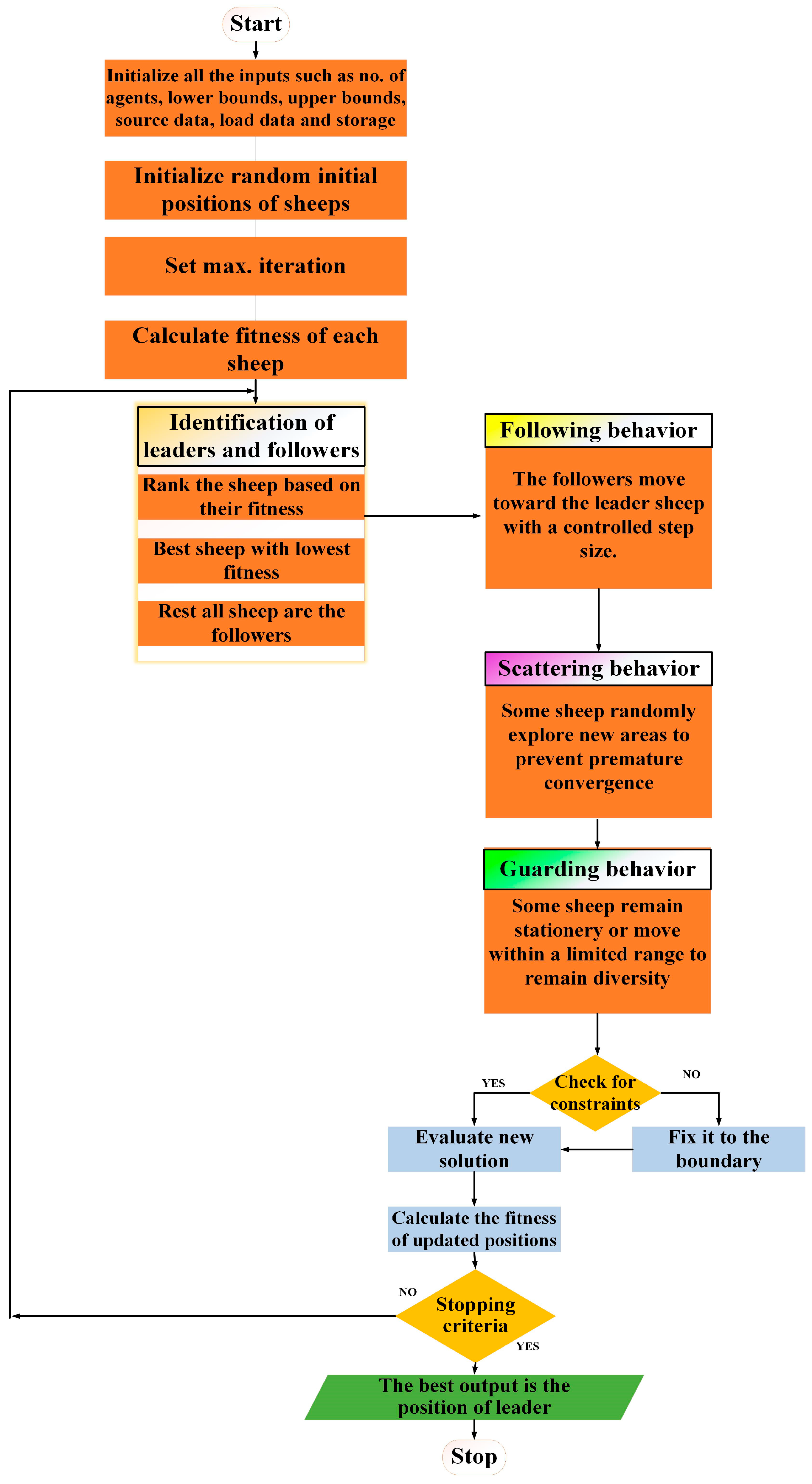
4.2. Sheep Flock Optimization

Sheep flock optimization is a population-based metaheuristic algorithm inspired by the collective movement and social behavior of sheep herds in nature. In SFO, individual agents, referred to as sheep, represent potential solutions in the search space and move according to simple rules that balance exploration and exploitation. Each sheep updates its position by considering both its own experience and the influence of neighboring sheep, effectively guiding the flock toward promising regions of the solution space. The movement dynamics involve mechanisms such as random wandering to encourage diversity, grouping behavior to exploit good solutions, and leader-following strategies to intensify the search around the current best candidates, as shown in Figure 2. These adaptive movements allow SFO to efficiently navigate complex, multimodal landscapes and avoid premature convergence to local optima. The algorithm’s inherent flexibility enables it to handle nonlinear, non-convex, and large-scale optimization problems effectively, making it particularly suitable for dynamic environments like energy management in MGs and fast-charging station planning. Although SFO does not guarantee global optimality, its simple structure, low computational burden, and strong global search capability make it a powerful tool when exact methods are impractical. Additionally, SFO can be hybridized with constraint-handling techniques, such as penalty methods or Lagrangian Relaxation, to enhance solution feasibility in constrained optimization scenarios. Equation (44) indicates the initialization of the algorithm. Sheep move towards the best (leader) solution with a controlled step size and are formulated as represented in Equation (45). Introduce exploration by moving some sheep away from the leader as presented in Equation (46). Equation (47) indicates the lamb reunion.
x i = x m i n + r x m a x x m i n
x i t + 1 = x i t + r 1 ( x l e a d e r x i t )
x i t + 1 = x i t + r 1 D s c a t t e r
x i = m a x ( min x i ,   x m a x , x m i n )

4.2.1. Limitations of SFO

While Sheep Flock Optimization (SFO) has demonstrated strong capabilities in global search and flexibility across complex optimization landscapes, it also suffers from several limitations when applied to constrained and highly dynamic problems such as FCS planning in MGs. One of the primary disadvantages of standard SFO is its weak constraint-handling ability, as the algorithm lacks built-in mechanisms to rigorously enforce equality or inequality constraints, often leading to infeasible or suboptimal solutions in real-world power systems. Additionally, SFO may experience premature convergence due to the loss of diversity in the search agents, especially when the herd quickly clusters around suboptimal regions. The absence of a dynamic strategy to balance exploration and exploitation throughout the search process further limits its adaptability in time-varying and high-dimensional problem spaces. Although SFO offers strong global search capabilities, it lacks a built-in mechanism to strictly satisfy operational equality and inequality constraints such as power balance, bus-voltage limits, generator output bounds, and line-flow capacities.

4.2.2. Adaptive SFO

α t = α m a x ( t T ) ( α m a x α m i n )
x n e w = x c u r r e n t + α t x b e s t x c u r r e n t + β R
D s c a t t e r = D m a x ( t T ) ( D m a x D m i n )
To overcome these drawbacks, adaptive enhancements have been introduced, wherein control parameters governing the movement of sheep are dynamically adjusted based on iteration count, convergence behavior, or performance feedback. This adaptive mechanism allows the algorithm to intensify exploration in the early stages and gradually shift towards exploitation as the search progresses, thereby improving convergence speed, avoiding local optima, and increasing solution quality. When coupled with hybrid strategies such as Lagrangian Relaxation, adaptive SFO can effectively manage constraints while retaining its strong global search capability, making it a more robust and practical tool for complex energy optimization tasks. Algorithm 1 shows the proposed hybrid methodology. Equation (48) indicates the adaptive step size, Equation (49) indicates the updating rule, and Equation (50) indicates the adaptive scattering behavior of sheep.
D m a x , D m i n are considered as 0.9, 0.1, respectively. α m a x and α m i n are considered as 1 and 0.1 to regulate the flock’s movement, exploration-exploitation balance, and search step size. In our implementation, these parameters were chosen based on standard recommendations from the literature without excessive computation.
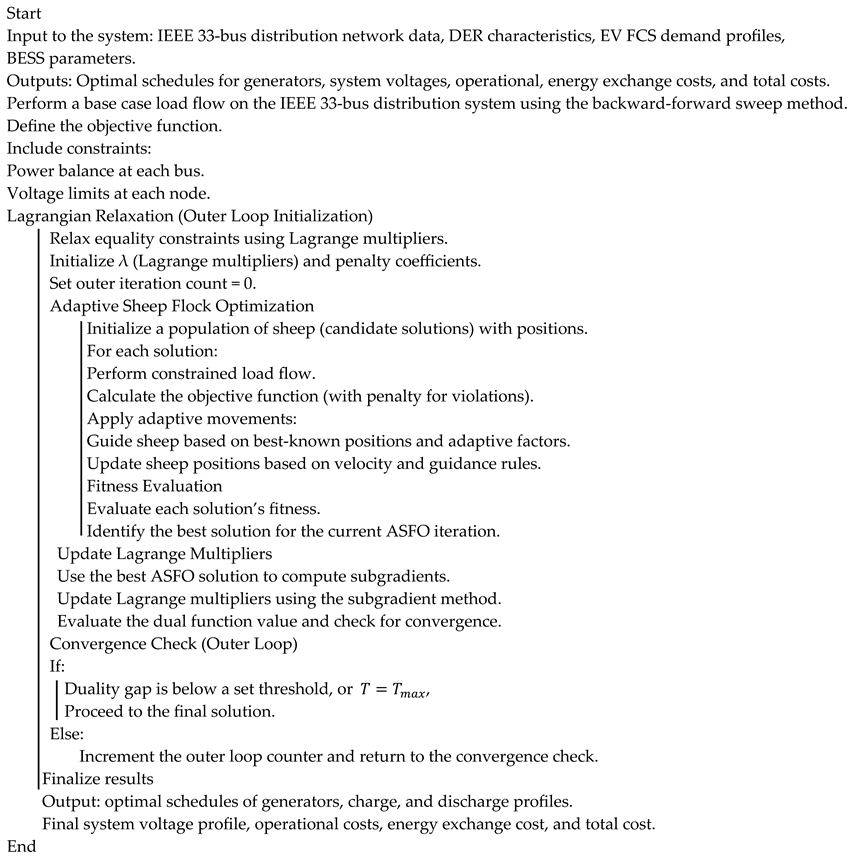
Algorithm 1. Proposed algorithm for energy management. Proposed hybrid LR and ASFO
Wevj 17 00011 i001

5. Results & Discussion

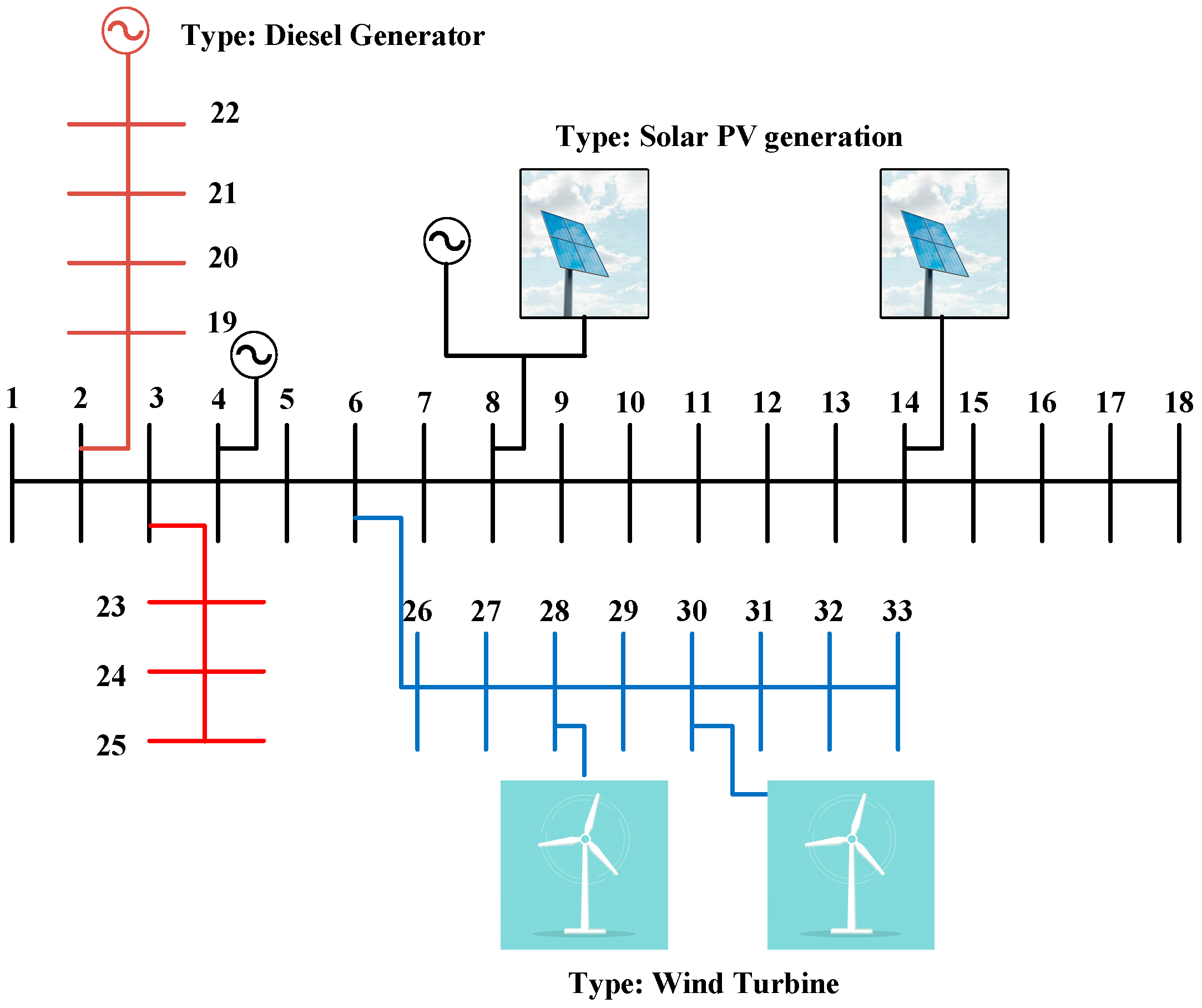
This section discusses the results obtained by employing the hybrid methodology on an IEEE-33 bus system, as shown in Figure 3. Monocrystalline solar panels, constructed from single-crystal silicon, are well-regarded for their high efficiency and durability. These panels typically deliver power outputs between 0 and 200 kW, with efficiencies ranging from 15% to 22%. Due to their high energy density, long operational life, and excellent charge/discharge performance, lithium-ion batteries are used for energy storage. The BESS has a rated capacity of 50 kWh, with both charging and discharging efficiencies at 90%. The SoC is constrained between a minimum of 20%, i.e., 10 kWh, and a maximum of 80%, i.e., 40 kWh, and the initial SoC is set at 50%, i.e., 25 kWh. The system employs horizontal-axis WTs, which operate within a wind speed range of 3 m/s (cut-in) to 25 m/s (cut-out). These turbines can achieve their rated output at a wind speed of 12 m/s, operating with an efficiency between 30% and 40%. Table 1 indicates the cost coefficients. Table 2 indicates the initialization of the hybrid algorithm. The study has been carried out on a balanced power distribution network operating with a rated voltage of 20 kV and a minimum voltage of 230 V. The work specifically emphasizes distribution-level MGs, where the integration of small-scale WTs is both feasible and practical. It is recognized that large WTs are typically integrated at the transmission level, often through HVDC connections. However, the present study highlights the advantages and challenges associated with connecting smaller WTs directly to the distribution network, which better aligns with the microgrid framework. The output powers of generators, BESS powers, grid exchange, and EV charging setpoints are considered as decision variables here; therefore, in total, 4 decisions for 24 h, it is 96.
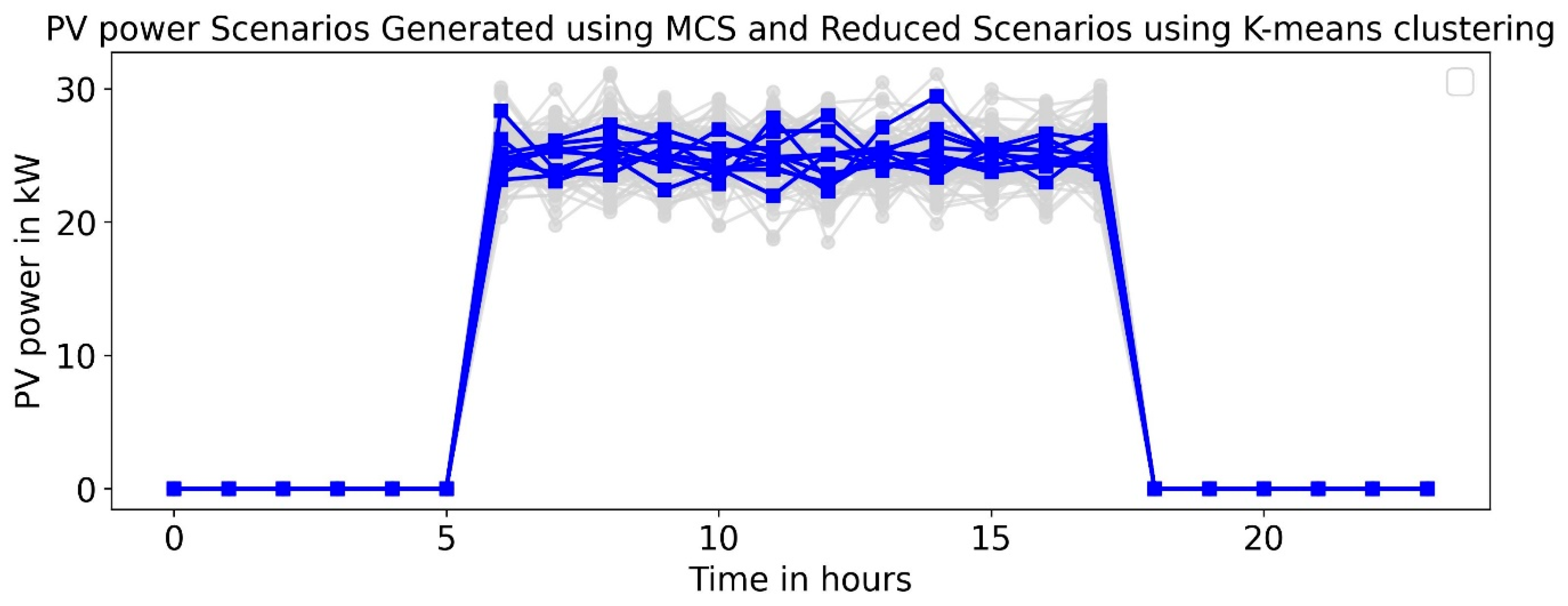
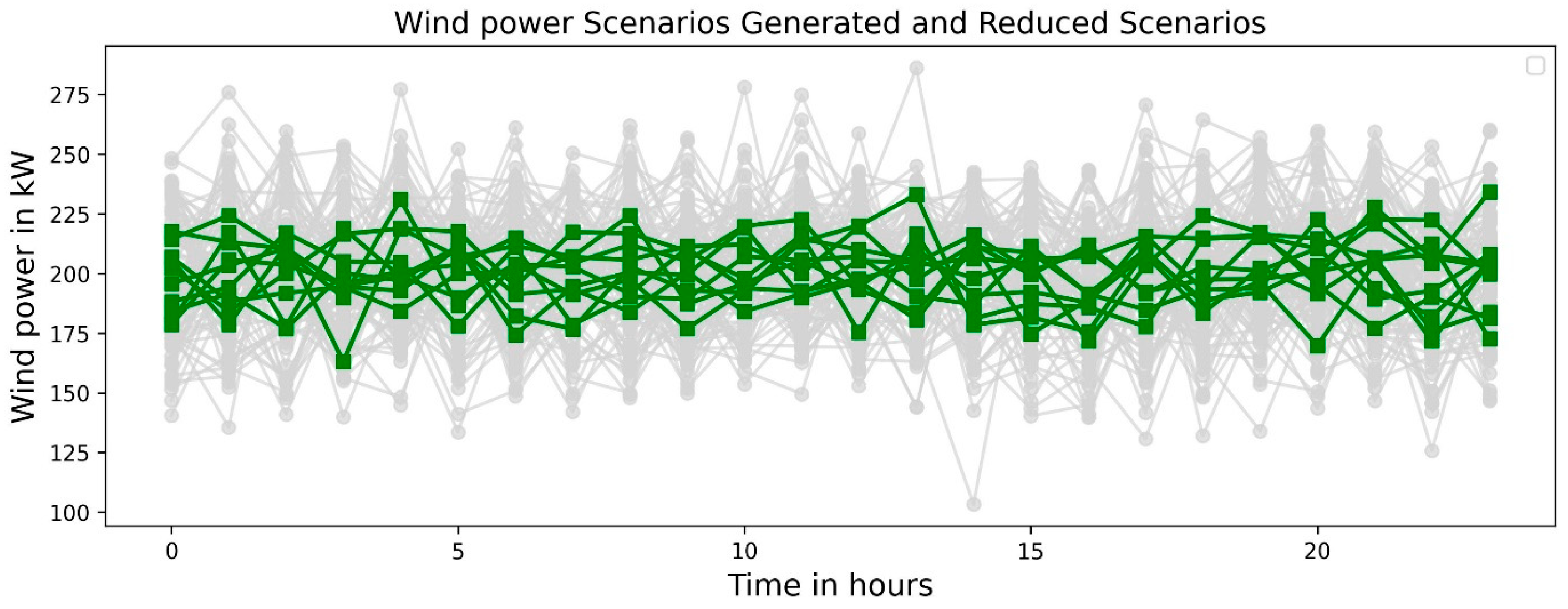
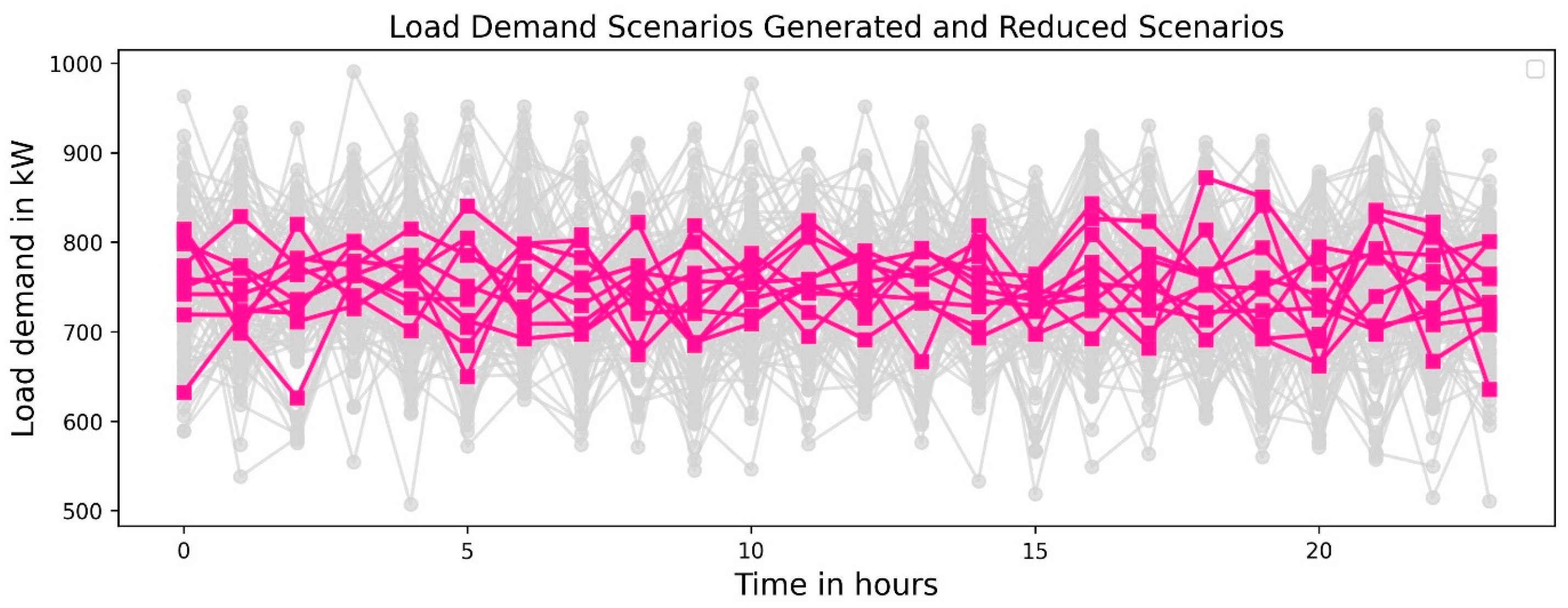
Visualizing the uncertainty associated with PV and WT outputs is essential for clarity and reproducibility. The daily generation profiles of PV and WT under uncertainty are plotted, generated using probabilistic scenario generation and scenario reduction. Figure 4 indicates the uncertain PV using scenario generation and scenario reduction, Figure 5 indicates the wind scenario generation and reduction, whereas Figure 6 indicates the uncertain scenarios for load demand. To effectively capture the uncertainty associated with RES and load demand, the Monte Carlo Simulation (MCS) is used for scenario generation. MCS generates a large number of possible realizations by repeatedly sampling from the probabilistic distributions of input variables such as solar irradiance, wind speed, and electric vehicle charging demand. These scenarios represent diverse operating conditions that reflect the stochastic nature of the system. However, solving optimization problems with a large number of scenarios becomes computationally intensive. To address this, K-means clustering is employed for scenario reduction. This technique groups similar scenarios into clusters based on their statistical features and selects representative scenarios from each cluster, thereby preserving the overall distribution characteristics while significantly reducing computational burden.
As shown in Figure 4, Figure 5 and Figure 6, each uncertain parameter is tackled using a scenario generation technique, and grey lines indicate the generated scenarios. By employing MCS, 100 scenarios were generated for each uncertain parameter, i.e., PV, wind, and load demand. Managing such a large set of uncertainties is challenging, as the uncertainty space grows to (100)3, making it difficult for the scheduling algorithm to process all scenarios and significantly increasing the computational complexity. To address this, a scenario reduction method based on K-means clustering was applied, which simplifies the uncertainty space to (10)3 manageable scenarios. In this approach, the results obtained from the MCS are provided as input to the K-means algorithm, which groups the data into clusters, thereby reducing the overall problem size. The method is computationally efficient, requiring only the specification of the number of clusters, initial centroids, and the uncertainty space as inputs. Operational costs, energy exchange costs, BESS operation, and power losses are evaluated separately for each reduced scenario, using the corresponding realizations of PV output, wind generation, load demand, and EV charging demand. This per-scenario evaluation preserves scenario-specific operational behavior and ensures that the model accurately captures the variability and uncertainty inherent in the system.
Each scenario is assigned a probability weight derived from the scenario-generation and reduction process. These scenario weights multiply the individual scenario costs, thus scaling them in proportion to their probability of occurrence. As a result, scenarios with a higher probability result in a greater influence on the total cost objective, while less likely scenarios still contribute but with appropriately reduced impact. This weighting mechanism guarantees that the optimization seeks decisions that are cost-effective not only on average but also reflective of the underlying uncertainty distribution.
All operational constraints, such as power balance, generation limits, network flow constraints, storage dynamics, voltage limits, and charging requirements, are enforced independently for every scenario.

5.1. Impact on Voltage Profile

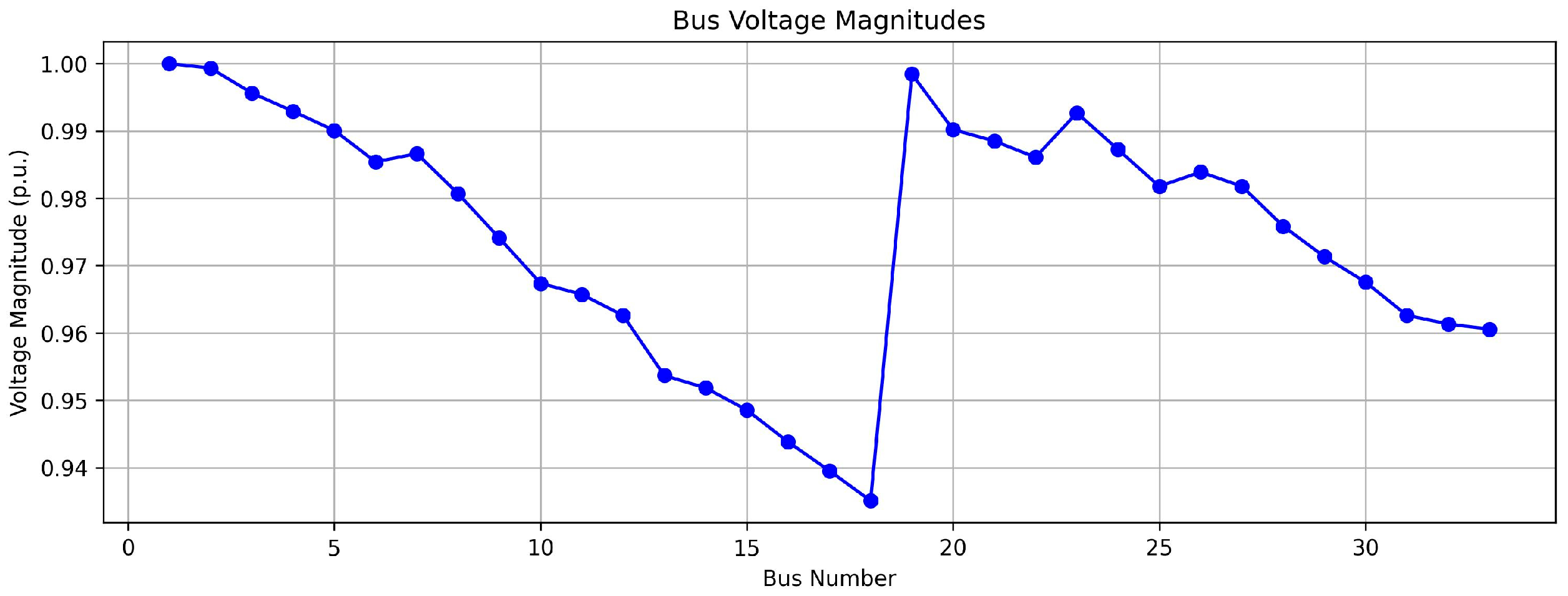
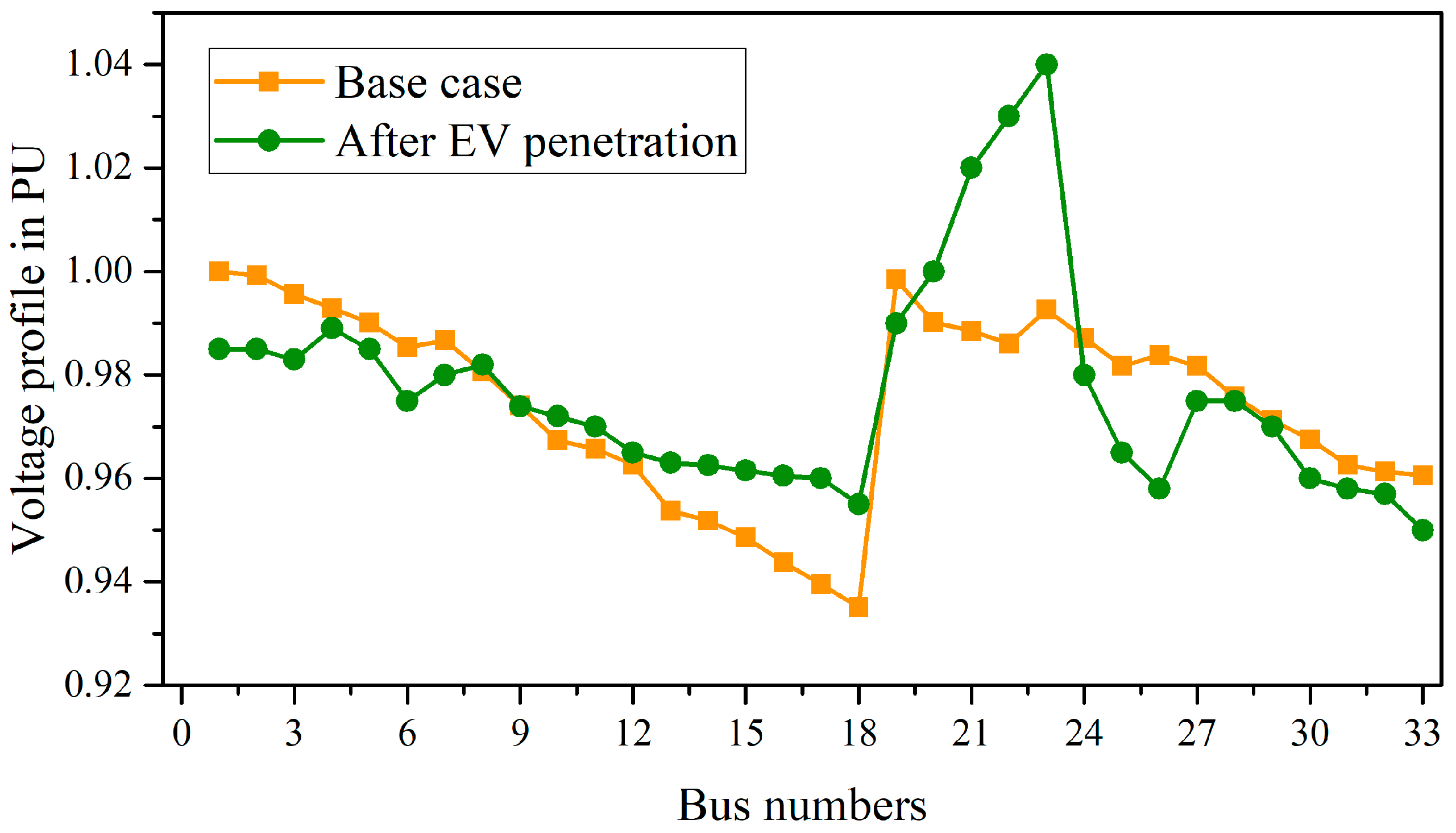
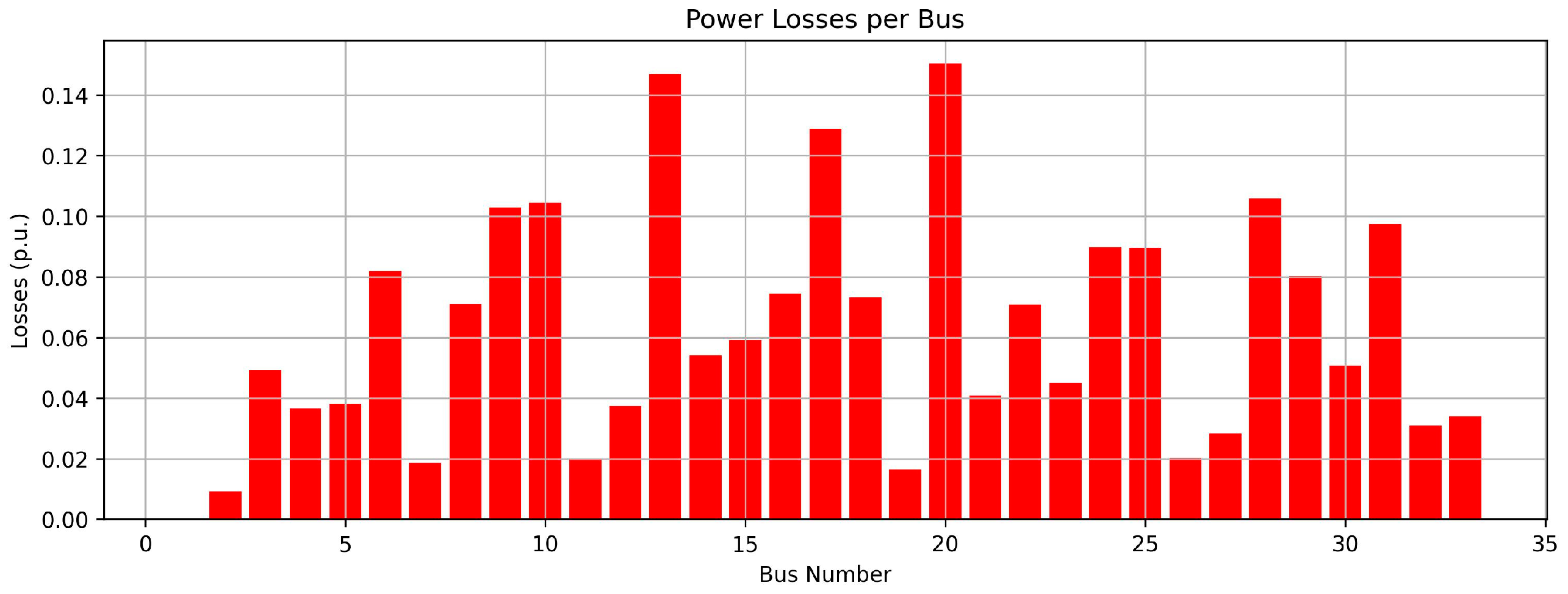
This sub-section discusses the impact of EVs on the voltage profile of the 33 bus system, as shown in Figure 7 and Figure 8. Figure 9 indicates the power loss profile of 33 bus systems. It can be seen from the same Figure 9 that the power losses are more at buses 13 and 20, since these are the farthest buses from the sources. It is evident from Figure 7 that the voltage is low at bus 18, since this bus is located at the farther end of the reference bus 1. The voltage again rises nearer to 1 at bus 19, since it is connected to bus 2, and the voltage at bus 23 is also increased since it is connected to bus 3. Figure 8 indicates the voltage profile of 33 bus systems before and after EV penetration, which indicates that the careful scheduling of EVs might improve the voltage profile. The penetration of EVs into the MG might hinder the voltage profile if not carefully scheduled. It is evident from Figure 9 that the voltage profile has been improved from buses 20 to 23 with better scheduling.

5.2. Impact of EV Penetration on the Scheduling of MG Resources

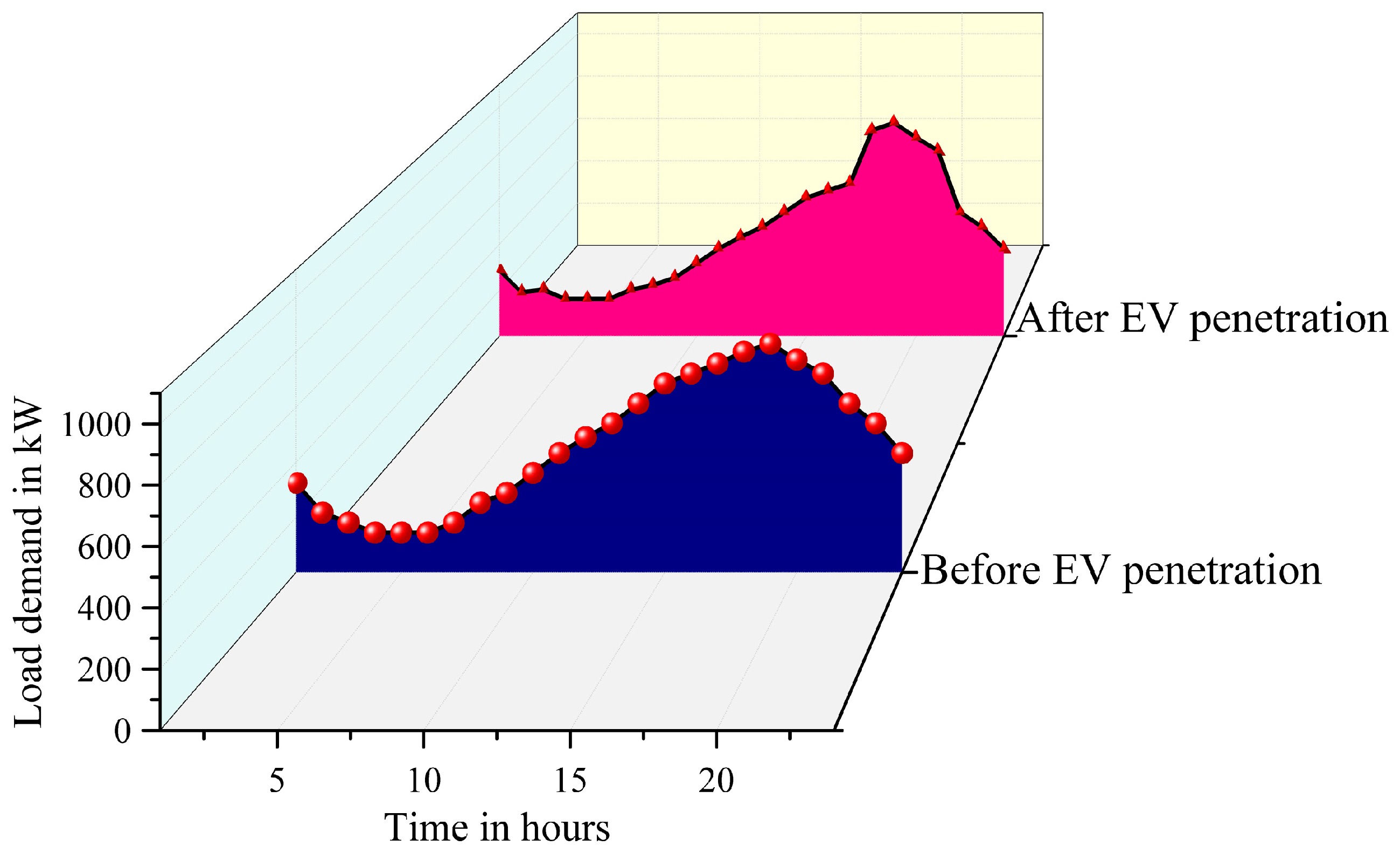
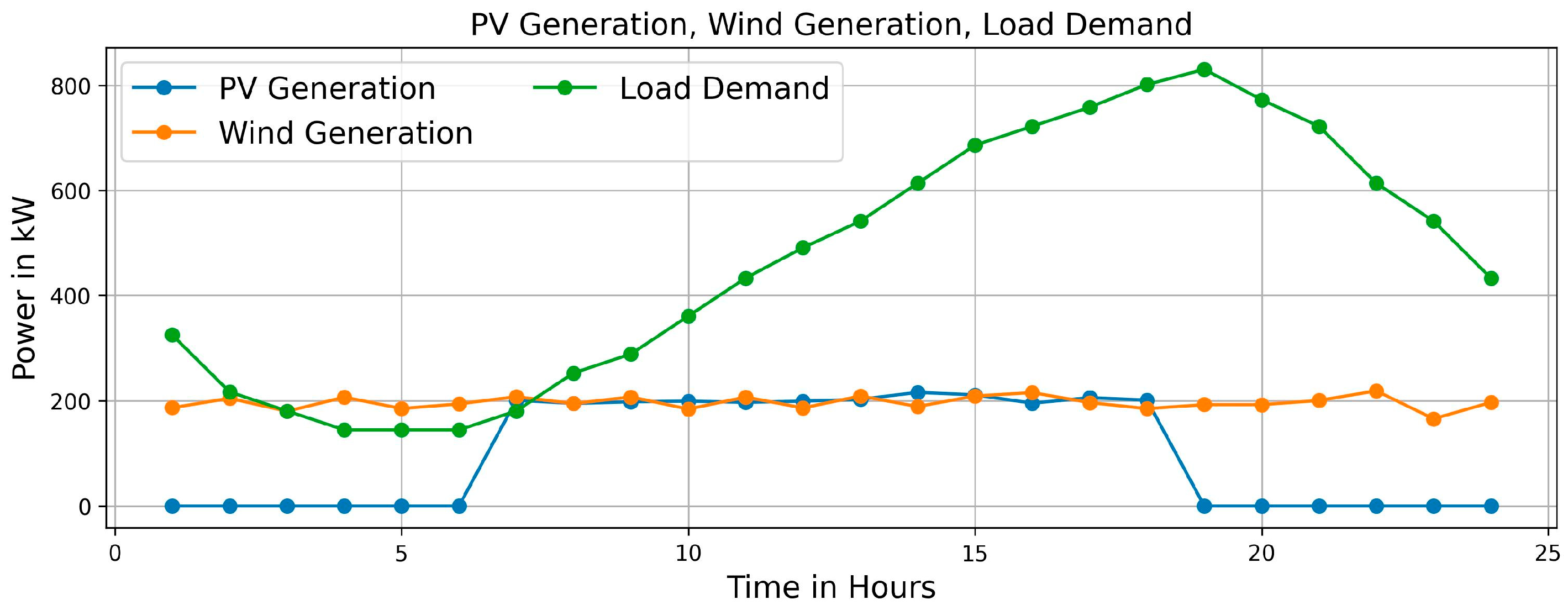
Figure 10 indicates the load demand profile before and after EV penetration. With EV penetration, the load demand has increased to a new peak. Figure 11 indicates the load demand and power generation through RESs, i.e., PV and WT. The peak load on the system is 830.3 kW, the minimum load on the system is 144.4 kW, and the average load is around 480 kW. The power generation through PV is zero during the first six hours and the last six hours due to the non-availability of sunlight. After EV penetration, the load demand has increased to 880 kW instead of 830.3 kW at scheduling hour 19. It indicates that the load demand increases for EVs to charge.
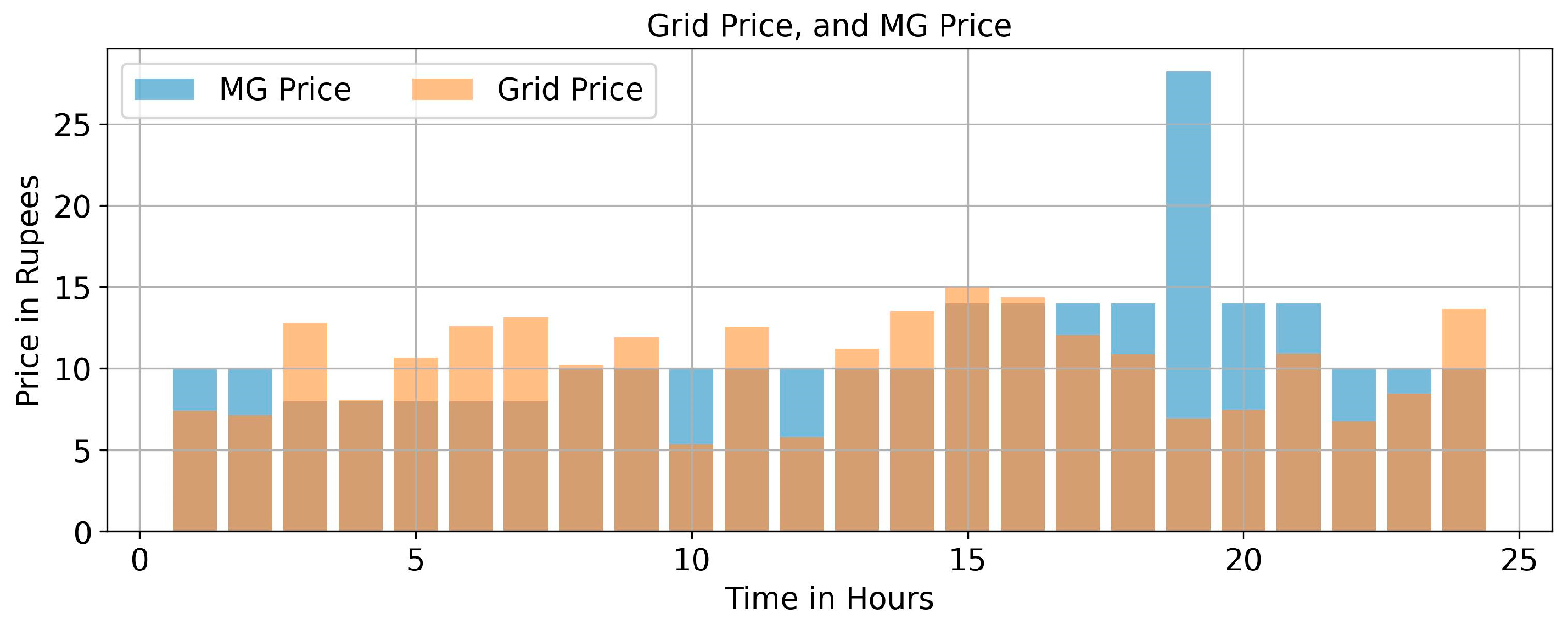
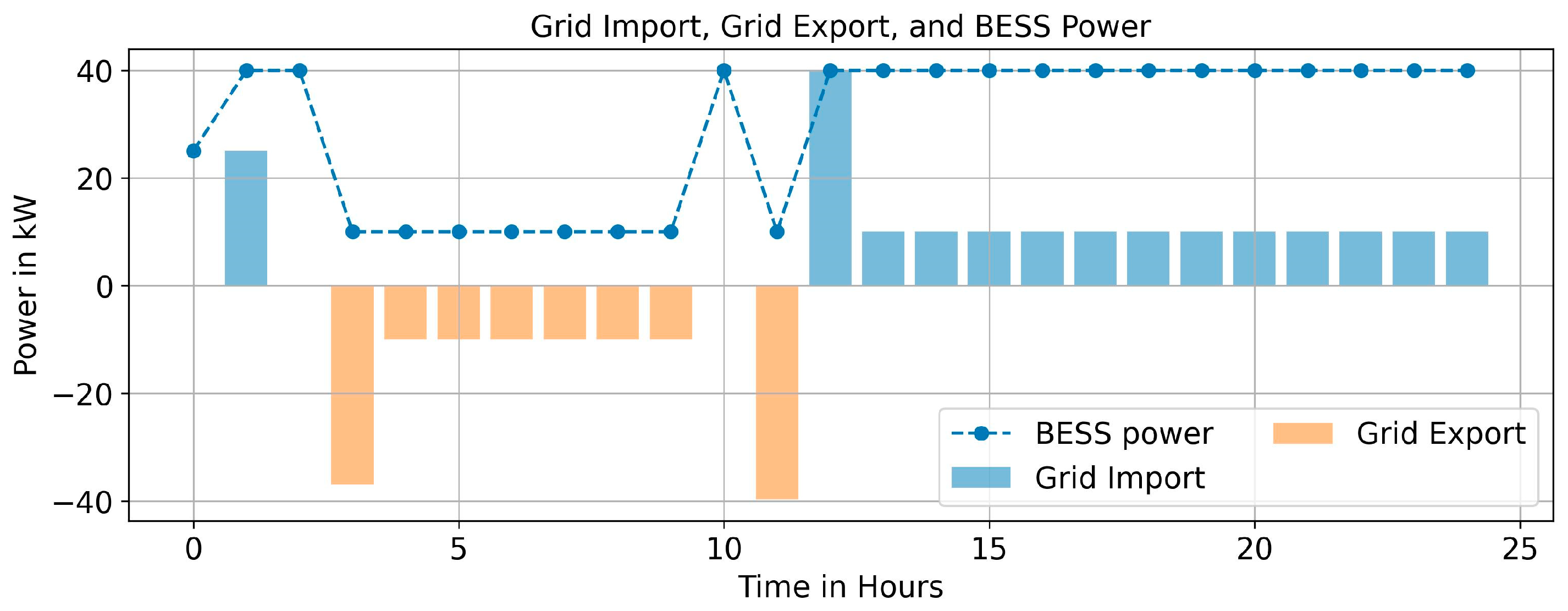
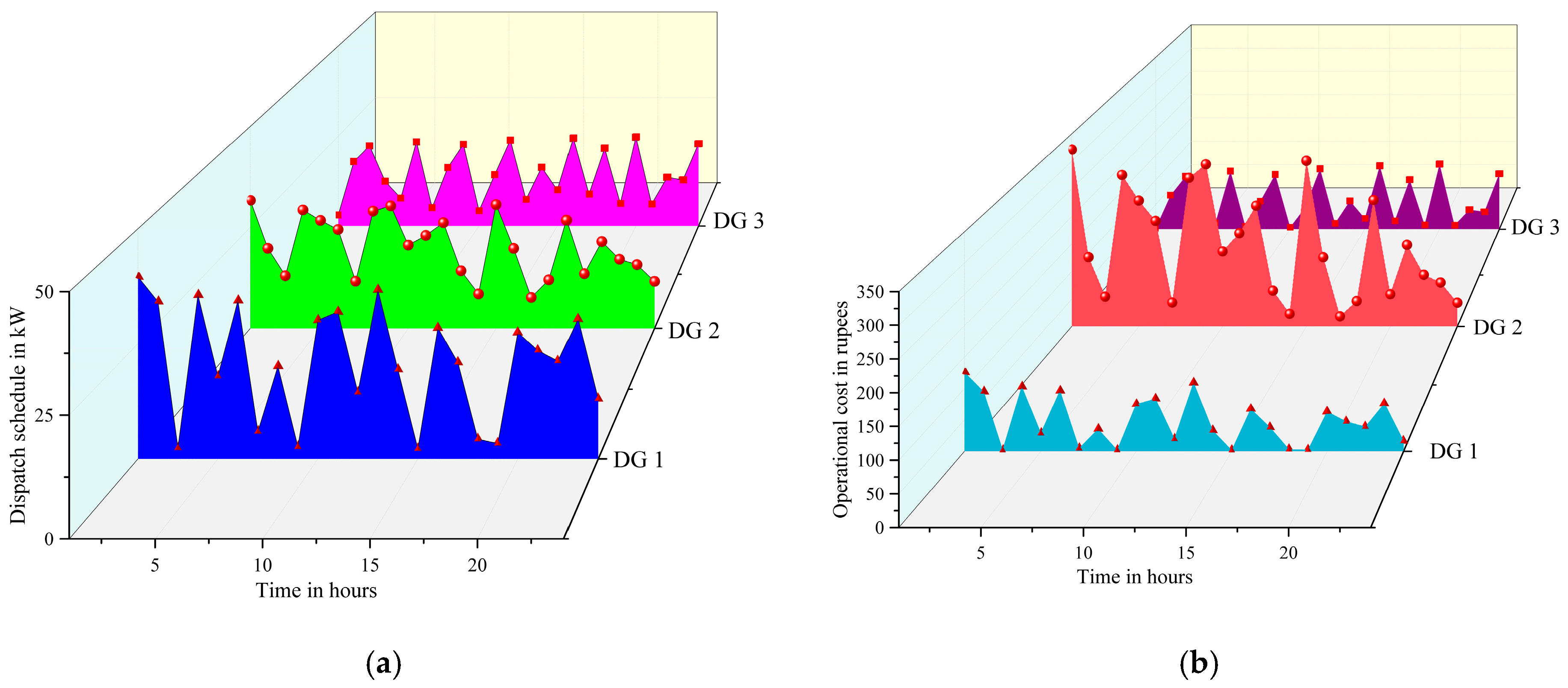
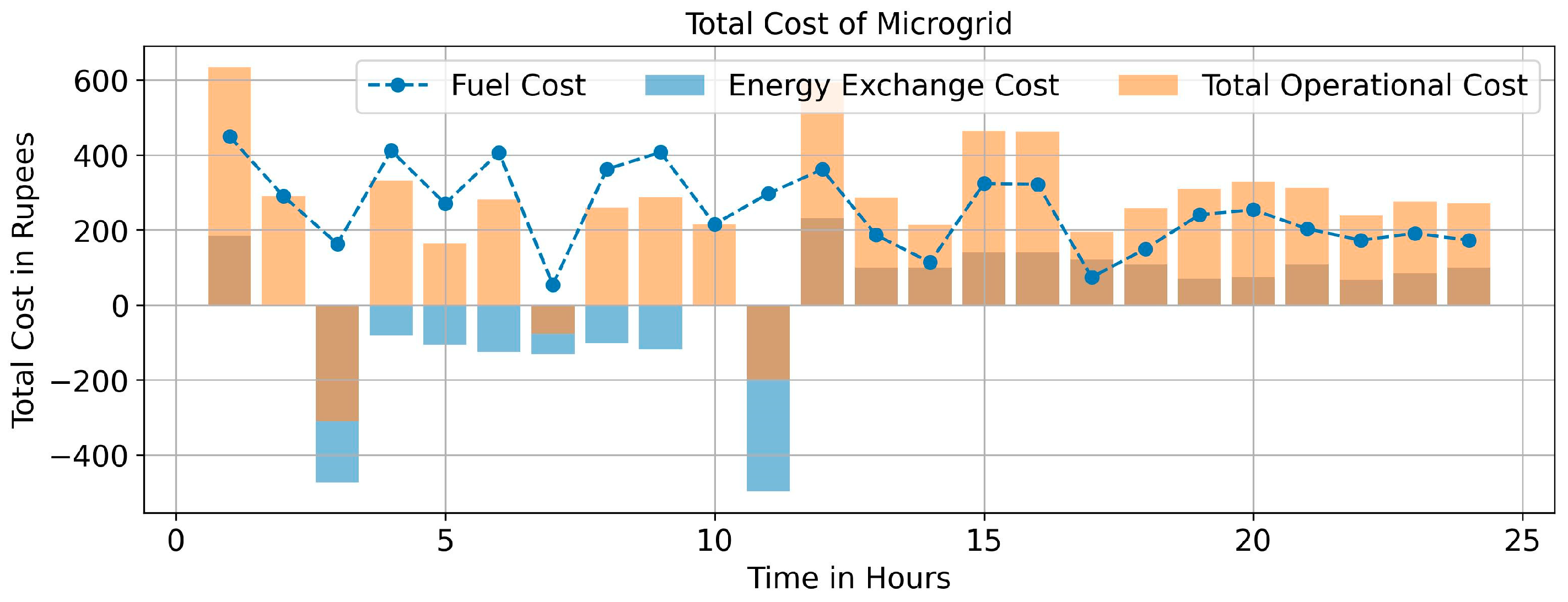
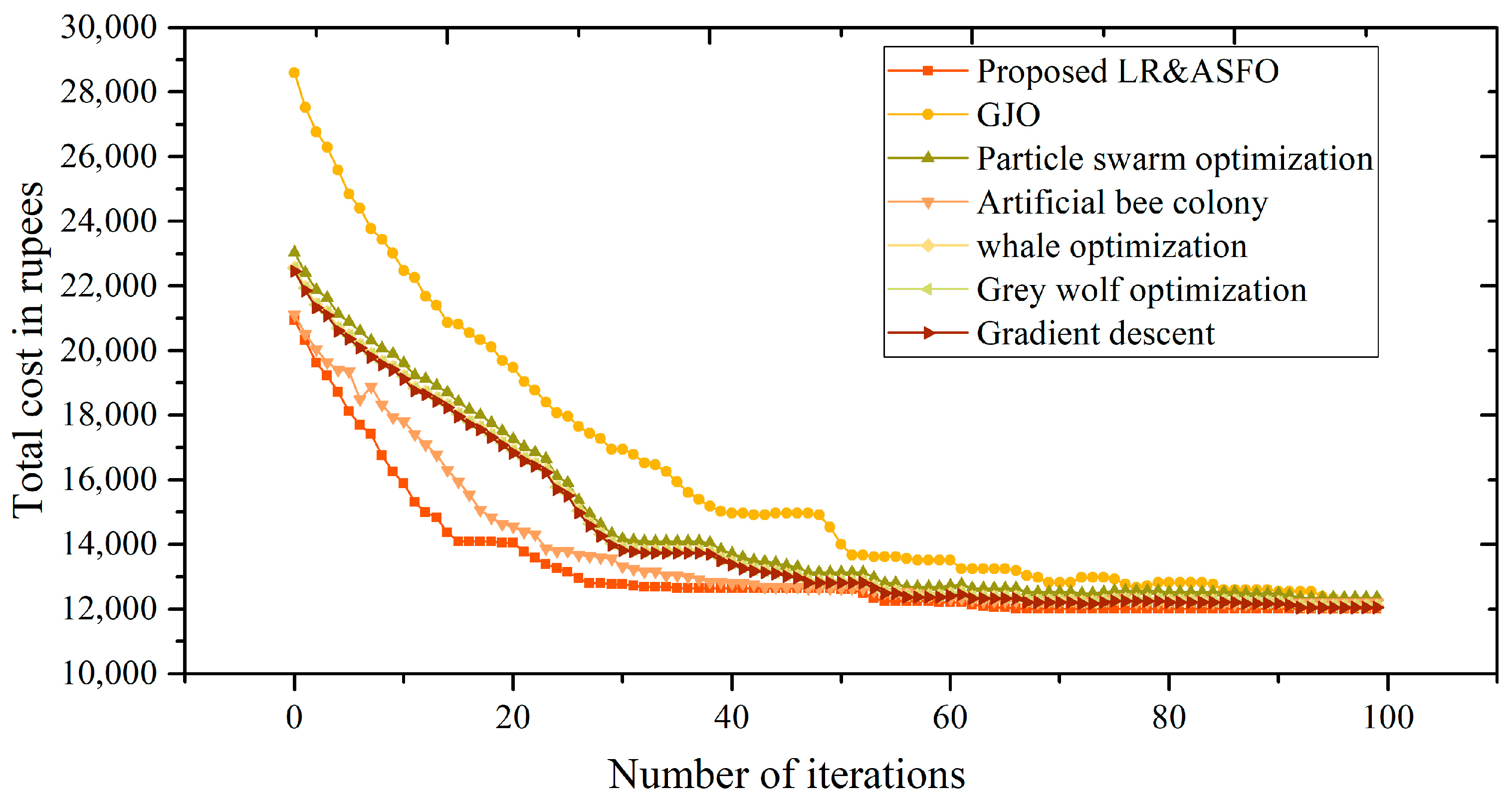
As seen from the above figures (Figure 12 and Figure 13), the BESS charges during the period when the grid price is lower than the MG price (at scheduling hours 1 and 2), and it discharges during the period of high grid price (at hour 11). It is evident from the Figure that the power export to the grid is maximum when the grid price is higher, and it is minimum during the grid price is low. The power from the grid to the MG is maximum when the grid price is lower than the cost incurred for generating power from the MG’s resources. The MG price is higher during the peak load instant, for example, at scheduling hour 19. Figure 14a indicates the dispatch schedule of DGs, and Figure 14b indicates the operational cost of DGs. Figure 15 indicates the total cost of the MG. The performance of the proposed LR&ASFO algorithm is superior compared to other state-of-the-art optimization techniques, as illustrated in the convergence graph. In terms of total cost, LR&ASFO achieves the lowest value, approximately 12,016.97, outperforming all competing methods. GJO reaches final cost values at 12,284.67, followed by PSO and ABC algorithms with higher costs near 12,358 and 12,203, respectively, as shown in Figure 16. Table 3 indicates the comparison of the proposed methodology with existing algorithms.
In terms of the number of iterations to reach the optimal value, LR&ASFO exhibits the fastest convergence, stabilizing within the first 30 iterations. This is significantly faster than PSO and GJO, which require around 45 to 60 iterations to stabilize. Other algorithms, such as PSO, ABC, GWO, and Whale Optimization, demonstrate much slower convergence, often requiring more than 70 iterations. Other algorithms, such as PSO, ABC, GWO, WOA, and GD, take more iterations to converge primarily due to their inherent exploration-exploitation trade-offs and population dynamics. These algorithms often prioritize global search in the early stages to avoid local optima, which increases the exploration time. For example, PSO and ABC rely heavily on population-wide communication, which may slow convergence as individuals must evaluate multiple candidate solutions. GWO and WOA simulate natural behaviors that focus on slow refinement of positions over time, requiring more iterations to fine-tune their solutions. GD, while mathematically efficient, suffers from slow progress when facing non-convex or highly nonlinear objective functions, especially if the learning rate is not optimally tuned. The authors have considered GD as an exact optimization technique, since the problem considered has non-convexities and it results in discontinuities in the search space, and exact optimization problems such as MILP, LP, and convex programming methods are unable to handle these issues.
In contrast, the proposed LR&ASFO combines the global search strength of swarm-based methods with the problem decomposition power of LR, enabling it to focus the search more effectively and reduce unnecessary iterations. Moreover, the computational efficiency of the proposed LR&ASFO algorithm is evident due to its rapid convergence and lower number of iterations, implying a reduction in computational time and resources. This makes it particularly suitable for complex MG optimization problems where timely and cost-effective solutions are essential. Therefore, considering the combined metrics of cost minimization, convergence speed, and computational efficiency, LR&ASFO clearly outperforms the compared algorithms and can be considered the most effective optimization approach among those evaluated. Since the stochastic optimization generates different outputs for different trial runs, it is recommended to run the techniques for 30 trial runs and take the mean, median, and standard deviation from that.

5.3. Impact of EV Uncertainties on Operational Cost

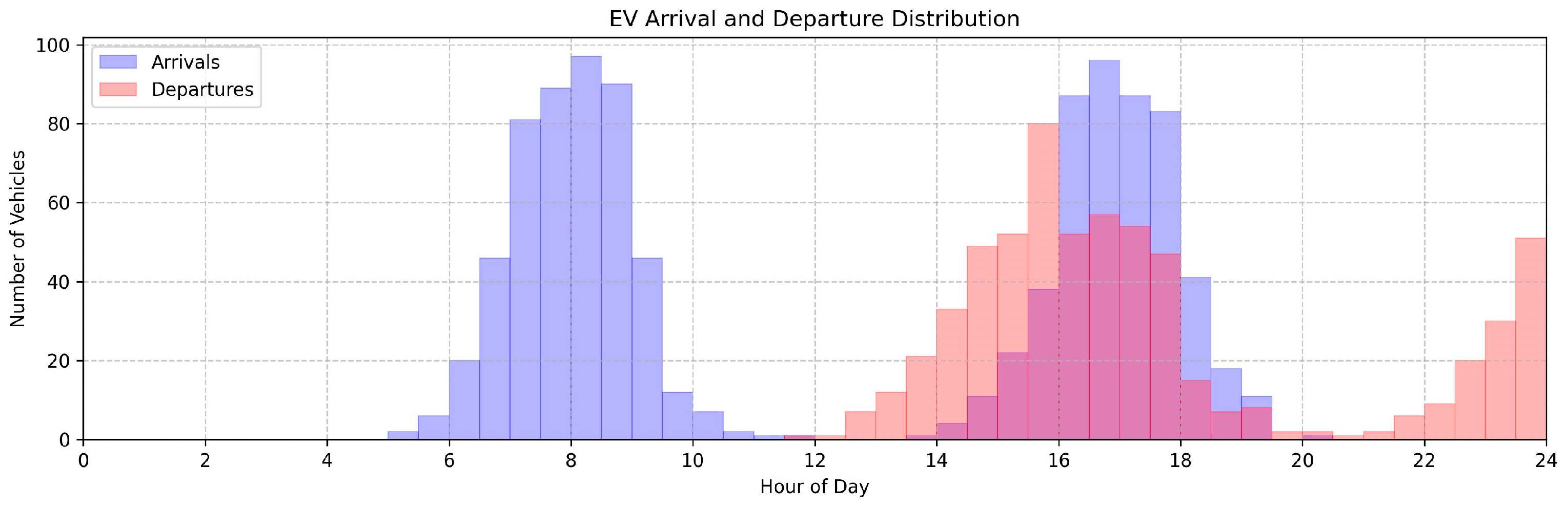
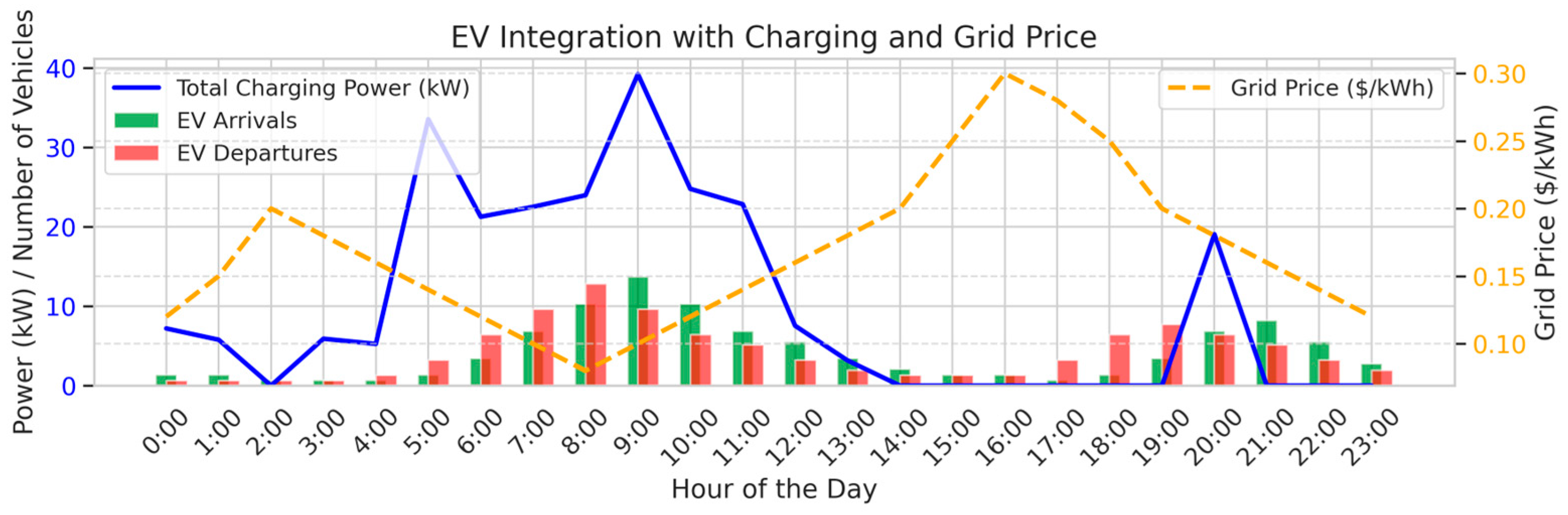
Uncertainties in EV charging behavior, such as unpredictable arrival/departure times, variable state-of-charge requirements, and user preferences, can significantly impact the operational cost of an MG. Figure 17 indicates the arrival and departure for EVs, and Figure 18 indicates the charge and discharge profiles. These uncertainties can lead to suboptimal dispatching of distributed energy resources and increased reliance on grid energy at peak prices, thereby elevating overall system costs. Accurate modeling and scenario-based planning are essential to mitigate these impacts and enhance cost-effective operation. The operational cost increases with the presence of uncertainties in EV when compared with the absence of uncertainties. The operational cost without uncertainties is 12,016.97 rupees, whereas in the presence of uncertainties, the operational cost is 12,350 rupees, which indicates that the scheduling decisions will be impacted due to the presence of uncertainties. To assess the performance of the presented hybrid technique, the simulations were conducted in Python (version 2.7) on a system featuring 16 GB RAM and, i5 processor. Libraries: NumPy, Pandas, Intel i5-8th generation, Windows 11 (64-bit).

5.4. Potential Limitations of the Proposed Work

The study relies on historical data and probabilistic models to simulate PV, wind, and EV demand uncertainty. However, forecasting errors due to unexpected weather fluctuations or abrupt changes in EV usage patterns can influence the accuracy of dispatch schedules and cost calculations.

6. Conclusions

This study presents a hybrid optimization approach combining LR and ASFO for the optimal scheduling of MG resources in the presence of electric vehicle FCS in MG-integrated distribution systems. The proposed framework effectively manages the dual challenges of system constraints and nonlinear optimization by leveraging LR’s constraint-handling capabilities and ASFO’s global search efficiency. Simulation results on an IEEE 33-bus system validate the method’s ability to handle uncertainties in renewable generation profiles. Key findings indicate that the hybrid LR-ASFO approach reduces TC by 12,358 rupees when PSO is used, to 12,016.97 rupees when the proposed methodology is employed; enhances voltage stability by 2.4%; and lowers operational cost by 4.3% compared to conventional metaheuristics and exact methods used individually. Beyond these metrics, our study reveals practical insights of interest to operators under moderate to high EV-penetration levels. Coordinating storage dispatch and renewable usage prior to peak charging events reduces stress on network infrastructure and enables more stable voltage profiles; in high-demand periods, reserving a portion of storage capacity for charging-peak smoothing improves resilience. These findings suggest that, with proper scheduling of DERs and storage, the LR-ASFO framework can support realistic operational planning in EV-heavy distribution systems.
  • Future scope:
While computational performance was acceptable for the tested 33-bus case, further work is needed to assess scalability to larger distribution networks and real-time implementation under fast-changing load/renewable/charging conditions. Moreover, extending the framework to multi-objective optimization balancing cost, reliability, emissions, and voltage stability may provide a more comprehensive operational tool for future smart-grid deployments. Further, the impact of cyberattacks (e.g., false data injection or DoS) on microgrid optimization may be considered, which can help develop resilient control strategies.

Author Contributions

Conceptualization, S.P., S.N. and S.R.S.; methodology, S.P. and S.R.S.; software, S.P., S.N. and S.R.S.; validation, S.P., S.N. and S.R.S.; formal analysis, S.P., S.N. and S.R.S.; investigation, S.P. and S.N.; resources, S.R.S. and S.N.; data curation, S.P., S.N. and S.R.S.; writing—original draft preparation, S.P., S.N. and S.R.S.; writing—review and editing, S.P., S.N. and S.R.S.; visualization, S.R.S. and S.N.; supervision, S.R.S. and S.N. All authors have read and agreed to the published version of the manuscript.

Funding

This research work was supported by “Woosong University’s Academic Research Funding-2025”.

Data Availability Statement

The original contributions presented in the study are included in the article, further inquiries can be directed to the corresponding author.

Conflicts of Interest

The authors declare no conflicts of interest.

Abbreviations

MGMicrogrid
EVsElectric vehicles
V2GVehicle-to-grid
DERDistributed energy resources
PVSolar photovoltaic
BESSBattery energy storage systems
WT’sWind turbines
LRLagrangian relaxation
ASFOAdaptive sheep flock optimization
SFOSheep flock optimization
FCSFast-charging stations
GAGenetic algorithm
PSOParticle swarm optimization
DGDiesel generator
FC Fuel cell
MTMicro turbine
SoCState of charge
RESsRenewable energy sources
KKTKarush-kuhn-tucker
MCSMonte Carlo simulation
ABCArtificial bee colony
GWOGrey wolf optimization
WOAWhale optimization algorithm
GDGradient descent
List of acronyms
P W i n d t Power generated from wind
P W i n d r Rated wind power
v c i n Cut-in speed
v c o u t Cut-out speed
P S t Power generation through solar
R c Critical insolation
R s t a n d Standard insolation
Z0, Z1, and Z2Cost coefficients of DG
C D G t Fuel cost of DG
P F C t Power generated from FC
X0, X1Cost coefficients of FC
C F C t Cost of energy produced from FC
C M T t Cost of energy produced from MT
P M T t Power produced from MT
T C M G Total cost of the MG
C E e x c h a n g e t Energy exchange cost
O C M G t Operational costs
V i l b Lower bound on voltage
V i u b Upper bound on voltage
P g i l b Lower bound on active power
P g i u b Upper bound on active power
Q g i l b Lower bound on reactive power
Q g i u b Upper bound on reactive power
P i j l b Lower bound on active power in line i and j
P i j u b Upper bound on active power in line i and j
S o C t M G State of charge of MG at time t
X t . d c h B E S S , X t . c h B E S S Charge and discharge status
P c h , t B E S S , P d c h , t B E S S Charge and discharge power
η c h B E S S , η d c h B E S S Efficiency of BESS during Charging and discharging

References

  1. Boruah, D.; Chandel, S.S. Techno-economic feasibility analysis of a commercial grid-connected photovoltaic plant with battery energy storage-achieving a net zero energy system. J. Energy Storage 2024, 77, 109984. [Google Scholar] [CrossRef]
  2. Gautam, M. Evolutionary Game Dynamics between Distributed Energy Resources and Microgrid Operator: Balancing Act for Power Factor Improvement. Electronics 2024, 13, 248. [Google Scholar] [CrossRef]
  3. Mohammed, A.; Sakr, E.K.; Abo-Adma, M.; Elazab, R. A comprehensive review of advancements and challenges in reactive power planning for microgrids. Energy Inf. 2024, 7, 63. [Google Scholar] [CrossRef]
  4. R, S.; Sankaranarayanan, V. Optimal Scheduling of Electric Vehicle Charging at Geographically Dispersed Charging Stations with Multiple Charging Piles. Int. J. Intell. Transp. Syst. Res. 2022, 20, 672–695. [Google Scholar] [CrossRef]
  5. Chen, Z.; Carrel, A.L.; Gore, C.; Shi, W. Environmental and Economic Impact of Electric Vehicle Adoption in the U.S. Environ. Res. Lett. 2021, 16, 045011. [Google Scholar] [CrossRef]
  6. Hawkins, T.R.; Singh, B.; Majeau-Bettez, G.; Strømman, A.H. Comparative Environmental Life Cycle Assessment of Conventional and Electric Vehicles. J. Ind. Ecol. 2013, 17, 53–64. [Google Scholar] [CrossRef]
  7. Nour, M.; Chaves-Ávila, J.P.; Magdy, G.; Sánchez-Miralles, Á. Review of Positive and Negative Impacts of Electric Vehicles Charging on Electric Power Systems. Energies 2020, 13, 4675. [Google Scholar] [CrossRef]
  8. Wang, J.; Bharati, G.R.; Paudyal, S.; Ceylan, O.; Bhattarai, B.P.; Myers, K.S. Coordinated Electric Vehicle Charging with Reactive Power Support to Distribution Grids. IEEE Trans. Ind. Inform. 2019, 15, 54–63. [Google Scholar] [CrossRef]
  9. Pradhan, P.; Ahmad, I.; Habibi, D.; Kothapalli, G.; Masoum, M.A.S. Reducing the Impacts of Electric Vehicle Charging on Power Distribution Transformers. IEEE Access 2020, 8, 210183–210193. [Google Scholar] [CrossRef]
  10. Ahmadi, B.; Ceylan, O.; Ozdemir, A. Distributed energy resource allocation using multi-objective grasshopper optimization algorithm. Electr. Power Syst. Res. 2021, 201, 107564. [Google Scholar] [CrossRef]
  11. Pal, A.; Bhattacharya, A.; Chakraborty, A.K. Allocation of electric vehicle charging station considering uncertainties. Sustain. Energy Grids Netw. 2021, 25, 100422. [Google Scholar] [CrossRef]
  12. Zhang, Y.; Zhang, Q.; Farnoosh, A.; Chen, S.; Li, Y. GIS-Based Multi-Objective Particle Swarm Optimization of charging stations for electric vehicles. Energy 2019, 169, 844–853. [Google Scholar] [CrossRef]
  13. Liu, Q.; Liu, J.; Le, W.; Guo, Z.; He, Z. Data-driven intelligent location of public charging stations for electric vehicles. J. Clean. Prod. 2019, 232, 531–541. [Google Scholar] [CrossRef]
  14. Abo-Elyousr, F.K.; Sharaf, A.M.; Darwish, M.M.F.; Lehtonen, M.; Mahmoud, K. Optimal scheduling of DG and EV parking lots simultaneously with demand response based on self-adjusted PSO and K-means clustering. Energy Sci. Eng. 2022, 10, 4025–4043. [Google Scholar] [CrossRef]
  15. S., S.M.; Titus, F.; Thanikanti, S.B.; M., S.S.; Deb, S.; Kumar, N.M. Charge Scheduling Optimization of Plug-In Electric Vehicle in a PV Powered Grid-Connected Charging Station Based on Day-Ahead Solar Energy Forecasting in Australia. Sustainability 2022, 14, 3498. [Google Scholar] [CrossRef]
  16. Martin, H.; Buffat, R.; Bucher, D.; Hamper, J.; Raubal, M. Using rooftop photovoltaic generation to cover individual electric vehicle demand—A detailed case study. Renew. Sustain. Energy Rev. 2022, 157, 111969. [Google Scholar] [CrossRef]
  17. Kabir, M.E.; Assi, C.; Tushar, M.H.K.; Yan, J. Optimal Scheduling of EV Charging at a Solar Power-Based Charging Station. IEEE Syst. J. 2020, 14, 4221–4231. [Google Scholar] [CrossRef]
  18. Ullah, Z.; Wang, S.; Wu, G.; Hasanien, H.M.; Rehman, A.U.; Turky, R.A.; Elkadeem, M.R. Optimal scheduling and techno-economic analysis of electric vehicles by implementing solar-based grid-tied charging station. Energy 2023, 267, 126560. [Google Scholar] [CrossRef]
  19. Lu, H.; Xie, K.; Hu, B.; Shao, C.; Wang, Y.; Pan, C. Reliability–flexibility integrated optimal sizing of second-life battery energy storage systems in distribution networks. IET Renew. Power Gener. 2024, 18, 2177–2193. [Google Scholar] [CrossRef]
  20. Han, J.; Park, J.; Lee, K. Optimal Scheduling for Electric Vehicle Charging under Variable Maximum Charging Power. Energies 2017, 10, 933. [Google Scholar] [CrossRef]
  21. Jin, H.; Lee, S.; Nengroo, S.H.; Har, D. Development of Charging/Discharging Scheduling Algorithm for Economical and Energy-Efficient Operation of Multi-EV Charging Station. Appl. Sci. 2022, 12, 4786. [Google Scholar] [CrossRef]
  22. Leou, R.-C.; Hung, J.-J. Optimal Charging Schedule Planning and Economic Analysis for Electric Bus Charging Stations. Energies 2017, 10, 483. [Google Scholar] [CrossRef]
  23. Tostado-Véliz, M.; Kamel, S.; Hasanien, H.M.; Arévalo, P.; Turky, R.A.; Jurado, F. A stochastic-interval model for optimal scheduling of PV-assisted multi-mode charging stations. Energy 2022, 253, 124219. [Google Scholar] [CrossRef]
  24. An, Y.; Gao, Y.; Wu, N.; Zhu, J.; Li, H.; Yang, J. Optimal scheduling of electric vehicle charging operations considering real-time traffic condition and travel distance. Expert Syst. Appl. 2023, 213, 118941. [Google Scholar] [CrossRef]
  25. Chowdhury, R.; Mishra, P.; Mathur, H.D. Optimal scheduling of mobile and stationary electric vehicle charging stations in a distribution system with stochastic loading. Energy 2025, 326, 136305. [Google Scholar] [CrossRef]
  26. Lu, J.; Yin, W.; Wang, P.; Ji, J. EV charging load forecasting and optimal scheduling based on travel characteristics. Energy 2024, 311, 133389. [Google Scholar] [CrossRef]
  27. Ghotge, R.; Snow, Y.; Farahani, S.; Lukszo, Z.; van Wijk, A. Optimized Scheduling of EV Charging in Solar Parking Lots for Local Peak Reduction under EV Demand Uncertainty. Energies 2020, 13, 1275. [Google Scholar] [CrossRef]
  28. Schurz, G.; Thorn, P. Escaping the No Free Lunch Theorem: A Priori Advantages of Regret-Based Meta-Induction. J. Exp. Theor. Artif. Intell. 2024, 36, 87–119. [Google Scholar] [CrossRef]
  29. Abualigah, L.; Sheikhan, A.; Ikotun, A.M.; Abu Zitar, R.; Alsoud, A.R.; Al-Shourbaji, I.; Hussien, A.G.; Jia, H. Particle swarm optimization algorithm: Review and applications. In Metaheuristic Optimization Algorithms; Laith, A., Ed.; Morgan Kaufmann: San Francisco, CA, USA, 2024; pp. 1–14. ISBN 9780443139253. [Google Scholar] [CrossRef]
  30. Amponsah, A.A.; Han, F.; Ling, Q.H.; Kudjo, P.K. An enhanced class topper algorithm based on particle swarm optimizer for global optimization. Appl. Intell. 2021, 51, 1022–1040. [Google Scholar] [CrossRef]
  31. Barenji, R.V.; Nejad, M.G.; Asghari, I. Optimally Sized Design of a Wind/Photovoltaic/Fuel Cell off-Grid Hybrid Energy System by Modified-Gray Wolf Optimization Algorithm. Energy Environ. 2018, 29, 1053–1070. Available online: https://www.jstor.org/stable/26979275 (accessed on 16 April 2018). [CrossRef]
  32. Wong, L.A.; Ramachandaramurthy, V.K.; Walker, S.L.; Taylor, P.; Sanjari, M.J. Mohammad Javad Sanjari, Optimal placement and sizing of battery energy storage system for losses reduction using whale optimization algorithm. J. Energy Storage 2019, 26, 100892. [Google Scholar] [CrossRef]
  33. Algabalawy, M.A.; Abdelaziz, A.Y.; Mekhamer, S.F.; Aleem, S.H.A. Considerations on optimal design of hybrid power generation systems using whale and sine cosine optimization algorithms. J. Electr. Syst. Inf. Technol. 2018, 5, 312–325. [Google Scholar] [CrossRef]
  34. Pothireddy, K.M.R.; Vuddanti, S. Alternating direction method of multipliers based distributed energy scheduling of grid connected microgrid by considering the demand response. Discov. Appl. Sci. 2024, 6, 343. [Google Scholar] [CrossRef]
  35. Pothireddy, K.M.R.; Vuddanti, S. Novel demand response-based stochastic optimisation in a grid-connected MG considering outlier detection and imputation. Int. J. Ambient. Energy 2024, 46, 2442602. [Google Scholar] [CrossRef]
  36. Pothireddy, K.M.R.; Vuddanti, S. A Hybrid Lagrangian and Improved Class Topper Optimization for Optimal Sizing of Battery Energy Storage System. Smart Grids Energy 2025, 10, 8. [Google Scholar] [CrossRef]
  37. Pothireddy, K.M.R.; Vuddanti, S.; Salkuti, S.R. Optimal assortment of methods to mitigate the imbalance power in the day-ahead market. Electr. Eng. 2025, 107, 7933–7954. [Google Scholar] [CrossRef]
  38. Li, H.; Li, G.; Lie, T.T.; Li, X.; Wang, K.; Han, B.; Xu, J. Constrained large-scale real-time EV scheduling based on recurrent deep reinforcement learning. Int. J. Electr. Power Energy Syst. 2023, 144, 108603. [Google Scholar] [CrossRef]
  39. Yan, L.; Chen, X.; Chen, Y.; Wen, J. A Cooperative Charging Control Strategy for Electric Vehicles Based on Multiagent Deep Reinforcement Learning. IEEE Trans. Ind. Inform. 2022, 18, 8765–8775. [Google Scholar] [CrossRef]
  40. Liang, Y.; Ding, Z.; Zhao, T.; Lee, W.-J. Real-Time Operation Management for Battery Swapping-Charging System via Multi-Agent Deep Reinforcement Learning. IEEE Trans. Smart Grid 2023, 14, 559–571. [Google Scholar] [CrossRef]
  41. Kamarposhti, M.A.; Colak, I.; Eguchi, K. Optimal energy management of distributed generation in micro-grids using artificial bee colony algorithm. Math. Biosci. Eng. 2021, 18, 7402–7418. [Google Scholar] [CrossRef] [PubMed]
  42. Sarkar, M.; Seo, Y.W. Biodegradable waste to renewable energy conversion under a sustainable energy supply chain management. Math. Biosci. Eng. 2023, 20, 6993–7019. [Google Scholar] [CrossRef] [PubMed]
  43. Dai, X.; Sheng, K.; Shu, F. Ship power load forecasting based on PSO-SVM. Math. Biosci. Eng. 2022, 19, 4547–4567. [Google Scholar] [CrossRef] [PubMed]
  44. Sanin-Villa, D.; Grisales-Noreña, L.F.; Montoya, O.D. Coordinated Active–Reactive Power Scheduling of Battery Energy Storage in AC Microgrids for Reducing Energy Losses and Carbon Emissions. Sci 2025, 7, 147. [Google Scholar] [CrossRef]
  45. Grisales-Noreña, L.F.; Vega, H.P.; Montoya, O.D.; Botero-Gómez, V.; Sanin-Villa, D. Cost Optimization of AC Microgrids in Grid-Connected and Isolated Modes Using a Population-Based Genetic Algorithm for Energy Management of Distributed Wind Turbines. Mathematics 2025, 13, 704. [Google Scholar] [CrossRef]
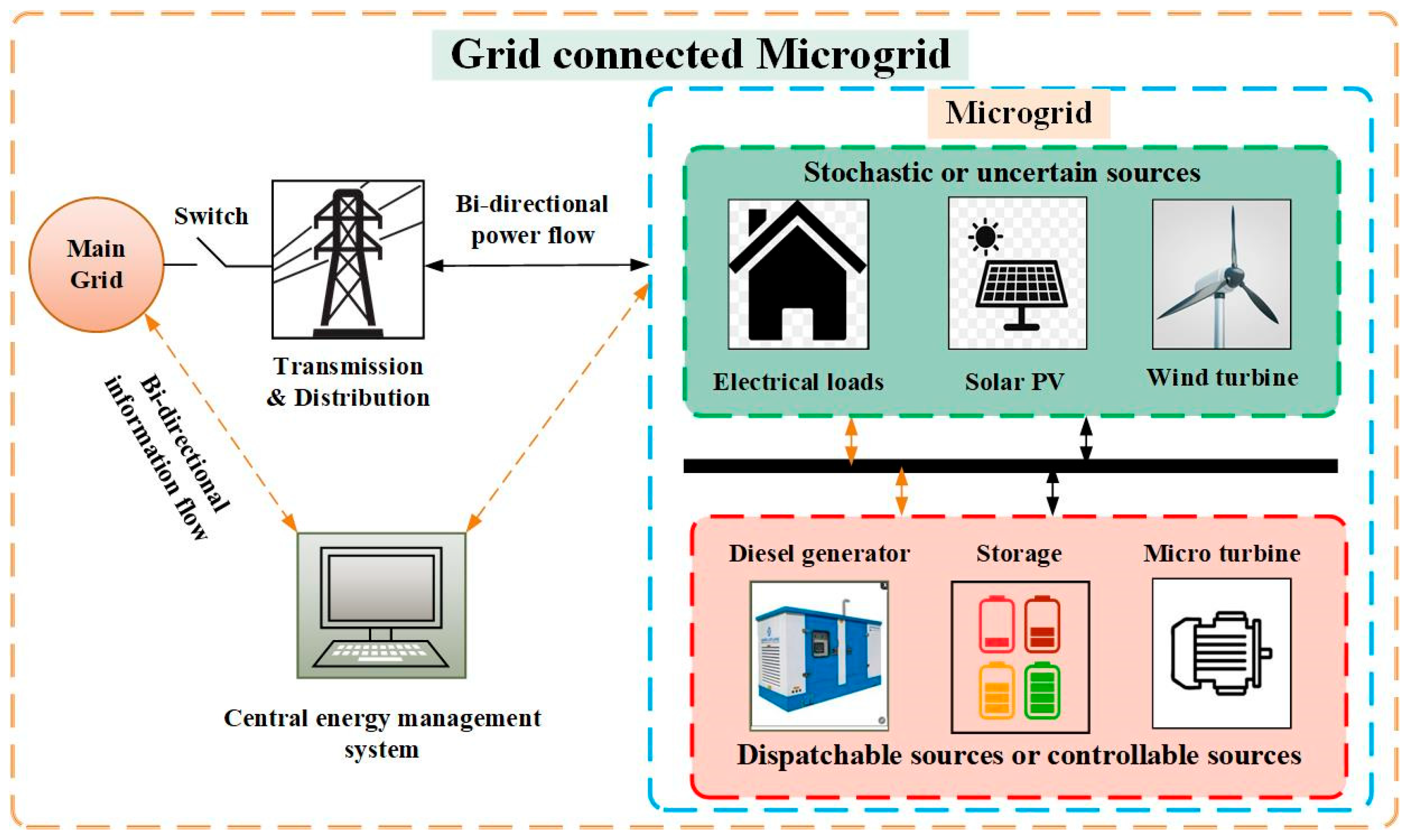
Figure 1. MG resources for energy management.
Wevj 17 00011 g001
Figure 2. Working of Sheep flock optimization.
Wevj 17 00011 g002
Figure 3. IEEE-33 bus system.
Wevj 17 00011 g003
Figure 4. Scenario generation and reduction for PV uncertainty.
Wevj 17 00011 g004
Figure 5. Scenario generation and reduction for wind uncertainty.
Wevj 17 00011 g005
Figure 6. Scenario generation and reduction for load uncertainty.
Wevj 17 00011 g006
Figure 7. Voltage profile of IEEE-33 bus system (base case).
Wevj 17 00011 g007
Figure 8. Voltage profile of the IEEE-33 bus system.
Wevj 17 00011 g008
Figure 9. Power loss at various buses in the IEEE-33 bus system.
Wevj 17 00011 g009
Figure 10. Load demand variation before and after EV penetration.
Wevj 17 00011 g010
Figure 11. Load profile and renewable generation.
Wevj 17 00011 g011
Figure 12. Grid and MG electricity price.
Wevj 17 00011 g012
Figure 13. Charge, discharge profiles, and grid exchange.
Wevj 17 00011 g013
Figure 14. (a) Dispatch schedule in kW, (b) operational cost of the MG.
Wevj 17 00011 g014
Figure 15. Total cost of the MG.
Wevj 17 00011 g015
Figure 16. Comparison curves of the proposed algorithm with existing algorithms.
Wevj 17 00011 g016
Figure 17. Arrival and departure schedules of EV.
Wevj 17 00011 g017
Figure 18. Charge and discharge profiles.
Wevj 17 00011 g018
Table 1. Cost coefficients and limits on sources [41].
Type of GenerationCost Coefficients in RupeesInequality Constraints
Z0Z1Z2Lower Limit in kWUpper Limit in kW
DG 10.0102100150
DG 20.02038050
DG 30.0151120150
PV---0250
Wind---0200
Table 2. Initialization of the ASFO algorithm.
ParameterNumber
Number of agents30
Maximum number of iterations100
Dimension 96 = 24 × 4
Table 3. Comparison of the proposed algorithm with existing algorithms.
AlgorithmFinal Total Cost (Rupees)Iterations to ConvergeRelative Computational Efficiency
Proposed LR&ASFO12,016.97 (133.59 USD)30High
GJO12,284.67 (136.57 USD)60Moderate
PSO12,358 (138.38 USD)45Moderate
ABC12,203 (135.66 USD)65Low
Whale Optimization12,111.13 (134.64 USD)70Low
GWO12,098.77 (134.57 USD)80Low
GD12,049.3 (133.98 USD)80Low
Disclaimer/Publisher’s Note: The statements, opinions and data contained in all publications are solely those of the individual author(s) and contributor(s) and not of MDPI and/or the editor(s). MDPI and/or the editor(s) disclaim responsibility for any injury to people or property resulting from any ideas, methods, instructions or products referred to in the content.