
COAu-IoD: A Cloud and Offline Computing-Assisted Authentication Framework for Lightweight UAV Communication in IoD


Abstract
1. Introduction
1.1. Our Result
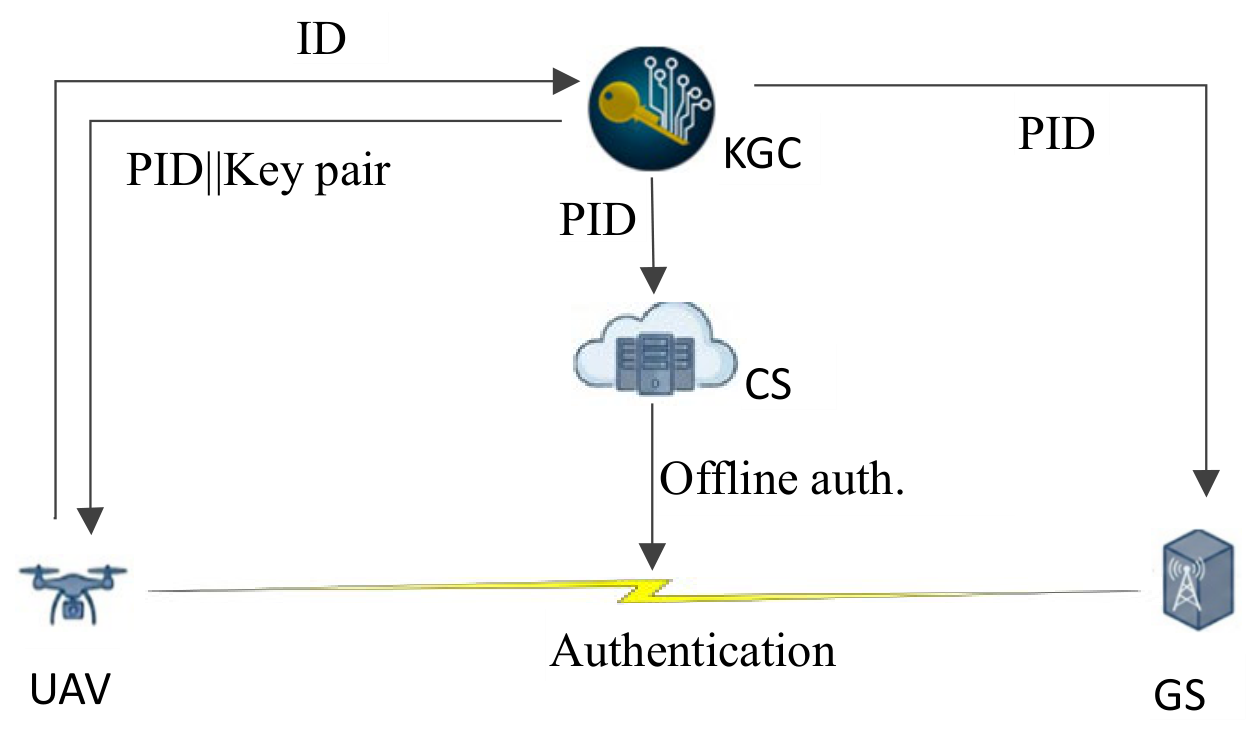
- New Authentication Framework for Achieving Lightweight UAV-to-GS Communication. This paper presents a novel framework for efficient authentication in the IoD system. Unlike conventional identity-based authentication architecture, the proposed model enables lightweight authentication via a different design. First, we adopt the offline precomputation in this model before the message is available and add a cloud server as an extra component to share authentication calculation with limited onboard resources. In addition, we formally define its authentication framework for UAV communication along with its corresponding security model. The framework separates cloud-side preauthorization and local offline verification. Even under the link outage, UAV-to-GS authentication can still proceed locally without requesting real-time responses from cloud or edge nodes.
- A Concrete Instantiation For Our Authentication Framework. Following the proposed offline and could-assisted authentication mechanism, this work presents an efficient instantiation along with rigorous security proofs based on a known identity-based digital signature. Our construction is far from the simple combination of our model and the signature scheme. Some complex authentication operations can be performed offline by distributed computing by the key generation center and cloud servers in this proposed construction. In addition, the UAV in our scheme only holds the partial component for online signing. Even if the UAV node is hijacked, the adversary cannot obtain the full long-term signing material, which reduces the damage scope of node compromise. What is more, by splitting secret credentials between the cloud and UAV, partial verification tasks are offloaded to the cloud, further mitigating the onboard computation and storage overhead of UAVs without leaking private information.
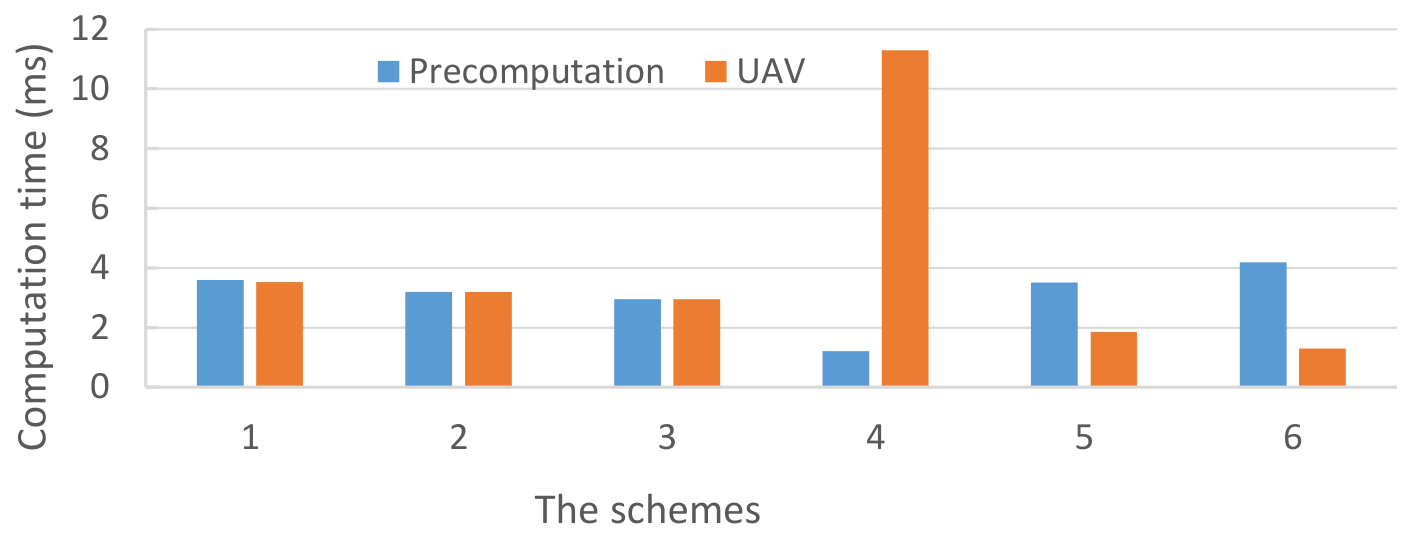
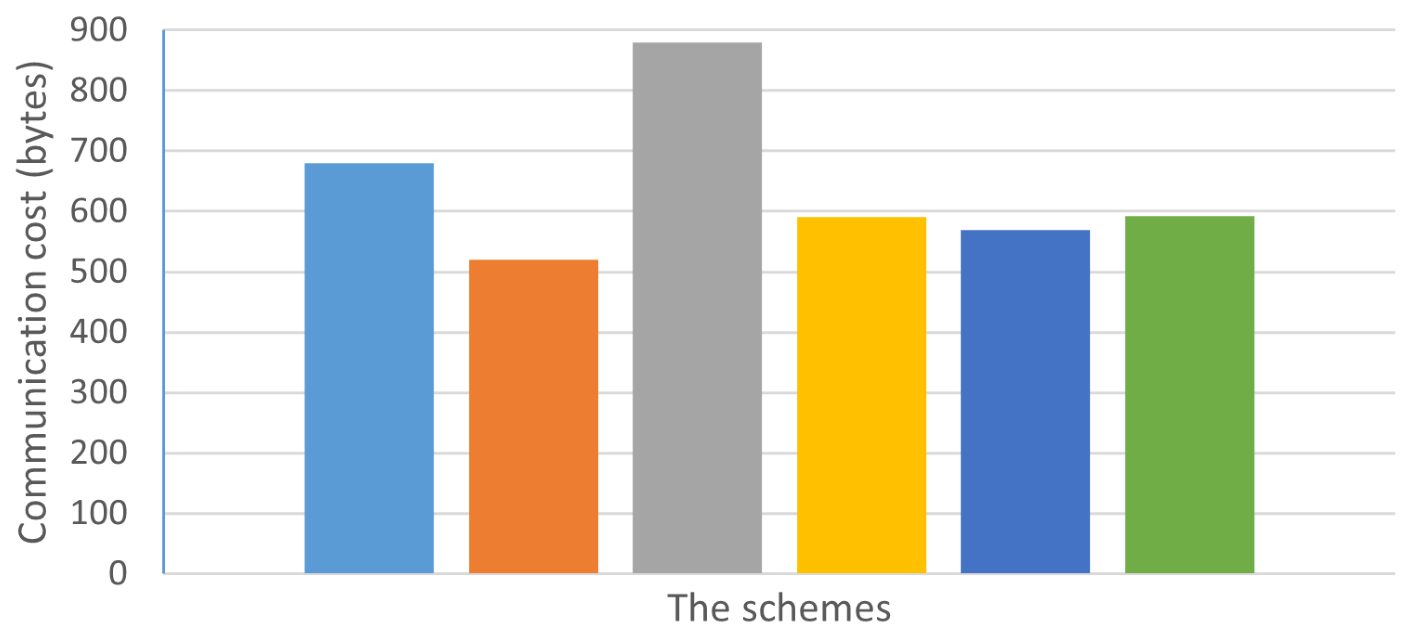
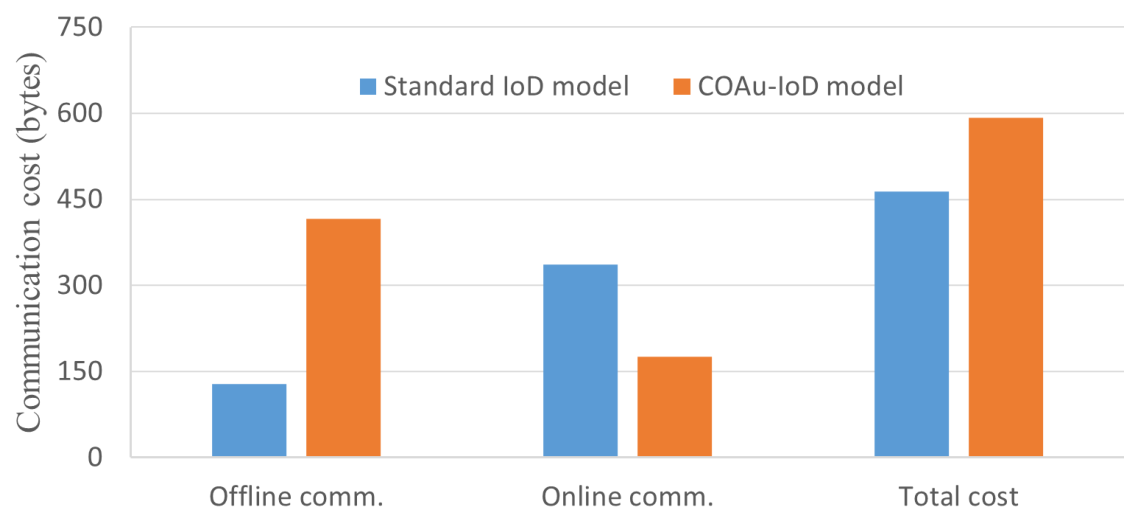
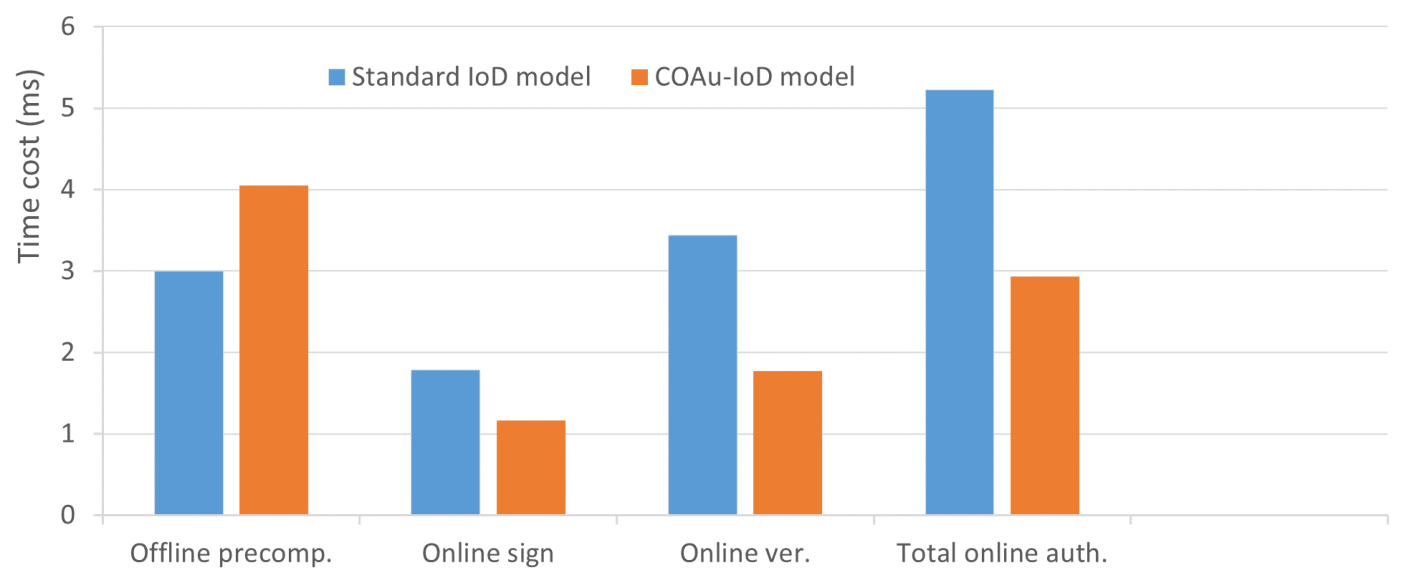
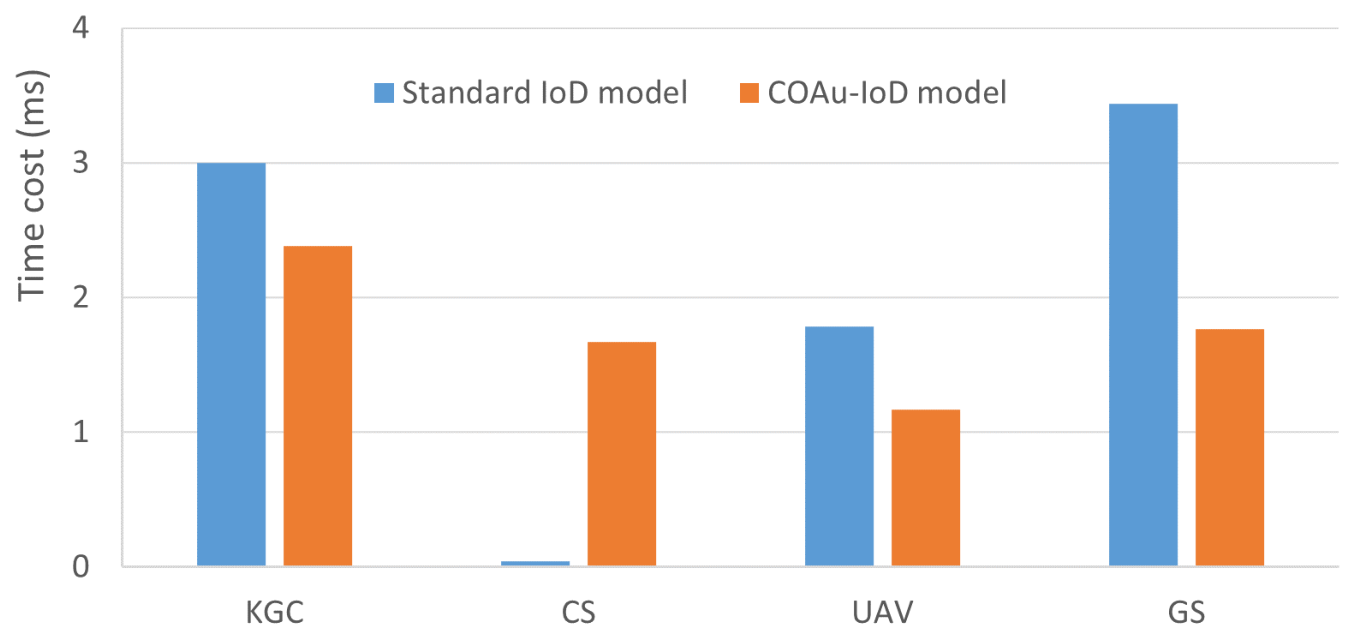
- Low Communication and Computation Overhead. The high efficiency of our scheme is inherently guaranteed by the designed model. Devices with limited resources only need to perform online computations after the authentication message is available. We compared the efficiency between the standard model and our proposed model. Both theoretical analysis and experimental results demonstrate that our authentication scheme achieves UAV-side lightweight online computation and communication overhead, at the expense of increased but acceptable offline and total costs, such as KGC’s processing and data storage.
1.2. Related Works
1.3. Organization
2. Preliminaries
2.1. Notations
2.2. System Model
- KGC. KGC serves as the trusted authority of the system and undertakes its initialization tasks. It generates global public parameters and the system master secret key. Prior to mission deployment, it distributes valid cryptographic key pairs to all authenticated entities, including GS and CS, via secure channels.
- GS. It acts as the local authentication authority and edge gateway, governing all UAVs within its communication coverage. Additionally, GS functions as a local command hub, delivering and forwarding control instructions to successfully authenticated UAVs.
- UAV. It functions as a mobile sensing and execution node with limited resources, including battery power, storage space, and computing capability. In the proposed model, each UAV serves as an online signer. It avoids performing computationally intensive cryptographic operations during flight, which guarantees low-latency communication with GS.
- CS. It acts as a high-performance offline auxiliary computing center with abundant storage and computational resources. Within the proposed framework, it is tasked with reducing the computational overhead of edge devices. Specifically, CS runs resource-heavy offline precomputation algorithms to generate preverified parameters, and functions as a verification cache for subsequent tasks.
2.3. Security Requirements
- Authentication. No unidentified drone shall be allowed to access the IoD network or send telemetry before legitimacy validation. The UAV and GS must perform an identity-based authentication handshake prior to mission execution. It enables the UAV to confirm its authorized status to the GS, and the flight control commands from the GS are only permitted post successful authentication.
- Anonymity. For authentication in IoD, anonymity refers to the protection of user identity against leakage. As a result, all the attackers, as well as GS, cannot establish a connection between flight data and the user identities.
- Traceability. If there is a UAV that was not certified or has transmitted a forged authentication message, KGC can trace this UAV’s original identity information.
2.4. Elliptic Curve Cryptography
- Point Addition. Let be two distinct points lying on elliptic curve E. Their group addition within yields the output point . The doubling operation, i.e., adding point P to itself in , is written as . Summing P and its inverse produces , the additive group identity element. Accordingly, the identity rule holds for any .
- Point Multiplication. Given a point and a positive scalar , the notation refers to iteratively adding P for times. This operation outputs another point belonging to E, where the scalar satisfies .
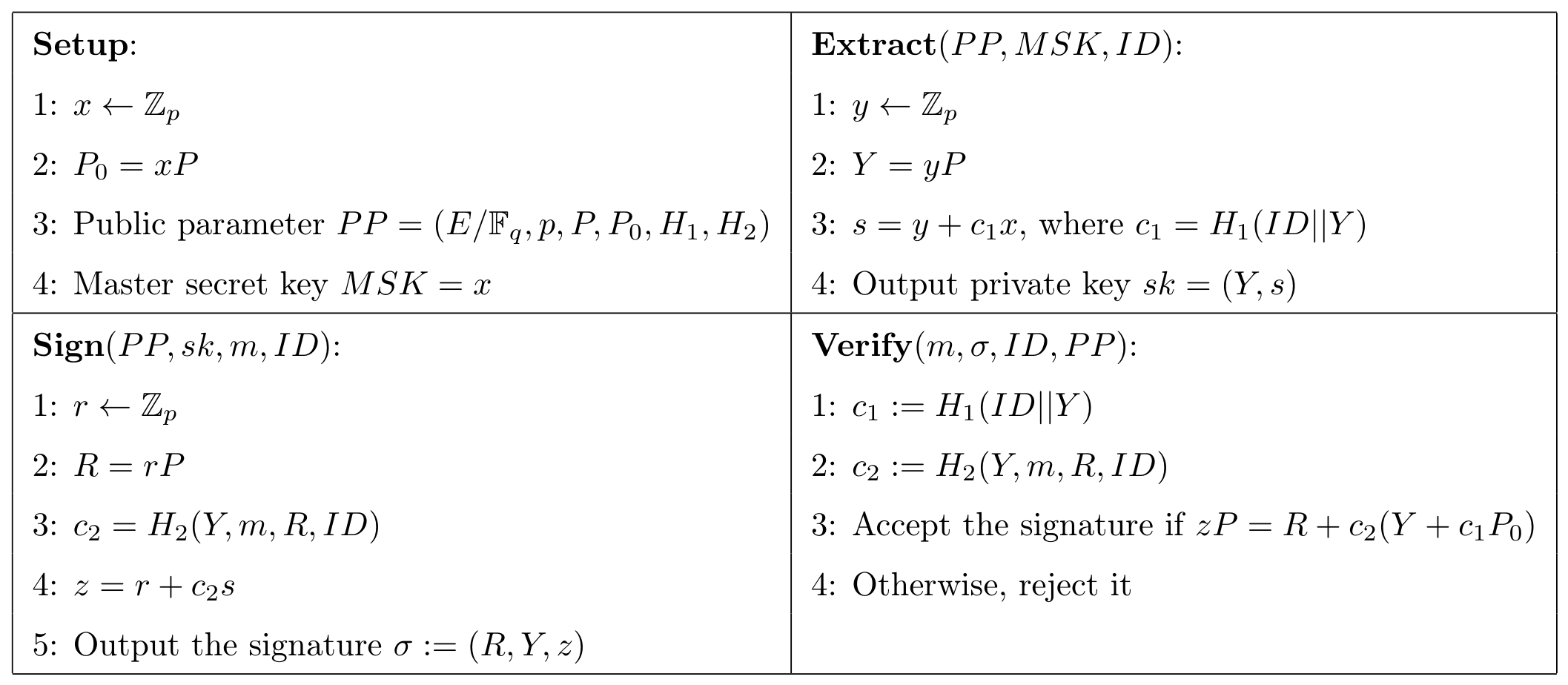
2.5. Identity-Based Signature Scheme BNN
3. Our Authentication Framework and Security Model
3.1. Definition of COAu-IoD
- Initialization (): The initialization algorithm takes as input the security parameter λ and the real identity of a UAV. It then produces the system public parameters , the master secret key , and the pseudonym ID (). This phase is executed by the trusted authority KGC. Consequently, in our proposed framework, it enables the KGC to trace malicious UAVs by recovering the original using the trapdoor mechanism.
- OffKeyExt (): The offline key extraction algorithm takes as input the pseudonym , , and . It then derives a credential pair, which consists of a key for CS and the signer’s private key for UAV. Where represents the partial component for distributed computing, while denotes the secret key for extracting the online signature. The KGC transmits to the CS, and sends to the signer UAV via secure channels.
- KGC-SignPre (): The offline precomputation phase for the signing algorithm is executed by KGC, takes as input the public parameters , and outputs the precalculated value Ω for the UAV-OnSign algorithm.
- CS-OffVer (): The CS-offline verification algorithm takes as input , , and the key . It then outputs the transition parameter ω intended for online verification. In this proposed model, the CS can perform this partial offline precomputation alongside the KGC, as this specific algorithm does not leak any private information. Furthermore, this process can be executed in advance, prior to the online signing phase.
- UAV-OnSign (): Once the authentication message is given, the UAV-online signing algorithm takes as input the authentication message m, the precalculated value Ω, the current timestamp T, the pseudonym , and the private key . It then computes and outputs the final signature σ for the authentication message m.
- GS-OnVer (): The GS-online verification algorithm takes as input the public parameters , pseudonym , the transition value ω, and the message-signature pair . Based on the verification result, the GS either accepts or rejects the authentication request initiated by the UAV.
3.2. Security Model
- Initialization Phase—the challenger runs the initialization algorithm to generate system parameters, and subsequently forwards these parameters to the adversary .
- Query Phase—the adversary executes the following queries in this phase:
- –
- Offline Preprocessing Queries: The adversary queries on precomputation of and . obtains and , then sends them to the adversary .
- –
- Private Key Queries: The adversary issues a private-key extraction query for a given pseudonym . In response, the challenger generates the corresponding secret key and delivers it to .
- –
- Partial Precomputation Replacement Queries: The adversary transmits the new precomputation of to . Then replaces the original with and transmits it to .
- –
- Signing Queries: The adversary submits a signing query for pseudonym with respect to the selected authentication message m. The challenger computes the corresponding signature and returns it to .
- Forgery Phase—after performing all the above queries, adversary outputs a forged tuple . wins the game if all the following conditions hold:
- –
- is a valid signature.
- –
- has never queried the signature on the tuple .
- –
- has never obtained the corresponding private key associated with via key queries.
3.3. Security Models for Other Features
- Setup: runs and generates public parameters and master secret key . Publish to .
- Phase 1: adaptively issues polynomial-bounded queries to oracles and .
- Challenge: outputs two distinct honest UAV identities which have never been queried to . samples , generates the corresponding pseudonym , computes challenge signature and sends to .
- Phase 2: continues oracle queries, while key extraction queries on and are forbidden.
- Guess: outputs bit . wins if .
- Setup: executes to obtain and , and sends to .
- Phase 1: adaptively invokes oracles and for polynomial times.
- Forgery: outputs a forgery tuple . The forgery is valid ifand is not obtained from .
- Trace Test: invokes trapdoor recovery algorithm . The adversary wins the game if the recovery outputs ⊥.
- Setup: runs and publishes .
- Phase 1: adaptively invokes oracle queries. is allowed to corrupt one UAV with pseudonym and obtain its private key .
- Forgery: outputs an authentication transcript for an uncorrupted target pseudonym . Adversary wins if all conditions below hold:
- –
- passes the verification algorithm;
- –
- corresponds to an honest and uncompromised UAV;
- –
- is not produced by the signing oracle.
- Setup: runs system initialization and sends to . Adversary corrupts cloud server and obtains cloud-side secret .
- Query Phase: may call , , and signing queries for honest UAV entities.
- Forgery: outputs a valid authentication transcript for some honest-UAV pseudonym . Adversary wins when the following apply:
- –
- is a valid transcript passing verification;
- –
- has not retrieved the UAV-side private key associated with ;
- –
- is not generated via the signing oracle.
4. The Construction
4.1. Formal Construction
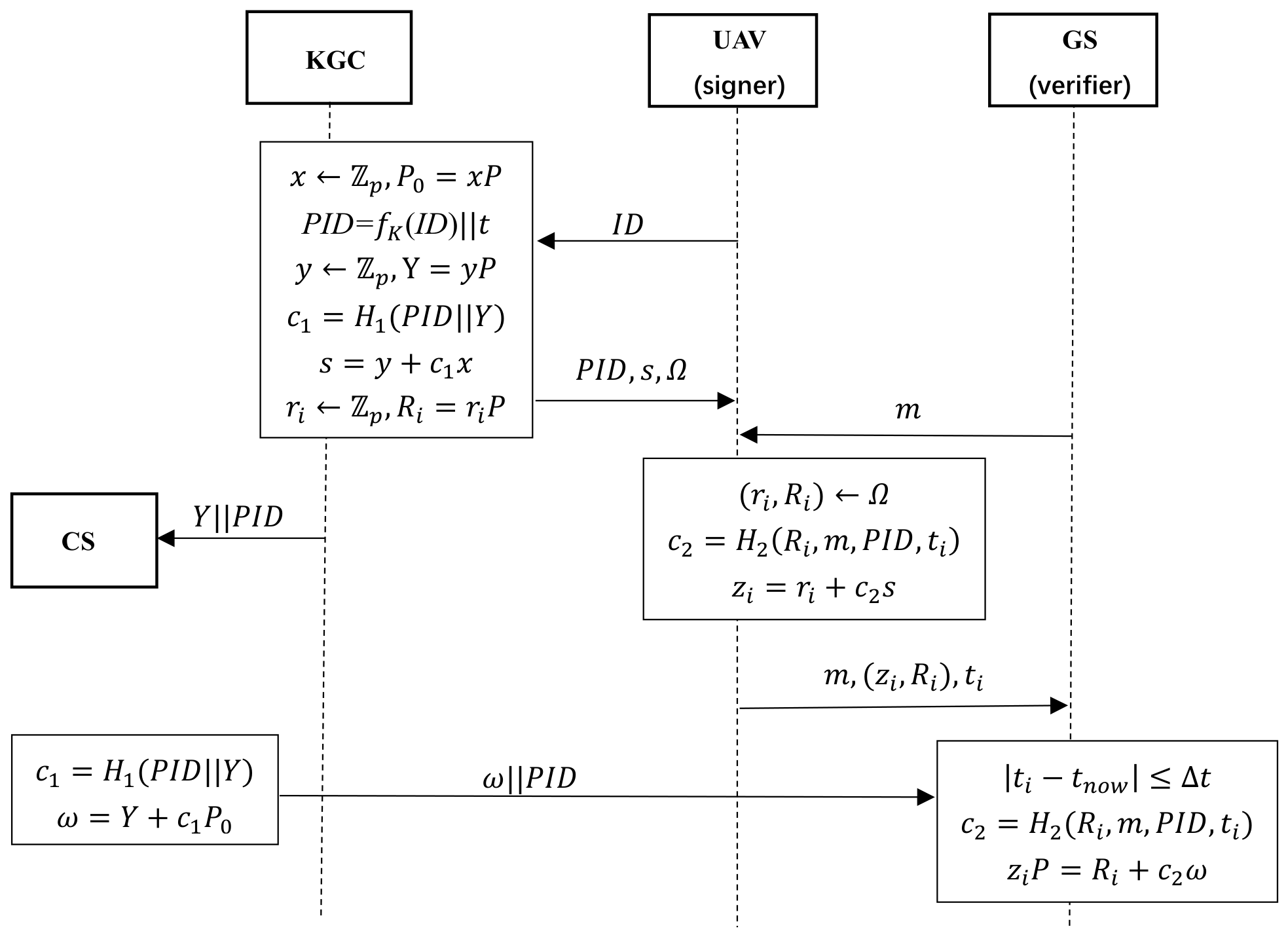
- Initialization ()—the KGC initializes the environment and generates the public parameters and the master secret key . Subsequently, a UAV submits its original to join the network and obtains a corresponding :
- The KGC selects the elliptic curve parameters as described in the preliminaries.
- It chooses two cryptographic hash functions, .
- The KGC randomly selects a master secret and computes the system public key .
- It sets the master secret key and publishes the public parameters
- The UAV registers with the system using its real identity .
- The KGC computes and assigns the pseudonym to the UAV, where t denotes the valid timestamp, is a secure one-way trapdoor function, and K is the trapdoor.
- OffKeyExt ()—for each authentication session or period, the KGC extracts the CS keys for verification and private keys for our authentication scheme:
- The KGC selects a random number .
- It computes the value , which acts as the public verification component for CS.
- It calculates and the secret value .
- Let , and , KGC then sends and to the UAV and CS respectively.
- Refreshing y for the same , the KGC can generate multiple valid key pairs.
- KGC-SignPre ()—before the authentication message becomes available, KGC can executes the offline signing phase of the authentication signature, as it does not involve the use of the private key:
- The KGC randomly chooses an ephemeral nonce r.
- It computes the ephemeral public key .
- The KGC repeats this process to generate a batch of precomputation and sends it to the corresponding UAV.
- CS-OffVer ()—before the verification and even the online signing phase, the CS executes partial verification computations to accelerate the online authentication process of GS:
- The CS computes the hash .
- It then calculates the transition value .
- The CS sends to GS for the online verification. This value acts as a preverified aggregated public key for the specific UAV.
- UAV-OnSign ()—once the authentication message m is ready, the UAV executes the online signing algorithm using the precomputed values and its private key :
- The UAV randomly chooses a pair from the set .
- For a current valid timestamp , the UAV computes the signature component , where .
- The UAV outputs the signature and sends it and to GS for a special of interval of time.
- GS-OnVer ()—upon receiving the request, GS first checks the freshness of the signature, then verifies its validness if it is fresh:
- The GS verifies whether , where is the maximum acceptable time delay, and is the arrival time of the signature. If , the signature is expired, then the authentication request is rejected. Otherwise, GS executes the following verifying phase.
- GS computes .
- GS accepts the authentication request if . Otherwise, it rejects the request.
4.2. Discussion of the COAu-IoD Scheme
- Cloud and Offline Precomputation Collaboration: Our COAu-IoD scheme proposed above innovatively combines cloud-assisted computation with offline precomputation, shifting heavy cryptographic operations to the preprocessing phase before authentication messages are available. Complex computations are offloaded to the KGC and CS, while resource-constrained UAVs only execute lightweight online signing after the real-time message and timestamp arrive. This design greatly cuts down online computational overhead on UAV onboard devices, which is critical for power-limited UAVs.
- Online Communication Cost Optimization: This framework achieves favorable online communication efficiency. As our proposed scheme is a cloud- and offline-computing-assisted authentication framework, it provides lightweight communication between a UAV and GS by transferring heavy communication overhead to the offline phase. Therefore, compared with the standard schemes that execute all cryptographic operations in the online phase, our proposed scheme can achieve lower online communication cost.
- Balance Between Privacy and Accountability: Our proposed scheme also balances identity privacy and accountability. Pseudonym identities PID are adopted for regular UAV communication to hide real-world identities. Meanwhile, the trapdoor mechanism retained by the KGC supports traceback toward malicious UAVs when security incidents occur, which satisfies the regulatory requirement for auditing misbehaving drones.
- KGC Assumption Constraints: For the KGC’s trust assumption, we divide it into two situations. If KGC is only curious and attempts to exploit unauthorized partial precomputation values and public parameters in place of legitimate ones. That is to say, it acts as a malicious entity in our defined security model; our scheme is still secure by our following Theorem 1. If KGC is completed and compromised and can make any attacks within its capacities, it can issue legitimate certificates and fake warnings or messages with valid signatures. At this point, relying solely on all cryptography-based schemes is completely ineffective. In such a worst-case scenario within IoD, the defense mechanism must transcend cryptographic verification and evolve into a trust-oriented evaluation framework. UAVs assess the credibility of each message source based on physical layers, including neighboring UAVs’ cooperative observations, GS-assisted validation, and track anomaly detection. Based on this assessment, suspicious messages are quarantined, and a distributed consensus among multiple UAVs and GS is reached to revoke the compromised KGC’s identity. In short, from a purely cryptographic perspective, we have to assume that KGC cannot be completely captured. But in practical IoD, UAVs and GS make judgments and responses relying on the trust management system of the whole network besides cryptography.
- Mutual Authentication: Our current scheme only supports one-way authentication. Future research could extend COAu-IoD to support bidirectional mutual authentication within large-scale UAV clusters. In the current framework, only one-way authentication from UAVs to the GS is realized, while direct peer-to-peer verification among UAV nodes is not covered. Enabling pairwise bidirectional authentication would allow UAVs to authenticate each other during collaborative swarm missions. Additionally, it is necessary to adapt the framework to highly dynamic IoD scenarios where UAVs frequently join and leave the network. Dynamic pseudonym update mechanisms should be designed to refresh PID credentials for active UAVs. This helps resist long-term identity tracing attacks and maintains system security when swarm membership changes frequently.
- Fog or Edge Computing for Our Scheme: Fog or edge computing does outperform cloud in terms of transmission latency. However, the role of cloud is not used for real-time computation in our proposed framework, but for offline preverification. Cloud has powerful computing and storage resources and is responsible for heavy computation, while UAV only needs lightweight verification. Moreover, fog or edge nodes are physically vulnerable. UAVs operate in hostile environments where edge nodes can be easily compromised or jammed. If we deploy an online/real-time edge-based authentication framework, the edge server becomes a single point of failure and a prime target for man-in-the-middle attacks. In conclusion, fog or edge computing may further reduce the communication latency of the proposed scheme, but it will be slightly insufficient in terms of storage capacity and security protection.
- Application Scenarios: Our COAu-IoD authentication scheme is best suited for regulated, mission-oriented scenarios such as military surveillance and public security, where flight paths are predictable, UAV fleets remain relatively stable, and centralized identity tracing by the KGC is acceptable. In these contexts, the offline precomputation mechanism effectively reduces online authentication overhead. However, the present scheme is ill-suited for dynamic application scenarios like urban logistics or air taxi services, where frequent handovers and unpredictable trajectories are essential. This is because our current scheme needs to generate a large number of precomputed values. Moreover, the frequent updates of credentials have further reduced the efficiency gains brought about by offline precomputation, making our current scheme a solution specifically for a certain field rather than a universal IoD authentication solution.
4.3. Discussion of the Offline Precomputed Values
- Distribution and Storage: The KGC produces precomputed intermediate values during the offline phase and delivers these values to authorized UAVs via GS within communication coverage. Each precomputed item is bound to its associated timestamp and pseudonym PID, guaranteeing consistency for subsequent authentication operations. Moreover, a hierarchical storage architecture is adopted: the PID mapping table and private key materials are safeguarded inside a hardware security module, while other precomputed data reside in ordinary flash memory maintained by either the KGC or CS. This design prevents excessive storage and delivery burdens from accumulating on one single central node.
- Freshness: The freshness of pre-computed items obeys PID pseudonym refresh policies, namely periodic fixed renewal and event-driven emergency refresh. Leveraging the offline precomputation design, the periodic refresh interval may be tuned to hundreds of seconds for various deployment scenarios. By contrast, emergency renewal events, including GS handover and security incidents, require a much shorter refresh interval. The refresh cycle might be relatively shorter.
- Reuse and Exhaustion: To prohibit unbounded reuse of precomputed values, our scheme adopts a PID replacement policy that compels UAVs to refresh pseudonyms periodically. Expired PIDs are normally revoked, unless traceability is invoked amid their valid term. Once malicious activity occurs, the KGC can retrieve the UAV’s true identity from relevant precomputed outputs for accountability. Each PID possesses a finite lifetime. Upon completing authentication with a UAV, the KGC produces and caches new PIDs to refill depleted resources and sustain continuous service operation.
4.4. Application
5. Security Analysis
5.1. Security Proof
5.2. Attack Models
- Replay Attacks: In our scheme, the hash computation for each communication session is inherently bound to the unique random number generated for the current session. Specifically, each generated signature embeds a dedicated timestamp and a session-specific nonce. Even if an adversary intercepts a valid signature, the intercepted signature will be discarded immediately in the subsequent communication round, as the adversary cannot acquire the fresh random number for a new session. Moreover, the adversary defined in our formal security model is endowed with replay attack capabilities, and the proposed scheme is formally proven resilient against such adversarial behaviors. In addition to the theoretical analysis, we also carry out a simulation experiment to validate the replay-attack resistance in the revised manuscript. The simulation was conducted on a workstation equipped with a Qualcomm Snapdragon 778 G processor, 8.0 GB + 2.0 GB RAM, and the Android 12 operating system. During the simulation, one communication session generates a fresh nonce and timestamp, and the UAV outputs a valid message-signature pair. The adversary captures this pair and replays it in the subsequent new session with a distinct nonce and timestamp. We set the timestamp valid time window to 5 s and run 1000 independent replay-attack trials. Experimental results show that all replayed expired message-signature pairs are rejected in the verification phase, and no replayed signature can pass verification. The experimental observation is consistent with our theoretical analysis, which provides practical evidence that our scheme can defend against replay attacks.
- Precomputation Reuse Attacks: The precomputation refresh mechanism is tied to the pseudonym PID replacement policy, under which UAVs are obligated to renew their PIDs periodically. Once a PID expires, both the pseudonym and its associated precomputed materials will be revoked, except when the traceability function is activated within its valid lifecycle. In addition, precomputed items carrying invalid timestamps will be rejected by the system.
- Sybil Attacks: In our proposed scheme, any adversarial entity or untrusted curious KGC is prohibited from generating fake identities via illegal precomputed data. As formally verified by the established security model, the proposed scheme can effectively defend against Sybil attacks launched by such adversaries. Benefiting from the hardness of the ECDLP, our protocol possesses inherent resistance to Sybil impersonation threats in drone network authentication scenarios.
5.3. Security Objectives Analysis
- Authentication: It fundamentally relies on the security proof of the above Theorem 1. With a tight security reduction to ECDLP, we prove that impersonating a legitimate UAV is computationally infeasible. In particular, an adversary who does not possess the legitimate secret signing key cannot forge a valid message-signature pair with non-negligible probability. In practical deployment, GS nodes are physically safeguarded and stationary, making direct compromise extremely hard. Since GS authentication follows the same cryptographic logic as UAV authentication, preventing unauthenticated drones from passing verification is sufficient to protect the authentication process in this scheme.
- Anonymity: In our proposed scheme, authentication is conducted using a generated rather than the original real identity. is indistinguishable across different communication sessions and discloses no valid identity information of the UAV. Since adversaries cannot recover the original identity from such pseudonyms, they are unable to link a UAV to its historical activities. Furthermore, any identity inquiry received by a UAV will be directly rejected, as only KGC is authorized to initiate legitimate identity queries. Consequently, neither external adversaries nor GS can compromise the UAV’s identity privacy under our scheme. For illustration, suppose a UAV transmits telemetry message at time under pseudo-identity and corresponding private key . When the same physical UAV later receives navigation instruction at time , it has already switched to an unrelated pseudo-identity with key . From the perspective of a passive eavesdropper, these two sessions appear to involve completely distinct devices, rendering session linkage computationally impossible. According to the security model of conditional anonymity, only pseudonym rather than real identity is exposed in signature and communication payloads. The real identity is only bounded inside KGC via the trapdoor mechanism. Without master secret , the adversary cannot invert to retrieve . The distribution of challenge signature is statistically indistinguishable for and , yielding negligible anonymity advantage. That is to say, for all PPT adversaries , is negligible.
- Traceability: Suppose a UAV disseminates malicious messages throughout COAu-IoD. When GS verifies these messages, it submits a report to KGC within its communication range. KGC then looks up the corresponding of this UAV in its local database. If the is registered, KGC leverages the secret key to retrieve the real identity of the malicious UAV. Afterwards, it revokes the UAV’s registration and broadcasts the revocation information to the entire IoD. Therefore, the proposed scheme achieves traceability for UAV communications. According to the security of conditional traceability, each pseudonym is deterministically bound to one real UAV identity in the initialization phase. A valid signature passing verification must carry a system-valid . If an adversary produces a valid signature whose cannot be recovered to , it implies breaking the underlying trapdoor primitive. That is ti say, for every PPT adversary , is negligible. Thus traceability holds under the trapdoor security assumption.
6. Performance Analysis
6.1. Communication Cost
6.2. Computation Cost
6.3. Comparison with Other Schemes
7. Conclusions
Author Contributions
Funding
Data Availability Statement
Conflicts of Interest
References
- Jain, A.; Barke, S.; Garg, M.; Gupta, A.; Narwal, B.; Mohapatra, A.K.; Sharma, D.K.; Srivastava, G. A walkthrough of blockchain-based internet of drones architectures. IEEE Internet Things J. 2024, 11, 34924–34940. [Google Scholar] [CrossRef] [Scilit]
- Chen, X.; Sheng, M.; Li, B.; Zhao, N. Survey on unmanned aerial vehicle communications for 6G. J. Electron. Inf. Technol. 2022, 44, 781–789. [Google Scholar]
- Zhang, P.; Chen, S.; Zheng, X.; Li, P.; Wang, G.; Wang, R.; Wang, J.; Tan, L. Uav communication in space-air-ground integrated networks (sagins): Technologies, applications, and challenges. Drones 2025, 9, 108. [Google Scholar] [CrossRef] [Scilit]
- Singh, M.; Aujla, G.S.; Bali, R.S. A deep learning-based blockchain mechanism for secure internet of drones environment. IEEE Trans. Intell. Transp. Syst. 2020, 22, 5404–5413. [Google Scholar] [CrossRef] [Scilit]
- Bera, B.; Saha, S.; Das, A.K.; Kumar, N.; Lorenz, P.; Alazab, M. Blockchain-envisioned secure data delivery and collection scheme for 5g-based iot-enabled internet of drones environment. IEEE Trans. Veh. Technol. 2020, 69, 9097–9111. [Google Scholar] [CrossRef] [Scilit]
- Tian, C.; Ma, J.; Li, T.; Zhang, J.; Ma, C.; Xi, N. Provably and physically secure uav-assisted authentication protocol for iot devices in unattended settings. IEEE Trans. Inf. Forensics Secur. 2024, 19, 3452–3466. [Google Scholar] [CrossRef] [Scilit]
- Yang, W.; Ma, C.; Wang, S.; Wu, S.; Yang, X. A lightweight authentication scheme with dynamic management for uavs in agriculture and food industries. IEEE Internet Things J. 2025, 12, 49221–49232. [Google Scholar] [CrossRef] [Scilit]
- Xie, M.; Chang, Z.; Li, H.; Min, G. Basuv: A blockchain-enabled uav authentication scheme for internet of vehicles. IEEE Trans. Inf. Forensics Secur. 2024, 19, 8359–8373. [Google Scholar] [CrossRef] [Scilit]
- Zhang, H.; Huang, N.; Ding, J.; Hang, Q. Natural physical adversarial attack method for uav visual recognition system. J. Cyber Secur. 2025, 10, 77–91. [Google Scholar]
- He, D.; Chan, S.-H.G.; Guizani, M. Communication security of unmanned aerial vehicles. IEEE Wirel. Commun. 2016, 24, 134–139. [Google Scholar] [CrossRef] [Scilit]
- Wazid, M.; Das, A.K.; Kumar, N.; Vasilakos, A.V.; Rodrigues, J.J. Design and analysis of secure lightweight remote user authentication and key agreement scheme in internet of drones deployment. IEEE Internet Things J. 2018, 6, 3572–3584. [Google Scholar] [CrossRef] [Scilit]
- Alquwayzani, A.A.; Albuali, A.A. A systematic literature review of zero trust architecture for military uav security systems. IEEE Access 2024, 12, 176033–176056. [Google Scholar] [CrossRef] [Scilit]
- Li, Y.; Dai, J.; Zhu, S. Resource allocation in uav edge computing communication system. In Proceedings of the 2024 10th International Conference on Computer and Communications (ICCC), Chengdu, China, 13–16 December 2024; pp. 2521–2526. [Google Scholar]
- Hassija, V.; Saxena, V.; Chamola, V. Scheduling drone charging for multi-drone network based on consensus time-stamp and game theory. Comput. Commun. 2020, 149, 51–61. [Google Scholar] [CrossRef] [Scilit]
- Ali, I.; Li, J.; Chen, J.; Chen, Y.; Ullah, S.; Khan, S. Ioosc-u2g: An identity-based online/offline signcryption scheme for unmanned aerial vehicle to ground station communication. IEEE Internet Things J. 2024, 11, 29941–29955. [Google Scholar] [CrossRef] [Scilit]
- Yu, S.; Das, A.K.; Park, Y. Rlba-uav: A robust and lightweight blockchain-based authentication and key agreement scheme for puf-enabled uavs. IEEE Trans. Intell. Transp. Syst. 2024, 25, 21697–21708. [Google Scholar] [CrossRef] [Scilit]
- Zhang, J.; Chen, X.; Cheng, Q.; Chen, X.; Luo, X. An enhanced certificateless blockchain-assisted authentication and key agreement protocol for internet of drones. IEEE Trans. Netw. Sci. Eng. 2025, 12, 3065–3081. [Google Scholar] [CrossRef] [Scilit]
- Yoon, K.; Park, J.; Kim, D.; Kim, H. Security authentication system using encrypted channel on uav network. In Proceedings of the 2017 First IEEE International Conference on Robotic Computing (IRC), Taichung, Taiwan, 10–12 April 2017; pp. 393–398. [Google Scholar]
- Verma, G.K.; Singh, B.; Kumar, N.; He, D. Cb-ps: An efficient short-certificate-based proxy signature scheme for uavs. IEEE Syst. J. 2019, 14, 621–632. [Google Scholar] [CrossRef] [Scilit]
- Bansal, G.; Naren, N.; Chamola, V.; Sikdar, B.; Kumar, N.; Guizani, M. Lightweight mutual authentication protocol for v2g using physical unclonable function. IEEE Trans. Veh. Technol. 2020, 69, 7234–7246. [Google Scholar] [CrossRef] [Scilit]
- Chatterjee, B.; Das, D.; Maity, S.; Sen, S. Rf-puf: Enhancing iot security through authentication of wireless nodes using in-situ machine learning. IEEE Internet Things J. 2018, 6, 388–398. [Google Scholar] [CrossRef] [Scilit]
- Alladi, T.; Gera, B.; Chamola, V.; Guizani, M. Parth: A two-stage lightweight mutual authentication protocol for uav surveillance networks. Comput. Commun. 2020, 160, 81–90. [Google Scholar] [CrossRef] [Scilit]
- Alladi, T.; Bansal, G.; Chamola, V.; Guizani, M. Secauthuav: A novel authentication scheme for uav-ground station and uav-uav communication. IEEE Trans. Veh. Technol. 2020, 69, 15068–15077. [Google Scholar] [CrossRef] [Scilit]
- Bansal, G.; Sikdar, B. Achieving secure and reliable uav authentication: A shamir’s secret sharing based approach. IEEE Trans. Netw. Sci. Eng. 2024, 11, 3598–3610. [Google Scholar] [CrossRef] [Scilit]
- Jangirala, S.; Das, A.K.; Kumar, N.; Rodrigues, J.J. Tcalas: Temporal credential-based anonymous lightweight authentication scheme for internet of drones environment. IEEE Trans. Veh. Technol. 2019, 68, 6903–6916. [Google Scholar] [CrossRef] [Scilit]
- Ali, Z.; Chaudhry, S.A.; Ramzan, M.S.; Al-Turjman, F. Securing smart city surveillance: A lightweight authentication mechanism for unmanned vehicles. IEEE Access 2020, 8, 43711–43724. [Google Scholar] [CrossRef] [Scilit]
- Lin, L.; Shangguan, R.; Ge, H.; Liu, Y.; Zhou, Y.; Zhou, Y. Mutual identity authentication based on dynamic identity and hybrid encryption for UAV–GCS Communications. Drones 2025, 9, 422. [Google Scholar] [CrossRef] [Scilit]
- Wani, A.R.; Gupta, S.K.; Khanam, Z.; Rashid, M.; Alshamrani, S.S.; Baz, M. A novel approach for securing data against adversary attacks in UAV embedded HetNet using identity based authentication scheme. IET Intell. Transp. Syst. 2023, 17, 2171–2189. [Google Scholar] [CrossRef] [Scilit]
- Yang, J.; Shi, R.; Wang, P.; Zhang, Y. Lattice-based on line/offline cross-domain authentication scheme in vehicle-to-grid network. IEEE Trans. Depend. Secur. Comput. 2026, 23, 6196–6211. [Google Scholar] [CrossRef] [Scilit]
- Semal, B.; Markantonakis, K.; Akram, R.N. A certificateless group authenticated key agreement protocol for secure communication in untrusted uav networks. In Proceedings of the 2018 IEEE/AIAA 37th Digital Avionics Systems Conference (DASC), London, UK, 23–27 September 2018; pp. 1–8. [Google Scholar]
- Bellare, M.; Namprempre, C.; Neven, G. Security proofs for identity-based identification and signature schemes. J. Cryptol. 2009, 22, 1–61. [Google Scholar] [CrossRef] [Scilit]
- Boldyreva, A.; Palacio, A.; Warinschi, B. Secure proxy signature schemes for delegation of signing rights. J. Cryptol. 2012, 25, 57–115. [Google Scholar] [CrossRef] [Scilit]
- Tajammul, M.; Shariq, M.; Rawat, G.S.; Dwivedi, S.K.; Masud, M.; Jamil, N. A secure and reliable privacy-preserving authentication protocol for UAV–UAV communications in IoT systems. IEEE Trans. Dependable Secur. Comput. 2026, 23, 8489–8500. [Google Scholar] [CrossRef] [Scilit]
- Zhang, Y.; Meng, L.; Gan, J.; Huang, Z. A novel and efficient authentication scheme based on UAV-UAV environment. Wirel. Commun. Mob. Comput. 2023, 1, 7107015. [Google Scholar] [CrossRef] [Scilit]
- Karmakar, R.; Kaddoum, G.; Akhrif, O. A PUF and fuzzy extractor-based UAV-ground station and UAV-UAV authentication mechanism with intelligent adaptation of secure sessions. IEEE Trans. Mob. Comput. 2023, 23, 3858–3875. [Google Scholar] [CrossRef] [Scilit]
- Huang, K.; Hu, H.; Lin, C. BAKAS-UAV: A secure blockchain-assisted authentication and key agreement scheme for unmanned aerial vehicles networks. IEEE Internet Things J. 2024, 22, 36858–36883. [Google Scholar] [CrossRef] [Scilit]
- Tanveer, M.; Aldosary, A.; Kumar, N.; Aldossari, S.A. SEAF-IOD: Secure and efficient user authentication framework for the Internet of Drones. Comput. Netw. 2024, 247, 110449. [Google Scholar] [CrossRef] [Scilit]
- Chen, Z.; Ren, Z.; Li, X.; Zhang, Z.; Wang, Y.; Deng, R.H. Efficient one-to-many authentication with intelligent illegal request identification for uav networks. IEEE Trans. Inf. Forensics Secur. 2025, 20, 12173–12187. [Google Scholar] [CrossRef] [Scilit]
- de Jesus Sousa, M.; Gondim, P.R.L.; Sendra, S.; Lloret, J. Authentication protocol for the internet of drones with fog computing based on aggregate signatures for forest inventory. Ad Hoc Netw. 2026, 181, 104034. [Google Scholar] [CrossRef] [Scilit]





| Notations | Descriptions |
|---|---|
| KGC | Key generation center |
| GS | Ground station |
| CS | Cloud server |
| Original identity | |
| Pseudonym identity | |
| Cyclic additive group of prime order q | |
| m | Authentication message |
| Generated signature | |
| Timestamp | |
| Public system parameter | |
| Cryptographic hash functions | |
| Private key of a UAV for online signing | |
| Ring of integers modulo p | |
| x is uniformly sampled from |
| Category | Configuration |
|---|---|
| Hardware platform | device: Qualcomm Snapdragon 778 G |
| Memory: 8.0 GB + 2.0 GB RAM | |
| System: Android 12 | |
| Software environment | Programming language: Java |
| Cryptographic library: JPBC library-2.0.0 | |
| Cryptographic setup | Security level: Uniform 128-bit security |
| Elliptic curve: | |
| Statistical experimental settings | Repeats per primitive operation: 10 times |
| Iterations per run: 100 iterations | |
| Reported metric: Mean value with confidence interval |
| Items | Standard Model | COAu-IoD Model |
|---|---|---|
| Offline comm. cost | ||
| Online comm. cost | ||
| Total cost |
| Items | Standard IoD | COAu-IoD |
|---|---|---|
| KGC precomp. | ||
| CS offline pre-ver. | 0 | |
| UAV online signing. | ||
| GS online ver. | ||
| Total online auth. |
| Feature | [33] | [34] | [35] | [36] | [37] | Ours |
|---|---|---|---|---|---|---|
| UAV/IoD | UAV | UAV | UAV | UAV | IoD | IoD |
| IBC | YES | NO | NO | NO | NO | YES |
| Offline | NO | NO | NO | NO | YES | YES |
| Cloud/Edge | NO | NO | NO | NO | NO | Cloud |
| Mutual | YES | YES | YES | YES | YES | NO |
| Anonymity | YES | NO | YES | YES | YES | YES |
| Traceability | YES | NO | NO | NO | NO | YES |
| Replay attack | YES | YES | NO | YES | YES | YES |
| Batch Verification | NO | NO | NO | YES | NO | NO |
Disclaimer/Publisher’s Note: The statements, opinions and data contained in all publications are solely those of the individual author(s) and contributor(s) and not of MDPI and/or the editor(s). MDPI and/or the editor(s) disclaim responsibility for any injury to people or property resulting from any ideas, methods, instructions or products referred to in the content. |
© 2026 by the authors. Licensee MDPI, Basel, Switzerland. This article is an open access article distributed under the terms and conditions of the Creative Commons Attribution (CC BY) license.
Share and Cite
Zhang, P.; Fu, C.; Zhang, Q. COAu-IoD: A Cloud and Offline Computing-Assisted Authentication Framework for Lightweight UAV Communication in IoD. Future Internet 2026, 18, 488. https://doi.org/10.3390/fi18090488
Zhang P, Fu C, Zhang Q. COAu-IoD: A Cloud and Offline Computing-Assisted Authentication Framework for Lightweight UAV Communication in IoD. Future Internet. 2026; 18(9):488. https://doi.org/10.3390/fi18090488
Chicago/Turabian StyleZhang, Pingyuan, Chen Fu, and Qikun Zhang. 2026. "COAu-IoD: A Cloud and Offline Computing-Assisted Authentication Framework for Lightweight UAV Communication in IoD" Future Internet 18, no. 9: 488. https://doi.org/10.3390/fi18090488
APA StyleZhang, P., Fu, C., & Zhang, Q. (2026). COAu-IoD: A Cloud and Offline Computing-Assisted Authentication Framework for Lightweight UAV Communication in IoD. Future Internet, 18(9), 488. https://doi.org/10.3390/fi18090488