1. Introduction
Money Laundering (ML) continues to be a significant global financial crime, with the United Nations Office on Drugs and Crime (UNODC) estimating that the amount of money laundered represents 2% to 5% of the world’s annual GDP. Anti-Money Laundering (AML) laws mandate that financial institutions conduct thorough Customer Due Diligence (CDD), which heavily depends on validating documents such as passports and bank statements [
1,
2]. Nevertheless, the emergence of sophisticated digital editing tools and high-quality physical overlays has resulted in an increase in advanced forged documents intended to bypass both human reviewers and typical automated systems [
3,
4].
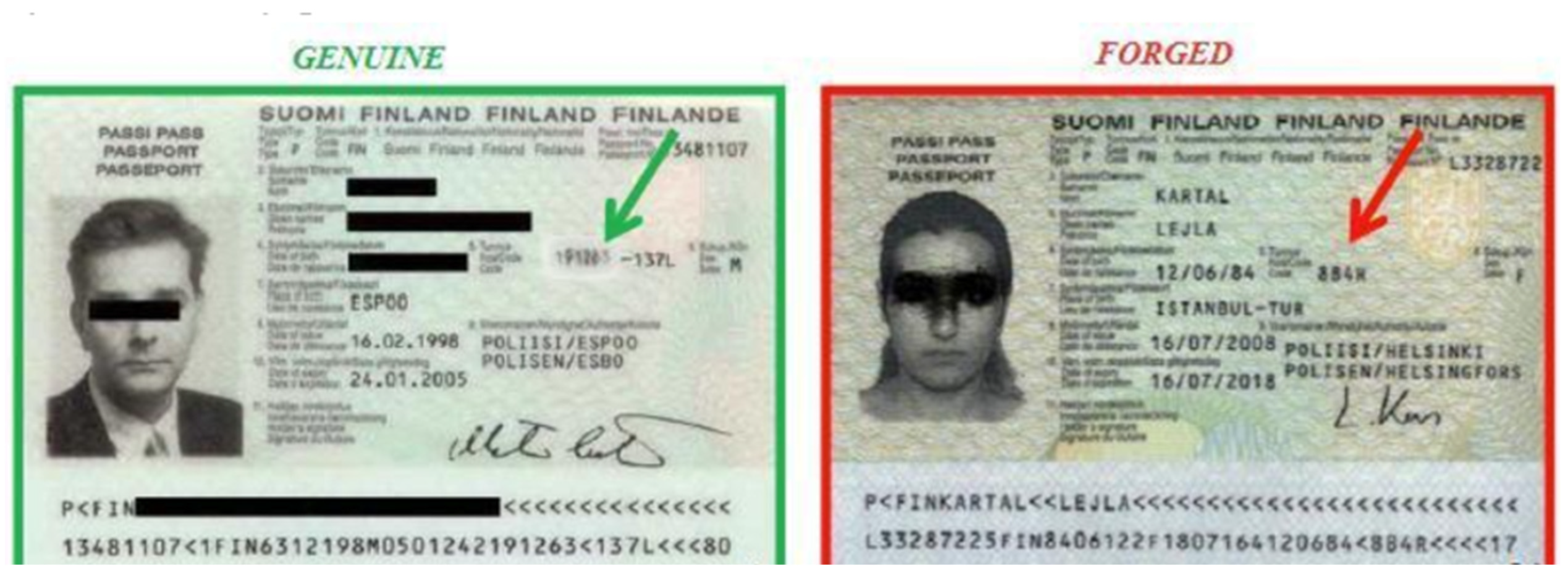
Figure 1 shows a counterfeit example of identity document forgery obtained from KYC AML Guide [
5].
Know Your Customer (KYC) refers to the identity verification procedures performed by financial institutions during customer onboarding and account monitoring processes. KYC workflows typically require validation of identity documents such as passports, national identification cards, and financial records to ensure customer legitimacy and regulatory compliance. The increasing adoption of remote digital onboarding has further intensified the need for reliable automated document authentication systems capable of detecting sophisticated forged identity documents under uncontrolled imaging conditions.
From a network-technology perspective, remote AML/KYC onboarding is itself a networked service: document images are typically captured on a customer-owned mobile device, transmitted over cellular or Wi-Fi networks to a financial institution’s verification backend, and processed either in the cloud or, increasingly, at the network edge to reduce round-trip latency and limit the exposure of sensitive identity data in transit. These deployment constraints, bandwidth-limited mobile uplinks, variable network latency, and the preference for edge or on-premise inference over centralized GPU clusters for data-sovereignty reasons directly motivate the design goals pursued in this study. A CPU-only, sub-millisecond-inference authentication model is not only computationally convenient but is also better suited to being embedded directly within edge nodes, API gateways, or lightweight microservices in a distributed KYC verification network, where round-trip calls to a remote deep-learning inference server would add latency and network dependency to the onboarding pipeline. This framing situates the proposed framework within the broader network-technology considerations relevant to distributed, latency-sensitive, and bandwidth-constrained financial-service infrastructures.
Traditional verification techniques, including manual visual inspection and rule-based digital evaluation, are increasingly ineffective against sophisticated forged identity documents. Human reviewers are susceptible to fatigue-related errors, while static rule-based systems often fail to detect subtle post-production manipulations such as resized text regions, shifted typography, or digitally smoothed alterations [
6,
7].
To address these limitations, this study proposes an interpretable document authentication framework that combines handcrafted forensic feature extraction, OCR-based semantic analysis, rule-based semantic field extraction and Random Forest classification to detect physical and logical inconsistencies within identity documents captured under realistic AML/KYC onboarding conditions [
4,
8,
9].
3. Proposed Solution
3.1. Proposed System Overview
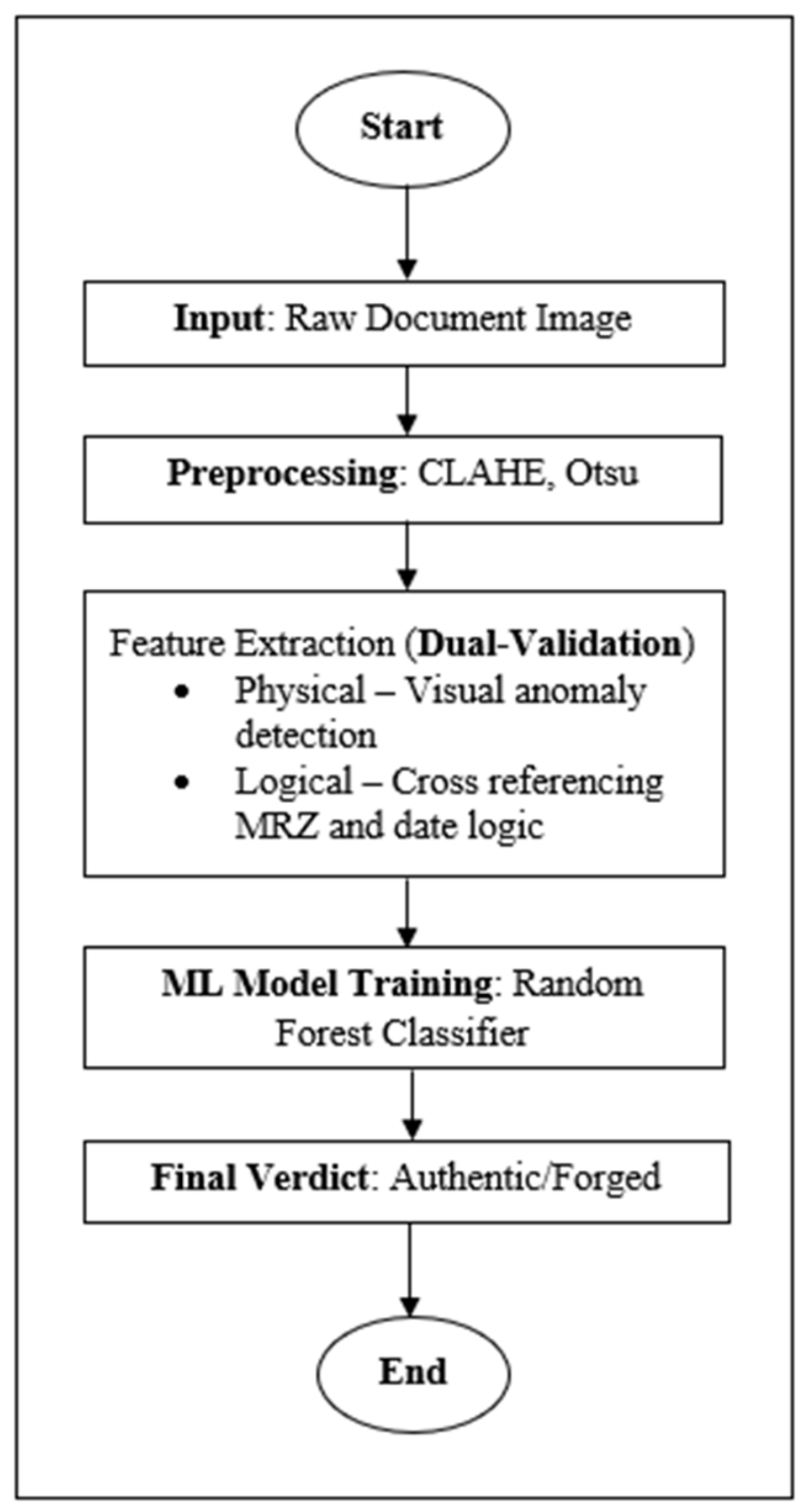
The proposed framework shown in
Figure 2 presents a forensic document authentication pipeline that emphasizes internal pixel-level consistency analysis rather than external database verification. The framework integrates handcrafted forensic feature extraction, OCR-driven semantic analysis, and machine learning classification to identify subtle document manipulations such as geometric inconsistencies, typography distortions, and localized texture anomalies commonly observed in forged identity documents [
4,
9]. This design enables interpretable and lightweight document verification suitable for AML/KYC onboarding environments operating under realistic mobile capture conditions.
3.2. Forensic Data Preprocessing and Normalization
3.2.1. Contrast Enhancement and Binarization
The core of the system consists of a preprocessing and normalization pipeline for forensic data, specifically designed to manage the significant variability of mobile images found in the MIDV-2020 dataset [
33]. The system employs Contrast Limited Adaptive Histogram Equalization (CLAHE) to adjust illumination and emphasize subtle features in text ink, followed by Otsu’s Binarization to isolate text from intricate background patterns [
11]. This phase is crucial for stabilizing inputs that may exhibit motion blur, perspective distortions, or different lighting conditions commonly encountered during digital AML onboarding in real-world scenarios [
9].
Contrast Limited Adaptive Histogram Equalization (CLAHE) was selected instead of conventional global histogram equalization because identity document images captured under mobile AML onboarding conditions frequently exhibit localized lighting inconsistencies, glare, and shadowing. Unlike standard histogram equalization, which may excessively amplify background noise and distort fine textual regions, CLAHE performs localized contrast enhancement while limiting over-amplification through adaptive clipping thresholds [
4]. This improves the visibility of forensic indicators such as character boundaries and texture inconsistencies while preserving document structure under varying capture conditions.
3.2.2. Resolution Standardization
All varied inputs, including passports and financial documents, are converted to a consistent 224 × 224 resolution in a three-channel RGB format [
19,
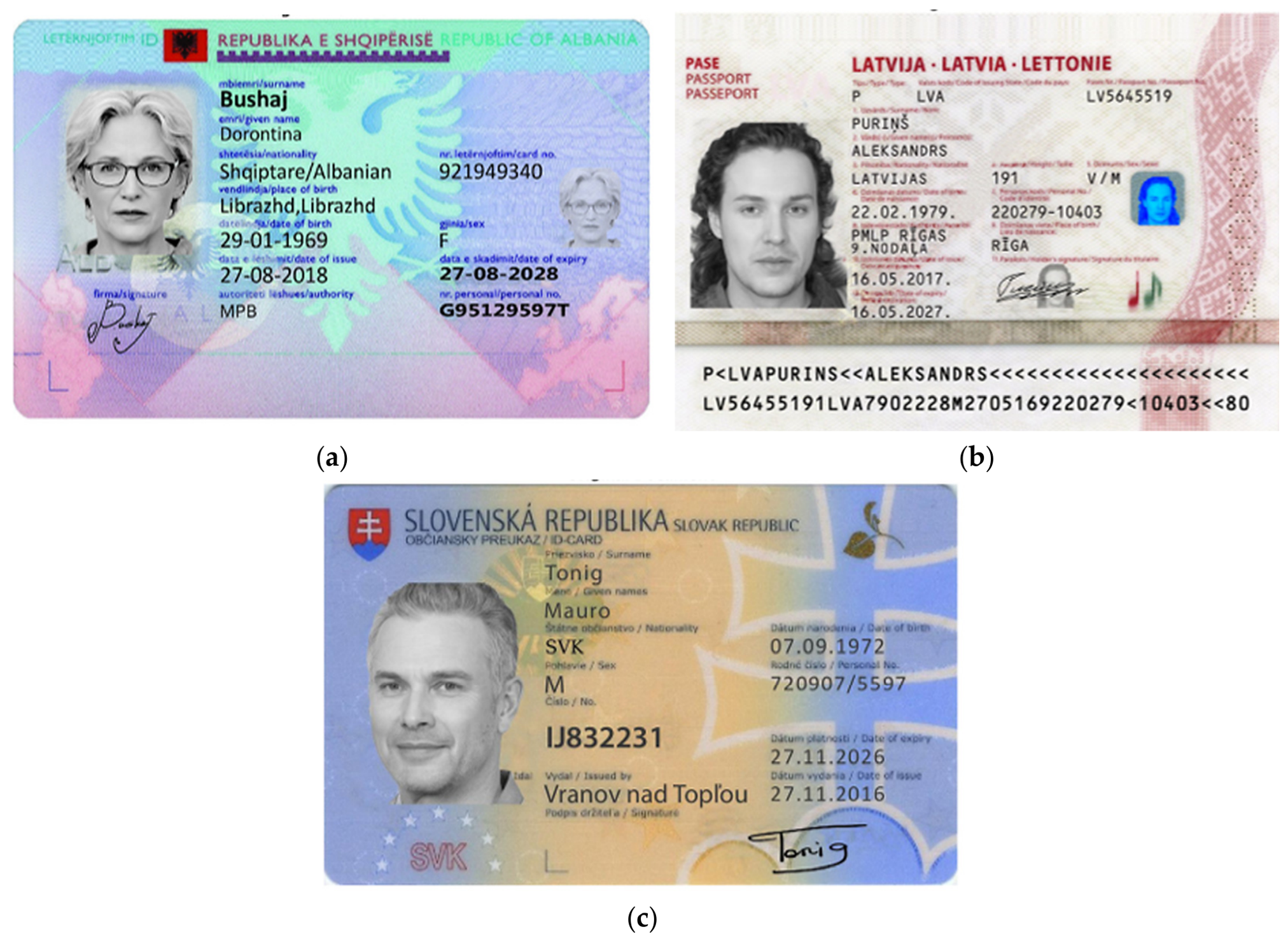
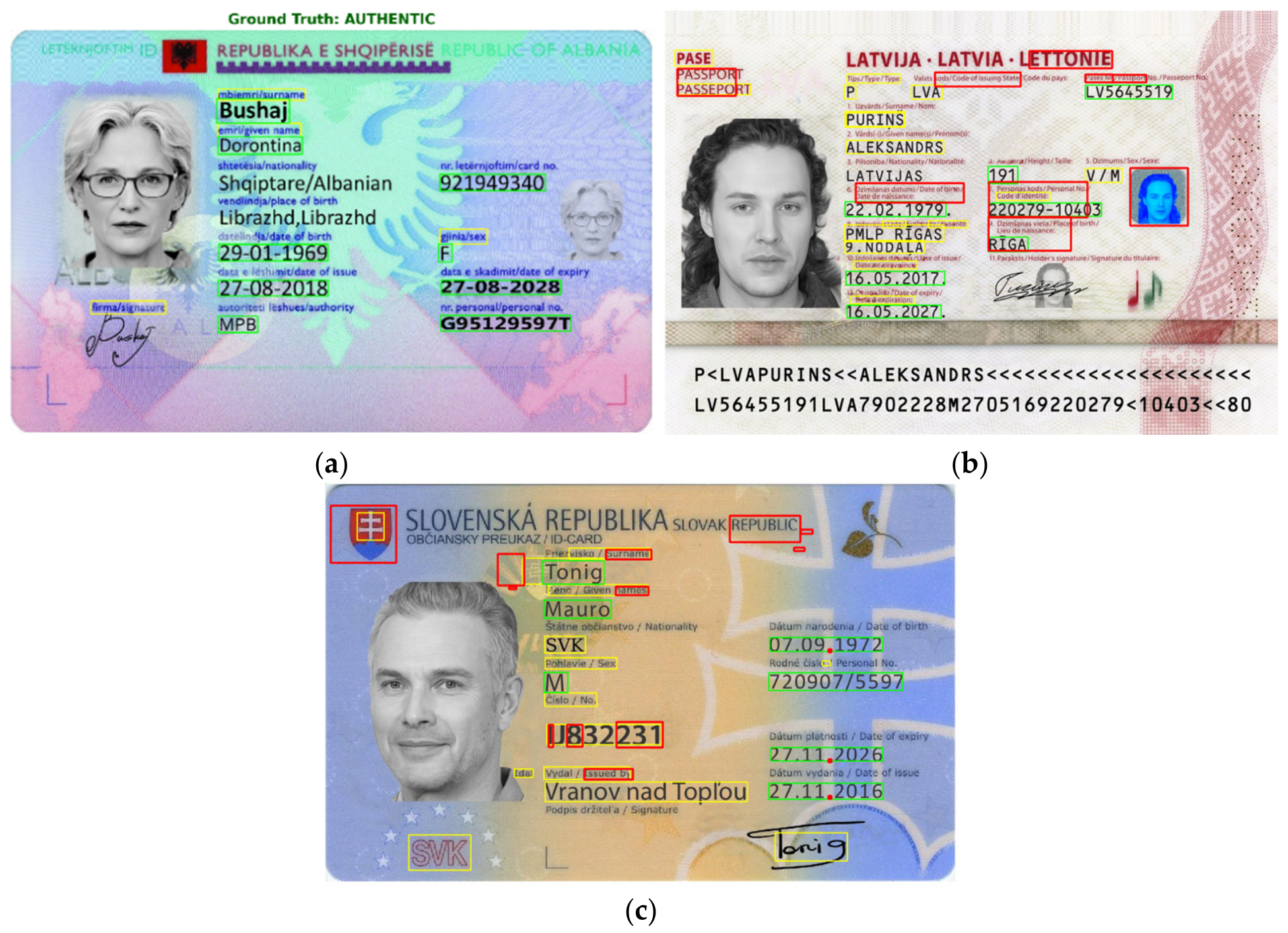
33]. The 224 × 224 normalization resolution was selected to balance computational efficiency with preservation of forensic detail in identity documents. This resolution maintained sufficient visibility of character boundaries, blur artifacts, spacing irregularities, and background texture inconsistencies required for handcrafted feature extraction and OCR-based semantic analysis. Some representative identity documents from the MIDV-2020 Dataset are shown in
Figure 3.
3.3. Forensic Feature Extraction
3.3.1. Handcrafted Feature Design
The proposed framework extracts a 32-dimensional handcrafted forensic feature vector from OCR-detected document regions to capture physical and semantic inconsistencies associated with identity fraud. Guided by forensic domain knowledge and preliminary experimentation, these indicators are grouped into five distinct categories: blur-based indicators, OCR-quality features, geometric consistency features, texture-based metrics, and anomaly-driven semantic indicators.
During preliminary testing, scaling feature dimensionality beyond 32 introduced high feature redundancy and increased multicollinearity without yielding classification gains, while smaller subsets reduced model sensitivity toward localized text manipulations. The final 32-feature baseline represents an optimized operational tradeoff that balances descriptive forensic expressiveness, classification stability, and model generalization.
Dimensionality-reduction methods such as Principal Component Analysis (PCA) were explicitly rejected. Because PCA projects physically verifiable features into abstract, latent components, it degrades feature-level reasoning and limits the explicit forensic traceability required in tightly regulated compliance environments.
To state the feature-selection methodology explicitly: candidate indicators were first proposed based on forensic document-examination domain knowledge, targeting five physically and semantically motivated tampering signatures (blur inconsistency, OCR/text-quality degradation, geometric distortion, background-texture irregularity, and rule-based semantic anomalies), as summarized in
Table 2. This initial candidate set was then narrowed and validated through three complementary, quantitative evaluation stages rather than domain judgment alone: (i) a Pearson correlation and multicollinearity analysis (
Section 3.3.2) to remove redundant or duplicated indicators; (ii) a post hoc SHAP-based global feature-importance ranking (
Section 4.4.1) to quantify each retained feature’s actual contribution to model output; and (iii) a feature-group ablation study (
Section 4.3) to directly measure the classification-performance impact of removing each forensic category. A feature was retained in the final 32-dimensional vector only if it passed the redundancy check and demonstrated a measurable, non-negligible contribution in at least one of the SHAP-importance or ablation analyses.
Two entries in
Table 2, OCR_Quality and Field_Completeness, are explicit aliases of OCR_Confidence_Mean and Field_Completeness_Ratio, respectively, retained for backward compatibility with earlier pipeline versions and for readability in downstream SHAP visualizations and forensic reports referenced elsewhere in this manuscript (e.g.,
Section 4.4). They are not independent statistical variables and were excluded as duplicates prior to the Pearson correlation and multicollinearity analysis in
Section 3.3.2, so the reported 32-dimensional feature vector reflects unique, non-redundant indicators only.
where
3.3.2. Feature Selection and Correlation Analysis
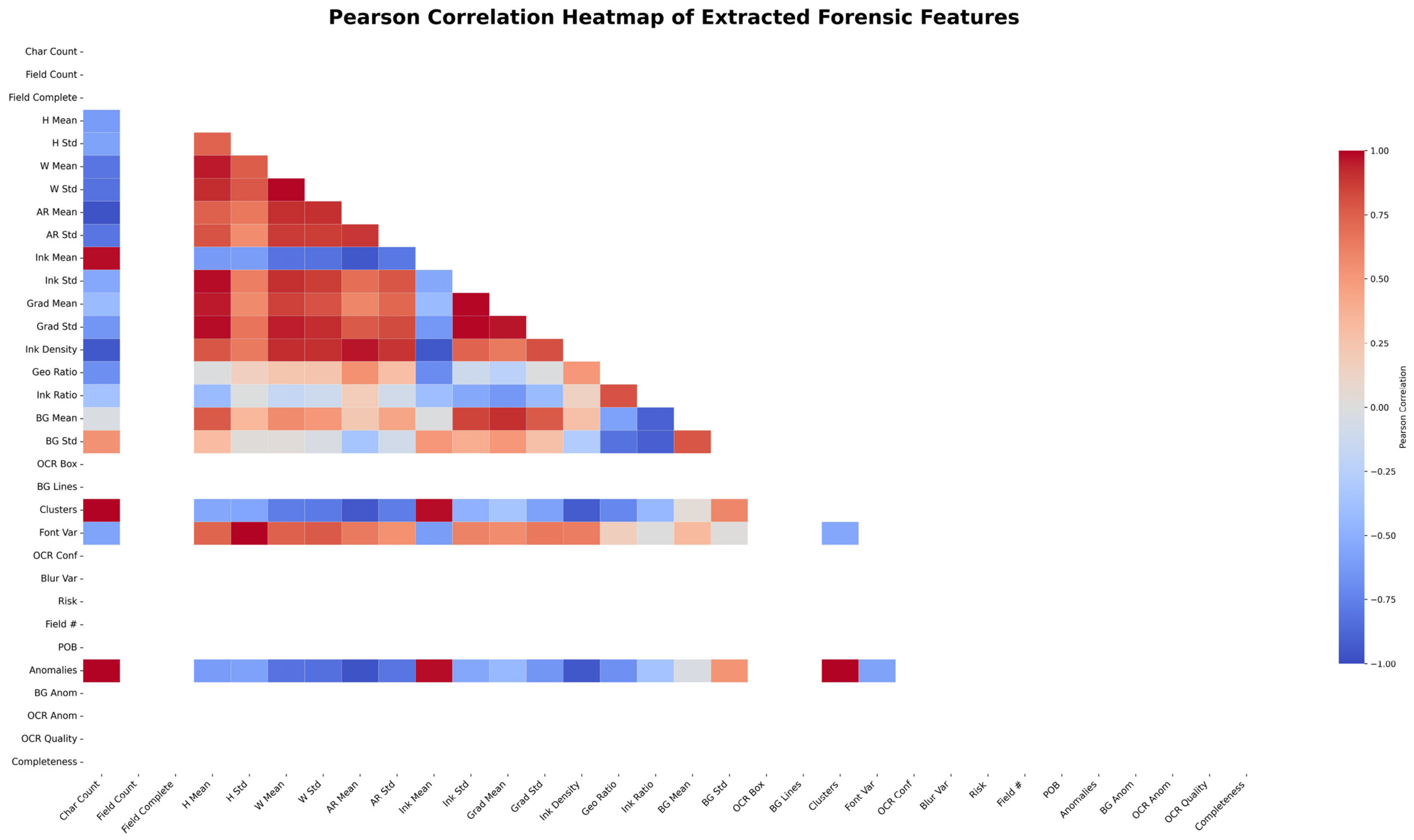
To evaluate redundancy, a comprehensive Pearson correlation analysis was executed over the complete extracted feature space. The resulting heatmaps demonstrate that the primary discriminative feature sets maintain meaningful statistical independence, enabling clean evidence fusion within the downstream Random Forest classifier without suffering from global multicollinearity.
Localized, predictable feature relationships occur within specific structural categories:
Geometric and Texture Indicators: Moderate positive correlations are present among coupled attributes like character height statistics, width boundaries, aspect ratios, edge gradient variations, and OCR-confidence scores. This pattern is expected because manual layout adjustments, print-scan copying, or digital image recompression typically disrupt multiple visual characteristics simultaneously.
Anomaly-Driven Indexes: Strong correlations exist among anomaly tracking variables, including clustered-region counts, cumulative anomaly metrics, and rule-based risk scores. This behavior validates that the anomaly-localization layer consistently highlights coupled suspicious trends across modified document text fields.
Figure 4 illustrates the Pearson correlation analysis conducted across the complete handcrafted forensic feature space utilized by the proposed authentication framework. The heatmap demonstrates that the selected forensic indicators capture multiple complementary categories of document-tampering evidence while avoiding excessive multicollinearity among the primary discriminative features.
Several moderate positive correlations were observed among geometrically related indicators such as character height statistics, width statistics, aspect-ratio measurements, gradient descriptors, and OCR-confidence features. These relationships are expected because forged-document manipulations frequently affect multiple visual characteristics simultaneously during identity-field editing, print-scan degradation, or recompression processes.
Strong correlation was additionally observed between several anomaly-driven indicators including clustered-region counts, field-count statistics, detected anomalies, and risk-score measurements. This behavior validates that the anomaly-localization subsystem consistently captures related suspicious forensic behavior across manipulated document regions.
Conversely, minor correlation is observed across blur-based, text-semantic, and background-texture categories, confirming that these groups deliver complementary forensic signals rather than redundant information. Retaining these partially correlated yet distinct parameters provide vital auxiliary robustness under degraded mobile capture conditions. Random Forest estimation and SHAP attribution validate this architecture, proving that blur indicators, OCR-confidence stability, geometric shifts, and texture deviations contribute the strongest baseline weight toward final classification decisions.
3.3.3. Edge Degradation Modeling
A key metric within this engine is the Blurriness Score
β, computed using the variance of the Laplacian operator. The two-dimensional Laplacian operator Δ
I maps high-frequency spatial edge transitions across the image coordinate layers:
The overall regional blur metric
β is calculated as the statistical variance of this Laplacian response across all evaluated coordinate pixels:
where Δ
Ii represents the Laplacian response at pixel
i,
μ denotes the mean Laplacian response across the image region, and
N represents the total number of pixels within the evaluated document region.
Lower variance values indicate reduced high-frequency edge information commonly associated with blur or digitally smoothed tampered regions. Laplacian variance is sensitive to high-frequency edge degradation commonly introduced during digital tampering and image resaving operations.
This means Laplacian-based measures provide strong responsiveness to localized edge smoothing and “artificial flattening” artifacts frequently observed in manipulated identity documents. Furthermore, Laplacian variance offers computational simplicity and stable performance under varying illumination conditions, making it suitable for real-time AML/KYC verification pipelines.
At the same time, the system evaluates geometric consistency including the height, width, and ink density of characters compared to document-specific standards to spot internal discrepancies that may indicate a character or text block has been resized or displaced.
3.3.4. OCR-Driven Semantic Validation
The semantic field extraction component replaces pretrained transformer or probabilistic NLP models with a custom rule-based engine integrated directly within the forensic pipeline. The framework utilizes country-aware templates, regular expressions (regex), spatial coordinate mapping, and Machine-Readable Zone (MRZ) parsing to extract critical biographical data from Albanian, Latvian, and Slovakian identity documents.
By grouping OCR bounding boxes based on relative spatial relationships, the system associates’ text with expected fields such as names, nationalities, document identifiers, and dates. This rule-based parsing serves as a verification layer to detect logical discrepancies across different document zones.
Because the subsystem is deterministic rather than probabilistic, no independent statistical accuracy benchmark was computed. Instead, extraction failures or anomalies manifest as missing fields, which directly penalize downstream forensic metrics, including Field_Completeness_Ratio, Risk_Score, Field_Completeness, and Field_Count.
To minimize error propagation, isolated extraction failures reduce semantic confidence but do not independently dictate the final verdict. Instead, the downstream Random Forest classifier aggregates these rule-derived semantic indicators with low-level geometric, OCR-quality, blur-based, and texture-driven forensic features to determine document authenticity.
Figure 5 depicts some OCR-driven semantic field extraction and validation examples from the MIDV-2020 Dataset.
3.4. Dataset Construction and Forgery Generation
The experimental evaluation utilized identity document images derived primarily from the MIDV-2020 dataset, consisting of Albanian identity cards, Latvian passports, and Slovakian identity cards. These document categories were selected because they provide diverse layouts, machine-readable zones, multilingual text structures, and varying document-security designs while remaining computationally feasible for detailed forensic analysis.
The dataset was constructed to simulate realistic AML/KYC document verification scenarios involving both authentic and forged identity documents commonly encountered during financial onboarding and identity validation processes.
3.4.1. Dataset Composition
The final dataset consisted of 450 identity document samples, including 209 authentic documents and 241 forged documents. Authentic samples were obtained directly from the original MIDV-2020 dataset without modification, while forged samples were synthetically generated through controlled tampering procedures designed to emulate realistic document manipulation attacks observed in financial fraud and identity falsification activities.
The forged document samples were generated through a combination of controlled synthetic manipulation procedures and manual identity-field editing operations designed to emulate realistic AML/KYC document fraud scenarios. The manipulation process was guided by forgery characteristics and attack patterns described within the MIDV-2020 dataset documentation and related identity-document verification literature.
Forgery generation primarily targeted semantically sensitive identity fields commonly exploited in financial onboarding fraud, including personal identity numbers, names, dates of birth, expiration dates, and facial regions. The manipulations were intentionally designed to preserve overall visual realism while introducing subtle forensic inconsistencies that resemble real-world document tampering behavior encountered during identity verification processes.
The final dataset consisted of 450 document images, including 209 authentic documents and 241 forged documents derived from selected MIDV-2020 identity-document categories. Forged samples were generated from authentic source documents using the manipulation procedures described in
Section 3.4.2. Consequently, the dataset contained both original identity documents and multiple manipulated variants designed to emulate realistic AML/KYC document fraud scenarios while preserving document-level traceability throughout the experimental pipeline.
3.4.2. Forgery Generation Procedure
To create forged samples that accurately reflect practical identity-document fraud rather than simplistic synthetic alterations, the generation strategy intentionally paired semantic layout tampering with low-level forensic degradation. This process integrated manual identity-field editing with automated forensic degradation procedures by integrating manual visual edits with automated algorithmic filters.
Textual content replacement, region-specific editing, and identity-field alterations were executed manually to simulate realistic biometric and biographical tampering attacks. Concurrently, programmatic OpenCV-based perturbation techniques were used to introduce environmental and capture degradations.
These synthetic procedures included Gaussian blur simulation, low-illumination generation, glare insertion, perspective transformations, JPEG compression artifact generation, and print-scan noise simulation. These targeted adjustments successfully preserved overall document realism while embedding subtle inconsistencies detectable via texture, OCR-semantic, geometric and anomaly-based forensic analysis.
Furthermore, this hybrid generation approach closely mimics uncontrolled mobile-camera capture artifacts, rescanned photocopies, and compressed online uploads frequently observed in real-world banking, fintech, and digital KYC onboarding environments. The resulting dataset provides a realistic evaluation benchmark for AML/KYC document-authentication systems suitable for evaluating explainable document authentication frameworks.
3.4.3. Dataset Partitioning into Training, Validation and Testing Sets
To ensure reliable and unbiased experimental evaluation, identity-independent and template-disjoint partitioning was applied prior to model training. Authentic documents and all corresponding forged variants derived from the same source document were assigned exclusively to a single dataset partition. This prevented document identities, visual layouts, and manipulation variants from appearing simultaneously across training, validation, and testing subsets.
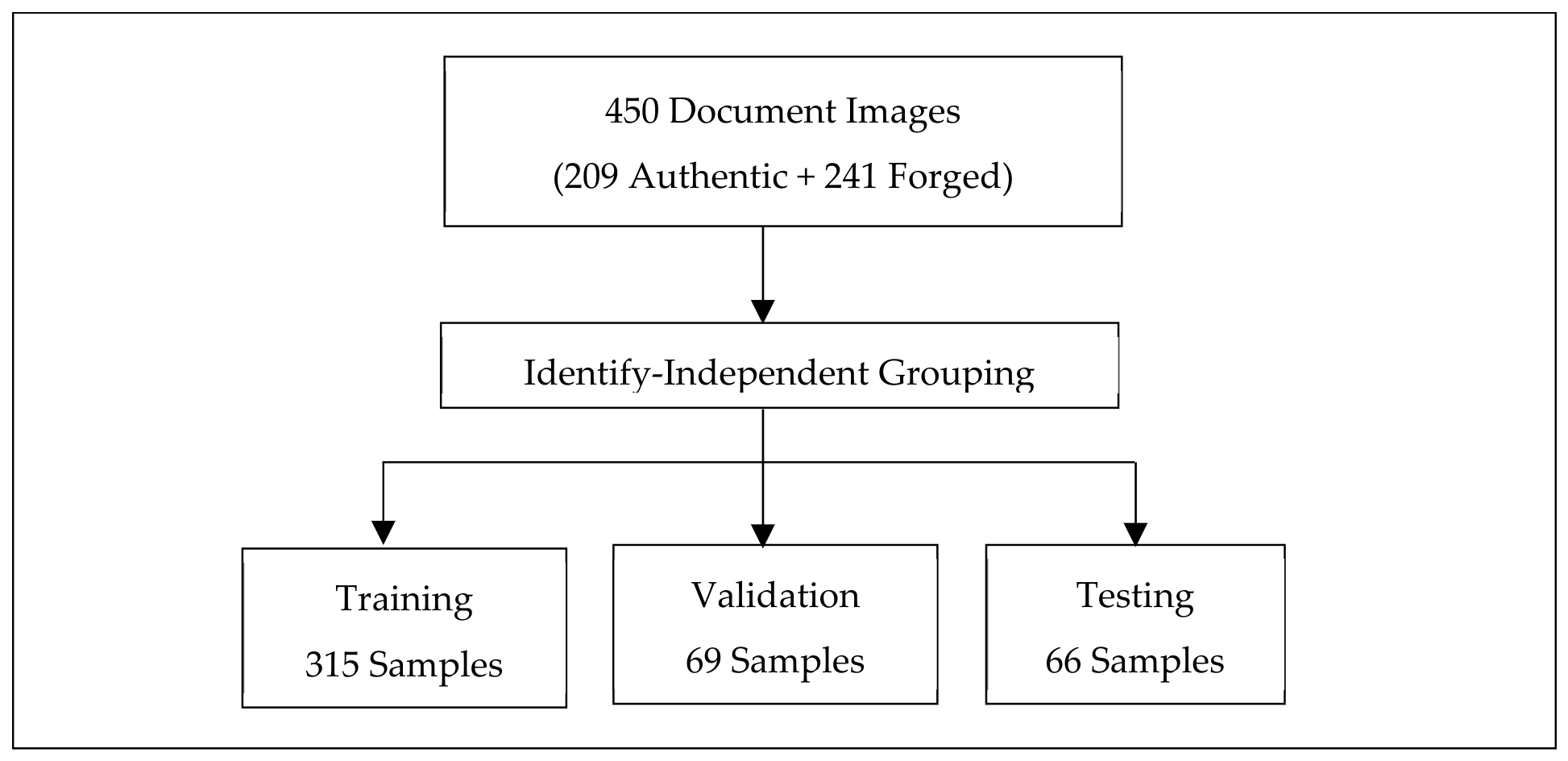
The final dataset comprised 450 document images and was divided into 315 training samples, 69 validation samples, and 66 testing samples. By ensuring that forged versions originating from the same source document remained within a single partition, the evaluation protocol eliminated potential data leakage arising from shared document structures or duplicated identity information. Consequently, the classifier was evaluated only on previously unseen document instances during testing, providing a more realistic assessment of generalization performance in AML/KYC verification environments.
Table 3 summarizes the overall dataset composition utilized throughout the experimental evaluation, while
Table 4 presents the class distribution across the training, validation, and testing subsets.
The class distribution was maintained at a relatively balanced ratio between authentic and forged samples to reduce classification bias and improve learning stability. Specifically, the training subset contained 147 authentic and 168 forged documents, the validation subset contained 35 authentic and 34 forged documents, and the testing subset contained 27 authentic and 39 forged documents.
The resulting partitioning strategy preserved both class balance and partition independence. Training, validation, and testing subsets contained separate document identities, ensuring that model performance reflected genuine forgery-detection capability rather than memorization of document-specific characteristics. This partitioning approach further improves the reliability of the reported evaluation results and better reflects practical deployment conditions where previously unseen identity documents must be verified.
Figure 6 illustrates the template-disjoint dataset partitioning strategy.
3.5. Random Forest Hyperparameter Sensitivity Analysis
To justify the selection of the Random Forest hyperparameters, a sensitivity analysis was conducted by varying the number of decision trees from 50 to 500 while maintaining all other model parameters unchanged. The evaluated configurations consisted of 50, 100, 200, 350, and 500 trees. Performance was assessed using Accuracy, Recall, Precision, and F1-Score on the independent testing subset.
The experimental results shown in
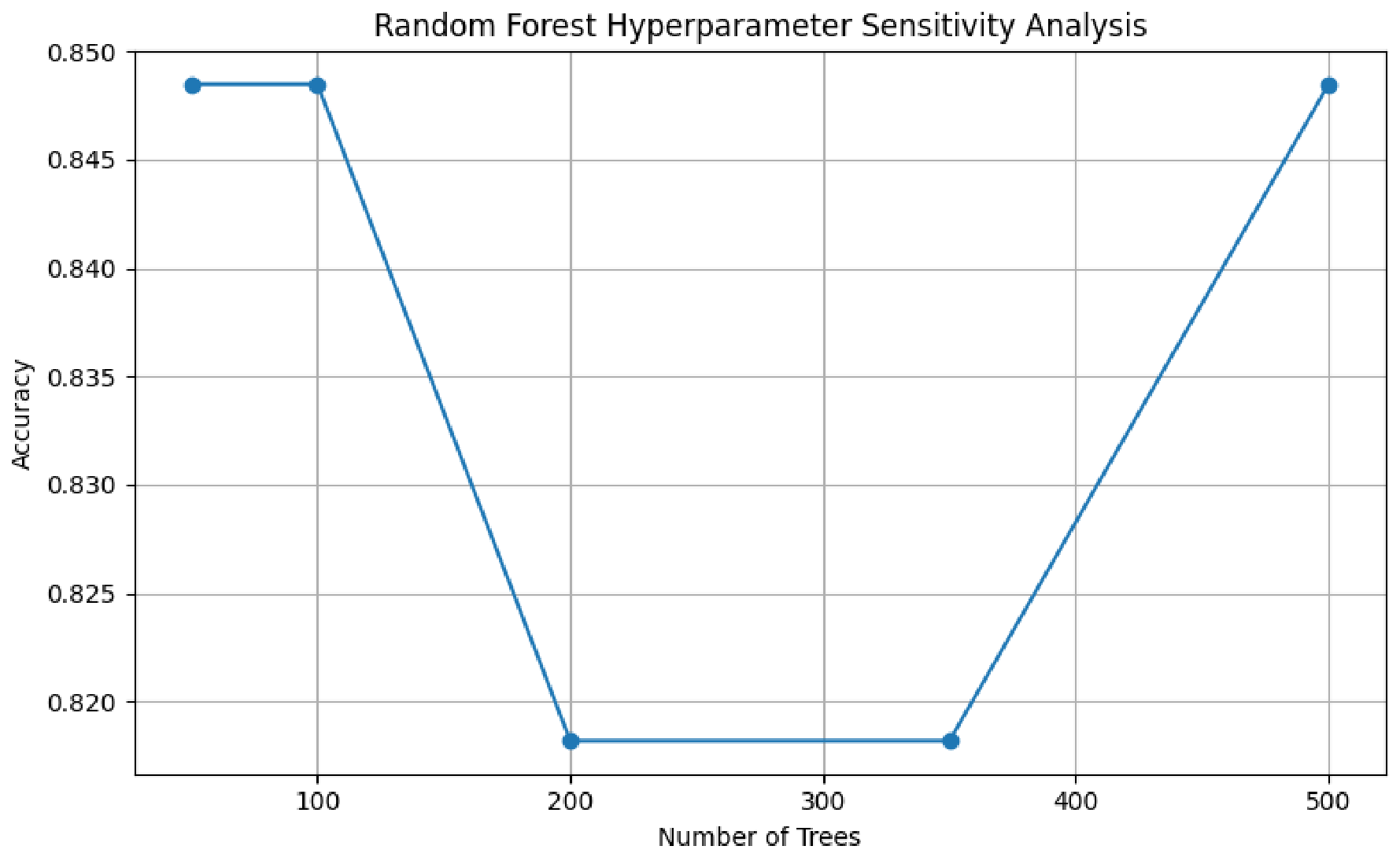
Table 5 demonstrated that classifier performance remained relatively stable across different ensemble sizes, although notable differences were observed in Recall and F1-Score. The 50-tree configuration achieved the strongest overall performance, obtaining an Accuracy of 84.85%, Recall of 92.31%, Precision of 83.72%, and F1-Score of 87.80%. While the 100-tree and 500-tree configurations achieved comparable Accuracy values of 84.85%, both produced lower Recall and F1-Score values than the 50-tree model. The 200-tree and 350-tree configurations exhibited reduced Accuracy (81.82%) and F1-Score (84.62%), indicating no performance advantage from increasing the ensemble size.
Interestingly, increasing the number of trees beyond 50 did not result in consistent classification improvements (refer to
Figure 7). Although larger ensembles are generally expected to improve robustness through additional averaging, the proposed forensic feature space already provided sufficient discriminative information for effective classification using a relatively small ensemble. Consequently, larger configurations introduced additional computational cost without yielding meaningful gains in Accuracy, Recall, Precision, or F1-Score. These findings suggest diminishing returns from excessively large ensembles for the proposed forensic document-authentication task.
Based on the experimental findings, the 50-tree configuration was selected as the optimal Random Forest architecture because it achieved the highest Recall (92.31%) and F1-Score (87.80%) while maintaining competitive Accuracy (84.85%). Given that AML/KYC document-authentication systems prioritize minimizing false-negative outcomes, Recall was considered the most critical evaluation metric.
The selected configuration therefore provides the most effective balance between forged-document detection performance, computational efficiency, and model simplicity. Further increases in ensemble size did not produce consistent performance improvements, demonstrating diminishing returns from larger Random Forest ensembles.
3.6. OCR Engine Sensitivity Analysis
The proposed framework relies on PaddleOCR for text and bounding-box recovery prior to rule-based semantic field extraction. Because the downstream field-completeness, risk-scoring, and classification stages are all conditioned on OCR output quality, a sensitivity analysis was conducted to evaluate whether the framework’s field-extraction performance is dependent on the specific OCR engine selected, or whether it generalizes across alternative open-source OCR implementations.
Two additional OCR engines, Tesseract and EasyOCR, were substituted into the existing OCR-Driven Semantic Validation component (
Section 3.3.4) without modifying the downstream rule-based field-extraction, country detection, or validation logic. All three engines were evaluated on the same 66-image testing subset described in
Section 3.4.3, using identical image-preprocessing variants (
Section 3.3) to ensure a controlled, apples-to-apples comparison.
The experimental results demonstrate that all three OCR engines achieved identical classification performance, obtaining 83.33% Accuracy, 92.31% Recall, and 86.75% F1-Score. This finding suggests that the proposed authentication framework exhibits strong robustness to OCR engine selection and does not rely on a particular OCR implementation to achieve effective forgery detection.
The observed consistency can be attributed to the framework’s hybrid design, which combines OCR-derived semantic validation with handcrafted forensic indicators extracted from document structure, character geometry, background consistency, and anomaly detection mechanisms. While OCR contributes to entity extraction and field completeness assessment, the classification decision is influenced by a broader set of forensic features, reducing sensitivity to minor OCR recognition differences.
From a deployment perspective, these findings indicate that alternative OCR engines may be substituted without substantial degradation in authentication performance. This flexibility is advantageous for AML/KYC environments where computational constraints, licensing considerations, deployment requirements, or language support may influence OCR engine selection. The results therefore provide evidence that the proposed framework maintains stable performance across multiple OCR backends, supporting its practicality and portability for real-world document authentication applications.
One clarification is warranted regarding the 83.33% figure in
Table 6: this value is the overall framework classification Accuracy on the 66-image sensitivity-analysis subset, not the OCR engine’s own text-recognition accuracy, and it is identical across all three OCR backends precisely because the framework does not depend on any single OCR engine’s raw output. OCR errors are mitigated at three levels: first, rule-based semantic field extraction (
Section 3.3.4) validates recognized fields against expected identity-document structure (e.g., field completeness, presence of Place-of-Birth) rather than trusting raw OCR text directly; second, the OCR_Confidence_Mean and OCR_Box_Anomalies_Count indicators (
Table 2) explicitly encode OCR reliability as forensic evidence in their own right, so low-confidence or misaligned OCR output itself becomes a discriminative signal rather than being silently propagated as an error; and third, the classification decision is distributed across 32 features spanning blur, geometric, texture, and anomaly categories in addition to OCR-derived features (
Section 4.3.1), so an isolated OCR misrecognition on a single field is unlikely to flip the overall prediction. The residual effect of OCR errors on performance is visible in the ablation results (
Section 4.3, “Without OCR Quality Features” row), where removing OCR-derived indicators alone reduces Accuracy from 84.85% to 81.82% and F1-Score from 87.80% to 84.62%, indicating a meaningful but non-dominant contribution consistent with the framework’s redundant, multi-signal design.
4. Experimental Results
The proposed authentication framework was evaluated using a stratified test set created from selected identity document subsets of the MIDV-2020 dataset, including Albanian identity cards, Latvian passports, and Slovakian identity cards [
33]. The goal of the evaluation was to assess the model’s ability to distinguish between authentic biometric templates and simulated forgeries involving either physical overlays or digital alterations of biographical information. The experimental setup emphasized evaluation metrics aligned with the high-risk nature of Anti-Money Laundering (AML) compliance, particularly Recall (Sensitivity), due to the severe implications of false-negative authentication outcomes [
2,
14]. For readers looking specifically for the component-contribution and existing-methods comparisons, the module-level ablation study is reported in
Section 4.3 and the comparison against existing document-forgery-detection and document-understanding methods is reported in
Table 1 and
Section 4.8, including the dataset-matched lightweight-baseline comparison and the literature-context discussion of why a direct experimental reproduction of certain deep-learning baselines was not performed.
4.1. Experimental Setup and Performance Metrics
The performance of the system was quantified through four primary statistical metrics: Accuracy, Recall (Sensitivity), Precision, and F1-Score. In the context of AML, Recall is prioritized as the mission-critical metric, as a single undetected forgery (False Negative) can lead to severe regulatory exposure and financial crime (refer to
Table 7).
In addition to Accuracy, Recall, Precision, and F1-Score, the system was also evaluated using Equal Error Rate (EER), which represents the operating point where false-positive and false-negative rates are equivalent. EER is commonly used in biometric and forensic authentication systems to measure the tradeoff between false acceptance and false rejection under probabilistic classification settings.
4.2. Classification Performance
4.2.1. Baseline Comparison
To evaluate the effectiveness of the proposed authentication framework, additional baseline comparisons were conducted against both a deep-learning-based Vision Transformer (ViT-B/16) model and an OCR-driven baseline consisting of PaddleOCR feature extraction followed by Random Forest classification.
Table 8 summarizes the comparative performance of all evaluated approaches. The OCR-based baseline achieved an Accuracy of 51.52% and an F1-Score of 54.29%, indicating that OCR-derived semantic information alone is insufficient for reliable forged-document detection. This result highlights the importance of integrating geometric, texture-based, anomaly-driven, and forensic indicators beyond purely textual information.
The ViT-B/16 model achieved a Recall of 100%, successfully identifying all forged documents in the testing set. However, its overall Accuracy (59.09%) and Precision (59.09%) were substantially lower than those achieved by the proposed framework, indicating a tendency toward over-predicting forgery and generating excessive false-positive alerts. Such behavior may be undesirable in AML/KYC environments where unnecessary manual investigations increase operational workload.
In contrast, the proposed framework achieved the highest overall Accuracy (84.85%), Precision (83.72%), and F1-Score (87.80%) while maintaining a strong Recall of 92.31%. Furthermore, unlike transformer-based architectures that require GPU acceleration and provide limited forensic transparency, the proposed framework operates efficiently on conventional hardware and produces interpretable forensic evidence through handcrafted feature analysis and SHAP-based explanations.
These findings demonstrate that combining OCR-driven semantic validation with handcrafted forensic feature extraction provides a more balanced and operationally practical solution for AML/KYC document authentication than either OCR-only or deep-learning-only approaches.
4.2.2. Cross-Validation Stability Results
A 5-fold stratified cross-validation procedure was additionally performed to evaluate the robustness and stability of the proposed authentication framework across varying training partitions. Stratified sampling was used to preserve forged-document class distribution across folds. Mean and standard deviation values were computed for Accuracy, Precision, Recall, F1-Score, and ROC-AUC to assess model consistency under repeated evaluation settings.
The experimental dataset consisted of both authentic and synthetically forged identity document samples derived from selected MIDV-2020 subsets. Stratified partitioning was applied to preserve class distribution consistency across training and testing splits during evaluation.
All train, validation, and test partitions were constructed using template-disjoint and identity-independent separation procedures. Forged versions derived from the same source identity document were restricted to a single partition only, ensuring that document templates, identities, and manipulated variants were not shared across evaluation splits. This prevented data leakage and ensured realistic generalization evaluation under unseen-document conditions.
4.2.3. ROC, DET, and Precision-Recall Frontiers
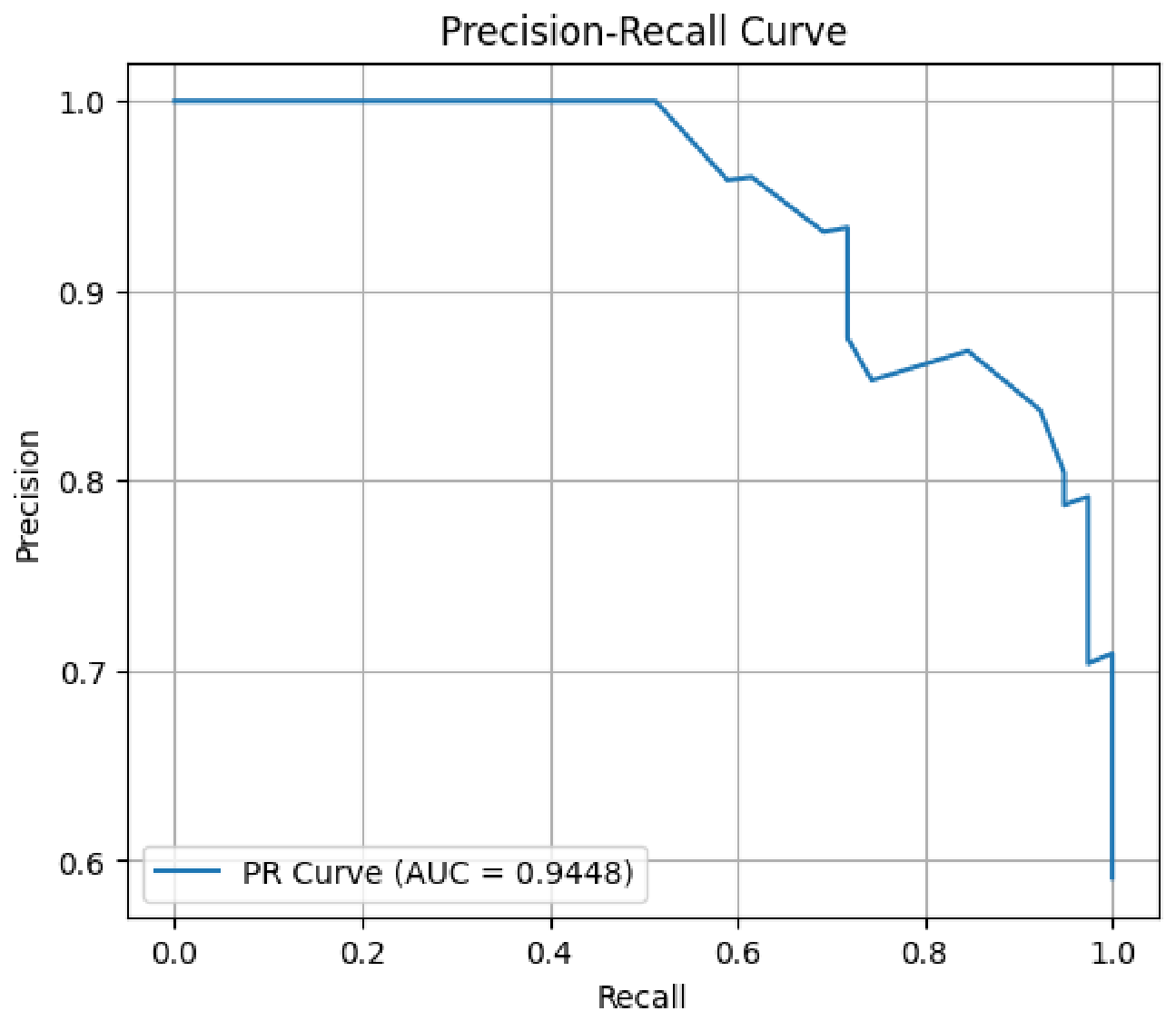
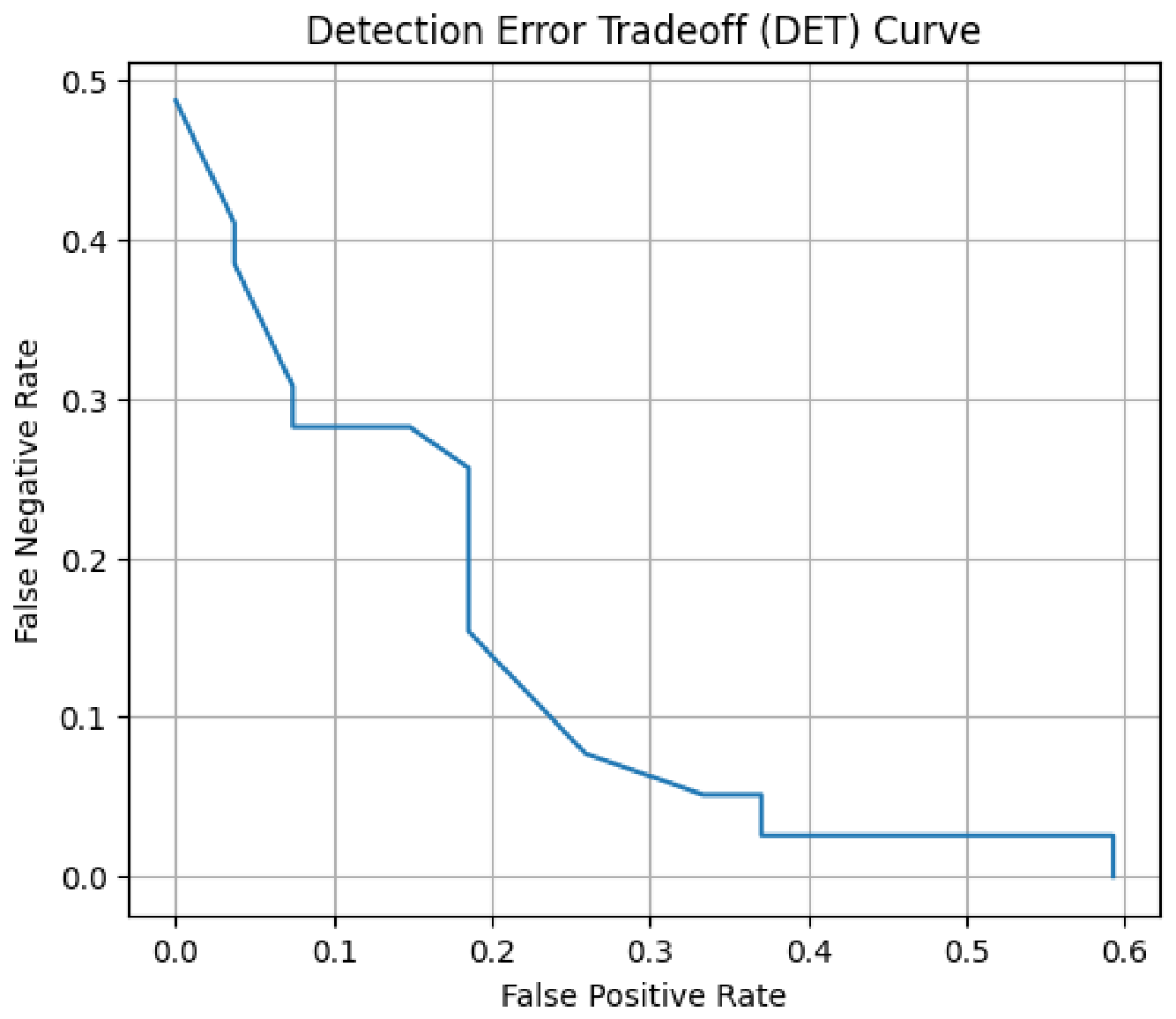
In addition to scalar evaluation metrics, the proposed authentication framework was further analyzed using Receiver Operating Characteristic (ROC), Detection Error Tradeoff (DET), and Precision-Recall (PR) curves. These visual evaluation methods provide threshold-sensitive analysis of classifier behavior under varying operating conditions and are commonly used in biometric authentication and forensic verification systems.
The ROC curve illustrates the tradeoff between the True Positive Rate (TPR) and False Positive Rate (FPR), while the DET curve visualizes the relationship between false-positive and false-negative errors across probabilistic thresholds. The Precision-Recall curve further evaluates the system’s ability to maintain high forged-document detection performance under class-imbalanced AML/KYC conditions.
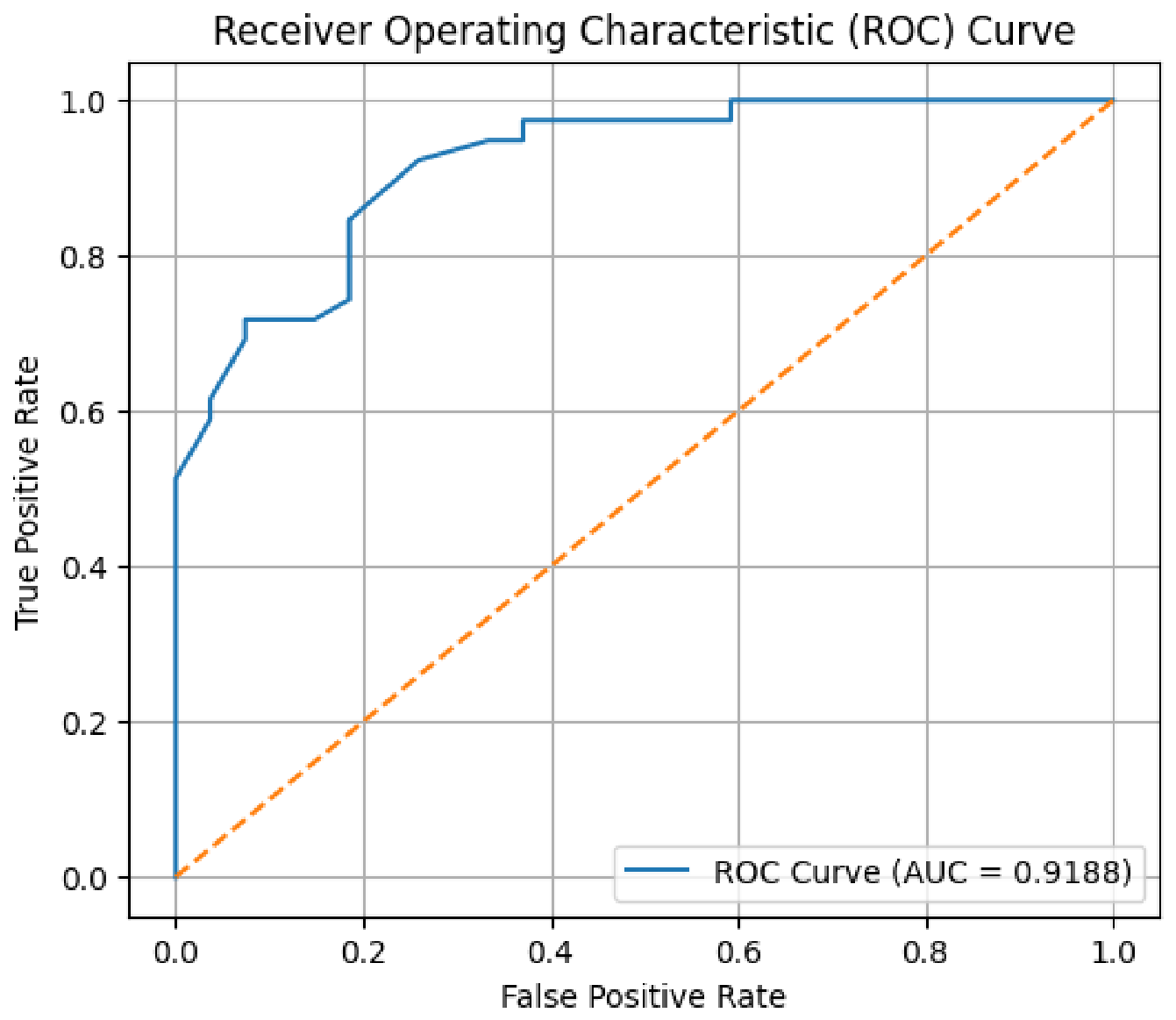
The Receiver Operating Characteristic (ROC) curve shown in
Figure 8 evaluates the ability of the proposed authentication framework to distinguish between authentic and forged identity documents across varying probabilistic thresholds. The curve illustrates the tradeoff between the True Positive Rate (TPR) and False Positive Rate (FPR). The model achieved an Area Under the Curve (ROC-AUC) value of approximately 0.9188, indicating strong discriminative capability on the unseen test dataset. The upward curvature toward the top-left region demonstrates that the classifier maintains relatively high forged-document detection performance while controlling false-positive authentication outcomes.
The Precision-Recall (PR) curve shown in
Figure 9 evaluates the relationship between forged-document detection sensitivity and prediction reliability under varying decision thresholds. Because AML/KYC forgery detection represents a partially imbalanced classification problem, the PR curve provides additional insight beyond ROC analysis. The model achieved a PR-AUC value of approximately 0.9448, indicating strong performance in maintaining high precision while preserving forged-document recall. The gradual reduction in precision at higher recall levels reflects the expected tradeoff between aggressive threat detection and false-positive escalation.
The Detection Error Tradeoff (DET) curve presented in
Figure 10 visualizes the relationship between False Positive Rate (FPR) and False Negative Rate (FNR) across probabilistic classification thresholds. The decreasing DET trajectory indicates that the proposed authentication framework effectively reduces false-negative forgery outcomes while maintaining acceptable false-positive rates. This behavior is particularly important in AML/KYC environments, where undetected forged documents represent significantly higher regulatory and financial risk than increased manual review requirements.
4.2.4. Confusion Matrix and Error Analysis
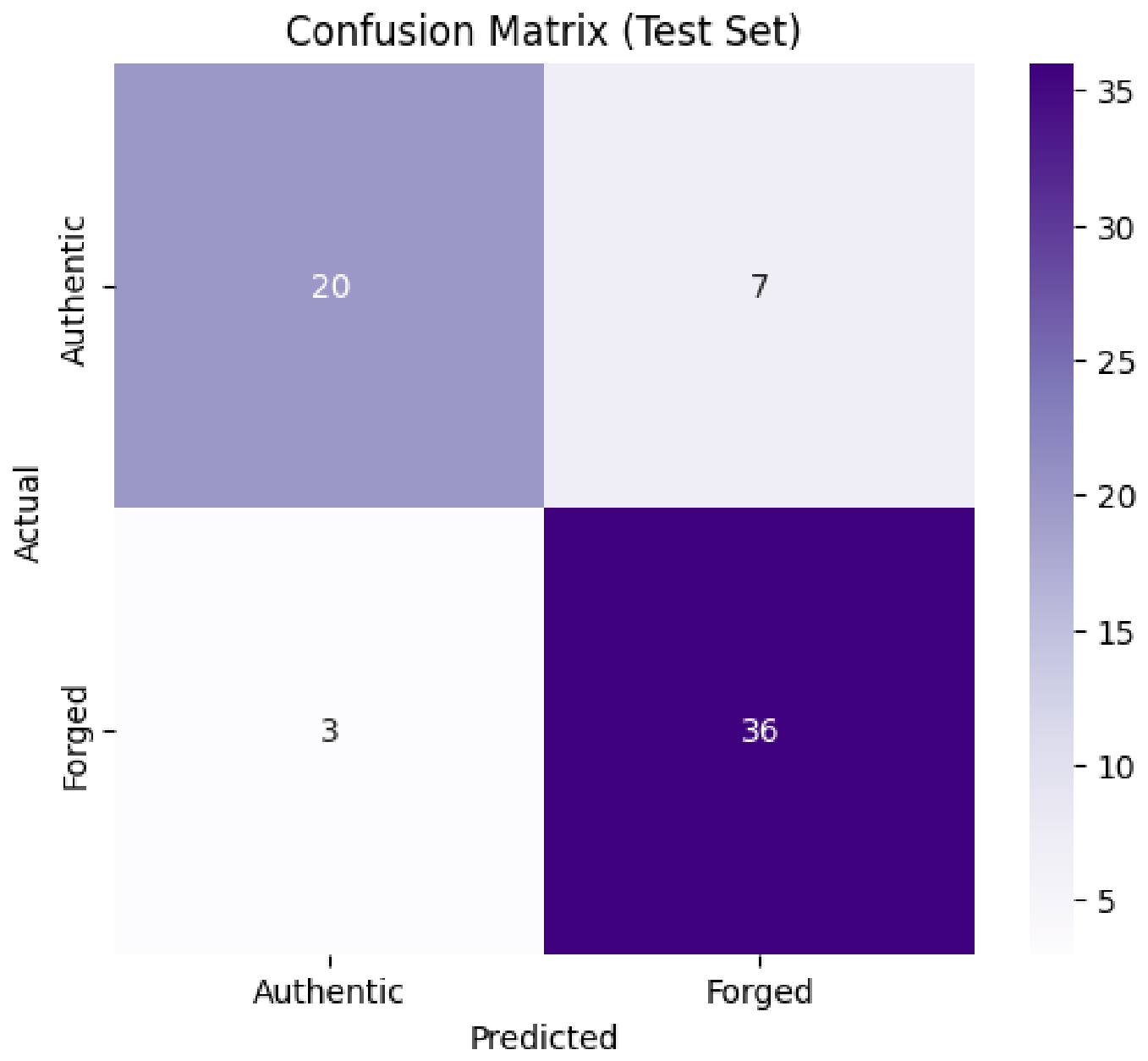
A detailed analysis of the performance presented in
Figure 11 reveals that the system successfully identified nearly all fraudulent documents within the sample. This high sensitivity is attributed to the multi-level feature extraction pipeline and the use of Laplacian variance to identify the “artificial flattening” found in digitally tampered data. While the majority-class baseline classifier failed to identify any forged documents, the proposed solution correctly flagged most threats.
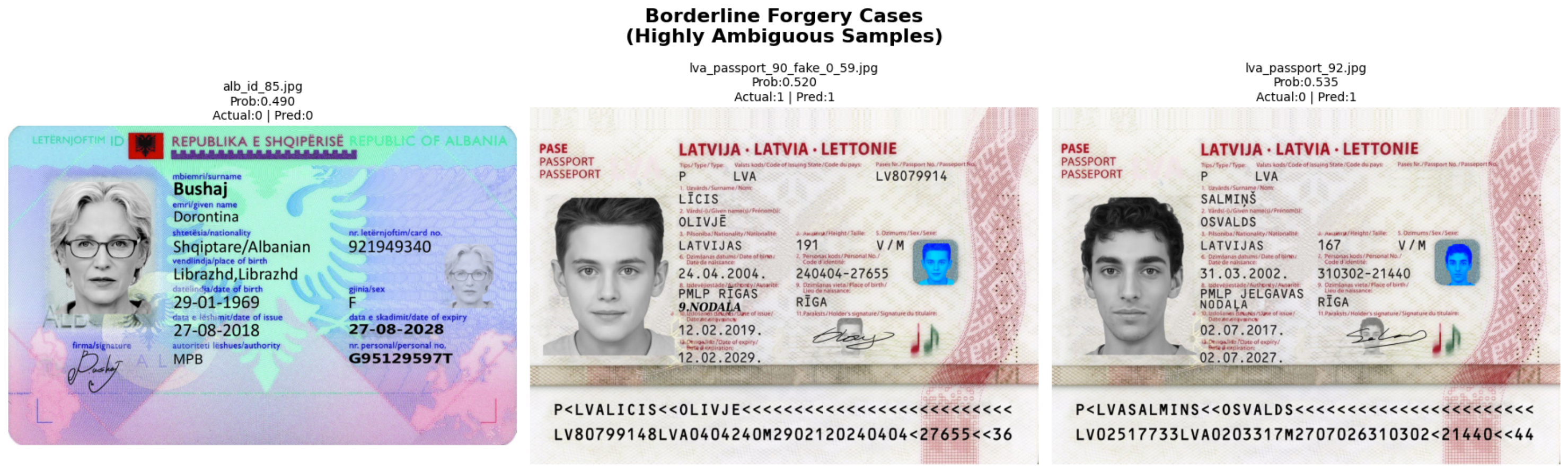
The remaining error rate typically occurs due to the difficulty in distinguishing between high-quality digital fabrications and natural camera artifacts, such as glare or perspective distortion found in mobile-taken photographs. Despite these challenges, the system’s ability to maintain high recall in realistic, uncontrolled digital environments demonstrates promising performance under the evaluated AML/KYC verification conditions.
Table 9 presents the false-negative and false-positive rates observed under different distortion conditions. The results indicate that Gaussian Blur and Perspective Disortion produced the highest false-negative rates (60.0%), suggesting that severe geometric transformations and blur artifacts substantially reduce the effectiveness of the extracted forensic indicators.
To further investigate the operational robustness of the proposed forensic authentication framework, an error analysis was conducted under multiple document distortion conditions (refer to
Table 10). The objective was to identify which types of image degradation contribute most significantly to false-negative and false-positive predictions. Understanding distortion-specific failure patterns provides deeper insight into model limitations beyond overall accuracy metrics and helps identify areas for future improvement in real-world AML/KYC document verification environments.
Overall, the analysis highlights that geometric distortions and gaussian blur artifacts represent the most challenging operational conditions for the proposed framework and should be prioritized in future robustness enhancement efforts. The reported percentages are based on the robustness evaluation subset and are intended to provide qualitative insight into distortion-specific failure behavior rather than statistically conclusive error estimates.
4.3. Algorithmic Ablation Studies
4.3.1. Feature Group Contribution Analysis
An ablation study was conducted to evaluate the contribution of different forensic feature groups within the proposed authentication framework. The analysis measured the impact of removing specific feature categories on forged-document detection performance. Experimental evaluation focused primarily on Recall and F1-Score due to the high sensitivity requirements of AML/KYC verification environments [
2,
14].
The first ablation configuration removed blur-based forensic indicators, including Laplacian-variance-derived features. This resulted in a noticeable reduction in Recall performance, indicating that blur and edge-degradation analysis played a critical role in detecting digitally smoothed tampering artifacts.
The second configuration excluded OCR-derived semantic and field-completeness indicators. Performance degradation under this setting demonstrated the importance of semantic consistency analysis in identifying manipulated biographical information and incomplete document structures [
9,
19].
The third configuration removed geometric and spacing-based indicators, including character width and alignment statistics. Although the impact was less severe than semantic-feature removal, the resulting decrease in classification stability highlighted the importance of structural typography consistency for forgery detection [
6,
7].
The relatively gradual degradation observed during feature removal does not indicate feature irrelevance, but instead reflects intentional feature complementarity and forensic evidence fusion within the proposed architecture. In realistic AML/KYC environments, forged documents may evade isolated forensic indicators while remaining detectable through alternative semantic, geometric, or texture-based inconsistencies. Consequently, the framework was intentionally designed to preserve operational robustness through multi-feature aggregation rather than dependence on a single dominant feature source. This is broadly consistent with the direction taken by mask-guided multimodal fusion designs proposed for other cross-modal detection problems, such as visible–infrared vehicle detection [
34], where explicit mask guidance is used to align complementary modalities during fusion; such mask-guided fusion paradigms represent a promising state-of-the-art reference for future work on more tightly coupling OCR-derived semantic evidence with visual forensic features in the proposed pipeline, beyond the current concatenation-based feature aggregation used prior to Random Forest classification.
Justification for Random Forest as the Final Classifier
Table 11 additionally reports the performance of two alternative classifiers, Support Vector Machine (SVM) and XGBoost, trained on the identical 32-dimensional forensic feature set and evaluation split used by the proposed framework, to directly justify the choice of Random Forest as the final classifier. These three algorithms were selected because they represent three distinct, widely used learning paradigms for tabular forensic-feature classification, bagging-based ensembles (Random Forest), margin-based classification (SVM), and boosting-based ensembles (XGBoost), providing broad coverage of the classifier families most commonly applied to structured, low-dimensional feature vectors of this kind, while remaining within a scope that could be trained, tuned, and evaluated exhaustively on the 450-sample dataset without risking the overfitting or instability that more complex or data-hungry classifiers (e.g., large neural tabular models) would introduce at this sample size. SVM achieved perfect Recall (100.00%) but substantially lower Accuracy (59.09%) and Precision, indicating a strong bias toward flagging documents as forged; because SVM decision boundaries in this feature space are not natively decomposable into per-feature contributions, this comes at the cost of the transparent, feature-level reasoning required for AML/KYC auditability. XGBoost achieved competitive Accuracy (81.82%) and Recall (89.74%), close to the Random Forest configuration, but was excluded as the final classifier because its sequential, boosted-tree structure is more sensitive to hyperparameter tuning, is more prone to overfitting on the relatively small 450-sample dataset used in this study, and yields feature-attribution explanations (e.g., gain-based importance) that are less stable under the SHAP framework than the bagging-based Random Forest ensemble. Random Forest was therefore selected because it offered the best joint balance of Recall, F1-Score, native feature-importance interpretability, low sensitivity to hyperparameter choice, and computational efficiency (
Section 4.11) among the classifiers evaluated, rather than because it was assumed a priori to be superior.
4.3.2. Operational Recall Stability Under Pruning
Among the evaluated configurations, removal of texture features indicators shown in
Table 12 produced the largest overall reduction in performance, decreasing Accuracy from 84.85% to 75.76% and F1-Score from 87.80% to 71.79%. This suggests that OCR reliability measurements contributed substantially toward classification stability under realistic mobile capture conditions.
Overall, the ablation analysis confirmed that the proposed system benefited from combining complementary forensic indicators rather than relying on any single feature category independently. The strongest performance was consistently achieved when blur-based, semantic, geometric, and anomaly-driven features were jointly incorporated within the Random Forest ensemble.
The ablation analysis demonstrates that texture-based forensic indicators contributed the greatest impact toward forged-document detection performance, with Recall decreasing following their removal. This finding suggests that texture irregularities, ink-density inconsistencies, and background statistical deviations represent the primary discriminative evidence used by the proposed framework. Blur-related features also demonstrated substantial importance, validating the effectiveness of artificial smoothing detection for identifying digitally manipulated regions.
In contrast, OCR semantic features and anomaly-based indicators produced comparatively smaller performance degradation when removed independently (
Table 13). This behavior suggests that these feature groups primarily operate as complementary verification signals rather than dominant standalone predictors. Geometric features contributed moderate performance support, indicating that character dimension and alignment inconsistencies provide additional forensic evidence within the multi-feature authentication pipeline.
To further evaluate the stability of the proposed forensic framework under feature-group removal conditions, ROC-AUC analysis was additionally conducted for each ablation configuration. The results demonstrated that the proposed framework maintained relatively stable discriminative capability despite moderate reductions in Recall and F1-Score under isolated feature removal scenarios.
The cumulative feature removal analysis further validates the feature complementarity characteristics of the proposed framework. While isolated feature-group removal resulted in moderate degradation, progressively removing multiple forensic feature categories produced increasingly severe Recall deterioration.
4.4. Forensic Explainability Analysis
The Shapley Additive Explanations (SHAP) method [
31] was selected as the primary explainability technique for the proposed framework rather than alternative approaches such as LIME or raw Random Forest Mean-Decrease-in-Impurity (MDI) importance alone. SHAP was chosen for three reasons specific to the AML/KYC use case: (i) it is grounded in cooperative game theory and satisfies local accuracy, consistency, and missingness axioms, so per-document attributions sum exactly to the difference between the model output and its baseline expectation, a property required for defensible, auditable evidence in regulatory review; (ii) unlike LIME, which fits a local surrogate model and can yield attributions that vary between repeated runs on the same instance, TreeSHAP computes exact Shapley values for tree ensembles such as the proposed Random Forest classifier, providing deterministic and reproducible explanations; and (iii) SHAP supports both global feature-importance ranking (
Section 4.4.1) and per-document local decision explanations (
Section 4.4.2), whereas MDI importance alone only provides a global, model-level view and cannot explain why a specific document was flagged. The effectiveness of the selected SHAP-based approach is evaluated qualitatively throughout
Section 4.4 via the global importance ranking (
Figure 12), the local waterfall decision explanation (
Figure 13), and the decision-path analysis (
Section 4.4.3), and quantitatively via its consistency with the independently computed Mean-Decrease-in-Impurity ranking reported in
Table 14 and
Section 4.5.
4.4.1. Global SHAP Feature Importance
To improve forensic interpretability and operational transparency, explainability analysis was conducted on the proposed authentication framework using feature-importance analysis, SHAP-based attribution methods, and localized forensic decision explanations. Unlike black-box deep learning architectures, the proposed handcrafted forensic framework provides directly interpretable verification indicators that allow investigators to understand why a document was classified as suspicious.
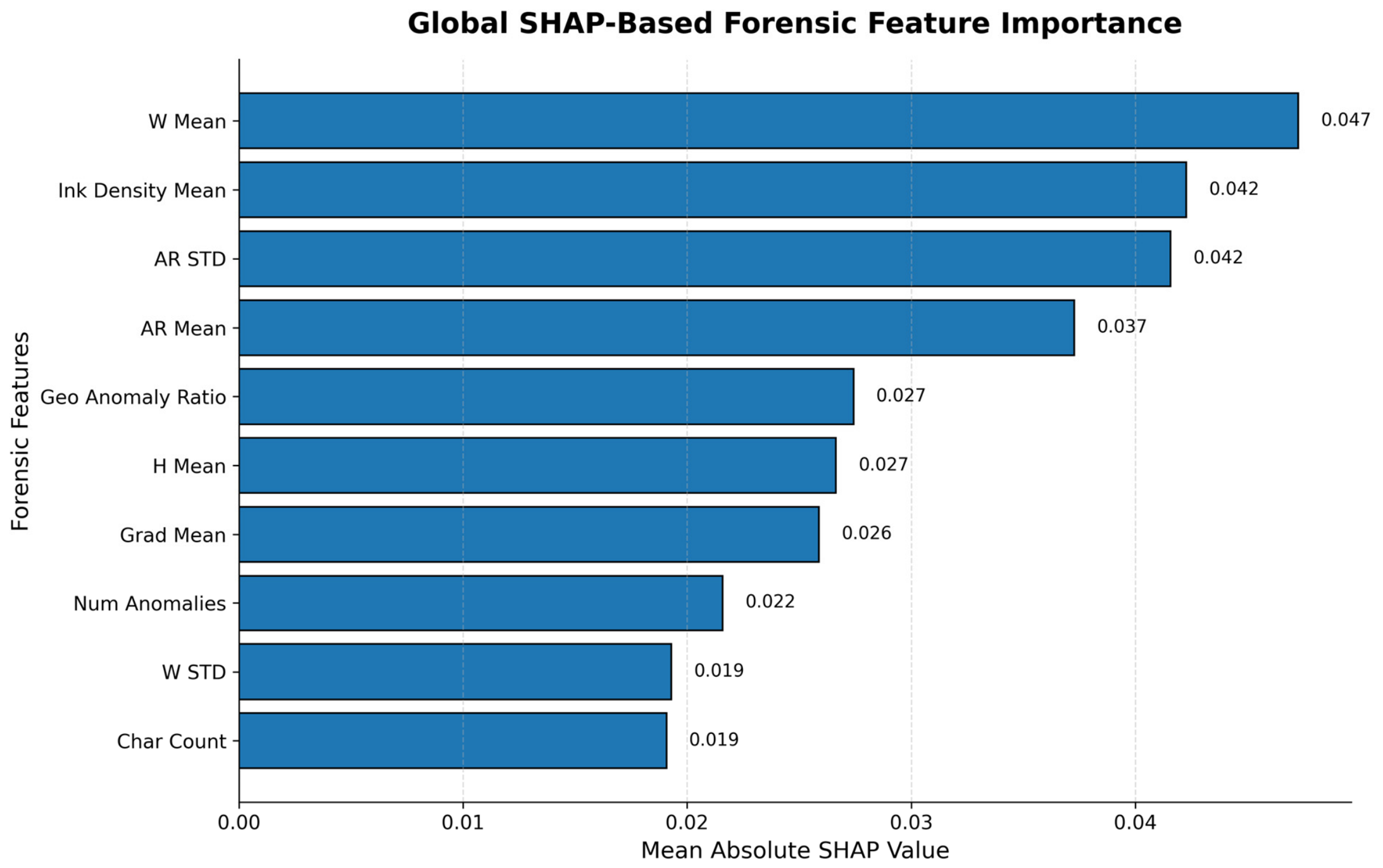
Figure 12 presents the global SHAP-based feature-importance analysis for the proposed forensic authentication framework. The SHAP results demonstrated that Character Width Mean was the most influential feature contributing toward forged-document classification decisions. This indicates that localized blur inconsistencies and smoothing artifacts represent strong forensic indicators of potential tampering activity.
In addition, Ink Density Mean, Aspect Ratio Variance, Mean Aspect Ratio, and Geometric Anomaly Ratio also exhibited significant contribution magnitudes, suggesting that manipulated documents frequently introduce inconsistencies in text texture, printing density, and character geometry. Mean Character Height (H Mean) further contributed to suspicious-document detection, indicating that forged regions may disrupt normal background texture distributions and security-pattern consistency.
The analysis validates that the proposed handcrafted forensic framework relies on meaningful forensic indicators rather than opaque black-box representations. The dominance of blur-related and texture-based features further supports the suitability of Laplacian variance analysis and anomaly-based feature engineering for real-world AML/KYC document verification environments.
4.4.2. SHAP Decision Explanation
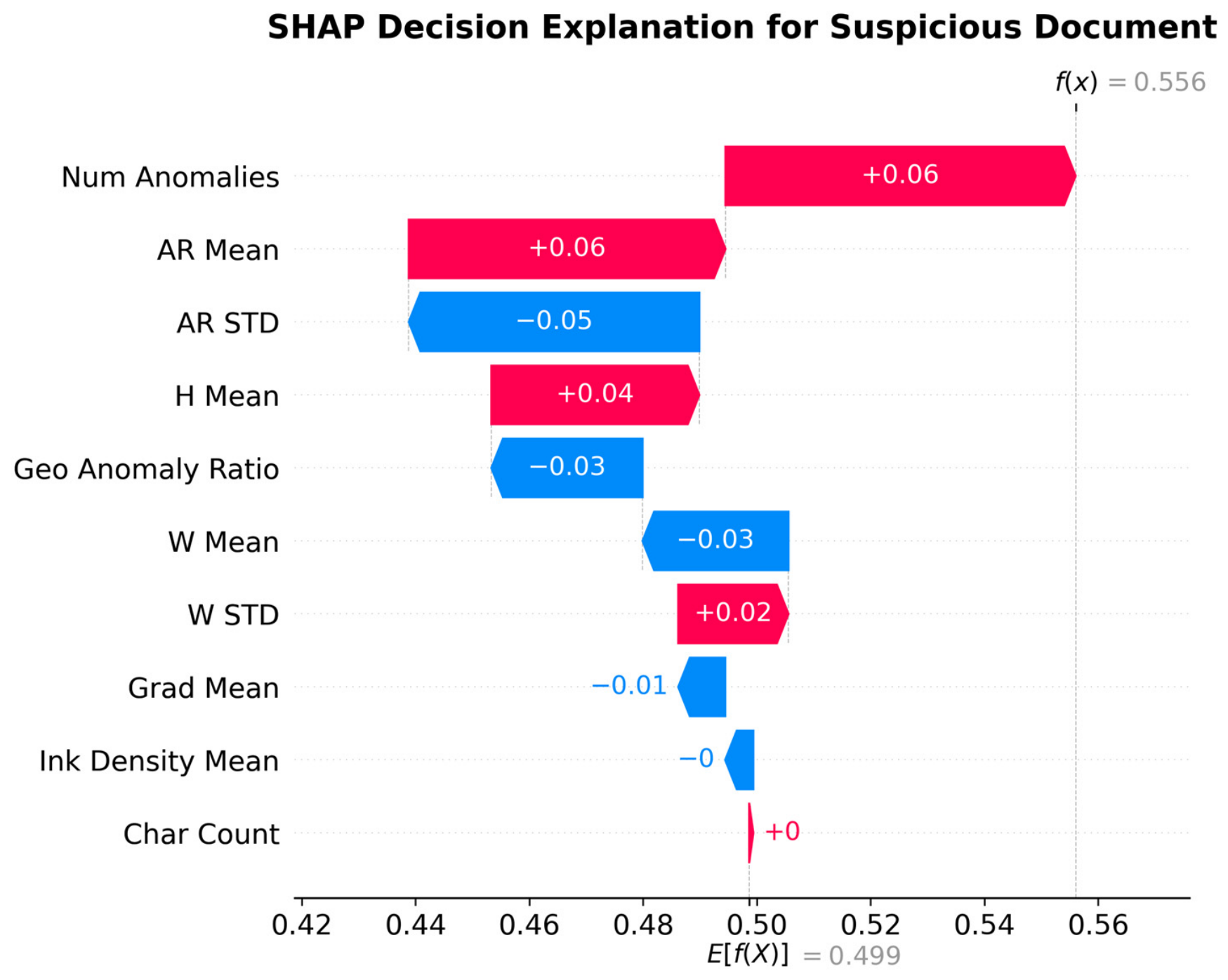
Figure 13 illustrates a localized SHAP decision explanation for an individual suspicious document prediction. Positive SHAP contributions are represented in red, while negative contributions are represented in blue. The analysis demonstrated that Number of Detected Anomalies, Mean Aspect Ratio, and Mean Character Height contributed most strongly toward the suspicious-document classification outcome.
The presence of elevated number of anomalies detected and abnormal mean aspect ratio statistics increased the model prediction score from the baseline expectation (E[f(X)] = 0.499) to the final suspicious prediction value (f(x) = 0.556). This indicates that the document contained multiple localized forensic inconsistencies collectively contributing toward the final classification outcome.
The waterfall explanation further demonstrates the interpretability advantage of the proposed framework. Unlike black-box deep learning models, the proposed system provides explicit forensic reasoning explaining why a document was flagged as suspicious, thereby improving transparency, auditability, and investigator trust within regulated AML/KYC operational settings.
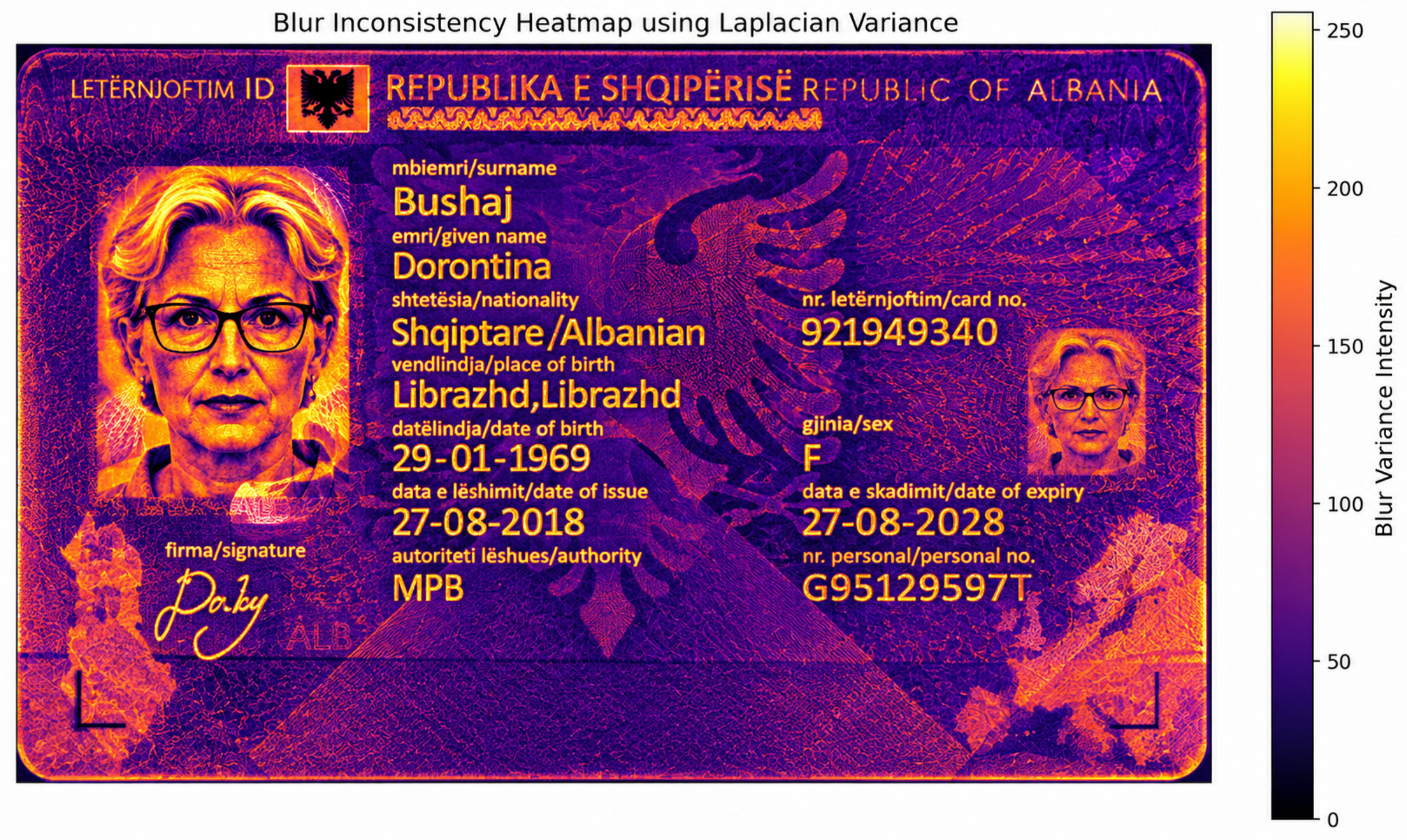
Figure 14 visualizes the blur inconsistency heatmap generated using the Laplacian variance operator. Bright regions correspond to areas exhibiting higher edge intensity and texture variation, while darker regions indicate smoother or low-frequency areas associated with blur or image smoothing effects.
The heatmap revealed strong edge responses surrounding textual regions, facial boundaries, signatures, and security elements, while several localized regions exhibited comparatively inconsistent blur distributions. Such irregular smoothing behavior may indicate potential tampering operations including copy-move manipulation, print-scan degradation, localized editing, or synthetic compositing artifacts.
The visualization demonstrates that Laplacian variance analysis successfully captures fine-grained texture irregularities and blur inconsistencies that may not be visually observable under standard inspection. This supports the inclusion of blur-based forensic indicators within the proposed feature-engineering framework.
The feature-importance analysis revealed that blur-related forensic indicators, OCR semantic consistency metrics, and geometric character statistics contributed most strongly toward forged-document detection performance. In particular, Laplacian variance features demonstrated high discriminative capability for identifying digitally smoothed tampering regions, while OCR semantic completeness ratios captured inconsistencies commonly associated with manipulated identity fields.
The SHAP importance ranking further validated the effectiveness of the selected 32-feature configuration by demonstrating that multiple complementary forensic indicators jointly contributed toward suspicious-document classification decisions rather than relying on a single dominant feature source.
4.4.3. Decision Path Analysis and Suspicious Region Localization
To further improve forensic transparency, localized decision-path analysis was conducted using SHAP-based forensic attribution mechanisms. Unlike conventional black-box classification systems that provide only binary outputs, the proposed framework explains the specific forensic indicators contributing toward suspicious-document classification outcomes.
The SHAP decision-path analysis demonstrated that the suspicious document was primarily flagged due to elevated Field Blur Variance, abnormal Character Width Statistics, and irregular Ink Density Distribution patterns. These features collectively increased the suspiciousness prediction score beyond the baseline decision threshold, resulting in final forged-document classification.
The Field Blur Variance feature contributed strongly toward the suspicious prediction because manipulated regions frequently introduce localized smoothing inconsistencies caused by editing operations, synthetic blending, print-scan degradation, or compression artifacts. Similarly, abnormal Character Width Mean and Character Width Standard Deviation measurements indicated inconsistent typography geometry that deviated from naturally printed identity-document text distributions.
Additional contributions from Gradient Standard Deviation, Background Texture Variability, and Ink Anomaly Ratio further suggested the presence of irregular printing patterns and inconsistent texture continuity across sensitive document regions. These combined forensic inconsistencies collectively increased the model confidence toward forged-document classification.
The generated decision explanations provide several operational advantages for AML/KYC deployment scenarios. First, investigators can visually identify the dominant forensic indicators contributing toward suspicious classification outcomes. Second, auditors may independently verify whether flagged regions correspond to genuine manipulation evidence. Third, explainable forensic attribution improves regulatory transparency by enabling human-understandable verification reasoning rather than opaque automated predictions alone.
Overall, the decision-path analysis confirms that the proposed framework does not rely on hidden latent representations or country-template memorization, but instead performs classification using interpretable forensic evidence derived from blur inconsistencies, OCR irregularities, texture anomalies, and geometric deviations.
4.5. Framework Limitations and Failure Modes
A key component of the experimental analysis involved ranking the forensic indicators that drove the Random Forest model’s decision-making process. This was achieved by calculating the Mean Decrease in Impurity for the extracted features. The analysis identified several primary indicators that had the greatest impact on classification accuracy.
The highest-ranked forensic indicator was Character Width Mean, which detects abnormal character-width variations and typography distortions associated with text manipulation (Importance: 0.0944), followed by Ink Density Mean (Importance: 0.0851). These features are instrumental in identifying the smoothing typically found in digitally tampered biographical data. This transparency allows the system to provide an auditable rationale for its verdicts, meeting the stringent transparency demands of modern KYC and AML regulations.
Visual Forensic Analysis and Qualitative Error Analysis
Despite achieving a mission-critical Recall of 92.31%, several failure scenarios and operational limitations remain relevant for real-world deployment. To directly address best- and worst-case prediction behavior,
Figure 15 illustrates a best-case outcome, a correctly flagged forged document in which OCR-box anomalies and clustered suspicious regions are clearly identified and consistent with the SHAP-based decision attribution shown in
Figure 13 (
Section 4.4), while
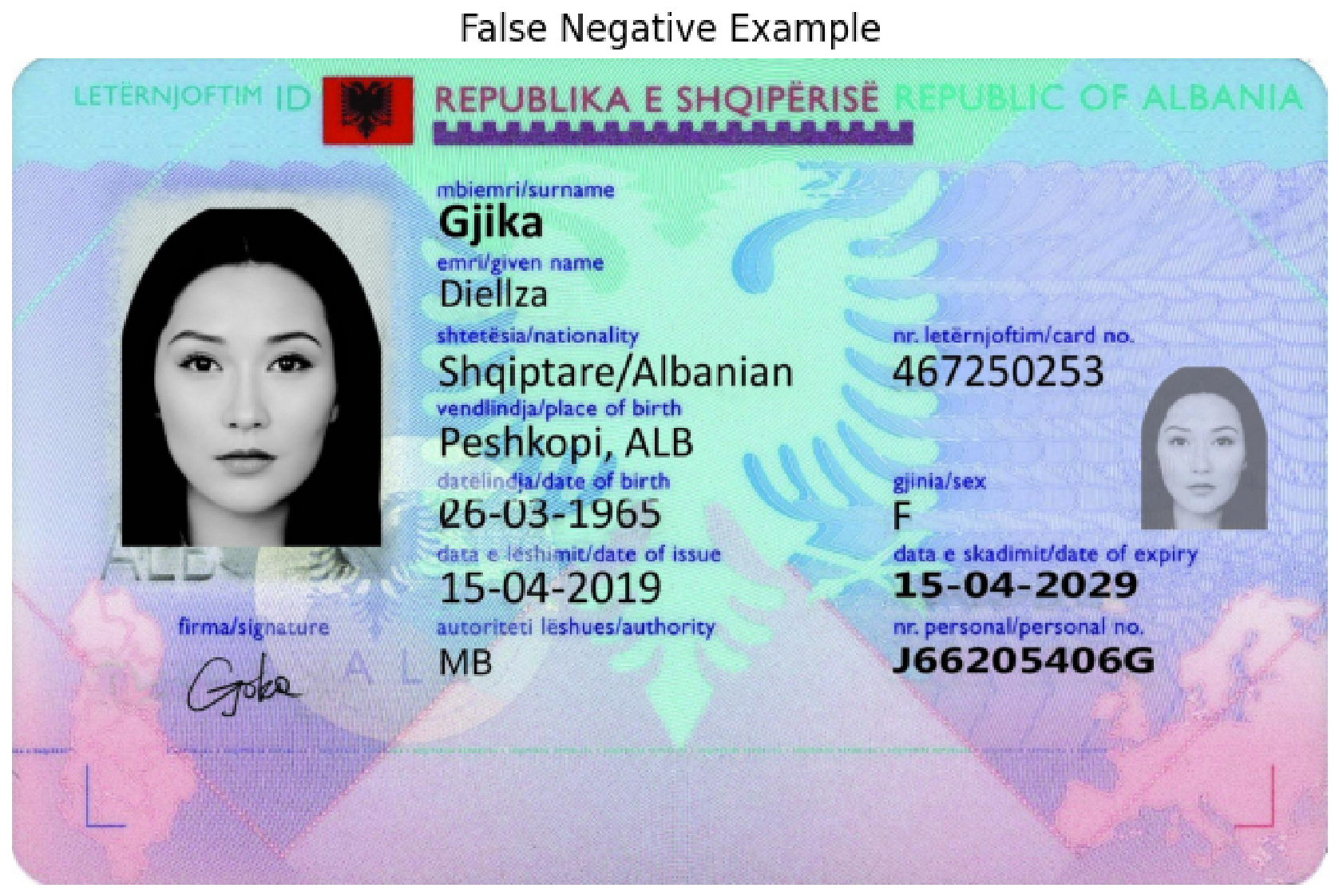
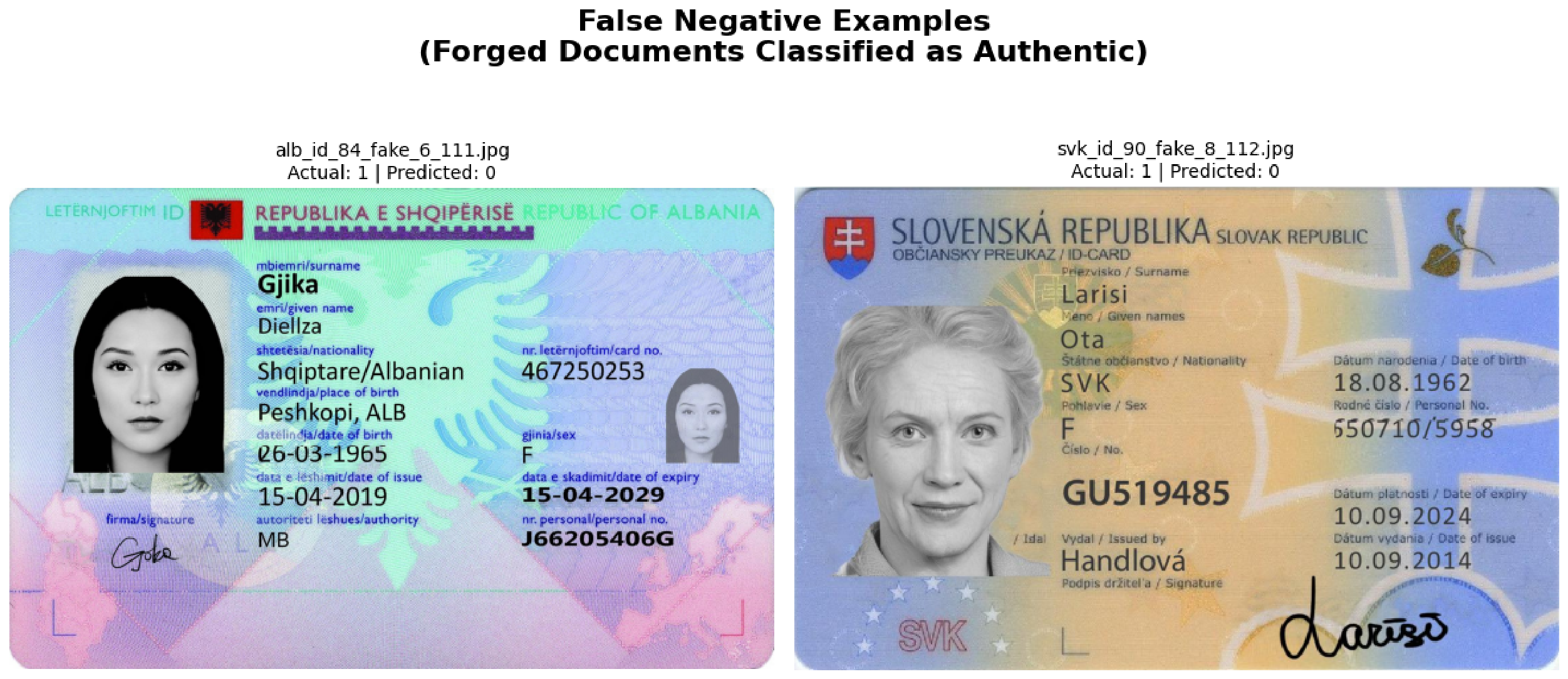
Figure 16 illustrates a worst-case outcome, a false-negative failure in which severe illumination distortion and low contrast suppressed the blur- and OCR-confidence-based forensic signals that the framework relies on most heavily. A small proportion of authentic documents may be incorrectly flagged as suspicious, representing a deliberate design choice that prioritizes high threat sensitivity over false alert rates to protect against regulatory penalties.
Qualitative failure analysis on misclassified test samples demonstrates that errors primarily stem from high-quality digital fabrications that closely mimic natural environmental degradation. As shown in
Figure 15 and
Figure 16, false-negative errors occurred under severe image degradation involving heavy blur, extreme JPEG recompression, low illumination, and low contrast.
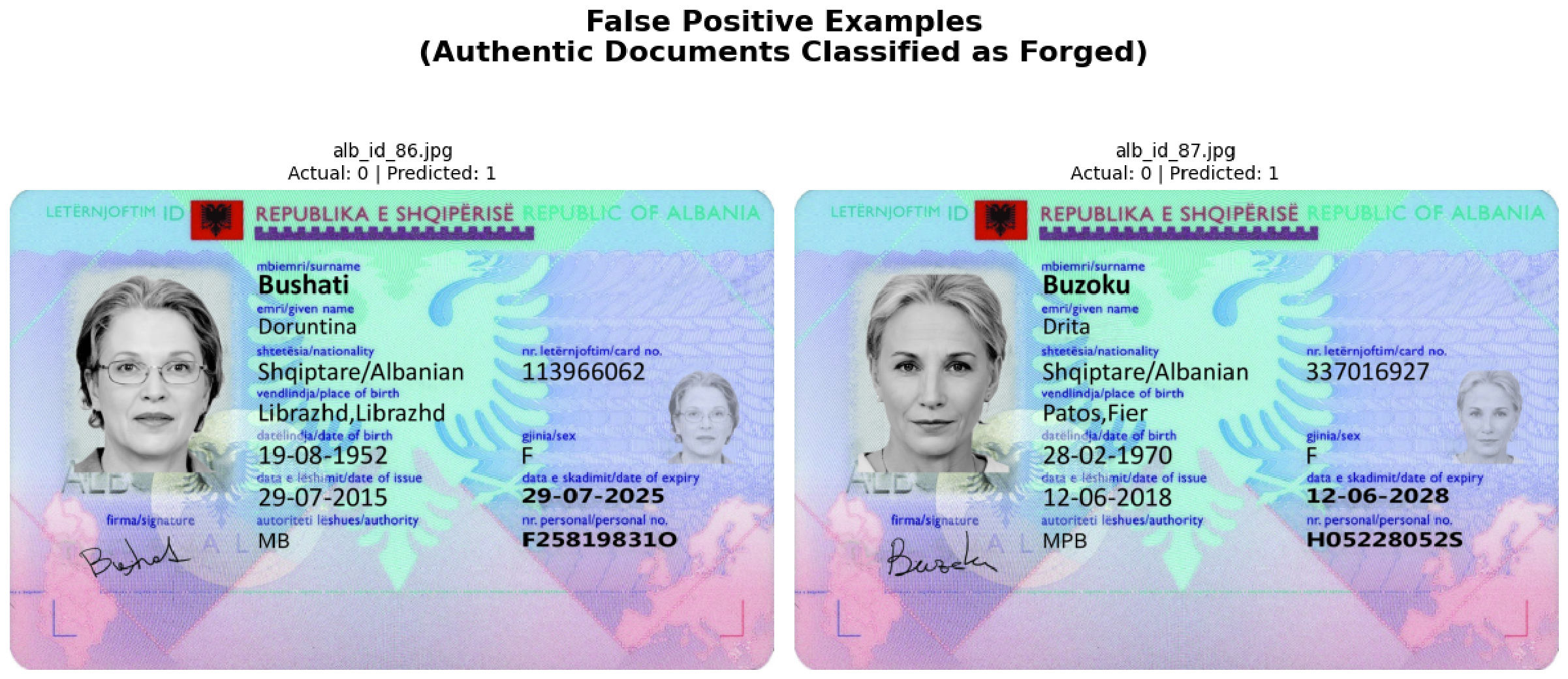
False-negative cases frequently exhibited reduced Field Blur Variance and OCR Confidence Mean discriminative power due to severe image degradation. False-positive cases were often associated with elevated Geo Anomaly Ratio and OCR Box Anomalies Count values caused by naturally occurring capture artifacts.
Under these poor image constraints, low-level indicators such as blur-consistency metrics, OCR confidence, geometric alignment, and background texture become indistinguishable from genuine patterns, causing manipulated areas to evade detection. Conversely, false-positive errors were heavily driven by clean, authentic document images suffering from motion blur, scanner artifacts, uneven lighting, and low-resolution text zones. These distortions trigger localized forensic anomalies that elevate suspicion metrics, causing authentic documents to be flagged for manual review despite the absence of physical tampering.
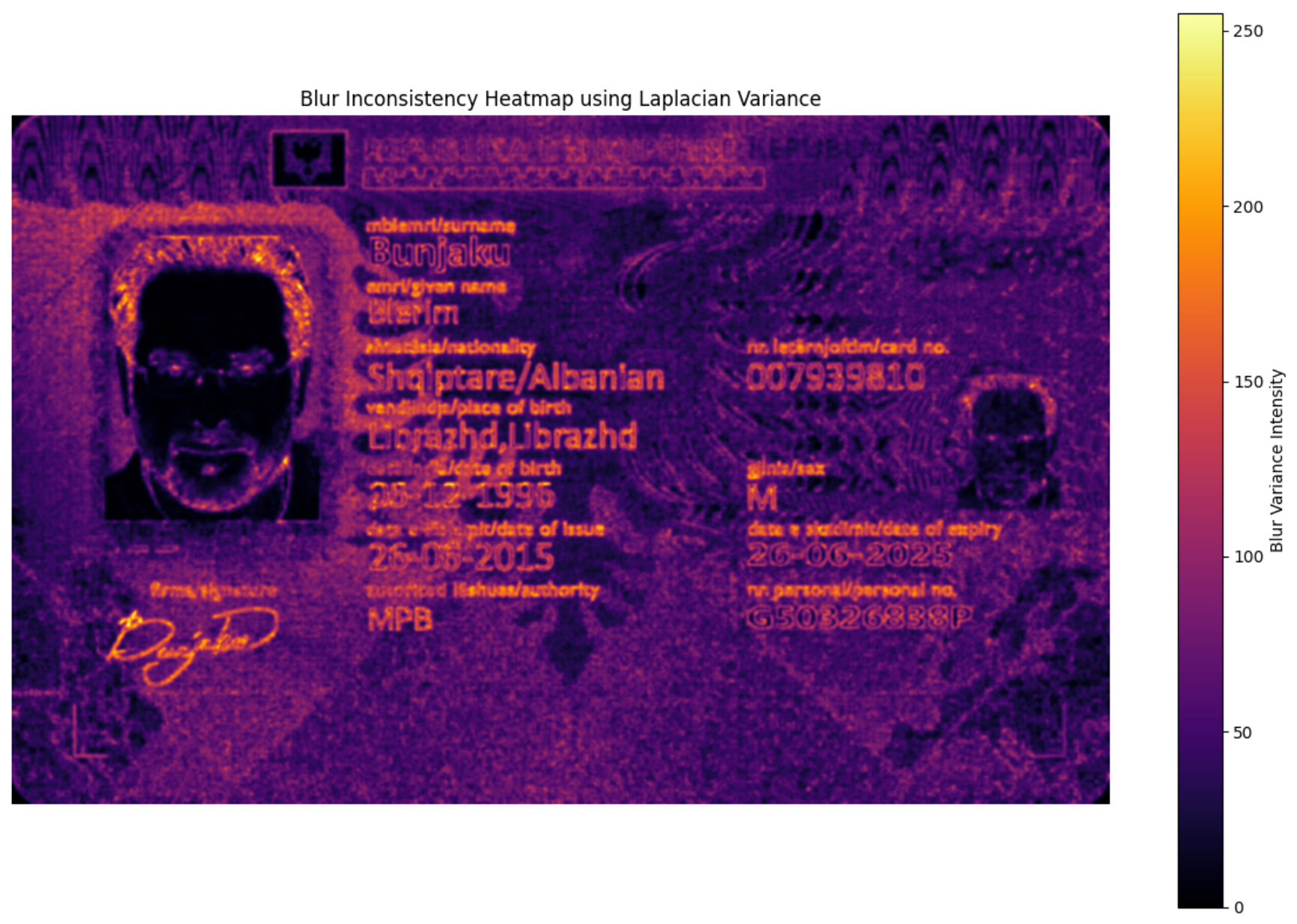
Visual inspection across the dataset confirms that the framework successfully localized multiple forms of forgery, including digitally smoothed text overlays, abnormal field inconsistencies, and texture irregularities surrounding modified zones. Suspicious document regions frequently corresponded to areas exhibiting reduced Laplacian variance, inconsistent ink-density distributions, and anomalous OCR confidence scores.
As visualized in
Figure 17 and
Figure 18, the pipeline leverages Laplacian variance maps to isolate subtle blur anomalies and clusters anomaly contours to explicitly localize suspicious regions. However, severe glare, low illumination, and extreme perspective distortion reduce the reliability of these handcrafted geometric and semantic extraction layers.
Beyond quality dependencies, the pipeline faces distribution-shift limitations when deployed in broader international markets. Because the model was trained and evaluated on Albanian identity cards, Latvian passports, and Slovakian identity cards from the MIDV-2020 dataset, generalization across unfamiliar document layouts, non-Latin scripts, and unique typographical structures remains an open challenge.
This structural scope leaves the system vulnerable to sophisticated adversarial attacks explicitly engineered to preserve local visual edge continuity, such as AI-assisted text generation or synthetic background texture cloning. Because OCR performance serves as a foundational dependency, any ambient distortion or partial occlusion limits text completeness and directly compromises downstream classification stability.
Potential mitigation strategies to address these vulnerabilities include the integration of adaptive image-quality assessment layers, the introduction of hybrid deep representation features alongside handcrafted variables, and the collection of broader multi-country datasets showcasing real-world onboarding fraud variants. In this regard, robust feature-representation strategies developed for other complex, imaging-condition-sensitive vision tasks offer useful design references: for example, learning representations that remain discriminative when moving from clean to visually complex scenes [
35] parallels the robustness challenge faced by texture- and geometry-based forensic indicators when moving from clean scans to low-quality, mobile-captured identity documents, and suggests that scene-complexity-aware feature learning could be adapted to strengthen the handcrafted forensic feature set used in this study.
4.6. Cross-Country Generalization Evaluation
To evaluate the generalization capability of the proposed authentication framework across previously unseen national document templates, a leave-one-country-out evaluation strategy was conducted (refer to
Table 15). In each experiment, the Random Forest classifier was trained using identity documents from two countries and evaluated on a third unseen country entirely excluded from training.
This evaluation was designed to simulate realistic AML/KYC deployment scenarios where financial institutions may encounter unfamiliar document layouts, typography structures, language formatting, and country-specific identity template variations. The experiments utilized Albanian identity cards, Latvian passports, and Slovakian identity cards derived from the MIDV-2020 dataset.
The experimental results demonstrated moderate cross-country generalization capability when evaluated on unseen Slovakian and Latvian documents. However, the Albanian evaluation represents the most challenging generalization scenario and serves as an important case study highlighting the effects of template dependency and OCR dependency on cross-country document authentication performance.
Substantial performance degradation was observed when the system was trained on Latvian and Slovakian documents and evaluated on unseen Albanian identity cards, where Recall decreased to 0.00%. This result indicates that none of the forged Albanian samples were successfully identified by the classifier. Although the framework achieved reasonable performance on the other unseen-country evaluations, the Albanian results reveal an important limitation regarding template dependency and OCR dependency within document authentication systems.
One possible explanation is the significant structural difference between Albanian identity cards and the document templates observed during training. The proposed framework extracts numerous handcrafted forensic features from OCR-detected text regions, including character geometry statistics, field completeness ratios, anomaly counts, OCR confidence measures, and semantic-validation indicators. Because these features are influenced by document layout, typography arrangement, field positioning, and visual design characteristics, substantial changes in document structure may shift the resulting feature distributions beyond those encountered during training.
Additionally, the framework exhibits partial OCR dependency. Several features, including OCR_Confidence_Mean, Field_Completeness_Ratio, Field_Count, OCR_Quality, and Risk_Score, are directly derived from OCR outputs and semantic validation procedures. If OCR performance degrades on previously unseen document layouts, the extracted feature representations may differ significantly from those used during model training. Consequently, forged Albanian documents may generate feature patterns that resemble authentic samples, causing the classifier to misclassify them and resulting in the observed zero-recall scenario.
The findings further suggest that the classifier may have learned certain template-specific characteristics in addition to general forgery indicators. While handcrafted forensic features successfully captured transferable integrity signals across some document types, complete template invariance was not achieved. This observation highlights a common challenge in document forensics, where strong performance on familiar document structures does not necessarily translate to reliable detection on previously unseen templates.
To mitigate these limitations, future work should incorporate a wider range of document types, countries, languages, and identity templates during training. Additional improvements may be achieved through template-normalization strategies, domain-adaptation techniques, OCR-ensemble approaches, and multimodal document-understanding models such as LayoutLMv3 that jointly learn visual, textual, and structural document representations. Such enhancements could improve robustness against template variation and reduce the dependence of the authentication framework on specific OCR and document-layout characteristics.
Despite the reduced Albanian performance, the cross-country evaluation provides valuable insight into the practical deployment challenges of AML/KYC document authentication systems. The results demonstrate that strong within-dataset performance does not necessarily guarantee reliable generalization across unseen document templates, emphasizing the importance of diverse training data and template-agnostic forensic feature design for real-world deployment.
4.7. Visual Robustness Evaluation
To evaluate robustness under realistic AML/KYC onboarding conditions, additional perturbation-based testing was conducted using degraded versions of the unseen test dataset (refer to
Table 16). The robustness evaluation simulated common document acquisition artifacts including Gaussian blur, JPEG compression, glare, perspective distortion, low illumination, and print-scan degradation.
These perturbations were selected to reflect practical challenges encountered during remote mobile identity verification, where document images may be captured under uncontrolled environmental conditions using consumer-grade cameras. The evaluation assessed whether the proposed handcrafted forensic framework maintained stable forged-document detection performance under moderate visual degradation.
Experimental results demonstrated that the framework retained relatively stable Recall performance under moderate perturbation levels, particularly for blur and compression distortions. However, stronger degradation conditions such as severe glare and aggressive perspective distortion produced greater reduction in OCR consistency and semantic completeness, thereby affecting downstream forensic feature reliability. Despite these limitations, the framework continued to demonstrate reasonable robustness for practical AML/KYC pre-screening scenarios.
The proposed framework is not intended to perform adversarially robust forgery localization under extreme degradation conditions. Instead, the system is designed as a lightweight forensic pre-screening framework capable of maintaining reasonable verification stability under common mobile onboarding artifacts encountered in practical AML/KYC workflows.
4.8. Lightweight Deep Learning Baseline Comparison
To further evaluate the effectiveness of the proposed lightweight forensic framework, additional comparisons were conducted against several lightweight deep learning architectures commonly used in image classification tasks, including ResNet18, EfficientNet-B0, and MobileNetV3. These architectures were selected due to their relatively low computational complexity and suitability for resource-constrained environments compared to larger transformer-based models.
All deep learning baselines were trained using the same training and testing partitions applied to the proposed framework to ensure fair comparison. Input document images were resized to 224 × 224 RGB format, and final classification layers were modified for binary forged-document classification. Training was conducted under CPU-compatible settings using lightweight optimization configurations to reflect realistic AML/KYC deployment constraints.
Although several lightweight CNN architectures demonstrated competitive classification performance, the proposed handcrafted forensic framework remained advantageous in terms of interpretability, forensic transparency, CPU efficiency, and operational explainability. Unlike deep learning models that primarily operate as black-box feature extractors, the proposed system provides directly interpretable forensic indicators including blur inconsistencies, OCR-quality degradation, geometric anomalies, and semantic field validation results, which are important for regulated AML/KYC compliance workflows.
Direct experimental benchmarking against recently published document-forensics systems such as EdgeDoc, DocForgeNet, and DOCFORGE-BENCH (
Table 1) was not performed in this study, and this limitation is acknowledged explicitly rather than left implicit. EdgeDoc was trained and evaluated on the FantasyID competition dataset released for the ICCV 2025 DeepID Challenge rather than MIDV-2020, and its authors indicated that source code would be released only after publication; at the time of writing, no verified public checkpoint compatible with the Albanian, Latvian, and Slovakian MIDV-2020 subsets used in this study was available. DocForgeNet and DOCFORGE-BENCH were likewise developed and benchmarked on scanned-document and multi-source forgery corpora distinct from MIDV-2020’s mobile-captured identity documents. Reproducing these architectures from scratch on the present 450-sample dataset would risk an unfair comparison, since none of these systems were designed or tuned for this specific dataset and document category distribution. Instead, this study benchmarks against ViT-B/16, PaddleOCR + RF, and three lightweight CNNs (ResNet18, EfficientNet-B0, MobileNetV3) trained on the identical MIDV-2020 partitions used by the proposed framework (
Table 8 and
Table 17), which provides a fair, dataset-matched comparison; the conceptual comparison against EdgeDoc, DocForgeNet, and DOCFORGE-BENCH in
Table 1 is limited to architectural characteristics, computational cost, and explainability support reported in their original publications, and should not be read as a claim of superior detection accuracy on those systems’ own benchmarks.
It is also worth situating this limitation within the wider literature: to the authors’ knowledge, no prior published work reports document-forgery-detection results on the specific MIDV-2020 identity-document subsets used in this study, which limits the availability of a directly comparable, dataset-matched literature baseline; a related MIDV-2020-based authentication study explicitly notes that a comparative study is not practically possible for this reason, since no other results have been reported on this dataset in the identity-document-authentication literature [
36]. Independently, DOCFORGE-BENCH’s own zero-shot evaluation of 14 published forgery-detection methods across eight benchmark datasets, including identity-document data, found a pervasive calibration failure in which methods achieved moderate pixel-level AUC (\u22650.76) but near-zero pixel-level F1 under realistic, no-domain-adaptation deployment, a pattern the DOCFORGE-BENCH authors attribute to the severe class imbalance of tampered regions in document images rather than to a fundamental detection failure. This finding from the literature itself supports the position taken in this manuscript: methods developed and tuned for one document-forgery benchmark do not reliably transfer their reported performance to a new, unseen dataset without recalibration or retraining, which is precisely the scenario an out-of-the-box experimental reproduction of EdgeDoc, DocForgeNet, or DOCFORGE-BENCH on the present 450-sample MIDV-2020 subset would have created. The proposed framework’s explicit, dataset-matched comparison against ViT-B/16, PaddleOCR + RF, and three lightweight CNNs (
Table 8,
Table 17), together with its explicit leave-one-country-out evaluation (
Section 4.6), is offered as a more methodologically sound alternative to an unfair cross-dataset reproduction, while the literature context above clarifies why a direct head-to-head numerical comparison with EdgeDoc, DocForgeNet, and DOCFORGE-BENCH could not be responsibly included.
Table 18 presents an efficiency comparison among the lightweight deep learning methods. The experimental comparison demonstrates that lightweight CNN architectures achieved moderate forged-document detection capability under controlled evaluation settings. Among the evaluated deep learning baselines, MobileNetV3 achieved the highest Recall performance, indicating strong sensitivity toward forged-document identification. However, the proposed handcrafted forensic framework consistently provided the best overall balance between Recall, F1-Score, interpretability, and operational transparency.
Unlike deep learning architectures that function primarily as black-box feature extractors, the proposed framework produces directly interpretable forensic indicators, including blur inconsistencies, OCR-quality degradation, geometric anomalies, and semantic validation irregularities. Furthermore, the proposed system operates efficiently under CPU-only execution without requiring GPU acceleration, making it more suitable for practical AML/KYC onboarding environments where computational efficiency, explainability, and auditability are critical regulatory requirements.
4.9. Statistical Rigor and Bootstrap Analysis
To improve experimental reliability and statistical robustness, repeated-run evaluation and bootstrap-based confidence interval analysis were conducted on the proposed forensic authentication framework (refer to
Table 19). Unlike single-run evaluation protocols that may be sensitive to random initialization and sampling effects, the proposed statistical analysis evaluated model stability across multiple independent training executions using different random seeds.
The repeated-run experiments demonstrated highly stable classification behavior across all evaluation settings, with only minor performance fluctuations observed between independent runs. The low variance across Accuracy, Recall, Precision, and F1-Score metrics indicates that the proposed handcrafted forensic framework maintains consistent generalization capability and does not depend on unstable optimization behavior or stochastic convergence effects commonly associated with deep learning architectures.
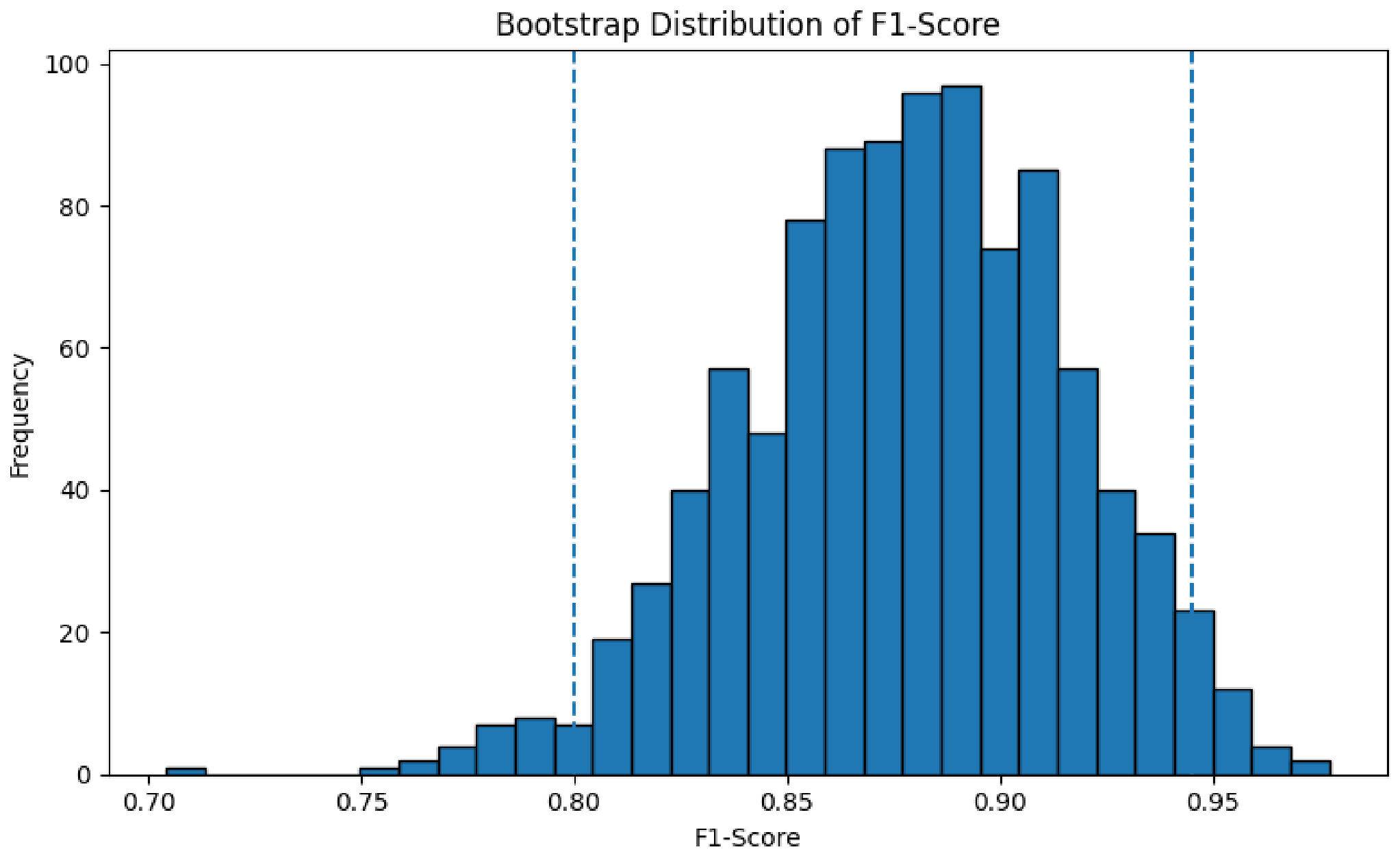
To further strengthen statistical validity, non-parametric bootstrap analysis was performed using 1000 resampling iterations on the testing dataset. The resulting bootstrap distribution of the F1-Score exhibited a concentrated bell-shaped pattern centered around the mean classification performance, indicating strong reproducibility under varying sample selections.
Figure 19 illustrates the bootstrap distribution of the F1-Score obtained across repeated resampling iterations. The dashed vertical lines represent the estimated 95% confidence interval boundaries. The relatively narrow confidence interval demonstrates that the proposed framework maintains stable classification performance with limited sensitivity to dataset perturbation and sampling variability.
The statistical findings further support the robustness of the proposed forensic authentication framework for real-world AML/KYC deployment environments, where consistent operational behavior, reproducible verification outcomes, and dependable forged-document detection performance are critical requirements. The observed statistical stability also reinforces that the proposed handcrafted feature-engineering strategy captures generalized forensic inconsistencies rather than relying on unstable dataset-specific patterns.
4.10. Operational Feasibility
To evaluate deployment feasibility, inference latency benchmarking was executed under CPU-only settings on a workstation equipped with an Intel Core i7 processor and 16 GB RAM without dedicated GPU acceleration. The proposed framework achieved an average inference latency of approximately 1.99 ms per document, processing the entire testing split in 0.1316 s. These findings indicate that the lightweight, handcrafted-feature architecture effectively supports real-time, high-volume financial screening workflows without requiring specialized deep-learning clusters or hardware infrastructure. Because the sub-millisecond, CPU-only inference cost is small relative to typical mobile-network round-trip latency, the model is also well suited to deployment directly within edge nodes or lightweight API microservices in a distributed KYC verification network, rather than requiring calls to a centralized GPU-backed inference server over the network.
The architecture demonstrated highly consistent performance across independent executions, exhibiting tight bootstrap confidence intervals and minimal metric variance across Accuracy, Recall, Precision, and F1-Score indices. This stable behavior confirms that the feature-engineering pipeline captures generalized forensic integrity trends rather than memorizing volatile dataset-specific patterns, ensuring reproducible verification outcomes required in regulated compliance environments.
4.11. Computational Complexity Analysis
To support the lightweight deployment claim of the proposed AML/KYC authentication framework, a computational complexity analysis was conducted by comparing the proposed Random Forest classifier against representative deep learning baselines, namely ResNet18 and MobileNetV3.
Table 20 summarizes the training time, inference time, and memory requirements of each model. Training time was measured as the total model training duration, inference time was calculated as the average prediction time per document image, and memory consumption was estimated using the serialized model size stored on disk.
The results demonstrate substantial computational advantages of the proposed framework. The Random Forest classifier required only 0.23 s for training, whereas MobileNetV3, ResNet18, and EfficientNetB0 required 180.50 s, 216.89 s, and 106.15 s, respectively. The proposed framework achieved the fastest inference speed at approximately 0.50 ms per image. In comparison, MobileNetV3 required 71.20 ms per image, while ResNet18 and EfficientNetB0 required 97.90 ms and 98.50 ms per image, respectively.
Memory consumption further highlights the efficiency of the proposed approach. The Random Forest model occupied only 0.36 MB of storage, compared with 42.71 MB for ResNet18, 15.58 MB for EfficientNetB0, and 5.92 MB for MobileNetV3. This represents approximately a 30× reduction in memory usage relative to ResNet18, an 11× reduction relative to EfficientNetB0, and a 4× reduction relative to MobileNetV3.
Although deep learning architectures provide automatic feature learning capabilities, they require substantially greater computational resources and typically benefit from GPU acceleration during both training and deployment. In contrast, the proposed framework achieves competitive forgery-detection performance while maintaining significantly lower computational requirements and higher interpretability. These characteristics make the framework particularly suitable for practical AML/KYC environments where deployment efficiency, auditability, and low hardware requirements are important operational considerations.
4.12. Borderline Case Analysis
The results demonstrated highly consistent classification performance with only minor fluctuations across Accuracy, Recall, Precision, and F1-Score metrics. The narrow bootstrap confidence intervals and low metric variance indicate stable generalization behavior and reduced sensitivity to dataset-specific effects.
In addition to quantitative stability analysis, qualitative failure analysis was performed on misclassified testing samples to identify challenging forgery scenarios and understand the limitations of the proposed forensic feature set.
Several false-negative cases occurred under severe image degradation conditions involving strong blur artifacts, excessive JPEG recompression, low illumination, and print-scan distortion. Under these conditions, blur-consistency measurements, OCR-confidence indicators, geometric statistics, and texture-based features became less distinguishable, causing manipulated regions to resemble naturally degraded authentic documents.
False-positive cases were primarily associated with authentic documents exhibiting motion blur, scanner artifacts, illumination inconsistencies, low-resolution text regions, and OCR instability. These conditions occasionally produced forensic responses similar to those observed in forged documents, resulting in elevated suspiciousness scores despite the absence of tampering.
Figure 20 presents representative false-negative examples,
Figure 21 illustrates false-positive examples, and
Figure 22 shows borderline cases containing subtle manipulation traces and highly ambiguous forensic characteristics.
Table 21 summarizes representative borderline cases identified during failure analysis. The results indicate that several samples produced prediction probabilities close to the decision boundary threshold, highlighting the inherent difficulty associated with distinguishing between subtle manipulations and naturally degraded authentic documents under challenging acquisition conditions.
The analysis further revealed that OCR-semantic validation, geometric anomaly statistics, and texture-based indicators were most susceptible to performance degradation under poor image-quality conditions. Similarly, blur-based features exhibited reduced discriminative capability when authentic and forged samples contained comparable degradation patterns.
Several mitigation strategies may improve future robustness. These include integrating adaptive image-quality assessment and restoration techniques, incorporating deep lightweight feature representations alongside handcrafted forensic indicators, and expanding the dataset with more diverse real-world fraud scenarios and document types.
Despite these limitations, the proposed framework maintained strong Recall performance, statistical stability, cross-country generalization capability, and practical deployment efficiency. These characteristics demonstrate the suitability of the proposed approach for explainable AML/KYC document verification environments where reliable and auditable fraud detection remains operationally important.