
Evaluation of Vanilla and RAG-Supported LLM Comprehension of the EU AI Act




Abstract
1. Introduction
2. Materials and Methods
2.1. Language Models
2.2. Retrieval-Augmented Generation
2.3. The EU Artificial Intelligence Act
2.4. Benchmarking and Evaluation Questions
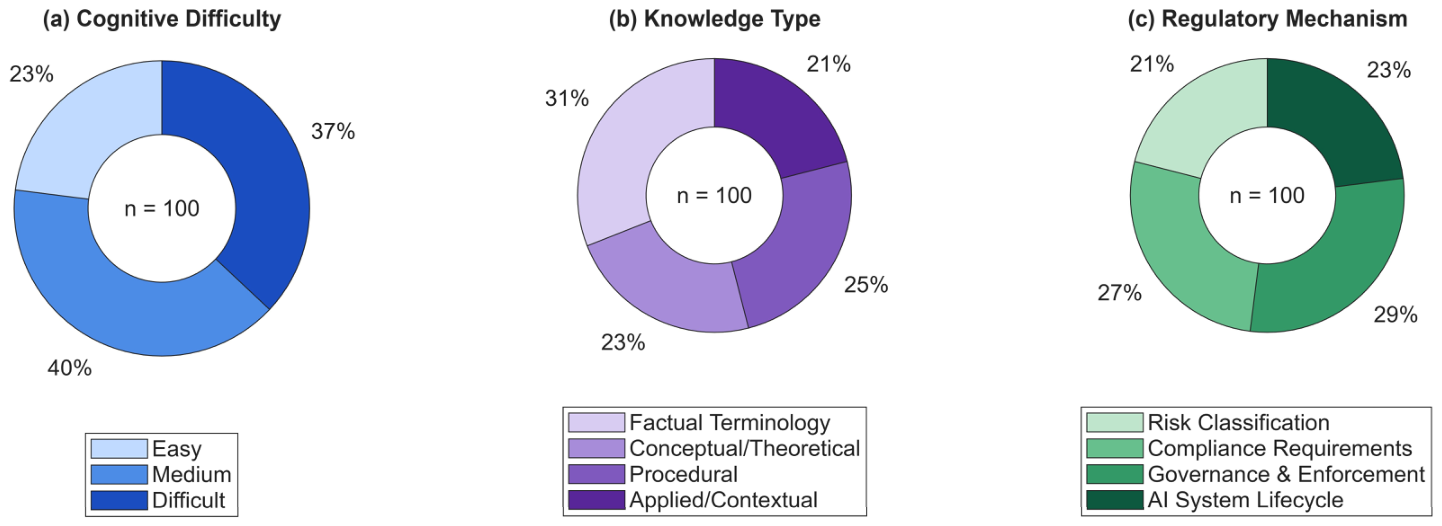
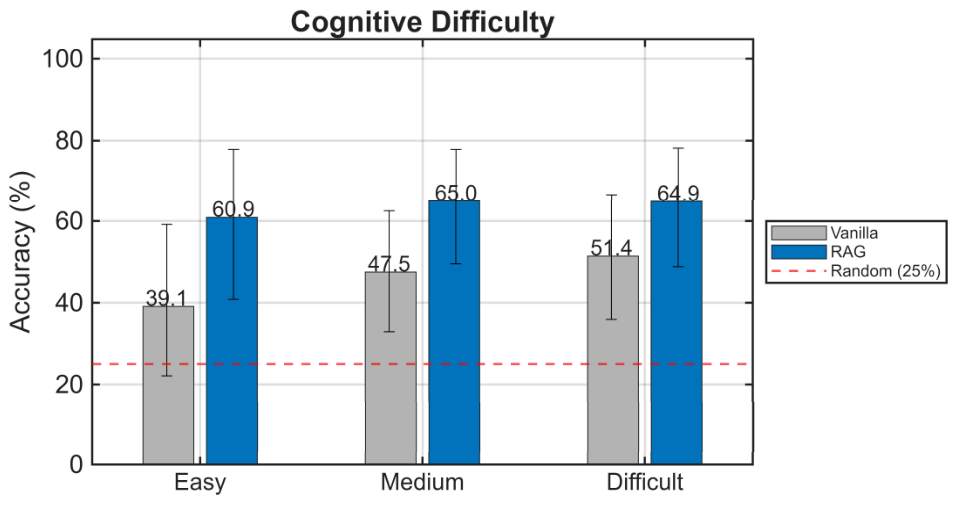
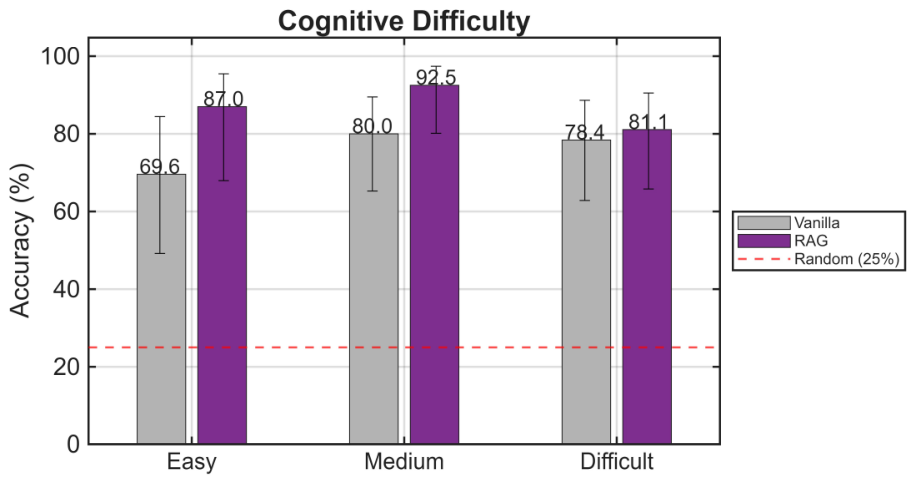
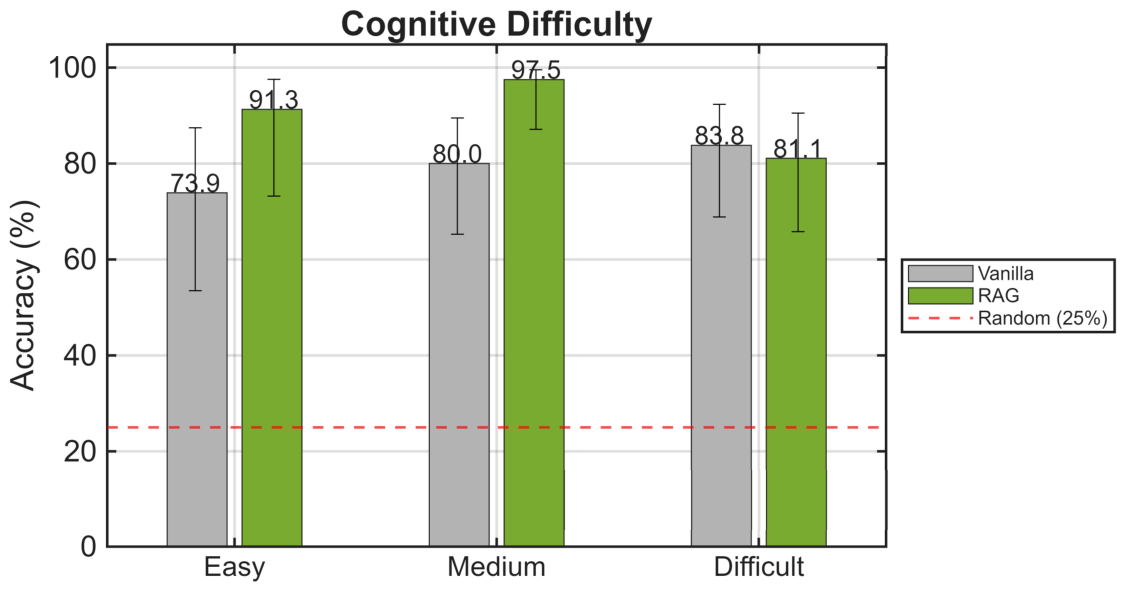
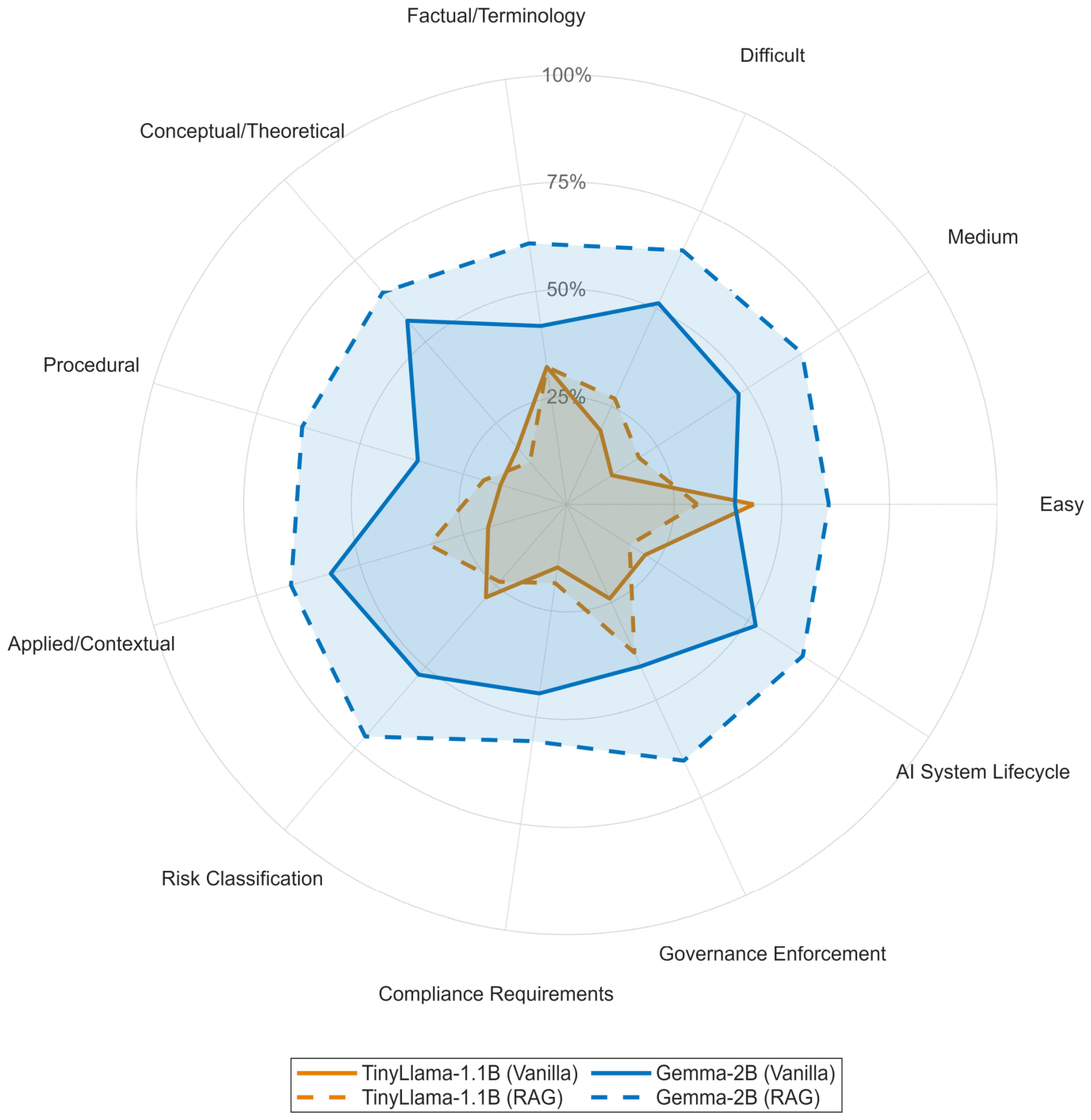
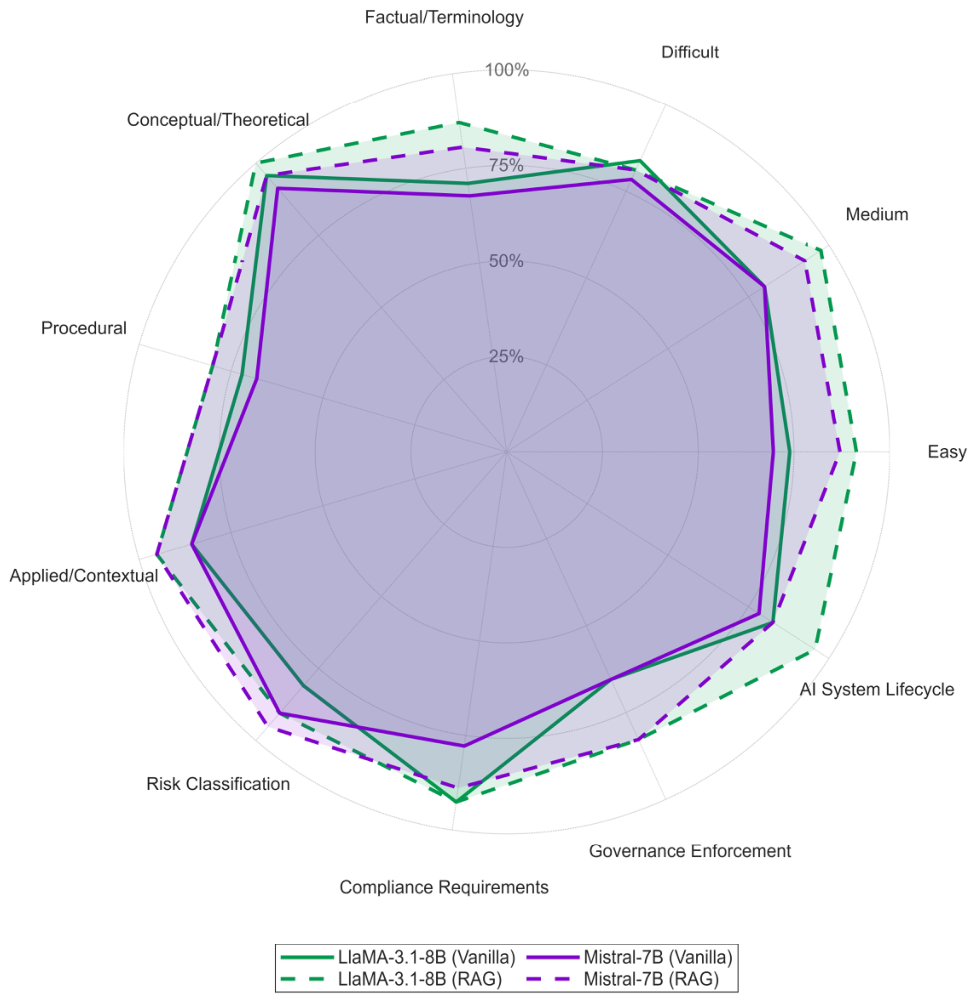
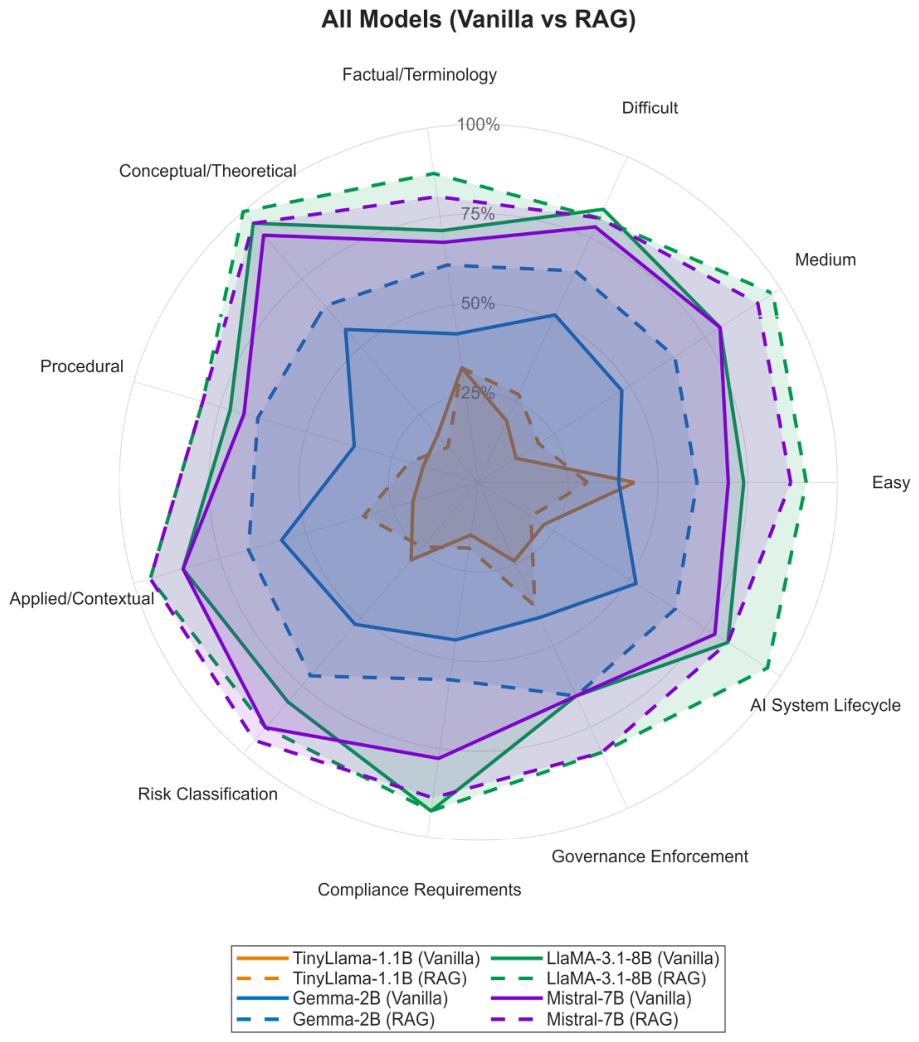
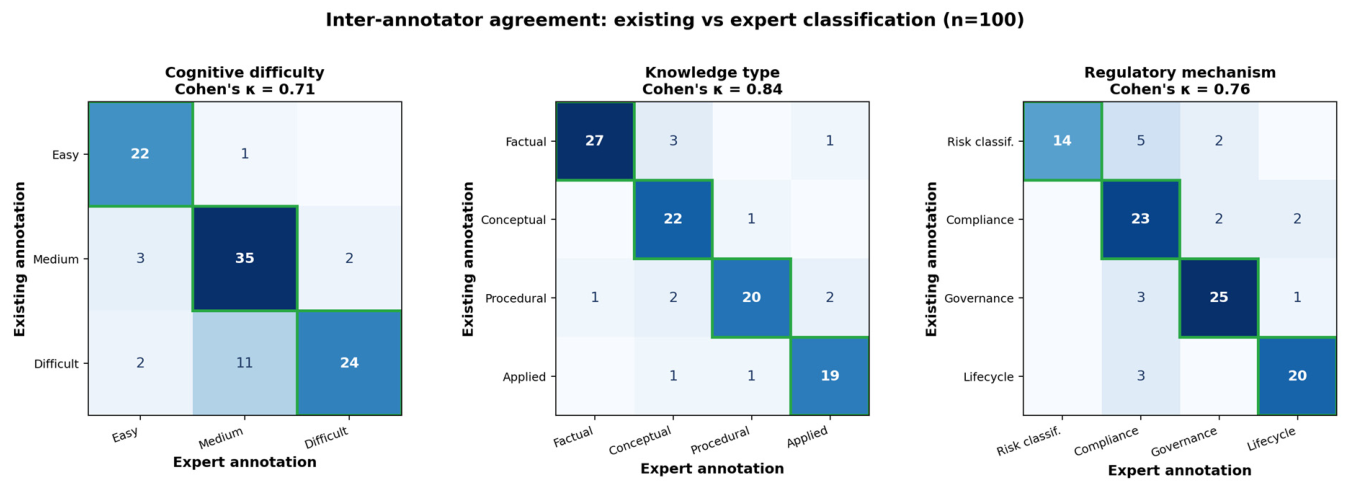
- Cognitive Difficulty: Questions were assigned one of three levels. Easy questions (n = 23) require direct recall or definition of terms and thresholds explicitly stated in the Act. Questions of medium difficulty (n = 40) demand conceptual understanding and reasoning about regulatory principles. Difficult questions (n = 37) involve multi-step legal and analytical reasoning, such as identifying chains of responsibility across actors and evaluating the interaction of two regulatory provisions.
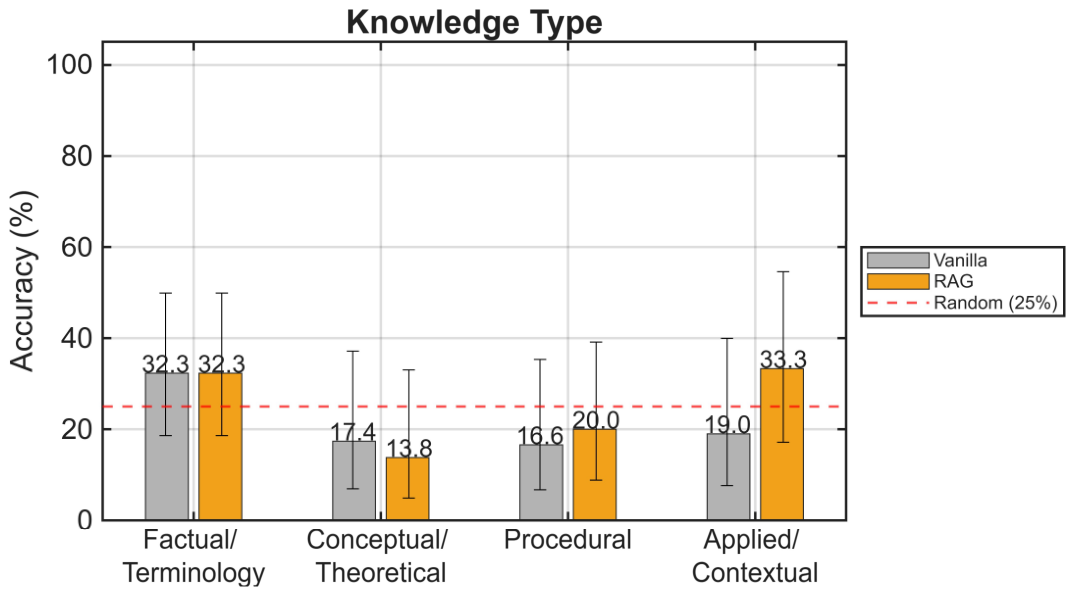
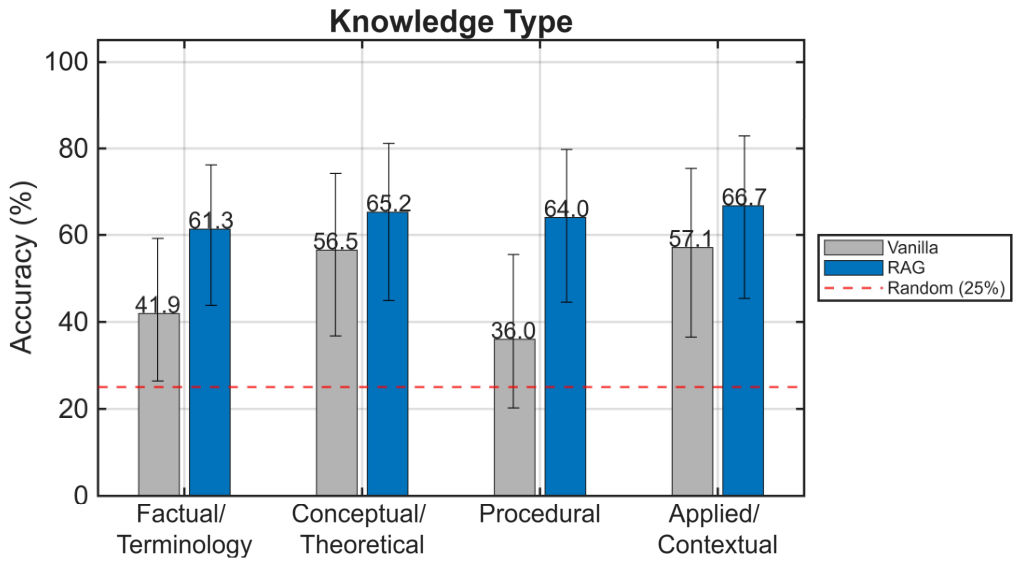
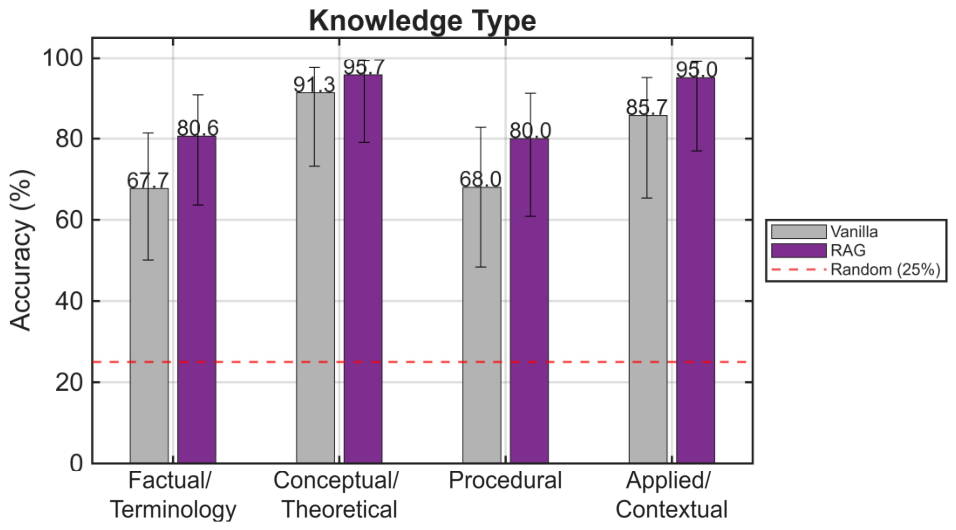
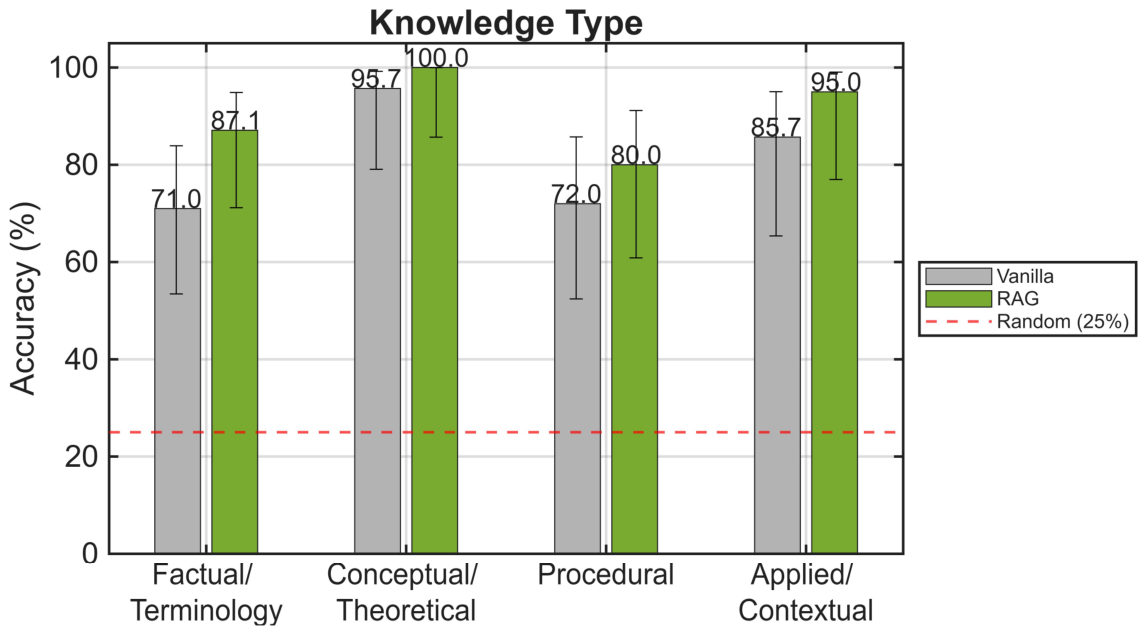
- Knowledge Type: Questions were further classified into four knowledge-related categories: (a) factual/terminology, covering definitions, numerical thresholds, and named provisions (n = 31); (b) conceptual/theoretical, targeting the rationale and principles underpinning regulatory choices (n = 23); (c) procedural, addressing ordered sequences of compliance actions such as conformity assessment workflows (n = 25); and (d) applied/contextual, presenting realistic deployment scenarios that require mapping a situation to the appropriate regulatory category or obligation (n = 21).
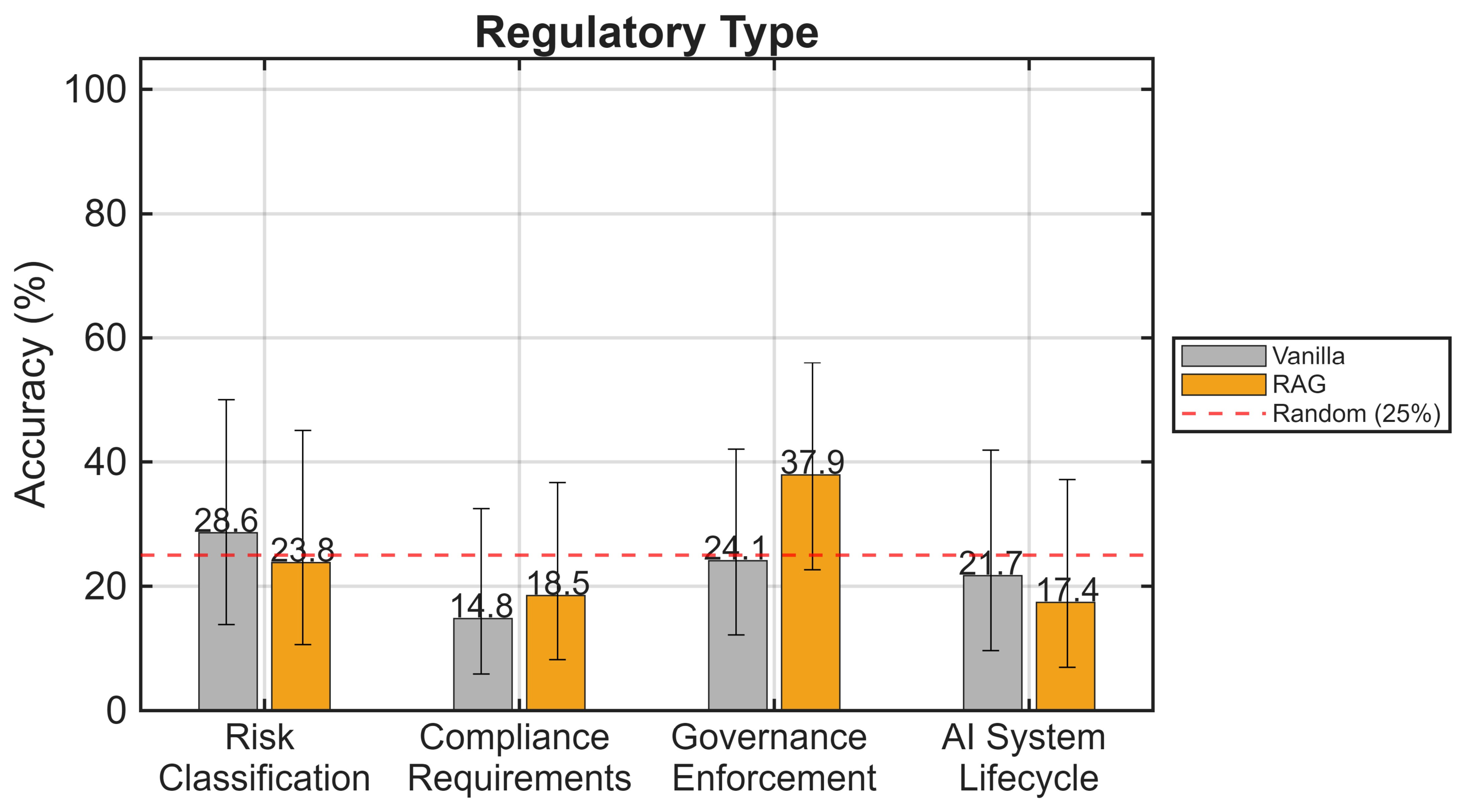
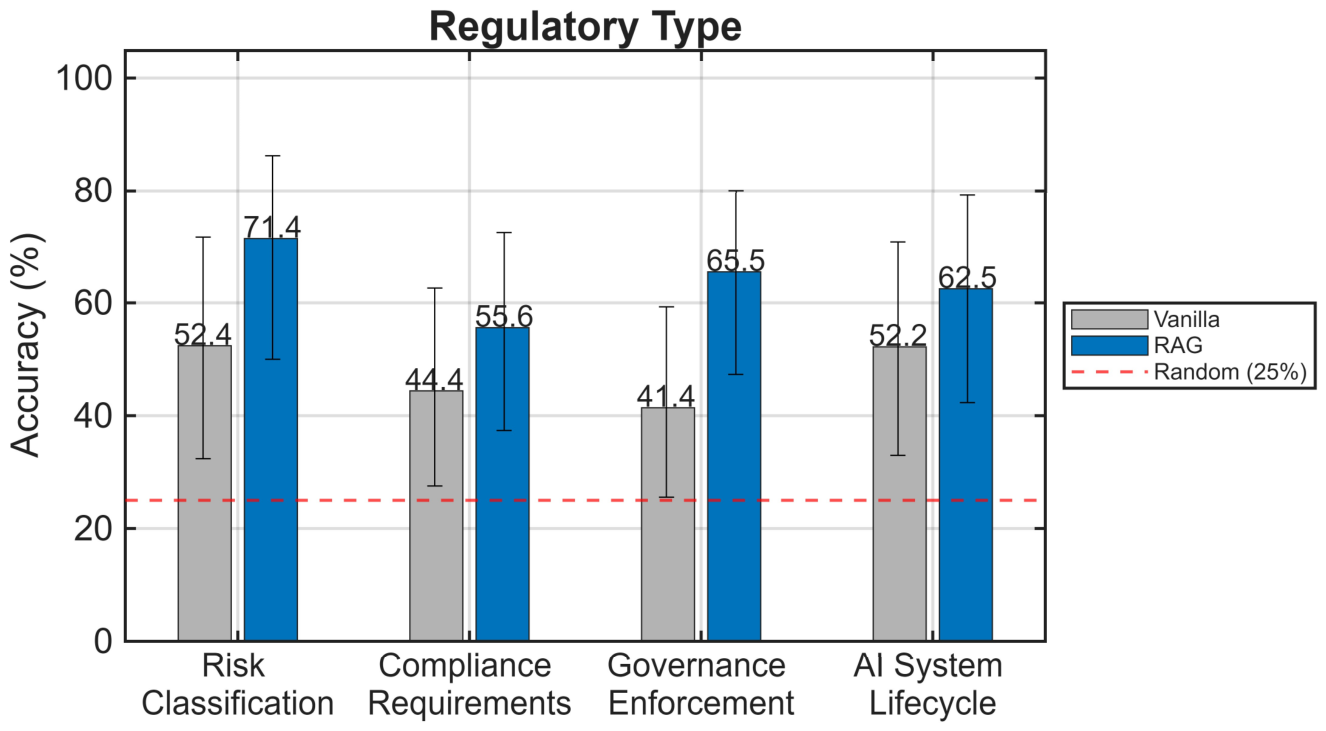
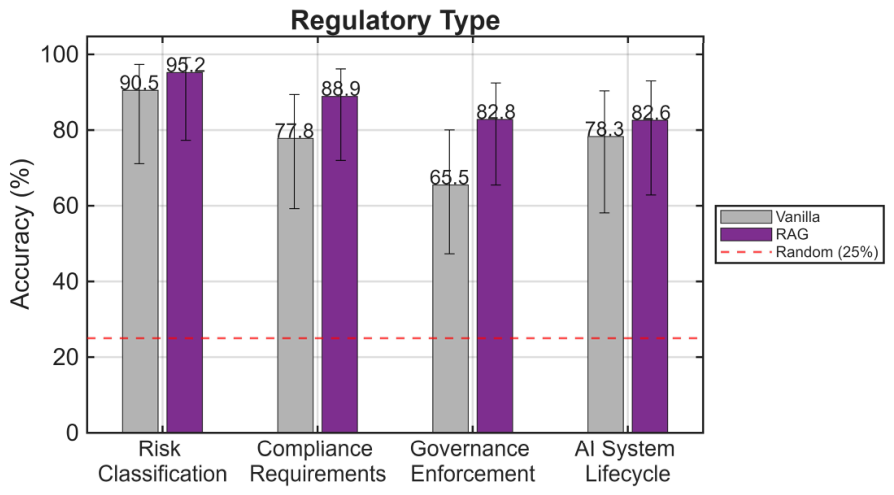
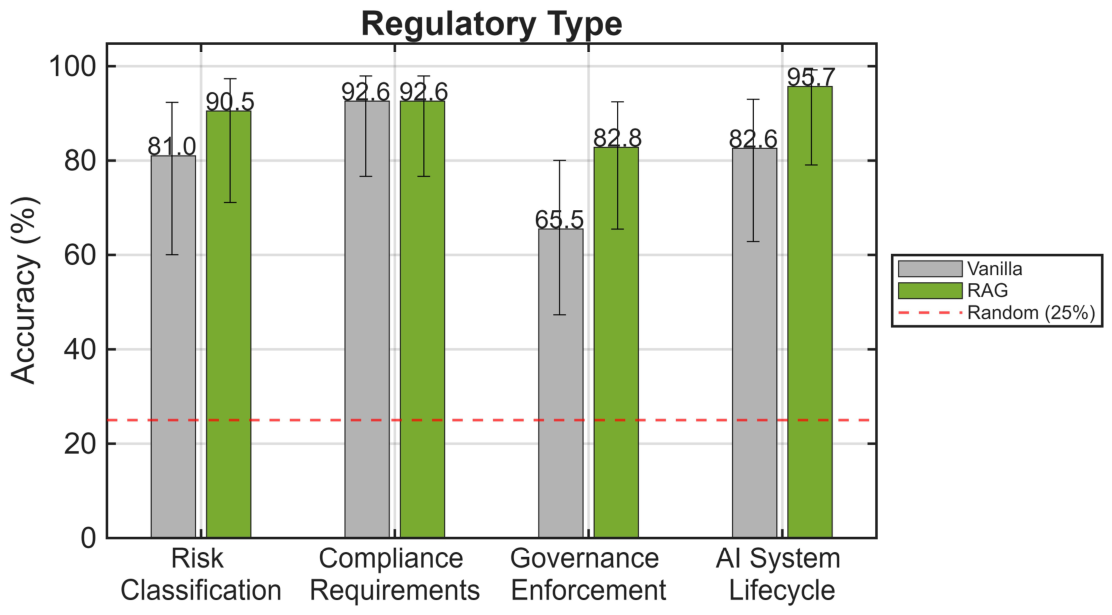
- Regulatory Mechanism: A third perspective captures which structural component of the Act each question addresses: risk classification (questions about the four-tier risk hierarchy and prohibited practices) (n = 21), compliance requirements (obligations concerning documentation (n = 27), data governance, human oversight, and transparency), governance and enforcement (national authorities, the European AI Office, penalties, and market surveillance) (n = 29), and AI system lifecycle (development-time, deployment, post-market monitoring, and modification obligations) (n = 23).
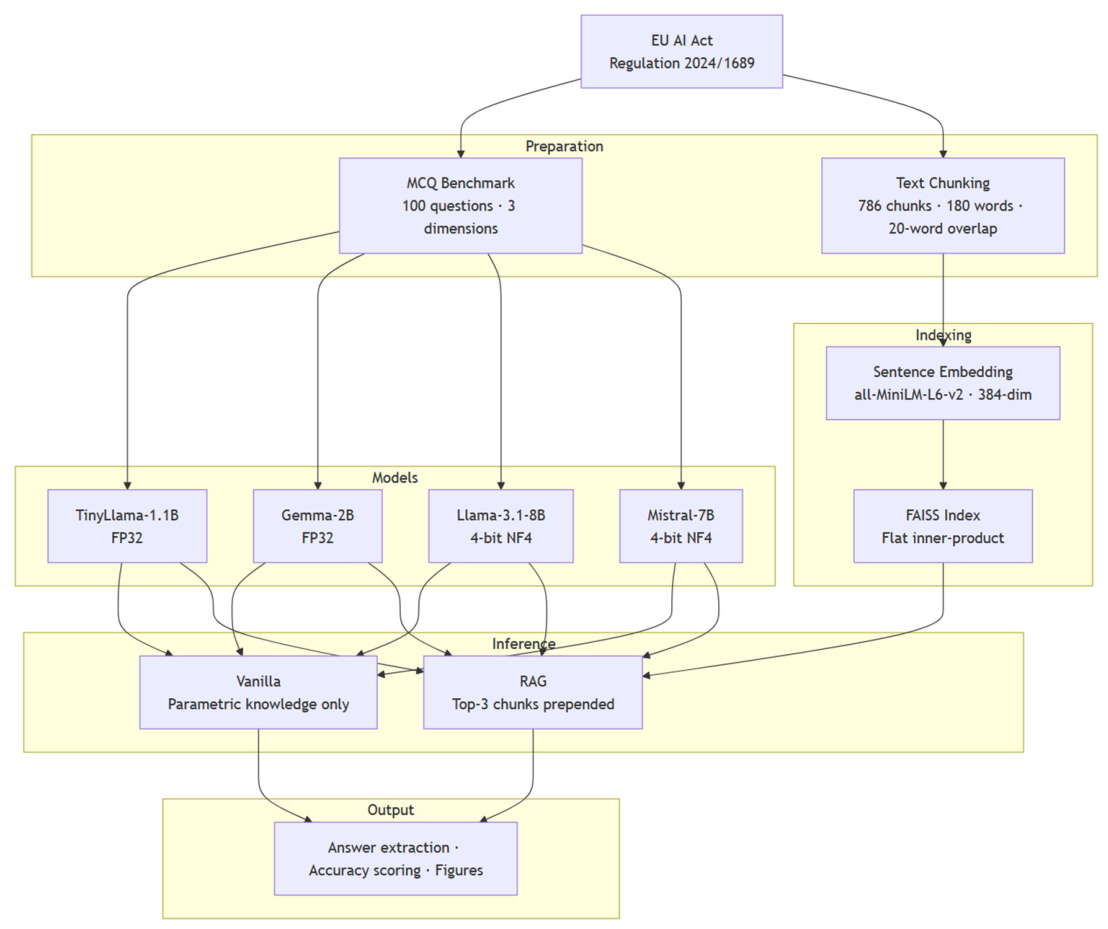
2.5. Workflow
3. Results
3.1. Chunking Mechanism
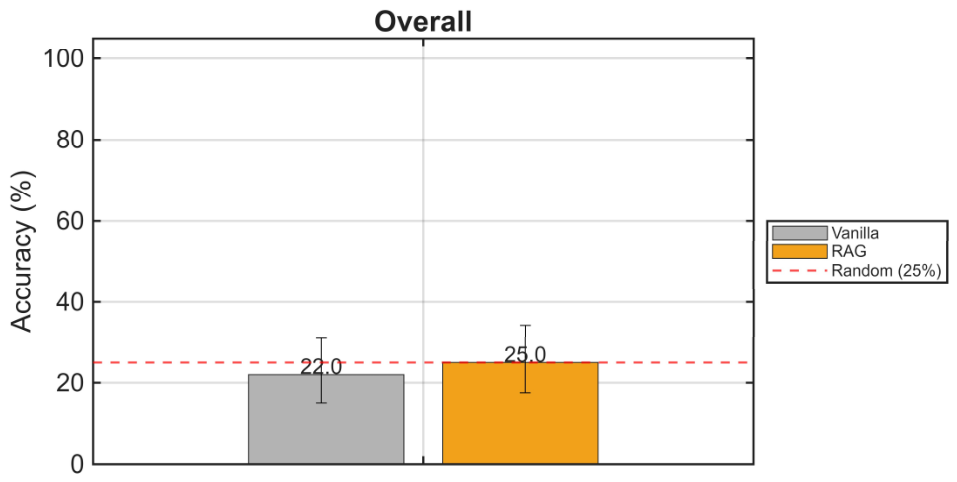
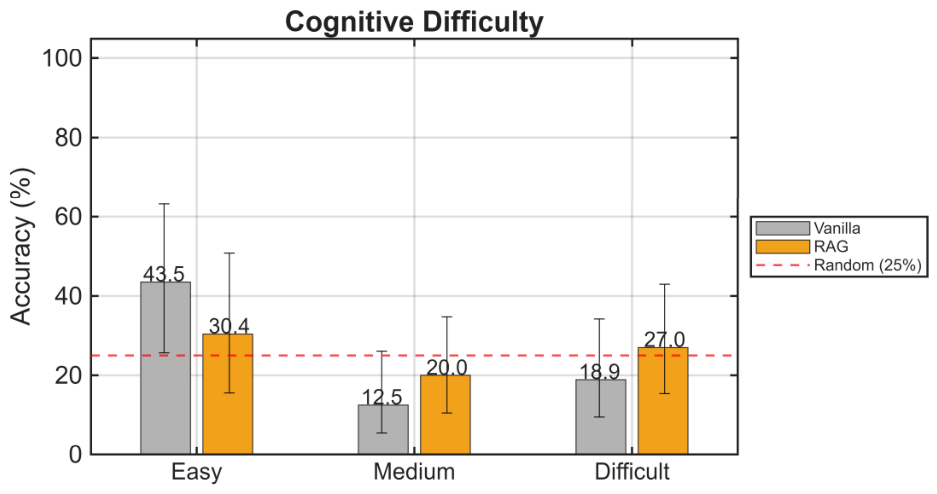
3.2. TinyLlama Results
3.3. Gemma-2B Results
3.4. Mistral 7B Results
3.5. Llama 3.1-8B Results
4. Discussion
4.1. RAG Case Analysis
4.2. Model Comparison
4.3. Statistical Significance Analysis
- a: The number of questions answered correctly by both the vanilla and RAG versions.
- b: The number of questions answered incorrectly by the vanilla model but correctly by the RAG model.
- c: The number of questions answered correctly by the vanilla model but incorrectly by the RAG model.
- d: The number of questions answered incorrectly by both models.
4.4. Methodology Validation
4.5. Limitations
5. Conclusions
Author Contributions
Funding
Data Availability Statement
Acknowledgments
Conflicts of Interest
Abbreviations
| AI | Artificial Intelligence |
| BM25 | Best Match 25 |
| CI | Confidence Interval |
| DPR | Dense Passage Retrieval |
| EDPR | European Data Protection Board |
| ENISA | European Union Agency for Cybersecurity |
| EU | European Union |
| FAISS | Facebook AI Similarity Search |
| FRIA | Fundamental Rights Impact Assessment |
| GDPR | General Data Protection Regulation |
| GPAI | General-Purpose Artificial Intelligence |
| IR | Information Retrieval |
| JSON | JavaScript Object Notation |
| KGs | Knowledge Graphs |
| LLM(s) | Large Language Model(s) |
| MLM(s) | Medium Language Model(s) |
| MCQs | Multiple-Choice Questions |
| MRR | Mean Reciprocal Rank |
| NLP | Natural Language Processing |
| OPT | Open Pretrained Transformer |
| RAG | Retrieval Augmented Generation |
| SLM(s) | Small Language Model(s) |
Appendix A

| MCQ |
|---|
| [ { “id”: “q1”, “question”: “Under the EU AI Act, which category of AI systems is subject to the most stringent requirements?”, “options”: { “A”: “Minimal-risk AI systems”, “B”: “High-risk AI systems”, “C”: “Limited-risk AI systems”, “D”: “General-purpose AI systems” }, “correct_answer”: “B”, “cognitive_difficulty”: “easy”, “knowledge_type”: “factual_terminology”, “regulatory_mechanism”: “risk_classification”, “source_reference”: “Article 8, Article 6 and Annex III” }, { “id”: “q2”, “question”: “Which of the following AI practices is explicitly prohibited under the EU AI Act?”, “options”: { “A”: “Using AI for credit scoring within a regulated financial institution”, “B”: “Deploying subliminal techniques to distort behaviour”, “C”: “Applying AI to assist with personalised marking in educational assessments”, “D”: “Using AI for predictive maintenance on industrial equipment” }, “correct_answer”: “B”, “cognitive_difficulty”: “easy”, “knowledge_type”: “factual_terminology”, “regulatory_mechanism”: “risk_classification”, “source_reference”: “Article 5(1)(a)” }, { “id”: “q3”, “question”: “What is the primary regulatory body established at EU level to coordinate enforcement of the AI Act?”, “options”: { “A”: “European Data Protection Board (EDPB)”, “B”: “European Securities and Markets Authority (ESMA)”, “C”: “European Standardisation Committee (CEN)”, “D”: “European AI Office” }, “correct_answer”: “D”, “cognitive_difficulty”: “easy”, “knowledge_type”: “factual_terminology”, “regulatory_mechanism”: “governance_and_enforcement”, “source_reference”: “Recital 160, Articles 88-94 “ }, { “id”: “q4”, “question”: “According to the EU AI Act, which document must high-risk AI system providers maintain to demonstrate compliance?”, “options”: { “A”: “Technical documentation”, “B”: “Environmental impact assessment”, “C”: “Financial audit report”, “D”: “User satisfaction survey” }, “correct_answer”: “A”, “cognitive_difficulty”: “easy”, “knowledge_type”: “factual_terminology”, “regulatory_mechanism”: “compliance_requirements”, “source_reference”: “Article 11, Article 18” }, { “id”: “q5”, “question”: “In the EU AI Act, ‘deployer’ refers to:”, “options”: { “A”: “Any natural or legal person that develops an AI system and places it on the market, under current legislation”, “B”: “A public authority responsible for auditing AI systems in its jurisdiction”, “C”: “Any natural or legal person that uses an AI system under its authority, except for personal non-professional use “, “D”: “An independent body appointed by a Member State to certify AI system compliance” }, “correct_answer”: “C”, “cognitive_difficulty”: “easy”, “knowledge_type”: “factual_terminology”, “regulatory_mechanism”: “compliance_requirements”, “source_reference”: “Article 3(4)” }, { “id”: “q6”, “question”: “Which of the following is not listed as a high-risk AI application area in Annex III of the EU AI Act?”, “options”: { “A”: “Biometric identification”, “B”: “Critical infrastructure management”, “C”: “Online gaming platforms”, “D”: “Access to education and vocational training” }, “correct_answer”: “C”, “cognitive_difficulty”: “easy”, “knowledge_type”: “factual_terminology”, “regulatory_mechanism”: “risk_classification”, “source_reference”: “Annex III” }, { “id”: “q7”, “question”: “What does the CE marking on a high-risk AI system indicate?”, “options”: { “A”: “The system conforms to applicable EU requirements”, “B”: “The system has been cybersecurity-certified”, “C”: “The system has received GDPR clearance”, “D”: “The system has been tested for environmental impact” }, “correct_answer”: “A”, “cognitive_difficulty”: “easy”, “knowledge_type”: “factual_terminology”, “regulatory_mechanism”: “compliance_requirements”, “source_reference”: “Recital 129, Article 47” }, { “id”: “q8”, “question”: “Under the EU AI Act, who bears primary responsibility for ensuring a high-risk AI system complies with the regulation before placing it on the market?”, “options”: { “A”: “The deployer”, “B”: “The national competent authority”, “C”: “The provider”, “D”: “The end user” }, “correct_answer”: “C”, “cognitive_difficulty”: “easy”, “knowledge_type”: “factual_terminology”, “regulatory_mechanism”: “compliance_requirements”, “source_reference”: “Article 16” }, { “id”: “q9”, “question”: “Which AI system type is subject to transparency obligations including disclosure that a person is interacting with an AI?”, “options”: { “A”: “Limited-risk AI such as chatbots”, “B”: “High-risk AI”, “C”: “Minimal-risk AI”, “D”: “General-purpose AI models only” }, “correct_answer”: “A”, “cognitive_difficulty”: “easy”, “knowledge_type”: “factual_terminology”, “regulatory_mechanism”: “risk_classification”, “source_reference”: “Article 50” }, { “id”: “q10”, “question”: “What is the primary duty of a notified body under the EU AI Act?”, “options”: { “A”: “To manage the EU database of registered high-risk AI systems on behalf of the Commission, under current legislation”, “B”: “To investigate serious incidents reported by providers and issue corrective orders”, “C”: “To publish harmonized technical standards for AI systems in the Official Journal”, “D”: “To carry out third-party conformity assessments of high-risk AI systems before market placement” }, “correct_answer”: “D”, “cognitive_difficulty”: “easy”, “knowledge_type”: “factual_terminology”, “regulatory_mechanism”: “governance_and_enforcement”, “source_reference”: “Article 33(1), Article 44(1)” }, { “id”: “q11”, “question”: “Why does the EU AI Act adopt a risk-based approach rather than a uniform set of rules for all AI systems?”, “options”: { “A”: “To reduce administrative costs for all AI developers uniformly across the market”, “B”: “To exclude all academic research AI systems from any form of regulatory oversight, per the regulation”, “C”: “To align regulatory obligations proportionally with the level of harm a system can cause”, “D”: “To replicate existing product safety law without adaptation to AI-specific risks” }, “correct_answer”: “C”, “cognitive_difficulty”: “medium”, “knowledge_type”: “conceptual_theoretical”, “regulatory_mechanism”: “risk_classification”, “source_reference”: “Recital 26” }, { “id”: “q12”, “question”: “A company uses an AI system to rank job applicants. Under the EU AI Act, this system is most likely classified as:”, “options”: { “A”: “High-risk”, “B”: “Prohibited”, “C”: “Limited-risk”, “D”: “Minimal-risk” }, “correct_answer”: “A”, “cognitive_difficulty”: “medium”, “knowledge_type”: “applied_contextual”, “regulatory_mechanism”: “risk_classification”, “source_reference”: “Annex III, point 4(a)” }, { “id”: “q13”, “question”: “What is the conceptual rationale behind requiring a risk management system for high-risk AI systems throughout the entire lifecycle?”, “options”: { “A”: “Because risks materialise after deployment and cannot be identified at design stage”, “B”: “Because the lifecycle requirement aligns the AI Act with GDPR’s data retention principles, as applicable”, “C”: “Because AI systems may evolve in behaviour over time, introducing new risks not foreseeable at the point of conformity assessment”, “D”: “Because post-market monitoring is required for systems processing biometric data” }, “correct_answer”: “C”, “cognitive_difficulty”: “medium”, “knowledge_type”: “conceptual_theoretical”, “regulatory_mechanism”: “compliance_requirements”, “source_reference”: “Article 9” }, { “id”: “q14”, “question”: “Under the EU AI Act, real-time remote biometric identification in public spaces by law enforcement is:”, “options”: { “A”: “Permitted without restriction for any law enforcement purpose”, “B”: “Prohibited under all circumstances with no exceptions”, “C”: “Classified as high-risk and permitted with prior authorization in strictly defined situations”, “D”: “Only permitted for private security companies with prior national authority approval, as applicable” }, “correct_answer”: “C”, “cognitive_difficulty”: “medium”, “knowledge_type”: “conceptual_theoretical”, “regulatory_mechanism”: “risk_classification”, “source_reference”: “Article 5(2)” }, { “id”: “q15”, “question”: “How does the concept of ‘human oversight’ in the EU AI Act differ from having a human just present during AI operation?”, “options”: { “A”: “Physical proximity of a trained operator to the hardware running the AI system”, “B”: “Mandatory human review of all AI outputs regardless of system risk classification”, “C”: “A human must be able to monitor, understand, and intervene in the system’s operation”, “D”: “Logging AI outputs automatically for batch review by a compliance officer once per month” }, “correct_answer”: “C”, “cognitive_difficulty”: “medium”, “knowledge_type”: “conceptual_theoretical”, “regulatory_mechanism”: “compliance_requirements”, “source_reference”: “Article 14(1)” }, { “id”: “q16”, “question”: “An AI system is used to evaluate loan applications at a bank. The bank is based in France but serves customers across the EU. Which statement describes the territorial scope of the EU AI Act?”, “options”: { “A”: “The Act applies only in France, since that is where the provider is established, as applicable”, “B”: “The Act applies across all EU Member States where the system’s outputs affect persons”, “C”: “The Act applies only if the bank has more than 250 employees in the EU”, “D”: “The Act does not apply to financial institutions already regulated by the ECB” }, “correct_answer”: “B”, “cognitive_difficulty”: “medium”, “knowledge_type”: “applied_contextual”, “regulatory_mechanism”: “governance_and_enforcement”, “source_reference”: “Article 2(1)” }, { “id”: “q17”, “question”: “Why are general-purpose AI (GPAI) models subject to separate rules in the EU AI Act compared to task-specific AI systems?”, “options”: { “A”: “GPAI models always achieve higher accuracy than task-specific models on standardised tests, under current legislation”, “B”: “GPAI models can be adapted for many uses, making it harder to foresee and assess risks at development stage”, “C”: “GPAI models are developed outside the EU and fall under import regulations”, “D”: “Task-specific AI systems are exempt from the regulation whenever used by SMEs” }, “correct_answer”: “B”, “cognitive_difficulty”: “medium”, “knowledge_type”: “conceptual_theoretical”, “regulatory_mechanism”: “risk_classification”, “source_reference”: “Recital 17, Recital 101” }, { “id”: “q18”, “question”: “A deployer of a high-risk AI system receives complaints from users about biased outputs. Under the EU AI Act, what is the deployer’s primary obligation?”, “options”: { “A”: “The deployer has no obligations; all responsibility rests solely with the provider”, “B”: “The deployer must renegotiate the commercial contract to include liability transfer clauses”, “C”: “The deployer must conduct a full independent conformity assessment before use”, “D”: “The deployer must implement appropriate measures and ensure human oversight during use” }, “correct_answer”: “D”, “cognitive_difficulty”: “medium”, “knowledge_type”: “applied_contextual”, “regulatory_mechanism”: “compliance_requirements”, “source_reference”: “Article 26(1, 2 and 5) “ }, { “id”: “q19”, “question”: “What principle underlies the requirement for high-risk AI training data to be ‘relevant, representative, and free of errors’?”, “options”: { “A”: “Data minimization as defined in Article 5(1)(c) of the GDPR”, “B”: “Standardizing data formats to ensure interoperability across EU Member States”, “C”: “Reducing the computational cost of training by using smaller but cleaner datasets, in the relevant context”, “D”: “Ensuring the AI performs reliably across the intended population without introducing bias” }, “correct_answer”: “D”, “cognitive_difficulty”: “medium”, “knowledge_type”: “conceptual_theoretical”, “regulatory_mechanism”: “compliance_requirements”, “source_reference”: “Article 10(3)” }, { “id”: “q20”, “question”: “Under the EU AI Act, what is the legal significance of an AI system being developed in compliance with a harmonized standard whose reference has been published in the Official Journal of the EU?”, “options”: { “A”: “The system is automatically classified as minimal-risk without further assessment”, “B”: “The system is presumed to meet the corresponding Act requirements, removing the need to prove compliance separately”, “C”: “The system is fully exempt from conformity assessment for five years”, “D”: “The harmonized standard replaces national AI legislation entirely in that product sector, under current legislation” }, “correct_answer”: “B”, “cognitive_difficulty”: “medium”, “knowledge_type”: “conceptual_theoretical”, “regulatory_mechanism”: “compliance_requirements”, “source_reference”: “Article 40” }, { “id”: “q21”, “question”: “A provider of a high-risk AI system claims its system qualifies for an exception because it is used solely for military purposes. How does the EU AI Act treat this claim?”, “options”: { “A”: “Military AI is subject to double the standard compliance requirements”, “B”: “Military and national security AI systems are fully excluded from the scope of the Act”, “C”: “Military AI is prohibited under the Act”, “D”: “Military AI follows reduced compliance requirements but must register with ENISA, in the relevant context” }, “correct_answer”: “B”, “cognitive_difficulty”: “medium”, “knowledge_type”: “applied_contextual”, “regulatory_mechanism”: “risk_classification”, “source_reference”: “Article 2(3)” }, { “id”: “q22”, “question”: “Post-market monitoring under the EU AI Act is best understood as:”, “options”: { “A”: “An active, ongoing data collection and review process throughout the system’s operational lifetime”, “B”: “A single compliance review conducted six months after initial market placement”, “C”: “Annual written reporting to the national competent authority on system performance, under the applicable rules”, “D”: “A monitoring obligation triggered only when a user lodges a formal complaint” }, “correct_answer”: “A”, “cognitive_difficulty”: “medium”, “knowledge_type”: “conceptual_theoretical”, “regulatory_mechanism”: “ai_system_lifecycle”, “source_reference”: “Article 72” }, { “id”: “q23”, “question”: “Considering the EU AI Act’s penalty structure, what is the maximum fine for a provider who places a prohibited AI system on the market?”, “options”: { “A”: “€10 million or 2% of global annual turnover”, “B”: “€35 million or 7% of global annual turnover”, “C”: “€20 million or 4% of global annual turnover”, “D”: “€50 million or 10% of global annual turnover” }, “correct_answer”: “B”, “cognitive_difficulty”: “medium”, “knowledge_type”: “factual_terminology”, “regulatory_mechanism”: “governance_and_enforcement”, “source_reference”: “Article 99(3)” }, { “id”: “q24”, “question”: “An AI system automatically filters CVs and shortlists candidates without human review. An applicant claims that he/she has been unfairly rejected. Under the EU AI Act, what right does this person have?”, “options”: { “A”: “No right under the AI Act specifically; GDPR Article 22 rights may apply separately”, “B”: “The right to access the full source code and training data of the system”, “C”: “The right to demand the AI system be taken offline pending review”, “D”: “The right to obtain clear explanations of the AI system’s role in the decision” }, “correct_answer”: “D”, “cognitive_difficulty”: “medium”, “knowledge_type”: “applied_contextual”, “regulatory_mechanism”: “compliance_requirements”, “source_reference”: “Article 86” }, { “id”: “q25”, “question”: “The EU AI Act requires that certain high-risk AI systems be registered in the EU database before deployment. What is the primary governance purpose of this database?”, “options”: { “A”: “To restrict market access to AI systems that have not obtained a commercial license from the Commission, under current legislation”, “B”: “To assign each high-risk AI system a unique identifier that replaces the CE marking requirement”, “C”: “To store training data used by high-risk AI systems for inspection by data protection authorities”, “D”: “To enable national authorities and the public to identify which high-risk AI systems are on the market and verify their compliance status” }, “correct_answer”: “D”, “cognitive_difficulty”: “medium”, “knowledge_type”: “conceptual_theoretical”, “regulatory_mechanism”: “governance_and_enforcement”, “source_reference”: “Article 71” }, { “id”: “q26”, “question”: “A US-based company trains a GPAI model abroad and licenses it to an EU business, acting as a deployer for customer-facing use. Under the EU AI Act:”, “options”: { “A”: “The US company must retrain the model on EU-only data before any deployment”, “B”: “The EU business must comply with deployer obligations including use-case monitoring”, “C”: “The EU business must obtain an exemption waiver from the European AI Office first”, “D”: “The US company must register as an EU establishment within 30 days of first use” }, “correct_answer”: “B”, “cognitive_difficulty”: “difficult”, “knowledge_type”: “applied_contextual”, “regulatory_mechanism”: “compliance_requirements”, “source_reference”: “Article 2(1), Article 26” }, { “id”: “q27”, “question”: “A provider is designing a conformity assessment for a high-risk AI system used in critical infrastructure. Which sequence of steps correctly represents the required process under the EU AI Act?”, “options”: { “A”: “Register in EU database → obtain CE mark → conduct internal conformity assessment, under current legislation”, “B”: “File a patent → pass an ENISA cybersecurity audit → obtain CE mark from ENISA”, “C”: “Submit to a notified body → publish a notice in the Official Journal → deploy”, “D”: “Risk management → technical documentation → conformity assessment → CE marking → register in the EU database” }, “correct_answer”: “D”, “cognitive_difficulty”: “difficult”, “knowledge_type”: “procedural”, “regulatory_mechanism”: “compliance_requirements”, “source_reference”: “Article 9, Article 11, Article 43, Article 48, Article 49” }, { “id”: “q28”, “question”: “A GPAI model provider notifies the AI Office that the cumulative amount of compute used for training their model exceeds 10^25 floating point operations. Under the EU AI Act, what does this trigger?”, “options”: { “A”: “The model is automatically banned from the EU market until reviewed”, “B”: “The model is classified as having systemic risk and triggers enhanced obligations including adversarial testing and incident reporting to the AI Office”, “C”: “The provider must open-source the model under a designated EU public license”, “D”: “The provider must submit the model to a national AI safety institute for evaluation, under current legislation” }, “correct_answer”: “B”, “cognitive_difficulty”: “difficult”, “knowledge_type”: “applied_contextual”, “regulatory_mechanism”: “risk_classification”, “source_reference”: “Article 51(2), Article 55” }, { “id”: “q29”, “question”: “A high-risk AI system used in healthcare undergoes a substantial modification post-deployment. Under the EU AI Act, this modification most likely requires:”, “options”: { “A”: “No action if the modification improves performance metrics”, “B”: “Withdrawal from the market followed by reapplication for CE marking from scratch”, “C”: “Only an updated user manual and no further regulatory steps”, “D”: “A new conformity assessment to determine whether the system still meets requirements” }, “correct_answer”: “D”, “cognitive_difficulty”: “difficult”, “knowledge_type”: “procedural”, “regulatory_mechanism”: “ai_system_lifecycle”, “source_reference”: “Article 43(4), Article 3(23)” }, { “id”: “q30”, “question”: “Analyze the following scenario: an AI system used to assess creditworthiness is sold to a bank (deployer) by a technology firm (provider). The bank customizes the model’s decision thresholds. Who bears provider-like obligations for the customized version?”, “options”: { “A”: “The original technology firm retains all obligations regardless of customization”, “B”: “The bank assumes provider obligations for the aspects it has modified”, “C”: “No additional obligations arise because threshold changes are not a substantial modification”, “D”: “The European Banking Authority assumes regulatory responsibility” }, “correct_answer”: “B”, “cognitive_difficulty”: “difficult”, “knowledge_type”: “applied_contextual”, “regulatory_mechanism”: “compliance_requirements”, “source_reference”: “Article 25(1)” }, { “id”: “q31”, “question”: “Under the EU AI Act, which combination of factors would most strongly indicate that an AI system poses ‘systemic risk’?”, “options”: { “A”: “Wide deployment across critical sectors combined with high capability and potential for systemic harm”, “B”: “High accuracy benchmarks on standardized tests and rapid inference speed”, “C”: “Use of open-source code and transparent documentation of the training data, as applicable”, “D”: “Certification under ISO 27001 and SOC2 security assurance standards” }, “correct_answer”: “A”, “cognitive_difficulty”: “difficult”, “knowledge_type”: “conceptual_theoretical”, “regulatory_mechanism”: “risk_classification”, “source_reference”: “Article 51(1), Recital 110” }, { “id”: “q32”, “question”: “A provider of a high-risk AI system learns of a serious incident. Within how many days does the EU AI Act require notification to the national competent authority for serious incidents?”, “options”: { “A”: “72 h”, “B”: “15 days”, “C”: “30 days”, “D”: “90 days” }, “correct_answer”: “B”, “cognitive_difficulty”: “difficult”, “knowledge_type”: “procedural”, “regulatory_mechanism”: “governance_and_enforcement”, “source_reference”: “ Article 73(1), Article 73(2)” }, { “id”: “q33”, “question”: “How does the EU AI Act treat an AI system that is also covered by sector-specific EU safety legislation listed in Annex I (e.g., medical devices or machinery)?”, “options”: { “A”: “The system must comply with both the AI Act requirements and the sector-specific legislation simultaneously”, “B”: “The AI Act applies exclusively and sector-specific legislation is suspended”, “C”: “The sector-specific legislation takes precedence, and the AI Act does not apply”, “D”: “The provider must choose which framework to comply with and notify the Commission of their choice, as applicable” }, “correct_answer”: “A”, “cognitive_difficulty”: “medium”, “knowledge_type”: “conceptual_theoretical”, “regulatory_mechanism”: “compliance_requirements”, “source_reference”: “Article 8(2), Annex I” }, { “id”: “q34”, “question”: “A national authority conducts a market surveillance investigation and finds that a high-risk AI system’s technical documentation is incomplete. Under the EU AI Act, which sequence of enforcement actions is most consistent with the regulation?”, “options”: { “A”: “Immediate fine → public blacklisting → mandatory market withdrawal”, “B”: “Notify EUROPOL → conduct criminal investigation → impose administrative fine”, “C”: “Request corrective action within a reasonable period → if non-compliant, restrict or withdraw the system → notify the Commission “, “D”: “Publish an advisory notice → wait 12 months → initiate infringement procedure, in the relevant context” }, “correct_answer”: “C”, “cognitive_difficulty”: “difficult”, “knowledge_type”: “procedural”, “regulatory_mechanism”: “governance_and_enforcement”, “source_reference”: “Article 79(1)” }, { “id”: “q35”, “question”: “A provider argues that its AI system used for employee performance monitoring is exempt from the EU AI Act because it constitutes scientific research. Evaluate this claim.”, “options”: { “A”: “Valid as all scientific research AI is explicitly exempt from the Act’s scope”, “B”: “Invalid as employee monitoring AI is categorically prohibited under Article 5”, “C”: “Partially valid as research is exempt but the system becomes subject to the Act on deployment”, “D”: “Valid only if the provider is a publicly funded university or research institution, in the relevant context” }, “correct_answer”: “C”, “cognitive_difficulty”: “difficult”, “knowledge_type”: “applied_contextual”, “regulatory_mechanism”: “risk_classification”, “source_reference”: “Article 2(6), Article 2(8)” }, { “id”: “q36”, “question”: “Which entity is responsible for maintaining the EU database of high-risk AI systems under the EU AI Act?”, “options”: { “A”: “Each member state independently”, “B”: “The European Commission”, “C”: “The European Union Agency for Cybersecurity (ENISA)”, “D”: “The European Data Protection Supervisor (EDPS)” }, “correct_answer”: “B”, “cognitive_difficulty”: “easy”, “knowledge_type”: “factual_terminology”, “regulatory_mechanism”: “governance_and_enforcement”, “source_reference”: “Article 71(1)” }, { “id”: “q37”, “question”: “The EU AI Act defines an ‘AI system’ as a machine-based system that operates with varying levels of autonomy. Which characteristic distinguishes an AI system from conventional software under this definition?”, “options”: { “A”: “It must maintain a continuous internet connection throughout all operational phases”, “B”: “It must use a neural network with at least three independently trained hidden layers, under current legislation”, “C”: “It must have been trained on a minimum of one million labelled data points”, “D”: “It can generate outputs such as predictions, recommendations, or decisions that influence real or virtual environments, inferred from its inputs” }, “correct_answer”: “D”, “cognitive_difficulty”: “medium”, “knowledge_type”: “conceptual_theoretical”, “regulatory_mechanism”: “risk_classification”, “source_reference”: “Article 3(1)” }, { “id”: “q38”, “question”: “Under the EU AI Act, an AI system used for social scoring by public authorities and leading to treatment disproportionate to their behavior, is:”, “options”: { “A”: “High-risk and subject to third-party conformity assessment”, “B”: “Limited-risk and subject to transparency disclosures”, “C”: “Prohibited”, “D”: “Allowed if an ethics board approves the scoring criteria” }, “correct_answer”: “C”, “cognitive_difficulty”: “easy”, “knowledge_type”: “factual_terminology”, “regulatory_mechanism”: “risk_classification”, “source_reference”: “Article 5(1)(c)” }, { “id”: “q39”, “question”: “Providers of GPAI models must publish a summary of training data used, primarily to fulfil which obligation under the EU AI Act?”, “options”: { “A”: “Environmental sustainability reporting”, “B”: “Consumer protection labelling requirements”, “C”: “Competition law notification to the European Commission”, “D”: “Copyright compliance and transparency about training content” }, “correct_answer”: “D”, “cognitive_difficulty”: “medium”, “knowledge_type”: “conceptual_theoretical”, “regulatory_mechanism”: “compliance_requirements”, “source_reference”: “Article 53(1)(d), Recital 107” }, { “id”: “q40”, “question”: “Under the EU AI Act, which of the following is a specific obligation of deployers operating high-risk AI systems that involve natural persons?”, “options”: { “A”: “Informing natural persons that they are subject to the use of the high-risk AI system”, “B”: “Publishing the system’s algorithmic logic in a publicly accessible national register”, “C”: “Submitting a fundamental rights impact assessment to the Commission before first deployment”, “D”: “Obtaining prior approval from the European AI Office before each individual deployment decision” }, “correct_answer”: “A”, “cognitive_difficulty”: “medium”, “knowledge_type”: “procedural”, “regulatory_mechanism”: “compliance_requirements”, “source_reference”: “Article 26(11)” }, { “id”: “q41”, “question”: “AI regulatory sandboxes established under the EU AI Act are intended to:”, “options”: { “A”: “Allow prohibited AI practices to be piloted without legal penalties for participants”, “B”: “Provide a controlled environment to develop and test innovative AI under regulatory supervision”, “C”: “Replace conformity assessments for startups with fewer than 50 employees”, “D”: “Enable Member States to opt out of AI Act requirements for domestically developed systems, in the relevant context” }, “correct_answer”: “B”, “cognitive_difficulty”: “easy”, “knowledge_type”: “factual_terminology”, “regulatory_mechanism”: “governance_and_enforcement”, “source_reference”: “Article 57” }, { “id”: “q42”, “question”: “A high-risk AI system unexpectedly produces discriminatory outputs affecting a minority group. The provider investigates and determines whether the root cause is biased training data. Under the EU AI Act, the obligation most directly violated is:”, “options”: { “A”: “The requirement to use relevant, representative, and appropriately bias-mitigated training data”, “B”: “The obligation to affix a CE marking before placing the system on the market”, “C”: “The requirement to register the discriminatory system in the EU high-risk database, as applicable”, “D”: “The obligation to conduct post-market monitoring and log incidents automatically” }, “correct_answer”: “A”, “cognitive_difficulty”: “difficult”, “knowledge_type”: “applied_contextual”, “regulatory_mechanism”: “compliance_requirements”, “source_reference”: “Article 10(2)(f)” }, { “id”: “q43”, “question”: “The EU AI Act requires logs to be kept automatically by high-risk AI systems. What is the principal regulatory purpose of this logging requirement?”, “options”: { “A”: “Enabling providers to monetize anonymized usage data through authorized commercial channels”, “B”: “Ensuring traceability of system operations to support post-incident review and accountability”, “C”: “Reducing the burden of real-time human oversight by automating compliance checks”, “D”: “Facilitating automated compliance reporting to the European AI Office on a quarterly basis” }, “correct_answer”: “B”, “cognitive_difficulty”: “medium”, “knowledge_type”: “conceptual_theoretical”, “regulatory_mechanism”: “ai_system_lifecycle”, “source_reference”: “Recital 71” }, { “id”: “q44”, “question”: “Which threshold of training compute currently triggers the presumption of systemic risk for a GPAI model under the EU AI Act?”, “options”: { “A”: “10^25 floating point operations”, “B”: “10^20 floating point operations”, “C”: “10^23 floating point operations”, “D”: “10^30 floating point operations” }, “correct_answer”: “A”, “cognitive_difficulty”: “easy”, “knowledge_type”: “factual_terminology”, “regulatory_mechanism”: “risk_classification”, “source_reference”: “Article 51(2)” }, { “id”: “q45”, “question”: “A provider of a GPAI model with systemic risk fails to conduct the required adversarial testing. Under the EU AI Act, the maximum applicable fine is:”, “options”: { “A”: “€10 million or 2% of global annual turnover”, “B”: “€5 million or 1% of global annual turnover”, “C”: “€15 million or 3% of global annual turnover”, “D”: “€20 million or 4% of global annual turnover” }, “correct_answer”: “C”, “cognitive_difficulty”: “difficult”, “knowledge_type”: “applied_contextual”, “regulatory_mechanism”: “governance_and_enforcement”, “source_reference”: “Article 101(1)(a), Article 55(1)(a)” }, { “id”: “q46”, “question”: “When a downstream provider integrates a GPAI model into their high-risk AI application, the EU AI Act establishes that responsibilities are allocated through:”, “options”: { “A”: “Single liability placed entirely on the GPAI model provider regardless of downstream use”, “B”: “An arbitration process where the national authority assigns liability after each incident”, “C”: “A shared responsibility where each actor is accountable for the parts under their control”, “D”: “Default assignment of all obligations to the national competent authority as co-regulator” }, “correct_answer”: “C”, “cognitive_difficulty”: “difficult”, “knowledge_type”: “conceptual_theoretical”, “regulatory_mechanism”: “compliance_requirements”, “source_reference”: “Article 25, Recital 97” }, { “id”: “q47”, “question”: “Under the EU AI Act, which AI application in the law enforcement domain is prohibited?”, “options”: { “A”: “Predictive policing tools that identify crime hotspots”, “B”: “AI-powered tools for investigating serious cross-border crime”, “C”: “Emotion recognition systems used in law enforcement interrogations”, “D”: “Automated license plate recognition for traffic enforcement” }, “correct_answer”: “C”, “cognitive_difficulty”: “difficult”, “knowledge_type”: “applied_contextual”, “regulatory_mechanism”: “risk_classification”, “source_reference”: “Article 5(1)(f)” }, { “id”: “q48”, “question”: “The EU AI Act’s provisions on ‘fundamental rights impact assessments’ for deployers of high-risk AI primarily serve to:”, “options”: { “A”: “Replace GDPR data protection impact assessments in all AI-related processing activities, in the relevant context”, “B”: “Certify that an AI system collects no personal data during its operational lifetime”, “C”: “Ensure deployers systematically consider and document potential impacts on fundamental rights”, “D”: “Provide conformity evidence that substitutes for third-party audits by notified bodies” }, “correct_answer”: “C”, “cognitive_difficulty”: “difficult”, “knowledge_type”: “conceptual_theoretical”, “regulatory_mechanism”: “compliance_requirements”, “source_reference”: “Article 27” }, { “id”: “q49”, “question”: “A startup releases an open-source GPAI model and claims it is fully exempt from all EU AI Act obligations. Is this claim accurate?”, “options”: { “A”: “Yes, open-source GPAI models are fully exempt from all obligations under the Act”, “B”: “Yes, but only if the startup employs fewer than ten full-time employees”, “C”: “No, open-source GPAI models are exempt from some transparency obligations but not all”, “D”: “Yes, but only if the model has fewer than one billion trainable parameters” }, “correct_answer”: “C”, “cognitive_difficulty”: “difficult”, “knowledge_type”: “applied_contextual”, “regulatory_mechanism”: “risk_classification”, “source_reference”: “Article 53(2)” }, { “id”: “q50”, “question”: “A hospital deploys a high-risk AI clinical decision-support system. Six months after deployment, the system vendor releases a major update that changes the clinical logic. The hospital applies the update without re-evaluation. What is the primary compliance failure in this scenario?”, “options”: { “A”: “Failure to notify the vendor of the scheduled maintenance update”, “B”: “Failing to assess whether the update constitutes a substantial modification requiring a new conformity assessment”, “C”: “GDPR violation if patient data was processed during the update”, “D”: “No compliance failure because routine software updates are explicitly excluded, under the applicable rules” }, “correct_answer”: “B”, “cognitive_difficulty”: “difficult”, “knowledge_type”: “applied_contextual”, “regulatory_mechanism”: “ai_system_lifecycle”, “source_reference”: “Article 3(23), Article 43(4)” }, { “id”: “q51”, “question”: “Under the EU AI Act, a provider becomes aware that a serious incident constitutes a widespread infringement affecting persons in multiple Member States. Within what timeframe must the provider notify the relevant market surveillance authority?”, “options”: { “A”: “Within 72 h”, “B”: “Within 30 calendar days”, “C”: “Immediately, with no formal deadline”, “D”: “Within 2 days of becoming aware” }, “correct_answer”: “D”, “cognitive_difficulty”: “difficult”, “knowledge_type”: “procedural”, “regulatory_mechanism”: “compliance_requirements”, “source_reference”: “Article 73(3)” }, { “id”: “q52”, “question”: “Which of the following actions must a provider complete before placing a high-risk AI system on the market?”, “options”: { “A”: “Notify the AI Office of planned market entry”, “B”: “Complete conformity assessment and affix CE marking”, “C”: “Obtain user consent from first deployers”, “D”: “Register on the national authority’s public website” }, “correct_answer”: “B”, “cognitive_difficulty”: “medium”, “knowledge_type”: “procedural”, “regulatory_mechanism”: “compliance_requirements”, “source_reference”: “Article 43, Article 48” }, { “id”: “q53”, “question”: “Who bears the primary responsibility for registering a high-risk AI system in the EU database prior to its placement on the market?”, “options”: { “A”: “The provider, or their authorized representative when the provider is established outside the EU”, “B”: “The deployer who first uses the system, as applicable”, “C”: “The national competent authority”, “D”: “The importer of the system” }, “correct_answer”: “A”, “cognitive_difficulty”: “easy”, “knowledge_type”: “procedural”, “regulatory_mechanism”: “compliance_requirements”, “source_reference”: “Article 49(1)” }, { “id”: “q54”, “question”: “What is the minimum retention period for technical documentation after a high-risk AI system is placed on the market?”, “options”: { “A”: “3 years”, “B”: “7 years”, “C”: “10 years”, “D”: “5 years” }, “correct_answer”: “C”, “cognitive_difficulty”: “easy”, “knowledge_type”: “procedural”, “regulatory_mechanism”: “ai_system_lifecycle”, “source_reference”: “Article 18(1)” }, { “id”: “q55”, “question”: “Before placing a high-risk AI system on the market, a provider must draw up a document formally stating that the system conforms with the EU AI Act. What is this document called?”, “options”: { “A”: “CE marking certificate”, “B”: “Technical documentation file”, “C”: “Conformity assessment report”, “D”: “EU declaration of conformity” }, “correct_answer”: “D”, “cognitive_difficulty”: “medium”, “knowledge_type”: “procedural”, “regulatory_mechanism”: “compliance_requirements”, “source_reference”: “Article 47” }, { “id”: “q56”, “question”: “Before a high-risk AI system is put into service, which system must the providers have in place under EU AI Act?”, “options”: { “A”: “An independent audit mechanism”, “B”: “A quality management system”, “C”: “A user feedback register”, “D”: “A notified body review protocol” }, “correct_answer”: “B”, “cognitive_difficulty”: “medium”, “knowledge_type”: “procedural”, “regulatory_mechanism”: “compliance_requirements”, “source_reference”: “Article 17” }, { “id”: “q57”, “question”: “How must providers of general-purpose AI models make their training data summary available?”, “options”: { “A”: “Via paid subscription only”, “B”: “Only upon formal request from the AI Office”, “C”: “Publicly, following the AI Office template “, “D”: “In paper form submitted annually to the Commission” }, “correct_answer”: “C”, “cognitive_difficulty”: “difficult”, “knowledge_type”: “procedural”, “regulatory_mechanism”: “compliance_requirements”, “source_reference”: “Article 53(1)(d)” }, { “id”: “q58”, “question”: “ A public authority is about to deploy a high-risk AI system listed in Annex III for an employment-related decision. The system is already registered in the EU database. Which additional procedural step specific to public body deployers must it complete before deployment under the EU AI Act?”, “options”: { “A”: “Register the system in the EU database”, “B”: “Notify the European Data Protection Supervisor”, “C”: “Conduct a fundamental rights impact assessment”, “D”: “File a data protection impact assessment under GDPR” }, “correct_answer”: “C”, “cognitive_difficulty”: “difficult”, “knowledge_type”: “procedural”, “regulatory_mechanism”: “compliance_requirements”, “source_reference”: “Article 27” }, { “id”: “q59”, “question”: “In which document must post-market monitoring plans for high-risk AI systems be included?”, “options”: { “A”: “The technical documentation”, “B”: “The quality management system report”, “C”: “The EU declaration of conformity”, “D”: “The national supervisory authority register” }, “correct_answer”: “A”, “cognitive_difficulty”: “difficult”, “knowledge_type”: “procedural”, “regulatory_mechanism”: “ai_system_lifecycle”, “source_reference”: “Article 72(1)” }, { “id”: “q60”, “question”: “When an entity substantially modifies a high-risk AI system, what role does that entity assume?”, “options”: { “A”: “Distributor with enhanced obligations”, “B”: “National authority liaison”, “C”: “Provider, with full provider obligations”, “D”: “Co-provider alongside the original provider” }, “correct_answer”: “C”, “cognitive_difficulty”: “difficult”, “knowledge_type”: “procedural”, “regulatory_mechanism”: “ai_system_lifecycle”, “source_reference”: “Article 25(1)” }, { “id”: “q61”, “question”: “How long must providers of GPAI models retain technical documentation after the model is withdrawn from the market?”, “options”: { “A”: “10 years”, “B”: “3 years”, “C”: “1 year”, “D”: “5 years” }, “correct_answer”: “A”, “cognitive_difficulty”: “medium”, “knowledge_type”: “procedural”, “regulatory_mechanism”: “ai_system_lifecycle”, “source_reference”: “Article 54(3)(b)” }, { “id”: “q62”, “question”: “Under the EU AI Act, deployers of certain high-risk AI systems that make decisions related to natural persons must inform those persons. When does this obligation arise?”, “options”: { “A”: “Before or at the time the AI system is used in relation to those persons”, “B”: “Before each individual decision is made by the AI system”, “C”: “Only after a formal complaint is filed by an affected person, under the applicable rules”, “D”: “Annually, through a public transparency report” }, “correct_answer”: “A”, “cognitive_difficulty”: “difficult”, “knowledge_type”: “procedural”, “regulatory_mechanism”: “compliance_requirements”, “source_reference”: “Article 26(11), Article 50(5)” }, { “id”: “q63”, “question”: “Which body is empowered under the EU AI Act to conduct audits of GPAI providers suspected of serious violations?”, “options”: { “A”: “The AI Office”, “B”: “ENISA on behalf of the Commission”, “C”: “Member State market surveillance authorities acting jointly”, “D”: “The European Data Protection Board” }, “correct_answer”: “A”, “cognitive_difficulty”: “medium”, “knowledge_type”: “procedural”, “regulatory_mechanism”: “governance_and_enforcement”, “source_reference”: “Article 92” }, { “id”: “q64”, “question”: “To which authority must providers of high-risk AI systems make automatically generated logs available on request?”, “options”: { “A”: “The European Commission only”, “B”: “The AI Board only”, “C”: “National market surveillance authorities”, “D”: “Any EU citizen upon formal request, in the relevant context” }, “correct_answer”: “C”, “cognitive_difficulty”: “medium”, “knowledge_type”: “procedural”, “regulatory_mechanism”: “governance_and_enforcement”, “source_reference”: “Article 21(2)” }, { “id”: “q65”, “question”: “What timeframe applies when a market surveillance authority orders a provider to correct a non-compliant high-risk AI system?”, “options”: { “A”: “30 days, per the regulation”, “B”: “The timeframe set by the authority in its order”, “C”: “10 days”, “D”: “15 days” }, “correct_answer”: “B”, “cognitive_difficulty”: “difficult”, “knowledge_type”: “procedural”, “regulatory_mechanism”: “governance_and_enforcement”, “source_reference”: “Article 79(2)” }, { “id”: “q66”, “question”: “At which stage must providers of high-risk AI systems establish a risk management system?”, “options”: { “A”: “At the design and development stage, maintained as a continuous iterative process throughout the entire lifecycle”, “B”: “When a serious incident is reported by a deployer”, “C”: “After first deployment, once real-world performance data becomes available, under current legislation”, “D”: “At least six months before the planned market placement date” }, “correct_answer”: “A”, “cognitive_difficulty”: “medium”, “knowledge_type”: “procedural”, “regulatory_mechanism”: “ai_system_lifecycle”, “source_reference”: “Article 9(1), Article 9(2)” }, { “id”: “q67”, “question”: “Which best describes post-market monitoring obligations for high-risk AI system providers?”, “options”: { “A”: “A one-time review six months after market placement”, “B”: “Annual reporting to the national competent authority, as applicable”, “C”: “Only triggered when a user complaint is filed”, “D”: “An active, ongoing data collection and review process throughout the system’s lifetime” }, “correct_answer”: “D”, “cognitive_difficulty”: “medium”, “knowledge_type”: “conceptual_theoretical”, “regulatory_mechanism”: “ai_system_lifecycle”, “source_reference”: “Article 72” }, { “id”: “q68”, “question”: “What triggers the obligation for a provider to treat a downstream modifier as a new provider?”, “options”: { “A”: “Any software update to the system”, “B”: “A substantial modification that alters the system’s risk profile or intended purpose”, “C”: “A change of brand name or trademark”, “D”: “Transfer of commercial ownership of the system, under the applicable rules” }, “correct_answer”: “B”, “cognitive_difficulty”: “difficult”, “knowledge_type”: “applied_contextual”, “regulatory_mechanism”: “ai_system_lifecycle”, “source_reference”: “Article 25(1)” }, { “id”: “q69”, “question”: “A provider discovers that their deployed high-risk AI system poses an unacceptable risk not identified earlier. What must he/she do?”, “options”: { “A”: “Request a six-month remediation period from the national authority”, “B”: “Publish a public notice on the company website”, “C”: “Continue operation while preparing updated documentation”, “D”: “Withdraw the system and notify users and authorities without delay” }, “correct_answer”: “D”, “cognitive_difficulty”: “difficult”, “knowledge_type”: “applied_contextual”, “regulatory_mechanism”: “ai_system_lifecycle”, “source_reference”: “Article 20” }, { “id”: “q70”, “question”: “Which document must be provided to deployers alongside a high-risk AI system under the EU AI Act?”, “options”: { “A”: “The instructions for use”, “B”: “The EU declaration of conformity”, “C”: “The risk management report”, “D”: “The training data adequacy summary” }, “correct_answer”: “A”, “cognitive_difficulty”: “easy”, “knowledge_type”: “factual_terminology”, “regulatory_mechanism”: “ai_system_lifecycle”, “source_reference”: “Article 13(1)” }, { “id”: “q71”, “question”: “When does the obligation to conduct post-market monitoring begin for a high-risk AI system?”, “options”: { “A”: “As soon as the system is placed on the market or put into service”, “B”: “When the first user complaint is received”, “C”: “One year after initial market placement”, “D”: “After the first periodic review by the competent authority, per the regulation” }, “correct_answer”: “A”, “cognitive_difficulty”: “medium”, “knowledge_type”: “procedural”, “regulatory_mechanism”: “ai_system_lifecycle”, “source_reference”: “Article 72(1), Article 72(2)” }, { “id”: “q72”, “question”: “A GPAI model provider has withdrawn their model from the market. Which obligations does the EU AI Act explicitly impose beyond the withdrawal date?”, “options”: { “A”: “No obligations remain once the model is discontinued”, “B”: “Only GDPR-related data deletion obligations remain”, “C”: “Continued registration in the EU database for one year, per the regulation”, “D”: “Cooperation with ongoing investigations and documentation retention” }, “correct_answer”: “D”, “cognitive_difficulty”: “difficult”, “knowledge_type”: “applied_contextual”, “regulatory_mechanism”: “ai_system_lifecycle”, “source_reference”: “Article 53(3), Article 54(3)(b)” }, { “id”: “q73”, “question”: “If a distributor resells a high-risk AI system without modification, what happens to the original provider’s obligations?”, “options”: { “A”: “They transfer to the importer”, “B”: “They lapse after resale”, “C”: “They remain unchanged with the original provider”, “D”: “They transfer to the distributor upon resale” }, “correct_answer”: “C”, “cognitive_difficulty”: “medium”, “knowledge_type”: “conceptual_theoretical”, “regulatory_mechanism”: “ai_system_lifecycle”, “source_reference”: “Article 25(1), Article 25(2)” }, { “id”: “q74”, “question”: “Which of the following constitutes a ‘substantial modification’ triggering new conformity assessment obligations?”, “options”: { “A”: “Routine security patching with no AI functionality change”, “B”: “Rebranding of the system without technical alterations”, “C”: “Translation of the user interface into another language”, “D”: “A performance update that changes the system’s risk profile” }, “correct_answer”: “D”, “cognitive_difficulty”: “difficult”, “knowledge_type”: “applied_contextual”, “regulatory_mechanism”: “ai_system_lifecycle”, “source_reference”: “Article 3(23)” }, { “id”: “q75”, “question”: “Providers of high-risk AI systems must proactively inform deployers of which of the following?”, “options”: { “A”: “The system’s market price and licensing terms”, “B”: “The identities of other current deployers of the system, as applicable”, “C”: “The system’s intended purpose, accuracy metrics, and oversight measures”, “D”: “The full composition of the training dataset” }, “correct_answer”: “C”, “cognitive_difficulty”: “medium”, “knowledge_type”: “factual_terminology”, “regulatory_mechanism”: “ai_system_lifecycle”, “source_reference”: “Article 13(3)” }, { “id”: “q76”, “question”: “Automatic log generation in high-risk AI systems serves primarily which purpose under the EU AI Act?”, “options”: { “A”: “Providing real-time performance data to deployers for operational optimization”, “B”: “Allowing the system to self-correct errors in real time”, “C”: “Enabling user personalization features”, “D”: “Facilitating post-market monitoring and incident investigation” }, “correct_answer”: “D”, “cognitive_difficulty”: “medium”, “knowledge_type”: “conceptual_theoretical”, “regulatory_mechanism”: “ai_system_lifecycle”, “source_reference”: “Article 12” }, { “id”: “q77”, “question”: “When a serious incident occurs in a Member State other than the provider’s home state, which authority must be notified by the provider?”, “options”: { “A”: “The competent authority of the provider’s home Member State, as applicable”, “B”: “The competent authority of the Member State where the incident occurred”, “C”: “The AI Office centrally”, “D”: “The European Data Protection Board” }, “correct_answer”: “B”, “cognitive_difficulty”: “difficult”, “knowledge_type”: “procedural”, “regulatory_mechanism”: “ai_system_lifecycle”, “source_reference”: “Article 73(6)” }, { “id”: “q78”, “question”: “Under the EU AI Act, a person is subject to a decision significantly affecting them, made with the assistance of a high-risk AI system. What right is granted to that person?”, “options”: { “A”: “The right to have the AI system’s decision automatically reversed on request, per the regulation”, “B”: “The right to access the full source code and training data of the system”, “C”: “The right to obtain clear explanations of the AI system’s role and the main elements of the decision”, “D”: “The right to prohibit further use of the AI system by the deployer” }, “correct_answer”: “C”, “cognitive_difficulty”: “medium”, “knowledge_type”: “factual_terminology”, “regulatory_mechanism”: “governance_and_enforcement”, “source_reference”: “Article 86” }, { “id”: “q79”, “question”: “Which entity affixes the CE marking to a high-risk AI system?”, “options”: { “A”: “The EU AI Office upon registration”, “B”: “The relevant national competent authority”, “C”: “A designated notified body after third-party review”, “D”: “The provider, after completing the conformity assessment” }, “correct_answer”: “D”, “cognitive_difficulty”: “easy”, “knowledge_type”: “factual_terminology”, “regulatory_mechanism”: “ai_system_lifecycle”, “source_reference”: “Article 16(h), Article 48(3)” }, { “id”: “q80”, “question”: “Under the EU AI Act, for what primary purpose must providers use the data collected through post-market monitoring of high-risk AI systems?”, “options”: { “A”: “The Commission, for regulatory reporting”, “B”: “End users, through mandatory disclosure of performance data”, “C”: “National market surveillance authorities, for enforcement purposes, under current legislation”, “D”: “The provider, to evaluate continuous compliance with requirements “ }, “correct_answer”: “D”, “cognitive_difficulty”: “medium”, “knowledge_type”: “conceptual_theoretical”, “regulatory_mechanism”: “ai_system_lifecycle”, “source_reference”: “Article 72” }, { “id”: “q81”, “question”: “A high-risk AI system provider learns that a third party has made an unauthorized substantial modification to their deployed system. What is the provider’s obligation?”, “options”: { “A”: “Immediately withdraw all units from the market”, “B”: “Nothing; obligations transfer automatically to the modifier”, “C”: “Inform the relevant market surveillance authority”, “D”: “Conduct a new conformity assessment on behalf of the modifier” }, “correct_answer”: “C”, “cognitive_difficulty”: “difficult”, “knowledge_type”: “applied_contextual”, “regulatory_mechanism”: “ai_system_lifecycle”, “source_reference”: “Article 20(2), Article 25(1)(b)” }, { “id”: “q82”, “question”: “Which body established by the EU AI Act advises the Commission and is composed of national supervisory authority representatives?”, “options”: { “A”: “The European Data Protection Board”, “B”: “The European AI Board”, “C”: “The European Standardisation Committee”, “D”: “ENISA” }, “correct_answer”: “B”, “cognitive_difficulty”: “easy”, “knowledge_type”: “factual_terminology”, “regulatory_mechanism”: “governance_and_enforcement”, “source_reference”: “Article 65” }, { “id”: “q83”, “question”: “What is the maximum fine for a GPAI model provider that fails to comply with a Commission corrective action decision?”, “options”: { “A”: “€5 million or 1% of global annual turnover”, “B”: “€15 million or 3% of global annual turnover”, “C”: “€35 million or 7% of global annual turnover”, “D”: “€50 million or 10% of global annual turnover” }, “correct_answer”: “B”, “cognitive_difficulty”: “difficult”, “knowledge_type”: “factual_terminology”, “regulatory_mechanism”: “governance_and_enforcement”, “source_reference”: “Article 101(1)(c)” }, { “id”: “q84”, “question”: “To which of the following can the market surveillance authorities request access from a high-risk AI system provider?”, “options”: { “A”: “Marketing materials and pricing strategies”, “B”: “Personal data of end users”, “C”: “Financial statements and shareholder records”, “D”: “Source code, documentation, and training data” }, “correct_answer”: “D”, “cognitive_difficulty”: “medium”, “knowledge_type”: “factual_terminology”, “regulatory_mechanism”: “governance_and_enforcement”, “source_reference”: “ Article 74(12), Article 74(13)” }, { “id”: “q85”, “question”: “Which body is empowered to impose fines directly on providers of general-purpose AI models?”, “options”: { “A”: “National market surveillance authorities”, “B”: “The European Data Protection Supervisor”, “C”: “The AI Board”, “D”: “The European Commission” }, “correct_answer”: “D”, “cognitive_difficulty”: “medium”, “knowledge_type”: “factual_terminology”, “regulatory_mechanism”: “governance_and_enforcement”, “source_reference”: “Article 101” }, { “id”: “q86”, “question”: “Which EU instrument protects whistleblowers who report AI Act violations?”, “options”: { “A”: “Directive (EU) 2019/1937”, “B”: “The NIS2 Directive”, “C”: “GDPR Article 80”, “D”: “The EU AI Act itself in a dedicated chapter” }, “correct_answer”: “A”, “cognitive_difficulty”: “difficult”, “knowledge_type”: “factual_terminology”, “regulatory_mechanism”: “governance_and_enforcement”, “source_reference”: “Article 87” }, { “id”: “q87”, “question”: “AI regulatory sandboxes under the EU AI Act are primarily designed to serve which purpose?”, “options”: { “A”: “Permanently exempt innovative AI from compliance requirements, under the applicable rules”, “B”: “Provide a public registry of approved AI systems”, “C”: “Enable controlled pre-market testing and development of innovative AI”, “D”: “Host confidential enforcement proceedings” }, “correct_answer”: “C”, “cognitive_difficulty”: “medium”, “knowledge_type”: “conceptual_theoretical”, “regulatory_mechanism”: “governance_and_enforcement”, “source_reference”: “Article 57” }, { “id”: “q88”, “question”: “Which article of the EU AI Act allows authorities to take immediate protective measures against a system posing imminent serious risk?”, “options”: { “A”: “Article 72”, “B”: “Article 74”, “C”: “Article 79”, “D”: “Article 80” }, “correct_answer”: “D”, “cognitive_difficulty”: “difficult”, “knowledge_type”: “procedural”, “regulatory_mechanism”: “governance_and_enforcement”, “source_reference”: “Article 80” }, { “id”: “q89”, “question”: “What may trigger an AI Office evaluation of a GPAI model under the EU AI Act?”, “options”: { “A”: “Concerns about systemic risks or non-compliance with GPAI obligations”, “B”: “Only a formal complaint from a Member State government, under current legislation”, “C”: “A request from any EU citizen”, “D”: “Automatic annual reviews of all registered GPAI models” }, “correct_answer”: “A”, “cognitive_difficulty”: “medium”, “knowledge_type”: “conceptual_theoretical”, “regulatory_mechanism”: “governance_and_enforcement”, “source_reference”: “Article 92” }, { “id”: “q90”, “question”: “A market surveillance authority finds a high-risk AI system compliant but still posing fundamental rights risks. What may the authority require?”, “options”: { “A”: “No action since the system is technically compliant”, “B”: “Mandatory immediate withdrawal from the market”, “C”: “Appropriate measures to eliminate the risk”, “D”: “Review by the Court of Justice of EU” }, “correct_answer”: “C”, “cognitive_difficulty”: “difficult”, “knowledge_type”: “applied_contextual”, “regulatory_mechanism”: “governance_and_enforcement”, “source_reference”: “Article 82” }, { “id”: “q91”, “question”: “ Under the EU AI Act, which body holds exclusive powers to supervise and enforce obligations on providers of general-purpose AI models?”, “options”: { “A”: “Member State market surveillance authorities”, “B”: “ENISA, in coordination with the European Data Protection Board”, “C”: “The European Artificial Intelligence Board, composed of Member State representatives”, “D”: “The Commission, acting through the AI Office as primary GPAI enforcement body” }, “correct_answer”: “D”, “cognitive_difficulty”: “difficult”, “knowledge_type”: “conceptual_theoretical”, “regulatory_mechanism”: “governance_and_enforcement”, “source_reference”: “Article 88” }, { “id”: “q92”, “question”: “What is the maximum fine for an SME committing a minor infringement not involving prohibited AI or GPAI violations?”, “options”: { “A”: “€5 million or 1% of global annual turnover”, “B”: “€15 million or 3% of global annual turnover”, “C”: “€10 million or 2% of global annual turnover”, “D”: “€7.5 million or 1.5% of global annual turnover” }, “correct_answer”: “A”, “cognitive_difficulty”: “difficult”, “knowledge_type”: “factual_terminology”, “regulatory_mechanism”: “governance_and_enforcement”, “source_reference”: “Article 99(6)” }, { “id”: “q93”, “question”: “When a serious incident affects persons in multiple Member States, which authorities must the providers notify?”, “options”: { “A”: “The national market surveillance authority in affected Member States”, “B”: “The European Commission only”, “C”: “The European Data Protection Board, pursuant to the Regulation, per the regulation”, “D”: “The AI Board only” }, “correct_answer”: “A”, “cognitive_difficulty”: “difficult”, “knowledge_type”: “procedural”, “regulatory_mechanism”: “governance_and_enforcement”, “source_reference”: “Article 73” }, { “id”: “q94”, “question”: “For which specific function are notified bodies responsible under the EU AI Act?”, “options”: { “A”: “Managing the EU high-risk AI database”, “B”: “Conducting third-party conformity assessments for certain high-risk AI systems”, “C”: “Issuing administrative fines to non-compliant providers, per the regulation”, “D”: “Publishing harmonized standards for AI systems” }, “correct_answer”: “B”, “cognitive_difficulty”: “easy”, “knowledge_type”: “factual_terminology”, “regulatory_mechanism”: “governance_and_enforcement”, “source_reference”: “Article 44(1)” }, { “id”: “q95”, “question”: “Under the EU AI Act, what is the maximum fine for supplying incorrect, incomplete or misleading information to national competent authorities or notified bodies?”, “options”: { “A”: “€15 million or 3% of global annual turnover”, “B”: “€7.5 million or 1% of global annual turnover”, “C”: “€35 million or 7% of global annual turnover”, “D”: “€5 million or 0.5% of global annual turnover” }, “correct_answer”: “B”, “cognitive_difficulty”: “difficult”, “knowledge_type”: “factual_terminology”, “regulatory_mechanism”: “governance_and_enforcement”, “source_reference”: “Article 99(5)” }, { “id”: “q96”, “question”: “With which body should a person primarily lodge a complaint about a high-risk AI system under the EU AI Act?”, “options”: { “A”: “Directly with the system’s provider, in the relevant context”, “B”: “The national market surveillance authority”, “C”: “The European AI Office”, “D”: “The Court of Justice of the EU” }, “correct_answer”: “B”, “cognitive_difficulty”: “easy”, “knowledge_type”: “factual_terminology”, “regulatory_mechanism”: “governance_and_enforcement”, “source_reference”: “Article 85” }, { “id”: “q97”, “question”: “Which AI systems are presumed high-risk under Annex III of the EU AI Act?”, “options”: { “A”: “Weather forecasting”, “B”: “Spam filtering for email services, per the regulation”, “C”: “Music recommendation algorithms”, “D”: “Creditworthiness assessment of natural persons” }, “correct_answer”: “D”, “cognitive_difficulty”: “easy”, “knowledge_type”: “factual_terminology”, “regulatory_mechanism”: “risk_classification”, “source_reference”: “Annex III, point 5(b)” }, { “id”: “q98”, “question”: “An AI system intended as a safety component of a product covered by EU harmonization legislation in Annex I is classified as:”, “options”: { “A”: “High-risk”, “B”: “Minimal-risk”, “C”: “Limited-risk”, “D”: “Prohibited” }, “correct_answer”: “A”, “cognitive_difficulty”: “medium”, “knowledge_type”: “factual_terminology”, “regulatory_mechanism”: “risk_classification”, “source_reference”: “Article 6(1)” }, { “id”: “q99”, “question”: “ Under the EU AI Act, which of the following is prohibited?”, “options”: { “A”: “AI systems that create facial recognition databases through untargeted scraping of images”, “B”: “AI systems used for credit scoring by regulated financial institutions”, “C”: “AI systems used to recommend personalized content on social media platforms”, “D”: “AI systems used for fraud detection in financial services” }, “correct_answer”: “A”, “cognitive_difficulty”: “easy”, “knowledge_type”: “factual_terminology”, “regulatory_mechanism”: “risk_classification”, “source_reference”: “Article 5(1)(c)” }, { “id”: “q100”, “question”: “An AI system assessing recidivism risk in criminal proceedings is classified under the EU AI Act as:”, “options”: { “A”: “Prohibited, as it constitutes predictive profiling of natural persons in criminal proceedings”, “B”: “Limited-risk”, “C”: “Minimal-risk”, “D”: “High-risk” }, “correct_answer”: “D”, “cognitive_difficulty”: “medium”, “knowledge_type”: “applied_contextual”, “regulatory_mechanism”: “risk_classification”, “source_reference”: “Annex III, point 6(d)” } ] |
References
- Vaswani, A.; Shazeer, N.; Parmar, N.; Uszkoreit, J.; Jones, L.; Gomez, A.N.; Kaiser, Ł.; Polosukhin, I. Attention Is All You Need. arXiv 2017, arXiv:1706.03762. [Google Scholar] [CrossRef] [Scilit]
- Brown, T.; Mann, B.; Ryder, N.; Subbiah, M.; Kaplan, J.; Dhariwal, P.; Neelakantan, A.; Shyam, P.; Sastry, G.; Askell, A.; et al. Language Models Are Few-Shot Learners. Adv. Neural Inf. Process. Syst. 2020, 33, 1877–1901. [Google Scholar]
- Maynez, J.; Narayan, S.; Bohnet, B.; McDonald, R. On faithfulness and factuality in abstractive summarization. In Proceedings of the 58th Annual Meeting of the Association for Computational Linguistics; Association for Computational Linguistics: Stroudsburg, PA, USA, 2020; pp. 1906–1919. [Google Scholar] [CrossRef] [Scilit]
- Huang, L.; Yu, W.; Ma, W.; Zhong, W.; Feng, Z.; Wang, H.; Chen, Q.; Peng, W.; Feng, X.; Qin, B.; et al. A survey on hallucination in large language models: Principles, taxonomy, challenges, and open questions. ACM Trans. Inf. Syst. 2025, 43, 42. [Google Scholar] [CrossRef] [Scilit]
- Ji, Z.; Lee, N.; Frieske, R.; Yu, T.; Su, D.; Xu, Y.; Ishii, E.; Bang, Y.; Madotto, A.; Fung, P. Survey of Hallucination in Natural Language Generation. ACM Comput. Surv. 2023, 55, 248. [Google Scholar] [CrossRef] [Scilit]
- Chalkidis, I.; Jana, A.; Hartung, D.; Bommarito, M.; Androutsopoulos, I.; Katz, D.M.; Aletras, N. LexGLUE: A Benchmark Dataset for Legal Language Understanding in English. In Proceedings of the 60th Annual Meeting of the Association for Computational Linguistics; Association for Computational Linguistics: Stroudsburg, PA, USA, 2022. [Google Scholar]
- Guha, N.; Nyarko, J.; Ho, D.E.; Ré, C.; Chilton, L.; Narayanan, A.; Kim, J.; Chohlas-Wood, A.; Peters, M.; Waldon, J.; et al. LegalBench: A Collaboratively Built Benchmark for Measuring Legal Reasoning in Large Language Models. arXiv 2023, arXiv:2308.11462. [Google Scholar] [CrossRef] [Scilit]
- Zhang, S.; Dong, L.; Li, X.; Zhang, S.; Sun, X.; Wang, S.; Li, J.; Hu, R.; Zhang, T.; Wu, F.; et al. Instruction tuning for large language models: A survey. ACM Comput. Surv. 2026, 58, 169. [Google Scholar] [CrossRef] [Scilit]
- Wang, J.; Zhang, B.; Du, Q.; Zhang, J.; Chu, D. A survey on data selection for LLM instruction tuning. arXiv 2024, arXiv:2402.05123. [Google Scholar] [CrossRef] [Scilit]
- Qin, Y.; Yang, Y.; Guo, P.; Li, G.; Shao, H.; Shi, Y.; Xu, Z.; Gu, Y.; Li, K.; Sun, X. Unleashing the power of data tsunami: A comprehensive survey on data assessment and selection for instruction tuning of language models. arXiv 2024, arXiv:2408.02085. [Google Scholar] [CrossRef] [Scilit]
- Hu, E.J.; Shen, Y.; Wallis, P.; Allen-Zhu, Z.; Li, Y.; Wang, S.; Wang, L.; Chen, W. LoRA: Low-Rank Adaptation of Large Language Models. arXiv 2022, arXiv:2106.09685. [Google Scholar] [CrossRef] [Scilit]
- Taylor, N.; Ghose, U.; Rohanian, O.; Nouriborji, M.; Kormilitzin, A.; Clifton, D.A.; Nevado-Holgado, A. Efficiency at scale: Investigating the performance of diminutive language models in clinical tasks. Artif. Intell. Med. 2024, 157, 103002. [Google Scholar] [CrossRef] [Scilit] [PubMed]
- Yao, Y.; Huang, S.; Wang, W.; Dong, L.; Wei, F. Adapt-and-distill: Developing small, fast, and effective pretrained language models for domains. In Findings of the Association for Computational Linguistics: ACL-IJCNLP 2021; Association for Computational Linguistics: Stroudsburg, PA, USA, 2021; pp. 460–470. [Google Scholar] [CrossRef] [Scilit]
- Hsieh, C.Y.; Li, C.L.; Yeh, C.K.; Nakhost, H.; Fujii, Y.; Ratner, A.; Krishna, R.; Lee, C.Y.; Pfister, T. Distilling step-by-step! Outperforming larger language models with less training data and smaller model sizes. In Findings of the Association for Computational Linguistics: ACL 2023; Association for Computational Linguistics: Stroudsburg, PA, USA, 2023; pp. 8003–8017. [Google Scholar] [CrossRef] [Scilit]
- Zhang, W.; Deng, Y.; Liu, B.; Pan, S.; Bing, L. Sentiment analysis in the era of large language models: A reality check. In Findings of the Association for Computational Linguistics: NAACL 2024; Association for Computational Linguistics: Stroudsburg, PA, USA, 2024; pp. 3881–3906. [Google Scholar] [CrossRef] [Scilit]
- Giannilias, T.; Papadakis, A.; Nikolaou, N.; Zahariadis, T. Classification of Hacker’s Posts Based on Zero-Shot, Few-Shot, and Fine-Tuned LLMs in Environments with Constrained Resources. Future Internet 2025, 17, 207. [Google Scholar] [CrossRef] [Scilit]
- Zhang, P.; Zeng, G.; Wang, T.; Lu, W. TinyLLaMA: An open-source small language model. arXiv 2024, arXiv:2401.02385. [Google Scholar] [CrossRef] [Scilit]
- Riviere, M.; Pathak, S.; Sessa, P.G.; Hardin, C.; Bhupatiraju, S.; Hussenot, L.; Mesnard, T.; Shahriari, B.; Ramé, A.; Ferret, J.; et al. GEMMA 2: Improving open language models at a practical size. arXiv 2024, arXiv:2408.00118. [Google Scholar] [CrossRef] [Scilit]
- Zhang, S.; Roller, S.; Goyal, N.; Artetxe, M.; Chen, M.; Chen, S.; Dewan, C.; Diab, M.; Li, X.; Lin, X.V.; et al. OPT: Open pre-trained transformer language models. arXiv 2022, arXiv:2205.01068. [Google Scholar] [CrossRef] [Scilit]
- Weerawardhena, S.; Kassianik, P.; Nelson, B.; Saglam, B.; Vellore, A.; Priyanshu, A.; Vijay, S.; Aufiero, M.; Goldblatt, A.; Burch, F.; et al. LLaMA-3.1-FoundationAI-SecurityLLM-8B-Instruct technical report. arXiv 2025, arXiv:2508.01059. [Google Scholar] [CrossRef] [Scilit]
- Jiang, A.Q.; Sablayrolles, A.; Mensch, A.; Bamford, C.; Chaplot, D.S.; de las Casas, D.; Bressand, F.; Lengyel, G.; Lample, G.; Saulnier, L.; et al. Mistral 7B. arXiv 2024, arXiv:2310.06825. [Google Scholar] [CrossRef] [Scilit]
- Lewis, P.; Perez, E.; Piktus, A.; Petroni, F.; Karpukhin, V.; Goyal, N.; Küttler, H.; Lewis, M.; Yih, W.T.; Rocktäschel, T.; et al. Retrieval-augmented generation for knowledge-intensive NLP tasks. Adv. Neural Inf. Process. Syst. 2020, 33, 9459–9474. [Google Scholar] [CrossRef] [Scilit]
- Guu, K.; Lee, K.; Tung, Z.; Pasupat, P.; Chang, M.-W. REALM: Retrieval-Augmented Language Model Pre-Training. In Proceedings of the 37th International Conference on Machine Learning (ICML); ACM Digital Library: New York, NY, USA, 2020. [Google Scholar]
- Izacard, G.; Grave, E.; LeCun, Y.; Joulin, A. Few-Shot Learning with Retrieval Augmented Language Models. arXiv 2022, arXiv:2208.03299. [Google Scholar] [CrossRef] [Scilit]
- Douze, M.; Guzhva, A.; Deng, C.; Johnson, J.; Szilvasy, G.; Mazaré, P.E.; Lomeli, M.; Hosseini, L.; Jégou, H. The FAISS library. IEEE Trans. Big Data 2026, 12, 346–361. [Google Scholar] [CrossRef] [Scilit]
- Salemi, A.; Zamani, H. Comparing retrieval-augmentation and parameter-efficient fine-tuning for privacy-preserving personalization of large language models. In Proceedings of the 2025 International ACM SIGIR Conference on Innovative Concepts and Theories in Information Retrieval (ICTIR); ACM Digital Library: New York, NY, USA, 2025; pp. 286–296. [Google Scholar]
- Zhong, R.; Li, Y.; Yu, G.; Gu, W.; Kuang, J.; Huo, Y.; Lyu, M.R. Larger is not always better: Exploring small open-source language models in logging statement generation. ACM Trans. Softw. Eng. Methodol. 2026, 35, 206. [Google Scholar] [CrossRef] [Scilit]
- Karpukhin, V.; Oguz, B.; Min, S.; Lewis, P.; Wu, L.; Edunov, S.; Chen, D.; Yih, W.T. Dense passage retrieval for open-domain question answering. In Proceedings of the 2020 Conference on Empirical Methods in Natural Language Processing (EMNLP); Association for Computational Linguistics: Stroudsburg, PA, USA, 2020; pp. 6769–6781. [Google Scholar] [CrossRef] [Scilit]
- Liu, N.F.; Lin, K.; Hewitt, J.; Paranjape, A.; Bevilacqua, M.; Petroni, F.; Liang, P. Lost in the Middle: How Language Models Use Long Contexts. Trans. Assoc. Comput. Linguist. 2024, 12, 157–173. [Google Scholar] [CrossRef] [Scilit]
- Beltagy, I.; Peters, M.E.; Cohan, A. Longformer: The Long-Document Transformer. arXiv 2020, arXiv:2004.05150. [Google Scholar] [CrossRef] [Scilit]
- Shuster, K.; Poff, S.; Chen, M.; Kiela, D.; Weston, J. Retrieval Augmentation Reduces Hallucination in Conversation. In Proceedings of the 2021 Conference on Empirical Methods in Natural Language Processing (EMNLP); Association for Computational Linguistics: Stroudsburg, PA, USA, 2021. [Google Scholar]
- Ali, Z.; Huang, Y.; Khan, A.; Qi, G.; Zhang, Y.; Feng, J.; Deng, C.; Kefalas, P. Pythia-RAG: Retrieval-Augmented Generation over a Unified Multimodal Knowledge Graph for Enhanced Question Answering. Knowl.-Based Syst. 2026, 335, 115200. [Google Scholar] [CrossRef] [Scilit]
- Khan, A.; Ali, Z.; Irfanullah; Aziz, A.; Kefalas, P. Talk2Doc: A Patient Question Answering System Using Retrieval-Augmented Generation with Weighted Knowledge Graphs and Large Language Models. In Proceedings of the ICIC 2025 Posters, Ningbo, China, 26–29 July 2025. [Google Scholar] [CrossRef] [Scilit]
- Asai, A.; Min, S.; Zhong, Z.; Zettlemoyer, L.; Hajishirzi, H.; Yih, W.-T. Self-RAG: Learning to Retrieve, Generate, and Critique through Self-Reflection. arXiv 2024, arXiv:2310.11511. [Google Scholar]
- Zhou, W.; Xu, F.; Zhang, H.; Zhou, B.; Lo, D. DocPrompting: Generating Code by Retrieving Relevant Documentation. In Proceedings of the 30th ACM Joint European Software Engineering Conference and Symposium on the Foundations of Software Engineering (ESEC/FSE), Singapore, 14–18 November 2022. [Google Scholar] [CrossRef] [Scilit]
- European Parliament; Council of the European Union. Regulation (EU) 2024/1689 of the European Parliament and of the Council of 13 June 2024 Laying Down Harmonised Rules on Artificial Intelligence (Artificial Intelligence Act). Off. J. Eur. Union 2024, 1689. Available online: https://eur-lex.europa.eu/eli/reg/2024/1689/oj/eng (accessed on 22 November 2025).
- SQuAD2.0 The Stanford Question Answering Dataset. Available online: https://rajpurkar.github.io/SQuAD-explorer/ (accessed on 20 January 2026).
- Clark, C.; Lee, K.; Chang, M.W.; Kwiatkowski, T.; Collins, M.; Toutanova, K. BoolQ: Exploring the surprising difficulty of natural yes/no questions. In Proceedings of the 2019 Conference of the North American Chapter of the Association for Computational Linguistics: Human Language Technologies, Volume 1 (Long and Short Papers); Association for Computational Linguistics: Stroudsburg, PA, USA, 2019; pp. 2924–2936. [Google Scholar]
- Talmor, A.; Herzig, J.; Lourie, N.; Berant, J. CommonsenseQA: A question answering challenge targeting commonsense knowledge. In Proceedings of the 2019 Conference of the North American Chapter of the Association for Computational Linguistics: Human Language Technologies, Volume 1 (Long and Short Papers); Association for Computational Linguistics: Stroudsburg, PA, USA, 2019; pp. 4149–4158. [Google Scholar]
- Richardson, M.; Burges, C.J.; Renshaw, E. MCTest: A challenge dataset for the open-domain machine comprehension of text. In Proceedings of the 2013 Conference on Empirical Methods in Natural Language Processing; Association for Computational Linguistics: Stroudsburg, PA, USA, 2013; pp. 193–203. [Google Scholar] [CrossRef] [Scilit]
- TensorFlow Unified_qa. Available online: https://www.tensorflow.org/datasets/catalog/unified_qa (accessed on 20 December 2025).
- Samarakou, M.; Tsaganou, G.; Papadakis, A.; Gelegenis, J.; Fylladitakis, E.; Grigoriadou, M. Student Monitoring Text Comprehension for Profiling in Retudis. J. Inf. Technol. Appl. Educ. 2013, 2, 132–142. [Google Scholar] [CrossRef] [Scilit]
- Haladyna, T.M.; Downing, S.M.; Rodriguez, M.C. A review of multiple-choice item-writing guidelines for classroom assessment. Appl. Meas. Educ. 2002, 15, 309–333. [Google Scholar] [CrossRef] [Scilit] [PubMed]


| RAG Correct | RAG Incorrect | ||
|---|---|---|---|
| TinyLlama-1.1B | Vanilla Correct | 15 | 7 |
| Vanilla Incorrect | 10 | 68 | |
| Gemma-2B | Vanilla Correct | 46 | 1 |
| Vanilla Incorrect | 18 | 35 | |
| Llama-3.1-8B | Vanilla Correct | 78 | 2 |
| Vanilla Incorrect | 12 | 8 | |
| Mistral-7B | Vanilla Correct | 73 | 4 |
| Vanilla Incorrect | 14 | 9 |
| Model | Vanilla | RAG | b | c | Test Used | McNemar Statistic | p-Value | Significant |
|---|---|---|---|---|---|---|---|---|
| TinyLlama-1.1B | 22.0% | 25.0% | 10 | 7 | Exact McNemar | 7 | 0.629 | No |
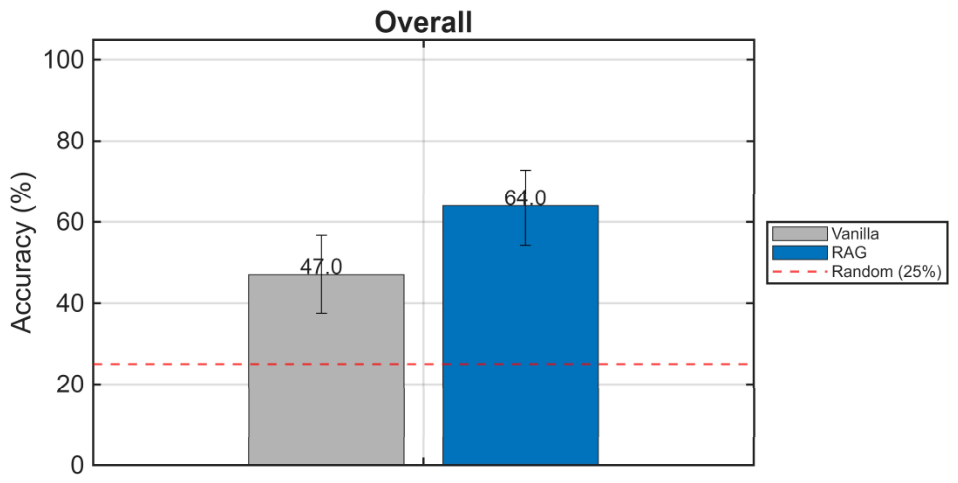
| Gemma-2B | 47.0% | 64.0% | 18 | 1 | Exact McNemar | 1 | <0.001 | Yes |
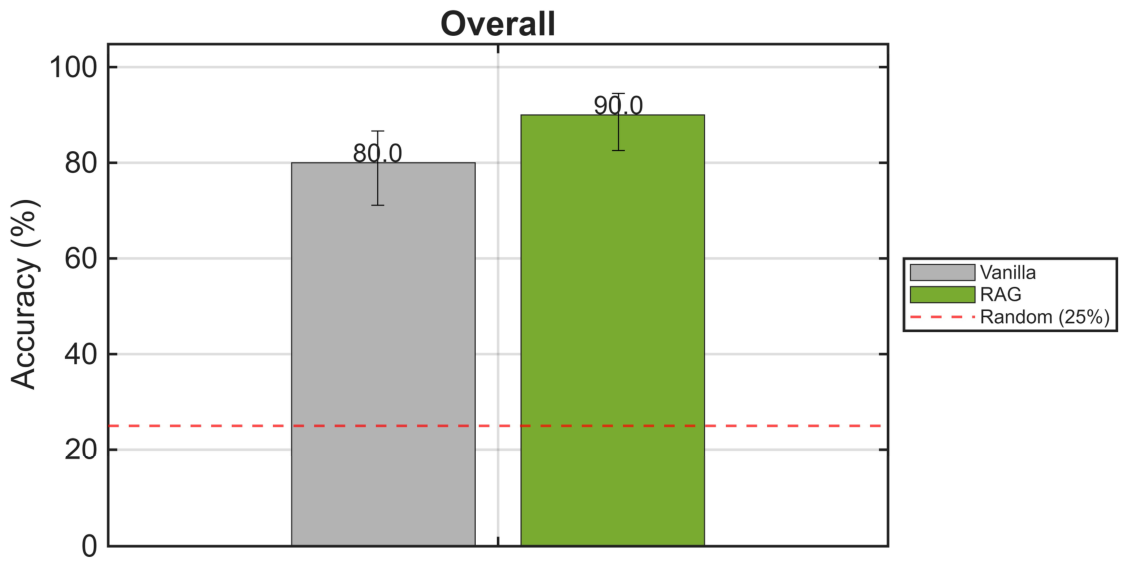
| Llama-3.1-8B | 80.0% | 90.0% | 12 | 2 | Exact McNemar | 2 | 0.013 | Yes |
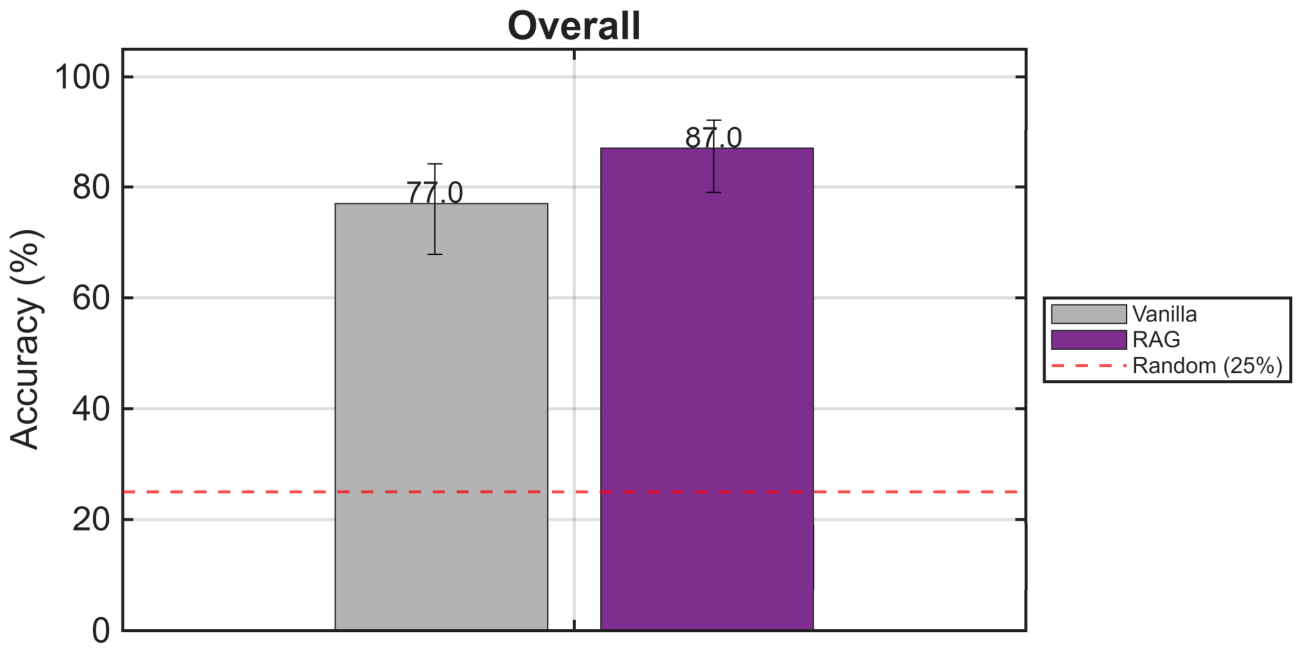
| Mistral-7B | 77.0% | 87.0% | 14 | 4 | Exact McNemar | 4 | 0.031 | Yes |
Disclaimer/Publisher’s Note: The statements, opinions and data contained in all publications are solely those of the individual author(s) and contributor(s) and not of MDPI and/or the editor(s). MDPI and/or the editor(s) disclaim responsibility for any injury to people or property resulting from any ideas, methods, instructions or products referred to in the content. |
© 2026 by the authors. Licensee MDPI, Basel, Switzerland. This article is an open access article distributed under the terms and conditions of the Creative Commons Attribution (CC BY) license.
Share and Cite
Tsalera, E.; Pagiatakis, G.; Papadakis, A. Evaluation of Vanilla and RAG-Supported LLM Comprehension of the EU AI Act. Future Internet 2026, 18, 469. https://doi.org/10.3390/fi18090469
Tsalera E, Pagiatakis G, Papadakis A. Evaluation of Vanilla and RAG-Supported LLM Comprehension of the EU AI Act. Future Internet. 2026; 18(9):469. https://doi.org/10.3390/fi18090469
Chicago/Turabian StyleTsalera, Eleni, Gerasimos Pagiatakis, and Andreas Papadakis. 2026. "Evaluation of Vanilla and RAG-Supported LLM Comprehension of the EU AI Act" Future Internet 18, no. 9: 469. https://doi.org/10.3390/fi18090469
APA StyleTsalera, E., Pagiatakis, G., & Papadakis, A. (2026). Evaluation of Vanilla and RAG-Supported LLM Comprehension of the EU AI Act. Future Internet, 18(9), 469. https://doi.org/10.3390/fi18090469