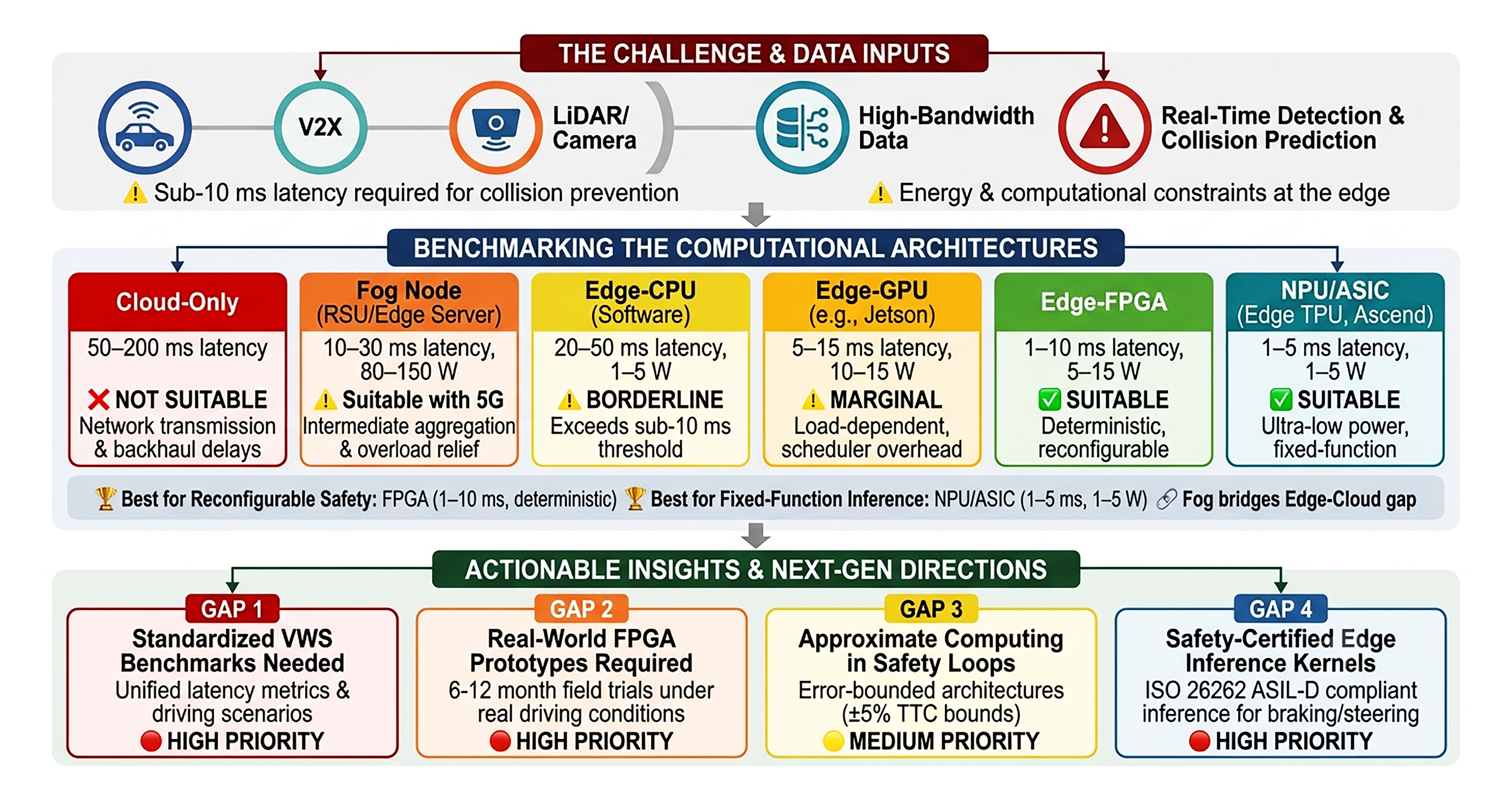

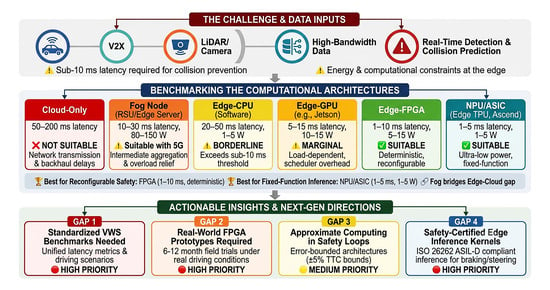
Low-Latency Edge Computing Architectures for Real-Time Vehicle Warning Systems: A Review
Abstract
1. Introduction
1.1. Scope and Contribution
- Edge intelligence frameworks for intelligent transportation systems (ITSs);
- Collision avoidance algorithms and their computational requirements;
- V2X communication and edge offloading for low-latency warning dissemination;
- Hardware accelerators including FPGAs, adders, and approximate computing for edge artificial intelligence (AI);
- Comparative analysis of latency, power, and area trade-offs across CPU, GPU, FPGA, NPU/ASIC, fog, and cloud;
- Research gaps and future directions.
1.2. Review Methodology
- Peer-reviewed journal articles, conference proceedings, or authoritative technical reports.
- Explicit focus on latency constraints below 100 ms for vehicular applications.
- Quantitative reporting of processing latency, power consumption, or hardware resource utilization.
- Applicability to terrestrial vehicular environments (excluding aerial/underwater robotics).
- Publication date between January 2018 and June 2026.
- Papers solely focused on pure cloud solutions without edge or fog consideration.
- Non-vehicular robotics or general IoT applications without clear transportation relevance.
- Papers lacking experimental validation or quantitative performance metrics.
- Pre-print servers (arXiv, TechRxiv) without peer review, unless they had subsequent journal publications.
1.3. Research Questions
- RQ1: What are the key architectural frameworks, communication protocols, and hardware accelerators currently proposed for low-latency edge computing in vehicle warning systems?
- RQ2: What are the computational demands of state-of-the-art collision avoidance algorithms, and which hardware platforms (CPU, GPU, FPGA, ASIC/NPU, fog) best meet the sub-10 ms latency requirement?
- RQ3: What are the power, latency, and reconfigurability trade-offs among different edge acceleration technologies, and how do these trade-offs impact real-world vehicular deployment?
- RQ4: What are the critical research gaps and open challenges that must be addressed to enable widespread adoption of edge-based vehicle warning systems?
1.4. Motivation and Industrial Relevance
2. Edge Intelligence for Intelligent Transportation Systems
2.1. Architectures and Frameworks
2.2. Information Dissemination in Vehicle-to-Everything
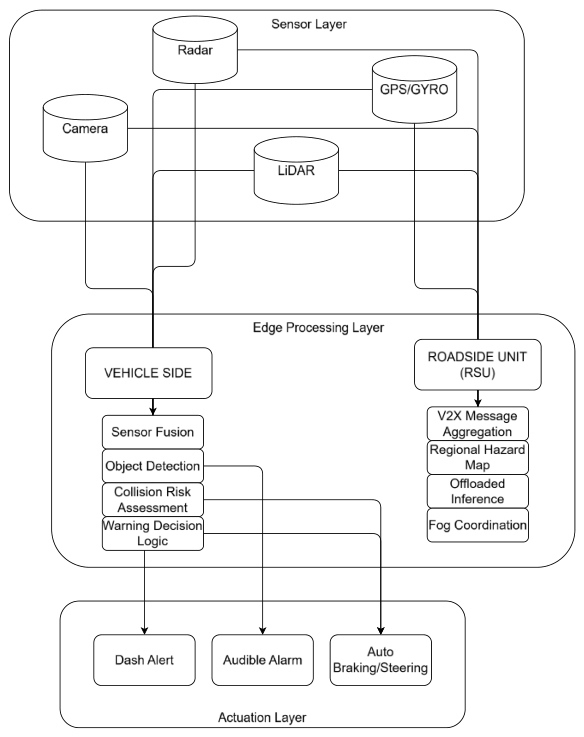
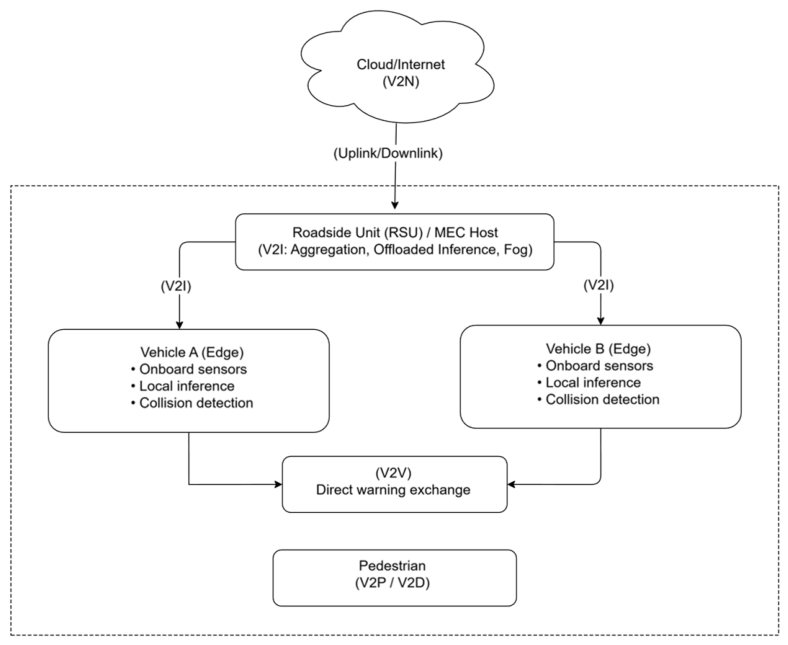
2.3. High-Level Architecture
3. Collision Avoidance Algorithms and Their Computational Demands
3.1. Survey and Analytical Classification of Collision Avoidance Algorithms
3.2. Computational Requirements for Real-Time Operation
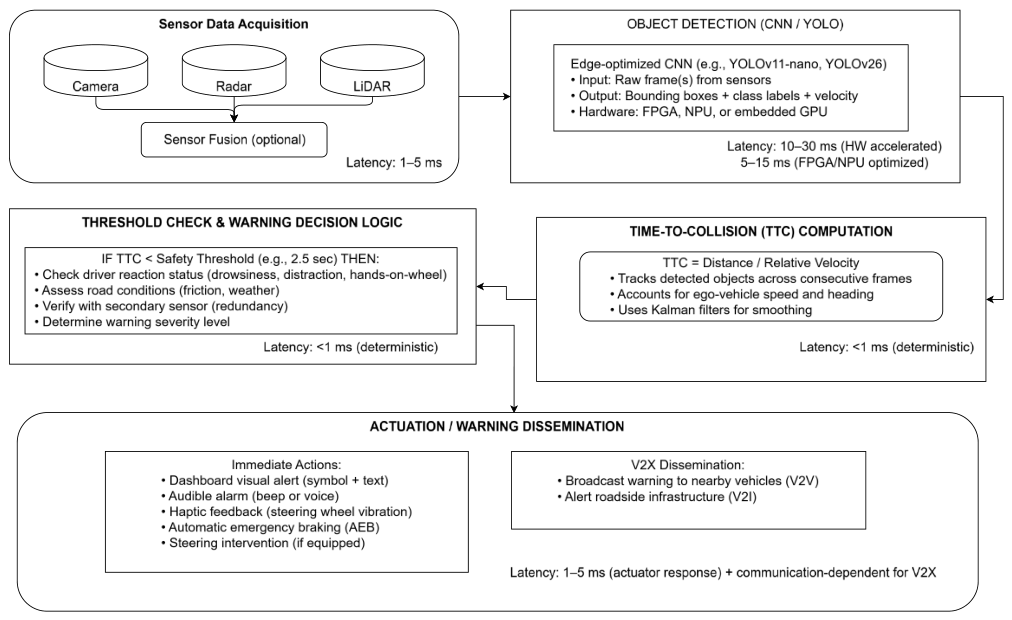
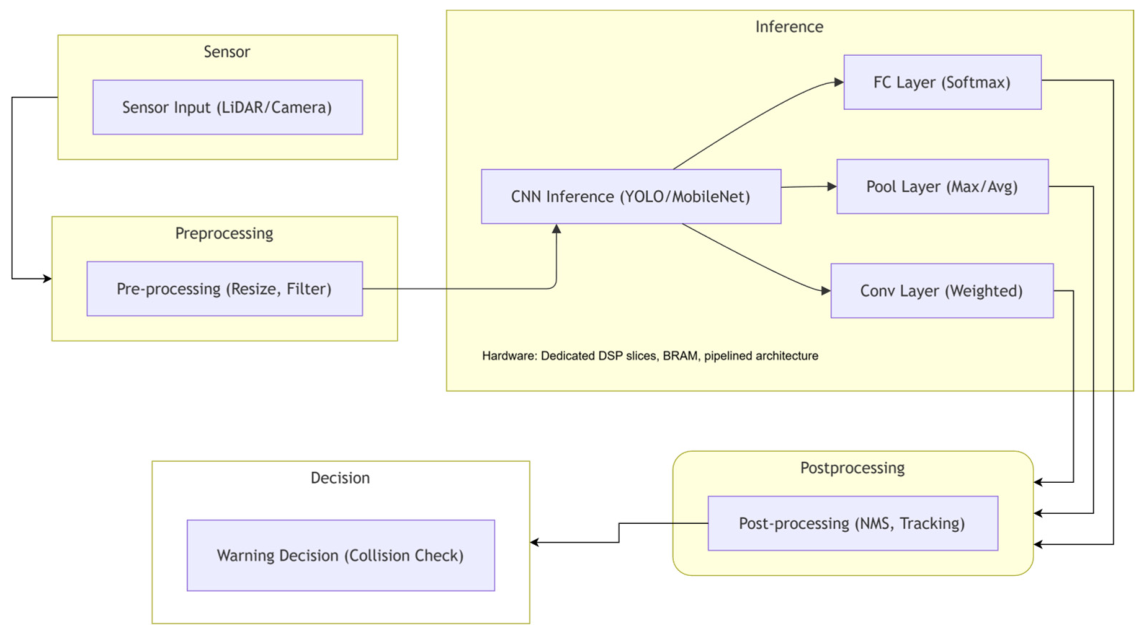
3.3. From Algorithm Output to Warning Activation
4. Vehicle-to-Everything Communication and Edge Offloading for Low-Latency Warning Systems
4.1. Multi-Access Edge Computing for Vehicle-to-Everything
4.2. Task Offloading in Vehicular Edge Computing
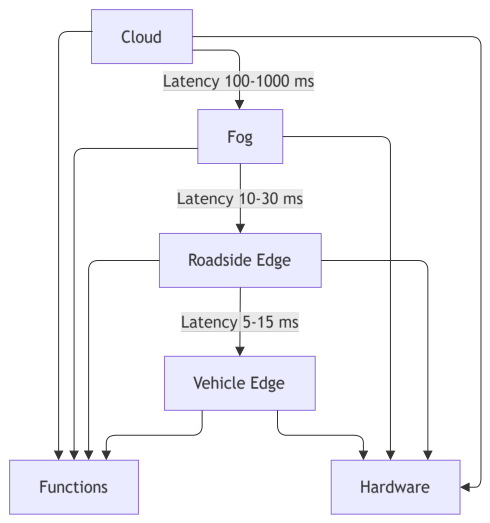
4.3. Fog Computing Architectures for Vehicular Networks
5. Hardware Accelerators for Edge Artificial Intelligence in Vehicle Warning Systems
5.1. Field-Programmable Gate Array Accelerators for Real-Time Inference
5.2. Low-Latency Adder and Approximate Computing
6. Comparative Analysis of Edge Architectures for Vehicle Warnings
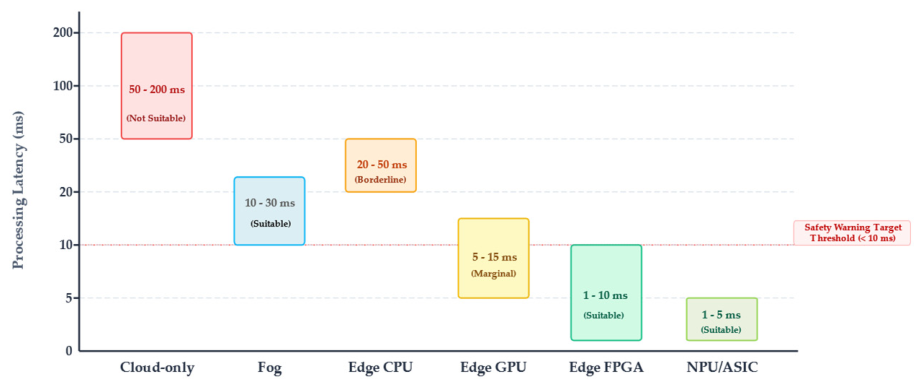
6.1. Latency Comparison
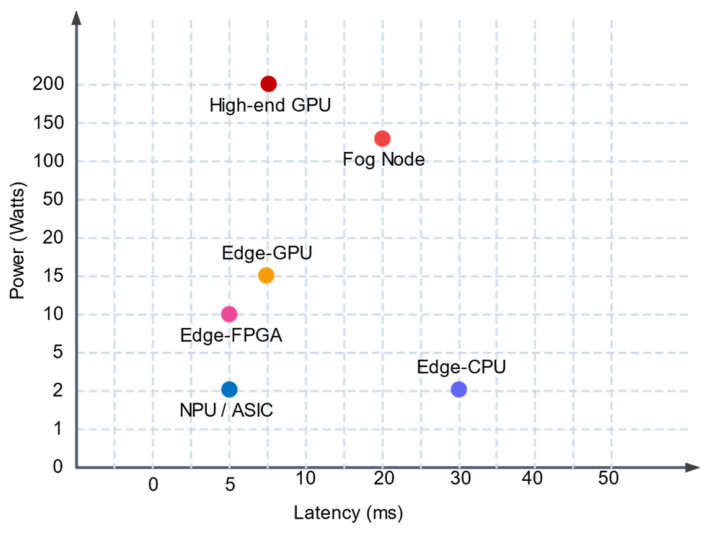
6.2. Power and Energy Efficiency
6.3. Trade-Offs Summary
6.4. Critical Synthesis of the Surveyed Literature
7. Research Gaps and Future Directions
- Gap 1: Lack of Standardized Benchmarks for Edge-Based Warning Systems
- Gap 2: Limited Integration of Approximate Computing in Safety-Critical Loops
- Gap 3: Field-Tested FPGA Prototypes Under Real Driving Conditions
- Gap 4: Integration of V2X and Edge AI in Heterogeneous Networks
- Gap 5: Energy-Harvesting Edge Nodes for Sustainable Warning Systems
Real-Time Edge-Enhanced Vehicular Decision Making
8. Limitations of This Review
9. Conclusions
Author Contributions
Funding
Data Availability Statement
Acknowledgments
Conflicts of Interest
Abbreviations
| ADAS | Advanced Driver-Assistance System |
| AEB | Automatic Emergency Braking |
| AI | Artificial Intelligence |
| ASIC | Application-Specific Integrated Circuit |
| C-V2X | Cellular Vehicle-to-Everything |
| CNN | Convolutional Neural Network |
| DRL | Deep Reinforcement Learning |
| DSP | Digital Signal Processing |
| FPGA | Field-Programmable Gate Array |
| ITS | Intelligent Transportation System |
| MEC | Multi-Access Edge Computing |
| MPC | Model Predictive Control |
| NPU | Neural Processing Unit |
| RSU | Roadside Unit |
| TTC | Time-to-Collision |
| URLLC | Ultra-Reliable Low-Latency Communication |
| V2I | Vehicle-to-Infrastructure |
| V2N | Vehicle-to-Network |
| V2P | Vehicle-to-Pedestrian |
| V2V | Vehicle-to-Vehicle |
| V2X | Vehicle-to-Everything |
| VANET | Vehicular Ad Hoc Network |
References
- Ghasemi, A.; Keshavarzi, A.; Abdelmoniem, A.M.; Nejati, O.R.; Derikvand, T. Edge intelligence for intelligent transport systems: Approaches, challenges, and future directions. Expert Syst. Appl. 2025, 280, 127273. [Google Scholar] [CrossRef] [Scilit]
- Khang, A. Driving Green Transportation System Through Artificial Intelligence and Automation: Approaches, Technologies and Applications; Springer Nature: London, UK, 2025. [Google Scholar]
- Ryu, D.; Kang, Y.; Jeong, M.; Batzorig, M.; Yim, K. Edge AI in vehicle modules using heterogeneous networks: Research trends and future directions. In Innovative Mobile and Internet Services in Ubiquitous Computing: Proceedings of the 19th International Conference on Innovative Mobile and Internet Services in Ubiquitous Computing (IMIS-2025); Springer Nature: London, UK, 2025; pp. 314–324. [Google Scholar]
- Tomar, R.; Sastry, H.G.; Prateek, M. A novel framework for efficient information dissemination for V2X. Int. J. Veh. Inf. Commun. Syst. 2025, 10, 227–242. [Google Scholar] [CrossRef] [Scilit]
- Hamidaoui, M.; Talhaoui, M.Z.; Li, M.; Midoun, M.A.; Haouassi, S.; Mekkaoui, D.E.; Smaili, A.; Cherraf, A.; Benyoub, F.Z. Survey of autonomous vehicles’ collision avoidance algorithms. Sensors 2025, 25, 395. [Google Scholar] [CrossRef] [Scilit] [PubMed]
- Zhu, Y. EdgeDriver: Optimising autonomous driving assistance with multi-LLM framework in cloud-edge computing environments. Int. J. Veh. Inf. Commun. Syst. 2025, 10, 285–298. [Google Scholar]
- Karthick, G.; Whig, P. Enhancing road safety a review of deep learning techniques for accident avoidance. SGS-Eng. Sci. 2025, 1. Available online: https://spast.org/techrep/article/view/5271/528 (accessed on 16 July 2026).
- Kumar, V.P.A.; Bhattacharjee, S.; Kumar, H.; Mal, R.; Ravichandran, V.; Sivasankaran, K. FPGA based Vehicle Collision Avoidance and Accident Warning using Sobel Operation and Manhattan Distance Metrics. In Proceedings of the 2025 3rd International Conference on Intelligent Data Communication Technologies and Internet of Things (IDCIoT), Bengaluru, India, 5–7 February 2025; IEEE: New York, NY, USA, 2025; pp. 837–842. [Google Scholar]
- Saloni; Dutta, U.; Pahal, S. A review of different strategies for vehicle collision avoidance. Int. J. Veh. Inf. Commun. Syst. 2025, 10, 299–324. [Google Scholar] [CrossRef] [Scilit]
- Abboud, M.B.; Drissi, M.; Baala, O.; Allio, S. Optimizing mobility prediction in 5G for enhanced C-V2X applications: A multidisciplinary research survey. Comput. Commun. 2025, 242, 108254. [Google Scholar] [CrossRef] [Scilit]
- Gebrezgiher, Y.T.; Jeremiah, S.R.; Deng, X.; Park, J.H. Machine learning-based blockchain technology for secure V2X communication: Open challenges and solutions. Sensors 2025, 25, 4793. [Google Scholar] [CrossRef] [Scilit] [PubMed]
- Wang, T. Orchestrating Trajectory, Active Jamming, and Antenna Selection for Energy-Efficient Secure Aerial IRS Communications. Veh. Commun. 2025, 57, 100987. [Google Scholar] [CrossRef] [Scilit]
- Ahmed, M.; Raza, S.; Mirza, M.A.; Aziz, A.; Khan, M.A.; Khan, W.U.; Li, J.; Han, Z. A survey on vehicular task offloading: Classification, issues, and challenges. J. King Saud Univ.-Comput. Inf. Sci. 2022, 34, 4135–4162. [Google Scholar] [CrossRef] [Scilit]
- al-Qumati, I.a.-D.A.M.; Saada, O.A.-M.A. Adaptive Communication Mechanisms in VANETs: A Survey on Congestion Control, QoS Optimization, and Reliable Data Dissemination: Adaptive Communication Mechanisms in VANETs. J. Humanit. Appl. Sci. 2025, 9, 27–35. [Google Scholar]
- Markets, R.A. Automotive Edge AI Market—Strategic Insights and Forecasts (2026–2031); 6232071; Research and Markets: Dublin, Ireland, 2026. [Google Scholar]
- Katariya, V.; Pazho, A.D.; Noghre, G.A.; Tabkhi, H. VegaEdge: Edge AI confluence for real-time IoT-applications in highway safety. Internet Things 2024, 27, 101268. [Google Scholar] [CrossRef] [Scilit]
- Yan, H.; Gu, Y.; He, H.; Ning, X.; Wang, Q.; Cheng, L. DNN-based task partitioning and offloading in edge-cloud collaboration within electric vehicles. IEEE Trans. Consum. Electron. 2024, 71, 4100–4109. [Google Scholar]
- Ali, E.M.; Abawajy, J.; Lemma, F.; Baho, S.A. Analysis of deep reinforcement learning algorithms for task offloading and resource allocation in fog computing environments. Sensors 2025, 25, 5286. [Google Scholar] [CrossRef] [Scilit] [PubMed]
- Banerjee, S.; Mondal, M.K.; Roy, M.; Alnumay, W.S.; Biswas, U. A deep learning-based car accident detection framework using edge and cloud computing. IEEE Access 2024, 12, 130107–130115. [Google Scholar] [CrossRef] [Scilit]
- Zhang, J.; Xu, Q.; Li, Z.; Xu, C.; Li, K. Cooperative Safety Intelligence in V2X-Enabled Transportation: A Survey. arXiv 2025, arXiv:2512.00490. [Google Scholar]
- Sameer, M.M. A Context-Aware Hybrid Trust Management Model for the Internet of Vehicles. Master’s Thesis, Macquarie University, Sydney, NSW, Australia, 2025. [Google Scholar]
- Hassan, S.R.; Mehmood, A. A Multi-Tier Vehicular Edge-Fog Framework for Real-Time Traffic Management in Smart Cities. Mathematics 2025, 13, 3947. [Google Scholar] [CrossRef] [Scilit]
- Al Amin, R.; Obermaisser, R. Real-Time Object Detection and Classification using YOLO for Edge FPGAs. In Proceedings of the 2025 International Symposium ELMAR, Zadar, Croatia, 15–17 September 2025; IEEE: New York, NY, USA, 2025; pp. 291–295. [Google Scholar]
- Adam, M.A.; Tapamo, J.R. Enhancing YOLOv5 for Autonomous Driving: Efficient Attention-Based Object Detection on Edge Devices. J. Imaging 2025, 11, 263. [Google Scholar] [CrossRef] [Scilit] [PubMed]
- Punia, D.; Kumar, R. A YOLOv3-powered edge computing technique for real-time rear-end collision prediction in autonomous vehicles. Appl. Soft Comput. 2025, 185, 113981. [Google Scholar] [CrossRef] [Scilit]
- Lamb, L.; Mohammadi, M.; Zand, R. Multi-Modal Vision at the Edge: Toward Low-Latency Perception for Autonomous Systems. In Proceedings of the 2025 IEEE International Conference on Omni-Layer Intelligent Systems (COINS), Madison, WI, USA, 4–6 August 2025; IEEE: New York, NY, USA, 2025; pp. 1–7. [Google Scholar]
- Xing, C.; Sun, H.; Yang, J. A Lightweight Traffic Sign Detection Model Based on Improved YOLOv8s for Edge Deployment in Autonomous Driving Systems Under Complex Environments. World Electr. Veh. J. 2025, 16, 478. [Google Scholar] [CrossRef] [Scilit]
- Sapkota, R.; Karkee, M. Ultralytics YOLO evolution: An overview of YOLO26, YOLO11, YOLOv8 and YOLOv5 object detectors for computer vision and pattern recognition. arXiv 2025, arXiv:2510.09653. [Google Scholar]
- Chakrabarty, S. Yolo26: An analysis of NMS-free end to end framework for real-time object detection. arXiv 2026, arXiv:2601.12882. [Google Scholar]
- Minott, D.; Siddiqui, S.; Haddad, R.J. Benchmarking edge AI platforms: Performance analysis of Nvidia Jetson and raspberry pi 5 with coral TPU. In Proceedings of the SoutheastCon 2025, Concord, NC, USA, 22–30 March 2025; IEEE: New York, NY, USA, 2025; pp. 1384–1389. [Google Scholar]
- Qiu, J.; Wang, J.; Yao, S.; Guo, K.; Li, B.; Zhou, E.; Yu, J.; Tang, T.; Xu, N.; Song, S. Going deeper with embedded FPGA platform for convolutional neural network. In Proceedings of the 2016 ACM/SIGDA International Symposium On Field-Programmable Gate Arrays, Monterey, CA, USA, 21–23 February 2016; ACM: New York, NY, USA, 2016; pp. 26–35. [Google Scholar]
- Zhang, C.; Li, P.; Sun, G.; Guan, Y.; Xiao, B.; Cong, J. Optimizing FPGA-based accelerator design for deep convolutional neural networks. In Proceedings of the 2015 ACM/SIGDA International Symposium on Field-Programmable Gate Arrays, Monterey, CA, USA, 22–24 February 2015; ACM: New York, NY, USA, 2015; pp. 161–170. [Google Scholar]
- Wang, X.; Yang, Y.; Shangguan, Y.; Yan, W.; An, Z.; Bunting, M.; Nice, M.; Beckers, T.; Ma, M.; Work, D. A Safety-Driven Interpretable Model for Vehicle Control With Impact on Traffic. IEEE Trans. Intell. Transp. Syst. 2025, 26, 22151–22160. [Google Scholar] [CrossRef] [Scilit]
- Li, X.; Yan, C.; Duan, W.; Wang, X. Intelligent Offloading and Driving Strategy for Delay Minimization and Collision Avoidance in V2X Network. In Proceedings of the 2025 IEEE/CIC International Conference on Communications in China (ICCC Workshops), Shanghai, China, 10–13 August 2025; IEEE: New York, NY, USA, 2025; pp. 1–6. [Google Scholar]
- Raviglione, F.; Casetti, C.; Restuccia, F. Edge-V: Vehicular Edge Intelligence Through Multi-Band Unlicensed Spectrum Access. IEEE Trans. Veh. Technol. 2025, 75, 5030–5045. [Google Scholar]
- Chang, C.; Zhang, J.; Zhang, K.; Zheng, Y.; Shi, M.; Hu, J.; Li, S.; Li, L. CAV driving safety monitoring and warning via V2X-based edge computing system. Front. Eng. Manag. 2024, 11, 107–127. [Google Scholar] [CrossRef] [Scilit]
- Farooqi, A.M.; Alam, M.A.; Hassan, S.I.; Idrees, S.M. A fog computing model for VANET to reduce latency and delay using 5G network in smart city transportation. Appl. Sci. 2022, 12, 2083. [Google Scholar] [CrossRef] [Scilit]
- Ehtisham, M.; Hassan, M.u.; Al-Awady, A.A.; Ali, A.; Junaid, M.; Khan, J.; Abdelrahman Ali, Y.A.; Akram, M. Internet of vehicles (IoV)-based task scheduling approach using fuzzy logic technique in fog computing enables vehicular ad hoc network (VANET). Sensors 2024, 24, 874. [Google Scholar] [CrossRef] [Scilit] [PubMed]
- Tripura, S.; Lu, Q.-C.; Hussain, A.; Mahmud, T. Optimizing traffic safety message dissemination and resource allocation using adaptive deep reinforcement learning in fog-enabled internet of vehicles network. Egypt. Inform. J. 2025, 32, 100804. [Google Scholar] [CrossRef] [Scilit]
- Hu, B.; Du, J.; Zhang, J.; Chu, X. Computation offloading and resource allocation in mixed cloud/vehicular-fog computing systems. IEEE Trans. Mob. Comput. 2025, 24, 8612–8624. [Google Scholar] [CrossRef] [Scilit]
- Sneha, C.; Chakravarthy, A.S.; Veni, T. A comprehensive review of task offloading methods in Vehicular Fog Computing. Comput. Electr. Eng. 2026, 129, 110847. [Google Scholar] [CrossRef] [Scilit]
- Gu, K.; Chen, Q.; Tan, J.; Liang, R.; Cai, L. Multi-Layer Task Offloading Scheme in Fog Computing-Based VANETs With Optimized Completion Delay. IEEE Trans. Intell. Transp. Syst. 2025, 26, 11574–11591. [Google Scholar] [CrossRef] [Scilit]
- Alshemi, M.; Saif, S.; Taher, M. Hardware acceleration of lane detection algorithm: A GPU versus FPGA comparison. arXiv 2022, arXiv:2212.09460. [Google Scholar]
- Hanif, M.A.; Hafiz, R.; Shafique, M. Configurable models and design space exploration for low-latency approximate adders. In Approximate Circuits: Methodologies and CAD; Springer: Berlin/Heidelberg, Germany, 2018; pp. 3–23. [Google Scholar]
- Vishwakarma, V.; Mittal, A.; Gupta, B.B.; Chui, K.T.; Vishvakarma, S.K. A Novel 4-Bit CMOS Based Full Adder for Low-Power IoT and Edge Computing Applications. In Proceedings of the 2025 22nd International SoC Design Conference (ISOCC), Busan, Republic of Korea, 15–18 October 2025; IEEE: New York, NY, USA, 2025; pp. 1–2. [Google Scholar]
- Sayadi, L.; Moaiyeri, M.H.; Timarchi, S. Layer-specific approximate multipliers for energy-precision trade-offs in convolutional neural networks. IEEE Trans. Comput./Sci. Rep. 2025, 15, 39482. [Google Scholar] [CrossRef] [Scilit]
- Omidian, F.; Abdi, A.; Hamed-Rouhbakhs, A. AdApTS: Adaptive approximate computing-based traffic sign recognition unit for self-driving cars. J. Supercomput. 2025, 81, 1339. [Google Scholar] [CrossRef] [Scilit]
- Kouris, A.; Venieris, S.I.; Rizakis, M.; Bouganis, C.-S. Approximate LSTMs for time-constrained inference: Enabling fast reaction in self-driving cars. arXiv 2019, arXiv:1905.00689. [Google Scholar]
- Omidian, F.; Abdi, A. Appsign: Multi-level approximate computing for real-time traffic sign recognition in autonomous vehicles. arXiv 2024, arXiv:2411.10988. [Google Scholar]
- Katare, D.; Perino, D.; Nurmi, J.; Warnier, M.; Janssen, M.; Ding, A.Y. A survey on approximate edge AI for energy efficient autonomous driving services. IEEE Commun. Surv. Tutor. 2023, 25, 2714–2754. [Google Scholar] [CrossRef] [Scilit]
- Tang, C.; Wei, X.; Zhu, C.; Wang, Y.; Jia, W. Mobile vehicles as fog nodes for latency optimization in smart cities. IEEE Trans. Veh. Technol. 2020, 69, 9364–9375. [Google Scholar] [CrossRef] [Scilit]
- Tang, Y.; Zhou, H.; Ji, Z.; Wang, C.-L. Cube-fx: Mapping Taylor Expansion Onto Matrix Multiplier-Accumulators of Huawei Ascend AI Processors. IEEE Trans. Parallel Distrib. Syst. 2025, 36, 1115–1129. [Google Scholar] [CrossRef] [Scilit]
- Shin, P.; Hong, S. Performance Characterization of Deep Learning Primitives for Hardware-Aware Mapping on Heterogeneous Edge Accelerators. In Proceedings of the 2025 IEEE/IEIE International Conference on Consumer Electronics-Asia (ICCE-Asia), Busan, Republic of Korea, 27–29 October 2025; IEEE: New York, NY, USA, 2005; pp. 1–6. [Google Scholar]
- Fan, M.; Kong, X.; Xu, S.; Xiong, H.; Liu, X. Video-based traffic light recognition by rockchip RV1126 for autonomous driving. In Proceedings of the 2025 IEEE Intelligent Vehicles Symposium (IV), Cluj-Napoca, Romania, 22–25 June 2025; IEEE: New York, NY, USA, 2025; pp. 1738–1744. [Google Scholar]
- Chen, Y.-H.; Emer, J.; Sze, V. Eyeriss: A spatial architecture for energy-efficient dataflow for convolutional neural networks. ACM SIGARCH Comput. Archit. News 2016, 44, 367–379. [Google Scholar] [CrossRef] [Scilit]
- Li, Y.; Liu, W.; Liu, Q.; Zheng, X.; Sun, K.; Huang, C. Complying with iso 26262 and iso/sae 21434: A safety and security co-analysis method for intelligent connected vehicle. Sensors 2024, 24, 1848. [Google Scholar] [CrossRef] [Scilit] [PubMed]
- Zhang, Y.; Zhao, K.; Yang, Y.; Zhou, Z. Real-time service migration in edge networks: A survey. J. Sens. Actuator Netw. 2025, 14, 79. [Google Scholar] [CrossRef] [Scilit]
- Bilal, M.A.; Islam, I.U.; Iltaf, N.; Khan, M.J.; Khan, J. Federated learning with explainable ai for malicious traffic detection in iot networks. IEEE Access 2025, 13, 173368–173383. [Google Scholar] [CrossRef] [Scilit]




| Algorithm Type | Example Methods | CPU-Only Latency (Large Models) | Latency with Edge Optimizations (Nano/Small + HW Accel) | Hardware Acceleration Needed? | Notes |
|---|---|---|---|---|---|
| Rule-based | Safety distance, TTC threshold | <5 ms * | <5 ms * | No | Suitable for simple warnings |
| CNN object detection (earlier) | YOLOv5-large, SSD, Faster R-CNN | 50–200 ms | N/A (not edge-optimized) | Yes (GPU/FPGA required) | High accuracy, compute-intensive |
| CNN object detection (edge-optimized) | YOLOv11-nano/-small/-medium, YOLOv26 [21,28] | 30–60 ms (CPU) | 10–30 ms (edge TPU, Jetson) [23,24,25,26,27,30] | Yes (NPU/FPGA/GPU beneficial) | Best for edge deployment |
| Path planning | A *, RRT, DWA | 10–50 ms ** | 5–15 ms (GPU-accelerated) | Moderate (GPU/FPGA helpful) | RRT * iteration: 1.2–3.9 ms; total planning: 50–450 ms |
| Deep reinforcement learning | DQN, PPO, SAC | 20–100 ms | 10–50 ms (GPU/FPGA inference) | Yes (GPU for training) | Advisory warnings only *** |
| Architecture | Processing Latency (per Frame/Inference) | Suitability for <10 ms Warning |
|---|---|---|
| Cloud-only (4G/5G) | 50–200 ms | No |
| Fog (RSU/Gateway) | 10–30 ms | Suitable (with 5G/ideal conditions) |
| Edge (CPU, software) | 20–50 ms | No (borderline) |
| Edge (GPU, e.g., Jetson) | 5–15 ms | Marginal (depends on load) |
| Edge (FPGA) | 1–10 ms | Yes (deterministic) |
| NPU/ASIC | 1–5 ms | Yes (ultra-low-power, fixed-function) |
| Hybrid (edge + cloud) | 5–30 ms | Depends on offloading strategy |
| Accelerator Type | Power (W) | Energy per Inference (J) | Best Use Case |
|---|---|---|---|
| High-end GPU (e.g., NVIDIA A100) | 150–250 | 15–30 | Training, non-real-time batch processing |
| Fog node (RSU/edge server) [22,37,38,40,51] | 80–150 | 3–10 | Intermediate aggregation, overload relief |
| Embedded GPU (e.g., Jetson Orin) | 10–15 | 0.5–2 | Moderate real-time, flexible software stack |
| Edge NPU/ASIC (e.g., Google Edge TPU, Huawei Ascend, Qualcomm Hexagon) [30,52,53,54] | 1–5 | 0.05–0.5 | Fixed-function, ultra-low-power edge inference |
| FPGA (mid-range, e.g., Xilinx Zynq) | 5–15 * | 0.2–1 | Low-latency, energy-sensitive, reconfigurable |
| Custom ASIC (mass production) [55] | 1–5 | 0.05–0.2 | High-volume, fixed-function production |
| Criterion | Cloud | Fog | Edge (CPU) | Edge (GPU) | Edge (FPGA) | NPU/ASIC |
|---|---|---|---|---|---|---|
| Low latency (<10 ms) | No | Suitable (10–30 ms) | No | Yes | Yes | Yes (1–5 ms) |
| Low power (<5 W) | N/A | No (80–150 W) | Yes | No | Moderate 1 | Yes (1–5 W) |
| Reconfigurability | N/A | Moderate | Yes | Moderate 2 | Yes | No (Fixed-function) |
| Development ease | Yes | Moderate | Yes | Moderate 3 | No | Moderate 4 |
| Deterministic timing | No | Moderate | No | Moderate 5 | Yes | Yes |
| Focus Area | Methodology/Algorithm | Strength | Weakness/Gap | Applicability to Vehicle Warnings |
|---|---|---|---|---|
| Edge Intelligence Frameworks [1] | Hierarchical edge-cloud collaboration survey | Comprehensive taxonomy | Lacks quantitative hardware comparison | High (architectural guidance) |
| Collision Avoidance Algorithms [5] | Systematic review of DRL and CNN methods | Covers algorithmic diversity | Does not address hardware mapping | Medium (algorithm selection) |
| FPGA Implementation [8] | Sobel + Manhattan distance on Cyclone IV | Achieves 5.2 ms latency | Tested only in lab, not real roads | High (proof of HW viability) |
| V2X Dissemination [4] | Edge relay broadcast storm reduction | 40% latency reduction via simulation | Simulation-only; no HW prototype | Medium (communication strategy) |
| GPU vs. FPGA [43] | Lane detection on Zynq vs. Jetson TX2 | Direct quantitative HW comparison | Limited to lane detection only | High (energy efficiency benchmark) |
| Fog Computing [37] | 5G fog model for VANET | 40% latency reduction vs. cloud | Assumes ideal 5G coverage | High (latency optimization) |
| Fog Task Scheduling [38] | Fuzzy logic scheduling in fog-VANET | Balances load, keeps <20 ms latency | Complexity of fuzzy rules in dynamic V2X | High (resource management) |
| Mobile Fog Nodes [51] | Vehicles-as-fog for latency optimization | Dynamic resource pooling | Security/privacy of shared vehicle resources | High (novel architectural insight) |
| ASIC/NPU Performance [30] | Benchmarking Google Coral vs. GPU | 1–5 W power, fast ML inference | Fixed models; lacks reconfigurability | Medium (low-power inference) |
| Edge-Optimized CNNs [23,24,25,26,27] | YOLOv5/v8/v11 FPGA/NPU implementations | Real-time detection on edge | Limited to specific model variants | High (practical deployment) |
| Gap | Proposed Future Direction |
|---|---|
| No standardized benchmarks | Develop a public benchmark suite with unified latency metrics and representative driving scenarios |
| Approximate computing in safety loops | Design error-resilient accelerators with mathematically guaranteed bounded error (±5% in TTC) [42,47,48,49] |
| Lack of field-tested FPGA prototypes | Conduct long-term field trials under real driving conditions [8,23] |
| Joint communication-computation optimization | Design ML-based online schedulers for V2X edge offloading under dynamic channel conditions [34,35] |
| Energy-harvesting edge nodes | Integrate low-power arithmetic and sleep-wake scheduling with piezoelectric/solar harvesting |
Disclaimer/Publisher’s Note: The statements, opinions and data contained in all publications are solely those of the individual author(s) and contributor(s) and not of MDPI and/or the editor(s). MDPI and/or the editor(s) disclaim responsibility for any injury to people or property resulting from any ideas, methods, instructions or products referred to in the content. |
© 2026 by the authors. Licensee MDPI, Basel, Switzerland. This article is an open access article distributed under the terms and conditions of the Creative Commons Attribution (CC BY) license.
Share and Cite
Amartey, R.K.; Zhao, D. Low-Latency Edge Computing Architectures for Real-Time Vehicle Warning Systems: A Review. Future Internet 2026, 18, 387. https://doi.org/10.3390/fi18080387
Amartey RK, Zhao D. Low-Latency Edge Computing Architectures for Real-Time Vehicle Warning Systems: A Review. Future Internet. 2026; 18(8):387. https://doi.org/10.3390/fi18080387
Chicago/Turabian StyleAmartey, Redeemer Kwei, and Duan Zhao. 2026. "Low-Latency Edge Computing Architectures for Real-Time Vehicle Warning Systems: A Review" Future Internet 18, no. 8: 387. https://doi.org/10.3390/fi18080387
APA StyleAmartey, R. K., & Zhao, D. (2026). Low-Latency Edge Computing Architectures for Real-Time Vehicle Warning Systems: A Review. Future Internet, 18(8), 387. https://doi.org/10.3390/fi18080387