1. Introduction
As the requirements for ultra-fast, reliable, and intelligent communication infrastructures continue to increase, sixth-generation (6G) wireless networks have emerged as a key enabling technology for future large-scale connectivity. Sixth-generation systems represent the next evolutionary step in wireless communications and have attracted considerable interest from both academia and industry. Building upon the capabilities introduced by fifth-generation (5G) networks, which already support enhanced data rates and low-latency services, 6G is expected to further enhance communication performance through ultra-high transmission speeds, near-instantaneous latency, improved reliability, and advanced intelligent networking functionalities [
1]. In addition, 6G is envisioned to support a broad range of emerging applications and services requiring highly adaptive and scalable communication infrastructures [
2,
3,
4,
5].
The development and standardization of 6G technologies have been actively supported by several major international organizations. In particular, the 3rd Generation Partnership Project (3GPP) [
6], the International Telecommunication Union (ITU) [
7], and the Open Radio Access Network (O-RAN) Alliance [
8] have initiated extensive research activities toward defining the architectures, protocols, and performance requirements of next-generation wireless systems. Through their ongoing standardization efforts, these organizations contribute significantly to shaping the technological foundations and operational frameworks of future 6G communication networks.
The O-RAN architecture has emerged as one of the most promising paradigms for realizing the flexibility and intelligence required by future 6G networks. Unlike conventional vendor-specific RAN deployments, O-RAN promotes openness, interoperability, virtualization, and disaggregation of network functions through standardized interfaces [
8,
9]. A key feature of O-RAN is the separation of the Radio Unit (RU), Distributed Unit (DU), and Central Unit (CU), enabling independent deployment and management of radio, processing, and control functionalities. Furthermore, O-RAN introduces intelligent control entities such as the Near-Real-Time RAN Intelligent Controller (Near-RT RIC) and Non-Real-Time RAN Intelligent Controller (Non-RT RIC), which facilitate data-driven optimization, machine learning integration, and adaptive resource management [
10,
11]. While such architectural flexibility significantly improves scalability and programmability, it also introduces new resource allocation challenges due to the distributed nature of decision-making, heterogeneous service requirements, and resource coupling among network entities.
Software-Defined Networking (SDN) further enhances the O-RAN vision by decoupling the control plane from the data plane and enabling centralized network orchestration. Through global network visibility and programmable control mechanisms, SDN facilitates dynamic resource management, traffic engineering, and service-aware optimization across distributed network nodes [
12,
13]. However, the coexistence of SDN control mechanisms with disaggregated O-RAN components creates complex interactions among network entities competing for shared radio and computational resources. In particular, resource allocation decisions made by one CU or DU may directly affect the performance of neighboring entities due to interference, congestion, and shared infrastructure limitations. Consequently, scalable distributed optimization mechanisms are required to coordinate resource usage while maintaining service-level guarantees.
Within the 6G O-RAN paradigm, one of the most critical challenges concerns the efficient allocation of radio resources in order to simultaneously satisfy the heterogeneous requirements of enhanced Mobile Broadband (eMBB) and Ultra-Reliable Low-Latency Communications (URLLC) services [
9,
14], while also maximizing the overall energy efficiency of the network. Traditional resource allocation approaches generally optimize individual objectives independently, such as aggregate network throughput, eMBB throughput, or URLLC latency, without adequately capturing the inherent trade-offs among these competing performance metrics. Moreover, the coexistence of heterogeneous traffic patterns together with rapidly varying wireless channel conditions significantly increases the complexity of resource management in next-generation communication systems [
15,
16].
Recent advances in representation learning highlight the importance of disentangling transferable structural information from domain-specific variations in complex systems. For instance, prompt-guided disentanglement and fusion strategies [
17] have been shown effective in handling domain mismatch in fault diagnosis tasks. Motivated by these ideas, future extensions of O-RAN resource allocation frameworks may incorporate representation learning techniques to separate invariant service characteristics (e.g., QoS requirements) from environment-dependent interference patterns, enabling more adaptive and context-aware control policies in dynamic network conditions.
Game-theoretic methodologies have been extensively applied in wireless communication networks [
18], including emerging 6G systems [
19], particularly in the context of resource allocation problems [
20,
21,
22]. Despite significant progress in O-RAN resource management, several limitations remain in the existing literature. Most proposed approaches rely on centralized optimization frameworks, heuristic algorithms, or machine learning techniques that often require extensive training data, high computational complexity, or centralized coordination [
9,
14]. Furthermore, many existing schemes focus primarily on throughput maximization or latency minimization without providing rigorous analytical guarantees regarding equilibrium existence, convergence, or stability. Among the various game-theoretic frameworks, potential games [
23] have received significant attention due to their desirable convergence properties, especially their ability to converge almost surely to a Nash equilibrium. Such characteristics make potential games highly suitable for distributed optimization and self-organizing resource management in wireless networking environments [
24].
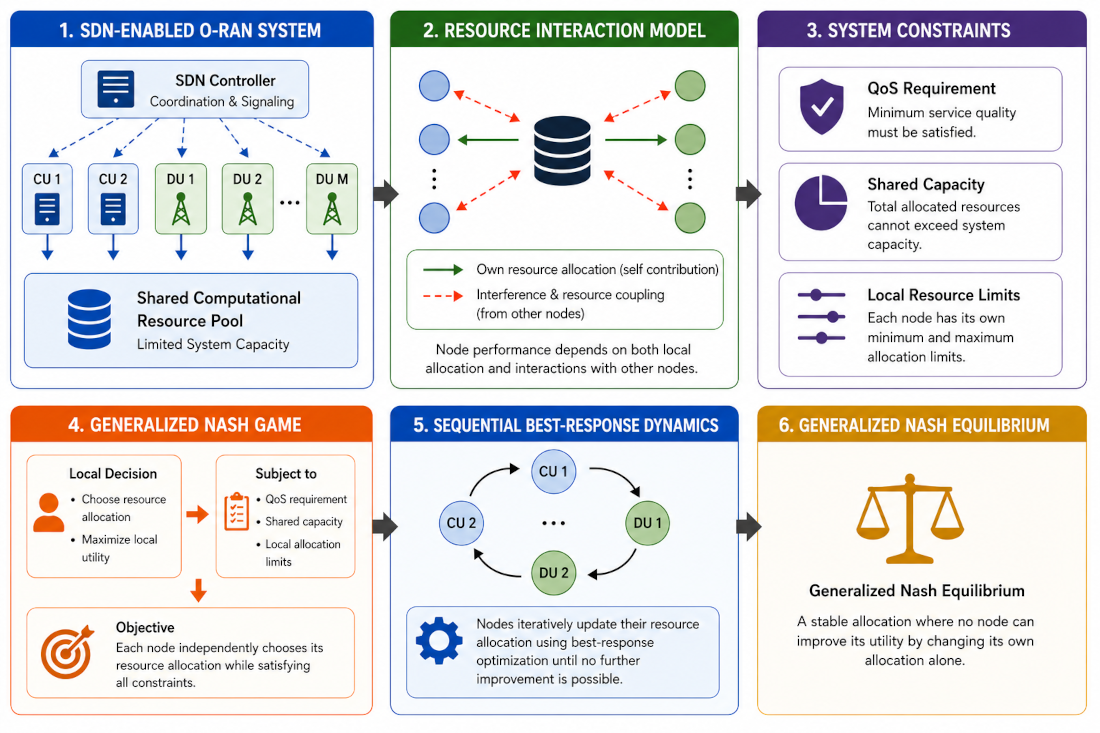
In this paper, we propose a game-theoretic formulation to address the resource allocation challenge in 6G O-RAN, where SDN-enabled CUs and DUs compete for shared network resources. Each node independently selects its resource allocation within local bounds while accounting for the impact of congestion and interference—arising from fronthaul bandwidth, spectrum contention, and processing limitations—on its performance through an effective SINR-like metric. The proposed framework moves beyond traditional single-metric optimization by balancing performance gains and resource costs. Each node maximizes its utility under local SINR-based QoS constraints that reflect diverse traffic requirements. An SDN controller supervises the network by dynamically adjusting system-level parameters, such as resource pricing, to guide the system toward efficient and fair allocations. Modeling the system as an exact generalized potential game ensures convergence to a pure-strategy Nash equilibrium through distributed updates. By incorporating realistic wireless channels, QoS requirements, and SDN coordination, the approach aligns with the modular design of O-RAN and provides a scalable solution for managing complex demands in next-generation networks.
Noveltyand Main Contributions
While generalized Nash games and potential games have been extensively studied in wireless resource allocation, their application to SDN-controlled O-RAN resource management remains relatively unexplored. Existing O-RAN resource allocation approaches primarily focus on optimization-based formulations, centralized control strategies, or learning-driven solutions, often without establishing rigorous equilibrium properties under coupled resource constraints.
The novelty of this work lies not in the individual use of game theory or SDN concepts, but in their unified integration into a mathematically tractable O-RAN resource allocation framework. In particular, the proposed model captures the interaction among SDN-enabled CUs and DUs competing for shared network resources while explicitly accounting for capacity coupling and QoS requirements.
The main contributions of this paper are summarized as follows:
We formulate SDN-controlled O-RAN resource allocation as a generalized Nash game in which the feasible strategy set of each node depends on the actions of other nodes through shared capacity constraints and QoS coupling.
We establish that the proposed game admits an exact generalized potential function, allowing the decentralized resource allocation problem to be analyzed through potential-game theory.
We prove that the generalized best-response dynamics generate a non-decreasing potential sequence and converge to a generalized Nash equilibrium under standard convexity and constraint qualification assumptions.
We provide a local stability characterization of the equilibrium through analysis of the Jacobian of the best-response mapping, linking equilibrium stability to the spectral radius condition.
The framework offers a scalable and distributed alternative to centralized O-RAN resource management by enabling autonomous decision-making while preserving global resource feasibility.
To rigorously assess the effectiveness of the proposed approach, we benchmark not only against conventional heuristic methods but also against representative optimization and game-theoretic schemes, including convex optimization, proportional fairness, water-filling allocation, and Stackelberg game formulations, ensuring a comprehensive evaluation across both baseline and advanced resource allocation paradigms.
Therefore, the primary contribution of the paper is the development of a theoretically grounded SDN-enabled O-RAN resource allocation framework with provable equilibrium existence, convergence, and stability properties under coupled resource constraints.
2. Related Work
Wang et al. [
25] investigate the resource allocation problem between Radio Units (RUs) and Distributed Units (DUs) in O-RAN environments by formulating it as a two-dimensional bin-packing problem. To address the complexity of the allocation process, the authors develop a self-play deep reinforcement learning framework inspired by the AlphaGo Zero paradigm and neural Monte Carlo Tree Search (MCTS). Their approach enables intelligent RU–DU assignment under varying network conditions and traffic demands. Experimental evaluation using both benchmark bin-packing datasets and real deployment scenarios demonstrates that the proposed self-play mechanism achieves higher resource utilization efficiency compared to conventional approaches, including heuristic virtual resource allocation, Lego-based heuristics, and classical MCTS techniques.
Du et al. [
26] propose an SDN-assisted architecture for cloud-edge computing services in 5G heterogeneous networks. Their framework enables flexible and on-demand resource orchestration while adapting to the dynamic computational requirements generated by end-user devices. To model user behavior under incomplete information, the authors formulate the service-selection process as an evolutionary game characterized by replicator dynamics. Based on this formulation, they introduce a Stackelberg differential-game mechanism that regulates resource trading between a central cloud provider and multiple edge computing providers. The study derives optimal pricing and resource allocation policies that maximize the collective utility of the participating entities while driving the system toward an evolutionarily stable equilibrium. Simulation results validate the effectiveness of the proposed framework, showing stable convergence in both pricing strategies and user subscription dynamics.
Mollahasani et al. [
27] present two nested actor–critic reinforcement learning schemes designed to jointly optimize network-function placement and resource allocation decisions. Their work specifically investigates the impact of observability levels on the performance of reinforcement learning-based resource management strategies. The obtained results indicate that adaptive relocation of network functions according to service requirements can significantly improve network latency and throughput performance. The study further demonstrates the capability of reinforcement learning techniques to dynamically adapt resource allocation policies in complex networking environments.
In [
28], the authors focus on improving energy efficiency within the O-RAN architecture while simultaneously satisfying user delay constraints. The considered optimization problem is reformulated into a mixed-integer linear programming (MILP) framework to enable tractable solution derivation. The proposed joint optimization strategy is compared against a disjoint optimization baseline that separately handles resource allocation objectives. Numerical results reveal that the joint optimization approach provides substantial gains in energy efficiency while maintaining the required quality-of-service guarantees.
The existing literature on O-RAN and SDN-enabled resource management demonstrates significant progress in addressing distributed optimization, learning-based control, and energy-efficient networking. However, several important limitations can be observed when these approaches are critically examined. First, learning-based and heuristic optimization methods such as those in [
25,
27] achieve strong empirical performance, but they typically lack analytical guarantees regarding equilibrium existence, convergence properties, or stability. In particular, deep reinforcement learning and actor–critic frameworks rely on training data and exploration mechanisms that may not generalize well to dynamic or large-scale O-RAN deployments. Second, game-theoretic formulations such as evolutionary games and Stackelberg models [
26] provide structured decision-making frameworks; however, they often assume simplified interaction structures or hierarchical control that may not fully capture the bidirectional coupling induced by shared radio and computational resources in O-RAN systems. Third, optimization-based formulations such as MILP approaches [
28] provide strong optimality guarantees but suffer from scalability limitations and require centralized computation, which contradicts the distributed and disaggregated nature of O-RAN architectures. Moreover, most existing works treat either resource allocation, energy efficiency, or service orchestration in isolation, without jointly modeling the coupled effects of interference, QoS constraints, and shared resource limitations within a unified analytical framework. These limitations motivate the need for a distributed and scalable resource allocation framework that (i) explicitly captures coupling among network entities, (ii) provides theoretical guarantees on equilibrium existence and convergence, and (iii) is compatible with the decentralized nature of SDN-enabled O-RAN systems.
3. System Model
We consider a set of O-RAN nodes composed of SDN-enabled CUs and DUs, denoted by
. These nodes compete for a shared network resource pool with total capacity
. Each node
i chooses a resource allocation level
, and the aggregate allocation must respect the overall system capacity constraint:
The considered framework targets a computational resource allocation problem in SDN-enabled O-RAN systems. Specifically, the model captures a load-adaptive scheduling scenario where CUs and DUs compete for a limited shared resource pool under coupled QoS constraints. Unlike isolated RU–DU association or fronthaul-only optimization problems, the proposed formulation targets service-aware resource distribution, where each node dynamically adjusts its allocation to satisfy both system capacity and SINR-based service requirements.
The performance of each node depends on both its own allocation and the allocations of other nodes due to congestion, interference, or control-plane coupling. We define a SINR-like performance metric:
where
represents allocation efficiency,
models cross-impact, and
represents background load.
The SINR-like metric is interpreted as a unified performance indicator that aggregates multiple O-RAN effects, while it is inspired by classical radio SINR, in the SDN-enabled O-RAN context, it captures a composite notion of service quality, including radio interference, effective resource congestion, and processing load induced by shared infrastructure. Thus, represents generalized interference that may arise from radio-level coupling, fronthaul congestion, or computational resource contention, depending on the functional role of node j. This abstraction allows the same mathematical structure to represent multiple layers of O-RAN resource coupling.
Each node must satisfy a minimum QoS requirement:
The considered system is interpreted within an SDN-enabled O-RAN architecture, where a logically centralized controller (e.g., SDN controller) is responsible for coordinating resource allocation decisions across distributed CUs and DUs. The controller does not directly solve a centralized optimization problem; instead, it provides coordination signals that influence the decentralized decision-making process modeled by the game. In this context, each node represents either a CU or DU entity equipped with local computation capability and partial network state information. The decision variable is interpreted as a normalized abstraction of heterogeneous resources, including radio spectrum, processing capacity, or fronthaul-computing share, depending on the functional role of the node. This abstraction allows a unified modeling framework while preserving heterogeneity through node-specific parameters such as , , and utility weights. The coupling coefficients capture aggregated network effects induced by interference, shared infrastructure constraints, and control-plane coupling under the SDN orchestration layer.
CU-DU Interpretation and Resource Abstraction
The proposed formulation considers a unified resource abstraction in which both CUs and DUs are modeled as strategic decision-making entities competing for a shared resource pool.
The distinction between the two node types is captured through heterogeneous parameter sets:
which may differ significantly between CUs and DUs.
For instance, CUs may exhibit larger computational capabilities and larger values of . DUs may experience stronger interference coupling represented by larger coefficients . Different service priorities may be represented through different utility parameters and .
Similarly, the resource variable can represent either spectrum resources, computing resources, or a normalized combination of both. The present paper adopts the unified-resource abstraction to facilitate theoretical analysis while preserving heterogeneity through node-specific parameters.
4. Utility and Game Formulation
Each node’s strategy set is determined by physical limits, QoS requirements, and the shared capacity constraint. For fixed allocations of other nodes
, node
i’s feasible set is
For any fixed allocation of other players , the feasible set is defined by the intersection of a closed interval , the residual system capacity, and the QoS requirement. Since all constraints define closed and bounded intervals on the real line, is compact. Moreover, as the intersection of convex sets (intervals), is also convex.
The utility function of node
i is:
which is strictly concave and continuously differentiable for
.
Although the utility function depends only on the local decision variable, the coupling among nodes is introduced implicitly through the feasible set and the SINR constraint. In particular, the interference term induces cross-player dependence, ensuring that each node’s optimal strategy is influenced by the allocation decisions of all other nodes. Therefore, coupling in the proposed model is enforced at the constraint level rather than directly embedded in the utility structure, which preserves tractability while still capturing interdependent O-RAN dynamics such as interference and shared resource competition.
The resulting interaction is a generalized Nash game:
5. Generalized Potential Game Construction
We now formally show that the SDN resource allocation game constitutes a generalized potential game. The key feature is that each player’s feasible set depends on other players’ actions due to the coupling constraints.
5.1. Potential Function Definition
Consider the candidate potential function:
where
is the strictly concave utility of player
i.
5.2. Generalized Potential Property
For any feasible unilateral deviation
, the change in the potential function equals the change in that player’s utility:
Since all other players’ actions remain fixed during the unilateral update (
for
), we have:
which satisfies the definition of an exact generalized potential game.
5.3. Feasible Sets and Coupling Constraints
We assume that the joint feasible set
is non-empty. Moreover, we assume that the total system capacity
is sufficiently large such that there exists a strictly feasible allocation
satisfying
which ensures that Slater’s condition holds for the coupled constraint structure. Under this assumption, strong duality and well-defined KKT conditions apply to each player’s local optimization problem.
5.4. Generalized Best Response Dynamics
Each update solves a local concave optimization problem, ensuring monotonic improvement of the potential function until convergence to a generalized Nash equilibrium.
6. Convergence Analysis
For any fixed , the feasible set is the intersection of: (i) a closed interval , (ii) the residual capacity, and (iii) an affine lower bound induced by the SINR constraint. Therefore, is non-empty, compact, and convex provided total capacity is sufficient to satisfy QoS requirements.
Theorem 1. Assume that for every player i, the feasible set is non-empty, compact, and convex for all , and that Slater’s condition holds. Under exact sequential generalized best response dynamics (i.e., without perturbations or external normalization steps), the generated sequence produces a non-decreasing potential function sequence whose limit points are generalized Nash equilibria.
Proof. Step 1: Well-defined updates. Each utility is continuous and strictly concave, and each feasible set is compact and convex. Hence, each best response exists and is unique.
Step 2: Monotonicity of potential. Under exact generalized best response updates (i.e., each player solves its local problem without perturbation or post-update projection),
Step 3: Boundedness. Since feasible sets are bounded and is continuous, the monotone sequence converges.
Any accumulation point satisfies the fixed point condition and is therefore a generalized Nash equilibrium. □
Relationship Between Theory and Perturbed Implementation
The convergence result established in Theorem 1 applies to exact generalized best-response dynamics:
The simulation study incorporates Gaussian perturbations and proportional normalization as implementation-oriented mechanisms to improve numerical robustness and enforce feasibility.
The theoretical convergence proof does not include these additional operations. Therefore, the monotonicity result
is guaranteed only for the exact best-response dynamics.
In the simulations, perturbations are selected with sufficiently small variance and normalization is applied solely to enforce feasibility under finite-precision computations. Consequently, the simulated algorithm should be interpreted as a perturbed approximation of the theoretical dynamics. A rigorous convergence analysis of the perturbed process constitutes an interesting direction for future research.
7. Fixed Point Stability Analysis
Since utilities are strictly concave and feasible sets convex, each player has a unique best response, making the mapping locally single-valued.
We restrict attention to equilibria that lie in the interior of the feasible region, i.e., equilibria at which neither the total capacity constraint nor the SINR constraints are active. Under this interior-point assumption and Slater’s condition, the KKT system is differentiable in a neighborhood of the equilibrium, and the best response mapping is locally continuously differentiable.
If , where denotes the spectral radius, the best response mapping is locally a contraction in a neighborhood of the equilibrium, implying local asymptotic stability of the generalized Nash equilibrium. Because feasible sets depend smoothly on and constraint qualifications hold, the best response mapping is locally Lipschitz continuous.
The local stability is based on an interior-point assumption where neither SINR constraints nor capacity constraints are active. In practical O-RAN deployments, equilibrium solutions may lie on the boundary of the feasible region due to tight QoS or resource limitations. In such cases, the Jacobian-based contraction analysis may no longer directly apply. Therefore, the uniqueness and stability claims should be interpreted as local properties valid in the interior regime, while boundary equilibria may require alternative variational inequality or projected dynamical system analysis.
7.1. Practical O-RAN Considerations and Model Scope
The proposed formulation intentionally focuses on the resource-allocation layer of the O-RAN architecture in order to establish the game-theoretic properties of the system. Several practical O-RAN characteristics are abstracted into the coupling coefficients and system constraints. Specifically:
Fronthaul bandwidth limitations can be incorporated through additional linear constraints of the form
where
denotes the capacity of fronthaul segment
m.
Fronthaul latency effects may be reflected through latency-dependent efficiency coefficients
where
captures latency degradation.
Dynamic node admission and removal can be represented by a time-varying player set
Time-varying wireless conditions can be modeled through time-dependent coupling coefficients
The present work focuses on the static resource-allocation snapshot, which is a standard first step in generalized Nash equilibrium analysis. The extension to dynamic environments is discussed in
Section 7.2.
7.2. Dynamic and Time-Varying Extension
The stability analysis developed in
Section 7 focuses on a static generalized Nash game corresponding to a network snapshot.
For a time-varying environment, the system parameters become functions of time:
The resulting equilibrium trajectory is
If parameter variations are sufficiently slow compared to the convergence speed of the generalized best-response dynamics, the equilibrium tracking error satisfies
where
depends on the rate of parameter variation.
Consequently, the static equilibrium analysis may be interpreted as a quasi-static approximation of a slowly varying O-RAN environment. A rigorous treatment of dynamic generalized Nash games remains an important direction for future work.
8. Results
We simulate an SDN-controlled O-RAN environment with network nodes (CUs and DUs) competing for a shared resource pool of total capacity . Each node has a maximum resource limit sampled uniformly from . The background noise level is fixed at . Allocation efficiency and coupling effects are modeled by the matrix , with self-gain and cross-load coefficients for .
Each node’s minimum QoS requirement is converted to an SINR threshold ensuring feasibility of the constrained optimization problem. Utility function parameters are and , while the unit resource price is .
Initial allocations
are sampled randomly from
and scaled proportionally to satisfy
. The system evolves over
iterations using asynchronous generalized best response updates. At each iteration, a randomly selected node solves its local constrained utility maximization problem over the feasible set. Small Gaussian perturbations are introduced to avoid numerical degeneracies and boundary stagnation in finite-precision computations. If the total allocation exceeds
, all
are proportionally scaled to maintain global feasibility. The simulation parameters of the experiments are given in
Table 1.
In
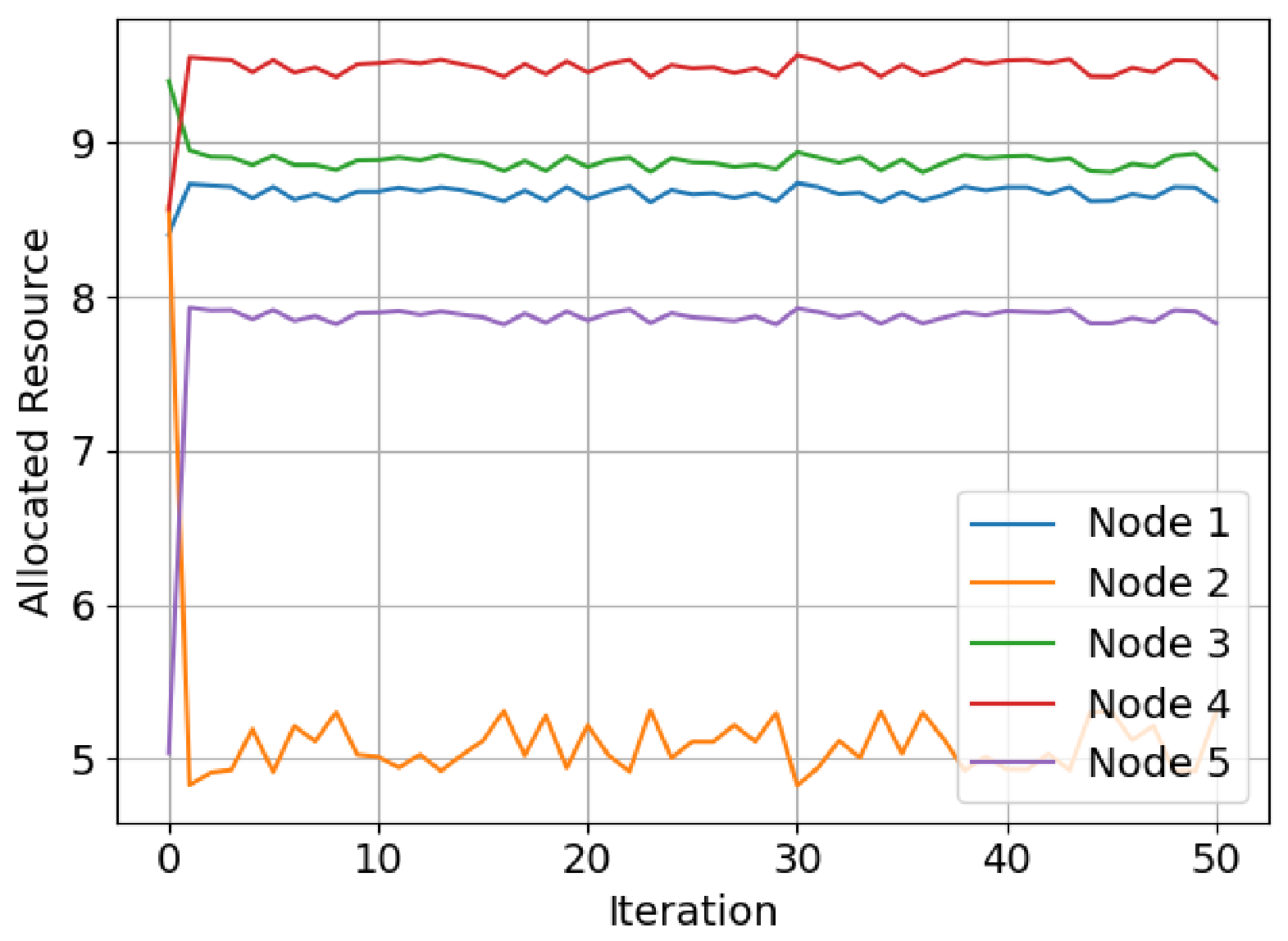
Figure 1, Node 4 consistently receives the highest and most stable allocation (just below 9.6 units), suggesting it either contributes most to the system potential or has the strongest utility response in the game dynamics, possibly due to lower interference sensitivity. In contrast, Node 2 receives the lowest and most volatile allocation (around 5 units), indicating a lower strategic advantage or diminished marginal utility—typical in games where players compete for limited resources. Meanwhile, Nodes 1, 3, and 5 converge rapidly to mid-range allocations (between 7.8 and 8.9 units), reflecting equilibrium behavior where no player has an incentive to unilaterally deviate. The quick convergence and stability of the allocations confirm the existence of a Nash equilibrium or a potential game framework that guides the system toward an efficient and stable state.
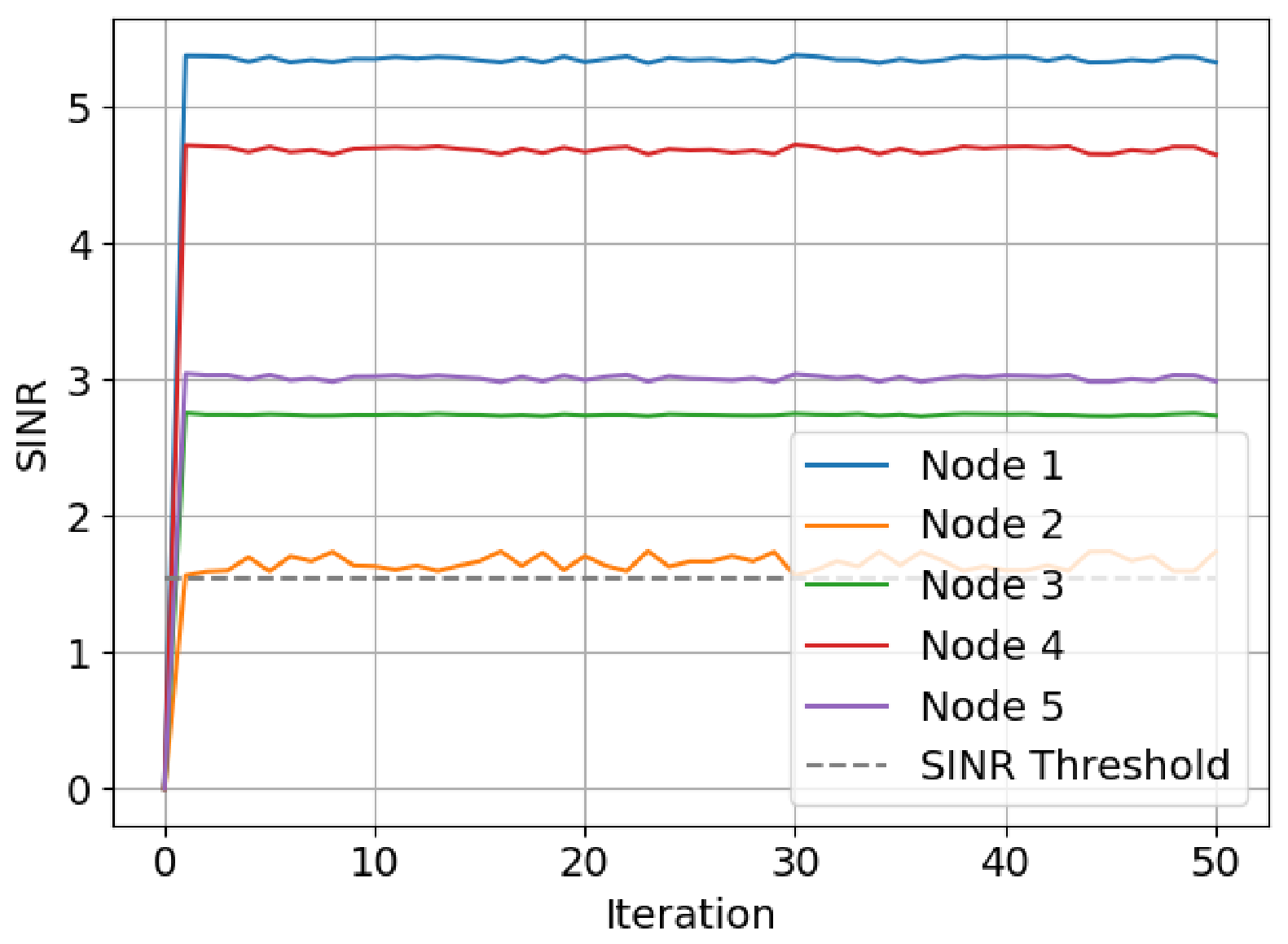
Figure 2 shows that all nodes’ SINR levels stabilize quickly within the first few iterations, indicating that the resource allocation algorithm converges efficiently to a steady state. Each node exceeds the target SINR threshold, with Node 2 positioned just above it, suggesting minimal but sufficient resource allocation to meet performance requirements. Nodes 1 and 4 achieve notably higher SINR margins, which may be due to more favorable channel conditions or higher utility in the optimization objective. Notably, Node 4 exhibits a slight decrease in SINR over time, reflecting adjustments in allocations as other nodes, such as Node 2, compete for the shared capacity.
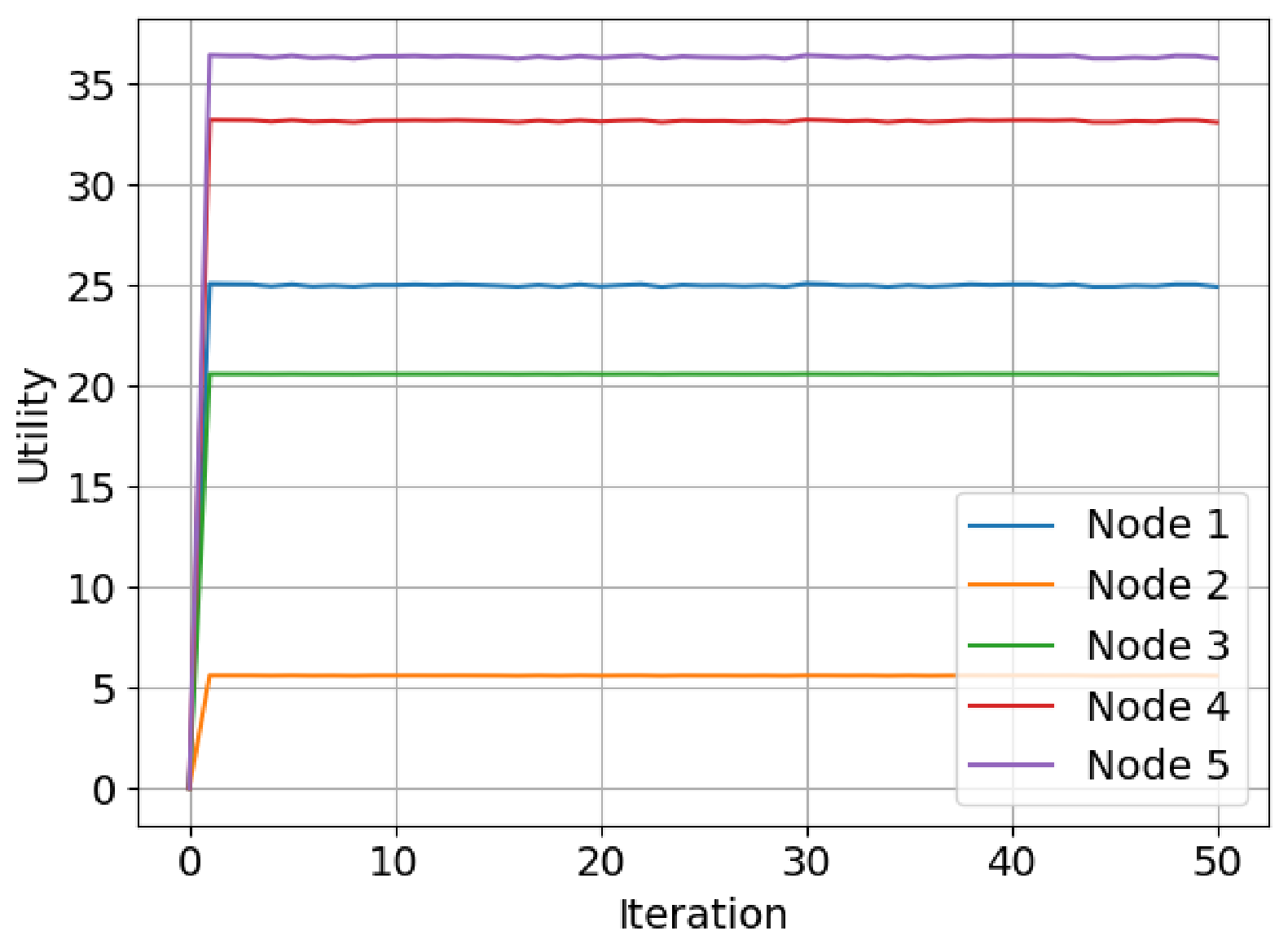
Figure 3 shows the utility value over iterations for five nodes in a system, reflecting how well each node performs in terms of its assigned objective. All nodes rapidly reach a stable utility value within the first few iterations, indicating fast convergence of the algorithm. Node 5 consistently achieves the highest utility, suggesting it benefits the most from the resource allocation—possibly due to favorable channel conditions or a higher priority weight—while Node 4 also shows high performance. In contrast, Node 2 has the lowest utility, likely due to stricter constraints such as poor channel conditions or limited resource allocation caused by optimization trade-offs. The flat plateaus across all curves indicate that utility values remain stable post-convergence, confirming the robustness of the optimization. Overall, the plot demonstrates that the system effectively balances utility across nodes, though the outcomes differ due to varying underlying factors.
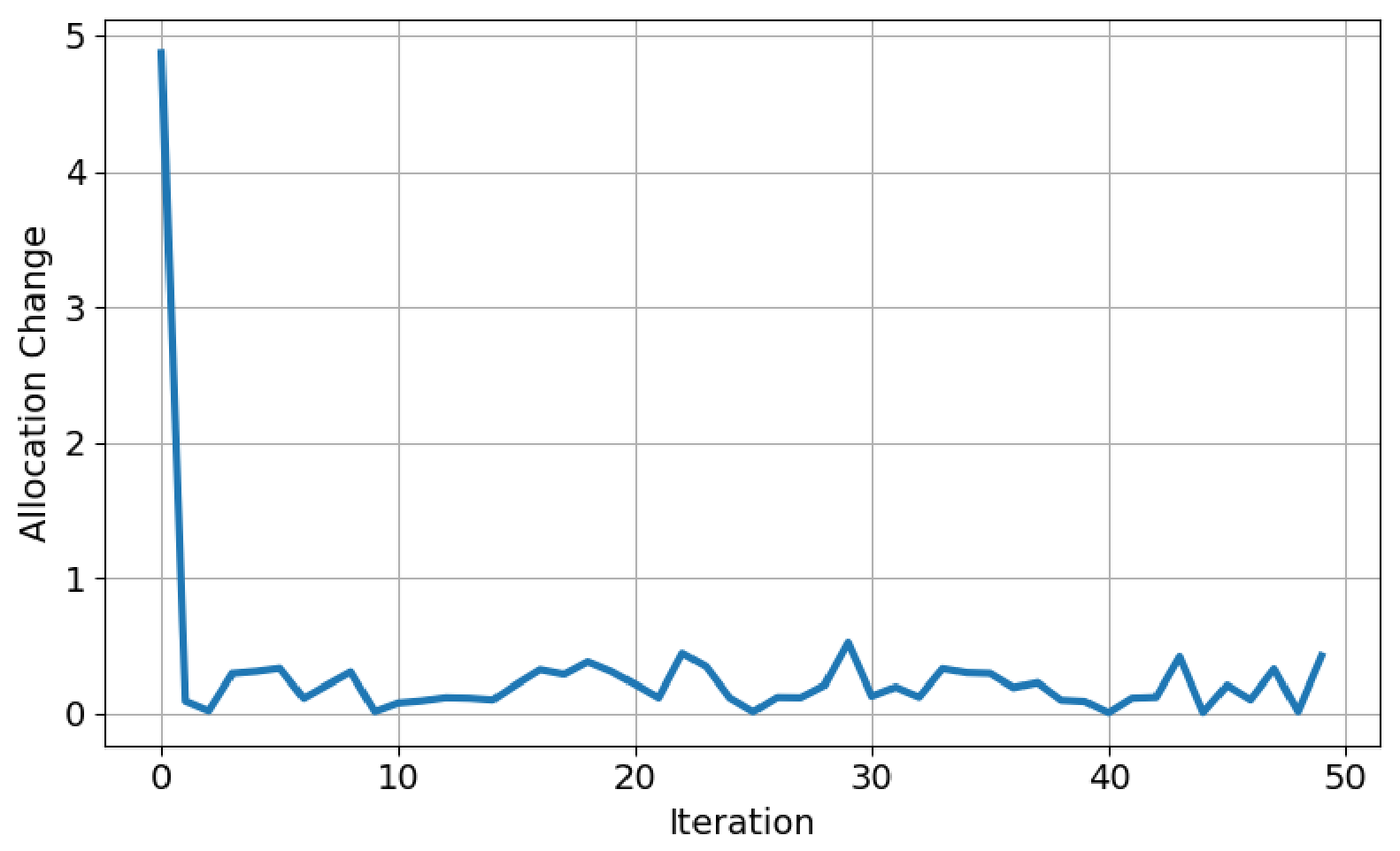
Figure 4 shows the Euclidean distance between successive iterations of the resource allocation vector
q. This measures how much the strategy profile is changing at each step. A high value at the beginning indicates that players are making large adjustments to their resource allocations in response to others. As the iterations proceed, the distance steadily decreases, approaching zero, which signifies that each player’s allocation is stabilizing. This trend reflects convergence toward a generalized Nash equilibrium, where no player has an incentive to unilaterally deviate. The plot, therefore, illustrates the system’s dynamic settling process and confirms that the game reaches a steady, self-enforcing state over time.
Table 2 presents the resource allocation values for five nodes across selected iterations of the optimization process, along with the corresponding total potential function values. Each row corresponds to a specific iteration (
), showing how the allocations for nodes 1 through 5 evolve over time. The resource values remain relatively stable with slight fluctuations, indicating gradual convergence towards an equilibrium. Concurrently, the total potential exhibits minor fluctuations from
at iteration 0 to
at iteration 49, due to the perturbation and normalization steps used in the simulation.
Although exact generalized best response dynamics guarantee a non-decreasing potential function, the simulation incorporates proportional normalization steps and small Gaussian perturbations to maintain strict feasibility and avoid numerical degeneracies. These additional operations slightly perturb the theoretical ascent property, resulting in minor fluctuations of the potential value.
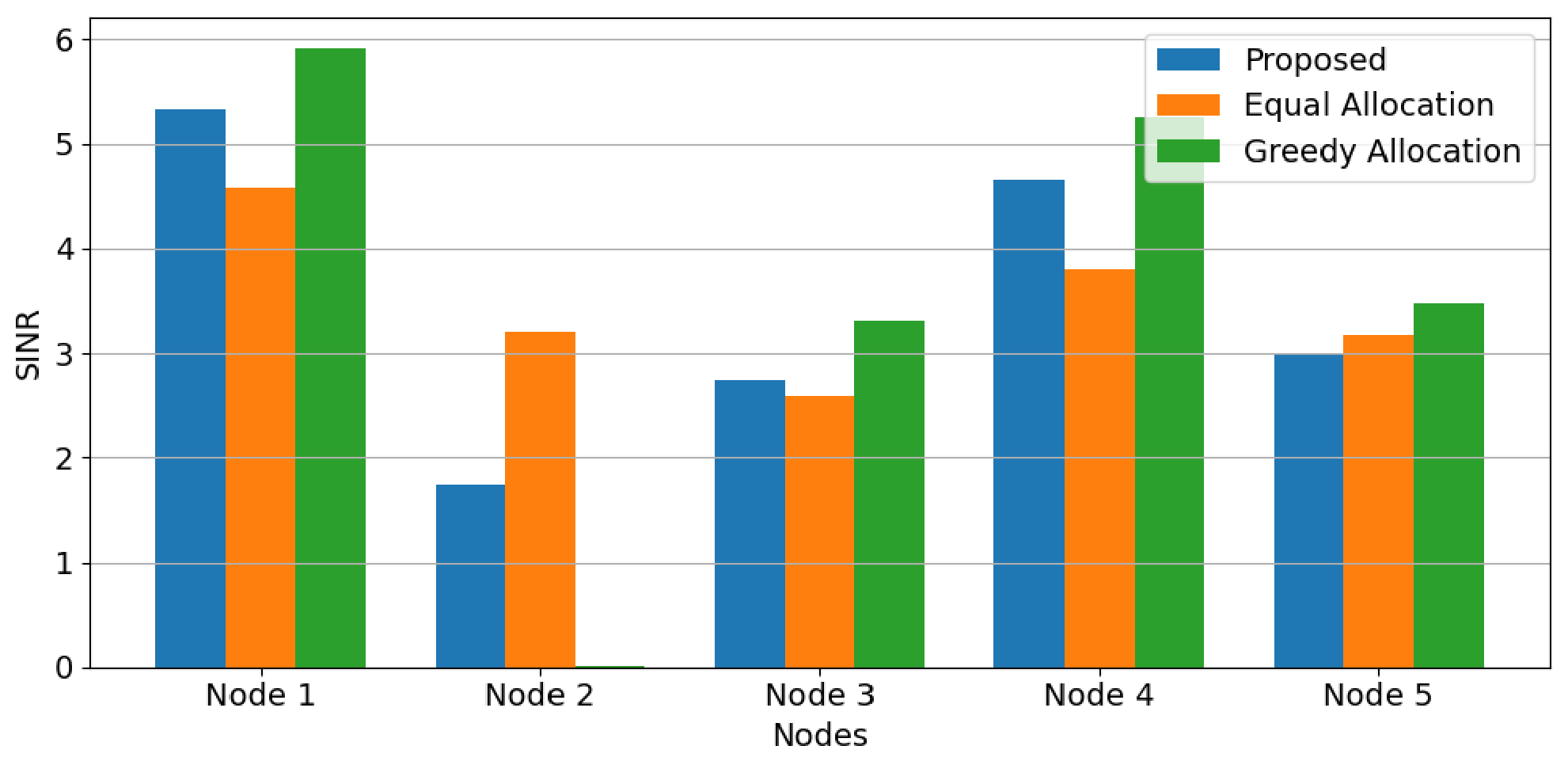
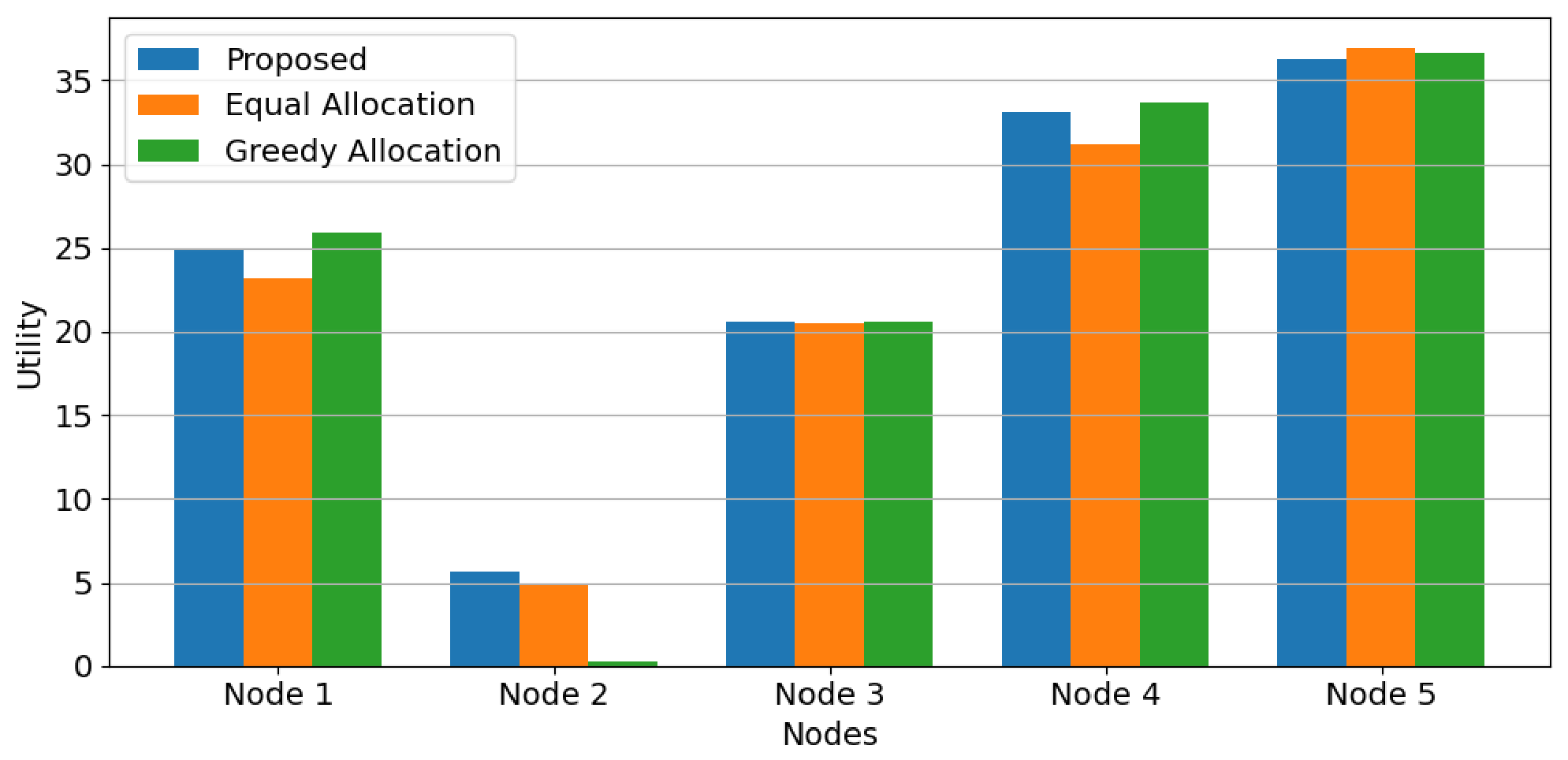
To evaluate the effectiveness of the proposed randomized best-response potential game, two conventional baseline schemes were considered: equal allocation and greedy allocation. In the former, the total available resource is distributed uniformly among all users while respecting individual resource constraints, while in the latter, the resources are sequentially assigned to users with the highest utility priority metric, maximizing immediate utility gains without accounting for interference coupling.
In
Figure 5, the per-node SINR performance is illustrated. The proposed method achieves consistently high SINR values across all nodes while maintaining balanced interference management. For Node 1, the proposed framework achieves an SINR close to 5.3, outperforming the Equal Allocation scheme at approximately 4.6, while remaining competitive with the Greedy approach near 5.9. For Node 4, the proposed method attains an SINR around 4.7 compared to approximately 3.8 for Equal Allocation and 5.2 for Greedy Allocation. Importantly, the proposed framework avoids the severe fairness degradation observed in the Greedy baseline, where Node 2 experiences an SINR collapse close to zero due to aggressive resource concentration toward dominant users. This behavior demonstrates that the proposed interference-aware distributed optimization achieves a more balanced SINR distribution while preserving high communication reliability for all users.
Figure 6 shows the per-node utility comparison. The proposed framework maintains strong utility performance across the entire network while avoiding the instability and unfairness observed in the baseline methods. Node 1 achieves a utility value around 25 under the proposed method compared to nearly 23 for Equal Allocation and 26 for the Greedy approach. Similarly, Node 4 obtains a utility close to 33 under the proposed framework, outperforming Equal Allocation at approximately 31 while remaining close to the Greedy allocation near 34. A key observation concerns Node 2, where the Greedy baseline causes the utility to collapse close to zero because most resources are allocated to high-priority users. In contrast, the proposed model preserves a positive and stable utility around 5.5 for Node 2, confirming that the distributed game-theoretic resource adaptation maintains fairness and prevents user starvation while still maximizing the global network utility.
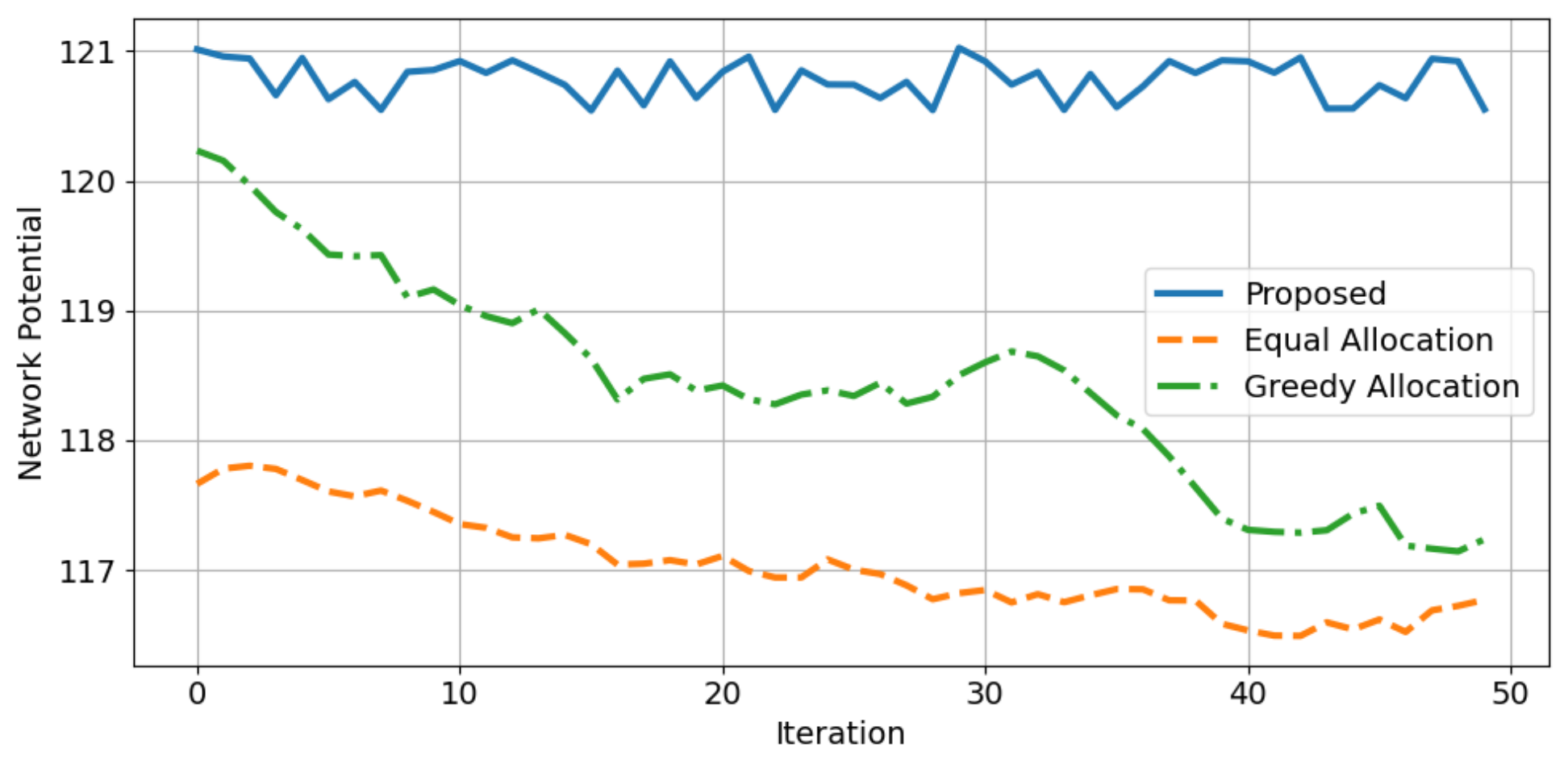
Figure 7 illustrates the convergence behavior of the global network potential over the iterations. The proposed model converges rapidly and stabilizes around a network potential value near 120.8–121 throughout the optimization horizon. In comparison, the Equal Allocation baseline converges to significantly lower values around 116.5–117.8, while the Greedy Allocation scheme initially starts near 120 but gradually deteriorates toward approximately 117 due to interference accumulation and unfair resource concentration. The proposed framework therefore achieves both higher stability and higher long-term network efficiency. The smooth convergence profile further validates the effectiveness of the randomized best-response dynamics in driving the distributed system toward a stable equilibrium operating point under SINR and resource constraints.
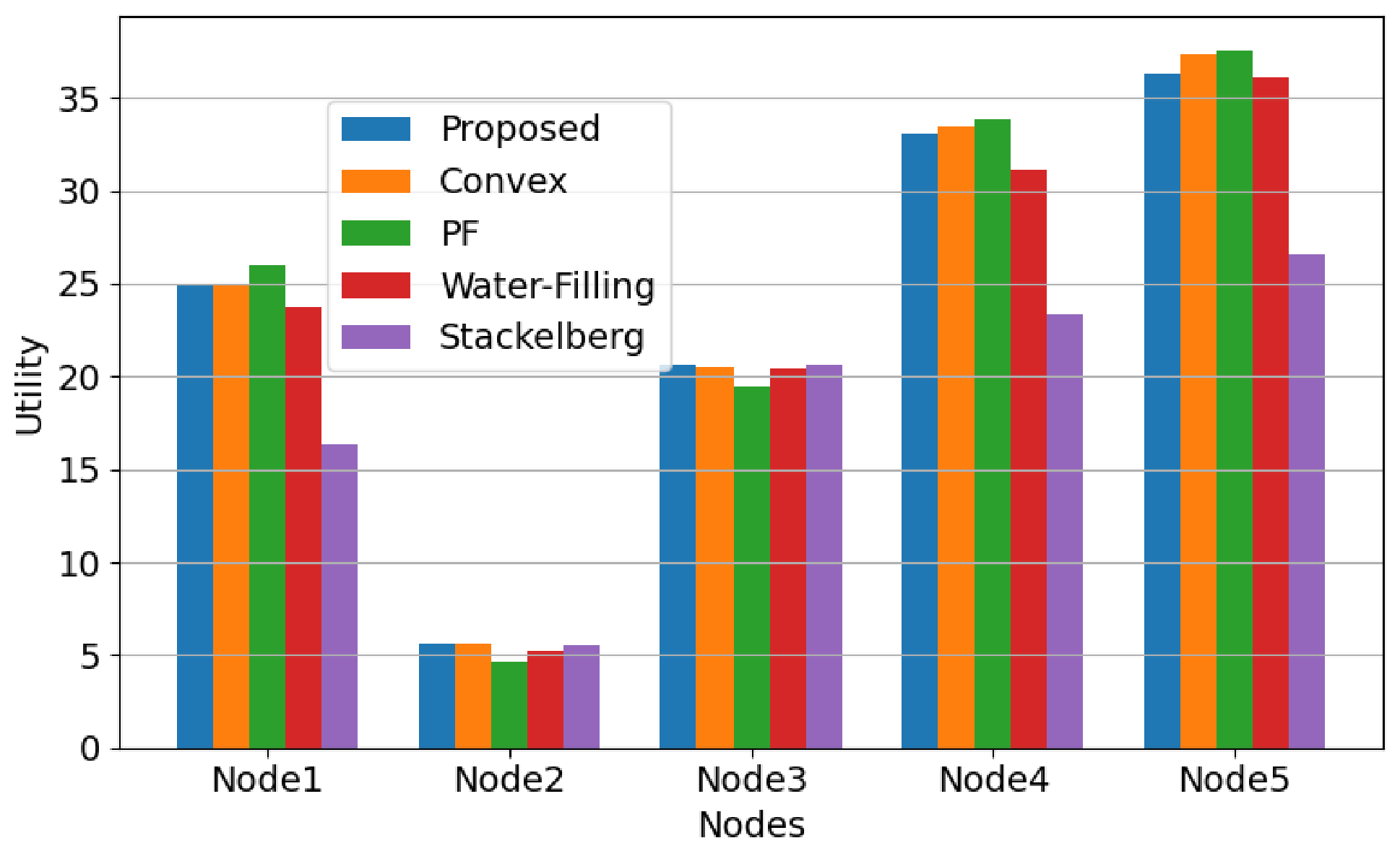
Figure 8 illustrates the per-node utility performance of the proposed generalized potential game-based resource allocation scheme compared with the convex optimization, proportional fairness (PF), water-filling, and Stackelberg-game benchmarks under the considered SDN-controlled O-RAN scenario. The results show that the proposed approach achieves a balanced utility distribution among all network nodes while preserving competitive performance with respect to the alternative optimization strategies.
For Node 1, the proposed method achieves a utility value of approximately 25, which is comparable to the convex optimization approach (≈25) and slightly lower than the PF scheme (≈26). In contrast, the Stackelberg formulation provides a significantly lower utility of approximately 16, indicating that the leader–follower resource allocation mechanism may prioritize specific nodes while reducing the utility contribution of individual nodes. Similarly, for Node 2, all resource allocation methods achieve relatively low utility values due to the stricter resource and QoS constraints of this node. The proposed method reaches approximately , closely matching the convex approach (≈5.5), water-filling (≈5), and Stackelberg (≈5.5), while PF obtains a slightly lower value of approximately . For Node 3, the proposed framework achieves a utility of approximately , remaining close to convex optimization (≈20.5) and water-filling (≈20.5), while outperforming PF (≈19.5) and Stackelberg (≈20). For Node 4, the proposed approach obtains a utility value close to 33, demonstrating similar performance to convex optimization (≈33.5) and PF (≈34), while providing a higher utility than water-filling (≈31) and Stackelberg (≈23). Finally, for Node 5, the proposed method achieves approximately , which is competitive with convex optimization (≈37.5) and PF (≈37.5), while clearly outperforming water-filling (≈36) and Stackelberg (≈26.5). The proposed resource allocation strategy achieves near-optimal utility performance compared with centralized optimization-based methods while maintaining distributed decision-making and equilibrium convergence properties. Although PF and convex optimization obtain slightly higher utility values for some individual users, the proposed game-theoretic approach provides a more balanced allocation among O-RAN nodes.
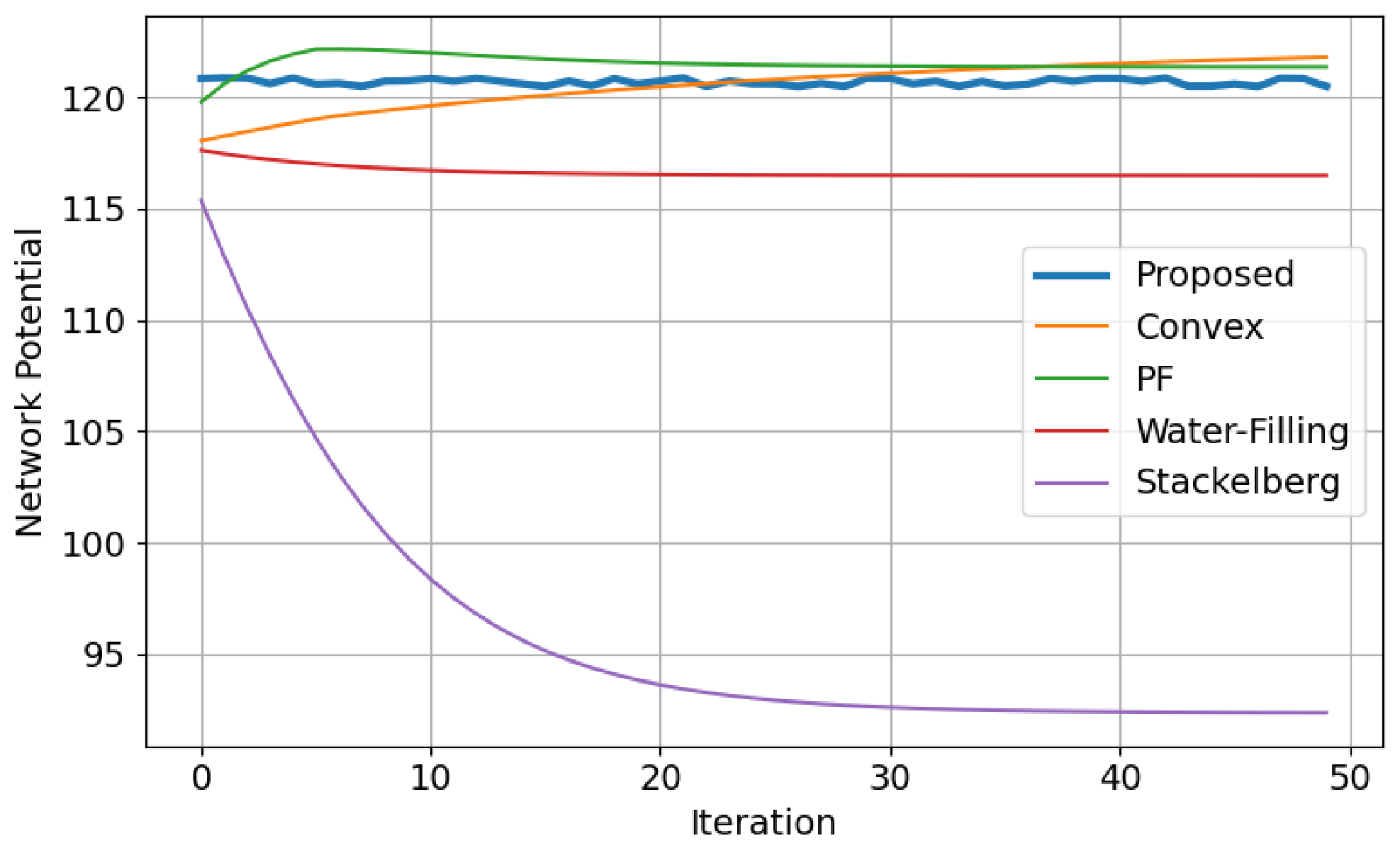
Figure 9 presents the convergence behavior of the proposed generalized potential game-based resource allocation framework compared with the convex optimization, PF, water-filling, and Stackelberg-game approaches. The network potential value is used to evaluate the overall effectiveness of the resource allocation process across the SDN-controlled O-RAN nodes, where higher values indicate improved collective utility performance. The proposed method starts from a network potential value of approximately
and remains highly stable throughout the optimization process, converging around
–
after approximately 10 iterations. The small fluctuations observed in the proposed approach are caused by the stochastic perturbation mechanism introduced during the best-response updates, which improves numerical stability while maintaining the feasibility of the resource allocation process. The rapid stabilization demonstrates that the distributed decision-making process reaches a stable equilibrium within a small number of iterations.
The convex optimization baseline gradually improves its performance from an initial value of approximately 118 and converges to around after 50 iterations. This behavior is expected since the convex approach directly optimizes the resource allocation objective through an iterative numerical procedure. However, unlike the proposed distributed game-theoretic formulation, it does not explicitly model the strategic interaction among O-RAN nodes. The proportional fairness (PF) approach achieves the highest transient performance during the initial iterations, increasing from approximately 120 to a peak value close to 122 within the first five iterations. After this point, the potential value gradually decreases and stabilizes around . This indicates that PF provides efficient resource balancing among nodes, but its static fairness-driven allocation mechanism does not fully capture the coupled interference and QoS constraints considered in the proposed generalized Nash game.
The water-filling method exhibits stable convergence but reaches a lower final potential value, starting from approximately and reaching a final value near . Although water-filling is effective for classical resource allocation problems with known channel conditions, the reduced potential value in this scenario highlights its limitation in handling the coupled resource competition and heterogeneous QoS requirements of the SDN-enabled O-RAN environment. The Stackelberg-game benchmark exhibits the weakest convergence performance, decreasing significantly from approximately 115 at initialization to nearly 92 after 50 iterations. This degradation is attributed to the leader–follower structure, where resource decisions are influenced by the selected leader strategy and may lead to inefficient allocation for follower nodes. The result indicates that hierarchical decision-making may reduce the overall network utility when multiple O-RAN nodes compete under shared capacity and interference constraints.
9. Discussion on Scalability and Service-Type Considerations
The numerical evaluation employs a five-node O-RAN scenario primarily to illustrate the equilibrium behavior and convergence properties of the proposed generalized potential game. The computational complexity of each best-response update remains independent of network size except through the interference aggregation term
suggesting applicability to significantly larger deployments.
Nevertheless, large-scale O-RAN scenarios involving tens or hundreds of nodes were not investigated in the current study and represent an important direction for future work. Similarly, the proposed framework is service-agnostic. Different service classes may be incorporated through different QoS thresholds
or through differentiated utility parameters
Dedicated evaluations for eMBB and URLLC traffic profiles are left for future investigations.
10. Conclusions
We formulated the resource allocation problem among CUs and DUs as an exact generalized potential game with shared resource constraints. The coupling among players arises through a global spectrum constraint, while individual utilities remain separable and strictly concave. The resulting joint feasible set is convex and satisfies Slater’s condition, ensuring well-defined optimization and the applicability of KKT optimality conditions.
We proved that the game admits an exact potential function equal to the sum of individual utilities. Consequently, any generalized Nash equilibrium coincides with the maximizer of the potential function over the joint feasible set. The strict concavity of the potential guarantees the uniqueness of the equilibrium solution.
Numerical results demonstrated stable convergence of the perturbed and normalized best-response dynamics toward the equilibrium allocation. Although proportional normalization and small Gaussian perturbations were introduced to maintain feasibility and mitigate numerical degeneracies, the potential function exhibited consistent stabilization, confirming the robustness of the proposed framework in practical implementations. The supervisory role of the SDN controller, implemented through adaptive pricing, enables controlled regulation of aggregate resource usage while preserving distributed decision-making. Moreover, the results show that the proposed approach rapidly converges toward a stable operating point within a small number of iterations while maintaining high network potential and balanced resource allocation among heterogeneous nodes. The utility analysis shows that the proposed framework achieves better performance than classical baselines and competitive performance compared to centralized convex optimization, proportional fairness, water-filling, and Stackelberg-based approaches. In particular, the proposed method maintains utility values close to the optimization-based schemes while providing a more balanced performance across users compared with hierarchical and non-cooperative strategies.
While the proposed framework provides a tractable and theoretically grounded formulation for SDN-enabled O-RAN resource allocation using a generalized potential game, several limitations should be acknowledged. First, the current model adopts a quasi-static formulation, where network parameters such as channel gains and coupling coefficients are assumed to remain constant during the convergence of the game dynamics. In practice, O-RAN environments exhibit fast time-varying channel conditions, dynamic traffic arrivals, and user mobility, which may require extending the analysis to fully dynamic or stochastic generalized Nash game settings. Furthermore, the resource abstraction is modeled in a unified form to ensure analytical tractability. However, in practical deployments, resources may be heterogeneous (e.g., spectrum, computing, and fronthaul resources), and a more detailed multi-dimensional resource allocation framework would further enhance realism. Similarly, the distinction between CU and DU functional roles is captured through parameters rather than explicit architectural constraints, which may be refined in future work using hierarchical or multi-layer game formulations.
Beyond SINR, utility, and potential convergence, a comprehensive evaluation of O-RAN resource allocation frameworks should include additional system-level metrics. These include end-to-end throughput, latency, energy efficiency, Jain’s fairness index, resource utilization efficiency, QoS violation probability, and convergence time. Such metrics provide a more complete assessment of system performance, capturing not only equilibrium properties but also practical service-level effectiveness in SDN-enabled O-RAN deployments.
Moreover, the current analysis assumes perfect local information and reliable exchange of coupling-related parameters. Relaxing this assumption to incorporate imperfect information, delayed feedback, or partial observability would be an important extension toward practical implementation in distributed O-RAN systems. Finally, future research may explore large-scale deployments with hierarchical control structures, learning-augmented best-response dynamics, and robust formulations under uncertainty [
30]. These directions would further bridge the gap between theoretical generalized potential games and real-world O-RAN operational environments.
The current evaluation assumes nominal operating conditions with bounded parameter variability. In practical O-RAN deployments, however, resource allocation decisions must remain robust under rare or unseen network states, including sudden traffic surges, channel disruptions, and node failures. Future extensions may incorporate out-of-distribution (OOD) augmentation strategies inspired by robust learning frameworks [
31], where training and evaluation are performed under perturbed or adversarial network configurations. Such approaches can stress-test the stability of the proposed game dynamics and improve resilience under non-stationary O-RAN environments.





 ,
,