1. Introduction
Faculty governance is a central mechanism through which universities preserve academic quality, procedural legitimacy, and trust in internal decision-making. Departmental councils and similar faculty bodies deliberate on curriculum matters, program development, academic planning, internal committees, departmental policies, recommendations, and resource-related issues. These decisions are not simply administrative. They shape teaching, research, student progression, academic standards, and the credibility of institutional processes. A valid faculty governance system must therefore provide more than a mechanism for casting votes. It must establish who is eligible to participate, how proposals are introduced, how supporting documents are circulated, how conflicts of interest are handled, how quorum is verified, how votes are counted, how decisions are ratified, and how implementation is tracked.
In many universities, these processes remain dependent on meetings, e-mail exchanges, manual minutes, paper or office-based records, and hierarchical post-decision review. Such arrangements are institutionally familiar and legally recognizable, but they create persistent governance weaknesses. Participation may be uneven, members may not be able to verify how a decision moved from agenda item to outcome, procedural evidence may be scattered across several administrative systems, and rule enforcement may depend on manual interpretation rather than consistent automation. Prior research on shared governance similarly emphasizes the importance of faculty participation, procedural legitimacy, and accountability, while also noting that role ambiguity, uneven engagement, and weak documentation can limit the effectiveness of governance bodies [
1,
2,
3,
4,
5]. These weaknesses are especially important in regulated higher education environments, where the legitimacy of a decision depends not only on the final result but also on whether the process followed the required procedural path.
Blockchain technology and smart contracts offer a useful design option for this problem because they support tamper-evident recording, event-driven transparency, programmable rule enforcement, and verifiable state transitions [
6,
7,
8]. The justification for blockchain in this setting is not that centralized systems cannot manage forms, routing, or storage. A secure centralized workflow system may digitize agenda circulation, approval routing, document retention, and notifications. The distinctive value of a blockchain-supported workflow is that authorized stakeholders can verify state transitions [
9], quorum checks, voting records, ratification actions, and execution events against a shared append-only audit trail rather than relying only on a single administrative system owner. Decentralized Autonomous Organizations (DAOs) extend these capabilities by organizing members, proposals, votes, and execution logic around encoded governance rules [
10,
11,
12]. However, a university department cannot be treated as a purely autonomous on-chain community. Faculty governance is embedded in legal, academic, and administrative structures. Department chairs, deans, college councils, university councils, and national regulations retain formal authority. A useful DAO model for higher education must therefore be hybrid: it should automate and record rule-bound stages while preserving institutional judgment, deliberation, ratification, escalation, and implementation.
This paper consolidates two connected stages of the same study into one integrated contribution. The first stage developed a conceptual DAO-based faculty governance framework and evaluated its fit with Saudi university faculty governance regulations. The second stage implemented a Solidity-based prototype and evaluated the resulting lifecycle through a simulation of 1488 proposals across faculty sizes and adoption levels. Accordingly, this paper combines the two stages to move from institutional problems and regulatory requirements, to framework design, prototype implementation, simulation-based evaluation and deployment implications.
The research gap addressed in this study is the lack of an integrated model that connects faculty governance regulations, hybrid DAO design, implementable smart-contract logic, and scenario-based evaluation of the full departmental council lifecycle. The existing shared-governance literature explains why faculty participation and procedural legitimacy matter, but it does not provide a technical mechanism for verifiable quorum, conflict-of-interest exclusion, immutable process evidence, or execution traceability [
1,
3,
4]. Blockchain voting and higher-education blockchain studies demonstrate technical feasibility for secure voting, credentialing, accreditation, and record management, but they usually do not model the complete faculty council process from proposal preparation to ratification and administrative execution [
13,
14,
15,
16]. DAO governance studies offer relevant mechanisms for proposals and voting, but their open, tokenized, or highly autonomous assumptions are not directly suitable for regulated university councils [
12,
17,
18]. This paper therefore positions the DAO as a governed institutional artifact rather than a replacement for university authority.
The contributions of this paper are fivefold. First, it presents an expanded hybrid DAO-based faculty governance framework that integrates conceptual governance dimensions from blockchain governance theory with the operational requirements of departmental councils. Second, it maps Saudi faculty governance requirements to technical design mechanisms while retaining the regulatory discussion as a core part of the paper rather than treating it as an appendix. Third, it presents a working smart-contract prototype implementing role-based authority, proposal state transitions, conflict-of-interest exclusion, quorum, voting, chair tie-breaking, dean ratification, and execution logging. Fourth, it evaluates the model through simulation across faculty size and adoption scenarios using governance, cost, auditability, security, centralization, and robustness metrics. Fifth, it derives practical deployment guidance for universities considering DAO-assisted governance, including adoption support, cost optimization, privacy safeguards, and institutional integration.
The remainder of the paper is organized as follows.
Section 2 reviews the related literature on faculty governance, blockchain governance, DAO systems, and blockchain applications in higher education.
Section 3 explains the Saudi departmental governance context and regulatory requirements.
Section 4 presents the expanded faculty governance framework.
Section 5 describes the prototype implementation.
Section 6 explains the evaluation methodology.
Section 7 presents the results.
Section 8 provides the detailed regulatory alignment discussion.
Section 9 discusses implications, limitations, and future work.
Section 10 concludes the paper.
2. Literature Review
This section reviews the work that motivates the proposed framework. The purpose is not to repeat general claims about blockchain, but to identify the non-trivial design gap addressed by this study: faculty governance requires a system that is transparent and auditable enough to benefit from DAO mechanisms, while remaining institutionally controlled enough to comply with university regulations.
2.1. Shared Faculty Governance
Faculty governance research emphasizes that academic decision-making is strengthened when faculty members participate meaningfully in matters affecting curriculum, hiring, promotion, academic policy, program quality, and departmental planning [
1,
2,
3,
4]. Shared governance contributes to institutional legitimacy because academic decisions are not imposed only through administrative authority; they are informed by disciplinary expertise and collective responsibility. This is especially important in departmental councils, where faculty members possess the contextual knowledge required to evaluate curriculum changes, program quality, committee formation, teaching arrangements, and internal policy proposals.
However, prior work also recognizes persistent weaknesses in faculty governance. These include uneven participation, ambiguous role boundaries, weak accountability mechanisms, limited transparency, and inconsistent procedural enforcement [
5]. These weaknesses do not necessarily mean that faculty governance lacks formal rules. Rather, they show that rules can be difficult to verify when evidence is distributed across meeting minutes, e-mail threads, administrative files, and informal communications. This creates a design opportunity for systems that improve procedural consistency without eliminating faculty deliberation or replacing legally recognized authorities.
2.2. Blockchain, Smart Contracts, and Governance Systems
Traditional administrative information systems can digitize agendas, workflow routing, document storage, and notifications, but they are usually centralized and controlled by an administrative office. Centralized systems may improve convenience, yet they do not inherently provide tamper resistance, independently verifiable state transitions, or a shared audit trail visible to authorized stakeholders. Blockchain systems address these limitations through distributed ledgers, immutable records, consensus-backed state changes, and smart-contract execution [
6,
7,
8,
10,
19]. In governance settings, these features can support verifiable voting, transparent decision logs, and rule-based process enforcement.
This distinction is important because the proposed system is not simply a digitized meeting-management platform. A centralized workflow system can improve convenience and standardization, but its audit trail remains dependent on the integrity, access policies, and administrative controls of the organization operating it. In contrast, a permissioned blockchain or shared ledger can distribute verification of procedural events across authorized institutional stakeholders, making it harder to alter or selectively reconstruct the history of a decision after the fact [
6,
7,
20]. For faculty governance, the relevant benefit is not public decentralization; it is role-bounded verifiability within a regulated institutional network [
21].
The blockchain governance literature distinguishes between governance of blockchain systems and governance by blockchain systems [
8,
19]. Governance of blockchain concerns the rules and actors that control the blockchain ecosystem itself. Governance by blockchain concerns the use of blockchain infrastructure to support a real-world governance process. This study focuses on governance by blockchain. The department council remains the governed institution, while the blockchain acts as a procedural enforcement and audit layer.
2.3. DAO Governance and Its Limits in Institutional Settings
DAOs organize proposals, voting, membership, and execution through programmable governance mechanisms [
11,
12,
22]. In principle, this makes DAOs attractive for faculty governance because council processes also rely on membership, proposals, voting rules, quorum, and recorded outcomes. Yet DAO research also identifies serious risks, including voter apathy, coordination failures, token concentration, incentive misalignment, procedural manipulation, and emergent centralization [
17,
18,
23]. These risks are particularly relevant to universities. A department council cannot be governed as an open token community, and academic voting rights cannot be bought, traded, or concentrated through market mechanisms. Recent DAO governance reviews also show that delegation and participation mechanisms may improve decision efficiency, but they can introduce trade-offs involving centralization, fairness, transparency, and informed participation.
For this reason, faculty governance requires a non-financial, identity-bound, regulation-aware DAO design. The DAO should not replace the council, dean, college council, or university bylaws. Instead, it should encode the procedural parts of governance that are explicit and repeatable: who can vote, when voting opens and closes, whether quorum is reached, whether a member is excluded because of conflict of interest, how ties are handled, whether ratification was recorded, and whether implementation was completed.
2.4. Blockchain Voting and Higher Education Applications
Blockchain-enabled voting research shows that distributed ledgers and smart contracts can improve verifiability, auditability, and resistance to tampering in electronic voting systems [
13,
15,
24]. These properties are relevant to faculty governance because council decisions require procedural evidence and defensible records. However, faculty governance differs from many e-voting settings because it combines voting with deliberation, agenda preparation, regulatory interpretation, conflict-of-interest review, and post-vote ratification.
Higher education studies have examined blockchain in credentialing, accreditation, certification, and institutional management [
14,
16,
25,
26]. These studies demonstrate the feasibility of blockchain in academic environments, but they typically focus on records or administrative services rather than the full faculty council lifecycle. The gap is therefore not whether blockchain can be used in higher education; it is whether a DAO-based mechanism can support a regulated academic decision process from proposal preparation to execution without undermining existing authority. Recent reviews of blockchain initiatives in higher education further show that most institutional applications remain concentrated in credentialing, certificates, and record verification, which reinforces the need to examine governance-oriented use cases beyond academic records.
2.5. Research Gap and Positioning of This Study
Table 1 summarizes representative bodies of work and their relevance to this study. The existing literature provides strong foundations for shared governance, blockchain governance, DAO mechanisms, and e-voting. What remains underdeveloped is an integrated model for faculty councils that includes regulatory alignment, hybrid institutional control, smart-contract implementation, and scenario-based evaluation. This paper addresses that gap by combining a conceptual governance framework, a regulatory alignment analysis, a working smart-contract prototype, and a simulation-based evaluation in a single study.
3. Faculty Governance and Regulatory Context
Saudi Arabia’s higher education system has undergone substantial governance reform as part of national efforts to improve institutional autonomy, accountability, and educational quality. The revised Saudi University System grants universities greater administrative, financial, and academic independence while preserving structured oversight through formal governance bodies [
27,
28,
30]. Within this system, university governance is distributed across multiple levels, including university councils, college councils, and department councils. Department councils are especially important because they are the primary venue through which faculty participation is translated into departmental recommendations and decisions.
A department council is typically composed of the department head, who chairs the council, and the faculty members of the department [
30]. Depending on the issue and institutional rules, additional members or invited experts may participate. The council deliberates on academic, administrative, and financial matters, including curriculum standards, program review, committee formation, teaching arrangements, internal recommendations, and departmental resource needs. These matters require documented collective input, but they also remain subject to college-level and university-level oversight.
The regulatory model contains several procedural requirements that map naturally to rule-based enforcement [
30]. First, valid council participation depends on a defined membership structure. Second, valid decision-making requires quorum, commonly represented as two-thirds of eligible members. Third, voting follows majority rule, with the chair empowered to resolve ties. Fourth, members with personal interests or close relationships connected to a decision must not participate in that decision. Fifth, council decisions may require ratification, objection handling, reconsideration, or escalation to college or university authorities. These requirements are precise enough to be encoded in part, but they exist inside a broader institutional process that requires human judgment and official authority.
The Saudi departmental governance model is therefore neither fully centralized nor fully decentralized. Faculty members participate in deliberation and voting, but their decisions remain embedded in a hierarchical regulatory structure. This makes the context well suited to a hybrid DAO design. The rule-bound elements of the process can be encoded and recorded on-chain, while agenda preparation, deliberation, legal interpretation, college review, and administrative execution remain off-chain. The objective is not to replace university authority; it is to make the path from proposal to vote to ratification to execution more transparent, more auditable, and less dependent on informal or fragmented record keeping.
4. Expanded Faculty Governance Framework
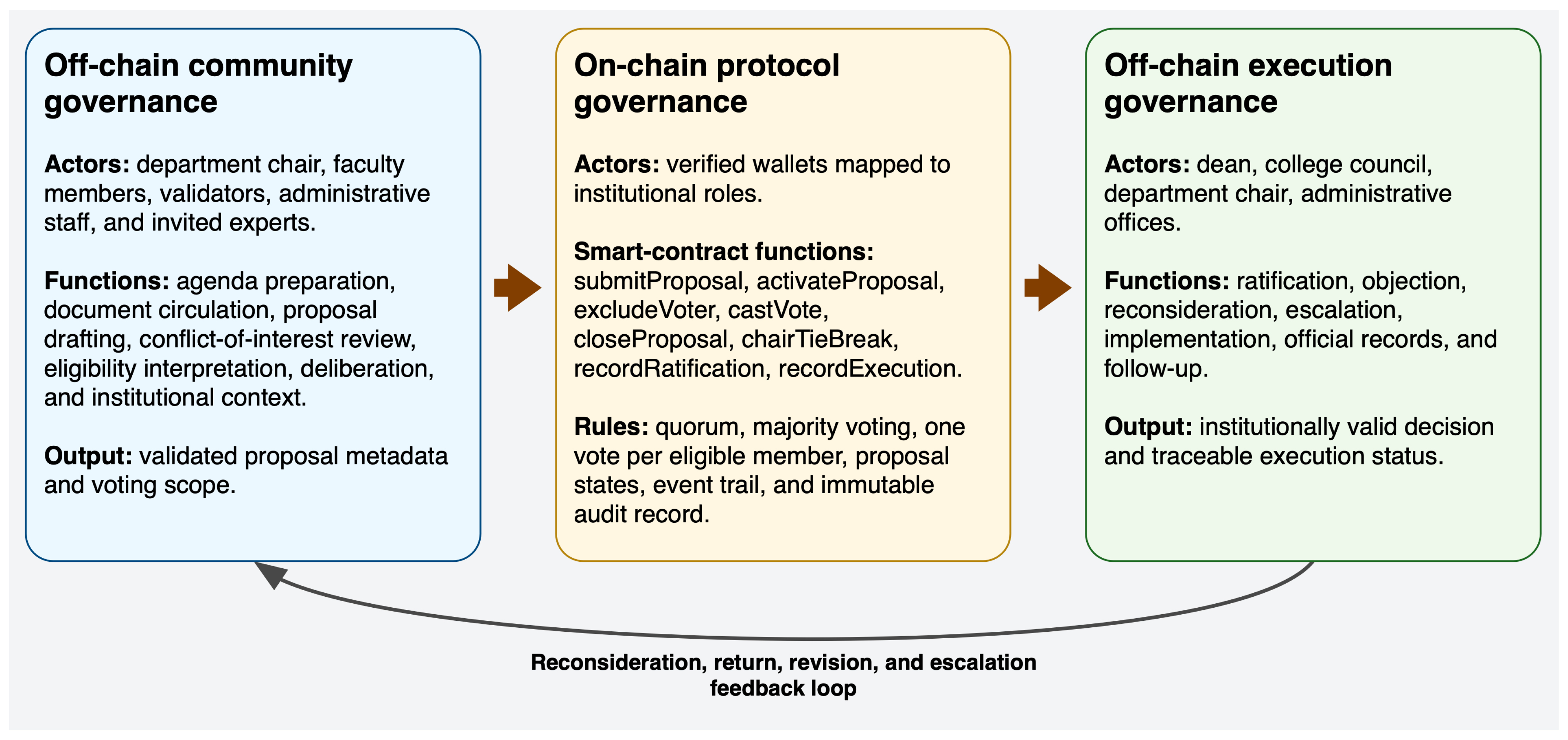
The proposed framework organizes faculty governance into three interacting layers: off-chain community governance, on-chain protocol governance, and off-chain execution governance. It expands the earlier conceptual framework by integrating five governance dimensions from the conceptual study—roles, incentives, membership, communication, and decision-making—with implementation-level dimensions required by the prototype: identity, access control, state management, auditability, cost, privacy, and regulatory escalation.
Figure 1 summarizes the resulting architecture.
4.1. Layer 1: Off-Chain Community Governance
The off-chain community layer represents the social and institutional environment in which faculty governance begins. It includes agenda preparation, proposal drafting, document circulation, informal consultation, academic deliberation, eligibility interpretation, and conflict-of-interest review. The key actors include the department chair, faculty members, validators or committee members, administrative staff, invited experts, and college-level stakeholders.
This layer is necessary because not all governance tasks can be reduced to code. A proposal may require academic judgment, interpretation of bylaws, review of supporting documents, or consultation with other departments. The DAO should not decide whether a curriculum proposal is academically sound; faculty and institutional bodies do that. The DAO should instead ensure that once a proposal is admitted into the formal voting workflow, its procedural treatment is transparent and consistent.
4.2. Layer 2: On-Chain Protocol Governance
The on-chain protocol layer converts formal and repeatable governance rules into smart-contract logic. It records proposal submission, activation, voting windows, eligible voter counts, conflict-of-interest exclusions, votes, quorum checks, majority outcomes, chair tie-breaking events, ratification decisions, and execution records. This layer is responsible for procedural reliability. It does not judge the academic merit of a proposal; it enforces the rules governing how the proposal moves through the decision lifecycle.
The on-chain layer is based on verified institutional identity rather than open token markets. Faculty participation is represented through verified wallets mapped to official roles. Governance tokens, where used, are non-financial and are intended only to support participation rights, proposal limits, or accountability signals. This design avoids the risks of economic vote buying or token concentration, which would be inappropriate for academic governance.
4.3. Layer 3: Off-Chain Execution Governance
The off-chain execution layer covers dean ratification, college council review, reconsideration, escalation, administrative implementation, and follow-up. This layer preserves the legal and institutional authority of the university. Even if the vote is recorded on-chain, the university must still determine whether the decision is final, whether it requires college-level review, and how it should be implemented.
The framework therefore treats ratification and execution as recorded governance states rather than fully automatic outcomes. This is a deliberate design choice. In regulated higher education, smart contracts can strengthen procedural integrity, but they cannot replace legally mandated authority. The DAO should make institutional interventions visible and auditable, not remove them.
4.4. Governance Dimensions Across the Three Layers
Table 2 presents the expanded faculty governance framework. Compared with a basic three-layer model, the table explicitly includes incentives, communication, identity, auditability, and risk controls. These dimensions are necessary for a deployable academic DAO because governance effectiveness depends on both technical correctness and institutional legitimacy.
4.5. Governance Lifecycle
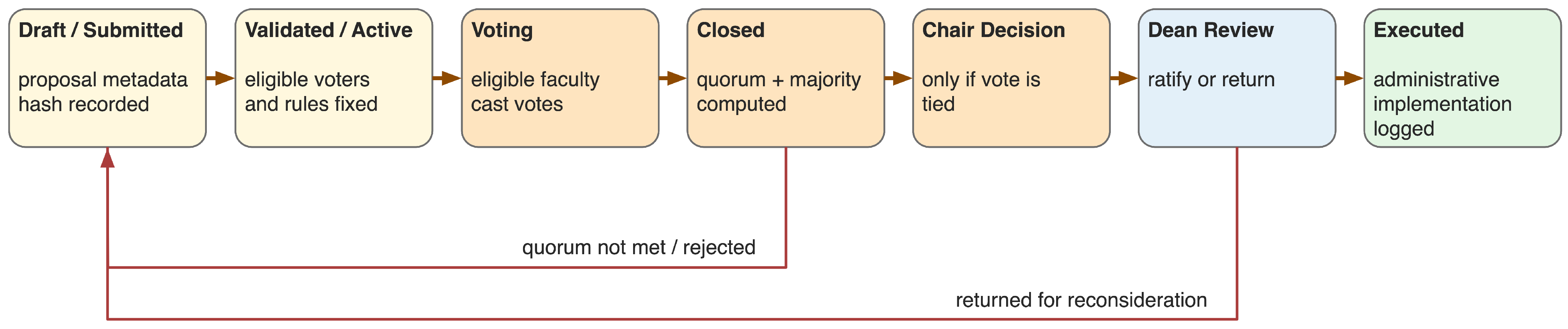
The framework operationalizes departmental governance through seven linked lifecycle states, shown in
Figure 2. The process begins with a submitted proposal that includes off-chain metadata references. A validator or authorized office activates the proposal only after checking scope and documentation. Eligible faculty then vote within a defined window. At closure, the contract verifies quorum and computes the majority result. If the vote is tied, the chair resolves the tie through a bounded tie-break action. The dean or college-level authority records ratification or return. Finally, an administrator records execution once implementation occurs.
This lifecycle preserves the strongest elements of both papers. From the conceptual study, it retains the three-layer model, the governance dimensions, the five-phase on-chain voting process, non-financial participation tokens, and the central regulatory alignment argument. From the prototype study, it adds implementable roles, concrete smart-contract functions, measurable proposal states, simulation outputs, and deployment metrics. The combined framework is therefore stronger than either version alone: it is conceptually grounded, institutionally aligned, and technically evaluated.
5. Prototype Implementation
The prototype was implemented as a Solidity smart contract named
Faculty GovernanceDAO. It is intentionally minimal enough to be auditable, but complete enough to represent the core departmental governance lifecycle. The contract defines six role states:
None,
Faculty,
Chair,
Validator,
Dean, and
Admin. It also defines a proposal state machine covering submission, activation, closure, approval, rejection, chair decision, ratification, return, and execution.
Table 3 summarizes the implemented smart-contract functions and their governance purposes.
A faculty member or chair may submit a proposal by recording a metadata hash and proposal type. Detailed documents remain off-chain, while the hash anchors the proposal to a tamper-evident reference. A validator or authorized owner may activate the proposal by defining the voting window and the eligible voter count. Conflict-of-interest handling is supported through proposal-specific voter exclusion. Eligible members may cast one vote using Yes, No, or Abstain. The contract prevents duplicate voting, voting outside the active window, voting by inactive members, voting by unauthorized roles, and voting by excluded voters.
When a proposal is closed, the contract checks quorum using a configurable two-thirds rule. If quorum is not reached, the proposal is rejected with a quorum-related note. If quorum is reached, the contract compares yes and no counts. A yes majority results in approval, a no majority results in rejection, and a tie moves the proposal to a chair-decision state. The chair can approve or reject only in this tie condition. After the outcome is recorded, the dean records ratification or return. Only ratified proposals may proceed to administrative execution recording.
The prototype emits events for member registration, proposal submission, activation, voter exclusion, vote casting, closure, chair tie-break, ratification, and execution. These events form the audit trail of the DAO process. The prototype therefore implements a governance-support system rather than an unconstrained autonomous decision system.
6. Evaluation Methodology
This study follows a design-science orientation in which the proposed governance framework and Solidity prototype are treated as an artifact designed to address a practical institutional problem [
31,
32]. The artifact is evaluated through scenario-based simulation. This methodological choice is appropriate for an early-stage governance system because real departmental deployment would require institutional approval, identity integration, legal review, privacy assessment, and non-trivial organizational change. The simulation examines lifecycle behavior across controlled council-size and adoption scenarios.
The evaluation uses simulation to examine how the proposed model behaves under different faculty sizes and adoption conditions. The simulation generated 1488 proposals over a twelve-month horizon. Four faculty sizes were evaluated: 15, 30, 50, and 100 members. Three usage levels were evaluated: low, moderate, and high. These adoption levels are modelling conditions rather than estimates of a specific university. Low usage represents weak engagement, moderate usage represents threshold-sensitive engagement near the quorum boundary, and high usage represents sustained participation. The two-thirds quorum threshold is fixed by the regulatory context modeled in this study, while the participation assumptions are varied to test sensitivity around that threshold. The simulation design follows the logic of scenario analysis and simulation verification/validation: assumptions are stated explicitly, outputs are compared across controlled conditions, and the resulting findings are tied to the tested scenarios [
33,
34].
Each simulated proposal progressed through a governance lifecycle that included proposal generation, eligible voter selection, voting, quorum checking, approval or rejection, ratification, execution, cost estimation, and audit/security checks. The simulation included five proposal types: General Faculty Decision, Subcommittee Proposal, Curriculum Proposal, Membership Change, and Dean Ratification Matter. These proposal types were included because faculty governance is not homogeneous. Some matters involve the full council, some involve subcommittees, some require heightened ratification, and some are more routine than others. Ratification and execution probabilities are treated as scenario parameters used to test lifecycle behavior across different governance conditions.
The evaluation considers governance legitimacy, operational efficiency, auditability, security, cost, and decentralization. Participation rate, quorum achievement, execution rate, vote diversity, consensus strength, and role participation balance measure governance quality. Decision-cycle reduction, time to quorum, and comparison with a modeled conventional workflow baseline measure process efficiency. Unauthorized-action rejection, duplicate-vote rejection, invalid-action rejection, audit completeness, and false acceptance measure security and procedural correctness. Gas consumption, USD-denominated cost, gas per vote, and gas per proposal measure operational cost. Role vote shares, voting-power Gini coefficient, and governance centralization index measure whether the lifecycle behaves as decentralized, centralized, or hybrid governance.
Two composite indicators are used to summarize the scenario results. The governance robustness score combines quorum achievement, execution, invalid-action rejection, audit completeness, participation balance, and cost efficiency. The balanced governance score combines legitimacy, efficiency, security/audit quality, and cost. These indicators support comparison across deployment conditions while the raw metrics remain the primary evidence for interpreting governance performance.
Table 4 summarizes the main simulation assumptions and how they should be interpreted. The assumptions define the conditions under which the proposed DAO-supported lifecycle is tested, including council size, adoption level, quorum, proposal type, baseline comparison, cost, and composite scoring. Therefore, the results should be interpreted as model-dependent evidence about how the framework behaves under controlled governance conditions, not as universal empirical performance claims.
A detailed parameterization of the simulation, including the adoption distributions, proposal-generation settings, voting assumptions, ratification and execution logic, Monte Carlo configuration, gas-price assumptions, and conventional workflow baseline settings, is provided in
Appendix A.
The following metric formalization explains how these assumptions are translated into participation, quorum, execution, cost, auditability, and robustness measures.
Metric Formalization
Let
S denote the set of scenarios and let
denote the set of proposals simulated under scenario
. For each proposal
, let
be the number of eligible voters,
the number of cast votes,
the number of yes votes,
the number of no votes,
the number of abstentions,
the gas consumed, and
an indicator that the proposal reached administrative execution. Proposal-level participation is defined as
The scenario-level average participation rate is therefore
Quorum is evaluated using a two-thirds threshold consistent with the departmental council rule modeled in this study. The quorum indicator is defined as
and the scenario quorum achievement rate is
When quorum is achieved, majority approval is computed from yes and no votes, while abstentions contribute to participation but not to affirmative approval. The approval indicator is
with tied proposals routed to the chair tie-break state rather than silently counted as approved. The execution rate is
To evaluate deliberative quality, the vote distribution for proposal
i is represented as
, where
,
, and
for
. Consensus strength is defined as the dominant vote share,
while vote diversity is measured using the Gini–Simpson form,
This formalization explains why consensus strength and vote diversity are expected to move in opposite directions: as one vote category dominates,
increases and
decreases.
Cost is derived from gas consumption. If
is the gas price in native currency units and
is the exchange rate to USD, proposal cost is
and scenario-level average cost is
For normalized scoring, cost efficiency is computed relative to the observed scenario range:
Thus, lower-cost scenarios receive higher cost-efficiency scores while preserving comparability across the evaluated scenario set.
Process efficiency is evaluated against the modeled conventional workflow baseline described in
Table 4. If
is the DAO decision-cycle duration and
is the manual baseline duration, the time reduction percentage is
Audit improvement is computed similarly:
where
and
are the DAO and conventional workflow audit-completeness scores. These comparisons evaluate relative process behavior under the stated assumptions and are not intended to replace future measurements from live institutional deployments.
The governance robustness score is a normalized composite designed to capture whether the system is legitimate, secure, auditable, participatory, and operationally feasible. Let
be the invalid-action rejection rate,
the DAO audit completeness score, and
the participation-balance score derived from role participation shares. The reported robustness score is defined as
where
. Equal weights are used in the reported scenario rankings to avoid overfitting the score to a single institutional preference; however, alternative institutions may choose different weights or normalization rules according to their own priorities. The balanced governance score is defined as
where
is legitimacy,
is process efficiency,
is the combined security-audit score, and
is cost efficiency, with
. In this study, equal weights are used for these four categories. These equations make the composite metrics transparent: they are not independent empirical observations, but structured summaries of the underlying governance, security, auditability, efficiency, and cost measurements.
7. Results
7.1. Scenario-Level Patterns
Under the stated simulation assumptions, the results indicate that adoption intensity is the strongest determinant of governance success.
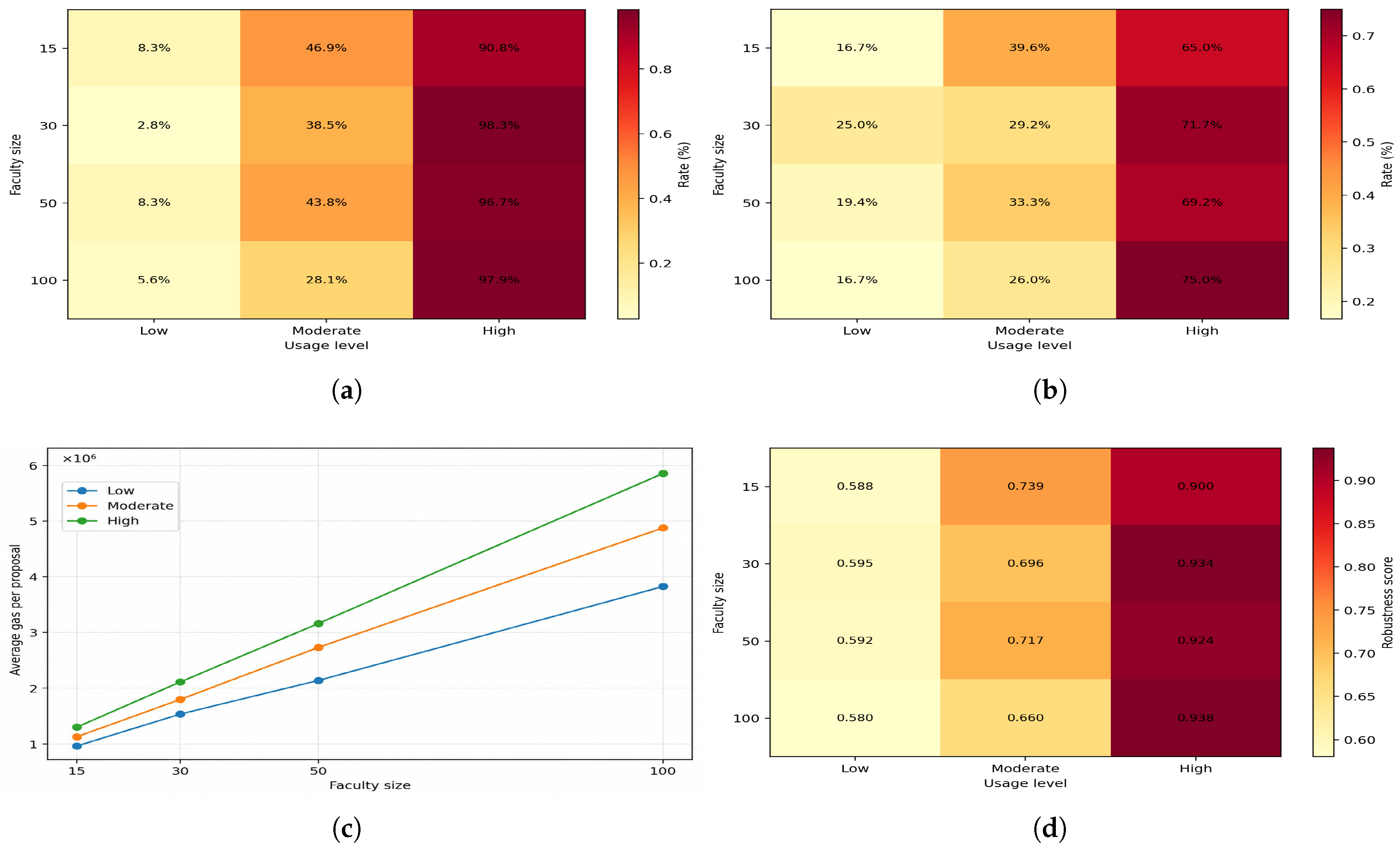
Table 5 summarizes the average outcomes by usage level. Low usage produces weak participation and very low quorum achievement. Moderate usage improves performance but remains unstable because many proposals sit near the quorum threshold. High usage produces the strongest simulated governance performance, with mean participation of about 85%, quorum achievement of about 96%, and execution of about 70%.
Faculty size has a different effect. As shown in
Table 6, average participation remains broadly comparable across faculty sizes, but cost grows sharply. Average gas per proposal increases from about 1.14 million gas at 15 members to about 4.86 million gas at 100 members. This indicates that the model scales functionally, but not cost-neutrally. Larger councils require careful optimization, particularly for voting and voter-exclusion operations.
Figure 3a,b visualize the relationship between adoption and governance success. The heatmaps show that the transition from moderate to high adoption is more important than the change in faculty size. High-adoption scenarios consistently reach quorum and execute more proposals, while low-adoption scenarios fail primarily because too few eligible voters participate.
Figure 3c confirms that gas cost grows strongly with faculty size. The relationship between faculty size and total gas is very strong (
), meaning that implementation decisions that reduce repeated per-voter operations would directly improve deployment feasibility.
7.2. Governance Robustness and Deployment Ranking
The governance robustness heatmap in
Figure 3d shows that high-adoption scenarios dominate the evaluation. Robustness is high across all faculty sizes when participation is high, while low-adoption scenarios remain weak even when the faculty body is small. This reinforces the conclusion that user adoption, reminders, usability, and governance culture are not secondary matters. They are core determinants of whether a DAO-supported faculty process works.
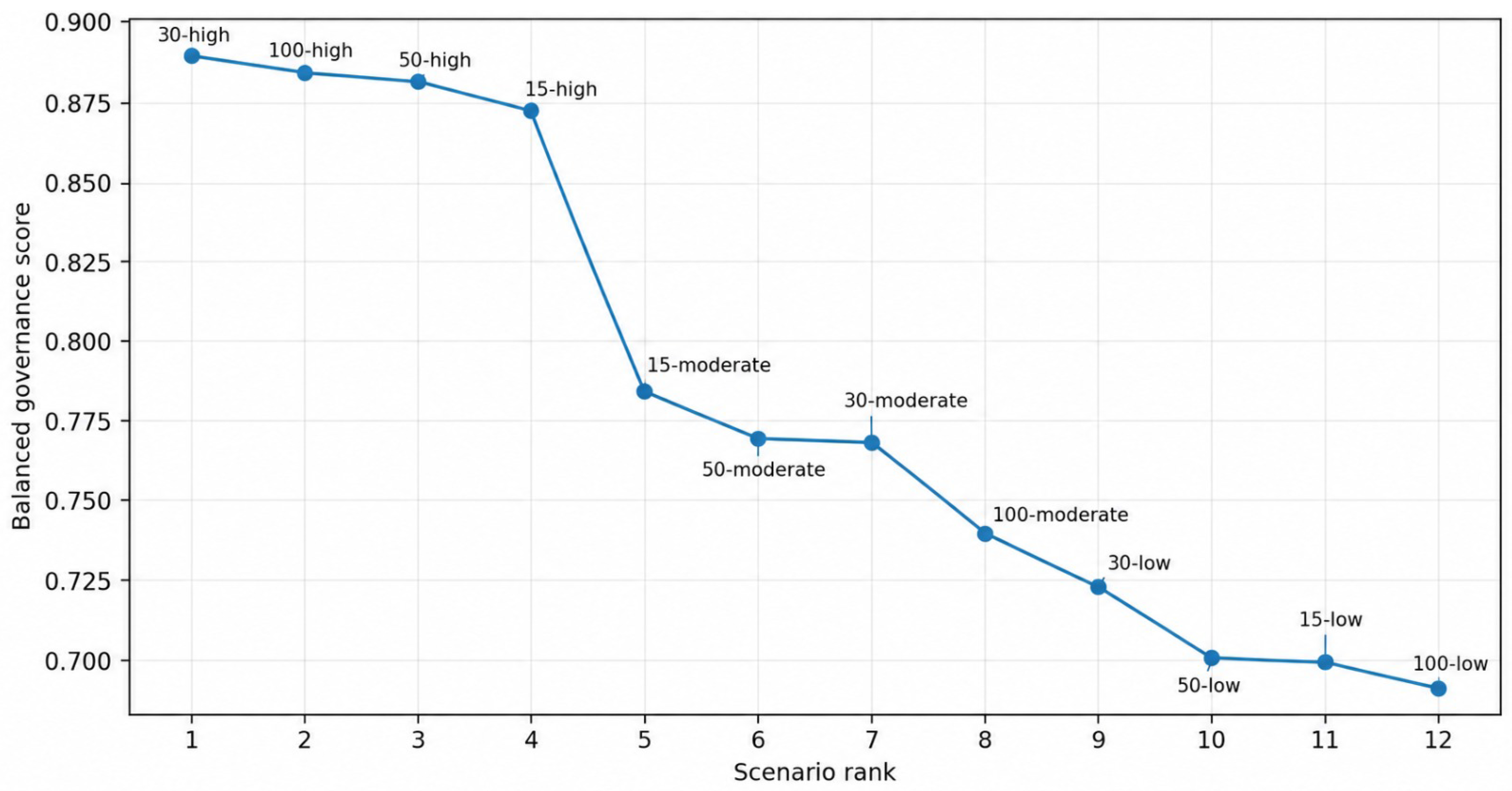
Table 7 presents the scenario-based deployment ranking. The recommendation column translates the balanced score, robustness score, participation stability, quorum behavior, and cost exposure into practical deployment guidance. “Yes” identifies scenarios that appear suitable for controlled piloting under the simulated conditions. “Conditional” identifies scenarios that require additional adoption support, cost control, or institutional safeguards before deployment. The highest balanced governance score is achieved by the 30-member high-adoption scenario. The 100-member high-adoption scenario has a slightly higher robustness score but a lower balanced score because cost and lifecycle dependencies increase with scale. The weakest scenario is the 100-member low-adoption case, which combines the participation risk of low engagement with the cost pressure of a large eligible-voter pool.
Figure 4 visualizes this ranking and shows the separation between high-adoption and lower-adoption scenarios.
7.3. Proposal-Type Behavior and Failure Modes
Proposal types behave differently, as shown in
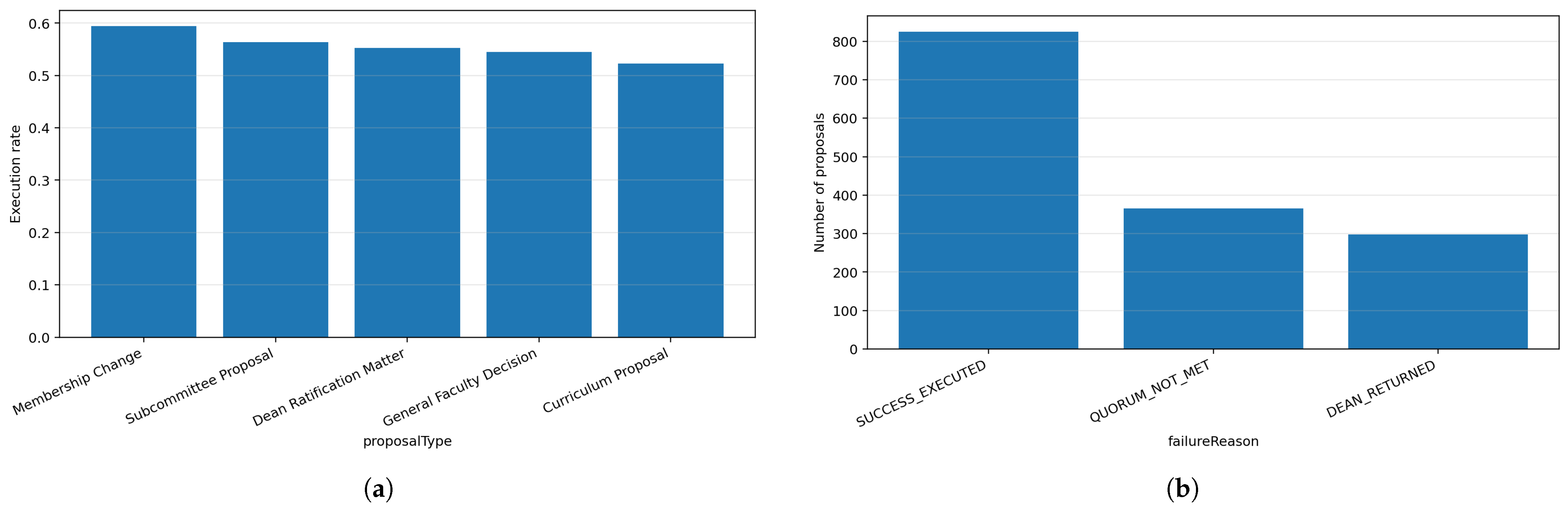
Table 8. Membership Change proposals have the highest execution rate at 59.5%, while Subcommittee Proposals have the highest average cost at 35.91 USD per proposal. General Faculty Decisions account for the largest share of proposals and show relatively strong execution. Dean Ratification Matters show high quorum achievement but lower approval rates, which is expected because these matters involve a more formal review path.
Figure 5a further illustrates the execution-rate differences across proposal types, showing that membership-change and subcommittee proposals achieve slightly higher execution rates than curriculum proposals and general faculty decisions. The failure-mode distribution in
Figure 5b shows that failed governance is driven more by participation shortfall than by substantive rejection. Across all proposals, 825 ended as successful executions, while 365 failed because quorum was not met. This is an important practical finding within the simulation. A technically correct DAO will still fail operationally if members do not participate. Deployment should therefore include notification design, participation dashboards, clear voting deadlines, training, and chair-level follow-up for low-engagement periods.
7.4. Process Efficiency, Auditability, and Traceability
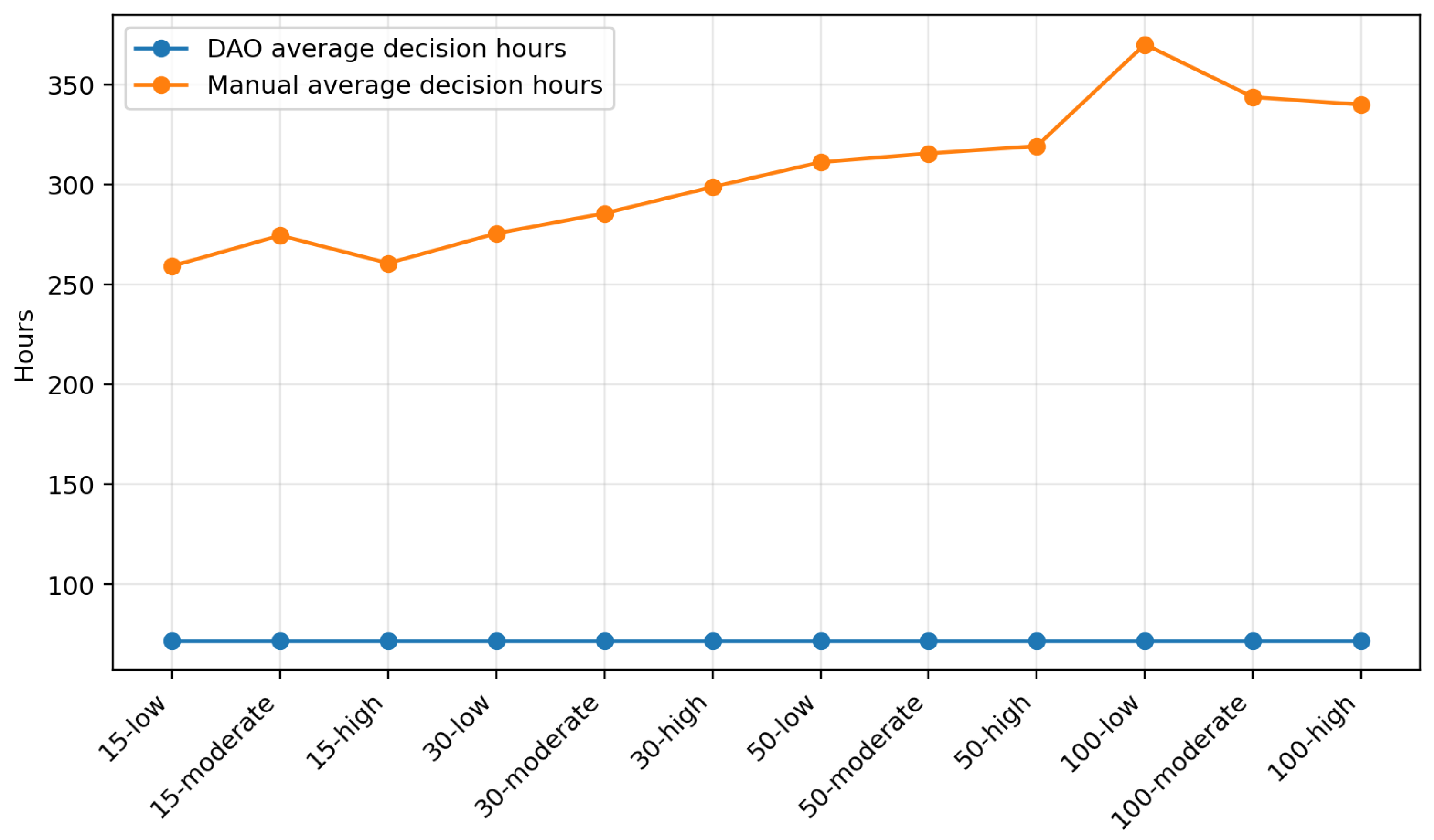
The simulated DAO model substantially improves process efficiency compared with the modeled conventional workflow baseline. The average DAO decision window is 72 h, while the manual baseline ranges from approximately 259 to 370 h depending on faculty size and scenario. Under these assumptions, this produces an average decision-cycle reduction of about 76%.
Figure 6 shows the difference between DAO and manual decision-cycle duration.
The model also improves audit completeness and traceability under the event-capture assumptions. The DAO process records proposal submission, activation, voter exclusion, vote casting, closure, chair decision, ratification, and execution as explicit events. In the simulation, DAO audit completeness is 1.00, while the modeled conventional workflow baseline is lower because manual processes are assumed to be more likely to suffer from fragmented documentation, missing links between stages, and delayed recording. The modeled improvement in audit completeness is about 30%, and traceability increases from about 0.63 to 1.00. These results are among the strongest design arguments for DAO-supported faculty governance: even when final authority remains institutional, the path of the decision becomes easier to verify.
7.5. Cost and Lifecycle Bottlenecks
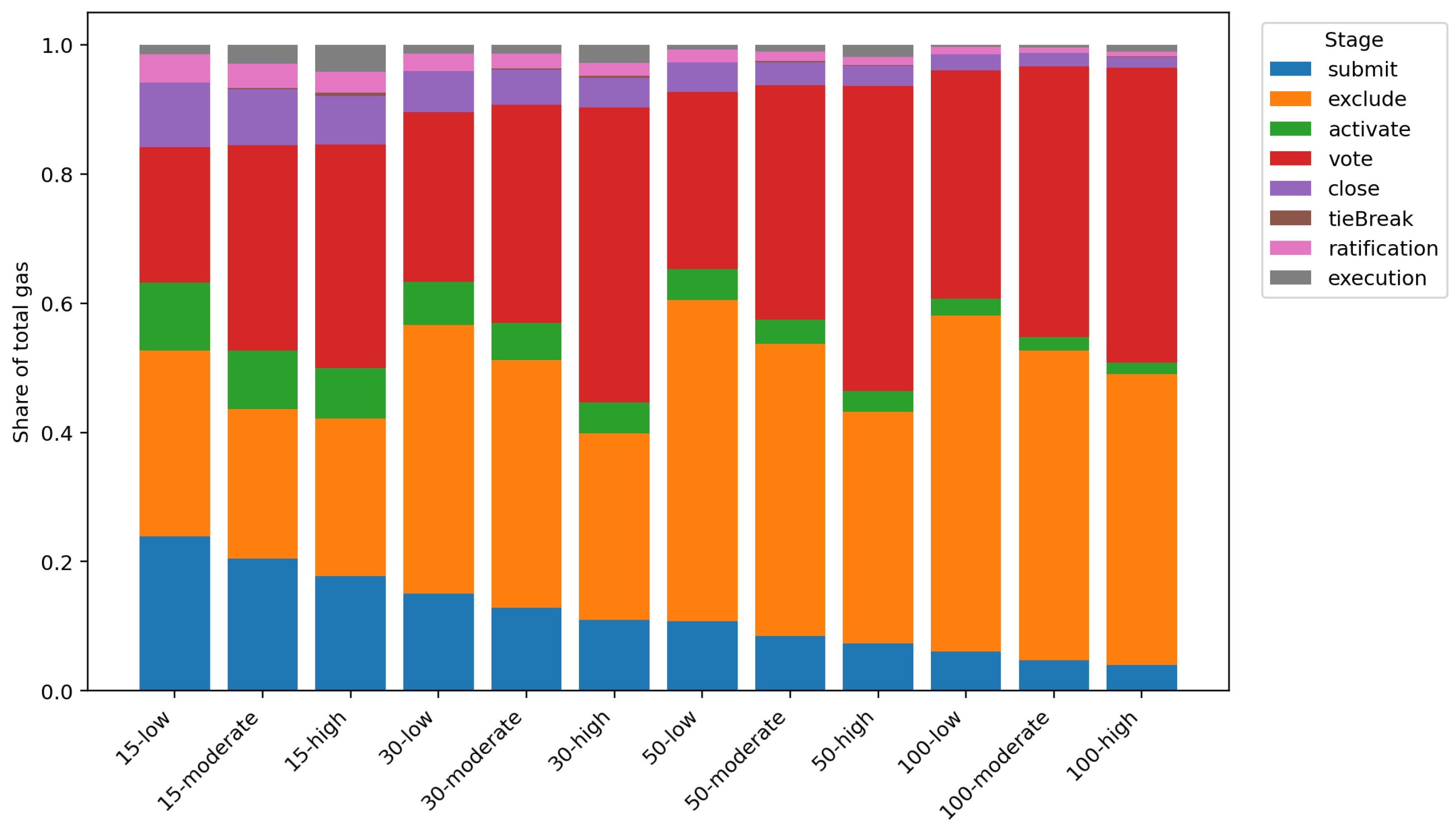
Cost is concentrated in a few lifecycle stages.
Figure 7 shows that voting and voter exclusion dominate the gas budget in most scenarios. The most frequent highest-cost stage is voter exclusion in seven scenarios, followed by voting in five scenarios. This result is consistent with the contract design: per-voter interactions and proposal-specific eligibility changes create repeated on-chain operations.
This finding has direct implementation implications. Because the cost estimates are sensitive to gas price, exchange-rate assumptions, and deployment architecture, they should be treated as scenario-dependent. For small and medium departments, the cost profile appears more manageable for a permissioned or institutional deployment. For large faculties, the design should be optimized before production use. Possible optimizations include batching eligible-voter updates, storing detailed participation evidence off-chain with cryptographic commitments, using a permissioned chain, using layer-2 infrastructure, or limiting on-chain writes to final vote commitments and state transitions. The key design principle is to preserve procedural auditability while reducing repeated per-voter gas costs.
7.6. Correlation, Monte Carlo Robustness, and Hybrid Control
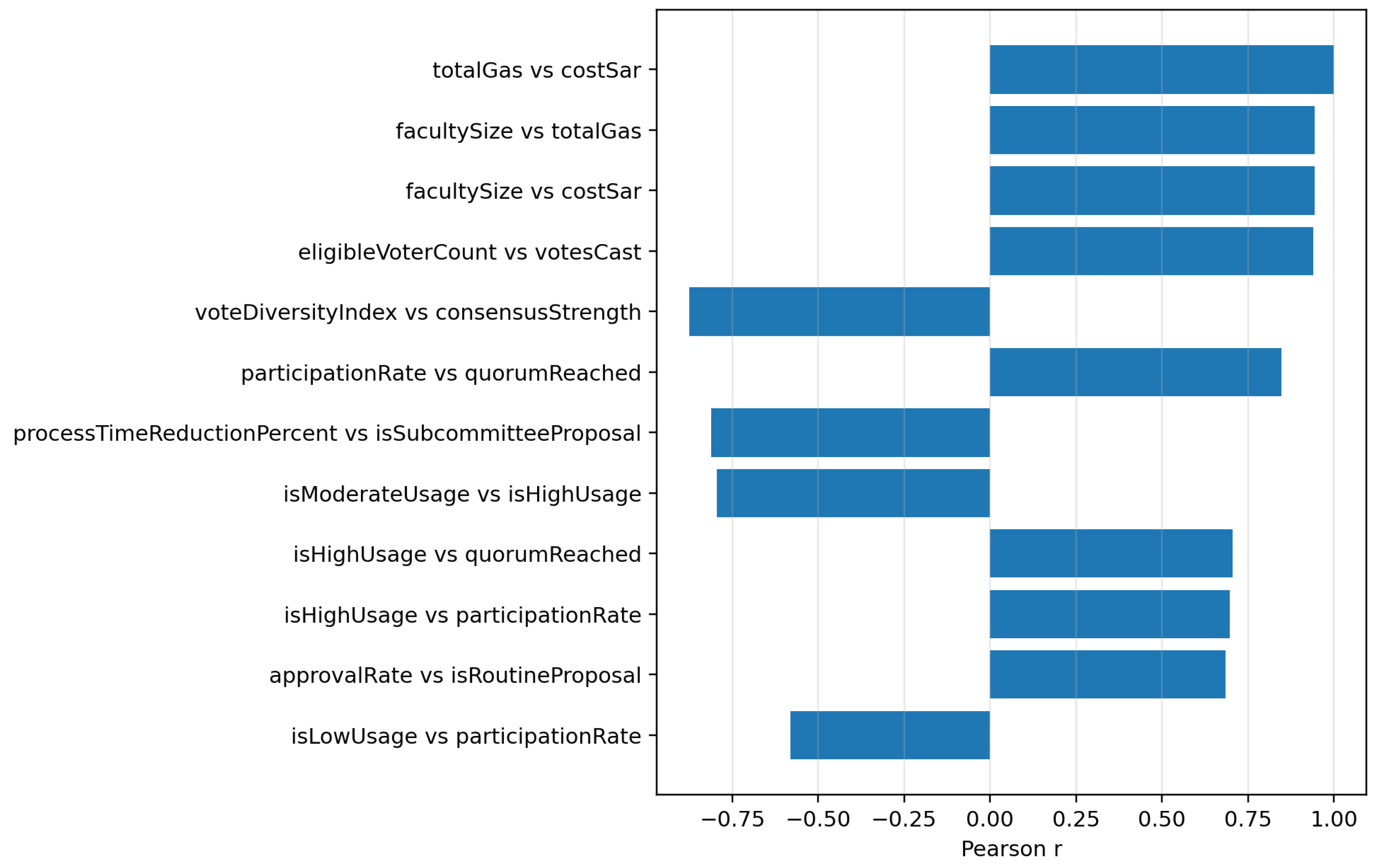
The correlation analysis identifies the strongest drivers of the system. Total gas and cost are perfectly correlated because cost is derived from gas assumptions. Faculty size and total gas are very strongly correlated (). Eligible voter count and votes cast are also very strongly correlated (). Participation rate and quorum achievement are very strongly correlated (), confirming that quorum is the main operational threshold. Vote diversity and consensus strength are strongly negatively correlated (), which is expected because more disagreement reduces consensus strength.
Figure 8 visualizes the strongest non-trivial correlations among the simulated metrics. The pattern confirms that governance performance is mainly shaped by participation and scale. Higher participation is strongly associated with quorum achievement, showing that quorum is the key operational threshold in the proposed lifecycle. At the same time, faculty size is closely related to gas consumption, which indicates that larger councils may require cost-optimization strategies before deployment. The negative relationship between vote diversity and consensus strength is also expected, as more evenly distributed votes reduce the dominance of any single voting outcome. Overall, the correlation results support the main interpretation of the simulation: adoption drives governance effectiveness, while scale drives implementation cost.
For the Monte Carlo robustness analysis, the advanced analysis script performed 1000 resampling runs for each of the 12 scenarios, producing 12,000 Monte Carlo runs in total. Each run sampled a scenario-level participation value from the same low-, moderate-, or high-adoption triangular participation distribution used in the base simulation. Proposal-level participation was then jittered around this sampled value, approval rates were perturbed within bounded limits, and gas consumption was adjusted using a bounded noise factor while preserving the measured lifecycle gas structure. The Monte Carlo results are therefore used to assess scenario uncertainty, especially around quorum-sensitive moderate-adoption cases, rather than to claim empirical deployment performance.
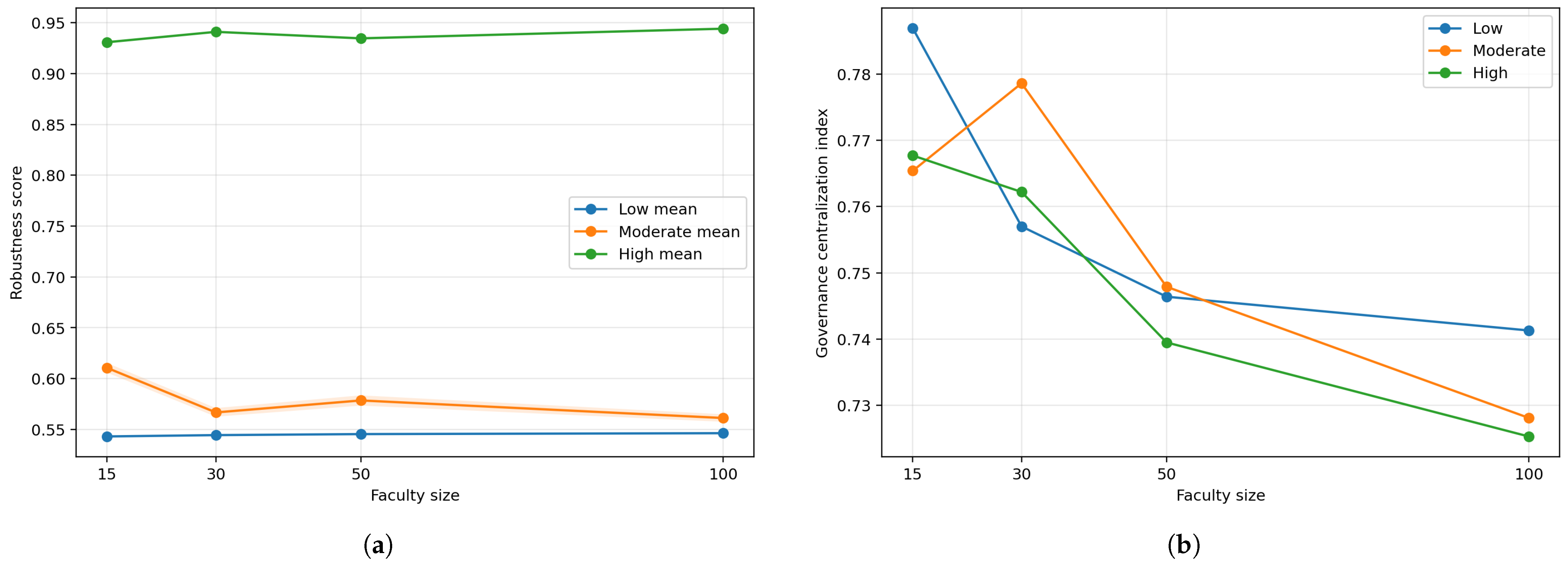
Monte Carlo summaries indicate that uncertainty is highest in moderate-adoption scenarios. High-adoption scenarios produce narrow confidence intervals and stronger robustness because participation is usually well above quorum. Moderate scenarios are less stable because small changes in participation can determine whether quorum is reached.
Figure 9a illustrates the robustness score with 95% confidence intervals. The practical implication is that the most important deployment risk is not only the extreme low-adoption case, which is obviously weak, but also the moderate-adoption case, where the process may appear healthy while still failing unpredictably around quorum thresholds.
The framework is intentionally hybrid, and the simulated results indicate that it does not behave like a fully decentralized system. Faculty members provide the majority of votes, but dean ratification and administrative execution remain structurally centralized. The mean governance centralization index is 0.754, and the average voting-power Gini coefficient is 0.464.
Figure 9b shows centralization by faculty size and usage level. This should not be interpreted as a design failure. In regulated academic governance, some centralization is necessary. The objective is not to eliminate the dean, chair, college council, or administrative execution. The objective is to ensure that their interventions are transparent, role-bounded, and linked to an auditable decision record.
8. Regulatory Alignment
This section retains and expands the regulatory discussion because it is one of the most important contributions of the study. A DAO-based faculty governance system cannot be judged only by technical feasibility. It must also be assessed against the legal and institutional rules that define valid faculty decision-making. The purpose of the alignment analysis is not to claim that a smart contract can replace university bylaws, the dean, the college council, or national regulations. Rather, it is to show that a DAO can support regulatory compliance by making procedural rules explicit, consistent, and auditable.
8.1. Council Composition and Membership
Saudi departmental governance depends on a defined council membership structure. The department chair, faculty members, and other authorized participants must be identifiable before a decision can be treated as valid. The DAO framework supports this requirement through role-based membership registration. Each participant is represented by a verified wallet mapped to an institutional role. The prototype distinguishes faculty, chair, validator, dean, and administrator roles. This mapping allows the university to preserve official records as the source of authority while using the smart contract as a controlled execution and audit layer.
The membership model is also compatible with invited participation. Some issues may require consultation or participation from faculty outside the department or from college-level stakeholders. In the proposed framework, these participants can be handled through role assignment and proposal-specific eligibility controls. Voting eligibility is therefore not open-ended; it is derived from institutional authority and then enforced through the DAO workflow.
8.2. Agenda Preparation and Proposal Validity
Departmental council decisions typically begin with agenda preparation, document circulation, and verification that the item is appropriate for council consideration. These activities cannot be fully automated because they require academic judgment, regulatory interpretation, and document review. The framework therefore keeps agenda preparation and proposal validation in the off-chain community layer. The on-chain record begins when a proposal is submitted with a metadata hash and proposal type. This allows the university to retain full proposal documents off-chain while anchoring their existence and integrity to the DAO record.
The validator role supports this regulatory need. A validator or authorized office can review whether a proposal is complete, within scope, and ready for voting. Only after this review is the proposal activated for voting. This prevents the smart contract from becoming a channel for unfiltered or procedurally invalid proposals. It also gives the department chair and administrative reviewers a clear checkpoint without allowing them to quietly alter the voting record after the process has begun.
8.3. Quorum and Majority Decision Rules
The two-thirds quorum requirement is one of the most important procedural rules in departmental governance. Manual quorum verification can be error-prone, especially when eligibility changes because of conflicts of interest, invited participation, or proposal-specific voting groups. The DAO framework directly supports quorum compliance by recording the eligible voter count at activation and checking turnout before a proposal can be approved. The prototype applies the rule using the configured quorum numerator and denominator, with the default set to two-thirds.
Majority decision-making is also enforced on-chain. After voting closes, the contract compares yes and no votes and records the result. Abstentions count toward turnout but do not create approval unless yes votes exceed no votes. If yes and no votes are equal, the proposal enters a chair-decision state. This preserves the chair’s tie-breaking role without allowing the chair to override a non-tied vote. The design therefore reflects a key regulatory balance: collective faculty voting remains the main decision mechanism, while the chair’s exceptional authority is limited to the condition where it is formally needed.
8.4. Conflict-of-Interest Exclusion
Regulations prohibit members from participating in decisions involving personal interests or close relations. This requirement is difficult to audit when handled only through meeting minutes. The framework improves this process by providing proposal-specific voter exclusion before or during activation. An excluded voter cannot cast a vote on that proposal, and the exclusion action is recorded. If a voter has already voted, the prototype prevents retroactive exclusion through the same function, reducing the risk that exclusions are misused to manipulate outcomes after voting behavior becomes known.
This mechanism does not remove the need for human judgment. The determination that a conflict exists remains an institutional matter. However, once that determination is made, the DAO can enforce it consistently and preserve evidence that the exclusion was applied.
8.5. Ratification, Objection, Reconsideration, and Escalation
Departmental decisions do not always become final immediately after a vote. Depending on the matter, they may require college-level review, dean ratification, objection handling, reconsideration, or escalation to higher university authorities. A fully autonomous DAO would be inappropriate in this setting because it could bypass required institutional oversight. The proposed framework therefore treats ratification as a formal stage after the vote. The dean role records whether an approved or rejected proposal is ratified or returned. Returned proposals can be treated procedurally as requiring reconsideration, revision, or further escalation according to the university’s internal rules.
This design preserves the authority of the college council and dean while making their intervention visible. Rather than replacing institutional review, the DAO record clarifies when faculty voting ended, what the result was, who recorded the ratification decision, and whether the decision moved to execution or was returned. This is especially important in regulated academic settings where both faculty participation and administrative oversight must be demonstrable.
8.6. Execution and Administrative Follow-Up
The final stage of the governance process is implementation. Even when a vote is valid and ratified, the department or college must still execute the decision through administrative channels. The prototype requires a ratified proposal before execution can be recorded. The administrator role records execution and adds an execution note. This creates a complete chain from proposal to vote to ratification to implementation.
This execution design supports accountability because it distinguishes between approval and implementation. A proposal may pass a faculty vote but still require ratification, and a ratified decision may still require administrative action. By separating these states, the DAO can show where a decision is delayed or blocked. This supports departmental follow-up, audit review, and process improvement.
8.7. Privacy, Confidentiality, and Institutional Records
Faculty governance may involve sensitive matters such as personnel recommendations, committee assignments, academic performance, internal disputes, or confidential institutional planning. A public and fully transparent blockchain record would therefore be inappropriate for many university governance contexts. The proposed framework addresses this by separating content from proof. Detailed documents remain in university-controlled repositories, while the DAO stores metadata hashes, role-bounded events, proposal states, and procedural evidence. This preserves traceability without exposing confidential content.
For deployment, the university should define what data may be stored on-chain, what must remain off-chain, who may view proposal metadata, and how long governance records should be retained. A permissioned blockchain or private institutional ledger is likely more suitable than an unrestricted public chain for sensitive faculty governance [
35]. It allows the institution to restrict validators, manage identity, enforce access policies, and align audit rights with university regulations [
6,
20]. However, permissioned architectures do not eliminate privacy and security risks; recent reviews of permissioned blockchain interoperability emphasize that metadata flows, cross-chain communication, decentralized identity, and cryptographic countermeasures require explicit security and privacy evaluation. Metadata exposure must also be treated carefully. Even when document contents are stored off-chain, proposal titles, timestamps, role actions, and voting events may reveal sensitive institutional information if access is not controlled.
Transparency in this framework therefore means procedural visibility to authorized institutional stakeholders, not public disclosure of academic or personal information. The university should maintain role-based access controls for proposal records, supporting documents, ratification notes, execution evidence, and audit logs. Sensitive documents should be stored off-chain, and on-chain records should use hashes or cryptographic commitments to verify integrity without exposing content. Where stronger privacy is needed, future versions can use confidential voting, zero-knowledge eligibility proofs, or selective-disclosure mechanisms to prove that a voter is eligible without revealing unnecessary identity or content details [
36]. These privacy safeguards are not optional technical enhancements; they are necessary conditions for deploying DAO-supported governance in academic institutions.
8.8. Overall Alignment Assessment
Table 9 summarizes the alignment between regulatory requirements and DAO mechanisms. The overall assessment is that the proposed framework is compatible with departmental faculty governance because it preserves formal authority while improving procedural enforcement and evidence quality. Its strongest alignment areas are quorum verification, conflict-of-interest exclusion, vote recording, auditability, and execution traceability. Its main dependency is institutional integration: the university must define identity verification, official wallet assignment, off-chain document storage, access rights, and the legal status of the DAO record within existing administrative systems.
9. Discussion, Limitations, and Future Work
9.1. Interpretation of Main Findings
The combined study supports five main conclusions. First, participation is the primary determinant of governance effectiveness. A DAO can enforce quorum, but it cannot create participation by itself. The high-adoption scenarios show that the framework can perform well when participation is sustained, while low-adoption scenarios fail mainly because too few members vote. Successful deployment therefore requires onboarding, reminders, simple interfaces, deadline visibility, participation monitoring, and chair-level follow-up.
Second, the model provides strong audit and traceability benefits. This is not a cosmetic improvement. In faculty governance, the ability to prove how a decision was made is part of the legitimacy of the decision. By recording each major state transition and action, the DAO reduces ambiguity and makes later review easier. Third, the model is cost-sensitive. Faculty size is the main cost driver in the simulation, and voting and exclusion operations dominate the gas budget. A production deployment should therefore avoid treating the prototype as a final architecture. A permissioned blockchain, institutional private chain, layer-2 deployment, or hybrid off-chain/on-chain commitment scheme may be more appropriate depending on cost tolerance, audit requirements, privacy requirements, and integration capacity.
Fourth, the model is best understood as hybrid governance. The centralization metrics show that dean ratification and administrative execution remain important control points. This is aligned with the regulated nature of university governance. The DAO contributes rule enforcement and auditability; it does not eliminate legally mandated authority. Fifth, moderate adoption deserves special attention. Low adoption is obviously problematic, and high adoption is robust. Moderate adoption is more dangerous because the process may appear operational but remain unstable around quorum thresholds. Institutions piloting this model should monitor participation distributions, not only average participation.
9.2. Distinctive Contribution Compared with Prior Work
The distinctive contribution of this study is not merely the use of blockchain for voting. Prior research has already shown that blockchain can support secure voting, academic records, credentialing, accreditation, and administrative trust mechanisms [
13,
14,
15,
16]. The contribution here is the integration of regulatory alignment, hybrid institutional control, conflict-of-interest exclusion, quorum enforcement, chair tie-breaking, dean ratification, execution logging, and simulation-based evaluation in one faculty-governance lifecycle. The proposed DAO is deliberately non-financial, identity-bound, and regulation-aware. This makes it different from open token-governance models [
37] and more appropriate for departmental councils, where voting rights come from institutional membership rather than economic ownership. This positioning is consistent with recent DAO governance research showing that DAO decision-making often departs from ideals of full decentralization and autonomy, especially when voting arrangements and governance coalitions shape outcomes.
9.3. Practical Deployment Implications
For a university, the framework should be deployed as a governance-support system, not as an autonomous replacement for council authority. The university should first identify low-risk or non-binding decisions suitable for a pilot, define official identity and wallet-assignment procedures, map roles to existing regulations, and determine which documents remain off-chain. The institution should also set clear rules for proposal metadata, audit access, record retention, exception handling, and escalation. Cost optimization should be addressed before large-scale deployment, especially for large faculties or frequent proposal cycles. Most importantly, adoption should be treated as an operational requirement: if faculty members do not participate, the system will correctly enforce quorum but will still fail to produce valid decisions.
9.4. Limitations
This study has limitations. The evaluation is simulation-based and does not include a live pilot with real faculty users. Adoption behavior, usability, resistance to change, and administrative acceptance may differ in an operational deployment. The manual baseline is modeled rather than measured from a longitudinal institutional dataset. Cost estimates depend on assumed gas price and exchange-rate values; these values may change and are less relevant if the system is deployed on a permissioned chain. The prototype is also intentionally simplified and does not yet include advanced privacy mechanisms, identity federation, document-management integration, anonymous voting, zero-knowledge eligibility proofs, or full college-level escalation workflows. Finally, the composite scores rely on selected weights and normalization choices; future deployments can adapt these weights to institutional priorities.
9.5. Future Work
Future work should address each of these limitations directly. First, the prototype should be piloted in a controlled departmental setting using non-binding or shadow governance decisions to compare simulated behavior with real user behavior. Second, the interface should be evaluated for usability, accessibility, and faculty trust, because adoption is the strongest driver of governance performance. Third, the technical architecture should be optimized to reduce gas-heavy operations, especially repeated voter-exclusion and voting writes. Fourth, future versions should incorporate privacy-preserving participation mechanisms, confidential voting, and zero-knowledge eligibility proofs where sensitive decisions are involved. Fifth, the regulatory model should be extended from departmental councils to college and university councils, where authority, delegation, objection, and escalation rules are more complex. Sixth, future studies should collect observed institutional governance data so that manual baselines, delay estimates, audit-completeness assumptions, and execution rates can be validated empirically.
10. Conclusions
This work presented a unified DAO-based faculty governance study that combines conceptual framework development, Saudi regulatory alignment, prototype implementation, and scenario-based simulation. The expanded framework preserves the institutional structure of faculty governance while using on-chain mechanisms to enforce and record proposal submission, voting, quorum, conflict-of-interest exclusion, chair tie-breaking, dean ratification, and execution. The scenario-based evaluation indicates that high adoption produces stronger governance outcomes, that the 30-member high-adoption scenario offers the strongest balanced deployment profile, and that the DAO model can improve decision-cycle efficiency, audit completeness, and traceability compared with the modeled conventional workflow baseline.
The findings also show that DAO-supported faculty governance is not automatically decentralized, low-cost, or self-sustaining. Participation must be actively managed, large-faculty deployments require cost optimization, privacy must be designed into the architecture, and institutional authority remains necessary for ratification and execution. The value of the proposed model lies in combining decentralized procedural enforcement with regulated academic oversight. When implemented carefully and evaluated through institutional pilots, this hybrid approach can strengthen transparency, accountability, and confidence in faculty decision-making without disrupting the legal and administrative foundations of university governance.