1. Introduction
Graph neural networks (GNNs) have shown great success in various areas related to open networked systems [
1], such as online social networks [
2,
3], recommender systems [
4,
5,
6], security detection [
7,
8,
9,
10], and smart transportation systems [
11,
12,
13], supporting the development of intelligent and secure Internet services. These advances rely on high-value graph datasets, which require considerable human and financial resources to build and therefore have substantial commercial and research value. As a result, increasing attention has been paid to dataset security, authorized use, and ownership protection in open data sharing scenarios. However, unauthorized use of graph data for model training has become increasingly common, which seriously infringes upon the legitimate rights and interests of data owners. Therefore, it is very important to develop reliable schemes for graph data infringement verification to protect the intellectual property rights of graph data.
Conventional data protection methods (e.g., encryption [
14,
15], digital signatures [
16,
17], digital watermarking [
18,
19]) usually require access to suspicious samples to verify data provenance. However, in practical settings, many deployed model services operate as black-box systems. Model providers typically expose only an API and do not disclose internal information such as training datasets. This makes it difficult to apply the aforementioned protection methods to infringement verification in black-box settings.
To overcome this problem, existing studies have employed backdoor watermarking techniques for graph dataset infringement verification. For example, Li et al. [
20] proposed DVBW, which introduces backdoor triggers into data as watermarks. Verification is performed by checking whether a suspicious model exhibits a specific response to these triggers (e.g., outputting a specified label). Xing et al. [
21] argued that DVBW’s fixed-subgraph triggers are insufficiently stealthy and yield limited verification performance; they therefore proposed GDOA. By adopting a clean-label strategy and an adaptive feature trigger, GDOA significantly enhances both the stealthiness and the verification success rate of backdoor watermarks.
Although these approaches are effective for infringement verification in black-box settings, they have a major limitation: they do not adequately address practical settings such as open-source datasets or legitimate data transactions in Internet environments. In particular, when a legitimate user trains a model on an open-source dataset that contains backdoor watermark triggers, the resulting model will inadvertently learn harmful backdoor behavior. Such a design enables the data publisher to perform infringement verification, but it may also introduce backdoor risks into models trained by legitimate users. Consequently, existing graph dataset infringement verification methods have very limited applicability, and are suitable only for private datasets.
To broaden the applicability of graph dataset infringement verification, this paper proposes a backdoor watermarking scheme called Class-Expansion Backdoor Watermark (CEBW), which is built on a class-expansion mechanism. Compared with conventional backdoor-based verification methods, this scheme enables data infringement verification while reducing backdoor-related security risks in models trained by legitimate users. The core idea is to introduce an additional class into the dataset solely for infringement verification, and re-label all trigger-carrying watermarked samples to the new class. During training, the model learns the mapping between watermark patterns and a special “expansion-class” separately from the normal classification task. This ensures that a model trained by an adversary on the watermarked dataset without authorization maintains its response to the expansion-class watermark. It also helps mitigate the security risk that arises when legitimate users train on watermarked data, namely, the erroneous association of watermark patterns with original task classes.
The main contributions of this paper are as follows:
We systematically analyze, for the first time, the limitations of existing backdoor watermark-based graph dataset infringement verification methods in open-source scenarios, and explicitly point out that they expose legitimate users’ models to backdoor risks.
We propose a “class-expansion” watermark and develop the graph dataset infringement verification method CEBW. The approach enables infringement verification while reducing the direct security risk to legitimate users.
We conduct extensive experiments on several benchmark graph datasets. The results show that our approach achieves strong verification performance, while preserving the model’s clean performance.
The rest of this paper is organized as follows:
Section 2 reviews related work;
Section 3 introduces the background and threat model;
Section 4 details the design and implementation of CEBW;
Section 5 validates the method through experiments;
Section 6 discusses the main findings, limitations, and implications of the proposed method; and
Section 7 concludes the paper and discusses future research directions.
2. Related Work
2.1. Graph Backdoor Attack
The main challenge of backdoor attacks against GNNs lies in the non-Euclidean nature of graph data. Adversaries must jointly consider graph topology and node features, which is a key difference from conventional image backdoor attacks. Early research in this area focused on graph classification. Zhang et al. [
22] were the first to use malicious subgraphs with specific topological patterns as triggers. This line of research was soon extended to other major tasks such as node classification and link prediction [
23,
24,
25]. Among these, the GTA attack proposed by Xi et al. [
23] is a milestone. It dynamically optimizes both trigger topology and node features based on model outputs, allowing the trigger to adapt to different input graphs.
Subsequent work improved attack strategies along several dimensions to enhance effectiveness and stealthiness. Xu et al. [
26], using explainability techniques for GNNs, discovered that injecting triggers into positions of low importance can result in more covert and effective attacks. Zheng et al. [
27] innovatively used graph motifs as triggers, selecting motifs that are enriched in the target class, and used shadow models to filter appropriate injection locations, resulting in effective black-box attacks. Dai et al. [
28] selected important nodes via clustering and generated adaptive similarity-preserving triggers, thereby mitigating the disruption of node similarity while limiting the attack scale. Xing et al.’s CGBA [
29] first selects the highest-degree nodes from the target class, then employs the top-k largest feature values as triggers and uses the indices of these features as injection positions, which makes the attack more stealthy and natural. Chen Y. et al. [
30] followed a different approach by treating “high-frequency features” in the original data as natural triggers, and reconstructing the topology to maintain graph homophily, making poisoned nodes harder to detect.
Meanwhile, backdoor attacks have been extended to more diverse scenarios. Zhang et al. [
31] proposed GCBA for graph contrastive learning, which injects and optimizes malicious nodes and spans the full pipeline from model publication to inference. Yang et al. [
32] tackled the problem of scarce labeled data in semi-supervised node classification—where backdoor methods that rely on label modification often fail—by proposing PerCBA, which implants triggers together with adversarial perturbations to drive unlabeled nodes carrying the trigger toward the target class. Chen et al. [
33] introduced Dyn-Backdoor, the first backdoor attack targeting dynamic link prediction (DLP); its key idea is to use sequences of subgraphs with temporal patterns as triggers. In their later work [
34], the same team expanded the threat to heterogeneous graph neural networks (HGNNs) with HGBA: its core is a relation-based trigger that establishes links between trigger nodes and poisoned nodes via backdoor meta-paths to inject the backdoor.
2.2. Data Protection
Data protection aims to prevent unauthorized use of data. Conventional methods include encryption, digital signatures, digital watermarking, and differential privacy. Encryption restricts access to data through secret keys [
14,
15,
35,
36]. Digital signatures attach a signature to data in order to verify integrity and provenance [
16,
17,
37,
38]. Digital watermarking embeds ownership identifiers into the data itself and can offer greater robustness and traceability than digital signatures [
18,
19,
39,
40]. Differential privacy defends against inference about whether an individual sample was part of a training set by injecting noise during training [
41,
42,
43].
However, the above techniques have several limitations: encryption can reduce the usability of the dataset; digital signatures and conventional watermarks both depend on access to the original data; and differential privacy requires intervening in model training and cannot protect open-source datasets. None of these conventional methods can support infringement verification in black-box scenarios, where the training set is not disclosed and only the model API is available; this is the typical context for third-party infringement.
Inspired by the ability of backdoor triggers to precisely control model behavior, researchers have converted attack techniques into black-box infringement verification methods by constructing trigger-based watermarks. Li et al. proposed DVBW [
20], which was inspired by poison-only backdoor attacks such as BadNets [
44]. DVBW randomly selects a subset of protected data samples to embed distinctive watermarks, then determines infringement by checking whether a suspicious model exhibits specific backdoor behavior. To avoid spurious results from single-sample tests, it further employs hypothesis-testing-based verification. DVBW addressed the problem of dataset infringement verification under black-box conditions. It also demonstrated its feasibility across tasks including image classification, graph classification, and natural language processing.
DVBW provided only preliminary feasibility validation based on the method proposed in [
23], and did not conduct a systematic study specific to graph dataset infringement verification. Xing et al. extended this line of research and proposed the GDOA method [
21]. GDOA uses a clean-label attack strategy, injecting adaptive backdoor watermarks into target class samples without altering their labels to improve stealthiness. Additionally, GDOA analyzes the importance of feature dimensions in node attributes and selects optimal injection locations for feature triggers, thereby improving the verification success rate.
However, for graph datasets, existing methods such as DVBW and GDOA still have significant shortcomings. First, when applied to open-source datasets, they may cause models trained by legitimate users to inadvertently learn backdoor behavior, thereby introducing security risks. Second, these methods mainly focus on graph classification settings, while verification methods for node classification tasks are still limited. Therefore, building an infringement verification framework that reduces security risks to legitimate users while remaining applicable to both node and graph classification has become an important research problem.
3. Preliminaries
3.1. The Standard Workflow of Poison-Only Backdoor Attacks
The verification method proposed in this paper is based on poison-only backdoor attacks. Consequently, this subsection introduces their standard workflow.
Given a clean dataset D used for model training, the adversary first selects a subset from the clean dataset according to a poisoning rate , where denotes the proportion of in . Then, for each clean sample , the adversary applies a specific trigger pattern and injection method to generate a poisoned sample ; the label for these poisoned samples is set to an adversary-chosen target label . Finally, the poisoned samples are mixed with the remaining clean samples to form the poisoned training dataset .
The model is trained by optimizing the following objective:
where
denotes the loss function, and
controls the balance between clean-sample and poisoned-sample performance.
The model trained using this procedure will exhibit backdoor behavior: for clean samples, it correctly predicts their original class y, i.e., ; for poisoned samples containing the trigger, it outputs the adversary-specified class , i.e., .
3.2. Problem Formulation and Threat Model
This paper focuses on the problem of infringement verification for open-source graph datasets. Specifically, given a suspicious model , we aim to verify, in a black-box setting, whether was trained on the dataset . This problem typically involves two parties: an adversary and a defender.
The adversary aims to train a model on without authorization. They release only the final model and do not disclose training details (e.g., the training procedure, hyperparameters, or original samples).
The defender publishes the dataset and aims to verify whether infringement has occurred. In the black-box setting considered in this paper, they can access only through API queries and observe its outputs, without access to the model’s parameters, architecture, or training data.
Specifically, CEBW assumes that the suspicious API preserves the expansion-class in its observable output label space. Thus, the proposed verification can be performed as long as the API can return the expansion-class as an output label. If the API remaps predictions to the original class space or suppresses the expansion-class, then CEBW cannot be directly deployed through that interface.
CEBW is specifically designed for black-box scenarios in which the expansion-class remains observable in the API output space.
4. Proposed Method
4.1. Overall Procedure
CEBW consists of two main steps: (1) build watermarked dataset, and (2) dataset infringement verification. The first step uses poison-only backdoor attacks for dataset watermarking, and the second step adopts a threshold-based dataset verification rule.
4.2. Build Watermarked Dataset
Generally speaking, we inject a given trigger pattern
as a watermark into a small portion of the graph data, and uniformly re-label those selected samples as an “expansion-class”
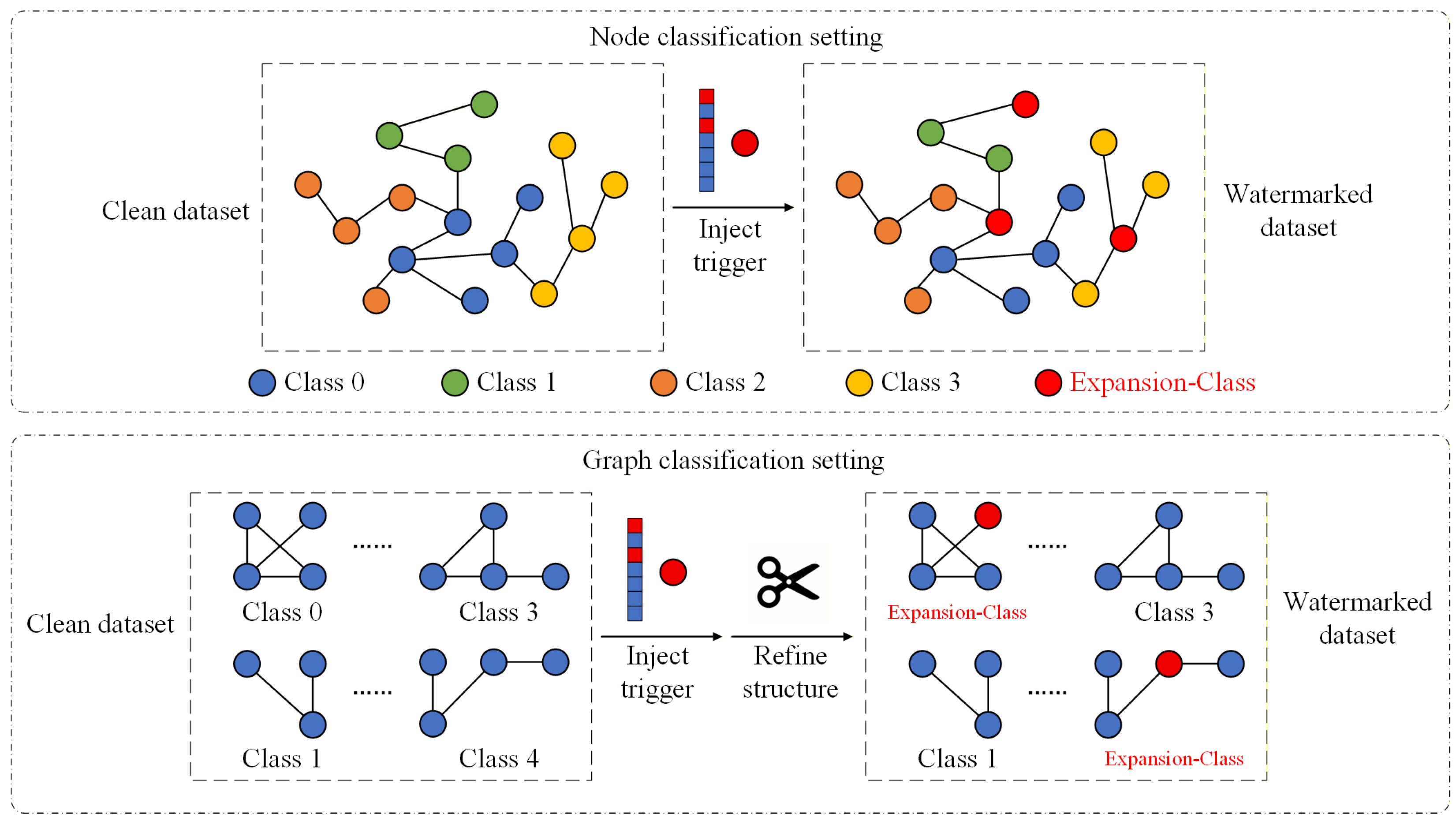
that does not appear in the original dataset. In this paper, the method is validated in both node classification and graph classification settings. The overall construction process is illustrated in
Figure 1.
For a node classification dataset, we randomly select from the full node set V of the clean graph G at a proportion of . For each selected node , we select a proportion of feature dimensions from its feature vector according to a predefined rule, modify the corresponding feature components to the trigger feature value , and change the node’s label to the expansion-class . The procedure is outlined in Algorithm 1.
For a graph classification dataset, we randomly sample a set of graphs
from the clean dataset
at a proportion of
. For each selected graph
, we randomly choose a subset of nodes
consisting of
nodes. For every selected node
, we select
feature dimensions from its feature vector
according to a predefined rule and set those feature components to the preset trigger feature value
. After feature trigger injection, we further refine the local connectivity among the selected trigger nodes according to their feature similarity. Specifically, for each pair of selected trigger nodes, the edge between them is preserved or added if their feature similarity is above a predefined threshold
, and removed otherwise. Finally, the label of graph
is changed to the expansion-class
. The procedure is outlined in Algorithm 2.
| Algorithm 1 Build watermarked dataset (node classification task). |
- Require:
Clean graph , node poisoning rate , trigger feature ratio , expansion-class - Ensure:
Watermarked graph - 1:
Randomly select nodes from V to form - 2:
for each node do - 3:
Select a set of feature dimensions from according to a predefined rule and the ratio - 4:
Modify the selected features to the trigger feature value - 5:
Set the label of v to - 6:
end for - 7:
return
|
| Algorithm 2 Build watermarked dataset (graph classification task). |
- Require:
Clean graph dataset , graph poisoning rate , number of trigger nodes , number of trigger feature dimensions , expansion-class - Ensure:
Watermarked graph dataset - 1:
▹ Initialize as the original clean graph dataset - 2:
Randomly select graphs from to form - 3:
for each graph do - 4:
Randomly select nodes from to form - 5:
for each node do - 6:
Select feature dimensions from according to a predefined rule - 7:
Modify the selected features to the trigger feature value - 8:
end for - 9:
Refine the local connectivity among nodes in according to feature similarity and the threshold - 10:
Set the label of to - 11:
end for - 12:
return
|
After the watermarked dataset
is built, training any GNNs on
follows the poison-only backdoor workflow described in
Section 3.1.
4.3. Dataset Infringement Verification
In the infringement verification phase, we determine whether a suspicious model
was trained on the watermarked dataset
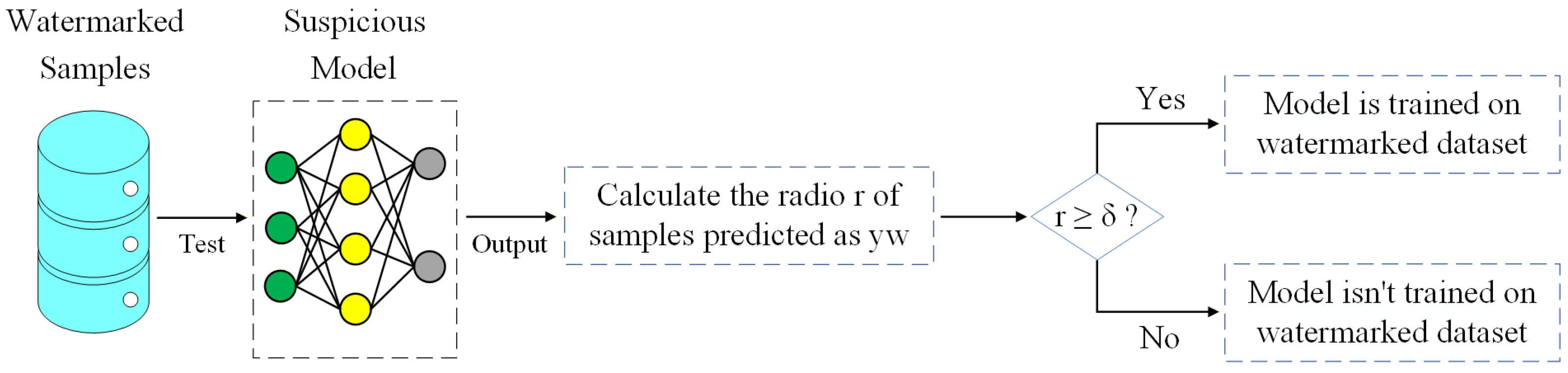
by examining its prediction behavior on watermarked samples. This procedure assumes that the expansion-class is preserved in the observable output label space of the suspicious API. The infringement verification process is shown in
Figure 2.
Given a watermarked sample set , where each sample contains the watermark trigger, verification is performed as follows:
- (1)
For each watermarked sample , feed it to to obtain the prediction . If , add to the set S.
- (2)
Compute the proportion . If , the suspicious model is regarded as having been trained on under the proposed threshold-based verification rule; otherwise, the verification result is negative.
The above verification is formalized in Algorithm 3. It combines sample-level checking with set-level statistics. This reduces the probability of accidental matches on individual samples and improves the reliability of infringement determinations.
| Algorithm 3 Dataset infringement verification. |
- Require:
Suspicious model , watermark sample set , expansion-class , threshold - Ensure:
Boolean (True if infringement detected, False otherwise) - 1:
- 2:
for each do - 3:
- 4:
if then - 5:
- 6:
end if - 7:
end for - 8:
- 9:
if
then - 10:
return True - 11:
else - 12:
return False - 13:
end if
|
4.4. Advantages of Class-Expansion Watermark
CEBW re-labels all trigger-bearing watermarked samples as , so that the learned mapping “watermark patterns → class ” is completely isolated from the normal mapping “original features → normal classes.” As a result, the learning objective for watermarked samples is independent of the original task.
The role of is analogous to an error code in computer systems: it serves only as a dedicated identifier for verifying model infringement and does not correspond to any valid class in the original task. This characteristic leads to prediction behavior distinct from that produced by conventional methods, yielding the following advantages:
Reduced misclassification risk for legitimate-user models. Conventional backdoor-based watermarking methods typically use an existing normal class as the watermark target. As a result, the model may learn a mapping from watermark patterns to a normal task label, which creates a direct risk of watermark-induced misclassification within the original label space. In CEBW, watermark patterns are associated with a dedicated expansion-class rather than with any normal class. Therefore, compared with conventional methods, CEBW reduces the risk that trigger-bearing inputs are redirected to an existing normal category of the original task.
Stronger verification signal against unauthorized use. If an adversary trains a model using the watermarked dataset, the resulting model may learn the association between watermark patterns and the expansion-class . Since does not exist in the original clean data, a model trained solely on clean data is generally not expected to output on trigger-bearing samples. Therefore, when a suspicious model consistently predicts for watermarked queries, this behavior provides a strong and distinctive verification signal for potential infringement. This makes the verification signal of CEBW easier to distinguish from normal task behavior than that of conventional methods.
Minimal interference with clean-task performance. Since is independent of the original classes, learning the watermark has little effect on the model’s learning of normal patterns, thereby minimizing its impact on the model’s original task performance.
5. Experiments
5.1. Experimental Setting
5.1.1. Datasets
In the node classification setting, we consider the verification performance on Cora [
45], CiteSeer [
46], and PubMed [
47]. These are citation networks where nodes represent papers and edges denote citation links. Cora focuses on machine learning, CiteSeer on information science, and PubMed on biomedical research. Detailed statistics are reported in
Table 1.
We adopt the standard dataset split provided by the PyTorch Geometric [
48]: 20 labeled nodes per class are used for training, 500 nodes for validation, and 1000 nodes for testing.
In the graph classification setting, we make evaluations using AIDS [
49], IMDB-MULTI [
50], and ENZYMES [
51]. AIDS consists of 2000 molecular graphs and is used to study molecular property prediction related to anti-HIV activity. IMDB-MULTI is derived from the IMDB movie collaboration network: each graph represents a movie, nodes are actors, and edges indicate co-appearance. ENZYMES contains protein structure graphs from six enzyme families, where nodes represent secondary-structure units and edges indicate spatial proximity. Details are given in
Table 2.
5.1.2. Training Configuration
We make evaluations using three widely used GNN architectures: GCN [
52], GAT [
53], and GraphSAGE [
54]. All models are trained with the Adam optimizer [
55]. The training configurations for the two scenarios are summarized in
Table 3.
5.1.3. Watermarking Parameters
The node classification setting involves three watermarking parameters: the node poisoning rate , the trigger feature ratio , and the trigger feature value . The graph classification setting involves five watermarking parameters: the graph poisoning rate , the number of trigger nodes , the number of trigger feature dimensions , the trigger feature value , and the similarity threshold used for local connectivity refinement.
Unless otherwise stated, the default parameter settings are as follows: for node classification, , , and ; for graph classification, , , , , and each is randomly sampled from the range .
In the experiments, watermarked samples used for training the watermarked models are selected from the corresponding training split. For infringement verification, we use a predefined empirical decision threshold throughout the experiments.
5.1.4. Baseline
For the graph classification task, we compare CEBW with three baselines: DVBW [
20], GDOA [
21], and CLBA [
56]. CLBA is a clean-label graph backdoor attack. Since CEBW is also based on a backdoor watermarking mechanism, we adapt CLBA as a baseline by treating its trigger design as a watermark pattern and evaluating it under the same verification protocol.
For the node classification task, to the best of our knowledge, there is currently no directly comparable dataset infringement verification method based on backdoor watermarking. Therefore, we adopt several poison-only graph backdoor attack methods as baselines, including UGBA [
28], CGBA [
29], and CGBA-R. Their trigger designs are also treated as watermark patterns and evaluated under the same verification protocol.
CGBA-R is a variant of CGBA, in which the feature trigger injection positions are randomly selected.
5.1.5. Evaluation Metrics
We adopt verification success rate (VSR) and clean accuracy drop (CAD) to evaluate the effectiveness of dataset watermarking.
VSR is defined as the proportion of watermarked samples that the model predicts as
. As described in
Section 4.3, it serves as the core statistic in the threshold-based verification rule. VSR is defined as follows:
where
S denotes the set of watermarked samples predicted as
. When
, the model is regarded as having been trained on the watermarked dataset under the proposed verification rule.
CAD measures the impact of watermarking on the model’s original task performance. It is defined as the difference in accuracy on the clean test set between the clean model
and the watermarked model
:
A higher VSR and a smaller CAD indicate a better trade-off between verification effectiveness and clean accuracy.
5.2. Main Results
In both node classification and graph classification tasks, the watermark is injected into a fixed contiguous segment starting from the first feature dimension. The experimental results of CEBW and the baseline methods are shown in
Table 4 and
Table 5. Overall, CEBW generally achieves high VSR in both settings, while keeping CAD within a relatively small range in most cases.
In the node classification task, CEBW usually achieves VSR values close to 100% on Cora and CiteSeer. On PubMed, although the GCN-based result is slightly lower, the other models still maintain the high verification success rate. Across these datasets, CEBW generally outperforms CGBA and its variant CGBA-R, and also shows competitive performance compared with UGBA. At the same time, CAD fluctuates only slightly overall, indicating limited impact on the original task performance.
In the graph classification task, CEBW also achieves strong verification performance on AIDS, IMDB-MULTI, and ENZYMES, with many results close to 100%. Compared with DVBW and CLBA, CEBW attains higher VSR. Compared with GDOA, the two methods show similar performance, and both achieve the high verification success rates in most experimental settings. Meanwhile, the CAD of CEBW fluctuates only slightly in most cases. This suggests that CEBW maintains strong verification capability while causing a relatively limited impact on normal model performance.
5.3. Clean-Sample Prediction Analysis of the Expansion-Class Isolation Effect
To verify whether the class-expansion mechanism effectively isolates watermark-related behavior from the normal classification task, this subsection analyzes the prediction distributions of the watermarked GCN model on clean test sets from multiple datasets.
Table 6,
Table 7,
Table 8 and
Table 9 show the prediction distributions of the watermarked model on clean test samples. It can be observed that, across both node classification and graph classification datasets, none of the clean samples are assigned to the newly introduced expansion-class
. This result indicates that the expansion-class is not activated by clean samples. Consequently, clean inputs are not misclassified into the special category used for infringement verification.
Furthermore, prediction errors on clean samples occur only among the original classes. Specifically, whether on node classification datasets such as Cora and CiteSeer or on graph classification datasets such as AIDS and IMDB-MULTI, the outputs of the watermarked model on clean inputs always remain within the original task label space. Even when misclassification occurs, no clean sample is assigned to the expansion-class . This suggests that the learned mapping from “watermark pattern → expansion-class ” has a clear triggering condition: it is activated only when the input contains the designated watermark pattern, rather than generalizing to ordinary clean samples.
5.4. Analysis of Watermark Design Factors
5.4.1. Poisoning Rate
The poisoning rate determines how frequently the watermark pattern appears in the training data. This subsection analyzes the effect of the poisoning rate on verification performance in both node and graph classification settings. In the graph classification task, each is randomly sampled from the range .
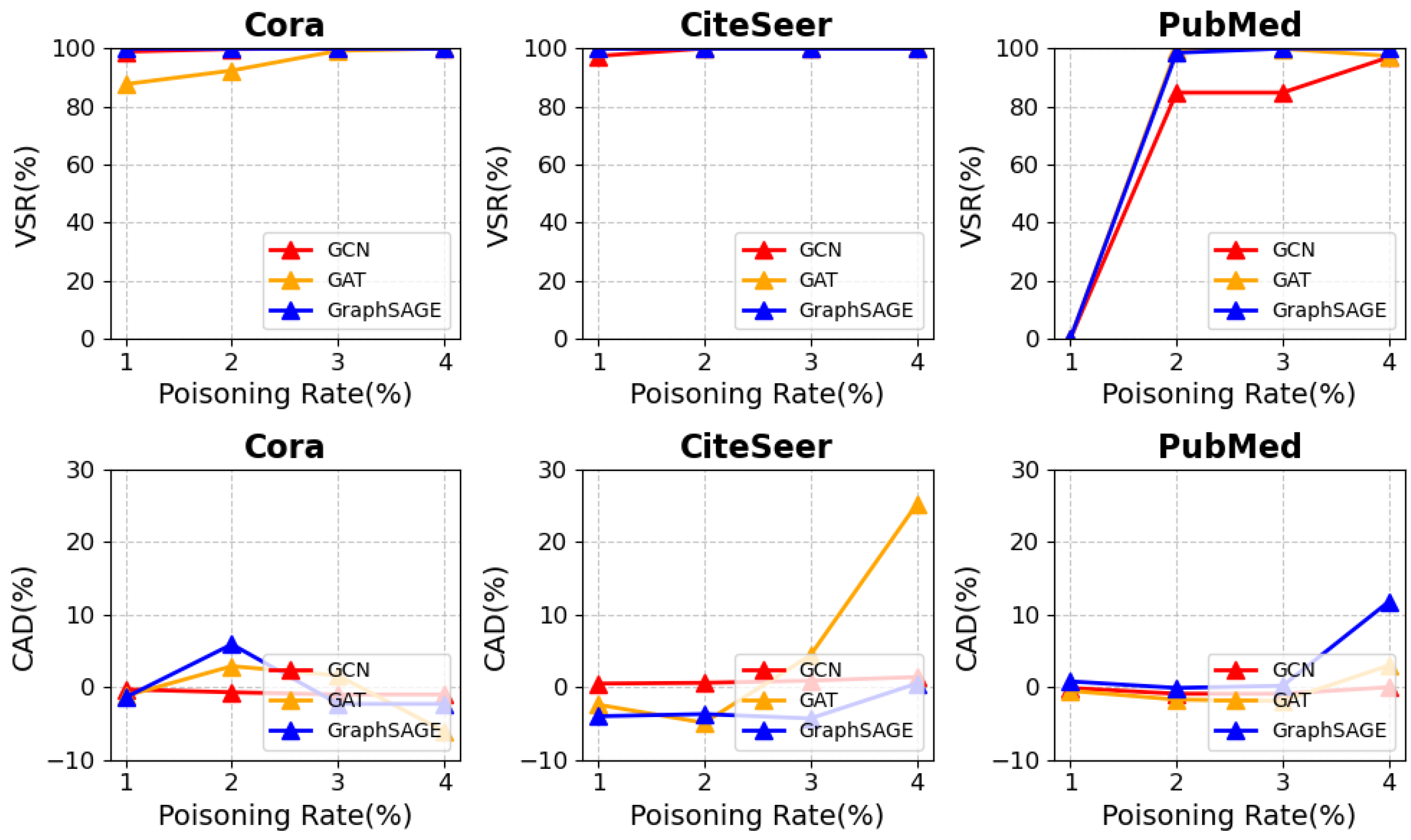
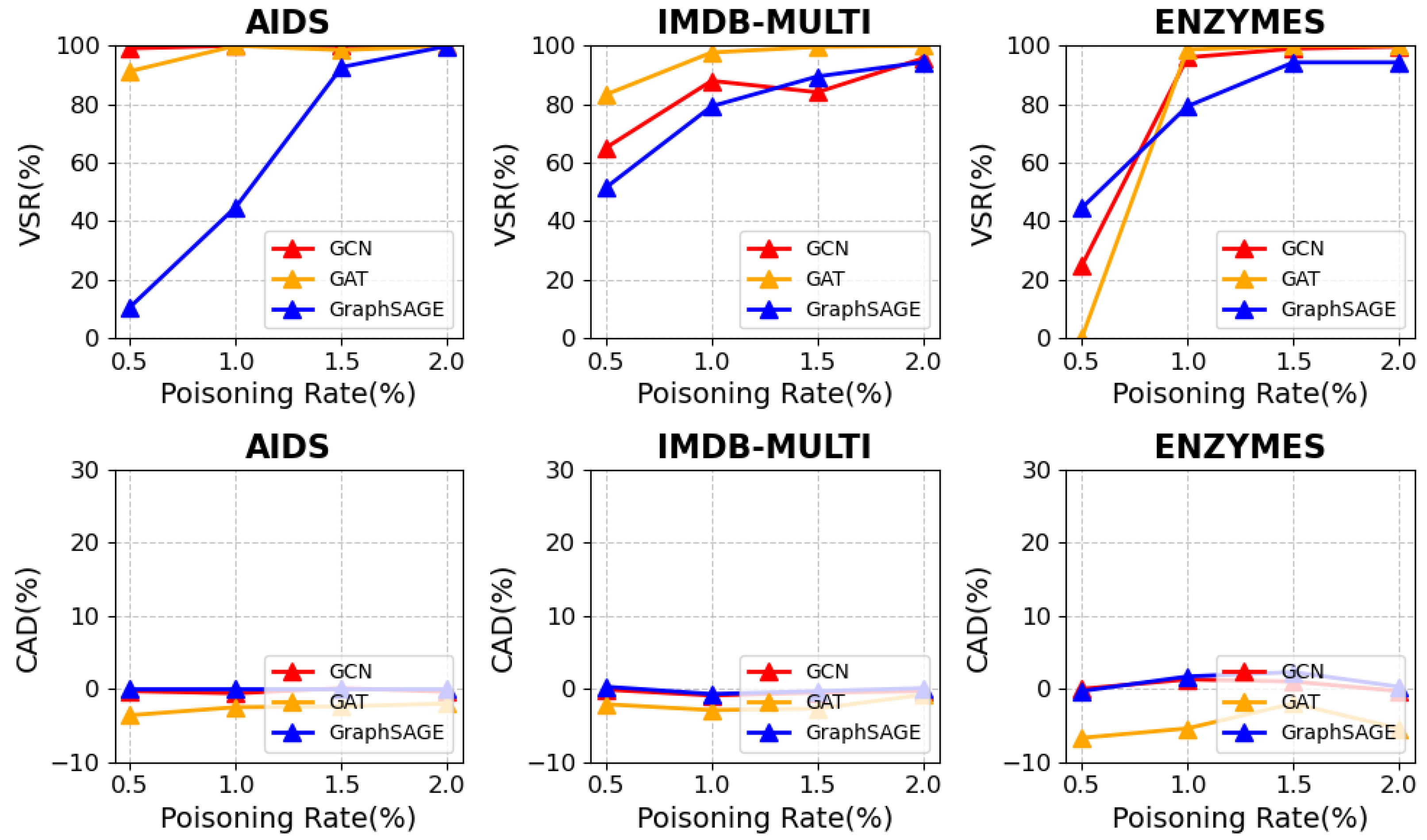
As shown in
Figure 3 and
Figure 4, the poisoning rate has a clear influence on the verification performance of CEBW. In both node classification and graph classification settings, VSR generally increases as the poisoning rate rises, while CAD mostly remains within a small fluctuation range. This indicates that increasing the proportion of watermarked samples in the training set strengthens the model’s learning of the mapping from “watermark patterns → expansion-class
,” thereby improving the success rate of infringement verification. Meanwhile, because the class-expansion mechanism isolates watermark behavior from the original task, increasing the poisoning rate does not obviously degrade the model’s normal task performance in most settings.
A notable exception occurs on PubMed when , where the VSR drops to 0. This is mainly because the PubMed training set is relatively small. Consequently, an extremely low poisoning rate results in almost no poisoned nodes being included in training, so the watermark signal is too weak to be learned effectively.
It should be noted that, in some graph classification settings, a higher poisoning rate may also lead to a slight increase in CAD. This suggests that the choice of the poisoning rate still requires a trade-off between the verification success rate and normal task performance.
5.4.2. Selection of Injection Node
The choice of injection nodes affects how watermark patterns propagate through the graph. Based on the GCN model, this subsection analyzes the impact of different injection node strategies on verification performance in both node and graph classification tasks. In the graph classification task, each is randomly sampled from the range .
Three node injection strategies were considered in this study: random selection, highest-degree node, and lowest-degree node.
Table 10 and
Table 11 show that randomly selecting nodes and choosing highest-degree nodes generally achieve higher VSR. In contrast, fixing the watermark on lowest-degree nodes often leads to relatively poorer verification performance. Meanwhile, CAD remains broadly stable across different strategies. This indicates that the choice of injection nodes mainly affects verification capability, while its influence on the model’s original task performance is relatively limited.
In the node classification task, PubMed is more sensitive to the injection node strategy: the highest-degree node strategy achieves the highest VSR, followed by random selection, while the lowest-degree node strategy performs the worst. This may be related to the fact that node classification relies on neighborhood message passing, where highest-degree nodes make it easier for trigger features to propagate through the local structure and be learned by the model. By contrast, the differences among strategies on Cora and CiteSeer are relatively small, suggesting that on these datasets, the model can already learn watermark patterns more easily. Thus, the effect of injection node location is comparatively limited.
In the graph classification task, the influence of the injection node selection strategy is also dataset-dependent. As shown in
Table 11, the best-performing strategy differs across datasets: random selection achieves the highest VSR on IMDB-MULTI, while the lowest-degree strategy achieves the highest VSR on ENZYMES but with a relatively larger CAD of 4.7%. On AIDS, both the lowest-degree and random strategies reach 100% VSR. Overall, the highest-degree strategy does not consistently provide better verification performance, and both VSR and CAD should be considered when selecting injection nodes.
5.4.3. Selection of Injection Feature Dimensions
The feature dimensions into which the watermark is injected directly affect whether the model can effectively learn watermark patterns during training. Based on the GCN model, this subsection analyzes the impact of different feature dimension injection strategies on verification performance in both node and graph classification tasks. In the graph classification task, each is randomly sampled from the range . Four injection strategies were selected for this study:
- (1)
Start-consecutive dimensions: Select a consecutive block of feature components as the injection positions.
- (2)
Random dimensions: Randomly sample feature components.
- (3)
High-variance dimensions: Compute the variance of each feature dimension across all nodes, and select the feature dimensions with the highest variances.
- (4)
Low-variance dimensions: Compute the variance of each feature dimension across all nodes, and select the feature dimensions with the lowest variances.
Table 12 shows that the effect of feature dimension injection positions in node classification tasks varies clearly across datasets. On Cora and CiteSeer, the VSR under different injection strategies is close to 100%. In contrast, PubMed is more sensitive to the choice of injection dimensions. On this dataset, the high-variance and consecutive dimension strategies perform better, while the VSR of random injection drops noticeably. This may be because the importance of different feature dimensions is more uneven in PubMed. Injecting the watermark into more important dimensions makes it easier for the model to learn an effective trigger pattern. By contrast, random injection may select dimensions with lower contribution, thereby weakening the model’s ability to learn watermark patterns.
Table 13 shows that graph classification tasks are more sensitive to feature dimension injection positions. On AIDS, the VSR remains high under all strategies. However, on IMDB-MULTI and ENZYMES, the differences among strategies become much larger. In particular, the high-variance strategy performs poorly, while the consecutive dimension strategy is more stable overall. This may be because graph classification relies on graph-level representation aggregation. If trigger features are injected into overly scattered positions, the trigger signal is more likely to be weakened during aggregation. By contrast, fixed contiguous dimensions concentrate the watermark into a continuous feature region. This makes it easier for the model to learn watermark patterns and thus improves verification performance.
5.4.4. Selection of Threshold
The choice of threshold affects the final infringement verification decision. Based on the VSR results in
Table 4 and
Table 5, this subsection analyzes how the verification decisions change under different thresholds. Specifically, we examine how many dataset–model combinations can be regarded as “trained on the watermarked dataset
” under different thresholds, including
.
As shown in
Table 14, when
and
, all experimental settings in both node classification and graph classification tasks pass the verification criterion. When
, the PubMed-GCN combination fails to pass the verification criterion. When
, the number of failed dataset–model combinations further increases.
A lower threshold makes the decision criterion more relaxed. For example, when , a model only needs to predict the expansion-class for of the watermarked samples to pass the verification, so some cases with relatively weak watermark responses may also be accepted. In contrast, a higher threshold makes the decision criterion stricter. When or higher, some dataset–model combinations with relatively clear watermark responses may fail to pass the verification. For example, the VSRs of some dataset–model combinations fall between and , indicating that the model produces the expected response for most watermarked samples. However, because these VSRs do not reach the higher threshold, they are still classified as failures.
Therefore, this paper adopts as the default decision threshold. Compared with , this threshold provides a stricter decision criterion. Compared with or , it is not overly stringent and can avoid judging some experimental settings with clear watermark responses as failed cases.
5.5. Robustness of CEBW
5.5.1. Data-Cleansing Defense in Node Classification
The externally injected watermark patterns may reduce node similarity, which enables an adversary to remove the watermark using similarity-based defense methods [
28]. To evaluate the robustness of CEBW against this data-cleansing defense, we perform low-similarity edge-pruning defense on three poisoned datasets in the node classification task, then retrain the models on the pruned graphs to observe whether the watermark remains effective.
Table 15 shows that, under both similarity thresholds, CEBW maintains relatively high VSR in most model and dataset settings. This indicates that low-similarity edge pruning does not substantially weaken its watermark verification capability in most cases. Overall, the results of GCN and GAT change only slightly before and after defense. Although GraphSAGE shows some decline in a few settings, its VSR remains relatively high overall. These results suggest that this defense method is not very effective at disrupting the watermark pattern injected by CEBW.
A possible reason is that conventional methods usually map poisoned nodes to an existing normal class, which damages their local homophily with neighboring nodes and makes them more likely to be detected by low-similarity edge pruning. In contrast, CEBW introduces an expansion-class
that does not exist in the original task, so watermark nodes do not need to imitate any existing class. Therefore, even if some low-similarity edges are pruned, the model can still retain the mapping from “watermark patterns → class
” relatively well. This may help explain why CEBW still maintains high VSR in
Table 15.
5.5.2. Data-Cleansing Defense in Graph Classification
To evaluate CEBW’s robustness in the graph classification task, we consider three data-cleansing defenses: low-similarity edge pruning (with the threshold set to 0.5) [
28], adversarial training [
57], and outlier detection [
58]. Adversarial training adds Gaussian noise to the training set to disrupt watermark patterns while improving the model’s ability to resist interference. The outlier detection method assumes that poisoned samples have different feature distributions from clean samples. This method quantifies each sample’s deviation from normal patterns with multiple algorithms and removes those found to be anomalous.
The defense results for the graph classification task are shown in
Table 16. Overall, the three defense methods do not significantly weaken the verification capability of CEBW in most model and dataset settings, and the VSR after defense remains at a relatively high level. The results of GCN and GAT change only slightly before and after defense, while GraphSAGE shows some decline in a few settings but still maintains a relatively high VSR overall. These results indicate that edge pruning, adversarial training, and outlier detection do not substantially weaken CEBW’s watermark for graph classification in most settings.
A possible reason is that, in graph classification, CEBW learns a stable mapping from “the graph-level watermark pattern → expansion-class ”. This watermark pattern is jointly formed by the injected trigger features and the refined local connectivity among selected trigger nodes. Edge pruning mainly weakens local low-similarity structures, adversarial training mainly introduces random perturbations to node features, and outlier detection focuses on filtering abnormal samples. However, these defenses usually have limited ability to consistently disrupt both the injected trigger features and the refined local connectivity among multiple trigger nodes. Therefore, CEBW can still maintain relatively high verification performance against these three types of data-cleansing defenses in the graph classification task.
5.5.3. Fine-Tuning
This subsection investigates the robustness of CEBW against fine-tuning [
59]. Fine-tuning is a model-cleaning defense method. It continues training a poisoned model on clean data, so that the poisoned model gradually forgets the previously learned trigger pattern, thereby weakening the backdoor attack effect. In our experiments, the fine-tuning analysis is conducted based on the GCN model, and the fine-tuning learning rate is set to 0.001.
Table 17 and
Table 18 show that, as the number of fine-tuning epochs increases, the VSR in both node classification and graph classification tasks decreases, and the CAD remains within a relatively small fluctuation range in most settings. In particular, on the AIDS dataset, when the number of fine-tuning epochs increases to 30, the VSR is close to 0. This indicates that fine-tuning can substantially weaken or even eliminate the verification capability of CEBW while largely preserving the original task performance.
These results show that CEBW is sensitive to fine-tuning and has limited robustness against model-cleaning defenses. We speculate that this is mainly because CEBW introduces an additional expansion-class as the target class, while the clean training set used for fine-tuning does not contain any samples from . As training on clean data continues, the model gradually forgets the mapping from “watermark patterns → expansion-class,” and finally can no longer classify watermarked samples as .
To further analyze how to mitigate the effect of fine-tuning on CEBW’s verification effectiveness, we conduct supplementary experiments on the AIDS dataset by adjusting several key parameters of the feature trigger, including the poisoning rate
, the number of trigger nodes
, and the trigger feature value
.
Table 19 reports the corresponding VSR and CAD under different feature trigger configurations after 10, 20, and 30 epochs of fine-tuning.
The original configuration, i.e., , , , and is randomly sampled from the range , quickly becomes ineffective after fine-tuning, with the VSR dropping to only after 30 epochs. When the other parameters remain unchanged, increasing the poisoning rate alone can partially alleviate this issue, but the effect is still limited. For example, when is increased to , the VSR after 30 epochs increases to , but it still does not reach the verification threshold adopted in this paper. Similarly, increasing the trigger feature value alone cannot stably resist fine-tuning. Even when each is randomly sampled from the range , the VSR reaches after 10 epochs but still drops to after 30 epochs. This indicates that enhancing only a single parameter is insufficient to stably preserve the watermark response under continuous fine-tuning.
In contrast, when the poisoning rate is increased together with a stronger trigger configuration, the VSR after fine-tuning can be significantly improved. For example, when , , , and is randomly sampled from the range , the VSR remains at after 30 epochs. When each is further sampled from the range , the VSR still remains at after 30 epochs. Meanwhile, the CAD values under these configurations remain relatively small, indicating that increasing the watermark injection strength does not significantly degrade the clean-task performance. These results show that adjusting a single parameter has limited effectiveness on mitigating fine-tuning, whereas jointly increasing the poisoning rate, the number of trigger nodes, and the trigger feature values can help the model learn the mapping between watermark patterns and the expansion-class more effectively, thereby partially mitigating the weakening effect of fine-tuning on the watermark response.
It should be noted that the above mitigation effect relies on a higher watermark injection strength. Therefore, it is still necessary to balance resistance to fine-tuning, clean-task performance, and watermark stealthiness.
6. Discussion
The experimental results demonstrate that the proposed CEBW scheme provides an effective approach to graph dataset infringement verification in open-source settings. Unlike conventional backdoor watermarking methods, which associate trigger patterns with existing normal classes, CEBW introduces a dedicated expansion-class for verification. This design changes the role of watermark samples from misleading normal samples to samples belonging to an isolated verification class. As a result, the model can learn watermark-related patterns while keeping interference with the original task limited.
This mechanism explains the overall experimental trends observed in both node classification and graph classification tasks. As shown in
Table 4 and
Table 5, CEBW generally achieves high VSR while keeping CAD within a relatively small range in most settings. In the node classification task, CEBW outperforms CGBA and CGBA-R in most cases and also shows competitive performance against UGBA. In the graph classification task, CEBW clearly outperforms DVBW and CLBA, and achieves performance comparable to GDOA on most datasets. These results indicate that the proposed class-expansion design can provide strong verification capability while causing limited degradation to the original task performance.
The clean-sample prediction analysis further clarifies the isolation effect of the expansion-class mechanism. As shown in
Table 6,
Table 7,
Table 8 and
Table 9, none of the clean samples are assigned to the expansion-class across both node classification and graph classification datasets. This means that the learned mapping from the designated watermark pattern to the expansion-class is activated only when the watermark pattern is present, rather than generalizing to ordinary clean inputs. Therefore, the class-expansion design effectively separates watermark-triggered behavior from the original task label space, which is also the important reason why CEBW can reduce the direct risk that legitimate inputs are redirected to a normal class by watermark-induced behavior.
The parameter analysis further shows that the effectiveness of CEBW depends on the watermark design and verification configuration. Increasing the poisoning rate generally improves VSR, which suggests that more watermark samples help the model learn the mapping from the watermark pattern to the expansion-class more reliably. At the same time, CAD remains relatively stable in most cases, indicating that the class-expansion mechanism can preserve normal task performance under appropriate parameter settings. In addition, the selection of injection nodes and feature dimensions also influences verification performance, but the best strategy is dataset-dependent rather than fixed. The threshold analysis also shows that provides a practical empirical trade-off: a lower threshold may make the verification criterion too relaxed, whereas a higher threshold may reject some settings that already show clear watermark responses. These observations suggest that CEBW is effective, but its performance still depends on the configuration of watermark injection and verification threshold.
The defense results reveal that the robustness of CEBW depends on the type of defense. Under data-cleansing defenses such as low-similarity edge pruning, adversarial training, and outlier detection, CEBW generally maintains relatively high VSR in most settings. This suggests that the watermark pattern learned by CEBW is not easily removed by data-level sanitization alone. In contrast, fine-tuning shows a more significant weakening effect. As the number of fine-tuning epochs increases, VSR decreases substantially in both node classification and graph classification tasks, and on some datasets such as AIDS, it approaches zero under the original configuration. This indicates that the current CEBW design is more resistant to data-cleansing defenses than to model-cleaning defenses. The supplementary fine-tuning analysis further shows that this vulnerability can be partially mitigated by increasing the watermark injection strength, such as jointly increasing the poisoning rate, the number of trigger nodes, and the trigger feature strength. However, such mitigation also requires a trade-off among resistance to fine-tuning, clean-task performance, and watermark stealthiness.
Overall, these results show that CEBW provides a practical approach to graph dataset infringement verification for open-source data sharing. Its main advantage lies in combining strong verification performance with reduced direct security risk to legitimate users through the class-expansion mechanism. At the same time, the current method still has limitations in expanded label space usability and in robustness against model-cleaning defenses such as fine-tuning, although the supplementary analysis suggests that stronger watermark injection configurations can provide a preliminary mitigation direction. These issues point to important directions for future improvement.
7. Conclusions
In this paper, we propose CEBW, a graph dataset infringement verification method based on a class-expansion mechanism. By assigning watermarked samples to a dedicated expansion-class that does not exist in the original dataset, the proposed method separates watermark learning from the original task and reduces the direct security risks caused by conventional backdoor watermarking in open-source settings.
Extensive experiments in both node classification and graph classification settings demonstrate that CEBW achieves effective infringement verification while largely preserving normal model utility. The results further show that the proposed method reduces the direct security risk to legitimate users relative to conventional methods and remains effective under several data-cleansing defenses. For model-cleaning defenses such as fine-tuning, the original configuration is still vulnerable, but the supplementary analysis shows that increasing the watermark injection strength can partially mitigate this weakness with limited impact on clean-task performance.
Overall, this study provides a practical technical solution for black-box graph dataset infringement verification in open-source data-sharing scenarios. Nevertheless, the practical impact of the expanded label space still requires further investigation. In addition, the trade-off among resistance to fine-tuning, clean-task performance, and watermark stealthiness also needs to be further studied. Future work will focus on further improving the robustness and stealth of the watermark in more complex real-world environments, while extending CEBW to larger-scale and heterogeneous graph settings.
Author Contributions
Z.Y. contributed to conceptualization, formal analysis, investigation, methodology, software, validation, visualization, and writing—original draft; M.X. contributed to project administration, resources, supervision, and writing—review and editing; X.X. contributed to conceptualization, software, and writing—review and editing; Y.L. contributed to data curation; Y.S. contributed to validation; X.Q. contributed to visualization. All authors have read and agreed to the published version of the manuscript.
Funding
This research received no external funding.
Data Availability Statement
The Cora, CiteSeer, and PubMed datasets used in this study were obtained through the Planetoid interface in the PyTorch Geometric library [
48]. Public information on these datasets is available in the PyTorch Geometric Planetoid documentation (
https://pytorch-geometric.readthedocs.io/ (accessed on 29 April 2026)). No new datasets were created in this study.
Acknowledgments
The authors gratefully acknowledge the support of the Hangzhou Dianzi University (HDU) in this publication.
Conflicts of Interest
The authors declare no conflicts of interest.
Abbreviations
The following abbreviations are used in this manuscript:
| API | Application Programming Interface |
| CAD | Clean Accuracy Drop |
| CLBA | Clean-Label Backdoor Attack |
| CEBW | Class-Expansion Backdoor Watermark (proposed method) |
| CGBA | Clean-label Graph Backdoor Attack |
| DLP | Dynamic Link Prediction |
| DVBW | Dataset Verification via Backdoor Watermarking |
| GAT | Graph Attention Network |
| GCBA | Graph Contrastive Backdoor Attack |
| GCN | Graph Convolutional Network |
| GDOA | Graph Data Ownership Authentication |
| GNNs | Graph Neural Networks |
| GraphSAGE | Graph Sample and Aggregate |
| GTA | Graph Trojaning Attack |
| HGBA | Heterogeneous Graph Backdoor Attack |
| HGNNs | Heterogeneous Graph Neural Networks |
| UGBA | Unnoticeable Graph Backdoor Attack |
| PerCBA | Persistent Clean-label Backdoor Attack |
| VSR | Verification Success Rate |
References
- Huang, K.; Tang, J.; Liu, J.; Yang, R.; Xiao, X. Node-wise diffusion for scalable graph learning. In Proceedings of the ACM Web Conference 2023; ACM: New York, NY, USA, 2023; pp. 1723–1733. [Google Scholar]
- Jain, L.; Katarya, R.; Sachdeva, S. Opinion leaders for information diffusion using graph neural network in online social networks. ACM Trans. Web 2023, 17, 13. [Google Scholar] [CrossRef] [Scilit]
- Lyu, N.; Xu, B.; Guo, F.; Shen, H. DCGNN: Dual-channel graph neural network for social bot detection. In Proceedings of the 32nd ACM International Conference on Information and Knowledge Management; ACM: New York, NY, USA, 2023; pp. 4155–4159. [Google Scholar]
- Li, X.; Sun, L.; Ling, M.; Peng, Y. A survey of graph neural network based recommendation in social networks. Neurocomputing 2023, 549, 126441. [Google Scholar] [CrossRef] [Scilit]
- Ying, R.; He, R.; Chen, K.; Eksombatchai, P.; Hamilton, W.L.; Leskovec, J. Graph convolutional neural networks for web-scale recommender systems. In Proceedings of the 24th ACM SIGKDD International Conference on Knowledge Discovery & Data Mining; ACM: New York, NY, USA, 2018; pp. 974–983. [Google Scholar]
- Wu, J.; Wang, X.; Feng, F.; He, X.; Chen, L.; Lian, J.; Xie, X. Self-supervised graph learning for recommendation. In Proceedings of the 44th International ACM SIGIR Conference on Research and Development in Information Retrieval; ACM: New York, NY, USA, 2021; pp. 726–735. [Google Scholar]
- Zhong, M.; Lin, M.; Zhang, C.; Xu, Z. A survey on graph neural networks for intrusion detection systems: Methods, trends and challenges. Comput. Secur. 2024, 141, 103821. [Google Scholar] [CrossRef] [Scilit]
- Caville, E.; Lo, W.W.; Layeghy, S.; Portmann, M. Anomal-E: A self-supervised network intrusion detection system based on graph neural networks. Knowl.-Based Syst. 2022, 258, 110030. [Google Scholar] [CrossRef] [Scilit]
- Li, P.; Yu, H.; Luo, X.; Wu, J. LGM-GNN: A local and global aware memory-based graph neural network for fraud detection. IEEE Trans. Big Data 2023, 9, 1116–1127. [Google Scholar] [CrossRef] [Scilit]
- Lo, W.W.; Layeghy, S.; Sarhan, M.; Gallagher, M.; Portmann, M. Graph neural network-based android malware classification with jumping knowledge. In Proceedings of the 2022 IEEE Conference on Dependable and Secure Computing (DSC); IEEE: New York, NY, USA, 2022; pp. 1–9. [Google Scholar]
- Jiang, W.; Luo, J.; He, M.; Gu, W. Graph neural network for traffic forecasting: The research progress. ISPRS Int. J. Geo-Inf. 2023, 12, 100. [Google Scholar] [CrossRef] [Scilit]
- Yu, B.; Yin, H.; Zhu, Z. Spatio-temporal graph convolutional networks: A deep learning framework for traffic forecasting. arXiv 2018, arXiv:1709.04875. [Google Scholar] [CrossRef] [Scilit]
- Li, Y.; Yu, R.; Shahabi, C.; Liu, Y. Diffusion convolutional recurrent neural network: Data-driven traffic forecasting. arXiv 2018, arXiv:1707.01926. [Google Scholar] [CrossRef] [Scilit]
- Li, J.; Yu, Q.; Zhang, Y. Hierarchical attribute based encryption with continuous leakage-resilience. Inf. Sci. 2019, 484, 113–134. [Google Scholar] [CrossRef] [Scilit]
- Jayaprakash, J.S.; Balasubramanian, K.; Sulaiman, R.; Hasan, M.K.; Parameshachari, B.D.; Iwendi, C. Cloud data encryption and authentication based on enhanced Merkle hash tree method. Comput. Mater. Contin. 2022, 72, 519. [Google Scholar] [CrossRef] [Scilit]
- Cremers, C.; Düzlü, S.; Fiedler, R.; Fischlin, M.; Janson, C. BUFFing signature schemes beyond unforgeability and the case of post-quantum signatures. In Proceedings of the 2021 IEEE Symposium on Security and Privacy (SP); IEEE: New York, NY, USA, 2021; pp. 1696–1714. [Google Scholar]
- Goswami, A.; Chowdhury, S.; Mukherjee, R.; Ghoshal, N. Digitized data validation using dual color images with improved robustness and error correction facility. Sādhanā 2021, 46, 116. [Google Scholar] [CrossRef] [Scilit]
- Chopra, D.; Gupta, P.; Gaur, S.; Gupta, A. LSB based digital image watermarking for gray scale image. IOSR J. Comput. Eng. 2012, 6, 36–41. [Google Scholar] [CrossRef] [Scilit]
- Juarez-Sandoval, O.U.; Cedillo-Hernandez, M.; Nakano-Miyatake, M.; Cedillo-Hernandez, A.; Perez-Meana, H. Digital image ownership authentication via camouflaged unseen-visible watermarking. Multimed. Tools Appl. 2018, 77, 26601–26634. [Google Scholar] [CrossRef] [Scilit]
- Li, Y.; Zhu, M.; Yang, X.; Jiang, Y.; Wei, T.; Xia, S.-T. Black-box dataset ownership verification via backdoor watermarking. IEEE Trans. Inf. Forensics Secur. 2023, 18, 2318–2332. [Google Scholar] [CrossRef] [Scilit]
- Xing, X.; Xu, M.; Bai, Y.; Zheng, R.; Qiao, T. A Data Ownership Authentication Method for Graph Neural Networks via Clean-Label Backdoor. IEEE Internet Things J. 2025, 12, 27742–27752. [Google Scholar] [CrossRef] [Scilit]
- Zhang, Z.; Jia, J.; Wang, B.; Gong, N.Z. Backdoor attacks to graph neural networks. In Proceedings of the 26th ACM Symposium on Access Control Models and Technologies; ACM: New York, NY, USA, 2021; pp. 15–26. [Google Scholar]
- Xi, Z.; Pang, R.; Ji, S.; Wang, T. Graph backdoor. In Proceedings of the 30th USENIX Security Symposium (USENIX Security 21); USENIX: Berkeley, CA, USA, 2021; pp. 1523–1540. [Google Scholar]
- Chen, Y.; Ye, Z.; Zhao, H.; Wang, Y. Feature-Based Graph Backdoor Attack in the Node Classification Task. Int. J. Intell. Syst. 2023, 2023, 5418398. [Google Scholar] [CrossRef] [Scilit]
- Zheng, H.; Xiong, H.; Ma, H.; Huang, G.; Chen, J. Link-backdoor: Backdoor attack on link prediction via node injection. IEEE Trans. Comput. Soc. Syst. 2023, 11, 1816–1831. [Google Scholar] [CrossRef] [Scilit]
- Xu, J.; Xue, M.; Picek, S. Explainability-based backdoor attacks against graph neural networks. In Proceedings of the 3rd ACM Workshop on Wireless Security and Machine Learning; ACM: New York, NY, USA, 2021; pp. 31–36. [Google Scholar]
- Zheng, H.; Xiong, H.; Chen, J.; Ma, H.; Huang, G. Motif-backdoor: Rethinking the backdoor attack on graph neural networks via motifs. IEEE Trans. Comput. Soc. Syst. 2023, 11, 2479–2493. [Google Scholar] [CrossRef] [Scilit]
- Dai, E.; Lin, M.; Zhang, X.; Wang, S. Unnoticeable Backdoor Attacks on Graph Neural Networks. In Proceedings of the ACM Web Conference; ACM: New York, NY, USA, 2023; pp. 2263–2273. [Google Scholar]
- Xing, X.; Xu, M.; Bai, Y.; Yang, D. A clean-label graph backdoor attack method in node classification task. Knowl.-Based Syst. 2024, 304, 112433. [Google Scholar] [CrossRef] [Scilit]
- Chen, Y.; Bin, Z.; Zhao, H. Stealthy graph backdoor attack based on feature trigger. Complex Intell. Syst. 2025, 11, 325. [Google Scholar] [CrossRef] [Scilit]
- Zhang, H.; Chen, J.; Lin, L.; Jia, J.; Wu, D. Graph contrastive backdoor attacks. In Proceedings of the International Conference on Machine Learning; ACM: New York, NY, USA, 2023; pp. 40888–40910. [Google Scholar]
- Yang, X.; Li, G.; Zhang, C.; Han, M.; Yang, W. PerCBA: Persistent Clean-label Backdoor Attacks on Semi-Supervised Graph Node Classification. In Proceedings of the IJCAI-23 Workshop on Artificial Intelligence Safety, Macau, China, 21–22 August 2023; pp. 1–10. [Google Scholar]
- Chen, J.; Xiong, H.; Zheng, H.; Zhang, J.; Liu, Y. Dyn-backdoor: Backdoor attack on dynamic link prediction. IEEE Trans. Netw. Sci. Eng. 2023, 11, 525–542. [Google Scholar] [CrossRef] [Scilit]
- Chen, J.; Li, L.; Takabi, D.; Sosonkina, M.; Ning, R. Heterogeneous Graph Backdoor Attack. arXiv 2025, arXiv:2506.00191. [Google Scholar] [CrossRef] [Scilit]
- Wang, S.; Zhou, J.; Liu, J.K.; Yu, J.; Chen, J.; Xie, W. An efficient file hierarchy attribute-based encryption scheme in cloud computing. IEEE Trans. Inf. Forensics Secur. 2016, 11, 1265–1277. [Google Scholar] [CrossRef] [Scilit]
- Deng, H.; Qin, Z.; Wu, Q.; Guan, Z.; Deng, R.H.; Wang, Y.; Zhou, Y. Identity-based encryption transformation for flexible sharing of encrypted data in public cloud. IEEE Trans. Inf. Forensics Secur. 2020, 15, 3168–3180. [Google Scholar] [CrossRef] [Scilit]
- Beduschi, A. Digital identity: Contemporary challenges for data protection, privacy and non-discrimination rights. Big Data Soc. 2019, 6, 2053951719855091. [Google Scholar] [CrossRef] [Scilit]
- Mohammed, Q.A.A.S.; Joudah, M.; Mohammed, H. A survey on digital signature schemes. In AIP Conference Proceedings; AIP Publishing: Melville, NY, USA, 2024; Volume 3232, p. 020057. [Google Scholar]
- Kadian, P.; Arora, S.M.; Arora, N. Robust digital watermarking techniques for copyright protection of digital data: A survey. Wirel. Pers. Commun. 2021, 118, 3225–3249. [Google Scholar] [CrossRef] [Scilit]
- Sun, J.; Li, Y.; Zhang, G.; Dong, L.; Yang, Z.; Wang, M.; Cai, J. Data traceability scheme of industrial control system based on digital watermark. In Proceedings of the 2022 7th IEEE International Conference on Data Science in Cyberspace (DSC); IEEE: New York, NY, USA, 2022; pp. 322–325. [Google Scholar]
- Abadi, M.; Chu, A.; Goodfellow, I.; McMahan, H.B.; Mironov, I.; Talwar, K.; Zhang, L. Deep learning with differential privacy. In Proceedings of the 2016 ACM SIGSAC Conference on Computer and Communications Security; ACM: New York, NY, USA, 2016; pp. 308–318. [Google Scholar]
- Zhu, L.; Liu, X.; Li, Y.; Yang, X.; Xia, S.-T.; Lu, R. A fine-grained differentially private federated learning against leakage from gradients. IEEE Internet Things J. 2021, 9, 11500–11512. [Google Scholar] [CrossRef] [Scilit]
- Triastcyn, A.; Faltings, B. Bayesian differential privacy for machine learning. In Proceedings of the International Conference on Machine Learning (ICML); PMLR: Cambridge, MA, USA, 2020; pp. 9583–9592. [Google Scholar]
- Gu, T.; Dolan-Gavitt, B.; Garg, S. Badnets: Identifying vulnerabilities in the machine learning model supply chain. arXiv 2019, arXiv:1708.06733. [Google Scholar] [CrossRef] [Scilit]
- McCallum, A.K.; Nigam, K.; Rennie, J.; Seymore, K. Automating the construction of internet portals with machine learning. Inf. Retr. 2000, 3, 127–163. [Google Scholar] [CrossRef] [Scilit]
- Sen, P.; Namata, G.; Bilgic, M.; Getoor, L.; Gallagher, B.; Eliassi-Rad, T. Collective classification in network data. AI Mag. 2008, 29, 93. [Google Scholar] [CrossRef] [Scilit]
- Yang, Z.; Cohen, W.; Salakhutdinov, R. Revisiting semi-supervised learning with graph embeddings. In Proceedings of the International Conference on Machine Learning (ICML); PMLR: Cambridge, MA, USA, 2016; pp. 40–48. [Google Scholar]
- Fey, M.; Lenssen, J.E. Fast graph representation learning with PyTorch Geometric. arXiv 2019, arXiv:1903.02428. [Google Scholar] [CrossRef] [Scilit]
- Riesen, K.; Bunke, H. IAM graph database repository for graph based pattern recognition and machine learning. In Joint IAPR International Workshops on Statistical Techniques in Pattern Recognition (SPR) and Structural and Syntactic Pattern Recognition (SSPR); Springer: Berlin/Heidelberg, Germany, 2008; pp. 287–297. [Google Scholar]
- Yanardag, P.; Vishwanathan, S.V.N. Deep graph kernels. In Proceedings of the 21th ACM SIGKDD International Conference on Knowledge Discovery and Data Mining; ACM: New York, NY, USA, 2015; pp. 1365–1374. [Google Scholar]
- Borgwardt, K.M.; Ong, C.S.; Schönauer, S.; Vishwanathan, S.V.N.; Smola, A.J.; Kriegel, H.P. Protein function prediction via graph kernels. Bioinformatics 2005, 21, i47–i56. [Google Scholar] [CrossRef] [Scilit] [PubMed]
- Kipf, T.N.; Welling, M. Semi-supervised classification with graph convolutional networks. arXiv 2017, arXiv:1609.02907. [Google Scholar] [CrossRef] [Scilit]
- Veličković, P.; Cucurull, G.; Casanova, A.; Romero, A.; Liò, P.; Bengio, Y. Graph attention networks. arXiv 2018, arXiv:1710.10903. [Google Scholar]
- Hamilton, W.; Ying, Z.; Leskovec, J. Inductive representation learning on large graphs. In Advances in Neural Information Processing Systems; NeurIPS: San Diego, CA, USA, 2017; Volume 30. [Google Scholar]
- Kingma, D.P.; Ba, J. Adam: A method for stochastic optimization. arXiv 2017, arXiv:1412.6980. [Google Scholar] [CrossRef] [Scilit]
- Xu, J.; Picek, S. Poster: Clean-label backdoor attack on graph neural networks. In Proceedings of the 2022 ACM SIGSAC Conference on Computer and Communications Security; ACM: New York, NY, USA, 2022; pp. 3491–3493. [Google Scholar]
- Madry, A.; Makelov, A.; Schmidt, L.; Tsipras, D.; Vladu, A. Towards deep learning models resistant to adversarial attacks. arXiv 2019, arXiv:1706.06083. [Google Scholar] [CrossRef] [Scilit]
- Zhang, Z.; Lin, M.; Dai, E.; Wang, S. Rethinking graph backdoor attacks: A distribution-preserving perspective. In Proceedings of the 30th ACM SIGKDD Conference on Knowledge Discovery and Data Mining; ACM: New York, NY, USA, 2024; pp. 4386–4397. [Google Scholar]
- Liu, K.; Dolan-Gavitt, B.; Garg, S. Fine-pruning: Defending against backdooring attacks on deep neural networks. In Research in Attacks, Intrusions, and Defenses; Springer International Publishing: Cham, Switzerland, 2018; pp. 273–294. [Google Scholar]
Figure 1.
The main process of building a watermarked dataset.
Figure 1.
The main process of building a watermarked dataset.
Figure 2.
The main process of dataset infringement verification.
Figure 2.
The main process of dataset infringement verification.
Figure 3.
Impact of poisoning rate on VSR(%) and CAD(%) in node classification.
Figure 3.
Impact of poisoning rate on VSR(%) and CAD(%) in node classification.
Figure 4.
Impact of poisoning rate on VSR(%) and CAD(%) in graph classification.
Figure 4.
Impact of poisoning rate on VSR(%) and CAD(%) in graph classification.
Table 1.
Node classification datasets.
Table 1.
Node classification datasets.
| Datasets | Nodes | Edges | Features | Classes |
|---|
| Cora | 2708 | 5429 | 1433 | 7 |
| CiteSeer | 3327 | 4732 | 3703 | 6 |
| PubMed | 19,717 | 44,338 | 500 | 3 |
Table 2.
Graph classification datasets.
Table 2.
Graph classification datasets.
| Datasets | Graphs | Avg. Nodes | Avg. Edges | Classes |
|---|
| AIDS | 2000 | 15.69 | 16.20 | 2 |
| IMDB-MULTI | 1500 | 13.00 | 65.94 | 3 |
| ENZYMES | 600 | 32.63 | 62.14 | 6 |
Table 3.
Training configuration.
Table 3.
Training configuration.
| Type | Node Classification | Graph Classification |
|---|
| Hidden Dimension | 256 | 256 → 128 |
| Number of Layers | 3 | 4 |
| Activation Function | ReLU | ReLU |
| Dropout Rate | 0.5 | 0.5 |
| Loss Function | Cross-entropy | Cross-entropy |
| Learning Rate | 0.01 | 0.01 |
| Weight Decay | | |
| Batch Size | 1024 | 128 |
| Epochs | 400 | 300/1000 (GraphSAGE) |
| Random Seed | 0 | 123 |
Table 4.
Overall experimental results on node classification datasets.
Table 4.
Overall experimental results on node classification datasets.
| Models | Methods | VSR (%)|CAD (%) |
|---|
| Cora | CiteSeer | PubMed |
|---|
| GCN | UGBA | 99.6|0.0 | 100.0|−0.3 | 99.6|−2.9 |
| CGBA | 69.9|0.9 | 90.4|0.7 | 45.1|0.1 |
| CGBA-R | 51.2|0.8 | 56.3|1.4 | 38.7|0.2 |
| Ours | 99.8|−0.7 | 100.0|0.6 | 84.8|−0.9 |
| GAT | UGBA | 100.0|0.6 | 6.01|0.61 | 100.0|−0.6 |
| CGBA | 11.5|−2.4 | 47.4|6.4 | 42.0|−3.4 |
| CGBA-R | 9.8|−8.2 | 12.7|14.6 | 29.5|−3.2 |
| Ours | 92.4|2.9 | 100.0|−4.9 | 99.7|−1.7 |
| GraphSAGE | UGBA | 91.8|−0.2 | 81.5|1.03 | 90.8|0.3 |
| CGBA | 71.6|6.1 | 64.2|−0.4 | 43.9|0.4 |
| CGBA-R | 53.3|5.8 | 38.9|−0.7 | 39.1|0.3 |
| Ours | 100.0|3.2 | 100.0|−3.7 | 98.5|−0.1 |
Table 5.
Overall experimental results on graph classification datasets.
Table 5.
Overall experimental results on graph classification datasets.
| Models | Methods | VSR (%)|CAD (%) |
|---|
| AIDS | IMDB-MULTI | ENZYMES |
|---|
| GCN | DVBW | 18.3|−0.5 | 25.6|1.2 | 28.4|−4.0 |
| CLBA | 18.8|−0.1 | 28.3|0.3 | 23.7|−1.4 |
| GDOA | 99.7|0.4 | 95.2|0.3 | 99.7|−3.7 |
| Ours | 98.8|−0.3 | 93.9|0.3 | 99.7|2.7 |
| GAT | DVBW | 15.4|0.6 | 26.8|−0.7 | 23.1|3.0 |
| CLBA | 14.5|−3.2 | 24.5|−0.7 | 18.1|1.0 |
| GDOA | 99.9|−2.0 | 98.9|−0.9 | 100.0|2.3 |
| Ours | 99.9|−4.1 | 99.7|−1.3 | 100.0|−2.3 |
| GraphSAGE | DVBW | 0.0|0.0 | 27.7|0.0 | 4.7|3.3 |
| CLBA | 0.0|0.0 | 27.5|0.0 | 7.7|4.0 |
| GDOA | 96.7|0.0 | 97.3|−1.2 | 96.7|0.0 |
| Ours | 94.1|0.0 | 91.1|0.0 | 96.0|3.4 |
Table 6.
Prediction results of the watermarked GCN model on Cora clean test set.
Table 6.
Prediction results of the watermarked GCN model on Cora clean test set.
| True\Pred | 0 | 1 | 2 | 3 | 4 | 5 | 6 | |
|---|
| Class 0 | 95 | 4 | 2 | 9 | 9 | 2 | 9 | 0 |
| Class 1 | 3 | 77 | 5 | 4 | 0 | 1 | 1 | 0 |
| Class 2 | 2 | 10 | 124 | 7 | 0 | 1 | 0 | 0 |
| Class 3 | 15 | 6 | 5 | 257 | 28 | 4 | 4 | 0 |
| Class 4 | 7 | 1 | 0 | 10 | 128 | 2 | 1 | 0 |
| Class 5 | 10 | 2 | 4 | 2 | 0 | 78 | 7 | 0 |
| Class 6 | 6 | 2 | 0 | 1 | 0 | 2 | 53 | 0 |
| Total | 138 | 102 | 140 | 290 | 165 | 90 | 75 | 0 |
| Percent (%) | 13.8 | 10.2 | 14.0 | 29.0 | 16.5 | 9.0 | 7.5 | 0 |
Table 7.
Prediction results of the watermarked GCN model on CiteSeer clean test set.
Table 7.
Prediction results of the watermarked GCN model on CiteSeer clean test set.
| True\Pred | 0 | 1 | 2 | 3 | 4 | 5 | |
|---|
| Class 0 | 34 | 13 | 6 | 5 | 9 | 10 | 0 |
| Class 1 | 28 | 112 | 16 | 4 | 9 | 13 | 0 |
| Class 2 | 4 | 27 | 128 | 12 | 3 | 7 | 0 |
| Class 3 | 18 | 15 | 18 | 162 | 9 | 9 | 0 |
| Class 4 | 4 | 5 | 2 | 2 | 143 | 13 | 0 |
| Class 5 | 9 | 2 | 10 | 8 | 4 | 127 | 0 |
| Total | 97 | 174 | 180 | 193 | 177 | 179 | 0 |
| Percent (%) | 9.7 | 17.4 | 18.0 | 19.3 | 17.7 | 17.9 | 0 |
Table 8.
Prediction results of the watermarked GCN model on AIDS clean test set.
Table 8.
Prediction results of the watermarked GCN model on AIDS clean test set.
| True\Pred | 0 | 1 | |
|---|
| Class 0 | 153 | 53 | 0 |
| Class 1 | 16 | 770 | 0 |
| Total | 169 | 823 | 0 |
| Percent (%) | 17.03 | 82.96 | 0 |
Table 9.
Prediction results of the watermarked GCN model on IMDB-MULTI clean test set.
Table 9.
Prediction results of the watermarked GCN model on IMDB-MULTI clean test set.
| True\Pred | 0 | 1 | 2 | |
|---|
| Class 0 | 99 | 71 | 72 | 0 |
| Class 1 | 60 | 142 | 46 | 0 |
| Class 2 | 61 | 65 | 134 | 0 |
| Total | 220 | 278 | 252 | 0 |
| Percent (%) | 29.3 | 37.1 | 33.6 | 0 |
Table 10.
Impact of node selection strategies on verification performance in node classification.
Table 10.
Impact of node selection strategies on verification performance in node classification.
| Datasets | Strategies | VSR (%) | CAD (%) |
|---|
| Cora | Highest-degree | 100.0 | −0.4 |
| Lowest-degree | 99.3 | −0.3 |
| Random | 99.8 | −0.7 |
| CiteSeer | Highest-degree | 100.0 | 1.2 |
| Lowest-degree | 99.2 | −0.2 |
| Random | 100.0 | 0.6 |
| PubMed | Highest-degree | 87.8 | 0.5 |
| Lowest-degree | 68.8 | −0.4 |
| Random | 84.8 | −0.9 |
Table 11.
Impact of node selection strategies on verification performance in graph classification.
Table 11.
Impact of node selection strategies on verification performance in graph classification.
| Datasets | Strategies | VSR (%) | CAD (%) |
|---|
| AIDS | Highest-degree | 92.0 | −0.3 |
| Lowest-degree | 100.0 | −0.2 |
| Random | 100.0 | −0.3 |
| IMDB-MULTI | Highest-degree | 82.0 | 1.1 |
| Lowest-degree | 86.1 | 0.8 |
| Random | 88.7 | 1.5 |
| ENZYMES | Highest-degree | 94.6 | 2.7 |
| Lowest-degree | 99.0 | 4.7 |
| Random | 95.7 | 1.3 |
Table 12.
Impact of watermark injection positions on verification performance in node classification.
Table 12.
Impact of watermark injection positions on verification performance in node classification.
| Datasets | Strategies | VSR (%) | CAD (%) |
|---|
| Cora | Start-consecutive | 99.8 | −0.7 |
| Random | 99.9 | −0.4 |
| High-variance | 100.0 | 0.2 |
| Low-variance | 100.0 | 0.3 |
| CiteSeer | Start-consecutive | 100.0 | 0.6 |
| Random | 100.0 | 1.1 |
| High-variance | 100.0 | −0.4 |
| Low-variance | 100.0 | −0.5 |
| PubMed | Start-consecutive | 84.8 | −0.9 |
| Random | 64.4 | −0.5 |
| High-variance | 86.1 | −0.4 |
| Low-variance | 80.1 | 0.0 |
Table 13.
Impact of watermark injection positions on verification performance in graph classification.
Table 13.
Impact of watermark injection positions on verification performance in graph classification.
| Datasets | Strategies | VSR (%) | CAD (%) |
|---|
| AIDS | Start-consecutive | 98.8 | −0.3 |
| Random | 100.0 | 0.4 |
| High-variance | 93.6 | −0.1 |
| Low-variance | 100.0 | −0.2 |
| IMDB-MULTI | Start-consecutive | 93.9 | 0.3 |
| Random | 94.3 | 0.1 |
| High-variance | 0.1 | 0.4 |
| Low-variance | 91.1 | 1.2 |
| ENZYMES | Start-consecutive | 99.7 | 2.7 |
| Random | 29.8 | 1.3 |
| High-variance | 0.0 | 4.7 |
| Low-variance | 31.4 | 1.3 |
Table 14.
Impact of decision threshold on verification decisions.
Table 14.
Impact of decision threshold on verification decisions.
| Threshold | Node Classification | Graph Classification |
|---|
| 9/9 | 9/9 |
| 9/9 | 9/9 |
| 8/9 | 9/9 |
| 7/9 | 6/9 |
Table 15.
Impact of edge-pruning defense on verification performance in node classification.
Table 15.
Impact of edge-pruning defense on verification performance in node classification.
| Models | Thresholds | VSR (%)|CAD (%) |
|---|
| Cora | CiteSeer | PubMed |
|---|
| GCN | 0.1 | 100.0|−0.2 | 98.3|0.2 | 82.7|−0.9 |
| 0.5 | 99.9|−0.2 | 100.0|0.9 | 82.6|0.6 |
| No Defense | 99.8|−0.7 | 100|0.6 | 84.8|−0.9 |
| GAT | 0.1 | 90.4|0.9 | 100.0|3.0 | 84.3|−1.7 |
| 0.5 | 93.6|0.8 | 100.0|6.1 | 84.5|2.6 |
| No Defense | 92.4|2.9 | 100.0|−4.9 | 99.7|−1.7 |
| GraphSAGE | 0.1 | 99.2|−0.4 | 100.0|−1.6 | 98.1|−1.7 |
| 0.5 | 85.9|−0.9 | 100.0|1.4 | 100.0|1.3 |
| No Defense | 100.0|3.2 | 100.0|−3.7 | 98.5|−0.1 |
Table 16.
Impact of data-cleansing defense in graph classification.
Table 16.
Impact of data-cleansing defense in graph classification.
| Models | Defenses | VSR (%)|CAD (%) |
|---|
| AIDS | IMDB-MULTI | ENZYMES |
|---|
| GCN | Pruning | 100.0|−0.8 | 93.2|−0.3 | 99.7|1.3 |
| Noise | 100.0|0.1 | 92.5|0.8 | 99.3|3.7 |
| Outlier | 100.0|0.3 | 95.3|−0.7 | 99.7|3.7 |
| No Defense | 98.8|−0.3 | 93.9|0.3 | 99.7|2.7 |
| GAT | Pruning | 100.0|0.1 | 99.7|−3.3 | 99.0|−2.3 |
| Noise | 100.0|−3.3 | 98.1|7.5 | 100.0|1.0 |
| Outlier | 100.0|−4.7 | 99.3|−1.2 | 100.0|−1.3 |
| No Defense | 99.3|−4.1 | 99.8|−1.3 | 100.0|−2.3 |
| GraphSAGE | Pruning | 100.0|0.0 | 90.7|−0.5 | 75.9|1.6 |
| Noise | 100.0|0.0 | 92.3|−0.4 | 89.3|3.7 |
| Outlier | 100.0|0.0 | 89.5|3.2 | 99|2.0 |
| No Defense | 94.2|0.0 | 91.1|0 | 96|3.4 |
Table 17.
Impact of fine-tuning on verification performance in node classification.
Table 17.
Impact of fine-tuning on verification performance in node classification.
| Datasets | Epochs | VSR (%) | CAD (%) |
|---|
| Cora | 10 | 99.9 | 0.5 |
| 20 | 96.9 | −0.7 |
| 30 | 85.4 | −0.3 |
| CiteSeer | 10 | 99.8 | −0.3 |
| 20 | 28.4 | 1.0 |
| 30 | 0.0 | 0.5 |
| PubMed | 10 | 83.2 | 2.1 |
| 20 | 76.6 | −0.8 |
| 30 | 71.7 | 0.4 |
Table 18.
Impact of fine-tuning on verification performance in graph classification.
Table 18.
Impact of fine-tuning on verification performance in graph classification.
| Datasets | Epochs | VSR (%) | CAD (%) |
|---|
| AIDS | 10 | 28.4 | 0.0 |
| 20 | 0.4 | −0.5 |
| 30 | 0.1 | −0.5 |
| IMDB-MULTI | 10 | 55.7 | −0.4 |
| 20 | 30.5 | −0.5 |
| 30 | 30.1 | −0.5 |
| ENZYMES | 10 | 99.7 | 0.3 |
| 20 | 98.3 | −2.3 |
| 30 | 75.9 | 3.7 |
Table 19.
Impact of feature trigger configurations on verification performance under fine-tuning defense.
Table 19.
Impact of feature trigger configurations on verification performance under fine-tuning defense.
| | | Range | Epochs | VSR (%) | CAD (%) |
|---|
| 1% | 2 | 2 | | 10 | 28.4 | 0.0 |
| 20 | 0.4 | −0.5 |
| 30 | 0.1 | −0.5 |
| 20% | 2 | 2 | | 10 | 0.0 | 0.2 |
| 20 | 0.0 | −0.3 |
| 30 | 0.0 | 0.0 |
| 40% | 2 | 2 | | 10 | 86.6 | 0.1 |
| 20 | 41.9 | −0.7 |
| 30 | 38.1 | −0.7 |
| 1% | 4 | 2 | | 10 | 56.0 | 0.3 |
| 20 | 0.0 | 0.0 |
| 30 | 0.0 | −0.2 |
| 1% | 2 | 2 | | 10 | 96.3 | 0.2 |
| 20 | 1.7 | 0.0 |
| 30 | 1.4 | −0.2 |
| 20% | 4 | 2 | | 10 | 89.2 | −0.3 |
| 20 | 5.5 | −0.5 |
| 30 | 4.4 | −0.6 |
| 20% | 4 | 2 | | 10 | 100.0 | −0.8 |
| 20 | 86.9 | −0.6 |
| 30 | 78.4 | −0.5 |
| Disclaimer/Publisher’s Note: The statements, opinions and data contained in all publications are solely those of the individual author(s) and contributor(s) and not of MDPI and/or the editor(s). MDPI and/or the editor(s) disclaim responsibility for any injury to people or property resulting from any ideas, methods, instructions or products referred to in the content. |