

Fuzzy Logic-Based Driving Style Classification for Lane-Change Prediction in Intelligent Transportation Systems



Abstract
1. Introduction
1.1. Background and Motivation
1.2. Importance of Driving Style in Road Safety and Lane Change Prediction
1.3. Literature Review on Driving Style Classification
| Algorithm 1 Assumptions to set for subjective ground truth labelling |
|
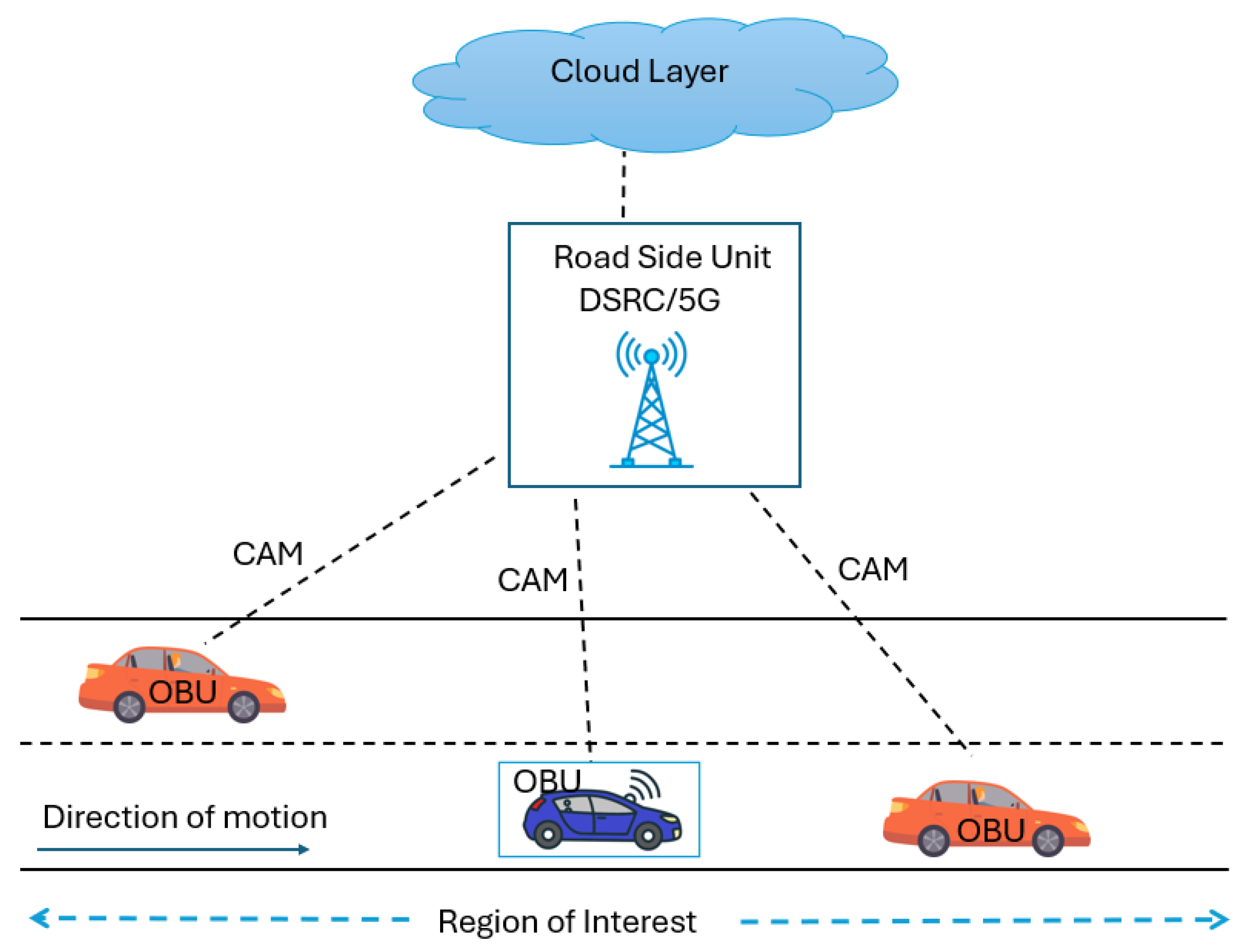
2. Vehicular Network in Intelligent Transportation Systems
3. Materials and Methods
3.1. Data for Driver Style Classification
3.2. Model Design for Driving Style with Fuzzy Logic Method
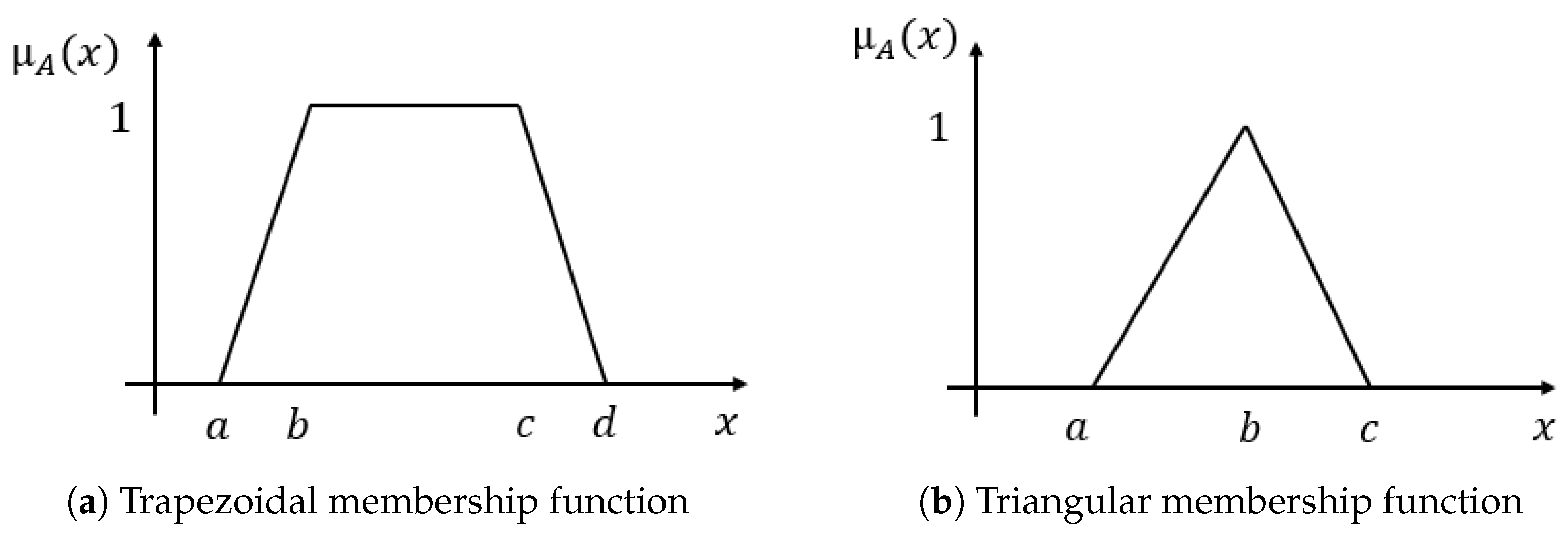
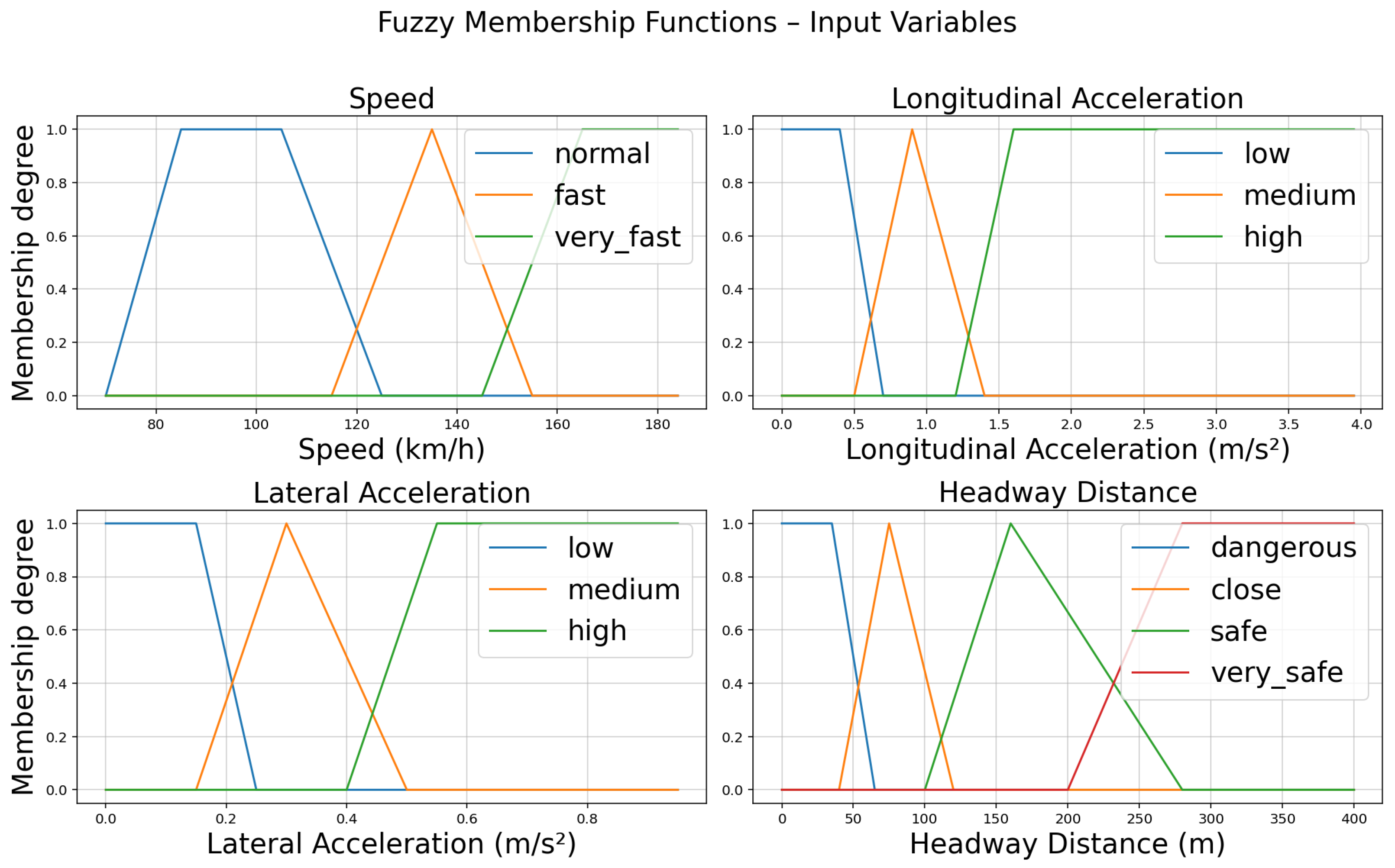
3.3. Methodology for Membership Function Design
- Speed (km/h): (Normal, Fast, Very Fast);
- Longitudinal Acceleration (m/s2): (Low, Medium, High);
- Lateral Acceleration (m/s2): (Low, Medium, High);
- Distance Headway (m): (Dangerous, Close, Safe, Very Safe).
3.4. Dataset Illustration for Membership Function Range Selection
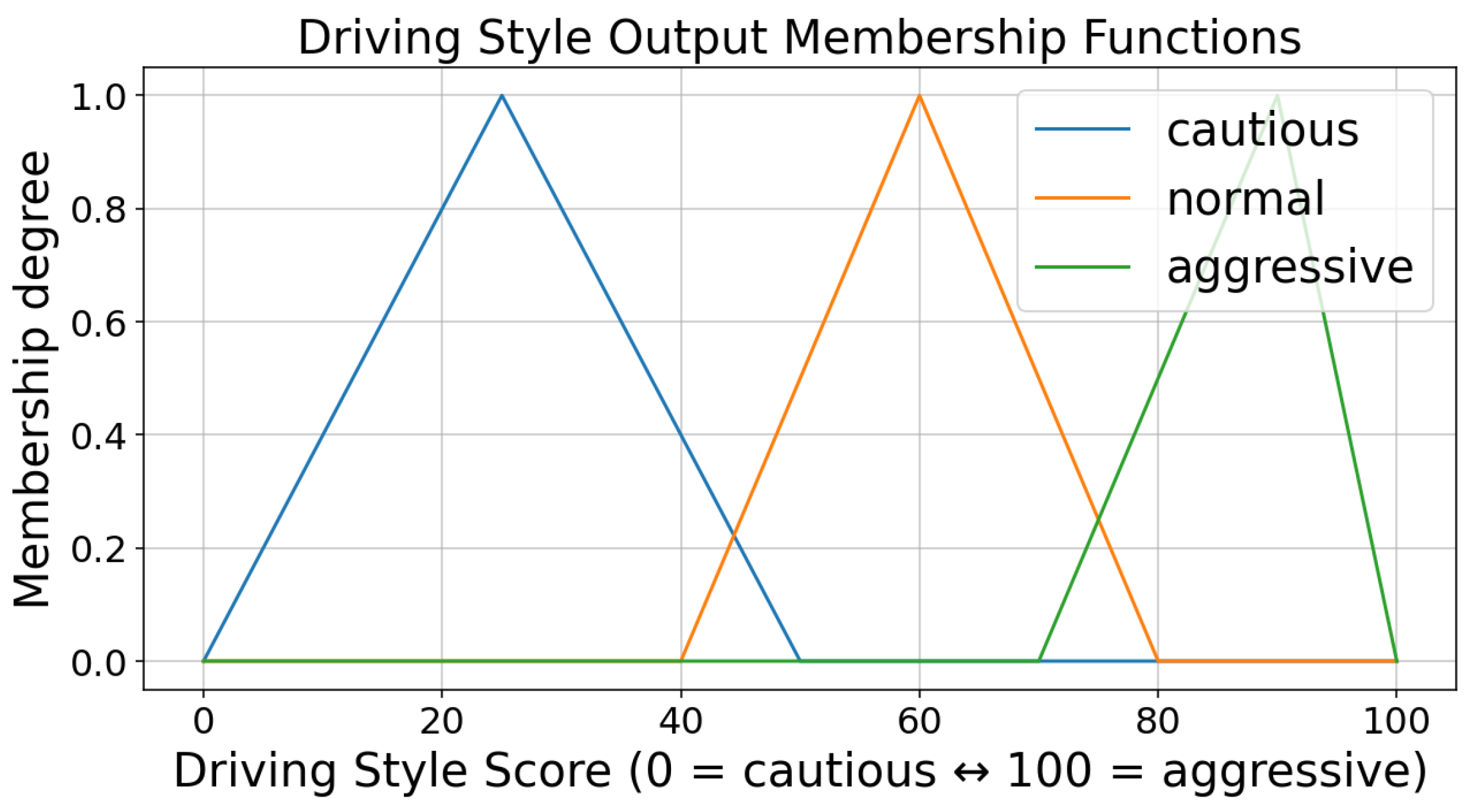
3.5. Output Variable: Driving Style
3.6. Rules for Driving Style Classification
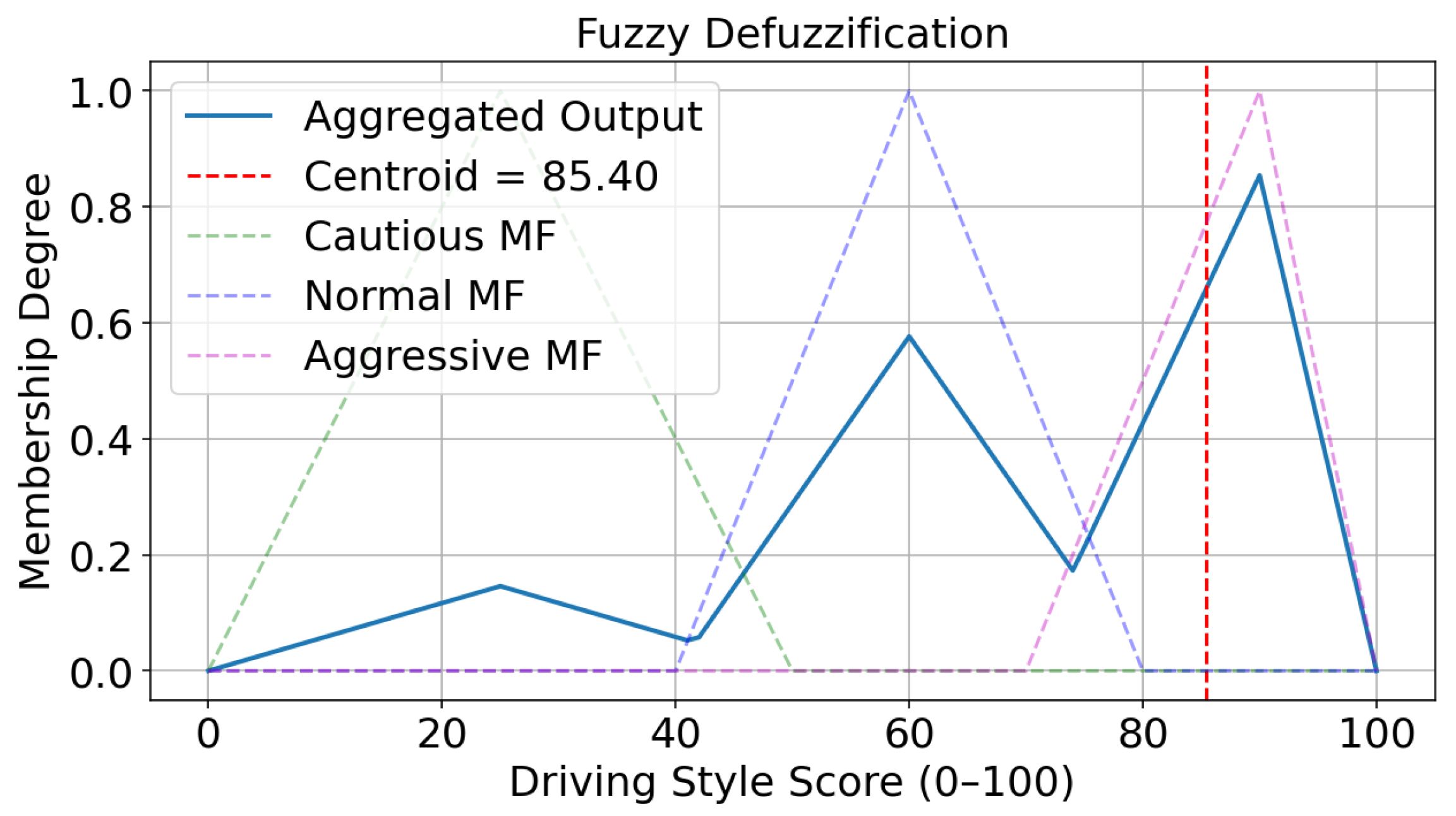
3.7. Defuzzification
4. Results and Discussion
4.1. Performance Evaluation for Driving Style Classification
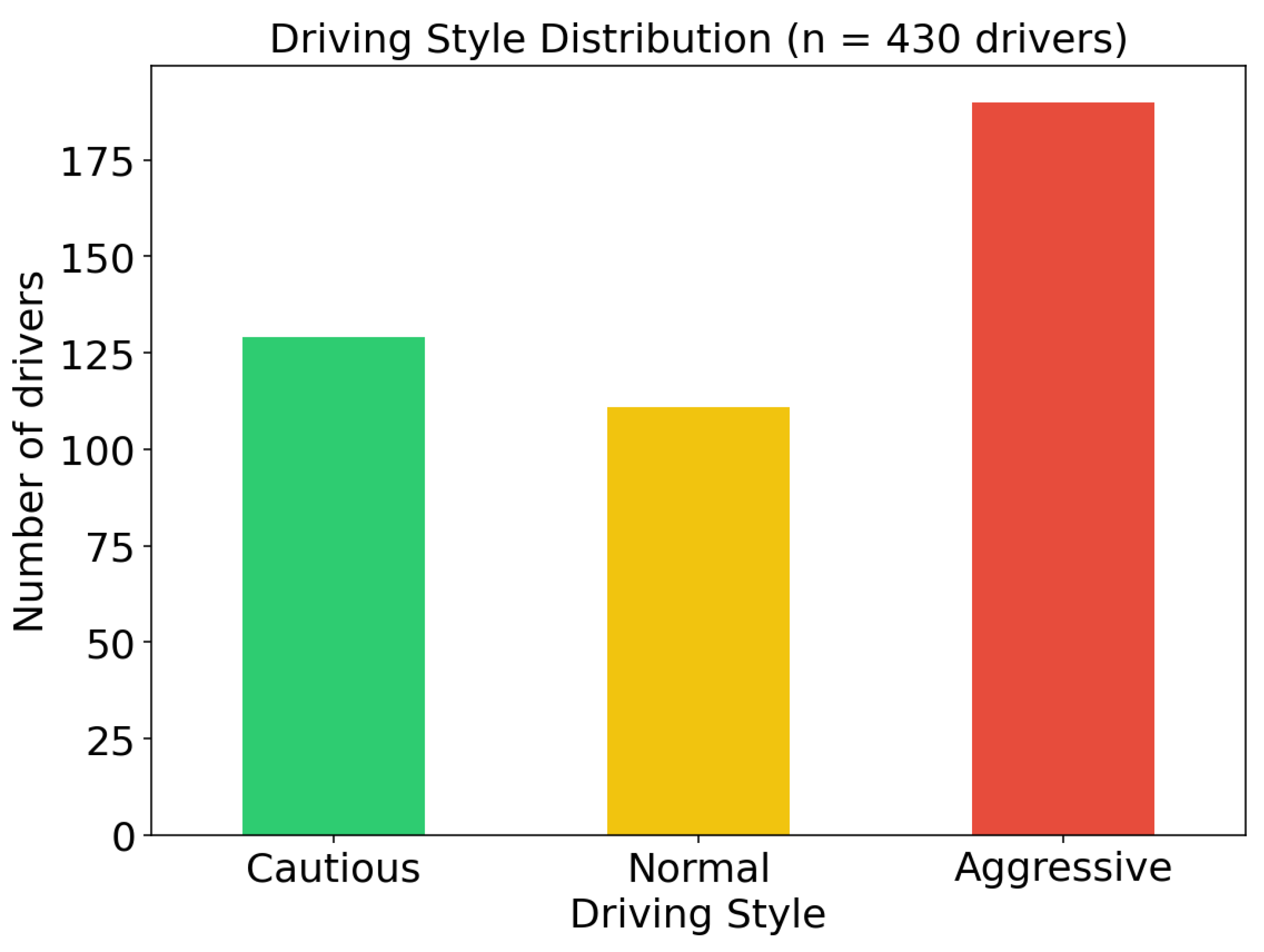
4.2. Evaluation Without Ground Truth (Descriptive Analysis)
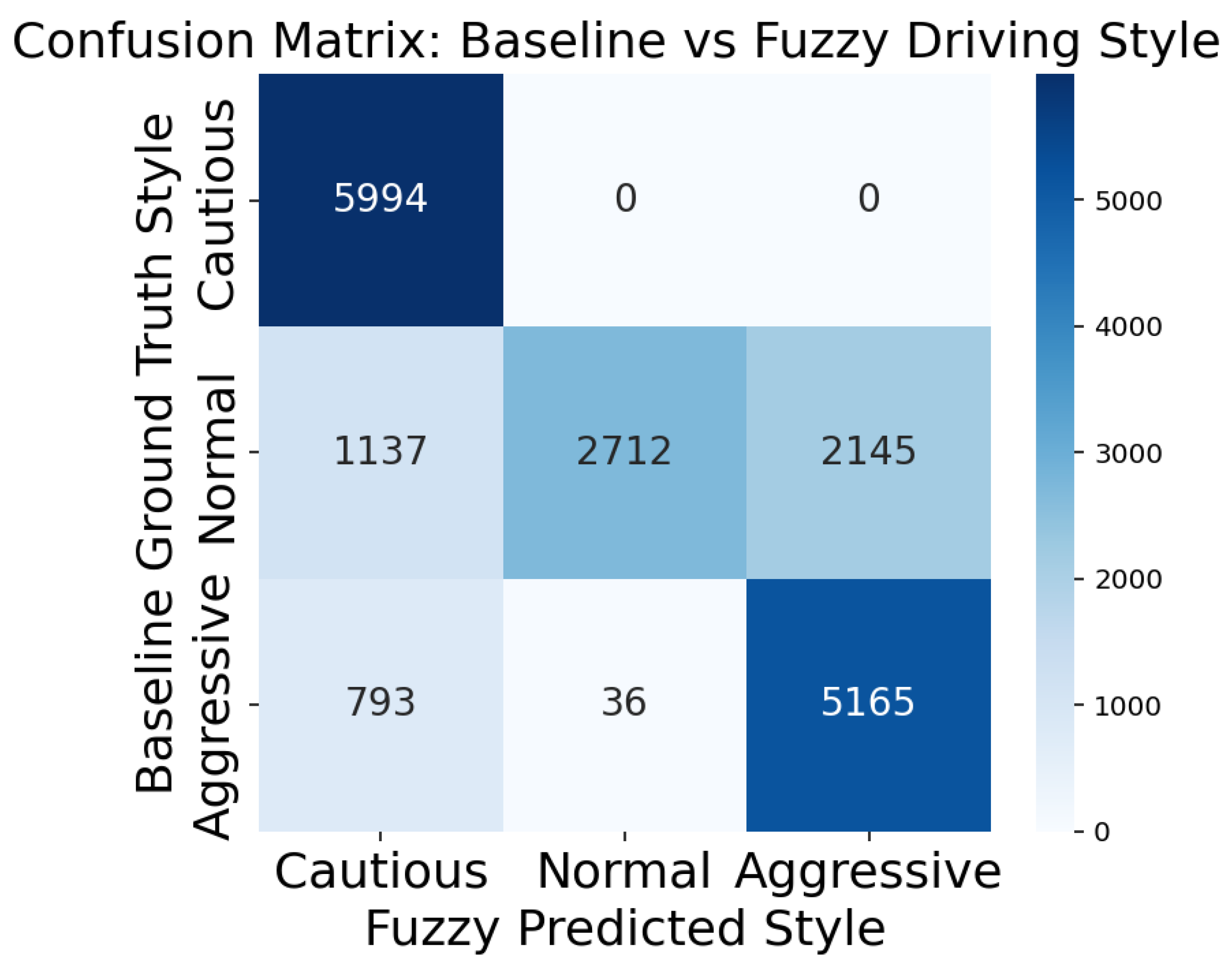
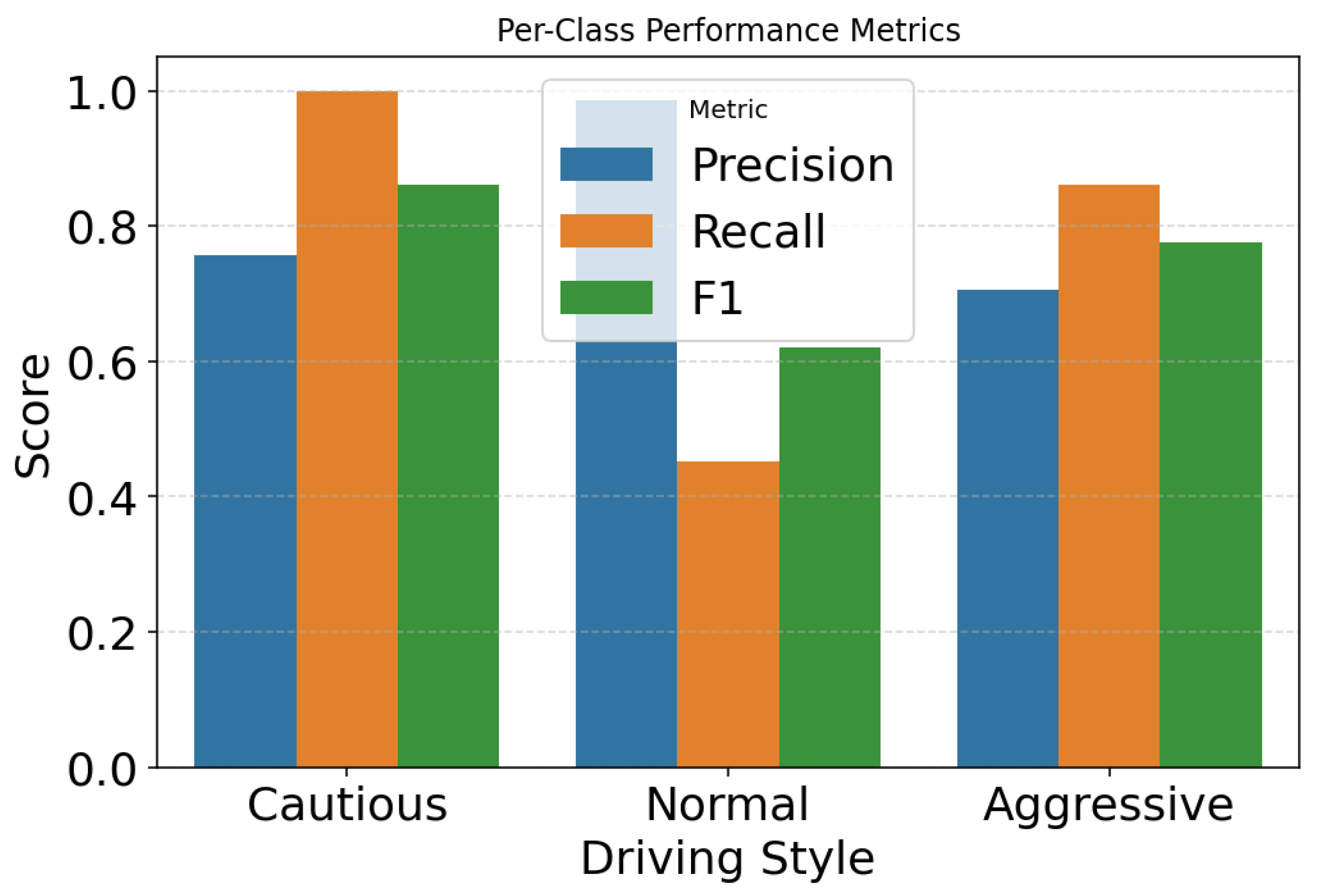
4.3. Evaluation with Subjective Ground Truth Labels from Algorithm 1
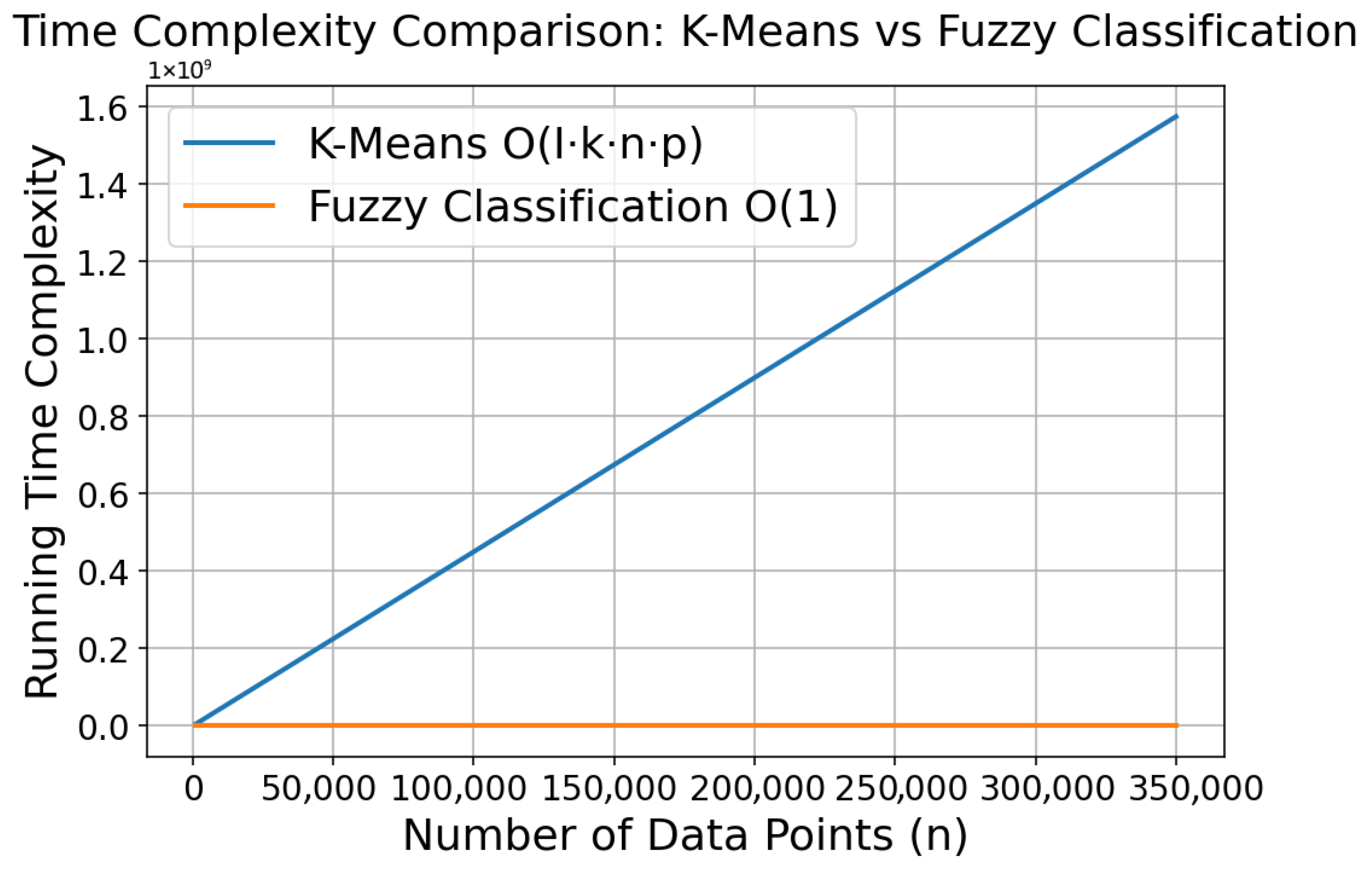
4.4. Comparison with K-Means Clustering and Computational Complexity
4.5. Random Forest Benchmark for Driving Style

4.6. Testing Driving Style for Lane-Change Prediction in ITS
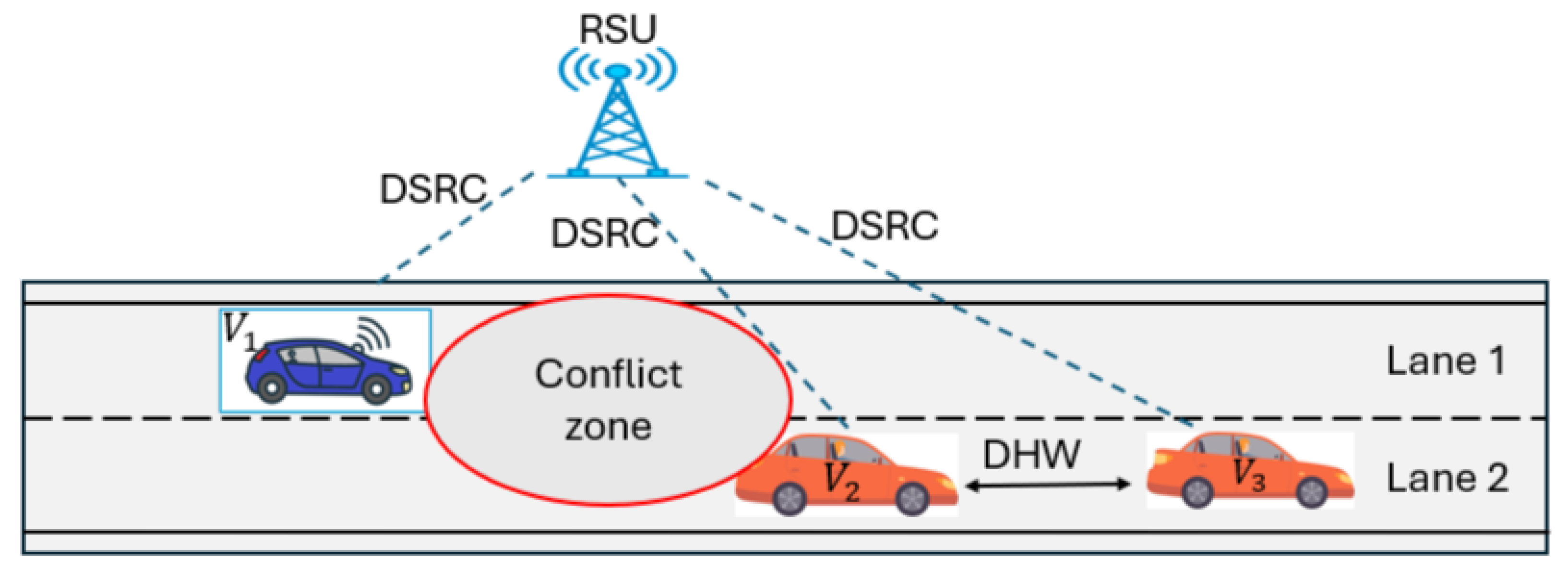
4.7. Use Case: Leveraging Driving Style for Lane-Change Prediction in ITS
5. Conclusions and Future Work
Author Contributions
Funding
Data Availability Statement
Acknowledgments
Conflicts of Interest
References
- Mei, P.; Karimi, H.R.; Ou, L.; Xie, H.; Zhan, C.; Li, G.; Yang, S. Driving Style Classification and Recognition Methods for Connected Vehicle Control in Intelligent Transportation Systems: A Review. ISA Trans. 2025, 158, 167–183. [Google Scholar] [CrossRef] [Scilit]
- Liao, X.; Zhao, X.; Wang, Z.; Zhao, Z.; Han, K.; Gupta, R.; Barth, M.J.; Wu, G. Driver Digital Twin for Online Prediction of Personalized Lane-Change Behavior. IEEE Internet Things J. 2023, 10, 13235–13246. [Google Scholar] [CrossRef] [Scilit]
- Alabdouli, H.; Hassan, M.S.; Abdelfatah, A. Enhancing Route Guidance with Integrated V2X Communication and Transportation Systems: A Review. Smart Cities 2025, 8, 24. [Google Scholar] [CrossRef] [Scilit]
- Peng, J.; Shangguan, W.; Chai, L.; Chen, J.; Peng, C.; Cai, B. V2X-Enabled Platoon Control for Aperiodic Congestion Mitigation via Moving Bottlenecks in Mixed Traffic Environments. IEEE Trans. Veh. Technol. 2025. early access. [Google Scholar] [CrossRef] [Scilit]
- Liu, H.; Dong, K.; Li, J.; Zheng, X. Research on Mandatory Lane Changing for Exiting of Buses in V2I Environments: A Centralized Cooperative Control Framework. IEEE Open J. Intell. Transp. Syst. 2026, 7, 492–507. [Google Scholar] [CrossRef] [Scilit]
- Nour, M.; Nour, M.; Zaki, M.H. Integrating Vehicle-to-Infrastructure Communication for Safer Lane Changes in Smart Work Zones. World Electr. Veh. J. 2025, 16, 215. [Google Scholar] [CrossRef] [Scilit]
- Fernandez, S.; Ito, T. Driver Classification for Intelligent Transportation Systems Using Fuzzy Logic. In Proceedings of the IEEE Intelligent Transportation Systems Conference (ITSC), Rio de Janeiro, Brazil, 1–4 November 2016; pp. 1212–1216. [Google Scholar]
- Lyu, N.; Wang, Y.; Wu, C.; Peng, L.; Thomas, A.F. Using Naturalistic Driving Data to Identify Driving Style Based on Longitudinal Driving Operation Conditions. J. Intell. Connect. Veh. 2022, 5, 17–35. [Google Scholar] [CrossRef] [Scilit]
- Hattori, H.; Nakajima, Y.; Ishida, T. Learning From Humans: Agent Modeling With Individual Human Behaviors. IEEE Trans. Syst. Man Cybern.-Part A 2011, 41, 1–9. [Google Scholar] [CrossRef] [Scilit]
- Zhao, L.; Xu, T.; Zhang, Z.; Hao, Y. Lane-Changing Recognition of Urban Expressway Exit Using Natural Driving Data. Appl. Sci. 2022, 12, 9762. [Google Scholar] [CrossRef] [Scilit]
- Ren, Y.; Li, F.; Li, Z. Lane-Change Risk Prediction Model Based on Traffic Context and Driving Styles. Sci. Rep. 2025, 15, 35153. [Google Scholar] [CrossRef] [Scilit]
- Peng, J.; Tang, H.; Wang, C.; Gu, X.; Peng, H. Intelligent Vehicles Lane-Changing Intention Identification Method with Driving Style Recognition. In Proceedings of the International Conference on Computer Supported Cooperative Work in Design (CSCWD), Tianjin, China, 8–10 May 2024; pp. 3036–3041. [Google Scholar]
- Lyu, Y.; Wang, Y.; Liu, H.; Dong, X.; He, Y.; Ren, Y. A Driving-Preference-Aware Framework for Vehicle Lane Change Prediction. Sensors 2025, 25, 5342. [Google Scholar] [CrossRef] [Scilit]
- Fu, X.; Liu, J.; Huang, Z.; Hainen, A.; Khattak, A.J. LSTM Based Lane Change Prediction Using Waymo Open Motion Dataset: The Role of Vehicle Operating Space. Digit. Transp. Saf. 2023, 2, 112–123. [Google Scholar] [CrossRef] [Scilit]
- Wissing, C.; Nattermann, T.; Glander, K.; Hass, C.; Bertram, T. Lane Change Prediction by Combining Movement and Situation Based Probabilities. IFAC-PapersOnLine 2017, 50, 3554–3559. [Google Scholar] [CrossRef] [Scilit]
- Liu, S.; Tan, D.; Hong, S.; Fu, H. Study on the Prediction of Lane Change Intention of Intelligent Vehicles in the Network Environment. World Electr. Veh. J. 2021, 12, 27. [Google Scholar] [CrossRef] [Scilit]
- Ye, M.; Pu, L.; Li, P.; Lu, X.; Liu, Y. Time-Series-Based Personalized Lane-Changing Decision-Making Model. Sensors 2022, 22, 6659. [Google Scholar] [CrossRef] [Scilit]
- Izquierdo, R.; Parra, I.; Muñoz-Bulnes, J.; Fernández-Llorca, D.; Sotelo, M.A. Vehicle trajectory and lane change prediction using ANN and SVM classifiers. In Proceedings of the 2017 IEEE 20th International Conference on Intelligent Transportation Systems (ITSC), Yokohama, Japan, 16–19 October 2017; pp. 1–6. [Google Scholar]
- Mei, P.; Karimi, H.R.; Huang, C.; Yang, S.; Chen, F. A Learning-Based Driving Style Classification Approach for Intelligent Vehicles. In Sensor Systems and Software (S-Cube); Springer: Cham, Switzerland, 2022. [Google Scholar]
- Dörr, D.; Grabengiesser, D.; Gauterin, F. Online Driving Style Recognition Using Fuzzy Logic. In Proceedings of the IEEE Intelligent Transportation Systems Conference (ITSC), Qingdao, China, 8–11 October 2014; pp. 1021–1026. [Google Scholar]
- Zhang, X.; Li, J.; Zhou, J.; Zhang, S.; Wang, J.; Yuan, Y.; Liu, J.; Li, L. Vehicle-to-Everything Communication in Intelligent Connected Vehicles: A Survey and Taxonomy. Automot. Innov. 2025, 8, 13–45. [Google Scholar] [CrossRef] [Scilit]
- Fernandez, S.; Ito, T.; Cruz-Piris, L.; Marsa-Maestre, I. Fuzzy Ontology-Based System for Driver Behavior Classification. Sensors 2022, 22, 7954. [Google Scholar] [CrossRef] [Scilit]
- Piróg, M.; Piróg, T.; Bartman, J.; Łukiewicz, K.; Hawro, P. The application of fuzzy logic for the identification and assessment of a driver’s driving style. In Proceedings of the 2024 Progress in Applied Electrical Engineering (PAEE), Koscielisko, Poland, 24–28 June 2024; pp. 1–5. [Google Scholar]
- Zhang, Z.; Zhang, T.; Hong, J.; Zhang, H.; Yangab, J. Energy management strategy of a novel electric–hydraulic hybrid vehicle based on driving style recognition. Sustain. Energy Fuels 2023, 7, 420–430. [Google Scholar] [CrossRef] [Scilit]
- Pachêco Gomes, I.; Wolf, D.F. Driving Style Recognition Using Interval Type-2 Fuzzy Inference System and Multiple Experts Decision-Making. Int. J. Fuzzy Syst. 2024, 26, 553–571. [Google Scholar] [CrossRef] [Scilit]
- Qiuyi, G.; Zhao, Z.; Shen, P.; Zhan, X.; Li, J. Adaptive Optimal Control Based on Driving Style Recognition for Plug-in Hybrid Electric Vehicle. Energy 2019, 186, 115824. [Google Scholar] [CrossRef] [Scilit]
- Kalra, N.; Goyal, R.; Parashar, A.; Singh, J.; Singla, G. Driving Style Recognition System Using Smartphone Sensors Based on Fuzzy Logic. Comput. Mater. Contin. 2021, 69, 1967–1978. [Google Scholar] [CrossRef] [Scilit]
- Cordero, J.; Aguilar, J.; Aguilar, K.; Chávez, D.; Puerto, E. Recognition of the Driving Style in Vehicle Drivers. Sensors 2020, 20, 2597. [Google Scholar] [CrossRef] [Scilit]
- Silva, I.; Eugenio Naranjo, J. A Systematic Methodology to Evaluate Prediction Models for Driving Style Classification. Sensors 2020, 20, 1692. [Google Scholar] [CrossRef] [Scilit]
- Arena, F.; Pau, G.; Severino, A. A Review on IEEE 802.11p for Intelligent Transportation Systems. J. Sens. Actuator Netw. 2020, 9, 22. [Google Scholar] [CrossRef] [Scilit]
- Wang, J.; Topilin, I.; Feofilova, A.; Shao, M.; Wang, Y. Cooperative Intelligent Transport Systems: The Impact of C-V2X Communication Technologies on Road Safety and Traffic Efficiency. Sensors 2025, 25, 2132. [Google Scholar] [CrossRef] [Scilit]
- Zadobrischi, E.; Havriliuc, Ș. Enhancing Scalability of C-V2X and DSRC Vehicular Communication Protocols with LoRa 2.4 GHz in the Scenario of Urban Traffic Systems. Electronics 2024, 13, 2845. [Google Scholar] [CrossRef] [Scilit]
- Jung, C.; Lee, D.; Lee, S.; Shim, D.H. V2X-Communication-Aided Autonomous Driving: System Design and Experimental Validation. Sensors 2020, 20, 2903. [Google Scholar] [CrossRef] [Scilit] [PubMed]
- Khalid, I.; Maglogiannis, V.; Naudts, D.; Shahid, A.; Moerman, I. Optimizing Hybrid V2X Communication: An Intelligent Technology Selection Algorithm Using 5G, C-V2X PC5 and DSRC. Future Internet 2024, 16, 107. [Google Scholar] [CrossRef] [Scilit]
- Rovid, A.; Viktor, T.; Márton, C.; Mihaly, C.; Adam, D.; Viktor, R.; Zsolt, V.; Matyas, S.; Matyas, M.; Szabolcs, N.; et al. Digital Twin and Cloud Based Remote Control of Vehicles. In Proceedings of the IEEE International Conference on Mobility, Operations, Services and Technologies, Dallas, TX, USA, 1–3 May 2024; pp. 154–167. [Google Scholar]
- Road Safety Authority. Rules of the Road; The O’Brien Press Ltd.: Dublin, Ireland, 2026. [Google Scholar]
- Sun, J.; Pan, S.; Pei, Y. Fuzzy Logic and Enhanced MOBIL Model for Lane-Changing Decisions in Mixed Traffic. Proc. Inst. Civ. Eng.-Transp. 2023. ahead-of-print. [Google Scholar] [CrossRef] [Scilit]
- Han, W.; Wang, W.; Li, X.; Xi, J. Statistical-Based Approach for Driving Style Recognition Using Bayesian Probability with Kernel Density Estimation. Intell. Transp. Syst. 2019, 13, 22–30. [Google Scholar] [CrossRef] [Scilit]
- Thakur, P.S.; Verma, R.K.; Tiwari, R. Analysis of Time Complexity of K-Means and Fuzzy C-Means Clustering Algorithm. Eng. Math. Lett. 2024, 2024, 4. [Google Scholar]
- Liao, X.; Wang, Z.; Zhao, X.; Zhao, Z.; Han, K.; Tiwari, P.; Barth, M.J.; Wu, G. Online Prediction of Lane Change with a Hierarchical Learning-Based Approach. In Proceedings of the IEEE International Conference on Robotics and Automation (ICRA), Philadelphia, PA, USA, 23–27 May 2022; pp. 948–954. [Google Scholar]
- Amaral, J.; Figueiredo, A.; Rito, P.; Sargento, S. Cooperative V2X Communications and Sensing for Autonomous Mobility. In Proceedings of the IEEE International Conference on Mobility, Operations, Services and Technologies, Newark, DE, USA, 4–7 May 2025; pp. 229–240. [Google Scholar]
- Ramos, J.; Figueiredo, A.; Almeida, P.; Aston, T.; Campos, A.; Perna, G.; Mendes, M.; Rito, P.; Sargento, S. Enhancing Autonomous Vehicles Control: Distributed Microservices with V2X Integration and Perception Modules. In Proceedings of the IEEE International Conference on Mobility, Operations, Services and Technologies, Dallas, TX, USA, 1–3 May 2024; pp. 143–153. [Google Scholar]





| Ref. | Input/Parameters | Output/Styles | Data Collection | Fuzzy Shape | Rules | Evaluation |
|---|---|---|---|---|---|---|
| [27] | Longitudinal acceleration, lateral acceleration, speed | Below mild, mild, reckless, very reckless | Accelerometer, GPS | Triangular, Trapezoidal | 11 rules | Various types of driving styles |
| [22] | Speed, accelerator, brake | Very passive, passive, normal, aggressive, dangerous | 3D simulator data | Triangular, Trapezoidal | Five rules | Using the normal model rules and compare with fuzzy output |
| [25] | Acceleration, deceleration, jerk | Calm, moderate, aggressive | Argoverse v1 Motion Forecasting Dataset | Trapezoidal | 135 rules created by eight experts | Comparison to clustering algorithms, comparison of different types of fuzzy |
| [28] | 27 multimodal descriptors across three layers (emotion, state, style) | Aggressive, normal, ecological | Artificial database | Triangular | Multilayer Fuzzy Classifier System | Large rule base leads to slower inference |
| [29] | Avg acceleration, deceleration, sudden events, violations | Aggressive, normal, calm | 50 drivers, naturalistic driving data collected on a real route | Triangular, trapezoidal | 15 human experts for ground truth, 10 rules | Compared with SVM, ANN, kNN, RF |
| [23] | Gas pedal, brake, route frame, cruise control usage, driving up to 87 km/h | Very poor, poor, acceptable, good, very good | Telematics system | Triangular, trapezoidal | Hundreds of multi-input fuzzy rules | Numerical score mapped to a driving style category |
| [24] | Maximum, minimum, and ratio of acceleration and deceleration; maximum, mean velocity | High, medium and low velocity | Actual vehicle data collected from an EV in Qingdao (9.3 km) | Fuzzy logic rules to map driving style | Knowledge of experts rules | Battery consumption reduction comparison |
| Feature | Mean | Min | Max |
|---|---|---|---|
| Speed (km/h) | 108.4 | 72.5 | 180.9 |
| Longitudinal Acceleration (m/s2) | 0.22 | 0.0 | 2.95 |
| Distance Headway (m) | 73.72 | 5.23 | 391.17 |
| Lateral Acceleration (m/s2) | 0.1 | 0.0 | 0.56 |
| Feature | Fuzzy Set | Type | Range |
|---|---|---|---|
| Speed (km/h) | normal | Trap. | 70–125 |
| fast | Tri. | 115–155 | |
| very fast | Trap. | 145–185 | |
| Longitudinal Acceleration (m/s2) | low | Trap. | 0–0.7 |
| medium | Tri. | 0.5–1.4 | |
| high | Trap. | 1.2–4.0 | |
| Lateral Acceleration (m/s2) | low | Trap. | 0–0.25 |
| medium | Tri. | 0.15–0.50 | |
| high | Trap. | 0.40–1.0 | |
| Distance Headway (m) | dangerous | Trap. | 0–65 |
| close | Tri. | 40–120 | |
| safe | Tri. | 100–280 | |
| very safe | Trap. | 200–400 | |
| Driving Style (Output) | cautious | Tri. | 0–45 |
| normal | Tri. | 45–75 | |
| aggressive | Tri. | 75–100 |
| Rule | Antecedents (If) | Consequent (Then) |
|---|---|---|
| 1 | distance headway (“dangerous”) or longitudinal acceleration (“high”) or lateral acceleration (“high”) | Aggressive |
| 2 | speed (“very fast”) and distance headway (“close”) | Aggressive |
| 3 | longitudinal acceleration (“high”) and distance headway (“close”) | Aggressive |
| 4 | speed (“very fast”) and longitudinal acceleration (“medium”) | Aggressive |
| 5 | distance headway (“very safe”) and longitudinal acceleration (“low”) and speed (“normal”) | Cautious |
| 6 | distance headway (“safe”) and longitudinal acceleration (“low”) | Cautious |
| 7 | distance headway (“safe”) and speed (“fast”) and longitudinal acceleration (“medium”) | Normal |
| 8 | distance headway (“close”) and speed (“normal”) | Normal |
Disclaimer/Publisher’s Note: The statements, opinions and data contained in all publications are solely those of the individual author(s) and contributor(s) and not of MDPI and/or the editor(s). MDPI and/or the editor(s) disclaim responsibility for any injury to people or property resulting from any ideas, methods, instructions or products referred to in the content. |
© 2026 by the authors. Licensee MDPI, Basel, Switzerland. This article is an open access article distributed under the terms and conditions of the Creative Commons Attribution (CC BY) license.
Share and Cite
Koc, M.F.; Ashraf, N.; Pathak, P.; Sharma, S. Fuzzy Logic-Based Driving Style Classification for Lane-Change Prediction in Intelligent Transportation Systems. Future Internet 2026, 18, 256. https://doi.org/10.3390/fi18050256
Koc MF, Ashraf N, Pathak P, Sharma S. Fuzzy Logic-Based Driving Style Classification for Lane-Change Prediction in Intelligent Transportation Systems. Future Internet. 2026; 18(5):256. https://doi.org/10.3390/fi18050256
Chicago/Turabian StyleKoc, Muhammed Fatih, Nouman Ashraf, Pramod Pathak, and Sachin Sharma. 2026. "Fuzzy Logic-Based Driving Style Classification for Lane-Change Prediction in Intelligent Transportation Systems" Future Internet 18, no. 5: 256. https://doi.org/10.3390/fi18050256
APA StyleKoc, M. F., Ashraf, N., Pathak, P., & Sharma, S. (2026). Fuzzy Logic-Based Driving Style Classification for Lane-Change Prediction in Intelligent Transportation Systems. Future Internet, 18(5), 256. https://doi.org/10.3390/fi18050256