
Article

EKG-NSGA-III: An Expert Knowledge-Guided Improved NSGA-III for Large-Scale Frequency Assignment in Ultra-Dense Heterogeneous Networks

1
School of Communication and Electronic Engineering, East China Normal University, Shanghai 200062, China
2
College of Electronic Engineering, National University of Defense Technology, Hefei 230037, China
*
Author to whom correspondence should be addressed.
Future Internet 2026, 18(5), 247; https://doi.org/10.3390/fi18050247
Submission received: 2 April 2026 / Revised: 2 May 2026 / Accepted: 3 May 2026 / Published: 7 May 2026
(This article belongs to the Special Issue IoT, Edge, and Cloud Computing in Smart Cities, 2nd Edition)

Abstract

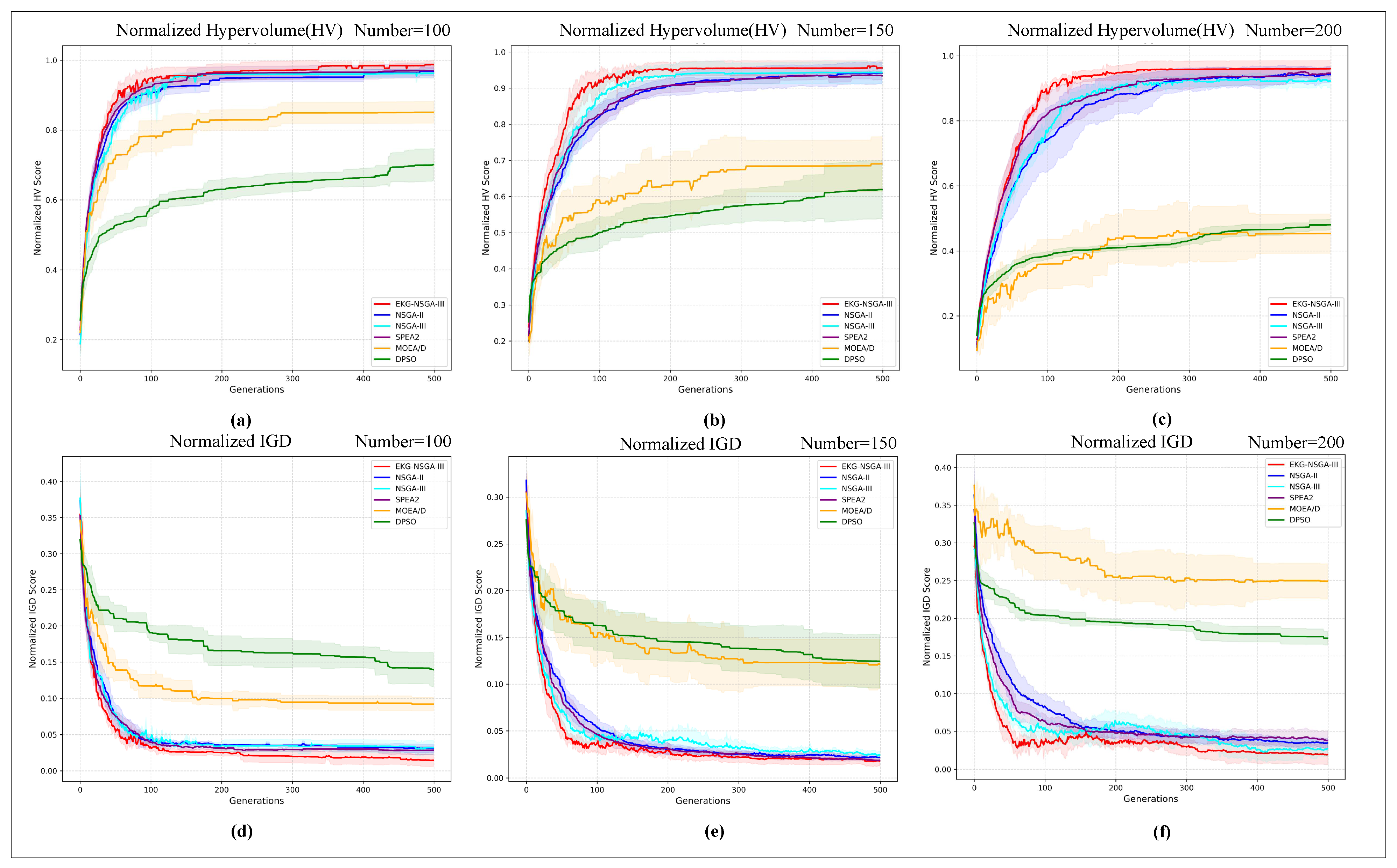
To address the critical requirements for electromagnetic spectrum orchestration in complex ultra-dense communication environments, this paper proposes an Expert Knowledge-Guided improved NSGA-III framework to solve large-scale frequency assignment problems efficiently. which is built upon the standard NSGA-III architecture as the algorithmic backbone. Traditional multi-objective evolutionary algorithms often struggle with slow convergence and insufficient local search capabilities when navigating high-dimensional, strongly constrained search spaces. In this study, we first introduce a Conflict Graph-based Intelligent Initialization strategy to generate high-quality initial populations by constructing an interference conflict graph based on network topology. Second, a Knowledge-Guided Mutation operator is designed to precisely identify and reconfigure conflicting communication nodes using physical layer indicators. Furthermore, a Best-individual Guided Double-Scale Mutation mechanism is incorporated to dynamically balance global exploration and local exploitation. Experimental results on complex multi-node datasets demonstrate that EKG-NSGA-III significantly outperforms the standard NSGA-III and other baseline algorithms in terms of Hypervolume and Inverted Generational Distance. Specifically, for the 200 nodes scenario, the proposed method achieves a 25.7% improvement in IGD and a 4.2% increase in HV compared to the standard NSGA-III. The proposed algorithm provides a robust and efficient solution for spectrum management in complex urban electromagnetic environments, such as future smart city infrastructures.
Keywords: frequency assignment; NSGA-III; Knowledge-Guided Mutation; Ultra-Dense Networks (UDN); spectrum management; multi-objective optimization frequency assignment; NSGA-III; Knowledge-Guided Mutation; Ultra-Dense Networks (UDN); spectrum management; multi-objective optimization