Article

Resource Allocation for D2D Communications in Multi-Slice NOMA-Based Cellular Networks

School of Computer Science and Engineering, Northeastern University, Shenyang 110169, China
*
Author to whom correspondence should be addressed.
Future Internet 2026, 18(5), 246; https://doi.org/10.3390/fi18050246
Submission received: 31 March 2026 / Revised: 29 April 2026 / Accepted: 2 May 2026 / Published: 6 May 2026
(This article belongs to the Special Issue 6G Wireless Network Technologies)

Abstract

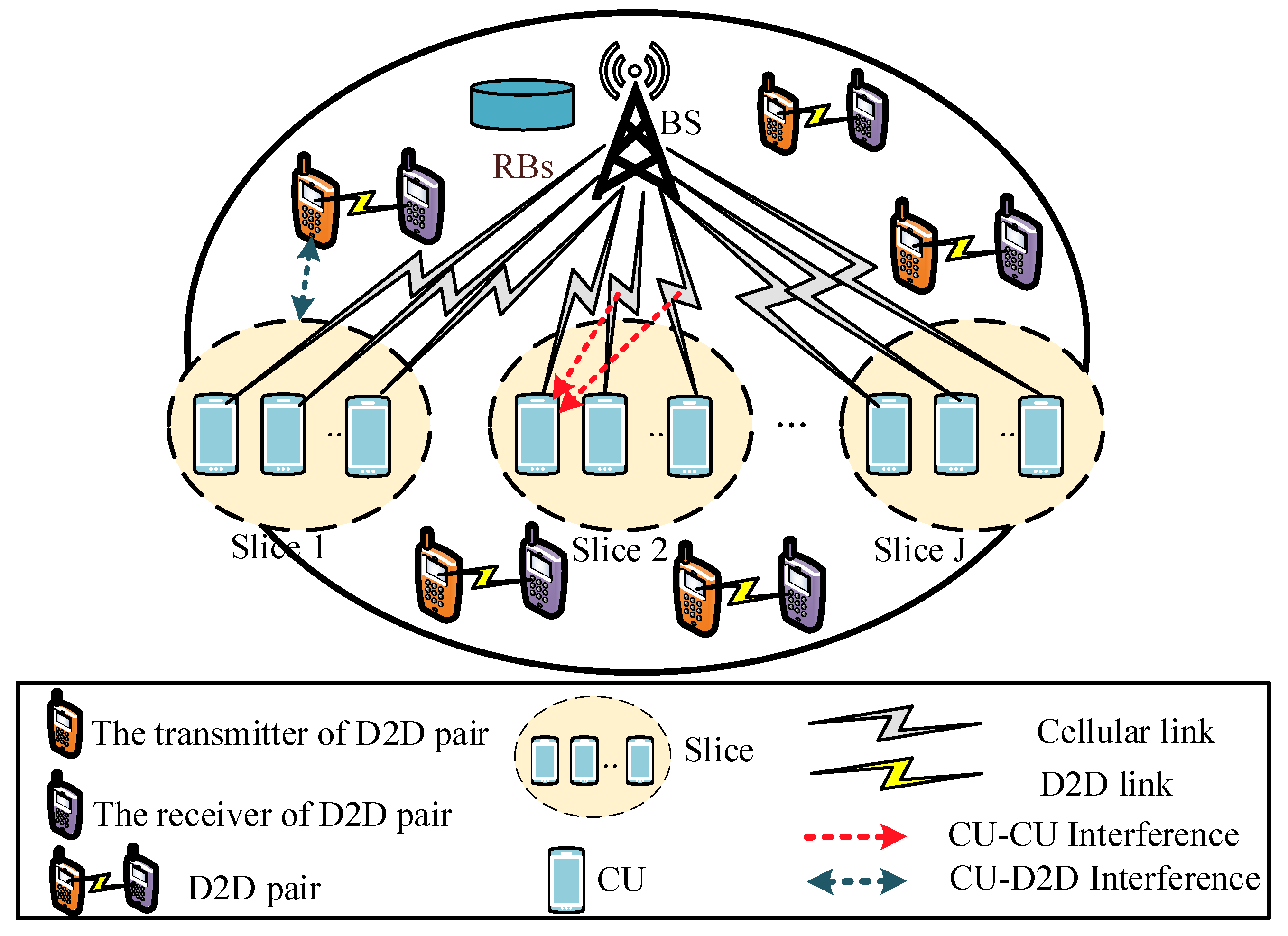
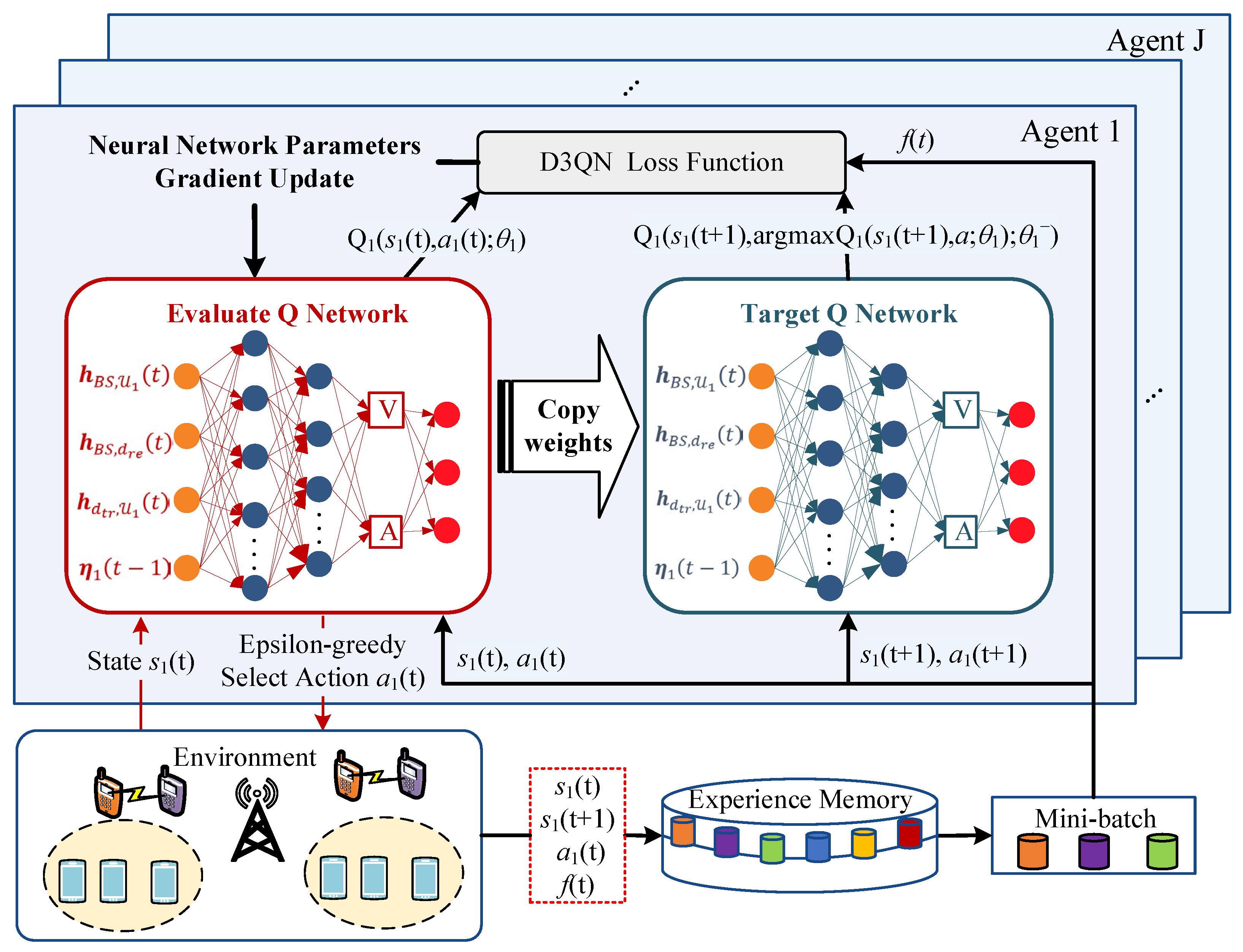
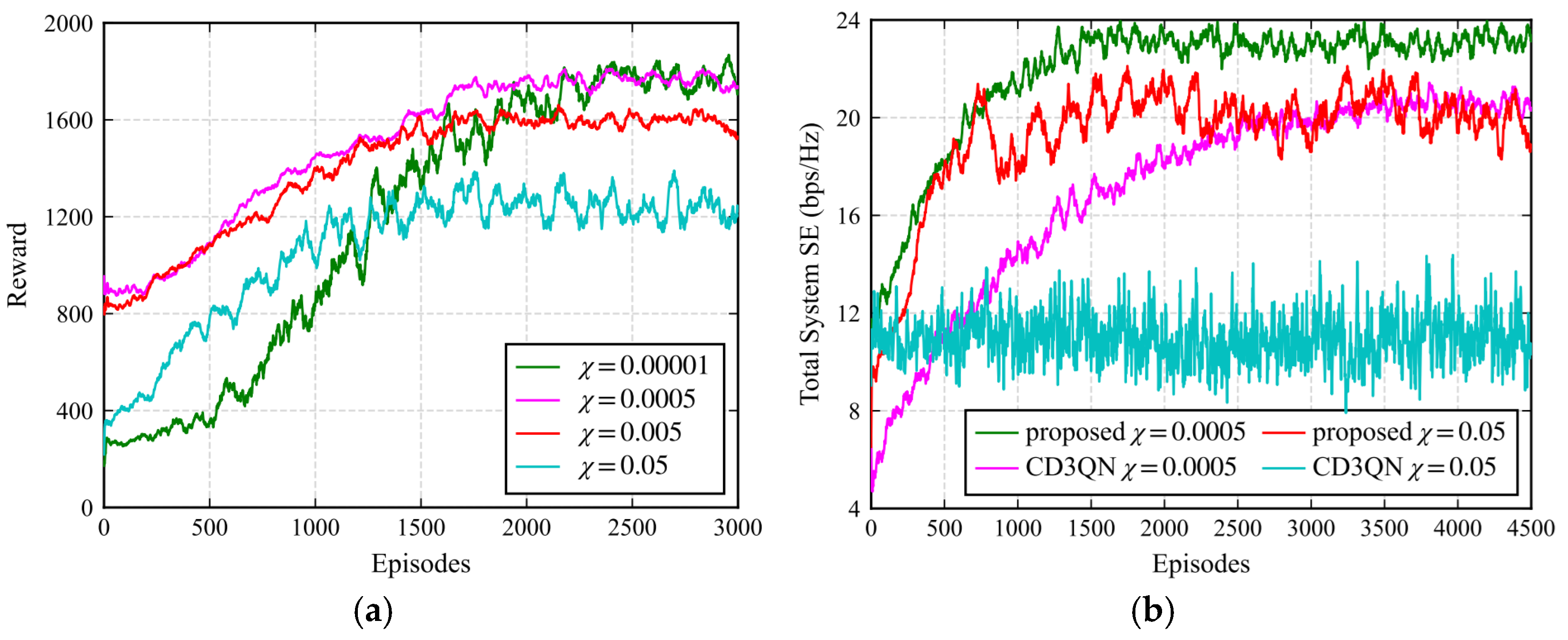
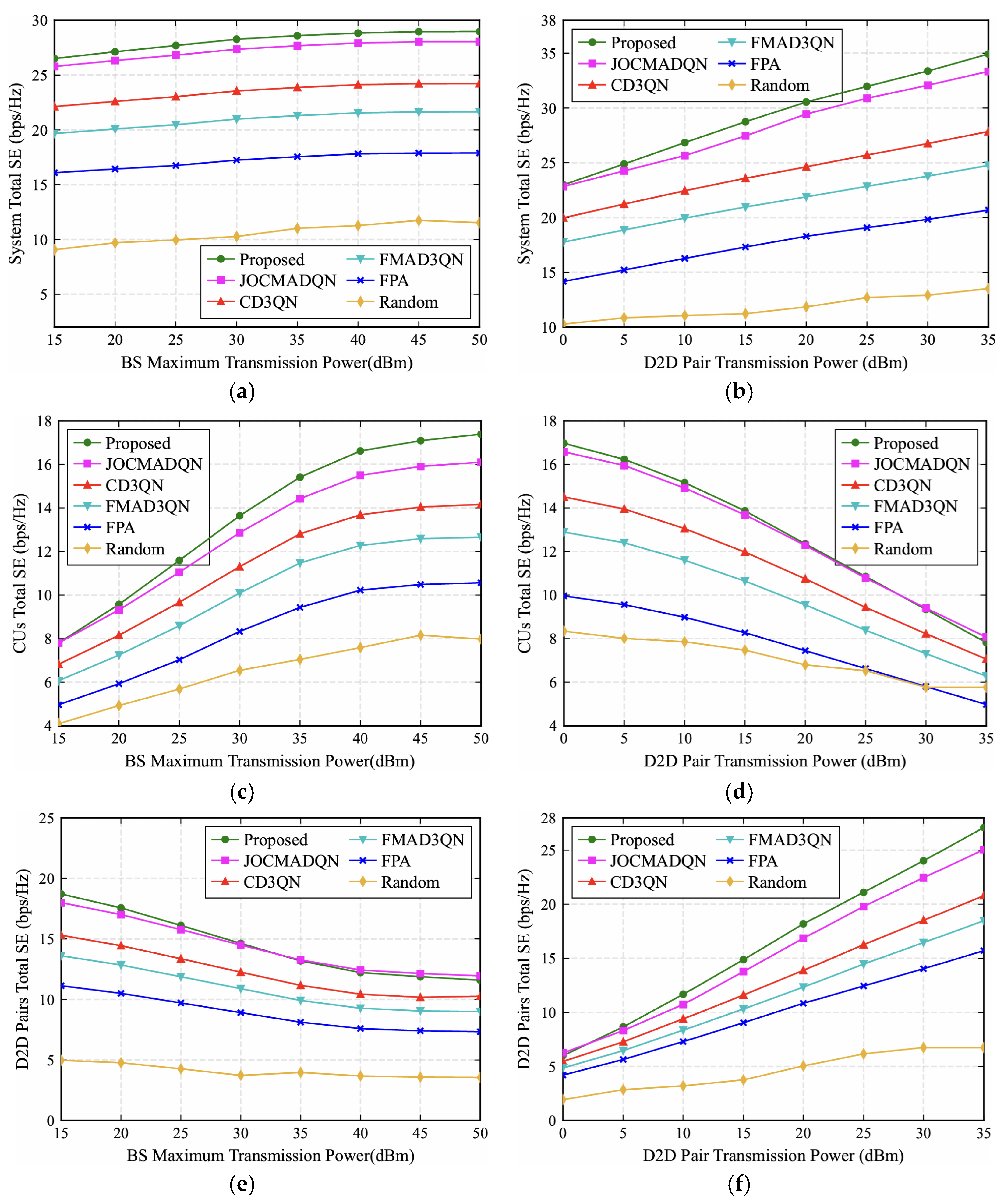
Significant challenges will be encountered in next-generation cellular networks to achieve both high spectral efficiency (SE) and diverse quality of service (QoS) requirements simultaneously, particularly under stringent bandwidth and power budgets within highly dynamic and dense topologies. To address these challenges, we formulate an optimization problem in a multi-slice non-orthogonal multiple access (NOMA) system with underlay device-to-device (D2D) communications. This problem aims to maximize SE and satisfy user QoS demands by jointly optimizing power allocation and resource block (RB) assignment. To solve this non-convex and NP-hard problem, we propose a resource allocation mechanism based on joint optimization and cooperative multi-agent deep reinforcement learning (MADRL). Specifically, we construct an optimization framework based on successive convex approximation (SCA) and the Lagrange duality method to derive an analytical iterative solution for the optimal power allocation under a given RB assignment, thereby avoiding the inherent discretization error of the action space in pure learning methods. Furthermore, we propose a cooperative multi-agent algorithm based on dueling double deep Q-Network (CMAD3QN) to address the discrete RB assignment problem. Simulation results demonstrate that, compared with benchmark schemes, the proposed scheme exhibits faster convergence speed and significantly enhances system spectral efficiency while ensuring slice isolation and resource constraints.
Keywords: non-orthogonal multiple access; network slicing; device-to-device communications; resource allocation; joint optimization; D3QN non-orthogonal multiple access; network slicing; device-to-device communications; resource allocation; joint optimization; D3QN