1. Introduction
Radio frequency spectrum is a cornerstone of modern digital society, supporting critical services such as high-speed mobile communications, autonomous driving, the Internet of Things (IoT), and smart city infrastructures. With the massive deployment of multi-dimensional communication equipment across urban environments, the contradiction between the scarcity of spectrum resources and the surge in connectivity demand has become increasingly prominent. The core objective of the Frequency Assignment Problem (FAP) is to allocate limited frequency points reasonably under the premise of satisfying electromagnetic compatibility constraints, thereby eliminating the impact of co-channel and adjacent-channel interference in high-density network deployments.
Whether for long-term network planning or real-time resource management, the FAP is essentially an NP-Hard combinatorial optimization problem characterized by a strongly constrained search space. Its complexity is primarily rooted in its equivalence to the generalized graph coloring problem under multi-level interference constraints. In extensive ultra-dense contexts, the number of potential assignment combinations grows factorially with the scale of nodes, while the intricate electromagnetic compatibility constraints significantly prune the feasible region, making the search for optimal solutions computationally exhaustive. Fundamental research by Hale established the basic criteria for frequency-distance constraint models [
1], which were later extended by Gamst [
2] to address specific requirements in mobile automatic systems. Early studies primarily relied on deterministic methods, such as branch-and-bound techniques [
3], graph coloring theory [
4], and constraint satisfaction frameworks [
5]. However, as the scale of commercial networks expanded, the computational time of deterministic algorithms increased exponentially, making them unsuitable for the low-latency requirements of modern communication systems; thus, meta-heuristic algorithms have become the mainstream approach.
To date, the development of these meta-heuristic optimization strategies can be categorized into two primary streams: traditional single-objective heuristics focusing on feasibility, and modern multi-objective frameworks targeting complex trade-offs. Subsequent developments saw a diverse range of optimization strategies. Aardal et al. [
6] systematically reviewed the mathematical models of FAP and solution techniques such as tabu search and simulated annealing. Specifically, researchers explored enhanced search procedures with polarization constraints [
7,
8] and developed guided genetic algorithms [
9]. Various local search algorithms [
10,
11] and their performance comparisons [
12] have demonstrated that while effective for static tasks, these methods encounter significant challenges when dealing with the high-dimensional and dynamic nature of modern spectrum orchestration in heterogeneous architectures [
13].
In the realm of multi-objective optimization, the algorithm based on dominance and decomposition (MOEA/D) proposed by Li et al. [
14,
15] further enhanced search capabilities under complex interference constraints. Furthermore, the Reference-point-based Non-dominated Sorting Genetic Algorithm (NSGA-III) laid an important foundation for solving multi-objective tasks with complex boundary constraints [
16], while Vesikar et al. improved search precision through a preference reference point mechanism [
17]. In specific scenarios, researchers have explored diverse paths, such as satellite communications [
18], interference coordination in ultra-dense Radio Access Networks (RANs) [
19], and spectrum optimization in cognitive radio IoT [
20,
21,
22]. Related technologies have been widely extended to cloud computing resource allocation [
23] and 5G Device-to-Device (D2D) communications [
24]. As stated by Kouhalvandi et al. [
25], evolutionary algorithms have become an inevitable trend for modern mobile communication optimization, with many-objective surveys [
26] and decomposition-based approaches [
27] indicating broad prospects for complex configurations.
Despite the development of various optimization strategies for large-scale real-world FAP instances [
28], existing multi-objective evolutionary algorithms encounter substantial hurdles when addressing large-scale instances in complex ultra-dense network (UDN) scenarios. A critical research gap remains: most existing algorithms operate in a “black-box” manner, relying on stochastic operators that ignore the underlying physical-layer laws of the electromagnetic environment. Specifically, the traditional reliance on random sampling for initialization exhibits significant blindness, making it difficult to generate competitive initial solutions within intricate electromagnetic interference constraints. Furthermore, standard evolutionary operators often lack physical-layer guidance and depend solely on statistical properties, thereby ignoring critical electromagnetic laws, such as spatial distance and propagation loss, which result in inefficient repair of interference zones. To address these constrained multi-objective optimization issues, the process knowledge-guided technology proposed by Zuo et al. [
29] provides an important research direction for utilizing domain rules to optimize the search process.
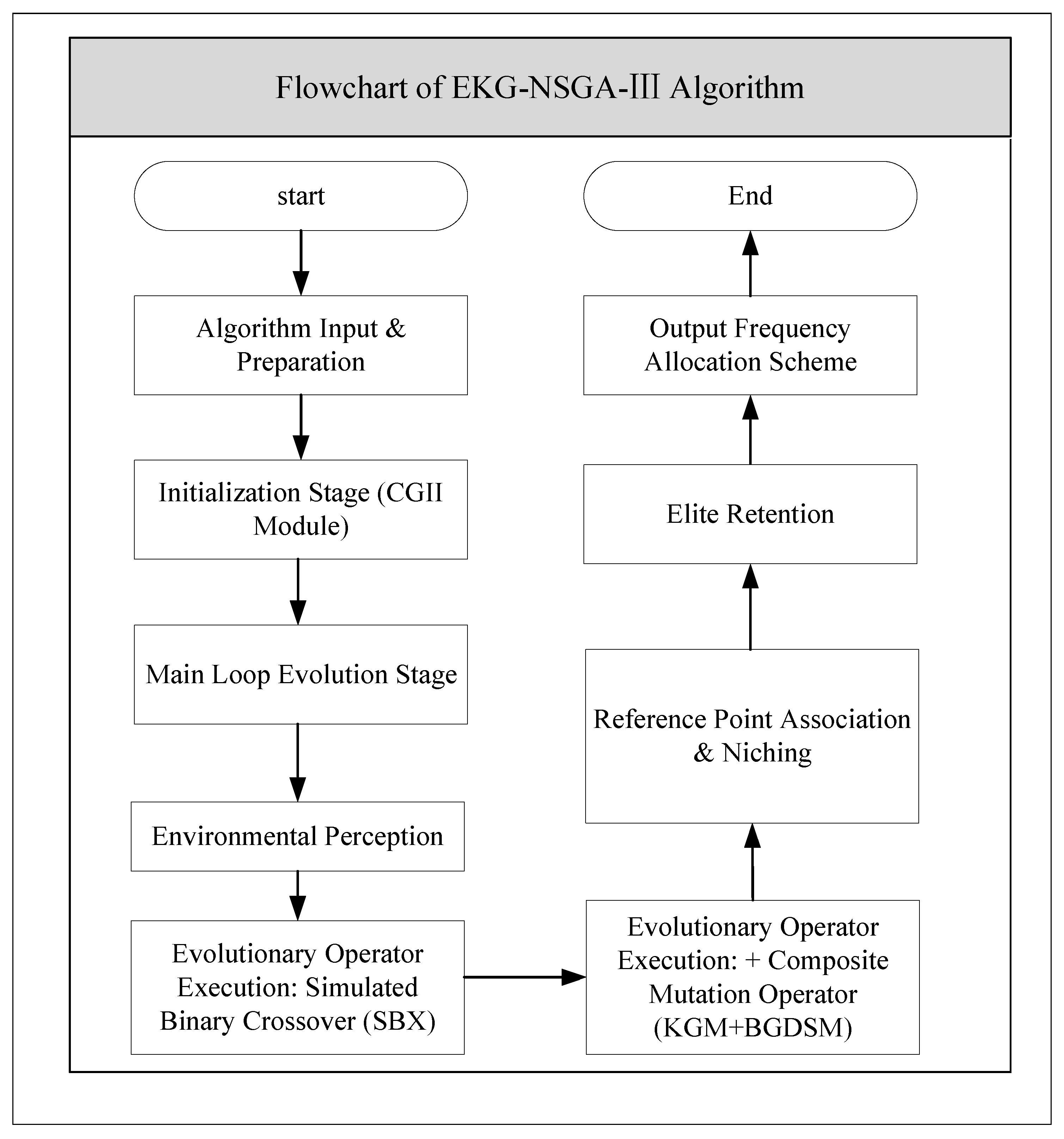
To address the issues of blind initialization, slow response to physical constraints, and the difficulty of balancing convergence in large-scale urban frequency assignment, this paper proposes an Expert Knowledge-Guided improved NSGA-III algorithm framework (EKG-NSGA-III). By deeply integrating a network physical environment analysis module, the framework transforms geospatial conflict priors and physical layer interference criteria into the search momentum of the algorithm.
The main contributions of this paper are as follows:
Conflict Graph-based Intelligent Initialization (CGII): This module constructs a conflict graph model based on geographic locations and distance thresholds. By employing greedy coloring logic, it injects "interference-free" prior knowledge into the population initialization process, significantly elevating the quality of the search starting point.
Knowledge-Guided Mutation (KGM): This operator introduces a physical environment analyzer to identify the indices of interfered nodes in real-time. Compared to blind random mutation, KGM focuses specifically on reconfiguring conflict nodes, thereby improving the efficiency of directional search for interference mitigation.
Best-individual Guided Double-Scale Mutation (BGDSM): This mechanism designs a dual-scale mutation strategy where fine-tuning is performed on non-conflicting nodes. For conflicting nodes, the algorithm either learns from the current Pareto optimal set or executes large-scale jumps, achieving a dynamic balance between global exploration and local exploitation.
The remainder of this paper is organized as follows:
Section 2 introduces the system model and problem description.
Section 3 elaborates on the proposed EKG-NSGA-III algorithm framework in detail.
Section 4 presents and analyzes the performance results. Finally,
Section 5 summarizes the paper.
2. System Model
Establishing a precise physical environment model and interference evaluation criteria is the prerequisite for implementing efficient optimization algorithms in frequency assignment problems. This section describes the system model from four dimensions: the spatial topology model, the electromagnetic propagation loss model, interference criteria, and the definition of the multi-objective optimization functions for ultra-dense heterogeneous networks.
2.1. Spatial Coordinate Transformation Model
To accurately calculate the spatial distance between communication nodes deployed at different geographical locations in an urban environment, it is first necessary to convert the Longitude-Latitude-Altitude (LLA) coordinates into three-dimensional spatial coordinates in the Earth-Centered, Earth-Fixed (ECEF) coordinate system.
Let the longitude, latitude, and altitude of the
i-th communication node be
,
,
, respectively. Its spatial coordinates
are calculated as follows:
where
km represents the average radius of the Earth. The straight-line Euclidean distance
between node
i and node
j is defined as:
2.2. Discrete Frequency Decision Space
Spectrum resources available in modern urban networks are typically divided into discrete sets of frequency points according to regulatory standards. Let N be the total number of communication nodes (e.g., small cells, IoT gateways) to be assigned. For each node i, the set of available frequency points is denoted as .
In this study, we employ an Integer Encoding scheme for the chromosome representation. The decision variable is the index vector
X =
, where each gene
represents the indexof the selected frequency within the set
. Specifically, the actual frequency assigned to node
i is
. This encoding inherently restricts the search to the discrete available spectrum, and feasibility is maintained by ensuring
.
The decision variable of the algorithm is the index vector
X:
where
denotes the
x-th frequency point selected from the set
for node
i.
2.3. Electromagnetic Interference Link Model
This study utilizes the Free Space Propagation Loss (FSPL) model to characterize the signal attenuation in vacuum or atmospheric environments. When node
i acts as the transmitter and node
j acts as the receiver, the link loss
is calculated as:
The corresponding received power
is given by:
where
is the transmission power, and
and
are the antenna gains. A necessary condition for interference is that the received interference signal strength exceeds the receiver’s sensitivity threshold
. The interference decision function
is defined as:
Based on this, the interference types are categorized into two classes according to the frequency difference
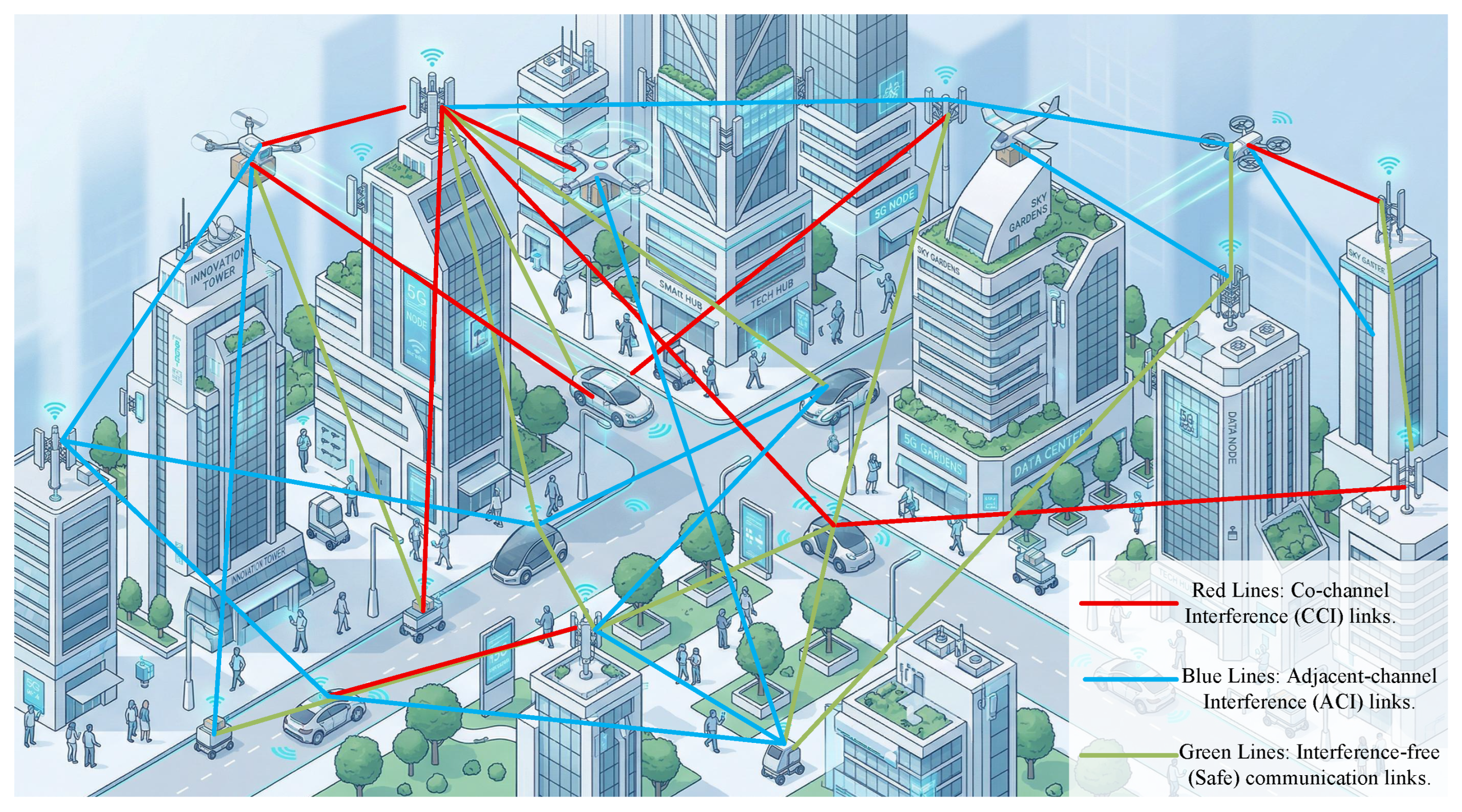
. The typical interference scenarios and link categories are visually represented in
Figure 1.
Co-channel interference: Occurs if GHz (i.e., identical frequency).
Adjacent-channel interference: Occurs if , where is the receiving bandwidth of node j.
2.4. Multi-Objective Optimization Function Definition
To comprehensively evaluate the assignment schemes, we construct a minimization optimization vector containing four sub-objectives:
- 1.
: Total number of co-channel interferences. This objective counts the number of links in the model where co-channel conflicts occur and the intensity exceeds the threshold.
- 2.
: Total number of adjacent-channel interferences. This counts the links that satisfy adjacent-channel interference conditions with physical interference present.
- 3.
: Spectrum interference risk weight. This quantifies the criticality of adjacent-channel interference through the reciprocal of the frequency difference (where smaller
indicates a higher risk of actual interference if environment parameters fluctuate).
where
is a risk weight coefficient assigned to the specific link between node
i and node
j.
- 4.
: Business satisfaction (negatived). This performs a weighted sum of nodes in a completely interference-free state based on their priority levels (e.g., levels 1–3), aiming to maximize the quality of high-priority services. Isolated nodes are defined as communication units that strictly satisfy all spectral constraints, exhibiting zero co-channel or adjacent-channel interference within the assignment scheme.
The defined sub-objectives are inherently conflicting: reducing co-channel interference () typically requires spreading frequencies, which may increase adjacent-channel conflicts () or spectrum risk (). Moreover, maximizing business satisfaction () demands complete interference isolation for high-priority nodes, which frequently contradicts the goal of minimizing the total interference count in spectrum-constrained, ultra-dense environments. In summary, this section establishes a rigorous mathematical model for the urban frequency assignment problem. By utilizing coordinate transformation for dynamic ranging and link budget equations for interference criteria, the defined multi-objective functions provide clear metrics for the subsequent optimization process.
4. Simulation and Results
To verify the effectiveness of the EKG-NSGA-III algorithm in solving large-scale frequency assignment in complex urban electromagnetic environments, this study utilizes a comprehensive task dataset containing hundreds of nodes. The dataset includes precise geographical coordinates (LLA), transmission power, antenna gain, receiver sensitivity, and discrete available frequency sets for each node. The proposed framework is compared against the standard NSGA-III and several baseline algorithms. The primary simulation parameters are summarized in
Table 1.
4.1. Simulation Parameter Settings
The parameters for the evolutionary process are determined through empirical testing to ensure fair comparison and optimal performance. In our experiments, the simulated communication services are mapped to three priority levels to evaluate business satisfaction (): Level 1 represents standard IoT monitoring services (weight = 1), Level 2 represents mobile broadband services (weight = 2), and Level 3 is reserved for ultra-reliable low-latency communications (weight = 5).
4.2. Performance Evaluation Metrics
Two widely recognized metrics in multi-objective optimization are employed to quantify the performance of the algorithms:
- 1.
Hypervolume (HV): A comprehensive metric that measures both the convergence and diversity of the solution set. To ensure fairness, all objective values are normalized before calculation.
where
S is the obtained solution set,
is the reference point (typically
after normalization), and
represents the hypercube bounded by the normalized objective vector of solution
x and the reference point
.
Prior to calculating both HV and IGD, all objective values are mapped to the range using min-max normalization to ensure no single objective dominates the evaluation. The normalization is defined as , where and are the minimum and maximum values of the i-th objective found across the union of all algorithms’ Pareto fronts.
- 2.
Inverted Generational Distance (IGD): Measures the distance between the obtained Pareto front (
) and the reference front (
). A smaller IGD value indicates superior overall performance in terms of both convergence and uniform distribution.
The reference front is obtained by extracting all non-dominated solutions from the union of all algorithms’ results across multiple runs. where denotes the minimum Euclidean distance between point v in the reference front and the obtained solution set . Objective values are normalized to to eliminate the influence of different scales.
In addition to aggregate metrics, the sub-objectives
–
in
Section 2.4 serve as domain-specific indicators to directly evaluate conflict resolution and business satisfaction.
4.3. Performance Comparison and Analysis
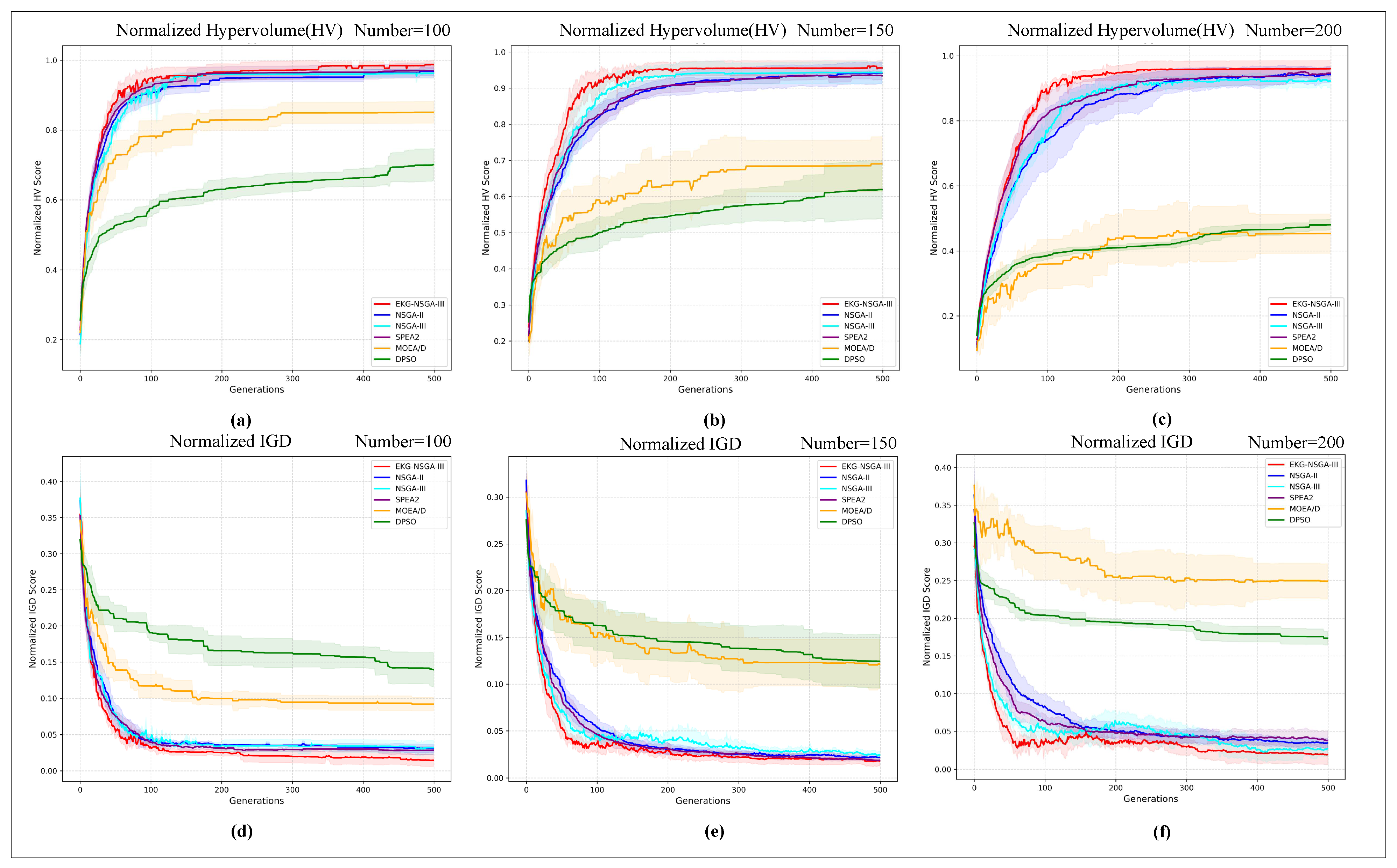
To evaluate the scalability and robustness of EKG-NSGA-III, three scenarios with different problem scales (100, 150, and 200 nodes) are established. Baseline algorithms include NSGA-II, NSGA-III, SPEA2, MOEA/D, and DPSO. The detailed numerical results and convergence trends across three problem scales are summarized in
Table 2 and
Figure 3, respectively.
The statistical results based on five independent runs (mean ± standard deviation) are presented in the following tables. As the problem scale increases from 100 to 200, EKG-NSGA-III maintains high robustness with HV values consistently above 0.95, while the performance of DPSO and MOEA/D degrades significantly. Specifically, for the 200-node task, EKG-NSGA-III achieves a 25.7% improvement in IGD compared to the standard NSGA-III with only a 5.6% increase in computational time, highlighting the efficiency of the knowledge-guided operators. To further evaluate the system-level trade-off between optimization precision and complexity, we introduce a Search Efficiency Metric (
), inspired by the latency-weighted evaluation philosophy in [
30]. For the 200-node scenario, EKG-NSGA-III yields an
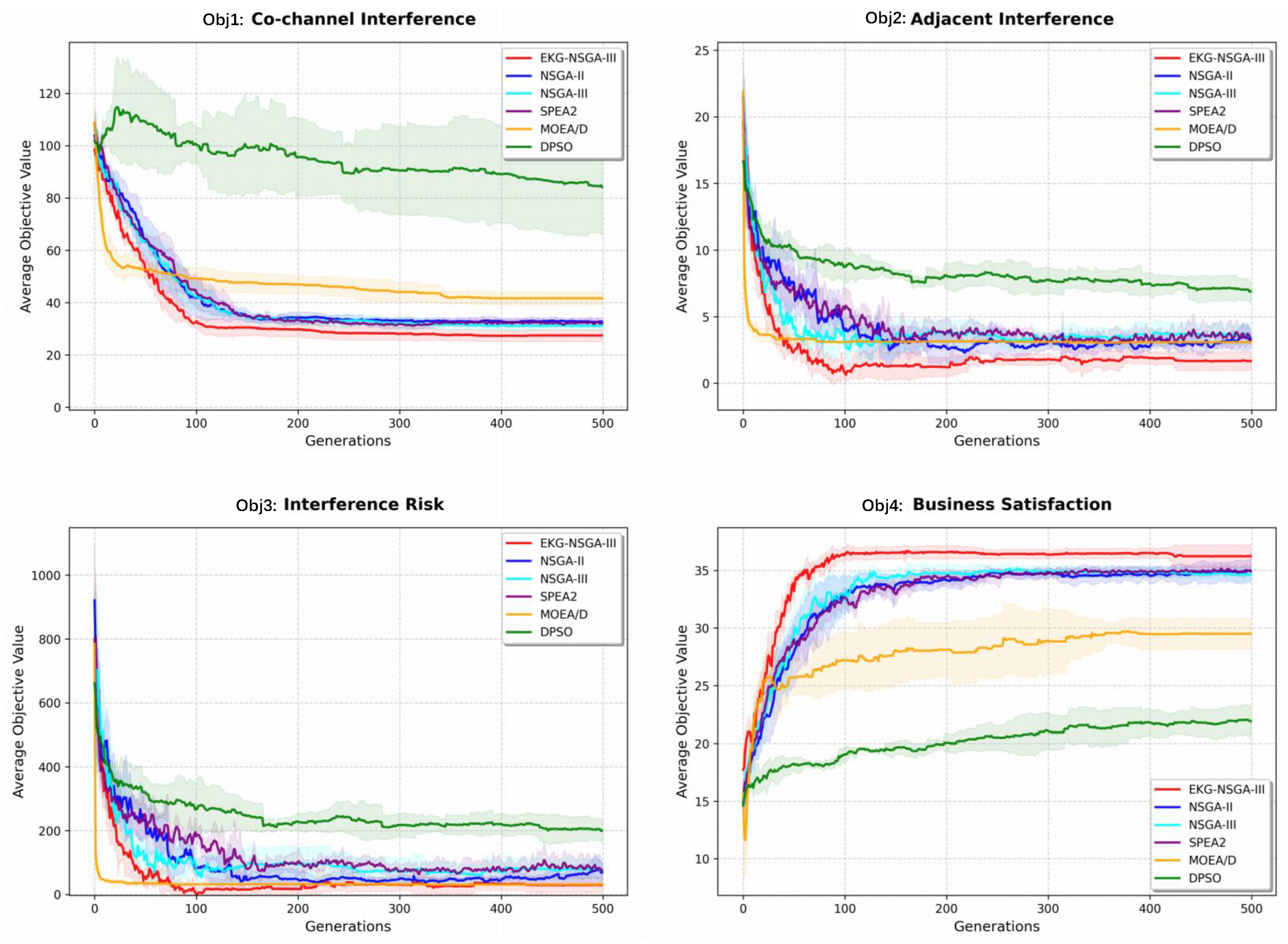
of ≈2.50, which is notably lower than standard NSGA-III (≈3.18) and NSGA-II (≈4.11). This demonstrates that the proposed framework achieves a superior balance between search accuracy and computational overhead, a critical factor for low-latency spectrum orchestration in smart city infrastructures. To further examine the optimization process, the convergence curves of the four objective functions for the 100-node scenario are illustrated in
Figure 4.
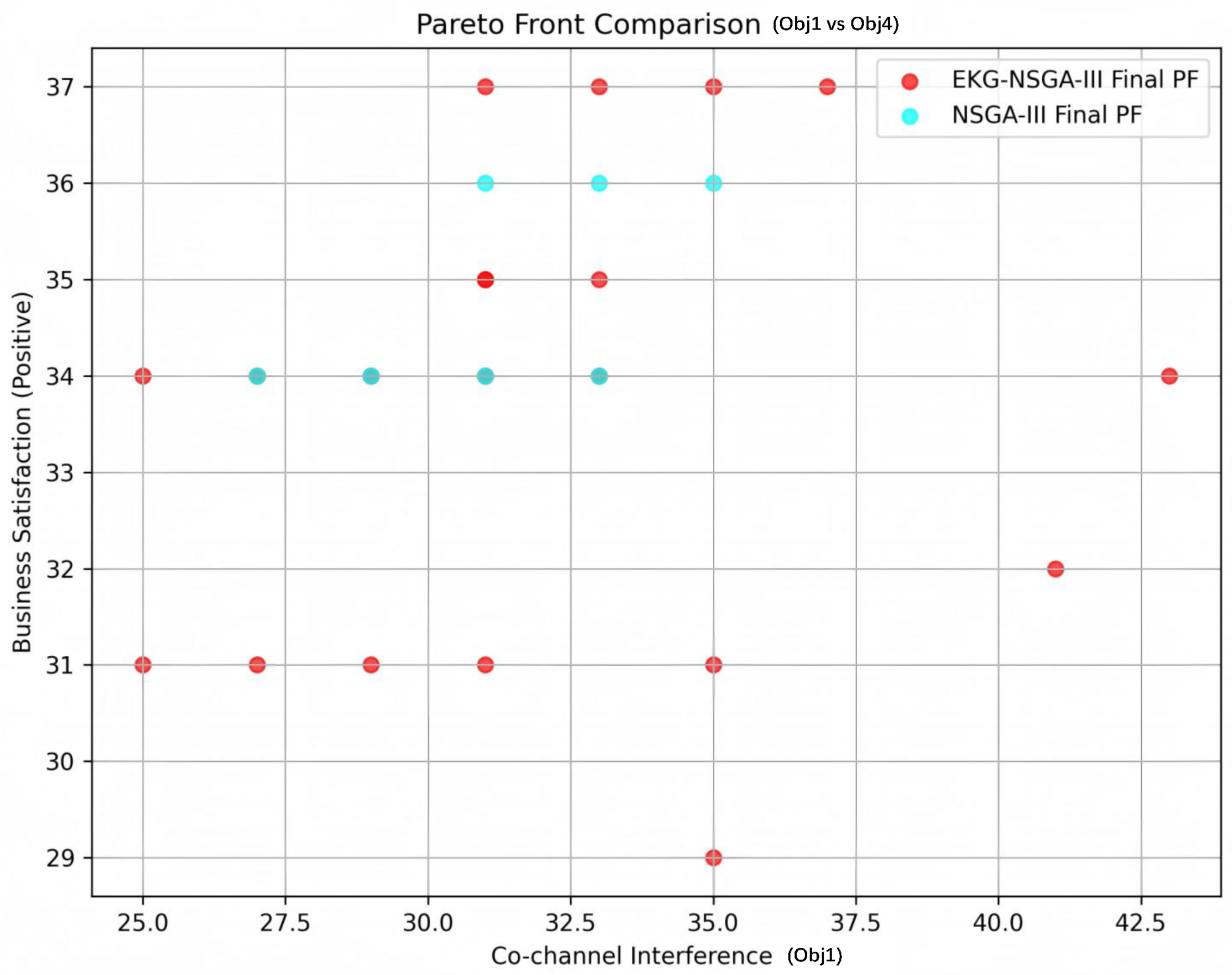
To facilitate a visual evaluation of the solution quality,
Figure 5 presents the 2D projections of the final four-objective non-dominated sets for EKG-NSGA-III and the standard NSGA-III in the 100-node scenario. It should be noted that while some points may appear dominated in this specific 2D visualization, they remain non-dominated within the full 4D objective space due to their performance in
and
. Furthermore, this visualization explicitly demonstrates the convergence of non-dominated solutions toward the objective space’s ideal point. EKG-NSGA-III visibly concentrates its solutions in the lower-right quadrant, successfully maximizing business satisfaction (
) while keeping co-channel interference (
) strictly bounded compared to the standard NSGA-III baseline.
In conclusion, the numerical performance margins presented in this section can be explicitly linked to the underlying physical-layer laws. By embedding spatial distance and propagation bounds directly into the evolutionary operators, EKG-NSGA-III actively avoids exploring physically unviable regions. This knowledge-guided pruning is the fundamental reason why the proposed framework maintains high convergence and diversity in ultra-dense configurations.
4.4. Ablation Study
As presented in
Table 3, an ablation experiment was conducted in the 200-node scenario to quantify the contributions of the proposed modules: CGII, KGM, and BGDSM.
The results indicate that the CGII module significantly reduces initial conflicts (from 112.5 to 85.2), providing a high-quality starting point. The KGM and BGDSM operators further enhance convergence accuracy and diversity by leveraging physical layer insights.
4.5. Typical Solution Showcase
EKG-NSGA-III provides a diverse set of trade-off solutions.
Table 4 extracts three typical schemes from the final set obtained in the 100-node scenario, representing different operational priorities.
Solution 1 minimizes co-channel interference (), while Solution 3 maximizes business satisfaction at the cost of a slight increase in compared to Solution 1, while simultaneously providing a much lower spectrum interference risk (). This showcase provides decision-makers with quantitative options depending on whether they prioritize absolute interference counts or service quality.