

Securing the Internet of Things, Lightweight Mutual Authentication Based on Quantum Key Distribution





Abstract
1. Introduction
Contributions
- A review of Quantum-IoT technologies for IoT devices that pose a threat to conventional security measures. Using conventional techniques for security presents both possibilities and problems in the context of quantum IoT devices. IoT systems that deploy post-quantum approaches significantly impact resources; hence, a new mechanism is needed.
- Implement a quantum key-based mutual authentication with a distributed approach to asymmetrically share symmetric keys for IoT devices. These devices then communicate with each other without using servers with the help of quantum keys and quantum numbers. Quantum IoT makes it easier and more efficient to provide ubiquitous services.
- Implement the model using specified parameters and verify the model using various metric values. Furthermore, attempt to check the suggested method in various settings and environments to confirm its efficacy. A set of criteria for different attacks on IoT with quantum-based keys is used to test the proposed mechanism.
2. Authentication Schemes in Quantum IoT
Motivation and Research Gaps
- Lacking a lightweight and privacy-preserved authentication mechanism based on QKD that meets the needs of resource-constrained IoT devices.
- Due to the highly dynamic infrastructure of large-scale IoT networks, it always suffers from scalable key distribution.
- Lack interoperability between classical and quantum architectures for quantum-assisted attacks and no auditing for vulnerabilities in the hybrid architecture.
- It is a unified design of QKD-generated keys and QRN-assisted permutations in a lightweight mutual authentication for IoT.
- A novel lightweight sequencing mechanism for IoT to minimize authentication rounds, reduce device-side computation and maintain quantum-based security.
- A novel architecture using a hybrid classical–quantum infrastructure which addressed latency and energy limitations of IoT devices.
3. Lightweight Mutual Authentication Based on Quantum Key Distribution
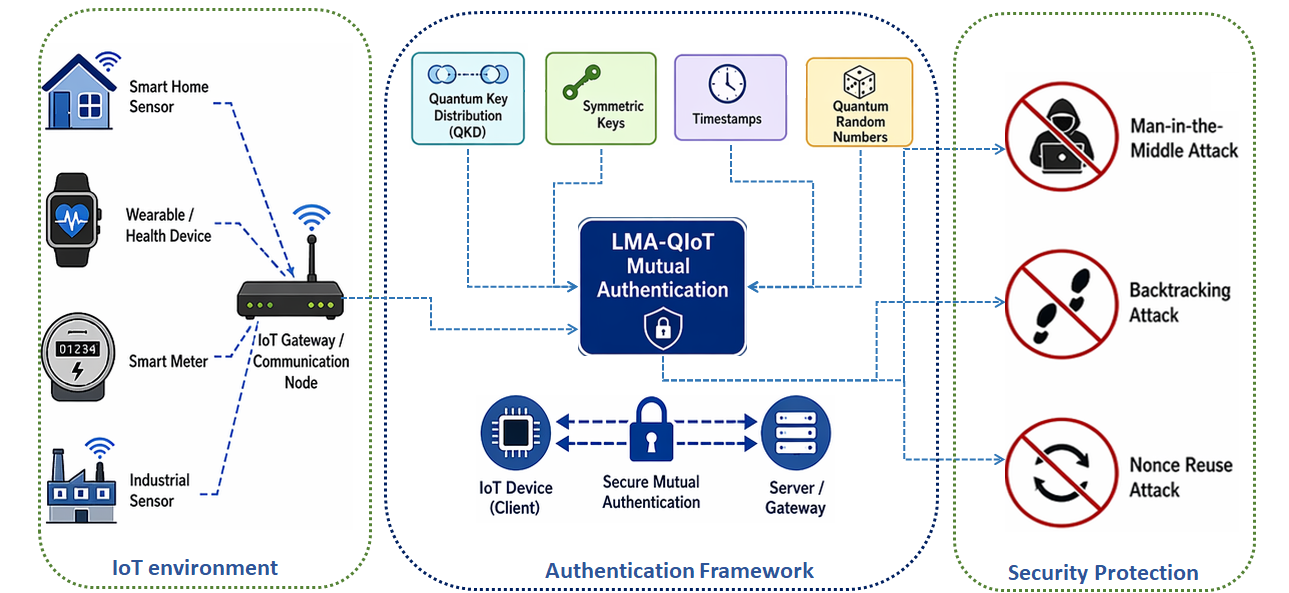
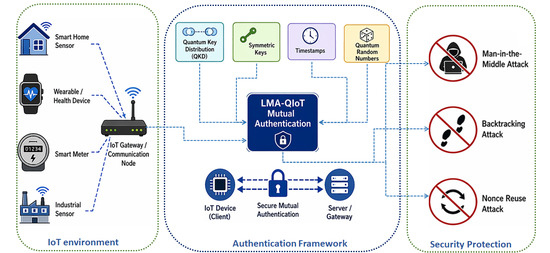
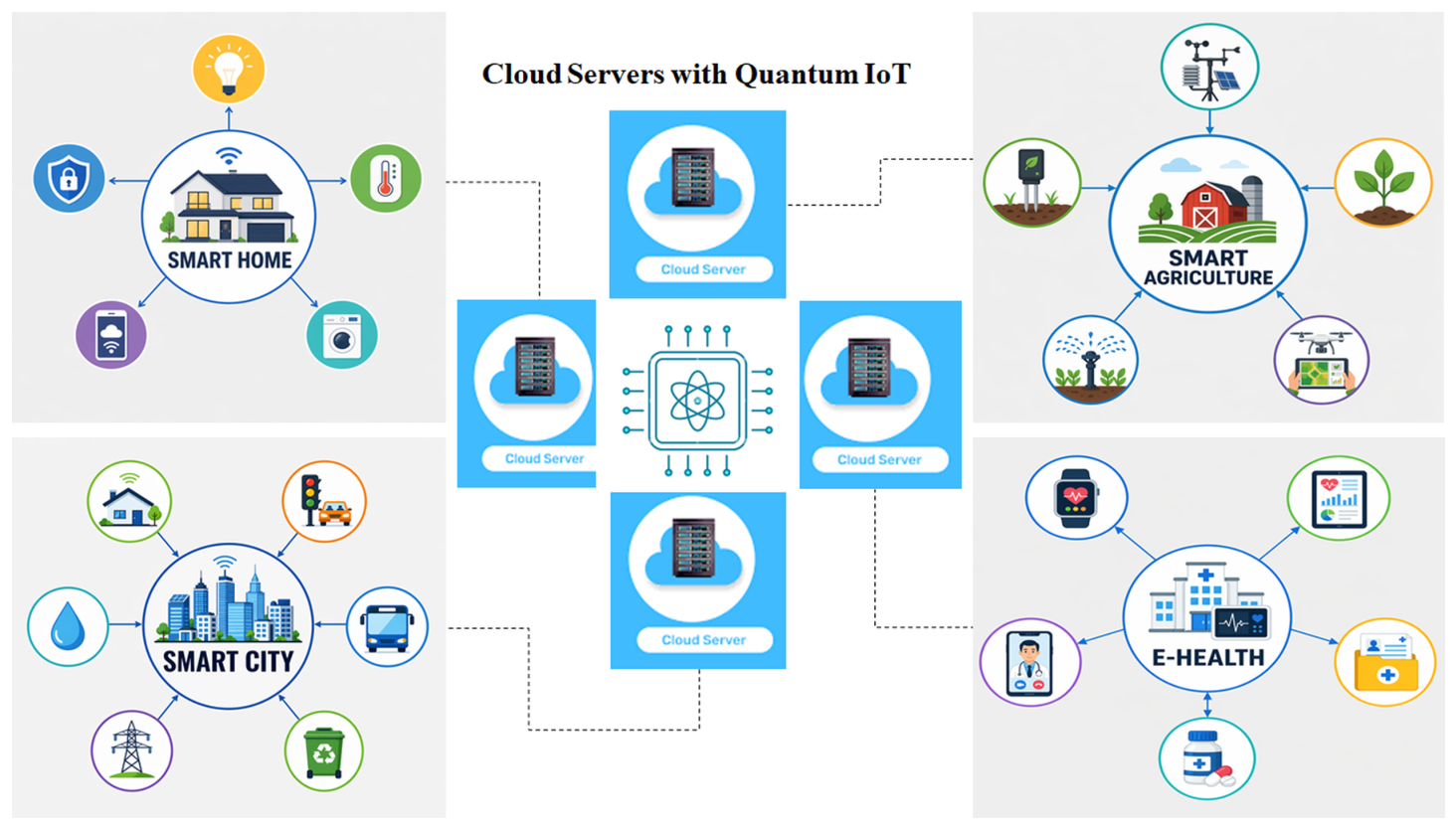
3.1. LMA-QIoT System Model
3.2. Lattice in LMA-QIoT
3.3. LWE Distribution over the Space
- Secret Vector:
 where i is any polynomial and j is any prime number.
 - Random Vectors:

- Error Terms: derived from error distribution

3.4. Working Procedure of LMA-QIoT
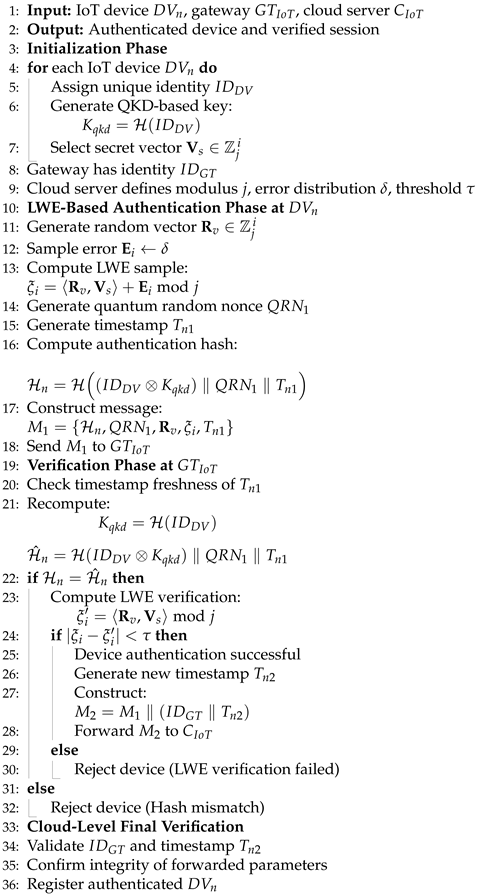
3.4.1. Initialization Phase
| Algorithm 1 Quantum-Enhanced LWE-Based IoT Authentication (Authentication P-I). |
 |
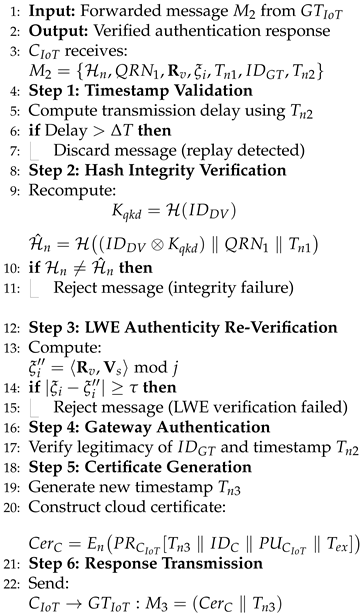
3.4.2. Login Phase at
| Algorithm 2 Cloud-Level Verification and Response Generation (Authentication P-II). |
 |
3.4.3. Verification of
| Algorithm 3 Verification Phase at (Authentication P-III). |
 |
3.4.4. Direct Communication of Different IoT Devices
| Algorithm 4 Direct Communication of Different IoT Entities (Authentication P-IV). |
|
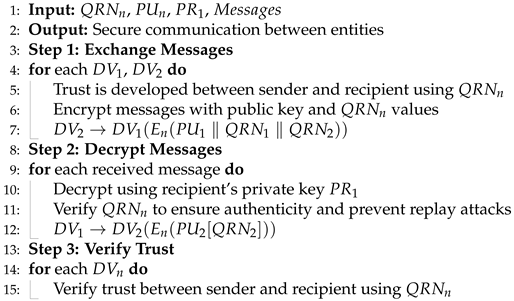
3.4.5. Encryption and Decryption with Shared Keys Between Different Entities
| Algorithm 5 Encryption and Decryption with Shared Keys between Different Entities (Authentication P-V). |
 |
4. Performance Evaluation of LMA-QIoT
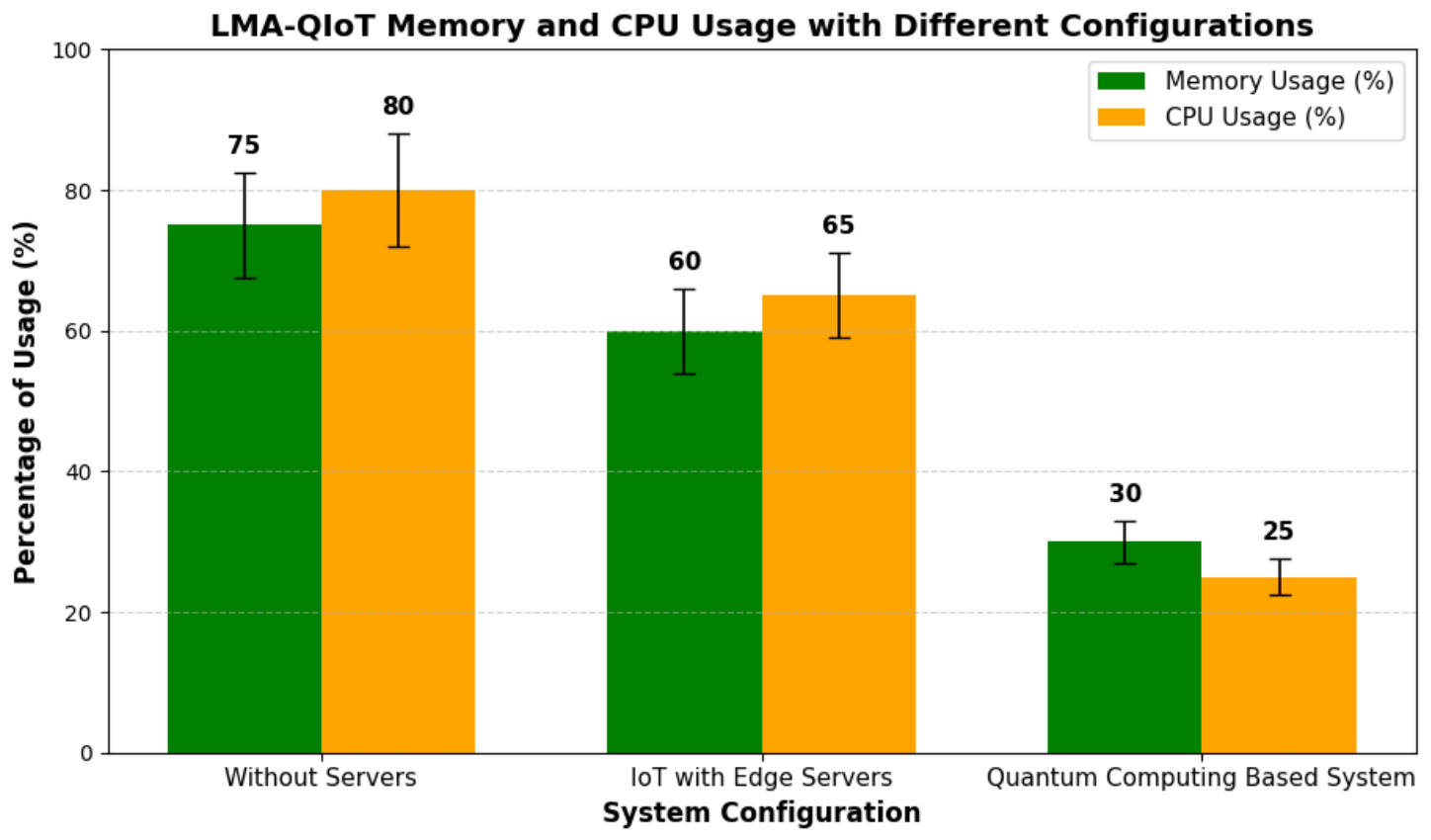
4.1. CPU and Memory Requirements of LMA-QIoT
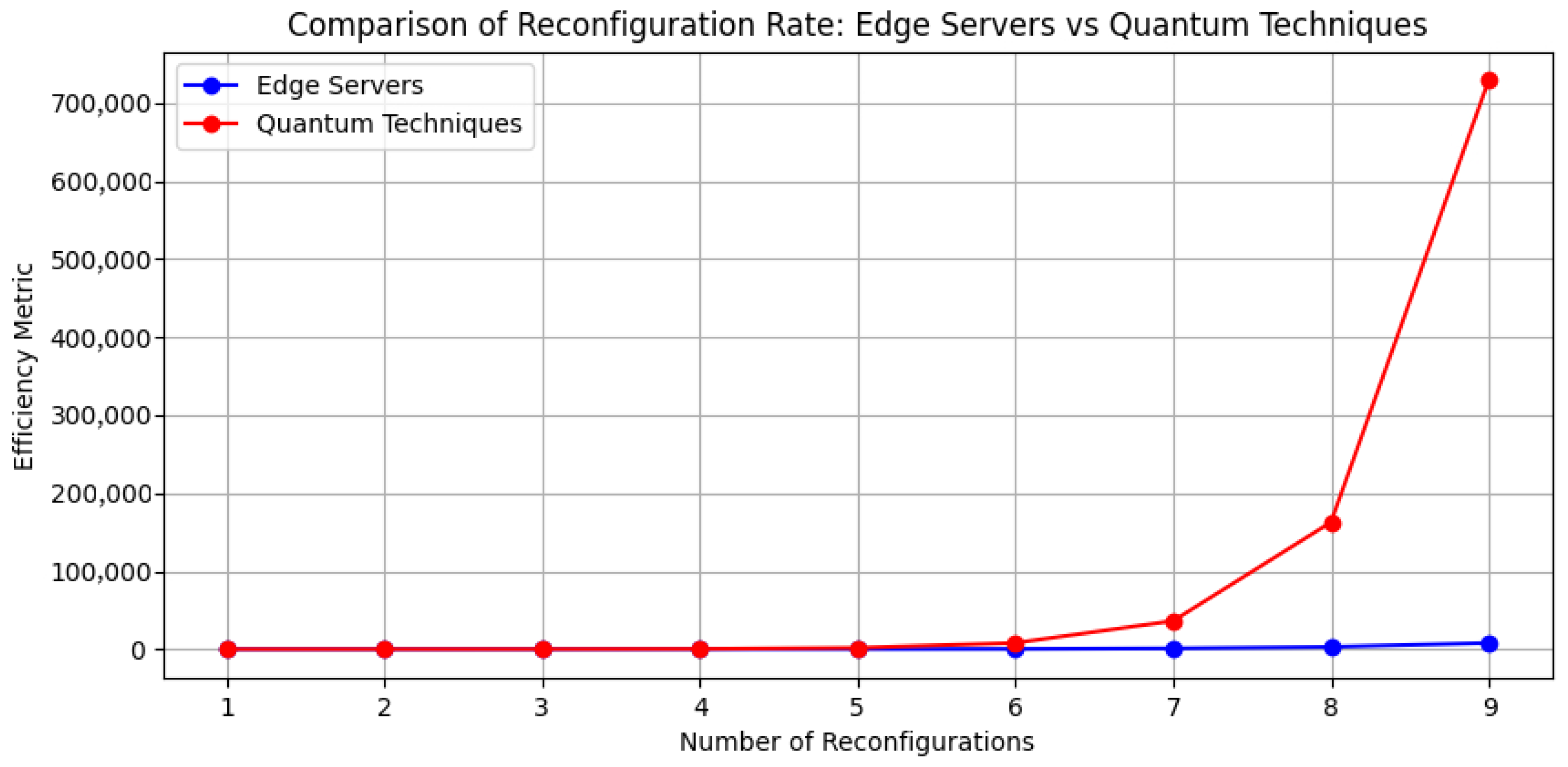
4.2. Reconfiguration Time in LMA-QIoT
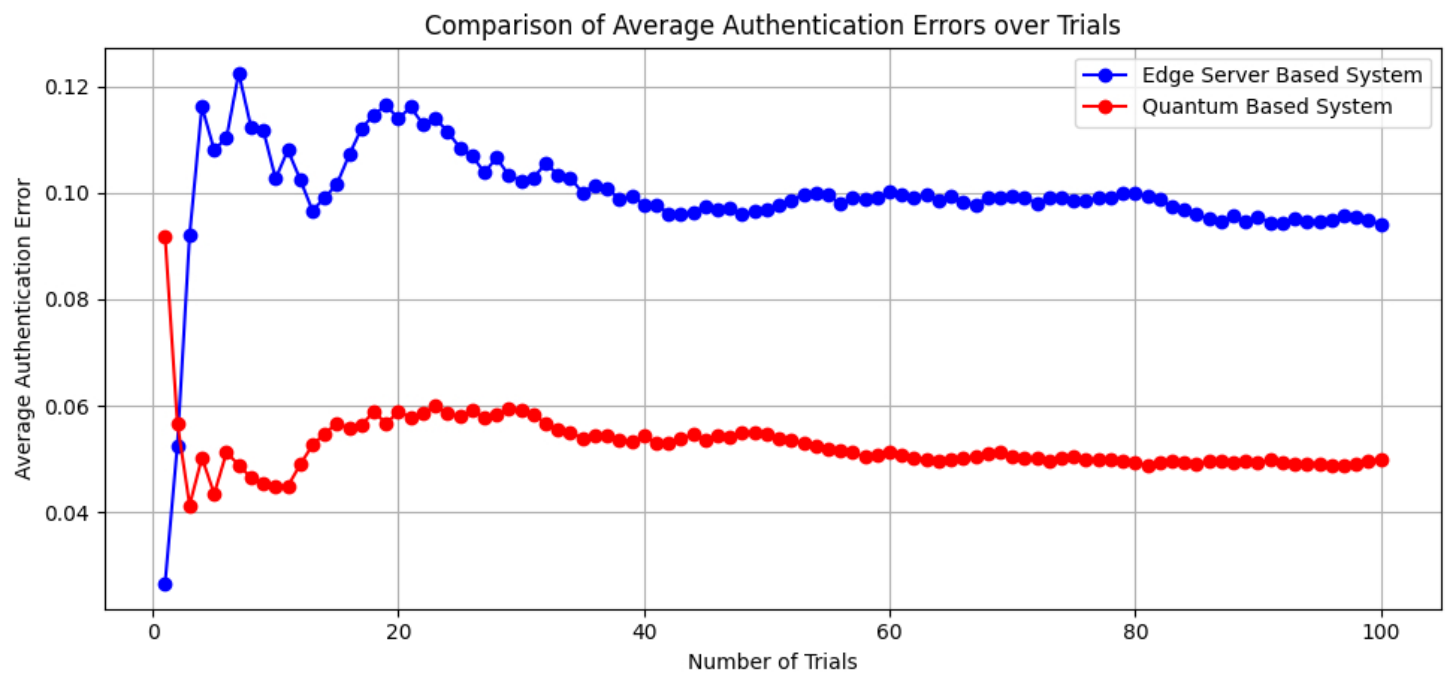
4.3. Authentication Error in LMA-QIoT
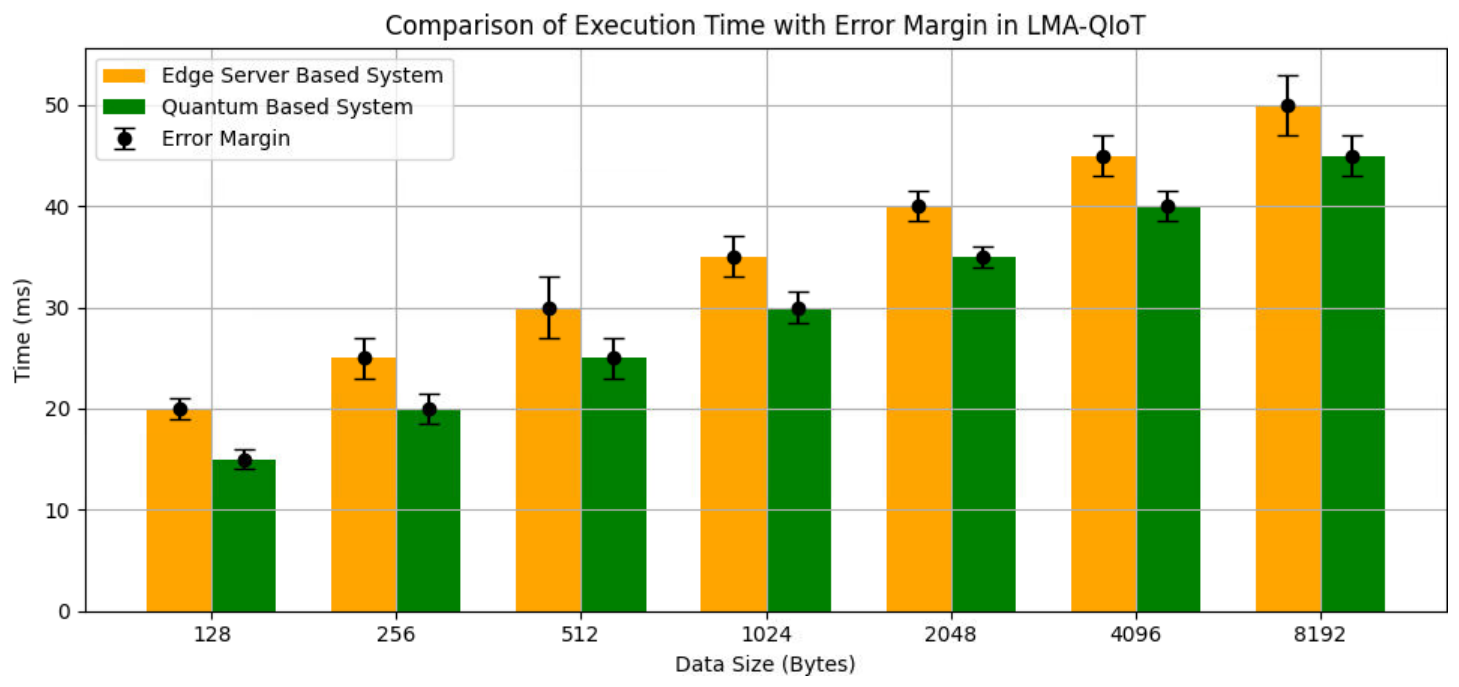
4.4. Execution Time Comparison in Message Sizes
4.5. Formal Verification of LMA-QIoT Using AVISPA
5. Comparative Analysis of LMA-QIoT with Other Schemes
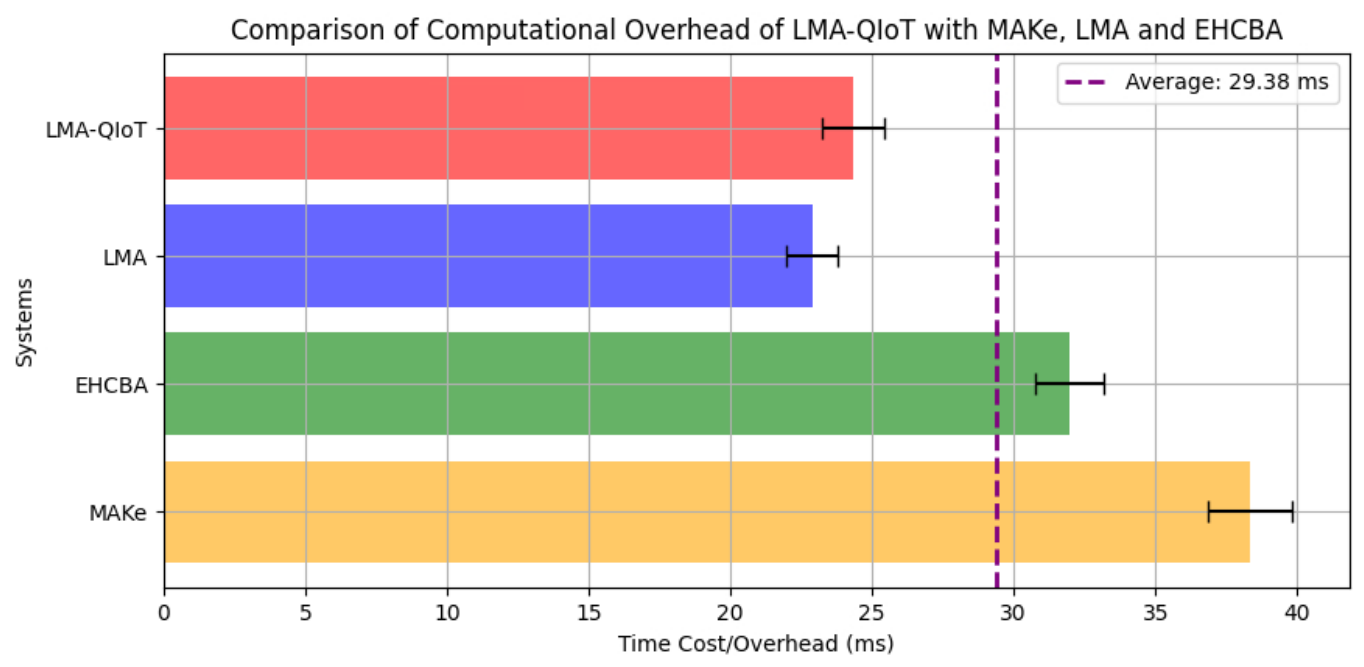
5.1. Time Cost and Overhead
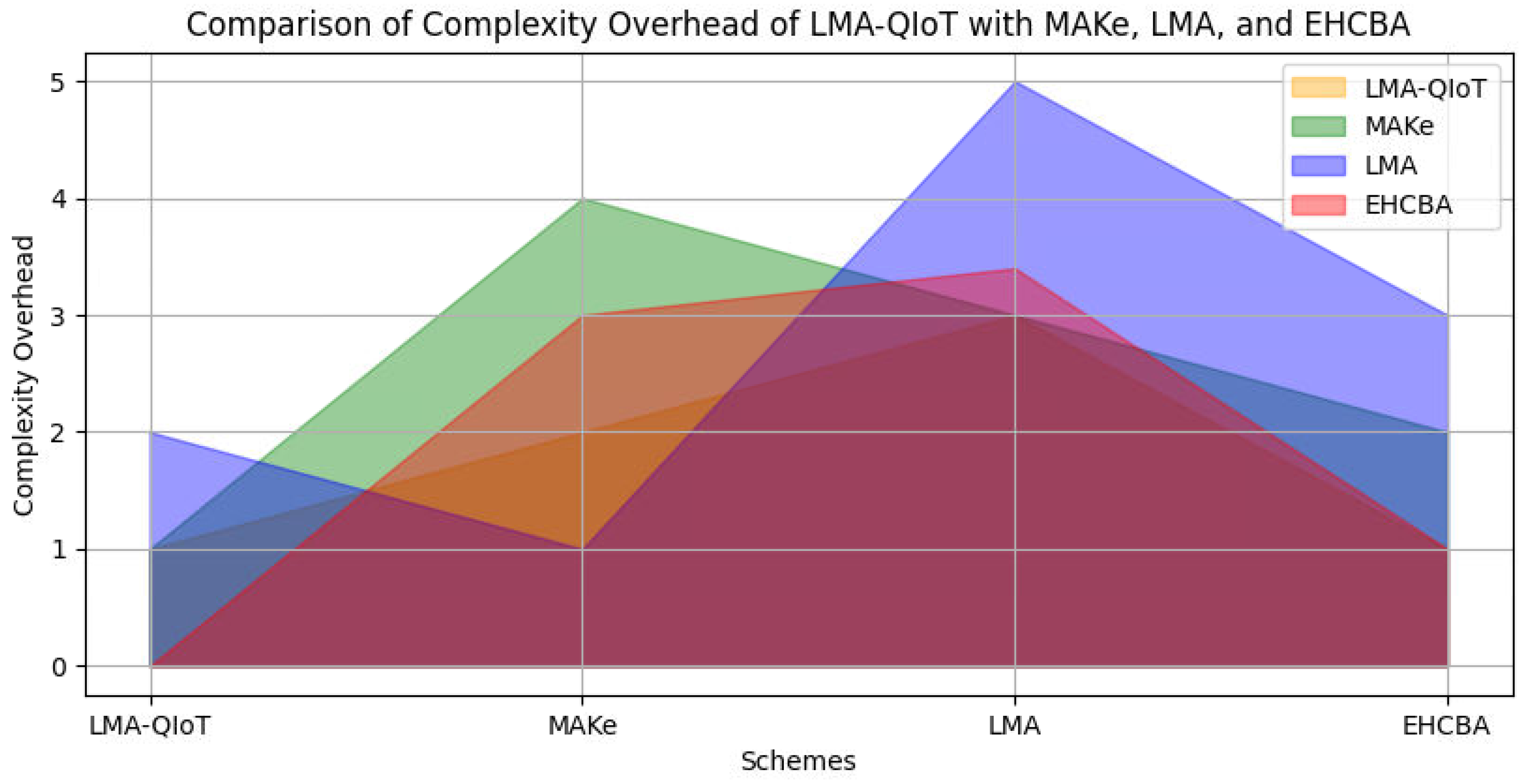
5.2. Computational Complexity
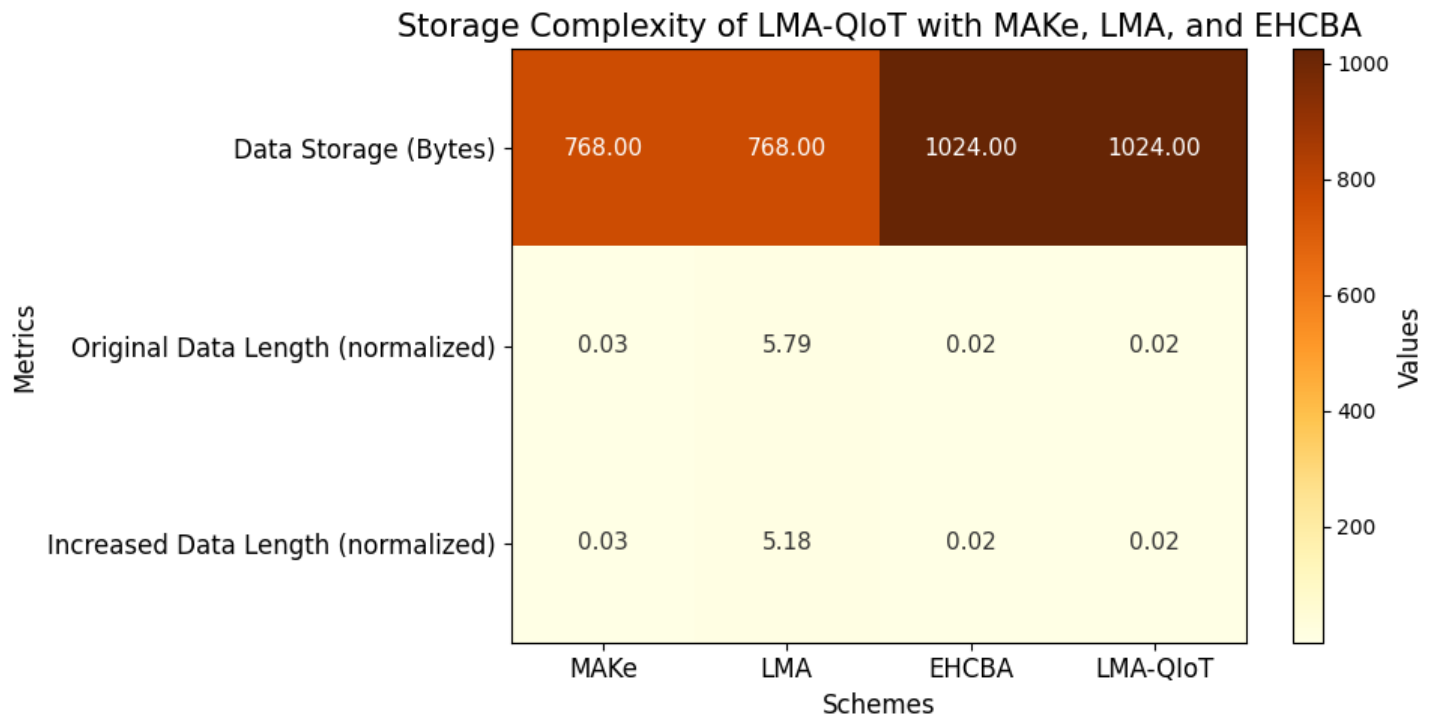
5.3. Storage Complexity
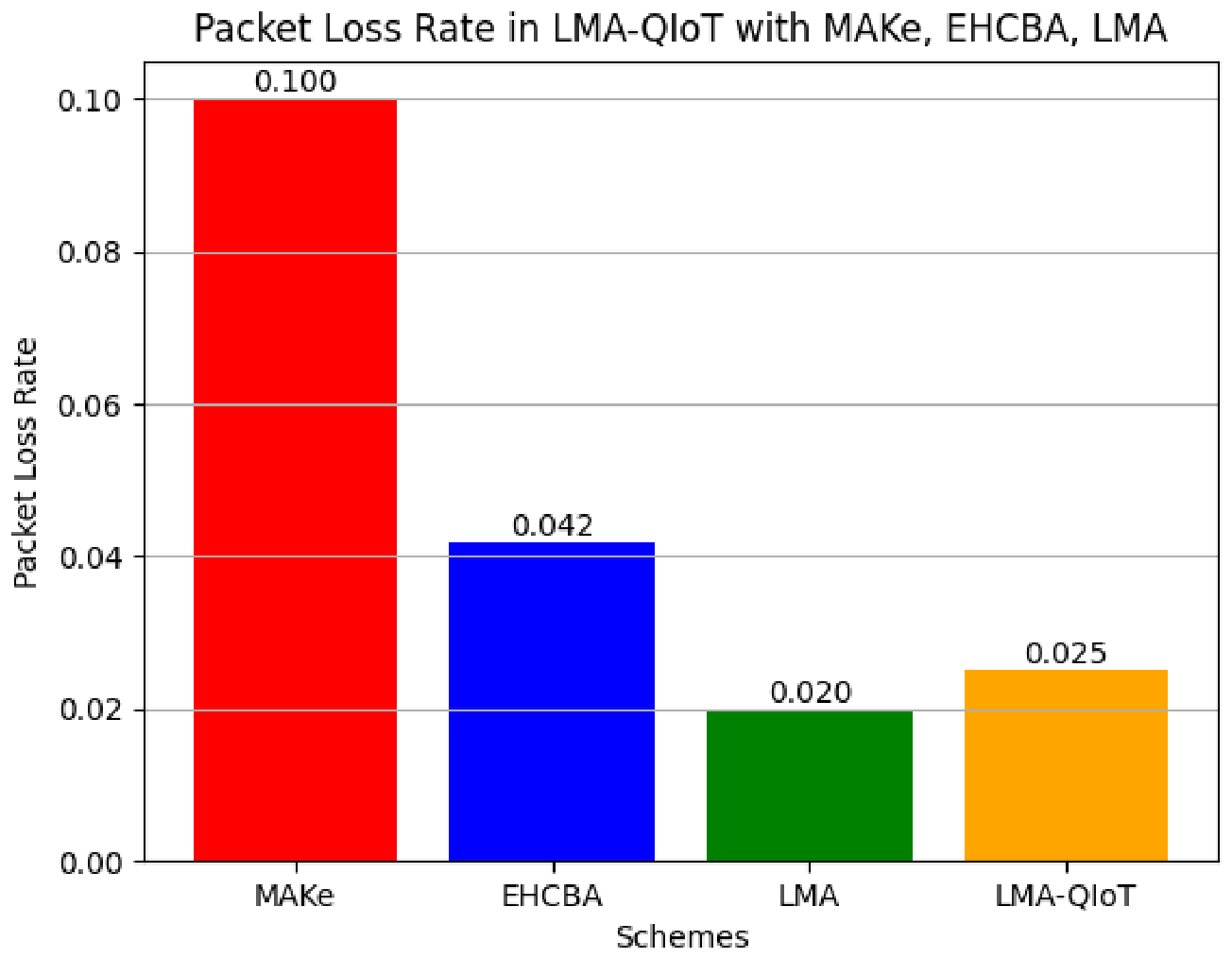
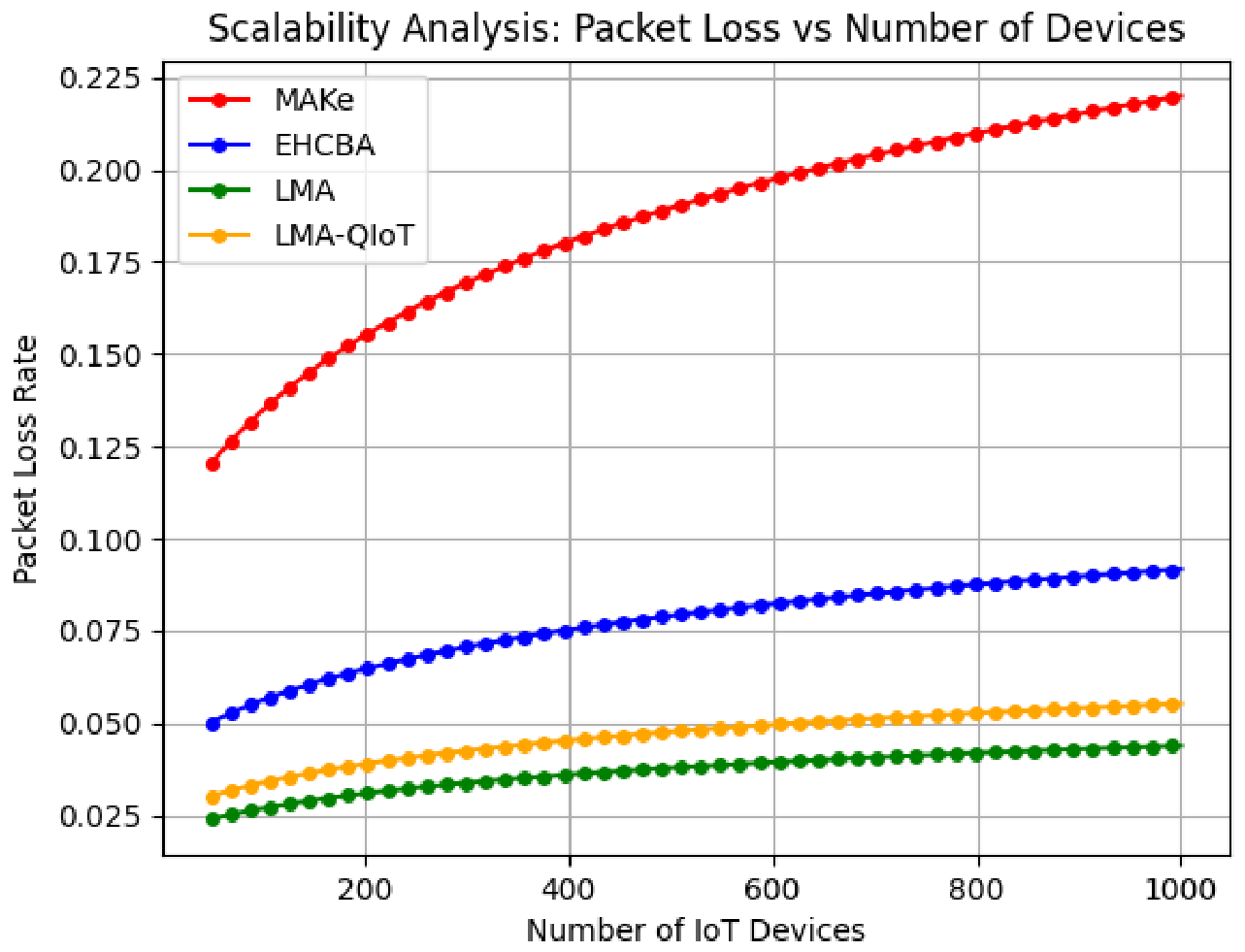
5.4. Packet Loss Rate
5.5. Scalability
5.6. Attacker Success Rate
5.7. Key Entropy and QKD Error Rate (QBER)
5.8. Limitations in LMA-QIoT
6. Conclusions and Future Work
Author Contributions
Funding
Data Availability Statement
Acknowledgments
Conflicts of Interest
References
- Loeys, S.; Boute, R.N.; Antonio, K. The Use of IoT Sensor Data to Dynamically Assess Maintenance Risk in Service Contracts. Eur. J. Oper. Res. 2025, 324, 454–465. [Google Scholar] [CrossRef] [Scilit]
- Rosca, C.-M.; Stancu, A. Integration of AI in Self-Powered IoT Sensor Systems. Appl. Sci. 2025, 15, 7008. [Google Scholar] [CrossRef] [Scilit]
- Park, K.; Kim, M.; Park, Y. Security Evaluation of Provably Secure ECC-Based Anonymous Authentication and Key Agreement Scheme for IoT. Sensors 2025, 25, 237. [Google Scholar] [CrossRef] [Scilit]
- Khan, M.N.; Lee, S.; Shah, M. Adaptive Scheduling in Cognitive IoT Sensors for Optimizing Network Performance Using Reinforcement Learning. Appl. Sci. 2025, 15, 5573. [Google Scholar] [CrossRef] [Scilit]
- Ullah, I.; Adhikari, D.; Su, X.; Palmieri, F.; Wu, C.; Choi, C. Integration of Data Science with the Intelligent IoT (IIoT): Current Challenges and Future Perspectives. Digit. Commun. Netw. 2025, 11, 280–298. [Google Scholar]
- Dritsas, E.; Trigka, M. A Survey on the Applications of Cloud Computing in the Industrial Internet of Things. Big Data Cogn. Comput. 2025, 9, 44. [Google Scholar] [CrossRef] [Scilit]
- Hwang, S.O.; Waseem, H.M.; Munir, N. Billiard Quantum Chaos: A Pioneering Image Encryption Scheme in the Post-Quantum Era. IEEE Access 2024, 12, 85150–85164. [Google Scholar] [CrossRef] [Scilit]
- Kumari, S.; Singh, M.; Singh, R.; Tewari, H. A Post-Quantum Lattice-Based Lightweight Authentication and Code-Based Hybrid Encryption Scheme for IoT Devices. Comput. Netw. 2022, 217, 109327. [Google Scholar] [CrossRef] [Scilit]
- Shekhawat, H.; Gupta, D.S. Quantum-Safe Lattice-Based Mutual Authentication and Key-Exchange Scheme for the Smart Grid. Trans. Emerg. Telecommun. Technol. 2024, 35, e5017. [Google Scholar] [CrossRef] [Scilit]
- Prajapat, S.; Thakur, G.; Kumar, P.; Kumar, G.; Sharma, K.P. Blockchain-Enabled Quantum Encryption Scheme for Securing Next-Generation IoT Networks. IEEE Commun. Stand. Mag. 2025, 10, 65–71. [Google Scholar] [CrossRef] [Scilit]
- Han, K.; Lee, W.-K.; Karmakar, A.; Yi, M.-K.; Hwang, S.O. QuripfeNet: Quantum-Resistant IPFE-Based Neural Network. IEEE Trans. Emerg. Top. Comput. 2024, 13, 640–653. [Google Scholar]
- Laktionov, I.; Diachenko, G.; Moroz, D.; Getman, I. A Comprehensive Review of Cybersecurity Threats to Wireless Infocommunications in the Quantum-Age Cryptography. IoT 2025, 6, 61. [Google Scholar] [CrossRef] [Scilit]
- Waseem, H.M.; Munir, N.; Hwang, S.O. Advancing IoT-Driven Transportation Security: A Comprehensive Review of Privacy-Preserving Identity-Based Encryption With Quantum Enhancements. IEEE Open J. Intell. Transp. Syst. 2026, 7, 268–284. [Google Scholar]
- Sebestyen, H.; Popescu, D.E.; Zmaranda, R.D. A Literature Review on Security in the Internet of Things: Identifying and Analysing Critical Categories. Computers 2025, 14, 61. [Google Scholar] [CrossRef] [Scilit]
- Hafeez, M.A.; Lee, W.-K.; Karmakar, A.; Hwang, S.O. Efficient TMVP-Based Polynomial Convolution on GPU for Post-Quantum Cryptography Targeting IoT Applications. IEEE Internet Things J. 2024, 11, 23428–23443. [Google Scholar] [CrossRef] [Scilit]
- Lee, W.-K.; Hwang, S.O. High Throughput Implementation of Post-Quantum Key Encapsulation and Decapsulation on GPU for Internet of Things Applications. IEEE Trans. Serv. Comput. 2021, 15, 3275–3288. [Google Scholar] [CrossRef] [Scilit]
- Al Rawajbeh, M.; Maria Soosai, A.J.; Ramasamy, L.K.; Khan, F. Trustworthy Adaptive AI for Real-Time Intrusion Detection in Industrial IoT Security. IoT 2025, 6, 53. [Google Scholar]
- Khan, S.; Lee, W.-K.; Karmakar, A.; Mera, J.M.B.; Majeed, A.; Hwang, S.O. Area–Time Efficient Implementation of NIST Lightweight Hash Functions Targeting IoT Applications. IEEE Internet Things J. 2022, 10, 8083–8095. [Google Scholar] [CrossRef] [Scilit]
- Santhiya Devi, R.; Balaguru, R.J.B.; Amirtharajan, R.; Praveenkumar, P. A Novel Quantum Encryption and Authentication Framework Integrated with IoT. In Security, Privacy and Trust in the IoT Environment; Springer: Berlin, Germany, 2019; pp. 123–150. [Google Scholar]
- Babu, P.R.; Kumar, S.A.P.; Reddy, A.G.; Das, A.K. Quantum secure authentication and key agreement protocols for IoT-enabled applications: A comprehensive survey and open challenges. Comput. Sci. Rev. 2024, 54, 100676. [Google Scholar]
- Gharavi, H.; Granjal, J.; Monteiro, E. Post-quantum blockchain security for the Internet of Things: Survey and research directions. IEEE Commun. Surv. Tutor. 2024, 26, 1748–1774. [Google Scholar]
- Cherbal, S.; Zier, A.; Hebal, S.; Louail, L.; Annane, B. Security in internet of things: A review on approaches based on blockchain, machine learning, cryptography, and quantum computing. J. Supercomput. 2024, 80, 3738–3816. [Google Scholar] [CrossRef] [Scilit]
- Imran, M.; Altamimi, A.B.; Khan, W.; Hussain, S.; Alsaffar, M. Quantum cryptography for future networks security: A systematic review. IEEE Access 2024, 12, 180048–180078. [Google Scholar] [CrossRef] [Scilit]
- Al-Saggaf, A.A.; Sheltami, T.; Alkhzaimi, H.; Ahmed, G. Lightweight Two-Factor-Based User Authentication Protocol for IoT-Enabled Healthcare Ecosystem in Quantum Computing. Arab. J. Sci. Eng. 2023, 48, 2347–2357. [Google Scholar] [CrossRef] [Scilit]
- Benrebbouh, C.; Mansouri, H.; Cherbal, S.; Pathan, A.-S.K. A Lightweight Security Scheme to Defend against Quantum Attack in IoT-Based Energy Internet. Int. J. Sens. Netw. 2023, 43, 13–26. [Google Scholar] [CrossRef] [Scilit]
- Gupta, D.S.; Islam, S.K.H.; Obaidat, M.S.; Karati, A.; Sadoun, B. LAAC: Lightweight Lattice-Based Authentication and Access Control Protocol for E-Health Systems in IoT Environments. IEEE Syst. J. 2020, 15, 3620–3627. [Google Scholar]
- Adeli, M.; Bagheri, N.; Maimani, H.R.; Kumari, S.; Rodrigues, J.J.P.C. A Post-Quantum Compliant Authentication Scheme for IoT Healthcare Systems. IEEE Internet Things J. 2023, 11, 6111–6118. [Google Scholar] [CrossRef] [Scilit]
- Xu, P.; Wu, H.; Tao, X.; Wang, C.; Chen, D.; Nan, G. Anti-Quantum Certificateless Group Authentication for Massive Accessing IoT Devices. IEEE Internet Things J. 2024, 11, 16561–16577. [Google Scholar]
- Zhang, S.; Du, X.; Liu, X. A Novel and Quantum-Resistant Handover Authentication Protocol in IoT Environment. Wirel. Netw. 2023, 29, 2873–2890. [Google Scholar] [CrossRef] [Scilit]
- Li, N.; Liu, D.; Nepal, S. Lightweight Mutual Authentication for IoT and Its Applications. IEEE Trans. Sustain. Comput. 2017, 2, 359–370. [Google Scholar] [CrossRef] [Scilit]
- Gupta, D.S. PiLike: Post-Quantum Identity-Based Lightweight Authenticated Key Exchange Protocol for IIoT Environments. IEEE Syst. J. 2023, 18, 15–23. [Google Scholar]
- Liu, G.; Han, J.; Zhou, Y.; Liu, T.; Chen, J. QSLT: A Quantum-Based Lightweight Transmission Mechanism against Eavesdropping for IoT Networks. Wirel. Commun. Mob. Comput. 2022, 2022, 4809210. [Google Scholar]
- Gupta, D.S.; Ray, S.; Singh, T.; Kumari, M. Post-Quantum Lightweight Identity-Based Two-Party Authenticated Key Exchange Protocol for Internet of Vehicles. Comput. Commun. 2022, 181, 69–79. [Google Scholar]
- Wang, Z.; Huang, J.; Miao, K.; Lv, X.; Chen, Y.; Su, B.; Liu, L.; Han, M. Lightweight Zero-Knowledge Authentication Scheme for IoT Embedded Devices. Comput. Netw. 2023, 236, 110021. [Google Scholar] [CrossRef] [Scilit]
- Cao, J.; Yu, P.; Xiang, X.; Ma, M.; Li, H. Anti-Quantum Fast Authentication and Data Transmission Scheme for Massive Devices in 5G NB-IoT Systems. IEEE Internet Things J. 2019, 6, 9794–9805. [Google Scholar]
- Roy, K.S.; Kalita, H.K. A Quantum Safe User Authentication Protocol for the Internet of Things. Int. J. Next-Gener. Comput. 2019, 10, 178–193. [Google Scholar]
- Chawla, D.; Mehra, P.S. QAKA: A Novel Quantum Authentication and Key Agreement Protocol Using Quantum Entanglement for Secure Communication among IoT Devices. Trans. Emerg. Telecommun. Technol. 2024, 35, e4957. [Google Scholar] [CrossRef] [Scilit]
- Mishra, D.; Singh, M.; Rewal, P.; Pursharthi, K.; Kumar, N.; Barnawi, A.; Rathore, R.S. Quantum-Safe Secure and Authorized Communication Protocol for Internet of Drones. IEEE Trans. Veh. Technol. 2023, 72, 16499–16507. [Google Scholar] [CrossRef] [Scilit]
- Schoffel, M.; Lauer, F.; Rheinlander, C.C.; Wehn, N. Secure IoT in the Era of Quantum Computers: Where Are the Bottlenecks? Sensors 2022, 22, 2484. [Google Scholar] [CrossRef] [Scilit]
- Rehmani, M.H.; Saleem, Y. Network Simulator NS-2. In Encyclopedia of Information Science and Technology, 3rd ed.; IGI Global: Hershey, PA, USA, 2015; pp. 6249–6258. [Google Scholar]
- Mehdi, K.; Lounis, M.; Bounceur, A.; Kechadi, T. Cupcarbon: A Multi-Agent and Discrete Event Wireless Sensor Network Design and Simulation Tool. In Proceedings of the Seventh International Conference on Simulation Tools and Techniques, Lisbon, Portugal, 17–19 March 2014. [Google Scholar]
- Oheimb, D.V. The high-lvel protocol specification language developed in the EU project AVISPA. In Proceedings of the APPSEM 2005, Frauenchiemsee, Germany, 12–15 September 2005; pp. 1–17. [Google Scholar]
- Ram, A.; Dutta, M.P.; Chakraborty, S.K. An Authentication Mechanism to Prevent Various Security Threats in Software-Defined Networking Using AVISPA. J. Sci. Ind. Res. 2024, 83, 977–988. [Google Scholar]
- Banerjee, S.; Odelu, V.; Das, A.K.; Srinivas, J.; Kumar, N.; Chattopadhyay, S.; Choo, K.-K.R. A Provably Secure and Lightweight Anonymous User Authenticated Session Key Exchange Scheme for Internet of Things Deployment. IEEE Internet Things J. 2019, 6, 8739–8752. [Google Scholar] [CrossRef] [Scilit]
- Lopez Becerra, J.M.; Iovino, V.; Ostrev, D.; Skrobot, M. On the Relation between SIM and IND-RoR Security Models for PAKEs. In Proceedings of the International Conference on Security and Cryptography; SciTePress: Setubal, Portugal, 2017. [Google Scholar]
- Sihare, S.R. Qubit and Bit-Based Quantum Hybrid Secret Key Generation. Eur. Phys. J. D. 2022, 76, 222. [Google Scholar] [CrossRef] [Scilit]
- Fiorini, F.; Pagano, M.; Garroppo, R.G. QBER Statistics to Determine Eavesdropper Position in Fiber-Based Quantum Key Distribution. In IEEE INFOCOM 2025-IEEE Conference on Computer Communications Workshops (INFOCOM WKSHPS); IEEE: Piscataway, NJ, USA, 2025; pp. 1–6. [Google Scholar]
- Khan, M.N.; Rahman, H.U.; Hussain, T.; Yang, B.; Qaisar, S.M. Enabling Trust in Automotive IoT: Lightweight Mutual Authentication Scheme for Electronic Connected Devices in Internet of Things. IEEE Trans. Consum. Electron. 2024, 70, 5065–5078. [Google Scholar] [CrossRef] [Scilit]
- Khashan, O.A.; Khafajah, N.M. Efficient Hybrid Centralized and Blockchain-Based Authentication Architecture for Heterogeneous IoT Systems. J. King Saud Univ. Comput. Inf. Sci. 2023, 35, 726–739. [Google Scholar] [CrossRef] [Scilit]
- Huang, H.; Zheng, J.; Chen, Z.; Zhao, S.; Wu, H.; Yu, B.; Liu, Z. Review of Modular Multiplication Algorithms over Prime Fields for Public-Key Cryptosystems. Cryptography 2025, 9, 46. [Google Scholar] [CrossRef] [Scilit]





| Scheme | Primitive | Mutual Auth. | Computational Over. | Energy Enhan. | Security | Scalability | Post-Quantum C. |
|---|---|---|---|---|---|---|---|
| TFA-HQ | Hash + RO | Yes | Yes | No | Med | Med | No |
| Ring-LWE | Lattice | Yes | Yes | Yes | High | High | Yes |
| LSS-IoT | GGH + QKD | Yes | Yes | No | High | Low | Partial |
| LAAC | Classical | Yes | Yes | No | Med | Med | No |
| PQCA | Lattice | Yes | No | No | High | Med | Yes |
| ACGA | Agg. Sign | No | Yes | Yes | Med | High | No |
| QRHA | NTRU | Yes | Yes | No | High | Med | Yes |
| LMA-IoT | Hash | No | Yes | No | Med | High | No |
| PiLike | Lattice | Yes | No | No | High | Med | Yes |
| QSLT | Q-assisted | Yes | Yes | No | High | Low | Partial |
| LB-ID-2PAKA | Lattice | Yes | Yes | Yes | High | Med | Yes |
| LZIA | Hash | Yes | Yes | No | Med | High | No |
| AFADT | Hybrid | Yes | Yes | No | High | Med | Partial |
| QSUA | NTRU + OTP | Yes | Yes | Yes | High | Med | Yes |
| QAKA | Q-hash | Yes | Yes | No | Med | Low | Partial |
| RLWE | RLWE | Yes | No | No | High | Med | Yes |
| SIoT-QC | PQ-TLS | Yes | Yes | No | High | High | Yes |
| Symbols | Meaning |
|---|---|
| Quantum random number | |
| Cloud server | |
| Quantum bit (logical parameter for quantum) | |
| Super key generated by cloud-server | |
| IoT-devices | |
| Unique ID of each device | |
| IoT-gateway | |
| Identity of IoT-gateway | |
| Session key for each session | |
| Distance between any two IoT devices | |
| Time stamps | |
| Certificate of gateway | |
| Private key of cloud server | |
| Public key of any device | |
| Public key of customer/user | |
| Private key of cloud server | |
| Encryption process | |
| Decryption process | |
| Time of expiry |
| Parameter | Symbol | Metrics |
|---|---|---|
| Simulation Dynamics | 250 × 250 m | |
| Simulation Time | Tm | 1000 s |
| Distance B/W Pair of | 10–15 m | |
| Data Rate at each | 250 Kbps | |
| Baud Rate at IoT | 50–400 kBaud/s | |
| No of | 100 (maximum) | |
| Buffer at Transmitter + Receiver | 256 Bytes | |
| Distance of GT | 50–120 m | |
| Uplink Resource for DV-IoT | DV-IoT | Single-tone with 15 kHz, 5 RUs |
| Downlink Resource for DV-IoT | DV-IoT | 1 PRB, 5 SFs |
| Power-Saving Strategy | PSM | |
| T3324 Timer | 30 s | |
| T3412 Timer | 1 h | |
| No. of Devices | 50–200 | |
| Gateways | () | 5–20 |
| Cloud Server | () | 1 |
| Communication Topology | Hierarchical | |
| Traffic Pattern | Periodic data + event-driven alerts | |
| Packet Size | 32–128 bytes | |
| Key Size (Symmetric/Asymmetric) | 128-bit/2048-bit | |
| Hash Function | () | SHA-256 |
| Number of Simulation Repetitions | 30 runs | |
| Confidence Interval | 95% |
| Security Property | Attack Model | AVISPA Result |
|---|---|---|
| Mutual Authentication | Dolev–Yao | SAFE |
| Replay Attack Resistance | Dolev–Yao | SAFE |
| Man-in-the-Middle Attack | Dolev–Yao | SAFE |
| Session Key Secrecy | Dolev–Yao | SAFE |
| Parameter | MAKe | EHCBA | LMA | LMA-QIoT |
|---|---|---|---|---|
| Initialization | ||||
| Handshaking | 2+2 | 7+ | 2+3 | + 7 |
| Authentication | 3+5+ 3 | 2++ 5 | 3+3+ 5 | + 3 |
| Total Cost | 7++ 9 | 4++ 9 | 8+7+ | + 9 |
| Overhead (ms) | 37.912 | 29.321 | 23.112 | 25.491 |
| Scheme | Total Overhead (ms) | ||||
|---|---|---|---|---|---|
| MAKe | 12 | 18 | 10 | 8 | 48 |
| LMA | 10 | 15 | 8 | 7 | 40 |
| EHCBA | 14 | 20 | 12 | 9 | 55 |
| LMA-QIoT | 9 | 13 | 7 | 6 | 33 |
| Average | 12 | 17.7 | 10 | 8 | 47.7 |
| Reduction (%) | −25% | −26.5% | −30% | −25% | 16.632% |
| Scheme | Complexity Overhead | Computational Cost |
|---|---|---|
| MAKe | (Medium) | (High) |
| LMA | (Low) | (Low) |
| EHCBA | (High) | (Medium) |
| LMA-QIoT | (Medium) | (Very High) |
| Scheme Name | Storage | Length of Data |
|---|---|---|
| Make | 512/1024 Bytes | |
| LMA | 512/1024 Bytes | |
| EHCBA | 1024 | |
| LMA-QIoT | 1024 |
| Parameters | MAKe | EHCBA | LMA | LMA-QIoT |
|---|---|---|---|---|
| Authentication | Blockchain, decentralized | Centralized, cloud server | Edge server, centralized | Centralized, distributed |
| Data Integrity | Yes | No | Yes | Yes |
| Pseudo-Random Number | PRNs | Nonces | Nonces | QRNs |
| Resistance against MIM | Strong | Moderate | Strong | Very strong |
| Key Freshness | No | No | Yes | Yes |
| Non-Repudiation | Yes | No | No | Yes |
| Efficiency Level | Low efficiency | Moderate efficiency | Low efficiency | High efficiency |
| Keys | Symmetric and asymmetric | ECC and digital signature | Symmetric and asymmetric | Symmetric and asymmetric |
| Data Freshness | No | No | Yes | Yes |
| Scheme | Total Score | Average Score | Improvement (%) |
|---|---|---|---|
| MAKe | 8 | 0.89 | - |
| EHCBA | 6 | 0.67 | - |
| LMA | 10 | 1.11 | - |
| Average (MAKe, EHCBA, LMA) | 8 | 0.89 | - |
| LMA-QIoT | 13 | 1.44 | 61.8% |
| Scheme | Delay (ms) | Packet Loss Rate | Attack Success Rate (%) |
|---|---|---|---|
| MAKe | 37.912 | 0.100 | 10.0 |
| EHCBA | 29.321 | 0.065 | 6.5 |
| LMA | 23.112 | 0.020 | 2.0 |
| LMA-QIoT | 25.491 | 0.028 | 2.8 |
| Run | Entropy | ||
|---|---|---|---|
| 1 | 0.52 | 0.48 | 0.998 |
| 2 | 0.49 | 0.51 | 0.999 |
| 3 | 0.55 | 0.45 | 0.993 |
| 4 | 0.50 | 0.50 | 1.000 |
| 5 | 0.53 | 0.47 | 0.997 |
| 6 | 0.47 | 0.53 | 0.997 |
| 7 | 0.51 | 0.49 | 0.999 |
| 8 | 0.54 | 0.46 | 0.994 |
| 9 | 0.48 | 0.52 | 0.998 |
| 10 | 0.50 | 0.50 | 1.000 |
Disclaimer/Publisher’s Note: The statements, opinions and data contained in all publications are solely those of the individual author(s) and contributor(s) and not of MDPI and/or the editor(s). MDPI and/or the editor(s) disclaim responsibility for any injury to people or property resulting from any ideas, methods, instructions or products referred to in the content. |
© 2026 by the authors. Licensee MDPI, Basel, Switzerland. This article is an open access article distributed under the terms and conditions of the Creative Commons Attribution (CC BY) license.
Share and Cite
Khan, M.N.; Ullah, I.; Lee, S.; Shah, M. Securing the Internet of Things, Lightweight Mutual Authentication Based on Quantum Key Distribution. Future Internet 2026, 18, 230. https://doi.org/10.3390/fi18050230
Khan MN, Ullah I, Lee S, Shah M. Securing the Internet of Things, Lightweight Mutual Authentication Based on Quantum Key Distribution. Future Internet. 2026; 18(5):230. https://doi.org/10.3390/fi18050230
Chicago/Turabian StyleKhan, Muhammad Nawaz, Inam Ullah, Sokjoon Lee, and Mohsin Shah. 2026. "Securing the Internet of Things, Lightweight Mutual Authentication Based on Quantum Key Distribution" Future Internet 18, no. 5: 230. https://doi.org/10.3390/fi18050230
APA StyleKhan, M. N., Ullah, I., Lee, S., & Shah, M. (2026). Securing the Internet of Things, Lightweight Mutual Authentication Based on Quantum Key Distribution. Future Internet, 18(5), 230. https://doi.org/10.3390/fi18050230