


Accelerating the Uptake of 5G for Automotive: Real-World Trials from the TARGET-X Project

Abstract
1. Introduction
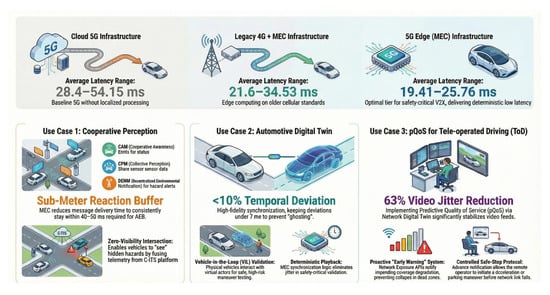
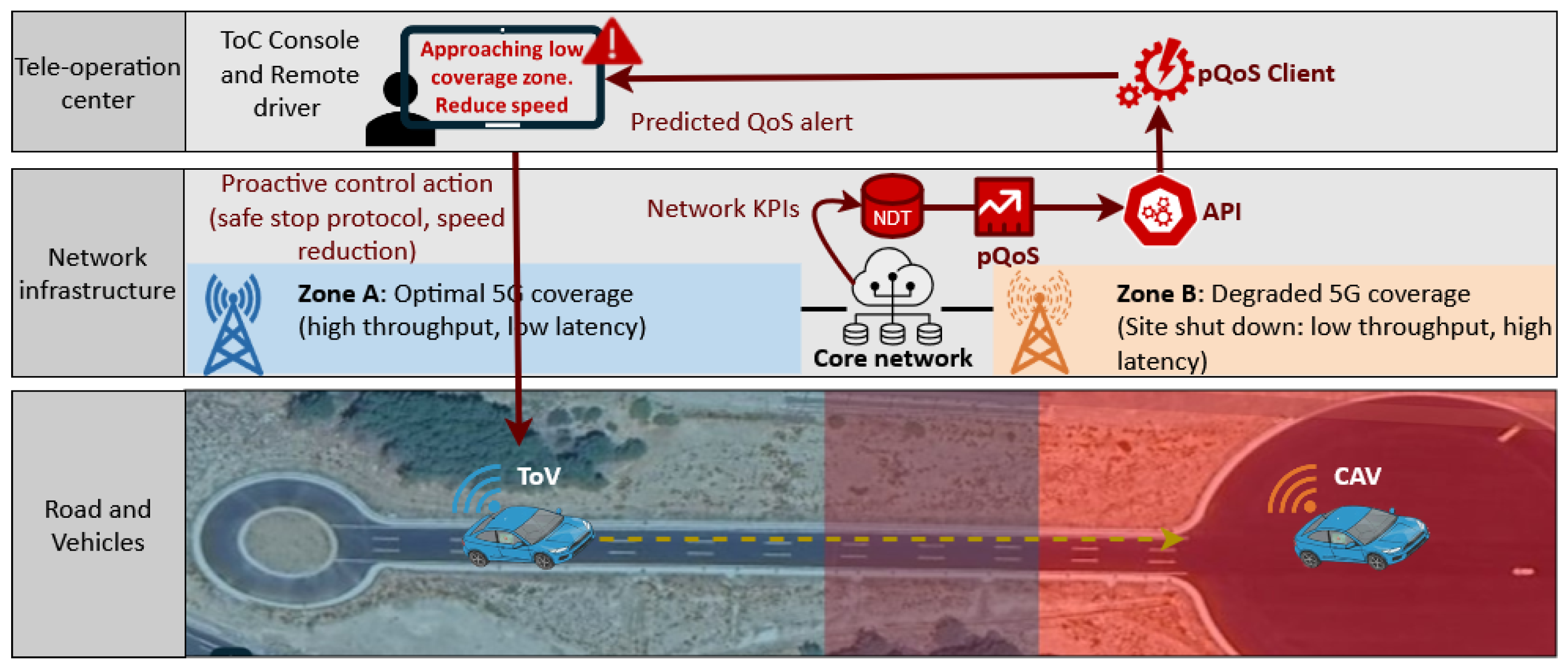
- Unified Network Exposure API and pQoS: We implement a Network Digital Twin (NDT) and a Network Exposure Application Programming Interface (API) to provide pQoS alerts regarding impending performance degradation. Although demonstrated in a ToD context (reducing video jitter by up to 63%), this proactive mechanism can serve as a unified cross-layer solution to mitigate network-induced reliability drops across various ITS use cases.
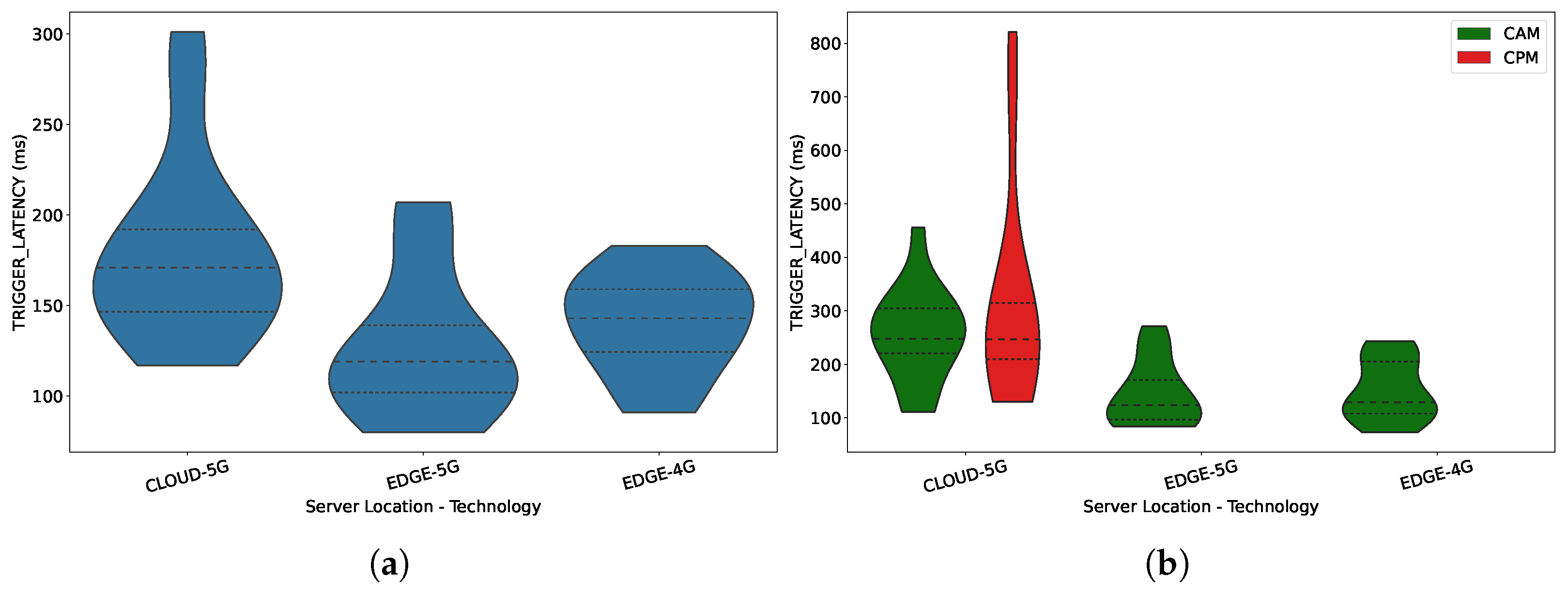
- Environment-Adaptive Cooperative Perception: We evaluate the efficacy of two different V2X messaging strategies based on environmental constraints, comparing CAM and CPM. While CAMs are used to maintain mutual awareness in scenarios where direct sensor visibility is obstructed (e.g., zero-visibility intersections), CPMs are utilized to detect and report non-connected road users, effectively extending the perception horizon of connected vehicles. The trials indicate that while CPMs are essential for comprehensive environmental models, they exhibit a 24.2% higher average trigger latency compared to CAMs under the tested conditions.
- Vehicle-in-the-Loop (ViL) via Digital Twin: We introduce an Automotive DT framework specifically designed to bridge physical and digital domains enabling high-fidelity ViL validation. This system allows physical ego-vehicles to interact with virtual actors in a synchronized digital environment, facilitating the safe, energy efficient, and repeatable testing of high-risk maneuvers with temporal synchronization deviations below 10%.
- Real-Life 5G and MEC Evaluation: We evaluate three ITS use cases at the 370-hectare IDIADA proving ground using a functional 5G Non-Standalone (NSA) network. Results demonstrate that 5G NSA and MEC reduce service latency by up to 90% for safety-critical messages compared to legacy 4G and cloud infrastructures, establishing a performance benchmark for resilient future internet mobility services.
- Identification of 6G Design Imperatives: Based on the trial results, we define critical architectural gaps and lessons learned that serve as inputs for 6G research. This includes the identification of the “TDD Frame Mismatch” for uplink-heavy services, the “Static Allocation Gap” in current slicing, and the requirement for sub-second streaming telemetry to achieve deterministic performance.
2. Use Cases
2.1. Cooperative Perception
2.1.1. Use Case Description
2.1.2. System Architecture and Methodology
2.2. Automotive Digital Twin
2.2.1. Use Case Description
2.2.2. System Architecture and Methodology
- Recording Phase: Scenario 1 of the cooperative perception use case is executed iteratively using two physical CAVs. During these trials, the recorder captures high-fidelity V2X data, specifically CAM and DENM, directly from the MQTT broker. This telemetry is subsequently archived in a structured recording database to serve as the ground truth for the DT.
- Replay and Augmentation Phase: In the second phase, the physical test track is restricted to a single CAV. The replay system orchestrates the scenario by injecting a DT (virtual CAV) into the network environment using the previously recorded message sets. This approach allows for the evaluation of the real vehicle’s response to the virtual agent under diverse conditions, including high-speed maneuvers that would pose significant safety risks if conducted with two physical vehicles on the track.
2.3. Predictive QoS for Tele-Operated Driving
2.3.1. Use Case Description
2.3.2. System Architecture and Methodology
- MASTER API: This component acts as the central orchestrator. Based on the specific parameters within a subscription request, the MASTER API determines the execution logic and the necessary transformation functions (APIs) to be invoked. In this implementation, it coordinates two primary services: the cell ID retrieval API and the QoS monitoring API. The architecture is designed for extensibility, allowing it to interface with additional APIs for varied use cases.
- Cell ID Retrieval API: This service tracks the specific cell ID to which the ToV is connected. To account for vehicle mobility, the cell ID is updated every T seconds. To ensure real-time accuracy, the API subscribes to an MQTT broker that captures and exposes the current cell ID of the connected vehicle.
- Monitoring API: This API monitors predicted metrics (e.g., signal level, latency, throughput, and cell status) for both the current serving cell and the upcoming cell in the vehicle’s path. If any metric falls below the defined thresholds, the API triggers an alarm to the MASTER API. It receives target cell IDs from the MASTER API and queries the NDT for network KPIs and cell status. Cell status is derived from the IDIADA dashboard, which fetches Operations, Administration, and Maintenance (OAM) data at 15-min intervals, providing a snapshot of deployment-grade granularities. Network KPIs (e.g., SINR, RSRP, latency, and throughput) are collected via the MQTT broker from both the primary ToV and a leading vehicle connected to the cell ahead. Notably, in a full Network Data Analytics Function (NWDAF) deployment [19], these KPIs could be retrieved directly using the provided cell IDs.
3. Network Implementation
3.1. Network Infrastructure
3.2. ITS Platform
- CAM: Broadcast periodic dynamic status data, including vehicle position, speed, and heading, to ensure mutual awareness among nearby entities.
- DENM: Triggered by specific events to alert the network of localized hazards, such as accidents, roadworks, or adverse weather.
- CPM: Facilitate the sharing of sensor-detected data regarding non-connected road users (e.g., pedestrians or cyclists), significantly extending the perception horizon of connected vehicles beyond their immediate line-of-sight.
4. Performance Evaluation Results
4.1. Results of Cooperative Perception Use Case
4.1.1. Latency
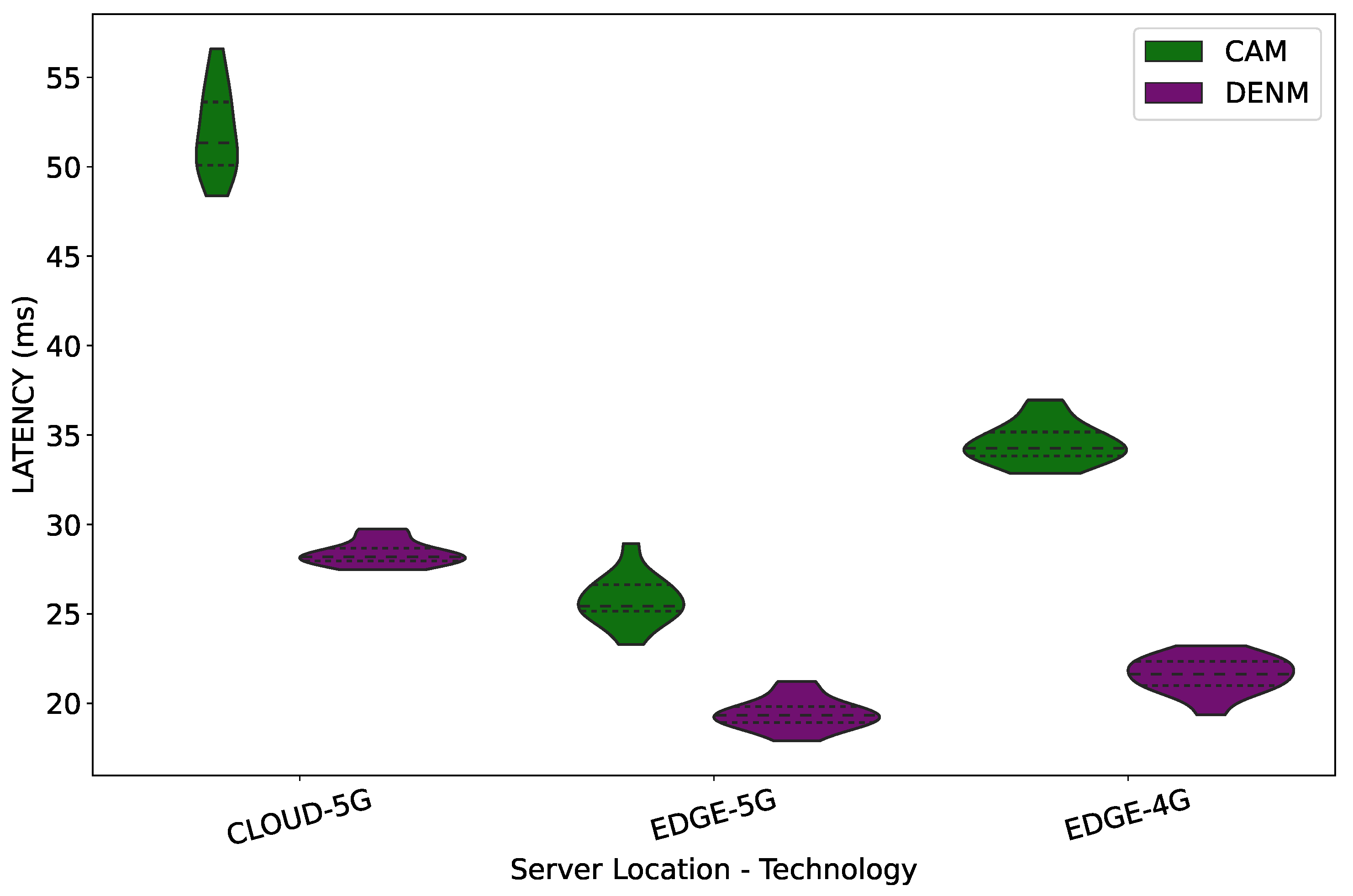
- Determinism and Jitter: Across both scenarios, the 5G-Edge (MEC) configuration demonstrated superior stability, with a Standard Deviation (STD) consistently between 1.0 and 1.6 ms. This is reflected in the narrow gap (typically <1.5 ms) between the 95th percentile and the absolute maximum latency. In contrast, 5G-Cloud configurations exhibited nearly double the jitter (STD up to 2.8 ms), illustrating how public backhaul fluctuations introduce non-deterministic delays.
- Safety-Critical Reliability: The worst-case performance (maximum latency) remained well within safety-critical bounds at the Edge. For DENM messages, the maximum recorded latency was 21.2 ms (Scenario 1) and 24.6 ms (Scenario 2), ensuring emergency alerts are delivered in less than half the time of a standard 50 ms perception cycle. Even for more complex CAM and CPM messages, the 5G-Edge maximum (28.9 ms) stayed significantly below the 95th percentile of the 4G-Edge alternative (32.6 ms), proving that 5G-MEC is essential for maintaining a sub-50 ms reaction buffer.
- Protocol Efficiency: The analysis of CPM in Scenario 2 validates the efficiency of the ITG translation and MQTT broker. Despite the higher data complexity of CPM compared to CAM, the maximum latency (59.3 ms) remained within a 3% margin of the CAM Cloud maximum (61.1 ms). This confirms that the serialization processes and Quadtree-based filtering are highly optimized, preventing complex payloads from inducing non-linear delays that would jeopardize the V2X validity window.
4.1.2. Reliability
4.2. Results of Automotive DT Use Case
4.3. Results of the pQoS for ToD Use Case
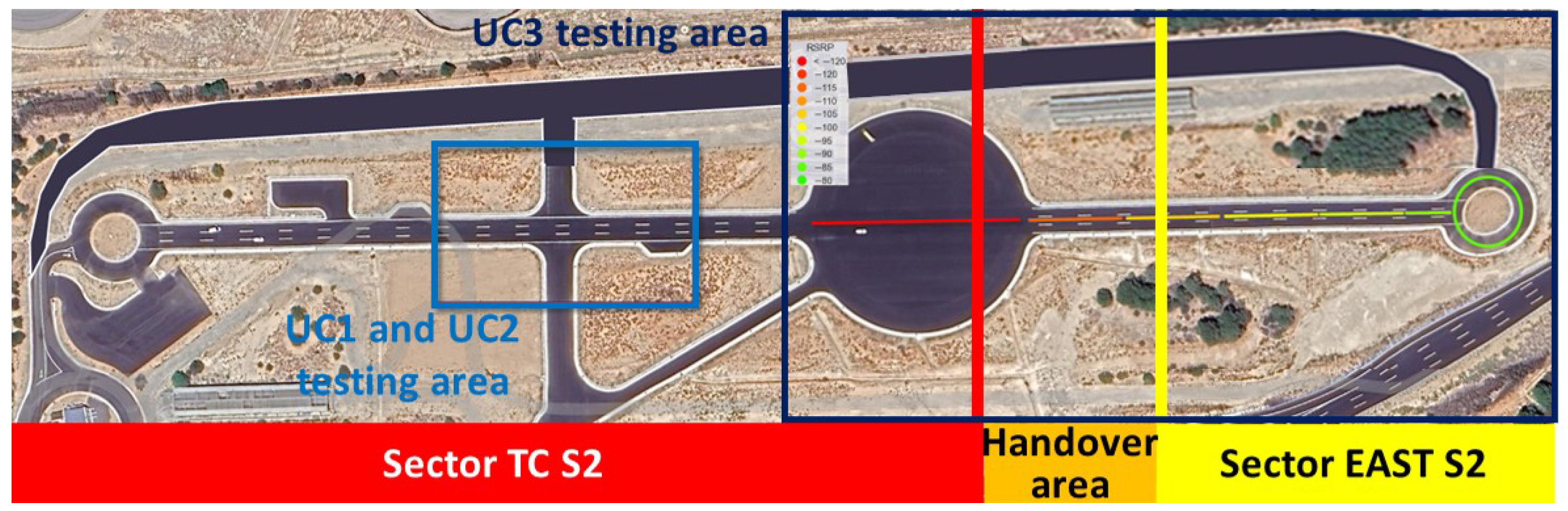
- Scenario 1 (No NDT): In this scenario, Sector TC S2 in Figure 5 is turned off and the network exposure API is deactivated.
- Scenario 2 (UE-based NDT): In this scenario, Sector TC S2 is turned off and the network exposure API is activated using the information collected from the CAVs located in the big roundabout with no coverage.
- Scenario 3 (Network-based NDT): In this scenario, Sector TC S2 is turned off, and the network exposure API is activated using the information collected from the network through the network OAM.
4.3.1. Video KPIs
4.3.2. Command KPIs
4.3.3. Scalability Analysis
5. Challenges and Lessons Learned
5.1. Beyond Best-Effort to 6G Determinism
- Architectural Symbiosis (Beyond Exposure): It is no longer sufficient to merely “expose” network statistics. Real-time telemetry regarding localized congestion and resource availability must be ingested by the application’s logic, while the application must simultaneously inject its performance requirements directly into the network’s orchestration plane. This enables a proactive “early warning system” where the network and application negotiate a graceful degradation or a “safe state” transition (e.g., for an autonomous vehicle) before a physical link failure occurs.
- Beyond CAMARA (The Negotiation Gap): While current frameworks like the CAMARA project [16] provide standardized “Northbound APIs” for status exposure, they remain largely transactional. 6G requires rich APIs that support iterative negotiation, allowing the application to request specific performance requirements and the network to provide “counter-offers” based on predictive telemetry.
- Evolution of pQoS into “Self-Healing” Orchestration: The use of pQoS as an early warning system remains a reactive control loop where the application (ToD) must adjust to a network alert. The 6G architectural gap lies in Autonomous Orchestration, where the network does not only “alert” the application to a 15-min “coarse” degradation, but uses sub-second streaming telemetry (via NWDAF-like functions) to proactively migrate MEC workloads or adjust beamforming before the user experience is impacted.
5.2. Beyond Static Pipes: Digital Twin for Context-Aware 6G V2X Slicing
- From Rigid Pipes to Context-Aware Slicing: In 5G, a slice is often a static reservation that does not differentiate between a vehicle on an empty highway and one caught in a sudden traffic jam or heavy rain. These environmental factors drastically alter the QoS. 6G architecture must bridge this gap by making slice configuration dynamic and context aware in a similar way to the orchestrator in the previous section. For instance, as vehicle density increases, the network can proactively expand the V2X slice capacity to handle the surge in basic safety messages. Another example, at the start of rain, the system can trigger a higher-reliability profile (lower latency, higher redundancy) to compensate for the increased risk of accidents and potential signal degradation.
- The “What-If” Engine: Simulating Impact via NDT: A core innovation in this 6G vision is the use of a DT as a “What-If” engine. Before any slice reconfiguration is pushed to the live network, the DT simulates the change. It should be able to provide an impact analysis by predicting how expanding a V2X slice will affect existing users (e.g., public voice users or industrial IoT sensors). It should also be able to perform conflict resolution: If the simulation predicts a drop in reliability for safety-critical services, the engine must suggest an optimized configuration that balances the load without compromising safety.
5.3. Transitioning from Coarse to Fine-Grained Analytics
- The “Minute vs. Second” Gap: Conventional network dashboards often provide updates at 15-min intervals, a “coarse” granularity sufficient for general monitoring but inadequate for safety-critical V2X applications.
- Real-time Telemetry: Future 5G/6G functions must support sub-second, fine-grained analytics (e.g., instantaneous SINR and scheduling delays) to enable responsive edge intelligence. This requires a shift from batch-based polling to streaming telemetry and standardized APIs. Whether utilizing the Network Data Analytics Function (NWDAF) or NDT, data acquisition should be on-demand and AI-triggered to minimize computational and memory overhead.
5.4. TDD Frame Mismatch: Addressing Uplink-Heavy V2X Demand
- The Asymmetry Paradox: Most commercial 5G deployments utilize a Time Division Duplex (TDD) frame configuration that is heavily biased toward the Downlink (DL) to accommodate consumer data consumption (e.g., video streaming, web browsing). However, critical V2X use cases are inherently Uplink (UL) heavy. For example, ToD massive UL throughput (ranging from 15 to 50 Mbps per vehicle) to stream high-definition camera feeds and LiDAR sensor data to the edge/cloud, while requiring minimal DL bandwidth for control commands.
- Infrastructure Recommendations: This mismatch leads to rapid UL resource exhaustion in public networks. Recent research has identified this as a critical bottleneck, proposing machine-learning-based approaches to dynamically optimize uplink scheduling and resource allocation to handle such vertical-specific demands [21]. To support large-scale automotive deployments, there is a critical need for:
- –
- Flexible TDD Configurations: Implementing more symmetric or dynamically adjustable TDD patterns within existing bands to better serve vertical industries.
- –
- Dedicated Spectrum: The allocation of specific frequency bands dedicated to industrial and automotive use cases, ensuring that safety-critical UL traffic is not throttled by consumer DL demand.
5.5. Evolution from Basic Awareness to Collective Perception
- Rich Messaging Frameworks: There is a fundamental requirement to transition toward richer message types, such as the CPM and the Sensor Data Sharing Message (SDSM). These allow vehicles to share processed sensor data, effectively extending the “line of sight” for all connected actors.
- Centralized Intelligence via Traffic Management Center (TMC): Achieving true cooperative perception requires a cloud-based TMC. By acting as a C-ITS orchestrator, a TMC can aggregate multi-source data to infer global traffic patterns and distribute dynamic safety policies, bridging the gap between individual vehicle awareness and system-wide safety.
5.6. Bridging the Semantic Gap: Mapping Network to Service KPIs
- Correlation Modeling: Future deployments must establish systematic, cross-layer KPI correlation models. These models should link stochastic network behavior with deterministic service outcomes under varying mobility patterns and environmental conditions.
- Automated Service-Level Agreement (SLA) Assurance: Developing these analytical models is a prerequisite for automated SLA assurance, allowing the network to proactively adjust resources before service degradation occurs.
5.7. The Scalability Gap: Performance Degradation in Dense V2X Environments
- Radio Resource Exhaustion: In our trials, the ego-vehicles had nearly exclusive access to the Physical Resource Blocks (PRBs). However, in a dense urban environment thousands of vehicles requesting high-bandwidth Uplink (e.g., for ToD) and frequent messaging (e.g., CAM/CPM) lead to PRB exhaustion. This results in increased scheduling delays and packet loss as the 5G gNodeB struggles to allocate resources within the TDD frame. The 90% latency reduction observed in our trials could quickly evaporate if the MAC-layer scheduler becomes a bottleneck.
- Signal Integrity and Interference Floor: High vehicle density significantly raises the interference floor. Even with advanced beamforming, the cumulative “noise” from thousands of sidelink (V2V) and cellular (V2I) transmissions degrades the Signal-to-Interference-plus-Noise Ratio (SINR). Lower SINR forces the system to use more robust but lower-order Modulation and Coding Schemes (MCS). This reduces the effective throughput, making high-definition sensor streaming for ToD unreliable or impossible without massive infrastructure densification.
- The “Message Storm” and MEC Processing Jitter: A single intersection with 200 connected vehicles can generate thousands of (CAMs/CPMs) per second. This “message storm” puts immense pressure on the MEC application server. We observed 40–50 ms latencies with few actors, but under mass-scale load, the MEC compute jitter increases. The time required for the Traffic Management Center (TMC) to fuse data from thousands of sources can exceed the “freshness” requirements of safety-critical DTs.
- Impact on pQoS Reliability: Our pQoS mechanism relies on the network’s ability to predict its own state. In a highly dynamic, large-scale environment, the temporal validity of a pQoS alert shrinks. If the network state changes faster than the API can “expose” it, the reduction in video jitter we achieved may drop. This necessitates a move toward the sub-second streaming telemetry we identified as a 6G requirement, as traditional polling-based APIs cannot keep up with urban-scale volatility.
- The automotive DT as a Scalability Bridge: The primary value of the proposed ViL framework is its ability to bridge the gap between controlled trials and urban complexity. By achieving high-fidelity synchronization (below 10% deviation) in a controlled environment, we establish the DT as a “ground-truth” emulated environment. Once calibrated, these twins allow for the high-fidelity scaling of dense vehicular traffic and dynamic radio environments, to test resilience and “edge-case” scenarios without the prohibitive costs or safety risks of full-scale physical infrastructure. The proposed DT framework allows us to simulate the “Message Storms” by flooding the MEC application with thousands of virtual V2X messages, testing the limits of the Traffic Management Center’s (TMC) processing capacity.
- Hybrid Emulation Strategy: Future 6G validation must adopt a hybrid approach where the NDT simulates thousands of background V2X users (generating congestion and interference) while the physical “Ego-vehicle” interacts with this virtual load in real-time. This allows researchers to test if the pQoS and MEC orchestration logic remains robust under “urban-scale” stress that is physically impossible to replicate on a proving ground.
6. Conclusions
Author Contributions
Funding
Data Availability Statement
Conflicts of Interest
References
- SAE International. Taxonomy and Definitions for Terms Related to Driving Automation Systems for On-Road Motor Vehicles; SAE international: Warrendale, PA, USA, 2021. [Google Scholar]
- Giordani, M.; Polese, M.; Mezzavilla, M.; Rangan, S.; Zorzi, M. Toward 6G Networks: Use Cases and Technologies. IEEE Commun. Mag. 2020, 58, 55–61. [Google Scholar] [CrossRef]
- Testouri, M.; Elghazaly, G.; Hawlader, F.; Frank, R. 5G-Enabled Teleoperated Driving: An Experimental Evaluation. In Proceedings of the International Conference on Models and Technologies for Intelligent Transportation Systems (MT-ITS), Luxembourg, 8–10 September 2025. [Google Scholar] [CrossRef]
- Liu, R.; Hua, M.; Guan, K.; Wang, X.; Zhang, L.; Mao, T.; Zhang, D.; Wu, Q.; Jamalipour, A. 6G Enabled Advanced Transportation Systems. IEEE Trans. Intell. Transp. Syst. 2024, 25, 10564–10580. [Google Scholar] [CrossRef]
- Alalewi, A.; Dayoub, I.; Cherkaoui, S. On 5G-V2X Use Cases and Enabling Technologies: A Comprehensive Survey. IEEE Access 2021, 9, 107710–107737. [Google Scholar]
- Turkovic, B.; Vlasakker, R.V.D.; Toumi, N.; Schwartz, R.D.S.; Schackmann, P.P. 5G Blueprint: Enabling Cross-Border Automotive with 5G Standalone Seamless Roaming. In Proceedings of the 2023 IEEE Future Networks World Forum (FNWF), Baltimore, MD, USA, 13–15 November 2023. [Google Scholar]
- Hamza-Cherif, A.; Jami, W.; Ksouri, C.; Aguilar-Rivera, A.; Parada, R.; Vidal, N.; Porcuna, D.; Vazquez-Gallego, F.; Nasreddine, J. 5G-Based Traffic Safety and Management Service for Cooperative Connected and Automated Mobility in Cross-Border Scenarios. In Proceedings of the 2025 IEEE 101st Vehicular Technology Conference (VTC2025-Spring), Oslo, Norway, 17–20 June 2025. [Google Scholar]
- Technical Report ETSI TR 103 562; Intelligent Transport Systems (ITS); Vehicular Communications; Basic Set of Applications; Analysis of the Collective Perception Service (CPS). Release 2. ETSI: Valbonne, France, 2019.
- Huang, T.; Liu, J.; Zhou, X.; Nguyen, D.C.; Azghadi, M.R.; Xia, Y.; Han, Q.; Sun, S. Vehicle-to-Everything Cooperative Perception for Autonomous Driving. Proc. IEEE 2025, 113, 443–477. [Google Scholar] [CrossRef]
- Schiegg, F.A.; Llatser, I.; Bischoff, D.; Volk, G. Collective Perception: A Safety Perspective. Sensors 2021, 21, 159. [Google Scholar] [CrossRef] [PubMed]
- Werbińska-Wojciechowska, S.; Giel, R.; Winiarska, K. Digital Twin Approach for Operation and Maintenance of Transportation System-Systematic Review. Sensors 2024, 24, 6069. [Google Scholar] [CrossRef] [PubMed]
- Szalay, Z.; Ficzere, D.; Tihanyi, V.; Magyar, F.; Soós, G.; Varga, P. 5G-Enabled Autonomous Driving Demonstration with a V2X Scenario-in-the-Loop Approach. Sensors 2020, 20, 7344. [Google Scholar] [CrossRef]
- Gao, T.; Chen, L.; Zhang, X.; Guo, J.; Ni, D. Credibility Assessment for Digital Twins in Vehicle-in-the-Loop Test Based on Information Entropy. Sensors 2025, 25, 1372. [Google Scholar] [CrossRef]
- 5GAA Automotive Association. Making 5G Proactive and Predictive for the Automotive Industry—White Paper 5GAA. 2019. Available online: https://5gaa.org/content/uploads/2020/01/5GAA_White-Paper_Proactive-and-Predictive_v04_8-Jan.-2020-003.pdf (accessed on 27 February 2026).
- Schippers, H.; Schüler, C.; Sliwa, B.; Wietfeld, C. System Modeling and Performance Evaluation of Predictive QoS for Future Tele-Operated Driving. In Proceedings of the 2022 IEEE International Systems Conference (SysCon), Montreal, QC, Canada, 25–28 April 2022; pp. 1–8. [Google Scholar] [CrossRef]
- CAMARA Project. Available online: https://camaraproject.org/ (accessed on 7 January 2026).
- Oliver, R.R.; Nasreddine, J.; Camps-Mur, D.; Salvati, P. Reducing travel times of Tele-Operated vehicles through Connected Road Maps. In Proceedings of the he 27th International Conference on Modeling, Analysis and Simulation of Wireless and Mobile Systems (MSWIM), Barcelona, Spain, 27–31 October 2025. [Google Scholar]
- FastAPI Framework Website. Available online: https://fastapi.tiangolo.com/ (accessed on 24 June 2025).
- 3GPP TS 23.288; 3rd Generation Partnership Project Technical Specification Group Services and System Aspects, 5G, Architecture Enhancements for 5G System (5GS) to Support Network Data Analytics Services (Release 19). ETSI: Valbonne, France, 2026. Available online: https://www.3gpp.org/ftp/Specs/archive/23_series/23.288/23288-j60.zip (accessed on 27 February 2026).
- Technical Report ETSI TR 102 638; Intelligent Transport Systems (ITS); Vehicular Communications; Basic Set of Applications; Definitions. ETSI: Valbonne, France, 2009.
- Miuccio, L.; Riolo, S.; Samarakoon, S.; Bennis, M.; Panno, D. Emerging Generalized Wireless MAC Communication Protocols via Abstraction. IEEE Open J. Commun. Soc. 2025, 6, 6842–6865. [Google Scholar] [CrossRef]










| SCENARIO 1 | SCENARIO 2 | |||
|---|---|---|---|---|
| 95%-Tile | Max | 95%-Tile | Max | |
| CAM CLOUD–5G | 55.8 | 56.6 | 58.8 | 61.1 |
| CAM EDGE–5G | 27.7 | 28.9 | 25.8 | 26.7 |
| CAM EDGE–4G | 36.0 | 37.0 | 32.6 | 33.6 |
| DENM CLOUD–5G | 29.7 | 29.7 | 32.8 | 33.0 |
| DENM EDGE–5G | 20.9 | 21.2 | 23.1 | 24.6 |
| DENM EDGE–4G | 22.9 | 23.2 | 24.7 | 26.0 |
| CPM CLOUD–5G | — | — | 56.7 | 59.3 |
Disclaimer/Publisher’s Note: The statements, opinions and data contained in all publications are solely those of the individual author(s) and contributor(s) and not of MDPI and/or the editor(s). MDPI and/or the editor(s) disclaim responsibility for any injury to people or property resulting from any ideas, methods, instructions or products referred to in the content. |
© 2026 by the authors. Licensee MDPI, Basel, Switzerland. This article is an open access article distributed under the terms and conditions of the Creative Commons Attribution (CC BY) license.
Share and Cite
Nasreddine, J.; Salvati, P.; Fuentes, M. Accelerating the Uptake of 5G for Automotive: Real-World Trials from the TARGET-X Project. Future Internet 2026, 18, 189. https://doi.org/10.3390/fi18040189
Nasreddine J, Salvati P, Fuentes M. Accelerating the Uptake of 5G for Automotive: Real-World Trials from the TARGET-X Project. Future Internet. 2026; 18(4):189. https://doi.org/10.3390/fi18040189
Chicago/Turabian StyleNasreddine, Jad, Paul Salvati, and Miguel Fuentes. 2026. "Accelerating the Uptake of 5G for Automotive: Real-World Trials from the TARGET-X Project" Future Internet 18, no. 4: 189. https://doi.org/10.3390/fi18040189
APA StyleNasreddine, J., Salvati, P., & Fuentes, M. (2026). Accelerating the Uptake of 5G for Automotive: Real-World Trials from the TARGET-X Project. Future Internet, 18(4), 189. https://doi.org/10.3390/fi18040189



