
MAPE-ZT: A Multi-Layer Access Policy Encryption System for Zero Trust Architectures

 , , , , and
Abstract
1. Introduction
- Development and performance evaluation of multi-layer security architecture: A three-layer encryption framework, i.e., MAPE-ZT, has been developed that combines trapdoor indexing, Symmetric Encryption (SE), and CP-ABE.
- Reduce the risk of unauthorized modification in access policies: Having knowledge of access control policies and the ability to change them could allow adversaries to gain unauthorized access. It may appear legitimate by manipulating a query accordingly.
- Realistic modeling of policy complexity for a real-life simulation: To address the issue of perfect attribute matching, three access levels (simple, medium, and complex) were used with an increasing level of complexity.
- Tradeoff between security and performance: To achieve enterprise-grade performance while maintaining security, parallelizable encryption and various other techniques have been used to take full advantage of processing units.
- Establish reproducible benchmarking methodology for ZT policy encryption: Various tests, including security assessments, performance analysis, scalability, accuracy measurement, etc., were tested under different circumstances to get a complete overview of the research.
- Achieve various security principles: Various security principles, including confidentiality, integrity, etc., are fulfilled to call MAPE-ZT secure.
- Novel Three-Layer Policy Protection Framework: An integrated framework combining the following:
- –
- Layer 1: HMAC-SHA256 trapdoor generation.
- –
- Layer 2: AES-256-CTR SE.
- –
- Layer 3: Simplified CP-ABE with XOR-based key encapsulation.
- Multi-dimensional Security Protection: The approach provides comprehensive security through:
- –
- Confidentiality through dual-layer encryption;
- –
- Integrity through AES-GCM authentication tags and cryptographic binding of policies to their encrypted content (CP-ABE);
- –
- Robust defense against various cyberattacks.
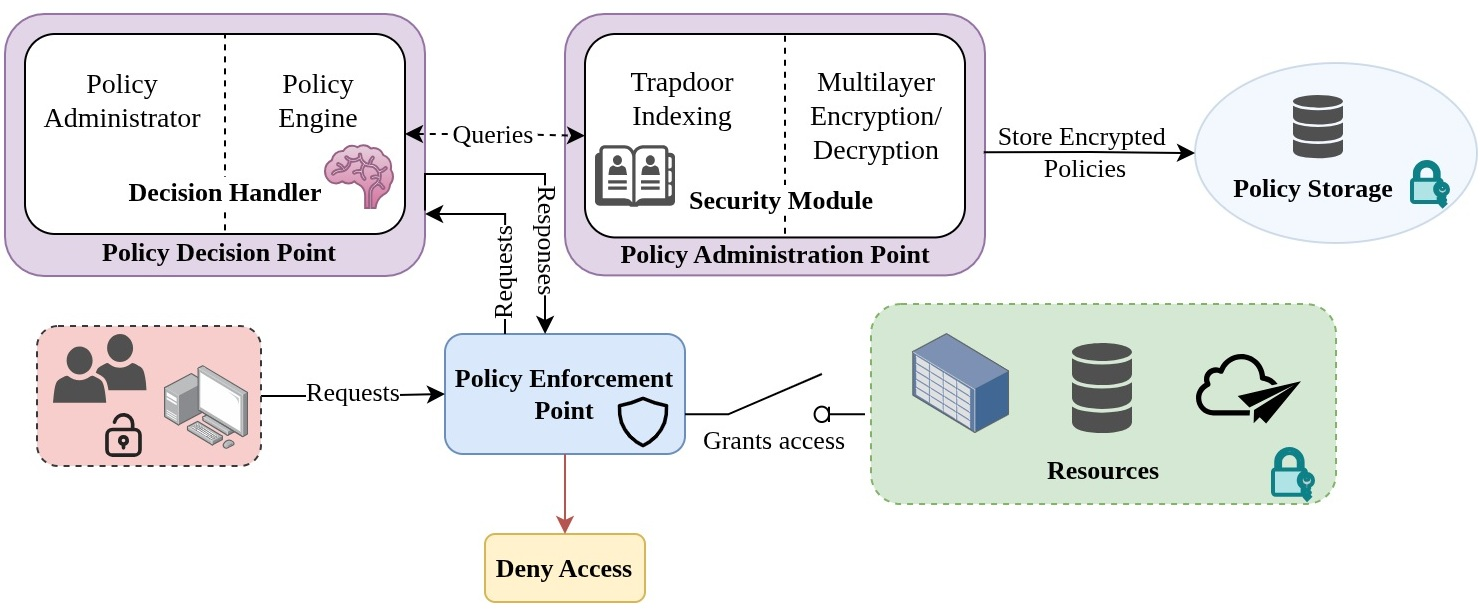
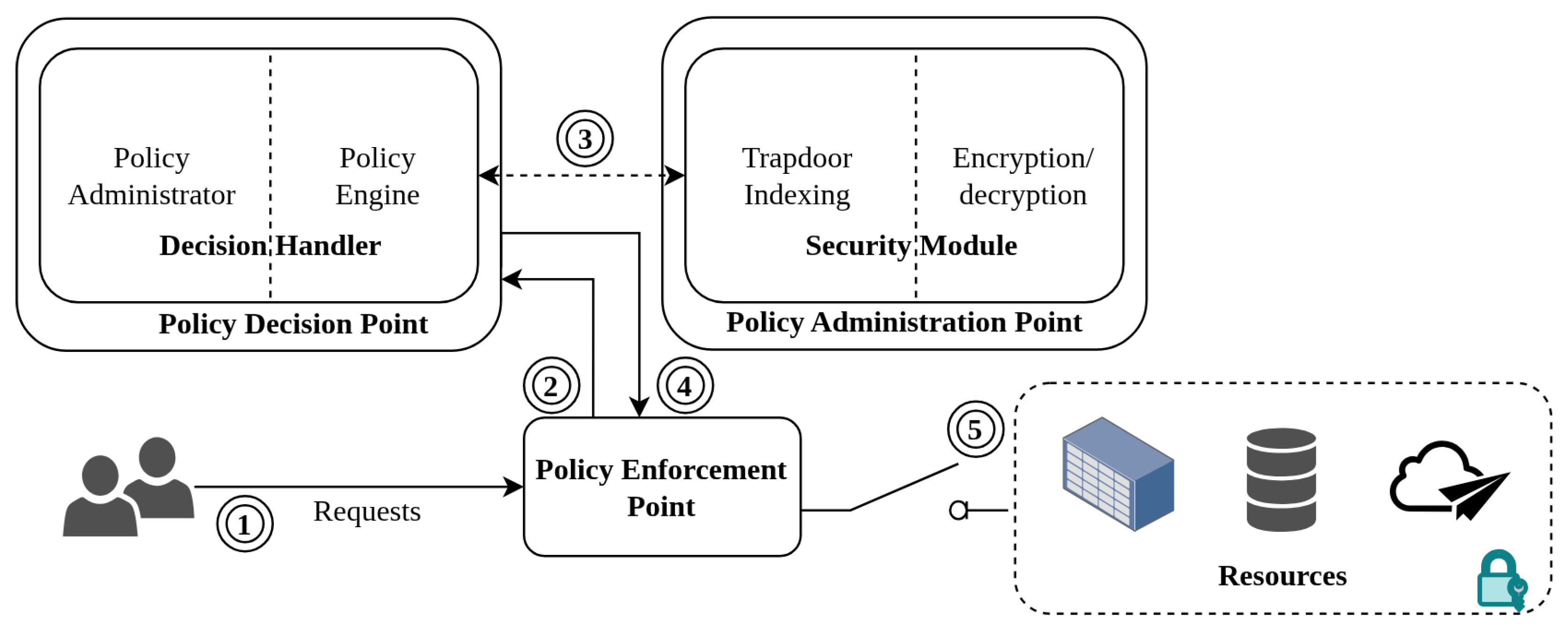
- Design for PAP: A design for PAP has been put forward through this study. It was a relatively overlooked component in many studies.
- Realistic Enterprise Policy Modeling: Various eXtensible Access Control Markup Language (XACML)-based control policies were generated using various contexts, including 10 role types and six geographic locations. In addition, an intentional failure rate of ∼30% has been used to simulate real-life scenarios.
- Optimized CP-ABE for ZT: HMAC-based derivation has been used instead of complex bilinear pairings to improve the speed of the approach.
- Comprehensive Performance Analysis: A comprehensive benchmarking framework has been designed using various metrics to evaluate the efficacy of the approach.
2. Related Works
Problem Motivation
3. Methodology
3.1. Encryption Process Flow
3.1.1. Phase 1: Policy Preprocessing and Keyword Extraction
- 1.
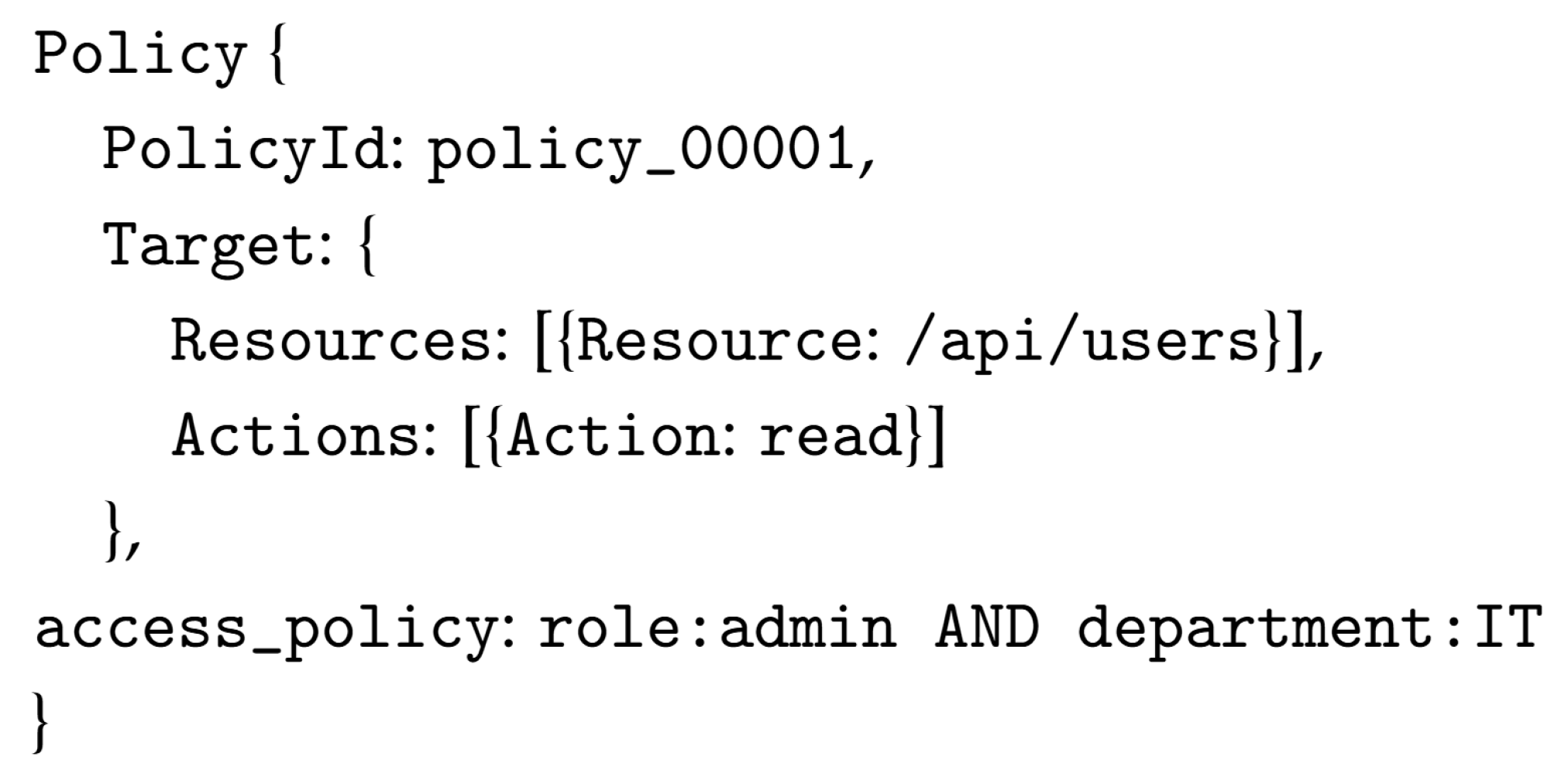
- Structural Keywords: Attribute names such as role, department, clearance_level.
- 2.
- Value Keywords: Attribute values such as admin, IT, confidential.
- 3.
- Paired Keywords: Attribute-value combinations such as role:admin, department:IT.
- 4.
- Resource Keywords: API endpoints such as /api/users, /api/billing.
- 5.
- Action Keywords: Permission types such as read, write, delete.
| Algorithm 1 Keyword extraction |
|
3.1.2. Phase 2: Trapdoor Index Construction
- ‘a7f5c9d2e8b1a4c6…’→[policy_00001, policy_00045]// original keyword: “role”
- ‘b8e6d3f1a9c2b5e8…’→[policy_00002]// original keyword: “role:admin”
- ‘c9f7e4a2b0d3c6f9…’→[policy_00001, policy_00012]// original keyword: “department”
- ‘d4a8b5c2f6e9a3d7…’→[policy_00001, policy_00034]// original keyword: “IT”
3.1.3. Phase 3: Multi-Layer Policy Encryption
Layer 1: AES-CTR Encryption
| Algorithm 2 Policy encryption |
|
Layer 2: CP-ABE Encryption
| Algorithm 3 CP-ABE encryption |
|
| Algorithm 4 XOR-based CP-ABE encapsulation |
▹Step 1: Generate nonce
▹Step 2: CP-ABE encryption
▹Step 3: Prepare PRF input
▹Step 4: Derive keystream using HKDF
▹Step 5: XOR encapsulation
|
| Algorithm 5 XOR-based CP-ABE decapsulation |
▹Step 4: XOR decapsulation
|
- 1.
- PRF security of HMAC-SHA256 is broken;
- 2.
- Security guarantees of HKDF are violated;
- 3.
- IND-CPA security of AES-256-GCM is compromised.
3.1.4. Final Storage Structure
3.2. Decryption Process Flow
3.2.1. Phase 1: Secure Search
| Algorithm 6 Trapdoor search |
|
3.2.2. Phase 2: User Key Generation and Authorization
- Simple Policies: Require exact attribute matching using AND logic; ≤5 attributes; no nested logic.
- Medium Policies: Support OR groups with AND operations within groups; 6–20 attributes; up to 3 levels of nesting.
- Complex Policies: Uses fuzzy matching with the 70% attribute satisfaction threshold; >20 attributes; >3 nesting levels; includes wildcards/negations/dynamic attributes.
| Algorithm 7 Policy evaluation |
|
| Algorithm 8 Recursive policy tree evaluation |
|
3.2.3. Phase 3: Multi-Layer Decryption
| Algorithm 9 CP-ABE decryption |
|
| Algorithm 10 Policy decryption |
|
CP-ABE Decryption
Symmetric Decryption
4. Findings and Results
4.1. System Comparison
- Role-permission mapping: Five predefined roles (admin, manager, analyst, user, and guest) were used with hierarchical permissions.
- Access control logic: Simple Boolean checks in which users are granted access based solely on their role.
- Performance measurement: Access checks performed without any encryption overhead.
4.2. Policy Scalability
4.3. Access Control Accuracy
4.4. Analysis Policy Size
4.5. Scalability Impact on Observable Patterns
- Small: 500 policies, 50 users, 200 queries.
- Medium: 1000 policies, 100 users, 500 queries.
- Large: 2000 policies, 200 users, 1000 queries.
- User Query Diversity: It measures the diversity of queries issued by each user. It can be calculated as the average ratio of unique queries to total queries per user. It is presented in Equation (16).where U is the user set, are distinct queries by user u, and are all queries by u. This metric is important for assessing risk profile. A low diversity score indicates that the behavior of the user is predictable. This makes it easier for adversaries to identify the user’s access pattern and infer the roles or other details.
- Co-occurrence Strength: It measures how frequently pairs of policies together appear in the same result set. For each query returning policies , all policy pairs are counted and computed using Equation (17).where is the number of times that policies and appear in the same set of results. It ensures structural information on the relationships of policies. High occurrence indicates dependencies that could be exploited to gain knowledge about the semantics of policies.
- Result Count Entropy: It quantifies the unpredictability of the result set using Shannon entropy. It can be evaluated using Equation (18).where C is the set of observed result counts and is the probability of the observed count c. It is measured in bits. This metric helps to identify how many different result size patterns exist. For example, an entropy of 4 bits suggests ∼ unique result size patterns. Higher entropy indicates make inference of query type more difficult.
4.6. Statistical Analysis
4.7. Mitigation Against Various Cyberattacks
4.8. Keyspace Analysis
4.9. Complexity Analysis
- n: Number of policies.
- k: Average keywords per policy.
- : Average policy size in bytes.
- : Number of query keywords.
- : Size of trapdoor index.
- : Number of matching policies.
- : Number of attributes per policy (also the size of the per-policy encrypted key table ).
4.10. Security Properties
5. Conclusions
Author Contributions
Funding
Institutional Review Board Statement
Informed Consent Statement
Data Availability Statement
Conflicts of Interest
Abbreviations
| AES | Advanced Encryption Standard |
| AI | Artificial Intelligence |
| CVE | Common Vulnerabilities and Exposures |
| DAM | Distributed Authentication Mechanism |
| DP | Differential Privacy |
| ECC | Elliptic Curve Cryptography |
| FNN | Feedforward Neural Network |
| HMAC | Message Authentication Code |
| IAM | Identity and Access Management |
| IOT | Internet of Things |
| IIOT | Industrial Internet of Things |
| IPFS | InterPlanetary File System |
| NIST | National Institute of Science and Technology |
| OT | Operation Technologies |
| PA | Policy Administrator |
| PAP | Policy Administration Point |
| PDP | Policy Decision Point |
| PE | Policy Engine |
| PEP | Policy Enforcement Point |
| RBAC | Role-Based Access Control |
| SDP | Software-Defined Perimeter |
| SE | Symmetric Encryption |
| XACML | eXtensible Access Control Markup Language |
| ZKPs | Zero-Knowledge Proofs |
| ZT | Zero Trust |
| ZTA | ZT Architecture |
References
- AAG IT Support Business Security. The Latest Cyber Crime Statistics (Updated April 2025). 2025. Available online: https://aag-it.com/the-latest-cyber-crime-statistics/ (accessed on 3 December 2025).
- Cybersecurity Ventures. Global Ransomware Damage Costs Predicted to Exceed $275 Billion by 2031. 2025. Available online: https://cybersecurityventures.com/global-ransomware-damage-costs-predicted-to-reach-250-billion-usd-by-2031/ (accessed on 5 December 2025).
- News, C. Why Gen Z Is Driving the Future of Cybersecurity. 2023. Available online: https://www.cbc.ca/news/canada/calgary/gen-z-cybersecurity-1.7088579 (accessed on 8 November 2025).
- Das, S.; Priyadarshini, R.; Mishra, M.; Barik, R.K. Leveraging Towards Access Control, Identity Management, and Data Integrity Verification Mechanisms in Blockchain-Assisted Cloud Environments: A Comparative Study. J. Cybersecur. Priv. 2024, 4, 1018–1043. [Google Scholar] [CrossRef] [Scilit]
- Feng, X.; Hu, S. Cyber-Physical Zero Trust Architecture for Industrial Cyber-Physical Systems. IEEE Trans. Ind. Cyber-Phys. Syst. 2023, 1, 394–405. [Google Scholar] [CrossRef] [Scilit]
- Lampson, B.W. Protection. SIGOPS Oper. Syst. Rev. 1974, 8, 18–24. [Google Scholar] [CrossRef] [Scilit]
- Saltzer, J.; Schroeder, M. The protection of information in computer systems. Proc. IEEE 1975, 63, 1278–1308. [Google Scholar] [CrossRef] [Scilit]
- Tsai, M.; Lee, S.; Shieh, S.W. Strategy for Implementing of Zero Trust Architecture. IEEE Trans. Reliab. 2024, 73, 93–100. [Google Scholar] [CrossRef] [Scilit]
- Poirrier, A.; Cailleux, L.; Heide Clausen, T. Is Trust Misplaced? A Zero-Trust Survey. Proc. IEEE 2025, 113, 5–39. [Google Scholar] [CrossRef] [Scilit]
- Rose, S.; Connelly, O.; Forrest, S.A.; Orebaugh, A. Zero Trust Architecture; Technical Report NIST SP 800-207; National Institute of Standards and Technology: Gaithersburg, MD, USA, 2020. [Google Scholar] [CrossRef] [Scilit]
- Ali, A.; Sharafian, A.; Yasir Naeem, H.; Zakarya, M.; Wu, Z.; Bai, X. Advanced computational models for urban traffic flow prediction: A comprehensive review and future directions. Comput. Sci. Rev. 2026, 60, 100886. [Google Scholar] [CrossRef] [Scilit]
- GDPR-Info.eu. Fines/Penalties–General Data Protection Regulation (GDPR). 2025. Available online: https://gdpr-info.eu/issues/fines-penalties/ (accessed on 1 November 2025).
- Paliwal, A. The Cost of Non-Compliance: Real-World Consequences of Ignoring Cybersecurity Regulations. 2025. Available online: https://www.secopsolution.com/blog/the-cost-of-non-compliance-real-world-consequences-of-ignoring-cybersecurity-regulations (accessed on 1 November 2025).
- Barker, E. Recommendation for Key Management: Part 1–General (Special Publication 800-57 Part 1 Rev.5); Technical Report SP 800-57pt1r5; National Institute of Standards and Technology (NIST): Gaithersburg, MD, USA, 2020. [Google Scholar] [CrossRef] [Scilit]
- Daemen, J.; Rijmen, V. The Design of Rijndael; Springer: Berlin/Heidelberg, Germany, 2002. [Google Scholar] [CrossRef] [Scilit]
- Ghali, C.; Tsudik, G.; Wood, C.A. When encryption is not enough: Privacy attacks in content-centric networking. In Proceedings of the 4th ACM Conference on Information-Centric Networking, Association for Computing Machinery, New York, NY, USA, 26–28 September 2017; ICN ’17. pp. 1–10. [Google Scholar] [CrossRef] [Scilit]
- Stănică, G.C.; Anghelescu, P. Design of a Multi-Layer Symmetric Encryption System Using Reversible Cellular Automata. Mathematics 2025, 13, 304. [Google Scholar] [CrossRef] [Scilit]
- Jin, R.; Pan, Y.; Li, J.; Liu, Y.; Yang, D.; Zhou, M.; Zhu, K. Efficient Outsourced Decryption System with Attribute-Based Encryption for Blockchain-Based Digital Asset Transactions. Symmetry 2025, 17, 1133. [Google Scholar] [CrossRef] [Scilit]
- Le, H.Q.; Le, P.T.; Trinh, S.T.; Susilo, W.; Trinh, V.C. Levelled attribute-based encryption for hierarchical access control. Comput. Stand. Interfaces 2025, 93, 103957. [Google Scholar] [CrossRef] [Scilit]
- Soni, A.; Rout, J.; Sathua, M.; Nanda, S.K.; Priyadarshini, R. Hybrid Cryptosystem to Secure Access Policies for Zero Trust Environment. In Proceedings of the 2025 International Conference on Electrical, Electronics, and Computer Science with Advance Power Technologies—A Future Trends (ICE2CPT), Jamshedpur, India, 29–31 October 2025; pp. 1–6. [Google Scholar] [CrossRef] [Scilit]
- Bansal, V. Survey on Homomorphic Encryption. In Proceedings of the 2021 5th International Conference on Information Systems and Computer Networks (ISCON), Mathura, India, 22–23 October 2021; pp. 1–4. [Google Scholar] [CrossRef] [Scilit]
- Kiesel, R.; Lakatsch, M.; Mann, A.; Lossie, K.; Sohnius, F.; Schmitt, R.H. Potential of homomorphic encryption for cloud computing use cases in manufacturing. J. Cybersecur. Priv. 2023, 3, 44–60. [Google Scholar] [CrossRef] [Scilit]
- Gao, S.; Wu, R.; Iu, H.H.C.; Erkan, U.; Cao, Y.; Li, Q.; Toktas, A.; Mou, J. Chaos-based video encryption techniques: A review. Comput. Sci. Rev. 2025, 58, 100816. [Google Scholar] [CrossRef] [Scilit]
- Cheng, X.; Wang, H.; Luo, X.; Guan, Q.; Ma, B.; Wang, J. Re-cropping Framework: A Grid Recovery Method for Quantization Step Estimation in Non-aligned Recompressed Images. IEEE Trans. Circuits Syst. Video Technol. 2025; Early Access. [CrossRef] [Scilit]
- Wang, L.; Ohta, K.; Sasaki, Y.; Sakiyama, K.; Kunihiro, N. Cryptanalysis of two MD5-based authentication protocols: APOP and NMAC. IEICE Trans. Inf. Syst. 2010, 93, 1087–1095. [Google Scholar] [CrossRef] [Scilit]
- Awn. Should We Be Using SHA3? 2017. Available online: https://security.stackexchange.com/questions/152360/should-we-be-using-sha3-2017 (accessed on 9 December 2025).
- Gueron, S. Intel® Advanced Encryption Standard (AES) New Instructions Set; White Paper 323641–001, Revision 3.0; Intel Corporation: Santa Clara, CA, USA, 2010. [Google Scholar]
- Almuhammadi, S.; Al-Hejri, I. A comparative analysis of AES common modes of operation. In Proceedings of the 2017 IEEE 30th Canadian conference on electrical and computer engineering (CCECE), Windsor, ON, Canada, 30 April–3 May 2017; pp. 1–4. [Google Scholar] [CrossRef] [Scilit]
- Bethencourt, J.; Sahai, A.; Waters, B. Ciphertext-Policy Attribute-Based Encryption. In Proceedings of the 2007 IEEE Symposium on Security and Privacy (SP ’07), Berkeley, CA, USA, 20–23 May 2007; pp. 321–334. [Google Scholar] [CrossRef] [Scilit]
- Rasori, M.; Manna, M.L.; Perazzo, P.; Dini, G. A Survey on Attribute-Based Encryption Schemes Suitable for the Internet of Things. IEEE Internet Things J. 2022, 9, 8269–8290. [Google Scholar] [CrossRef] [Scilit]
- Gartner, Inc. Gartner Survey Reveals 63% of Organizations Worldwide Have Implemented a Zero-Trust Strategy; Press Release; Gartner, Inc.: Stamford, CO, USA, 2024; Based on a Q4 2023 survey of 303 security leaders. [Google Scholar]
- Joshi, H. Emerging Technologies Driving Zero Trust Maturity Across Industries. IEEE Open J. Comput. Soc. 2025, 6, 25–36. [Google Scholar] [CrossRef] [Scilit]
- Federici, F.; Martintoni, D.; Senni, V. A zero-trust architecture for remote access in industrial IoT infrastructures. Electronics 2023, 12, 566. [Google Scholar] [CrossRef] [Scilit]
- Huber, B.; Kandah, F. Zero Trust+: A Trusted-based Zero Trust architecture for IoT at Scale. In Proceedings of the 2024 IEEE International Conference on Consumer Electronics (ICCE), Las Vegas, NV, USA, 5–8 January 2024; pp. 1–6. [Google Scholar] [CrossRef] [Scilit]
- Ashraf, U.; Al-Naeem, M.; Bhutta, M.N.M.; Yuen, C. ZFort: A scalable zero-trust approach for trust management and traffic engineering in SDN based IoTs. Internet Things 2024, 28, 101419. [Google Scholar] [CrossRef] [Scilit]
- Al-Sharafi, A.M.; Alrayes, F.S.; Alruwais, N.; Maray, M.; Alshuhail, A.; Darem, A.A.; Dlaim Alotaibi, S.; Abdullah Al-Hagery, M. Ensuring Zero Trust Security in Consumer Internet of Things Using Federated Learning-Based Attack Detection Model. IEEE Access 2025, 13, 54423–54438. [Google Scholar] [CrossRef] [Scilit]
- Chen, B.; Qiao, S.; Zhao, J.; Liu, D.; Shi, X.; Lyu, M.; Chen, H.; Lu, H.; Zhai, Y. A Security Awareness and Protection System for 5G Smart Healthcare Based on Zero-Trust Architecture. IEEE Internet Things J. 2021, 8, 10248–10263. [Google Scholar] [CrossRef] [Scilit]
- Bello, Y.; Hussein, A.R.; Ulema, M.; Koilpillai, J. On Sustained Zero Trust Conceptualization Security for Mobile Core Networks in 5G and Beyond. IEEE Trans. Netw. Serv. Manag. 2022, 19, 1876–1889. [Google Scholar] [CrossRef] [Scilit]
- Sedjelmaci, H.; Tourki, K.; Ansari, N. Enabling 6G Security: The Synergy of Zero Trust Architecture and Artificial Intelligence. IEEE Netw. 2024, 38, 171–177. [Google Scholar] [CrossRef] [Scilit]
- Nie, S.; Ren, J.; Wu, R.; Han, P.; Han, Z.; Wan, W. Zero-Trust Access Control Mechanism Based on Blockchain and Inner-Product Encryption in the Internet of Things in a 6G Environment. Sensors 2025, 25, 550. [Google Scholar] [CrossRef] [Scilit]
- Das, S.; Mishra, M.; Priyadarshini, R.; Barik, R.K.; Saikia, M.J. A secure, privacy-preserving, and cost-efficient decentralized cloud storage framework using blockchain. J. King Saud Univ.—Comput. Inf. Sci. 2024, 36, 102260. [Google Scholar] [CrossRef] [Scilit]
- Awan, S.M.; Azad, M.A.; Arshad, J.; Waheed, U.; Sharif, T. A blockchain-inspired attribute-based zero-trust access control model for IoT. Information 2023, 14, 129. [Google Scholar] [CrossRef] [Scilit]
- Jose Diaz Rivera, J.; Muhammad, A.; Song, W.C. Securing Digital Identity in the Zero Trust Architecture: A Blockchain Approach to Privacy-Focused Multi-Factor Authentication. IEEE Open J. Commun. Soc. 2024, 5, 2792–2814. [Google Scholar] [CrossRef] [Scilit]
- Ajish, D. The significance of artificial intelligence in zero trust technologies: A comprehensive review. J. Electr. Syst. Inf. Technol. 2024, 11, 30. [Google Scholar] [CrossRef] [Scilit]
- Meher, M.K.; Rath, A.; Panda, G.; Thanapati, B.B.; Puthal, D. Robust Detection of Evasive Fileless Powershell Malware: A Machine Learning Approach. In Proceedings of the 2025 International Conference on Artificial intelligence and Emerging Technologies (ICAIET), Bhubaneswar, India, 28–30 August 2025; pp. 1–6. [Google Scholar] [CrossRef] [Scilit]
- Tiwari, S.; Sarma, W.; Srivastava, A. Integrating Artificial Intelligence with Zero Trust Architecture: Enhancing Adaptive Security in Modern Cyber Threat Landscape. Int. J. Res. Anal. Rev. 2022, 9, 712–728. [Google Scholar]
- Nawshin, F.; Unal, D.; Hammoudeh, M.; Suganthan, P.N. AI-powered malware detection with Differential Privacy for zero trust security in Internet of Things networks. Ad Hoc Netw. 2024, 161, 103523. [Google Scholar] [CrossRef] [Scilit]
- Al-Khalidi, M.; Al-Zaidi, R.; Ali, T.; Khan, S.; Bashir, A.K. AI-optimized elliptic curve with Certificate-Less Digital Signature for zero trust maritime security. Ad Hoc Netw. 2025, 166, 103669. [Google Scholar] [CrossRef] [Scilit]
- Daah, C.; Qureshi, A.; Awan, I. Zero Trust Model Implementation Considerations in Financial Institutions: A Proposed Framework. In Proceedings of the 2023 10th International Conference on Future Internet of Things and Cloud (FiCloud), Marrakesh, Morocco, 14–16 August 2023; pp. 71–77. [Google Scholar] [CrossRef] [Scilit]
- Surantha, N.; Ivan, F. Secure kubernetes networking design based on zero trust model: A case study of financial service enterprise in indonesia. In Proceedings of the Innovative Mobile and Internet Services in Ubiquitous Computing: Proceedings of the 13th International Conference on Innovative Mobile and Internet Services in Ubiquitous Computing (IMIS-2019); Springer: Berlin/Heidelberg, Germany, 2020; pp. 348–361. [Google Scholar] [CrossRef] [Scilit]
- Yang, X.; Chen, X.; Huang, J.; Li, H.; Huang, Q. FS-IBEKS: Forward secure identity-based encryption with keyword search from lattice. Comput. Stand. Interfaces 2023, 86, 103732. [Google Scholar] [CrossRef] [Scilit]
- National Institute of Standards and Technology. Recommendation for Key Derivation Using Pseudorandom Functions. In NIST Special Publication 800-108r1 SP 800-108r1; U.S. Department of Commerce, National Institute of Standards and Technology: Gaithersburg, MD, USA, 2022; Withdrawn (archived)—legacy version available. [Google Scholar] [CrossRef] [Scilit]
- Colombo, P.; Ferrari, E. Evaluating the effects of access control policies within NoSQL systems. Future Gener. Comput. Syst. 2021, 114, 491–505. [Google Scholar] [CrossRef] [Scilit]
- Gupta, E.; Sural, S.; Vaidya, J.; Atluri, V. Enabling Attribute-Based Access Control in NoSQL Databases. IEEE Trans. Emerg. Top. Comput. 2023, 11, 208–223. [Google Scholar] [CrossRef] [Scilit] [PubMed]
- Ferraiolo, D.F.; Kuhn, D.R. Role-Based Access Controls. In Proceedings of the 15th National Computer Security Conference, National Institute of Standards and Technology, Baltimore, MD, USA, 13–16 October 1992; pp. 554–563, NIST CSRC, NIST IR. [Google Scholar]
- Oh, S.; Park, S. Task-Role Based Access Control (T-RBAC): An Improved Access Control Model for Enterprise Environment. In Proceedings of the Database and Expert Systems Applications; Springer: Berlin/Heidelberg, Germany, 2000; pp. 264–273. [Google Scholar]
- Indu, I.; Anand, P.R.; Bhaskar, V. Identity and access management in cloud environment: Mechanisms and challenges. Eng. Sci. Technol. Int. J. 2018, 21, 574–588. [Google Scholar] [CrossRef] [Scilit]



| SL | Techniques | Usual Way | Optimized Way Used |
|---|---|---|---|
| 1 | Trapdoor Index Generation | Single keyword extraction with basic hashing | Five-category keyword extraction (structural, value, paired, resource, action) with HMAC-SHA256 and deduplication. |
| 2 | Symmetric Encryption | AES-CBC with fixed IV causing pattern leakage | AES-256-CTR with random 96-bit nonces provides parallelization. |
| 3 | CP-ABE Key Generation | Complex bilinear pairings requiring expensive group operations | HMAC-based key derivation replaces bilinear pairings with a single HMAC call. |
| 4 | CP-ABE Key Encapsulation | Modular exponentiation in multiplicative groups | XOR-based encapsulation: for constant-time operation. |
| 5 | Policy Evaluation | Perfect attribute matching only (binary decision) | Recursive Boolean evaluation supporting leaf nodes, AND-nodes, and OR-nodes via evaluate_policy(), with short-circuit evaluation and backward compatibility with flat string policies. |
| 6 | Search Intersection | Linear search through policy lists | Hash-based O(1) lookup with set intersection optimization. |
| 7 | User Key Generation | Regenerate keys for each query | Per-attribute HMAC derivation is computed on demand to avoid long-term key storage in memory. |
| 8 | Policy Parsing | Real-time string parsing for each evaluation | Unified evaluate_policy() handles both flat string and structured tree formats to remove redundant parsing branches through a single recursive traversal. |
| 9 | Batch Processing | Individual policy encryption sequentially | Sequential per-policy encryption with one-time trapdoor index construction at setup, amortizing index build cost for all policies rather than rebuilding at query time. |
| Evaluation Technique | Criterion | [33] | [34] | [35] | [36] | [37] | [38] | [39] | [40] | [42] | [43] | [46] | [47] | [48] | [49] | [50] | Proposed |
|---|---|---|---|---|---|---|---|---|---|---|---|---|---|---|---|---|---|
| Proposal Type | Architecture/ Implementation | A + I | A | A + I | I | A + I | A + I | A | A + I | A | A + I | I | A + I | A + I | A + I | A + I | A + I |
| Policy Evaluation | Static (S)/ Dynamic(D) | D | – | D | D | – | S | – | D | D | S | – | – | – | D | S | NA |
| Contextual Awareness | ✓ | ✓ | ✓ | – | ✓ | ✓ | ✓ | ✓ | ✓ | ✓ | ✓ | ✓ | – | ✓ | – | ✓ | |
| Authentication | MFA/ Continuous Authentication | ✓ | ✓ | ✓ | – | ✓ | – | – | ✓ | ✓ | ✓ | ✓ | ✓ | ✓ | ✓ | – | ✓ |
| Asset Security | Posture Calculation | ✓ | ✓ | ✓ | – | ✓ | ✓ | – | ✓ | ✓ | ✓ | ✓ | – | – | ✓ | – | – |
| Automated Threat Detection & Traffic Control | Anomaly Detection and Traffic Monitoring | ✓ | ✓ | ✓ | ✓ | ✓ | ✓ | ✓ | ✓ | ✓ | – | ✓ | ✓ | – | ✓ | ✓ | NA |
| Policy Management | Securing Access Policies | – | – | – | – | – | – | – | – | Hashed storage of data in IPFS | – | – | – | – | – | – | Policy Encryption |
| Approach | Encryption Time (s) | Avg. Access Time (s) | Access Success Rate (%) |
|---|---|---|---|
| Zero Trust | 0.7967 | 0.0085 | 0.97 |
| Traditional RBAC | 0 | 0 | 0.8 |
| Basic Encryption | 0.1182 | 0 | 1 |
| Enterprise IAM | 1.195 | 0.0068 | 0.8 |
| Metric | 100 | 500 | 1000 | 2500 | 5000 | 7500 | 10,000 |
|---|---|---|---|---|---|---|---|
| Encryption Time (s) | 0.0477 | 0.0919 | 0.2071 | 0.7036 | 2.0733 | 4.2516 | 7.3284 |
| Search Time (ms) | 0.28 | 1.29 | 2.5 | 6.3 | 13.37 | 21.32 | 28.18 |
| Trapdoor Lookup (ms) | 0.0123 | 0.033 | 0.0553 | 0.1623 | 0.4769 | 0.6573 | 0.8749 |
| Throughput | 3594.4 | 775.87 | 399.27 | 158.85 | 74.79 | 46.9 | 35.48 |
| Before Encryption (KB) | 122.1 | 616 | 1227.7 | 3064.6 | 6130.4 | 9193.4 | 12,259.8 |
| After Encryption (KB) | 162.9 | 820.5 | 1636.9 | 4086.2 | 8175.6 | 12,261.4 | 16,349.1 |
| Avg Policy Size (B) | 1250.6 | 1261.5 | 1257.2 | 1255.3 | 1255.5 | 1255.2 | 1255.4 |
| Storage Overhead (%) | 33.4 | 33.2 | 33.3 | 33.3 | 33.4 | 33.4 | 33.4 |
| Metric | 100 | 500 | 1000 | 2500 | 5000 | 7500 | 10,000 |
|---|---|---|---|---|---|---|---|
| Encryption Time (s) | 0.024 ± 0.003 | 0.092 ± 0.003 | 0.206 ± 0.006 | 0.709 ± 0.025 | 2.093 ± 0.070 | 4.178 ± 0.188 | 6.784 ± 0.015 |
| Search Time (ms) | 0.286 ± 0.003 | 1.271 ± 0.022 | 2.492 ± 0.013 | 6.329 ± 0.082 | 13.832 ± 0.703 | 20.814 ± 0.183 | 28.436 ± 0.491 |
| Trapdoor Lookup (ms) | 0.013 ± 0.001 | 0.038 ± 0.003 | 0.058 ± 0.005 | 0.181 ± 0.017 | 0.523 ± 0.093 | 0.677 ± 0.071 | 0.944 ± 0.101 |
| Throughput (ops/sec) | 3494.956 ± 42.314 | 786.781 ± 13.703 | 401.303 ± 2.124 | 158.028 ± 2.051 | 72.437 ± 3.488 | 48.047 ± 0.421 | 35.175 ± 0.608 |
| Before Encryption (KB) | 123.170 ± 0.301 | 613.945 ± 1.766 | 1225.369 ± 1.742 | 3063.670 ± 1.681 | 6131.054 ± 2.205 | 9195.185 ± 5.000 | 12,258.526 ± 2.565 |
| After Encryption (KB) | 164.155 ± 0.553 | 818.319 ± 1.792 | 1634.214 ± 2.040 | 4085.182 ± 2.060 | 8175.038 ± 2.278 | 12,261.351 ± 5.159 | 16,346.533 ± 2.147 |
| Avg Policy Size (B) | 1261.264 ± 3.084 | 1257.360 ± 3.616 | 1254.778 ± 1.784 | 1254.879 ± 0.689 | 1255.640 ± 0.452 | 1255.449 ± 0.683 | 1255.273 ± 0.263 |
| Storage Overhead (%) | 33.275 ± 0.159 | 33.289 ± 0.096 | 33.365 ± 0.025 | 33.343 ± 0.016 | 33.338 ± 0.014 | 33.345 ± 0.020 | 33.348 ± 0.016 |
| Query Type | Simple Role | Department | Multi-Attribute | Complex |
|---|---|---|---|---|
| Accuracy (%) | 96.6 | 96.7 | 96.4 | 96.3 |
| Precision (%) | 100 | 100 | 100 | 100 |
| Avg Total Decision (ms) | 5.4 | 5.46 | 5.61 | 5.76 |
| Avg Search Trapdoor (ms) | 0.0766 | 0.0771 | 0.1767 | 0.2923 |
| Avg Decrypt (ms) | 0 | 0 | 0 | 0 |
| Decisions per s | 185.1 | 183.2 | 178.3 | 173.8 |
| Metric | Small Scale | Medium Scale | Large Scale |
|---|---|---|---|
| (500 Policies) | (1000 Policies) | (2000 Policies) | |
| User Query Diversity | 0.821 | 0.827 | 0.835 |
| Co-occurrence Strength | 1.538 | 1.491 | 1.479 |
| Result Count Entropy (bits) | 3.84 | 4.02 | 4.21 |
| Size Entropy (bits) | 3.84 | 4.02 | 4.21 |
| Comparison | Metric | t-Statistic | p-Value | Significant ( = 0.05) | Cohen’s d | Effect Size | Improvement (%) |
|---|---|---|---|---|---|---|---|
| ZT vs RBAC | Avg Access Time | 146.3185 | 0 | Yes | 92.542 | Large | −658,243.32 |
| Avg Search Time | 66.8795 | 0 | Yes | 42.3219 | Large | −9979.91 | |
| Throughput | −41.9976 | 0 | Yes | −26.5616 | Large | 99.98 | |
| Success Rate | −21.5 | 0 | Yes | −13.5978 | Large | 53.75 | |
| ZT vs Basic Encryption | Avg Access Time | 146.0529 | 0 | Yes | 92.2067 | Large | −26,406.02 |
| Avg Search Time | 54.1071 | 0 | Yes | 32.144 | Large | −305.83 | |
| Throughput | −244.9993 | 0 | Yes | −154.1823 | Large | 99.62 | |
| Success Rate | −31.5 | 0 | Yes | −19.9223 | Large | 63 | |
| ZT vs Enterprise IAM | Avg Access Time | 134.6486 | 0 | Yes | 12.9417 | Large | −25.11 |
| Avg Search Time | 67.5973 | 0 | Yes | 41.8888 | Large | −4900 | |
| Throughput | −56.0227 | 0 | Yes | −12.4388 | Large | 20.08 | |
| Success Rate | −24 | 0 | Yes | −15.1789 | Large | 56.47 |
| Metric | F-Statistic | p-Value | Significance |
|---|---|---|---|
| Avg Access Time | 11,450.6699 | 0 | Yes |
| Avg Search Time | 3963.2976 | 0 | Yes |
| Throughput | 1719.4399 | 0 | Yes |
| Success Rate | 731 | 0 | Yes |
| SL | Attack Name | Protecting Component | How Protection Works |
|---|---|---|---|
| 1 | Search Pattern Analysis | Trapdoor Index | HMAC-SHA256 generates unlinkable trapdoors. The server sees random hashes, preventing correlation. |
| 2 | Frequency Analysis | Multi-tier Keywords | Each policy generates 5–15 diverse keywords, preventing frequency-based inference. |
| 3 | Chosen Plaintext Attack | AES-CTR + Random Nonces | 96-bit random nonces ensure different ciphertexts for identical plaintexts. |
| 4 | Insider Privilege Escalation | CP-ABE Access Control | Cryptographic attribute proof required. Failed access reveals zero information. |
| 5 | Replay Attack | Nonce-Based Freshness | Unique 96-bit nonce per encryption. Deterministic trapdoor replay detection. |
| 6 | Man-in-the-Middle | AES-GCM Authentication | Authenticated encryption provides confidentiality and integrity verification. |
| 7 | Side-Channel Attack | Constant-Time Operations | XOR operations and HMAC resist timing attacks. No secret-dependent branches. |
| 8 | Brute Force Attack | Keyspace | Combined keyspace of makes brute force computationally infeasible. |
| 9 | Differential Cryptanalysis | AES-256 + CTR Mode | Random nonces prevent differential analysis. AES-256 immune to known attacks. |
| 10 | Cache-Based Attack | Uniform Memory Access | All attributes are processed identically. XOR prevents cache timing leakage. |
| 11 | Key Escrow Demands | Distributed Key Architecture | Four independent 256-bit keys. No single master key compromises the system. |
| 12 | Advanced Persistent Threat | Key Rotation + Audit Logs | Regular key updates limit the compromise window. Complete operation tracking. |
| 13 | Dictionary Attack | Salted Attribute Keys | Each attribute key is derived as , binding derivation to and making offline dictionary attacks infeasible without it. |
| 14 | Collision Attack | SHA-256 Collision Resistance | HMAC-SHA256 provides collision resistance for trapdoors. |
| 15 | Timing Attack | Constant-Time XOR | XOR-based key encapsulation executes in constant time. |
| 16 | Memory Disclosure | On-Demand Key Derivation | Keys derived using HMAC when needed. No long-term key storage. |
| Operation | Time Complexity |
|---|---|
| Encryption | |
| Search | |
| Decryption |
| Component | Space Complexity |
|---|---|
| Trapdoor Index | |
| Encrypted Database | |
| Total Space |
| Security Property | Security Level | Cryptographic Basis |
|---|---|---|
| Trapdoor Unlinkability | HMAC-SHA256 one-way function; is a 256-bit secret key | |
| Semantic Security | AES-256-CTR (Layer 1) and AES-256-GCM (Layer 2) pseudorandom permutation | |
| Ciphertext Integrity | AES-GCM 128-bit authentication tag provides INT-CTXT | |
| Enforcement of Access Control | Cryptographic | Attribute-based key derivation via ; policy evaluation via evaluate_policy() |
| Collusion Resistance | ; recovery requires | |
| Search Pattern Privacy | External: | Token unlinkability to external observers |
| Forward Secrecy | per nonce | Fresh 96-bit nonce per encryption (×2) |
| Collision Resistance | SHA-256 collision resistance | |
| Key Separation | Independent | Four independent 256-bit keys |
Disclaimer/Publisher’s Note: The statements, opinions and data contained in all publications are solely those of the individual author(s) and contributor(s) and not of MDPI and/or the editor(s). MDPI and/or the editor(s) disclaim responsibility for any injury to people or property resulting from any ideas, methods, instructions or products referred to in the content. |
© 2026 by the authors. Licensee MDPI, Basel, Switzerland. This article is an open access article distributed under the terms and conditions of the Creative Commons Attribution (CC BY) license.
Share and Cite
Soni, A.; Nanda, S.K.; Rout, J.; Sathua, M.; Panda, G.; Saikia, M.J. MAPE-ZT: A Multi-Layer Access Policy Encryption System for Zero Trust Architectures. Future Internet 2026, 18, 135. https://doi.org/10.3390/fi18030135
Soni A, Nanda SK, Rout J, Sathua M, Panda G, Saikia MJ. MAPE-ZT: A Multi-Layer Access Policy Encryption System for Zero Trust Architectures. Future Internet. 2026; 18(3):135. https://doi.org/10.3390/fi18030135
Chicago/Turabian StyleSoni, Ashutosh, Surendra Kumar Nanda, Jayanti Rout, Mrutyunjaya Sathua, Ganapati Panda, and Manob Jyoti Saikia. 2026. "MAPE-ZT: A Multi-Layer Access Policy Encryption System for Zero Trust Architectures" Future Internet 18, no. 3: 135. https://doi.org/10.3390/fi18030135
APA StyleSoni, A., Nanda, S. K., Rout, J., Sathua, M., Panda, G., & Saikia, M. J. (2026). MAPE-ZT: A Multi-Layer Access Policy Encryption System for Zero Trust Architectures. Future Internet, 18(3), 135. https://doi.org/10.3390/fi18030135