
Review

Interference-Resilient Concurrent Sensing in Dense Environments: A Review of OFDM and OTFS Waveforms for JRC

1
Department of Electrical Engineering, University of South Florida, Tampa, FL 33620, USA
2
Department of Electrical and Electronics Engineering, Istanbul Medipol University, Istanbul 34810, Türkiye
*
Author to whom correspondence should be addressed.
Future Internet 2026, 18(2), 97; https://doi.org/10.3390/fi18020097
Submission received: 28 November 2025 / Revised: 27 January 2026 / Accepted: 11 February 2026 / Published: 13 February 2026
(This article belongs to the Special Issue State-of-the-Art Future Internet Technology in USA 2024–2025)

Abstract

This paper presents a unified perspective on Orthogonal Frequency-Division Multiplexing (OFDM)-based joint radar–communication (JRC) sensing, focusing on the efficient reuse of time and frequency resources in range–Doppler estimation and imaging scenarios. By leveraging OFDM’s inherent subcarrier orthogonality, noise-like temporal properties, and minor carrier frequency offsets, these systems can support concurrent transmissions over the same spectral and temporal resources while maintaining interference resilience. Experimental and simulation-based insights demonstrate the feasibility of simultaneous sensing across users and antennas, even in dense Radio Frequency (RF) environments. We analyze trade-offs, implementation considerations, and system-level implications to provide a consolidated foundation for designing future OFDM-based JRC systems. The feasibility of an Orthogonal Time Frequency Space (OTFS) waveform for the proposed method is also investigated. The review highlights the potential of such architectures in spectrum and time-congested applications such as Vehicle-to-Everything (V2X), indoor localization, Internet of Things (IoT), and beyond fifth-generation (5G) networks.

1. Introduction

Historically, wireless communication and sensing systems have been designed and deployed independently, relying on separate hardware platforms, waveforms, and spectral resources. While this separation simplified system design, it has become increasingly inefficient in modern wireless ecosystems characterized by spectrum scarcity, dense device deployments, and stringent latency requirements. Emerging applications such as Vehicle-to-Vehicle (V2V) and Vehicle-to-Everything (V2X) networks, industrial automation, robotic surgery, Internet of Things (IoT), and Unmanned Aerial Vehicle (UAV)-based surveillance demand simultaneous, reliable communication, and high-resolution environmental awareness within the same spectral and hardware constraints [1,2,3]. These requirements have driven significant interest in Joint Radar and Communication (JRC) and Integrated Sensing and Communication (ISAC) paradigms.
Orthogonal Frequency-Division Multiplexing (OFDM), the dominant waveform in contemporary wireless standards, including fourth-generation (4G), fifth-generation (5G), and emerging sixth-generation (6G) systems, has emerged as a natural candidate for JRC/ISAC integration [4]. By reusing communication-centric OFDM signals for sensing, it becomes possible to estimate range, Doppler velocity, and even perform imaging without altering the waveform structure or sacrificing communication functionality [5,6,7]. Such reuse enables spectrum-efficient sensing, reduces hardware redundancy, and aligns sensing capabilities with existing communication infrastructures. However, realizing these benefits in multi-user and multi-transceiver environments remains a fundamental challenge.
In practical deployments, multiple users or multiple transmitter antennas often operate simultaneously and within highly overlapping spectral resources. Conventional JRC and radar imaging approaches typically address this by enforcing time-division (TDMA/TDM) or frequency-division (FDMA/FDM) multiplexing to mitigate mutual interference. While effective, these strategies inherently reduce spectral and temporal efficiency and limit scalability in dense networks [8,9]. This limitation becomes particularly severe for future ISAC systems, where a large number of distributed users or antennas must sense the environment concurrently without explicit coordination.
Motivated by these challenges, recent studies have explored opportunistic sensing, where communication signals are reused for sensing immediately after data transmission, without modifying the waveform or introducing additional signaling overhead [10]. Leveraging the noise-like nature and favorable correlation properties of OFDM, opportunistic sensing enables range and Doppler estimation through matched filtering (MF) or cross-correlation, even in spectrally congested environments. However, most existing works remain limited to either single-user scenarios or rely on partial resource separation when extended to multi-user or MIMO configurations.
In parallel, Orthogonal Time Frequency Space (OTFS) modulation has attracted growing attention as a promising alternative waveform for high-mobility and doubly selective channels. Unlike OFDM, which operates in the time-frequency domain, OTFS represents information in the delay–Doppler domain, inherently capturing channel dynamics and mitigating Doppler-induced degradation [11]. This structure provides enhanced robustness against mobility, improved diversity, and superior performance in rapidly time-varying environments [12,13]. These properties make OTFS particularly appealing for JRC/ISAC systems, where accurate velocity estimation and target resolution are critical [14,15]. Moreover, OTFS exhibits a significantly lower peak-to-average power ratio (PAPR) compared to OFDM, which is advantageous for practical transmitter implementations.
Despite these advantages, a unified sensing framework that supports both OFDM and OTFS waveforms under fully overlapping time and frequency resources, without relying on TDMA or FDMA, has not been comprehensively investigated, particularly when extending beyond range–Doppler estimation to imaging applications. This paper addresses the above gaps by proposing and validating an interference-resilient, opportunistic sensing framework applicable to both OFDM and OTFS waveforms. The key contributions are summarized as follows:
  • A novel sensing paradigm is introduced in which multiple users operate at slightly offset carrier frequencies while occupying identical bandwidths and transmitting simultaneously, without employing TDMA or FDMA. Using cross-correlation and MF, accurate range and Doppler velocity estimation is achieved despite strong spectral overlap.
  • The sensing performance of both OFDM and OTFS waveform schemes are meticulously observed by exploiting the given method above. The results demonstrate that OTFS can achieve comparable range, Doppler, and imaging performance under the same opportunistic sensing framework.
  • The characteristics of a time domain OTFS signal are additionally investigated resulting in a lower peak-to-average power ratio (PAPR) while accomplishing sensing using the proposed method. Therefore, this work gains more significance in terms of OFDM’s well-known PAPR issue.
  • The behavior of OTFS under such interference-intensive, non-orthogonal sensing scenarios remains insufficiently explored, which is critical for the prospect of an alternative waveform usage in sensing enhancement.
The proposed framework is extended from multi-user sensing to Multiple-Input Multiple-Output (MIMO) imaging, where multiple transmitter antennas simultaneously emit independent waveforms within the same time-frequency resources. This enables high-resolution imaging while suppressing inter-antenna interference, eliminating the need for conventional multiplexing strategies [16]. This work is organized as follows: Section 2 introduces the comparison between existing studies and the proposed method. Section 3 presents the system model and the given opportunistic sensing framework for multi-user scenarios. This section also discusses the simulation results for range–Doppler estimation exploiting OFDM and OTFS waveforms. Section 4 provides theoretical analysis of the proposed method in multi-antenna cases for imaging. Experimental validation and performance comparisons are illustrated. Finally, Section 5 evaluates all the findings obtained from simulations and experiments while expressing their significance for current and upcoming wireless systems.

2. Related Works in the Literature

Recent advancements in OFDM-based JRC systems have confirmed the viability of deriving sensing data from communication signals. Addressing the challenges posed by mobility and synchronization, researchers have investigated various Inter-Carrier Interference (ICI) mitigation strategies for single- and multi-user environments [17]; however, these often depend on frequency-division methods that compromise spectral efficiency.
While the delay–Doppler ambiguity properties of OFDM were theoretically established in [18], which analysis lacked experimental validation and consideration of competitive multi-user scenarios. Conversely, ref. [19] utilizes advanced signal processing to transform ICI from a detrimental effect into a degree of freedom for improved resolution.
Other methodologies ensure orthogonality through subcarrier interleaving or disjoint allocation [20,21]. Although these prevent mutual interference, they inevitably degrade sensing resolution by limiting available bandwidth per user. Furthermore, traditional multi-user sensing via TDMA or FDMA remains common but scales poorly in dense networks due to inherent losses in temporal and spectral efficiency.
Despite these efforts, practical demonstrations of multiple users performing interference-free range and Doppler velocity estimation while transmitting simultaneously over the same bandwidth remain scarce. The present study addresses this gap by adopting an opportunistic sensing framework that does not rely on TDMA or FDMA. By exploiting the intrinsic orthogonality of OFDM subcarriers, introducing slight carrier frequency offsets, and employing independent modulation symbols, cross-user interference is effectively suppressed without requiring cooperation or additional hardware [22]. Importantly, sensing performance is preserved without modifying the OFDM waveform structure or increasing system complexity.
From the perspective of imaging that relies on MIMO settings, OFDM signals have emerged as a viable candidate for advanced imaging applications [23], particularly within MIMO radar frameworks. Recent advancements include spaceborne synthetic aperture systems utilizing optimized OFDM waveforms for superior resolution and interference mitigation [24]. In automotive settings, researchers have achieved precise multidimensional estimation covering range, velocity, and angular data by employing multiple signal classification (MUSIC) algorithms, virtual arrays, and beamforming techniques [25,26]. Furthermore, subcarrier allocation strategies paired with Bayesian matching pursuit have been proposed to enhance compressive sensing performance [27]. Despite these successes, the reliance on Frequency-Division Multiplexing (FDM) and spectral interleaving to manage interference often results in reduced spectral efficiency and heightened computational complexity in array processing.
This study introduces an innovative opportunistic MIMO OFDM imaging technique where transmitter antennas utilize random, independent symbols modulated with subtle carrier frequency offsets. Distinguishing itself from traditional TDM or FDM approaches, this method enables simultaneous resource sharing across all antennas for sensing without mutual interference. The system leverages the inherent noise-like characteristics of OFDM and independent data streams, utilizing MF based on cross-correlation to reconstruct images from the offset signals. Although there are numerous studies probing OTFS and OFDM waveforms from the point of sensing, an investigation including multiple aspects such as range, Doppler velocity estimation and imaging is quite underexplored.

3. Multi-User Range and Doppler Sensing with Identical Resource Allocation

Enhancing radar and communication systems, particularly in multiple-target and multiple-user environments, relies heavily on multi-user range–Doppler sensing. This method capitalizes on the range–Doppler domain to distinguish overlapping signals, enabling precise user differentiation and significantly improving both target localization and tracking performance. A key benefit of multi-user range–Doppler sensing is its capability to minimize user interference. Through approaches like Range–Doppler Division Multiple Access (RD-DMA), systems can efficiently distribute resources across the range and Doppler domains, enabling seamless data transmission and reception with minimal performance degradation [28]. This is especially critical in densely populated settings, such as urban areas or congested frequency bands, where conventional techniques often struggle to preserve signal integrity [29,30]. Furthermore, advanced signal processing methods, including the Dynamic Range–Doppler Trajectory technique, facilitate the precise separation of overlapping signals, enhancing the system’s capacity to track multiple targets concurrently [31]. However, those approaches either require a change in waveform or result in extra computational complexity, leading to latency issues.
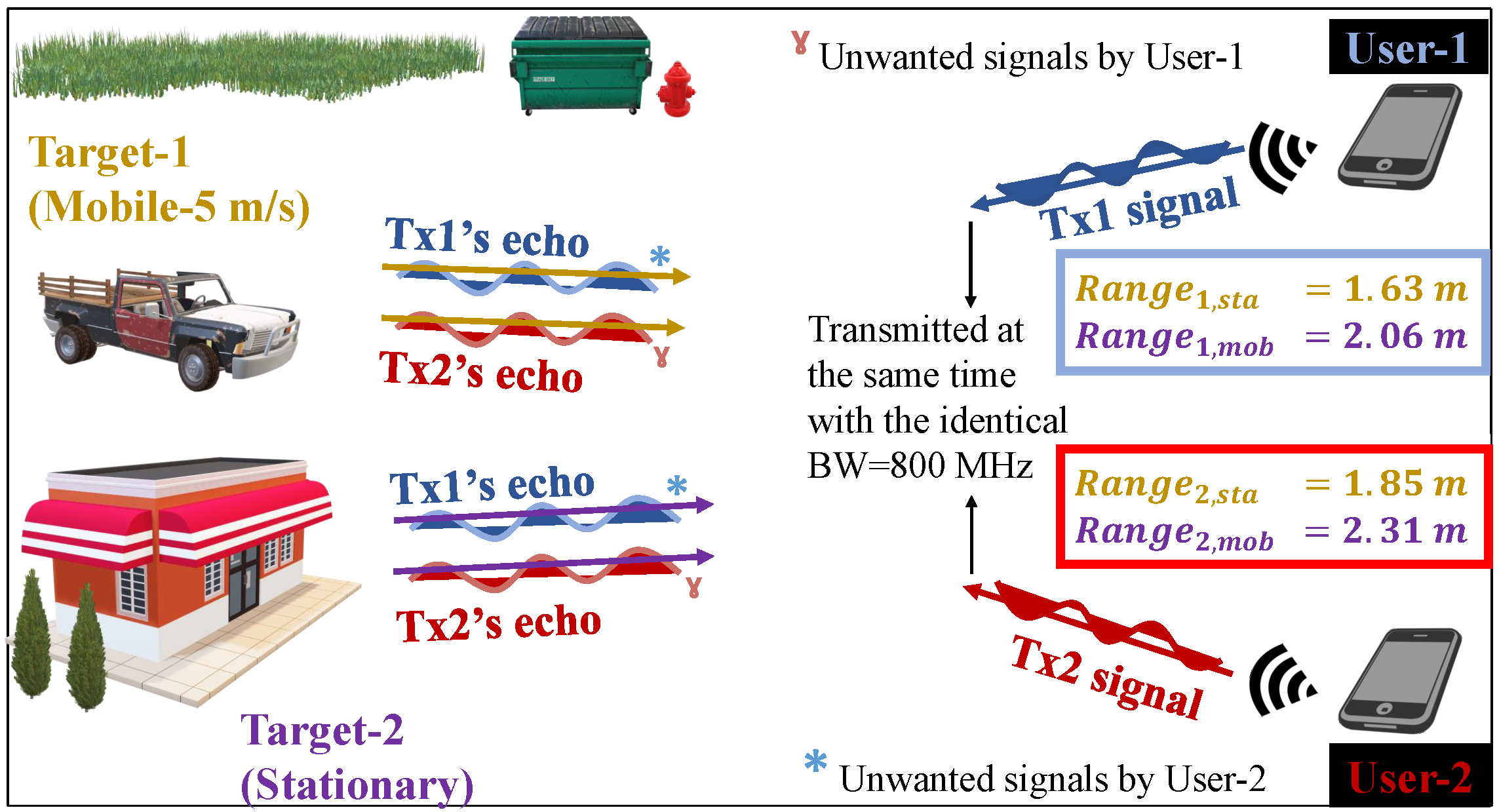
Due to the aforementioned reasons, the authors proposed a new paradigm using OFDM signals in [32]. By exploiting the orthogonal subcarrier structure of OFDM waveform and different Quadrature Amplitude Modulation (QAM) types, the system achieved multi-user range–Doppler sensing employing identical temporal and overlapping spectral resources. Since OTFS is a stunning candidate for future wireless systems, we investigate the sensing performance of OTFS using the same configuration and method in this work, as demonstrated in Figure 1. Considering a two-target, two-user scenario, OTFS users utilize 4-QAM and 8-QAM schemes to convert the data into symbols. Those users simultaneously transmit OTFS signals with carrier frequencies of 3.8 GHz and 3.85 GHz with a slight frequency offset difference of 50 MHz.

3.1. Multiple Users Transmitting OFDM and Allocated to Shared Resources

OFDM signals exhibit a distinctive noise-like temporal structure, wherein the transmitted information is distributed across a multitude of subcarriers, thereby facilitating wideband signal propagation. This unique attribute of OFDM signals confers several significant advantages, particularly in environments susceptible to jamming and interference. The inherent robustness of OFDM to such disturbances stems from its ability to disperse the signal energy over a broad spectrum, making it inherently resistant to narrowband interference and jamming attempts. Furthermore, the wideband nature of OFDM enables the simultaneous transmission of multiple radar signals within the same frequency band, a capability that is particularly advantageous in applications requiring high spectral efficiency. This multi-signal transmission is enabled by MF techniques, a core component of coherent noise radar systems that facilitate signal separation and interference suppression [33]. By leveraging MF, OFDM-based radar systems can effectively isolate and process individual signals, even when they occupy overlapping frequency ranges. This characteristic not only enhances the system’s resilience to interference but also allows for the concurrent operation of multiple radar units without significant degradation in performance. The principles underlying this approach have been extensively studied and validated, as evidenced by research in the field of coherent noise radar, which highlights the efficacy of OFDM in maintaining signal integrity and operational efficiency in complex electromagnetic environments. Thus, the noise-like temporal behavior of OFDM signals, combined with their wideband transmission capabilities, positions them as a highly effective solution for modern radar and communication systems, particularly in scenarios where resistance to interference is paramount, allowing multiple transceivers to operate in the same environment.
The deployment of multiple radar transceivers in shared environments has grown due to the need for specialized sensing in applications like automotive navigation, environmental monitoring, and defense. Each transceiver is designed for specific objectives, utilizing unique configurations and signal processing techniques. However, their simultaneous operation introduces challenges such as spectral overlap and interference, which are mitigated through strategies like frequency division, adaptive filtering, and beamforming. Integrating data from multiple units enhances situational awareness, enabling the detection of complex phenomena and improving systems [34]. In this respect, based on Figure 1, the OFDM signals simultaneously transmitted (Tx) by User-1 (Tx1 signal) and User-2 (Tx2 signal) can, respectively, be written as
x 1 ( t ) = n = 0 N 1 S n 1 e j 2 π f n 1 t ,
x 2 ( t ) = n = 0 N 1 S n 2 e j 2 π f n 2 t ,
where S n 1 and S n 2 are the 4-QAM and 8-QAM symbols transmitted on the n-th subcarrier by User-1 and User-2, respectively. Also, f n 1 and f n 2 are the corresponding subcarrier frequencies of User-1 and User-2, respectively, and their relation can be given as
f n 2 = f n 1 + f off ,
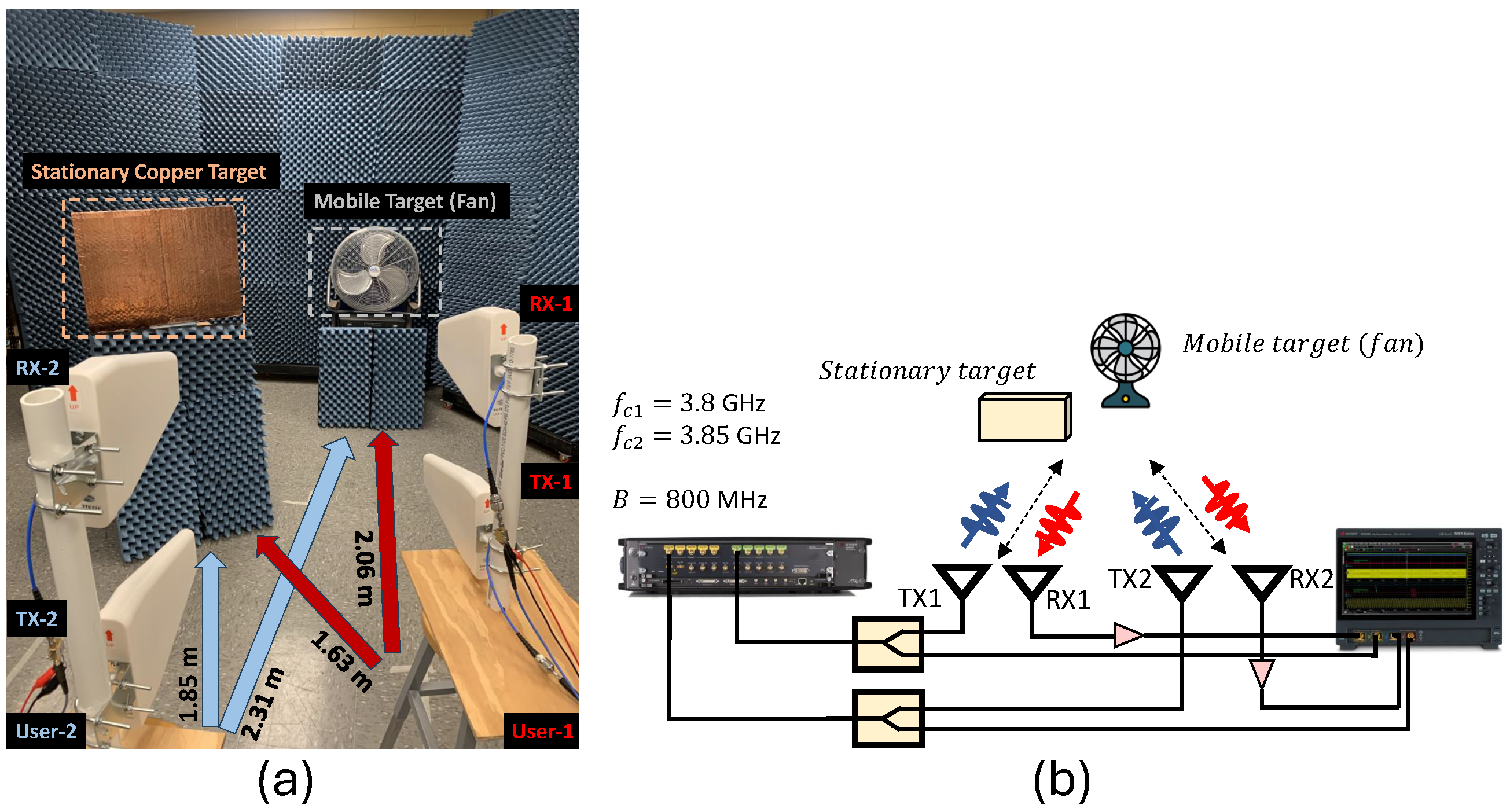
where f off is the frequency offset that denotes the difference between the carrier frequencies of User-1 and User-2 while f n 1 = Δ f + f c 1 , with Δ f corresponding to subcarrier spacing. The carrier frequency of User-1 f c 1 is 3.8 GHz, and that of User-2 is 3.85 GHz, which meets the sub-6 GHz 5G standards [35]. Target-1 and Target-2 are located at 1.63 m and 2.06 m away from User-1, as seen in Figure 1. On the other hand, User-2’s distances to Target-1 and Target-2 are 1.85 m and 2.31 m. User-1 and User-2 transmit OFDM signals at the same time using the identical bandwidth of 800 MHz. Hence, all the reflections of User-1 and User-2 from both targets are captured by the receivers of those users. For instance, the signal received (Rx) by User-1 can be computed as
y ( t ) = y 1 , sta + y 1 , mob + y 2 , sta + y 2 , mob ,
where y 1 , sta and y 2 , sta denote the echoes of User-1 and User-2 from the stationary target. Also, y 1 , mob and y 2 , mob are User-1 and User-2’s echoes from the mobile target, respectively. The y ( t ) signal includes all the reflections, and it is received by both users. Accordingly, the cross-correlation process at User-1 and User-2’s receivers can be expressed as
C 1 ( τ , v ) = x 1 * ( t τ ) y ( t ) e j 2 π v t d t ,
C 2 ( τ , v ) = x 2 * ( t τ ) y ( t ) e j 2 π v t d t ,
where τ represents the time delay caused by the targets (two different τ values are expected for two targets), and v is the Doppler frequency shift (related to the velocity of the mobile target). The operational efficacy of OFDM systems is fundamentally contingent upon establishing accurate frequency synchronization, a requirement for preserving orthogonality among subcarriers. This orthogonality is critical as it ensures that subcarriers do not interfere with one another, thereby safeguarding the integrity of the transmitted signal. However, in multi-user OFDM configurations, the presence of frequency offsets represented by the difference between f n 1 and f n 2 , as depicted in (3), can disrupt this delicate balance. Even a slight deviation in frequency, arising from factors such as hardware imperfections or environmental influences, can lead to the misalignment of subcarriers [32]. Hence, the interference in (5) and (6) is minimized.
Moreover, the separability of OFDM transmissions is facilitated by the use of distinct modulation symbols transmitted by two separate users, where the amplitude variations observed in the echoes of User-1 differ significantly from those of User-2. This enhances the correlation between each user’s transmitted signal and its own echo while diminishing cross-correlation with the other user’s echo, thereby reducing interference at the receivers. As a result, both users can perform sensing operations with minimal interference from one another. This reduction in cross-user interference is further supported by random data transmission strategies, varying modulation orders, and the introduction of frequency offsets between users, which collectively enhance the isolation of user signals and enable efficient and interference-free sensing in multi-user OFDM systems.

3.2. OTFS Multi-User Range-Doppler Sensing with Identical Bandwidth and Time

OFDM has dominated communication systems in the past decade, powering 4G, 5G, and Wi-Fi [36]. OTFS, however, is a strong candidate for the coming generations thanks to its JRC compatibility and high data rate support [37]. Thus, the method from the previous section is applied to OTFS, where two users transmit signals simultaneously over the same 800 MHz bandwidth, as shown in Figure 1.
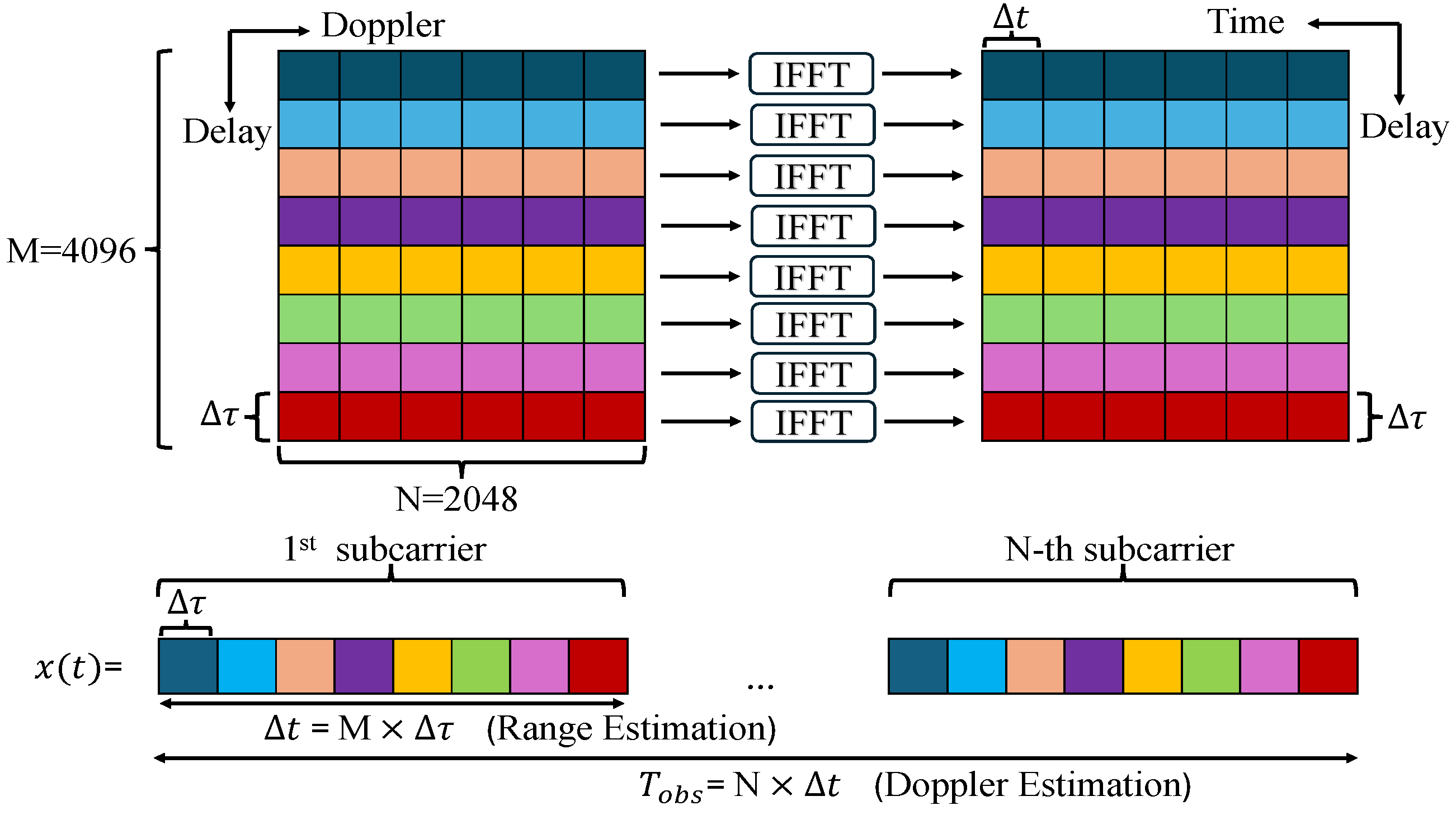
As illustrated in Figure 2, the transmitted signals by OTFS User-1 and User-2 can be computed as [38]
x 1 ( t ) = n = 0 M 1 n = 0 N 1 S n 1 , m 1 e j 2 π m Δ f ( t n T ) ,
x 2 ( t ) = n = 0 M 1 n = 0 N 1 S n 2 , m 2 e j 2 π m ( Δ f + f off ) ( t n T ) ,
where S n 1 , m 1 and S n 2 , m 2 are the 4-QAM and 8-QAM symbols transmitted on the n-th subcarrier and m-th time slot by User-1 and User-2, respectively. Δ f is the subcarrier spacing with N number of subcarriers. Exploiting (4), OTFS User-1 and User-2’s receivers can process the 2D cross-correlation as
C 1 ( τ , v ) = x 1 * ( t τ ) y ( t ) e j 2 π v t d t ,
C 2 ( τ , v ) = x 2 * ( t τ ) y ( t ) e j 2 π v t d t .

3.3. Simulation Results

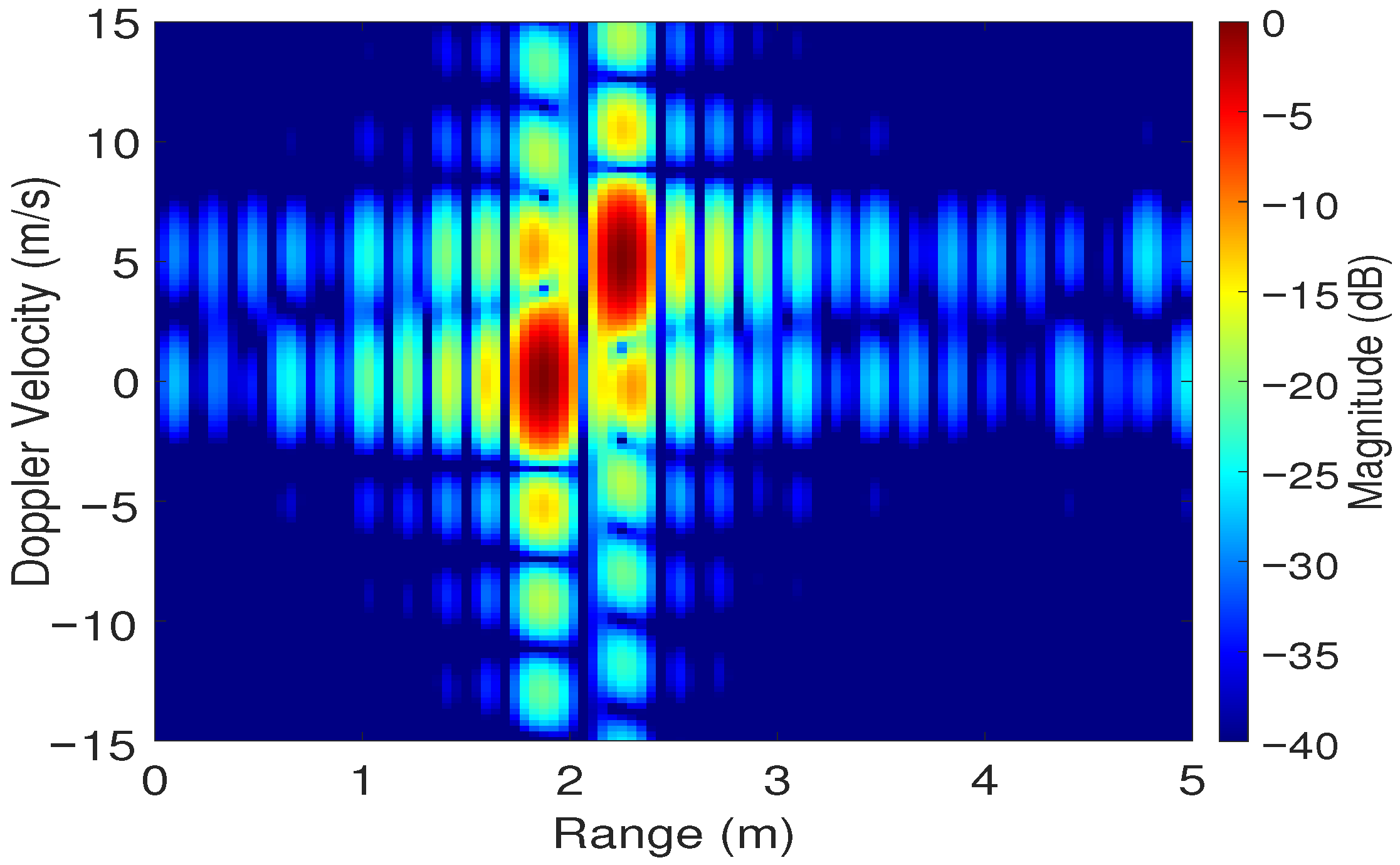
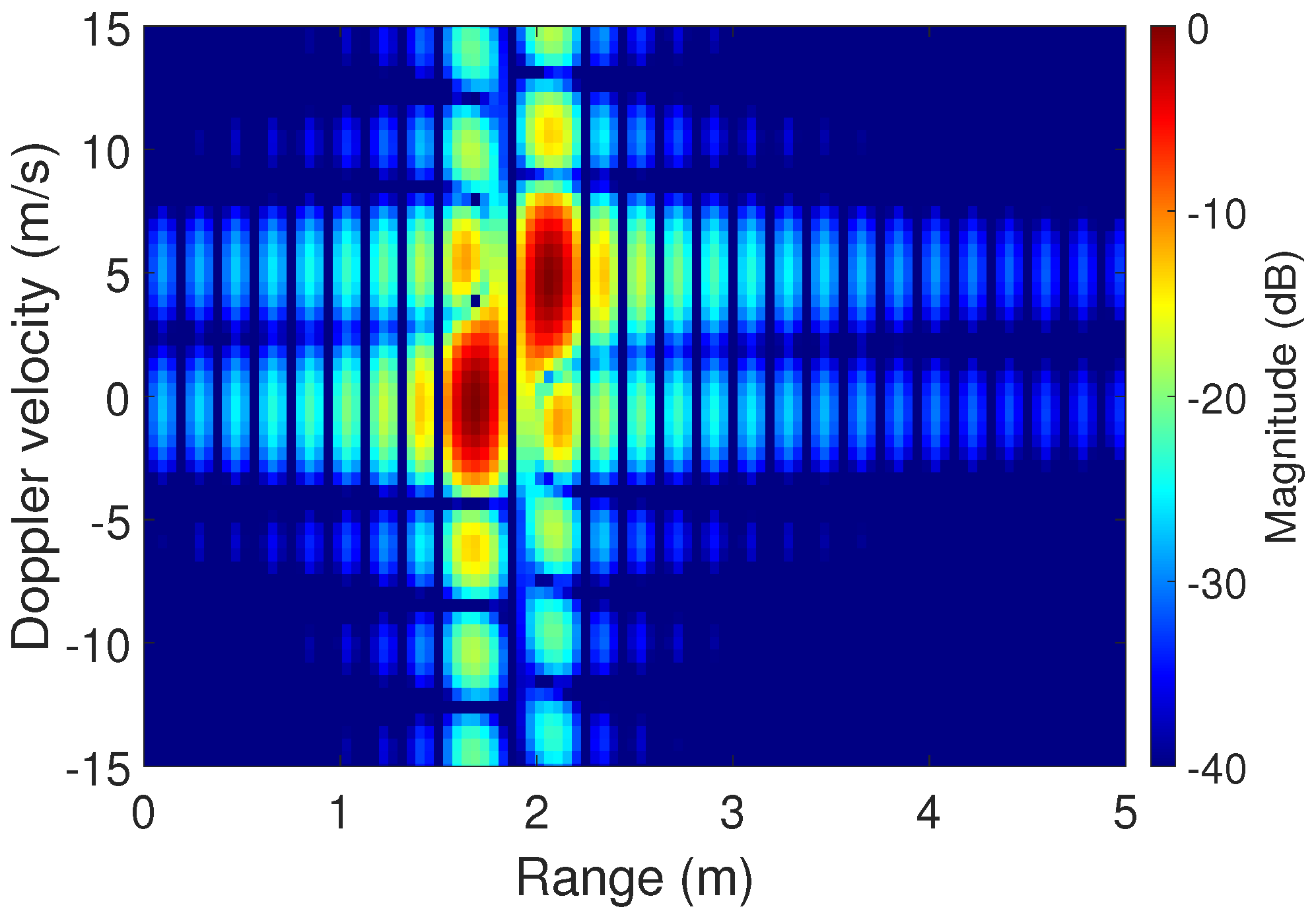
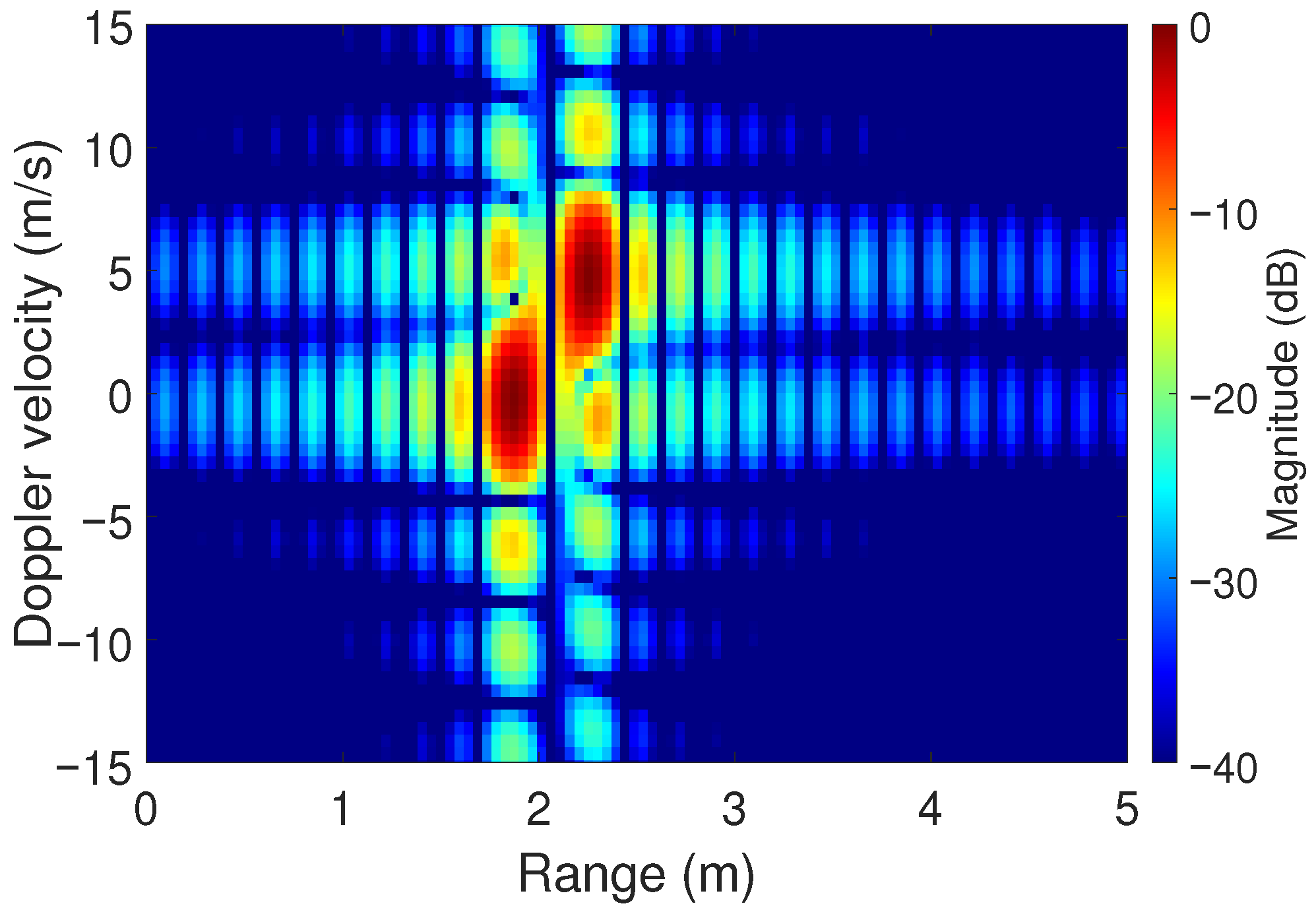
The scenario in Figure 1 is implemented in MATLAB R2024b for range–Doppler velocity estimation. User-1 and User-2 simultaneously transmit OFDM signals modulated with 4-QAM and 8-QAM, respectively, sharing the same 800 MHz bandwidth at a 50 MHz carrier frequency. The observation time is 10.4 ms with 3000 OFDM symbols, a CP ratio of 1 / 4 , and 2048 subcarriers. As shown in Figure 3, User-1 detects the stationary object at 1.63 m with a velocity of 0 m/s and estimates the mobile target at 2.06 m with a velocity of 5 m/s. Figure 4 shows that User-2 detects the stationary object at 1.85 m with a velocity of 0 m/s and the mobile object at 2.31 m with a velocity of 5 m/s. Despite identical bandwidth and simultaneous transmission, both users achieve accurate sensing. No windowing techniques are applied to suppress side lobes. These results confirm OFDM’s ability to estimate the range and Doppler velocity of multiple targets with minimal interference, enabling multi-user sensing without TDM or FDM.
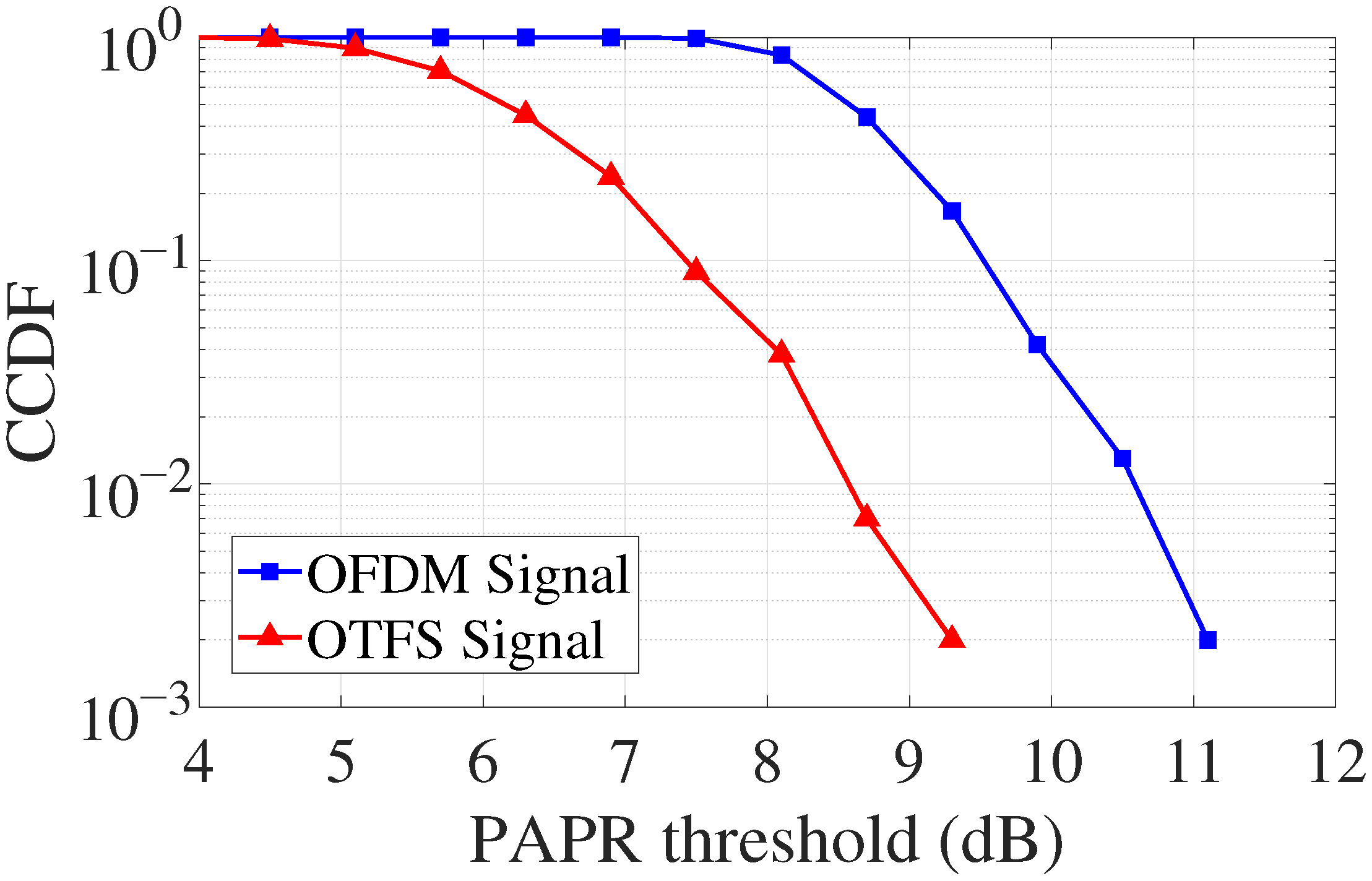
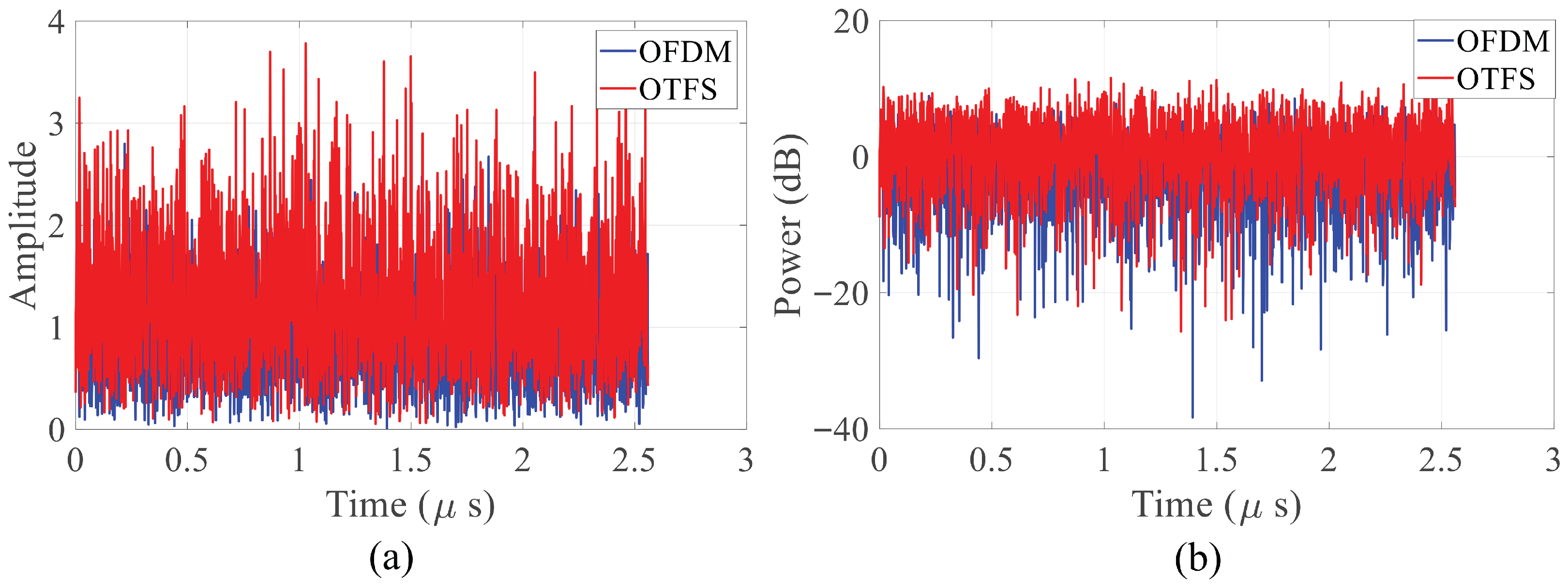
A primary drawback of OFDM is its high PAPR, which considerably impacts overall system efficiency and hardware performance [39,40]. Figure 5a illustrates the temporal envelope of the modulated signals. The OFDM signal (blue) exhibits high-amplitude fluctuations characteristic of multi-carrier modulation, where independent subcarriers may align in phase. In contrast, the OTFS signal (red) displays a more uniform envelope. This is attributed to the Symplectic Finite Fourier Transform (SFFT) precoding, which spreads 4-QAM symbols across the entire delay–Doppler grid, effectively distributing the signal energy more consistently over the total duration of the frame. The instantaneous power profile, expressed in decibels (dB), highlights the PAPR characteristics of both waveforms. The OFDM signal demonstrates significant spikes or peaks that necessitate a substantial power amplifier back-off to prevent non-linear distortion. The OTFS signal demonstrates a lower dynamic range between peak and average power. In JRC applications, this reduced power variation allows for higher average transmit power, improving the Signal-to-Noise Ratio (SNR) for both communication throughput and radar sensing range. To prove this point, the PAPR performance comparison is indicated in Figure 6.
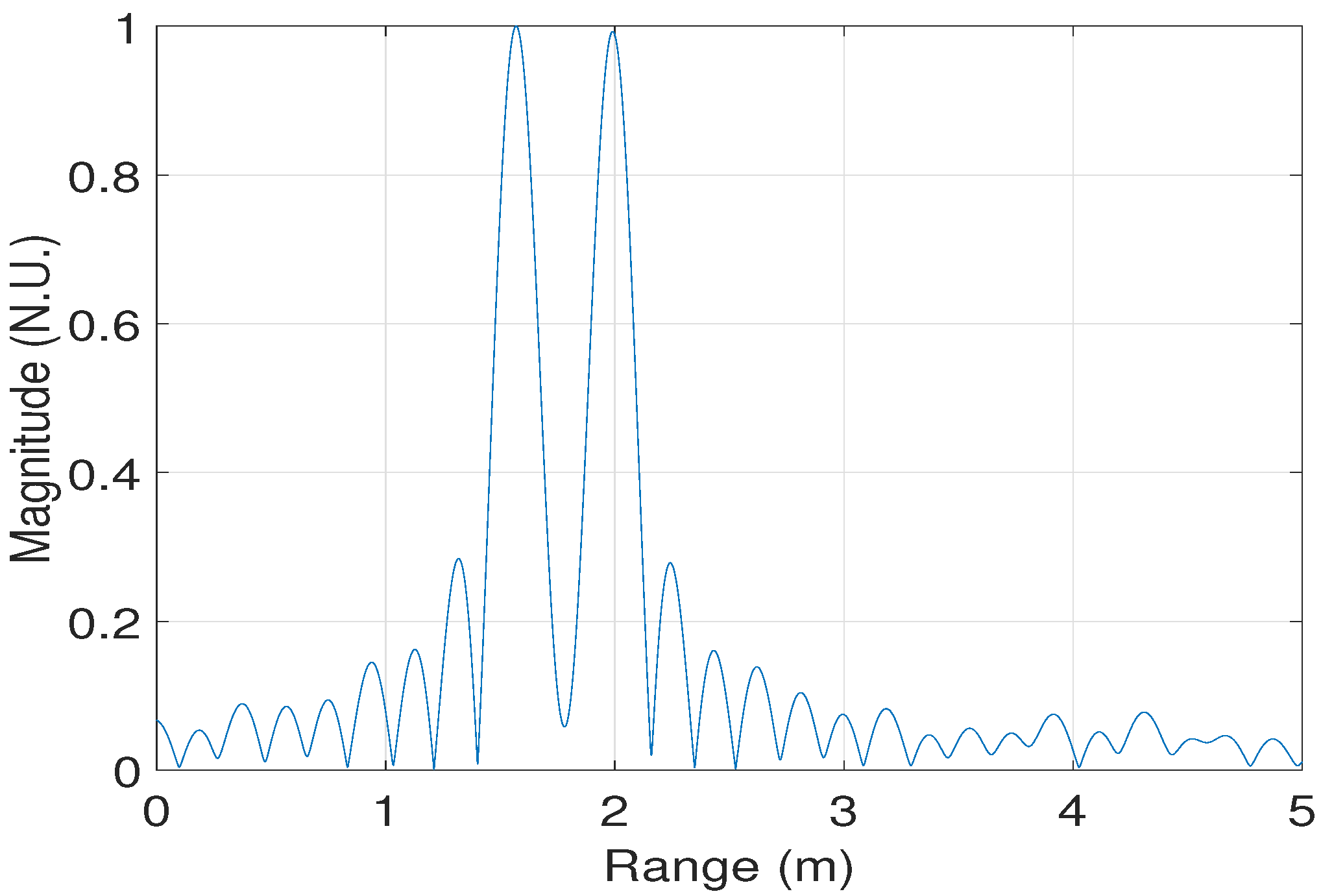
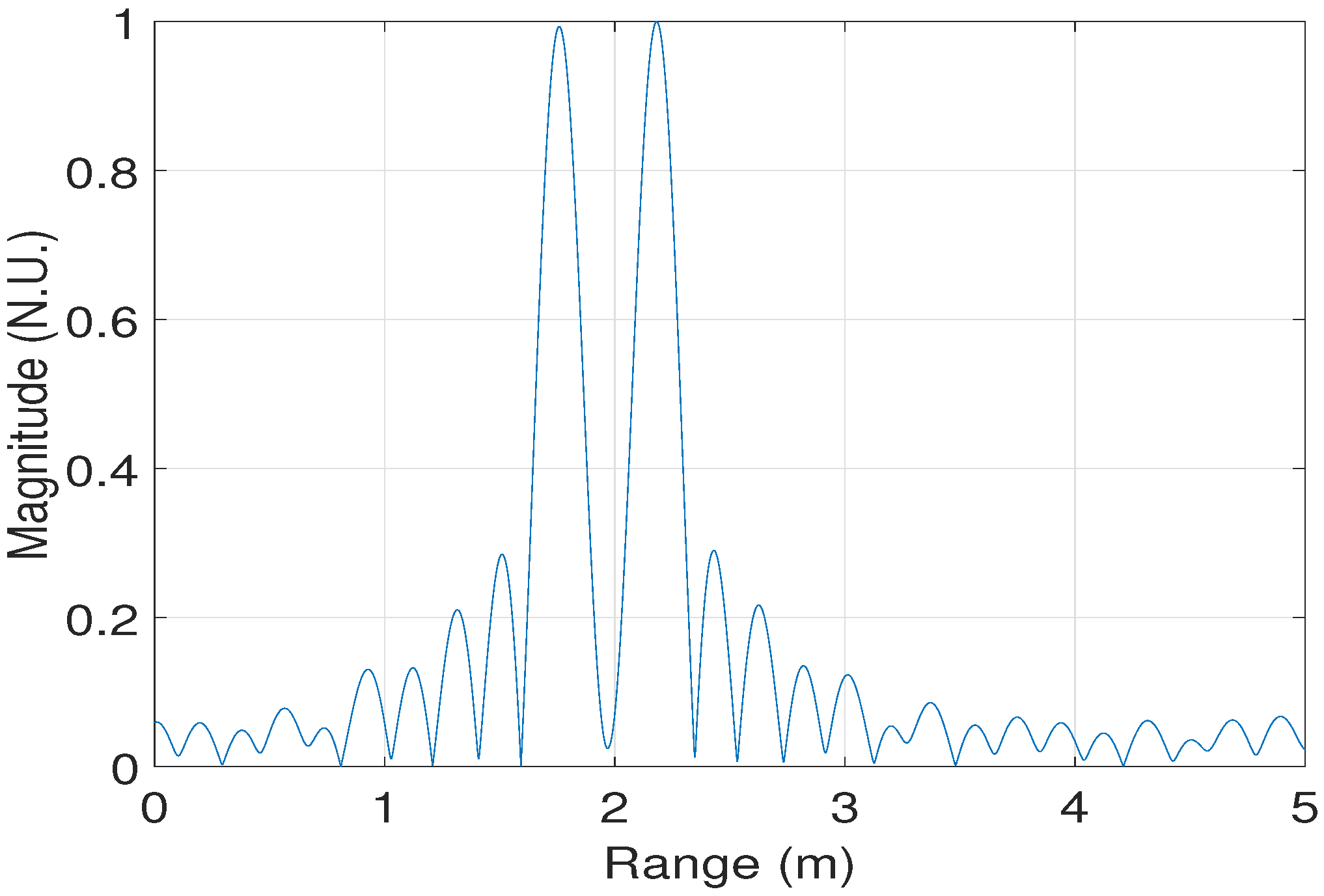
With respect to evaluation of the proposed method, the OTFS transmitter structure displayed in Figure 2 and the scenario shown in Figure 1 are considered in the simulations. Both users utilize 4096 × 2048 points in their delay–Doppler grids. To perform the range–Doppler velocity estimation of stationary and mobile objects, User-1 and User-2 transmit 4-QAM and 8-QAM modulated OTFS signals at the same time using the identical 800 MHz bandwidth. Recalling the parameters of delay–Doppler points and the bandwidth, the delay period Δ t and Doppler period are 5.12 μs and 195.31 kHz, respectively, ensuring quasi-periodicity. In order to readably observe the range estimation process and the resolutions, the range profiles of User-1 and User-2 are demonstrated in Figure 7 and Figure 8, respectively. The range resolution can be expressed mathematically as R res = c / ( 2 · B ) , where B denotes bandwidth. Also, the velocity resolution can be written as v res = c / ( 2 · T obs · f c ) , where c is the speed of light, f c denotes the carrier frequency, and T obs represents the observation time [41], corresponding to 10.4 ms, which aligns with the OFDM case.
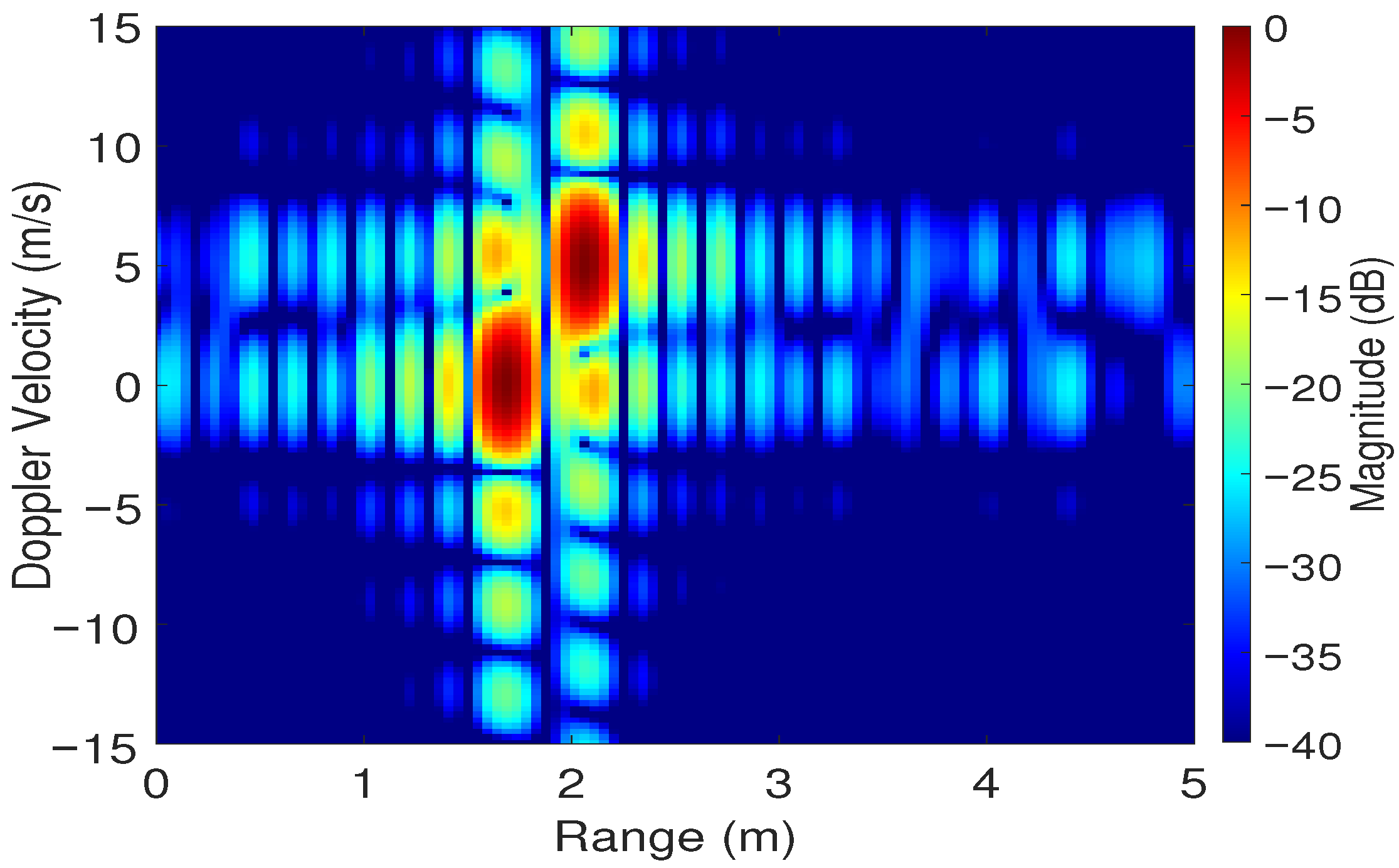
The results in Figure 9 show that User-1 effectively detects the stationary target, locating it at a distance of 1.63 m with zero velocity. Furthermore, the mobile target is estimated to be at a range of 2.06 m, moving at a speed of 5 m/s. Additionally, Figure 10 reveals that User-2 identifies the stationary target at 1.85 m, also with zero velocity. User-2 perceives the mobile target to be at a distance of 2.31 m, maintaining the same velocity estimate of 5 m/s. Notably, the system operates without the application of any windowing techniques to suppress side lobes. Interestingly, even though both users transmit simultaneously using the same bandwidth, OTFS users can also successfully estimate the range and velocities of stationary and moving targets, in the same manner as OFDM users. However, 3000 OFDM symbols are required to achieve OFDM range–Doppler sensing with a desirable velocity resolution, whereas an OTFS signal with 4096 × 2048 points in the delay–Doppler grids can enable users to perform the similar range–Doppler sensing. This case indicates that OTFS is well-suited to JRC systems, and it can also provide high spectral and temporal efficiency for sensing due to the proposed technique.

3.4. Experimental Validation of OFDM Transmission

Experimental measurements were conducted in a semi-anechoic research lab at the University of South Florida, as shown in Figure 11a. User-1 and User-2 simultaneously transmitted OFDM waveforms generated by a Keysight M8190 Arbitrary Waveform Generator (AWG) (Keysight Technologies, Santa Rosa, CA, USA) at 3.8 GHz and 3.85 GHz, each occupying 800 MHz of bandwidth, as summarized in Table 1. Both users employed 64-subcarrier OFDM symbols with 4-QAM modulation and a CP ratio of 1/4, using log-periodic antennas (9 dBi gain, 55° elevation and 60° azimuth beamwidths). A stationary copper plate (45 cm × 61 cm) was positioned 1.63 m from User-1 and 1.85 m from User-2, while mobility was introduced using an Airmaster I-20LS (Airmar Technology Corporation, Milford, NH, USA) fan placed at 2.06 m and 2.31 m, respectively. The rotating blades produced periodic radial velocity components, creating Doppler-like signatures. Ground clutter was ignored due to its low amplitude. Reflected signals were received, amplified using Mini-Circuits ZX60-53LN+ LNAs (Mini-Circuits, Brooklyn, NY, USA), and captured with a Keysight MXR404A (Keysight Technologies, Santa Rosa, CA, USA) oscilloscope over a 10.4 ms observation interval, as depicted in Figure 11b.
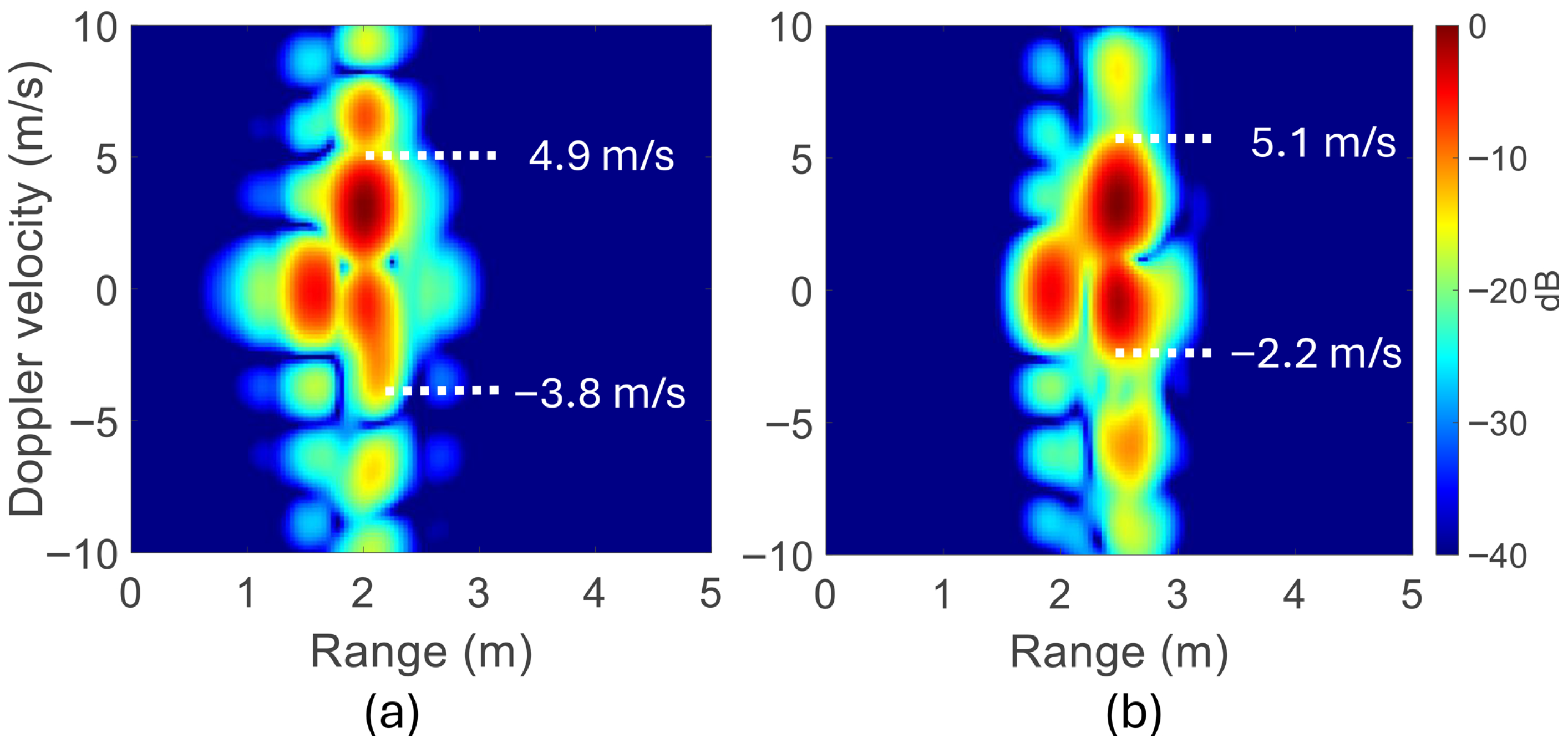
For User-1, frequency domain MF estimates the stationary and mobile targets at 1.63 m and 2.07 m, as demonstrated in Figure 12, with velocity outputs of 0 m/s and a spread from −3.8 m/s to 4.91 m/s. User-2 observes the targets at 1.85 m and 2.32 m, with velocities ranging from 0 m/s (stationary) to between −2.2 m/s and 5.1 m/s. Despite the relatively coarse range (0.1875 m) and velocity resolutions (1.97 m/s for User-1, 1.95 m/s for User-2), both users clearly distinguish stationary and moving objects. The results confirm that simultaneous OFDM transmission within the same bandwidth enables accurate range and Doppler estimation with minimal mutual interference.

4. Imaging Using Multiple Antennas Operating with Shared Time and Frequency Resources

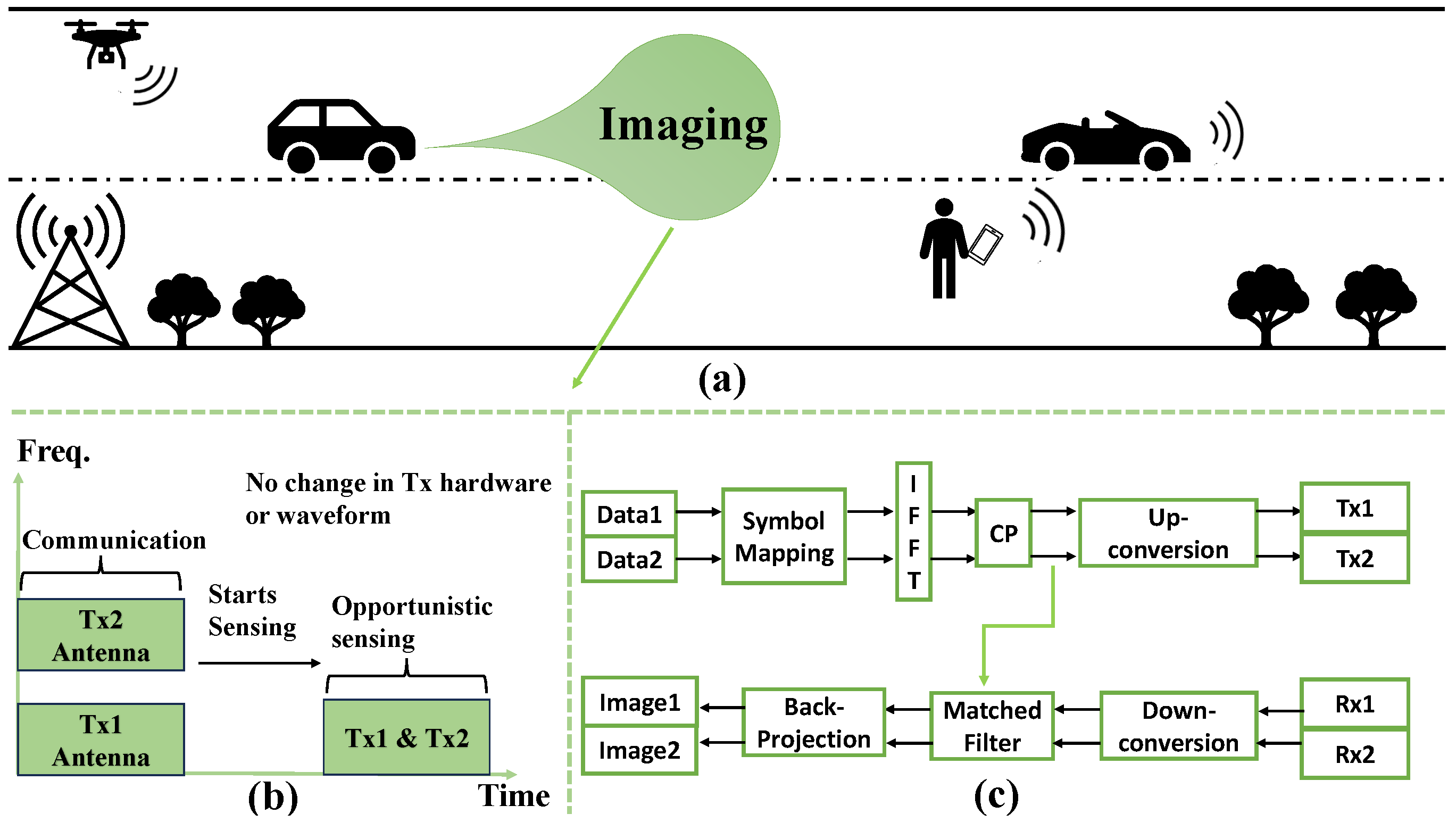
MIMO imaging relies on multiple transmitter and receiver antennas to generate detailed reconstructions by leveraging spatial diversity and a larger set of sensing perspectives [42,43]. A key requirement in such systems is the suppression of mutual interference between transmitters, as unmanaged interactions can deteriorate image fidelity and spatial resolution [44,45]. As displayed in Figure 13a, the number of wireless devices used for both sensing and communication continues to grow; pressure on available spectral and temporal resources has intensified [46,47]. Consequently, maintaining efficient use of bandwidth and time while keeping inter-antenna interference under control has become increasingly challenging.

4.1. Interference Management Using OFDM Signals

In a MIMO imaging architecture, multiple transmitters operate simultaneously, and the received field is a superposition of the echoes generated by each probing signal. When all transmitter antennas illuminate the scene at the same time and occupy nearly the same spectral region, the principal challenge lies in ensuring that the individual waveforms remain distinguishable after reflection. As given in Figure 13b, the method summarized in this section provides a mechanism for separating these contributions without resorting to conventional multiplexing schemes such as TDM or FDM [48].

4.1.1. Independent OFDM Transmissions and Frequency Offsets

Each transmitter emits an OFDM waveform whose subcarriers are modulated by independent and randomly selected data symbols, as indicated in Figure 13c. Let the l-th transmitter generate a baseband signal
s l ( t ) = k = 0 N 1 a l , k e j 2 π f l , k t ,
where a l , k is the constellation symbol and f l , k denotes the k-th subcarrier frequency. Different transmitter antennas employ slightly shifted carrier frequencies, ensuring that their respective subcarrier grids are not perfectly aligned. Although the transmitted spectra overlap, the imposed carrier offsets and independent symbol draws make the composite transmission highly uncorrelated across antennas.

4.1.2. Suppression of Mutual Interference Through Matched Filtering

After propagation and reflection from the scene, each receiver observes a sum of delayed and attenuated replicas of all transmitted signals. To isolate the contribution of transmitter p, the receiver correlates the measurement with a time-reversed version of s p ( t ) . The matched-filter output for a trial delay τ can be expressed as
z p ( τ ) = r ( t ) s p * ( t τ ) d t .
When expanding this correlation, cross-terms of the form a p , k a q , m e j 2 π ( f p , k f q , m ) t d t arise for p q . Because the carrier offsets guarantee f p , k f q , m for nearly all ( k , m ) pairs, these integrals evaluate to values significantly smaller than those produced when p = q . Thus, the desired autocorrelation terms dominate whereas inter-transmitter contributions are heavily suppressed.
Further discrimination is provided by symbol diversity: since each transmitter modulates its subcarriers using independently generated QAM symbols, products of the form a p , k a q , m exhibit low coherence on average. In contrast, the autocorrelation terms reduce to | a p , k | 2 , producing strong peaks at the correct propagation delays. Consequently, the imaging system naturally produces transmitter-specific matched-filter responses without relying on resource partitioning.

4.1.3. Implications for OFDM-Based MIMO Imaging

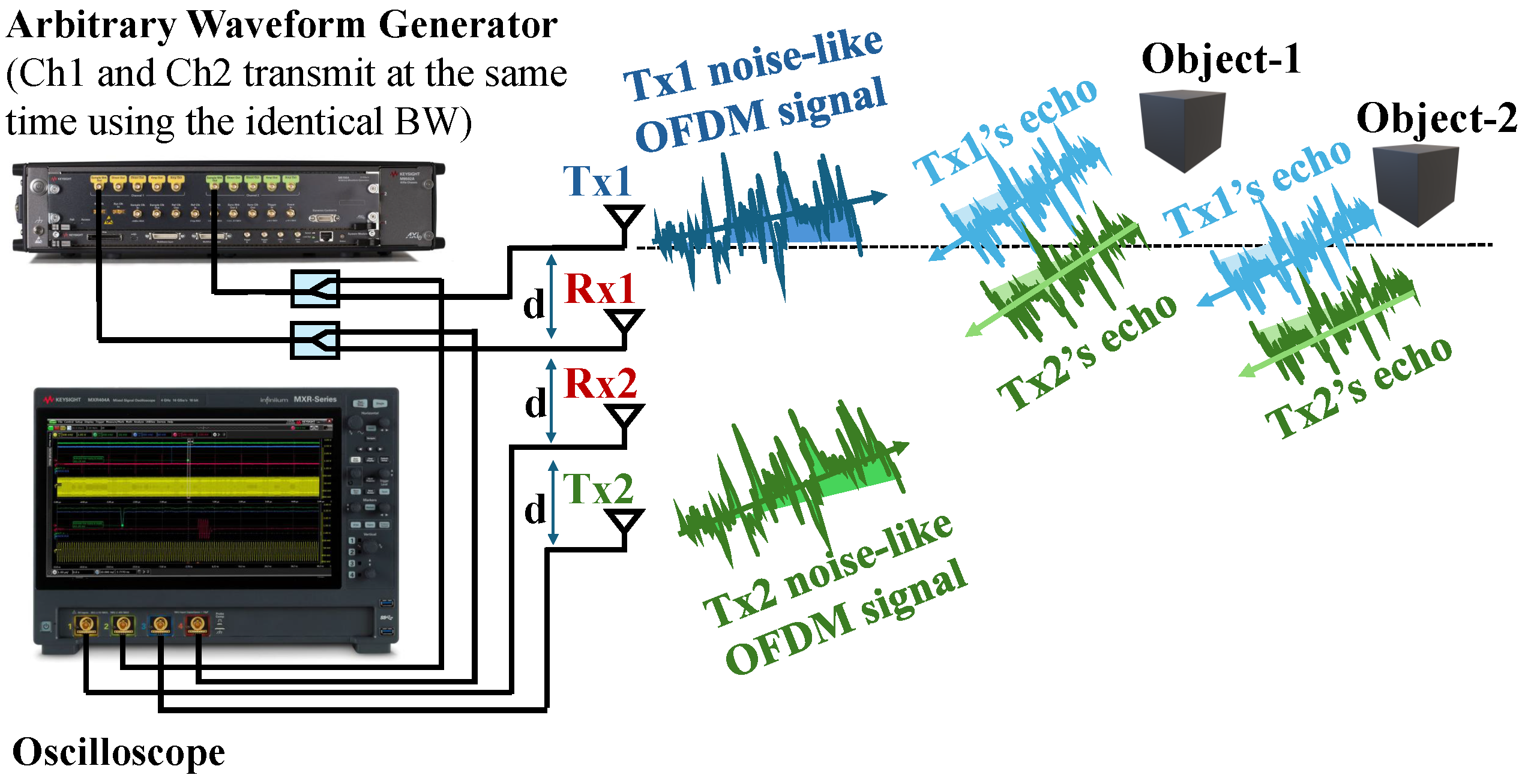
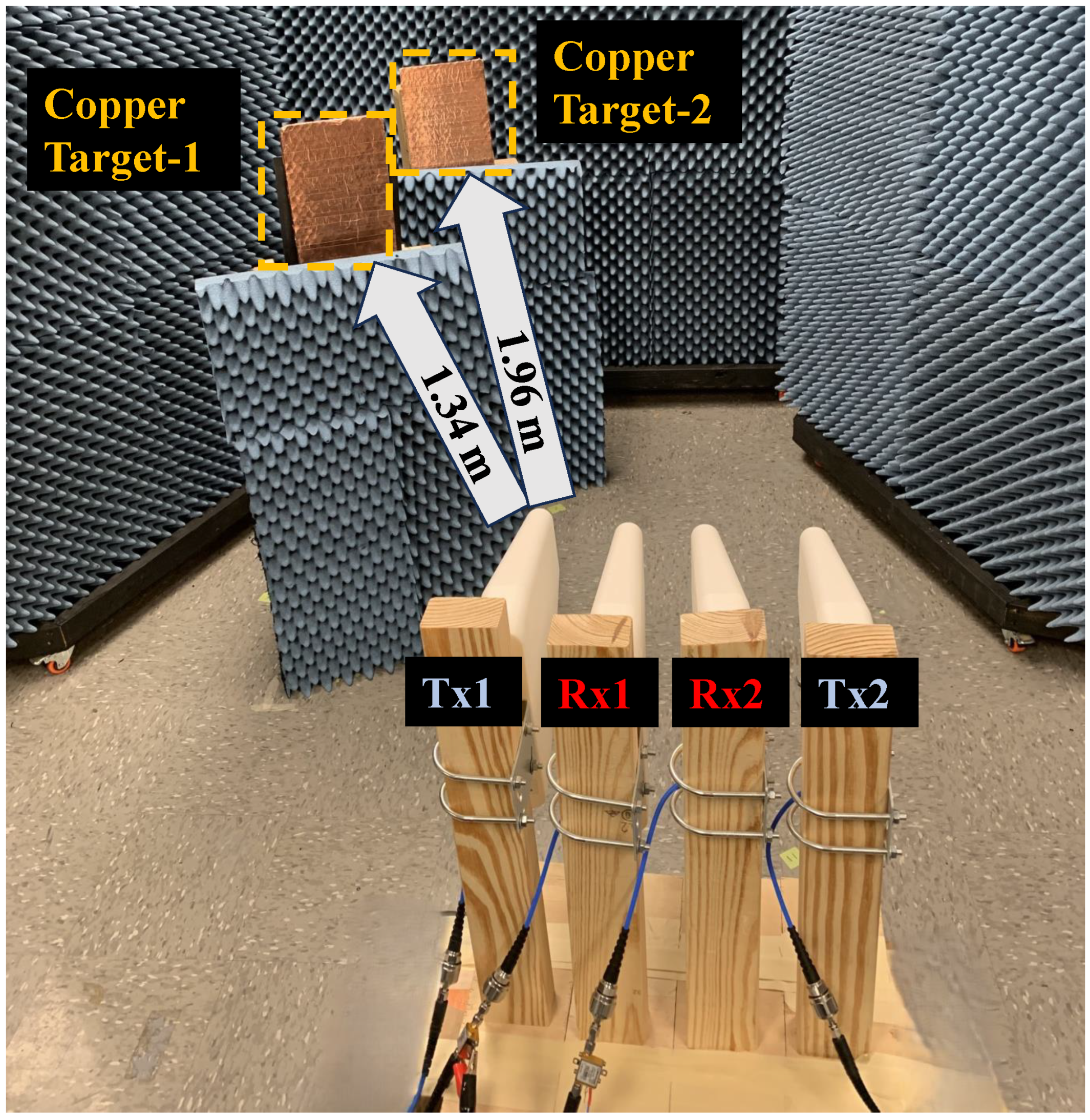
The proposed MIMO-OFDM imaging method was experimentally verified using a semi-anechoic laboratory setup where two OFDM waveforms—each 400 MHz wide and centered at 2.4 GHz and 2.415 GHz—were generated simultaneously by a dual-channel Keysight M8190A AWG. A 2 × 2 antenna layout using log-periodic elements (10 cm spacing) illuminated two metallic plates positioned at different down-range locations. The overall hardware configuration, including the AWG, receivers, and amplifiers, is outlined schematically in Figure 14 of the original document, while Figure 15 displays the physical arrangement of the antennas and targets.
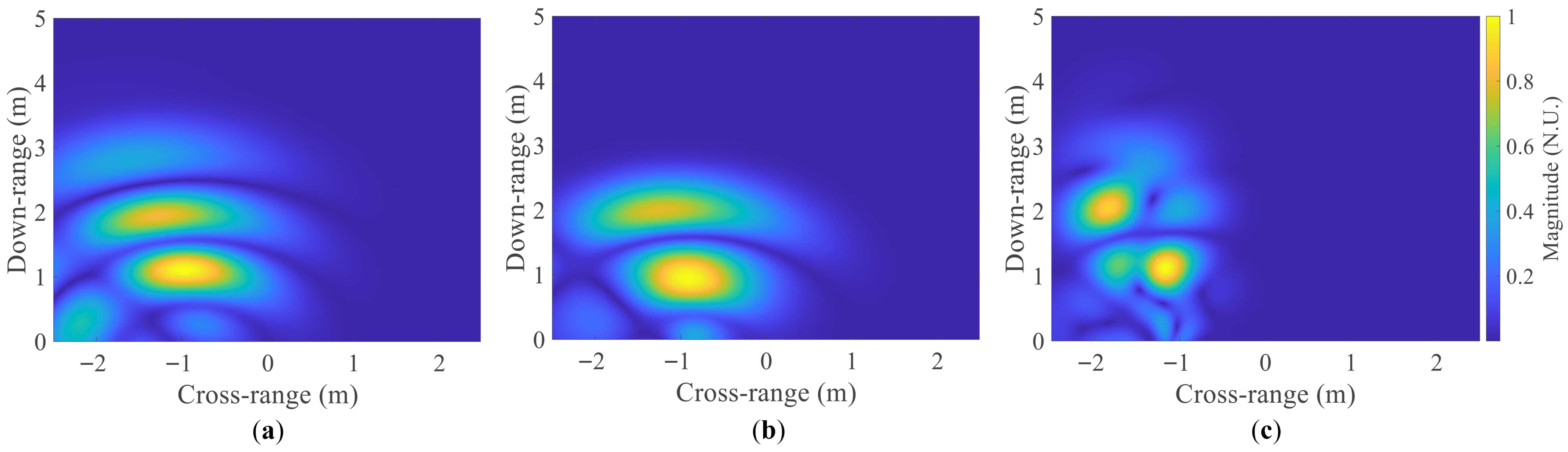
The received signals from both antennas were processed independently for each transmitter using frequency domain MF. This produced two intermediate images, and their combination yielded the final reconstruction. The reconstructed scenes shown in Figure 16a–c demonstrate accurate localization of both copper plates, confirming that high-quality imaging is achievable even when both transmitters occupy the same bandwidth and operate concurrently.
By jointly exploiting independent data symbols, small carrier frequency offsets, and matched filtering, co-channel interference can be effectively mitigated even when multiple transmitters share the same bandwidth. This feature is advantageous for imaging scenarios with limited spectral or temporal resources. In addition, the noise-like temporal structure of the OFDM waveform facilitates signal separability, enabling simultaneous multi-antenna probing without the need for conventional TDM- or FDM-based radar schemes.

4.2. Cross-Antenna Interference-Free Imaging with OTFS

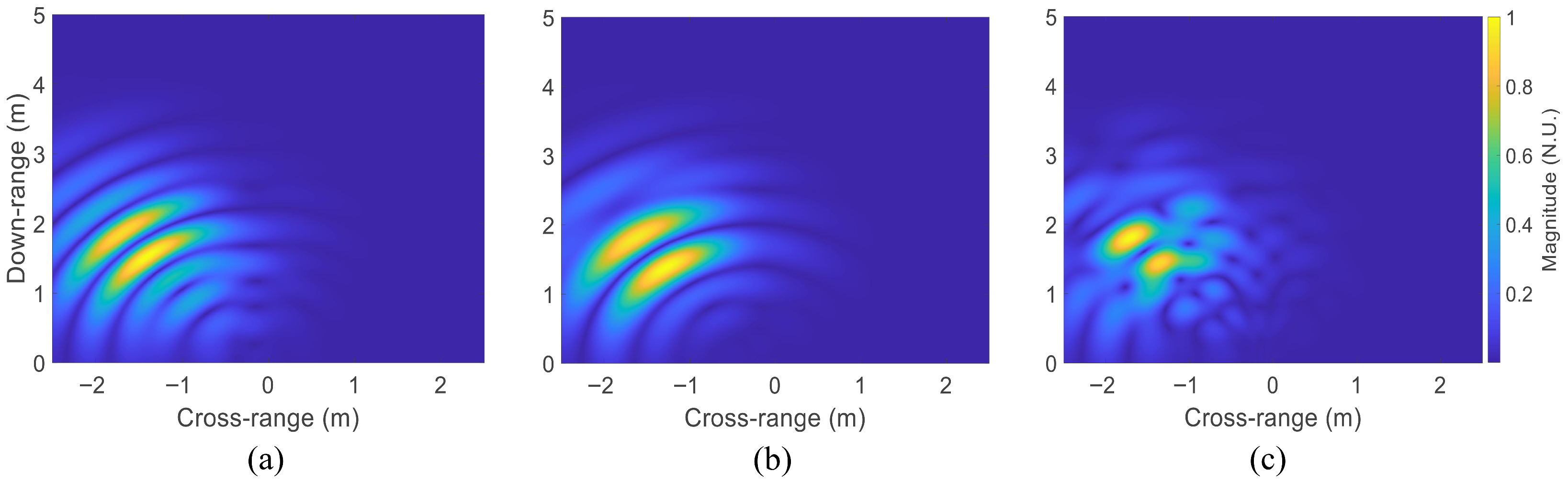
In addition to the OFDM-based radar imaging, we implemented the same scenario and configuration using OTFS waveforms in MATLAB. All key system parameters, including bandwidth, cross-range, and down-range dimensions, were kept identical to the OFDM setup to enable a direct comparison. The OTFS frame was structured with a 64 × 32 grid in the delay–Doppler domain, capturing the same spatial and velocity resolution as the OFDM system. As demonstrated in Figure 17, the resulting OTFS-based radar images exhibit strong agreement with the OFDM experimental results, demonstrating that OTFS can achieve comparable imaging performance under the same system configuration. This finding highlights OTFS’s potential for integrated sensing applications while preserving the advantages of delay–Doppler processing, suggesting its suitability for practical joint radar–communication systems.

5. Evaluation of Results

This section consolidates and evaluates the simulation and experimental results obtained for multi-user range–Doppler sensing and multi-antenna imaging using OFDM and OTFS waveforms. The objective is to assess the effectiveness, robustness, and practical relevance of the proposed opportunistic sensing framework under fully overlapping spectral and temporal resources.

5.1. Multi-User Range–Doppler Sensing Performance

Simulation results for both OFDM and OTFS demonstrate that accurate range and Doppler velocity estimation can be achieved by multiple users transmitting simultaneously over identical bandwidths. In the OFDM case, two users employing different modulation orders successfully detect both stationary and moving targets with precise localization, despite the absence of TDMA or FDMA-based separation. The ability to resolve targets without applying sidelobe suppression or windowing further highlights the intrinsic interference resilience of the proposed approach.
Similar sensing performance is observed when OTFS waveforms are employed. Both users correctly estimate the range and velocity of stationary and mobile targets, confirming that the proposed sensing paradigm is not limited to time–frequency modulation schemes. Notably, OTFS achieves comparable sensing accuracy using a single delay–Doppler frame, whereas OFDM requires a large number of symbols to obtain an equivalent Doppler resolution. This observation underscores the advantage of OTFS in scenarios with constrained observation time or high mobility, where rapid sensing updates are required.
Overall, these results validate that simultaneous multi-user sensing is feasible without explicit resource partitioning, provided that waveform diversity, slight carrier frequency offsets, and matched filtering are jointly exploited. This finding is particularly relevant for dense wireless environments where coordination among users is limited or impractical.

5.2. Imaging Performance and Extension to OTFS

Beyond range–Doppler estimation, the proposed framework is shown to support high-resolution imaging. Experimental OFDM imaging results demonstrate accurate reconstruction of target locations using multiple transmit–receive channels operating concurrently. The fusion of individual channel images leads to improved spatial coverage and robustness, highlighting the scalability of the approach for MIMO sensing systems.
Simulation-based OTFS imaging results further confirm that the same framework can be extended to delay–Doppler-domain waveforms. OTFS achieves imaging performance comparable to OFDM under identical system parameters, despite operating in a fundamentally different signal domain. This result suggests that the proposed interference-resilient sensing principle is waveform-agnostic, provided that sufficient signal diversity is present.

5.3. Implications for 5G and Future ISAC Systems

The presented results have important implications for both current and future wireless systems. For existing 5G networks, the proposed method enables opportunistic sensing using standard communication waveforms, requiring neither waveform redesign nor additional spectrum allocation. This makes it particularly attractive for applications such as vehicular sensing, industrial monitoring, and indoor localization, where communication infrastructure is already deployed.
Looking ahead to 6G and beyond, the demonstrated compatibility with OTFS highlights the potential of the proposed framework for high-mobility and ultra-dense scenarios. The ability to perform multi-user sensing and imaging without TDMA or FDMA significantly improves spectral and temporal efficiency, which is critical for scalable ISAC deployments. Moreover, the reduced PAPR and delay–Doppler robustness of OTFS further strengthen its suitability for future joint sensing and communication systems.

6. Conclusions

This paper investigated an opportunistic sensing framework that enables simultaneous multi-user and multi-antenna sensing using communication-centric waveforms under fully overlapping time and frequency resources. By leveraging inherent waveform diversity, independent modulation symbols, slight carrier frequency offsets, and matched filtering, the proposed approach eliminates the need for conventional TDMA or FDMA strategies while preserving accurate range, Doppler velocity, and imaging performance. The results demonstrate that reliable sensing can be achieved without waveform modification, additional coordination, or increased system complexity, even in interference-intensive scenarios. The presented results indicate that sensing capabilities can be seamlessly embedded into legacy and emerging communication networks, enabling spectrum-efficient environmental awareness without sacrificing communication functionality. This positions the proposed approach as a viable solution for future 5G-Advanced and 6G systems, where dense deployments, limited resources, and dynamic operating conditions necessitate unified and flexible sensing architectures. Future work will focus on extending the proposed framework to more complex and realistic scenarios. This includes large-scale multi-user and massive MIMO configurations, where the interaction between spatial multiplexing and opportunistic sensing must be carefully characterized. Additionally, the impact of imperfect channel knowledge will be investigated to further assess robustness in real-world deployments. Finally, experimental validation of OTFS-based sensing and imaging using practical hardware platforms, as well as the incorporation of learning-based methods for reduced observation time and adaptive sensing, constitute promising directions for advancing the proposed framework toward fully deployable ISAC solutions.

Author Contributions

Conceptualization, M.Y., H.A. and S.V.; methodology, M.Y.; software, M.Y. and B.K.; validation, M.Y., H.A. and S.V.; formal analysis, M.Y.; investigation, B.K.; resources, B.K.; data curation, M.Y. and B.K.; writing—original draft preparation, M.Y.; writing—review and editing, M.Y. and B.K.; supervision, H.A. and S.V. All authors have read and agreed to the published version of the manuscript.

Funding

This research received no external funding.

Data Availability Statement

The raw data supporting the conclusions of this article will be made available by the authors on request.

Conflicts of Interest

The authors declare no conflicts of interest.

References

  1. Nemati, M.; Kim, Y.H.; Choi, J. Toward joint radar, communication, computation, localization, and sensing in IoT. IEEE Access 2022, 10, 11772–11788. [Google Scholar] [CrossRef]
  2. Cao, Y.; Yu, Q. A joint beamforming design and integrated CPM-LFM signal for dual-functional radar-communication systems. arXiv 2021, arXiv:2112.09825. [Google Scholar]
  3. Mahipathi, A.C.; Pardhasaradhi, B.; Purushottama, T.; Srihari, P.; D’Souza, J.; Cenkeramaddi, L.R. A Survey on Waveform Design for Radar-Communication Convergence. IEEE Access 2024, 12, 75442–75461. [Google Scholar] [CrossRef]
  4. Juwono, F.H.; Reine, R. Future OFDM-based communication systems towards 6G and beyond: Machine learning approaches. Green Intell. Syst. Appl. 2021, 1, 19–25. [Google Scholar] [CrossRef]
  5. Zhuang, Y.; El-Sheimy, N. Tightly-Coupled Integration of WiFi and MEMS Sensors on Handheld Devices for Indoor Pedestrian Navigation. IEEE Sens. J. 2016, 16, 224–234. [Google Scholar] [CrossRef]
  6. Mudumbai, R.; Brown Iii, D.R.; Madhow, U.; Poor, H.V. Distributed transmit beamforming: Challenges and recent progress. IEEE Commun. Mag. 2009, 47, 102–110. [Google Scholar] [CrossRef]
  7. Cidronali, A.; Collodi, G.; Maddio, S.; Passafiume, M.; Pelosi, G. 2-D DoA Anchor Suitable for Indoor Positioning Systems Based on Space and Frequency Diversity for Legacy WLAN. IEEE Microw. Wirel. Components Lett. 2018, 28, 627–629. [Google Scholar] [CrossRef]
  8. Feng, Z.; Fang, Z.; Wei, Z.; Chen, X.; Quan, Z.; Ji, D. Joint radar and communication: A survey. China Commun. 2020, 17, 1–27. [Google Scholar] [CrossRef]
  9. Mestoui, J.; El Ghzaoui, M. Theoretical analysis and performance comparison of multi-carrier waveforms for 5G wireless applications. Int. J. Integr. Eng. 2021, 13, 202–219. [Google Scholar] [CrossRef]
  10. Yazgan, M. Comprehensive Sensing Analysis of OFDM Waveform for Future JRC and Radar Systems. Ph.D. Thesis, University of South Florida, Tampa, FL, USA, 2025. [Google Scholar]
  11. Wei, Z.; Yuan, W.; Li, S.; Yuan, J.; Bharatula, G.; Hadani, R.; Hanzo, L. Orthogonal time-frequency space modulation: A promising next-generation waveform. IEEE Wirel. Commun. 2021, 28, 136–144. [Google Scholar] [CrossRef]
  12. Darghouthi, A.; Khlifi, A.; Chibani, B.; Shaiek, H. OTFS vs. OFDM Waveforms Switching Use based on Mobile Speed Estimation. Wirel. Pers. Commun. 2024, 139, 1499–1513. [Google Scholar] [CrossRef]
  13. Ali, D.M.; Yatiya, Z.; Abbosh, Y.M. OTFS waveform effectiveness in 6G communication networks. Int. J. Micro Opt. Technol. 2023, 18. [Google Scholar]
  14. Yuan, W.; Wei, Z.; Li, S.; Schober, R.; Caire, G. Orthogonal time frequency space modulation—Part III: ISAC and potential applications. IEEE Commun. Lett. 2022, 27, 14–18. [Google Scholar] [CrossRef]
  15. Hadani, R.; Rakib, S.; Tsatsanis, M.; Monk, A.; Goldsmith, A.J.; Molisch, A.F.; Calderbank, R. Orthogonal time frequency space modulation. In 2017 IEEE Wireless Communications and Networking Conference (WCNC); IEEE: New York, NY, USA, 2017; pp. 1–6. [Google Scholar]
  16. Yazgan, M.; Arslan, H.; Vakalis, S. Highly Efficient MIMO-OFDM Imaging Using Shared Transmission Bandwidth. In 2025 IEEE Wireless and Microwave Technology Conference (WAMICON); IEEE: New York, NY, USA, 2025; pp. 1–4. [Google Scholar]
  17. Hakobyan, G.; Yang, B. A novel intercarrier-interference free signal processing scheme for OFDM radar. IEEE Trans. Veh. Technol. 2017, 67, 5158–5167. [Google Scholar] [CrossRef]
  18. Franken, G.; Nikookar, H.; Van Genderen, P. Doppler tolerance of OFDM-coded radar signals. In 2006 European Radar Conference; IEEE: New York, NY, USA, 2006; pp. 108–111. [Google Scholar]
  19. Keskin, M.F.; Wymeersch, H.; Koivunen, V. MIMO-OFDM joint radar-communications: Is ICI friend or foe? IEEE J. Sel. Top. Signal Process. 2021, 15, 1393–1408. [Google Scholar] [CrossRef]
  20. Sturm, C.; Sit, Y.L.; Braun, M.; Zwick, T. Spectrally interleaved multi-carrier signals for radar network applications and multi-input multi-output radar. IET Radar Sonar Navig. 2013, 7, 261–269. [Google Scholar] [CrossRef]
  21. Hakobyan, G.; Yang, B. A novel OFDM-MIMO radar with non-equidistant subcarrier interleaving and compressed sensing. In 2016 17th International Radar Symposium (IRS); IEEE: New York, NY, USA, 2016; pp. 1–5. [Google Scholar]
  22. Vakalis, S.; Mghabghab, S.; Nanzer, J.A. Fourier Domain Millimeter-Wave Imaging Using Noncooperative 5G Communications Signals. IEEE Trans. Antennas Propag. 2022, 70, 8872–8882. [Google Scholar] [CrossRef]
  23. Huang, D.; Nandakumar, R.; Gollakota, S. Feasibility and limits of Wi-Fi imaging. In Proceedings of the 12th ACM Conference on Embedded Network Sensor Systems, Memphis, TN, USA, 3–6 November 2014; pp. 266–279. [Google Scholar]
  24. Jin, G.; Deng, Y.; Wang, W.; Zhang, Y.; Liang, D.; Wang, R. A novel spaceborne MIMO-SAR imaging scheme based on improved OFDM waveforms. IEEE Geosci. Remote Sens. Lett. 2020, 18, 2122–2126. [Google Scholar] [CrossRef]
  25. Sit, Y.L.; Nguyen, T.T.; Sturm, C.; Zwick, T. 2D radar imaging with velocity estimation using a MIMO OFDM-based radar for automotive applications. In 2013 European Radar Conference; IEEE: New York, NY, USA, 2013; pp. 145–148. [Google Scholar]
  26. Sit, Y.L.; Nguyen, T.T.; Zwick, T. 3D Radar imaging with a MIMO OFDM-based radar. In 2013 Asia-Pacific Microwave Conference Proceedings (APMC); IEEE: New York, NY, USA, 2013; pp. 68–70. [Google Scholar]
  27. Hwang, S.; Seo, J.; Park, J.; Kim, H.; Jeong, B.J. Compressive sensing-based Radar imaging and subcarrier allocation for joint MIMO OFDM Radar and communication system. Sensors 2021, 21, 2382. [Google Scholar] [CrossRef]
  28. Sakhnini, A.; Bourdoux, A.; Pollin, S. Range-Doppler Division Multiple Access for Joint Radar and Communication. In ICC 2023—IEEE International Conference on Communications; IEEE: New York, NY, USA, 2023; pp. 3534–3539. [Google Scholar]
  29. Yu, Z.; Hu, X.; Liu, C.; Peng, M.; Zhong, C. Location sensing and beamforming design for IRS-enabled multi-user ISAC systems. IEEE Trans. Signal Process. 2022, 70, 5178–5193. [Google Scholar] [CrossRef]
  30. Zhu, M.; Li, L.; Xia, S.; Chang, T.H. Information and sensing beamforming optimization for multi-user multi-target MIMO ISAC systems. EURASIP J. Adv. Signal Process. 2023, 2023, 15. [Google Scholar] [CrossRef]
  31. Ding, C.; Hong, H.; Zou, Y.; Chu, H.; Zhu, X.; Fioranelli, F.; Le Kernec, J.; Li, C. Continuous human motion recognition with a dynamic range-Doppler trajectory method based on FMCW radar. IEEE Trans. Geosci. Remote Sens. 2019, 57, 6821–6831. [Google Scholar] [CrossRef]
  32. Yazgan, M.; Arslan, H.; Vakalis, S. Non-Cooperative Multi-User Range and Doppler Sensing Using OFDM Signals. IEEE Wirel. Commun. Lett. 2025, 14, 1613–1617. [Google Scholar] [CrossRef]
  33. Narayanan, R.M. Through-wall radar imaging using UWB noise waveforms. J. Frankl. Inst. 2008, 345, 659–678. [Google Scholar] [CrossRef]
  34. Ignatious, H.A.; El-Sayed, H.; Khan, M. An overview of sensors in Autonomous Vehicles. Procedia Comput. Sci. 2022, 198, 736–741. [Google Scholar] [CrossRef]
  35. Matinmikko-Blue, M.; Yrjölä, S.; Seppänen, V.; Ahokangas, P.; Hämmäinen, H.; Latva-Aho, M. Analysis of spectrum valuation elements for local 5G networks: Case study of 3.5-GHz band. IEEE Trans. Cogn. Commun. Netw. 2019, 5, 741–753. [Google Scholar] [CrossRef]
  36. Hanzo, L.; Akhtman, Y.; Wang, L.; Jiang, M. MIMO-OFDM for LTE, WiFi and WiMAX: Coherent Versus Non-Coherent and Cooperative Turbo Transceivers; John Wiley & Sons: Hoboken, NJ, USA, 2010; Volume 9. [Google Scholar]
  37. Das, S.S.; Prasad, R. Orthogonal Time Frequency Space Modulation: OTFS a Waveform for 6G; River Publishers: Gistrup, Denmark, 2022. [Google Scholar]
  38. Zegrar, S.E.; Arslan, H. A novel cyclic prefix configuration for enhanced reliability and spectral efficiency in OTFS systems. IEEE Wirel. Commun. Lett. 2023, 12, 888–892. [Google Scholar] [CrossRef]
  39. Yazgan, M.; Arslan, H.; Vakalis, S. Impact of PAPR Reduction Techniques on the OFDM Correlation Performance for Sensing. In 2025 IEEE International Symposium on Antennas and Propagation and North American Radio Science Meeting (AP-S/CNC-USNC-URSI); IEEE: New York, NY, USA, 2025; pp. 804–807. [Google Scholar]
  40. Chadha, A.; Satam, N.; Ballal, B. Orthogonal frequency division multiplexing and its applications. arXiv 2013, arXiv:1309.7334. [Google Scholar] [CrossRef]
  41. Mohammed, S.K.; Hadani, R.; Chockalingam, A. OTFS Modulation: Theory and Applications; John Wiley & Sons: Hoboken, NJ, USA, 2024. [Google Scholar]
  42. Stoica, P.; Li, J.; Xie, Y. On Probing Signal Design For MIMO Radar. IEEE Trans. Signal Process. 2007, 55, 4151–4161. [Google Scholar] [CrossRef]
  43. Li, J.; Stoica, P. MIMO Radar with Colocated Antennas. IEEE Signal Process. Mag. 2007, 24, 106–114. [Google Scholar] [CrossRef]
  44. Chiani, M.; Win, M.Z.; Shin, H. MIMO networks: The effects of interference. IEEE Trans. Inf. Theory 2009, 56, 336–349. [Google Scholar] [CrossRef]
  45. Yang, H.; Qamar, F.; Kazmi, S.H.A.; Jafri, S.T.A.; Ariffin, K.A.Z.; Nguyen, Q.N. Interference Mitigation in B5G Network Architecture for MIMO and CDMA: State of the Art, Issues, and Future Research Directions. Information 2024, 15, 771. [Google Scholar] [CrossRef]
  46. Atzori, L.; Iera, A.; Morabito, G. The internet of things: A survey. Comput. Netw. 2010, 54, 2787–2805. [Google Scholar] [CrossRef]
  47. Larsson, E.G.; Edfors, O.; Tufvesson, F.; Marzetta, T.L. Massive MIMO for next generation wireless systems. IEEE Commun. Mag. 2014, 52, 186–195. [Google Scholar] [CrossRef]
  48. Yazgan, M.; Arslan, H.; Vakalis, S. MIMO-OFDM Imaging Using Shared Time and Bandwidth. IEEE Open J. Commun. Soc. 2025, 6, 4885–4893. [Google Scholar] [CrossRef]
Figure 1. The multiple-target multiple-user scenario of OFDM and OTFS simulations. The users simultaneously transmit signals using an 800 MHz bandwidth with 3.8 GHz and 3.85 GHz carrier frequencies for User-1 and User-2, respectively.
Futureinternet 18 00097 g001
Figure 2. OTFS transmitter structure. M and N denote the delay and Doppler points on the delay–Doppler grid, respectively. Δ t is the delay period, and T o b s represents the total observation time of the OTFS signal.
Futureinternet 18 00097 g002
Figure 3. Simulation results of OFDM User-1. The distance to the stationary object is 1.63 m, while the mobile object is at 2.06 m with a speed of 5 m/s.
Futureinternet 18 00097 g003
Figure 4. OFDM User-2 simulation results. The stationary object is 1.85 m away from User-2, and the mobile object is 2.31 m away with a speed of 5 m/s.
Futureinternet 18 00097 g004
Figure 5. (a) Comparison of instantaneous time domain magnitudes for OFDM and OTFS waveforms; both occupy the 800 MHz bandwidth. The OFDM signal consists of 64 subcarriers while the OTFS signal includes 64 × 32 delay–Doppler grid structure. (b) Instantaneous power profiles (dB) for a bandwidth of 800 MHz.
Futureinternet 18 00097 g005
Figure 6. Peak-to-average power ratio (PAPR) comparison of OFDM and OTFS signals with 1000 iterations in MATLAB. System parameters are identical to those in the previous figure.
Futureinternet 18 00097 g006
Figure 7. Range profile of OTFS User-1. Target-1 and Target-2 are 1.63 m and 2.06 m away from User-1, respectively.
Futureinternet 18 00097 g007
Figure 8. Range profile of OTFS User-2. The targets are 1.85 m and 2.31 m away from the user.
Futureinternet 18 00097 g008
Figure 9. Simulation results of OTFS User-1. The distance to the stationary object is 1.63 m, while the mobile object is at 2.06 m with a speed of 5 m/s.
Futureinternet 18 00097 g009
Figure 10. OTFS User-2 simulation results. The stationary object is 1.85 m away from User-2, and the mobile object is 2.31 m away with a speed of 5 m/s.
Futureinternet 18 00097 g010
Figure 11. (a) Photograph of the measurement environment. User-1 and User-2 are indicated in red and blue, respectively, while the stationary copper plate and the rotating fan used to emulate motion are shown in copper and silver with dashed outlines. (b) Schematic representation of the measurement system.
Futureinternet 18 00097 g011
Figure 12. (a) User-1’s results show a stationary target at 1.63 m and a rotating fan at 2.06 m, producing a Doppler spread of approximately −3.8 to 4.9 m/s. (b) For User-2, the stationary object appears at 1.85 m, while the fan at 2.31 m generates a Doppler range of about −2.2 to 5.1 m/s.
Futureinternet 18 00097 g012
Figure 13. (a) The illustration of a dense environment for a practical vehicle-to-everything MIMO-OFDM imaging scenario. (b) Demonstration of the proposed method’s impact on resource allocation efficiency. (c) Architectural overview of the proposed imaging framework.
Futureinternet 18 00097 g013
Figure 14. The schematic representation of the experimental configuration. The two outputs of the Arbitrary Waveform Generator (AWG) operate concurrently, producing the Tx1 and Tx2 waveforms, each occupying a 400 MHz bandwidth, and centered at 2.4 GHz and 2.415 GHz, respectively.
Futureinternet 18 00097 g014
Figure 15. Illustration of the experimental arrangement. The two copper targets are placed at distinct spatial locations, with Target 1 positioned at ( 1.39 m , 1.34 m ) and Target 2 located at ( 1.75 m , 1.96 m ) in the cross-range and down-range dimensions.
Futureinternet 18 00097 g015
Figure 16. Experimental imaging outcomes. (a) Reconstruction obtained from the Tx1 transmission using both Rx1 and Rx2. (b) Reconstruction corresponding to the Tx2 illumination with the same receiver pair. (c) Fused image generated by combining all transmit–receive channel contributions (Tx1, Tx2, Rx1, and Rx2).
Futureinternet 18 00097 g016
Figure 17. Simulation-based OTFS imaging results (cross-range: −1.39 m and −1.75 m, down-range: 1.34 m and 1.96 m). (a) Reconstruction obtained from Tx1 transmission using both Rx1 and Rx2. (b) Reconstruction corresponding to Tx2 illumination with the same receiver pair. (c) Fused image generated by combining contributions from all transmit–receive channels.
Futureinternet 18 00097 g017
Table 1. Experimental Parameters.
ParameterUser-1User-2Reason
Carrier frequency3.8 GHz3.85 GHzClosely aligning with current 5G standards and emerging sufficient Doppler frequency change.
Bandwidth800 MHz800 MHzProviding shared frequency bands.
Beamwidth60° azimuth60° azimuthIdentical for all Tx and Rx antennas to enable common standards and directionality.
Subcarrier number6464Occupying the same time resources due to identical symbol duration and simultaneous transmission.
Sensing methodMFMFProvided by a power splitter in the measurements. Two users operate in a mono-static radar manner to increase the SNR without extra complexity.
Disclaimer/Publisher’s Note: The statements, opinions and data contained in all publications are solely those of the individual author(s) and contributor(s) and not of MDPI and/or the editor(s). MDPI and/or the editor(s) disclaim responsibility for any injury to people or property resulting from any ideas, methods, instructions or products referred to in the content.