
Article

AI-Driven Transformations in Manufacturing: Bridging Industry 4.0, 5.0, and 6.0 in Sustainable Value Chains

by
Andrés Fernández-Miguel
1,2,
Fernando Enrique García-Muiña
2,
Susana Ortíz-Marcos
3,
Mariano Jiménez-Calzado
3,
Alfonso P. Fernández del Hoyo
1 and
Davide Settembre-Blundo
1,4,*
1
Faculty of Economics and Business Administration (ICADE), Comillas Pontifical University, 28015 Madrid, Spain
2
Department of Business Administration (ADO), Rey Juan Carlos University, 28933 Madrid, Spain
3
School of Engineering (ICAI), Comillas Pontifical University, 28015 Madrid, Spain
4
Innovability Unit, Gresmalt Group, 41049 Sassuolo, Italy
*
Author to whom correspondence should be addressed.
Future Internet 2025, 17(9), 430; https://doi.org/10.3390/fi17090430
Submission received: 1 September 2025 / Revised: 15 September 2025 / Accepted: 19 September 2025 / Published: 21 September 2025
(This article belongs to the Special Issue Artificial Intelligence and Control Systems for Industry 4.0 and 5.0)

Abstract

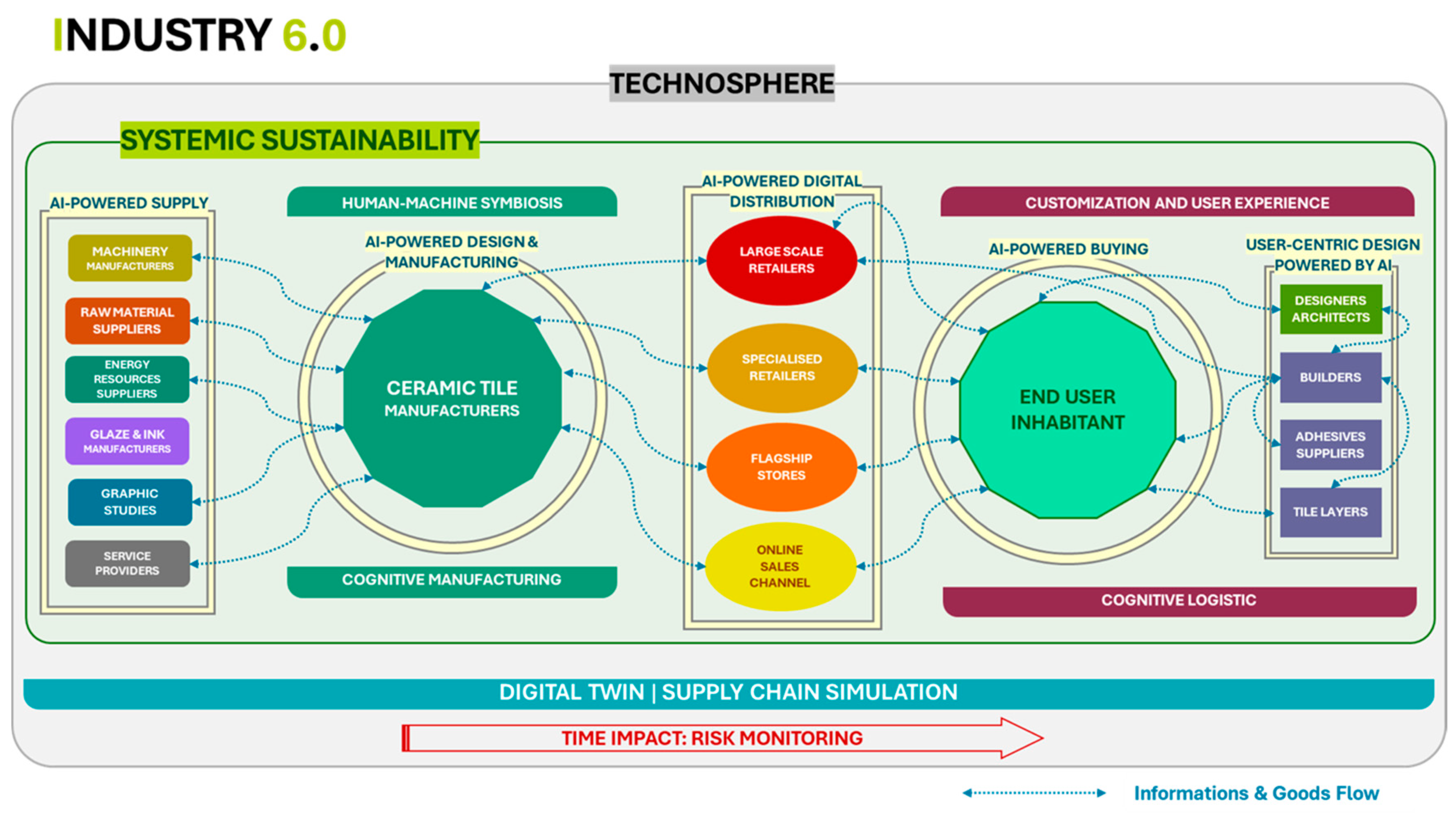
This study investigates how AI-driven innovations are reshaping manufacturing value chains through the transition from Industry 4.0 to Industry 6.0, particularly in resource-intensive sectors such as ceramics. Addressing a gap in the literature, the research situates the evolution of manufacturing within the broader context of digital transformation, sustainability, and regulatory demands. A mixed-methods approach was employed, combining semi-structured interviews with key industry stakeholders and an extensive review of secondary data, to develop an Industry 6.0 model tailored to the ceramics industry. The findings demonstrate that artificial intelligence, digital twins, and cognitive automation significantly enhance predictive maintenance, real-time supply chain optimization, and regulatory compliance, notably with the Corporate Sustainability Reporting Directive (CSRD). These technological advancements also facilitate circular economy practices and cognitive logistics, thereby fostering greater transparency and sustainability in B2B manufacturing networks. The study concludes that integrating AI-driven automation and cognitive logistics into digital ecosystems and supply chain management serves as a strategic enabler of operational resilience, regulatory alignment, and long-term competitiveness. While the industry-specific focus may limit generalizability, the study underscores the need for further research in diverse manufacturing sectors and longitudinal analyses to fully assess the long-term impact of AI-enabled Industry 6.0 frameworks.
Keywords: AI-driven manufacturing; Industry 6.0; Industry 5.0; digital transformation; cognitive automation; circular economy; predictive maintenance; smart supply chains; regulatory compliance; ceramic industry AI-driven manufacturing; Industry 6.0; Industry 5.0; digital transformation; cognitive automation; circular economy; predictive maintenance; smart supply chains; regulatory compliance; ceramic industry