Article

Security Analysis and Designing Advanced Two-Party Lattice-Based Authenticated Key Establishment and Key Transport Protocols for Mobile Communication


1
Department of Mathematics, Amrita School of Engineering, Amrita Vishwa Vidyapeetham, Chennai 601103, India
2
Department of Artificial Intelligence, Amrita School of Artificial Intelligence, Amrita Vishwa Vidyapeetham, Faridabad 121002, India
3
Department of Electronics and Communication Engineering, Amrita School of Engineering, Amrita Vishwa Vidyapeetham, Chennai 601103, India
4
Department of Library and Information Science, Fu Jen Catholic University, New Taipei City 24205, Taiwan
5
Department of Computer Science and Information Engineering, Fintech and Blockchain Research Center, Asia University, Taichung City 41354, Taiwan
*
Authors to whom correspondence should be addressed.
Future Internet 2025, 17(10), 472; https://doi.org/10.3390/fi17100472
Submission received: 22 July 2025 / Revised: 24 September 2025 / Accepted: 29 September 2025 / Published: 16 October 2025

Abstract

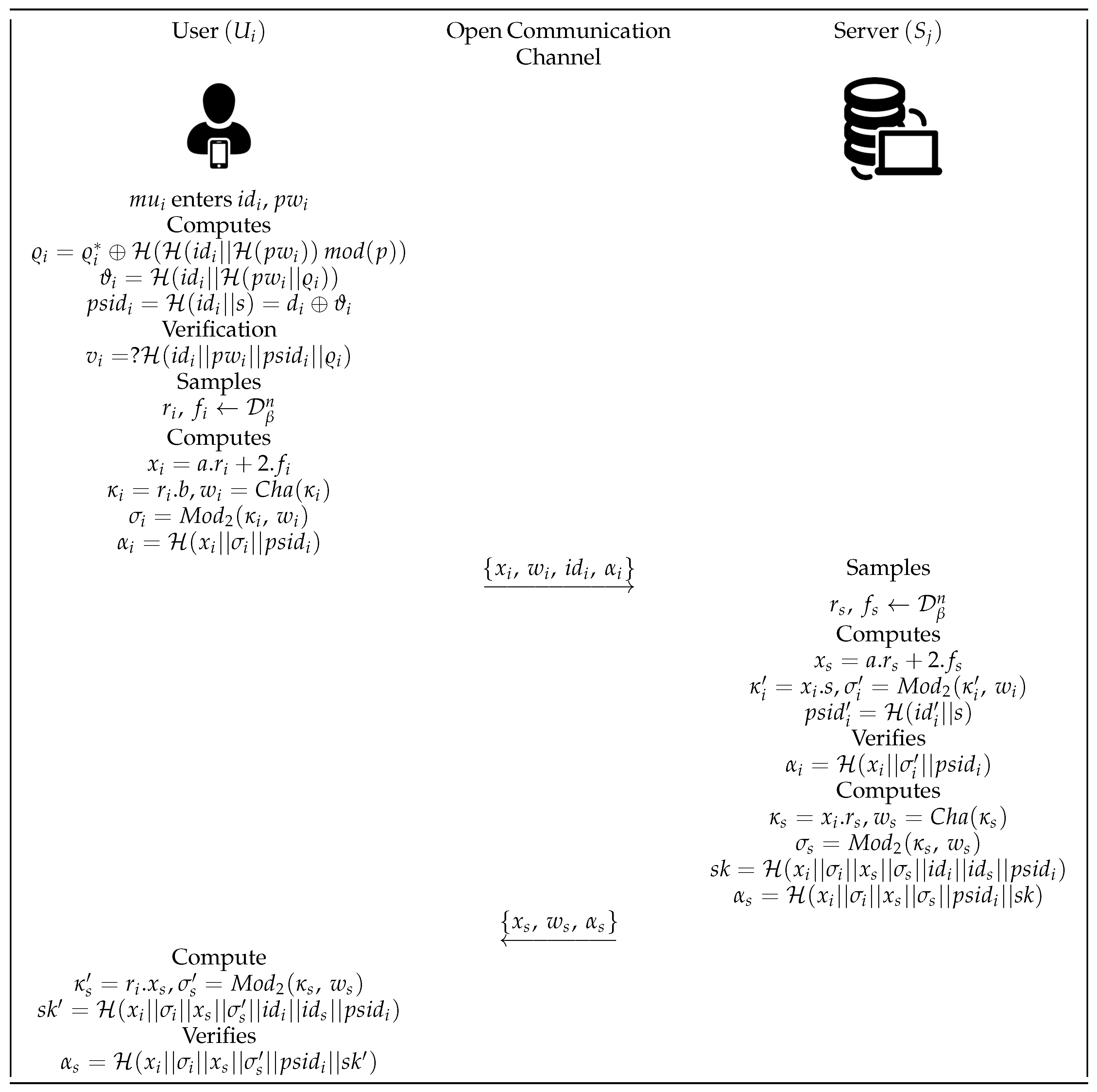
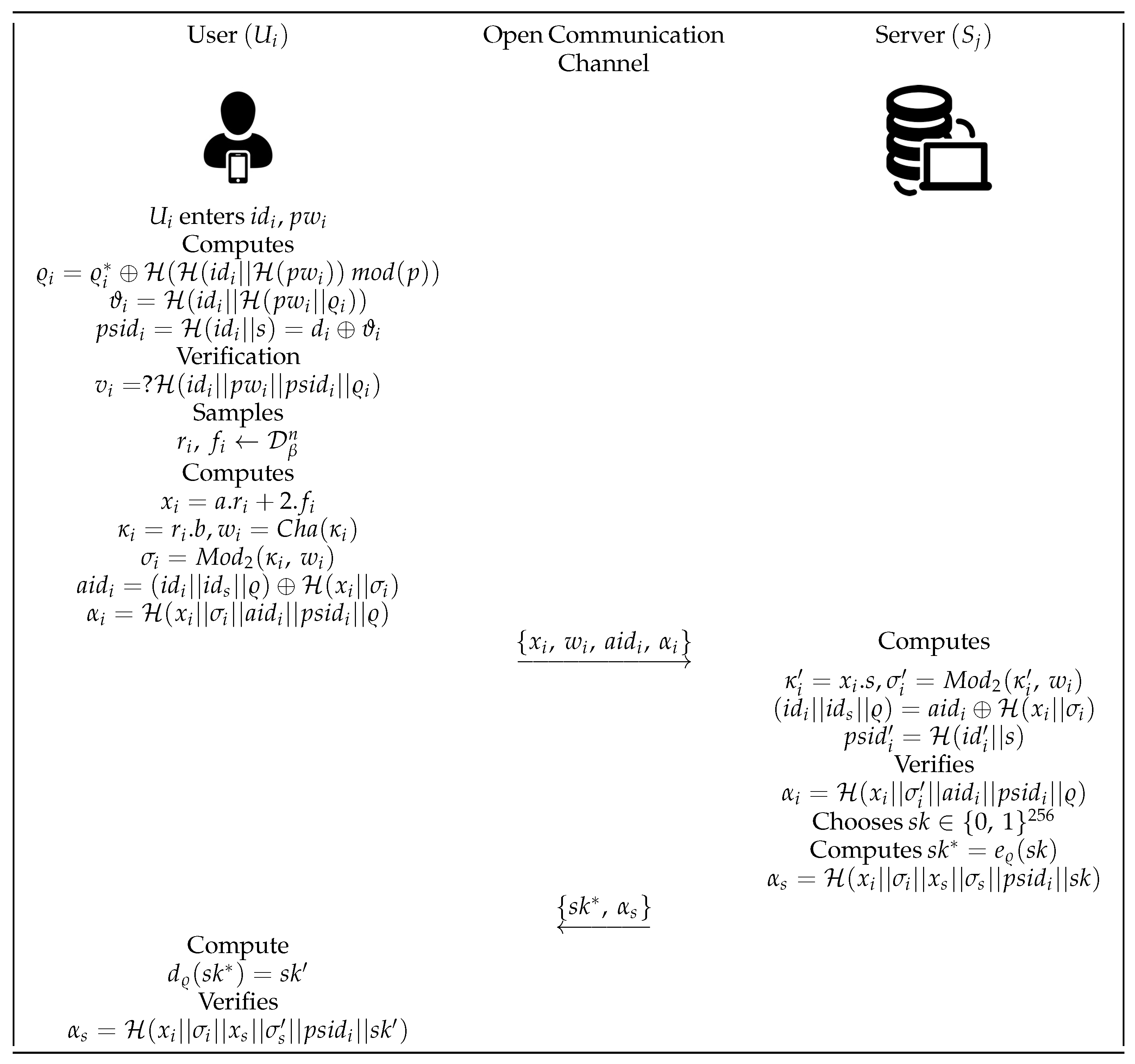
In this paper, we have proposed a two-party authenticated key establishment (AKE), and authenticated key transport protocols based on lattice-based cryptography, aiming to provide security against quantum attacks for secure communication. This protocol enables two parties, who may share long-term public keys, to securely establish a shared session key, and transportation of the session key from the server while achieving mutual authentication. Our construction leverages the hardness of lattice problems Ring Learning With Errors (Ring-LWE), ensuring robustness against quantum and classical adversaries. Unlike traditional schemes whose security depends upon number-theoretic assumptions being vulnerable to quantum attacks, our protocol ensures security in the post-quantum era. The proposed protocol ensures forward secrecy, and provides security even if the long-term key is compromised. This protocol also provides essential property key freshness and resistance against man-in-the-middle attacks, impersonation attacks, replay attacks, and key mismatch attacks. On the other hand, the proposed key transport protocol provides essential property key freshness, anonymity, and resistance against man-in-the-middle attacks, impersonation attacks, replay attacks, and key mismatch attacks. A two-party key transport protocol is a cryptographic protocol in which one party (typically a trusted key distribution center or sender) securely generates and sends a session key to another party. Unlike key exchange protocols (where both parties contribute to key generation), key transport protocols rely on one party to generate the key and deliver it securely. The protocol possesses a minimum number of exchanged messages and can reduce the number of communication rounds to help minimize the communication overhead.
Keywords: data security; network security; mobile communications; wireless communications security; key establishment; cryptography data security; network security; mobile communications; wireless communications security; key establishment; cryptography