

Natural Polymer-Based Hemostatic Hydrogels with Advanced Material and Structural Designs for Functional Applications
 ,
,
Abstract
1. Introduction
2. Basic Principles of Hemostasis
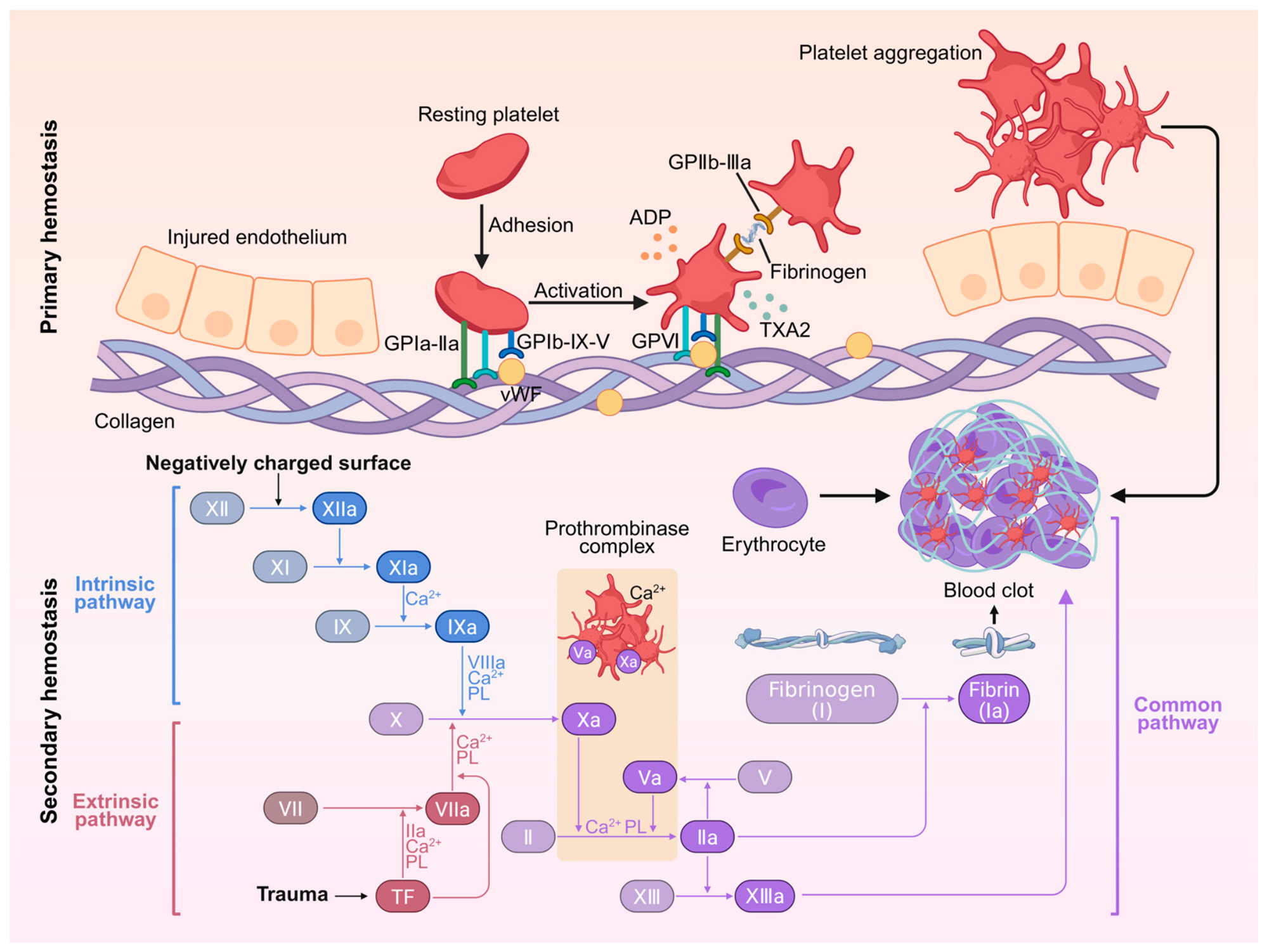
2.1. Physiological Hemostasis
2.2. Mechanisms of Action of Hemostatic Hydrogels
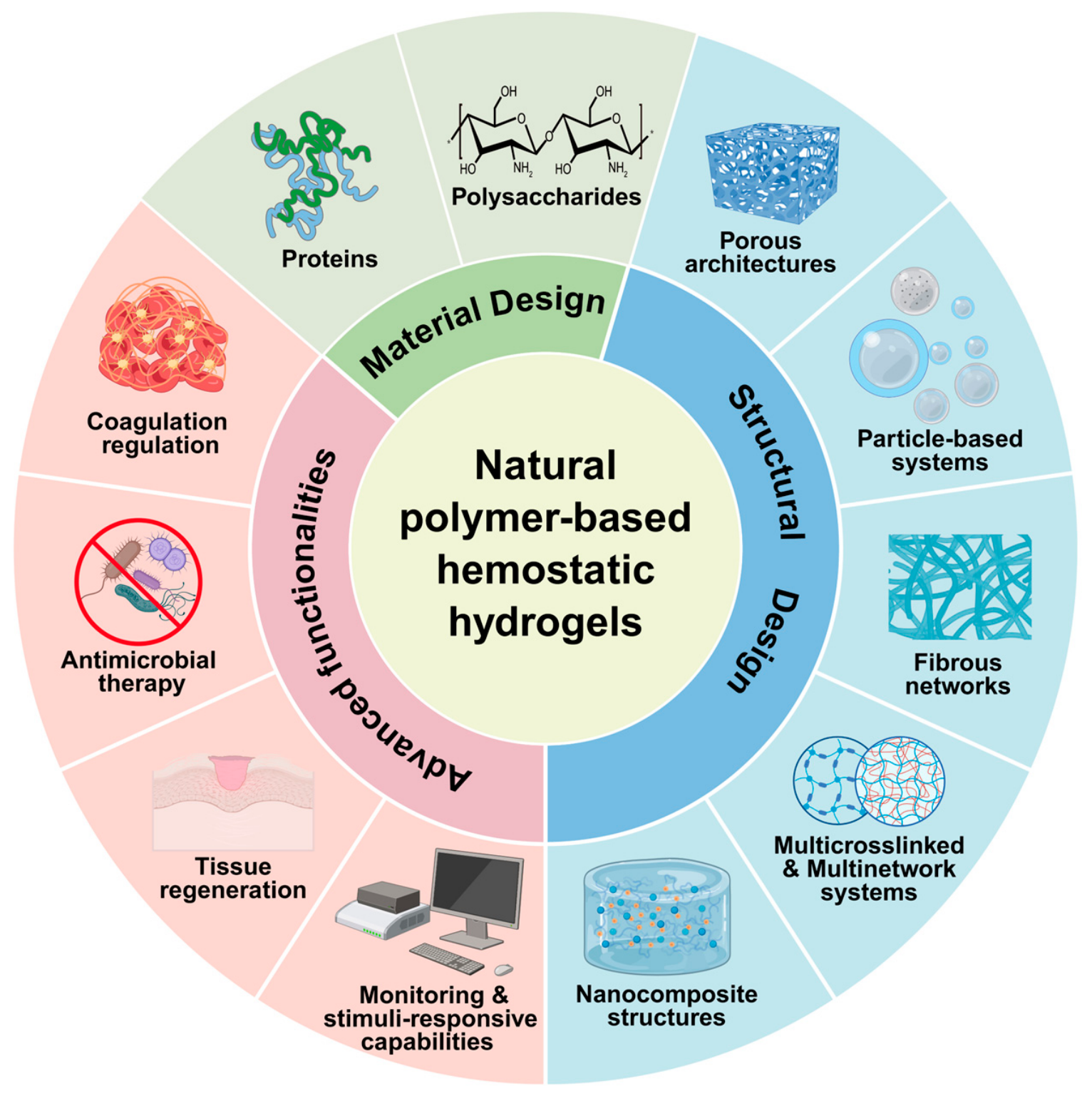
3. Material Design of Natural Polymer-Based Hemostatic Hydrogels
3.1. Polysaccharides
3.1.1. Chitosan
3.1.2. Cellulose
3.1.3. Alginate
3.1.4. Hyaluronic Acid
3.1.5. Starch
3.2. Proteins
3.2.1. Collagen and Gelatin
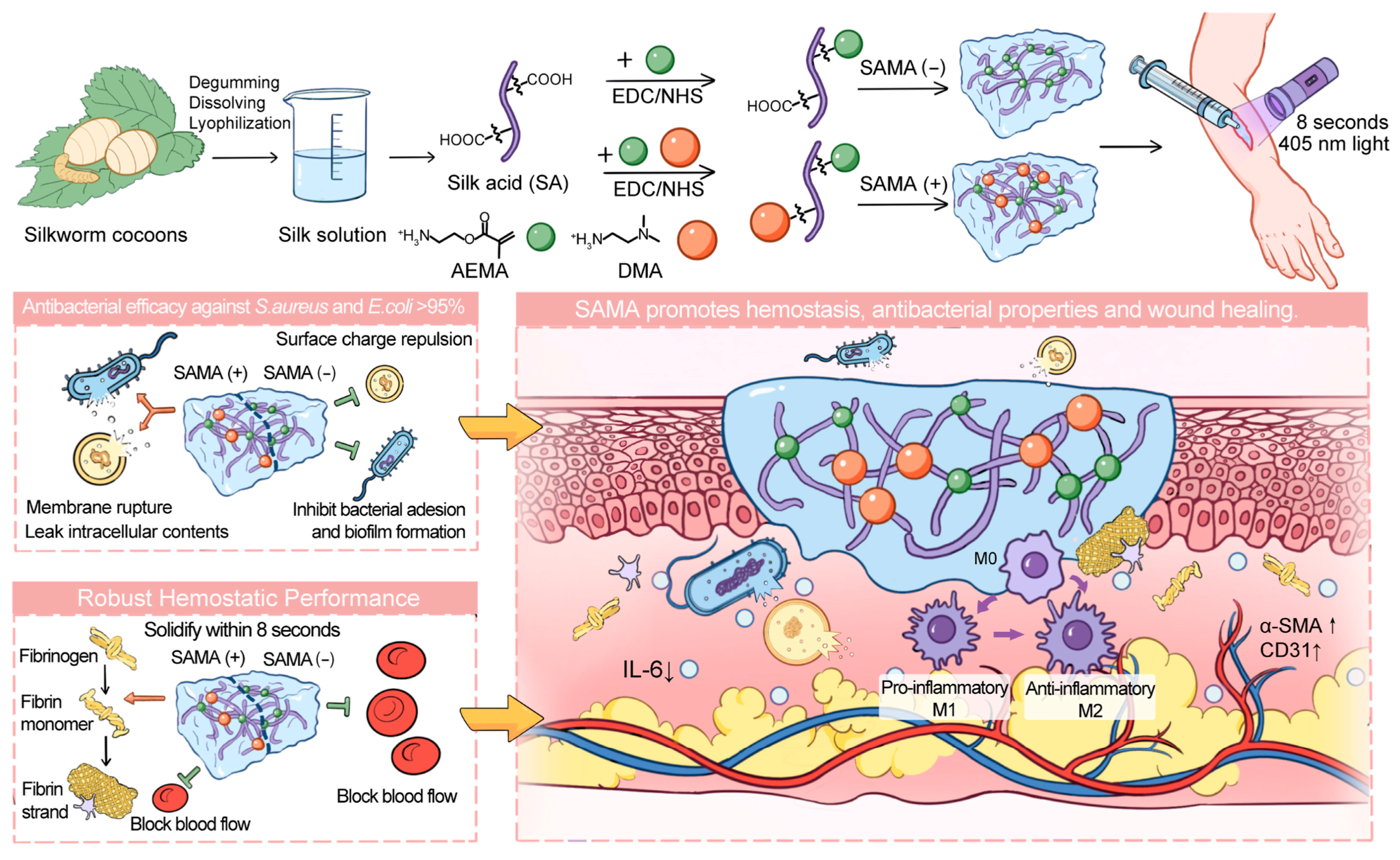
3.2.2. Silk Fibroin
3.2.3. Fibrin
4. Structural Design of Natural Hemostatic Hydrogels
4.1. Porous Hydrogels
4.1.1. Isotropic Porous Structure
4.1.2. Oriented Microchannel Structures
4.1.3. Other Hierarchical Structures
4.2. Particle-Based Hydrogels
4.2.1. Self-Gelling Powders
4.2.2. Microspheres with Advanced Structures
4.2.3. Functionally Integrated Microspheres
4.3. Fibrous Hydrogels
4.3.1. In Situ Fibrous Networks
4.3.2. Preformed Fibrous Networks
4.4. Multicrosslinked and Multinetwork Hydrogels
4.4.1. Physicochemical Dual-Crosslinking Networks
4.4.2. Multinetwork Structures
4.4.3. Dynamic Reconfigurable Networks
4.5. Nanocomposite Hydrogels
4.5.1. Mineral-Based Nanophases
4.5.2. Carbon-Based Nanophases
4.5.3. Other Nanophases
5. Advanced Functionalities of Hydrogels
5.1. Coagulation Modulation and Hemostatic Enhancement
5.1.1. Enhancement of Coagulation Cascade Initiation
5.1.2. Acceleration and Amplification of the Coagulation Process
5.1.3. Hemostatic Stabilization and Prevention of Re-Bleeding
5.2. Antimicrobial Therapy
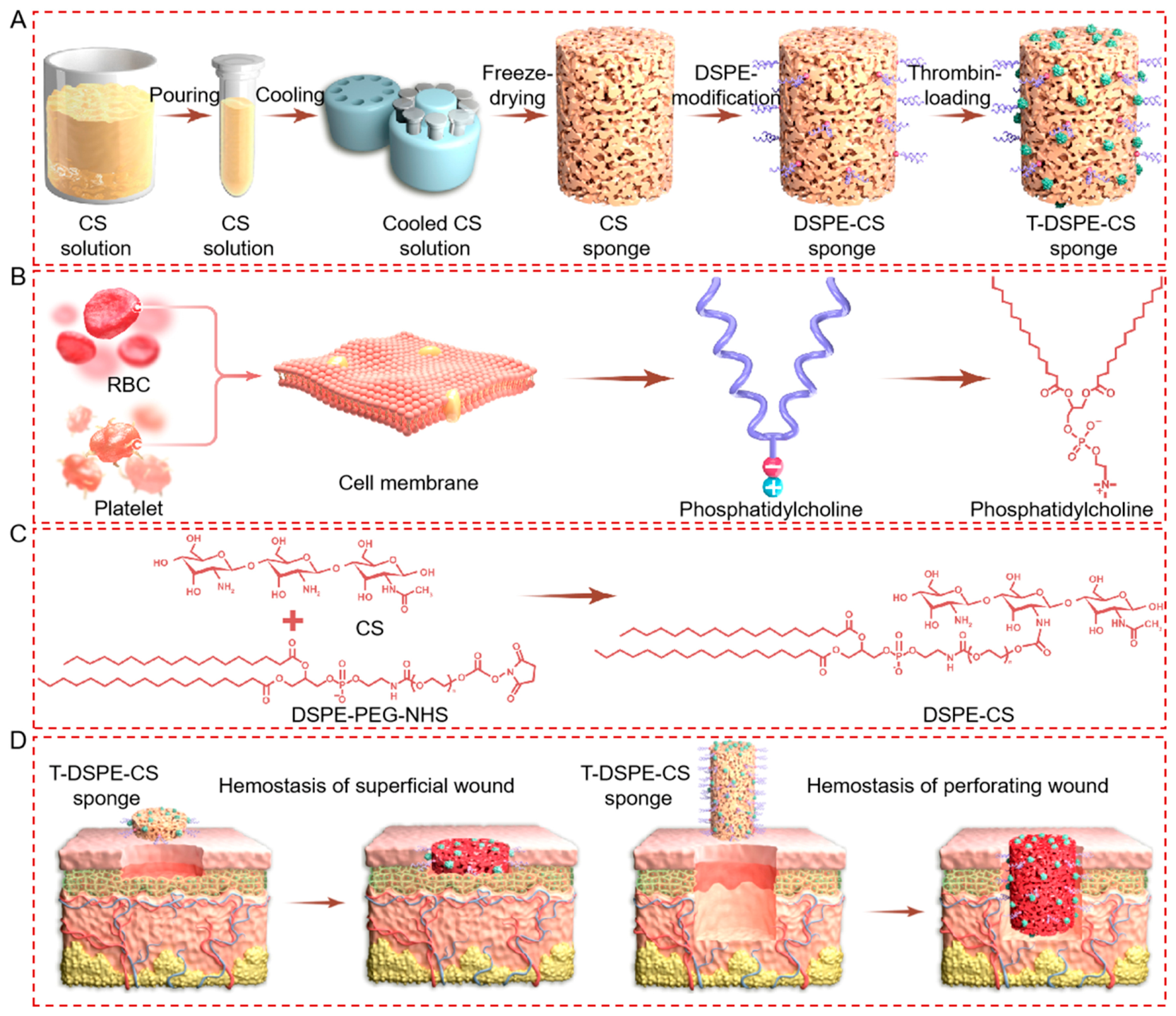
5.2.1. Antimicrobial Agent Loading
5.2.2. Intrinsic Antimicrobial Activity
5.2.3. Photothermal/Photodynamic Therapy
5.3. Tissue Regeneration
5.3.1. Antioxidant Regulation and Inflammation Alleviation
5.3.2. Immune Regulation
5.3.3. Vascular Regeneration and Matrix Reconstruction
5.4. Dynamic Monitoring and Stimuli-Responsive Capabilities
5.4.1. Visualization and Dynamic Monitoring of Pathological Signals
5.4.2. Pathology-Triggered On-Demand Therapeutic Release
5.4.3. External-Field Regulation and Interdisciplinary Extensions
6. Conclusions and Outlook
6.1. Overcoming Raw Material Barriers
6.2. Improving Full Life-Cycle Toxicological Evaluation
6.3. Advancing Intelligent and Digital Closed-Loop Systems
6.4. Balancing Functional Complexity and Clinical Feasibility
6.5. Comparative Translational Potential of Hemostatic Platforms
6.6. Establishing a Standardized Evaluation System
Author Contributions
Funding
Institutional Review Board Statement
Informed Consent Statement
Data Availability Statement
Conflicts of Interest
References
- Kauvar, D.S.; Lefering, R.; Wade, C.E. Impact of hemorrhage on trauma outcome: An overview of epidemiology, clinical presentations, and therapeutic considerations. J. Trauma 2006, 60, S3–S11. [Google Scholar] [CrossRef]
- Mikhail, J. The trauma triad of death: Hypothermia, acidosis, and coagulopathy. AACN Clin. Issues 1999, 10, 85–94. [Google Scholar] [CrossRef]
- Hong, C.; Olsen, B.D.; Hammond, P.T. A review of treatments for non-compressible torso hemorrhage (NCTH) and internal bleeding. Biomaterials 2022, 283, 121432. [Google Scholar] [CrossRef]
- Dong, R.; Zhang, H.; Guo, B. Emerging hemostatic materials for non-compressible hemorrhage control. Natl. Sci. Rev. 2022, 9, nwac162. [Google Scholar] [CrossRef]
- Liang, Y.; Xu, C.; Liu, F.; Du, S.; Li, G.; Wang, X. Eliminating heat injury of zeolite in hemostasis via thermal conductivity of graphene sponge. ACS Appl. Mater. Interfaces 2019, 11, 23848–23857. [Google Scholar] [CrossRef]
- Nam, S.; Mooney, D. Polymeric tissue adhesives. Chem. Rev. 2021, 121, 11336–11384. [Google Scholar] [CrossRef]
- Guo, B.; Dong, R.; Liang, Y.; Li, M. Haemostatic materials for wound healing applications. Nat. Rev. Chem. 2021, 5, 773–791. [Google Scholar] [CrossRef]
- Zou, C.-Y.; Lei, X.-X.; Hu, J.-J.; Jiang, Y.-L.; Li, Q.-J.; Song, Y.-T.; Zhang, Q.-Y.; Li-Ling, J.; Xie, H.-Q. Multi-crosslinking hydrogels with robust bio-adhesion and pro-coagulant activity for first-aid hemostasis and infected wound healing. Bioact. Mater. 2022, 16, 388–402. [Google Scholar] [CrossRef]
- Briquez, P.S.; Clegg, L.E.; Martino, M.M.; Gabhann, F.M.; Hubbell, J.A. Design principles for therapeutic angiogenic materials. Nat. Rev. Mater. 2016, 1, 15006. [Google Scholar] [CrossRef]
- Wang, C.; Sani, E.S.; Shih, C.-D.; Lim, C.T.; Wang, J.; Armstrong, D.G.; Gao, W. Wound management materials and technologies from bench to bedside and beyond. Nat. Rev. Mater. 2024, 9, 550–566. [Google Scholar] [CrossRef]
- Broos, K.; Feys, H.B.; De Meyer, S.F.; Vanhoorelbeke, K.; Deckmyn, H. Platelets at work in primary hemostasis. Blood Rev. 2011, 25, 155–167. [Google Scholar] [CrossRef]
- Nuyttens, B.P.; Thijs, T.; Deckmyn, H.; Broos, K. Platelet adhesion to collagen. Thromb. Res. 2011, 127, S26–S29. [Google Scholar] [CrossRef]
- Sang, Y.; Roest, M.; de Laat, B.; de Groot, P.G.; Huskens, D. Interplay between platelets and coagulation. Blood Rev. 2021, 46, 100733. [Google Scholar] [CrossRef]
- Mackman, N.; Tilley, R.E.; Key, N.S. Role of the extrinsic pathway of blood coagulation in hemostasis and thrombosis. Arterioscler. Thromb. Vasc. Biol. 2007, 27, 1687–1693. [Google Scholar] [CrossRef]
- Chan, L.W.; Wang, X.; Wei, H.; Pozzo, L.D.; White, N.J.; Pun, S.H. A synthetic fibrin cross-linking polymer for modulating clot properties and inducing hemostasis. Sci. Transl. Med. 2015, 7, 277ra29. [Google Scholar] [CrossRef]
- Gailani, D.; Renné, T. Intrinsic pathway of coagulation and arterial thrombosis. Arterioscler. Thromb. Vasc. Biol. 2007, 27, 2507–2513. [Google Scholar] [CrossRef]
- Wolberg, A.S. Thrombin generation and fibrin clot structure. Blood Rev. 2007, 21, 131–142. [Google Scholar] [CrossRef]
- Scridon, A. Platelets and Their Role in Hemostasis and Thrombosis—From Physiology to Pathophysiology and Therapeutic Implications. Int. J. Mol. Sci. 2022, 23, 12772. [Google Scholar] [CrossRef]
- Nepal, A.; Tran, H.D.N.; Nguyen, N.-T.; Ta, H.T. Advances in haemostatic sponges: Characteristics and the underlying mechanisms for rapid haemostasis. Bioact. Mater. 2023, 27, 231–256. [Google Scholar] [CrossRef]
- Guo, Y.; Wang, M.; Liu, Q.; Liu, G.; Wang, S.; Li, J. Recent advances in the medical applications of hemostatic materials. Theranostics 2023, 13, 161–196. [Google Scholar] [CrossRef]
- Liu, J.; Qu, M.; Wang, C.; Xue, Y.; Huang, H.; Chen, Q.; Sun, W.; Zhou, X.; Xu, G.; Jiang, X. A dual-cross-linked hydrogel patch for promoting diabetic wound healing. Small 2022, 18, 2106172. [Google Scholar] [CrossRef]
- Zou, C.-Y.; Li, Q.-J.; Hu, J.-J.; Song, Y.-T.; Zhang, Q.-Y.; Nie, R.; Li-Ling, J.; Xie, H.-Q. Design of biopolymer-based hemostatic material: Starting from molecular structures and forms. Mater. Today Bio 2022, 17, 100468. [Google Scholar] [CrossRef]
- Zhou, M.; Lin, X.; Wang, L.; Yang, C.; Yu, Y.; Zhang, Q. Preparation and application of hemostatic hydrogels. Small 2024, 20, 2309485. [Google Scholar] [CrossRef]
- Fan, X.; Wang, S.; Fang, Y.; Li, P.; Zhou, W.; Wang, Z.; Chen, M.; Liu, H. Tough polyacrylamide-tannic acid-kaolin adhesive hydrogels for quick hemostatic application. Mater. Sci. Eng. C 2020, 109, 110649. [Google Scholar] [CrossRef]
- Liu, A.; Cui, S.; Song, L.; Guo, X.; Huang, Z.; Wang, S.; Cheng, K.; Xiao, Y.; Fan, Y.; Wang, R. Ultrafast self-gelling, superabsorbent, and adhesive chitosan-based hemostatic powders for rapid hemostasis and wound healing. Carbohydr. Polym. 2025, 355, 123362. [Google Scholar] [CrossRef]
- Pornttewabuncha, T.; Owattanapanich, N. Tranexamic acid in hemostasis and resuscitation: A comprehensive clinical review. Clin. Crit. Care 2026, 34, e260009. [Google Scholar] [CrossRef]
- Hou, D.; Wang, Y.; Qi, L.; Wang, C.; Deng, J.; Zhao, X.; Geng, X.; Sun, Q.; Ye, L.; Guo, Z. A facile way to fabricate a thrombin immobilized composite sponge with dual hemostatic effects for acute hemorrhage control. Biomater. Adv. 2025, 166, 214037. [Google Scholar] [CrossRef]
- Ahmadi, Z.; Jha, D.; Yadav, S.; Singh, A.P.; Singh, V.P.; Gautam, H.K.; Sharma, A.K.; Kumar, P. Self-assembled arginine–glycine–aspartic acid mimic peptide hydrogels as multifunctional biomaterials for wound healing. ACS Appl. Mater. Interfaces 2024, 16, 67302–67320. [Google Scholar] [CrossRef]
- Luo, Q.; Luo, J.; Luan, Z.; Xu, K.; Tian, L.; Zhang, K.; Peng, X.; Yuan, M.; Zheng, C.; Shu, Z.; et al. Blue laser triggered hemostatic peptide hydrogel for gastrointestinal bleeding treatment. Adv. Mater. 2024, 36, 2405290. [Google Scholar] [CrossRef]
- Zhang, J.; Fu, C.; Tian, T.; Batur, S.; Lv, J.; Xie, Q.; Kong, L.; Yang, C.; Zhang, Z. In situ ultrafast self-gelling coacervate powder with antibacterial, antioxidant, and robust wet adhesion properties for hemostasis and wound healing. Adv. Funct. Mater. 2025, 35, 2502577. [Google Scholar] [CrossRef]
- Yuk, H.; Wu, J.; Sarrafian, T.L.; Mao, X.; Varela, C.E.; Roche, E.T.; Griffiths, L.G.; Nabzdyk, C.S.; Zhao, X. Rapid and coagulation-independent haemostatic sealing by a paste inspired by barnacle glue. Nat. Biomed. Eng. 2021, 5, 1131–1142. [Google Scholar] [CrossRef]
- Wang, G.; Meng, X.; Wang, P.; Wang, X.; Liu, G.; Wang, D.-A.; Fan, C. A catechol bioadhesive for rapid hemostasis and healing of traumatic internal organs and major arteries. Biomaterials 2022, 291, 121908. [Google Scholar] [CrossRef]
- Zheng, Y.; Shariati, K.; Ghovvati, M.; Vo, S.; Origer, N.; Imahori, T.; Kaneko, N.; Annabi, N. Hemostatic patch with ultra-strengthened mechanical properties for efficient adhesion to wet surfaces. Biomaterials 2023, 301, 122240. [Google Scholar] [CrossRef]
- Yu, L.; Liu, Z.; Zheng, Y.; Tong, Z.; Ding, Y.; Wang, W.; Ding, Y.; Mao, Z. Molecular self-assembly strategy tuning a dry crosslinking protein patch for biocompatible and biodegradable haemostatic sealing. Nat. Commun. 2025, 16, 1437. [Google Scholar] [CrossRef]
- Shen, K.; Lv, Z.; Yang, Y.; Wang, H.; Liu, J.; Chen, Q.; Liu, Z.; Zhang, M.; Liu, J.; Cheng, Y. A wet-adhesion and swelling-resistant hydrogel for fast hemostasis, accelerated tissue injury healing and bioelectronics. Adv. Mater. 2025, 37, 2414092. [Google Scholar] [CrossRef]
- Chen, T.; Xiao, C.; Chen, X.; Yang, Z.; Zhao, J.; Bao, B.; Zeng, Q.; Jiang, L.; Huang, X.; Yang, Y.; et al. Covalently reactive microparticles imbibe blood to form fortified clots for rapid hemostasis and prevention of rebleeding. Nat. Commun. 2025, 16, 3705. [Google Scholar] [CrossRef]
- Yang, X.; Liu, W.; Li, N.; Wang, M.; Liang, B.; Ullah, I.; Neve, A.L.; Feng, Y.; Chen, H.; Shi, C. Design and development of polysaccharide hemostatic materials and their hemostatic mechanism. Biomater. Sci. 2017, 5, 2357–2368. [Google Scholar] [CrossRef]
- Haridevamuthu, B.; Raj, D.; Chandran, A.; Murugan, R.; Seetharaman, S.; Dhanaraj, M.; Almutairi, B.O.; Arokiyaraj, S.; Arockiaraj, J. Sustainable food packaging: Harnessing biowaste of Terminalia catappa L. for chitosan-based biodegradable active films for shrimp storage. Carbohydr. Polym. 2024, 329, 121798. [Google Scholar] [CrossRef]
- Liu, L.; Gao, Q.; Lu, X.; Zhou, H. In situ forming hydrogels based on chitosan for drug delivery and tissue regeneration. Asian J. Pharm. Sci. 2016, 11, 673–683. [Google Scholar] [CrossRef]
- Zhou, M.; Liao, J.; Li, G.; Yu, Z.; Xie, D.; Zhou, H.; Wang, F.; Ren, Y.; Xu, R.; Dai, Y.; et al. Expandable carboxymethyl chitosan/cellulose nanofiber composite sponge for traumatic hemostasis. Carbohydr. Polym. 2022, 294, 119805. [Google Scholar] [CrossRef]
- Tsai, G.-J.; Su, W.-H. Antibacterial activity of shrimp chitosan against Escherichia coli. J. Food Prot. 1999, 62, 239–243. [Google Scholar] [CrossRef]
- Chang, L.; Chen, Y.; Zhou, M.; Gao, Y.; Wang, Y.; Li, W.; Cui, Z.; Zhou, C.; He, Y.; Qin, J. Photothermal enhanced antibacterial chitosan-based polydopamine composite hydrogel for hemostasis and burn wound repairing. Carbohydr. Polym. 2024, 345, 122568. [Google Scholar] [CrossRef]
- Lord, M.S.; Cheng, B.; McCarthy, S.J.; Jung, M.; Whitelock, J.M. The modulation of platelet adhesion and activation by chitosan through plasma and extracellular matrix proteins. Biomaterials 2011, 32, 6655–6662. [Google Scholar] [CrossRef]
- Jin, J.; Ji, Z.; Xu, M.; Liu, C.; Ye, X.; Zhang, W.; Li, S.; Wang, D.; Zhang, W.; Chen, J.; et al. Microspheres of carboxymethyl chitosan, sodium alginate, and collagen as a hemostatic agent in vivo. ACS Biomater. Sci. Eng. 2018, 4, 2541–2551. [Google Scholar] [CrossRef]
- Leventis, P.A.; Grinstein, S. The distribution and function of phosphatidylserine in cellular membranes. Annu. Rev. Biophys. 2010, 39, 407–427. [Google Scholar] [CrossRef]
- Bennett, B.L.; Littlejohn, L.F.; Kheirabadi, B.S.; Butler, F.K.; Kotwal, R.S.; Dubick, M.A.; Bailey, H.H. Management of external hemorrhage in tactical combat casualty care: Chitosan-based hemostatic gauze dressings-TCCC guidelines-change 13-05. J. Spec. Oper. Med. 2014, 14, 41–57. [Google Scholar] [CrossRef]
- Harugade, A.; Sherje, A.P.; Pethe, A. Chitosan: A review on properties, biological activities and recent progress in biomedical applications. React. Funct. Polym. 2023, 191, 105634. [Google Scholar] [CrossRef]
- Ji, M.; Li, J.; Wang, Y.; Li, F.; Man, J.; Li, J.; Zhang, C.; Peng, S.; Wang, S. Advances in chitosan-based wound dressings: Modifications, fabrications, applications and prospects. Carbohydr. Polym. 2022, 297, 120058. [Google Scholar] [CrossRef]
- Ho, T.T.-P.; Tran, H.A.; Doan, V.K.; Maitz, J.; Li, Z.; Wise, S.G.; Lim, K.S.; Rnjak-Kovacina, J. Natural polymer-based materials for wound healing applications. Adv. NanoBiomed Res. 2024, 4, 2300131. [Google Scholar] [CrossRef]
- Jiang, Z.; Wang, Y.; Li, L.; Hu, H.; Wang, S.; Zou, M.; Liu, W.; Han, B. Preparation, characterization, and biological evaluation of transparent thin carboxymethyl-chitosan/oxidized carboxymethyl cellulose films as new wound dressings. Macromol. Biosci. 2021, 22, 2100308. [Google Scholar] [CrossRef]
- Mottaghitalab, F.; Khodadadi Yazdi, M.; Reza Saeb, M.; Bączek, T.; Farokhi, M. Green and sustainable hydrogels based on quaternized chitosan to enhance wound healing. Chem. Eng. J. 2024, 492, 152288. [Google Scholar] [CrossRef]
- Huang, Z.; Zhang, D.; Tong, L.; Gao, F.; Zhang, S.; Wang, X.; Xie, Y.; Chen, F.; Liu, C. Protonated-chitosan sponge with procoagulation activity for hemostasis in coagulopathy. Bioact. Mater. 2024, 41, 174–192. [Google Scholar] [CrossRef]
- Huang, Y.; Feng, L.; Zhang, Y.; He, L.; Wang, C.; Xu, J.; Wu, J.; Kirk, T.B.; Guo, R.; Xue, W. Hemostasis mechanism and applications of N-alkylated chitosan sponge. Polym. Adv. Technol. 2017, 28, 1107–1114. [Google Scholar] [CrossRef]
- Wang, X.; Guan, J.; Zhuang, X.; Li, Z.; Huang, S.; Yang, J.; Liu, C.; Li, F.; Tian, F.; Wu, J.; et al. Exploration of blood coagulation of N-alkyl chitosan nanofiber membrane in vitro. Biomacromolecules 2018, 19, 731–739. [Google Scholar] [CrossRef]
- Du, X.; Zhang, T.; Liu, Y.; Li, T.; Yang, J.; Li, X.; Wang, L. A self-elastic chitosan sponge integrating active and passive hemostatic mechanisms for effectively managing uncontrolled coagulopathic hemorrhage. Mater. Today Bio 2024, 26, 101031. [Google Scholar] [CrossRef]
- Guo, S.; Ren, Y.; Chang, R.; He, Y.; Zhang, D.; Guan, F.; Yao, M. Injectable self-healing adhesive chitosan hydrogel with antioxidative, antibacterial, and hemostatic activities for rapid hemostasis and skin wound healing. ACS Appl. Mater. Interfaces 2022, 14, 34455–34469. [Google Scholar] [CrossRef]
- Liu, Y.; Hu, Y.; Wang, B.; Wei, Y.; Huang, D. Multifunctional cellulose based hemostatic materials: From hemostasis to multi-field applications. Carbohydr. Polym. 2025, 366, 123895. [Google Scholar] [CrossRef]
- Fan, X.; Li, Y.; Li, N.; Wan, G.; Ali, M.A.; Tang, K. Rapid hemostatic chitosan/cellulose composite sponge by alkali/urea method for massive haemorrhage. Int. J. Biol. Macromol. 2020, 164, 2769–2778. [Google Scholar] [CrossRef]
- Zhang, S.; Li, J.; Chen, S.; Zhang, X.; Ma, J.; He, J. Oxidized cellulose-based hemostatic materials. Carbohydr. Polym. 2020, 230, 115585. [Google Scholar] [CrossRef]
- Cheng, W.; Zhu, Y.; Jiang, G.; Cao, K.; Zeng, S.; Chen, W.; Zhao, D.; Yu, H. Sustainable cellulose and its derivatives for promising biomedical applications. Prog. Mater. Sci. 2023, 138, 101152. [Google Scholar] [CrossRef]
- Wang, L.; Liu, Y.; Duan, W.; Cao, F.; Lv, Q.; Zhang, S.; She, J.; Yang, L.; He, B.; Hou, Y.; et al. Sprayable oxidized cellulose nanofiber hydrogel with rapid hemostatic ability for skin wound healing. Int. J. Biol. Macromol. 2025, 310, 143264. [Google Scholar] [CrossRef]
- Zhang, Z.; Lin, Z.; Yu, C.; Lei, S.I.; Wang, L.; Wang, F.; Gao, J.; Meng, W. Chitosan/oxidized cellulose composite nanofiber sponges: A rapid and effective hemostasis strategy for non-compressible hemorrhage. Carbohydr. Polym. 2025, 361, 123655. [Google Scholar] [CrossRef]
- Zhu, X.; Wang, J.; Wu, S.; Liu, T.; Lin, G.; Shang, B.; Ma, J.; Lu, W.; Zhang, F.; Li, J.; et al. Biological application of novel biodegradable cellulose composite as a hemostatic material. Mediat. Inflamm. 2022, 2022, 4083477. [Google Scholar] [CrossRef]
- Alipour, N.; Salmanipour, S.; Rezaie, A.; Amini, H.; Ghahremani-Nasab, M.; Mehdipour, A.; Salehi, R. Mussel-inspired modified regenerated cellulose as tissue adhesive and antibacterial gauze: A promising approach for rapid hemostasis in non-compressible hemorrhage. Carbohydr. Polym. 2025, 349, 122949. [Google Scholar] [CrossRef]
- Yao, K.; Li, S.; Zheng, X.; Zhang, Q.; Liu, J.; Liang, C.; Duan, K.; Ye, J.; Yin, Y.; Chen, X. Superwettable calcium ion exchanged carboxymethyl cellulose powder with self-gelation, tissue adhesion and bioabsorption for effective hemorrhage control. Chem. Eng. J. 2024, 481, 148770. [Google Scholar] [CrossRef]
- Fernando, I.P.S.; Lee, W.; Han, E.J.; Ahn, G. Alginate-based nanomaterials: Fabrication techniques, properties, and applications. Chem. Eng. J. 2020, 391, 123823. [Google Scholar] [CrossRef]
- Xie, Y.; Gao, P.; He, F.; Zhang, C. Application of alginate-based hydrogels in hemostasis. Gels 2022, 8, 109. [Google Scholar] [CrossRef]
- Zhao, J.; Zhu, H.; Xu, T.; Xu, S.; Wang, Y.; Hou, Y.; Zhuo, M.; Du, K.; Su, Y.; Han, X.; et al. Self-healing oxidized dextran/sodium alginate hydrogel dressing with hemostatic activity speeds up wound healing in burn injuries. ACS Appl. Mater. Interfaces 2025, 17, 2940–2951. [Google Scholar] [CrossRef]
- Zhu, Y.; Hao, L.; Luo, Y.; Gao, J.; Xu, F.; Li, H.; Hao, C.; Lin, C.-P.; Yu, H.-P.; Zhu, Y.-J.; et al. A composite dressing combining ultralong hydroxyapatite nanowire bio-paper and a calcium alginate hydrogel accelerates wound healing. J. Mater. Chem. B 2025, 13, 997–1012. [Google Scholar] [CrossRef]
- Kumar, A.; Sah, D.K.; Rai, Y.; Yadav, A.K.; Solanki, P.R.; Ansari, M.S.; Bhatt, A.N. Granular hemostatic composite of alginate, calcium, and zinc for rapid and effective management of post-traumatic hemorrhage. ACS Appl. Mater. Interfaces 2024, 16, 10565–10579. [Google Scholar] [CrossRef]
- Juncan, A.M.; Moisă, D.G.; Santini, A.; Morgovan, C.; Rus, L.-L.; Vonica-Țincu, A.L.; Loghin, F. Advantages of hyaluronic acid and its combination with other bioactive ingredients in cosmeceuticals. Molecules 2021, 26, 4429. [Google Scholar] [CrossRef]
- Li, M.; Shi, X.; Yang, B.; Qin, J.; Han, X.; Peng, W.; He, Y.; Mao, H.; Kong, D.; Gu, Z. Single-component hyaluronic acid hydrogel adhesive based on phenylboronic ester bonds for hemostasis and wound closure. Carbohydr. Polym. 2022, 296, 119953. [Google Scholar] [CrossRef]
- Liu, Y.; Niu, H.; Wang, C.; Yang, X.; Li, W.; Zhang, Y.; Ma, X.; Xu, Y.; Zheng, P.; Wang, J.; et al. Bio-inspired, bio-degradable adenosine 5′-diphosphate-modified hyaluronic acid coordinated hydrophobic undecanal-modified chitosan for hemostasis and wound healing. Bioact. Mater. 2022, 17, 162–177. [Google Scholar] [CrossRef]
- Wei, S.; Chen, F.; Geng, Z.; Cui, R.; Zhao, Y.; Liu, C. Self-assembling RATEA16 peptide nanofiber designed for rapid hemostasis. J. Mater. Chem. B 2020, 8, 1897–1905. [Google Scholar] [CrossRef]
- Tscholl, V.; Spann, F.; Moses, J.; Nagel, P.; Bellmann, B.; Biewener, S.; Amtenbrink, M.; Stroux, A.; Rillig, A.; Landmesser, U.; et al. Prospective randomized study evaluating the effects of PerClot® (Polysaccharide Hemostatic System) application in patients with high bleeding risk undergoing cardiac rhythm device implantation. Int. J. Cardiol. 2017, 248, 84–91. [Google Scholar] [CrossRef]
- Huang, Z.; Wu, J.; Zhao, Y.; Zhang, D.; Tong, L.; Gao, F.; Liu, C.; Chen, F. Starch-based shape memory sponge for rapid hemostasis in penetrating wounds. J. Mater. Chem. B 2023, 11, 852–864. [Google Scholar] [CrossRef]
- Liu, Y.; Zhong, W.; Ai, Y.; Xing, M. Double cross-linked methacrylated carboxymethyl pea starch cryogels with highly compressive elasticity and hemostatic function. Biomacromolecules 2025, 26, 883–899. [Google Scholar] [CrossRef]
- Wu, J.; Huang, Z.; Zhang, D.; Tong, L.; Gao, F.; Chen, F.; Liu, C. Serotonin-functionalized starch-based hemostatic sponges enhance platelet activation in the management of non-compressible hemorrhage. Int. J. Biol. Macromol. 2024, 283, 137547. [Google Scholar] [CrossRef]
- An, S.; Jeon, J.; Han, S.Y.; Lee, M.J.; Oh, T.-G.; Jeon, E.J.; Joo, D.J.; Cho, S.-W. Highly absorbent ultrafast self-gelling starch microparticles for robust wet-tissue adhesion and instant hemostasis. Adv. Sci. 2025, 12, 2501857. [Google Scholar] [CrossRef]
- Huang, W.; Wu, J.; Huang, Z.; Zhang, D.; Chen, F.; Liu, C. A self-gelling starch-based sponge for hemostasis. J. Mater. Chem. B 2023, 11, 1331–1343. [Google Scholar] [CrossRef]
- Liu, Y.; Chen, W.; Gao, Y.; Wei, K. Anti-inflammatory dressing based on hyaluronic acid and hydroxyethyl starch for wound healing. Int. J. Biol. Macromol. 2024, 282, 137078. [Google Scholar] [CrossRef]
- Silvipriya, K.S.; Kumar, K.K.; Bhat, A.R.; Kumar, B.D.; John, A.; Lakshmanan, P. Collagen: Animal sources and biomedical application. J. Appl. Pharm. Sci. 2015, 5, 123–127. [Google Scholar] [CrossRef]
- Manon-Jensen, T.; Kjeld, N.G.; Karsdal, M.A. Collagen-mediated hemostasis. J. Thromb. Haemost. 2016, 14, 438–448. [Google Scholar] [CrossRef]
- Feitsma, L.J.; Brondijk, H.C.; Jarvis, G.E.; Hagemans, D.; Bihan, D.; Jerah, N.; Versteeg, M.; Farndale, R.W.; Huizinga, E.G. Structural insights into collagen binding by platelet receptor glycoprotein VI. Blood 2022, 139, 3087–3098. [Google Scholar] [CrossRef]
- Jin, H.; Huang, K.; Zhou, R.; Chen, P.; Zhang, M.; Jin, Y. Recent progress of collagen-based hydrogels for wound healing: A review. Collagen Leather 2026, 8, 1. [Google Scholar] [CrossRef]
- Peng, W.; Li, D.; Dai, K.; Wang, Y.; Song, P.; Li, H.; Tang, P.; Zhang, Z.; Li, Z.; Zhou, Y.; et al. Recent progress of collagen, chitosan, alginate and other hydrogels in skin repair and wound dressing applications. Int. J. Biol. Macromol. 2022, 208, 400–408. [Google Scholar] [CrossRef]
- Duymaz, D.; Karaoğlu, İ.C.; Kizilel, S. Effect of photoinitiation process on photo-crosslinking of gelatin methacryloyl hydrogel networks. Macromol. Rapid Commun. 2025, 46, e00376. [Google Scholar] [CrossRef]
- Kong, Y.; Tang, H.; Chai, H.; Zhang, L.; Mao, Z.; Xu, H. Asymmetric adhesive and absorbable fiber membrane of methacrylated gelatin–gelatin/acetylcysteine for advanced hemostatic applications. ACS Appl. Polym. Mater. 2025, 7, 8383–8395. [Google Scholar] [CrossRef]
- Liu, Z.; Ding, Y.; Ding, Y.; Wang, W.; Mao, Z.; Yu, L. Gelatin-DOPA-knob/fibrinogen hydrogel inspired by fibrin polymerization and mussel adhesion for rapid and robust hemostatic sealing. Biomaterials 2025, 317, 123038. [Google Scholar] [CrossRef]
- Tang, Z.; Dan, N.; Chen, Y. Utilizing epoxy Bletilla striata polysaccharide collagen sponge for hemostatic care and wound healing. Int. J. Biol. Macromol. 2024, 259, 128389. [Google Scholar] [CrossRef]
- Sultan, M.T.; Hong, H.; Lee, O.J.; Ajiteru, O.; Lee, Y.J.; Lee, J.S.; Lee, H.; Kim, S.H.; Park, C.H. Silk fibroin-based biomaterials for hemostatic applications. Biomolecules 2022, 12, 660. [Google Scholar] [CrossRef]
- Bai, S.; Zhang, X.; Cai, P.; Huang, X.; Huang, Y.; Liu, R.; Zhang, M.; Song, J.; Chen, X.; Yang, H. A silk-based sealant with tough adhesion for instant hemostasis of bleeding tissues. Nanoscale Horiz. 2019, 4, 1333–1341. [Google Scholar] [CrossRef]
- Bian, X.; Cui, C.; Qi, Y.; Sun, Y.; Zhang, Z.; Liu, W. Amino acid surfactant-induced superfast gelation of silk fibroin for treating noncompressible hemorrhage. Adv. Funct. Mater. 2022, 32, 2207349. [Google Scholar] [CrossRef]
- Zheng, H.; Zuo, B. Functional silk fibroin hydrogels: Preparation, properties and applications. J. Mater. Chem. B 2021, 9, 1238–1258. [Google Scholar] [CrossRef]
- Kim, S.H.; Lee, Y.J.; Chao, J.R.; Kim, D.Y.; Sultan, M.T.; Lee, H.J.; Lee, J.M.; Lee, J.S.; Lee, O.J.; Hong, H.; et al. Rapidly photocurable silk fibroin sealant for clinical applications. NPG Asia Mater. 2020, 12, 46. [Google Scholar] [CrossRef]
- Wang, S.; Wang, J.; Li, M.; Gao, D.; Yu, X.; Zhao, P.; Dou, H.; Guo, C.; Yuan, S. Rapidly photocrosslinkable charged silk-based hydrogel for emergency hemostasis and multifunctional wound therapy. Bioact. Mater. 2026, 57, 694–709. [Google Scholar] [CrossRef]
- Liu, Q.; Liu, Y.; He, H.; Wang, F.; Yao, D.; He, F.; Liu, H.; Fan, Y. Silk fibroin scavenges hydroxyl radicals produced from a long-term stored water-soluble fullerene system. J. Mater. Chem. B 2018, 6, 769–780. [Google Scholar] [CrossRef]
- Li, Q.; Wang, X.; Yu, K.; Leng, Y.; Wang, Y.; Zhou, Z.; Dai, F.; Lan, G. A silk fibroin/tannic acid hydrogel with acid-enhanced adhesion and procoagulant nanofiber reinforcement for gastric hemorrhage management. Acta Biomater. 2026, 212, 235–250. [Google Scholar] [CrossRef]
- Beudert, M.; Gutmann, M.; Lühmann, T.; Meinel, L. Fibrin sealants: Challenges and solutions. ACS Biomater. Sci. Eng. 2022, 8, 2220–2231. [Google Scholar] [CrossRef]
- Mosesson, M.W.; Thromb, J. Fibrinogen and fibrin structure and functions. J. Thromb. Haemost. 2005, 3, 1894–1904. [Google Scholar] [CrossRef]
- Levicheva, E.A.; Linkova, D.D.; Farafontova, E.A.; Rubtsova, Y.P.; Charykova, I.N.; Aleynik, D.Y.; Egorikhina, M.N. Fibrin glues: Proteins, mechanism of action, classification, and application. Int. J. Mol. Sci. 2025, 27, 447. [Google Scholar] [CrossRef]
- Litvinov, R.I.; Weisel, J.W. Fibrin mechanical properties and their structural origins. Matrix Biol. 2017, 60–61, 110–123. [Google Scholar] [CrossRef]
- Yu, L.; Liu, Z.; Tong, Z.; Ding, Y.; Qian, Z.; Wang, W.; Mao, Z.; Ding, Y. Sequential-crosslinking fibrin glue for rapid and reinforced hemostasis. Adv. Sci. 2024, 11, 2308171. [Google Scholar] [CrossRef]
- Hense, D.; Strube, O.I. Fibrillogenesis and hydrogel formation from fibrinogen induced by calcium salts. Gels 2023, 9, 175. [Google Scholar] [CrossRef]
- Anitua, E.; Pino, A.; Prado, R.; Muruzabal, F.; Alkhraisat, M.H. Biochemical and biomechanical characterization of an autologous protein-based fibrin sealant for regenerative medicine. J. Mater. Sci. Mater. Med. 2024, 35, 15. [Google Scholar] [CrossRef]
- Li, Z.; Wang, L.; Zheng, Z.; Yin, K.; Du, Z.; Liu, J.; Zhang, X.; Wang, X.; Tan, Y.; Liao, L.; et al. Directional pore size–mediated blood hydrodynamics govern hemostasis in cellulose sponges. Small 2025, 21, e06109. [Google Scholar] [CrossRef]
- Jiang, T.; Chen, S.; Xu, J.; Zhang, Y.; Fu, H.; Ling, Q.; Xu, Y.; Chu, X.; Wang, R.; Hu, L.; et al. Superporous sponge prepared by secondary network compaction with enhanced permeability and mechanical properties for non-compressible hemostasis in pigs. Nat. Commun. 2024, 15, 5460. [Google Scholar] [CrossRef]
- Wang, X.; Liu, C.; Liu, C.; Shi, Z.; Huang, F. Development of alginate macroporous hydrogels using sacrificial CaCO3 particles for enhanced hemostasis. Int. J. Biol. Macromol. 2024, 259, 129141. [Google Scholar] [CrossRef]
- Du, X.; Wu, L.; Yan, H.; Jiang, Z.; Li, S.; Li, W.; Bai, Y.; Wang, H.; Cheng, Z.; Kong, D.; et al. Microchannelled alkylated chitosan sponge to treat noncompressible hemorrhages and facilitate wound healing. Nat. Commun. 2021, 12, 4733. [Google Scholar] [CrossRef]
- Xie, H.; Shi, G.; Wang, R.; Chen, Q.; Yu, A.; Lu, A. Euryale ferox stem-inspired anisotropic quaternized cellulose/xanthan-based antibacterial sponge with high absorbency and compressibility for noncompressible hemorrhage. Int. J. Biol. Macromol. 2023, 237, 124166. [Google Scholar] [CrossRef]
- Cao, L.; Ji, Z.; Zhang, B.; Si, X.; Wang, Y.; Hao, J.; Li, X.; Mu, W.; Yang, X.; Shi, C. Gelatin methacryloyl-based sponge with designed conical microchannels for rapidly controlling hemorrhage and theoretical verification. ACS Biomater. Sci. Eng. 2023, 9, 2001–2013. [Google Scholar] [CrossRef]
- Qi, L.; Mu, L.; Guo, X.; Liu, A.; Chen, C.; Ye, Q.; Zhong, Z.; Shi, X. Fast expandable chitosan-fibers cryogel from ambient drying for noncompressible bleeding control and in situ tissue regeneration. Adv. Funct. Mater. 2023, 33, 2212231. [Google Scholar] [CrossRef]
- Song, C.; Wang, S.; Zhang, Z.; Kong, K.; Liang, K.; He, Y.; Zhang, S.; Pan, J.; Gong, Z.; Zhu, J.; et al. Highly deformable and robust ionic structure for multi-tissue adaptive hemostatic sponges. Adv. Funct. Mater. 2024, 34, 2408658. [Google Scholar] [CrossRef]
- Cai, B.; Fan, Y.; Yang, S.; Che, C.; Li, X.; Wang, X. A highly compressible and expandable cellulose sponge with arch-like lamellar structures for non-compressible hemorrhage. Carbohydr. Polym. 2025, 353, 123255. [Google Scholar] [CrossRef]
- Zhou, F.; Yang, Y.; Li, Y.; Cao, R.; Chen, Z.; Wang, Z.; Tan, N.; Tian, L.; Song, B. Blood clot inspired pore-gradient nanofiber sponge with “outer filtration” and “inner adsorption” bifunction for rapid stop of uncontrolled hemorrhage. BMEMat 2025, 3, e70002. [Google Scholar] [CrossRef]
- Kim, J.Y.; Sen, T.; Lee, J.Y.; Cho, D.-W. Degradation-controlled tissue extracellular sponge for rapid hemostasis and wound repair after kidney injury. Biomaterials 2024, 307, 122524. [Google Scholar] [CrossRef]
- Zhang, J.; Wang, Y.; Qu, Q.; Lu, T.; Li, F.; Wang, J.; Yang, A.; Zou, Y.; Huang, C. Preparation of single, heteromorphic microspheres, and their progress for medical applications. Macromol. Mater. Eng. 2021, 306, 2000593. [Google Scholar] [CrossRef]
- Ren, Z.; Wang, Y.; Wu, H.; Cong, H.; Yu, B.; Shen, Y. Preparation and application of hemostatic microspheres containing biological macromolecules and others. Int. J. Biol. Macromol. 2024, 257, 128299. [Google Scholar] [CrossRef]
- Lei, X.-X.; Zou, C.-Y.; Hu, J.-J.; Fan, M.-H.; Jiang, Y.-L.; Xiong, M.; Han, C.; Zhang, X.-Z.; Li, Y.-X.; Zhao, L.-M.; et al. A self-assembly pro-coagulant powder capable of rapid gelling transformation and wet adhesion for the efficient control of non-compressible hemorrhage. Adv. Sci. 2024, 11, 2306289. [Google Scholar] [CrossRef]
- Li, T.; Zheng, J.; Xia, M.; Zhu, H.; Song, X.; Zhou, Y.; Yin, C.; Yu, Z.; Hu, E.; Cai, Z.; et al. In situ sprayed self-gelling powder self-assembled by a pure molecular drug from herbal extract for rapid hemostasis and neuroprotection in traumatic brain injury. Adv. Funct. Mater. 2025, 35, 2419613. [Google Scholar] [CrossRef]
- Sung, Y.K.; Lee, D.R.; Chung, D.J. Advances in the development of hemostatic biomaterials for medical application. Biomater. Res. 2021, 25, 37–47. [Google Scholar] [CrossRef]
- Li, L.; Du, Y.; Xiong, Y.; Ding, Z.; Lv, G.; Li, H.; Liu, T. Injectable negatively charged gelatin microsphere-based gels as hemostatic agents for intracavitary and deep wound bleeding in surgery. J. Biomater. Appl. 2018, 33, 647–661. [Google Scholar] [CrossRef]
- Liu, Q.; Jiang, N.; Liu, D.; Ying, G.; Shi, Q.; Yetisen, A.K.; Liu, H.; Fan, Y. Monodispersed silk fibroin microdroplets for protein stabilization. Appl. Phys. Lett. 2018, 112, 173701. [Google Scholar] [CrossRef]
- Xi, G.; Liu, W.; Chen, M.; Li, Q.; Hao, X.; Wang, M.; Yang, X.; Feng, Y.; He, H.; Shi, C.; et al. Polysaccharide-based lotus seedpod surface-like porous microsphere with precise and controllable micromorphology for ultrarapid hemostasis. ACS Appl. Mater. Interfaces 2019, 11, 46558–46571. [Google Scholar] [CrossRef]
- Ouyang, X.-K.; Zhao, L.; Jiang, F.; Ling, J.; Yang, L.-Y.; Wang, N. Cellulose nanocrystal/calcium alginate-based porous microspheres for rapid hemostasis and wound healing. Carbohydr. Polym. 2022, 293, 119688. [Google Scholar] [CrossRef]
- Zhu, X.; Huang, S.; Ma, S.; Liu, M.; Kim, Y.-R.; Xu, Y.; Luo, K. Facile synthesis of multifunctional mesoporous starch-based microparticle for effective hemostasis and wound healing. ACS Appl. Mater. Interfaces 2024, 16, 30742–30754. [Google Scholar] [CrossRef]
- Yu, L.; Tian, Y.; Ding, Y.; Chi, Z.; Liu, C. Chitosan/β-glycerophosphate porous microsphere prepared by facile water-in-water emulsion as a topical hemostatic material. Int. J. Biol. Macromol. 2024, 277, 133683. [Google Scholar] [CrossRef]
- Li, X.; Ji, X.; Chen, K.; Ullah, M.W.; Li, B.; Cao, J.; Xiao, L.; Xiao, J.; Yang, G. Immobilized thrombin on X-ray radiopaque polyvinyl alcohol/chitosan embolic microspheres for precise localization and topical blood coagulation. Bioact. Mater. 2021, 6, 2105–2119. [Google Scholar] [CrossRef]
- Zhao, X.; Huang, Y.; Li, Z.; Chen, J.; Luo, J.; Bai, L.; Huang, H.; Cao, E.; Yin, Z.; Han, Y.; et al. Injectable self-expanding/self-propelling hydrogel adhesive with procoagulant activity and rapid gelation for lethal massive hemorrhage management. Adv. Mater. 2024, 36, 2308701. [Google Scholar] [CrossRef]
- Vogel, V. Unraveling the mechanobiology of extracellular matrix. Annu. Rev. Physiol. 2018, 80, 353–387. [Google Scholar] [CrossRef]
- Li, J.; Xing, R.; Bai, S.; Yan, X. Recent advances of self-assembling peptide-based hydrogels for biomedical applications. Soft Matter 2019, 15, 1704–1715. [Google Scholar] [CrossRef]
- Guan, T.; Li, J.; Chen, C.; Liu, Y. Self-assembling peptide-based hydrogels for wound tissue repair. Adv. Sci. 2022, 9, 2104165. [Google Scholar] [CrossRef]
- Sankar, S.; O’Neill, K.; Bagot D’Arc, M.; Rebeca, F.; Buffier, M.; Aleksi, E.; Fan, M.; Matsuda, N.; Gil, E.S.; Spirio, L. Clinical use of the self-assembling peptide RADA16: A review of current and future trends in biomedicine. Front. Bioeng. Biotechnol. 2021, 9, 679525. [Google Scholar] [CrossRef]
- Matsushita, K.; Kawashima, R.; Uesugi, K.; Okada, H.; Sakaguchi, H.; Quantock, A.J.; Nishida, K. Assessment of a self-assembling peptide gel, SPG-178, in providing a clear operative field for trabeculectomy surgery for glaucoma in an animal model. Sci. Rep. 2020, 10, 11326. [Google Scholar] [CrossRef]
- Wong, E.; Ho, J.; Smith, M.; Sritharan, N.; Riffat, F.; Smith, M.C. Use of Purastat, a novel haemostatic matrix based on self-assembling peptides in the prevention of nasopharyngeal adhesion formation. Int. J. Surg. Case Rep. 2020, 70, 227–229. [Google Scholar] [CrossRef]
- Chaugule, J.S.; Xu, Y. Designed fibril-forming mini-collagens engineered to exhibit up to two orders of magnitude differences in rates of matrix metalloproteinase I susceptibility. Biomacromolecules 2025, 26, 4041–4050. [Google Scholar] [CrossRef]
- Wang, L.; Hou, W.; Zhang, Q.; Qiao, H.; Lin, M.; Shen, Z.; Pang, X.; Sui, K. Hierarchical self-assembly of injectable alginate supramolecular nanofibril hydrogels for hemostasis in vivo. Adv. Fiber Mater. 2024, 6, 489–500. [Google Scholar] [CrossRef]
- Padilla-Lopategui, S.; Ligorio, C.; Bu, W.; Yin, C.; Laurenza, D.; Redondo, C.; Owen, R.; Sun, H.; Rose, F.R.A.J.; Iskratsch, T.; et al. Biocooperative regenerative materials by harnessing blood-clotting and peptide self-assembly. Adv. Mater. 2024, 36, 2407156. [Google Scholar] [CrossRef]
- Wang, Y.; Li, X.; Li, Z.; Han, X.; Li, G.; Zhou, C.; Gu, P.; Zou, Y.; Xiao, X.; Jiang, Y.; et al. A shape-recovery polycationic fibroin for hemostasis-regeneration transition by recapitulating natural coagulation networks. Adv. Mater. 2025, 37, e12265. [Google Scholar] [CrossRef]
- Mishra, B.; Pathak, D.; Verma, D.; Gupta, M.K. Nanofibrous composite from chitosan-casein polyelectrolyte complex for rapid hemostasis in rat models in vivo. Int. J. Biol. Macromol. 2024, 269, 131882. [Google Scholar] [CrossRef]
- Parhi, S.; Mukherjee, A.; Das, P.; Hoque, S.; Vaishak, K.R.; Biswas, S.; Datta, S.S.; Nandi, S.K.; Dhara, S.; Basak, P.; et al. Ultrathin nanofibers ameliorate commercial gauze for rapid hemorrhage control via improved clotting kinetics and RBC modulation. Adv. Healthc. Mater. 2025, 14, e2404814. [Google Scholar] [CrossRef]
- Mehmood, S.; Dawit, H.; Hussain, Z.; Ullah, S.; Ullah, I.; Liu, X.; Liu, Y.; Cao, Y.; Wang, Z.; Pei, R. Harnessing bi-layered supramolecular Janus tissue-adhesive/anti-adhesive fibrous hydrogel for efficient hemostasis, wound healing, and suppressing postoperative tissue adhesion. Chem. Eng. J. 2024, 495, 153095. [Google Scholar] [CrossRef]
- Liu, Q.; Ying, G.; Jiang, N.; Yetisen, A.K.; Yao, D.; Xie, X.; Fan, Y.; Liu, H. Three-dimensional silk fibroin microsphere-nanofiber scaffolds for vascular tissue engineering. Med. Nov. Technol. Devices 2021, 9, 100051. [Google Scholar] [CrossRef]
- Wang, P.; Liao, Q.; Zhang, H. Polysaccharide-based double-network hydrogels: Polysaccharide effect, strengthening mechanisms, and applications. Biomacromolecules 2023, 24, 5479–5510. [Google Scholar] [CrossRef]
- Liu, X.; Hu, Y.; Liang, H.; Feng, S.; Wei, Y.; Huang, D. Aldehyde-mediated carboxymethylcellulose/gelatin-based injectable dual network hydrogel with antimicrobial and adhesion properties for rapid hemostasis and wound repair. Carbohydr. Polym. 2026, 376, 124817. [Google Scholar] [CrossRef]
- Haque, M.A.; Kurokawa, T.; Gong, J.P. Super tough double network hydrogels and their application as biomaterials. Polymer 2012, 53, 1805–1822. [Google Scholar] [CrossRef]
- Lin, X.; Zhang, S.; Jiang, W.; Dong, W.; Wang, X.; Hao, K.; Cao, W.; Wang, J.; Dong, J.; Lin, X.; et al. Super-expandable dual-crosslinking all-cellulose sponge: A physical and chemical solution for hemostasis in severe hemorrhage. Int. J. Biol. Macromol. 2025, 311, 143837. [Google Scholar] [CrossRef]
- Jiang, W.; Hou, X.; Guo, X.; Zhu, M.; Lin, X.; Zhang, Z.; Chen, Z.; Lin, X.; Feng, Y.; Zhao, J.; et al. A superelastic, biofluid-locking, and degradable dressing for wound healing. Carbohydr. Polym. 2025, 347, 122774. [Google Scholar] [CrossRef]
- Chen, Z.; Zhao, J.; Wu, H.; Wang, H.; Lu, X.; Shahbazi, M.-A.; Wang, S. A triple-network carboxymethyl chitosan-based hydrogel for hemostasis of incompressible bleeding on wet wound surfaces. Carbohydr. Polym. 2023, 303, 120434. [Google Scholar] [CrossRef]
- Kim, H.S.; Lee, I.Y.; Hwang, J.; Park, J.S.; Kim, Y.; Lee, K.Y. 3D-printable hyaluronic acid/gelatin double-network hydrogels for stretchable and adhesive wound patches. Int. J. Biol. Macromol. 2026, 343, 150392. [Google Scholar] [CrossRef]
- Zhang, W.; Song, S.; Huang, J.; Zhang, Z. An injectable, robust double network adhesive hydrogel for efficient, real-time hemostatic sealing. Chem. Eng. J. 2023, 476, 146244. [Google Scholar] [CrossRef]
- Yan, M.; Hu, S.-Y.; Tan, H.-J.; Dai, R.; Wang, H.; Peng, X.; Wang, Z.-G.; Xu, J.-Z.; Li, Z.-M. Double-dynamic-bond cross-linked hydrogel adhesive with cohesion-adhesion enhancement for emergency tissue closure and infected wound healing. Adv. Healthc. Mater. 2025, 14, 2404447. [Google Scholar] [CrossRef]
- Tan, Y.; Yang, Q.; Zheng, M.; Sarwar, M.T.; Yang, H. Multifunctional nanoclay-based hemostatic materials for wound healing: A review. Adv. Healthc. Mater. 2024, 13, 2302700. [Google Scholar] [CrossRef]
- Huang, R.; Bian, Y.; Wang, W.; Xu, L.; Zhang, H.; Zhou, H.; Du, J.; Li, J.; Zhang, Y.; Li, X.; et al. Antibacterial chitosan/organic rectorite nanocomposite-conjugated gelatin/β-cyclodextrin hydrogels with improved hemostasis performance for wound repair. Carbohydr. Polym. 2025, 349, 122961. [Google Scholar] [CrossRef]
- Mahmoodzadeh, A.; Valizadeh, N.; Edalati, M.; Khordadmehr, M.; Zakeri, Z.; Salehi, R.; Jarolmasjed, S. Robust adhesive nanocomposite sponge composed of citric acid and nano clays modified cellulose for rapid hemostasis of lethal non-compressible hemorrhage. Carbohydr. Polym. 2024, 326, 121614. [Google Scholar] [CrossRef]
- Yang, Y.; Wang, X.; Li, Y.; Yang, F.; Liu, X.; Wang, A. Dencichine/palygorskite nanocomposite incorporated chitosan/polyvinylpyrrolidone film for accelerating wound hemostasis. Int. J. Biol. Macromol. 2024, 275, 133399. [Google Scholar] [CrossRef]
- Shakiba-Marani, R.; Ehtesabi, H. A flexible and hemostatic chitosan, polyvinyl alcohol, carbon dot nanocomposite sponge for wound dressing application. Int. J. Biol. Macromol. 2023, 224, 831–839. [Google Scholar] [CrossRef]
- Nezhad-Mokhtari, P.; Kashani, E.; Mazloomi, M.; Ghahremani-Nasab, M.; Ahadzadeh, I.; Del Bakhshayesh, A.R.; Hamishehkar, H. Electroactive dopamine-functionalized reduced graphene oxide/alginate hydrogel containing thymol/chitosan nanoparticles for advanced antibacterial and bioadhesive wound dressings. Carbohydr. Polym. 2026, 380, 124960. [Google Scholar] [CrossRef]
- Shokri, M.; Kharaziha, M.; Ahmadi Tafti, H.; Dalili, F.; Mehdinavaz Aghdam, R.; Baghaban Eslaminejad, M. Engineering wet-resistant and osteogenic nanocomposite adhesive to control bleeding and infection after median sternotomy. Adv. Healthc. Mater. 2024, 13, e2304349. [Google Scholar] [CrossRef]
- Zhao, N.; Yuan, W. Self-healing and shape-adaptive nanocomposite hydrogels with anti-inflammatory, antioxidant, antibacterial activities and hemostasis for real-time visual regeneration of diabetic wounds. Compos. Part B Eng. 2023, 262, 110819. [Google Scholar] [CrossRef]
- Wang, C.; Shi, C.; Huang, J.; Wei, X.; Shi, Y.; Xiao, L.; Fan, J. Synergistic procoagulant mechanism and application of kaolin-zeolite composite hemostat for effective hemorrhage control. ACS Appl. Mater. Interfaces 2024, 16, 49186–49196. [Google Scholar] [CrossRef]
- Haseef, H.M.A.; Dinesh, S.; Prakash, J.; Marvaan, M.S.; Madasamy, S.; Pannerselvam, B.; Venkatasubbu, G.D. Calcium oxide/silica nanocomposite and L. coromandelica bark incorporated κ-carrageenan/sodium alginate hydrogel for rapid hemostasis. Int. J. Biol. Macromol. 2024, 254, 127951. [Google Scholar] [CrossRef]
- Jahan, N.; Al Fahad, M.A.; Shanto, P.C.; Kim, H.; Lee, B.-T.; Bae, S.H. Development of self-gelling powder combining chitosan/bentonite nanoclay/sodium polyacrylate for rapid hemostasis: In vitro and in vivo study. Int. J. Biol. Macromol. 2025, 291, 139123. [Google Scholar] [CrossRef]
- Song, Y.; Li, S.; Chen, H.; Han, X.; Duns, G.J.; Dessie, W.; Tang, W.; Tan, Y.; Qin, Z.; Luo, X. Kaolin-loaded carboxymethyl chitosan/sodium alginate composite sponges for rapid hemostasis. Int. J. Biol. Macromol. 2023, 233, 123532. [Google Scholar] [CrossRef]
- Wu, Z.; Ding, Y.; Qin, Z.; Sun, Z.; Wang, Z.; Cao, X. Hemostatic dressing immobilized with ε-poly-L-lysine and alginate coated mesoporous bioactive glass prevents blood permeation by pseudo-dewetting behavior. Adv. Healthc. Mater. 2024, 13, 2400958. [Google Scholar] [CrossRef]
- Ma, M.; Guo, Y.; Ji, R.; Wang, L.; Zhang, Y.; Du, X.; Zeng, S. A shape memory cationized chitosan sponge loaded with thrombin for high-effective hemostasis and antibacterial activity. Int. J. Biol. Macromol. 2024, 278, 134686. [Google Scholar] [CrossRef]
- Ibne Mahbub, M.S.; Bae, S.H.; Gwon, J.-G.; Lee, B.-T. Decellularized liver extracellular matrix and thrombin loaded biodegradable TOCN/chitosan nanocomposite for hemostasis and wound healing in rat liver hemorrhage model. Int. J. Biol. Macromol. 2023, 225, 1529–1542. [Google Scholar] [CrossRef]
- Shuai, Y.; Qian, Y.; Zheng, M.; Yan, C.; Wang, J.; Wang, P.; Wang, J.; Mao, C.; Yang, M. Injectable platelet-mimicking silk protein-peptide conjugate microspheres for hemostasis modulation and targeted treatment of internal bleeding. J. Nanobiotechnol. 2025, 23, 128. [Google Scholar] [CrossRef]
- Sun, D.; Yu, H.; Shen, H.; Wang, Y.; Su, T.; Guo, H.; Xing, X.; Wang, W.; Wei, L.; Gao, W.; et al. Sodium alginate hydrogel platelet rich plasma exosome loaded for synergistic hemostasis. Int. J. Biol. Macromol. 2025, 311, 143447. [Google Scholar] [CrossRef]
- Chen, A.; Li, B.; Dang, Q.; Liu, C.; Shi, L.; Niu, S.; Wang, S.; Zhao, Y.; Zhang, B.; Cha, D. Carboxymethyl chitosan/dialdehyde quaternized pullulan self-healing hydrogel loaded with tranexamic acid for rapid hemostasis. Carbohydr. Polym. 2025, 348, 122817. [Google Scholar] [CrossRef]
- Chiang, H.-C.; Chen, P.-J.; Yang, E.-H.; Hsieh, M.-T.; Shih, I.-C.; Cheng, H.-C.; Chang, W.-L.; Chen, W.-Y.; Chiu, H.-C.; Kuo, H.-Y.; et al. Precise application of topical tranexamic acid to enhance endoscopic hemostasis for peptic ulcer bleeding: A randomized controlled study (with video). Gastrointest. Endosc. 2023, 98, 755–764. [Google Scholar] [CrossRef]
- Tang, C.; Shi, T.; Xu, G.; Yin, J.; Yan, S.; Bao, X. Tranexamic acid-loaded catechol-modified hyaluronic acid/carboxymethyl chitosan double cross-linked porous gel micropowders for rapid hemostasis and wound healing. Int. J. Biol. Macromol. 2024, 275, 133363. [Google Scholar] [CrossRef]
- Wang, Y.; Qiu, H.; Yang, B.; Li, Y.; Wang, W.; Fan, Y.; Jiang, L.; Sun, Y. An ultra-expansible chitosan-silk fibroin miniaturized sponge loaded with tranexamic acid modified gelatin for coagulation abnormalities. Carbohydr. Polym. 2026, 379, 125032. [Google Scholar] [CrossRef]
- Li, T.; Wen, Q.; Zhu, F.; Hu, Y.; Gong, J.; Zhang, X.; Huang, C.; Zhou, H.; Chen, L.; Pan, Y. A tranexamic acid-functionalized acellular dermal matrix sponge co-loaded with magnesium ions: Enhancing hemostasis, vascular regeneration, and re-epithelialization for comprehensive diabetic wound healing. Biomater. Adv. 2025, 167, 214096. [Google Scholar] [CrossRef]
- Chamchangi, M.A.; Abdollahi, S.; Raoufi, Z. Self-absorbent, antibacterial polysaccharide sponge incorporating tranexamic acid and ciprofloxacin for enhanced hemostasis and infected wound repair. Int. J. Biol. Macromol. 2026, 338, 149791. [Google Scholar] [CrossRef]
- Cheng, J.; Wang, H.; Gao, J.; Liu, X.; Li, M.; Wu, D.; Liu, J.; Wang, X.; Wang, Z.; Tang, P. First-aid hydrogel wound dressing with reliable hemostatic and antibacterial capability for traumatic injuries. Adv. Healthc. Mater. 2023, 12, e2300312. [Google Scholar] [CrossRef]
- Li, S.; Luo, M.; Li, J.; Huang, Q.; Lei, B. Sprayable nanocomposites hydrogel for wound healing and skin regeneration. Adv. Healthc. Mater. 2024, 13, e2402549. [Google Scholar] [CrossRef]
- Zhu, J.; Cheng, H.; Zhang, Z.; Chen, K.; Zhang, Q.; Zhang, C.; Gao, W.; Zheng, Y. Antibacterial hydrogels for wound dressing applications: Current status, progress, challenges, and trends. Gels 2024, 10, 495. [Google Scholar] [CrossRef]
- Li, Y.; Tan, Y.; Zhao, H.; Chen, S.; Nilghaz, A.; Cao, R.; Zhou, S. Green biosynthetic silver nanoparticles from Ageratum conyzoides as multifunctional hemostatic agents: Combining hemostasis, antibacterial, and anti-inflammatory properties for effective wound healing. Mater. Today Bio 2025, 31, 101468. [Google Scholar] [CrossRef]
- Sheng, K.; Zheng, X.; Ren, J.; Gao, Y.; Long, J.; Wang, Z.; Lu, L.; Bao, T.; Wang, S. Cotton gauze fabricated with hydro-stable Zn-MOF enables hemostasis acceleration, antibacterial activity, and wound regeneration. Int. J. Biol. Macromol. 2025, 316, 144654. [Google Scholar] [CrossRef]
- Mao, J.; Xiong, S.; Wu, X.; Sun, Z.; Yu, L.; Tao, M.; Chen, X.; Chen, C.; Wan, Z.; Zheng, Z.; et al. A collagen/silk fibroin/magnesium hydroxide multifunctional sponge with enhanced mechanical strength, rapid hemostasis, and antibacterial properties for promoting infectious wound healing. Biomater. Adv. 2026, 179, 214486. [Google Scholar] [CrossRef]
- Di Pasqua, R.; Betts, G.; Hoskins, N.; Edwards, M.; Ercolini, D.; Mauriello, G. Membrane toxicity of antimicrobial compounds from essential oils. J. Agric. Food Chem. 2007, 55, 4863–4870. [Google Scholar] [CrossRef]
- Sharifi-Rad, J.; Dey, A.; Koirala, N.; Shaheen, S.; El Omari, N.; Salehi, B.; Goloshvili, T.; Cirone Silva, N.C.; Bouyahya, A.; Vitalini, S.; et al. Cinnamomum species: Bridging phytochemistry knowledge, pharmacological properties and toxicological safety for health benefits. Front. Pharmacol. 2021, 12, 600139. [Google Scholar] [CrossRef]
- Cao, H.; Xiang, D.; Zhou, X.; Yue, P.; Zou, Y.; Zhong, Z.; Ma, Y.; Wang, L.; Wu, S.; Ye, Q. High-strength, antibacterial, antioxidant, hemostatic, and biocompatible chitin/PEGDE-tannic acid hydrogels for wound healing. Carbohydr. Polym. 2023, 307, 120609. [Google Scholar] [CrossRef]
- Xin, C.; Cheng, Z.; Liu, W.; Li, W.; Zhu, H. The antibacterial and hemostatic activity of Gastrodia elata polysaccharide-based hydrogel embedded with drug-carrying microspheres accelerates diabetic wound healing. Chem. Eng. J. 2024, 492, 152403. [Google Scholar] [CrossRef]
- Ding, Q.; Mo, Z.; Wang, X.; Chen, M.; Zhou, F.; Liu, Z.; Long, Y.; Xia, X.; Zhao, P. The antibacterial and hemostatic curdlan hydrogel–loading epigallocatechin gallate for facilitating the infected wound healing. Int. J. Biol. Macromol. 2024, 266, 131257. [Google Scholar] [CrossRef]
- Chen, Z.; Yao, J.; Zhao, J.; Wang, S. Injectable wound dressing based on carboxymethyl chitosan triple-network hydrogel for effective wound antibacterial and hemostasis. Int. J. Biol. Macromol. 2023, 225, 1235–1245. [Google Scholar] [CrossRef]
- Chen, Q.; Cao, X.; Jin, Z.; Yi, Z.; Chen, B.; Deng, J.; Zha, L.; Zhang, L.; Zha, Z. Nanocomposite reinforced powder with fast self-gelling and robust wet adhesive performances for acute hemostasis and wound repair. Small 2025, 21, e2501830. [Google Scholar] [CrossRef]
- Bechinger, B.; Gorr, S.-U. Antimicrobial peptides: Mechanisms of action and resistance. J. Dent. Res. 2017, 96, 254–260. [Google Scholar] [CrossRef]
- Wang, Y.; Wu, H.; Liu, X.; Ren, Z.; Cao, Y.; Cong, H.; Yu, B. Preparation of oligopeptide hydrogel with rapid hemostatic and broad-spectrum antibacterial properties for accelerating wound healing. Small 2025, 21, 2503490. [Google Scholar] [CrossRef]
- Hou, X.; Guan, Y.; Lu, Y.; Wang, Y.; Xu, S.; Zhu, H.; Zhao, J.; Xiao, L.; He, S.; Shi, Y. Chitosan-based thermosensitive injectable hydrogel with hemostatic and antibacterial activity for preventing breast cancer postoperative recurrence and metastasis via chemo-photothermal therapy. Int. J. Biol. Macromol. 2025, 290, 138930. [Google Scholar] [CrossRef]
- Zhao, P.; Feng, Y.; Zhou, Y.; Tan, C.; Liu, M. Gold@halloysite nanotubes-chitin composite hydrogel with antibacterial and hemostatic activity for wound healing. Bioact. Mater. 2023, 20, 355–367, Erratum in Bioact. Mater. 2024, 40, 275–279. https://doi.org/10.1016/j.bioactmat.2024.06.006. [Google Scholar] [CrossRef]
- Wu, C.; Liu, B.; Wen, Q.; Zhai, Q. A carbon nanotube/pyrrolidonecarboxylic acid zinc sponge for programmed management of diabetic wounds: Hemostatic, antibacterial, anti-inflammatory, and healing properties. Mater. Today Bio 2025, 32, 101769. [Google Scholar] [CrossRef]
- He, W.; Liu, J.; Liu, Z.; Chen, Y.; Gan, H.; Xiao, Z.; Zhang, Y.; Guo, N.; Chang, B. Protoporphyrin IX-modified chitosan/sodium alginate based cryogels for rapid hemostasis and antibacterial photodynamic therapy of infected wound healing. Int. J. Biol. Macromol. 2025, 303, 140614. [Google Scholar] [CrossRef]
- Hu, B.; Ouyang, Y.; Zhao, T.; Wang, Z.; Yan, Q.; Qian, Q.; Wang, W.; Wang, S. Antioxidant hydrogels: Antioxidant mechanisms, design strategies, and applications in the treatment of oxidative stress-related diseases. Adv. Healthc. Mater. 2024, 13, 2303817. [Google Scholar] [CrossRef]
- Joorabloo, A.; Liu, T. Recent advances in reactive oxygen species scavenging nanomaterials for wound healing. Exploration 2024, 4, 20230066. [Google Scholar] [CrossRef]
- Zhou, Z.; Zhang, D.; Ning, X.; Jin, L.; Lin, Y.; Liang, C.; Wen, X.; Huang, T.; Zhou, J.; Zhang, Y.; et al. An antibacterial, antioxidant and hemostatic hydrogel accelerates infectious wound healing. J. Nanobiotechnol. 2025, 23, 49. [Google Scholar] [CrossRef]
- Zhang, Y.; Sang, Z.; Liu, Y.; Qu, J.; Dong, Y.; Yang, H.; Dai, Z.; Feng, H.; Zhang, P.; Mei, X.; et al. Cu/Mn bimetallic nanozyme enhanced carboxymethyl chitosan/oxidized sodium alginate-based hydrogel promotes diabetic wound healing by regulating macrophage polarization through NF-κB/JAK-STAT pathway. Int. J. Biol. Macromol. 2026, 343, 150414. [Google Scholar] [CrossRef]
- Wang, Y.; Dong, Y.; Li, J.; Xiao, L.; Chang, X.; Zhu, W.; Guo, R.; Wen, J.; Yao, M.; Peng, G.; et al. A nano-therapeutic platform based on gladiolus-derived carbon dots for accelerated refractory wound healing through ROS scavenging and macrophage polarization. Carbon 2026, 252, 121367. [Google Scholar] [CrossRef]
- Duan, L.; Liu, G.; Liao, F.; Xie, C.; Shi, J.; Yang, X.; Zheng, F.; Reis, R.L.; Kundu, S.C.; Xiao, B. Antheraea pernyi silk nanofibrils with inherent RGD motifs accelerate diabetic wound healing: A novel drug-free strategy to promote hemostasis, regulate immunity and improve re-epithelization. Biomaterials 2025, 318, 123127. [Google Scholar] [CrossRef]
- Zheng, J.; Li, C.; Zhang, Q.; Ou, T.; Li, L.; Yu, P.; Wei, S.; Hou, G.; Yan, H. Bioinspired porous core-shell microspheres with spatiotemporal delivery coordinate immunomodulatory-osteogenic coupling via NF-κB/P-STAT6 and Rho/MAPK signaling for enhanced calvarial regeneration. Bioact. Mater. 2025, 54, 103–125. [Google Scholar] [CrossRef]
- Wang, S.; Liu, Y.; Wang, X.; Chen, L.; Huang, W.; Xiong, T.; Wang, N.; Guo, J.; Gao, Z.; Jin, M. Modulating macrophage phenotype for accelerated wound healing with chlorogenic acid-loaded nanocomposite hydrogel. J. Control. Release 2024, 369, 421–443. [Google Scholar] [CrossRef]
- Ahmad, P.; Wang, Y.; Zhang, Y.; Sculean, A.; Miron, R.J. Understanding exosomes in diabetic wound healing. Periodontology 2026. Early View. [Google Scholar] [CrossRef]
- Zhang, Q.; Li, C.; Sun, Q.; Zheng, J.; Hou, G.; Wang, Q.; Zhao, Y.; Xie, X.; Li, C.; Jiang, J.; et al. Bioinspired antibacterial-antioxidant bioactive hydrogel synchronizes immunomodulation-microenvironment remodeling for infected wound regeneration. Chem. Eng. J. 2025, 520, 166276. [Google Scholar] [CrossRef]
- Zhu, F.; Wen, Q.; Hu, Y.; Gong, J.; Zhang, X.; Huang, C.; Zhou, H.; Chen, L.; Yu, L. Chondroitin sulfate sponge scaffold for slow-release Mg2+/Cu2+ in diabetic wound management: Hemostasis, effusion absorption, and healing. Int. J. Biol. Macromol. 2024, 282, 137561. [Google Scholar] [CrossRef]
- Wang, Q.; Han, Q.; Xu, X.; Ding, X.; Nie, X.; Xu, X.; Liu, X.; Zhang, C.; Li, J.; Shi, Q. Bioinspired Zn-MOF doped radial porous chitosan-based sponge with antibacterial and antioxidant properties for rapid hemostasis and wound healing. Int. J. Biol. Macromol. 2024, 259, 128960. [Google Scholar] [CrossRef]
- Ren, H.; Zhang, Z.; Chen, X.; He, C. Stimuli-Responsive Hydrogel Adhesives for Wound Closure and Tissue Regeneration. Macromol. Biosci. 2024, 24, 2300379. [Google Scholar] [CrossRef]
- Haghniaz, R.; Gangrade, A.; Montazerian, H.; Zarei, F.; Ermis, M.; Li, Z.; Du, Y.; Khosravi, S.; de Barros, N.R.; Mandal, K.; et al. An all-in-one transient theranostic platform for intelligent management of hemorrhage. Adv. Sci. 2023, 10, 2301406. [Google Scholar] [CrossRef]
- Yu, W.; Gong, E.; Wang, C.; Che, C.; Zhao, Y.; Wu, X.; Yang, Y.; Shi, H.; Chen, M.; Li, M.; et al. In situ implantable DNA hydrogel for diagnosis and therapy of postoperative rehemorrhage following intracerebral hemorrhage surgery. Sci. Adv. 2024, 10, eado3919. [Google Scholar] [CrossRef]
- Jiang, T.; Tong, X.; Shi, S.; Song, Y.; Ren, H.; Tang, J.; Zhang, L. Bioinspired multifunctional hydrogels for deep learning-enabled wound pH visual monitoring and treatment. Anal. Chem. 2026, 98, 3732–3744. [Google Scholar] [CrossRef]
- Dang, X.; Guo, B.; Wang, X. Biomass-derived conductive hydrogel-based electronic-skin patch for integrated wearable bioelectronics and real-time wound-status monitoring and treatment. Anal. Chem. 2026, 98, 7561–7579. [Google Scholar] [CrossRef]
- Chen, Y.; Ma, X.; Hu, Y.; Wang, H.; Zhou, P.; Tian, X.; Wang, H.; He, Y.; Tao, G.; Cai, R.; et al. A pH/ROS dual-responsive hydrogel promotes diabetic wound healing by controlled release of O2 and EGCG to induce angiogenesis and immunomodulation. Chem. Eng. J. 2025, 526, 171032. [Google Scholar] [CrossRef]
- Sun, L.; Zhang, Z.; Cao, Y.; Lu, Z.; Zhang, Y.; He, X.; Wang, Z.; Pei, R. pH-responsive and on-demand hydrogen sulfide-releasing injectable hydrogel for wound healing promotion. Chem. Eng. J. 2025, 509, 160904. [Google Scholar] [CrossRef]
- Cai, M.; Huang, L.; Lv, S.; Jiang, X. Synthesis and characterization of thermosensitive 2-hydroxypropyl-trimethylammonium chitin and its antibacterial sponge for noncompressible hemostasis and tissue regeneration. Carbohydr. Polym. 2024, 331, 121879. [Google Scholar] [CrossRef]
- Meng, H.; Su, J.; Shen, Q.; Hu, W.; Li, P.; Guo, K.; Liu, X.; Ma, K.; Zhong, W.; Chen, S.; et al. A smart MMP-9-responsive hydrogel releasing M2 macrophage-derived exosomes for diabetic wound healing. Adv. Healthc. Mater. 2025, 14, 2404966. [Google Scholar] [CrossRef]
- Yan, P.; Zheng, H.; Liu, P.; Yan, C.; Zhao, M.; Ling, S.; Wang, Z.; Liu, C.; Tan, S.H.; Liang, K.; et al. Ultrasound-activated piezoelectric hydrogel scaffold for synergistic immunomodulation and angiogenesis in accelerated wound healing. Acta Biomater. 2025, 204, 216–233. [Google Scholar] [CrossRef]
- Yang, F.; Lv, J.; Gao, X.; Zhang, K.; Wang, Y.; Huang, L.; Yang, Z.; Huang, W. Hydrogel-powered adversity transformation: On-demand ultrasonic switching strategy for accelerating diabetic wound healing. ACS Nano 2025, 19, 36813–36825. [Google Scholar] [CrossRef]
- Zhao, B.; Sun, J.; Xu, Y.; Li, J.; Xie, K.; Zhou, C.; Su, B.; Chen, L. Programmed temporal modulation by using a magnetoelectric wound dressing for ultra-fast early-stage wound healing. Biomaterials 2026, 325, 123569. [Google Scholar] [CrossRef]
- Qiu, H.; Gong, L.; Slezak, P.; He, S.; Lu, F.; Yu, K.; Xie, J.; Geng, Z.; Hu, E.; Zhou, Z.; et al. Magnetic-navigable silk fibroin microneedles for oral drug delivery: Ensuring long-lasting Helicobacter pylori eradication and rapid hemostasis in the stomach. Int. J. Biol. Macromol. 2024, 275, 133584. [Google Scholar] [CrossRef]
- Ziyazadeh, M.; Vafaiee, M.; Mohammadpour, R.; Ehtesabi, H. Dual-sided and flexible triboelectric nanogenerator-based hydrogel skin patch for promoting wound healing. Nano Energy 2025, 134, 110558. [Google Scholar] [CrossRef]
- Qin, X.; Shi, H.; Wen, Z.; Chu, B.; Li, H.; Wang, H.; He, Y.; Sun, X. Triboelectric-responsive drug delivery hydrogel for accelerating infected wound healing. Adv. Healthc. Mater. 2024, 13, 2303474. [Google Scholar] [CrossRef]
- Jiang, Y.; Trotsyuk, A.A.; Niu, S.; Henn, D.; Chen, K.; Shih, C.-C.; Larson, M.R.; Mermin-Bunnell, A.M.; Mittal, S.; Lai, J.-C.; et al. Wireless, closed-loop, smart bandage with integrated sensors and stimulators for advanced wound care and accelerated healing. Nat. Biotechnol. 2023, 41, 652–662. [Google Scholar] [CrossRef]
- Wang, C.; Fan, K.; Shirzaei Sani, E.; Lasalde-Ramírez, J.A.; Heng, W.; Min, J.; Solomon, S.A.; Wang, M.; Li, J.; Han, H.; et al. A microfluidic wearable device for wound exudate management and analysis in human chronic wounds. Sci. Transl. Med. 2025, 17, eadt0882. [Google Scholar] [CrossRef]





| Material | Hemostatic Mechanism | Advantages | Limitations | Modification Strategies | References |
|---|---|---|---|---|---|
| Chitosan | Protonated amino groups enrich erythrocytes and platelets via electrostatic interactions and promote the assembly and activation of coagulation factors and plasma proteins on fiber surfaces | The only naturally cationic polysaccharide, possessing broad-spectrum antibacterial activity and procoagulant function, biodegradable in vivo | Poor solubility at physiological pH, pronounced mechanical brittleness, excessive gelation upon high water absorption | Carboxymethylation, quaternization, hydrophobic alkylation grafting, tannic acid complexation, zwitterionic charge balancing | [25,37,38,39,40,41,42,43,44,45,46,47,48,49,50,51,52,53,54,55,56] |
| Cellulose | Rapidly absorbs blood fluid to concentrate coagulation components; surface negative charges trigger contact activation of intrinsic coagulation factor XII | The most abundant natural polymer, high crystallinity, excellent chemical and mechanical stability, low cost | Lack of endogenous cellulase may provoke foreign body granuloma; conventional oxidized products exhibit strong acidity that damages tissue and inhibits thrombin activity, delaying healing | TEMPO-mediated selective oxidation, carboxymethylation, calcium ion exchange, in situ dopamine polymerization, ionic or polyphenolic composite modification | [57,58,59,60,61,62,63,64,65] |
| Alginate | Absorbs fluid physically and releases calcium ions which serve as coagulation factor IV to accelerate the coagulation cascade | Rich in guluronic acid blocks enabling rapid in situ gelation with multivalent cations, low toxicity and negligible immunogenicity | Pure calcium-crosslinked networks readily disintegrate via ion exchange in physiological fluids, exhibiting poor mechanical stability and resistance to blood flow erosion | Schiff base dynamic covalent crosslinking, reinforcement with ultralong hydroxyapatite nanowires, construction of zinc-mediated multi-coordination networks | [66,67,68,69,70] |
| Hyaluronic acid | Physically fills and seals wounds; specifically binds CD44 receptors on cell surfaces to facilitate migration and tissue repair | Outstanding cytocompatibility, carries biorecognition motifs such as CD44, serving as an ideal platform bridging hemostasis and subsequent tissue regeneration | Excessive hydrophilicity causes interfacial lubrication and slippage under blood flow; the molecular backbone lacks active moieties to initiate the coagulation cascade | Grafting of phenylboronic acid to form dynamic boronate ester bonds for wet adhesion; conjugation of adenosine diphosphate to actively activate platelets | [71,72,73] |
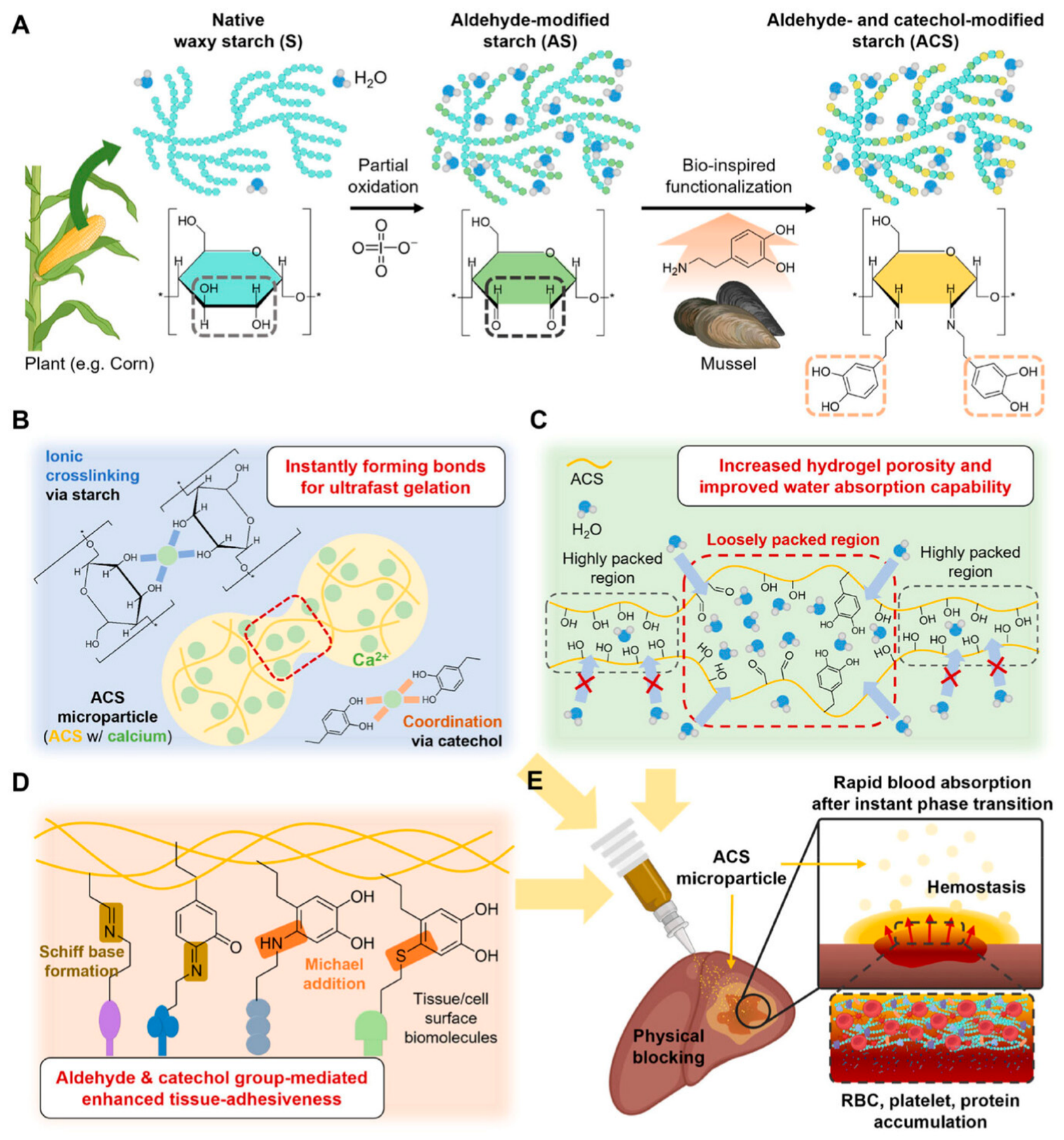
| Starch | Achieves mechanical tamponade and blood concentration through extreme fluid absorption and swelling | Abundant hydrophilic hydroxyl groups confer high swelling capacity, excellent biosafety, and extremely low material cost | Biologically inert with no inherent charge or cell recognition sites; rapid degradation by endogenous amylases limits long-term barrier function | Quaternization to introduce positive charge, serotonin grafting to activate platelets, aldehyde or catechol grafting to enhance interfacial adhesion, construction of reversible boronate ester or acylhydrazone dynamic networks | [74,75,76,77,78,79,80,81] |
| Collagen and gelatin | The Arg-Gly-Asp sequences and GFOGER motifs specifically mediate platelet adhesion, activation, and aggregation | Naturally contains cell-adhesive recognition motifs and matrix metalloproteinase cleavage sites, enabling complete bioabsorption | Physical gels disintegrate at body temperature; uncontrolled degradation in protease-rich wounds; animal-derived sources carry risks of immunogenicity and pathogen transmission | Methacrylation for photocrosslinking, grafting of acetylcysteine or catechol groups, specific peptide modification, polysaccharide-mediated mild crosslinking | [82,83,84,85,86,87,88,89,90] |
| Silk fibroin | Forms a β-sheet structure to seal wounds and promotes platelet pseudopodia extension and activation | Exceptional mechanical strength and shape recovery, tunable degradation rate, significantly lower immunogenicity than mammalian collagen | Spontaneous gelation relying on natural conformational transition is extremely slow; lacks the capacity for covalent bonding on wet interface to withstand arterial pressure | Dual side-chain modification with methacrylate and dimethylamino groups for rapid photocrosslinking and charge-mediated synergistic effects complexation with tannic acid to enhance wet adhesion | [91,92,93,94,95,96,97,98] |
| Fibrin | Mimics the terminal stage of physiological coagulation, forming a fibrin network clot catalyzed by thrombin | Perfectly recapitulates the architecture of native blood clots, high specific surface area facilitates cell infiltration and angiogenesis | Pure fibrin networks have low mechanical strength and are rapidly degraded by plasmin; clinical use depends on exogenous thrombin with high cost and risk of distal thrombosis | Sequential crosslinking to embed gelatin methacryloyl photosensitive networks for mechanical reinforcement; calcium ion tuning to induce supramolecular self-assembly into pseudo-fibrin structures | [99,100,101,102,103,104,105] |
| Hydrogel Structure Type | Formation Mechanism and Synthesis | Key Hemostatic Features | Limitations | References |
|---|---|---|---|---|
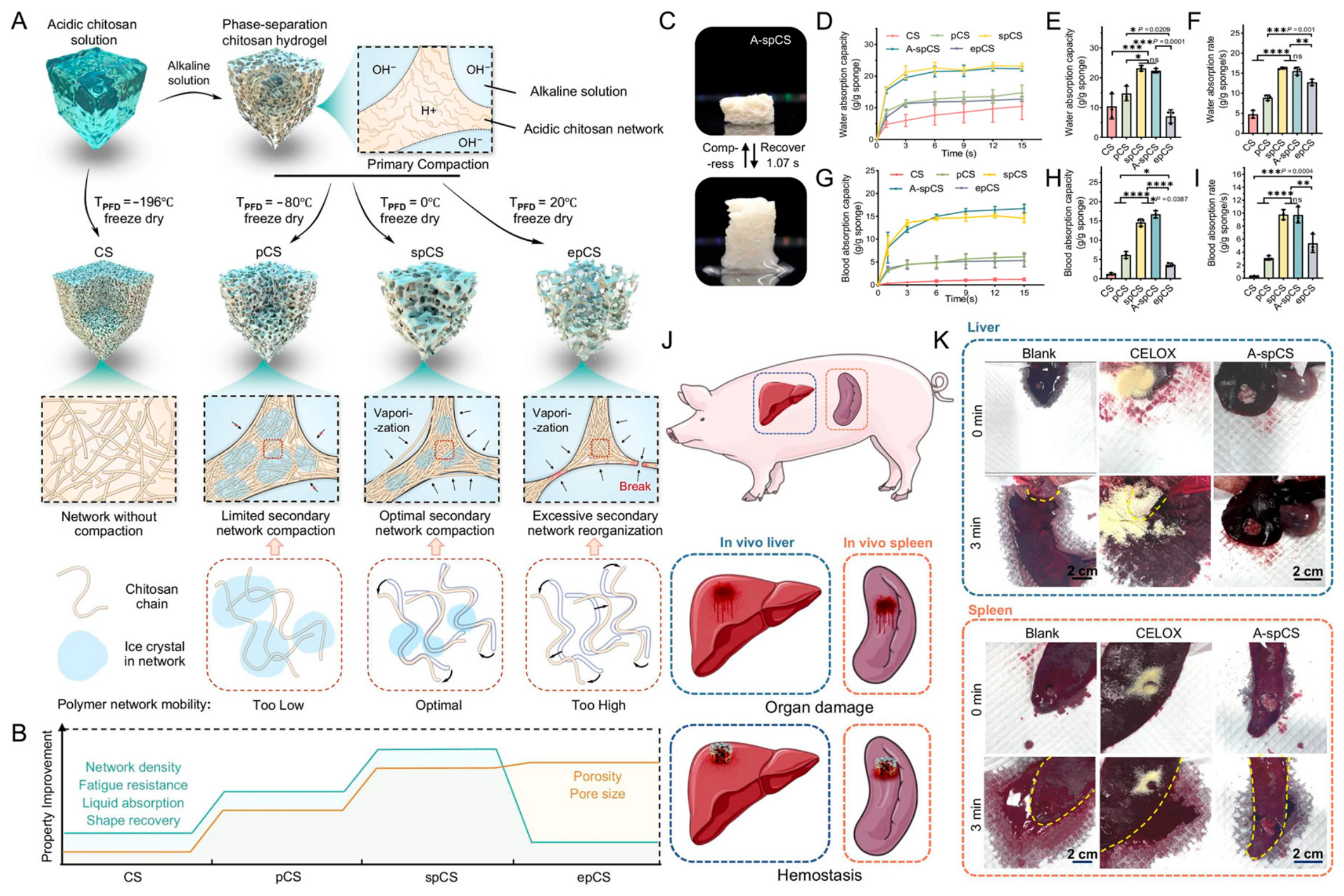
| Porous hydrogels | Freeze-drying, phase separation, gas foaming, or ice-templating creates 3D interconnected pores; directional freeze-casting yields oriented microchannels. | High porosity/surface area enables rapid fluid absorption and blood concentration; swelling occludes irregular wound cavities; aligned channels lower flow resistance and concentrate coagulation factors. | Trade-off between absorption rate and mechanical stability; lack of quantitative structure–function design rules. | [106,107,108,109,110,111,112,113,114,115,116] |
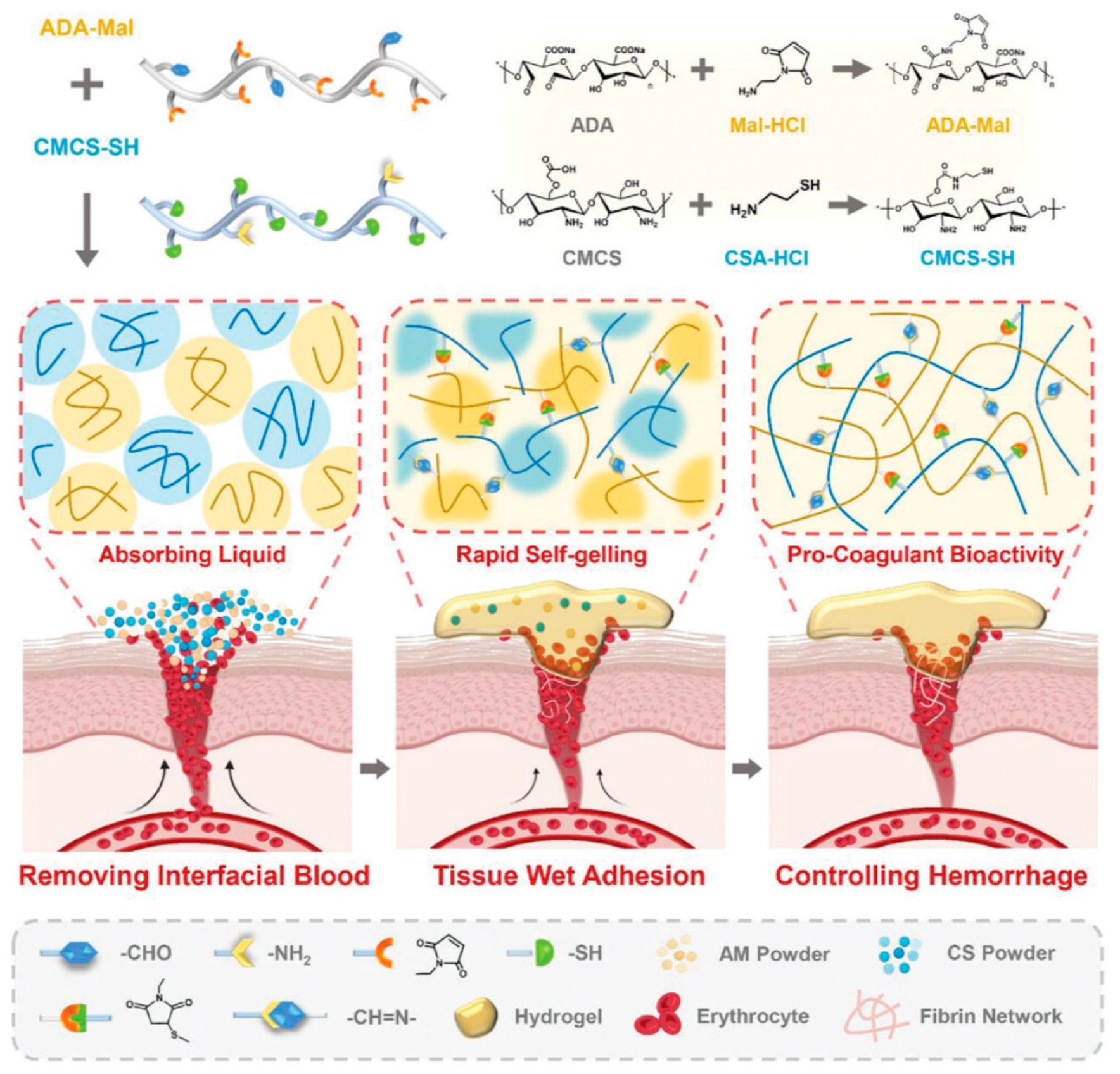
| Particle-based hydrogels | Emulsion polymerization, microfluidics, spray drying, or inverse emulsion crosslinking produces microspheres/powders; self-gelling powders crosslink and aggregate upon contact with blood. | Discrete particles allow injectable, conformal filling; swelling-induced jamming provides physical compression; self-gelling powders form cohesive adhesive networks; porous microspheres internally concentrate coagulation factors. | Prone to blood flow erosion and migration; reassembled networks lack bulk mechanical continuity; in vivo clearance fate remains unclear. | [117,118,119,120,121,122,123,124,125,126,127,128,129] |
| Fibrous hydrogels | In situ supramolecular self-assembly (e.g., peptide hydrogen bonding, π–π stacking) triggered by body fluids; ex vivo performed via electrospinning, polyelectrolyte complexation, or β-sheet induction. | Nanofibrous ECM-mimetic topography promotes platelet adhesion/activation; in situ assembly rapidly forms a physical barrier; preformed Janus structures enable directional exudate drainage. | Assembly kinetics slower than blood flow may fail to provide mechanical sealing; limited volumetric expansion restricts deep-cavity filling. | [130,131,132,133,134,135,136,137,138,139,140,141,142,143] |
| Multicrosslinked/Multinetwork hydrogels | Dual physical–chemical crosslinking or interpenetrating polymer networks; dynamic reversible bonds (Schiff base bonds, boronate ester bonds, ionic coordination) dissipate energy and enable self-healing. | Physical bonds dissipate energy, chemical bonds maintain integrity → high strength/toughness; dynamic networks tolerate cyclic deformation (e.g., heart, major arteries); simultaneously improves wet adhesion and burst pressure. | Complex degradation matching among components; high crosslinking density may mask bioactive sites. | [144,145,146,147,148,149,150,151,152] |
| Nanocomposite hydrogels | Blending, in situ growth, or electrostatic assembly of inorganic nanofillers (layered silicates, hydroxyapatite, carbon nanomaterials, metal-coordinated NPs) into polymer networks. | Nanofillers reinforce modulus and fatigue resistance; silicates activate intrinsic coagulation via charged surfaces; carbon-based fillers add photothermal/electroconductivity; hydroxyapatite promotes osteogenesis. | Risk of nanoparticle release and distal embolization; aggregation/deactivation in the hemorrhagic microenvironment; incomplete toxicological and metabolic data. | [153,154,155,156,157,158,159,160] |
| Functional Category | Specific Strategy | Core Mechanism and Effect | References |
|---|---|---|---|
| Coagulation modulation and hemostatic enhancement | Coagulation cascade initiation enhancement: loading inorganic minerals such as kaolin, zeolite, and mesoporous bioactive glass | Surface negative charges contact activation of coagulation factor XII; porous structures enrich factors X/V and accelerate thrombin burst formation, shortening initiation time | [161,162,163,164,165] |
| Coagulation cascade amplification: delivering thrombin, cationized chitosan, or constructing platelet-mimetic microparticles | Direct supplementation of rate-limiting enzymes or mimicking platelet membrane function bypasses upstream cascades to rapidly catalyze fibrin formation, suitable for thrombocytopenia | [166,167,168,169] | |
| Hemostatic stabilization and prevention of rebleeding: loading antifibrinolytics such as tranexamic acid | Inhibits plasminogen binding to fibrin, blocks fibrin degradation, maintains clot mechanical stability, and reduces rebleeding rate | [170,171,172,173,174,175] | |
| Antimicrobial Therapy | Antibacterial agent loading: Ag, Zn, Cu nanoparticles/ions, plant essential oils, and polyphenolic natural molecules | Metal ions disrupt respiratory chain enzymes and DNA; essential oils/polyphenols compromise membrane integrity. Multi-target bactericidal action with natural molecules exhibiting concurrent antioxidant activity | [176,177,178,179,180,181,182,183,184,185,186] |
| Inherent antibacterial activity: cationic polymers such as quaternized chitosan (QCS), ε-polylysine, and antimicrobial peptides | Electrostatic adsorption disrupts bacterial cell membranes, induces depolarization and intracellular leakage, providing a sustained contact-killing barrier | [187,188,189,190] | |
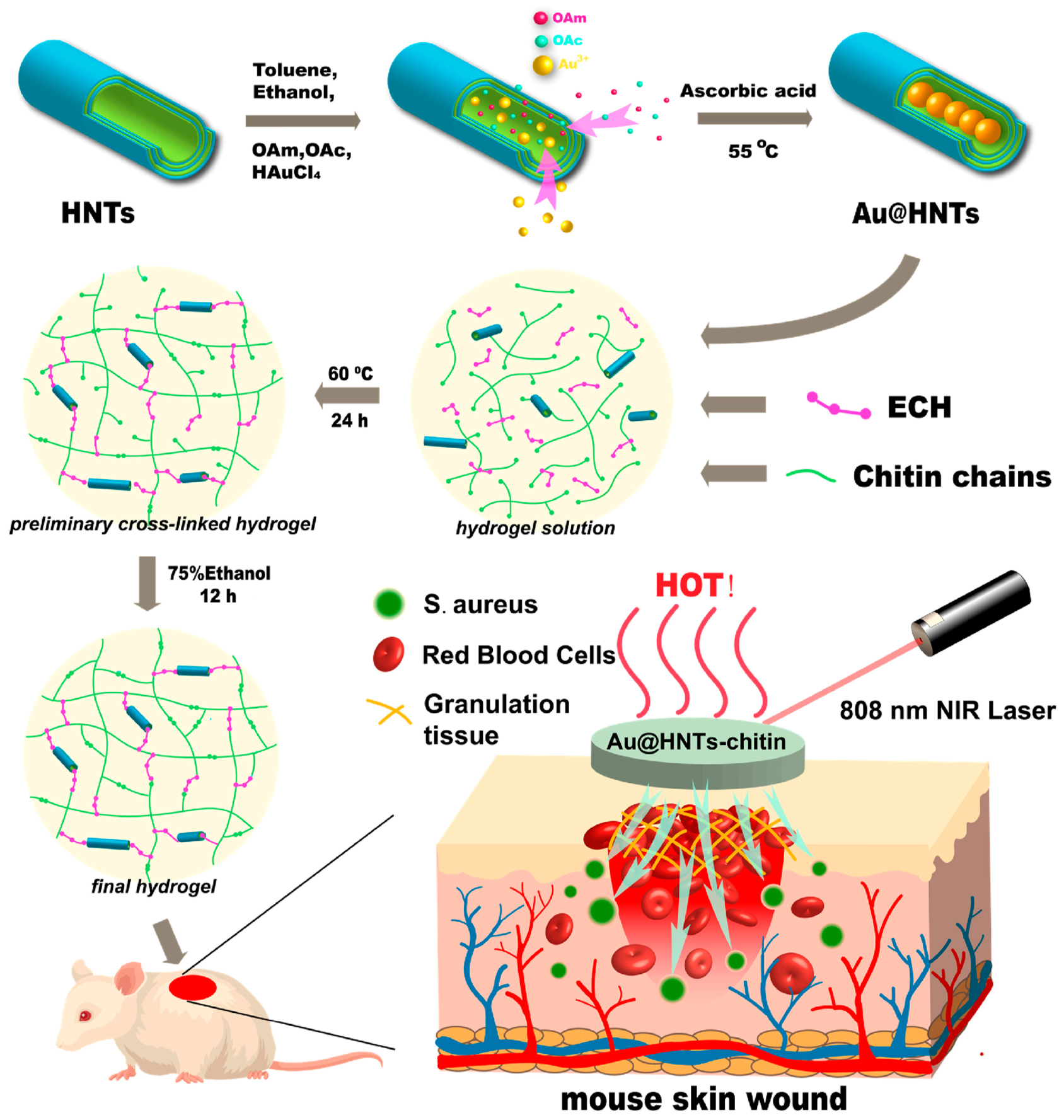
| Photothermal therapy (PTT) and photodynamic therapy (PDT): incorporating polydopamine, gold nanoparticles, carbon materials, or protoporphyrin IX photosensitizers | Photothermal effects generate localized hyperthermia to destroy bacteria; photodynamic action produces reactive oxygen species to degrade biofilm matrix. Spatiotemporally controllable and effective against mature biofilms | [191,192,193,194] | |
| Immunomodulation and tissue regeneration | Antioxidant and anti-inflammatory: polyphenol networks, nanozymes, carbon dots, and other ROS-scavenging systems | Hydrogen atom or single electron transfer terminates radical chain reactions; biomimetic SOD/CAT cascade catalysis eliminates ROS, restoring redox homeostasis | [160,195,196,197,198,199] |
| Immune reprogramming: RGD motif modification, core–shell microspheres, chlorogenic acid, and other active molecules | Activates JAK2-STAT5b/PI3K-Akt pathways, inhibits NF-κB, and induces macrophage polarization from M1 pro-inflammatory to M2 pro-regenerative phenotype, terminating chronic inflammation | [200,201,202] | |
| Angiogenesis and matrix remodeling: exosomes, controlled-release growth factors, delivery of Mg/Zn/Cu ions | Regulates PI3K/AKT, ERK/MAPK, STAT3, HIF-1α/VEGF, Nrf2 pathways and inhibits AGE/RAGE-mediated ferroptosis and apoptosis; metal ions upregulate VEGF expression, promoting microvascular network reconstruction and collagen deposition | [203,204,205,206] | |
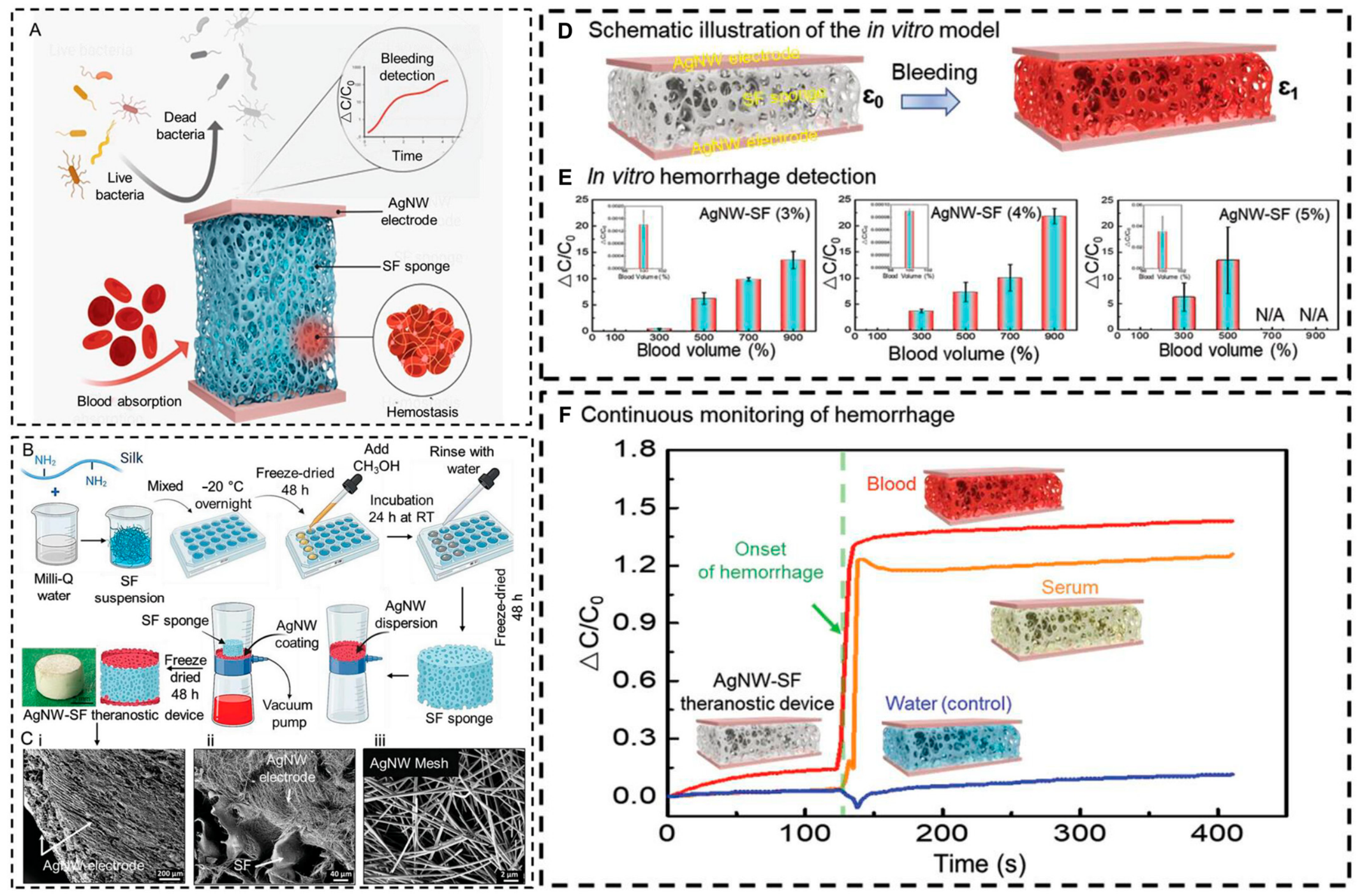
| Dynamic Monitoring and stimuli-responsive capabilities | Pathological signal visualization: hemoglobin-responsive DNA hydrogels, pH/ROS probes, electronic skin systems | Hemoglobin triggers aptamer conformational change generating optical signals; pH/ROS induce colorimetric changes; conductive networks acquire mechanical deformation and metabolic electrical signals | [207,208,209,210,211] |
| Stimuli-responsive controlled release: pH/ROS/enzyme-sensitive dynamic bond networks, thermoresponsive phase transition systems | Pathological microenvironments trigger cleavage of Schiff base, boronate ester, and other dynamic bonds or induce LCST-type polymer phase transition, matching drug release dynamics with disease progression | [209,212,213,214,215] | |
| Externally controlled actuation and theranostic integration: ultrasound-driven piezoelectric, magnetic navigation, triboelectric nanogenerators, microfluidic flexible systems | Ultrasound/magnetic fields remotely activate piezoelectric/magnetoelectric materials to generate electrical stimulation modulating cellular behavior; self-powered systems enable autonomous operation; microfluidics achieve exudate management and multi-indicator electrochemical sensing | [216,217,218,219,220,221,222,223] |
| Platform | Raw Material Readiness | Manufacturing Maturity | Sterilization Compatibility | Regulatory Complexity | Commercialization Potential |
|---|---|---|---|---|---|
| Particle-based hydrogels | High | High | High | Low | High |
| Porous hydrogels | High | High | High | Low | High |
| Fibrous hydrogels | Moderate | Moderate | Moderate | Moderate | Moderate |
| Multicrosslinked/Multinetwork hydrogels | Moderate | Low | Low | High | Moderate-Low |
| Nanocomposite hydrogels | Moderate | Low | Low | High | Low |
Disclaimer/Publisher’s Note: The statements, opinions and data contained in all publications are solely those of the individual author(s) and contributor(s) and not of MDPI and/or the editor(s). MDPI and/or the editor(s) disclaim responsibility for any injury to people or property resulting from any ideas, methods, instructions or products referred to in the content. |
© 2026 by the authors. Licensee MDPI, Basel, Switzerland. This article is an open access article distributed under the terms and conditions of the Creative Commons Attribution (CC BY) license.
Share and Cite
A, L.; Guo, Z.; Zhao, C.; Li, G.; Xu, X.; Yu, Y.; Qu, P.; Liu, Q. Natural Polymer-Based Hemostatic Hydrogels with Advanced Material and Structural Designs for Functional Applications. Pharmaceutics 2026, 18, 820. https://doi.org/10.3390/pharmaceutics18070820
A L, Guo Z, Zhao C, Li G, Xu X, Yu Y, Qu P, Liu Q. Natural Polymer-Based Hemostatic Hydrogels with Advanced Material and Structural Designs for Functional Applications. Pharmaceutics. 2026; 18(7):820. https://doi.org/10.3390/pharmaceutics18070820
Chicago/Turabian StyleA, Lixin, Zhaoming Guo, Chen Zhao, Guangyao Li, Xinwen Xu, Yongai Yu, Peng Qu, and Qiang Liu. 2026. "Natural Polymer-Based Hemostatic Hydrogels with Advanced Material and Structural Designs for Functional Applications" Pharmaceutics 18, no. 7: 820. https://doi.org/10.3390/pharmaceutics18070820
APA StyleA, L., Guo, Z., Zhao, C., Li, G., Xu, X., Yu, Y., Qu, P., & Liu, Q. (2026). Natural Polymer-Based Hemostatic Hydrogels with Advanced Material and Structural Designs for Functional Applications. Pharmaceutics, 18(7), 820. https://doi.org/10.3390/pharmaceutics18070820