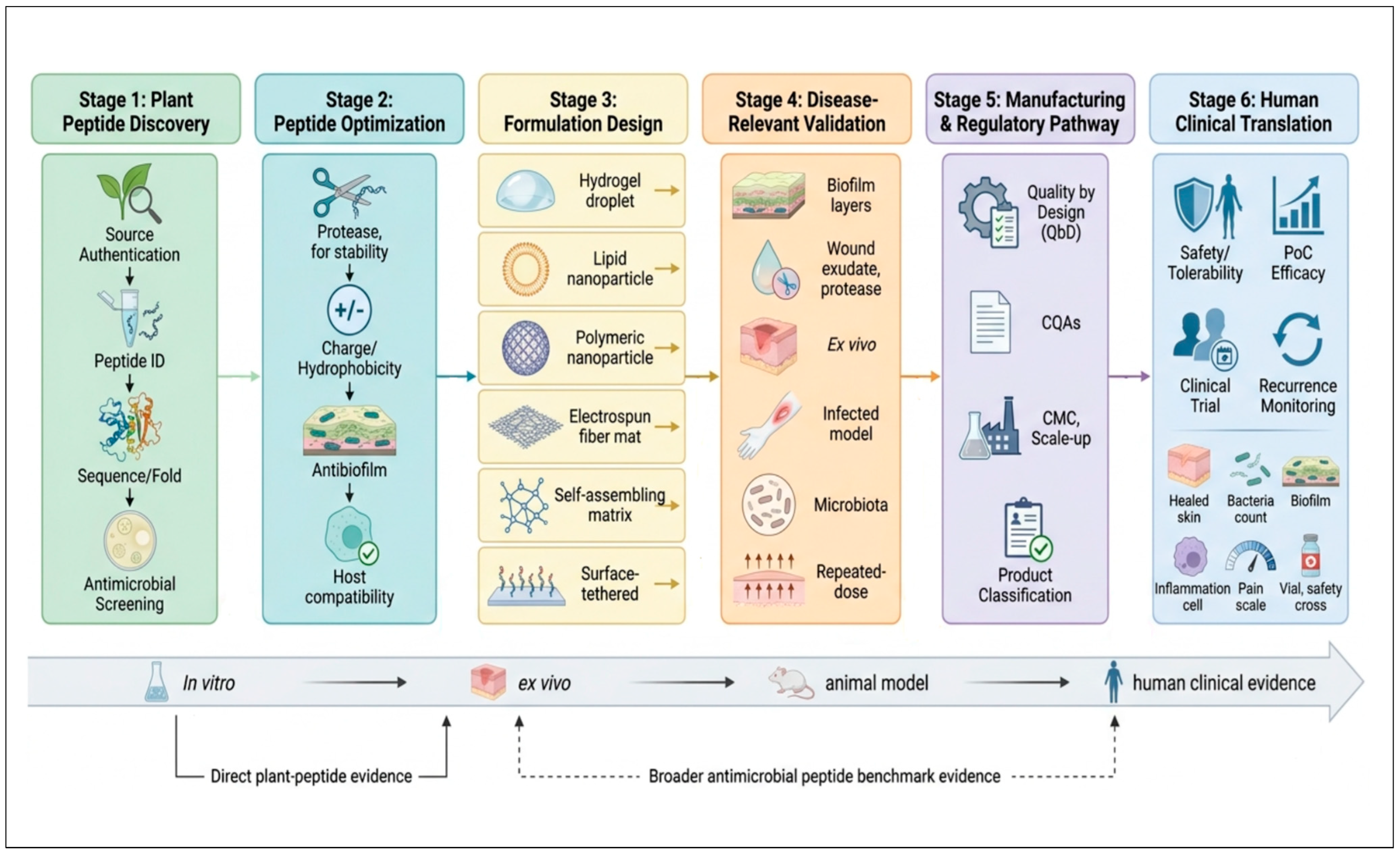
Plant-Derived Peptide–Polymer Therapeutics for Cutaneous Infections and Inflammation: Mechanistic Basis, Delivery Design and Translational Considerations




Abstract
1. Introduction
2. Literature Search Strategy
3. Plant-Derived Bioactive Peptides for Skin Applications
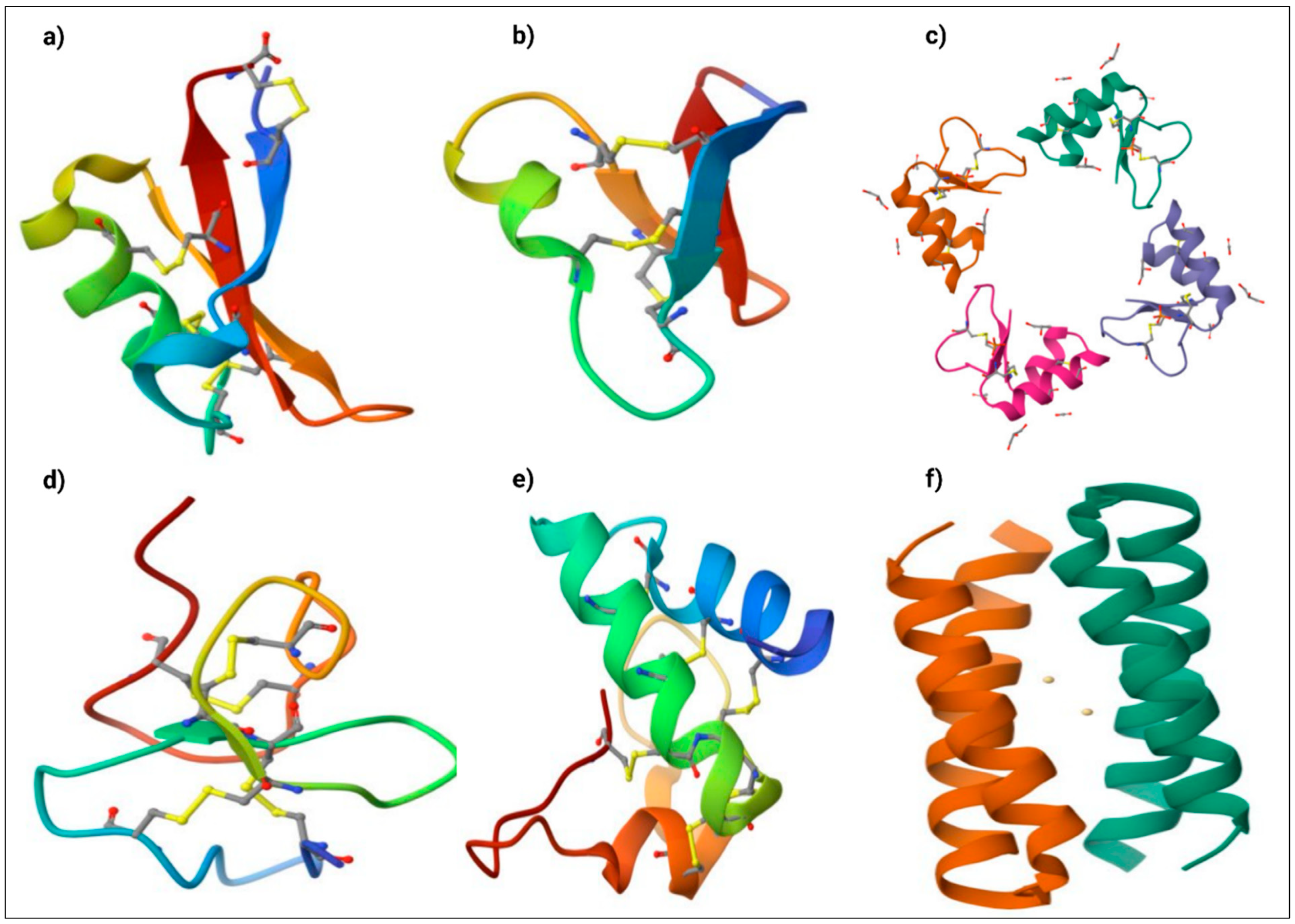
3.1. Classes and Sources
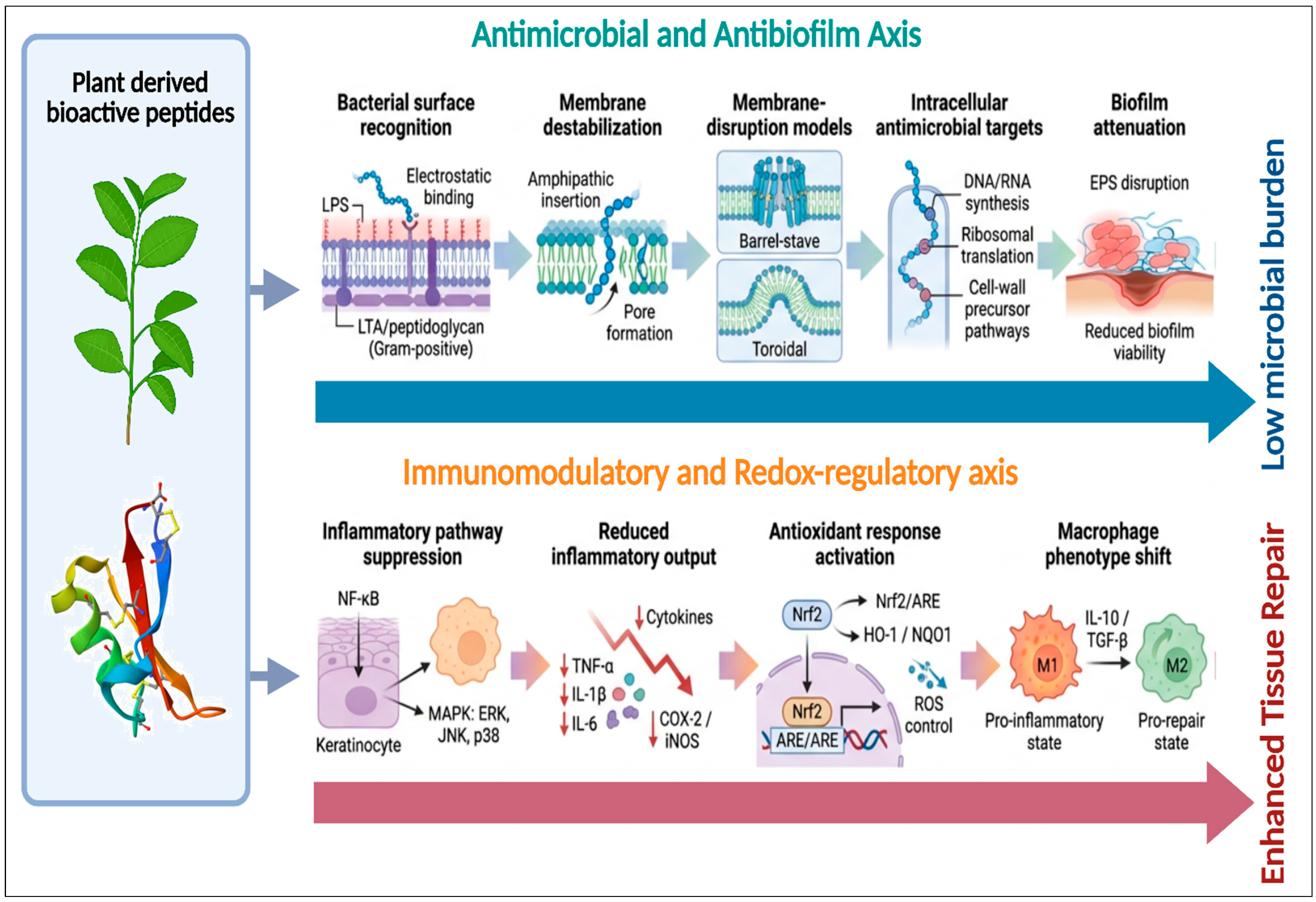
3.2. Antimicrobial and Antibiofilm Activity
3.3. Immunomodulatory Functions
3.4. Limitations in Native Form
4. Engineering Plant-Based Peptide–Polymers
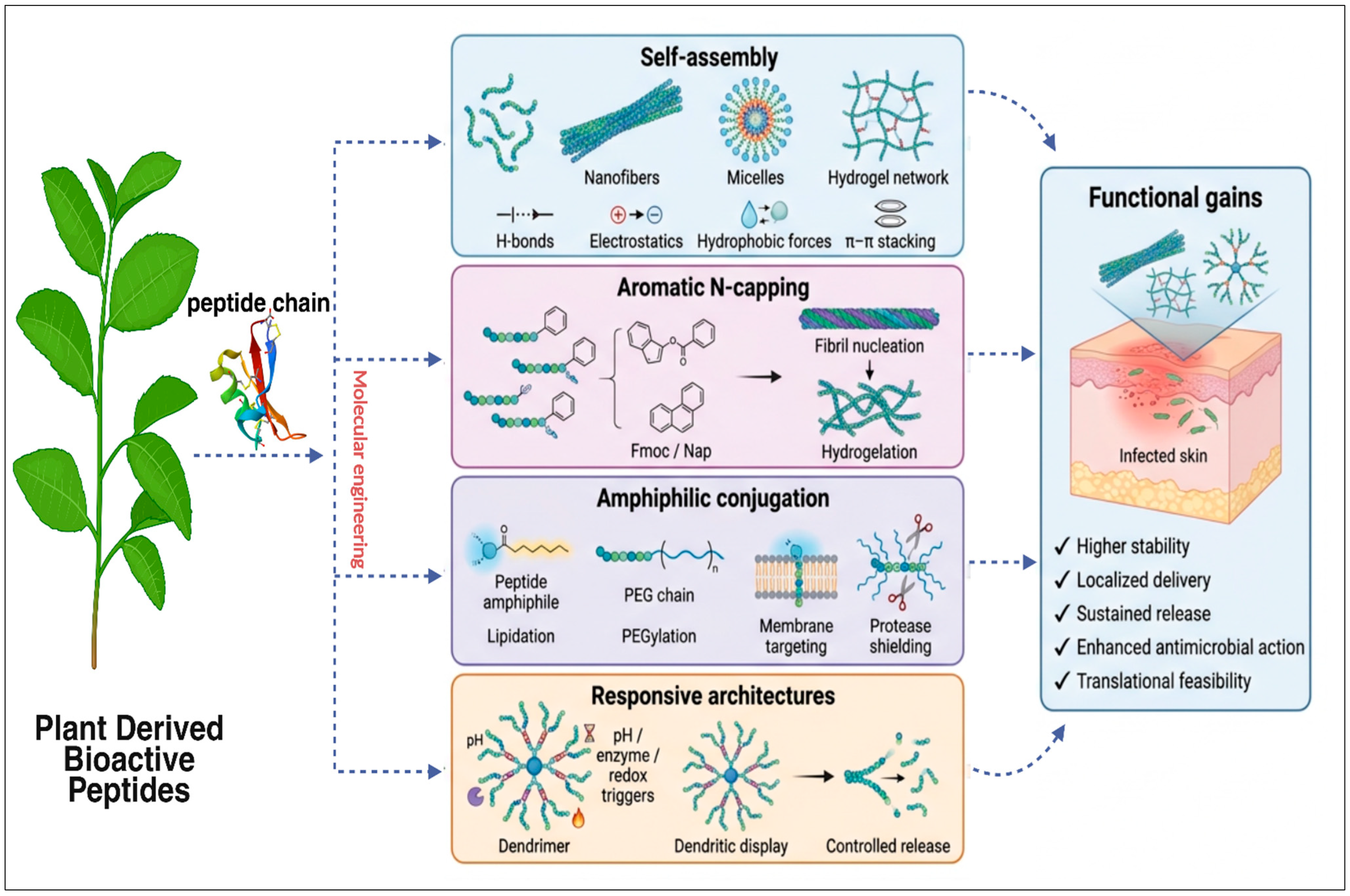
4.1. Polymerization and Conjugation Strategies
4.2. Structure–Activity Relationships
4.3. Functional Optimization for Skin Delivery
5. Delivery Systems for Cutaneous Applications
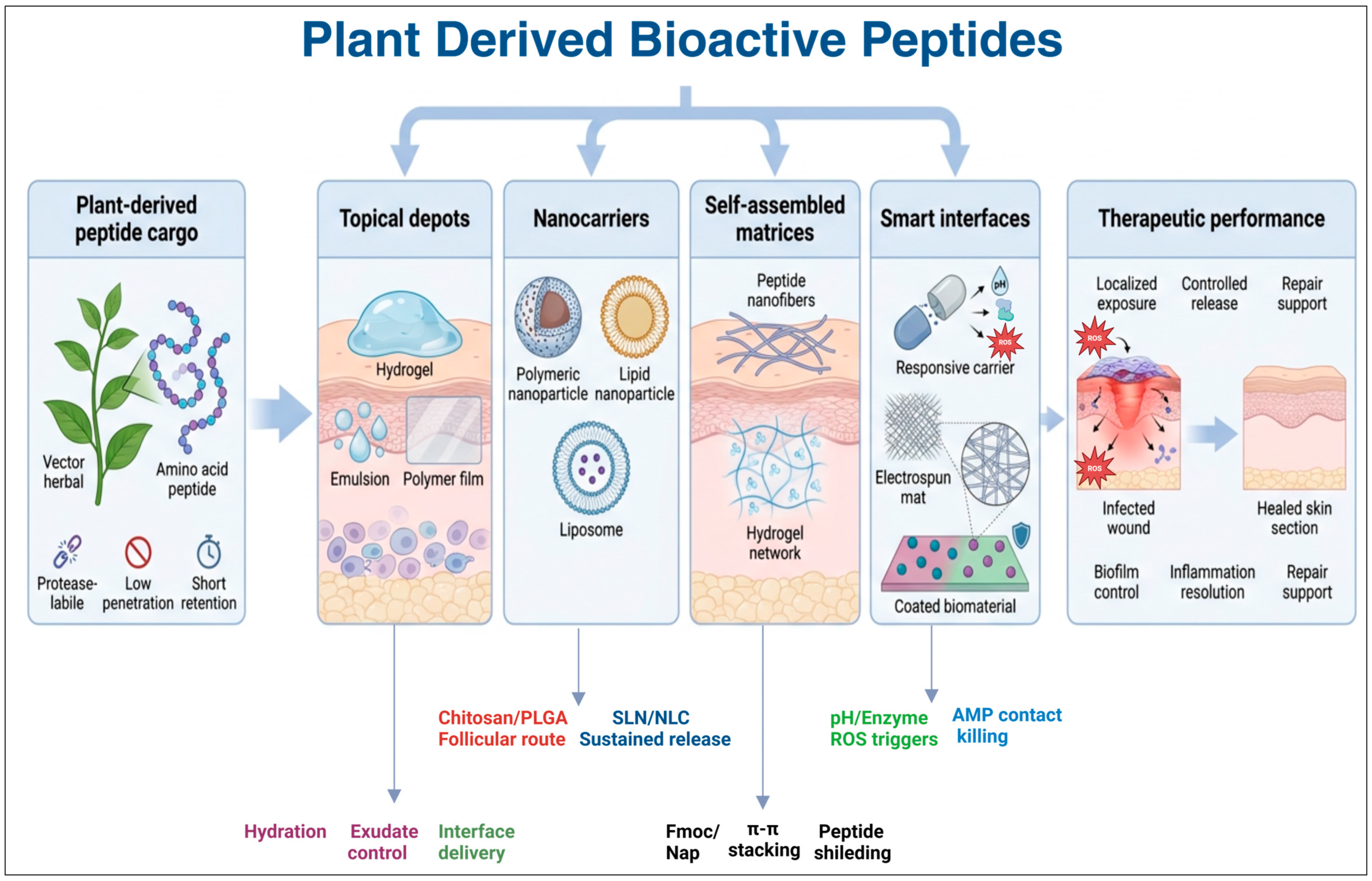
5.1. Topical and Transdermal Platforms
5.2. Nanocarrier-Based Systems
5.3. Self-Assembling and Stimuli-Responsive Systems
5.4. Surface-Tethered and Biomaterial-Integrated Systems
5.5. Skin Barrier Interaction
5.6. Comparative Translational Relevance of Delivery Platforms
6. Mechanistic Basis in Cutaneous Infections and Inflammation
6.1. Antibacterial and Antibiofilm Mechanisms
6.2. Immunomodulatory Pathways
6.3. Wound Healing and Tissue Regeneration
6.4. Skin Microbiota as a Therapeutic Determinant
6.5. Diet and Nutritional Status as Systemic Modifiers of Cutaneous Repair
7. Translational Challenges (Critical Analysis)
7.1. Stability and Degradation in Skin Microenvironment
7.2. Toxicity, Irritation, and Selectivity
7.3. Manufacturing and Scalability Constraints
7.4. Limited In Vivo and Clinical Evidence
7.5. Regulatory and Cost Considerations
7.6. Commercialization and Clinical-Translation Readiness

| Translational Barrier | Main Cause | Key Risk | Design Response | Validation Approach | Ref. |
|---|---|---|---|---|---|
| Proteolytic degradation | KLK-mediated AMP cleavage | Loss of activity | D-amino acids; cyclization; capping | LC–MS; residual MIC | [205] |
| Wound-environment instability | Hydrolysis, oxidation, photolysis, alkaline pH | Short topical activity | Hydrogel/nanocarrier protection | Stability + release assay | [206] |
| Poor skin retention | Low residence time; barrier effects | Subtherapeutic exposure | Bioadhesive films; hydrogels | Franz diffusion; retention assay | [207] |
| Weak selectivity | Charge/hydrophobicity imbalance | Hemolysis; cytotoxicity | Tune charge, amphipathicity, PEGylation | HC50; IC50; SI | [71] |
| Botanical sensitization | Plant allergens/photosensitizers | Contact dermatitis | Purified fractions; allergen profiling | Patch/photopatch test | [208] |
| Immunotoxic contamination | LPS/bioburden in formulations | False inflammation signal | Endotoxin-free GMP processing | LAL; TLR4; cytokines | [209] |
| Biofilm tolerance | EPS barrier; redox stress | Persistent infection | Antibiofilm hydrogel matrix | MBEC; CLSM biofilm assay | [210] |
| Peptide synthesis burden | SPPS solvent/reagent intensity | High cost; low scalability | Greener SPPS; shorter analogues | Yield; purity; E-factor | [211] |
| Plant extract variability | Genotype, season, extraction shifts | Batch inconsistency | HPLC/LC–MS fingerprinting | Marker assay; chemometrics | [212] |
| Nanocarrier scale-up | Size, PDI, loading variability | GMP failure | QbD; defined CQAs | PDI; zeta; loading; sterility | [213] |
| Model mismatch | Rodent wounds differ from humans | Poor prediction | Porcine/ex vivo human models | Human-relevant endpoints | [214] |
| Limited clinical evidence | Few clinically advanced AMPs | Uncertain efficacy | RCTs; standardized endpoints | Healing, bacterial load, safety | [201] |
8. Emerging Design Strategies and Future Directions
9. Conclusions
Author Contributions
Funding
Institutional Review Board Statement
Informed Consent Statement
Data Availability Statement
Acknowledgments
Conflicts of Interest
References
- Falanga, V.; Isseroff, R.R.; Soulika, A.M.; Romanelli, M.; Margolis, D.; Kapp, S.; Granick, M.; Harding, K. Chronic Wounds. Nat. Rev. Dis. Primers 2022, 8, 50. [Google Scholar] [CrossRef]
- Yang, L.; Rong, G.-C.; Wu, Q.-N. Diabetic Foot Ulcer: Challenges and Future. World J. Diabetes 2022, 13, 1014–1034. [Google Scholar] [CrossRef] [PubMed]
- Zhao, R.; Liang, H.; Clarke, E.; Jackson, C.; Xue, M. Inflammation in Chronic Wounds. Int. J. Mol. Sci. 2016, 17, 2085. [Google Scholar] [CrossRef] [PubMed]
- Chang, M.; Nguyen, T.T. Strategy for Treatment of Infected Diabetic Foot Ulcers. Acc. Chem. Res. 2021, 54, 1080–1093. [Google Scholar] [CrossRef] [PubMed]
- Ellis, S.; Lin, E.J.; Tartar, D. Immunology of Wound Healing. Curr. Dermatol. Rep. 2018, 7, 350–358. [Google Scholar] [CrossRef]
- Panda, S.K.; Buroni, S.; Swain, S.S.; Bonacorsi, A.; da Fonseca Amorim, E.A.; Kulshrestha, M.; Da Silva, L.C.N.; Tiwari, V. Recent Advances to Combat Eskape Pathogens with Special Reference to Essential Oils. Front. Microbiol. 2022, 13, 1029098. [Google Scholar] [CrossRef]
- Mulani, M.S.; Kamble, E.E.; Kumkar, S.N.; Tawre, M.S.; Pardesi, K.R. Emerging Strategies to Combat Eskape Pathogens in the Era of Antimicrobial Resistance: A Review. Front. Microbiol. 2019, 10, 539. [Google Scholar] [CrossRef]
- Schrader, S.M.; Vaubourgeix, J.; Nathan, C. Biology of Antimicrobial Resistance and Approaches to Combat it. Sci. Transl. Med. 2020, 12, eaaz6992. [Google Scholar] [CrossRef]
- Jamaledin, R.; Yiu, C.K.Y.; Zare, E.N.; Niu, L.-N.; Vecchione, R.; Chen, G.; Gu, Z.; Tay, F.R.; Makvandi, P. Advances in Antimicrobial Microneedle Patches for Combating Infections. Adv. Mater. 2020, 32, 2002129. [Google Scholar] [CrossRef]
- Zakrewsky, M.; Lovejoy, K.S.; Kern, T.L.; Miller, T.E.; Le, V.; Nagy, A.; Goumas, A.M.; Iyer, R.S.; Del Sesto, R.E.; Koppisch, A.T. Ionic Liquids as a Class of Materials for Transdermal Delivery and Pathogen Neutralization. Proc. Natl. Acad. Sci. USA 2014, 111, 13313–13318. [Google Scholar] [CrossRef]
- Menegatti, S.; Zakrewsky, M.; Kumar, S.; De Oliveira, J.S.; Muraski, J.A.; Mitragotri, S. De Novo Design of Skin-Penetrating Peptides for Enhanced Transdermal Delivery of Peptide Drugs. Adv. Healthc. Mater. 2016, 5, 602–609. [Google Scholar] [CrossRef]
- Panza, S.; Pellegrini, B.; Fiore, D.; Tarsitano, M.; Mancuso, A.; Cristiano, M.C.; Paolino, D. Botanical and Upcycled Bioactives for Advanced Topical Formulations: Mechanistic Pathways, Cutaneous Delivery, and Sustainability-by-Design. Pharmaceutics 2026, 18, 375. [Google Scholar] [CrossRef]
- Hashempur, M.H.; Ghorat, F.; Karami, F.; Jahanbin, A.; Nouraei, H.; Abbasi, M.; Jafari, M.; Zare, A.; Barzegar, S.; Zareshahrabadi, Z. Topical Delivery Systems for Plant-Derived Antimicrobial Agents: A Review of Current Advances. Int. J. Biomater. 2025, 2025, 4251091. [Google Scholar] [CrossRef]
- Paari, K.A.; Rajendran, R.R.R.; Khan, I.K.I.; Arul, V.A.V. Synthesis and Characterization of Nisin Loaded TPP Cross Linked Chitosan Nanoparticles. Int. J. Res. Appl. Sci. Eng. Technol. 2018, 6, 562–569. [Google Scholar] [CrossRef]
- Tahmasebi, A.; Mohammadi, N.S.; Jamali, B.; Shams-Abadi, S.T.; Khoddami, A.; Varma, R.S.; Ghasemlou, M.; Lee, C.W. Synthesis and Characterization of Peptide-Chitosan Engineered Nanoparticles as an Ideal Platform for Food Preservation, Cosmetics, and Pharmaceutical Applications. Polym. Rev. 2025, 65, 854–904. [Google Scholar] [CrossRef]
- Mazurkiewicz-Pisarek, A.; Baran, J.; Ciach, T. Antimicrobial Peptides: Challenging Journey to the Pharmaceutical, Biomedical, and Cosmeceutical Use. Int. J. Mol. Sci. 2023, 24, 9031. [Google Scholar] [CrossRef]
- Ranatunga, B.; Sekar, M.; Hashmi, A.R.; Zahra, F.; Ravi, R.N.; Kumar, B.R.P.; Al Hamod, M.; Al Hamood, N.; Begum, M.Y.; Wong, L.S. Biopolymer Hydrogel-Based Nanocomposites Functionalized with Natural Products for Wound Dressings: Translational Advances in Drug Design, Development, and Therapeutic Wound Care. Drug Des. Dev. Ther. 2026, 20, 578261. [Google Scholar] [CrossRef] [PubMed]
- Caselli, L.; Malmsten, M. Skin and Wound Delivery Systems for Antimicrobial Peptides. Curr. Opin. Colloid Interface Sci. 2023, 65, 101701. [Google Scholar] [CrossRef]
- Donlan, R.M. Biofilms: Microbial Life on Surfaces. Emerg. Infect. Dis. 2002, 8, 881–890. [Google Scholar] [CrossRef] [PubMed]
- Metselaar, J.M.; Lammers, T. Challenges in Nanomedicine Clinical Translation. Drug Deliv. Transl. Res. 2020, 10, 721–725. [Google Scholar] [CrossRef]
- Kamil, R.; Nyamathulla, S.; Mahmood, S. Peptides in Wound Healing: A Comprehensive Review of Their Roles, Challenges, and Hydrogel-Based Delivery Systems. EXCLI J. 2025, 24, 1657–1689. [Google Scholar]
- Nawrot, R.; Barylski, J.; Nowicki, G.; Broniarczyk, J.; Buchwald, W.; Goździcka-Józefiak, A. Plant Antimicrobial Peptides. Folia Microbiol. 2014, 59, 181–196. [Google Scholar] [CrossRef]
- Tam, J.P.; Wang, S.; Wong, K.H.; Tan, W.L. Antimicrobial Peptides from Plants. Pharmaceuticals 2015, 8, 711–757. [Google Scholar] [CrossRef] [PubMed]
- de Oliveira, S.S.; Cherene, M.B.; Taveira, G.B.; de Oliveira Mello, É.; de Oliveira Carvalho, A.; Gomes, V.M. Plant Antimicrobial Peptides and Their Main Families and Roles: A Review of the Literature. Curr. Issues Mol. Biol. 2025, 47, 1. [Google Scholar] [CrossRef] [PubMed]
- de Oliveira Dias, R.; Franco, O.L. Cysteine-Stabilized Aβ Defensins: From a Common Fold to Antibacterial Activity. Peptides 2015, 72, 64–72. [Google Scholar] [CrossRef]
- van der Weerden, N.L.; Anderson, M.A. Plant Defensins: Common Fold, Multiple Functions. Fungal Biol. Rev. 2013, 26, 121–131. [Google Scholar] [CrossRef]
- de Medeiros, L.N.; Domitrovic, T.; de Andrade, P.C.; Faria, J.; Bergter, E.B.; Weissmüller, G.; Kurtenbach, E. Psd1 Binding Affinity toward Fungal Membrane Components as Assessed by Spr: The Role of Glucosylceramide in Fungal Recognition and Entry. Biopolymers 2014, 102, 456–464. [Google Scholar] [CrossRef] [PubMed]
- Weidmann, J.; Craik, D.J. Discovery, Structure, Function, and Applications of Cyclotides: Circular Proteins from Plants. J. Exp. Bot. 2016, 67, 4801–4812. [Google Scholar] [CrossRef]
- Utnes, P.; Løkke, C.; Flægstad, T.; Einvik, C. Clinically Relevant Biomarker Discovery in High-Risk Recurrent Neuroblastoma. Cancer Inf. 2019, 18, 1176935119832910. [Google Scholar] [CrossRef] [PubMed]
- Poth, A.G.; Mylne, J.S.; Grassl, J.; Lyons, R.E.; Millar, A.H.; Colgrave, M.L.; Craik, D.J. Cyclotides Associate with Leaf Vasculature and Are the Products of a Novel Precursor in Petunia (Solanaceae). J. Biol. Chem. 2012, 287, 27033–27046. [Google Scholar] [CrossRef]
- Höng, K.; Austerlitz, T.; Bohlmann, T.; Bohlmann, H. The Thionin Family of Antimicrobial Peptides. PLoS ONE 2021, 16, e0254549. [Google Scholar] [CrossRef] [PubMed]
- Li, J.; Hu, S.; Jian, W.; Xie, C.; Yang, X. Plant Antimicrobial Peptides: Structures, Functions, and Applications. Bot. Stud. 2021, 62, 5. [Google Scholar] [CrossRef] [PubMed]
- Nagella, P.; Balasubramanian, B.; Park, S.; Singh, U.; Jayan, A.; Mukherjee, S.; Nizam, A.; Meyyazhagan, A.; Pappuswamy, M.; Sebastian, J.K. Production, Delivery, and Regulatory Aspects for Application of Plant-Based Anti-Microbial Peptides: A Comprehensive Review. Probiotics Antimicrob. Proteins 2025, 17, 2362–2393. [Google Scholar] [CrossRef]
- Iqbal, A.; Khan, R.S. Snakins: Antimicrobial Potential and Prospects of Genetic Engineering for Enhanced Disease Resistance in Plants. Mol. Biol. Rep. 2023, 50, 8683–8690. [Google Scholar] [CrossRef]
- Shagaghi, N.; Alfred, R.L.; Clayton, A.H.A.; Palombo, E.A.; Bhave, M. Anti-Biofilm and Sporicidal Activity of Peptides Based on Wheat Puroindoline and Barley Hordoindoline Proteins. J. Pept. Sci. 2016, 22, 492–500. [Google Scholar] [CrossRef]
- Odintsova, T.; Slezina, M.; Istomina, E. Plant Thionins: Structure, Biological Functions and Potential Use in Biotechnology. Vavilov J. Genet. Breed. 2018, 22, 667–675. [Google Scholar] [CrossRef]
- Barashkova, A.; Sadykova, V.; Salo, V.; Zavriev, S.; Rogozhin, E. Nigellothionins from Black Cumin (Nigella sativa L.) Seeds Demonstrate Strong Antifungal and Cytotoxic Activity. Antibiotics 2021, 10, 166. [Google Scholar] [CrossRef]
- Noonan, J.; Williams, W.; Shan, X. Investigation of Antimicrobial Peptide Genes Associated with Fungus and Insect Resistance in Maize. Int. J. Mol. Sci. 2017, 18, 1938. [Google Scholar] [CrossRef] [PubMed]
- D’Agostino, N.; Buonanno, M.; Ayoub, J.; Barone, A.; Monti, S.M.; Rigano, M.M. Identification of Non-Specific Lipid Transfer Protein Gene Family Members in Solanum lycopersicum and Insights into the Features of Sola L 3 Protein. Sci. Rep. 2019, 9, 1607. [Google Scholar] [CrossRef] [PubMed]
- Pelegrini, P.B.; Del Sarto, R.; Silva, O.; Franco, O.; Grossi-De-Sá, M. Antibacterial Peptides from Plants: What They are and How They Probably Work. Biochem. Res. Int. 2011, 2011, 250349. [Google Scholar] [CrossRef]
- Parthasarathy, A.; Borrego, E.J.; Savka, M.A.; Dobson, R.C.J.; Hudson, A.O. Amino Acid–Derived Defense Metabolites from Plants: A Potential Source to Facilitate Novel Antimicrobial Development. J. Biol. Chem. 2021, 296, 100438. [Google Scholar] [CrossRef] [PubMed]
- Slavokhotova, A.A.; Rogozhin, E.A. Defense Peptides from the A-Hairpinin Family Are Components of Plant Innate Immunity. Front. Plant Sci. 2020, 11, 2020. [Google Scholar] [CrossRef]
- Parisi, M.; Ozón, B.; González, S.V.; García-Pardo, J.; Obregón, W. Plant Protease Inhibitors as Emerging Antimicrobial Peptide Agents: A Comprehensive Review. Pharmaceutics 2024, 16, 582. [Google Scholar] [CrossRef]
- Kaur, K.D.; Habimana, O. Death at the Interface: Nanotechnology’s Challenging Frontier against Microbial Surface Colonization. Front. Chem. 2022, 10, 1003234. [Google Scholar] [CrossRef]
- Vaara, M. Polymyxins and Their Potential Next Generation as Therapeutic Antibiotics. Front. Microbiol. 2019, 10, 1689. [Google Scholar] [PubMed]
- Moretta, A.; Scieuzo, C.; Petrone, A.M.; Salvia, R.; Manniello, M.D.; Franco, A.; Lucchetti, D.; Vassallo, A.; Vogel, H.; Sgambato, A. Antimicrobial Peptides: A New Hope in Biomedical and Pharmaceutical Fields. Front. Cell. Infect. Microbiol. 2021, 11, 668632. [Google Scholar] [CrossRef] [PubMed]
- Diamond, G.; Beckloff, N.; Weinberg, A.; Kisich, K.O. The Roles of Antimicrobial Peptides in Innate Host Defense. Curr. Pharm. Des. 2009, 15, 2377–2392. [Google Scholar] [CrossRef]
- Kankala, R.K.; Han, Y.-H.; Xia, H.-Y.; Wang, S.-B.; Chen, A.-Z. Nanoarchitectured Prototypes of Mesoporous Silica Nanoparticles for Innovative Biomedical Applications. J. Nanobiotechnol. 2022, 20, 126. [Google Scholar] [CrossRef]
- Lai, Y.; Gallo, R.L. Amped up Immunity: How Antimicrobial Peptides Have Multiple Roles in Immune Defense. Trends Immunol. 2009, 30, 131–141. [Google Scholar] [CrossRef]
- Sengupta, D.; Leontiadou, H.; Mark, A.E.; Marrink, S.-J. Toroidal Pores Formed by Antimicrobial Peptides Show Significant Disorder. Biochim. Biophys. Acta (BBA) Biomembr. 2008, 1778, 2308–2317. [Google Scholar] [CrossRef]
- Ha-Tran, D.M.; Huang, C.-C. Peptides from Plants and Microorganisms: A Defense Strategy for Biotic and Abiotic Stresses. Front. Plant Sci. 2025, 16, 1649512. [Google Scholar] [CrossRef]
- Zhang, Q.-Y.; Yan, Z.-B.; Meng, Y.-M.; Hong, X.-Y.; Shao, G.; Ma, J.-J.; Cheng, X.-R.; Liu, J.; Kang, J.; Fu, C.-Y. Antimicrobial Peptides: Mechanism of Action, Activity and Clinical Potential. Mil. Med. Res. 2021, 8, 48. [Google Scholar] [PubMed]
- Zhou, J.; Cai, Y.; Liu, Y.; An, H.; Deng, K.; Ashraf, M.A.; Zou, L.; Wang, J. Breaking Down the Cell Wall: Still an Attractive Antibacterial Strategy. Front. Microbiol. 2022, 13, 952633. [Google Scholar] [CrossRef]
- Nadar, S.; Khan, T.; Patching, S.G.; Omri, A. Development of Antibiofilm Therapeutics Strategies to Overcome Antimicrobial Drug Resistance. Microorganisms 2022, 13, 303. [Google Scholar] [CrossRef]
- Saleh, H.A.; Yousef, M.H.; Abdelnaser, A. The Anti-Inflammatory Properties of Phytochemicals and Their Effects on Epigenetic Mechanisms Involved in Tlr4/Nf-Κb-Mediated Inflammation. Front. Immunol. 2021, 12, 2021. [Google Scholar] [CrossRef]
- Jazvinšćak Jembrek, M.; Oršolić, N.; Mandić, L.; Sadžak, A.; Šegota, S. Anti-Oxidative, Anti-Inflammatory and Anti-Apoptotic Effects of Flavonols: Targeting Nrf2, Nf-Κb and P53 Pathways in Neurodegeneration. Antioxidants 2021, 10, 1628. [Google Scholar] [CrossRef]
- Zhao, C.; Li, Z.; Chisti, Y.; Lei, S.; Miao, Y.; Liu, H.; Gong, J.; Wang, Q. Combination of Network Pharmacology, in vitro Experiments and Molecular Dynamic Simulations Revealed Anti-Inflammatory Molecular Mechanism of the Shrub Metapanax Delavayi. J. Funct. Foods 2024, 121, 106440. [Google Scholar] [CrossRef]
- Lamponi, S. Plant-Based Biomaterials as Bio-Instructive Immunomodulators: Design Principles, Mechanisms, and Translational Challenges. Life 2026, 16, 538. [Google Scholar] [CrossRef] [PubMed]
- Marvin, H.J.; Kleter, G.A.; Prandini, A.; Dekkers, S.; Bolton, D.J. Early Identification Systems for Emerging Foodborne Hazards. Food Chem. Toxicol. 2009, 47, 915–926. [Google Scholar] [CrossRef]
- Yin, Z.; Song, R.; Yu, T.; Fu, Y.; Ding, Y.; Nie, H. Natural Compounds Regulate Macrophage Polarization and Alleviate Inflammation against Ali/Ards. Biomolecules 2025, 15, 192. [Google Scholar] [CrossRef] [PubMed]
- Nakadate, K.; Ito, N.; Kawakami, K.; Yamazaki, N. Anti-Inflammatory Actions of Plant-Derived Compounds and Prevention of Chronic Diseases: From Molecular Mechanisms to Applications. Int. J. Mol. Sci. 2025, 26, 5206. [Google Scholar]
- Watanabe, S.; Alexander, M.; Misharin, A.V.; Budinger, G.R.S. The Role of Macrophages in the Resolution of Inflammation. J. Clin. Investig. 2019, 129, 2619–2628. [Google Scholar] [CrossRef]
- Hellinger, R.; Gruber, C.W. Peptide-Based Protease Inhibitors from Plants. Drug Discov. Today 2019, 24, 1877–1889. [Google Scholar] [CrossRef]
- Svenson, J.; Molchanova, N.; Schroeder, C.I. Antimicrobial Peptide Mimics for Clinical Use: Does Size Matter? Front. Immunol. 2022, 13, 915368. [Google Scholar] [CrossRef]
- Jiménez-Rodríguez, A.; Guardado-Félix, D.; Antunes-Ricardo, M. Challenges and Strategies for Topical and Transdermal Delivery of Bioactive Peptides. Crit. Rev. Ther. Drug Carr. Syst. 2022, 39, 1–31. [Google Scholar] [CrossRef]
- Fernández-García, R.; Lalatsa, A.; Statts, L.; Bolás-Fernández, F.; Ballesteros, M.P.; Serrano, D.R. Transferosomes as Nanocarriers for Drugs across the Skin: Quality by Design from Lab to Industrial Scale. Int. J. Pharm. 2020, 573, 118817. [Google Scholar] [CrossRef]
- Yang, G.; Li, Y.; Tian, J.; Ding, W.; Li, X.; Ma, X.; Wei, T.; Xu, J. From Bioactive Peptides to Transdermal Peptides: An Emerging Strategy for Revolutionizing Drug Delivery. Macromol. Biosci. 2026, 26, e00485. [Google Scholar] [CrossRef] [PubMed]
- Ghanbarzadeh, Z.; Mohagheghzadeh, A.; Hemmati, S. The Roadmap of Plant Antimicrobial Peptides under Environmental Stress: From Farm to Bedside. Probiotics Antimicrob. Proteins 2024, 16, 2269–2304. [Google Scholar] [CrossRef] [PubMed]
- Gonçalves, G.R.; de Azevedo Dos Santos, L.; da Silva, M.S.; Taveira, G.B.; da Silva, T.M.; Almeida, F.A.; Ferreira, S.R.; Oliveira, A.E.A.; Silveira, V.; de Oliveira Carvalho, A. Purification, Structural Characterization, and Anticandidal Activity of a Chitin-Binding Peptide with High Similarity to Hevein and Endochitinase Isolated from Pepper Seeds. Curr. Microbiol. 2024, 81, 319. [Google Scholar] [CrossRef] [PubMed]
- Haney, E.F.; Petersen, A.P.; Lau, C.K.; Jing, W.; Storey, D.G.; Vogel, H.J. Mechanism of Action of Puroindoline Derived Tryptophan-Rich Antimicrobial Peptides. Biochim. Biophys. Acta (BBA)-Biomembr. 2013, 1828, 1802–1813. [Google Scholar] [CrossRef]
- Matsuzaki, K. Control of Cell Selectivity of Antimicrobial Peptides. Biochim. Biophys. Acta 2009, 1788, 1687–1692. [Google Scholar]
- Cavallo, I.; Sivori, F.; Mastrofrancesco, A.; Abril, E.; Pontone, M.; Di Domenico, E.G.; Pimpinelli, F. Bacterial Biofilm in Chronic Wounds and Possible Therapeutic Approaches. Biology 2024, 13, 109. [Google Scholar] [CrossRef]
- dos Santos-Silva, C.A.; Zupin, L.; Oliveira-Lima, M.; Vilela, L.M.B.; Bezerra-Neto, J.P.; Ferreira-Neto, J.R.; Ferreira, J.D.C.; de Oliveira-Silva, R.L.; de Jesús Pires, C.; Aburjaile, F.F. Plant Antimicrobial Peptides: State of the Art, in Silico Prediction and Perspectives in the Omics Era. Bioinform. Biol. Insights 2020, 14, 1177932220952739. [Google Scholar] [CrossRef]
- Li, Q.; Chao, W.; Qiu, L. Therapeutic Peptides: Chemical Strategies Fortify Peptides for Enhanced Disease Treatment Efficacy. Amino Acids 2025, 57, 25. [Google Scholar] [CrossRef]
- Fosgerau, K.; Hoffmann, T. Peptide Therapeutics: Current Status and Future Directions. Drug Discov. Today 2015, 20, 122–128. [Google Scholar] [CrossRef]
- Yu, D.; Han, N.; Son, H.; Kim, S.J.; Kweon, S. Functional Peptide-Based Biomaterials for Pharmaceutical Application: Sequences, Mechanisms, and Optimization Strategies. J. Funct. Biomater. 2026, 17, 37. [Google Scholar] [CrossRef]
- Patel, B.H.; Percivalle, C.; Ritson, D.J.; Duffy, C.D.; Sutherland, J.D. Common Origins of RNA, Protein and Lipid Precursors in a Cyanosulfidic Protometabolism. Nat. Chem. 2015, 7, 301–307. [Google Scholar] [CrossRef] [PubMed]
- Yang, S.; Wang, M.; Wang, T.; Sun, M.; Huang, H.; Shi, X.; Duan, S.; Wu, Y.; Zhu, J.; Liu, F. Self-Assembled Short Peptides: Recent Advances and Strategies for Potential Pharmaceutical Applications. Mater. Today Bio 2023, 20, 100644. [Google Scholar] [CrossRef] [PubMed]
- Hamley, I.W. Self-Assembly, Bioactivity, and Nanomaterials Applications of Peptide Conjugates with Bulky Aromatic Terminal Groups. ACS Appl. Bio Mater. 2023, 6, 384–409. [Google Scholar] [CrossRef] [PubMed]
- Orbach, R.; Adler-Abramovich, L.; Zigerson, S.; Mironi-Harpaz, I.; Seliktar, D.; Gazit, E. Self-Assembled Fmoc-Peptides as a Platform for the Formation of Nanostructures and Hydrogels. Biomacromolecules 2009, 10, 2646–2651. [Google Scholar] [CrossRef]
- Das, S.; Das, D. Rational Design of Peptide-Based Smart Hydrogels for Therapeutic Applications. Front. Chem. 2021, 9, 770102. [Google Scholar] [CrossRef] [PubMed]
- Agca, Y. Genome Resource Banking of Biomedically Important Laboratory Animals. Theriogenology 2012, 78, 1653–1665. [Google Scholar] [CrossRef]
- Danial, M.; Stauffer, A.N.; Wurm, F.R.; Root, M.J.; Klok, H.-A. Site-Specific Polymer Attachment to Hr2 Peptide Fusion Inhibitors against Hiv-1 Decreases Binding Association Rates and Dissociation Rates Rather Than Binding Affinity. Bioconjug. Chem. 2017, 28, 701–712. [Google Scholar] [CrossRef] [PubMed]
- Wan, H.; Zhong, X.; Yang, S.; Deng, J.; Song, X.; Liu, Y.; Li, Y.; Yin, Z.; Zhao, X. Enhancing the Therapeutic Potential of Peptide Antibiotics Using Bacteriophage Mimicry Strategies. Adv. Sci. 2025, 12, 2411753. [Google Scholar] [CrossRef]
- Little, M.J.; Mason, J.M.; Mehrban, N. Evolution of Branched Peptides as Novel Biomaterials. J. Mater. Chem. B 2025, 13, 2226–2241. [Google Scholar] [CrossRef]
- Ray, P.; Haideri, N.; Haque, I.; Mohammed, O.; Chakraborty, S.; Banerjee, S.; Quadir, M.; Brinker, A.E.; Banerjee, S.K. The Impact of Nanoparticles on the Immune System: A Gray Zone of Nanomedicine. J. Immunol. Sci. 2021, 5, 19–33. [Google Scholar] [CrossRef]
- Cavallazzi Sebold, B.; Li, J.; Ni, G.; Fu, Q.; Li, H.; Liu, X.; Wang, T. Going Beyond Host Defence Peptides: Horizons of Chemically Engineered Peptides for Multidrug-Resistant Bacteria. BioDrugs 2023, 37, 607–623. [Google Scholar] [CrossRef]
- Gan, B.H.; Gaynord, J.; Rowe, S.M.; Deingruber, T.; Spring, D.R. The Multifaceted Nature of Antimicrobial Peptides: Current Synthetic Chemistry Approaches and Future Directions. Chem. Soc. Rev. 2021, 50, 7820–7880. [Google Scholar] [CrossRef]
- Montis, C.; Marelli, E.; Valle, F.; Bombelli, F.B.; Pigliacelli, C. Engineering the Interaction of Short Antimicrobial Peptides with Bacterial Barriers. Mol. Syst. Des. Eng. 2024, 9, 541–560. [Google Scholar] [CrossRef]
- Stillger, L.; Viau, L.; Kamm, L.; Holtmann, D.; Müller, D. Optimization of Antimicrobial Peptides for the Application against Biocorrosive Bacteria. Appl. Microbiol. Biotechnol. 2023, 107, 4041–4049. [Google Scholar] [CrossRef]
- Li, J.; Koh, J.-J.; Liu, S.; Lakshminarayanan, R.; Verma, C.S.; Beuerman, R.W. Membrane Active Antimicrobial Peptides: Translating Mechanistic Insights to Design. Front. Neurosci. 2017, 11, 73. [Google Scholar] [CrossRef]
- Fong-Coronado, P.A.; Ramirez, V.; Quintero-Hernández, V.; Balleza, D. A Critical Review of Short Antimicrobial Peptides from Scorpion Venoms, Their Physicochemical Attributes, and Potential for the Development of New Drugs. J. Membr. Biol. 2024, 257, 165–205. [Google Scholar] [CrossRef]
- Hadjicharalambous, A.; Bournakas, N.; Newman, H.; Skynner, M.J.; Beswick, P. Antimicrobial and Cell-Penetrating Peptides: Understanding Penetration for the Design of Novel Conjugate Antibiotics. Antibiotics 2022, 11, 1636. [Google Scholar] [CrossRef]
- Zewail, M.B.; Yang, G.; Fan, Y.; Hui, Y.; Zhao, C.-X.; Liu, Y. Cell Membrane-Coated Lipid Nanoparticles for Drug Delivery. Aggregate 2025, 6, e70054. [Google Scholar] [CrossRef]
- Kołodyńska, K.; Kamysz, W.; Kleczkowska, P. Peptide-Based Approaches for Pain Relief and Healing in Wounds. Int. J. Mol. Sci. 2026, 27, 685. [Google Scholar] [CrossRef]
- Gunasekera, S.; Muhammad, T.; Strömstedt, A.A.; Rosengren, K.J.; Göransson, U. Backbone Cyclization and Dimerization of Ll-37-Derived Peptides Enhance Antimicrobial Activity and Proteolytic Stability. Front. Microbiol. 2020, 11, 168. [Google Scholar] [CrossRef] [PubMed]
- Stillger, L.; Müller, D. Peptide-Coating Combating Antimicrobial Contaminations: A Review of Covalent Immobilization Strategies for Industrial Applications. J. Mater. Sci. 2022, 57, 10863–10885. [Google Scholar] [CrossRef]
- Manniello, M.D.; Moretta, A.; Salvia, R.; Scieuzo, C.; Lucchetti, D.; Vogel, H.; Sgambato, A.; Falabella, P. Insect Antimicrobial Peptides: Potential Weapons to Counteract the Antibiotic Resistance. Cell. Mol. Life Sci. 2021, 78, 4259–4282. [Google Scholar] [CrossRef]
- Helbik-Maciejewska, A.; Gitlin-Domagalska, A.; Glavas, M.; Ptaszynska, N.; Debowski, D.; Łęgowska, A.; Rolka, K. Time-Reduced N-Methylation: Exploring a Faster Synthesis Technique. J. Org. Chem. 2025, 90, 7182–7190. [Google Scholar] [CrossRef]
- Puthia, M.; Butrym, M.; Petrlova, J.; Strömdahl, A.-C.; Andersson, M.Å.; Kjellström, S.; Schmidtchen, A. A Dual-Action Peptide-Containing Hydrogel Targets Wound Infection and Inflammation. Sci. Transl. Med. 2020, 12, eaax6601. [Google Scholar] [CrossRef]
- Copling, A.; Akantibila, M.; Kumaresan, R.; Fleischer, G.; Cortes, D.; Tripathi, R.S.; Carabetta, V.J.; Vega, S.L. Recent Advances in Antimicrobial Peptide Hydrogels. Int. J. Mol. Sci. 2023, 24, 7563. [Google Scholar] [CrossRef]
- Xu, Y.; Hu, Q.; Wei, Z.; Ou, Y.; Cao, Y.; Zhou, H.; Wang, M.; Yu, K.; Liang, B. Advanced Polymer Hydrogels That Promote Diabetic Ulcer Healing: Mechanisms, Classifications, and Medical Applications. Biomater. Res. 2023, 27, 36. [Google Scholar] [CrossRef]
- Weng, H.; Jia, W.; Li, M.; Chen, Z. New Injectable Chitosan-Hyaluronic Acid Based Hydrogels for Hemostasis and Wound Healing. Carbohydr. Polym. 2022, 294, 119767. [Google Scholar] [CrossRef] [PubMed]
- Fu, Z.; Sun, H.; Wu, Y.; Li, C.; Wang, Y.; Liu, Y.; Li, Y.; Nie, J.; Sun, D.; Zhang, Y. A Cyclic Heptapeptide-Based Hydrogel Boosts the Healing of Chronic Skin Wounds in Diabetic Mice and Patients. NPG Asia Mater. 2022, 14, 99. [Google Scholar] [CrossRef]
- Mahlapuu, M.; Håkansson, J.; Ringstad, L.; Björn, C. Antimicrobial Peptides: An Emerging Category of Therapeutic Agents. Front. Cell Infect. Microbiol. 2016, 6, 194. [Google Scholar] [CrossRef]
- Zeng, F.; Zimmerman, S.C. Dendrimers in Supramolecular Chemistry: From Molecular Recognition to Self-Assembly. Chem. Rev. 1997, 97, 1681–1712. [Google Scholar] [CrossRef]
- Benson, H.A.E.; Grice, J.E.; Mohammed, Y.; Namjoshi, S.; Roberts, M.S. Topical and Transdermal Drug Delivery: From Simple Potions to Smart Technologies. Curr. Drug Deliv. 2019, 16, 444–460. [Google Scholar] [CrossRef]
- Liu, B.; Chen, K. Advances in Hydrogel-Based Drug Delivery Systems. Gels 2024, 10, 262. [Google Scholar] [CrossRef]
- Dabbaghi, M.; Namjoshi, S.; Panchal, B.; Grice, J.E.; Prakash, S.; Roberts, M.S.; Mohammed, Y. Viscoelastic and Deformation Characteristics of Structurally Different Commercial Topical Systems. Pharmaceutics 2021, 13, 1351. [Google Scholar] [CrossRef]
- Zhao, L.; Chen, J.; Bai, B.; Song, G.; Zhang, J.; Yu, H.; Huang, S.; Wang, Z.; Lu, G. Topical Drug Delivery Strategies for Enhancing Drug Effectiveness by Skin Barriers, Drug Delivery Systems and Individualized Dosing. Front. Pharmacol. 2024, 14, 1333986. [Google Scholar] [CrossRef]
- Khubiev, O.M.; Egorov, A.R.; Kirichuk, A.A.; Khrustalev, V.N.; Tskhovrebov, A.G.; Kritchenkov, A.S. Chitosan-Based Antibacterial Films for Biomedical and Food Applications. Int. J. Mol. Sci. 2023, 24, 10738. [Google Scholar] [CrossRef]
- Pfalzgraff, A.; Brandenburg, K.; Weindl, G. Antimicrobial Peptides and Their Therapeutic Potential for Bacterial Skin Infections and Wounds. Front. Pharmacol. 2018, 9, 281. [Google Scholar] [CrossRef]
- Bhavsar, J.; Kasture, K.; Salvi, B.V.; Shende, P. Strategies for Transportation of Peptides across the Skin for Treatment of Multiple Diseases. Ther. Deliv. 2025, 16, 63–86. [Google Scholar] [CrossRef]
- Islam, M.M.; Raikwar, S. Enhancement of Oral Bioavailability of Protein and Peptide by Polysaccharide-Based Nanoparticles. Protein Pept. Lett. 2024, 31, 209–228. [Google Scholar] [CrossRef]
- Dostert, M.; Belanger, C.R.; Hancock, R.E.W. Design and Assessment of Anti-Biofilm Peptides: Steps toward Clinical Application. J. Innate Immun. 2019, 11, 193–204. [Google Scholar] [CrossRef]
- Alford, M.A.; Baquir, B.; Santana, F.L.; Haney, E.F.; Hancock, R.E.W. Cathelicidin Host Defense Peptides and Inflammatory Signaling: Striking a Balance. Front. Microbiol. 2020, 11, 1902. [Google Scholar] [CrossRef]
- Hassan, D.H.; Shohdy, J.N.; El-Nabarawi, M.A.; El-Setouhy, D.A.; Abdellatif, M.M. Nanostructured Lipid Carriers for Transdermal Drug Delivery. Int. J. Appl. Pharm. 2022, 14, 88–93. [Google Scholar] [CrossRef]
- Liu, M.; Fang, X.; Yang, Y.; Wang, C. Peptide-Enabled Targeted Delivery Systems for Therapeutic Applications. Front. Bioeng. Biotechnol. 2021, 9, 701504. [Google Scholar] [CrossRef]
- Lee, N.-H.; You, S.; Taghizadeh, A.; Taghizadeh, M.; Kim, H.S. Cell Membrane-Cloaked Nanotherapeutics for Targeted Drug Delivery. Int. J. Mol. Sci. 2022, 23, 2223. [Google Scholar] [CrossRef]
- Moore, A.N.; Hartgerink, J.D. Self-Assembling Multidomain Peptide Nanofibers for Delivery of Bioactive Molecules and Tissue Regeneration. Acc. Chem. Res. 2017, 50, 714–722. [Google Scholar] [CrossRef]
- Edwards-Gayle, C.J.C.; Hamley, I.W. Self-Assembly of Bioactive Peptides, Peptide Conjugates, and Peptide Mimetic Materials. Org. Biomol. Chem. 2017, 15, 5867–5876. [Google Scholar] [CrossRef]
- Datta, D.; Colaco, V.; Nison, M.; Bandi, S.P.; Dhas, N.; Pai, V.R.; Halagali, P.; Tippavajhala, V.K.; Singh, S.; Vora, L.K. Smart Microdevices for Biomedical Drug Delivery: Endogenous Stimuli as the Key to Safer Therapeutics. RSC Adv. 2026, 16, 14878–14935. [Google Scholar] [CrossRef]
- Li, S.; Zhang, W.; Xue, H.; Xing, R.; Yan, X. Tumor Microenvironment-Oriented Adaptive Nanodrugs Based on Peptide Self-Assembly. Chem. Sci. 2020, 11, 8644–8656. [Google Scholar] [CrossRef]
- Wang, Z.; Xu, F.-J.; Yu, B. Smart Polymeric Delivery System for Antitumor and Antimicrobial Photodynamic Therapy. Front. Bioeng. Biotechnol. 2021, 9, 783354. [Google Scholar] [CrossRef]
- Huan, Y.; Kong, Q.; Mou, H.; Yi, H. Antimicrobial Peptides: Classification, Design, Application and Research Progress in Multiple Fields. Front. Microbiol. 2020, 11, 582779. [Google Scholar] [CrossRef]
- Ye, K.; Kuang, H.; You, Z.; Morsi, Y.; Mo, X. Electrospun Nanofibers for Tissue Engineering with Drug Loading and Release. Pharmaceutics 2019, 11, 182. [Google Scholar] [CrossRef]
- Song, Y.; Zheng, X.; Hu, J.; Ma, S.; Li, K.; Chen, J.; Xu, X.; Lu, X.; Wang, X. Recent Advances of Cell Membrane-Coated Nanoparticles for Therapy of Bacterial Infection. Front. Microbiol. 2023, 14, 1083007. [Google Scholar] [CrossRef]
- Kazemzadeh-Narbat, M.; Cheng, H.; Chabok, R.; Alvarez, M.M.; De La Fuente-Nunez, C.; Phillips, K.S.; Khademhosseini, A. Strategies for Antimicrobial Peptide Coatings on Medical Devices: A Review and Regulatory Science Perspective. Crit. Rev. Biotechnol. 2021, 41, 94–120. [Google Scholar] [CrossRef]
- Nicolas, M.; Beito, B.; Oliveira, M.; Martins, M.T.; Gallas, B.; Salmain, M.; Boujday, S.; Humblot, V. Strategies for Antimicrobial Peptides Immobilization on Surfaces to Prevent Biofilm Growth on Biomedical Devices. Antibiotics 2021, 11, 13. [Google Scholar] [CrossRef]
- Mitra, D.; Kang, E.-T.; Neoh, K.G. Polymer-Based Coatings with Integrated Antifouling and Bactericidal Properties for Targeted Biomedical Applications. ACS Appl. Polym. Mater. 2021, 3, 2233–2263. [Google Scholar] [CrossRef]
- Qiu, J.; Hayden, E.C. Genomics Sizes up. Nature 2008, 451, 234. [Google Scholar] [CrossRef] [PubMed]
- Brookes, K.J.; Chen, W.; Xu, X.; Taylor, E.; Asherson, P. Association of Fatty Acid Desaturase Genes with Attention-Deficit/Hyperactivity Disorder. Biol. Psychiatry 2006, 60, 1053–1061. [Google Scholar] [CrossRef]
- Shin, H.J.; Bak, S.U.; La, H.N.; Kang, J.S.; Lee, H.H.; Eom, H.J.; Lee, B.K.; Kang, H.A. Efficient Transdermal Delivery of Functional Protein Cargoes by a Hydrophobic Peptide Mtd 1067. Sci. Rep. 2022, 12, 10853. [Google Scholar] [CrossRef]
- Shin, H.J.; Lee, B.K.; Kang, H.A. Transdermal Properties of Cell-Penetrating Peptides: Applications and Skin Penetration Mechanisms. ACS Appl. Bio Mater. 2024, 7, 1–16. [Google Scholar] [CrossRef]
- Gaddam, V. Transfersomes and Ethosomes for Enhanced Transdermal Drug Delivery: Mechanistic Insights and Comparative Evaluation. Int. J. Sci. Res. Technol. 2026, 3, 65–80. [Google Scholar] [CrossRef]
- Eygeris, Y.; Gupta, M.; Kim, J.; Sahay, G. Chemistry of Lipid Nanoparticles for RNA Delivery. Acc. Chem. Res. 2021, 55, 2–12. [Google Scholar] [CrossRef]
- Ghasemiyeh, P.; Mohammadi-Samani, S. Solid Lipid Nanoparticles and Nanostructured Lipid Carriers as Novel Drug Delivery Systems: Applications, Advantages and Disadvantages. Res. Pharm. Sci. 2018, 13, 288–303. [Google Scholar] [CrossRef]
- Beach, M.A.; Nayanathara, U.; Gao, Y.; Zhang, C.; Xiong, Y.; Wang, Y.; Such, G.K. Polymeric Nanoparticles for Drug Delivery. Chem. Rev. 2024, 124, 5505–5616. [Google Scholar] [CrossRef] [PubMed]
- Moazzami Goudarzi, Z.; Zaszczyńska, A.; Kowalczyk, T.; Sajkiewicz, P. Electrospun Antimicrobial Drug Delivery Systems and Hydrogels Used for Wound Dressings. Pharmaceutics 2024, 16, 93. [Google Scholar] [CrossRef] [PubMed]
- Guan, T.; Li, J.; Chen, C.; Liu, Y. Self-Assembling Peptide-Based Hydrogels for Wound Tissue Repair. Adv. Sci. 2022, 9, e2104165. [Google Scholar] [CrossRef] [PubMed]
- Chen, H.; Song, Y.; Peng, Y.; Wang, M.; Dessie, W.; Duns, G.J.; Xu, L.; Luo, X.; Qin, Z. Hydrogel Complex Containing the Antimicrobial Peptide Hx-12c Accelerates Healing of Infected Wounds. Macromol. Biosci. 2023, 23, 2200514. [Google Scholar] [CrossRef]
- Hemmingsen, L.M.; Giordani, B.; Paulsen, M.H.; Vanić, Ž.; Flaten, G.E.; Vitali, B.; Basnet, P.; Bayer, A.; Strøm, M.B.; Škalko-Basnet, N. Tailored Anti-Biofilm Activity—Liposomal Delivery for Mimic of Small Antimicrobial Peptide. Biomater. Adv. 2023, 145, 213238. [Google Scholar] [CrossRef]
- Sankar, S.; O’Neill, K.; D’Arc, M.B.; Rebeca, F.; Buffier, M.; Aleksi, E.; Fan, M.; Matsuda, N.; Gil, E.S.; Spirio, L. Clinical Use of the Self-Assembling Peptide Rada16: A Review of Current and Future Trends in Biomedicine. Front. Bioeng. Biotechnol. 2021, 9, 679525. [Google Scholar] [CrossRef]
- Negut, I.; Bita, B.; Groza, A. Polymeric Coatings and Antimicrobial Peptides as Efficient Systems for Treating Implantable Medical Devices Associated-Infections. Polymers 2022, 14, 1611. [Google Scholar] [CrossRef]
- Yu, L.; Li, K.; Zhang, J.; Jin, H.; Saleem, A.; Song, Q.; Jia, Q.; Li, P. Antimicrobial Peptides and Macromolecules for Combating Microbial Infections: From Agents to Interfaces. ACS Appl. Bio Mater. 2022, 5, 366–393. [Google Scholar] [CrossRef]
- Jadi, P.K.; Sharma, P.; Bhogapurapu, B.; Roy, S. Alternative Therapeutic Interventions: Antimicrobial Peptides and Small Molecules to Treat Microbial Keratitis. Front. Chem. 2021, 9, 694998. [Google Scholar] [CrossRef]
- Su, Y.; Yrastorza, J.T.; Matis, M.; Cusick, J.; Zhao, S.; Wang, G.; Xie, J. Biofilms: Formation, Research Models, Potential Targets, and Methods for Prevention and Treatment. Adv. Sci. 2022, 9, 2203291. [Google Scholar] [CrossRef] [PubMed]
- Wang, X.; Liu, M.; Yu, C.; Li, J.; Zhou, X. Biofilm Formation: Mechanistic Insights and Therapeutic Targets. Mol. Biomed. 2023, 4, 49. [Google Scholar] [CrossRef]
- Yang, Y.; Wang, K.; Pan, Y.; Rao, L.; Luo, G. Engineered Cell Membrane-Derived Nanoparticles in Immune Modulation. Adv. Sci. 2021, 8, 2102330. [Google Scholar] [CrossRef] [PubMed]
- Liu, X.; Su, J.; Wang, G.; Zheng, L.; Wang, G.; Sun, Y.; Bao, Y.; Wang, S.; Huang, Y. Discovery of Phenolic Glycoside from Hyssopus Cuspidatus Attenuates Lps-Induced Inflammatory Responses by Inhibition of Inos and Cox-2 Expression through Suppression of Nf-Κb Activation. Int. J. Mol. Sci. 2021, 22, 12128. [Google Scholar] [CrossRef] [PubMed]
- Ambrožová, N.; Ulrichová, J.; Galandáková, A. Models for the Study of Skin Wound Healing. The Role of Nrf2 and Nf-Κb. Biomed. Pap. Med. Fac. Univ. Palacky. Olomouc Czechoslov. 2017, 161, 1–13. [Google Scholar] [CrossRef]
- Saha, S.; Buttari, B.; Panieri, E.; Profumo, E.; Saso, L. An Overview of Nrf2 Signaling Pathway and Its Role in Inflammation. Molecules 2020, 25, 5474. [Google Scholar] [CrossRef]
- Julius, S. Oxidative Stress as a Central Mediator of Chronic Inflammation: Mechanistic Insights and Therapeutic Targets. Newport Int. J. Public Health Pharm. (NIJPP) 2025, 6, 109–113. [Google Scholar] [CrossRef]
- Wu, X.; He, W.; Mu, X.; Liu, Y.; Deng, J.; Liu, Y.; Nie, X. Macrophage Polarization in Diabetic Wound Healing. Burn. Trauma. 2022, 10, tkac051. [Google Scholar] [CrossRef]
- Pérez, S.; Rius-Pérez, S. Macrophage Polarization and Reprogramming in Acute Inflammation: A Redox Perspective. Antioxidants 2022, 11, 1394. [Google Scholar] [CrossRef]
- Ross, A.; Sauce-Guevara, M.A.; Alarcon, E.I.; Mendez-Rojas, M.A. Peptide Biomaterials for Tissue Regeneration. Front. Bioeng. Biotechnol. 2022, 10, 893936. [Google Scholar] [CrossRef] [PubMed]
- Chen, X.; Xing, X.; Lin, S.; Huang, L.; He, L.; Zou, Y.; Zhang, X.; Su, B.; Lu, Y.; Zheng, D. Plant-Derived Nanovesicles: Harnessing Nature’s Power for Tissue Protection and Repair. J. Nanobiotechnol. 2023, 21, 445. [Google Scholar] [CrossRef]
- Nosrati, H.; Khouy, R.A.; Nosrati, A.; Khodaei, M.; Banitalebi-Dehkordi, M.; Ashrafi-Dehkordi, K.; Sanami, S.; Alizadeh, Z. Nanocomposite Scaffolds for Accelerating Chronic Wound Healing by Enhancing Angiogenesis. J. Nanobiotechnol. 2021, 19, 1. [Google Scholar] [CrossRef] [PubMed]
- Kim, H.-S.; Hwang, H.-J.; Kim, H.-J.; Choi, Y.; Lee, D.; Jung, H.-H.; Do, S.H. Effect of Decellularized Extracellular Matrix Bioscaffolds Derived from Fibroblasts on Skin Wound Healing and Remodeling. Front. Bioeng. Biotechnol. 2022, 10, 865545. [Google Scholar] [CrossRef] [PubMed]
- Stańczakg, M.; Swinnena, B.; Surmaczb, J.; Bielendad, B.; Febbie, M.; Trybulskif, R.; Hagner-Derengowskac, M. Knee Joint Response to Mechanical Load-Ing: Bounding Mechanotransduction with Rehabilitation. Cell Physiol. Biochem. 2025, 59, 666–729. [Google Scholar] [CrossRef]
- Fournière, M.; Latire, T.; Souak, D.; Feuilloley, M.; Bedoux, G. Staphylococcus Epidermidis and Cutibacterium Acnes: Two Major Sentinels of Skin Microbiota and the Influence of Cosmetics. Microorganisms 2020, 8, 1752. [Google Scholar] [CrossRef] [PubMed]
- Dass, M.; Abbai, N.; Ghai, M. The Human Skin Microbiome: Factors Affecting Individuality and Application in Forensic Investigations. Int. J. Leg. Med. 2025, 140, 1067–1084. [Google Scholar] [CrossRef] [PubMed]
- Tomic-Canic, M.; Burgess, J.; O’Neill, K.; Strbo, N.; Pastar, I. Skin Microbiota and Its Interplay with Wound Healing. Am. J. Clin. Dermatol. 2020, 21, 36–43. [Google Scholar] [CrossRef]
- Yang, Y.; Huang, J.; Zeng, A.; Long, X.; Yu, N.; Wang, X. The Role of the Skin Microbiome in Wound Healing. Burn. Trauma 2024, 12, tkad059. [Google Scholar] [CrossRef]
- Rademacher, F.; Gläser, R.; Harder, J. Antimicrobial Peptides and Proteins: Interaction with the Skin Microbiota. Exp. Dermatol. 2021, 30, 1496–1508. [Google Scholar] [CrossRef]
- Seth, I.; Lim, B.; Cevik, J.; Gracias, D.; Chua, M.; Kenney, P.; Rozen, W.; Cuomo, R. Impact of Nutrition on Skin Wound Healing and Aesthetic Outcomes: A Comprehensive Narrative Review. JPRAS Open 2024, 39, 291–302. [Google Scholar] [CrossRef]
- Stanescu, C.; Chiscop, I.; Mihalache, D.; Boev, M.; Tamas, C.; Stoleriu, G. The Roles of Micronutrition and Nutraceuticals in Enhancing Wound Healing and Tissue Regeneration: A Systematic Review. Molecules 2025, 30, 3568. [Google Scholar] [CrossRef]
- Apergi, K.; Dimosthenopoulos, C.; Papanas, N. The Role of Nutrients and Diet Characteristics in the Management of Diabetic Foot Ulcers: A Systematic Review. Int. J. Low. Extrem. Wounds 2023, 24, 525–541. [Google Scholar] [CrossRef]
- Zhu, A.; Chen, B.; Ma, J.; Wang, J.; Tang, R.; Liu, L.; Sun, W.; Zheng, X.; Pan, G. Application of Antimicrobial Peptides in Wound Dressings. Drug Des. Dev. Ther. 2025, 19, 8523–8539. [Google Scholar] [CrossRef]
- Latendorf, T.; Gerstel, U.; Wu, Z.; Bartels, J.; Becker, A.; Tholey, A.; Schröder, J.-M. Cationic Intrinsically Disordered Antimicrobial Peptides (Cidamps) Represent a New Paradigm of Innate Defense with a Potential for Novel Anti-Infectives. Sci. Rep. 2019, 9, 3331. [Google Scholar] [CrossRef] [PubMed]
- Acevedo-Fani, A.; Dave, A.; Singh, H. Nature-Assembled Structures for Delivery of Bioactive Compounds and Their Potential in Functional Foods. Front. Chem. 2020, 8, 564021. [Google Scholar] [CrossRef]
- Yusuf, A.; Almotairy, A.R.Z.; Henidi, H.; Alshehri, O.Y.; Aldughaim, M.S. Nanoparticles as Drug Delivery Systems: A Review of the Implication of Nanoparticles’ Physicochemical Properties on Responses in Biological Systems. Polymers 2023, 15, 1596. [Google Scholar] [CrossRef] [PubMed]
- Sun, L.; Liu, H.; Ye, Y.; Lei, Y.; Islam, R.; Tan, S.; Tong, R.; Miao, Y.-B.; Cai, L. Smart Nanoparticles for Cancer Therapy. Signal Transduct. Target. Ther. 2023, 8, 418. [Google Scholar] [CrossRef]
- Greco, I.; Molchanova, N.; Holmedal, E.; Jenssen, H.; Hummel, B.D.; Watts, J.L.; Håkansson, J.; Hansen, P.R.; Svenson, J. Correlation between Hemolytic Activity, Cytotoxicity and Systemic in Vivo Toxicity of Synthetic Antimicrobial Peptides. Sci. Rep. 2020, 10, 13206. [Google Scholar] [CrossRef] [PubMed]
- Araste, F.; Bakker, A.D.; Zandieh-Doulabi, B. Potential and Risks of Nanotechnology Applications in COVID-19-Related Strategies for Pandemic Control. J. Nanoparticle Res. 2023, 25, 229. [Google Scholar] [CrossRef]
- Ma, X.; Aminov, R.; Franco, O.; De La Fuente-Nunez, C.; Wang, G.; Wang, J. Editorial: Antimicrobial Peptides and Their Druggability, Bio-Safety, Stability, and Resistance. Front. Microbiol. 2024, 15, 1425952. [Google Scholar] [CrossRef] [PubMed]
- Miron, A.; Giurcaneanu, C.; Mihai, M.; Beiu, C.; Voiculescu, V.; Popescu, M.; Soare, E.; Popa, L. Antimicrobial Biomaterials for Chronic Wound Care. Pharmaceutics 2023, 15, 1606. [Google Scholar] [CrossRef]
- Rotem, S.; Mor, A. Antimicrobial Peptide Mimics for Improved Therapeutic Properties. Biochim. Biophys. Acta 2009, 1788, 1582–1592. [Google Scholar] [CrossRef]
- Agouridas, V.; El Mahdi, O.; Melnyk, O. Chemical Protein Synthesis in Medicinal Chemistry: Miniperspective. J. Med. Chem. 2020, 63, 15140–15152. [Google Scholar] [CrossRef]
- Amawi, H.; Ashby, C.R., Jr.; Tiwari, A.K. Cancer Chemoprevention through Dietary Flavonoids: What’s Limiting? Chin. J. Cancer 2017, 36, 50. [Google Scholar] [CrossRef]
- Cheng, X.; Xie, Q.; Sun, Y. Advances in Nanomaterial-Based Targeted Drug Delivery Systems. Front. Bioeng. Biotechnol. 2023, 11, 1177151. [Google Scholar] [CrossRef]
- Lee, Y.-C.J.; Javdan, B.; Cowan, A.; Smith, K. More Than Skin Deep: Cyclic Peptides as Wound Healing and Cytoprotective Compounds. Front. Cell Dev. Biol. 2023, 11, 1195600. [Google Scholar] [CrossRef]
- Bilal, M.; Usman, M.; Ali, M.; Samee-Ullah; Shaukat, F.; Arslan, M.; Li, Z.; Zou, X.; Guo, Y.; Sun, X. Turning Trash into Treasure: Bioactive Peptides from Food Waste–a Decade of Progress in Extraction, Purification, and Applications: A Systematic Review. Crit. Rev. Food Sci. Nutr. 2026, 1–29. [Google Scholar] [CrossRef]
- Júnior, E.R.; Nascimento, S.F.D.; De Pontes, J.T.C.; Takada, K.Y.; De Jesus Silva, V.; Pavan, F.R.; Roque-Borda, C.A. Structural Modification and Conjugation Strategies of Antimicrobial Peptides for Topical Anti-Infective Applications. Antibiotics 2026, 15, 390. [Google Scholar] [CrossRef]
- Khaliq, M.; Noor, Z.; Moazzam, M.; Saeed, F.; Tul-Zohra, K.; Tariq, E.; Shahbaz, H.M.; Khaliq, K. Navigating the Potential of Algal Peptides: Health Effects, Market Applications, and Scientific Challenges. Ann. Med. 2026, 58, 2637282. [Google Scholar] [CrossRef]
- Lipsky, B.; Holroyd, K.; Zasloff, M. Topical Versus Systemic Antimicrobial Therapy for Treating Mildly Infected Diabetic Foot Ulcers: A Randomized, Controlled, Double-Blinded, Multicenter Trial of Pexiganan Cream. Clin. Infect. Dis. Off. Publ. Infect. Dis. Soc. Am. 2008, 47, 1537–1545. [Google Scholar] [CrossRef]
- Rousel, J.; Saghari, M.; Pagan, L.; Nădăban, A.; Gambrah, T.; Theelen, B.; de Kam, M.L.; Haakman, J.; van der Wall, H.E.C.; Feiss, G.L.; et al. Treatment with the Topical Antimicrobial Peptide Omiganan in Mild-to-Moderate Facial Seborrheic Dermatitis Versus Ketoconazole and Placebo: Results of a Randomized Controlled Proof-of-Concept Trial. Int. J. Mol. Sci. 2023, 24, 14315. [Google Scholar] [CrossRef]
- Zhang, Y.; Håkansson, J.; Fan, Y.; Andrén, O.; García, J.S.J.; Qin, L.; Umerska, A.; Hutchinson, D.; Lüchow, M.; Mahlapuu, M.; et al. Dendritic Nanogels Directed Dual-Encapsulation Topical Delivery System of Antimicrobial Peptides Targeting Skin Infections. Macromol. Biosci. 2023, 23, e2200433. [Google Scholar] [CrossRef]
- Fadaka, A.; Sibuyi, N.; Madiehe, A.; Meyer, M. Nanotechnology-Based Delivery Systems for Antimicrobial Peptides. Pharmaceutics 2021, 13, 1795. [Google Scholar] [CrossRef]
- De Alcântara Sica De Toledo, L.; Rosseto, H.; Buccini, D.; Franco, O. Synergy between Antimicrobial Peptides and Lipid Nanoparticles for Skin Infection Control. ACS Appl. Mater. Interfaces 2025, 18, 7740–7754. [Google Scholar] [CrossRef]
- Dart, A.; Bhave, M.; Kingshott, P. Antimicrobial Peptide-Based Electrospun Fibers for Wound Healing Applications. Macromol. Biosci. 2019, 19, e1800488. [Google Scholar] [CrossRef]
- Van Der Kolk, T.; Buters, T.; Krouwels, L.; Boltjes, J.; De Kam, M.; Van Der Wall, H.; Van Alewijk, D.; Van Den Munckhof, E.; Becker, M.; Feiss, G.; et al. Topical Anti-Microbial Peptide Omiganan Recovers Cutaneous Dysbiosis but Does not Improve Clinical Symptoms in Patients with Mild-to-Moderate Atopic Dermatitis in a Phase 2 Randomized Controlled Trial. J. Am. Acad. Dermatol. 2020, 86, 854–862. [Google Scholar] [CrossRef]
- Mahlapuu, M.; Björn, C.; Ekblom, J. Antimicrobial Peptides as Therapeutic Agents: Opportunities and Challenges. Crit. Rev. Biotechnol. 2020, 40, 978–992. [Google Scholar] [CrossRef]
- Omar, M.; Abdelhamid, A.M.; Atea, M.A.; Abdo, A.M.; Fathy, M.M.; Maged, M. Tenebrio Molitor as a Sustainable Source of Proteins and Bioactive Peptides: Extraction Techniques, Functional Properties, and Applications. Eur. Food Res. Technol. 2026, 252, 106. [Google Scholar] [CrossRef]
- Hua, S.; De Matos, M.B.C.; Metselaar, J.M.; Storm, G. Current Trends and Challenges in the Clinical Translation of Nanoparticulate Nanomedicines: Pathways for Translational Development and Commercialization. Front. Pharmacol. 2018, 9, 790. [Google Scholar] [CrossRef]
- Mankoff, S.P.; Brander, C.; Ferrone, S.; Marincola, F.M. Lost in Translation: Obstacles to Translational Medicine. J. Transl. Med. 2004, 2, 14. [Google Scholar] [CrossRef]
- Reis, M.; Bettencourt, A.; Ribeiro, H. The Regulatory Challenges of Innovative Customized Combination Products. Front. Med. 2022, 9, 821094. [Google Scholar] [CrossRef]
- Racchi, M.; Govoni, S. The Concept of Non-Pharmacological Mechanism of Action in Medical Devices Made of Substances in Practice: What Pharmacology Can do to Promote the Scientific Implementation of the European Medical Device Regulation. Pharm. Adv. 2020, 1. [Google Scholar] [CrossRef]
- Dri, D.; Rinaldi, F.; Carafa, M.; Marianecci, C. Nanomedicines and Nanocarriers in Clinical Trials: Surfing through Regulatory Requirements and Physico-Chemical Critical Quality Attributes. Drug Deliv. Transl. Res. 2022, 13, 757–769. [Google Scholar] [CrossRef]
- Chen, C.; Lu, T. Development and Challenges of Antimicrobial Peptides for Therapeutic Applications. Antibiotics 2020, 9, 24. [Google Scholar] [CrossRef]
- Dijksteel, G.; Ulrich, M.; Middelkoop, E.; Boekema, B. Review: Lessons Learned from Clinical Trials Using Antimicrobial Peptides (Amps). Front. Microbiol. 2021, 12, 616979. [Google Scholar] [CrossRef]
- Mercer, D.; O’Neil, D. Peptides as the Next Generation of Anti-Infectives. Future Med. Chem. 2013, 5, 315–337. [Google Scholar] [CrossRef] [PubMed]
- Chaudhary, S.; Ali, Z.; Mahfouz, M. Molecular Farming for Sustainable Production of Clinical-Grade Antimicrobial Peptides. Plant Biotechnol. J. 2024, 22, 2282–2300. [Google Scholar] [CrossRef] [PubMed]
- Agrahari, V.; Hiremath, P. Challenges Associated and Approaches for Successful Translation of Nanomedicines into Commercial Products. Nanomedicine 2017, 12, 819–823. [Google Scholar] [CrossRef] [PubMed]
- Yamasaki, K.; Schauber, J.; Coda, A.; Lin, H.; Dorschner, R.A.; Schechter, N.M.; Bonnart, C.; Descargues, P.; Hovnanian, A.; Gallo, R.L. Kallikrein-Mediated Proteolysis Regulates the Antimicrobial Effects of Cathelicidins in Skin. Faseb J. 2006, 20, 2068–2080. [Google Scholar] [CrossRef]
- Thapa, R.K.; Diep, D.B.; Tønnesen, H.H. Topical Antimicrobial Peptide Formulations for Wound Healing: Current Developments and Future Prospects. Acta Biomater. 2020, 103, 52–67. [Google Scholar] [CrossRef]
- Gugleva, V.; Ivanova, N.; Sotirova, Y.; Andonova, V. Dermal Drug Delivery of Phytochemicals with Phenolic Structure Via Lipid-Based Nanotechnologies. Pharmaceuticals 2021, 14, 837. [Google Scholar] [CrossRef]
- Jack, A.R.; Norris, P.L.; Storrs, F.J. Allergic Contact Dermatitis to Plant Extracts in Cosmetics. Semin. Cutan. Med. Surg. 2013, 32, 140–146. [Google Scholar] [CrossRef]
- Costa, J.P.; Jesus, S.; Colaço, M.; Duarte, A.; Soares, E.; Borges, O. Endotoxin Contamination of Nanoparticle Formulations: A Concern in Vaccine Adjuvant Mechanistic Studies. Vaccine 2023, 41, 3481–3485. [Google Scholar] [CrossRef]
- Pranantyo, D.; Yeo, C.K.; Wu, Y.; Fan, C.; Xu, X.; Yip, Y.S.; Vos, M.I.G.; Mahadevegowda, S.H.; Lim, P.L.K.; Yang, L.; et al. Hydrogel Dressings with Intrinsic Antibiofilm and Antioxidative Dual Functionalities Accelerate Infected Diabetic Wound Healing. Nat. Commun. 2024, 15, 954. [Google Scholar] [CrossRef]
- Jaradat, D.M.M.; Al Musaimi, O.; Albericio, F. Advances in Solid-Phase Peptide Synthesis in Aqueous Media (Aspps). Green Chem. 2022, 24, 6360–6372. [Google Scholar] [CrossRef]
- Noviana, E.; Indrayanto, G.; Rohman, A. Advances in Fingerprint Analysis for Standardization and Quality Control of Herbal Medicines. Front. Pharmacol. 2022, 13, 853023. [Google Scholar] [CrossRef]
- Costa, C.; Padrela, L. Progress on Drug Nanoparticle Manufacturing: Exploring the Adaptability of Batch Bottom-up Approaches to Continuous Manufacturing. J. Drug Deliv. Sci. Technol. 2025, 111, 107120. [Google Scholar] [CrossRef]
- Seaton, M.; Hocking, A.; Gibran, N.S. Porcine Models of Cutaneous Wound Healing. ILAR J. 2015, 56, 127–138. [Google Scholar] [CrossRef]
- Wan, F.; Wong, F.; Collins, J.; De La Fuente-Nunez, C. Machine Learning for Antimicrobial Peptide Identification and Design. Nat. Rev. Bioeng. 2024, 2, 392–407. [Google Scholar] [CrossRef] [PubMed]
- Saleem, N.; Kumar, N.; El-Omar, E.; Willcox, M.; Jiang, X. Harnessing Machine Learning Approaches for the Identification, Characterization, and Optimization of Novel Antimicrobial Peptides. Antibiotics 2025, 14, 1263. [Google Scholar] [CrossRef] [PubMed]
- Wu, C.; Yu, Q.; Huang, C.; Li, F.; Zhang, L.; Zhu, D. Microneedles as Transdermal Drug Delivery System for Enhancing Skin Disease Treatment. Acta Pharm. Sinica. B 2024, 14, 5161–5180. [Google Scholar] [CrossRef]
- Liu, M.; Jiang, J.; Wang, Y.; Liu, H.; Lu, Y.; Wang, X. Smart Drug Delivery and Responsive Microneedles for Wound Healing. Mater. Today Bio 2024, 29, 101321. [Google Scholar] [CrossRef] [PubMed]
- Wang, C.; Fan, K.; Sani, E.S.; Lasalde-Ramírez, J.; Heng, W.; Min, J.; Solomon, S.; Wang, M.; Li, J.; Han, H.; et al. A Microfluidic Wearable Device for Wound Exudate Management and Analysis in Human Chronic Wounds. Sci. Transl. Med. 2025, 17, eadt0882. [Google Scholar] [CrossRef]


| Peptide Class | Main Botanical Sources | Key Features | Skin Applications | Ref. |
|---|---|---|---|---|
| Defensins | Wheat, barley, spinach, radish, pea | ~45–54 aa; ~5 kDa; cationic; cysteine-stabilized αβ fold; four disulfide bridges | Antifungal and antibacterial scaffolds; potential relevance for infected wounds and microbiome-associated skin disorders | [23,24] |
| Cyclotides | Violaceae, Rubiaceae; Oldenlandia affinis, Viola spp. | 28–37 aa; head-to-tail cyclic backbone; cyclic cystine knot; high thermal and enzymatic stability | Stable peptide scaffolds for topical peptide engineering and sustained delivery | [32] |
| Thionins | Wheat endosperm, barley, Nicotiana attenuata, black cumin | ~45–47 aa; highly basic and hydrophobic; three to four disulfide bridges | Rapid membrane-disruptive antimicrobial action; possible topical anti-infective scaffold, but toxicity must be assessed | [36,37] |
| Hevein-like peptides | Hevea brasiliensis, Wasabia japonica, cereals | ~4–5 kDa; cysteine-rich; conserved chitin-binding motif | Strong antifungal rationale through fungal cell-wall chitin targeting | [22,23] |
| Snakins | Potato and other Solanaceae | Cysteine-rich; 12 conserved cysteines; six disulfide bridges | Antibacterial and antifungal potential; mechanism still incompletely resolved | [38] |
| Non-specific lipid transfer proteins | Spinach, onion seeds, wheat, barley, tomato and other land plants | ~6.5–10.5 kDa; α-helical; eight-cysteine motif; four disulfide bridges; lipid-binding cavity | Potential membrane-interacting defense proteins; skin translation requires allergenicity assessment | [39] |
| Puroindolines/puroindoline-derived peptides | Wheat and related cereals | Wheat endosperm proteins with tryptophan-rich lipid-binding domains; antimicrobial activity mainly linked to the Trp-rich region | Potential membrane-active antimicrobial templates; formulation and mammalian-cell selectivity require evaluation | [32,40] |
| Knottin-type peptides | Diverse angiosperms, including Cucurbitaceae, Rubiaceae, and Solanaceae | Small cysteine-rich peptides with inhibitor cystine-knot fold; high thermal and proteolytic stability | Stable antimicrobial scaffolds for peptide engineering and topical delivery concepts | [23,41] |
| α-Hairpinins | Cereals and diverse angiosperms | Short cysteine-rich peptides; helix–loop–helix fold; usually two disulfide bridges | Antimicrobial scaffolds with potential for selective topical anti-infective engineering | [42] |
| Plant protease-inhibitor peptides | Legumes, cereals, Solanaceae, medicinal plants | Peptide/protein inhibitors of serine, cysteine, or aspartic proteases; often cysteine-stabilized | May reduce pathogen virulence and protease-driven wound inflammation; useful as adjacent wound-care bioactives | [43] |
| Platform | Evidence Basis | Readiness Level | Main Limitation | Ref. |
|---|---|---|---|---|
| Hydrogels/wound dressings | Established wound-dressing device precedent | Strong platform readiness | Peptide loading, sterilization, burst release, antimicrobial claims | [141] |
| Liposomes/lipid nanocarriers | Defined CMC guidance for liposome drug products | Moderate–strong platform readiness | Particle size, encapsulation, lipid stability, release testing | [142] |
| Polymeric nanoparticles | Tunable drug-delivery platform with broad translational literature | Moderate readiness | Polymer identity, residual solvent, batch reproducibility | [138] |
| Self-assembling peptide matrices | RADA16/PuraStat clinical-use precedent as a hemostatic peptide hydrogel | Moderate platform readiness | pH/ionic sensitivity, aggregation, release control | [143] |
| Electrospun fibers | Strong preclinical wound-dressing evidence | Moderate–low readiness | Scale-up, solvent removal, sterilization, fiber uniformity | [139] |
| Surface-tethered systems | Relevant for antimicrobial coatings and device biofilm prevention | Application-specific readiness | Peptide orientation, coating durability, limited diffusion | [144] |
| System/Formulation | Biological Target | Evidence Level | Model/Study Type | Key Finding | Translational Status | Ref. |
|---|---|---|---|---|---|---|
| Native plant antimicrobial peptides | Bacteria, fungi, microbial membranes | In vitro | MIC, antifungal, membrane assays | Antimicrobial activity reported | Discovery-stage; skin validation limited | [32] |
| Plant peptide scaffolds: cyclotides, defensins, knottins | Stability, membrane activity, peptide engineering | In vitro/mechanistic | Structural and activity studies | Stable scaffolds for peptide design | Promising templates; clinical use unproven | [23] |
| AMP-loaded hydrogels | Wound infection and inflammation | Advanced preclinical | In vitro, mouse, porcine wound models | Reduced bacterial burden and inflammation | Strong benchmark; not plant-derived | [100] |
| Dendritic nanogel–poloxamer AMP system | Staphylococcus aureus skin infection | Advanced preclinical | EpiDerm, pig skin, mouse infection models | Improved activity versus free peptide | Topical delivery benchmark; non-plant AMP | [188] |
| Nanocarrier-based AMP systems | Peptide stability, release, bacterial infection | Mainly preclinical | Nanoparticle characterization, antimicrobial assays | Improved stability and controlled release | Promising; scale-up and toxicity remain barriers | [189] |
| Lipid nanoparticle AMP systems | Skin infection, peptide protection | Mainly preclinical | Lipid-carrier design and antimicrobial studies | May improve AMP stability and dermal delivery | Experimental; clinical evidence limited | [190] |
| Electrospun peptide dressings | Local wound delivery, bacterial inhibition | Preclinical | Fiber fabrication, release, antimicrobial assays | Enable local delivery and sustained release | Experimental; scale-up and sterilization unresolved | [191] |
| Topical pexiganan cream | Mild infected diabetic foot ulcers | Human clinical | Randomized, double-blind trials | One trial failed equivalence; comparable outcomes to ofloxacin | Clinically tested topical AMP; not plant-derived | [186] |
| Topical omiganan | Atopic dermatitis/seborrheic dermatitis dysbiosis | Human clinical | Randomized phase II and proof-of-concept trials | Safe; microbiome effects observed, clinical efficacy inconsistent | Clinically tested; efficacy not established | [187,192] |
| Plant-derived peptide–polymer systems for skin therapy | Infection, biofilms, inflammation, repair | Conceptual/early preclinical | Integrated formulation studies remain sparse | Direct clinical evidence is lacking | Requires standardized preclinical and clinical validation | [18,193] |
Disclaimer/Publisher’s Note: The statements, opinions and data contained in all publications are solely those of the individual author(s) and contributor(s) and not of MDPI and/or the editor(s). MDPI and/or the editor(s) disclaim responsibility for any injury to people or property resulting from any ideas, methods, instructions or products referred to in the content. |
© 2026 by the authors. Licensee MDPI, Basel, Switzerland. This article is an open access article distributed under the terms and conditions of the Creative Commons Attribution (CC BY) license.
Share and Cite
Amin, A.; Santana de Oliveira, M.; Nawaz, T.; Ferreira, O.O. Plant-Derived Peptide–Polymer Therapeutics for Cutaneous Infections and Inflammation: Mechanistic Basis, Delivery Design and Translational Considerations. Pharmaceutics 2026, 18, 729. https://doi.org/10.3390/pharmaceutics18060729
Amin A, Santana de Oliveira M, Nawaz T, Ferreira OO. Plant-Derived Peptide–Polymer Therapeutics for Cutaneous Infections and Inflammation: Mechanistic Basis, Delivery Design and Translational Considerations. Pharmaceutics. 2026; 18(6):729. https://doi.org/10.3390/pharmaceutics18060729
Chicago/Turabian StyleAmin, Adnan, Mozaniel Santana de Oliveira, Touseef Nawaz, and Oberdan Oliveira Ferreira. 2026. "Plant-Derived Peptide–Polymer Therapeutics for Cutaneous Infections and Inflammation: Mechanistic Basis, Delivery Design and Translational Considerations" Pharmaceutics 18, no. 6: 729. https://doi.org/10.3390/pharmaceutics18060729
APA StyleAmin, A., Santana de Oliveira, M., Nawaz, T., & Ferreira, O. O. (2026). Plant-Derived Peptide–Polymer Therapeutics for Cutaneous Infections and Inflammation: Mechanistic Basis, Delivery Design and Translational Considerations. Pharmaceutics, 18(6), 729. https://doi.org/10.3390/pharmaceutics18060729