1. Introduction
The emergence of severe acute respiratory syndrome coronavirus 2 (SARS-CoV-2) in late 2019 triggered the coronavirus disease 2019 (COVID-19) pandemic, creating a global health crisis of unprecedented scale and exposing major vulnerabilities in the world’s capacity to respond rapidly to novel viral threats [
1,
2]. Although coronaviruses replicate with higher fidelity than many RNA viruses because of Nsp14-mediated proofreading, SARS-CoV-2 nevertheless showed substantial evolutionary plasticity, generating successive variants of concern that challenged public health responses and eroded the efficacy of first-generation vaccines and antibody therapies [
3,
4,
5]. Although vaccination has been central to reducing severe disease and mortality, the pandemic also underscored the indispensable role of direct-acting antivirals (DAAs) as a complementary pillar of infectious disease control [
6,
7,
8]. Small-molecule antivirals remain essential for treating established infections, reducing the risk of progression in high-risk patients, and providing therapeutic options for individuals who cannot be fully protected by vaccination, including the immunocompromised [
9]. They are also critical for the long-term management of coronavirus infections in an endemic setting, where breakthrough infections, viral evolution, and uneven immune protection remain ongoing challenges [
10,
11].
The case for continued antiviral drug discovery extends well beyond that of SARS-CoV-2. COVID-19 was the third major pathogenic β-coronavirus spillover into humans in the twenty-first century, following SARS-CoV and Middle East respiratory syndrome coronavirus (MERS-CoV), reinforcing the view that coronavirus emergence is not an isolated event but a recurring biological threat [
12]. This reality has driven a strategic shift from a purely reactive, outbreak-specific model of drug discovery toward a broader preparedness framework aimed at developing antiviral agents with utility against future variants and, ideally, across related coronaviruses [
13]. In this context, the search for variant-resilient, orally deployable, and mechanistically diverse DAAs is no longer simply a response to the last pandemic, but a central component of future pandemic preparedness [
14,
15,
16,
17,
18], supported by global initiatives such as the “100 Days Mission”, which aims to radically accelerate medical countermeasure development for future outbreaks [
19,
20].
Among the proteins encoded by SARS-CoV-2, the non-structural proteins (Nsps) represent the most clinically validated and mechanistically tractable landscape for small-molecule antiviral intervention [
21,
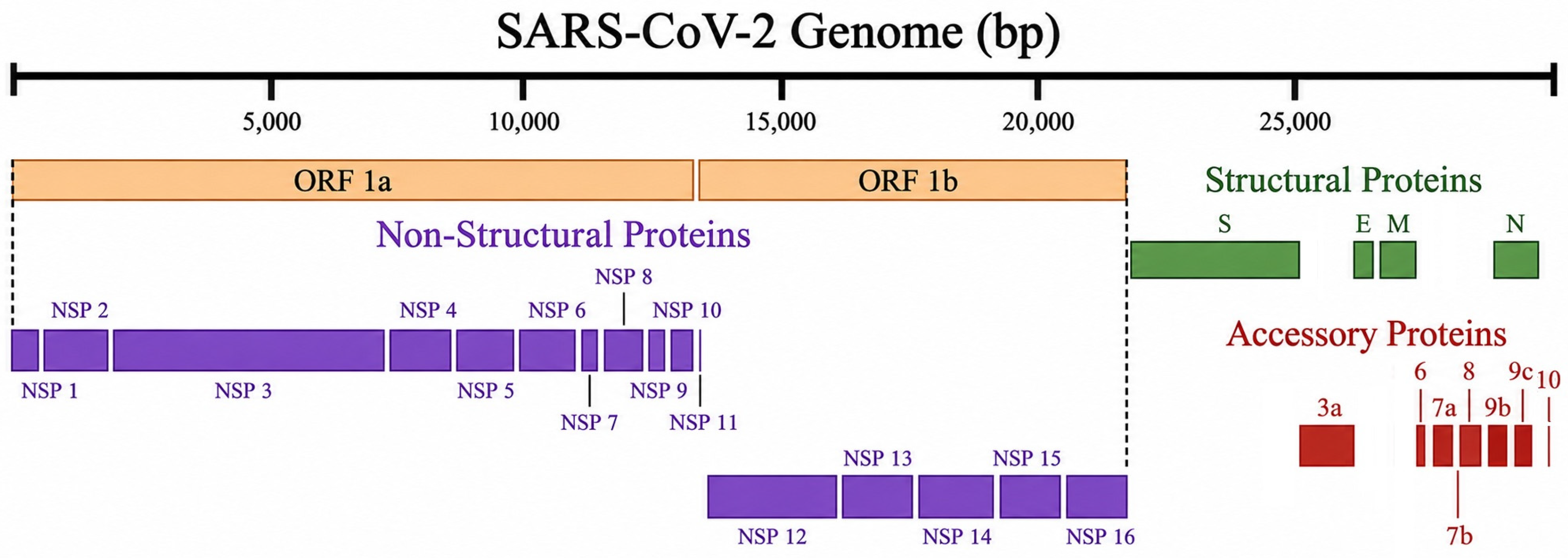
22]. Generated by proteolytic processing of the viral polyproteins pp1a and pp1ab [
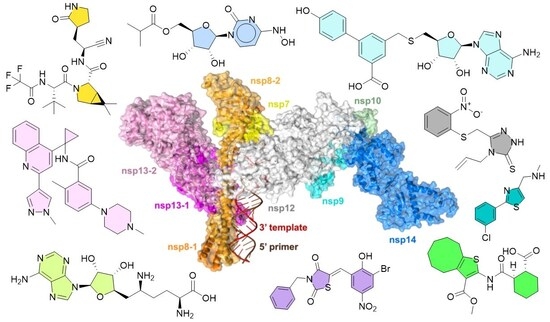
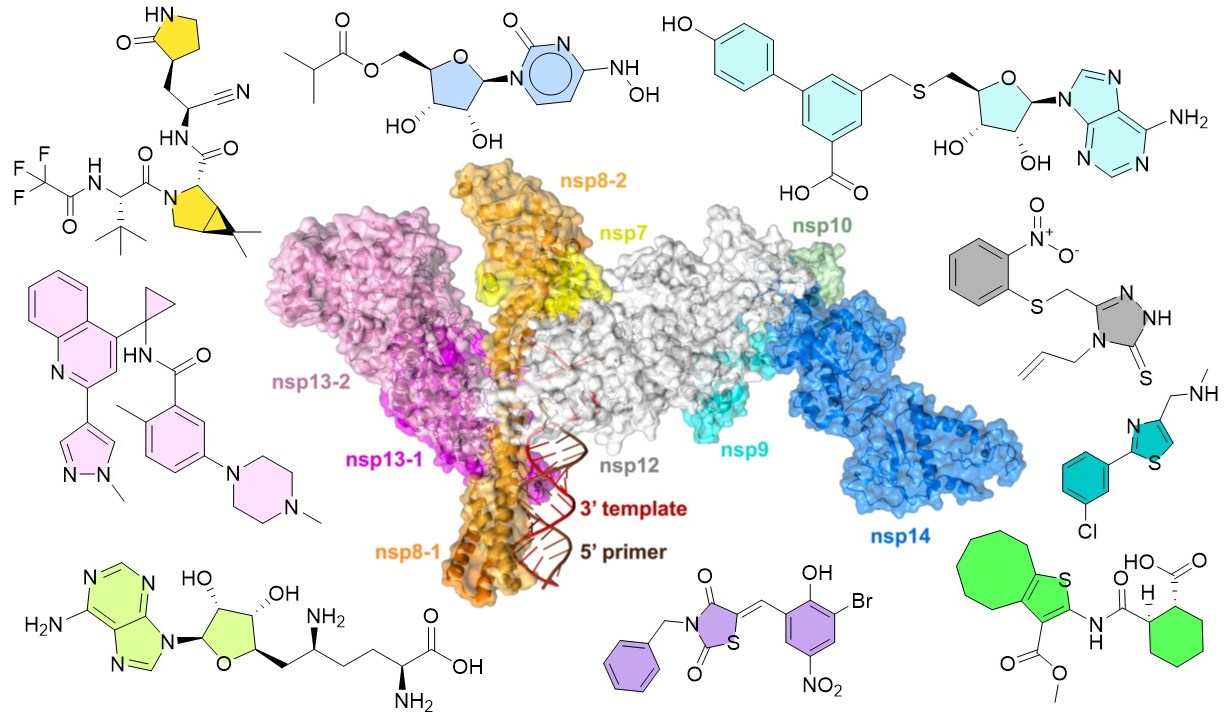
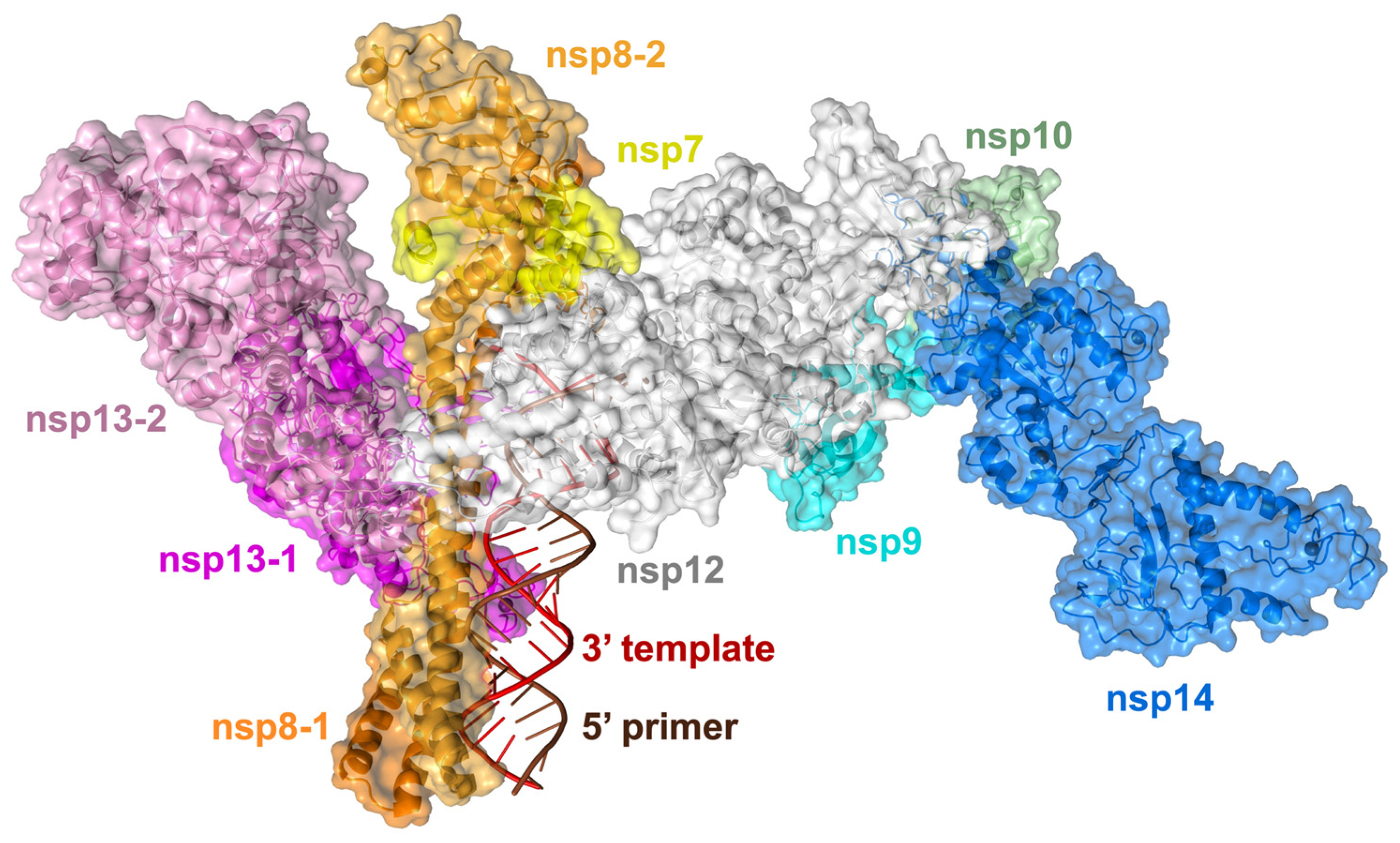
23], the Nsps assemble into the replication–transcription complex (RTC), which orchestrates viral genome replication, RNA processing, proofreading, and transcript maturation (
Figure 1) [
12]. This proteome contains the most important catalytic functions in the coronavirus life cycle, including proteolysis, RNA synthesis, helicase activity, RNA capping, and RNA quality control. From a drug discovery perspective, these functions are especially attractive because they are essential for viral fitness and often lack close human counterparts at the relevant drug-binding surfaces, enabling a clearer path toward selective small-molecule inhibition [
18,
22,
24,
25]. The first generation of clinically successful SARS-CoV-2 antivirals strongly validated this strategy: inhibition of the main protease (M
pro, Nsp5) and the RNA-dependent RNA polymerase (RdRp, Nsp12) established that viral Nsps can support rapid translation from target selection to approved therapy [
26,
27,
28].
At the same time, the limitations of first-generation agents have made it clear that the current therapeutic arsenal remains incomplete [
28]. The intravenous administration requirements of Remdesivir constrained its earliest clinical utility [
29,
30], while the oral combination Nirmatrelvir/Ritonavir demonstrated the power of protease inhibition but also highlighted the practical burden imposed by pharmacokinetic boosting and drug–drug interactions (DDI) [
26,
27,
31]. Likewise, the broader experience with approved and emergency-use antivirals emphasized the need for additional chemotypes, higher resistance barriers, improved convenience, and more flexible combination strategies suitable for early outpatient use. These realities sharpen the rationale for expanding beyond the initial benchmark targets and systematically assessing which additional Nsps are now sufficiently mature to support the next generation of orally deployable antiviral regimens.
In this review, we examine the SARS-CoV-2 non-structural proteome through a target-prioritised medicinal chemistry and translational framework, focusing on proteins that offer the strongest current or emerging rationale for small-molecule intervention. Structural and accessory proteins are mentioned here only for a broader biological context and are discussed in detail in the companion review [
32]. For each non-structural target, we assessed the biological function, structural tractability, assay modalities, quality of chemical matter, resistance liabilities, and key determinants of developability, with particular emphasis on the translational properties most relevant to clinical utility, including oral exposure, pharmacokinetic robustness, and suitability for short-course outpatient therapy. Herein, we focus exclusively on small molecules with demonstrated biological activity. To reflect the unequal maturity of the current antiviral landscape, the discussion is organised into three priority tiers: clinically validated benchmark targets, near-term translational priorities, and early stage but strategically important opportunities. This framework is intended not only to catalogue progress but also to distinguish which Nsps are most likely to support the next generation of variant-resilient and potentially broader-spectrum coronavirus therapeutics.
2. Clinically Validated Benchmark Nsp Targets
The clearest proof that the SARS-CoV-2 non-structural proteome can deliver clinically useful small-molecule antivirals comes from two targets: Mpro and RdRp. Together, these enzymes underpin the first clinically successful DAA strategies against COVID-19 and establish a practical benchmark against which other Nsp targets should be assessed. Beyond their central roles in viral proteolysis and RNA synthesis, they define the key translational features that distinguish a biochemically tractable target from a clinically actionable one, including robust enzymatic validation, structurally accessible binding sites, reproducible antiviral activity in cellular systems, pharmacokinetic properties compatible with early outpatient use, and a resistance profile that can support durable therapeutic benefit. Therefore, we begin with Mpro and RdRp as the reference points for target maturity in the SARS-CoV-2 antiviral landscape, using the lessons learned from these validated systems to inform the evaluation of additional Nsps discussed in the following sections.
2.1. Main Protease Nsp5 (3CLpro or Mpro)
2.1.1. Biology and Rationale
Nsp5, the main protease, is indispensable for replication of coronaviruses. It performs 11 cleavage events on the polyproteins pp1a/pp1ab, cutting at consensus Leu-Gln↓(Ser/Ala/Gly) sequences to release mature Nsps (from Nsp4 to Nsp16) [
33]. In other words, by cleaving the viral polyprotein at many sites, M
pro releases the mature replication machinery. Inhibition of M
pro halts viral RNA synthesis and thus virus replication [
34]. In addition, there is no human equivalent of this cysteine protease with the same specificity, making it a top-priority antiviral target [
35]. Indeed, the first widely approved oral SARS-CoV-2 antiviral regimen, Nirmatrelvir/Ritonavir (Paxlovid), targets M
pro. The validation of M
pro occurred even earlier during the SARS-CoV-1 outbreak when peptidomimetic inhibitors were shown to inhibit the virus [
36].
2.1.2. Assays and Structural Biology
M
pro has been extensively characterised structurally. Within weeks of SARS-CoV-2 genome release, the crystal structure of M
pro was determined (February 2020) in complex with a peptide inhibitor (N3) [
37]. Over 300 M
pro structures are now in the Protein Data Bank (PDB), including many co-crystals with inhibitors of diverse chemotypes. This abundance of structural data has guided structure-based drug design (SBDD) research. Enzymatic assays for M
pro use fluorescent peptides (e.g., DABCYL-KTSAVLQ↓SGFRKME-EDANS) that generate a signal when cleaved [
38,
39]. Cell-based assays include viral replication assays in Vero or human cells, often measuring viral RNA or cytopathic effects [
40]. Given the central role of M
pro, compounds typically show a strong correlation between enzyme IC
50 and antiviral EC
50, although cell permeability can modulate the latter.
2.1.3. Chemical Matter and SAR
M
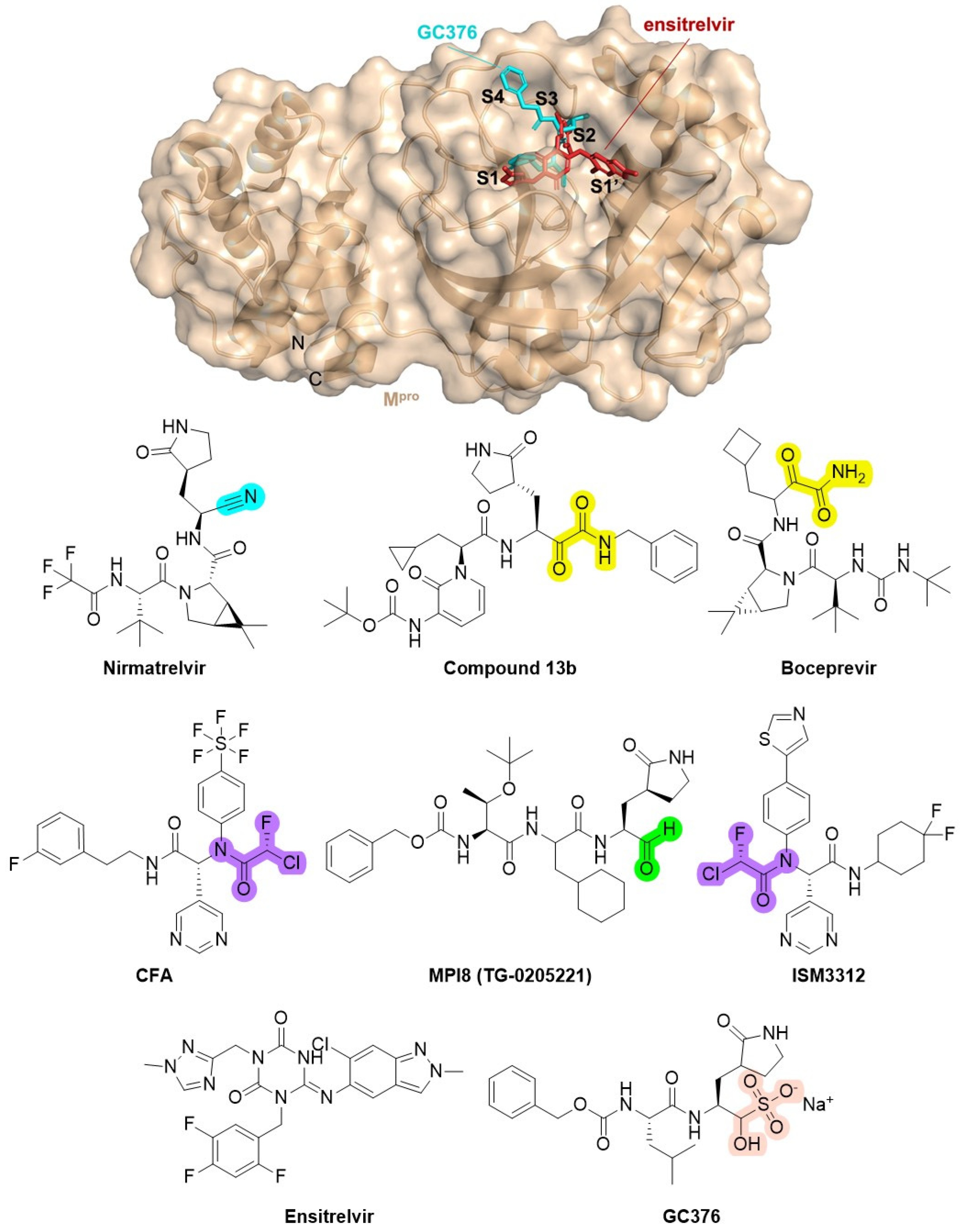
pro drug discovery has been highly fruitful (full clinical benchmarks are summarised in
Section 2.3). Key classes of chemical matter include peptidomimetic covalent inhibitors, non-peptidic covalent inhibitors, and non-covalent inhibitors.
Peptidomimetic covalent inhibitors: These often incorporate a glutamine surrogate at P1 (to bind the S1 pocket) and an electrophile (warhead) to covalently modify the catalytic Cys145 [
41]. Early covalent peptidomimetic inhibitors include α-ketoamides, such as Compound 13b, and related ketoamide scaffolds, such as the repurposed hepatitis C virus protease inhibitor Boceprevir (
Figure 2). In these compounds, the electrophilic carbonyl warhead is positioned for nucleophilic attack by the catalytic Cys145 thiol, forming a reversible thiohemiketal adduct [
42]. X-ray structures confirmed these covalent mechanisms (PDB ID 6Y2F for an aldehyde inhibitor, PDB ID 6WNP for Boceprevir). The peptidomimetics spanned P4 to P1′ positions, optimising interactions in subsites S4–S1′. Notably, Pfizer built on these leads to develop Nirmatrelvir, a peptidomimetic with a nitrile warhead [
43,
44,
45]. Nirmatrelvir (PF-07321332) is a tripeptide-derived, covalently reversible inhibitor (forming a thioimidate with Cys145) incorporating a P2 cyclopropyl glutamine mimic and a P3 tert-butylserine to optimise both potency and metabolic stability [
43]. Nirmatrelvir’s oral bioavailability was achieved in part by its unique non-peptidic P3 capping (a rigid bicyclic structure) that reduces polarity. When administered with the PK booster Ritonavir, it maintains plasma concentrations inhibitory to SARS-CoV-2. In the EPIC-HR trial, oral Nirmatrelvir/Ritonavir (Paxlovid) showed 89% reduction in progression to severe COVID-19 in high-risk patients, validating M
pro as a clinical target [
46].
Non-peptidic covalent inhibitors: Efforts have been made to develop smaller molecules beyond peptide-like structures (
Figure 2). Some successes include covalent inhibitors with alternative warheads, such as chlorofluoroacetamides (CFA, irreversible warhead targeting Cys145) [
47,
48]. For instance, ISM3312 is an orally available irreversible covalent M
pro inhibitor (CFA warhead) discovered through generative-AI-guided, structure-based optimisation. It represents one of the earliest clinical-stage examples of generative-AI-enabled COVID-19 drug design and shows nM, pan-coronavirus activity across SARS-CoV-2 variants and endemic human coronaviruses, with efficacy in human airway organoids and multiple in vivo models [
48]. It retains activity against Nirmatrelvir-resistant M
pro mutants, exhibits only moderate resistance on serial passaging, and its antiviral effect is largely independent of P-glycoprotein (P-gp) efflux, supporting sequential or combination use with Nirmatrelvir to curb resistance and strengthen pandemic preparedness. Another chemotype is GC376 (a dipeptidyl compound occupying S1, S2, S3, and S4 pockets). GC376 is a bisulfite adduct prodrug of the corresponding aldehyde inhibitor. Following release of the active aldehyde species, the electrophilic carbonyl reacts reversibly with the catalytic Cys145 thiol to form a reversible covalent thiohemiacetal adduct. Therefore, GC376 is better described as an aldehyde-prodrug/reversible covalent M
pro inhibitor rather than as a bisulfite adduct directly engaging Cys145 [
49]. It was originally an animal coronavirus drug candidate for feline infectious peritonitis virus and showed activity against SARS-CoV-2 but was not pursued clinically, likely due to its parenteral administration. Finally, aldehyde-containing M
pro inhibitors represent a separate reversible covalent class that forms thiohemiacetal adducts with Cys145. Pharmacophore-based designs have yielded aldehyde-containing compounds such as MPI8 (also known as TG-0205221), a pyridinone covalent inhibitor, with sub-μM antiviral activity and good metabolic stability [
36,
50]. Generally, smaller covalent inhibitors can benefit from better permeability but must carefully orient the warhead for selective reaction with Cys145.
Non-covalent inhibitors: These are attractive for avoiding potential off-target reactivity, although achieving high potency is more challenging. A notable non-covalent series is Shionogi’s Ensitrelvir (S-217622) (
Figure 2) [
51]. Ensitrelvir is a triazole-containing, non-peptidic inhibitor that binds to M
pro. It was optimised for oral delivery and potency, and remarkably, it became the first orally active, non-covalent, non-peptidic M
pro inhibitor to be approved (approved in Japan in 2022–2023). Ensitrelvir is effective against SARS-CoV-2 variants and has shown significant antiviral efficacy in clinical trials (faster viral clearance) [
52]. Structurally, Ensitrelvir occupies the S1, S1′, and S2 pockets similarly to peptidic inhibitors but relies on tight binding rather than covalent anchoring.
Figure 2.
Top: Crystal structure of SARS-CoV-2 M
pro (beige) in complex with Ensitrelvir (red; PDB ID 7VU6), with the ligand GC376 (cyan; PDB ID 9EET) superposed for comparison.
Bottom: Representative chemotypes for SARS-CoV-2 M
pro inhibition, including Nirmatrelvir [
43], Compound 13b [
42], Boceprevir [
49], chlorofluoroacetamide (CFA) inhibitors [
47], ISM3312 [
48], MPI8/TG-0205221 [
36,
50], Ensitrelvir [
51], and GC376 [
49]. Electrophilic warheads responsible for covalent or reversible covalent engagement of Cys145 are highlighted to distinguish α-ketoamide/ketoamide (yellow), aldehyde (green), nitrile (blue), bisulfite adduct/prodrug group (pink), and chlorofluoroacetamide (purple) mechanisms.
Figure 2.
Top: Crystal structure of SARS-CoV-2 M
pro (beige) in complex with Ensitrelvir (red; PDB ID 7VU6), with the ligand GC376 (cyan; PDB ID 9EET) superposed for comparison.
Bottom: Representative chemotypes for SARS-CoV-2 M
pro inhibition, including Nirmatrelvir [
43], Compound 13b [
42], Boceprevir [
49], chlorofluoroacetamide (CFA) inhibitors [
47], ISM3312 [
48], MPI8/TG-0205221 [
36,
50], Ensitrelvir [
51], and GC376 [
49]. Electrophilic warheads responsible for covalent or reversible covalent engagement of Cys145 are highlighted to distinguish α-ketoamide/ketoamide (yellow), aldehyde (green), nitrile (blue), bisulfite adduct/prodrug group (pink), and chlorofluoroacetamide (purple) mechanisms.
2.1.4. PK/PD and Clinical Data
Nirmatrelvir has a half-life suitable for twice-daily dosing when boosted by Ritonavir [
53]. Paxlovid’s clinical performance is well documented: in non-hospitalised high-risk patients, it reduced COVID-19 hospitalization or death by 88–89% compared to placebo [
7]. It retains activity against all major variants (Alpha through Omicron) because M
pro is conserved (only a few variant polymorphisms occur at non-critical sites) [
54,
55]. Ensitrelvir, given once daily, also showed significant reduction in viral RNA load and symptom relief time in Phase 3 trials (for example, faster clearance of infectious virus by 1–2 days) [
52]. Ensitrelvir received approval in Japan based on these data (among others). The safety profiles of M
pro inhibitors have been favourable: the main side effects of Nirmatrelvir are related to Ritonavir’s interactions, and Ensitrelvir’s trials reported mostly mild adverse events such as taste disturbance [
34].
2.1.5. Resistance
As anticipated, M
pro inhibitors face potential resistance [
54]. However, the clinical use of Paxlovid has led to reports of rebound in some patients, but not clearly linked to resistant mutants [
56]. Nonetheless, resistance can be selected in vitro [
57]. Experiments have identified mutations such as P132H in M
pro that can confer resistance to Nirmatrelvir (this mutation is seen in Omicron, though it remains largely susceptible) [
58]. Other laboratory-generated mutations include G15S and K90R, which modestly reduce inhibitor binding [
59]. Structural studies of these mutant proteases bound to Nirmatrelvir indicate that the binding mode is mostly retained.
Serial passaging of SARS-CoV-2 with Ensitrelvir selected M
pro substitutions M49L and E166A, which confer reduced drug sensitivity. Each mutation impaired viral growth in vitro in the absence of the drug; however, their combination largely abrogated Ensitrelvir’s suppressive effect [
60]. Crucially, because M
pro function is essential, most resistance mutations impose a fitness cost on the virus; therefore, high-level resistance may emerge slowly. To proactively address this, combination therapies (M
pro inhibitor + another antiviral) or next-generation M
pro inhibitors effective against resistant variants are being pursued [
61].
2.1.6. Development Status
In addition to Paxlovid, which is authorised globally, and Ensitrelvir, which is approved in Japan, several M
pro inhibitors have achieved regional regulatory milestones. Notably, the Ritonavir-boosted covalent inhibitor Simnotrelvir (Xiannuoxin) received regular approval in China in mid-2024, while the non-boosted agent Leritrelvir (RAY1216) was granted conditional approval in the same market (see
Table 1 in
Section 2.3). Beyond these approved therapies, a second generation of M
pro-targeted small molecules is actively advancing through clinical pipelines; for example, Pfizer’s new candidate PF-07817883 is currently undergoing evaluation [
62]. Additionally, intranasal M
pro inhibitors are being investigated for prophylaxis, aiming to achieve early infection control via direct delivery to the respiratory tract [
63]. To broaden therapeutic efficacy and mitigate resistance, these M
pro agents are also frequently evaluated in clinical trials in combination with polymerase inhibitors, such as Remdesivir analogues (
vide infra) [
64]. As of early 2026, Paxlovid remains the dominant, broadly approved oral antiviral for outpatient COVID-19 treatment across most international markets. Ensitrelvir, which offers a streamlined once-daily dosing regimen relative to the twice-daily requirement of Paxlovid, represents a highly promising alternative, though it has not yet secured widespread global regulatory approval.
2.1.7. Challenges and Opportunities
M
pro drug discovery is a success story, but challenges remain: Ritonavir boosting for Paxlovid introduces drug–drug interaction issues [
65]; thus, non-boosted inhibitors (such as Ensitrelvir) are desirable. There is also interest in pan-coronavirus M
pro inhibitors. M
pro is conserved among β-coronaviruses (e.g., SARS-CoV-1 and MERS M
pro share 96% and 50% identity with SARS-CoV-2 M
pro, respectively) [
55]. Many SARS-CoV-2 inhibitors also inhibit SARS-CoV-1 M
pro; some even inhibit MERS M
pro albeit weaker [
48]. Broad-spectrum M
pro inhibitors could be stockpiled for future outbreaks. Another opportunity is structure-enabled drug design: with artificial intelligence (AI) tools and abundant crystallographic data, designing inhibitors de novo (even via algorithms) is increasingly feasible; ISM3312 exemplifies this trajectory. Finally, M
pro inhibitors may be combined with host-directed agents (e.g., TMPRSS2 inhibitors or anti-inflammatories) to enhance outcomes for severe COVID-19 [
63]. In conclusion, M
pro is the most clinically advanced SARS-CoV-2 protein target. Continued optimisation focuses on dosing convenience, variant resistance-proofing, and expanding the arsenal to ensure long-term efficacy against SARS-CoV-2 and related viruses.
2.2. RNA-Dependent RNA Polymerase Complex (RdRp, Nsp12, with Nsp7/Nsp8 Cofactors)
2.2.1. Biology and Rationale
The RNA-dependent RNA polymerase (RdRp, Nsp12) is the core enzyme that copies the viral RNA genome [
66]. It is essential for viral replication, making it a validated drug target, exemplified by Remdesivir (full clinical benchmarks for RdRp are summarised in
Section 2.3). However, RdRp does not act alone: for optimal function, it forms a complex with Nsp7 and Nsp8 as cofactors [
66]. Nsp7 and Nsp8 serve as processivity factors or primase elements, helping the polymerase to initiate and elongate RNA strands [
67]. In fact, the active replicase is a multisubunit machine called the replication–transcription complex (RTC), transiently comprising RdRp, Nsp7/Nsp8 (polymerase cofactors), helicase, bifunctional Nsp14, and Nsp10 as a stimulator for Nsp14 and Nsp16 [
66]. In this section, we focus on RdRp and its immediately associated proteins Nsp7 and Nsp8, which have been structurally characterised as a complex.
2.2.2. Assays and Structural Biology
The structure of the SARS-CoV-2 RdRp/Nsp7/Nsp8 complex was solved early in the pandemic via cryo-electron microscopy (cryo-EM) at 2.9 Å resolution [
68]. It revealed the canonical right-hand polymerase architecture (palm, fingers, and thumb domains) and an N-terminal extension with a Nidovirus RdRp-associated nucleotidyltransferase (NiRAN) subdomain that may contain nucleotidyltransferase activity. Nsp7 and Nsp8 form a collar around RdRp, with Nsp8 also protruding to guide the exiting RNA. The structures of Nsp12 bound to RNA and incoming nucleotides (with Remdesivir or other analogues) have also been determined [
69]. These structures illuminate how nucleotide analogue drugs work. Enzymatic assays for RdRp use short RNA templates and primers to measure the incorporation of nucleotides (radioactive or fluorescent) [
70]. Cell-based assays rely on measuring virus replication, as polymerase inhibition stops viral RNA production (often reflected in viral RNA load by qPCR) [
71].
2.2.3. Chemical Matter—Nucleoside Analogues
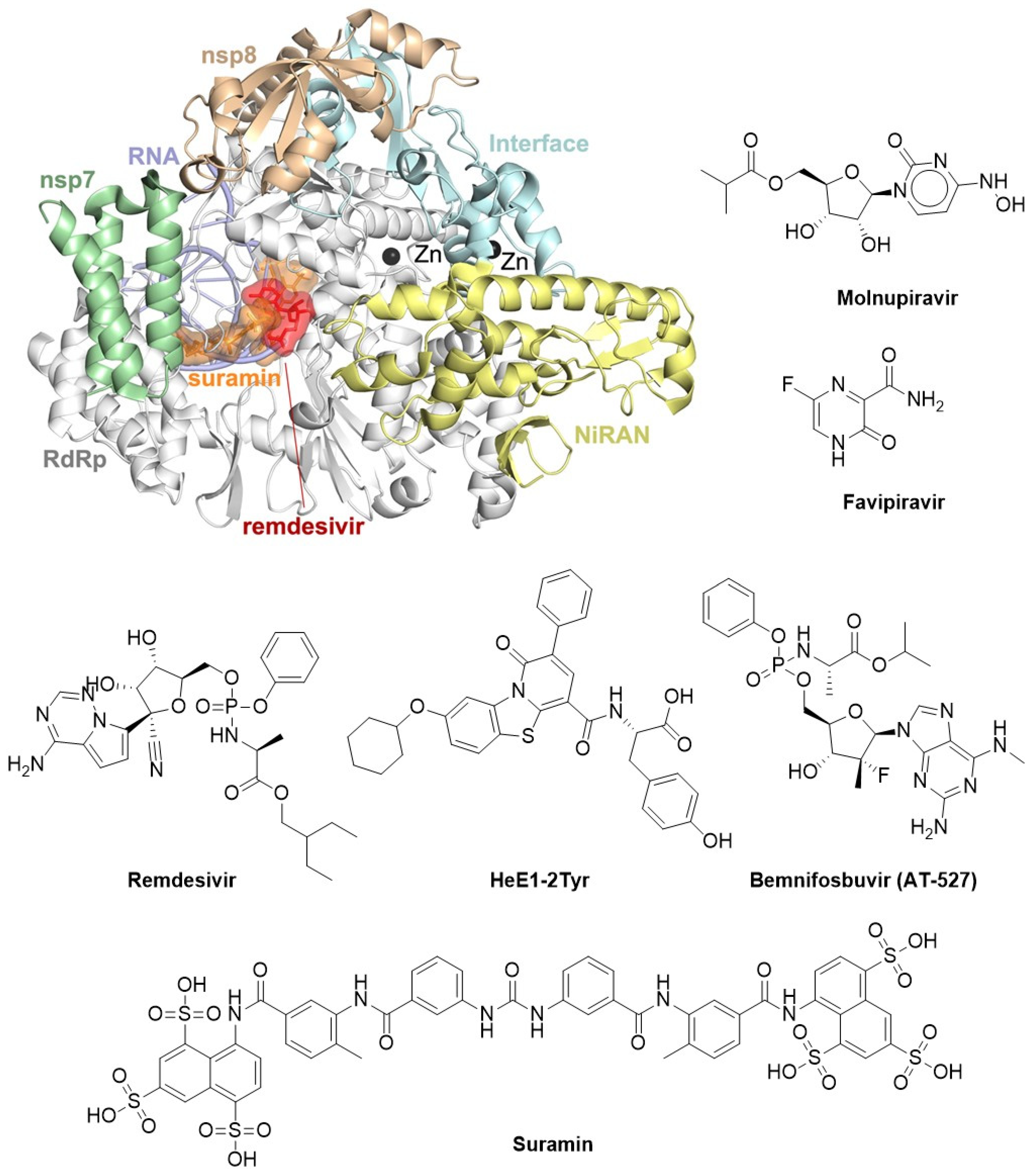
Historically, viral polymerases have been frequently targeted by nucleoside analogues that cause chain termination or lethal mutagenesis. Remdesivir (
Figure 3) was originally developed against the Ebola virus and quickly repurposed for SARS-CoV-2 [
72]. Remdesivir is a prodrug of an adenosine analogue. Once activated to its triphosphate form, it is incorporated into viral RNA by RdRp and causes delayed chain termination (after adding a few more nucleotides) [
73]. Remdesivir has moderate potency (in cell assays EC
50 ~1 μM) [
74] but showed efficacy in hospitalised patients by shortening recovery time [
75]. It received full approval for intravenous (IV) use in late 2020 [
76]. Chemically, Remdesivir includes a 1′-cyano modification on ribose that confers selectivity for viral polymerase and resists proofreading to some extent [
77]. However, the requirement for IV infusion limits its outpatient use.
A major advance was the development of Molnupiravir (EIDD-2801), an oral prodrug. Molnupiravir’s active metabolite, N
4-hydroxycytidine triphosphate (NHC-TP), is incorporated by RdRp and can base-pair with G or, after tautomerisation, with A, causing C→U and G→A transition mutations that accumulate to drive lethal mutagenesis, also called “error catastrophe” [
78]. It demonstrated a 30% reduction in hospitalisation risk in trials and was authorised for emergency use [
83]. Molnupiravir’s mutagenesis mechanism raises concerns about potential incorporation into host DNA (e.g., in rapidly dividing cells), but the short treatment duration mitigates this. Given the modest efficacy signals and theoretical risks, uptake has been limited. In the European Union (EU), the Committee for Medicinal Products for Human Use (CHMP) recommended refusal in February 2023, and the sponsor withdrew its marketing authorisation (MA) application in June 2023.
Favipiravir (a purine base analogue) showed broad activity against RNA viruses including coronaviruses, in vitro, but did not conclusively benefit COVID-19 patients in clinical trials [
79]. Ribavirin, a general antiviral, was similarly not very effective [
84,
85]. There are ongoing efforts to develop improved nucleoside analogues: for example, Bemnifosbuvir (AT-527) is a guanosine analogue prodrug that has reached Phase 2 trials [
82]. Galidesivir (adenosine analogue) and Rhodanine analogues are also being investigated [
24,
86]. Importantly, the proofreading exoribonuclease domain (ExoN) of Nsp14 can excise some incorporated analogues (like Ribavirin or 5-Fluorouracil), but analogues like Remdesivir partially evade this [
87]. Combining a nucleoside analogue with an ExoN inhibitor (see Nsp14 section) is a theoretical strategy to boost effectiveness.
2.2.4. Chemical Matter—Non-Nucleoside Inhibitors
Non-nucleoside inhibitors have been challenging to identify for coronaviruses. Unlike HIV or HCV polymerases, which present druggable allosteric sites, the coronavirus RdRp forms a compact Nsp12–Nsp7/Nsp8 complex with few obvious small-molecule pockets [
81]. Nonetheless, some studies have reported allosteric inhibitors that bind RdRp outside the active site. A report described Suramin (a large polyanionic drug) binding to RdRp and Nsp13, blocking polymerase activity [
80]. Suramin showed in vitro activity but is a bulky, polysulfonated repurposed molecule (bearing six sulfonate groups) with well-known target promiscuity (
Figure 3) [
81]. High-throughput screening has yielded several chemotypes, but most remain at the hit-to-lead stage, and to date, none approach the potency or breadth of leading nucleoside analogues [
88,
89]. A recent cryo-EM/mechanistic study established HeE1-2Tyr as a bona fide non-nucleoside RdRp inhibitor: it competitively displaces RNA and binds as a stack of three molecules in the RNA-binding channel, stabilised by an “arginine bracket” (Arg555/Arg836/Arg858). Biochemical assays reported an IC
50 of 5–5.5 µM with marked positive cooperativity [
81]. The complete conservation of this bracket across coronaviruses suggests pan-coronavirus potential, providing rare, high-resolution structural guidance for non-nucleoside design and a mechanistic counterpoint to promiscuous binders such as Suramin. As a complementary avenue, interface-mimicking peptides derived from Nsp8 disrupt the RdRp–Nsp8 interaction, suppress RdRp activity in cell-based assays, and reduce viral loads and mortality in mice after intranasal dosing [
90]. This nominates the RdRp–Nsp8 interface as a therapeutically tractable site despite its apparent flatness [
91].
2.2.5. PK/PD
Remdesivir’s PK is characterised by quick conversion to active triphosphate in cells and a long intracellular half-life of the active form (~40 h) [
92]. It must be administered IV once daily for five days; attempts at inhaled delivery are under exploration (to concentrate it in the lungs) [
93]. Molnupiravir achieves high oral bioavailability, rapidly converting to N
4-hydroxycytidine in plasma; it penetrates tissues including the lungs [
94,
95]. It is administered at a dose of 800 mg twice daily orally for five days. Molnupiravir’s active nucleoside has a short plasma half-life but is sufficient for incorporation into the replicating virus. Both drugs are well tolerated. However, Remdesivir can cause infusion reactions and liver enzyme elevations, and Molnupiravir can cause mild side effects such as headache or gastrointestinal (GI) upset [
92,
94]. Importantly, because efficacy hinges on very early treatment, outpatient-deployable formulations are critical, hence the emphasis on orally bioavailable nucleoside (pro)drugs such as Molnupiravir and Bemnifosbuvir (AT-527).
2.2.6. Resistance
SARS-CoV-2′s RdRp is conserved across variants, but variants resistant to Remdesivir have been selected in vitro (e.g., the E802D mutation in RdRp conferring around 6-fold resistance) [
96]. To date, clinical sequencing has not shown widespread polymerase mutations under drug pressure. Molnupiravir, by inducing mutations, could theoretically accelerate the emergence of new variants if some viruses survive suboptimal dosing (this is a debated issue) [
97]. As of 2026, no specific SARS-CoV-2 mutations are universally accepted as bona fide Molnupiravir-resistance substitutions, although several putative RdRp candidates have been described [
98,
99]. The ExoN domain of Nsp14 is a resistance factor in general, as it can proofread and remove certain analogues (
vide infra). Remdesivir partly evades proofreading owing to its structural mimicry of normal nucleotides after incorporation [
77]. Therefore, strategies that combine a nucleoside with an ExoN inhibitor could prevent the virus from fixing mistakes, amplifying the nucleoside’s effect.
2.2.7. Development Status
Remdesivir has been fully approved (use in hospitalised patients and as a 3-day outpatient IV course for high-risk early disease). Molnupiravir remains under emergency/conditional authorisation in several countries, although its uptake varies. Bemnifosbuvir (AT-527) reached Phase 2 for COVID-19 but failed to meet the primary endpoints, and its development has been de-prioritised. Deuremidevir (VV116; an oral prodrug of GS-441524) showed non-inferiority to Nirmatrelvir–Ritonavir in a randomised trial of mild-to-moderate COVID-19 [
100]. China has also approved Azvudine (FNC), a repurposed nucleoside originally developed for HIV, for COVID-19 treatment [
100,
101]. To date, no non-nucleoside RdRp inhibitors have advanced into clinical trials [
102].
2.2.8. Nsp7 and Nsp8 Cofactors
Although not traditionally considered drug targets on their own, Nsp7 and Nsp8 have intriguing aspects. A study in 2023 identified a small pocket on Nsp7 that binds gallic acid and related small molecules [
103]. Using NMR, researchers found gallic acid binds to a hydrophobic pocket on Nsp7 (not at the Nsp7–Nsp8 interface but on Nsp7’s surface). Although gallic acid is a very weak binder, this pocket could potentially be exploited to interfere with the assembly of the polymerase complex. Another approach has been the use of biologics: a nanobody (single-domain antibody) was developed targeting Nsp9 (an RNA-binding protein, but related to the replication complex), delivered via mRNA in lipid nanoparticles, which blocked viral replication in cells [
104]. This strategy, essentially intracellular immunotherapy, demonstrates the creative tactics being considered to disrupt the RTC. It is conceivable that similar nanobodies could target the Nsp7–Nsp8 interfaces.
2.2.9. Challenges and Opportunities
RdRp is a conserved machinery across all RNA viruses, and learning from decades of HIV/HCV polymerase inhibitor development is useful. One challenge is the proofreading ability of coronaviruses, which is almost unique among RNA viruses and reduces the efficacy of classic chain terminators [
105]. However, this can be overcome by using analogues that trick the exonuclease or by co-inhibiting ExoN (
vide infra). Another challenge is the design of allosteric inhibitors for such a large complex, and a deep understanding of transient pockets (via molecular dynamics simulations or fragment screening) may be needed. Opportunities include broad-spectrum nucleosides: some analogues (e.g., β-D-N
4-hydroxycytidine from Molnupiravir) inhibit not only SARS-CoV-2 but also a range of RNA viruses, making them valuable for pandemic preparedness in general [
106]. Polymerase inhibitors can also be made variant-proof by targeting absolutely conserved regions (e.g., the active site). The RdRp active-site motifs (A–G) are highly conserved; RdRp is ~96% identical between SARS-CoV and SARS-CoV-2 and the catalytic residues are invariant, helping explain why nucleotide analogues such as Remdesivir retain activity across variants and inhibit related β-coronaviruses (e.g., SARS-CoV and MERS-CoV) in vitro (notwithstanding rare resistance substitutions like Nsp12 E802D) [
96,
107,
108]. This bodes well for the longevity of polymerase-based antivirals. In conclusion, RdRp in complex with Nsp7 and Nsp8 is a validated drug target. The success of Remdesivir and Molnupiravir underscores the potential of nucleoside analogues. Continued innovation aims to create orally bioavailable potent polymerase inhibitors that can be used alone or in combination with M
pro inhibitors to achieve synergistic suppression of SARS-CoV-2.
2.3. Clinical Benchmark: Replication Targets (Mpro and RdRp)
The programmes that have advanced furthest clinically (and the only ones with regulatory approvals to date) target the two replication “workhorses” M
pro and RdRp. This concentration reflects the convergence of factors, including clear catalytic mechanisms and high-quality structural data, robust industry-standard assay cascades, and medicinal chemistry precedents (peptidomimetic cysteine protease inhibitors and nucleos(t)ide analogues). Therefore,
Table 1 serves as a field benchmark, summarising the most clinically validated chemical matter, setting exposure/PK, and resistance expectations for next-generation agents.
More than six years after the pandemic began, what does the therapeutic landscape look like? RdRp is validated by the nucleotide analogue Remdesivir (IV, hospital use) and the mutagenic ribonucleoside Molnupiravir (oral, outpatient); M
pro is validated by the oral protease inhibitor Nirmatrelvir co-dosed with Ritonavir, with additional regional approvals for other non-covalent M
pro inhibitors (e.g., Ensitrelvir). Together, these agents demonstrate that early, high target coverage can reduce progression risk, while also highlighting practical constraints: route of administration (Remdesivir), boosting/drug–drug interaction (DDI) (Nirmatrelvir/Ritonavir), and mechanism-linked safety and resistance considerations (Molnupiravir error catastrophe; emergent M
pro resistance pathways). By contrast, other RTC enzymes (
vide infra: PL
pro/Mac1, Nsp13, Nsp14, Nsp15, and Nsp16) remain preclinical or early translational.
Table 1 anchors the manuscript’s prioritisation logic: build on the proven M
pro/RdRp backbone and bring a second, orthogonal enzyme inhibitor toward the clinic to raise the barrier to escape (
vide infra, see
Section 5.2 and
Section 5.3).
3. Near-Term Translational Priorities
The next wave of SARS-CoV-2 Nsp targets comprises those that have moved beyond conceptual interest and now show meaningful translational momentum but have not yet reached the level of clinical validation established for Mpro and RdRp. These targets combine a strong biological rationale with increasing structural and chemical tractability, and in several cases, are supported by emerging cellular or in vivo evidence that places them within the realistic reach of preclinical advancement. Importantly, they also address functions complementary to first-generation antiviral mechanisms, including polyprotein processing outside Mpro, RNA proofreading, RNA capping, helicase-driven nucleic acid remodelling, and immune-evasion-linked processing of viral RNA byproducts. As such, PLpro, Nsp14, Nsp16, Nsp13, and Nsp15 represent the most credible near-term opportunities to expand the current antiviral arsenal beyond protease- and polymerase-centred therapy, particularly in the context of resistance-aware and mechanistically orthogonal combination therapy.
3.1. Papain-like Protease (PLpro, Belonging to Nsp3)
3.1.1. Biology and Rationale
Nsp3 is a large, multi-domain protein (~200 kDa), the largest protein encoded by the coronavirus genome, with at least 15 domains described in SARS-CoV-2 [
109]. Two notable enzymatic domains of Nsp3 are the papain-like protease (PL
pro) and the macrodomain (Mac1) (
vide infra) [
110,
111]. PL
pro cleaves the N-terminal portion of the polyprotein at three sites to release Nsp1, Nsp2, and Nsp3 [
112]. PL
pro also has deubiquitinating and deISGylating activity, meaning it can remove ubiquitin and ISG15 (an interferon-stimulated ubiquitin-like protein) from host proteins [
113]. This helps the virus antagonise innate immunity. PL
pro is essential for efficient replication and immune evasion, making it a prime target for antivirals [
111]. Notably, blocking PL
pro not only inhibits virus replication by preventing proper polyprotein processing, but it also blunts the virus’s ability to subvert host ubiquitin/ISG15 signalling [
114].
3.1.2. Assays and Structural Biology
PL
pro assays typically measure the cleavage of fluorogenic peptides corresponding to the Nsp2|Nsp3 junction or test deubiquitination activity on ubiquitin–luciferase substrates [
115,
116,
117]. High-throughput screens (HTS) have been conducted for PL
pro [
117,
118]. Crystallography has yielded multiple structures of PL
pro alone and in complex with inhibitors or substrates, aiding in structure-based design [
119,
120,
121].
3.1.3. Chemical Matter
Early efforts were based on SARS-CoV PL
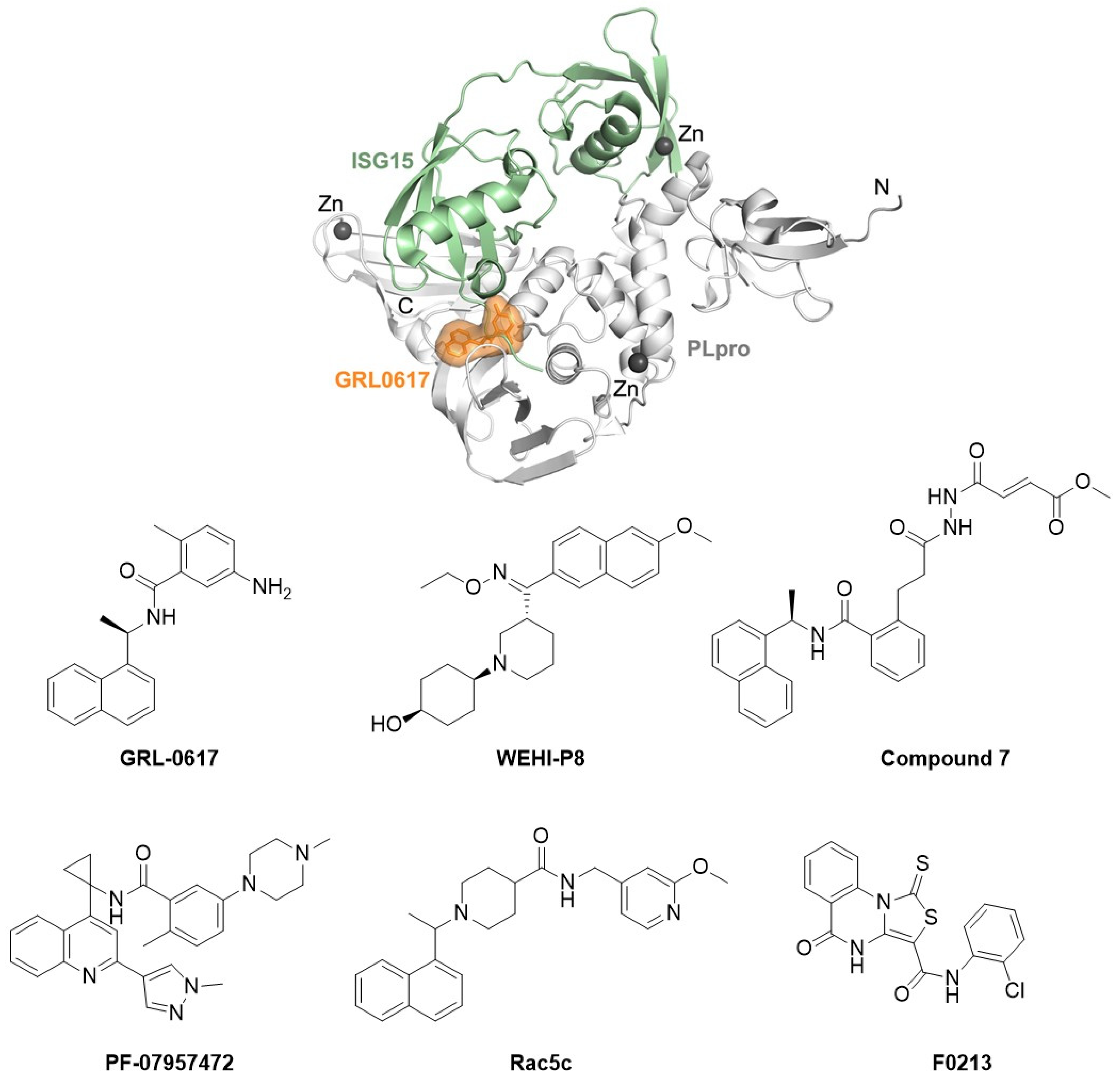
pro inhibitors. The non-covalent inhibitor GRL-0617, a naphthalene-benzamide (
Figure 4), was initially developed against SARS-CoV and was found to inhibit SARS-CoV-2 PL
pro with an IC
50 of 0.6 μM [
122]. GRL-0617 binds to the S3/S4 pocket adjacent to the active site, preventing the enzyme from accommodating the distal ubiquitin/ISG15 motif [
119]. Although GRL-0617 has good specificity (it does not hit human proteases), it showed relatively weak antiviral activity in cell culture (EC
50 of 68 μM in Vero cells, even with P-gp efflux inhibited) [
123]. This limited cell potency is thought to arise from poor cell permeability or efflux. Medicinal chemistry optimisation of GRL-0617 analogues was reported by Garnsey et al. (2024) and modifications on the naphthalene and aniline moieties led to improved potency [
123]. One optimised PL
pro inhibitor from that series, PF-07957472, showed sub-μM antiviral efficacy and was efficacious in a SARS-CoV-2 mouse infection model, a milestone validating PL
pro as a druggable target. Rac5c is another early non-covalent PL
pro chemotype that engages the S3/S4 substrate-binding pocket, blocking PL
pro’s deISGylase/deubiquitinase activity, inhibiting Nsp3 self-processing, and reducing SARS-CoV-2 replication in cells [
124]. Although its potency and PK are modest, with no in vivo data reported, Rac5c serves as a useful tool compound to benchmark assays and seed SAR around non-covalent PL
pro inhibition.
Another screening identified F0213 (IC
50 = 7.4 μM), a non-covalent inhibitor with broad coronavirus activity [
125]. F0213 blocks both the proteolytic and deubiquitinating functions of PL
pro, and it was suggested to allosterically interfere with the enzyme, possibly by binding near Lys157. Covalent inhibitors (Compound
7) have also been explored, targeting the catalytic Cys111, but selectivity is a concern given the host deubiquitinases with similar active sites [
126]. Regrettably, the most potent inhibitors in this series were deemed unsuitable for in vivo studies.
Finally, the WEHI-P series was recently reported [
127]. Unlike inhibitors from the GRL-0617 family, these compounds engage a distinct binding pocket on PL
pro by inducing a conformational change in Met208. The lead compound, WEHI-P8 (IC
50 = 12 nM, EC
50 = 0.36 μM), demonstrated potent antiviral activity (potentially a pan-coronavirus antiviral) and was highly efficacious in a mouse model of severe acute disease, outperforming a Paxlovid-like treatment in reducing viral load and lung inflammation. Crucially, in a preclinical model that recapitulates long COVID-19 symptoms, early treatment with WEHI-P8 prevented long-term lung pathology and cognitive dysfunction, a protective effect that was not observed with the Paxlovid-like regimen. This study provides key proof-of-principle that targeting PL
pro may not only treat acute infection but also prevent the development of post-acute sequelae.
Overall, the PLpro inhibitor landscape now comprises several mechanistically distinct chemotype classes. These include GRL-0617-derived non-covalent S3/S4 pocket inhibitors, including PF-07957472; alternative non-covalent scaffolds such as Rac5c and F0213; cysteine-directed covalent or reversible-covalent inhibitors such as Compound 7, which target Cys111 but require careful selectivity profiling against host deubiquitinases; and crystallographic fragment hits that provide ligand-efficient starting points for structure-guided optimisation. Among these, PF-07957472 and WEHI-P8 currently provide the strongest evidence for progression beyond tool-compound status because they combine potent enzyme inhibition with cellular and in vivo antiviral activity.
3.1.4. PK/PD and Safety
The PL
pro inhibitors reported (GRL-0617 analogues, F0213) are at the research stage and no detailed PK data have been reported. GRL-0617 has a moderate molecular weight of ~350 Da and a polar surface, suggesting potential cell permeability issues. New analogues with less efflux liability are being sought (Compound
7) [
126]. In terms of safety, PL
pro is virus-specific and, therefore, on-target toxicity is expected to be low. Off-target risks include human deubiquitinases; however, GRL-0617 is relatively selective [
126]. One consideration is that PL
pro inhibitors might synergise with innate immune stimulation because PL
pro blockade restores ISG15 and ubiquitin signalling [
114]. This could be beneficial but could also cause inflammation, and suitable in vivo models are needed.
3.1.5. Development Status
Several academic groups and biotech firms are actively developing PL
pro inhibitors. A few patent applications have been filed for PL
pro-targeting antivirals [
128]. As of 2026, none have entered clinical trials. However, PF-07957472, Compound
7, and WEHI-P8 are promising preclinical candidates. Dual inhibitors of PL
pro and other targets (or multi-target drug cocktails) may be a strategy for clinical use in the future.
3.1.6. Challenges and Opportunities
PL
pro has a flexible active site because it must bind diverse substrates (polyprotein and ubiquitin/ISG15) [
124]. Although this flexibility can complicate inhibitor design, it also creates opportunities to exploit multiple binding pockets, including both orthosteric and allosteric sites. One challenge is that coronaviruses can tolerate some changes in the PL
pro sequence, although the inhibitor-binding residues tend to be conserved across SARS-CoV and SARS-CoV-2 [
129]. Surveillance for resistance mutations, such as those affecting the inhibitor–binding pocket, will be needed once PL
pro inhibitors are used. Moreover, combining a PL
pro inhibitor (which acts early, processing the N-terminus of the polyprotein) with an M
pro inhibitor (processing the rest of the polyprotein) might yield a one-two punch, preventing viral polyprotein maturation. Indeed, a recent study showed that a dual inhibitor targeting both PL
pro and M
pro active sites is feasible [
130].
3.2. Nsp14: Proofreading and RNA Capping Functions
3.2.1. Biology and Rationale
Nsp14 is a bifunctional enzyme with two domains: an N-terminal 3′–5′ exoribonuclease (ExoN) and a C-terminal guanine-N7 methyltransferase (N7-MTase). Nsp10 acts as an essential cofactor that binds Nsp14 to activate its ExoN activity (and similarly binds and stimulates Nsp16,
vide infra) [
131]. The ExoN domain of Nsp14 confers the ability to proofread RNA. It excises misincorporated nucleotides from the nascent RNA, thereby significantly increasing replication fidelity [
132]. This proofreading function is why coronaviruses can have much larger genomes (~30 kb) than other RNA viruses, as they maintain lower mutation rates [
66]. From a drug perspective, this makes Nsp14 ExoN an attractive target: its inhibition could synergise with nucleotide analogue drugs (which depend on viral error rates) [
105]. The N7-MTase function of Nsp14 is involved in capping the viral mRNA (adding a methyl group to the 5′ cap guanosine), an essential step for mRNA stability, thus helping the virus evade innate immunity. Therefore, both activities of Nsp14 are essential for a viable virus, making Nsp14 a high-potential target.
3.2.2. Assays and Structural Biology
ExoN activity is commonly measured using fluorescently labelled or radiolabelled RNA substrates, often bearing a mismatched 3′ terminus to mimic proofreading substrates. In complex with Nsp10, Nsp14 mediates 3′→5′ exonucleolytic cleavage, which can be detected by monitoring the loss of the 3′ terminal nucleotide(s) or the formation of shorter RNA products [
133,
134]. Several structures of Nsp14 have been determined. An early low-resolution SARS-CoV Nsp14–Nsp10 complex structure (PDB ID 5C8S) shows the arrangement of the ExoN active site (with two metal ions) and the MTase domain [
135]. Recently, a cryo-EM structure of the SARS-CoV-2 Nsp14–Nsp10 complex was determined [
136]. Structures of the N7-MTase domain with cap analogues and inhibitors have also been reported [
137]. These structures illuminate drug–binding pockets: the ExoN active site binds metal ions and RNA, and the N7-MTase domain has a pocket for the methyl donor S-adenosylmethionine (SAM) and the guanine base. A 1.6 Å structure and biophysical characterisation of SARS-CoV-2 Nsp10, the highly conserved stimulator of Nsp14 ExoN, clarify its central role in viral RNA capping and provide a rigorous framework for designing Nsp10-targeted protein–protein interaction (PPI) inhibitors to disrupt viral replication [
138].
Nsp10–Nsp14 assembly is dynamic: biophysical assays show that full-length Nsp10 binds Nsp14 with sub-μM affinity (K
d = 0.5 μM), whereas truncations (especially loss of the C-terminus) weaken binding by >20-fold, indicating that both the N- and C-terminal regions of Nsp10 contribute to optimal complex formation [
139]. Hydrogen–deuterium exchange mass spectrometry (HDX-MS) further reveals transient contacts with the N7-MTase domain, implying intermediate association/dissociation states not captured by crystal structures and highlighting PPI-targetable surfaces beyond the canonical ExoN interface [
139].
3.2.3. Chemical Matter—ExoN Inhibitors
Because the ExoN function underpins coronavirus replication fidelity, its inhibition is expected to raise the viral mutation rate and, in principle, promote lethal mutagenesis, especially in combination with mutagenic nucleoside analogues [
140]. Before COVID-19, there were essentially no selective small-molecule ExoN inhibitors. Since 2020, several tool compounds and screening-derived leads have emerged, although none yet qualify as drug-like ExoN-selective chemotypes. For instance, aurintricarboxylic acid (ATA) (
Figure 5), reported since SARS-CoV-1 to inhibit ExoN, is a promiscuous polyanion that likely chelates catalytic metal ions and/or binds RNA non-specifically [
141]. Recently, ATA analogues have been developed as ExoN inhibitors [
142]. In addition, X-ray fragment screening of Nsp14 revealed dozens of hits across the ExoN and N7-MTase domains, including pockets at the Nsp10–Nsp14 interface and the Nsp14 hinge domain, providing concrete starting points for fragment-based drug discovery (FBDD)/allosteric design [
143]. Finally, using a robust gel-based assay, Baddock et al. showed that the Nsp14–Nsp10 proofreading complex, although canonically a 3′→5′ exoribonuclease, can display broader RNase activity in vitro, including cleavage patterns consistent with internal incisions on certain RNA substrates. Using the same assay platform, they identified drug and drug-like inhibitors of Nsp14–Nsp10 activity, including Ebselen (better known as an M
pro inhibitor) and Raltegravir, thereby providing useful small-molecule starting points for ExoN-focused discovery campaigns [
144]. These authors also found that ExoN activity is stimulated by the RdRp complex via Nsp8, reinforcing the value of orthogonal readouts to confirm on-target inhibition within the RTC. A focused review of this topic emphasised that ExoN proofreading blunts many nucleoside analogues, motivating combination strategies in which ExoN inhibition sensitises RdRp-targeting NAs [
145].
3.2.4. Chemical Matter—N7 MTase Inhibitors
The Nsp14 N7-MTase catalyses the transfer of a methyl group from SAM to the 5′ guanine cap of viral mRNA, forming a cap-0 structure. Inhibitors can either mimic the substrate (guanine analogues) or the cofactor SAM or occupy an allosteric pocket [
137]. Early tools such as Sinefungin (a SAM analogue, IC
50 = 0.46 μM) (
Figure 5) established assay feasibility but lack selectivity over host MTases [
146]. Building on SAM-mimetics, bisubstrate adenosine analogues that bridge the SAM and cap-binding sites (e.g., N-arylsulfonamide series) achieved sub-μM Nsp14 inhibition (e.g., N-arylsulfonamide adenosine 7, IC
50 = 0.9 μM) and defined productive vectors for linker and aryl tuning [
147]. Recent adenosine-5′-carboxamide derivatives, including coumarin analogues, refined this concept. HK370 (also reported as 18L) showed high selectivity, a favourable in vitro ADME/PK profile, and moderate cellular antiviral activity, providing an optimisable, enzyme-validated scaffold [
146]. Parallel structure-based docking and ultra-large library campaigns delivered non-SAM chemotypes with biochemical activity and cellular signals, thus moving away from nucleoside-like properties [
137].
A major advance is the discovery of the first non-covalent, non-SAM Nsp14 N7-MTase inhibitor series from high-throughput screening. Optimisation of RU-0415529 yielded TDI-015051, which binds in a ternary complex with Nsp14 and S-adenosyl-L-homocysteine (SAH), the demethylated product generated from S-adenosyl-L-methionine (SAM) after methyl transfer. This inhibitor is non-competitive with both SAM and GpppA, binds with a K
d of 61 pM, shows an EC
50 value of 11 nM in cells, and demonstrates in vivo efficacy in mouse infection models comparable to Nirmatrelvir [
148]. Follow-up medicinal chemistry details the SAR that enabled sub-nM (e.g., Compound
58, IC
50 = 0.25 nM) cellular potency and crystallographic confirmation of the ternary binding mode, establishing pharmacological validation of viral cap MTases [
149]. TDI-015051 series properties are consistent with oral developability (improved permeability/solubility and sustained cellular potency), aligning PD with the ternary SAH–inhibitor mechanism that should translate across coronaviruses where the MTase site is conserved [
149]. As an orthogonal approach, Bi(III) complexes allosterically inhibit both Nsp14 MTase and ExoN within the Nsp14/Nsp10 complex by displacing Zn(II) and inducing quaternary-structure rearrangements. They show antiviral activity in cells and animal models, making them useful mechanistic probes with multi-target potential, albeit outside classic small-molecule space [
150]. Finally, for SAM-mimetic scaffolds (e.g., adenosine N-arylsulfonamides and 5′-carboxamides), enzyme potency is established, but cellular activity and selectivity remain the gating liabilities to optimise for systemic exposure.
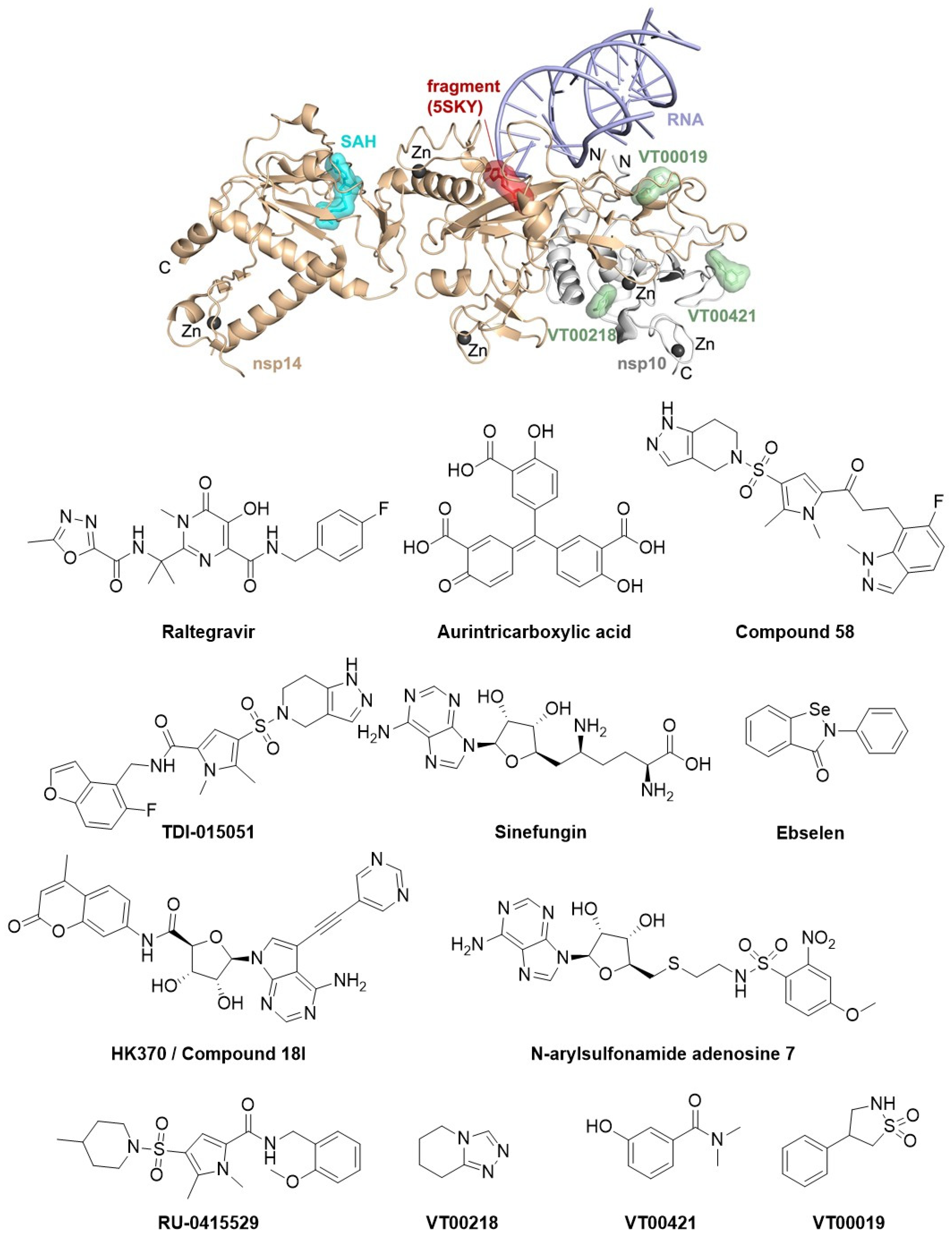
Figure 5.
Top: Structure of the SARS-CoV-2 Nsp14–Nsp10–RNA complex (PDB ID 7N0B), with ligands superposed at the Nsp14–Nsp10 interface (green; PDB IDs 9FWH, 9FWQ, and 9FWU), the ExoN active site (red; PDB ID 5SKY), and the N7-MTase active site (cyan; PDB ID 7R2V). Nsp14 is shown in beige, Nsp10 in grey, RNA in purple, and Zn ions in dark grey. Ligand structures are shown in the top right (VT00019, VT00218, and VT00421).
Bottom: Nsp14/Nsp10 chemical matter and structural context. Representative ExoN-directed inhibitors include aurintricarboxylic acid [
141], Ebselen and Raltegravir [
144], while representative N7-MTase ligands include the SAM mimic Sinefungin and HK370/compound 18L [
146], N-arylsulfonamide adenosine 7 [
147], RU-0415529 and TDI-015051 [
148], and the optimised compound 58 [
149]. Nsp10–Nsp14 interface fragments VT00019, VT00218, and VT00421 are also shown [
151].
Figure 5.
Top: Structure of the SARS-CoV-2 Nsp14–Nsp10–RNA complex (PDB ID 7N0B), with ligands superposed at the Nsp14–Nsp10 interface (green; PDB IDs 9FWH, 9FWQ, and 9FWU), the ExoN active site (red; PDB ID 5SKY), and the N7-MTase active site (cyan; PDB ID 7R2V). Nsp14 is shown in beige, Nsp10 in grey, RNA in purple, and Zn ions in dark grey. Ligand structures are shown in the top right (VT00019, VT00218, and VT00421).
Bottom: Nsp14/Nsp10 chemical matter and structural context. Representative ExoN-directed inhibitors include aurintricarboxylic acid [
141], Ebselen and Raltegravir [
144], while representative N7-MTase ligands include the SAM mimic Sinefungin and HK370/compound 18L [
146], N-arylsulfonamide adenosine 7 [
147], RU-0415529 and TDI-015051 [
148], and the optimised compound 58 [
149]. Nsp10–Nsp14 interface fragments VT00019, VT00218, and VT00421 are also shown [
151].
3.2.5. Chemical Matter—Nsp10-Nsp14 PPI Disruption
High-resolution crystal structures of the SARS-CoV-2 Nsp10–Nsp14 ExoN complex revealed the catalytic His268 in both active and inactive rotamers at 1.3 Å. An X-ray fragment screen (148 fragments) revealed five previously unreported ligandable pockets spanning the Nsp10–Nsp14 interface, the ExoN–hinge, and allosteric sites on Nsp10 (e.g., VT00019, VT00218, or VT00421) [
151]. Nine related fragments clustered in a shared interface pocket, with the best hits binding at sub-mM K
d (0.51–0.56 mM), highlighting PPI disruption and hinge allostery as viable routes and providing merge/grow vectors for FBDD against ExoN activation. Additionally, X-ray fragment screening of Nsp10 identified four fragments in two conserved pockets (one overlapping the Nsp10–Nsp14 interface and the other at the Nsp10–Nsp16 interface), establishing ligandable sites for PPI disruption [
152]. Microscale thermophoresis (MST) quantified a weak Nsp10–Nsp14 affinity (K
d 0.9–1.4 mM across ExoN and full-length constructs), consistent with a chemically dissociable complex.
3.2.6. PK/PD and Safety
The lead non-SAM series (TDI-015051) couples pM target engagement with nM cellular potency and in vivo efficacy in mice (benchmarking near Nirmatrelvir), supporting drug-like exposure and on-target pharmacodynamics for N7-MTase inhibition. Its ternary SAH–inhibitor binding mode exploits Nsp14-specific features of the cap pocket, providing a structural rationale to minimise cross-inhibition of human cap MTases observed with SAM-competitive scaffolds (e.g., adenosine analogues) [
148,
149]. By contrast, ExoN programmes remain preclinical: tool compounds and metals can impair ExoN within the Nsp14–Nsp10 complex, but drug-like orthosteric inhibitors with clear cellular PD have not yet been established, underscoring the need for selectivity panels against host nucleases and RTC-aware assays linking ExoN block to nucleotide analogue sensitisation [
144,
150].
3.2.7. Development Status
The most advanced programme is the Nsp14 N7-MTase series culminating in TDI-015051, a robust preclinical lead, but not yet in human studies. Follow-up medicinal chemistry confirmed the ternary SAH–inhibitor binding mode and improved properties consistent with oral developability, positioning the series for potential IND-enabling work. In contrast, ExoN efforts remain at the hit discovery/FBDD or tool-compound stage, and Nsp10–Nsp14 interface ligands are fragment-level with mM- to μM-range biophysical engagement, encouraging tractability.
3.2.8. Challenges and Opportunities
Proofreading by the Nsp14–Nsp10 complex lowers coronavirus mutation rates and underpins the large genome size. ExoN-defective viruses show elevated error rates and attenuated fitness in cell and animal models, supporting ExoN as a potential drug target. Because this domain excises multiple nucleoside analogues, inhibiting ExoN is expected to sensitise RdRp-targeting NAs. ExoN-loss backgrounds increase susceptibility to agents such as Remdesivir or Ribavirin, motivating combination designs and RTC-aware PD assays. Selectivity remains central: orthogonal panels should de-risk activity against host nucleases and DNA-polymerase proofreading domains, while fragment maps and interface pockets provide allosteric/PPI-disruption routes beyond the metal/RNA orthosteric site [
151]. Tool inhibitors (e.g., Ebselen, Raltegravir) demonstrate tractability but require translation into drug-like chemotypes with clear cellular PD [
144].
Non-SAM, non-covalent Nsp14 N7-MTase inhibitors, such as TDI-015051, exhibit nM cellular potency and in vivo efficacy, validating the target. Resistance mutations that reduce susceptibility arise with fitness costs, and synergy with Nirmatrelvir supports combination backbones [
148]. SAM-competitive series remain enzyme-potent but must improve selectivity versus human cap MTases. The ternary SAH–inhibitor binding mode exploited by TDI-015051 provides a structural pathway for selectivity [
148].
Nsp10 cofactor and PPIs: Sub-mM Nsp10–Nsp14 affinity and fragment-defined pockets at the interface and hinge indicate PPI disruption as a complementary strategy; the dynamic assembly argues for full-length constructs and solution biophysics in screening to avoid false negatives [
153].
Coronavirus mRNA capping relies on the Nsp16 (2′-O-MTase) and N7-MTase, both of which are stimulated by Nsp10. A survey of >13 million SARS-CoV-2 genomes highlighted that Nsp10 is highly conserved, with T12I, T102I, and A104V being the most frequent variants [
154]. Structural and biophysical characterisation indicated that these substitutions have minimal impact on Nsp10–Nsp14/Nsp16 binding and stability, suggesting limited mutational escape capacity and supporting Nsp10-centred PPI disruption as a resilient therapeutic strategy. In summary, Nsp14 in complex with Nsp10 is a high-value target because of its proofreading and capping functions. Recent breakthroughs in the discovery of inhibitors for both of its activities have marked Nsp14 as one of the most exciting antiviral targets. Continued development could yield drugs that not only inhibit SARS-CoV-2 but also render it vulnerable to its own errors or immune detection, a one-two punch strategy for antiviral therapy.
3.3. Nsp16: 2′-O-Methyltransferase
3.3.1. Biology and Rationale
Nsp16, in complex with Nsp10, is a 2′-O-MTase responsible for methylating the ribose 2′-OH of the first nucleotide of the viral mRNA cap, leading to cap-1 formation [
155]. This step is crucial for disguising viral mRNA as host mRNA, as cap-1 formation helps evade innate immune sensors such as MDA5 and IFIT proteins [
156]. Without Nsp16 activity, the virus’s mRNA would be flagged as “non-self” and trigger an immune response. Thus, Nsp16 is important for immune evasion and virulence. Inhibition of Nsp16 could make the virus more susceptible to host defences and directly reduce its replication efficiency. Humans have a 2′-O-MTase, named CMTR1, but it acts on host mRNA in the nucleus [
157]. SARS-CoV-2 Nsp16 acts on viral mRNA in the cytosol, and structural differences exist to allow the development of specific inhibitors [
158].
3.3.2. Assays and Structural Biology
Nsp16 requires complex formation with Nsp10 for activity, as Nsp10 binding stabilises the SAM cofactor pocket [
158,
159]. Numerous structures of the Nsp16–Nsp10 complex exist, including SARS-CoV-2 Nsp16–Nsp10 bound to a cap analogue and Sinefungin [
160]. These reveal a well-formed active site pocket for SAM and a separate binding groove for capped RNA. High-throughput assays measure the transfer of a radiolabelled methyl group from
3H-SAM to a short, capped RNA substrate [
161]. Alternatively, methylation can be detected using mass spectrometry. For screening, coupling assays (such as MTase-Glo that generates light when SAM is consumed) or fluorescence polarization (FP)-based RNA displacement assays can be used [
162,
163]. Additionally, a radiometric scintillation proximity assay (SPA) enabled screening cascades (virtual-to-biochemical-to-cellular) and triage by site occupancy, facilitating structure-guided optimisation [
164].
3.3.3. Chemical Matter
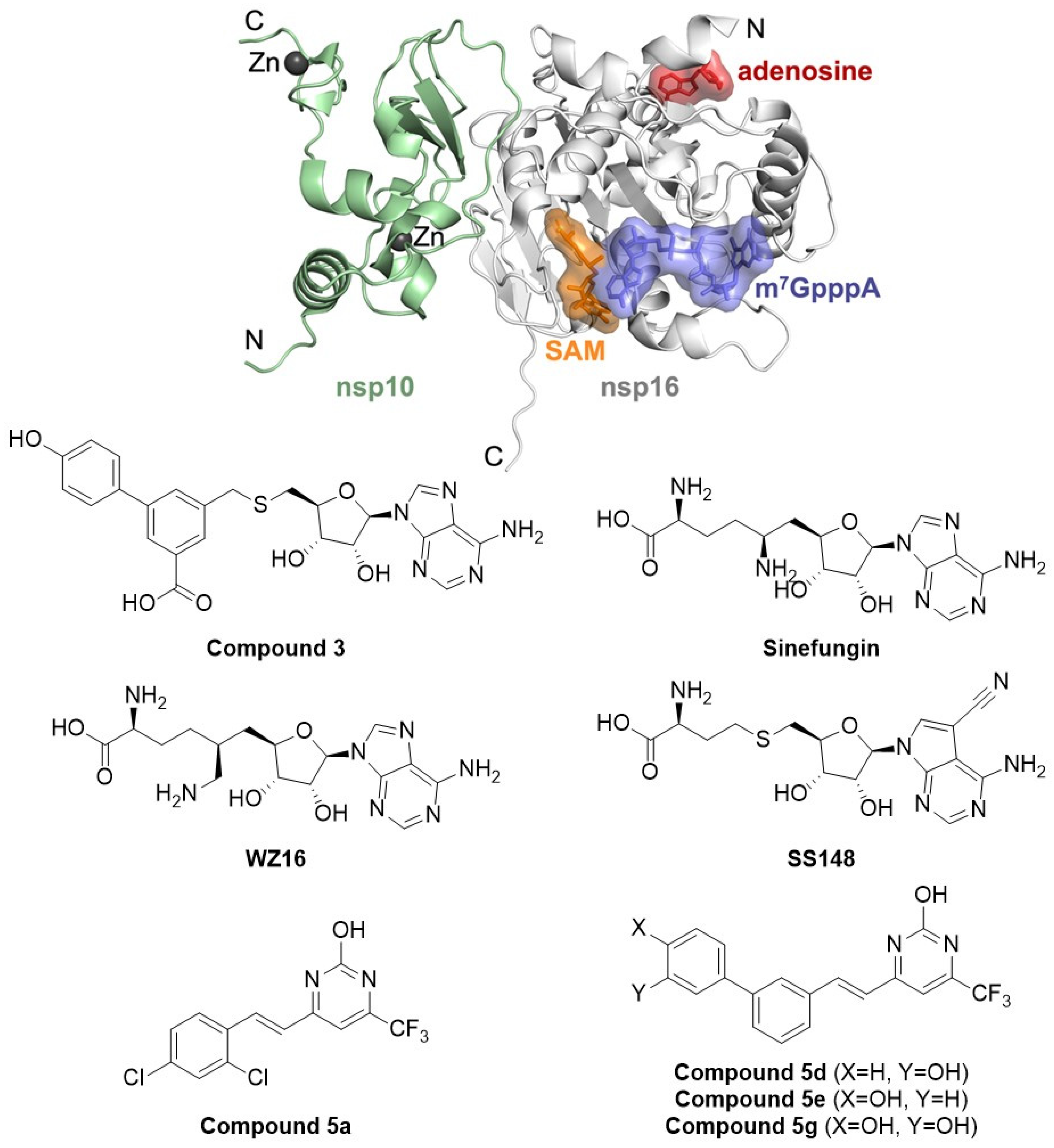
Early SAM-competitive tools, such as Sinefungin (
Figure 6), established tractability but lacked selectivity. Currently, co-crystal structures define a dual-site binding mode in which substrate-based adenosine analogues occupy the SAM subsite and project into the RNA (cap) groove of the target. Exemplars achieved low-nM inhibition of the Nsp16–Nsp10 complex (e.g., Compound
3 IC
50 = 0.8 nM), with clear H-bonding and π-stacking vectors that map potency-driving interactions for SAR [
165]. Orthogonally, Inniss et al. discovered a druggable cryptic pocket adjacent to the SAM cleft, yielding a covalent pyrimidin-2-ol series [
166]. Lead 5a showed time-dependent inhibition with crystallographic confirmation of covalent engagement, and optimised analogues (5d/5e/5g) retained irreversible MTase inhibition and displayed cellular antiviral activity against Mouse Hepatitis Virus (MHV) in L2 cells (6–15 µM), albeit with cell-line-dependent cytotoxicity in some SARS-CoV-2 models. These data validate the allosteric inhibition of Nsp16 as a viable route beyond SAM competition. Complementing these advances, a recent SPA for Nsp16–Nsp10 enabled screening cascades (virtual-to-biochemical-to-cellular) that yielded cell-active hits and classified chemotypes by site occupancy, providing a practical engine for SAR and selectivity optimisation alongside structural analysis. Finally, broad-spectrum benchmarking across all seven human coronaviruses revealed that Nsp16 exhibits low-nM RNA K
m (20–140 nM) and low-µM SAM K
m values on a cap-1-like substrate [
167]. SS148 and WZ16 inhibit the Nsp10–Nsp16 complex (SS148 IC
50 = 0.2–1.5 µM; WZ16 = 2.5–24 µM, species/substrate dependent), underscoring conserved pharmacology while providing useful starting points for broader-spectrum optimisation, albeit with the caveat of modest potency [
167].
3.3.4. PK/PD and Safety
Dual-site adenosine analogues deliver enzyme-level low-nM potency with structural confirmation. The translational risk remains selectivity versus human cap MTases, which the dual-site engagement and shape complementarity to the viral RNA channel could help mitigate, but must be demonstrated experimentally [
165]. Pan-coronavirus profiling indicates cell-active SAM-site inhibitors SS148 and WZ16 with µM potency. These serve as breadth probes but highlight the need to optimise permeability, cellular potency, and human-MTase selectivity for drug-like exposure [
167]. For allosteric chemotypes, cell-line-dependent cytotoxicity and time-dependent covalency require careful PD interpretation and off-target de-risking. Nonetheless, the cryptic pocket provides a structurally validated path to non-SAM inhibition with cellular signals in coronavirus models [
166]. SPA-based workflows support PK/PD linkage by enabling site-mechanism classification of hits prior to cellular assays [
164].
3.3.5. Development Status
The most advanced assets remain preclinical. They include dual-site, substrate-based adenosine analogues with low-nM enzyme potency and clear structure-guided paths towards selectivity [
165]; allosteric covalent tools targeting a cryptic pocket, with low-µM cellular activity in MHV and crystallographic validation [
166]; and the pan-coronavirus SAM-site probes SS148 and WZ16, which show µM potency across human coronaviruses [
164]. Finally, the standardisation of viral species panels, primary airway cell assays, and human MTase selectivity will be key milestones for hit-to-lead progression.
3.3.6. Challenges and Opportunities
The SAM and cap-RNA subsites of Nsp16 are highly polar, and inhibitors designed to mimic SAM or the cap substrate often inherit similar polar physicochemical properties, creating challenges for membrane permeability and selectivity over human MTases. Structural studies have shown that dual-site scaffolds can engage the SAM pocket and extend into the RNA groove to gain potency and shape complementarity, thereby providing a structural basis for selectivity, but they still require careful optimisation for cell entry and oral drug-like properties [
165]. In addition, the discovery of a cryptic/allosteric pocket adjacent to the SAM cleft enables non-SAM mechanisms with greater latitude in the physicochemical space. Covalent pyrimidin-2-ol tools validate this site and show cellular antiviral activity in coronavirus models, albeit with time-dependent inhibition and cell line-dependent cytotoxicity that must be engineered during lead optimisation [
166]. However, because Nsp16 activity depends on Nsp10 and a capped viral RNA substrate, screening should use the Nsp10–Nsp16 complex together with RNA substrates that mimic the native 5′ cap context, and incorporate site-aware workflows to classify SAM-site versus allosteric binders before cellular triage.
Functional constraints on capping and the conserved architecture of Nsp16 across human coronaviruses support pan-coronavirus potential. Broad profiling shows shared inhibitor sensitivity across human coronavirus Nsp16s (e.g., SS148 and WZ16), while sequence differences highlight the need for cross-species SAR and resistance surveillance [
164]. Inhibiting Nsp16 is expected to enhance innate sensing of viral RNA (cap-0/IFIT1 vulnerability). Allosteric inhibitors already show innate-sensitising phenotypes in cells, supporting combinations with polymerase inhibitors or immune modulators where safety allows. Synergy with Nsp14 N7-MTase inhibition (
vide supra) is mechanistically attractive for reducing capping capacity on two fronts. Overall, the Nsp16–Nsp10 complex offers two complementary avenues, dual-site SAM/cap mimetics and allosteric cryptic-site binders, with clear structural guidance. The main opportunities lie in translating enzyme-level potency into selective, cell-active, and orally developable leads with broad spectrum activity against coronaviruses.
3.4. Nsp13: RNA Helicase
3.4.1. Biology and Rationale
Nsp13 is a superfamily-1 (SF1) helicase and RNA 5′-triphosphatase that translocates 5′→3′ on nucleic acids, using NTP hydrolysis to unwind duplex RNA/DNA and initiate cap formation. It is essential for replication of the ~30 kb genome, associating with the RdRp complex, to resolve RNA secondary structures during synthesis. Nsp13 is highly conserved among closely related sarbecoviruses, including SARS-CoV and SARS-CoV-2, and preserves core helicase and ATPase motifs across β-coronaviruses, underscoring its strong functional constraint [
168]. Beyond its unwinding role, Nsp13 antagonises innate immunity, most notably by binding TBK1 to blunt IRF3 activation and type-I interferon signalling. It also engages the host deubiquitinase USP13, which stabilises Nsp13 and further dampens interferon (IFN) responses [
169]. Given its essential enzymatic function and limited homology to human SF1 helicases at drug-binding surfaces, Nsp13 is a potential antiviral target, albeit helicases have historically been difficult to drug.
3.4.2. Assays and Structural Biology
Helicase activity is measured by assays in which it unwinds a labelled double-stranded oligonucleotide (one strand is often radiolabelled or fluorescently tagged). ATPase activity (NTP hydrolysis) can also be monitored via colorimetric or luminescent phosphate detection [
170,
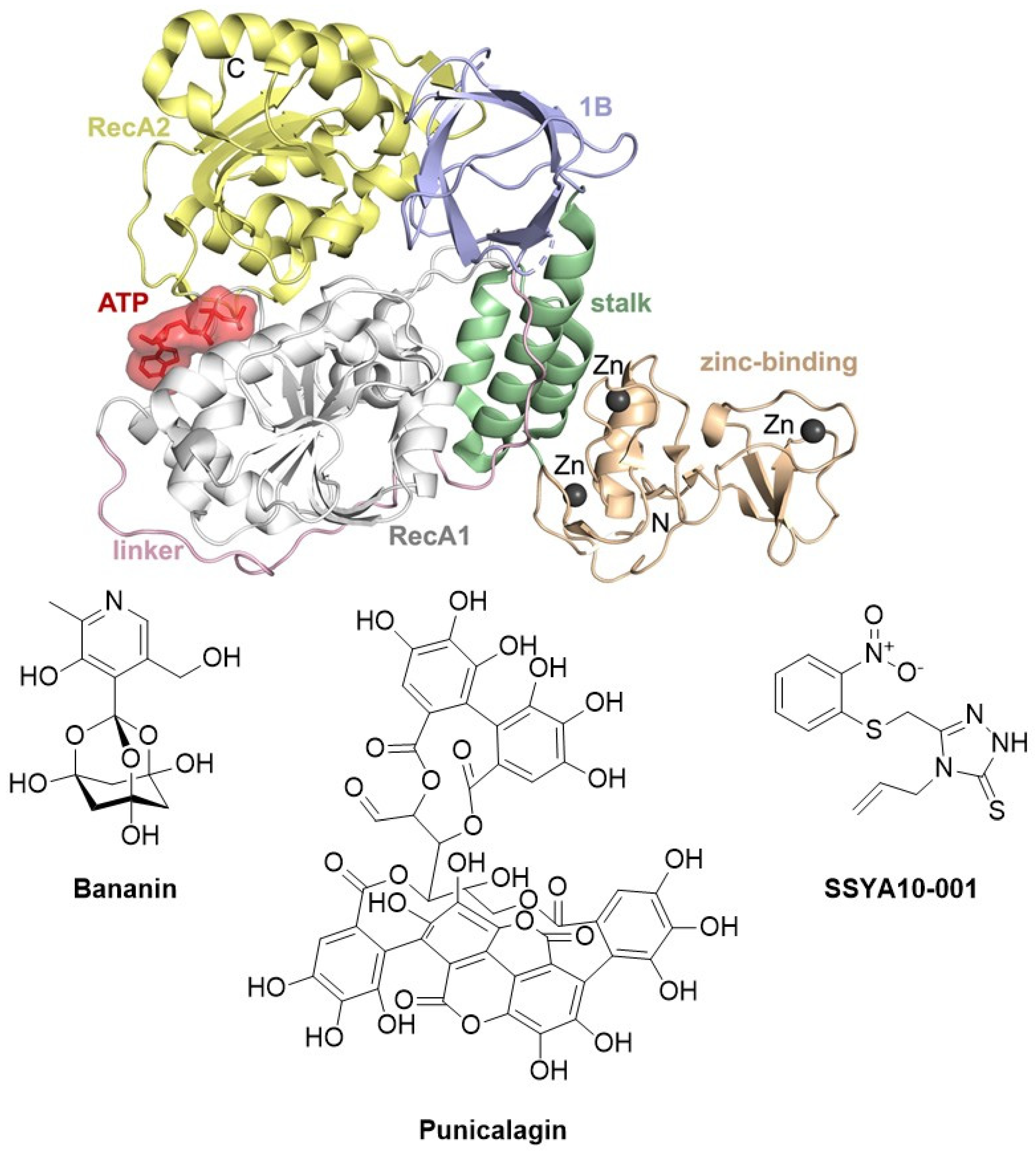
171]. Several structures of Nsp13 exist, showing the arrangement of the five domains: zinc-binding, stalk, 1B, RecA1 and RecA2 [
172]. Importantly, a cryo-EM structure places Nsp13 within the polymerase RdRp/Nsp7/Nsp8 complex, where two Nsp13 molecules associate with the RTC to help translocate along RNA [
173]. These structural details reveal pockets at the ATP binding site and at the junction of the 1A/2A domains, offering potential drug-binding sites.
3.4.3. Chemical Matter
Early “broad-spectrum” helicase chemotypes such as Bananins (
Figure 7) [
174,
175] and Suramin [
176]. (
vide supra, RdRp section) showed activity against SARS-CoV and SARS-CoV-2 helicase. However, their non-specific, multi-target behaviour and poor drug-like properties such as high charge and polarity, and frequent aggregation, confine them to tool-compound status rather than leads. Recent structural work mapped two druggable and highly conserved pockets on helicase and delivered 65 crystallographic fragment hits, providing concrete anchor points for structure-guided campaigns [
172]. Complementing this, an AViDD-led HTS (∼650,000 molecules) built a robust 1536-well helicase assay (average Z′ ≈ 0.86) and identified 674 compounds with IC
50 < 10 μM, establishing a sizeable, tractable starting set [
177]. Specific small-molecule exemplars now include SSYA10-001, which inhibits SARS-CoV-2 helicase and retains activity against the prevalent R392C Omicron-lineage variant, and the natural product Punicalagin, an allosteric inhibitor that binds at the 1A/2A interface (K
d = 21.6 nM) and suppresses replication in cells (EC
50 = 0.20–0.35 μM).
Despite sustained efforts, no helicase inhibitor has yet matched the potency of Mpro leads. The core hurdle is selectivity: the helicase catalytic site binds ATP, which is used by many host enzymes. Therefore, small molecules must exploit Nsp13-specific features, such as the RNA-binding channel, allosteric pockets between domains, or the conformational cycle that couples ATP hydrolysis to translocation. Several reported “selective” chemotypes likely work by stabilising an ADP-bound or “open state” that is incompetent for nucleic-acid engagement or product release. Encouragingly, recent high-resolution structures, fragment maps, and validated hit sets provide a solid foundation for FBDD/SBDD optimisation toward oral-drug-like scaffolds with improved on-target selectivity.
3.4.4. PK/PD and Safety
No helicase-directed compounds have yet demonstrated in vivo efficacy, and their ADME and pharmacokinetic properties remain insufficiently characterised in human-relevant systems. Suramin illustrates the pitfalls of early chemotypes such as parenteral administration, high polarity, and broad off-target liabilities. Therefore, it serves as a tool rather than a lead. A clinically viable helicase inhibitor should achieve rapid, sufficient exposure in the airway epithelium early in infection, favouring oral or inhaled delivery with high lung:plasma ratios, show clean selectivity versus host helicases/NTPases, especially human superfamilies 1 and 2 RNA/DNA helicases and the mitochondrial replicative helicase TWNK (“Twinkle”), and avoid generic liabilities (P-gp efflux, lysosomal trapping, hERG liabilities, phospholipidosis). The moderate interspecies conservation of Nsp13 across β-coronaviruses (>70% identity between SARS-CoV-2 and MERS-CoV) suggests that a single well-tuned scaffold may not deliver pan-coronavirus breadth [
178]. Even more important, antiviral selectivity must be demonstrated explicitly with host helicase and mitochondrial safety panels before first-in-animal studies [
179].
3.4.5. Development Status
Helicase inhibitors are still in the early stages of discovery. Due to its essential role and high degree of conservation, Nsp13 is considered a high-value target for pan-coronavirus therapeutics, despite the potential challenges in achieving universal breadth across all lineages. Nevertheless, inhibitors could also potentially act on other viral families with related helicases (though coronavirus helicases are somewhat unique to Nidoviruses) [
173]. Given the difficulty, one strategy considered is targeting a host cofactor if any are needed by Nsp13. However, helicase largely works independently (with some stabilisation from Nsp8/Nsp12) [
180]. Another strategy is to disrupt the interaction of Nsp13 with the RTC. For instance, helicase binds to Nsp8 and possibly RdRp, and a peptide or small molecule that interrupts that interface could indirectly inhibit helicase function. This is being explored by leveraging the structural data of helicase–RTC.
3.4.6. Challenges and Opportunities
Few licensed antivirals directly target the viral helicases. While herpesvirus helicase–primase inhibitors (exemplified by Amenamevir) provide a precedent [
181], no RNA-virus helicase inhibitor has been approved. Nsp13’s mechano-chemical cycle involves large conformational changes during ATP binding/hydrolysis and translocation, likely creating transient, allosteric pockets that can be exploited [
182]. Advances such as time-resolved cryo-EM and crystallography, alongside fragment maps, should help reveal and stabilise these states for structure-enabled design. Potency and selectivity versus host helicases remain key hurdles, and with two Nsp13 copies per RTC, shallow inhibition may be buffered. Nevertheless, partial conformation-locking inhibitors can still sufficiently slow replication, especially in combination with RdRp or protease inhibitors, to tip the balance toward immune clearance.
In terms of opportunities, Nsp13 helicase inhibitors could be deployed in combination with other DAAs in future outbreak settings. Although the catalytic helicase core and ATPase motifs are strongly conserved, peripheral and allosteric regions may vary more substantially across distant coronaviruses. Therefore, a scaffold optimised only against SARS-CoV-2 may not automatically deliver pan-coronavirus breadth; early cross-species biochemical, structural, and cellular profiling will be required to prioritise inhibitors that engage conserved functional pockets. At the same time, the strong functional constraints on Nsp13 may increase the barrier to resistance, as mutations that reduce inhibitor binding could also impair helicase activity and viral fitness. Consistent with this, relatively few Nsp13 substitutions have been observed among major SARS-CoV-2 variants compared with more variable viral proteins, although this observation should be interpreted cautiously until clinically validated helicase inhibitors impose direct selective pressure [
183]. In summary, Nsp13 is a tantalising but challenging target. Progress is being made in the discovery of hits. A concerted effort similar to that devoted to HCV helicase inhibitors could still yield a viable candidate, although none of those inhibitors has yet reached approval.
3.5. Nsp15: Uridylate-Specific Endoribonuclease (NendoU)
3.5.1. Biology and Rationale
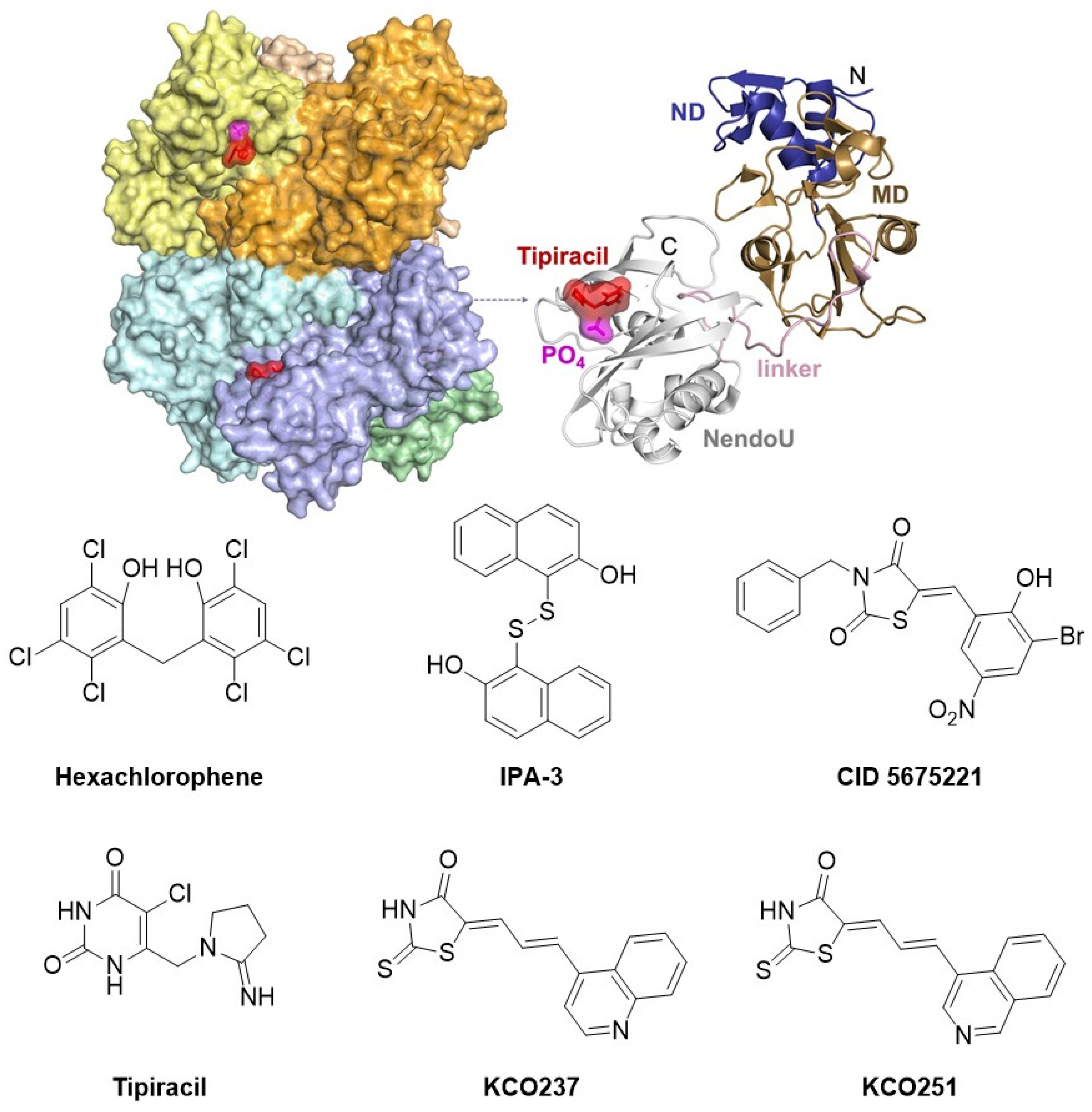
Nsp15 is a 345-amino-acid endoribonuclease that preferentially cleaves RNA 3′ of uridines, hence its designation as a poly(U)-specific endonuclease (NendoU) [
184]. It is highly conserved across coronaviruses (e.g., 88% sequence identity between SARS-CoV and SARS-CoV-2) [
185], underscoring its important role in the viral lifecycle. Unlike the exonuclease Nsp14, Nsp15 is not strictly required for viral RNA synthesis in cell culture [
184]. Instead, its principal function is to help the virus evade host innate immunity. Nsp15 specifically degrades viral RNA byproducts (particularly polyuridine sequences in double-stranded RNA replication intermediates), which would otherwise trigger intracellular sensors and induce interferon responses. Coronaviruses with catalytically inactive Nsp15 replicate but are attenuated: for example, Nsp15-deficient mutant viruses in mice and pigs showed markedly reduced virulence, elevated interferon levels, and rapid clearance by the host [
186]. By trimming 5′-polyU stretches on negative-sense RNAs, Nsp15 “hides” the virus from RNA sensors, making it a critical virulence factor. This immune evasion role provides a clear rationale for targeting Nsp15, and inhibiting its nuclease activity could unmask the virus to innate defences, thereby suppressing infection. Notably, because Nsp15 activity is not essential for genome replication
per se, an Nsp15 inhibitor might not completely block virus growth in cell culture on its own, but it could synergistically reduce pathogenicity and replication fitness in vivo by allowing immune recognition [
184]. The high conservation of Nsp15 and the severe fitness cost of Nsp15 loss reinforce its attractiveness as an antiviral target [
185].
3.5.2. Assays and Structural Biology
Nsp15 forms an active hexamer (dimer of trimers), and oligomerisation is essential for properly organising the catalytic site and conferring positive cooperativity [
184]. Each 38–39 kDa protomer contains an N-terminal oligomerization domain (ND), a middle domain (MD), and a C-terminal endoribonuclease (NendoU) domain. The six active sites face the hexamer central pore. Catalysis occurs at the His235, His250, Lys290 triad and follows an RNase-A-like mechanism [
185]; His250 activates the RNA 2′-OH for in-line attack, His235 protonates the leaving 5′-oxygen, and Lys290 stabilises the transition state, yielding a 2′,3′-cyclic phosphate and a 5′-OH [
187]. Uridylate selectivity is mainly enforced by Ser294, Thr341, Tyr343, which shape a U-recognition pocket [
185]. Nsp15 is only active as a hexamer. A truncated monomeric form (lacking the oligomerisation domain) was crystallised from SARS-CoV-1 and showed a distorted active site and loss of function, suggesting that protomer–protomer interactions serve as an allosteric switch to organize the active site properly [
184]. Consistent with this, kinetic studies show the enzyme exhibits positive cooperativity within the hexamer. For instance, substrate binding and turnover are enhanced by the oligomeric assembly [
188].
Biochemically, Nsp15 endonuclease activity is often measured using short RNA substrates containing uridine and detectable labels. A common high-throughput assay is a fluorescence resonance energy transfer (FRET) cleavage assay: for example, an RNA oligonucleotide labelled with a 5′ fluorophore (e.g., FAM) and 3′ quencher will yield increased fluorescence when Nsp15 cleaves it and separates the quencher [
189]. In addition to FRET assays, radiolabelled RNA cleavage assays have been used. For instance, an internally
32P-labeled poly(U) RNA or a short 5′−
32P RNA can be incubated with Nsp15 and the cleavage products can be separated by gel electrophoresis [
190].
Structurally, Nsp15 has been studied using X-ray crystallography and cryo-EM, revealing insights into its dynamics. Cryo-EM studies of SARS-CoV-2 Nsp15 further revealed that the enzyme can adopt at least two distinct conformational states: an “open” state where the endoribonuclease domain is positioned to accommodate substrate, and a “closed” state in which active-site loops constrict, potentially representing an inactive or post-catalytic state [
188]. pH-dependent movements and rotations of the endoU domain have been observed, hinting at an inherent flexibility that might regulate catalysis. This conformational malleability is of interest because it suggests additional allosteric mechanisms for the regulation of the protein.
3.5.3. Chemical Matter
While Nsp15 remains an attractive therapeutic target, no specific antivirals have yet advanced to clinical development; nevertheless, various inhibitor chemotypes have been identified through repurposing and high-throughput screening. The most prominent active-site inhibitor is Tipiracil (
Figure 8), an uracil analogue approved for use in oral chemotherapy (Trifluridine/Tipiracil). Tipiracil (IC
50 = 5–15 µM) was identified early in the pandemic as a potential Nsp15 binder owing to its similarity to uridine [
190]. Structural studies confirmed that Tipiracil inserts into the uridine-binding pocket of the Nsp15 active site (PDB ID 6WXC). In addition to Tipiracil, several high-throughput screens have identified Nsp15 inhibitors with diverse mechanisms. A recent screen of >100,000 compounds yielded five chemically distinct lead inhibitors [
189], including hexachlorophene (a polyphenolic antiseptic), IPA-3 (a pyrimidinone known as a PAK1 kinase inhibitor), and a sulfonamide analogue (CID 5675221). These compounds inhibited SARS-CoV-2 replication in cell culture at sub-cytotoxic concentrations, showed low-μM potency in enzymatic assays, and achieved measurable antiviral effects in cells, making them valuable starting points for drug development. Notably, IPA-3 was found to act as an irreversible inhibitor of Nsp15, likely by covalently modifying one or more cysteine residues of this enzyme. A recent study reported that Thiazolidinedione and Rhodanine analogues are first-in-class NendoU inhibitors [
86]. The lead compounds KCO237 (IC
50 = 0.3 μM) and KCO251 (IC
50 = 0.9 μM) suppressed SARS-CoV-2 replication in Vero E6 cells at non-toxic concentrations. Together, these chemotypes provide tractable starting points for structure-guided optimisation of selective Nsp15 inhibitors.
Looking ahead, the discovery of allosteric sites on Nsp15 opens the door for the development of non-active-site inhibitors. Fragments binding at the Nsp15 interdomain interfaces could, in principle, disrupt the hexamer or stabilise an inactive conformation. Such allosteric inhibitors might avoid the challenge of competing with RNA substrates in the highly polar active site. Indeed, a comprehensive fragment-based crystallographic screen (>1400 fragments) was recently performed by Godoy et al., identifying several small-molecule binding sites outside the active site [
188]. This fragment screen identified several ligandable pockets on the Nsp15 surface. Future campaigns could exploit these to design larger drug-like, potent inhibitors. Any small molecules that prevent Nsp15 from assembling into its active hexamer or lock the enzyme in a “closed” state would effectively shut down its nuclease function. Although no advanced allosteric inhibitors have been reported, this strategy is an active area of research.
3.5.4. Translational Considerations (Resistance and Opportunities)
Nsp15 remains an attractive yet challenging target for antiviral development. Its conservation across coronaviruses supports the possibility of broad-spectrum inhibition and aligns well with pandemic preparedness goals [
184,
189]. In principle, this conservation may also favour a relatively high barrier to resistance because mutations in or near the catalytic site can compromise enzymatic function and reduce viral fitness [
191]. However, recent studies have shown that coronaviruses can acquire Nsp15 inhibitor escape mutations, even if these come with fitness costs [
192]. Likewise, functional disruption of Nsp15 does not invariably cause severe attenuation but rather produces context-dependent defects that are most apparent in settings where innate immune control is relevant. Because Nsp15 contributes primarily to immune evasion and broader viral fitness rather than serving as a primary replication enzyme, its greatest value may lie as a complementary target in combination regimens [
193,
194]. Finally, although Nsp15 lacks a close human counterpart in the viral replication machinery, humans do encode an EndoU homolog and, therefore, selectivity over host nucleases remains an important medicinal chemistry consideration. Overall, Nsp15 is best viewed as a promising adjunctive target whose inhibition could strengthen current antiviral strategies while contributing to broader coronavirus preparedness and responses.
4. Emerging but Strategically Important Targets
A further group of Nsps remains at an earlier stage of chemical validation but retains strategic importance because of their distinctive biology, mechanistic complementarity, and potential relevance to long-term coronavirus preparedness. These targets are not yet supported by the same depth of translational evidence as the benchmark or near-term priority tiers, and in some cases, the available chemical matter remains limited, indirect, or predominantly tool compounds. Nevertheless, they continue to merit attention because they illuminate underexploited vulnerabilities in viral gene expression, host interaction control, and replication complex regulation, which may become increasingly actionable as assay systems, structural data, and screening approaches improve. Nsp1, the Nsp3 macrodomain (Mac1), and related emerging intervention nodes occupy an important exploratory space in the antiviral landscape. Although they are not immediate front-runners for clinical translation, they may help define the next generation of unconventional yet mechanistically valuable antiviral agents.
4.1. Nsp1: Host Translation Suppressor
4.1.1. Biology and Rationale
Nsp1 is a 180 amino-acid protein that binds to the 40S ribosomal subunit and blocks host mRNA entry into the ribosome, effectively shutting down host protein synthesis [
195]. By doing so, Nsp1 also dampens the host innate immune response (e.g., interferon production) [
196,
197]. The C-terminal helical region of Nsp1 (amino acids 150–180) inserts into the ribosomal mRNA channel, mimicking host translation initiation factors [
195]. This unique mechanism makes Nsp1 an attractive target and disabling Nsp1 could restore host antiviral protein synthesis and tip the balance in favour of the host during infection [
198]. In animal models and primary cells, Nsp1 is required for efficient replication and pathogenesis [
195,
199,
200].
4.1.2. Assays and Structural Biology
Structures of Nsp1 bound to the 40S ribosome via cryo-EM have confirmed the binding mode and key residues involved [
201]. These structural insights enabled in silico drug and fragment-based screening against two functional regions of Nsp1: the RNA-binding groove within the N-terminal domain and the C-terminal helix–loop–helix region [
202]. Cell-based assays for Nsp1 function often measure the restoration of reporter gene translation in the presence of Nsp1, or Nsp1’s inhibition of interferon-stimulated gene expression [
203].
4.1.3. Chemical Matter
Through virtual screening of FDA-approved drugs, Montelukast (an asthma drug) (
Figure 9) emerged as a top hit binding to the Nsp1 C-terminus [
204]. Montelukast was found to bind Nsp1 with a K
d of 10.8 μM in vitro and form a stable Nsp1–Montelukast complex in molecular dynamics simulations. In cells, Montelukast relieved Nsp1-mediated translation inhibition (rescuing a luciferase reporter) and reduced SARS-CoV-2 replication in the infected cell culture. These data validate small molecule targeting Nsp1’s ribosome-binding function and exhibit antiviral activity. Montelukast is considered a lead compound for Nsp1 and, potentially, analogues could improve its affinity. In line with this, Kao et al. identified synergistic repurposed combinations that blunt Nsp1 activity. A combination of Ponatinib, Rilpivirine, and Montelukast reversed Nsp1-driven translational shutdown to levels comparable with Nsp1 loss-of-function and mitigated Nsp1 toxicity in cells, supporting combination strategies for Nsp1 targeting [
202]. These data reinforce Montelukast’s on-target contribution within multi-drug regimens and further validate the disruption of the Nsp1–ribosome interface as a druggable mechanism.
In addition, studies have identified cryptic pockets in the N-terminal Nsp1 domain via NMR and crystallography that accommodate small ligands (
Figure 9) [
205]. For example, fragment-based X-ray screening revealed two distinct ligand-binding sites on Nsp1 [
206]. Furthermore, using anomalous diffraction at two low X-ray energies, Ma et al. showed that fragments containing sulphur or chlorine substituents (e.g., 11C6) bound to Nsp1 can be placed with high confidence, resolving multiple orientations and improving FBDD model accuracy, which is useful for refining SAR studies [
207].
Figure 9.
Top left: Crystal structure of the SARS-CoV-2 N-terminal Nsp1 domain (grey), with representative ligands superposed at binding site I (red; PDB ID 8CRF) and binding site II (orange; PDB ID 8AZ8).
Top right: Structure of the 40S ribosomal subunit (grey) bound to the SARS-CoV-2 C-terminal Nsp1 region (magenta) (PDB ID 6ZLW).
Bottom: Chemical starting points for Nsp1 inhibition, including Montelukast, a reported Nsp1 binder that rescues Nsp1-mediated translation shutoff [
204], and fragment hits 11C6, 5E11, 8E6, and 2E10 [
207].
Figure 9.
Top left: Crystal structure of the SARS-CoV-2 N-terminal Nsp1 domain (grey), with representative ligands superposed at binding site I (red; PDB ID 8CRF) and binding site II (orange; PDB ID 8AZ8).
Top right: Structure of the 40S ribosomal subunit (grey) bound to the SARS-CoV-2 C-terminal Nsp1 region (magenta) (PDB ID 6ZLW).
Bottom: Chemical starting points for Nsp1 inhibition, including Montelukast, a reported Nsp1 binder that rescues Nsp1-mediated translation shutoff [
204], and fragment hits 11C6, 5E11, 8E6, and 2E10 [
207].
4.1.4. PK/PD and Safety
As an approved asthma drug, Montelukast is orally available with a well-characterised human safety profile [
208]. However, achieving sufficient concentrations at the site of SARS-CoV-2 replication (e.g., lung tissues) is necessary. Currently, no dedicated ADME studies have been reported for Nsp1 inhibitors but repurposed drugs such as Montelukast provide a head start on safety considerations.
4.1.5. Development Status
Currently, there are no potent lead compounds for Nsp1. The proof-of-concept demonstrated by Afsar et al. in 2022 using Montelukast has spurred interest in Nsp1 [
204]. For this reason, Montelukast was explored in some clinical studies for COVID-19, but the results were inconclusive [
200,
209]. Ongoing academic efforts aim to optimise Nsp1 inhibitors with greater potency and specificity.
4.1.6. Challenges and Opportunities
The central challenge is selectively disrupting Nsp1–ribosome binding without perturbing normal translation [
210]. Fortunately, the unique C-terminal insertion site offers a specificity window not used by host factors; therefore, identifying specific inhibitors should be achievable [
198]. An opportunity lies in the broad-spectrum potential of Nsp1, which is highly conserved among SARS-like coronaviruses belonging to the Sarbecovirus subgenus (which includes SARS-CoV and SARS-CoV-2) [
198]. Finally, combining an Nsp1 inhibitor with an antiviral that directly blocks replication could yield additive or synergetic therapeutic benefits [
211].
4.2. Nsp3 Macrodomain 1 (Mac1)
4.2.1. Biology, Rationale, Assays and Structural Biology
The Mac1 (ADP-ribose-1″-phosphatase) domain of Nsp3, often called a “viral macrodomain”, counteracts host ADP-ribosylation signals and may help the virus evade immune responses involving PARP enzymes [
212]. Mac1 is essential for efficient replication and immune evasion, making it a prime target for antivirals [
111]. The Mac1 domain’s ADP-ribose binding site has also been determined crystallographically [
212,
213], and enzymatic assays measuring hydrolysis of ADP-ribose-1″-phosphate allow screening for Mac1 inhibitors [
214].
4.2.2. Chemical Matter
Targeting the Mac1 ADP-ribose binding site is challenging, as it is a shallow pocket that binds a small polar substrate [
215]. Nonetheless, fragment screening and structure-guided design have identified some hits [
215]. A recent study discovered a series of 2-amide-3-methylester thiophene compounds that bind to the Mac1 domain, with one lead compound (Compound
27, IC
50 = 2.1 μM) (
Figure 10) suppressing coronavirus replication in cells [
216]. This provided the first chemical validation of Mac1 as an antiviral target. The Mac1 inhibitor exhibited an on-target mechanism by inhibiting viral RNA replication without significant cytotoxicity, confirming Mac1’s role by showing loss of efficacy against a Mac1-mutant virus [
216]. These studies are crucial “hit identification” steps, although Mac1 inhibitors are still in the early phase. Notably, Mac1 is highly conserved in all coronaviruses, including distant ones, so a Mac1 inhibitor could be pan-coronaviral, a strong motivation for further development [
217].
4.2.3. Challenges and Opportunities
Mac1 inhibitors would need to avoid human macrodomains, but humans have no close analogue of viral Mac1, lowering the risk of cross-reactivity [
218]. Mac1 inhibitor work is more nascent but is attracting interest due to Mac1’s role in suppressing innate immunity and efforts to obtain co-crystal structures of Mac1 with small molecules are ongoing. A current limitation is that inhibitors often have low potency, but fragment-linking approaches or covalent warheads, if a nearby residue allows, may increase affinity. The advantage of this approach is its pan-coronavirus potential. Mac1 is nearly invariant even in distant coronaviruses; therefore, a Mac1 drug could be stockpiled for future coronavirus outbreaks [
219].
4.3. SARS-Unique Domain (SUD) Within Nsp3
Another interesting and emerging target within Nsp3 is the SARS-unique domain (SUD) [
220]. SUD offers an orthogonal mechanism: it binds host/viral G-quadruplex (G4) RNAs and Paip1M, and SARS-CoV-2 SUD is highly flexible, lacking the SARS-CoV interdomain disulfide. Engineering this disulfide back into SARS-CoV-2 was lethal to the virus, underscoring functional constraints alongside conformational plasticity that may complicate design [
109]. A biolayer interferometry (BLI)-guided screen identified theaflavin 3,3′-digallate (TF3) (
Figure 10) as a direct SUD binder (K
d of 2.8 μM) that disrupts SUD–G4 and SUD–Paip1M interactions and shows antiviral activity (Vero E6-TMPRSS2 cells EC
50 of 5.9 μM and CC
50 of 98.5 μM; comparable potency in Calu-3 cells), providing proof-of-concept that the SUD–G4 interface harbours exploitable pockets [
109]. Together, these data nominate the G4-interface and allosteric patches on SUD as tractable sites, with the caveat that conformational flexibility and the absence of an enzymatic readout demand structure-enabled and biophysics-led campaigns to progress potency and selectivity.
5. Cross-Cutting Strategic Lessons for NSP-Directed Antiviral Development
Across the benchmark, near-term, and emerging target tiers discussed above, several strategic lessons have become clear for the continued development of Nsp-directed antivirals. SARS-CoV-2 drug discovery has progressed from an urgent, largely crisis-driven search for deployable single agents to a more mature framework that prioritises mechanistic complementarity, resistance-aware design, and preparedness beyond the current virus. These lessons extend beyond any individual target and instead define the principles that should guide the next generation of antiviral development: how to combine orthogonal mechanisms rationally, how to prioritise conserved viral functions for broader-spectrum utility, and how to integrate structural biology, screening strategies, and pharmaceutical considerations to shorten the path from discovery to clinically useful therapy. In this section, we synthesise these cross-cutting principles to clarify what has been learned from the first wave of SARS-CoV-2 antivirals and which strategic choices are most likely to support durable, variant-resilient, and practically deployable coronavirus treatments in the future.
5.1. RTC Coupling as the Mechanistic Basis for Combination Design
SARS-CoV-2 RNA synthesis is executed by the multisubunit RTC (“replisome”) (
Figure 11) centred on RdRp (Nsp12) bound to Nsp7 and Nsp8 cofactors. Cryo-EM and crystallography have shown that long helices in Nsp8 form positively charged “sliding poles” that guide nascent RNA and increase processivity. Two helicases (Nsp13) can dock atop the polymerase; their ATP-driven translocation can induce RdRp backtracking, exposing the 3′ end of the nascent strand to the Nsp14 ExoN domain for proofreading and potentially promoting the template-switching events required for subgenomic RNA synthesis. The Nsp10 cofactor is a hub that activates both Nsp14 ExoN and Nsp16 2′-O-MTase, completing mRNA capping along with Nsp14’s N7-MTase activity. Nsp9 contributes to single-stranded RNA binding in the complex. This integrated architecture nicely explains why inhibiting one node can influence others and suggests rational combinations, such as pairing an RdRp inhibitor with agents that target proofreading (ExoN) or capping (MTases), or allosteric disruptors of helicase–polymerase coupling [
221].
5.2. Combination Strategies and Orthogonal Mechanistic Pairing
Antiviral therapy for coronaviruses is likely to benefit from the same broad principles that transformed HIV and HCV care: targeting independent, essential steps in the viral life cycle and combining agents with orthogonal pathways to improve antiviral effect and prolong durability. For SARS-CoV-2, the strongest current support for this strategy comes from preclinical studies of DAA combinations and from clinical studies pairing antiviral therapy with stage-appropriate immunomodulation.
Preclinically, orthogonal DAA–DAA pairs have shown encouraging results. In vitro studies report consistent synergy between Remdesivir and Nirmatrelvir, and independent work shows that nucleoside analogues can synergise with host-directed entry-pathway inhibitors such as Camostat or Nafamostat [
222,
223,
224]. In addition, combination treatment with Molnupiravir and Nirmatrelvir improved virological and clinical readouts relative to monotherapy in rhesus macaques and improved survival in a lethal mouse model [
222,
225,
226]. Together, these data support the concept that polymerase–protease or virus–host combinations can enhance antiviral efficacy through mechanistic complementarity.
Clinically, the clearest evidence for orthogonal pairing comes from stage-appropriate addition of immunomodulators to antiviral or standard-of-care backbones in hospitalized disease. Baricitinib plus Remdesivir shortened recovery time compared with Remdesivir alone in ACTT-2 [
227]. Dexamethasone reduced 28-day mortality in hospitalized patients requiring oxygen or ventilatory support [
228]. In critically ill patients, IL-6 receptor blockade with Tocilizumab or Sarilumab improved organ-support-free days and survival, and Baricitinib also reduced mortality in COV-BARRIER [
229,
230,
231]. These data support the broader principle that once disease biology shifts from predominantly viral replication to host inflammatory injury, combining antiviral pressure with calibrated immunomodulation can improve outcomes.
5.3. Resistance, Conservation, and Barrier-to-Escape Design
Functional mapping and rapid in vitro selection have delineated multiple resistance pathways for SARS-CoV-2 M
pro. Deep mutational scanning and serial passage under Nirmatrelvir pressure identified substitutions such as A173V that reduce drug susceptibility while variably impacting fitness, providing a mechanistic atlas of tolerated changes near the S1/S2 subsites [
58]. For Ensitrelvir, repeated passage selects M49L, a residue shaping the S2 pocket, frequently in combination with E166A, a key S1 wall contact, with the double mutant displaying marked resistance and a demonstrable fitness cost in drug-free conditions [
60]. Orthogonal profiling across protease chemotypes further shows that S144A and L167F confer the greatest resistance to Ensitrelvir, intermediate effects on Nirmatrelvir, and little effect on some next-generation 3CL
pro inhibitors, underscoring the value of cross-series benchmarking [
232]. Early clinical surveillance is beginning to detect M49L and related changes in treated populations, although at low prevalence to date [
233,
234].
Resistance to polymerases remains relatively rare in the clinic but is tractable in the laboratory. The Remdesivir-associated E802D substitution in RdRp has emerged in prolonged infections under therapy and carries measurable fitness costs, consistent with the conserved nature of the RdRp active site [
96]. Separately, population-scale phylogenomics have linked Molnupiravir use to a distinctive, transition-rich mutational signature (notably G→A changes) in circulating lineages, with occasional onward transmission. This is an expected pharmacodynamic consequence of an error-prone nucleoside, but one that reinforces antiviral stewardship and combination logics [
97].
Two principles emerge from this data. First, combination therapy with mechanistically orthogonal agents (e.g., M
pro + RdRp) is favoured, as it narrows escape routes and raises the genetic barrier, especially in immunocompromised hosts where viral replication persists. Second, prioritise targets in which resistance carries inherent fitness penalties, such as proofreading and capping machinery, so that any escape demands a virological cost [
234].
5.4. Discovery-Enabling Technologies: Structural Biology, RTC-Aware Assays, and AI-Assisted Prioritisation
Community-scale, structure-guided discovery during the COVID-19 pandemic showed how rapidly high-quality leads can emerge when crystallography, computation, medicinal chemistry, and open data are tightly integrated. The open-science COVID Moonshot is a prominent example, combining fragment maps, extensive structural data, and iterative design cycles to generate potent non-covalent M
pro leads on a rapid timescale [
235,
236]. Importantly, this effort was distinct from Pfizer’s internal programme that produced Nirmatrelvir, but it nevertheless illustrated a scalable model for accelerated antiviral lead discovery. More recently, ISM3312 has provided a useful example of how generative design, virtual screening, and structural optimisation can be combined to produce a non-peptidic M
pro inhibitor with activity against multiple coronaviruses and nirmatrelvir-resistant mutants [
48]. Together, these efforts illustrate how rapidly integrated structural, computational, and medicinal-chemistry workflows can accelerate antiviral lead discovery.
In parallel, cryo-EM has illuminated the dynamic states of the RTC. Studies have resolved Nsp13-driven backtracking of RdRp and captured multiple conformational states of the RTC assembly, revealing transient allosteric opportunities that are invisible in static models [
237]. Methodological advances, such as time-resolved cryo-EM, are now routinely capturing short-lived intermediates relevant to binding and resistance, tightening the loop between the hypothesis, structure, and design.
5.5. Strategic Roadmap for Next-Generation Nsp Antivirals
Despite major therapeutic advances, important scientific and translational gaps still constrain the durability, breadth, and real-world applicability of current antiviral strategies. The next phase of SARS-CoV-2 drug discovery will therefore depend not only on identifying additional active molecules, but on embedding those molecules within a more disciplined development framework that links target choice, treatment timing, resistance management, combination design, delivery, and preparedness. In practical terms, this means prioritising conserved Nsp functions that can support multiple orally deployable antiviral backbones beyond the current M
pro- and RdRp-centred paradigm, while also recognising that the clinical utility of DAAs is strongly shaped by when and where adequate drug exposure is achieved. Earlier intervention, particularly in high-risk and immunocompromised populations, remains a central objective, and future development programmes should increasingly evaluate not only short-term virologic benefit but also the potential to reduce persistent infection, within-host evolution, and longer-term post-acute sequelae [
30,
75,
238,
239].
At the same time, resistance management should become a built-in feature of antiviral development rather than a downstream consideration. This argues for combination-first strategies, prospective genomic surveillance of treatment failure, and prioritisation of targets for which escape is likely to carry meaningful fitness costs. Continued progress will also depend on stronger validation of underexplored Nsp biology, especially where mechanistic promise has not yet been matched by robust structural, cellular, and chemical evidence. Finally, preparedness will require more than target discovery alone: site-of-action optimisation, locally effective delivery where appropriate, stockpile-ready development, equitable access, and sustained inter-outbreak investment in structural biology, screening infrastructure, and rapid design platforms should all be treated as integral parts of next-generation antiviral strategy. Under this framework, the goal is not simply to expand the target list, but to build a durable and translationally credible pipeline of coronavirus therapeutics that remains useful across future outbreaks [
58,
96,
97,
240,
241].
6. Conclusions and Future Directions
In conclusion, coronavirus antiviral discovery has matured over more than two decades of work, built on foundational SARS and MERS research and accelerated by the intensive global effort mobilised during the COVID-19 pandemic. The first generation of DAAs established essential proof of principle: small-molecule inhibition of the SARS-CoV-2 non-structural proteome can rapidly translate from target selection to clinically meaningful therapy. In particular, Mpro and RdRp are the benchmark antiviral nodes against which all other SARS-CoV-2 Nsp targets will be judged. Their success validated not only the tractability of coronavirus enzymology but also the broader translational framework required for effective antiviral development, including robust structural biology, fit-for-purpose assay cascades, early pharmacokinetic optimisation, and clinically relevant deployment in outpatient settings.
Simultaneously, the field has moved well beyond the initial protease- and polymerase-centred paradigm. A credible second wave of Nsp targets has now emerged, most notably PLpro, Nsp14, Nsp16, Nsp13, and Nsp15, each offering mechanistically distinct opportunities to expand antiviral breadth, strengthen resistance barriers, and diversify future therapeutic strategies. However, the central lesson of the current landscape is that not all tractable targets are equally actionable. From a preparedness perspective, the most promising next-generation programmes should prioritise conserved and assayable non-structural functions supported by strong mechanistic rationale, structural tractability, chemically validated inhibition, reproducible cellular or in vivo antiviral evidence, and realistic prospects for oral, short-course deployment. In that sense, the goal is no longer target expansion for its own sake, but the disciplined progression of the right targets into rational, orthogonal regimens that can improve durability and breadth beyond first-generation single-target approaches.
Looking forward, the future of coronavirus antiviral development will depend on sustained integration rather than isolated research advances. Combination-first thinking, prospective resistance surveillance, RTC-aware assay design, improved delivery and exposure at the relevant site of antiviral action, and continuous investment in structure-guided and computationally enabled discovery should be treated as core components of the antiviral pipeline. If this momentum is maintained, the most enduring legacy of the COVID-19 era will not be a single drug or target class but a durable and reusable development playbook, capable of delivering broadly useful and practically deployable therapeutics against both current SARS-CoV-2 disease and, hopefully, future coronavirus spillover threats. The non-structural proteome remains the strongest foundation for this effort, and its continued prioritisation offers the clearest path toward a truly prepared antiviral landscape.
Author Contributions
Conceptualization, F.K., G.W., and E.O.J.P.; formal analysis, E.O.J.P., D.F.A., L.J., F.P., A.D., J.L., X.S., M.Q., G.W., and F.K.; investigation, E.O.J.P., D.F.A., L.J., F.P., A.D., J.L., X.S., M.Q., G.W., and F.K.; data curation, E.O.J.P.; writing—original draft preparation, E.O.J.P. and F.K.; writing—review and editing, E.O.J.P., D.F.A., L.J., F.P., A.D., J.L., X.S., G.W., and F.K.; visualization, E.O.J.P. and X.S.; supervision, G.W. and F.K.; funding acquisition, G.W. and F.K. All authors have read and agreed to the published version of the manuscript.
Funding
This work was supported by the UK Research and Innovation—Medical Research Council (grant number MR/X013995/1).
Institutional Review Board Statement
Not applicable.
Informed Consent Statement
Not applicable.
Data Availability Statement
No new data were created or analyzed in this study.
Acknowledgments
The authors gratefully acknowledge the financial support from the Medical Research Council (MRC). D.F.A. thanks King Abdulaziz University for awarding a scholarship. G.W. acknowledges support from the UCL School of Pharmacy. E.O.J.P. is grateful to the MRC for providing the fellowship.
Conflicts of Interest
The authors declare no conflicts of interest. The funders had no role in the design of the study; in the collection, analyses, or interpretation of data; in the writing of the manuscript; or in the decision to publish the results.
Abbreviations
The following abbreviations are used in this manuscript:
| 2′-O-MTase | 2′-O-methyltransferase |
| 3CLpro | 3C-like protease (Nsp5) |
| ACTT | Adaptive COVID-19 Treatment Trial |
| ADME | Absorption, distribution, metabolism, and excretion |
| AI | Artificial intelligence |
| ATA | Aurintricarboxylic acid |
| ATP | Adenosine triphosphate |
| BID | Twice daily |
| BLI | Biolayer interferometry |
| CC50 | 50% cytotoxic concentration |
| CFA | Chlorofluoroacetamides |
| CHMP | Committee for Medicinal Products for Human Use |
| CN | National Medical Products Administration of China (NMPA) |
| CoV | Coronavirus |
| COVID-19 | Coronavirus Disease 2019 |
| Cryo-EM | Cryo-electron microscopy |
| CYP | Cytochrome P450 |
| CYP3A | Cytochrome P450 3A |
| DAA(s) | Direct-acting antiviral(s) |
| DDI | Drug–drug interaction |
| DMPK | Drug metabolism and pharmacokinetics |
| DNA | Deoxyribonucleic acid |
| DUB | Deubiquitinase |
| EC50 | Half-maximal effective concentration |
| eGFR | Estimated glomerular filtration rate |
| EMA | European Medicines Agency |
| EPIC-HR | Evaluation of Protease Inhibition for COVID-19 in High-Risk Patients |
| EU | European Union/European Medicines Agency (EMA) |
| EUA | Emergency Use Authorization |
| ExoN | Exoribonuclease (Nsp14) |
| FBDD | Fragment-based drug design |
| FP | Fluorescence polarization |
| FRET | Fluorescence resonance energy transfer |
| G4 | G-quadruplex |
| GI | Gastrointestinal |
| HCV | Hepatitis C virus |
| HDX-MS | Hydrogen–deuterium exchange mass spectrometry |
| hERG | Human ether-à-go-go-related gene potassium channel |
| HIV | Human immunodeficiency virus |
| HTS | High-throughput screening |
| IC50 | Half-maximal inhibitory concentration |
| IFIT | Interferon-induced protein with tetratricopeptide repeats |
| IFN | Interferon |
| IL | Interleukin |
| ILR | Interleukin receptor |
| IRF3 | Interferon regulatory factor 3 |
| ISG | Interferon-stimulated gene |
| ISG15 | Interferon-stimulated gene 15 |
| IV | Intravenous |
| JAK | Janus kinase |
| JP | Pharmaceuticals and Medical Devices Agency of Japan (PMDA) |
| Kd | Equilibrium dissociation constant |
| MA | Marketing Authorisation |
| mAbs | Monoclonal antibodies |
| Mac1 | Macrodomain (of Nsp3) |
| MDA5 | Melanoma differentiation-associated protein 5 |
| MERS-CoV | Middle East Respiratory Syndrome Coronavirus |
| MHRA | Medicines and Healthcare products Regulatory Agency |
| MHV | Mouse hepatitis virus |
| Mpro | Main protease (Nsp5) |
| mRNA | Messenger RNA |
| MST | Microscale thermophoresis |
| MTase | Methyltransferase |
| N7-MTase | N7-methyltransferase (Nsp14) |
| NendoU | Endoribonuclease (Nsp15) |
| NHC-TP | N4-hydroxycytidine triphosphate |
| NiRAN | Nidovirus RdRp-associated nucleotidyltransferase (N-terminal domain of Nsp12) |
| NMPA | National Medical Products Administration (China) |
| NMR | Nuclear magnetic resonance |
| Nsp(s) | Non-Structural Protein(s) |
| NTP | Nucleoside triphosphate |
| ORF | Open reading frame |
| PARP | Poly(ADP-ribose) polymerase |
| PDB | Protein Data Bank |
| PEP | Post-exposure prophylaxis |
| P-gp | P-glycoprotein |
| PK/PD | Pharmacokinetics/pharmacodynamics |
| PLpro | Papain-like protease (Nsp3) |
| PMDA | Pharmaceuticals and Medical Devices Agency (Japan) |
| pp1a | Polyprotein 1a |
| pp1ab | Polyprotein 1ab |
| PPI | Protein–protein interaction |
| q12h | Every 12 h |
| QD | Once daily |
| qPCR | Quantitative polymerase chain reaction |
| RdRp | RNA-dependent RNA polymerase (Nsp12) |
| RECOVERY | Randomised Evaluation of COVID-19 Therapy |
| REMAP-CAP | Randomised, Embedded, Multifactorial Adaptive Platform Trial for Community-Acquired Pneumonia |
| RNA | Ribonucleic acid |
| RTC | Replication-transcription complex |
| SAH | S-adenosyl-L-homocysteine |
| SAM | S-adenosylmethionine |
| SAR | Structure–activity relationship |
| SARS-CoV | Severe Acute Respiratory Syndrome Coronavirus (2002–2003) |
| SARS-CoV-2 | Severe Acute Respiratory Syndrome Coronavirus 2 |
| SBDD | Structure-based drug design |
| SF | Superfamily |
| SPA | Scintillation proximity assay |
| ssRNA | Single-stranded RNA |
| SUD | SARS-unique domain (of Nsp3) |
| TBK1 | TANK-binding kinase 1 |
| TID | Three times daily |
| TMPRSS2 | Transmembrane protease, serine 2 |
| TWNK | Twinkle helicase |
| US | United States Food and Drug Administration (FDA) |
| USP13 | Ubiquitin-specific peptidase 13 |
References
- Lai, C.-C.; Shih, T.-P.; Ko, W.-C.; Tang, H.-J.; Hsueh, P.-R. Severe Acute Respiratory Syndrome Coronavirus 2 (SARS-CoV-2) and Coronavirus Disease-2019 (COVID-19): The Epidemic and the Challenges. Int. J. Antimicrob. Agents 2020, 55, 105924. [Google Scholar] [CrossRef]
- Global COVID-19 Overview|WHO COVID-19 Dashboard. Datadot. Available online: https://data.who.int/dashboards/covid19/summary (accessed on 9 October 2025).
- Mistry, P.; Barmania, F.; Mellet, J.; Peta, K.; Strydom, A.; Viljoen, I.M.; James, W.; Gordon, S.; Pepper, M.S. SARS-CoV-2 Variants, Vaccines, and Host Immunity. Front. Immunol. 2022, 12, 809244. [Google Scholar] [CrossRef]
- Malik, J.A.; Ahmed, S.; Mir, A.; Shinde, M.; Bender, O.; Alshammari, F.; Ansari, M.; Anwar, S. The SARS-CoV-2 Mutations versus Vaccine Effectiveness: New Opportunities to New Challenges. J. Infect. Public Health 2022, 15, 228–240. [Google Scholar] [CrossRef]
- Andrews, N.; Stowe, J.; Kirsebom, F.; Toffa, S.; Rickeard, T.; Gallagher, E.; Gower, C.; Kall, M.; Groves, N.; O’Connell, A.-M.; et al. Covid-19 Vaccine Effectiveness against the Omicron (B.1.1.529) Variant. N. Engl. J. Med. 2022, 386, 1532–1546. [Google Scholar] [CrossRef]
- Zabidi, N.Z.; Liew, H.L.; Farouk, I.A.; Puniyamurti, A.; Yip, A.J.W.; Wijesinghe, V.N.; Low, Z.Y.; Tang, J.W.; Chow, V.T.K.; Lal, S.K. Evolution of SARS-CoV-2 Variants: Implications on Immune Escape, Vaccination, Therapeutic and Diagnostic Strategies. Viruses 2023, 15, 944. [Google Scholar] [CrossRef]
- Liu, J.; Pan, X.; Zhang, S.; Li, M.; Ma, K.; Fan, C.; Lv, Y.; Guan, X.; Yang, Y.; Ye, X.; et al. Efficacy and Safety of Paxlovid in Severe Adult Patients with SARS-Cov-2 Infection: A Multicenter Randomized Controlled Study. Lancet Reg. Health—West. Pac. 2023, 33, 100694. [Google Scholar] [CrossRef]
- Lemieux, G.; Pérez-Vargas, J.; Désilets, A.; Hassanzadeh, M.; Thompson, C.A.H.; Gravel-Trudeau, A.; Joushomme, A.; Ennis, S.; Villanueva, I.; Marouseau, É.; et al. From N-0385 to N-0920: Unveiling a Host-Directed Protease Inhibitor with Picomolar Antiviral Efficacy against Prevalent SARS-CoV-2 Variants. J. Med. Chem. 2025, 68, 7119–7136. [Google Scholar] [CrossRef] [PubMed]
- DeWolf, S.; Laracy, J.C.; Perales, M.-A.; Kamboj, M.; van den Brink, M.R.M.; Vardhana, S. SARS-CoV-2 in Immunocompromised Individuals. Immunity 2022, 55, 1779–1798. [Google Scholar] [CrossRef] [PubMed]
- Miteu, G.D. Understanding the Public Health Value of Vaccines, Antivirals and Monoclonal Antibodies as Complementary Strategies against Infectious Diseases. Discov. Public Health 2025, 22, 647. [Google Scholar] [CrossRef]
- Rahmah, L.; Abarikwu, S.O.; Arero, A.G.; Essouma, M.; Jibril, A.T.; Fal, A.; Flisiak, R.; Makuku, R.; Marquez, L.; Mohamed, K.; et al. Oral Antiviral Treatments for COVID-19: Opportunities and Challenges. Pharmacol. Rep. 2022, 74, 1255–1278. [Google Scholar] [CrossRef]
- Brant, A.C.; Tian, W.; Majerciak, V.; Yang, W.; Zheng, Z.-M. SARS-CoV-2: From Its Discovery to Genome Structure, Transcription, and Replication. Cell Biosci. 2021, 11, 136. [Google Scholar] [CrossRef] [PubMed]
- Fefferman, N.H.; McAlister, J.S.; Akpa, B.S.; Akwataghibe, K.; Azad, F.T.; Barkley, K.; Bleichrodt, A.; Blum, M.J.; Bourouiba, L.; Bromberg, Y.; et al. A New Paradigm for Pandemic Preparedness. Curr. Epidemiol. Rep. 2023, 10, 240–251. [Google Scholar] [CrossRef] [PubMed]
- Cankat, S.; Demael, M.U.; Swadling, L. In Search of a Pan-Coronavirus Vaccine: Next-Generation Vaccine Design and Immune Mechanisms. Cell. Mol. Immunol. 2024, 21, 103–118. [Google Scholar] [CrossRef]
- Li, L.; Zhou, H. Development of an All-in-One Pan-Sarbecovirus Ferritin Nanoparticle Vaccine in Humans. Lancet Microbe 2025, 6, 100974. [Google Scholar] [CrossRef]
- Li, X.; Zhang, L.; Chen, S.; Ouyang, H.; Ren, L. Possible Targets of Pan-Coronavirus Antiviral Strategies for Emerging or Re-Emerging Coronaviruses. Microorganisms 2021, 9, 1479. [Google Scholar] [CrossRef] [PubMed]
- Baird, S.; Holmes, E.C.; Ashley, C.L.; Triccas, J.A.; Steain, M. The Batalogue: An Overview of Betacoronaviruses with Future Pandemic Potential. FEMS Microbiol. Rev. 2025, 49, fuaf023. [Google Scholar] [CrossRef]
- von Delft, A.; Hall, M.D.; Kwong, A.D.; Purcell, L.A.; Saikatendu, K.S.; Schmitz, U.; Tallarico, J.A.; Lee, A.A. Accelerating Antiviral Drug Discovery: Lessons from COVID-19. Nat. Rev. Drug Discov. 2023, 22, 585–603. [Google Scholar] [CrossRef]
- Third Implementation Report—IPPS. Available online: https://ippsecretariat.org/publication/third-implementation-report/ (accessed on 24 September 2025).
- Saville, M.; Cramer, J.P.; Downham, M.; Hacker, A.; Lurie, N.; der Veken, L.V.; Whelan, M.; Hatchett, R. Delivering Pandemic Vaccines in 100 Days—What Will It Take? N. Engl. J. Med. 2022, 387, e3. [Google Scholar] [CrossRef]
- Naqvi, A.A.T.; Fatima, K.; Mohammad, T.; Fatima, U.; Singh, I.K.; Singh, A.; Atif, S.M.; Hariprasad, G.; Hasan, G.M.; Hassan, M.I. Insights into SARS-CoV-2 Genome, Structure, Evolution, Pathogenesis and Therapies: Structural Genomics Approach. Biochim. Biophys. Acta Mol. Basis Dis. 2020, 1866, 165878. [Google Scholar] [CrossRef]
- Tam, D.; Lorenzo-Leal, A.C.; Hernández, L.R.; Bach, H. Targeting SARS-CoV-2 Non-Structural Proteins. Int. J. Mol. Sci. 2023, 24, 13002. [Google Scholar] [CrossRef]
- Jin, Y.; Ouyang, M.; Yu, T.; Zhuang, J.; Wang, W.; Liu, X.; Duan, F.; Guo, D.; Peng, X.; Pan, J.-A. Genome-Wide Analysis of the Indispensable Role of Non-Structural Proteins in the Replication of SARS-CoV-2. Front. Microbiol. 2022, 13, 907422. [Google Scholar] [CrossRef]
- Li, G.; Hilgenfeld, R.; Whitley, R.; De Clercq, E. Therapeutic Strategies for COVID-19: Progress and Lessons Learned. Nat. Rev. Drug Discov. 2023, 22, 449–475. [Google Scholar] [CrossRef]
- Jahirul Islam, M.; Nawal Islam, N.; Siddik Alom, M.; Kabir, M.; Halim, M.A. A Review on Structural, Non-Structural, and Accessory Proteins of SARS-CoV-2: Highlighting Drug Target Sites. Immunobiology 2023, 228, 152302. [Google Scholar] [CrossRef] [PubMed]
- Hashemian, S.M.R.; Sheida, A.; Taghizadieh, M.; Memar, M.Y.; Hamblin, M.R.; Bannazadeh Baghi, H.; Sadri Nahand, J.; Asemi, Z.; Mirzaei, H. Paxlovid (Nirmatrelvir/Ritonavir): A New Approach to Covid-19 Therapy? Biomed. Pharmacother. 2023, 162, 114367. [Google Scholar] [CrossRef]
- Harris, E. FDA Grants Full Approval to Paxlovid, COVID-19 Antiviral Treatment. JAMA 2023, 329, 2118. [Google Scholar] [CrossRef]
- Sendi, P.; Razonable, R.R.; Nelson, S.B.; Soriano, A.; Gandhi, R.T. First-Generation Oral Antivirals against SARS-CoV-2. Clin. Microbiol. Infect. 2022, 28, 1230–1235. [Google Scholar] [CrossRef] [PubMed]
- Godwin, P.O.; Polsonetti, B.; Caron, M.F.; Oppelt, T.F. Remdesivir for the Treatment of COVID-19: A Narrative Review. Infect. Dis. Ther. 2024, 13, 1–19. [Google Scholar] [CrossRef] [PubMed]
- Gottlieb, R.L.; Vaca, C.E.; Paredes, R.; Mera, J.; Webb, B.J.; Perez, G.; Oguchi, G.; Ryan, P.; Nielsen, B.U.; Brown, M.; et al. Early Remdesivir to Prevent Progression to Severe Covid-19 in Outpatients. N. Engl. J. Med. 2022, 386, 305–315. [Google Scholar] [CrossRef]
- Lam, C.; Patel, P. Nirmatrelvir-Ritonavir. In StatPearls; StatPearls Publishing: Treasure Island, FL, USA, 2025. [Google Scholar]
- Porta, E.O.J.; AlKharboush, D.F.; Jackson, L.; Pang, F.; Darin, A.; Louka, J.; Shi, X.; Wells, G.; Kozielski, F. Targeting SARS-CoV-2 Structural and Accessory Proteins: Emerging Opportunities for Small-Molecule Coronavirus Antivirals. ChemRxiv 2026. [Google Scholar] [CrossRef]
- Roe, M.K.; Junod, N.A.; Young, A.R.; Beachboard, D.C.; Stobart, C.C. Targeting Novel Structural and Functional Features of Coronavirus Protease Nsp5 (3CLpro, Mpro) in the Age of COVID-19. J. Gen. Virol. 2021, 102, 001558. [Google Scholar] [CrossRef]
- Zagórska, A.; Czopek, A.; Fryc, M.; Jończyk, J. Inhibitors of SARS-CoV-2 Main Protease (Mpro) as Anti-Coronavirus Agents. Biomolecules 2024, 14, 797. [Google Scholar] [CrossRef] [PubMed]
- Xiong, M.; Su, H.; Zhao, W.; Xie, H.; Shao, Q.; Xu, Y. What Coronavirus 3C-like Protease Tells Us: From Structure, Substrate Selectivity, to Inhibitor Design. Med. Res. Rev. 2021, 41, 1965–1998. [Google Scholar] [CrossRef]
- Lee, C.-C.; Kuo, C.-J.; Ko, T.-P.; Hsu, M.-F.; Tsui, Y.-C.; Chang, S.-C.; Yang, S.; Chen, S.-J.; Chen, H.-C.; Hsu, M.-C.; et al. Structural Basis of Inhibition Specificities of 3C and 3C-like Proteases by Zinc-Coordinating and Peptidomimetic Compounds. J. Biol. Chem. 2009, 284, 7646–7655. [Google Scholar] [CrossRef]
- Jin, Z.; Du, X.; Xu, Y.; Deng, Y.; Liu, M.; Zhao, Y.; Zhang, B.; Li, X.; Zhang, L.; Peng, C.; et al. Structure of Mpro from SARS-CoV-2 and Discovery of Its Inhibitors. Nature 2020, 582, 289–293. [Google Scholar] [CrossRef]
- Moghadasi, S.A.; Esler, M.A.; Otsuka, Y.; Becker, J.T.; Moraes, S.N.; Anderson, C.B.; Chamakuri, S.; Belica, C.; Wick, C.; Harki, D.A.; et al. Gain-of-Signal Assays for Probing Inhibition of SARS-CoV-2 Mpro/3CLpro in Living Cells. mBio 2022, 13, e00784-22. [Google Scholar] [CrossRef]
- Kuo, C.-J.; Chi, Y.-H.; Hsu, J.T.-A.; Liang, P.-H. Characterization of SARS Main Protease and Inhibitor Assay Using a Fluorogenic Substrate. Biochem. Biophys. Res. Commun. 2004, 318, 862–867. [Google Scholar] [CrossRef]
- Kilianski, A.; Baker, S.C. Cell-Based Antiviral Screening against Coronaviruses: Developing Virus-Specific and Broad-Spectrum Inhibitors. Antivir. Res. 2014, 101, 105–112. [Google Scholar] [CrossRef]
- Sacco, M.D.; Ma, C.; Lagarias, P.; Gao, A.; Townsend, J.A.; Meng, X.; Dube, P.; Zhang, X.; Hu, Y.; Kitamura, N.; et al. Structure and Inhibition of the SARS-CoV-2 Main Protease Reveal Strategy for Developing Dual Inhibitors against Mpro and Cathepsin L. Sci. Adv. 2020, 6, eabe0751. [Google Scholar] [CrossRef]
- Antonopoulou, I.; Sapountzaki, E.; Rova, U.; Christakopoulos, P. Inhibition of the Main Protease of SARS-CoV-2 (Mpro) by Repurposing/Designing Drug-like Substances and Utilizing Nature’s Toolbox of Bioactive Compounds. Comput. Struct. Biotechnol. J. 2022, 20, 1306–1344. [Google Scholar] [CrossRef] [PubMed]
- Owen, D.R.; Allerton, C.M.N.; Anderson, A.S.; Aschenbrenner, L.; Avery, M.; Berritt, S.; Boras, B.; Cardin, R.D.; Carlo, A.; Coffman, K.J.; et al. An Oral SARS-CoV-2 Mpro Inhibitor Clinical Candidate for the Treatment of COVID-19. Science 2021, 374, 1586–1593. [Google Scholar] [CrossRef] [PubMed]
- Yu, W.; Krishnan, M.K.; Weekly, M.; Shanker, R.M.; Doshi, P.; Ragan, J.A.; Greene, R.A.; Gampper, B.; Caron, S.; McKillop, A.; et al. The Unprecedented Paxlovid Journey from Milligrams to Millions of Patient Doses during the Covid-19 Pandemic. Commun. Med. 2025, 5, 80. [Google Scholar] [CrossRef]
- Anderson, A.S. A Lightspeed Approach to Pandemic Drug Development. Nat. Med. 2022, 28, 1538. [Google Scholar] [CrossRef]
- Hammond, J.; Leister-Tebbe, H.; Gardner, A.; Abreu, P.; Bao, W.; Wisemandle, W.; Baniecki, M.; Hendrick, V.M.; Damle, B.; Simón-Campos, A.; et al. Oral Nirmatrelvir for High-Risk, Nonhospitalized Adults with Covid-19. N. Engl. J. Med. 2022, 386, 1397–1408. [Google Scholar] [CrossRef] [PubMed]
- Yamane, D.; Onitsuka, S.; Re, S.; Isogai, H.; Hamada, R.; Hiramoto, T.; Kawanishi, E.; Mizuguchi, K.; Shindo, N.; Ojida, A. Selective Covalent Targeting of SARS-CoV-2 Main Protease by Enantiopure Chlorofluoroacetamide. Chem. Sci. 2022, 13, 3027–3034. [Google Scholar] [CrossRef] [PubMed]
- Sun, J.; Sun, D.; Yang, Q.; Wang, D.; Peng, J.; Guo, H.; Ding, X.; Chen, Z.; Yuan, B.; Ivanenkov, Y.A.; et al. A Novel, Covalent Broad-Spectrum Inhibitor Targeting Human Coronavirus Mpro. Nat. Commun. 2025, 16, 4546. [Google Scholar] [CrossRef] [PubMed]
- Fu, L.; Ye, F.; Feng, Y.; Yu, F.; Wang, Q.; Wu, Y.; Zhao, C.; Sun, H.; Huang, B.; Niu, P.; et al. Both Boceprevir and GC376 Efficaciously Inhibit SARS-CoV-2 by Targeting Its Main Protease. Nat. Commun. 2020, 11, 4417. [Google Scholar] [CrossRef]
- Ma, X.R.; Alugubelli, Y.R.; Ma, Y.; Vatansever, E.C.; Scott, D.A.; Qiao, Y.; Yu, G.; Xu, S.; Liu, W.R. MPI8 Is Potent against SARS-CoV-2 by Inhibiting Dually and Selectively the SARS-CoV-2 Main Protease and the Host Cathepsin L. ChemMedChem 2022, 17, e202100456. [Google Scholar] [CrossRef]
- Unoh, Y.; Uehara, S.; Nakahara, K.; Nobori, H.; Yamatsu, Y.; Yamamoto, S.; Maruyama, Y.; Taoda, Y.; Kasamatsu, K.; Suto, T.; et al. Discovery of S-217622, a Noncovalent Oral SARS-CoV-2 3CL Protease Inhibitor Clinical Candidate for Treating COVID-19. J. Med. Chem. 2022, 65, 6499–6512. [Google Scholar] [CrossRef]
- Mukae, H.; Yotsuyanagi, H.; Ohmagari, N.; Doi, Y.; Imamura, T.; Sonoyama, T.; Fukuhara, T.; Ichihashi, G.; Sanaki, T.; Baba, K.; et al. A Randomized Phase 2/3 Study of Ensitrelvir, a Novel Oral SARS-CoV-2 3C-Like Protease Inhibitor, in Japanese Patients with Mild-to-Moderate COVID-19 or Asymptomatic SARS-CoV-2 Infection: Results of the Phase 2a Part. Antimicrob. Agents Chemother. 2022, 66, e00697-22. [Google Scholar] [CrossRef]
- Gerhart, J.; Cox, D.S.; Singh, R.S.P.; Chan, P.L.S.; Rao, R.; Allen, R.; Shi, H.; Masters, J.C.; Damle, B. A Comprehensive Review of the Clinical Pharmacokinetics, Pharmacodynamics, and Drug Interactions of Nirmatrelvir/Ritonavir. Clin. Pharmacokinet. 2024, 63, 27–42. [Google Scholar] [CrossRef]
- Huang, C.; Shuai, H.; Qiao, J.; Hou, Y.; Zeng, R.; Xia, A.; Xie, L.; Fang, Z.; Li, Y.; Yoon, C.; et al. A New Generation Mpro Inhibitor with Potent Activity against SARS-CoV-2 Omicron Variants. Signal Transduct. Target. Ther. 2023, 8, 128. [Google Scholar] [CrossRef]
- Lee, J.T.; Yang, Q.; Gribenko, A.; Perrin, B.S.; Zhu, Y.; Cardin, R.; Liberator, P.A.; Anderson, A.S.; Hao, L. Genetic Surveillance of SARS-CoV-2 Mpro Reveals High Sequence and Structural Conservation Prior to the Introduction of Protease Inhibitor Paxlovid. mBio 2022, 13, e00869-22. [Google Scholar] [CrossRef] [PubMed]
- Rubin, R. From Positive to Negative to Positive Again—The Mystery of Why COVID-19 Rebounds in Some Patients Who Take Paxlovid. JAMA 2022, 327, 2380–2382. [Google Scholar] [CrossRef]
- Zhu, Y.; Yurgelonis, I.; Noell, S.; Yang, Q.; Guan, S.; Li, Z.; Hao, L.; Rothan, H.; Rai, D.K.; McMonagle, P.; et al. In Vitro Selection and Analysis of SARS-CoV-2 Nirmatrelvir Resistance Mutations Contributing to Clinical Virus Resistance Surveillance. Sci. Adv. 2024, 10, eadl4013. [Google Scholar] [CrossRef] [PubMed]
- Iketani, S.; Mohri, H.; Culbertson, B.; Hong, S.J.; Duan, Y.; Luck, M.I.; Annavajhala, M.K.; Guo, Y.; Sheng, Z.; Uhlemann, A.-C.; et al. Multiple Pathways for SARS-CoV-2 Resistance to Nirmatrelvir. Nature 2023, 613, 558–564. [Google Scholar] [CrossRef] [PubMed]
- Yaghi, R.M.; Wylie, D.C.; Andrews, C.L.; Dickert, O.H.; Ram, A.; Iverson, B.L. An Investigation of Nirmatrelvir (Paxlovid) Resistance in SARS-CoV-2 Mpro. ACS Bio Med. Chem. Au 2024, 4, 280–290. [Google Scholar] [CrossRef]
- Kiso, M.; Yamayoshi, S.; Iida, S.; Furusawa, Y.; Hirata, Y.; Uraki, R.; Imai, M.; Suzuki, T.; Kawaoka, Y. In Vitro and in Vivo Characterization of SARS-CoV-2 Resistance to Ensitrelvir. Nat. Commun. 2023, 14, 4231. [Google Scholar] [CrossRef]
- Moon, C.; Porges, E.; Roberts, A.; Bacon, J. A Combination of Nirmatrelvir and Ombitasvir Boosts Inhibition of SARS-CoV-2 Replication. Antivir. Res. 2024, 225, 105859. [Google Scholar] [CrossRef]
- Allerton, C.M.N.; Arcari, J.T.; Aschenbrenner, L.M.; Avery, M.; Bechle, B.M.; Behzadi, M.A.; Boras, B.; Buzon, L.M.; Cardin, R.D.; Catlin, N.R.; et al. A Second-Generation Oral SARS-CoV-2 Main Protease Inhibitor Clinical Candidate for the Treatment of COVID-19. J. Med. Chem. 2024, 67, 13550–13571. [Google Scholar] [CrossRef]
- Shuai, H.; Qiao, J.; Yoon, C.; Zhang, G.; Hou, Y.; Xia, X.; Wang, L.; Deng, X.; Wang, Y.; Li, Q.; et al. An Orally Available Mpro/TMPRSS2 Bispecific Inhibitor with Potent Anti-Coronavirus Efficacy in Vivo. Nat. Commun. 2025, 16, 6541. [Google Scholar] [CrossRef]
- Focosi, D.; Maggi, F.; D’Abramo, A.; Nicastri, E.; Sullivan, D.J. Antiviral Combination Therapies for Persistent COVID-19 in Immunocompromised Patients. Int. J. Infect. Dis. 2023, 137, 55–59. [Google Scholar] [CrossRef]
- Anwar, K.; Nguyen, L.; Nagasaka, M.; Ou, S.-H.I.; Chan, A. Overview of Drug-Drug Interactions Between Ritonavir-Boosted Nirmatrelvir (Paxlovid) and Targeted Therapy and Supportive Care for Lung Cancer. JTO Clin. Res. Rep. 2023, 4, 100452. [Google Scholar] [CrossRef]
- Malone, B.; Urakova, N.; Snijder, E.J.; Campbell, E.A. Structures and Functions of Coronavirus Replication–Transcription Complexes and Their Relevance for SARS-CoV-2 Drug Design. Nat. Rev. Mol. Cell Biol. 2022, 23, 21–39. [Google Scholar] [CrossRef]
- Subissi, L.; Posthuma, C.C.; Collet, A.; Zevenhoven-Dobbe, J.C.; Gorbalenya, A.E.; Decroly, E.; Snijder, E.J.; Canard, B.; Imbert, I. One Severe Acute Respiratory Syndrome Coronavirus Protein Complex Integrates Processive RNA Polymerase and Exonuclease Activities. Proc. Natl. Acad. Sci. USA 2014, 111, E3900–E3909. [Google Scholar] [CrossRef]
- Gao, Y.; Yan, L.; Huang, Y.; Liu, F.; Zhao, Y.; Cao, L.; Wang, T.; Sun, Q.; Ming, Z.; Zhang, L.; et al. Structure of the RNA-Dependent RNA Polymerase from COVID-19 Virus. Science 2020, 368, 779–782. [Google Scholar] [CrossRef]
- Shannon, A.; Le, N.T.-T.; Selisko, B.; Eydoux, C.; Alvarez, K.; Guillemot, J.-C.; Decroly, E.; Peersen, O.; Ferron, F.; Canard, B. Remdesivir and SARS-CoV-2: Structural Requirements at Both Nsp12 RdRp and Nsp14 Exonuclease Active-Sites. Antivir. Res. 2020, 178, 104793. [Google Scholar] [CrossRef]
- Zhu, W.; Chen, C.Z.; Gorshkov, K.; Xu, M.; Lo, D.C.; Zheng, W. RNA-Dependent RNA Polymerase as a Target for COVID-19 Drug Discovery. SLAS Discov. 2020, 25, 1141–1151. [Google Scholar] [CrossRef]
- Zhao, J.; Guo, S.; Yi, D.; Li, Q.; Ma, L.; Zhang, Y.; Wang, J.; Li, X.; Guo, F.; Lin, R.; et al. A Cell-Based Assay to Discover Inhibitors of SARS-CoV-2 RNA Dependent RNA Polymerase. Antivir. Res. 2021, 190, 105078. [Google Scholar] [CrossRef]
- Eastman, R.T.; Roth, J.S.; Brimacombe, K.R.; Simeonov, A.; Shen, M.; Patnaik, S.; Hall, M.D. Remdesivir: A Review of Its Discovery and Development Leading to Emergency Use Authorization for Treatment of COVID-19. ACS Cent. Sci. 2020, 6, 672–683. [Google Scholar] [CrossRef]
- Gordon, C.J.; Tchesnokov, E.P.; Woolner, E.; Perry, J.K.; Feng, J.Y.; Porter, D.P.; Götte, M. Remdesivir Is a Direct-Acting Antiviral That Inhibits RNA-Dependent RNA Polymerase from Severe Acute Respiratory Syndrome Coronavirus 2 with High Potency. J. Biol. Chem. 2020, 295, 6785–6797. [Google Scholar] [CrossRef]
- Pruijssers, A.J.; George, A.S.; Schäfer, A.; Leist, S.R.; Gralinksi, L.E.; Dinnon, K.H.; Yount, B.L.; Agostini, M.L.; Stevens, L.J.; Chappell, J.D.; et al. Remdesivir Inhibits SARS-CoV-2 in Human Lung Cells and Chimeric SARS-CoV Expressing the SARS-CoV-2 RNA Polymerase in Mice. Cell Rep. 2020, 32, 107940. [Google Scholar] [CrossRef]
- Beigel, J.H.; Tomashek, K.M.; Dodd, L.E.; Mehta, A.K.; Zingman, B.S.; Kalil, A.C.; Hohmann, E.; Chu, H.Y.; Luetkemeyer, A.; Kline, S.; et al. Remdesivir for the Treatment of Covid-19—Final Report. N. Engl. J. Med. 2020, 383, 1813–1826. [Google Scholar] [CrossRef]
- Lamb, Y.N. Remdesivir: First Approval. Drugs 2020, 80, 1355–1363. [Google Scholar] [CrossRef]
- Zhang, L.; Zhang, D.; Wang, X.; Yuan, C.; Li, Y.; Jia, X.; Gao, X.; Yen, H.-L.; Cheung, P.P.-H.; Huang, X. 1′-Ribose Cyano Substitution Allows Remdesivir to Effectively Inhibit Nucleotide Addition and Proofreading during SARS-CoV-2 Viral RNA Replication. Phys. Chem. Chem. Phys. 2021, 23, 5852–5863. [Google Scholar] [CrossRef]
- Kabinger, F.; Stiller, C.; Schmitzová, J.; Dienemann, C.; Kokic, G.; Hillen, H.S.; Höbartner, C.; Cramer, P. Mechanism of Molnupiravir-Induced SARS-CoV-2 Mutagenesis. Nat. Struct. Mol. Biol. 2021, 28, 740–746. [Google Scholar] [CrossRef]
- Luvira, V.; Schilling, W.H.K.; Jittamala, P.; Watson, J.A.; Boyd, S.; Siripoon, T.; Ngamprasertchai, T.; Almeida, P.J.; Ekkapongpisit, M.; Cruz, C.; et al. Clinical Antiviral Efficacy of Favipiravir in Early COVID-19 (PLATCOV): An Open-Label, Randomised, Controlled, Adaptive Platform Trial. BMC Infect. Dis. 2024, 24, 89. [Google Scholar] [CrossRef]
- Yin, W.; Luan, X.; Li, Z.; Zhou, Z.; Wang, Q.; Gao, M.; Wang, X.; Zhou, F.; Shi, J.; You, E.; et al. Structural Basis for Inhibition of the SARS-CoV-2 RNA Polymerase by Suramin. Nat. Struct. Mol. Biol. 2021, 28, 319–325. [Google Scholar] [CrossRef]
- Kabinger, F.; Doze, V.; Schmitzová, J.; Lidschreiber, M.; Dienemann, C.; Cramer, P. Structural Basis of SARS-CoV-2 Polymerase Inhibition by Nonnucleoside Inhibitor HeE1-2Tyr. Proc. Natl. Acad. Sci. USA 2025, 122, e2419854122. [Google Scholar] [CrossRef]
- Horga, A.; Kuritzkes, D.R.; Kowalczyk, J.J.; Pietropaolo, K.; Belanger, B.; Lin, K.; Perkins, K.; Hammond, J. Phase II Study of Bemnifosbuvir in High-Risk Participants in a Hospital Setting with Moderate COVID-19. Future Virol. 2023, 18, 489–500. [Google Scholar] [CrossRef]
- Butler, C.C.; Hobbs, F.D.R.; Gbinigie, O.A.; Rahman, N.M.; Hayward, G.; Richards, D.B.; Dorward, J.; Lowe, D.M.; Standing, J.F.; Breuer, J.; et al. Molnupiravir plus Usual Care versus Usual Care Alone as Early Treatment for Adults with COVID-19 at Increased Risk of Adverse Outcomes (PANORAMIC): An Open-Label, Platform-Adaptive Randomised Controlled Trial. Lancet 2023, 401, 281–293. [Google Scholar] [CrossRef]
- Khalili, J.S.; Zhu, H.; Mak, N.S.A.; Yan, Y.; Zhu, Y. Novel Coronavirus Treatment with Ribavirin: Groundwork for an Evaluation Concerning COVID-19. J. Med. Virol. 2020, 92, 740–746. [Google Scholar] [CrossRef]
- Huang, Y.-Q.; Tang, S.-Q.; Xu, X.-L.; Zeng, Y.-M.; He, X.-Q.; Li, Y.; Harypursat, V.; Lu, Y.-Q.; Wan, Y.; Zhang, L.; et al. No Statistically Apparent Difference in Antiviral Effectiveness Observed Among Ribavirin Plus Interferon-Alpha, Lopinavir/Ritonavir Plus Interferon-Alpha, and Ribavirin Plus Lopinavir/Ritonavir Plus Interferon-Alpha in Patients With Mild to Moderate Coronavirus Disease 2019: Results of a Randomized, Open-Labeled Prospective Study. Front. Pharmacol. 2020, 11, 1071. [Google Scholar] [CrossRef]
- Mehyar, N.; Samman, N.; Al Gheribi, S.; Mashhour, A.; Chan, P.; Al-Kaysi, R.O.; Perlman, S.; Boudjelal, M.; Islam, I. First-in-Class Inhibitors of Nsp15 Endoribonuclease of SARS-CoV-2: Modeling, Synthesis, and Enzymatic Assay of Thiazolidinedione and Rhodanine Analogs. J. Biol. Chem. 2025, 301, 110409. [Google Scholar] [CrossRef]
- Khater, S.; Kumar, P.; Dasgupta, N.; Das, G.; Ray, S.; Prakash, A. Combining SARS-CoV-2 Proofreading Exonuclease and RNA-Dependent RNA Polymerase Inhibitors as a Strategy to Combat COVID-19: A High-Throughput in Silico Screening. Front. Microbiol. 2021, 12, 647693. [Google Scholar] [CrossRef]
- Wu, J.; Chen, Z.; Han, X.; Chen, Q.; Wang, Y.; Feng, T. SARS-CoV-2 RNA-Dependent RNA Polymerase as a Target for High-Throughput Drug Screening. Future Virol. 2023, 18, 51–62. [Google Scholar] [CrossRef]
- Bertolin, A.P.; Weissmann, F.; Zeng, J.; Posse, V.; Milligan, J.C.; Canal, B.; Ulferts, R.; Wu, M.; Drury, L.S.; Howell, M.; et al. Identifying SARS-CoV-2 Antiviral Compounds by Screening for Small Molecule Inhibitors of Nsp12/7/8 RNA-Dependent RNA Polymerase. Biochem. J. 2021, 478, 2425–2443. [Google Scholar] [CrossRef]
- Casel, M.A.B.; Ahn, J.-W.; Kim, H.; Choi, I.; Jang, S.-G.; Rollon, R.; Ji, H.-Y.; Yu, M.; Min, S.C.; Song, M.-S.; et al. Therapeutic Applications of Interface-Mimicking Peptides for Targeting the SARS-CoV-2 NSP12-NSP8 RdRp Complex. Mol. Ther. 2025, 33, 4471–4487. [Google Scholar] [CrossRef]
- Lima Neto, J.X.; Bezerra, K.S.; Barbosa, E.D.; Araujo, R.L.; Galvão, D.S.; Lyra, M.L.; Oliveira, J.I.N.; Akash, S.; Jardan, Y.A.B.; Nafidi, H.-A.; et al. Investigation of Protein-Protein Interactions and Hotspot Region on the NSP7-NSP8 Binding Site in NSP12 of SARS-CoV-2. Front. Mol. Biosci. 2024, 10, 1325588. [Google Scholar] [CrossRef]
- Jorgensen, S.C.J.; Kebriaei, R.; Dresser, L.D. Remdesivir: Review of Pharmacology, Pre-clinical Data, and Emerging Clinical Experience for COVID-19. Pharmacotherapy 2020, 40, 659–671. [Google Scholar] [CrossRef]
- Humeniuk, R.; Juneja, K.; Chen, S.; Ellis, S.; Anoshchenko, O.; Xiao, D.; Share, A.; Johnston, M.; Davies, S.; DeZure, A.; et al. Pharmacokinetics, Safety, and Tolerability of Inhaled Remdesivir in Healthy Participants. Clin. Transl. Sci. 2023, 16, 2276–2288. [Google Scholar] [CrossRef]
- Masyeni, S.; Iqhrammullah, M.; Frediansyah, A.; Nainu, F.; Tallei, T.; Emran, T.B.; Ophinni, Y.; Dhama, K.; Harapan, H. Molnupiravir: A Lethal Mutagenic Drug against Rapidly Mutating Severe Acute Respiratory Syndrome Coronavirus 2—A Narrative Review. J. Med. Virol. 2022, 94, 3006–3016. [Google Scholar] [CrossRef]
- Tian, L.; Pang, Z.; Li, M.; Lou, F.; An, X.; Zhu, S.; Song, L.; Tong, Y.; Fan, H.; Fan, J. Molnupiravir and Its Antiviral Activity Against COVID-19. Front. Immunol. 2022, 13, 855496. [Google Scholar] [CrossRef]
- Gandhi, S.; Klein, J.; Robertson, A.J.; Peña-Hernández, M.A.; Lin, M.J.; Roychoudhury, P.; Lu, P.; Fournier, J.; Ferguson, D.; Mohamed Bakhash, S.A.K.; et al. De Novo Emergence of a Remdesivir Resistance Mutation during Treatment of Persistent SARS-CoV-2 Infection in an Immunocompromised Patient: A Case Report. Nat. Commun. 2022, 13, 1547. [Google Scholar] [CrossRef]
- Sanderson, T.; Hisner, R.; Donovan-Banfield, I.; Hartman, H.; Løchen, A.; Peacock, T.P.; Ruis, C. A Molnupiravir-Associated Mutational Signature in Global SARS-CoV-2 Genomes. Nature 2023, 623, 594–600. [Google Scholar] [CrossRef]
- Strizki, J.M.; Gaspar, J.M.; Howe, J.A.; Hutchins, B.; Mohri, H.; Nair, M.S.; Kinek, K.C.; McKenna, P.; Goh, S.L.; Murgolo, N. Molnupiravir Maintains Antiviral Activity against SARS-CoV-2 Variants and Exhibits a High Barrier to the Development of Resistance. Antimicrob. Agents Chemother. 2024, 68, e0095323. [Google Scholar] [CrossRef]
- Standing, J.F.; Buggiotti, L.; Guerra-Assuncao, J.A.; Woodall, M.; Ellis, S.; Agyeman, A.A.; Miller, C.; Okechukwu, M.; Kirkpatrick, E.; Jacobs, A.I.; et al. Randomized Controlled Trial of Molnupiravir SARS-CoV-2 Viral and Antibody Response in at-Risk Adult Outpatients. Nat. Commun. 2024, 15, 1652. [Google Scholar] [CrossRef]
- Xiao, N.; Huang, X.; Kang, X.; Zang, W.; Li, B.; Kiselev, S. The Safety and Efficacy of Oral Antiviral Drug VV116 for Treatment of COVID-19: A Systematic Review. Medicine 2023, 102, e34105. [Google Scholar] [CrossRef]
- Li, J.; Zhu, B.; Lu, J.; Dong, Z.; Li, P.; Li, W.; Zheng, C.; Chang, J.; Shang, S. Advances in the Effectiveness and Safety of Azvudine Treatment: A Comprehensive Review. Front. Pharmacol. 2025, 16, 1524072. [Google Scholar] [CrossRef]
- Zhou, B.; Chen, D.; Zhang, T.; Song, C.; Zhang, X.; Lin, L.; Huang, J.; Peng, X.; Liu, Y.; Wu, G.; et al. Recent Advancements in the Discovery of Small-Molecule Non-Nucleoside Inhibitors Targeting SARS-CoV-2 RdRp. Biomed. Pharmacother. 2024, 171, 116180. [Google Scholar] [CrossRef]
- Gu, Y.; Liu, M.; Staker, B.L.; Buchko, G.W.; Quinn, R.J. Drug-Repurposing Screening Identifies a Gallic Acid Binding Site on SARS-CoV-2 Non-Structural Protein 7. ACS Pharmacol. Transl. Sci. 2023, 6, 578–586. [Google Scholar] [CrossRef]
- Venit, T.; Blavier, J.; Maseko, S.B.; Shu, S.; Espada, L.; Breunig, C.; Holthoff, H.-P.; Desbordes, S.C.; Lohse, M.; Esposito, G.; et al. Nanobody against SARS-CoV-2 Non-Structural Protein Nsp9 Inhibits Viral Replication in Human Airway Epithelia. Mol. Ther. Nucleic Acids 2024, 35, 102304. [Google Scholar] [CrossRef]
- Robson, F.; Khan, K.S.; Le, T.K.; Paris, C.; Demirbag, S.; Barfuss, P.; Rocchi, P.; Ng, W.-L. Coronavirus RNA Proofreading: Molecular Basis and Therapeutic Targeting. Mol. Cell 2020, 79, 710–727. [Google Scholar] [CrossRef]
- Ojha, D.; Hill, C.S.; Zhou, S.; Evans, A.; Leung, J.M.; Schneider, C.A.; Amblard, F.; Woods, T.A.; Schinazi, R.F.; Baric, R.S.; et al. N4-Hydroxycytidine/Molnupiravir Inhibits RNA Virus-Induced Encephalitis by Producing Less Fit Mutated Viruses. PLoS Pathog. 2024, 20, e1012574. [Google Scholar] [CrossRef]
- Vangeel, L.; Chiu, W.; De Jonghe, S.; Maes, P.; Slechten, B.; Raymenants, J.; André, E.; Leyssen, P.; Neyts, J.; Jochmans, D. Remdesivir, Molnupiravir and Nirmatrelvir Remain Active against SARS-CoV-2 Omicron and Other Variants of Concern. Antivir. Res. 2022, 198, 105252. [Google Scholar] [CrossRef]
- Jin, Z.; Wang, H.; Duan, Y.; Yang, H. The Main Protease and RNA-Dependent RNA Polymerase Are Two Prime Targets for SARS-CoV-2. Biochem. Biophys. Res. Commun. 2021, 538, 63–71. [Google Scholar] [CrossRef]
- Qin, B.; Li, Z.; Tang, K.; Wang, T.; Xie, Y.; Aumonier, S.; Wang, M.; Yuan, S.; Cui, S. Identification of the SARS-Unique Domain of SARS-CoV-2 as an Antiviral Target. Nat. Commun. 2023, 14, 3999. [Google Scholar] [CrossRef]
- Yan, F.; Gao, F. An Overview of Potential Inhibitors Targeting Non-Structural Proteins 3 (PLpro and Mac1) and 5 (3CLpro/Mpro) of SARS-CoV-2. Comput. Struct. Biotechnol. J. 2021, 19, 4868–4883. [Google Scholar] [CrossRef]
- Li, X.; Song, Y. Targeting SARS-CoV-2 Nonstructural Protein 3: Function, Structure, Inhibition, and Perspective in Drug Discovery. Drug Discov. Today 2024, 29, 103832. [Google Scholar] [CrossRef] [PubMed]
- Yang, M.; Mariano, J.; Su, R.; Smith, C.E.; Das, S.; Gill, C.; Andresson, T.; Loncarek, J.; Tsai, Y.C.; Weissman, A.M. SARS-CoV-2 Papain-like Protease Plays Multiple Roles in Regulating Cellular Proteins in the Endoplasmic Reticulum. J. Biol. Chem. 2023, 299, 105346. [Google Scholar] [CrossRef] [PubMed]
- Clasman, J.R.; Everett, R.K.; Srinivasan, K.; Mesecar, A.D. Decoupling deISGylating and Deubiquitinating Activities of the MERS Virus Papain-like Protease. Antivir. Res. 2020, 174, 104661. [Google Scholar] [CrossRef] [PubMed]
- van Vliet, V.J.E.; Huynh, N.; Palà, J.; Patel, A.; Singer, A.; Slater, C.; Chung, J.; van Huizen, M.; Teyra, J.; Miersch, S.; et al. Ubiquitin Variants Potently Inhibit SARS-CoV-2 PLpro and Viral Replication via a Novel Site Distal to the Protease Active Site. PLoS Pathog. 2022, 18, e1011065. [Google Scholar] [CrossRef]
- van Huizen, M.; Bloeme-ter Horst, J.R.; de Gruyter, H.L.M.; Geurink, P.P.; van der Heden van Noort, G.J.; Knaap, R.C.M.; Nelemans, T.; Ogando, N.S.; Leijs, A.A.; Urakova, N.; et al. Deubiquitinating Activity of SARS-CoV-2 Papain-like Protease Does Not Influence Virus Replication or Innate Immune Responses in Vivo. PLoS Pathog. 2024, 20, e1012100. [Google Scholar] [CrossRef]
- Armstrong, L.A.; Lange, S.M.; Dee Cesare, V.; Matthews, S.P.; Nirujogi, R.S.; Cole, I.; Hope, A.; Cunningham, F.; Toth, R.; Mukherjee, R.; et al. Biochemical Characterization of Protease Activity of Nsp3 from SARS-CoV-2 and Its Inhibition by Nanobodies. PLoS ONE 2021, 16, e0253364. [Google Scholar] [CrossRef] [PubMed]
- Ma, C.; Sacco, M.D.; Xia, Z.; Lambrinidis, G.; Townsend, J.A.; Hu, Y.; Meng, X.; Szeto, T.; Ba, M.; Zhang, X.; et al. Discovery of SARS-CoV-2 Papain-like Protease Inhibitors through a Combination of High-Throughput Screening and a FlipGFP-Based Reporter Assay. ACS Cent. Sci. 2021, 7, 1245–1260. [Google Scholar] [CrossRef]
- Smith, E.; Davis-Gardner, M.E.; Garcia-Ordonez, R.D.; Nguyen, T.-T.; Hull, M.; Chen, E.; Baillargeon, P.; Scampavia, L.; Strutzenberg, T.; Griffin, P.R.; et al. High-Throughput Screening for Drugs That Inhibit Papain-Like Protease in SARS-CoV-2. SLAS Discov. 2020, 25, 1152–1161. [Google Scholar] [CrossRef] [PubMed]
- Gao, X.; Qin, B.; Chen, P.; Zhu, K.; Hou, P.; Wojdyla, J.A.; Wang, M.; Cui, S. Crystal Structure of SARS-CoV-2 Papain-like Protease. Acta Pharm. Sin. B 2021, 11, 237–245. [Google Scholar] [CrossRef]
- Osipiuk, J.; Azizi, S.-A.; Dvorkin, S.; Endres, M.; Jedrzejczak, R.; Jones, K.A.; Kang, S.; Kathayat, R.S.; Kim, Y.; Lisnyak, V.G.; et al. Structure of Papain-like Protease from SARS-CoV-2 and Its Complexes with Non-Covalent Inhibitors. Nat. Commun. 2021, 12, 743. [Google Scholar] [CrossRef]
- Lv, Z.; Cano, K.E.; Jia, L.; Drag, M.; Huang, T.T.; Olsen, S.K. Targeting SARS-CoV-2 Proteases for COVID-19 Antiviral Development. Front. Chem. 2022, 9, 819165. [Google Scholar] [CrossRef]
- Ratia, K.; Pegan, S.; Takayama, J.; Sleeman, K.; Coughlin, M.; Baliji, S.; Chaudhuri, R.; Fu, W.; Prabhakar, B.S.; Johnson, M.E.; et al. A Noncovalent Class of Papain-like Protease/Deubiquitinase Inhibitors Blocks SARS Virus Replication. Proc. Natl. Acad. Sci. USA 2008, 105, 16119–16124. [Google Scholar] [CrossRef] [PubMed]
- Garnsey, M.R.; Robinson, M.C.; Nguyen, L.T.; Cardin, R.; Tillotson, J.; Mashalidis, E.; Yu, A.; Aschenbrenner, L.; Balesano, A.; Behzadi, A.; et al. Discovery of SARS-CoV-2 Papain-like Protease (PLpro) Inhibitors with Efficacy in a Murine Infection Model. Sci. Adv. 2024, 10, eado4288. [Google Scholar] [CrossRef]
- Klemm, T.; Ebert, G.; Calleja, D.J.; Allison, C.C.; Richardson, L.W.; Bernardini, J.P.; Lu, B.G.; Kuchel, N.W.; Grohmann, C.; Shibata, Y.; et al. Mechanism and Inhibition of the Papain-like Protease, PLpro, of SARS-CoV-2. EMBO J. 2020, 39, e106275. [Google Scholar] [CrossRef] [PubMed]
- Yuan, S.; Gao, X.; Tang, K.; Cai, J.-P.; Hu, M.; Luo, P.; Wen, L.; Ye, Z.-W.; Luo, C.; Tsang, J.O.-L.; et al. Targeting Papain-like Protease for Broad-Spectrum Coronavirus Inhibition. Protein Cell 2022, 13, 940–953. [Google Scholar] [CrossRef]
- Sanders, B.C.; Pokhrel, S.; Labbe, A.D.; Mathews, I.I.; Cooper, C.J.; Davidson, R.B.; Phillips, G.; Weiss, K.L.; Zhang, Q.; O’Neill, H.; et al. Potent and Selective Covalent Inhibition of the Papain-like Protease from SARS-CoV-2. Nat. Commun. 2023, 14, 1733. [Google Scholar] [CrossRef] [PubMed]
- Bader, S.M.; Calleja, D.J.; Devine, S.M.; Kuchel, N.W.; Lu, B.G.C.; Wu, X.; Birkinshaw, R.W.; Bhandari, R.; Loi, K.; Volpe, R.; et al. A Novel PLpro Inhibitor Improves Outcomes in a Pre-Clinical Model of Long COVID. Nat. Commun. 2025, 16, 2900. [Google Scholar] [CrossRef]
- Brian Chia, C.S.; Pheng Lim, S. A Patent Review on SARS Coronavirus Papain-Like Protease (PLpro) Inhibitors. ChemMedChem 2023, 18, e202300216. [Google Scholar] [CrossRef]
- Kerti, L.; Frecer, V. Design of Inhibitors of SARS-CoV-2 Papain-like Protease Deriving from GRL0617: Structure–Activity Relationships. Bioorganic Med. Chem. 2024, 113, 117909. [Google Scholar] [CrossRef]
- Forrestall, K.; Pringle, E.S.; Sands, D.; Duguay, B.A.; Farewell, B.; Woldemariam, T.; Falzarano, D.; Pottie, I.; McCormick, C.; Darvesh, S. A Phenothiazine Urea Derivative Broadly Inhibits Coronavirus Replication via Viral Protease Inhibition. Antivir. Res. 2023, 220, 105758. [Google Scholar] [CrossRef] [PubMed]
- Bouvet, M.; Lugari, A.; Posthuma, C.C.; Zevenhoven, J.C.; Bernard, S.; Betzi, S.; Imbert, I.; Canard, B.; Guillemot, J.-C.; Lécine, P.; et al. Coronavirus Nsp10, a Critical Co-Factor for Activation of Multiple Replicative Enzymes. J. Biol. Chem. 2014, 289, 25783–25796. [Google Scholar] [CrossRef] [PubMed]
- Smith, E.C.; Blanc, H.; Vignuzzi, M.; Denison, M.R. Coronaviruses Lacking Exoribonuclease Activity Are Susceptible to Lethal Mutagenesis: Evidence for Proofreading and Potential Therapeutics. PLoS Pathog. 2013, 9, e1003565. [Google Scholar] [CrossRef]
- Bouvet, M.; Imbert, I.; Subissi, L.; Gluais, L.; Canard, B.; Decroly, E. RNA 3′-End Mismatch Excision by the Severe Acute Respiratory Syndrome Coronavirus Nonstructural Protein Nsp10/Nsp14 Exoribonuclease Complex. Proc. Natl. Acad. Sci. USA 2012, 109, 9372–9377. [Google Scholar] [CrossRef]
- Moeller, N.H.; Shi, K.; Demir, Ö.; Belica, C.; Banerjee, S.; Yin, L.; Durfee, C.; Amaro, R.E.; Aihara, H. Structure and Dynamics of SARS-CoV-2 Proofreading Exoribonuclease ExoN. Proc. Natl. Acad. Sci. USA 2022, 119, e2106379119. [Google Scholar] [CrossRef] [PubMed]
- Ma, Y.; Wu, L.; Shaw, N.; Gao, Y.; Wang, J.; Sun, Y.; Lou, Z.; Yan, L.; Zhang, R.; Rao, Z. Structural Basis and Functional Analysis of the SARS Coronavirus Nsp14-Nsp10 Complex. Proc. Natl. Acad. Sci. USA 2015, 112, 9436–9441. [Google Scholar] [CrossRef]
- Liu, C.; Shi, W.; Becker, S.T.; Schatz, D.G.; Liu, B.; Yang, Y. Structural Basis of Mismatch Recognition by a SARS-CoV-2 Proofreading Enzyme. Science 2021, 373, 1142–1146. [Google Scholar] [CrossRef]
- Singh, I.; Li, F.; Fink, E.A.; Chau, I.; Li, A.; Rodriguez-Hernández, A.; Glenn, I.; Zapatero-Belinchón, F.J.; Rodriguez, M.L.; Devkota, K.; et al. Structure-Based Discovery of Inhibitors of the SARS-CoV-2 Nsp14 N7-Methyltransferase. J. Med. Chem. 2023, 66, 7785–7803. [Google Scholar] [CrossRef] [PubMed]
- Rogstam, A.; Nyblom, M.; Christensen, S.; Sele, C.; Talibov, V.O.; Lindvall, T.; Rasmussen, A.A.; André, I.; Fisher, Z.; Knecht, W.; et al. Crystal Structure of Non-Structural Protein 10 from Severe Acute Respiratory Syndrome Coronavirus-2. Int. J. Mol. Sci. 2020, 21, 7375. [Google Scholar] [CrossRef] [PubMed]
- Sele, C.; Krupinska, E.; Andersson Rasmussen, A.; Ekström, S.; Hultgren, L.; Lou, J.; Kozielski, F.; Fisher, S.Z.; Knecht, W. New Insights into Complex Formation by SARS-CoV-2 Nsp10 and Nsp14. Nucleosides Nucleotides Nucleic Acids 2024, 43, 798–812. [Google Scholar] [CrossRef]
- Ogando, N.S.; Zevenhoven-Dobbe, J.C.; van der Meer, Y.; Bredenbeek, P.J.; Posthuma, C.C.; Snijder, E.J. The Enzymatic Activity of the Nsp14 Exoribonuclease Is Critical for Replication of MERS-CoV and SARS-CoV-2. J. Virol. 2020, 94, e01246-20. [Google Scholar] [CrossRef]
- Yap, Y.; Zhang, X.; Andonov, A.; He, R. Structural Analysis of Inhibition Mechanisms of Aurintricarboxylic Acid on SARS-CoV Polymerase and Other Proteins. Comput. Biol. Chem. 2005, 29, 212–219. [Google Scholar] [CrossRef]
- Danda, M.; Chvátalová, B.; Nečasová, D.; Křížová, I.; Ruml, T.; Rumlová, M. Bridging Predictions with Experimental Reality: In Vitro Evaluation of Phenolic Natural Products as SARS-CoV-2 Exoribonuclease Inhibitors. Biomed. Pharmacother. 2025, 192, 118588. [Google Scholar] [CrossRef]
- Imprachim, N.; Yosaatmadja, Y.; Newman, J.A. Crystal Structures and Fragment Screening of SARS-CoV-2 NSP14 Reveal Details of Exoribonuclease Activation and mRNA Capping and Provide Starting Points for Antiviral Drug Development. Nucleic Acids Res. 2022, 51, 475–487. [Google Scholar] [CrossRef]
- Baddock, H.T.; Brolih, S.; Yosaatmadja, Y.; Ratnaweera, M.; Bielinski, M.; Swift, L.P.; Cruz-Migoni, A.; Fan, H.; Keown, J.R.; Walker, A.P.; et al. Characterization of the SARS-CoV-2 ExoN (nsp14ExoN-Nsp10) Complex: Implications for Its Role in Viral Genome Stability and Inhibitor Identification. Nucleic Acids Res. 2022, 50, 1484–1500. [Google Scholar] [CrossRef]
- Tahir, M. Coronavirus Genomic Nsp14-ExoN, Structure, Role, Mechanism, and Potential Application as a Drug Target. J. Med. Virol. 2021, 93, 4258–4264. [Google Scholar] [CrossRef]
- Kocek, H.; Chalupská, D.; Dejmek, M.; Dvořáková, A.; Zgarbová, M.; Šála, M.; Chalupský, K.; Krafčíková, P.; Otava, T.; Drexler, M.; et al. Discovery of Highly Potent SARS-CoV-2 Nsp14 Methyltransferase Inhibitors Based on Adenosine 5′-Carboxamides. RSC Med. Chem. 2024, 15, 3469–3476. [Google Scholar] [CrossRef]
- Ahmed-Belkacem, R.; Troussier, J.; Delpal, A.; Canard, B.; Vasseur, J.-J.; Decroly, E.; Debart, F. N-Arylsulfonamide-Based Adenosine Analogues to Target RNA Cap N7-Methyltransferase Nsp14 of SARS-CoV-2. RSC Med. Chem. 2024, 15, 839–847. [Google Scholar] [CrossRef] [PubMed]
- Meyer, C.; Garzia, A.; Miller, M.W.; Huggins, D.J.; Myers, R.W.; Hoffmann, H.-H.; Ashbrook, A.W.; Jannath, S.Y.; Liverton, N.; Kargman, S.; et al. Small-Molecule Inhibition of SARS-CoV-2 NSP14 RNA Cap Methyltransferase. Nature 2025, 637, 1178–1185. [Google Scholar] [CrossRef]
- Miller, M.W.; Meyer, C.; Garzia, A.; Hoffmann, H.-H.; Khan, T.A.; Egbertson, M.; Myers, R.W.; Liverton, N.; Kargman, S.; Davis, J.A.; et al. Discovery, Optimization, and Evaluation of Non-Nucleoside SARS-CoV-2 NSP14 Inhibitors. J. Med. Chem. 2025, 68, 19076–19106. [Google Scholar] [CrossRef]
- Chen, J.; Zhou, Y.; Wei, X.; Xu, X.; Qin, Z.; Ong, C.P.; Ye, Z.-W.; Jin, D.-Y.; Boitrel, B.; Yuan, S.; et al. Development of Pan-Anti-SARS-CoV-2 Agents through Allosteric Inhibition of Nsp14/Nsp10 Complex. ACS Infect. Dis. 2024, 10, 858–869. [Google Scholar] [CrossRef]
- Kozielski, F.; Fisher, S.Z.; Ma, S.; Al Busaidi, F.; Krupinska, E.; Nyblom, M.; Sele, C.; Sullivan, H.M.; Krojer, T.; Knecht, W. Structural Basis for Small Molecule Binding to the SARS-CoV-2 Nsp10-Nsp14 ExoN Complex. Nucleic Acids Res. 2025, 53, gkaf753. [Google Scholar] [CrossRef] [PubMed]
- Kozielski, F.; Sele, C.; Talibov, V.O.; Lou, J.; Dong, D.; Wang, Q.; Shi, X.; Nyblom, M.; Rogstam, A.; Krojer, T.; et al. Identification of Fragments Binding to SARS-CoV-2 Nsp10 Reveals Ligand-Binding Sites in Conserved Interfaces between Nsp10 and Nsp14/Nsp16. RSC Chem. Biol. 2025, 3, 44–55. [Google Scholar] [CrossRef] [PubMed]
- AlKharboush, D.F.; Kozielski, F.; Wells, G.; Porta, E.O.J. Fragment-Based Drug Discovery: A Graphical Review. Curr. Res. Pharmacol. Drug Discov. 2025, 9, 100233. [Google Scholar] [CrossRef]
- Wang, H.; Rizvi, S.R.A.; Dong, D.; Lou, J.; Wang, Q.; Sopipong, W.; Su, Y.; Najar, F.; Agarwal, P.K.; Kozielski, F.; et al. Emerging Variants of SARS-CoV-2 NSP10 Highlight Strong Functional Conservation of Its Binding to Two Non-Structural Proteins, NSP14 and NSP16. eLife 2023, 12, RP87884. [Google Scholar] [CrossRef]
- Decroly, E.; Debarnot, C.; Ferron, F.; Bouvet, M.; Coutard, B.; Imbert, I.; Gluais, L.; Papageorgiou, N.; Sharff, A.; Bricogne, G.; et al. Crystal Structure and Functional Analysis of the SARS-Coronavirus RNA Cap 2′-O-Methyltransferase nsp10/nsp16 Complex. PLoS Pathog. 2011, 7, e1002059. [Google Scholar] [CrossRef]
- Beachboard, D.C.; Horner, S.M. Innate Immune Evasion Strategies of DNA and RNA Viruses. Curr. Opin. Microbiol. 2016, 32, 113–119. [Google Scholar] [CrossRef]
- Lee, Y.-L.; Kung, F.-C.; Lin, C.-H.; Huang, Y.-S. CMTR1-Catalyzed 2′-O-Ribose Methylation Controls Neuronal Development by Regulating Camk2α Expression Independent of RIG-I Signaling. Cell Rep. 2020, 33, 108269. [Google Scholar] [CrossRef]
- Vithani, N.; Ward, M.D.; Zimmerman, M.I.; Novak, B.; Borowsky, J.H.; Singh, S.; Bowman, G.R. SARS-CoV-2 Nsp16 Activation Mechanism and a Cryptic Pocket with Pan-Coronavirus Antiviral Potential. Biophys. J. 2021, 120, 2880–2889. [Google Scholar] [CrossRef]
- Chen, Y.; Su, C.; Ke, M.; Jin, X.; Xu, L.; Zhang, Z.; Wu, A.; Sun, Y.; Yang, Z.; Tien, P.; et al. Biochemical and Structural Insights into the Mechanisms of SARS Coronavirus RNA Ribose 2′-O-Methylation by Nsp16/Nsp10 Protein Complex. PLoS Pathog. 2011, 7, e1002294. [Google Scholar] [CrossRef]
- Krafcikova, P.; Silhan, J.; Nencka, R.; Boura, E. Structural Analysis of the SARS-CoV-2 Methyltransferase Complex Involved in RNA Cap Creation Bound to Sinefungin. Nat. Commun. 2020, 11, 3717. [Google Scholar] [CrossRef]
- Khalili Yazdi, A.; Li, F.; Devkota, K.; Perveen, S.; Ghiabi, P.; Hajian, T.; Bolotokova, A.; Vedadi, M. A High-Throughput Radioactivity-Based Assay for Screening SARS-CoV-2 Nsp10-Nsp16 Complex. SLAS Discov. 2021, 26, 757–765. [Google Scholar] [CrossRef]
- Perveen, S.; Khalili Yazdi, A.; Devkota, K.; Li, F.; Ghiabi, P.; Hajian, T.; Loppnau, P.; Bolotokova, A.; Vedadi, M. A High-Throughput RNA Displacement Assay for Screening SARS-CoV-2 Nsp10-Nsp16 Complex toward Developing Therapeutics for COVID-19. SLAS Discov. 2021, 26, 620–627. [Google Scholar] [CrossRef]
- Hsiao, K.; Zegzouti, H.; Goueli, S. High Throughput Bioluminescent Assay to Characterize and Monitor the Activity of SARS-CoV-2 Methyltransferases. PLoS ONE 2022, 17, e0274343. [Google Scholar] [CrossRef]
- Cao, M.; Trieshmann, C.W.; Samrat, S.K.; Li, H.; Wu, Y.; Maher, S.P.; Bae, A.A.; Xie, Z.-R.; Hogan, R.J.; Zheng, Y.G. Assay Development and Screening of Inhibitors Targeting the SARS-CoV-2 2′-O-Methyltransferase NSP16. Pharm. Sci. Adv. 2025, 3, 100076. [Google Scholar] [CrossRef]
- Kalnins, G.; Rudusa, L.; Bula, A.L.; Zelencova-Gopejenko, D.; Bobileva, O.; Sisovs, M.; Tars, K.; Jirgensons, A.; Jaudzems, K.; Bobrovs, R. Structural Basis for Inhibition of the SARS-CoV-2 Nsp16 by Substrate-Based Dual Site Inhibitors. ChemMedChem 2024, 19, e202400618. [Google Scholar] [CrossRef]
- Inniss, N.L.; Kozic, J.; Li, F.; Rosas-Lemus, M.; Minasov, G.; Rybáček, J.; Zhu, Y.; Pohl, R.; Shuvalova, L.; Rulíšek, L.; et al. Discovery of a Druggable, Cryptic Pocket in SARS-CoV-2 Nsp16 Using Allosteric Inhibitors. ACS Infect. Dis. 2023, 9, 1918–1931. [Google Scholar] [CrossRef]
- Li, F.; Ghiabi, P.; Hajian, T.; Klima, M.; Li, A.S.M.; Khalili Yazdi, A.; Chau, I.; Loppnau, P.; Kutera, M.; Seitova, A.; et al. SS148 and WZ16 Inhibit the Activities of Nsp10-Nsp16 Complexes from All Seven Human Pathogenic Coronaviruses. Biochim. Biophys. Acta Gen. Subj. 2023, 1867, 130319. [Google Scholar] [CrossRef]
- Sommers, J.A.; Loftus, L.N.; Jones, M.P.; Lee, R.A.; Haren, C.E.; Dumm, A.J.; Brosh, R.M. Biochemical Analysis of SARS-CoV-2 Nsp13 Helicase Implicated in COVID-19 and Factors That Regulate Its Catalytic Functions. J. Biol. Chem. 2023, 299, 102980. [Google Scholar] [CrossRef]
- Guo, G.; Gao, M.; Gao, X.; Zhu, B.; Huang, J.; Luo, K.; Zhang, Y.; Sun, J.; Deng, M.; Lou, Z. SARS-CoV-2 Non-Structural Protein 13 (Nsp13) Hijacks Host Deubiquitinase USP13 and Counteracts Host Antiviral Immune Response. Signal Transduct. Target. Ther. 2021, 6, 119. [Google Scholar] [CrossRef]
- Corona, A.; Wycisk, K.; Talarico, C.; Manelfi, C.; Milia, J.; Cannalire, R.; Esposito, F.; Gribbon, P.; Zaliani, A.; Iaconis, D.; et al. Natural Compounds Inhibit SARS-CoV-2 Nsp13 Unwinding and ATPase Enzyme Activities. ACS Pharmacol. Transl. Sci. 2022, 5, 226–239. [Google Scholar] [CrossRef]
- Lundrigan, E.; Hum, C.; Ahmed, N.; Pezacki, J.P. Monitoring SARS-CoV-2 Nsp13 Helicase Binding Activity Using Expanded Genetic Code Techniques. RSC Chem. Biol. 2025, 6, 860–868. [Google Scholar] [CrossRef]
- Newman, J.A.; Douangamath, A.; Yadzani, S.; Yosaatmadja, Y.; Aimon, A.; Brandão-Neto, J.; Dunnett, L.; Gorrie-Stone, T.; Skyner, R.; Fearon, D.; et al. Structure, Mechanism and Crystallographic Fragment Screening of the SARS-CoV-2 NSP13 Helicase. Nat. Commun. 2021, 12, 4848. [Google Scholar] [CrossRef]
- Chen, J.; Malone, B.; Llewellyn, E.; Grasso, M.; Shelton, P.M.M.; Olinares, P.D.B.; Maruthi, K.; Eng, E.T.; Vatandaslar, H.; Chait, B.T.; et al. Structural Basis for Helicase-Polymerase Coupling in the SARS-CoV-2 Replication-Transcription Complex. Cell 2020, 182, 1560–1573.e13. [Google Scholar] [CrossRef]
- Tanner, J.A.; Zheng, B.-J.; Zhou, J.; Watt, R.M.; Jiang, J.-Q.; Wong, K.-L.; Lin, Y.-P.; Lu, L.-Y.; He, M.-L.; Kung, H.-F.; et al. The Adamantane-Derived Bananins Are Potent Inhibitors of the Helicase Activities and Replication of SARS Coronavirus. Chem. Biol. 2005, 12, 303–311. [Google Scholar] [CrossRef]
- Habtemariam, S.; Nabavi, S.F.; Banach, M.; Berindan-Neagoe, I.; Sarkar, K.; Sil, P.C.; Nabavi, S.M. Should We Try SARS-CoV-2 Helicase Inhibitors for COVID-19 Therapy? Arch. Med. Res. 2020, 51, 733–735. [Google Scholar] [CrossRef]
- Kuzikov, M.; Reinshagen, J.; Wycisk, K.; Corona, A.; Esposito, F.; Malune, P.; Manelfi, C.; Iaconis, D.; Beccari, A.; Tramontano, E.; et al. Drug Repurposing Screen to Identify Inhibitors of the RNA Polymerase (Nsp12) and Helicase (Nsp13) from SARS-CoV-2 Replication and Transcription Complex. Virus Res. 2024, 343, 199356. [Google Scholar] [CrossRef]
- Otsuka, Y.; Kim, E.; Krueger, A.; Shumate, J.; Wang, C.; Bdiri, B.; Ullah, S.; Park, H.; Scampavia, L.; Bannister, T.D.; et al. High Throughput Screening for SARS-CoV-2 Helicase Inhibitors. SLAS Discov. 2024, 29, 100180. [Google Scholar] [CrossRef]
- Yue, K.; Yao, B.; Shi, Y.; Yang, Y.; Qian, Z.; Ci, Y.; Shi, L. The Stalk Domain of SARS-CoV-2 NSP13 Is Essential for Its Helicase Activity. Biochem. Biophys. Res. Commun. 2022, 601, 129–136. [Google Scholar] [CrossRef]
- Young, M.J. Off-Target Effects of Drugs That Disrupt Human Mitochondrial DNA Maintenance. Front. Mol. Biosci. 2017, 4, 74. [Google Scholar] [CrossRef]
- Grimes, S.L.; Denison, M.R. The Coronavirus Helicase in Replication. Virus Res. 2024, 346, 199401. [Google Scholar] [CrossRef]
- Crute, J.J.; Grygon, C.A.; Hargrave, K.D.; Simoneau, B.; Faucher, A.-M.; Bolger, G.; Kibler, P.; Liuzzi, M.; Cordingley, M.G. Herpes Simplex Virus Helicase-Primase Inhibitors Are Active in Animal Models of Human Disease. Nat. Med. 2002, 8, 386–391. [Google Scholar] [CrossRef]
- Lawal, M.M.; Roy, P.; McCullagh, M. The Role of ATP Hydrolysis and Product Release in the Translocation Mechanism of SARS-CoV-2 NSP13. J. Phys. Chem. B 2024, 128, 492–503. [Google Scholar] [CrossRef]
- Inniss, N.L.; Rzhetskaya, M.; Ling-Hu, T.; Lorenzo-Redondo, R.; Bachta, K.E.; Satchell, K.J.F.; Hultquist, J.F. Activity and Inhibition of the SARS-CoV-2 Omicron Nsp13 R392C Variant Using RNA Duplex Unwinding Assays. SLAS Discov. 2024, 29, 100145. [Google Scholar] [CrossRef]
- Pillon, M.C.; Frazier, M.N.; Dillard, L.B.; Williams, J.G.; Kocaman, S.; Krahn, J.M.; Perera, L.; Hayne, C.K.; Gordon, J.; Stewart, Z.D.; et al. Cryo-EM Structures of the SARS-CoV-2 Endoribonuclease Nsp15 Reveal Insight into Nuclease Specificity and Dynamics. Nat. Commun. 2021, 12, 636. [Google Scholar] [CrossRef] [PubMed]
- Tang, J.Y.; Tsigelny, I.F.; Greenberg, J.P.; Miller, M.A.; Kouznetsova, V.L. Potential SARS-CoV-2 Nonstructural Protein 15 Inhibitors: Repurposing FDA-Approved Drugs. J. Explor. Res. Pharmacol. 2021, 6, 137–147. [Google Scholar] [CrossRef]
- Otter, C.J.; Bracci, N.; Parenti, N.A.; Ye, C.; Asthana, A.; Blomqvist, E.K.; Tan, L.H.; Pfannenstiel, J.J.; Jackson, N.; Fehr, A.R.; et al. SARS-CoV-2 Nsp15 Endoribonuclease Antagonizes dsRNA-Induced Antiviral Signaling. Proc. Natl. Acad. Sci. USA 2024, 121, e2320194121. [Google Scholar] [CrossRef] [PubMed]
- Ricagno, S.; Egloff, M.-P.; Ulferts, R.; Coutard, B.; Nurizzo, D.; Campanacci, V.; Cambillau, C.; Ziebuhr, J.; Canard, B. Crystal Structure and Mechanistic Determinants of SARS Coronavirus Nonstructural Protein 15 Define an Endoribonuclease Family. Proc. Natl. Acad. Sci. USA 2006, 103, 11892–11897. [Google Scholar] [CrossRef]
- Godoy, A.S.; Nakamura, A.M.; Douangamath, A.; Song, Y.; Noske, G.D.; Gawriljuk, V.O.; Fernandes, R.S.; Pereira, H.D.M.; Oliveira, K.I.Z.; Fearon, D.; et al. Allosteric Regulation and Crystallographic Fragment Screening of SARS-CoV-2 NSP15 Endoribonuclease. Nucleic Acids Res. 2023, 51, 5255–5270. [Google Scholar] [CrossRef]
- Chen, J.; Farraj, R.A.; Limonta, D.; Tabatabaei Dakhili, S.A.; Kerek, E.M.; Bhattacharya, A.; Reformat, F.M.; Mabrouk, O.M.; Brigant, B.; Pfeifer, T.A.; et al. Reversible and Irreversible Inhibitors of Coronavirus Nsp15 Endoribonuclease. J. Biol. Chem. 2023, 299, 105341. [Google Scholar] [CrossRef]
- Kim, Y.; Wower, J.; Maltseva, N.; Chang, C.; Jedrzejczak, R.; Wilamowski, M.; Kang, S.; Nicolaescu, V.; Randall, G.; Michalska, K.; et al. Tipiracil Binds to Uridine Site and Inhibits Nsp15 Endoribonuclease NendoU from SARS-CoV-2. Commun. Biol. 2021, 4, 193. [Google Scholar] [CrossRef]
- Zhang, Y.; Hou, R.; Wei, Z.; Yuan, J.; Zu, S. Development of the Coronavirus Reverse Genetic System: Core Technology for Pathogenesis Mechanisms Research and Vaccine/Drug Development. Virulence 2025, 16, 2525930. [Google Scholar] [CrossRef]
- Van Loy, B.; Pujol, E.; Kamata, K.; Lee, X.Y.; Bakirtzoglou, N.; Van Berwaer, R.; Vandeput, J.; Mestdagh, C.; Persoons, L.; De Wijngaert, B.; et al. A Guanidine-Based Coronavirus Replication Inhibitor Which Targets the Nsp15 Endoribonuclease and Selects for Interferon-Susceptible Mutant Viruses. PLoS Pathog. 2025, 21, e1012571. [Google Scholar] [CrossRef]
- Malard, F.; Dias, K.; Baudy, M.; Thore, S.; Vialet, B.; Barthélémy, P.; Fribourg, S.; Karginov, F.V.; Campagne, S. Molecular Basis for the Calcium-Dependent Activation of the Ribonuclease EndoU. Nat. Commun. 2025, 16, 3110. [Google Scholar] [CrossRef]
- Zhou, Y.; Ahearn, Y.P.; Lokugamage, K.G.; Morgan, A.L.; Alvarado, R.E.; Estes, L.K.; Meyers, W.M.; McLeland, A.M.; Murray, J.T.; Rouse, J.R.; et al. SARS-CoV-2 EndoU-Ribonuclease Regulates RNA Recombination and Impacts Viral Fitness. Nat. Commun. 2025, 17, 280. [Google Scholar] [CrossRef]
- Schubert, K.; Karousis, E.D.; Jomaa, A.; Scaiola, A.; Echeverria, B.; Gurzeler, L.-A.; Leibundgut, M.; Thiel, V.; Mühlemann, O.; Ban, N. SARS-CoV-2 Nsp1 Binds the Ribosomal mRNA Channel to Inhibit Translation. Nat. Struct. Mol. Biol. 2020, 27, 959–966. [Google Scholar] [CrossRef]
- Narayanan, K.; Huang, C.; Lokugamage, K.; Kamitani, W.; Ikegami, T.; Tseng, C.-T.K.; Makino, S. Severe Acute Respiratory Syndrome Coronavirus Nsp1 Suppresses Host Gene Expression, Including That of Type I Interferon, in Infected Cells. J. Virol. 2008, 82, 4471–4479. [Google Scholar] [CrossRef]
- Minkoff, J.M.; tenOever, B. Innate Immune Evasion Strategies of SARS-CoV-2. Nat. Rev. Microbiol. 2023, 21, 178–194. [Google Scholar] [CrossRef] [PubMed]
- Ivanov, K.I.; Yang, H.; Sun, R.; Li, C.; Guo, D. The Emerging Role of SARS-CoV-2 Nonstructural Protein 1 (Nsp1) in Epigenetic Regulation of Host Gene Expression. FEMS Microbiol. Rev. 2024, 48, fuae023. [Google Scholar] [CrossRef] [PubMed]
- Vora, S.M.; Fontana, P.; Mao, T.; Leger, V.; Zhang, Y.; Fu, T.-M.; Lieberman, J.; Gehrke, L.; Shi, M.; Wang, L.; et al. Targeting Stem-Loop 1 of the SARS-CoV-2 5′ UTR to Suppress Viral Translation and Nsp1 Evasion. Proc. Natl. Acad. Sci. USA 2022, 119, e2117198119. [Google Scholar] [CrossRef]
- Rothman, R.L.; Stewart, T.G.; Mourad, A.; Boulware, D.R.; McCarthy, M.W.; Thicklin, F.; Garcia del Sol, I.T.; Garcia, J.L.; Bramante, C.T.; Shah, N.S.; et al. Time to Sustained Recovery Among Outpatients With COVID-19 Receiving Montelukast vs Placebo: The ACTIV-6 Randomized Clinical Trial. JAMA Netw. Open 2024, 7, e2439332. [Google Scholar] [CrossRef] [PubMed]
- Thoms, M.; Buschauer, R.; Ameismeier, M.; Koepke, L.; Denk, T.; Hirschenberger, M.; Kratzat, H.; Hayn, M.; Mackens-Kiani, T.; Cheng, J.; et al. Structural Basis for Translational Shutdown and Immune Evasion by the Nsp1 Protein of SARS-CoV-2. Science 2020, 369, 1249–1255. [Google Scholar] [CrossRef] [PubMed]
- Kao, H.-T.; Orry, A.; Palfreyman, M.G.; Porton, B. Synergistic Interactions of Repurposed Drugs That Inhibit Nsp1, a Major Virulence Factor for COVID-19. Sci. Rep. 2022, 12, 10174. [Google Scholar] [CrossRef]
- Kumar, A.; Ishida, R.; Strilets, T.; Cole, J.; Lopez-Orozco, J.; Fayad, N.; Felix-Lopez, A.; Elaish, M.; Evseev, D.; Magor, K.E.; et al. SARS-CoV-2 Nonstructural Protein 1 Inhibits the Interferon Response by Causing Depletion of Key Host Signaling Factors. J. Virol. 2021, 95, e00266-21. [Google Scholar] [CrossRef]
- Afsar, M.; Narayan, R.; Akhtar, M.N.; Das, D.; Rahil, H.; Nagaraj, S.K.; Eswarappa, S.M.; Tripathi, S.; Hussain, T. Drug Targeting Nsp1-Ribosomal Complex Shows Antiviral Activity against SARS-CoV-2. eLife 2022, 11, e74877. [Google Scholar] [CrossRef]
- Borsatto, A.; Akkad, O.; Galdadas, I.; Ma, S.; Damfo, S.; Haider, S.; Kozielski, F.; Estarellas, C.; Gervasio, F.L. Revealing Druggable Cryptic Pockets in the Nsp1 of SARS-CoV-2 and Other β-Coronaviruses by Simulations and Crystallography. eLife 2022, 11, e81167. [Google Scholar] [CrossRef]
- Ma, S.; Damfo, S.; Lou, J.; Pinotsis, N.; Bowler, M.W.; Haider, S.; Kozielski, F. Two Ligand-Binding Sites on SARS-CoV-2 Non-Structural Protein 1 Revealed by Fragment-Based X-Ray Screening. Int. J. Mol. Sci. 2022, 23, 12448. [Google Scholar] [CrossRef]
- Ma, S.; Mykhaylyk, V.; Bowler, M.W.; Pinotsis, N.; Kozielski, F. High-Confidence Placement of Fragments into Electron Density Using Anomalous Diffraction—A Case Study Using Hits Targeting SARS-CoV-2 Non-Structural Protein 1. Int. J. Mol. Sci. 2023, 24, 11197. [Google Scholar] [CrossRef]
- Wermuth, H.R.; Badri, T.; Takov, V. Montelukast. In StatPearls; StatPearls Publishing: Treasure Island, FL, USA, 2025. [Google Scholar]
- Khan, A.R.; Misdary, C.; Yegya-Raman, N.; Kim, S.; Narayanan, N.; Siddiqui, S.; Salgame, P.; Radbel, J.; Groote, F.D.; Michel, C.; et al. Montelukast in Hospitalized Patients Diagnosed with COVID-19. J. Asthma 2021, 59, 780–786. [Google Scholar] [CrossRef]
- Yuan, S.; Balaji, S.; Lomakin, I.B.; Xiong, Y. Coronavirus Nsp1: Immune Response Suppression and Protein Expression Inhibition. Front. Microbiol. 2021, 12, 752214. [Google Scholar] [CrossRef]
- Shen, M.; Ding, P.; Luan, G.; Du, T.; Deng, S. The Antiviral Activity of a Small Molecule Drug Targeting the NSP1-Ribosome Complex against Omicron, Especially in Elderly Patients. Front. Cell. Infect. Microbiol. 2023, 13, 1141274. [Google Scholar] [CrossRef]
- Frick, D.N.; Virdi, R.S.; Vuksanovic, N.; Dahal, N.; Silvaggi, N.R. Molecular Basis for ADP-Ribose Binding to the Mac1 Domain of SARS-CoV-2 Nsp3. Biochemistry 2020, 59, 2608–2615. [Google Scholar] [CrossRef]
- Schuller, M.; Correy, G.J.; Gahbauer, S.; Fearon, D.; Wu, T.; Díaz, R.E.; Young, I.D.; Carvalho Martins, L.; Smith, D.H.; Schulze-Gahmen, U.; et al. Fragment Binding to the Nsp3 Macrodomain of SARS-CoV-2 Identified through Crystallographic Screening and Computational Docking. Sci. Adv. 2021, 7, eabf8711. [Google Scholar] [CrossRef]
- Haikarainen, T.; Maksimainen, M.M.; Obaji, E.; Lehtiö, L. Development of an Inhibitor Screening Assay for Mono-ADP-Ribosyl Hydrolyzing Macrodomains Using AlphaScreen Technology. SLAS Discov. 2018, 23, 255–263. [Google Scholar] [CrossRef]
- Gahbauer, S.; Correy, G.J.; Schuller, M.; Ferla, M.P.; Doruk, Y.U.; Rachman, M.; Wu, T.; Diolaiti, M.; Wang, S.; Neitz, R.J.; et al. Iterative Computational Design and Crystallographic Screening Identifies Potent Inhibitors Targeting the Nsp3 Macrodomain of SARS-CoV-2. Proc. Natl. Acad. Sci. USA 2023, 120, e2212931120. [Google Scholar] [CrossRef]
- Wazir, S.; Parviainen, T.A.O.; Pfannenstiel, J.J.; Duong, M.T.H.; Cluff, D.; Sowa, S.T.; Galera-Prat, A.; Ferraris, D.; Maksimainen, M.M.; Fehr, A.R.; et al. Discovery of 2-Amide-3-Methylester Thiophenes That Target SARS-CoV-2 Mac1 and Repress Coronavirus Replication, Validating Mac1 as an Anti-Viral Target. J. Med. Chem. 2024, 67, 6519–6536. [Google Scholar] [CrossRef]
- Leung, A.K.L.; Griffin, D.E.; Bosch, J.; Fehr, A.R. The Conserved Macrodomain Is a Potential Therapeutic Target for Coronaviruses and Alphaviruses. Pathogens 2022, 11, 94. [Google Scholar] [CrossRef]
- O’Connor, J.J.; Ferraris, D.; Fehr, A.R. An Update on the Current State of SARS-CoV-2 Mac1 Inhibitors. Pathogens 2023, 12, 1221. [Google Scholar] [CrossRef]
- Correy, G.J.; Kneller, D.W.; Phillips, G.; Pant, S.; Russi, S.; Cohen, A.E.; Meigs, G.; Holton, J.M.; Gahbauer, S.; Thompson, M.C.; et al. The Mechanisms of Catalysis and Ligand Binding for the SARS-CoV-2 NSP3 Macrodomain from Neutron and x-Ray Diffraction at Room Temperature. Sci. Adv. 2022, 8, eabo5083. [Google Scholar] [CrossRef]
- Lei, J.; Ma-Lauer, Y.; Han, Y.; Thoms, M.; Buschauer, R.; Jores, J.; Thiel, V.; Beckmann, R.; Deng, W.; Leonhardt, H.; et al. The SARS-unique Domain (SUD) of SARS-CoV and SARS-CoV-2 Interacts with Human Paip1 to Enhance Viral RNA Translation. EMBO J. 2021, 40, e102277. [Google Scholar] [CrossRef]
- Hernández-Morales, R.; Becerra, A.; Campillo-Balderas, J.A.; Cottom-Salas, W.F.; Cruz-González, A.; Jácome, R.; Lazcano, A.; Muñoz-Velasco, I.; Vázquez-Salazar, A. Chapter 4—Structural Biology of the SARS-CoV-2 Replisome: Evolutionary and Therapeutic Implications. In Biomedical Innovations to Combat COVID-19; Rosales-Mendoza, S., Comas-Garcia, M., Gonzalez-Ortega, O., Eds.; Academic Press: Cambridge, MA, USA, 2022; pp. 65–82. [Google Scholar] [CrossRef]
- Woodall, M.; Ellis, S.; Zhang, S.; Kembou-Ringert, J.; Kite, K.-A.; Buggiotti, L.; Jacobs, A.I.; Agyeman, A.A.; Masonou, T.; Palor, M.; et al. Efficient in Vitro Assay for Evaluating Drug Efficacy and Synergy against Emerging SARS-CoV-2 Strains. Antimicrob. Agents Chemother. 2025, 69, e0123324. [Google Scholar] [CrossRef]
- Gidari, A.; Sabbatini, S.; Schiaroli, E.; Bastianelli, S.; Pierucci, S.; Busti, C.; Saraca, L.M.; Capogrossi, L.; Pasticci, M.B.; Francisci, D. Synergistic Activity of Remdesivir–Nirmatrelvir Combination on a SARS-CoV-2 In Vitro Model and a Case Report. Viruses 2023, 15, 1577. [Google Scholar] [CrossRef]
- Wagoner, J.; Herring, S.; Hsiang, T.-Y.; Ianevski, A.; Biering, S.B.; Xu, S.; Hoffmann, M.; Pöhlmann, S.; Gale, M.; Aittokallio, T.; et al. Combinations of Host- and Virus-Targeting Antiviral Drugs Confer Synergistic Suppression of SARS-CoV-2. Microbiol. Spectr. 2022, 10, e03331-22. [Google Scholar] [CrossRef]
- Rosenke, K.; Lewis, M.C.; Feldmann, F.; Bohrnsen, E.; Schwarz, B.; Okumura, A.; Bohler, W.F.; Callison, J.; Shaia, C.; Bosio, C.M.; et al. Combined Molnupiravir-Nirmatrelvir Treatment Improves the Inhibitory Effect on SARS-CoV-2 in Macaques. JCI Insight 2022, 8, e166485. [Google Scholar] [CrossRef]
- Jeong, J.H.; Chokkakula, S.; Min, S.C.; Kim, B.K.; Choi, W.-S.; Oh, S.; Yun, Y.S.; Kang, D.H.; Lee, O.-J.; Kim, E.-G.; et al. Combination Therapy with Nirmatrelvir and Molnupiravir Improves the Survival of SARS-CoV-2 Infected Mice. Antivir. Res. 2022, 208, 105430. [Google Scholar] [CrossRef] [PubMed]
- Kalil, A.C.; Patterson, T.F.; Mehta, A.K.; Tomashek, K.M.; Wolfe, C.R.; Ghazaryan, V.; Marconi, V.C.; Ruiz-Palacios, G.M.; Hsieh, L.; Kline, S.; et al. Baricitinib plus Remdesivir for Hospitalized Adults with Covid-19. N. Engl. J. Med. 2021, 384, 795–807. [Google Scholar] [CrossRef] [PubMed]
- RECOVERY Collaborative Group; Horby, P.; Lim, W.S.; Emberson, J.R.; Mafham, M.; Bell, J.L.; Linsell, L.; Staplin, N.; Brightling, C.; Ustianowski, A.; et al. Dexamethasone in Hospitalized Patients with Covid-19. N. Engl. J. Med. 2021, 384, 693–704. [Google Scholar] [CrossRef] [PubMed]
- Marconi, V.C.; Ramanan, A.V.; de Bono, S.; Kartman, C.E.; Krishnan, V.; Liao, R.; Piruzeli, M.L.B.; Goldman, J.D.; Alatorre-Alexander, J.; de Cassia Pellegrini, R.; et al. Efficacy and Safety of Baricitinib for the Treatment of Hospitalised Adults with COVID-19 (COV-BARRIER): A Randomised, Double-Blind, Parallel-Group, Placebo-Controlled Phase 3 Trial. Lancet Respir. Med. 2021, 9, 1407–1418. [Google Scholar] [CrossRef]
- REMAP-CAP Investigators; Gordon, A.C.; Mouncey, P.R.; Al-Beidh, F.; Rowan, K.M.; Nichol, A.D.; Arabi, Y.M.; Annane, D.; Beane, A.; van Bentum-Puijk, W.; et al. Interleukin-6 Receptor Antagonists in Critically Ill Patients with Covid-19. N. Engl. J. Med. 2021, 384, 1491–1502. [Google Scholar] [CrossRef]
- RECOVERY Collaborative Group. Tocilizumab in Patients Admitted to Hospital with COVID-19 (RECOVERY): A Randomised, Controlled, Open-Label, Platform Trial. Lancet 2021, 397, 1637–1645. [Google Scholar] [CrossRef]
- Moghadasi, S.A.; Biswas, R.G.; Harki, D.A.; Harris, R.S. Rapid Resistance Profiling of SARS-CoV-2 Protease Inhibitors. npj Antimicrob. Resist. 2023, 1, 9. [Google Scholar] [CrossRef]
- Inoue, A.; Ichikawa, T.; Wada, D.; Maruyama, S.; Shimazu, H.; Kashihara, M.; Okuda, K.; Saito, F.; Fukuhara, T.; Nakamori, Y. M49L and Other Drug Resistance Mutations Emerging in Individuals after Administration of Ensitrelvir in Japanese Clinical Settings. Antivir. Res. 2025, 236, 106118. [Google Scholar] [CrossRef]
- Bouzidi, H.S.; Driouich, J.-S.; Klitting, R.; Bernadin, O.; Piorkowski, G.; Amaral, R.; Fraisse, L.; Mowbray, C.E.; Scandale, I.; Escudié, F.; et al. Generation and Evaluation of Protease Inhibitor-Resistant SARS-CoV-2 Strains. Antivir. Res. 2024, 222, 105814. [Google Scholar] [CrossRef]
- Boby, M.L.; Fearon, D.; Ferla, M.; Filep, M.; Koekemoer, L.; Robinson, M.C.; COVID Moonshot Consortium; Chodera, J.D.; Lee, A.A.; London, N.; et al. Open Science Discovery of Potent Noncovalent SARS-CoV-2 Main Protease Inhibitors. Science 2023, 382, eabo7201. [Google Scholar] [CrossRef] [PubMed]
- Malone, B.; Chen, J.; Wang, Q.; Llewellyn, E.; Choi, Y.J.; Olinares, P.D.B.; Cao, X.; Hernandez, C.; Eng, E.T.; Chait, B.T.; et al. Structural Basis for Backtracking by the SARS-CoV-2 Replication–Transcription Complex. Proc. Natl. Acad. Sci. USA 2021, 118, e2102516118. [Google Scholar] [CrossRef]
- Chen, J.; Wang, Q.; Malone, B.; Llewellyn, E.; Pechersky, Y.; Maruthi, K.; Eng, E.T.; Perry, J.K.; Campbell, E.A.; Shaw, D.E.; et al. Ensemble Cryo-EM Reveals Conformational States of the Nsp13 Helicase in the SARS-CoV-2 Helicase Replication-Transcription Complex. Nat. Struct. Mol. Biol. 2022, 29, 250–260. [Google Scholar] [CrossRef]
- Xie, Y.; Choi, T.; Al-Aly, Z. Association of Treatment With Nirmatrelvir and the Risk of Post–COVID-19 Condition. JAMA Intern. Med. 2023, 183, 554–564. [Google Scholar] [CrossRef] [PubMed]
- Wang, F.; Zang, C.; Li, H.; Khullar, D.; Zhang, Y.; Strobel, S.; Chen, Y.; Sala, M.; Patel, P.; Comellas, A.; et al. Real-World Effectiveness of Nirmatrelvir in Protecting Long COVID for Outpatient Adult Patients—A Large-Scale Observational Cohort Study from the RECOVER Initiative. Research Square 2024. [Google Scholar] [CrossRef]
- COVID-19—MPP. Available online: https://medicinespatentpool.org/covid-19 (accessed on 8 October 2025).
- Lopez, U.M.; Hasan, M.M.; Havranek, B.; Islam, S.M. SARS-CoV-2 Resistance to Small Molecule Inhibitors. Curr. Clin. Microbiol. Rep. 2024, 11, 127–139. [Google Scholar] [CrossRef] [PubMed]
| Disclaimer/Publisher’s Note: The statements, opinions and data contained in all publications are solely those of the individual author(s) and contributor(s) and not of MDPI and/or the editor(s). MDPI and/or the editor(s) disclaim responsibility for any injury to people or property resulting from any ideas, methods, instructions or products referred to in the content. |




 ,
,