

Photo- and Immunotherapy Interface: Can Dendritic Cell Vaccines Overcome the Limitations of PDT?





Abstract
1. Introduction: The Principle of Photodynamic Therapy
2. Molecular Mechanisms of PDT Resistance
3. Mechanisms of Photoinduced Regulated Cell Death
3.1. Apoptosis
3.2. Autophagy
3.3. Necroptosis
3.4. Paraptosis
3.5. Ferroptosis
3.6. Parthanatos
3.7. Pyroptosis
3.8. Cuproptosis
4. Photoinduced Immunogenic Cell Death
5. Modification of Dendritic Cell Antitumor Vaccines with Photoinduced Cells
6. Dendritic Cell Vaccines as an Approach to Overcoming the Limitations of PDT
6.1. Approaches to Overcoming the Problems of Photosensitizer Solubility and Aggregation
6.2. Bypassing Limitations in Photosensitizer Delivery to Tumor Cells
6.3. Reducing Systemic Phototoxicity by Transferring PDT to an Ex Vivo Format
6.4. Circumventing the Limited Penetration Depth of Light
6.5. Shifting the Focus from Oxygen-Dependent Cytotoxicity to Tumor Immune Control
6.6. Transforming the Local Effect of PDT into a Systemic Immune Response Using DC Vaccines
7. Concluding Remarks
Supplementary Materials
Author Contributions
Funding
Institutional Review Board Statement
Informed Consent Statement
Data Availability Statement
Conflicts of Interest
Abbreviations
| 5-ALA | 5-Aminolevulinic acid |
| ABC | ATP-binding cassette |
| ABCB1 | Multidrug resistance protein 1 |
| ABCG2 | ATP-binding cassette subfamily G member 2 |
| AIF | Apoptosis-inducing factor |
| AIM2 | Absent in melanoma 2 |
| AIP1/Alix | ALG-2-interacting protein 1 (programmed cell death 6-interacting protein, PDCD6IP) |
| AlPcS2a | Aluminum phthalocyanine disulfonate, isomer a |
| ANXA | Annexin A protein family (e.g., Annexin A1, Annexin A2) |
| APE1 | Apurinic/apyrimidinic endonuclease 1 |
| AP-1 | Activator protein 1 |
| APAF-1 | Apoptotic protease-activating factor 1 |
| ATP | Adenosine triphosphate |
| ATF4 | Activating transcription factor 4 |
| ATF6 | Activating transcription factor 6 |
| ASC | Apoptosis-associated speck-like protein containing a CARD |
| Atg4 | Autophagy-related protein 4 |
| Atg12 | Autophagy-related protein 12 |
| Atg16L1 | Autophagy-related protein 16-like 1 |
| Bak | Bcl-2 homologous antagonist/killer |
| Bax | Bcl-2-associated X protein |
| Bcl-2 | B-cell lymphoma 2 |
| Bcl-B | Bcl-2-related protein A1 |
| Bcl-w | Bcl-2-like protein 2 |
| Bcl-xL | B-cell lymphoma-extra large |
| BER | Base excision repair |
| Bfl-1 | Bcl-2-related protein A1 |
| BID | BH3-interacting domain death agonist |
| Bok | Bcl-2-related ovarian killer |
| BPD | Benzoporphyrin derivative |
| BPD-MA | Benzoporphyrin derivative monoacid ring A |
| Ca2+ | Calcium |
| CCPS | Chimeric cross-linked polymersome |
| CLEC9A | C-type lectin domain family 9 member A |
| CPO | Chlorin p6 (or a related chlorin-based photosensitizer) |
| CRT | Calreticulin |
| CSF-1R | Colony-stimulating factor 1 receptor |
| CTL | Cytotoxic T lymphocyte |
| CTLA-4 | Cytotoxic T-lymphocyte associated protein 4 |
| CuO | Copper(II) oxide |
| Cu,Zn-SOD | Copper/zinc-dependent superoxide dismutase (SOD1) |
| DAMPs | Damage-associated molecular patterns |
| DC | Dendritic cell |
| DLAT | Dihydrolipoamide S-acetyltransferase |
| DNA | Deoxyribonucleic acid |
| eIF2α | Eukaryotic translation initiation factor 2 alpha |
| ER | Endoplasmic reticulum |
| ER stress | Endoplasmic reticulum stress |
| ERK2 | Extracellular signal-regulated kinase 2 |
| FDA | Food and Drug Administration |
| Fas | Fas cell surface death receptor (CD95) |
| GSDM | Gasdermin |
| GSDM-D | Gasdermin-D |
| GSDM-N | N-terminal domain of gasdermin family proteins |
| GSH | Glutathione |
| GPX4 | Glutathione peroxidase 4 |
| GST | Glutathione S-transferase |
| GRP78 | Glucose-regulated protein 78 kDa |
| H2O2 | Hydrogen peroxide |
| HIF-1 | Hypoxia-inducible factor 1 |
| HMGB1 | High mobility group box 1 protein |
| HO2• | Hydroperoxide radical |
| HPPH | 2-(1-Hexyloxyethyl)-2-devinyl pyropheophorbide-a |
| HpD | Hematoporphyrin derivative |
| HSF1 | Heat shock factor 1 |
| HSP | Heat shock protein |
| HSP27 | Heat shock protein 27 |
| HSP60 | Heat shock protein 60 |
| HSP70 | Heat shock protein 70 |
| ICD | Immunogenic cell death |
| IFN-γ | Interferon-gamma |
| IGF1R | Insulin-like growth factor 1 receptor |
| IL-1β | Interleukin-1 beta |
| IL-6 | Interleukin-6 |
| IL-10 | Interleukin-10 |
| IL-12 | Interleukin-12 |
| IL-18 | Interleukin-18 |
| IRE1 | Inositol-requiring enzyme 1 |
| IP3 | Inositol trisphosphate |
| JNK | c-Jun N-terminal kinase |
| Keap1 | Kelch-like ECH-associated protein 1 |
| LC3 | Microtubule-associated protein 1A/1B light chain 3 |
| LPS | Lipopolysaccharide |
| MAPK | Mitogen-activated protein kinase |
| MC38 | Murine colon adenocarcinoma cell line |
| Mcl-1 | Myeloid cell leukemia 1 |
| MDR1 | Multidrug resistance protein 1 (ABCB1) |
| MSNs | Mesoporous ones |
| MHC-II | Major histocompatibility complex class II |
| MIF | Macrophage migration inhibitory factor |
| MnSOD | Manganese-dependent superoxide dismutase (SOD2) |
| m-THPC | meta-Tetra(hydroxyphenyl)chlorin (Temoporfin) |
| m-TSX | meta-TSX (porphyrin-based photosensitizer, TSX family) |
| mTORC1 | Mechanistic (mammalian) target of rapamycin complex 1 |
| NAD+ | Nicotinamide adenine dinucleotide (oxidized form) |
| NCCD | Nomenclature Committee on Cell Death |
| NF-κB | Nuclear factor kappa B |
| NIR | Near-infrared |
| NK cells | Natural killer cells |
| NLRP1 | NLR family pyrin domain-containing 1 |
| NLRP3 | NLR family pyrin domain-containing 3 |
| NPe6 | Talaporfin sodium (mono-L-aspartyl chlorin e6) |
| NO | Nitric oxide |
| Nrf2 | Nuclear factor erythroid 2-related factor 2 |
| O2 | Molecular oxygen |
| O2−• | Superoxide anion radical |
| 1O2 | Singlet oxygen |
| OH• | Hydroxyl radical |
| Oxy-PDT | Oxygen-enhanced photodynamic therapy |
| PAMPs | Pathogen-associated molecular patterns |
| PARP1 | Poly(ADP-ribose) polymerase 1 |
| Pc 4 | Phthalocyanine 4 (silicon phthalocyanine-based photosensitizer) |
| PD-1 | Programmed cell death protein 1 |
| PD-L1 | Programmed death-ligand 1 |
| PDT | Photodynamic therapy |
| PEG2k-DSPE-FA | Poly(ethylene glycol)-2000-distearoylphosphatidylethanolamine-folate |
| PERK | PKR-like ER kinase |
| PI3K | Phosphoinositide 3-kinase |
| 1PS* | Excited singlet state |
| 3PS* | Triplet state |
| PRRs | Pattern recognition receptors |
| PS | Photosensitizers |
| PTT | Photothermal therapy |
| RCD | Regulated cell death |
| RHIM | RIP homotypic interaction motif |
| RIPK1 | Receptor-interacting protein kinase 1 |
| RIPK3 | Receptor-interacting protein kinase 3 |
| ROS | Reactive oxygen species |
| SOD1 | Copper/zinc-dependent superoxide dismutase 1 |
| SOD2 | Manganese-dependent superoxide dismutase 2 |
| STAT3 | Signal transducer and activator of transcription 3 |
| TAA | Tumor-associated antigen |
| TCA | Tricarboxylic acid cycle (citric acid cycle) |
| TLR3 | Toll-like receptor 3 |
| TLR4 | Toll-like receptor 4 |
| TME | Tumor microenvironment |
| TNF-α | Tumor necrosis factor alpha |
| TNFR1 | Tumor necrosis factor receptor 1 |
| TORC1 | Target of rapamycin complex 1 |
| TRADD | TNF receptor-associated death domain protein |
| TRAF2 | TNF receptor-associated factor 2 |
| TS-PDT | Talaporfin sodium photodynamic therapy |
| TSA | Tumor-specific antigen |
| UPR | Unfolded protein response |
| VEGF | Vascular endothelial growth factor |
| Vps34 | Vacuolar protein sorting 34 (class III phosphatidylinositol 3-kinase) |
| XBP1 | X-box binding protein 1 |
| XCR1 | X-C motif chemokine receptor 1 |
| ZBP1 | Z-DNA binding protein 1 (Z-NA binding protein 1/DAI/DLM-1) |
| ZnO | Zinc oxide |
| cDC1 | Conventional dendritic cells type 1 |
| cIAP1/2 | Cellular inhibitor of apoptosis protein 1 and 2 |
| c-fos | Cellular fos proto-oncogene |
| c-jun | Cellular jun proto-oncogene |
| p-TSX | para-TSX (porphyrin-based photosensitizer, TSX family) |
| p53 | Tumor protein p53 |
| tBID | Truncated BH3-interacting domain death agonist |
References
- Kwiatkowski, S.; Knap, B.; Przystupski, D.; Saczko, J.; Kędzierska, E.; Knap-Czop, K.; Kotlińska, J.; Michel, O.; Kotowski, K.; Kulbacka, J. Photodynamic Therapy—Mechanisms, Photosensitizers and Combinations. Biomed. Pharmacother. 2018, 106, 1098–1107. [Google Scholar] [CrossRef] [Scilit]
- Agostinis, P.; Berg, K.; Cengel, K.A.; Foster, T.H.; Girotti, A.W.; Gollnick, S.O.; Hahn, S.M.; Hamblin, M.R.; Juzeniene, A.; Kessel, D.; et al. Photodynamic Therapy of Cancer: An Update. CA Cancer J. Clin. 2011, 61, 250–281. [Google Scholar] [CrossRef] [Scilit]
- Hamblin, M.R. Introduction to “Advances in Photodynamic Therapy 2018”. Molecules 2019, 24, 160. [Google Scholar] [CrossRef] [Scilit] [PubMed]
- Allison, R.R. Photodynamic Therapy: Oncologic Horizons. Future Oncol. 2014, 10, 123–124. [Google Scholar] [CrossRef] [Scilit] [PubMed]
- Raab, O. Über Die Wirkung Fluorescierender Stoffe Auf Infusorien. Z. Biol. 1900, 39, 524–529. [Google Scholar]
- von Tappeiner, H.; Jodlbauer, A. Die Sensibilisierende Wirkung Fluorescierender Substanzen; F.C.W. Vogel: Leipzig, Germany, 1907. [Google Scholar]
- Lipson, R.L.; Baldes, E.J. The Photodynamic Properties of a Particular Hematoporphyrin Derivative. Arch. Dermatol. 1960, 82, 508–516. [Google Scholar] [CrossRef] [Scilit]
- Aebisher, D.; Rogóż, K.; Myśliwiec, A.; Dynarowicz, K.; Wiench, R.; Cieślar, G.; Kawczyk-Krupka, A.; Bartusik-Aebisher, D. The Use of Photodynamic Therapy in Medical Practice. Front. Oncol. 2024, 14, 1373263. [Google Scholar] [CrossRef] [Scilit]
- Chen, H.; Li, H.; Li, H.-J.; Zhang, Z. Umbrella Review of Photodynamic Therapy for Cancer: Efficacy, Safety, and Clinical Applications. Front. Oncol. 2025, 15, 1528314. [Google Scholar] [CrossRef] [Scilit]
- Dougherty, T.J.; Marcus, S.L. Photodynamic Therapy. Eur. J. Cancer 1992, 28, 1734–1742. [Google Scholar] [CrossRef] [Scilit]
- Scherer, K.M.; Bisby, R.H.; Botchway, S.W.; Parker, A.W. New Approaches to Photodynamic Therapy from Types I, II and III to Type IV Using One or More Photons. Anticancer Agents Med. Chem. 2017, 17, 171–189. [Google Scholar] [CrossRef] [Scilit]
- Abrahamse, H.; Hamblin, M.R. New Photosensitizers for Photodynamic Therapy. Biochem. J. 2016, 473, 347–364. [Google Scholar] [CrossRef] [Scilit]
- Plaetzer, K.; Krammer, B.; Berlanda, J.; Berr, F.; Kiesslich, T. Photophysics and Photochemistry of Photodynamic Therapy: Fundamental Aspects. Lasers Med. Sci. 2009, 24, 259–268. [Google Scholar] [CrossRef] [Scilit]
- Yao, Q.; Fan, J.; Long, S.; Zhao, X.; Li, H.; Du, J.; Shao, K.; Peng, X. The Concept and Examples of Type-III Photosensitizers for Cancer Photodynamic Therapy. Chem 2022, 8, 197–209. [Google Scholar] [CrossRef] [Scilit]
- Mitton, D.; Ackroyd, R. A Brief Overview of Photodynamic Therapy in Europe. Photodiagnosis Photodyn. Ther. 2008, 5, 103–111. [Google Scholar] [CrossRef] [Scilit] [PubMed]
- Hamblin, M.R.; Abrahamse, H. Oxygen-Independent Antimicrobial Photoinactivation: Type III Photochemical Mechanism? Antibiotics 2020, 9, 53. [Google Scholar] [CrossRef] [Scilit] [PubMed]
- Sun, L.; Zhao, Y.; Peng, H.; Zhou, J.; Zhang, Q.; Yan, J.; Liu, Y.; Guo, S.; Wu, X.; Li, B. Carbon Dots as a Novel Photosensitizer for Photodynamic Therapy of Cancer and Bacterial Infectious Diseases: Recent Advances. J. Nanobiotechnol. 2024, 22, 210. [Google Scholar] [CrossRef] [Scilit]
- Grebinyk, A.; Chepurna, O.; Frohme, M.; Qu, J.; Patil, R.; Vretik, L.O.; Ohulchanskyy, T.Y. Molecular and Nanoparticulate Agents for Photodynamic Therapy Guided by near Infrared Imaging. J. Photochem. Photobiol. C Photochem. Rev. 2024, 58, 100652. [Google Scholar] [CrossRef] [Scilit]
- Hauck, A.K.; Bernlohr, D.A. Oxidative Stress and Lipotoxicity. J. Lipid Res. 2016, 57, 1976–1986. [Google Scholar] [CrossRef] [Scilit]
- Korbelik, M.; Heger, M.; Girotti, A.W. Participation of Lipids in the Tumor Response to Photodynamic Therapy and Its Exploitation for Therapeutic Gain. J. Lipid Res. 2025, 66, 100729. [Google Scholar] [CrossRef] [Scilit]
- Jones, D.P. Radical-Free Biology of Oxidative Stress. Am. J. Physiol.-Cell Physiol. 2008, 295, C849–C868. [Google Scholar] [CrossRef] [Scilit]
- Correia, J.H.; Rodrigues, J.A.; Pimenta, S.; Dong, T.; Yang, Z. Photodynamic Therapy Review: Principles, Photosensitizers, Applications, and Future Directions. Pharmaceutics 2021, 13, 1332. [Google Scholar] [CrossRef] [Scilit] [PubMed]
- Sobhani, N.; Samadani, A.A. Implications of Photodynamic Cancer Therapy: An Overview of PDT Mechanisms Basically and Practically. J. Egypt. Natl. Cancer Inst. 2021, 33, 34. [Google Scholar] [CrossRef] [Scilit]
- Evans, M.D.; Cooke, M.S. (Eds.) Oxidative Damage to Nucleic Acids; Springer: New York, NY, USA, 2007; ISBN 978-0-387-72973-2. [Google Scholar]
- Postiglione, I.; Chiaviello, A.; Palumbo, G. Enhancing Photodynamyc Therapy Efficacy by Combination Therapy: Dated, Current and Oncoming Strategies. Cancers 2011, 3, 2597–2629. [Google Scholar] [CrossRef] [Scilit] [PubMed]
- Soares, H.T.; Campos, J.R.S.; Gomes-da-Silva, L.C.; Schaberle, F.A.; Dabrowski, J.M.; Arnaut, L.G. Pro-oxidant and Antioxidant Effects in Photodynamic Therapy: Cells Recognise That Not All Exogenous ROS Are Alike. ChemBioChem 2016, 17, 836–842. [Google Scholar] [CrossRef] [Scilit]
- Vollgraf, U.; Wegner, M.; Richter-Landsberg, C. Activation of AP-1 and Nuclear Factor-κB Transcription Factors Is Involved in Hydrogen Peroxide-Induced Apoptotic Cell Death of Olligodendrocytes. J. Neurochem. 1999, 73, 2501–2509. [Google Scholar] [CrossRef] [Scilit]
- Matroule, J.; Volanti, C.; Piette, J. NF-κB in Photodynamic Therapy: Discrepancies of a Master Regulator. Photochem. Photobiol. 2006, 82, 1241–1246. [Google Scholar] [CrossRef] [Scilit]
- Milla Sanabria, L.; Rodríguez, M.E.; Cogno, I.S.; Rumie Vittar, N.B.; Pansa, M.F.; Lamberti, M.J.; Rivarola, V.A. Direct and Indirect Photodynamic Therapy Effects on the Cellular and Molecular Components of the Tumor Microenvironment. Biochim. Biophys. Acta (BBA)—Rev. Cancer 2013, 1835, 36–45. [Google Scholar] [CrossRef] [Scilit]
- Allison, R.R.; Downie, G.H.; Cuenca, R.; Hu, X.-H.; Childs, C.J.; Sibata, C.H. Photosensitizers in Clinical PDT. Photodiagnosis Photodyn. Ther. 2004, 1, 27–42. [Google Scholar] [CrossRef] [Scilit]
- Mfouo-Tynga, I.S.; Dias, L.D.; Inada, N.M.; Kurachi, C. Features of Third Generation Photosensitizers Used in Anticancer Photodynamic Therapy: Review. Photodiagnosis Photodyn. Ther. 2021, 34, 102091. [Google Scholar] [CrossRef] [Scilit] [PubMed]
- Sobotta, L.; Skupin-Mrugalska, P.; Mielcarek, J.; Goslinski, T.; Balzarini, J. Photosensitizers Mediated Photodynamic Inactivation Against Virus Particles. Mini-Rev. Med. Chem. 2015, 15, 503–521. [Google Scholar] [CrossRef] [Scilit]
- Garland, M.J.; Cassidy, C.M.; Woolfson, D.; Donnelly, R.F. Designing Photosensitizers for Photodynamic Therapy: Strategies, Challenges and Promising Developments. Future Med. Chem. 2009, 1, 667–691. [Google Scholar] [CrossRef] [Scilit]
- Castano, A.P.; Demidova, T.N.; Hamblin, M.R. Mechanisms in Photodynamic Therapy: Part Three—Photosensitizer Pharmacokinetics, Biodistribution, Tumor Localization and Modes of Tumor Destruction. Photodiagnosis Photodyn. Ther. 2005, 2, 91–106. [Google Scholar] [CrossRef] [Scilit] [PubMed]
- Aebisher, D.; Serafin, I.; Batóg-Szczęch, K.; Dynarowicz, K.; Chodurek, E.; Kawczyk-Krupka, A.; Bartusik-Aebisher, D. Photodynamic Therapy in the Treatment of Cancer—The Selection of Synthetic Photosensitizers. Pharmaceuticals 2024, 17, 932. [Google Scholar] [CrossRef] [Scilit] [PubMed]
- Hou, X.; Tao, Y.; Pang, Y.; Li, X.; Jiang, G.; Liu, Y. Nanoparticle-based Photothermal and Photodynamic Immunotherapy for Tumor Treatment. Int. J. Cancer 2018, 143, 3050–3060. [Google Scholar] [CrossRef] [Scilit] [PubMed]
- Overchuk, M.; Weersink, R.A.; Wilson, B.C.; Zheng, G. Photodynamic and Photothermal Therapies: Synergy Opportunities for Nanomedicine. ACS Nano 2023, 17, 7979–8003. [Google Scholar] [CrossRef] [Scilit]
- Li, W.; Yang, J.; Luo, L.; Jiang, M.; Qin, B.; Yin, H.; Zhu, C.; Yuan, X.; Zhang, J.; Luo, Z.; et al. Targeting Photodynamic and Photothermal Therapy to the Endoplasmic Reticulum Enhances Immunogenic Cancer Cell Death. Nat. Commun. 2019, 10, 3349. [Google Scholar] [CrossRef] [Scilit]
- Li, W.; Zhang, H.; Guo, X.; Wang, Z.; Kong, F.; Luo, L.; Li, Q.; Zhu, C.; Yang, J.; Lou, Y.; et al. Gold Nanospheres-Stabilized Indocyanine Green as a Synchronous Photodynamic–Photothermal Therapy Platform That Inhibits Tumor Growth and Metastasis. ACS Appl. Mater. Interfaces 2017, 9, 3354–3367. [Google Scholar] [CrossRef] [Scilit]
- Kim, J.-Y.; Choi, W.I.; Kim, M.; Tae, G. Tumor-Targeting Nanogel That Can Function Independently for Both Photodynamic and Photothermal Therapy and Its Synergy from the Procedure of PDT Followed by PTT. J. Control. Release 2013, 171, 113–121. [Google Scholar] [CrossRef] [Scilit]
- Aniogo, E.C.; George, B.P.; Abrahamse, H. Molecular Effectors of Photodynamic Therapy-Mediated Resistance to Cancer Cells. Int. J. Mol. Sci. 2021, 22, 13182. [Google Scholar] [CrossRef] [Scilit]
- Mossakowska, B.J.; Shahmoradi Ghahe, S.; Cysewski, D.; Fabisiewicz, A.; Tudek, B.; Siedlecki, J.A. Mechanisms of Resistance to Photodynamic Therapy (PDT) in Vulvar Cancer. Int. J. Mol. Sci. 2022, 23, 4117. [Google Scholar] [CrossRef] [Scilit]
- Mossakowska, B.J.; Fabisiewicz, A.; Tudek, B.; Siedlecki, J.A. Possible Mechanisms of Resistance Development to Photodynamic Therapy (PDT) In Vulvar Cancer Cells. Int. J. Mol. Sci. 2022, 23, 14689. [Google Scholar] [CrossRef] [Scilit]
- Rapozzi, V.; Jori, G. (Eds.) Resistance to Photodynamic Therapy in Cancer; Springer International Publishing: Cham, Switzerland, 2015; ISBN 978-3-319-12729-3. [Google Scholar]
- Ma, S.; Wang, F.; Dong, J.; Wang, N.; Tao, S.; Du, J.; Hu, S. Inhibition of Hypoxia-Inducible Factor 1 by Acriflavine Renders Glioblastoma Sensitive for Photodynamic Therapy. J. Photochem. Photobiol. B 2022, 234, 112537. [Google Scholar] [CrossRef] [Scilit] [PubMed]
- Begagić, E.; Bečulić, H.; Džidić-Krivić, A.; Kadić Vukas, S.; Hadžić, S.; Mekić-Abazović, A.; Šegalo, S.; Papić, E.; Muchai Echengi, E.; Pugonja, R.; et al. Understanding the Significance of Hypoxia-Inducible Factors (HIFs) in Glioblastoma: A Systematic Review. Cancers 2024, 16, 2089. [Google Scholar] [CrossRef] [Scilit]
- Chai, T.; Li, Y.; Cai, Y.; Li, Y.; Kenar, N.; Lim, H.S.; Temple, H.; Chen, X.; Chen, W. Some Synergetic Therapy Strategies for Overcoming Hypoxia for Photodynamic Therapy of Cancer. J. Cancer Metastasis Treat. 2023, 9, 28. [Google Scholar] [CrossRef] [Scilit]
- Du, Y.; Han, J.; Jin, F.; Du, Y. Recent Strategies to Address Hypoxic Tumor Environments in Photodynamic Therapy. Pharmaceutics 2022, 14, 1763. [Google Scholar] [CrossRef] [Scilit] [PubMed]
- Dang, J.; He, H.; Chen, D.; Yin, L. Manipulating Tumor Hypoxia toward Enhanced Photodynamic Therapy (PDT). Biomater. Sci. 2017, 5, 1500–1511. [Google Scholar] [CrossRef] [Scilit]
- Dolgachev, V.; Oberley, L.W.; Huang, T.-T.; Kraniak, J.M.; Tainsky, M.A.; Hanada, K.; Separovic, D. A Role for Manganese Superoxide Dismutase in Apoptosis after Photosensitization. Biochem. Biophys. Res. Commun. 2005, 332, 411–417. [Google Scholar] [CrossRef] [Scilit]
- Kimáková, P.; Solár, P.; Fecková, B.; Sačková, V.; Solárová, Z.; Ilkovičová, L.; Kello, M. Photoactivated Hypericin Increases the Expression of SOD-2 and Makes MCF-7 Cells Resistant to Photodynamic Therapy. Biomed. Pharmacother. 2017, 85, 749–755. [Google Scholar] [CrossRef] [Scilit] [PubMed]
- Zhang, Z.; Jayakumar, M.K.G.; Zheng, X.; Shikha, S.; Zhang, Y.; Bansal, A.; Poon, D.J.J.; Chu, P.L.; Yeo, E.L.L.; Chua, M.L.K.; et al. Upconversion Superballs for Programmable Photoactivation of Therapeutics. Nat. Commun. 2019, 10, 4586. [Google Scholar] [CrossRef] [Scilit]
- Zhao, M.-X.; Wen, J.-L.; Wang, L.; Wang, X.-P.; Chen, T.-S. Intracellular Catalase Activity Instead of Glutathione Level Dominates the Resistance of Cells to Reactive Oxygen Species. Cell Stress Chaperones 2019, 24, 609–619. [Google Scholar] [CrossRef] [Scilit] [PubMed]
- Wang, H. Phospholipid Hydroperoxide Glutathione Peroxidase Protects against Singlet Oxygen-Induced Cell Damage of Photodynamic Therapy. Free Radic. Biol. Med. 2001, 30, 825–835. [Google Scholar] [CrossRef] [Scilit]
- Theodossiou, T.A.; Olsen, C.E.; Jonsson, M.; Kubin, A.; Hothersall, J.S.; Berg, K. The Diverse Roles of Glutathione-Associated Cell Resistance against Hypericin Photodynamic Therapy. Redox Biol. 2017, 12, 191–197. [Google Scholar] [CrossRef] [Scilit]
- Lu, W.D.; Atkins, W.M. A Novel Antioxidant Role for Ligandin Behavior of Glutathione S-Transferases: Attenuation of the Photodynamic Effects of Hypericin. Biochemistry 2004, 43, 12761–12769. [Google Scholar] [CrossRef] [Scilit]
- Liu, C.; Wu, T.; Liu, C.; Chen, K.; Chen, Y.; Chen, G.; Lin, S. Self-Supplying O2 through the Catalase-Like Activity of Gold Nanoclusters for Photodynamic Therapy against Hypoxic Cancer Cells. Small 2017, 13, 1700278. [Google Scholar] [CrossRef] [Scilit] [PubMed]
- Song, C.; Heping, H.; Shen, Y.; Jin, S.; Li, D.; Zhang, A.; Ren, X.; Wang, K.; Zhang, L.; Wang, J.; et al. AMPK/P38/Nrf2 Activation as a Protective Feedback to Restrain Oxidative Stress and Inflammation in Microglia Stimulated with Sodium Fluoride. Chemosphere 2020, 244, 125495. [Google Scholar] [CrossRef] [Scilit]
- Ajuwon, O.; Nsole-Biteghe, F.; Ndong, J.D.; Davids, L.; Ajiboye, B.; Brai, B.; Bamisaye, F.; Falode, J.; Odoh, I.; Adegbite, K.; et al. Nrf2-Mediated Antioxidant Response and Drug Efflux Transporters Upregulation as Possible Mechanisms of Resistance in Photodynamic Therapy of Cancers. OncoTargets Ther. 2024, 17, 605–627. [Google Scholar] [CrossRef] [Scilit]
- Liu, T.; Ma, X.; Ouyang, T.; Chen, H.; Xiao, Y.; Huang, Y.; Liu, J.; Xu, M. Efficacy of 5-Aminolevulinic Acid–Based Photodynamic Therapy against Keloid Compromised by Downregulation of SIRT1-SIRT3-SOD2-MROS Dependent Autophagy Pathway. Redox Biol. 2019, 20, 195–203. [Google Scholar] [CrossRef] [Scilit]
- Ishikawa, T.; Nakagawa, H.; Hagiya, Y.; Nonoguchi, N.; Miyatake, S.; Kuroiwa, T. Key Role of Human ABC Transporter ABCG2 in Photodynamic Therapy and Photodynamic Diagnosis. Adv. Pharmacol. Sci. 2010, 2010, 587306. [Google Scholar] [CrossRef] [Scilit]
- Robey, R.W.; Steadman, K.; Polgar, O.; Bates, S.E. ABCG2-Mediated Transport of Photosensitizers: Potential Impact on Photodynamic Therapy. Cancer Biol. Ther. 2005, 4, 195–202. [Google Scholar] [CrossRef] [Scilit]
- Olsen, C.E.; Weyergang, A.; Edwards, V.T.; Berg, K.; Brech, A.; Weisheit, S.; Høgset, A.; Selbo, P.K. Development of Resistance to Photodynamic Therapy (PDT) in Human Breast Cancer Cells Is Photosensitizer-Dependent: Possible Mechanisms and Approaches for Overcoming PDT-Resistance. Biochem. Pharmacol. 2017, 144, 63–77. [Google Scholar] [CrossRef] [Scilit] [PubMed]
- Hui, Y.-J.; Chen, H.; Peng, X.-C.; Li, L.-G.; Di, M.-J.; Liu, H.; Hu, X.-H.; Yang, Y.; Zhao, K.-L.; Li, T.-F.; et al. Up-Regulation of ABCG2 by MYBL2 Deletion Drives Chlorin E6-Mediated Photodynamic Therapy Resistance in Colorectal Cancer. Photodiagnosis Photodyn. Ther. 2023, 42, 103558. [Google Scholar] [CrossRef] [Scilit] [PubMed]
- Westover, D.; Li, F. New Trends for Overcoming ABCG2/BCRP-Mediated Resistance to Cancer Therapies. J. Exp. Clin. Cancer Res. 2015, 34, 159. [Google Scholar] [CrossRef] [Scilit] [PubMed]
- Baglo, Y.; Liang, B.J.; Robey, R.W.; Ambudkar, S.V.; Gottesman, M.M.; Huang, H.-C. Porphyrin-Lipid Assemblies and Nanovesicles Overcome ABC Transporter-Mediated Photodynamic Therapy Resistance in Cancer Cells. Cancer Lett. 2019, 457, 110–118. [Google Scholar] [CrossRef] [Scilit] [PubMed]
- Müller, P.; Abdel Gaber, S.A.; Zimmermann, W.; Wittig, R.; Stepp, H. ABCG2 Influence on the Efficiency of Photodynamic Therapy in Glioblastoma Cells. J. Photochem. Photobiol. B 2020, 210, 111963. [Google Scholar] [CrossRef] [Scilit]
- Wołuń-Cholewa, M.; Szymanowski, K.; Andrusiewicz, M.; Warchoł, W. Studies on Function of P-Glycoprotein in Photodynamic Therapy of Endometriosis. Photomed. Laser Surg. 2010, 28, 735–740. [Google Scholar] [CrossRef] [Scilit]
- Chekwube, A.E.; George, B.; Abrahamse, H. Phototoxic Effectiveness of Zinc Phthalocyanine Tetrasulfonic Acid on MCF-7 Cells with Overexpressed P-Glycoprotein. J. Photochem. Photobiol. B 2020, 204, 111811. [Google Scholar] [CrossRef] [Scilit]
- Huang, F.; Li, Y.; Zhang, X.-J.; Lin, M.-Y.; Han, G.-Y.; Lin, H.-Y.; Lin, H.-Y.; Miao, Z.; Li, B.-H.; Sheng, C.-Q.; et al. Novel Chlorin E6-Based Conjugates of Tyrosine Kinase Inhibitors: Synthesis and Photobiological Evaluation as Potent Photosensitizers for Photodynamic Therapy. Eur. J. Med. Chem. 2023, 261, 115787. [Google Scholar] [CrossRef] [Scilit]
- Liang, B.J.; Lusvarghi, S.; Ambudkar, S.V.; Huang, H.-C. Mechanistic Insights into Photodynamic Regulation of Adenosine 5′-Triphosphate-Binding Cassette Drug Transporters. ACS Pharmacol. Transl. Sci. 2021, 4, 1578–1587. [Google Scholar] [CrossRef] [Scilit]
- Verfaillie, T.; Rubio, N.; Garg, A.D.; Bultynck, G.; Rizzuto, R.; Decuypere, J.-P.; Piette, J.; Linehan, C.; Gupta, S.; Samali, A.; et al. PERK Is Required at the ER-Mitochondrial Contact Sites to Convey Apoptosis after ROS-Based ER Stress. Cell Death Differ. 2012, 19, 1880–1891. [Google Scholar] [CrossRef] [Scilit]
- Szegezdi, E.; Logue, S.E.; Gorman, A.M.; Samali, A. Mediators of Endoplasmic Reticulum Stress-induced Apoptosis. EMBO Rep. 2006, 7, 880–885. [Google Scholar] [CrossRef] [Scilit]
- Hetz, C. The Unfolded Protein Response: Controlling Cell Fate Decisions under ER Stress and Beyond. Nat. Rev. Mol. Cell Biol. 2012, 13, 89–102. [Google Scholar] [CrossRef] [Scilit]
- Broekgaarden, M.; Weijer, R.; van Gulik, T.M.; Hamblin, M.R.; Heger, M. Tumor Cell Survival Pathways Activated by Photodynamic Therapy: A Molecular Basis for Pharmacological Inhibition Strategies. Cancer Metastasis Rev. 2015, 34, 643–690. [Google Scholar] [CrossRef] [Scilit]
- Cabral-Miranda, F.; Tamburini, G.; Martinez, G.; Ardiles, A.O.; Medinas, D.B.; Gerakis, Y.; Hung, M.D.; Vidal, R.; Fuentealba, M.; Miedema, T.; et al. Unfolded Protein Response IRE1/XBP1Signaling Is Required for Healthy Mammalian Brain Aging. EMBO J. 2022, 41, EMBJ2022111952. [Google Scholar] [CrossRef] [Scilit]
- Rodríguez, M.E.; Arévalo, D.E.; Sanabria, L.M.; Carrión, F.D.C.; Fanelli, M.A.; Rivarola, V.A. Heat Shock Protein 27 Modulates Autophagy and Promotes Cell Survival after Photodynamic Therapy. Photochem. Photobiol. Sci. 2019, 18, 546–554. [Google Scholar] [CrossRef] [Scilit]
- Nonaka, M.; Ikeda, H.; Inokuchi, T. Inhibitory Effect of Heat Shock Protein 70 on Apoptosis Induced by Photodynamic Therapy In Vitro. Photochem. Photobiol. 2004, 79, 94–98. [Google Scholar] [CrossRef] [Scilit]
- Hanlon, J.G.; Adams, K.; Rainbow, A.J.; Gupta, R.S.; Singh, G. Induction of Hsp60 by Photofrin-Mediated Photodynamic Therapy. J. Photochem. Photobiol. B 2001, 64, 55–61. [Google Scholar] [CrossRef] [Scilit] [PubMed]
- Park, M.; Nam, J.S.; Kim, T.; Yoon, G.; Kim, S.; Lee, C.; Lee, C.G.; Park, S.; Bejoymohandas, K.S.; Yang, J.; et al. Rational Design of Biocompatible Ir(III) Photosensitizer to Overcome Drug-Resistant Cancer via Oxidative Autophagy Inhibition. Adv. Sci. 2025, 12, 2407236. [Google Scholar] [CrossRef] [Scilit] [PubMed]
- Ding, Q.; Chen, H.; Zhang, Y.; Yang, J.; Li, M.; He, Q.; Mei, L. Innovative Integration of Nanomedicines and Phototherapy to Modulate Autophagy for Enhanced Tumor Eradication. J. Control. Release 2025, 377, 855–879. [Google Scholar] [CrossRef] [Scilit]
- Shi, S.; Fu, K.; Hou, S.; Cao, Y.; Chang, Y.; Hu, X.; Yun, X.; Zhao, B.; Zhang, S.; Yang, J. Cancer Cell Membrane-Coated Nanoparticles for Treatment of Oral Tongue Squamous Cell Carcinoma by Combining Photothermal/Photodynamic Therapy and Autophagy Inhibition. ACS Appl. Nano Mater. 2024, 7, 8988–9001. [Google Scholar] [CrossRef] [Scilit]
- Vadarevu, H.; Sorinolu, A.J.; Munir, M.; Vivero-Escoto, J.L. Autophagy Regulation Using Multimodal Chlorin E6-Loaded Polysilsesquioxane Nanoparticles to Improve Photodynamic Therapy. Pharmaceutics 2023, 15, 1548. [Google Scholar] [CrossRef] [Scilit] [PubMed]
- Yang, Z.; Li, M.; Zhang, Y.; Xiang, D.; Dai, N.; Zeng, L.; Li, Z.; Wang, G.; Wang, D. Knock down of the Dual Functional Protein Apurinic/Apyrimidinic Endonuclease 1 Enhances the Killing Effect of Hematoporphrphyrin Derivative-mediated Photodynamic Therapy on Non-small Cell Lung Cancer Cells In Vitro and in a Xenograft Model. Cancer Sci. 2010, 101, 180–187. [Google Scholar] [CrossRef] [Scilit]
- Dorjsuren, D.; Kim, D.; Vyjayanti, V.N.; Maloney, D.J.; Jadhav, A.; Wilson, D.M.; Simeonov, A. Diverse Small Molecule Inhibitors of Human Apurinic/Apyrimidinic Endonuclease APE1 Identified from a Screen of a Large Public Collection. PLoS ONE 2012, 7, e47974. [Google Scholar] [CrossRef] [Scilit]
- Casas, A.; Di Venosa, G.; Hasan, T.; Batlle, A. Mechanisms of Resistance to Photodynamic Therapy. Curr. Med. Chem. 2011, 18, 2486–2515. [Google Scholar] [CrossRef] [Scilit]
- Moloudi, K.; Abrahamse, H.; George, B.P. Overcoming Photodynamic Therapy Resistance via DNA Repair Inhibitors: Advanced Review. Photodiagnosis Photodyn. Ther. 2025, 54, 104724. [Google Scholar] [CrossRef] [Scilit]
- Tell, G.; Fantini, D.; Quadrifoglio, F. Understanding Different Functions of Mammalian AP Endonuclease (APE1) as a Promising Tool for Cancer Treatment. Cell. Mol. Life Sci. 2010, 67, 3589–3608. [Google Scholar] [CrossRef] [Scilit]
- Franchi, L.P.; de Freitas Lima, J.E.B.; Piva, H.L.; Tedesco, A.C. The Redox Function of Apurinic/Apyrimidinic Endonuclease 1 as Key Modulator in Photodynamic Therapy. J. Photochem. Photobiol. B 2020, 211, 111992. [Google Scholar] [CrossRef] [Scilit]
- Shah, F.; Logsdon, D.; Messmann, R.A.; Fehrenbacher, J.C.; Fishel, M.L.; Kelley, M.R. Exploiting the Ref-1-APE1 Node in Cancer Signaling and Other Diseases: From Bench to Clinic. npj Precis. Oncol. 2017, 1, 19. [Google Scholar] [CrossRef] [Scilit] [PubMed]
- Marei, H.E.; Althani, A.; Afifi, N.; Hasan, A.; Caceci, T.; Pozzoli, G.; Morrione, A.; Giordano, A.; Cenciarelli, C. P53 Signaling in Cancer Progression and Therapy. Cancer Cell Int. 2021, 21, 703. [Google Scholar] [CrossRef] [Scilit] [PubMed]
- Chakrabarti, M.; Banik, N.L.; Ray, S.K. Photofrin Based Photodynamic Therapy and MiR-99a Transfection Inhibited FGFR3 and PI3K/Akt Signaling Mechanisms to Control Growth of Human Glioblastoma In Vitro and In Vivo. PLoS ONE 2013, 8, e55652. [Google Scholar] [CrossRef] [Scilit]
- Liu, K.; Lei, S.; Kuang, Y.; Jin, Q.; Long, D.; Liu, C.; Jiang, Y.; Zhao, H.; Yao, H. A Novel Mechanism of the C-Myc/NEAT1 Axis Mediating Colorectal Cancer Cell Response to Photodynamic Therapy Treatment. Front. Oncol. 2021, 11, 652831. [Google Scholar] [CrossRef] [Scilit] [PubMed]
- Chota, A.; George, B.P.; Abrahamse, H. Interactions of Multidomain Pro-Apoptotic and Anti-Apoptotic Proteins in Cancer Cell Death. Oncotarget 2021, 12, 1615–1626. [Google Scholar] [CrossRef] [Scilit]
- Dąbrowska, A.; Mastalerz, J.; Wilczyński, B.; Osiecka, B.; Choromańska, A. Determinants of Photodynamic Therapy Resistance in Cancer Cells. Int. J. Mol. Sci. 2024, 25, 12069. [Google Scholar] [CrossRef] [Scilit] [PubMed]
- Galluzzi, L.; Vitale, I.; Aaronson, S.A.; Abrams, J.M.; Adam, D.; Agostinis, P.; Alnemri, E.S.; Altucci, L.; Amelio, I.; Andrews, D.W.; et al. Molecular Mechanisms of Cell Death: Recommendations of the Nomenclature Committee on Cell Death 2018. Cell Death Differ. 2018, 25, 486–541. [Google Scholar] [CrossRef] [Scilit] [PubMed]
- Han, M.; Li, S.; Fan, H.; An, J.; Peng, C.; Peng, F. Regulated Cell Death in Glioma: Promising Targets for Natural Small-Molecule Compounds. Front. Oncol. 2024, 14, 1273841. [Google Scholar] [CrossRef] [Scilit]
- Jangamreddy, J.R.; Los, M.J. Mitoptosis, a Novel Mitochondrial Death Mechanism Leading Predominantly to Activation of Autophagy. Hepat. Mon. 2012, 12, e6159. [Google Scholar] [CrossRef] [Scilit]
- Holze, C.; Michaudel, C.; Mackowiak, C.; Haas, D.A.; Benda, C.; Hubel, P.; Pennemann, F.L.; Schnepf, D.; Wettmarshausen, J.; Braun, M.; et al. Oxeiptosis, a ROS-Induced Caspase-Independent Apoptosis-like Cell-Death Pathway. Nat. Immunol. 2018, 19, 130–140. [Google Scholar] [CrossRef] [Scilit]
- Liu, J.; Kuang, F.; Kang, R.; Tang, D. Alkaliptosis: A New Weapon for Cancer Therapy. Cancer Gene Ther. 2020, 27, 267–269. [Google Scholar] [CrossRef] [Scilit]
- Liu, X.; Nie, L.; Zhang, Y.; Yan, Y.; Wang, C.; Colic, M.; Olszewski, K.; Horbath, A.; Chen, X.; Lei, G.; et al. Actin Cytoskeleton Vulnerability to Disulfide Stress Mediates Disulfidptosis. Nat. Cell Biol. 2023, 25, 404–414. [Google Scholar] [CrossRef] [Scilit] [PubMed]
- Tsvetkov, P.; Coy, S.; Petrova, B.; Dreishpoon, M.; Verma, A.; Abdusamad, M.; Rossen, J.; Joesch-Cohen, L.; Humeidi, R.; Spangler, R.D.; et al. Copper Induces Cell Death by Targeting Lipoylated TCA Cycle Proteins. Science 2022, 375, 1254–1261. [Google Scholar] [CrossRef] [Scilit]
- Mishchenko, T.; Balalaeva, I.; Gorokhova, A.; Vedunova, M.; Krysko, D.V. Which Cell Death Modality Wins the Contest for Photodynamic Therapy of Cancer? Cell Death Dis. 2022, 13, 455. [Google Scholar] [CrossRef] [Scilit]
- Alzeibak, R.; Mishchenko, T.A.; Shilyagina, N.Y.; Balalaeva, I.V.; Vedunova, M.V.; Krysko, D.V. Targeting Immunogenic Cancer Cell Death by Photodynamic Therapy: Past, Present and Future. J. Immunother. Cancer 2021, 9, e001926. [Google Scholar] [CrossRef] [Scilit]
- Mroz, P.; Yaroslavsky, A.; Kharkwal, G.B.; Hamblin, M.R. Cell Death Pathways in Photodynamic Therapy of Cancer. Cancers 2011, 3, 2516–2539. [Google Scholar] [CrossRef] [Scilit]
- Turubanova, V.D.; Balalaeva, I.V.; Mishchenko, T.A.; Catanzaro, E.; Alzeibak, R.; Peskova, N.N.; Efimova, I.; Bachert, C.; Mitroshina, E.V.; Krysko, O.; et al. Immunogenic Cell Death Induced by a New Photodynamic Therapy Based on Photosens and Photodithazine. J. Immunother. Cancer 2019, 7, 350. [Google Scholar] [CrossRef] [Scilit]
- Xu, Y.; Wang, D.; Zhuang, Z.; Jin, K.; Zheng, L.; Yang, Q.; Guo, K. Hypericin-Mediated Photodynamic Therapy Induces Apoptosis in K562 Human Leukemia Cells through JNK Pathway Modulation. Mol. Med. Rep. 2015, 12, 6475–6482. [Google Scholar] [CrossRef] [Scilit] [PubMed]
- Qin, J.; Kunda, N.; Qiao, G.; Calata, J.F.; Pardiwala, K.; Prabhakar, B.S.; Maker, A. V Colon Cancer Cell Treatment with Rose Bengal Generates a Protective Immune Response via Immunogenic Cell Death. Cell Death Dis. 2017, 8, e2584. [Google Scholar] [CrossRef] [Scilit] [PubMed]
- Chen, X.; Zhao, P.; Chen, F.; Li, L.; Luo, R. Effect and Mechanism of 5-Aminolevulinic Acid-Mediated Photodynamic Therapy in Esophageal Cancer. Lasers Med. Sci. 2011, 26, 69–78. [Google Scholar] [CrossRef] [Scilit]
- Choi, E.K.; Kim, H.D.; Park, E.J.; Song, S.Y.; Phan, T.T.; Nam, M.; Kim, M.; Kim, D.-U.; Hoe, K.-L. 8-Methoxypsoralen Induces Apoptosis by Upregulating P53 and Inhibits Metastasis by Downregulating MMP-2 and MMP-9 in Human Gastric Cancer Cells. Biomol. Ther. 2023, 31, 219–226. [Google Scholar] [CrossRef] [Scilit]
- Soriano, J.; Mora-Espí, I.; Alea-Reyes, M.E.; Pérez-García, L.; Barrios, L.; Ibáñez, E.; Nogués, C. Cell Death Mechanisms in Tumoral and Non-Tumoral Human Cell Lines Triggered by Photodynamic Treatments: Apoptosis, Necrosis and Parthanatos. Sci. Rep. 2017, 7, 41340. [Google Scholar] [CrossRef] [Scilit]
- Zhu, B.; Li, S.; Yu, L.; Hu, W.; Sheng, D.; Hou, J.; Zhao, N.; Hou, X.; Wu, Y.; Han, Z.; et al. Inhibition of Autophagy with Chloroquine Enhanced Sinoporphyrin Sodium Mediated Photodynamic Therapy-Induced Apoptosis in Human Colorectal Cancer Cells. Int. J. Biol. Sci. 2019, 15, 12–23. [Google Scholar] [CrossRef] [Scilit]
- Song, C.; Xu, W.; Wu, H.; Wang, X.; Gong, Q.; Liu, C.; Liu, J.; Zhou, L. Photodynamic Therapy Induces Autophagy-Mediated Cell Death in Human Colorectal Cancer Cells via Activation of the ROS/JNK Signaling Pathway. Cell Death Dis. 2020, 11, 938. [Google Scholar] [CrossRef] [Scilit]
- Pevna, V.; Wagnières, G.; Huntosova, V. Autophagy and Apoptosis Induced in U87 MG Glioblastoma Cells by Hypericin-Mediated Photodynamic Therapy Can Be Photobiomodulated with 808 Nm Light. Biomedicines 2021, 9, 1703. [Google Scholar] [CrossRef] [Scilit]
- Noodt, B.; Berg, K.; Stokke, T.; Peng, Q.; Nesland, J. Apoptosis and Necrosis Induced with Light and 5-Aminolaevulinic Acid-Derived Protoporphyrin IX. Br. J. Cancer 1996, 74, 22–29. [Google Scholar] [CrossRef] [Scilit]
- Wang, X.; Han, X.; Tian, X.; Lee, H.; Xiang, C.; Wang, C.; Luo, L.; Hu, H.-Y.; Niu, G.; Yoon, J. Regioisomeric Engineering of Sterically Hindered Bright Near-Infrared Paraptosis Agents for Chemo-Photodynamic Therapy. J. Am. Chem. Soc. 2025, 147, 27068–27080. [Google Scholar] [CrossRef] [Scilit]
- Kessel, D. Paraptosis and Photodynamic Therapy: A Progress Report. Photochem. Photobiol. 2020, 96, 1096–1100. [Google Scholar] [CrossRef] [Scilit]
- Kojima, Y.; Tanaka, M.; Sasaki, M.; Ozeki, K.; Shimura, T.; Kubota, E.; Kataoka, H. Induction of Ferroptosis by Photodynamic Therapy and Enhancement of Antitumor Effect with Ferroptosis Inducers. J. Gastroenterol. 2024, 59, 81–94. [Google Scholar] [CrossRef] [Scilit] [PubMed]
- Yuan, H.; Han, Z.; Chen, Y.; Qi, F.; Fang, H.; Guo, Z.; Zhang, S.; He, W. Ferroptosis Photoinduced by New Cyclometalated Iridium(III) Complexes and Its Synergism with Apoptosis in Tumor Cell Inhibition. Angew. Chem. Int. Ed. 2021, 60, 8174–8181. [Google Scholar] [CrossRef] [Scilit]
- Wang, J.; Liu, M.; Wang, J.; Li, Z.; Feng, Z.; Xu, M.; Wang, H.; Li, H.; Li, Z.; Yu, J.; et al. Zinc Oxide Nanoparticles with Catalase-like Nanozyme Activity and near-Infrared Light Response: A Combination of Effective Photodynamic Therapy, Autophagy, Ferroptosis, and Antitumor Immunity. Acta Pharm. Sin. B 2024, 14, 4493–4508. [Google Scholar] [CrossRef] [Scilit]
- Zhang, C.; Liu, Z.; Zhang, Y.; Ma, L.; Song, E.; Song, Y. “Iron Free” Zinc Oxide Nanoparticles with Ion-Leaking Properties Disrupt Intracellular ROS and Iron Homeostasis to Induce Ferroptosis. Cell Death Dis. 2020, 11, 183. [Google Scholar] [CrossRef] [Scilit]
- Ma, D.; Lu, B.; Feng, C.; Wang, C.; Wang, Y.; Luo, T.; Feng, J.; Jia, H.; Chi, G.; Luo, Y.; et al. Deoxypodophyllotoxin Triggers Parthanatos in Glioma Cells via Induction of Excessive ROS. Cancer Lett. 2016, 371, 194–204. [Google Scholar] [CrossRef] [Scilit] [PubMed]
- Yang, F.; Zhang, S.; Zhang, X.; Xu, C.; Hou, X.; Shang, J.; Sun, B.; Shu, X.; Liu, Y.; Li, Y.; et al. Liposomal Chlorin E6-Mediated Photodynamic Therapy Induces Cell Pyroptosis and Promotes Anti-Tumor Immune Effects in Breast Cancer. J. Photochem. Photobiol. B 2024, 261, 113047. [Google Scholar] [CrossRef] [Scilit] [PubMed]
- Park, B.; Choi, J.; Lee, J.-H.; Kim, Y.; Lee, W.; Lee, A.; Sun, I.-C.; Yoon, H.Y.; Kim, Y.; Kim, S.H.; et al. Reprogramming of Cancer Metabolism via Photoresponsive Nano-PROTAC Enhances Pyroptosis-Mediated Immunotherapy. Signal Transduct. Target. Ther. 2025, 10, 310. [Google Scholar] [CrossRef] [Scilit]
- Liang, C.; Liu, X.; Yu, J.; Shi, L.; Wei, W.; Zhu, Y.; Feng, M.; Tang, T.; Li, D.; Yang, T.; et al. Hypericin Photoactivation Induces Triple-Negative Breast Cancer Cells Pyroptosis by Targeting the ROS/CALR/Caspase-3/GSDME Pathway. J. Adv. Res. 2025, 77, 669–688. [Google Scholar] [CrossRef] [Scilit]
- Wu, M.; Liu, X.; Chen, H.; Duan, Y.; Liu, J.; Pan, Y.; Liu, B. Activation of Pyroptosis by Membrane-Anchoring AIE Photosensitizer Design: New Prospect for Photodynamic Cancer Cell Ablation. Angew. Chem. Int. Ed. 2021, 60, 9093–9098. [Google Scholar] [CrossRef] [Scilit]
- Yu, Z.; Cao, L.; Shen, Y.; Chen, J.; Li, H.; Li, C.; Yin, J.; Li, Y.; Meng, Y.; Li, X. Inducing Cuproptosis with Copper Ion-Loaded Aloe Emodin Self-Assembled Nanoparticles for Enhanced Tumor Photodynamic Immunotherapy. Adv. Healthc. Mater. 2025, 14, 2404612. [Google Scholar] [CrossRef] [Scilit] [PubMed]
- Merlin, J.P.J.; Crous, A.; Abrahamse, H. Combining Photodynamic Therapy and Targeted Drug Delivery Systems: Enhancing Mitochondrial Toxicity for Improved Cancer Outcomes. Int. J. Mol. Sci. 2024, 25, 10796. [Google Scholar] [CrossRef] [Scilit]
- Uzdensky, A.; Bragin, D.; Kolosov, M.; Dergacheva, O.; Fedorenko, G.; Zhavoronkova, A. Photodynamic Inactivation of Isolated Crayfish Mechanoreceptor Neuron: Different Death Modes Under Different Photosensitizer Concentrations. Photochem. Photobiol. 2002, 76, 431. [Google Scholar] [CrossRef]
- Efendiev, K.T.; Alekseeva, P.M.; Shiryaev, A.A.; Skobeltsin, A.S.; Solonina, I.L.; Fatyanova, A.S.; Reshetov, I.V.; Loschenov, V.B. Preliminary Low-Dose Photodynamic Exposure to Skin Cancer with Chlorin E6 Photosensitizer. Photodiagnosis Photodyn. Ther. 2022, 38, 102894. [Google Scholar] [CrossRef] [Scilit] [PubMed]
- Kessel, D. Correlation between Subcellular Localization and Photodynamic Efficacy. J. Porphyr. Phthalocyanines 2004, 08, 1009–1014. [Google Scholar] [CrossRef] [Scilit]
- Morais, J.A.V.; Almeida, L.R.; Rodrigues, M.C.; Azevedo, R.B.; Muehlmann, L.A. The Induction of Immunogenic Cell Death by Photodynamic Therapy in B16F10 Cells in Vitro Is Effected by the Concentration of the Photosensitizer. Photodiagnosis Photodyn. Ther. 2021, 35, 102392. [Google Scholar] [CrossRef] [Scilit]
- Yan, X.; Li, Z.; Chen, H.; Yang, F.; Tian, Q.; Zhang, Y. Photodynamic Therapy Inhibits Cancer Progression and Induces Ferroptosis and Apoptosis by Targeting P53/GPX4/SLC7A11 Signaling Pathways in Cholangiocarcinoma. Photodiagnosis Photodyn. Ther. 2024, 47, 104104. [Google Scholar] [CrossRef] [Scilit]
- Wang, B.; Zhou, H.; Chen, L.; Ding, Y.; Zhang, X.; Chen, H.; Liu, H.; Li, P.; Chen, Y.; Yin, C.; et al. A Mitochondria-Targeted Photosensitizer for Combined Pyroptosis and Apoptosis with NIR-II Imaging/Photoacoustic Imaging-Guided Phototherapy. Angew. Chem. Int. Ed. 2024, 63, e202408874. [Google Scholar] [CrossRef] [Scilit]
- Vantieghem, A.; Xu, Y.; Declercq, W.; Vandenabeele, P.; Denecker, G.; Vandenheede, J.R.; Merlevede, W.; de Witte, P.A.; Agostinis, P. Different Pathways Mediate Cytochrome c Release After Photodynamic Therapy with Hypericin. Photochem. Photobiol. 2001, 74, 133–142. [Google Scholar] [CrossRef] [Scilit] [PubMed]
- Kovaľ, J.; Mikeš, J.; Jendželovský, R.; Kello, M.; Solár, P.; Fedoročko, P. Degradation of HER2 Receptor Through Hypericin-mediated Photodynamic Therapy. Photochem. Photobiol. 2010, 86, 200–205. [Google Scholar] [CrossRef] [Scilit]
- Abbasi Gamasaee, N.; Radmansouri, M.; Ghiasvand, S.; Shahriari, F.; Zare Marzouni, H.; Aryan, H.; Jangholi, E.; Javidi, M.A. Hypericin Induces Apoptosis in MDA-MB-175-VII Cells in Lower Dose Compared to MDA-MB-231. Arch. Iran. Med. 2018, 21, 387–392. [Google Scholar]
- Kinsella, T.J.; Baron, E.D.; Colussi, V.C.; Cooper, K.D.; Hoppel, C.L.; Ingalls, S.T.; Kenney, M.E.; Li, X.; Oleinick, N.L.; Stevens, S.R.; et al. Preliminary Clinical and Pharmacologic Investigation of Photodynamic Therapy with the Silicon Phthalocyanine Photosensitizer Pc 4 for Primary or Metastatic Cutaneous Cancers. Front. Oncol. 2011, 1, 14. [Google Scholar] [CrossRef] [Scilit]
- Karmakar, S.; Banik, N.L.; Patel, S.J.; Ray, S.K. 5-Aminolevulinic Acid-Based Photodynamic Therapy Suppressed Survival Factors and Activated Proteases for Apoptosis in Human Glioblastoma U87MG Cells. Neurosci. Lett. 2007, 415, 242–247. [Google Scholar] [CrossRef] [Scilit]
- He, G.-F.; Bian, M.-L.; Zhao, Y.-W.; Xiang, Q.; Li, H.-Y.; Xiao, C. Study on the Mechanism of 5-Aminolevulinic Acid Photodynamic Therapy In Vitro and In Vivo in Cervical Cancer. Oncol. Rep. 2009, 21, 861–868. [Google Scholar] [CrossRef] [Scilit]
- Granville, D.J.; Jiang, H.; An, M.T.; Levy, J.G.; McManus, B.M.; Hunt, D.W.C. Bcl-2 Overexpression Blocks Caspase Activation and Downstream Apoptotic Events Instigated by Photodynamic Therapy. Br. J. Cancer 1999, 79, 95–100. [Google Scholar] [CrossRef] [Scilit] [PubMed]
- Buytaert, E.; Matroule, J.Y.; Durinck, S.; Close, P.; Kocanova, S.; Vandenheede, J.R.; de Witte, P.A.; Piette, J.; Agostinis, P. Molecular Effectors and Modulators of Hypericin-Mediated Cell Death in Bladder Cancer Cells. Oncogene 2008, 27, 1916–1929. [Google Scholar] [CrossRef] [Scilit] [PubMed]
- Buytaert, E.; Callewaert, G.; Vandenheede, J.R.; Agostinis, P. Deficiency in Apoptotic Effectors BAX and BAK Reveals an Autophagic Cell Death Pathway Initiated by Photodamage to the Endoplasmic Reticulum. Autophagy 2006, 2, 238–240. [Google Scholar] [CrossRef] [Scilit]
- Buytaert, E.; Dewaele, M.; Agostinis, P. Molecular Effectors of Multiple Cell Death Pathways Initiated by Photodynamic Therapy. Biochim. Biophys. Acta (BBA)—Rev. Cancer 2007, 1776, 86–107. [Google Scholar] [CrossRef] [Scilit]
- Kessel, D.; Oleinick, N.L. Chapter 1 Initiation of Autophagy by Photodynamic Therapy. In Methods in Enzymology; Academic Press: Cambridge, MA, USA, 2009; pp. 1–16. [Google Scholar]
- Kessel, D.; Arroyo, A.S. Apoptotic and Autophagic Responses to Bcl-2 Inhibition and Photodamage. Photochem. Photobiol. Sci. 2007, 6, 1290–1295. [Google Scholar] [CrossRef] [Scilit] [PubMed]
- Domagala, A.; Stachura, J.; Gabrysiak, M.; Muchowicz, A.; Zagozdzon, R.; Golab, J.; Firczuk, M. Inhibition of Autophagy Sensitizes Cancer Cells to Photofrin-Based Photodynamic Therapy. BMC Cancer 2018, 18, 210. [Google Scholar] [CrossRef] [Scilit]
- de Souza, Á.C.; Mencalha, A.L.; de Souza da Fonseca, A.; de Paoli, F. Necroptosis as a Consequence of Photodynamic Therapy in Tumor Cells. Lasers Med. Sci. 2024, 39, 267. [Google Scholar] [CrossRef] [Scilit]
- Coupienne, I.; Fettweis, G.; Rubio, N.; Agostinis, P.; Piette, J. 5-ALA-PDT Induces RIP3-Dependent Necrosis in Glioblastoma. Photochem. Photobiol. Sci. 2011, 10, 1868–1878. [Google Scholar] [CrossRef] [Scilit] [PubMed]
- Hanson, S.; Dharan, A.; Jinsha, P.V.; Pal, S.; Nair, B.G.; Kar, R.; Mishra, N. Paraptosis: A Unique Cell Death Mode for Targeting Cancer. Front. Pharmacol. 2023, 14, 1159409. [Google Scholar] [CrossRef] [Scilit]
- Kessel, D. Apoptosis, Paraptosis and Autophagy: Death and Survival Pathways Associated with Photodynamic Therapy. Photochem. Photobiol. 2019, 95, 119–125. [Google Scholar] [CrossRef] [Scilit]
- Kessel, D.; Reiners, J.J. Effects of Combined Lysosomal and Mitochondrial Photodamage in a Non-small-Cell Lung Cancer Cell Line: The Role of Paraptosis. Photochem. Photobiol. 2017, 93, 1502–1508. [Google Scholar] [CrossRef] [Scilit] [PubMed]
- Dixon, S.J.; Stockwell, B.R. The Role of Iron and Reactive Oxygen Species in Cell Death. Nat. Chem. Biol. 2014, 10, 9–17. [Google Scholar] [CrossRef] [Scilit]
- Li, J.; Cao, F.; Yin, H.; Huang, Z.; Lin, Z.; Mao, N.; Sun, B.; Wang, G. Ferroptosis: Past, Present and Future. Cell Death Dis. 2020, 11, 88. [Google Scholar] [CrossRef] [Scilit]
- Andrabi, S.A.; Dawson, T.M.; Dawson, V.L. Mitochondrial and Nuclear Cross Talk in Cell Death. Ann. N. Y. Acad. Sci. 2008, 1147, 233–241. [Google Scholar] [CrossRef] [Scilit]
- Wang, Y.; An, R.; Umanah, G.K.; Park, H.; Nambiar, K.; Eacker, S.M.; Kim, B.; Bao, L.; Harraz, M.M.; Chang, C.; et al. A Nuclease That Mediates Cell Death Induced by DNA Damage and Poly(ADP-Ribose) Polymerase-1. Science 2016, 354, aad6872. [Google Scholar] [CrossRef] [Scilit]
- Wei, X.; Xie, F.; Zhou, X.; Wu, Y.; Yan, H.; Liu, T.; Huang, J.; Wang, F.; Zhou, F.; Zhang, L. Role of Pyroptosis in Inflammation and Cancer. Cell. Mol. Immunol. 2022, 19, 971–992. [Google Scholar] [CrossRef] [Scilit] [PubMed]
- Wang, Y.; Gao, W.; Shi, X.; Ding, J.; Liu, W.; He, H.; Wang, K.; Shao, F. Chemotherapy Drugs Induce Pyroptosis through Caspase-3 Cleavage of a Gasdermin. Nature 2017, 547, 99–103. [Google Scholar] [CrossRef] [Scilit]
- Li, J.; Hou, W.; Lin, S.; Wang, L.; Pan, C.; Wu, F.; Liu, J. Polydopamine Nanoparticle-Mediated Dopaminergic Immunoregulation in Colitis. Adv. Sci. 2022, 9, 2104006. [Google Scholar] [CrossRef] [Scilit]
- Liu, Y.; Niu, R.; Zhang, X.; Zhang, B.; Chen, X.; Guo, J.; Song, S.; Wang, Y.; Zhang, H.; Zhao, Y. Metal–Organic Framework-Based Nanovaccine for Relieving Immunosuppressive Tumors via Hindering Efferocytosis of Macrophages and Promoting Pyroptosis and Cuproptosis of Cancer Cells. ACS Nano 2024, 18, 12386–12400. [Google Scholar] [CrossRef] [Scilit] [PubMed]
- Zhang, X.; Zhu, J.; Wang, S.; Li, S.; E, J.; Hu, J.; Mou, R.; Ding, H.; Yang, P.; Xie, R. A Copper/Ferrous-Engineering Redox Homeostasis Disruptor for Cuproptosis/Ferroptosis Co-Activated Nanocatalytic Therapy in Liver Cancer. Adv. Funct. Mater. 2024, 34, 2402022. [Google Scholar] [CrossRef] [Scilit]
- Tang, D.; Chen, X.; Kroemer, G. Cuproptosis: A Copper-Triggered Modality of Mitochondrial Cell Death. Cell Res. 2022, 32, 417–418. [Google Scholar] [CrossRef] [Scilit]
- Ning, S.; Lyu, M.; Zhu, D.; Lam, J.W.Y.; Huang, Q.; Zhang, T.; Tang, B.Z. Type-I AIE Photosensitizer Loaded Biomimetic System Boosting Cuproptosis to Inhibit Breast Cancer Metastasis and Rechallenge. ACS Nano 2023, 17, 10206–10217. [Google Scholar] [CrossRef] [Scilit]
- Xu, Y.; Liu, S.; Zeng, L.; Ma, H.; Zhang, Y.; Yang, H.; Liu, Y.; Fang, S.; Zhao, J.; Xu, Y.; et al. An Enzyme-Engineered Nonporous Copper(I) Coordination Polymer Nanoplatform for Cuproptosis-Based Synergistic Cancer Therapy. Adv. Mater. 2022, 34, 2204733. [Google Scholar] [CrossRef] [Scilit] [PubMed]
- Garg, A.D.; Krysko, D.V.; Verfaillie, T.; Kaczmarek, A.; Ferreira, G.B.; Marysael, T.; Rubio, N.; Firczuk, M.; Mathieu, C.; Roebroek, A.J.M.; et al. A Novel Pathway Combining Calreticulin Exposure and ATP Secretion in Immunogenic Cancer Cell Death. EMBO J. 2012, 31, 1062–1079. [Google Scholar] [CrossRef] [Scilit]
- Kroemer, G.; Galassi, C.; Zitvogel, L.; Galluzzi, L. Immunogenic Cell Stress and Death. Nat. Immunol. 2022, 23, 487–500. [Google Scholar] [CrossRef] [Scilit]
- Aaes, T.L.; Kaczmarek, A.; Delvaeye, T.; De Craene, B.; De Koker, S.; Heyndrickx, L.; Delrue, I.; Taminau, J.; Wiernicki, B.; De Groote, P.; et al. Vaccination with Necroptotic Cancer Cells Induces Efficient Anti-Tumor Immunity. Cell Rep. 2016, 15, 274–287. [Google Scholar] [CrossRef] [Scilit]
- Zhang, Y.; Cheung, Y.-K.; Ng, D.K.P.; Fong, W.-P. Immunogenic Necroptosis in the Anti-Tumor Photodynamic Action of BAM-SiPc, a Silicon(IV) Phthalocyanine-Based Photosensitizer. Cancer Immunol. Immunother. 2021, 70, 485–495. [Google Scholar] [CrossRef] [Scilit]
- Li, X.; Li, Y.; Tuerxun, H.; Zhao, Y.; Liu, X.; Zhao, Y. Firing up “Cold” Tumors: Ferroptosis Causes Immune Activation by Improving T Cell Infiltration. Biomed. Pharmacother. 2024, 179, 117298. [Google Scholar] [CrossRef] [Scilit] [PubMed]
- Efimova, I.; Catanzaro, E.; Van der Meeren, L.; Turubanova, V.D.; Hammad, H.; Mishchenko, T.A.; Vedunova, M.V.; Fimognari, C.; Bachert, C.; Coppieters, F.; et al. Vaccination with Early Ferroptotic Cancer Cells Induces Efficient Antitumor Immunity. J. Immunother. Cancer 2020, 8, e001369. [Google Scholar] [CrossRef] [Scilit] [PubMed]
- Meng, X.; Deng, J.; Liu, F.; Guo, T.; Liu, M.; Dai, P.; Fan, A.; Wang, Z.; Zhao, Y. Triggered All-Active Metal Organic Framework: Ferroptosis Machinery Contributes to the Apoptotic Photodynamic Antitumor Therapy. Nano Lett. 2019, 19, 7866–7876. [Google Scholar] [CrossRef] [Scilit]
- Fucikova, J.; Kepp, O.; Kasikova, L.; Petroni, G.; Yamazaki, T.; Liu, P.; Zhao, L.; Spisek, R.; Kroemer, G.; Galluzzi, L. Detection of Immunogenic Cell Death and Its Relevance for Cancer Therapy. Cell Death Dis. 2020, 11, 1013. [Google Scholar] [CrossRef] [Scilit]
- Li, Q.; Zeng, H.; Liu, T.; Wang, P.; Zhang, R.; Zhao, B.; Feng, T.; Yang, Y.; Wu, J.; Zheng, Y.; et al. A Dendritic Cell Vaccine for Both Vaccination and Neoantigen-Reactive T Cell Preparation for Cancer Immunotherapy in Mice. Nat. Commun. 2024, 15, 10419. [Google Scholar] [CrossRef] [Scilit] [PubMed]
- Galluzzi, L.; Vitale, I.; Warren, S.; Adjemian, S.; Agostinis, P.; Martinez, A.B.; Chan, T.A.; Coukos, G.; Demaria, S.; Deutsch, E.; et al. Consensus Guidelines for the Definition, Detection and Interpretation of Immunogenic Cell Death. J. Immunother. Cancer 2020, 8, e000337. [Google Scholar] [CrossRef] [Scilit]
- Yamamoto, N.; Homma, S.; Sery, T.W.; Donoso, L.A.; Kenneth Hoober, J. Photodynamic Immunopotentiation: In Vitro Activation of Macrophages by Treatment of Mouse Peritoneal Cells with Haematoporphyrin Derivative and Light. Eur. J. Cancer Clin. Oncol. 1991, 27, 467–471. [Google Scholar] [CrossRef] [Scilit] [PubMed]
- Garg, A.D.; Vandenberk, L.; Koks, C.; Verschuere, T.; Boon, L.; Van Gool, S.W.; Agostinis, P. Dendritic Cell Vaccines Based on Immunogenic Cell Death Elicit Danger Signals and T Cell–Driven Rejection of High-Grade Glioma. Sci. Transl. Med. 2016, 8, 328ra27. [Google Scholar] [CrossRef] [Scilit]
- Turubanova, V.D.; Mishchenko, T.A.; Balalaeva, I.V.; Efimova, I.; Peskova, N.N.; Klapshina, L.G.; Lermontova, S.A.; Bachert, C.; Krysko, O.; Vedunova, M.V.; et al. Novel Porphyrazine-Based Photodynamic Anti-Cancer Therapy Induces Immunogenic Cell Death. Sci. Rep. 2021, 11, 7205. [Google Scholar] [CrossRef] [Scilit]
- Balalaeva, I.V.; Mishchenko, T.A.; Turubanova, V.D.; Peskova, N.N.; Shilyagina, N.Y.; Plekhanov, V.I.; Lermontova, S.A.; Klapshina, L.G.; Vedunova, M.V.; Krysko, D.V. Cyanoarylporphyrazines with High Viscosity Sensitivity: A Step towards Dosimetry-Assisted Photodynamic Cancer Treatment. Molecules 2021, 26, 5816. [Google Scholar] [CrossRef] [Scilit] [PubMed]
- Krysko, D.V.; Garg, A.D.; Kaczmarek, A.; Krysko, O.; Agostinis, P.; Vandenabeele, P. Immunogenic Cell Death and DAMPs in Cancer Therapy. Nat. Rev. Cancer 2012, 12, 860–875. [Google Scholar] [CrossRef] [Scilit]
- Morselli, E.; Galluzzi, L.; Kepp, O.; Mariño, G.; Michaud, M.; Vitale, I.; Maiuri, M.C.; Kroemer, G. Oncosuppressive Functions of Autophagy. Antioxid. Redox Signal. 2011, 14, 2251–2269. [Google Scholar] [CrossRef] [Scilit]
- Guo, J.Y.; Xia, B.; White, E. Autophagy-Mediated Tumor Promotion. Cell 2013, 155, 1216–1219. [Google Scholar] [CrossRef] [Scilit]
- Grebnev, D.Y.; Ivanov, V.A.; Likhovskikh, K.A.; Kovalev, G.S.; Maklakova, I.Y.; Trenina, O.A.; Popugailo, M.V.; Vechkaeva, I.V.; Bugakov, A.S.; Aleksandrova, A.D. Influence of Autophagy Activation on the Enhancement of Cell Proliferation and Changes in the Production of Biologically Active Substances. Int. Res. J. 2024. [Google Scholar] [CrossRef]
- Kupz, A.; Guarda, G.; Gebhardt, T.; Sander, L.E.; Short, K.R.; Diavatopoulos, D.A.; Wijburg, O.L.C.; Cao, H.; Waithman, J.C.; Chen, W.; et al. NLRC4 Inflammasomes in Dendritic Cells Regulate Noncognate Effector Function by Memory CD8+ T Cells. Nat. Immunol. 2012, 13, 162–169. [Google Scholar] [CrossRef] [Scilit]
- Yu, L.; Huang, K.; Liao, Y.; Wang, L.; Sethi, G.; Ma, Z. Targeting Novel Regulated Cell Death: Ferroptosis, Pyroptosis and Necroptosis in anti-PD-1/PD-L1 Cancer Immunotherapy. Cell Prolif. 2024, 57, e13644. [Google Scholar] [CrossRef] [Scilit]
- Saviuk, M.O.; Turubanova, V.D.; Efimova, Y.V.; Mishchenko, T.A.; Vedunova, M.V.; Krysko, D.V. Immunogenic Ferroptosis Protects against the Development of Tumour Growth. Genes Cells 2023, 18, 550–553. [Google Scholar] [CrossRef] [Scilit]
- David, K.K. Parthanatos, a Messenger of Death. Front. Biosci. 2009, 14, 1116–1128. [Google Scholar] [CrossRef] [Scilit]
- Arimoto, K.; Miyauchi, S.; Liu, M.; Zhang, D.-E. Emerging Role of Immunogenic Cell Death in Cancer Immunotherapy. Front. Immunol. 2024, 15, 1390263. [Google Scholar] [CrossRef] [Scilit]
- Yu, X.; Li, B.; Yan, J.; Li, W.; Tian, H.; Wang, G.; Zhou, S.; Dai, Y. Cuproptotic Nanoinducer-Driven Proteotoxic Stress Potentiates Cancer Immunotherapy by Activating the MtDNA–CGAS–STING Signaling. Biomaterials 2024, 307, 122512. [Google Scholar] [CrossRef] [Scilit]
- Jiang, A.; Luo, P.; Chen, M.; Fang, Y.; Liu, B.; Wu, Z.; Qu, L.; Wang, A.; Wang, L.; Cai, C. A New Thinking: Deciphering the Aberrance and Clinical Implication of Copper-Death Signatures in Clear Cell Renal Cell Carcinoma. Cell Biosci. 2022, 12, 209. [Google Scholar] [CrossRef] [Scilit] [PubMed]
- Yun, K.; Yu, X.; Liang, S.; Wang, Q.; Zhang, Z.; Han, Y.; Zhao, Y.; Peng, Y.; Rao, L.; Cui, Y.; et al. Tumor-Responsive Cuproptosis Nanoinducer Realizing Efficient PANoptosis for Enhanced Cancer Immunotherapy. Theranostics 2025, 15, 9294–9305. [Google Scholar] [CrossRef] [Scilit] [PubMed]
- Wang, Y.; Zhao, H.; Sun, K.; Deng, D.; Liu, G.; Li, L.; Liu, T.; Bao, L.; Xu, W.; Chen, C. Conductive Coordination Nanozyme Prodrugs Precisely Trigger Pyroptosis, Cuproptosis and Ferroptosis for in Situ Cancer Vaccination. Signal Transduct. Target. Ther. 2026, 11, 96. [Google Scholar] [CrossRef] [Scilit]
- Degavre, C.; Lepez, A.; Ibanez, S.; François, C.; Głowacka, K.; Guilbaud, C.; Laloux-Morris, F.; Esfahani, H.; Brusa, D.; Bouzin, C.; et al. In Situ Endoscopic Photodynamic Therapy Combined with Immature DC Vaccination Induces a Robust T Cell Response against Peritoneal Carcinomatosis. J. Immunother. Cancer 2024, 12, e009752. [Google Scholar] [CrossRef] [Scilit]
- Cheng, Y.; Cheng, H.; Jiang, C.; Qiu, X.; Wang, K.; Huan, W.; Yuan, A.; Wu, J.; Hu, Y. Perfluorocarbon Nanoparticles Enhance Reactive Oxygen Levels and Tumour Growth Inhibition in Photodynamic Therapy. Nat. Commun. 2015, 6, 8785. [Google Scholar] [CrossRef] [Scilit]
- Qiu, G.-Z.; Jin, M.-Z.; Dai, J.-X.; Sun, W.; Feng, J.-H.; Jin, W.-L. Reprogramming of the Tumor in the Hypoxic Niche: The Emerging Concept and Associated Therapeutic Strategies. Trends Pharmacol. Sci. 2017, 38, 669–686. [Google Scholar] [CrossRef] [Scilit] [PubMed]
- Acedo, P.; Stockert, J.C.; Cañete, M.; Villanueva, A. Two Combined Photosensitizers: A Goal for More Effective Photodynamic Therapy of Cancer. Cell Death Dis. 2014, 5, e1122. [Google Scholar] [CrossRef] [Scilit]
- Chen, Z.; Liu, L.; Liang, R.; Luo, Z.; He, H.; Wu, Z.; Tian, H.; Zheng, M.; Ma, Y.; Cai, L. Bioinspired Hybrid Protein Oxygen Nanocarrier Amplified Photodynamic Therapy for Eliciting Anti-Tumor Immunity and Abscopal Effect. ACS Nano 2018, 12, 8633–8645. [Google Scholar] [CrossRef] [Scilit]
- Bakker, A.B.; Marland, G.; de Boer, A.J.; Huijbens, R.J.; Danen, E.H.; Adema, G.J.; Figdor, C.G. Generation of Antimelanoma Cytotoxic T Lymphocytes from Healthy Donors after Presentation of Melanoma-Associated Antigen-Derived Epitopes by Dendritic Cells In Vitro. Cancer Res. 1995, 55, 5330–5334. [Google Scholar]
- Mayordomo, J.I.; Zorina, T.; Storkus, W.J.; Zitvogel, L.; Celluzzi, C.; Falo, L.D.; Melief, C.J.; Ildstad, S.T.; Martin Kast, W.; Deleo, A.B.; et al. Bone Marrow-Derived Dendritic Cells Pulsed with Synthetic Tumour Peptides Elicit Protective and Therapeutic Antitumour Immunity. Nat. Med. 1995, 1, 1297–1302. [Google Scholar] [CrossRef] [Scilit]
- Zitvogel, L.; Mayordomo, J.I.; Tjandrawan, T.; DeLeo, A.B.; Clarke, M.R.; Lotze, M.T.; Storkus, W.J. Therapy of Murine Tumors with Tumor Peptide-Pulsed Dendritic Cells: Dependence on T Cells, B7 Costimulation, and T Helper Cell 1-Associated Cytokines. J. Exp. Med. 1996, 183, 87–97. [Google Scholar] [CrossRef] [Scilit] [PubMed]
- Hao, Q.; Long, Y.; Yang, Y.; Deng, Y.; Ding, Z.; Yang, L.; Shu, Y.; Xu, H. Development and Clinical Applications of Therapeutic Cancer Vaccines with Individualized and Shared Neoantigens. Vaccines 2024, 12, 717. [Google Scholar] [CrossRef] [Scilit] [PubMed]
- Feola, S.; Chiaro, J.; Martins, B.; Cerullo, V. Uncovering the Tumor Antigen Landscape: What to Know about the Discovery Process. Cancers 2020, 12, 1660. [Google Scholar] [CrossRef] [Scilit]
- Shevchenko, J.; Khristin, A.; Kurilin, V.; Kuznetsova, M.; Blinova, D.; Starostina, N.; Sidorov, S.; Sennikov, S. Autologous Dendritic Cells and Activated Cytotoxic T-cells as Combination Therapy for Breast Cancer. Oncol. Rep. 2019, 43, 671–680. [Google Scholar] [CrossRef] [Scilit] [PubMed]
- Gleisner, M.A.; Pereda, C.; Tittarelli, A.; Navarrete, M.; Fuentes, C.; Ávalos, I.; Tempio, F.; Araya, J.P.; Becker, M.I.; González, F.E.; et al. A Heat-Shocked Melanoma Cell Lysate Vaccine Enhances Tumor Infiltration by Prototypic Effector T Cells Inhibiting Tumor Growth. J. Immunother. Cancer 2020, 8, e000999. [Google Scholar] [CrossRef] [Scilit] [PubMed]
- Flores, I.; Hevia, D.; Tittarelli, A.; Soto, D.; Rojas-Sepúlveda, D.; Pereda, C.; Tempio, F.; Fuentes, C.; Falcón-Beas, C.; Gatica, J.; et al. Dendritic Cells Loaded with Heat Shock-Conditioned Ovarian Epithelial Carcinoma Cell Lysates Elicit T Cell-Dependent Antitumor Immune Responses In Vitro. J. Immunol. Res. 2019, 2019, 9631515. [Google Scholar] [CrossRef] [Scilit]
- Kantoff, P.W.; Higano, C.S.; Shore, N.D.; Berger, E.R.; Small, E.J.; Penson, D.F.; Redfern, C.H.; Ferrari, A.C.; Dreicer, R.; Sims, R.B.; et al. Sipuleucel-T Immunotherapy for Castration-Resistant Prostate Cancer. N. Engl. J. Med. 2010, 363, 411–422. [Google Scholar] [CrossRef] [Scilit]
- Doix, B.; Trempolec, N.; Riant, O.; Feron, O. Low Photosensitizer Dose and Early Radiotherapy Enhance Antitumor Immune Response of Photodynamic Therapy-Based Dendritic Cell Vaccination. Front. Oncol. 2019, 9, 811. [Google Scholar] [CrossRef] [Scilit]
- Redkin, T.S.; Sleptsova, E.E.; Turubanova, V.D.; Saviuk, M.O.; Lermontova, S.A.; Klapshina, L.G.; Peskova, N.N.; Balalaeva, I.V.; Krysko, O.; Mishchenko, T.A.; et al. Dendritic Cells Pulsed with Tumor Lysates Induced by Tetracyanotetra(Aryl)Porphyrazines-Based Photodynamic Therapy Effectively Trigger Anti-Tumor Immunity in an Orthotopic Mouse Glioma Model. Pharmaceutics 2023, 15, 2430. [Google Scholar] [CrossRef] [Scilit] [PubMed]
- Ji, J.; Zhang, Y.; Chen, W.R.; Wang, X. DC Vaccine Generated by ALA-PDT-Induced Immunogenic Apoptotic Cells for Skin Squamous Cell Carcinoma. Oncoimmunology 2016, 5, e1072674. [Google Scholar] [CrossRef] [Scilit]
- Vedunova, M.; Turubanova, V.; Vershinina, O.; Savyuk, M.; Efimova, I.; Mishchenko, T.; Raedt, R.; Vral, A.; Vanhove, C.; Korsakova, D.; et al. DC Vaccines Loaded with Glioma Cells Killed by Photodynamic Therapy Induce Th17 Anti-Tumor Immunity and Provide a Four-Gene Signature for Glioma Prognosis. Cell Death Dis. 2022, 13, 1062. [Google Scholar] [CrossRef] [Scilit]
- Garg, A.D.; Krysko, D.V.; Vandenabeele, P.; Agostinis, P. Hypericin-Based Photodynamic Therapy Induces Surface Exposure of Damage-Associated Molecular Patterns like HSP70 and Calreticulin. Cancer Immunol. Immunother. 2012, 61, 215–221. [Google Scholar] [CrossRef] [Scilit]
- Shixiang, Y.; Xi, S.; Junliang, L.; Shanyi, Z.; Xingke, X.; Meiguang, Z.; Kai, W.; Fangcheng, L. Antitumor Efficacy of a Photodynamic Therapy-Generated Dendritic Cell Glioma Vaccine. Med. Oncol. 2011, 28, 453–461. [Google Scholar] [CrossRef] [Scilit]
- Ji, J.; Fan, Z.; Zhou, F.; Wang, X.; Shi, L.; Zhang, H.; Wang, P.; Yang, D.; Zhang, L.; Chen, W.R.; et al. Improvement of DC Vaccine with ALA-PDT Induced Immunogenic Apoptotic Cells for Skin Squamous Cell Carcinoma. Oncotarget 2015, 6, 17135–17146. [Google Scholar] [CrossRef] [Scilit] [PubMed]
- Kikuchi, T.; Akasaki, Y.; Irie, M.; Homma, S.; Abe, T.; Ohno, T. Results of a Phase I Clinical Trial of Vaccination of Glioma Patients with Fusions of Dendritic and Glioma Cells. Cancer Immunol. Immunother. 2001, 50, 337–344. [Google Scholar] [CrossRef] [Scilit] [PubMed]
- Baldin, A.V.; Savvateeva, L.V.; Bazhin, A.V.; Zamyatnin, A.A. Dendritic Cells in Anticancer Vaccination: Rationale for Ex Vivo Loading or In Vivo Targeting. Cancers 2020, 12, 590. [Google Scholar] [CrossRef] [Scilit] [PubMed]
- Lynch, M.J.; Gobbo, O.L. Advances in Non-Animal Testing Approaches towards Accelerated Clinical Translation of Novel Nanotheranostic Therapeutics for Central Nervous System Disorders. Nanomaterials 2021, 11, 2632. [Google Scholar] [CrossRef] [Scilit] [PubMed]
- Bhandarkar, V.; Dinter, T.; Spranger, S. Architects of Immunity: How Dendritic Cells Shape CD8+ T Cell Fate in Cancer. Sci. Immunol. 2025, 10, eadf4726. [Google Scholar] [CrossRef] [Scilit]
- Mastelic-Gavillet, B.; Balint, K.; Boudousquie, C.; Gannon, P.O.; Kandalaft, L.E. Personalized Dendritic Cell Vaccines—Recent Breakthroughs and Encouraging Clinical Results. Front. Immunol. 2019, 10, 766. [Google Scholar] [CrossRef] [Scilit] [PubMed]
- Heras-Murillo, I.; Mañanes, D.; Munné, P.; Núñez, V.; Herrera, J.; Catalá-Montoro, M.; Alvarez, M.; del Pozo, M.A.; Melero, I.; Wculek, S.K.; et al. Immunotherapy with Conventional Type-1 Dendritic Cells Induces Immune Memory and Limits Tumor Relapse. Nat. Commun. 2025, 16, 3369. [Google Scholar] [CrossRef] [Scilit]
- Chao, C.-J.; Zhang, E.; Trinh, D.N.; Udofa, E.; Lin, H.; Silvers, C.; Huo, J.; He, S.; Zheng, J.; Cai, X.; et al. Integrating Antigen Capturing Nanoparticles and Type 1 Conventional Dendritic Cell Therapy for in Situ Cancer Immunization. Nat. Commun. 2025, 16, 4578. [Google Scholar] [CrossRef] [Scilit] [PubMed]
- Zhang, S.; Mo, S.; Huang, W.; Zhong, D.; Yang, X.; Xie, S.; Liu, A.; Mo, F.; Huang, X.; Liu, H.; et al. Dendritic Cell Vaccines: Current Research Progress, Challenges, and Opportunities. Genes Dis. 2026, 13, 101913. [Google Scholar] [CrossRef] [Scilit]
- Cai, Y.; Chai, T.; Nguyen, W.; Liu, J.; Xiao, E.; Ran, X.; Ran, Y.; Du, D.; Chen, W.; Chen, X. Phototherapy in Cancer Treatment: Strategies and Challenges. Signal Transduct. Target. Ther. 2025, 10, 115. [Google Scholar] [CrossRef] [Scilit]
- Dudzik, T.; Domański, I.; Makuch, S. The Impact of Photodynamic Therapy on Immune System in Cancer—An Update. Front. Immunol. 2024, 15, 1335920. [Google Scholar] [CrossRef] [Scilit]
- Trempolec, N.; Doix, B.; Degavre, C.; Brusa, D.; Bouzin, C.; Riant, O.; Feron, O. Photodynamic Therapy-Based Dendritic Cell Vaccination Suited to Treat Peritoneal Mesothelioma. Cancers 2020, 12, 545. [Google Scholar] [CrossRef] [Scilit]
- El-Sadek, M.Z.; El-Aziz, M.K.A.; Shaaban, A.H.; Mostafa, S.A.; Wadan, A.-H.S. Advancements and Emerging Trends in Photodynamic Therapy: Innovations in Cancer Treatment and Beyond. Photochem. Photobiol. Sci. 2025, 24, 1489–1511. [Google Scholar] [CrossRef] [Scilit]
- Alzeibak, R.; Mishchenko, T.A.; Shilyagina, N.Y.; Balalaeva, I.V.; Vedunova, M.V.; Krysko, D.V. Targeting Immuno-genic Cancer Cell Death by Photodynamic Therapy: Past, Present and Future. J. Immunother. Cancer 2021, 9, e001926, Correction in J. Immunother. Cancer 2021, 9, e001926corr1. https://doi.org/10.1136/jitc-2020-001926corr1. [Google Scholar] [CrossRef] [Scilit] [PubMed]
- Gunaydin, G.; Gedik, M.E.; Ayan, S. Photodynamic Therapy—Current Limitations and Novel Approaches. Front. Chem. 2021, 9, 691697. [Google Scholar] [CrossRef] [Scilit] [PubMed]
- Dayyih, A.A.; Gutberlet, B.; Preis, E.; Engelhardt, K.H.; Amin, M.U.; Abdelsalam, A.M.; Bonsu, M.; Bakowsky, U. Thermoresponsive Liposomes for Photo-Triggered Release of Hypericin Cyclodextrin Inclusion Complex for Efficient Antimicrobial Photodynamic Therapy. ACS Appl. Mater. Interfaces 2022, 14, 31525–31540. [Google Scholar] [CrossRef] [Scilit]
- Ghosh, S.; Carter, K.A.; Lovell, J.F. Liposomal Formulations of Photosensitizers. Biomaterials 2019, 218, 119341. [Google Scholar] [CrossRef] [Scilit] [PubMed]
- Zhang, H.; Wang, P.; Wang, X.; Shi, L.; Fan, Z.; Zhang, G.; Yang, D.; Bahavar, C.F.; Zhou, F.; Chen, W.R.; et al. Antitumor Effects of DC Vaccine with ALA-PDT-Induced Immunogenic Apoptotic Cells for Skin Squamous Cell Carcinoma in Mice. Technol. Cancer Res. Treat. 2018, 17, 1533033818785275. [Google Scholar] [CrossRef] [Scilit]
- Zhou, Y.; Zou, P.; Chen, X.; Chen, P.; Shi, M.; Lang, J.; Chen, M. Overcoming Barriers in Photodynamic Therapy Harnessing Nanogenerators Strategies. Int. J. Biol. Sci. 2024, 20, 5673–5694. [Google Scholar] [CrossRef] [Scilit]
- Mehraban, N.; Freeman, H. Developments in PDT Sensitizers for Increased Selectivity and Singlet Oxygen Production. Materials 2015, 8, 4421–4456. [Google Scholar] [CrossRef] [Scilit]
- Al-Jamal, A.N.; Al-Hussainy, A.F.; Mohammed, B.A.; Abbas, H.H.; Kadhim, I.M.; Ward, Z.H.; Mahapatra, D.K.; Joseph, T.M.; Kianfar, E.; Thomas, S. Photodynamic Therapy (PDT) in Drug Delivery: Nano-Innovations Enhancing Treatment Outcomes. Health Sci. Rev. 2025, 14, 100218. [Google Scholar] [CrossRef] [Scilit]
- Saeidi, T.; Wang, S.; Contreras, H.A.; Daly, M.J.; Betz, V.; Lilge, L. Photosensitizer Spatial Heterogeneity and Its Impact on Personalized Interstitial Photodynamic Therapy Treatment Planning. J. Biomed. Opt. 2025, 30, 018001. [Google Scholar] [CrossRef] [Scilit]
- Inglut, C.T.; Gaitan, B.; Najafali, D.; Lopez, I.A.; Connolly, N.P.; Orsila, S.; Perttilä, R.; Woodworth, G.F.; Chen, Y.; Huang, H. Predictors and Limitations of the Penetration Depth of Photodynamic Effects in the Rodent Brain. Photochem. Photobiol. 2020, 96, 301–309. [Google Scholar] [CrossRef] [Scilit]
- Mallidi, S.; Anbil, S.; Bulin, A.-L.; Obaid, G.; Ichikawa, M.; Hasan, T. Beyond the Barriers of Light Penetration: Strategies, Perspectives and Possibilities for Photodynamic Therapy. Theranostics 2016, 6, 2458–2487. [Google Scholar] [CrossRef] [Scilit] [PubMed]
- Sun, B.; Bte Rahmat, J.N.; Zhang, Y. Advanced Techniques for Performing Photodynamic Therapy in Deep-Seated Tissues. Biomaterials 2022, 291, 121875. [Google Scholar] [CrossRef] [Scilit]
- Li, B.; Lin, L. Internal Light Source for Deep Photodynamic Therapy. Light Sci. Appl. 2022, 11, 85. [Google Scholar] [CrossRef] [Scilit]
- Shramova, E.I.; Chumakov, S.P.; Shipunova, V.O.; Ryabova, A.V.; Telegin, G.B.; Kabashin, A.V.; Deyev, S.M.; Proshkina, G.M. Genetically Encoded BRET-Activated Photodynamic Therapy for the Treatment of Deep-Seated Tumors. Light Sci. Appl. 2022, 11, 38. [Google Scholar] [CrossRef] [Scilit] [PubMed]
- Hong, L.; Li, J.; Luo, Y.; Guo, T.; Zhang, C.; Ou, S.; Long, Y.; Hu, Z. Recent Advances in Strategies for Addressing Hypoxia in Tumor Photodynamic Therapy. Biomolecules 2022, 12, 81. [Google Scholar] [CrossRef] [Scilit]
- Zou, J.; Zhu, J.; Yang, Z.; Li, L.; Fan, W.; He, L.; Tang, W.; Deng, L.; Mu, J.; Ma, Y.; et al. A Phototheranostic Strategy to Continuously Deliver Singlet Oxygen in the Dark and Hypoxic Tumor Microenvironment. Angew. Chem. Int. Ed. 2020, 59, 8833–8838. [Google Scholar] [CrossRef] [Scilit]
- Przygoda, M.; Bartusik-Aebisher, D.; Dynarowicz, K.; Cieślar, G.; Kawczyk-Krupka, A.; Aebisher, D. Cellular Mechanisms of Singlet Oxygen in Photodynamic Therapy. Int. J. Mol. Sci. 2023, 24, 16890. [Google Scholar] [CrossRef] [Scilit]
- Shen, Z.; Ma, Q.; Zhou, X.; Zhang, G.; Hao, G.; Sun, Y.; Cao, J. Strategies to Improve Photodynamic Therapy Efficacy by Relieving the Tumor Hypoxia Environment. NPG Asia Mater. 2021, 13, 39. [Google Scholar] [CrossRef] [Scilit]
- Wan, Y.; Fu, L.; Li, C.; Lin, J.; Huang, P. Conquering the Hypoxia Limitation for Photodynamic Therapy. Adv. Mater. 2021, 33, 2103978. [Google Scholar] [CrossRef] [Scilit] [PubMed]
- Sleptsova, E.E.; Redkin, T.S.; Saviuk, M.O.; Turubanova, V.D. Mechanisms of Triggering Antitumor Immunity: From Photodynamic Effects to Immunogenic Cell Death. Genes Cells 2024, 19, 127–151. [Google Scholar] [CrossRef] [Scilit]
- Li, S.; Wang, D.; Cheng, J.; Sun, J.; Kalvakolanu, D.V.; Zhao, X.; Wang, D.; You, Y.; Zhang, L.; Yu, D. A Photodynamically Sensitized Dendritic Cell Vaccine That Promotes the Anti-Tumor Effects of Anti-PD-L1 Monoclonal Antibody in a Murine Model of Head and Neck Squamous Cell Carcinoma. J. Transl. Med. 2022, 20, 505. [Google Scholar] [CrossRef] [Scilit] [PubMed]
- Falk-Mahapatra, R.; Gollnick, S.O. Photodynamic Therapy and Immunity: An Update. Photochem. Photobiol. 2020, 96, 550–559. [Google Scholar] [CrossRef] [Scilit]
- Nath, S.; Obaid, G.; Hasan, T. The Course of Immune Stimulation by Photodynamic Therapy: Bridging Fundamentals of Photochemically Induced Immunogenic Cell Death to the Enrichment of T-Cell Repertoire. Photochem. Photobiol. 2019, 95, 1288–1305. [Google Scholar] [CrossRef] [Scilit]
- Otvagin, V.F.; Kuzmina, N.S.; Kudriashova, E.S.; Nyuchev, A.V.; Gavryushin, A.E.; Fedorov, A.Y. Conjugates of Porphyrinoid-Based Photosensitizers with Cytotoxic Drugs: Current Progress and Future Directions toward Selective Photodynamic Therapy. J. Med. Chem. 2022, 65, 1695–1734. [Google Scholar] [CrossRef] [Scilit]
- Plaetzer, K.; Kiesslich, T.; Verwanger, T.; Krammer, B. The Modes of Cell Death Induced by PDT: An Overview. Med. Laser Appl. 2003, 18, 7–19. [Google Scholar] [CrossRef] [Scilit]
- Kato, T.; Jin, C.S.; Ujiie, H.; Lee, D.; Fujino, K.; Wada, H.; Hu, H.; Weersink, R.A.; Chen, J.; Kaji, M.; et al. Nanoparticle Targeted Folate Receptor 1-Enhanced Photodynamic Therapy for Lung Cancer. Lung Cancer 2017, 113, 59–68. [Google Scholar] [CrossRef] [Scilit] [PubMed]
- Bovis, M.J.; Woodhams, J.H.; Loizidou, M.; Scheglmann, D.; Bown, S.G.; MacRobert, A.J. Improved In Vivo Delivery of M-THPC via Pegylated Liposomes for Use in Photodynamic Therapy. J. Control. Release 2012, 157, 196–205. [Google Scholar] [CrossRef] [Scilit]
- Taşkonak, B.; Aylaz, G.; Andac, M.; Güven, E.; Ozkahraman, B.; Perçin, I.; Kılıç Süloğlu, A. Hypericin-Loaded Chitosan Nanoparticles for Enhanced Photodynamic Therapy in A549 Lung Cancer Cells. Bionanoscience 2023, 13, 352–364. [Google Scholar] [CrossRef] [Scilit]
- Uddin, M.M.N.; Bekmukhametova, A.; Antony, A.; Barman, S.K.; Houang, J.; Wu, M.J.; Hook, J.; George, L.; Wuhrer, R.; Mawad, D.; et al. Photodynamic Treatment of Human Breast and Prostate Cancer Cells Using Rose Bengal-Encapsulated Nanoparticles. Molecules 2023, 28, 6901. [Google Scholar] [CrossRef] [Scilit]
- Kaczorowska, A.; Malinga-Drozd, M.; Kałas, W.; Kopaczyńska, M.; Wołowiec, S.; Borowska, K. Biotin-Containing Third Generation Glucoheptoamidated Polyamidoamine Dendrimer for 5-Aminolevulinic Acid Delivery System. Int. J. Mol. Sci. 2021, 22, 1982. [Google Scholar] [CrossRef] [Scilit]
- Chis, A.A.; Dobrea, C.; Morgovan, C.; Arseniu, A.M.; Rus, L.L.; Butuca, A.; Juncan, A.M.; Totan, M.; Vonica-Tincu, A.L.; Cormos, G.; et al. Applications and Limitations of Dendrimers in Biomedicine. Molecules 2020, 25, 3982. [Google Scholar] [CrossRef] [Scilit]
- Li, Y.; Wen, T.; Zhao, R.; Liu, X.; Ji, T.; Wang, H.; Shi, X.; Shi, J.; Wei, J.; Zhao, Y.; et al. Localized Electric Field of Plasmonic Nanoplatform Enhanced Photodynamic Tumor Therapy. ACS Nano 2014, 8, 11529–11542. [Google Scholar] [CrossRef] [Scilit]
- Montaseri, H.; Kruger, C.A.; Abrahamse, H. Inorganic Nanoparticles Applied for Active Targeted Photodynamic Therapy of Breast Cancer. Pharmaceutics 2021, 13, 296. [Google Scholar] [CrossRef] [Scilit]
- Magaela, N.B.; Managa, M.; Nyokong, T. Gold-Silver Bimetallic Nanoparticles Conjugated to Asymmetric Porphyrin for Photodynamic Therapy against Triple Negative Breast Cancer. J. Lumin. 2025, 280, 121065. [Google Scholar] [CrossRef] [Scilit]
- Huang, R.; Shen, Y.-W.; Guan, Y.-Y.; Jiang, Y.-X.; Wu, Y.; Rahman, K.; Zhang, L.-J.; Liu, H.-J.; Luan, X. Mesoporous Silica Nanoparticles: Facile Surface Functionalization and Versatile Biomedical Applications in Oncology. Acta Biomater. 2020, 116, 1–15. [Google Scholar] [CrossRef] [Scilit]
- Wang, K.; Lu, J.; Li, J.; Gao, Y.; Mao, Y.; Zhao, Q.; Wang, S. Current Trends in Smart Mesoporous Silica-Based Nanovehicles for Photoactivated Cancer Therapy. J. Control. Release 2021, 339, 445–472. [Google Scholar] [CrossRef] [Scilit]
- Han, H.; Valdepérez, D.; Jin, Q.; Yang, B.; Li, Z.; Wu, Y.; Pelaz, B.; Parak, W.J.; Ji, J. Dual Enzymatic Reaction-Assisted Gemcitabine Delivery Systems for Programmed Pancreatic Cancer Therapy. ACS Nano 2017, 11, 1281–1291. [Google Scholar] [CrossRef] [Scilit] [PubMed]
- Cardoso Dos Santos, M.; Algar, W.R.; Medintz, I.L.; Hildebrandt, N. Quantum Dots for Förster Resonance Energy Transfer (FRET). TrAC Trends Anal. Chem. 2020, 125, 115819. [Google Scholar] [CrossRef] [Scilit]
- El-Shabasy, R.M.; Farouk Elsadek, M.; Mohamed Ahmed, B.; Fawzy Farahat, M.; Mosleh, K.N.; Taher, M.M. Recent Developments in Carbon Quantum Dots: Properties, Fabrication Techniques, and Bio-Applications. Processes 2021, 9, 388. [Google Scholar] [CrossRef] [Scilit]
- Duan, X.; Chan, C.; Guo, N.; Han, W.; Weichselbaum, R.R.; Lin, W. Photodynamic Therapy Mediated by Nontoxic Core–Shell Nanoparticles Synergizes with Immune Checkpoint Blockade To Elicit Antitumor Immunity and Antimetastatic Effect on Breast Cancer. J. Am. Chem. Soc. 2016, 138, 16686–16695. [Google Scholar] [CrossRef] [Scilit]
- Wang, D.; Wang, T.; Liu, J.; Yu, H.; Jiao, S.; Feng, B.; Zhou, F.; Fu, Y.; Yin, Q.; Zhang, P.; et al. Acid-Activatable Versatile Micelleplexes for PD-L1 Blockade-Enhanced Cancer Photodynamic Immunotherapy. Nano Lett. 2016, 16, 5503–5513. [Google Scholar] [CrossRef] [Scilit] [PubMed]
- Zeng, J.-Y.; Zou, M.-Z.; Zhang, M.; Wang, X.-S.; Zeng, X.; Cong, H.; Zhang, X.-Z. π-Extended Benzoporphyrin-Based Metal–Organic Framework for Inhibition of Tumor Metastasis. ACS Nano 2018, 12, 4630–4640. [Google Scholar] [CrossRef] [Scilit]
- Yang, G.; Xu, L.; Chao, Y.; Xu, J.; Sun, X.; Wu, Y.; Peng, R.; Liu, Z. Hollow MnO2 as a Tumor-Microenvironment-Responsive Biodegradable Nano-Platform for Combination Therapy Favoring Antitumor Immune Responses. Nat. Commun. 2017, 8, 902. [Google Scholar] [CrossRef] [Scilit] [PubMed]
- Chung, C.-H.; Lu, K.-Y.; Lee, W.-C.; Hsu, W.-J.; Lee, W.-F.; Dai, J.-Z.; Shueng, P.-W.; Lin, C.-W.; Mi, F.-L. Fucoidan-Based, Tumor-Activated Nanoplatform for Overcoming Hypoxia and Enhancing Photodynamic Therapy and Antitumor Immunity. Biomaterials 2020, 257, 120227. [Google Scholar] [CrossRef] [Scilit] [PubMed]
- Kong, F.; Dong, Y.; Hong, C.; Wang, Y.; Xia, L. Biomimetic Multifunctional Nanocomposites for Precise Catalytic Immunotherapy of Glioblastoma. Chem. Eng. J. 2025, 509, 161200. [Google Scholar] [CrossRef] [Scilit]
- Zhang, L.; Huang, X.-J.; Ke, M.-R.; Zheng, B.-Y.; Xie, Y.; Huang, J.-D. Synchronized Co-Delivery of Type I Photosensitizer and Immunomodulator via Tumor-PH-Responsive Nanoliposome for Photodynamic Immunotherapy. Mater. Today Chem. 2026, 53, 103473. [Google Scholar] [CrossRef] [Scilit]
- Huang, R.; Ding, Z.; Jiang, B.; Luo, Z.; Chen, T.; Guo, Z.; Ji, S.; Liang, H.; Shen, X. Artificial Metalloprotein Nanoanalogues: In Situ Catalytic Production of Oxygen to Enhance Photoimmunotherapeutic Inhibition of Primary and Abscopal Tumor Growth. Small 2020, 16, 2004345. [Google Scholar] [CrossRef] [Scilit]
- Li, Y.; Mu, X.; Feng, W.; Gao, M.; Wang, Z.; Bai, X.; Ren, X.; Lu, Y.; Zhou, X. Supramolecular Prodrug-like Nanotheranostics with Dynamic and Activatable Nature for Synergistic Photothermal Immunotherapy of Metastatic Cancer. J. Control. Release 2024, 367, 354–365. [Google Scholar] [CrossRef] [Scilit]
- Cai, Z.; Xin, F.; Wei, Z.; Wu, M.; Lin, X.; Du, X.; Chen, G.; Zhang, D.; Zhang, Z.; Liu, X.; et al. Photodynamic Therapy Combined with Antihypoxic Signaling and CpG Adjuvant as an In Situ Tumor Vaccine Based on Metal–Organic Framework Nanoparticles to Boost Cancer Immunotherapy. Adv. Healthc. Mater. 2020, 9, 1900996. [Google Scholar] [CrossRef] [Scilit]
- Xia, Y.; Gupta, G.K.; Castano, A.P.; Mroz, P.; Avci, P.; Hamblin, M.R. CpG Oligodeoxynucleotide as Immune Adjuvant Enhances Photodynamic Therapy Response in Murine Metastatic Breast Cancer. J. Biophotonics 2014, 7, 897–905. [Google Scholar] [CrossRef] [Scilit]
- Nakano, A.; Watanabe, D.; Akita, Y.; Kawamura, T.; Tamada, Y.; Matsumoto, Y. Treatment Efficiency of Combining Photodynamic Therapy and Ionizing Radiation for Bowen’s Disease. J. Eur. Acad. Dermatol. Venereol. 2011, 25, 475–478. [Google Scholar] [CrossRef] [Scilit]
- Liu, J.; Yang, Y.; Zhu, W.; Yi, X.; Dong, Z.; Xu, X.; Chen, M.; Yang, K.; Lu, G.; Jiang, L.; et al. Nanoscale Metal−organic Frameworks for Combined Photodynamic & Radiation Therapy in Cancer Treatment. Biomaterials 2016, 97, 1–9. [Google Scholar] [CrossRef] [Scilit]
- Wentrup, R.; Winkelmann, N.; Mitroshkin, A.; Prager, M.; Voderholzer, W.; Schachschal, G.; Jürgensen, C.; Büning, C. Photodynamic Therapy Plus Chemotherapy Compared with Photodynamic Therapy Alone in Hilar Nonresectable Cholangiocarcinoma. Gut Liver 2016, 10, 470. [Google Scholar] [CrossRef] [Scilit]
- Wu, Q.; Chen, Y.; Li, Q.; Chen, J.; Mo, J.; Jin, M.; Yang, Q.; Rizzello, L.; Tian, X.; Luo, L. Time Rules the Efficacy of Immune Checkpoint Inhibitors in Photodynamic Therapy. Adv. Sci. 2022, 9, 2200999. [Google Scholar] [CrossRef] [Scilit]
- Sugihara, T.; Tsujimoto, H.; Itazaki, Y.; Fujishima, S.; Kouzu, K.; Yaguchi, Y.; Horiguchi, H.; Ueno, H.; Morimoto, Y. Metronomic Photodynamic Therapy with Immune Checkpoint Inhibitors Does Not Affect Nontarget Lesions. J. Surg. Res. 2025, 308, 9–18. [Google Scholar] [CrossRef] [Scilit] [PubMed]
- Sullivan, R.J.; Weber, J.S. Immune-Related Toxicities of Checkpoint Inhibitors: Mechanisms and Mitigation Strategies. Nat. Rev. Drug Discov. 2022, 21, 495–508. [Google Scholar] [CrossRef] [Scilit] [PubMed]
- Mao, Y.; Xie, H.; Lv, M.; Yang, Q.; Shuang, Z.; Gao, F.; Li, S.; Zhu, L.; Wang, W. The Landscape of Objective Response Rate of Anti-PD-1/L1 Monotherapy across 31 Types of Cancer: A System Review and Novel Biomarker Investigating. Cancer Immunol. Immunother. 2023, 72, 2483–2498. [Google Scholar] [CrossRef] [Scilit] [PubMed]
- Bruni, D.; Angell, H.K.; Galon, J. The Immune Contexture and Immunoscore in Cancer Prognosis and Therapeutic Efficacy. Nat. Rev. Cancer 2020, 20, 662–680. [Google Scholar] [CrossRef] [Scilit]
- Spranger, S.; Dai, D.; Horton, B.; Gajewski, T.F. Tumor-Residing Batf3 Dendritic Cells Are Required for Effector T Cell Trafficking and Adoptive T Cell Therapy. Cancer Cell 2017, 31, 711–723.e4. [Google Scholar] [CrossRef] [Scilit]
- Gardner, A.; de Mingo Pulido, Á.; Ruffell, B. Dendritic Cells and Their Role in Immunotherapy. Front. Immunol. 2020, 11, 924. [Google Scholar] [CrossRef] [Scilit]
- Ribas, A.; Comin-Anduix, B.; Chmielowski, B.; Jalil, J.; de la Rocha, P.; McCannel, T.A.; Ochoa, M.T.; Seja, E.; Villanueva, A.; Oseguera, D.K.; et al. Dendritic Cell Vaccination Combined with CTLA4 Blockade in Patients with Metastatic Melanoma. Clin. Cancer Res. 2009, 15, 6267–6276. [Google Scholar] [CrossRef] [Scilit]
- Wilgenhof, S.; Corthals, J.; Van Nuffel, A.M.T.; Benteyn, D.; Heirman, C.; Bonehill, A.; Thielemans, K.; Neyns, B. Long-Term Clinical Outcome of Melanoma Patients Treated with Messenger RNA-Electroporated Dendritic Cell Therapy Following Complete Resection of Metastases. Cancer Immunol. Immunother. 2015, 64, 381–388. [Google Scholar] [CrossRef] [Scilit]
- Gunaydin, G.; Gedik, M.E.; Ayan, S. Photodynamic Therapy for the Treatment and Diagnosis of Cancer—A Review of the Current Clinical Status. Front. Chem. 2021, 9, 686303. [Google Scholar] [CrossRef] [Scilit]
- Dougherty, T.J.; Gomer, C.J.; Henderson, B.W.; Jori, G.; Kessel, D.; Korbelik, M.; Moan, J.; Peng, Q. Photodynamic Therapy. JNCI J. Natl. Cancer Inst. 1998, 90, 889–905. [Google Scholar] [CrossRef] [Scilit]
- Xiao, Q.; Wu, J.; Pang, X.; Jiang, Y.; Wang, P.; Leung, A.W.; Gao, L.; Jiang, S.; Xu, C. Discovery and Development of Natural Products and Their Derivatives as Photosensitizers for Photodynamic Therapy. Curr. Med. Chem. 2018, 25, 839–860. [Google Scholar] [CrossRef] [Scilit] [PubMed]
- Stranadko, E.F. Main stages of development of photodynamic therapy in Russia. Photodyn. Ther. Photodyagnosis 2015, 4, 3–10. [Google Scholar] [CrossRef] [Scilit]
- Allison, R.R.; Cuenca, R.E.; Downie, G.H.; Camnitz, P.; Brodish, B.; Sibata, C.H. Clinical Photodynamic Therapy of Head and Neck Cancers—A Review of Applications and Outcomes. Photodiagnosis Photodyn. Ther. 2005, 2, 205–222. [Google Scholar] [CrossRef] [Scilit] [PubMed]
- Gallardo-Villagrán, M.; Leger, D.Y.; Liagre, B.; Therrien, B. Photosensitizers Used in the Photodynamic Therapy of Rheumatoid Arthritis. Int. J. Mol. Sci. 2019, 20, 3339. [Google Scholar] [CrossRef] [Scilit]
- Yu, Z.; Li, H.; Zhang, L.-M.; Zhu, Z.; Yang, L. Enhancement of Phototoxicity against Human Pancreatic Cancer Cells with Photosensitizer-Encapsulated Amphiphilic Sodium Alginate Derivative Nanoparticles. Int. J. Pharm. 2014, 473, 501–509. [Google Scholar] [CrossRef] [Scilit] [PubMed]
- Sokolov, V.V.; Chissov, V.I.; Yakubovskaya, R.I.; Aristarkhova, E.I.; Filonenko, E.V.; Belous, T.A.; Vorozhtsov, G.N.; Zharkova, N.N.; Smirnov, V.V.; Zhitkova, M.B. Photodynamic Therapy (PDT) of Malignant Tumors by Photosensitizer Photosens: Results of 45 Clinical Cases. In Proceedings of the BiOSEurope’95, Barcelona, Spain, 12–16 September 1995; pp. 281–287. [Google Scholar]
- O’Connor, A.E.; Gallagher, W.M.; Byrne, A.T. Porphyrin and Nonporphyrin Photosensitizers in Oncology: Preclinical and Clinical Advances in Photodynamic Therapy. Photochem. Photobiol. 2009, 85, 1053–1074. [Google Scholar] [CrossRef] [Scilit]
- Kaplan, M.A.; Kapinus, V.N.; Romanko, Y.u.S.; Yaroslavtseva-Isaeva, E.V. Photoditazin: An Effective Photosensitizer for Photodynamic Therapy. Russ. Biother. J. 2004, 3, 50. (In Russian) [Google Scholar]
- Filonenko, E.V.; Serova, L.G. Photodynamic Therapy in Clinical Practice. Biomed. Photonics 2016, 5, 26–37. [Google Scholar]
- Filonenko, E.V.; Serova, L.G.; Ivanova-Radkevich, V.I. Results from Phase III Clinical Trials with Radachlorine for Photodynamic Therapy of Pre-Cancer and Early Cancer of Cervix. Biomed. Photonics 2015, 4, 36–42. [Google Scholar] [CrossRef] [Scilit]
- Uprety, B.; Abrahamse, H. Semiconductor Quantum Dots for Photodynamic Therapy: Recent Advances. Front. Chem. 2022, 10, 946574. [Google Scholar] [CrossRef] [Scilit]
- Kostenich, G.A.; Zhuravkin, I.N.; Zhavrid, E.A. Experimental Grounds for Using Chlorin Ρ6 in the Photodynamic Therapy of Malignant Tumors. J. Photochem. Photobiol. B 1994, 22, 211–217. [Google Scholar] [CrossRef] [Scilit]
- Petrov, P.T.; Vorobey, P.T.; Trukhacheva, T.V.; Tserkovsky, D.A.; Alexandrova, E.N.; Shlyakhtin, S.V.; Zhavrid, E.A.; Istomin, Y.P.; Pashkevich, V.I. Photolon: A Drug for Photodynamic Therapy and Diagnostics. Clinical Application Experience. Vestn. Farmatsii 2007, 37, 69–81. (In Russian) [Google Scholar]
- Deda, D.K.; Araki, K. Nanotechnology, Light and Chemical Action: An Effective Combination to Kill Cancer Cells. J. Braz. Chem. Soc. 2015, 26, 2448–2470. [Google Scholar] [CrossRef] [Scilit]
- Allison, R.R.; Sibata, C.H. Oncologic Photodynamic Therapy Photosensitizers: A Clinical Review. Photodiagn. Photodyn. Ther. 2010, 7, 61–75. [Google Scholar] [CrossRef] [Scilit]
- Pandey, R.K.; Bellnier, D.A.; Smith, K.M.; Dougherty, T.J. Chlorin and porphyrin derivatives as potential photosensitizers in photodynamic therapy. Photochem. Photobiol. 1991, 53, 65–72. [Google Scholar] [CrossRef] [Scilit]
- Yoon, I.; Li, J.Z.; Shim, Y.K. Advance in Photosensitizers and Light Delivery for Photodynamic Therapy. Clin. Endosc. 2013, 46, 7. [Google Scholar] [CrossRef] [Scilit] [PubMed]
- Kaplan, M.J.; Somers, R.G.; Greenberg, R.H.; Ackler, J. Photodynamic Therapy in the Management of Metastatic Cutaneous Adenocarcinomas: Case Reports from Phase 1/2 Studies Using Tin Ethyl Etiopurpurin (SnET2). J. Surg. Oncol. 1998, 67, 121–125. [Google Scholar] [CrossRef]
- Karges, J. Clinical Development of Metal Complexes as Photosensitizers for Photodynamic Therapy of Cancer. Angew. Chem. Int. Ed. 2022, 61, e202112236. [Google Scholar] [CrossRef] [Scilit]
- Baskaran, R.; Lee, J.; Yang, S.-G. Clinical Development of Photodynamic Agents and Therapeutic Applications. Biomater. Res. 2018, 22. [Google Scholar] [CrossRef] [Scilit] [PubMed]
- Mellish, K.J.; Brown, S.B. Verteporfin: A Milestone in Opthalmology and Photodynamic Therapy. Expert Opin. Pharmacother. 2001, 2, 351–361. [Google Scholar] [CrossRef] [Scilit]
- Filonenko, E.V. Fluorescence Diagnosis with Alasens in Patients with Skin Cancer. Biomed. Photonics 2015, 4, 14–17. [Google Scholar] [CrossRef] [Scilit]
- Peng, Q.; Berg, K.; Moan, J.; Kongshaug, M.; Nesland, J.M. 5-Aminolevulinic Acid-Based Photodynamic Therapy: Principles and Experimental Research. Photochem. Photobiol. 1997, 65, 235–251. [Google Scholar] [CrossRef] [Scilit]
- Calzavara-Pinton, P.; Venturini, M.; Sala, R. Photodynamic Therapy: Update 2006 Part 2: Clinical Results. J. Eur. Acad. Dermatol. Venereol. 2007, 21, 439–451. [Google Scholar] [CrossRef] [Scilit] [PubMed]
- Espiñeira Sicre, J.; García Sirvent, L.; Ruiz Sánchez, J.; García Fernández, L.; Soro Martínez, P.; Miralles Botella, J.; Fernández Fornos, L.; Onrubia Pintado, J.A.; Cuesta Montero, L. Neoadjuvant Photodynamic Therapy as a Therapeutic Alternative in Multiple Basal Cell Carcinoma Induced by Radiotherapy. Photodiagn. Photodyn. Ther. 2023, 44, 103820. [Google Scholar] [CrossRef] [Scilit] [PubMed]
- Zeitouni, N.C.; Oseroff, A.R.; Morgan, J. Photodynamic Therapy. In Skin Cancer Management; Springer: New York, NY, USA, 2009; pp. 41–56. [Google Scholar]
- Vale, N.; Ramos, R.; Cruz, I.; Pereira, M. Application of Peptide-Conjugated Photosensitizers for Photodynamic Cancer Therapy: A Review. Organics 2024, 5, 429–442. [Google Scholar] [CrossRef] [Scilit]

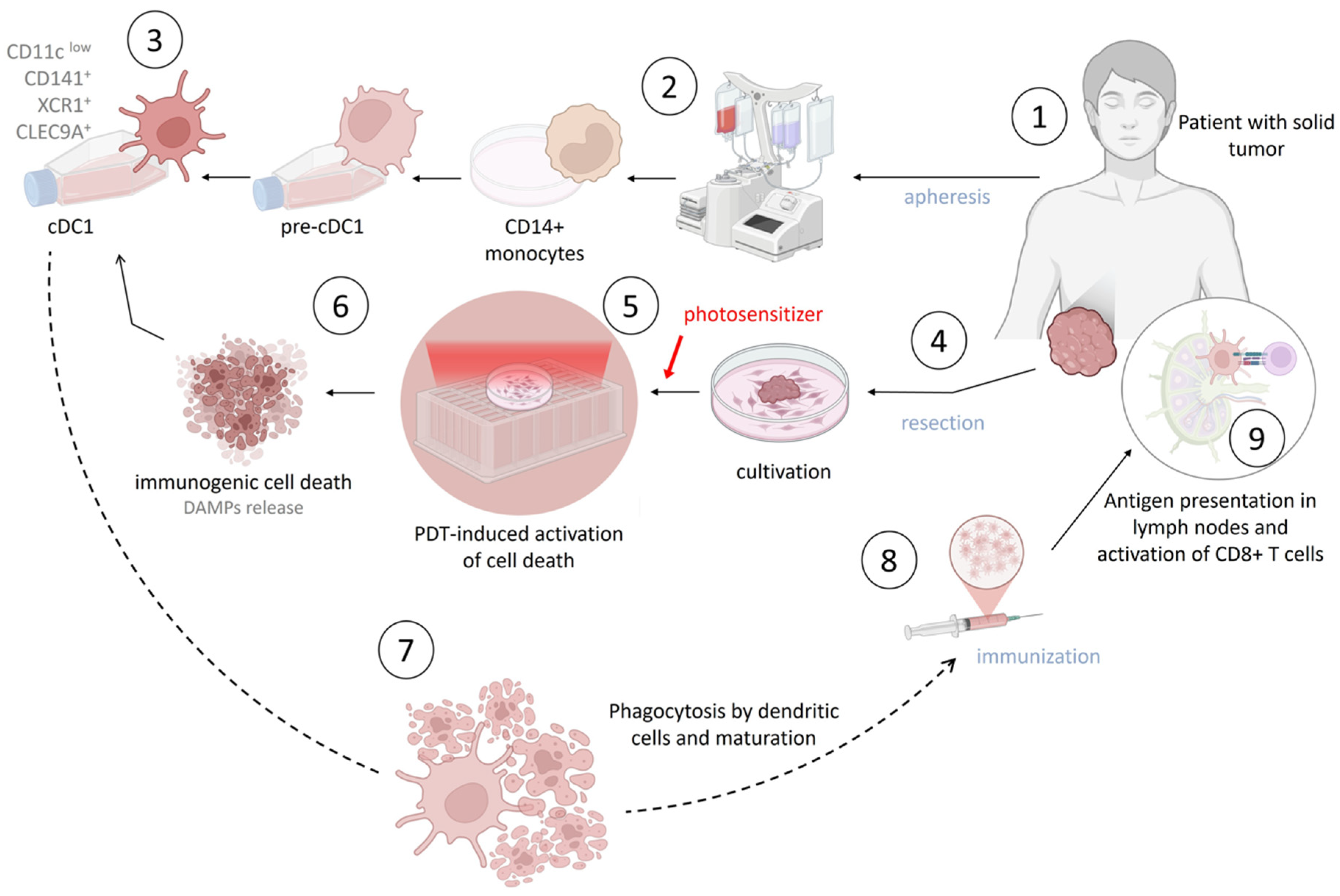


| Form of Cell Death | Cellular Morphology | Key Features of the Mechanism | Photosensitizers |
|---|---|---|---|
| Apoptosis | Cell shrinkage and reduction in size, chromatin condensation, nuclear fragmentation, formation of apoptotic bodies. | In the mitochondrial apoptotic pathway, the nuclear protein p53 activates pro-apoptotic regulators (BID/tBID) and inactivates anti-apoptotic proteins of the Bcl-2 family. This removes inhibition of the BAX/BAK effectors, leading to their oligomerization, pore formation in the outer mitochondrial membrane, and release of apoptotic factors (cytochrome c, procaspase-9, APAF-1) into the cytosol. There, an apoptosome is formed, which activates procaspase-9. Activated caspase-9 subsequently cleaves procaspases-3 and -7, initiating the terminal caspase cascade. | Photofrin [92], hypericin [107], Rose Bengal acetate [108], protoporphyrin IX induced by exogenous 5-aminolevulinic acid (5-ALA) [109], 2-(1-Hexyloxyethyl)-2-devinyl pyropheophorbide-a, 8-methoxypsoralen [110], meso-tetrakis (4-carboxyphenyl) porphyrin sodium salt, Zn-meso-tetrakis (4-carboxyphenyl) porphyrin sodium salt [111] |
| Autophagy | Double-membrane structures, autophagosomes, are formed in the cell. Individual organelles are engulfed, autophagosomes fuse with lysosomes, and cellular structures are degraded by hydrolases. | Induction of cell death activates macroautophagy signaling pathways involving proteins derived from damaged mitochondria and the endoplasmic reticulum. Ubiquitin-dependent labeling of damaged components recruits receptors (e.g., p62), which link substrates to the forming autophagosome. The resulting double-membrane autophagosome engulfs damaged organelles and subsequently fuses with the lysosome, forming an autolysosome. Morphologically, the process is characterized by cytoplasmic vacuolization and the presence of autophagosomes and autolysosomes. Assembly and elongation of the autophagosome membrane are regulated by the PI3K complex (Beclin-1, Vps34), ubiquitin-like conjugation systems (Atg12–Atg5–Atg16L1), as well as LC3-II and the Atg4 protease involved in its processing and recycling. | Sodium sinoporphyrin [112], verteporfin [113], CPO [112], hypericin [114], temoporfin [113] |
| Necroptosis | Increased plasma membrane permeability, increased cell volume, swelling of organelles, followed by cell lysis. | Necroptosis is regulated by the kinases RIPK1, RIPK3, and the pseudokinase MLKL. Upon binding of TNF-α to TNFR1, complex I is formed, where polyubiquitination of RIPK1 activates NF-κB and promotes cell survival. Disruption of RIPK1 ubiquitination leads to the formation of complex II (the ripoptosome), in which RIPK1 interacts with RIPK3 via RHIM motifs to form the necrosome. Upon inhibition of caspase-8, RIPK3 phosphorylates MLKL, inducing its oligomerization and translocation to the membrane, where it forms cation-selective pores, resulting in osmotic cell lysis. | Protoporphyrin IX induced by exogenous 5-aminolevulinic acid (5-ALA) [115] |
| Paraptosis | Appearance of multiple vacuoles gradually filling the cytoplasm; swelling of the endoplasmic reticulum and mitochondria. | The precise mechanism of paraptosis remains under investigation. Induction of paraptosis is associated with IGF1R overexpression, proteasome inhibition, ER stress, and oxidative stress. Specific stimuli activate RIP1 kinase and promote the accumulation of misfolded proteins, leading to maladaptive ER stress. This process induces opening of IP3 receptors and massive release of Ca2+ from the ER, resulting in cytoskeletal hypercontraction and mitochondrial calcium overload. Mitochondria undergo swelling due to opening of the mPTP without cytochrome c release, while AIF translocates to the nucleus, initiating DNA fragmentation. | m-TSX, p-TSX [116,117], verteporfin [103] |
| Ferroptosis | Loss of mitochondrial cristae and mitochondrial shrinkage; increased permeability of the plasma membrane | Iron-dependent regulated cell death associated with intracellular accumulation of ROS generated via the Fenton reaction, leading to excessive oxidation of membrane lipids. | Photosens, 5-ALA, talaporfin sodium (TS-PDT) [118], two cyclometallated Ir(III) complexes (IrL1 and MitoIrL2) [119], chlorin e6 [120,121] |
| Parthanatos | DNA fragmentation, nuclear pyknosis, necrotic membrane changes | Parthanatos is characterized by hyperactivation of PARP1 (poly(ADP-ribose) polymerase 1), a protein involved in the cellular response to DNA damage. Hyperactivation of PARP1 leads to depletion of NAD+ and ATP and loss of mitochondrial transmembrane potential. | Na-H2TCPP [111], Deoxypodophyllotoxin [122] |
| Pyroptosis | In early stages, characterized by chromatin condensation and DNA fragmentation, similar to apoptosis; in later stages, disruption of the plasma membrane, release of cellular contents into the extracellular environment, and induction of inflammatory processes in the tissue | Pyroptosis is initiated by cleavage of GSDM (Gasdermin) by caspase-1 and, in the non-canonical pathway, by caspases 4/5/11. This results in the formation of the GSDM-N fragment, which forms pores in the plasma membrane and leads to cell lysis. Caspase-1 simultaneously activates proinflammatory cytokines, including IL-1β and IL-18, which are released through GSDM-N pores. | NPe6 [123], verteporfin (BPD) [124], hypericin [125], 1,1,2,2-tetrachloroethane, diphenylmethylenemalononitrile [126] |
| Cuproptosis | Reduction in mitochondrial volume (shrinkage), appearance of cytoplasmic vacuoles, destruction of the endoplasmic reticulum, and loss of chromatin structure. | The mechanisms are not fully understood. Excessive copper accumulation initiates ROS production via copper-dependent Fenton reactions and simultaneously leads to destabilization of Fe-S clusters. | Aloe emodin (AE) loaded with copper ions (Cu), and self-assembled into nanoparticles (NPs) under the modification of PEG2k-DSPE-FA [127] |
Disclaimer/Publisher’s Note: The statements, opinions and data contained in all publications are solely those of the individual author(s) and contributor(s) and not of MDPI and/or the editor(s). MDPI and/or the editor(s) disclaim responsibility for any injury to people or property resulting from any ideas, methods, instructions or products referred to in the content. |
© 2026 by the authors. Licensee MDPI, Basel, Switzerland. This article is an open access article distributed under the terms and conditions of the Creative Commons Attribution (CC BY) license.
Share and Cite
Shilyagina, N.; Sannova, Y.; Turubanova, V.; Balalaeva, I. Photo- and Immunotherapy Interface: Can Dendritic Cell Vaccines Overcome the Limitations of PDT? Pharmaceutics 2026, 18, 588. https://doi.org/10.3390/pharmaceutics18050588
Shilyagina N, Sannova Y, Turubanova V, Balalaeva I. Photo- and Immunotherapy Interface: Can Dendritic Cell Vaccines Overcome the Limitations of PDT? Pharmaceutics. 2026; 18(5):588. https://doi.org/10.3390/pharmaceutics18050588
Chicago/Turabian StyleShilyagina, Natalia, Yevgeniya Sannova, Victoria Turubanova, and Irina Balalaeva. 2026. "Photo- and Immunotherapy Interface: Can Dendritic Cell Vaccines Overcome the Limitations of PDT?" Pharmaceutics 18, no. 5: 588. https://doi.org/10.3390/pharmaceutics18050588
APA StyleShilyagina, N., Sannova, Y., Turubanova, V., & Balalaeva, I. (2026). Photo- and Immunotherapy Interface: Can Dendritic Cell Vaccines Overcome the Limitations of PDT? Pharmaceutics, 18(5), 588. https://doi.org/10.3390/pharmaceutics18050588