Review

Model-Integrated Bioequivalence (MIBE) in Generic Drug Research: Can We Ease the Bioequivalence Burden?


by
Sivacharan Kollipara
*,
Rajkumar Boddu
,
Chandra Teja Uppuluri
and
Anuj Kumar Saini
Biopharmaceutics Group, Global Clinical Management, Dr. Reddy’s Laboratories Ltd., Integrated Product Development Organization (IPDO), Bachupally, Medchal Malkajgiri District, Hyderabad 500090, Telangana, India
*
Author to whom correspondence should be addressed.
Pharmaceutics 2026, 18(5), 536; https://doi.org/10.3390/pharmaceutics18050536

Submission received: 30 March 2026 / Revised: 23 April 2026 / Accepted: 24 April 2026 / Published: 28 April 2026
(This article belongs to the Section Clinical Pharmaceutics)

Abstract

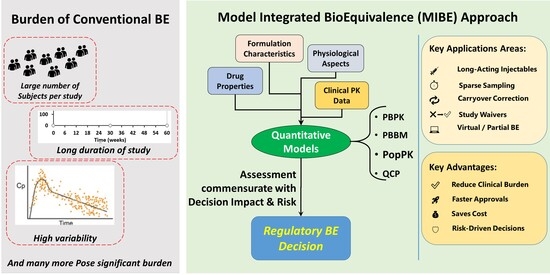
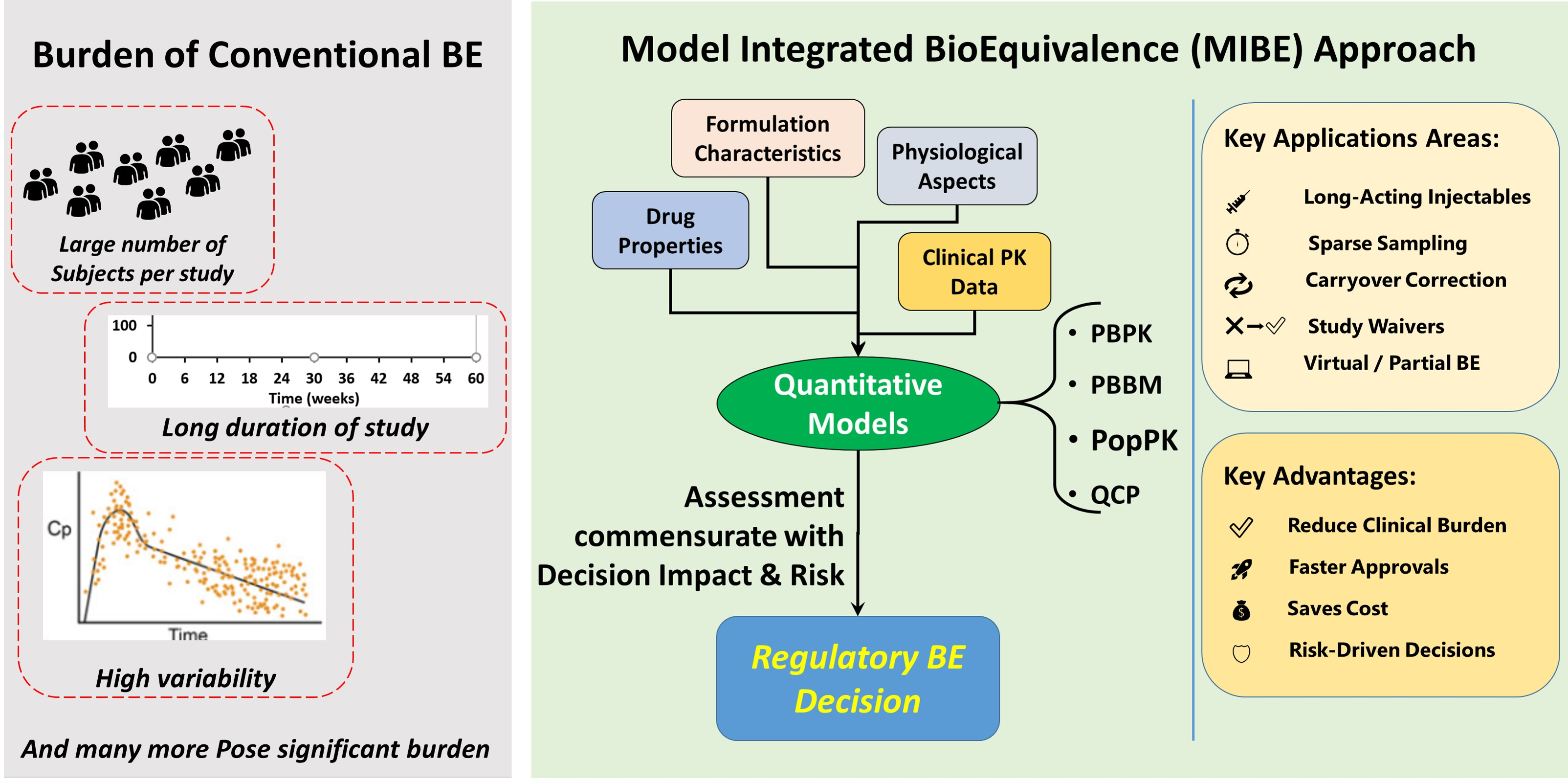
Bioequivalence (BE) studies are essential to file an abbreviated new drug application (ANDA) against an innovator drug product. Conventional BE studies can be complex, time-consuming, and operationally challenging, particularly for products with long half-life drugs, high variability, or formulation complexity. Advances in quantitative modeling and simulation have expanded the role of model-generated information in generic drug development from a supportive role toward providing critical regulatory evidence. Model-Integrated Bioequivalence (MIBE) represents a focused application of this paradigm in which mechanistic or empirical models are used to directly support BE determination. While physiologically based pharmacokinetic (PBPK) and physiologically based biopharmaceutics modeling (PBBM) approaches have been widely discussed in the literature, increasing attention is being directed toward population pharmacokinetic (POP-PK) modeling for MIBE implementation, particularly when mechanistic assumptions are uncertain or extensive in vitro characterization is impractical. This review provides a contemporary overview of MIBE in generic drug development, with a specific emphasis on POP-PK-based approaches. Key quantitative modeling frameworks are discussed along with evolving regulatory perspectives that support the integration of model-based evidence for BE assessment. We illustrate six diverse hypothetical case examples covering different formulations, a variety of BE scenarios and using MIBE to answer specific regulatory questions on BE. Collectively, this manuscript addresses an important topic of MIBE for complex and non-complex generic formulations and may provoke thinking among the generic companies to use such approaches in the regulatory context to enable faster and timely approval to bring the necessary medicines to the market at a rapid pace.
Keywords: MIBE; PBPK; PBBM; regulatory; bioequivalence; alternative BE; generic product development MIBE; PBPK; PBBM; regulatory; bioequivalence; alternative BE; generic product development
Graphical Abstract