Cutting-Edge Smart Hydrogel Platforms for Improved Wound Healing
 , , , ,
  and
and
Abstract
1. Introduction
2. Overview of Smart Hydrogels
2.1. Definition and Key Features of Smart Hydrogels
2.2. Mechanisms of Responsiveness in Smart Hydrogels
3. Types of Smart Hydrogels for Wound Healing
3.1. Stimuli-Responsive Hydrogels
3.1.1. pH-Responsive Hydrogels
3.1.2. Temperature-Responsive Hydrogels
3.1.3. Enzyme-Responsive Hydrogels
3.1.4. Light/Photocrosslinkable Hydrogels
3.1.5. Electrically Responsive Hydrogels
3.2. Injectable and Self-Healing Hydrogels
3.3. 3D-Printable and Shape-Adaptive Hydrogels
4. Functionalized Hydrogels for Therapeutic Enhancement
4.1. Antimicrobial Hydrogels
4.2. Drug- and Growth-Factor-Loaded Systems
4.3. Cell-Encapsulated and Tissue-Engineering Platforms
4.4. Nanocomposite and Multifunctional Hydrogels
4.5. Conductive Hydrogels for Accelerated Healing

| Hydrogel Type | Functional Component | Key Mechanism | Biological Effect | Ref. |
|---|---|---|---|---|
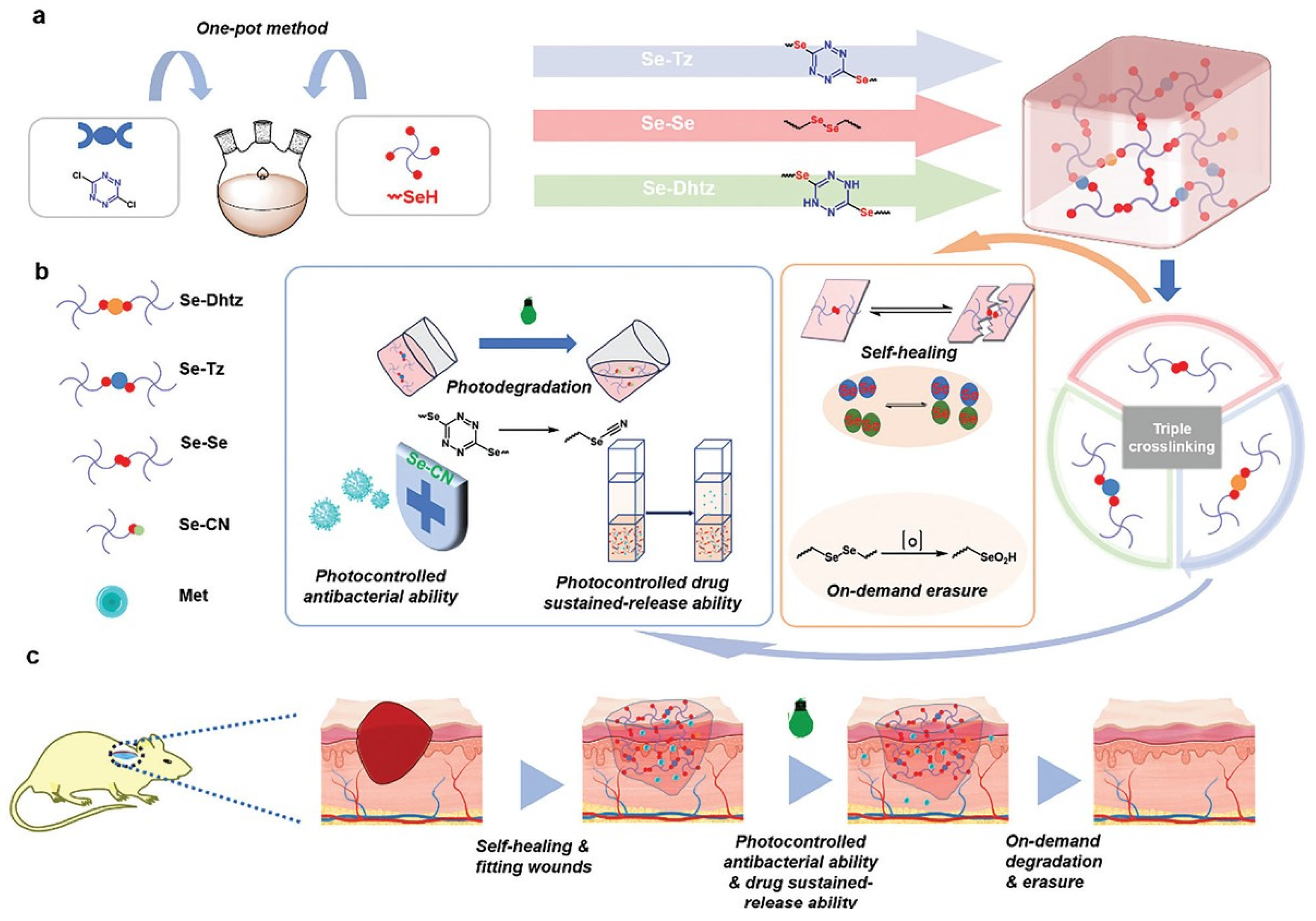
| Antimicrobial hydrogel | Se–Tz network | Light-triggered antibacterial activity | Diabetic wound healing | [171] |
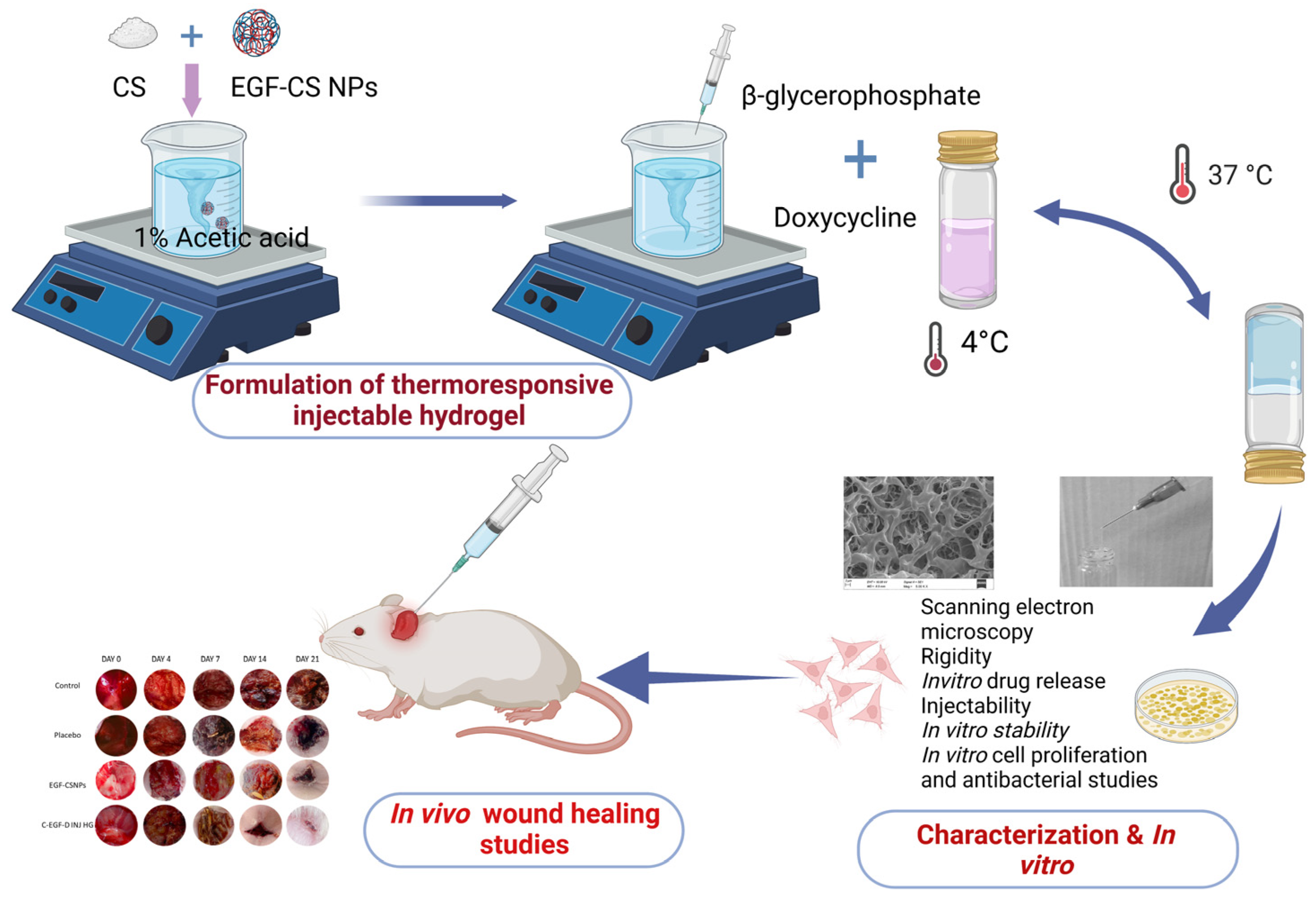
| Growth factor hydrogel | EGF-loaded thermoresponsive hydrogel | Sustained growth factor release | Accelerated diabetic wound repair | [173] |
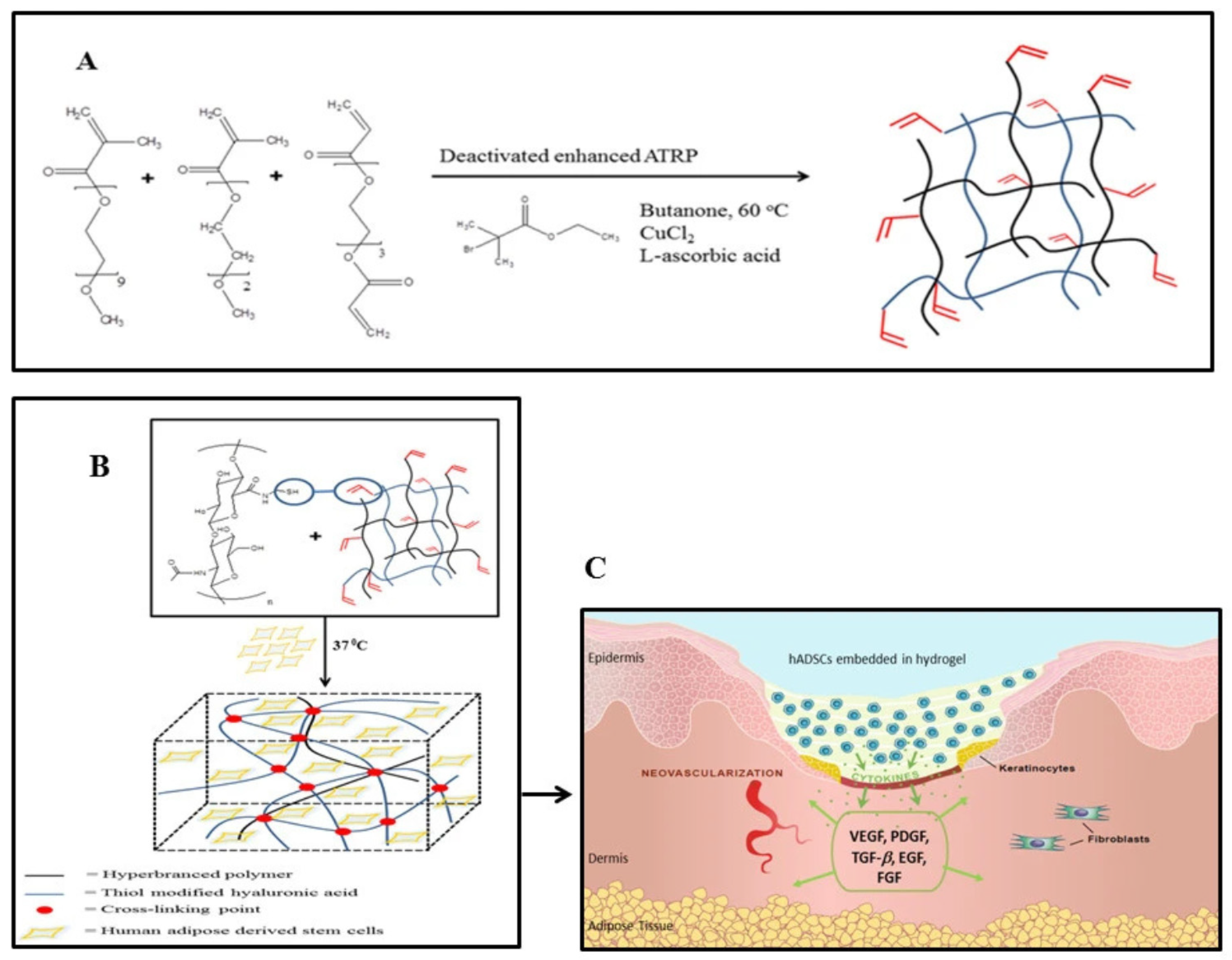
| Cell-encapsulation hydrogel | PEG-HA hydrogel + adipose-derived stem cells | Growth factor secretion | Enhanced angiogenesis and tissue regeneration | [178] |
| Nanocomposite hydrogel | Hydrogen-capped Au–Pd nanoparticles | Photothermal antibacterial action | Rapid infected wound healing | [181] |
| Conductive hydrogel | Alginate + silver nanowires | Electrical stimulation | Accelerated wound closure | [190] |
5. Characterization and Evaluation of Smart and Functionalized Hydrogels
5.1. Physicochemical and Mechanical Testing
5.1.1. Structural and Compositional Analysis
- X-Ray Diffraction (XRD), Thermal, and FTIR Analysis; XRD is utilized to confirm the crystallinity or amorphous nature of the hydrogel components. Concurrently, Differential Scanning Calorimetry (DSC) and Thermogravimetric Analysis (TGA) assess thermal stability and phase transitions. Fourier Transform Infrared (FTIR) spectroscopy is subsequently employed to confirm polymer–drug interactions and validate the successful functionalization of the polymeric network [206].
- Nuclear Magnetic Resonance (NMR) Spectroscopy: Solid-state NMR, particularly magic-angle spinning (MAS) techniques like 1H–13C CP-MAS, elucidates the molecular structure in the solid-like gel phase. These studies reveal network rigidity (e.g., phenylalanine and tyrosine forming rigid networks, while leucine and serine remain mobile). Solution-state, variable-temperature, and saturation transfer difference (STD) NMR provide critical insights into gelation dynamics, molecular uptake, and ligand binding processes [207].
- Circular Dichroism (CD): CD spectroscopy is used to analyze conformational changes and secondary structures in hydrogel networks. For example, studies on Fmoc-protected amino acid hydrogels have confirmed the presence of π–π interactions and helical structures, where peak shifts correlate with variations in ionic strength and network rigidity [208].
5.1.2. Morphological Characterization
- Electron Microscopy (SEM, TEM, and Cryo-EM): Scanning Electron Microscopy (SEM) evaluates physical characteristics such as pore dimensions, gel porosity, and polymeric strand orientation following cryogenic preservation. Transmission Electron Microscopy (TEM) visualizes nanoscale features like fibrils and micelles. Cryo-EM maintains the native hydrated state of the sample, significantly reducing drying artifacts. Together, these techniques offer profound insights into the micro- and nanostructural arrays of the matrices [211].
5.1.3. Rheological Properties
- Shear-Thinning and Self-Healing: Crucial for 3D bioprinting and injectable drug delivery, shear-thinning behavior occurs when applied shear stress disrupts the supramolecular network, leading to a reversible reduction in viscosity [212].
- Strain Sweep Testing: This amplitude sweep test evaluates viscoelasticity by applying an increasing oscillatory strain at a constant frequency. It measures the storage modulus (G′) and loss modulus (G″). A constant modulus defines the linear viscoelastic region (LVR), while a G′–G″ crossover indicates the gel–sol transition, marking the point where the material begins to exhibit fluid-like behavior [213,214].
5.1.4. Physical and Mechanical Evaluations
- Swelling Index: This critical parameter quantifies the hydrogel’s capacity to absorb wound exudate prior to matrix degradation [215].
- Gel Fraction and Crosslinking Effects: Three-dimensional networks are established via chemical crosslinking, physical linkages, ionic interactions, or hydrogen bonding. While synthetic chemical crosslinkers (e.g., epichlorohydrin, aldehydes, urea derivatives) efficiently interconnect polymer chains, unreacted reagents can be hazardous. Therefore, meticulous post-crosslinking purification or the adoption of green crosslinking strategies is imperative to ensure biocompatibility and environmental sustainability [216].
- Degradation and Erosion Studies: Custom-fabricated cast acrylic molds are frequently employed to standardize hydrogel geometry for erosion studies. Hydrogels—often fluorescently labeled or loaded with a model biomolecule like FITC–BSA (0.1 wt%)—are exposed to a buffer reservoir (e.g., PBS) under static conditions for extended periods (up to 60 days). Regular colorimetric quantification yields cumulative erosion and release profiles, providing vital insights into composition-dependent degradation kinetics [217].
- Mechanical Testing: Typically assessed using a universal testing machine in accordance with ASTM D638 standards, mechanical qualities such as tensile strength, fracture energy, and elastic modulus are evaluated. A hydrogel’s mechanical response to applied stress is a highly reliable predictor of its in vivo durability and tissue regeneration efficacy [218].
5.2. Antimicrobial and Biocompatibility Studies
5.3. In Vivo Studies
6. Clinical Applications and Commercial Outlook
7. Challenges and Future Perspectives
7.1. Manufacturing and Scalability Bottlenecks
7.2. Technological Hurdles in Sensor Hybridization
7.3. AI Integration and Next-Generation Autonomous Platforms
7.4. Concluding Remarks
8. Conclusions
Author Contributions
Funding
Institutional Review Board Statement
Informed Consent Statement
Data Availability Statement
Acknowledgments
Conflicts of Interest
References
- Peña, O.A.; Martin, P. Cellular and molecular mechanisms of skin wound healing. Nat. Rev. Mol. Cell Biol. 2024, 25, 599–616. [Google Scholar] [CrossRef] [PubMed]
- Martínez-Torija, M.; Esteban, P.F.; Santos-De-La-Mata, A.; Castillo-Hermoso, M.; Molina-Holgado, E.; Moreno-Luna, R. Multifaceted Pathophysiology and Secondary Complications of Chronic Spinal Cord Injury: Focus on Pressure Injury. J. Clin. Med. 2025, 14, 1556. [Google Scholar] [CrossRef] [PubMed]
- Zhao, X.; Xu, H.; Sun, Y.; Yang, Y.; Guo, B. Self-Adaptive Wound Dressings for Wound Healing and Repair. Adv. Mater. 2025, e15854. [Google Scholar] [CrossRef] [PubMed]
- Cristea, A.G.; Lisă, E.L.; Iacob, S.; Dragostin, I.; Ștefan, C.S.; Fulga, I.; Anghel, A.M.; Dragan, M.; Morariu, I.D.; Dragostin, O.M. Antimicrobial smart dressings for combating antibiotic resistance in wound care. Pharmaceuticals 2025, 18, 825. [Google Scholar] [CrossRef]
- Rezvani Ghomi, E.; Niazi, M.; Ramakrishna, S. The evolution of wound dressings: From traditional to smart dressings. Polym. Adv. Technol. 2023, 34, 520–530. [Google Scholar] [CrossRef]
- Khattak, S.; Ullah, I.; Sohail, M.; Akbar, M.U.; Rauf, M.A.; Ullah, S.; Shen, J.; Xu, H.T. Endogenous/exogenous stimuli-responsive smart hydrogels for diabetic wound healing. Aggregate 2025, 6, e688. [Google Scholar] [CrossRef]
- Mirhaj, M.; Labbaf, S.; Tavakoli, M.; Seifalian, A.M. Emerging treatment strategies in wound care. Int. Wound J. 2022, 19, 1934–1954. [Google Scholar] [CrossRef]
- Chu, L.; Dowling, C.; Etkin, Y.; Oropallo, A. Assessment and management of chronic venous, arterial, and diabetic wounds in elderly adults. Semin. Vasc. Surg. 2025, 38, 281–290. [Google Scholar]
- Zhao, L.; Yuan, J.; Yang, Q.; Ma, J.; Yang, F.; Zou, Y.; Liu, K.; Liu, F. Diabetes and its complications: Molecular mechanisms, prevention and treatment. Signal Transduct. Target. Ther. 2026, 11, 22. [Google Scholar] [CrossRef]
- Liu, Y.; Ge, L. Smart biomaterials in wound healing: Advances, challenges, and future directions in intelligent dressing design. Bioengineering 2025, 12, 1178. [Google Scholar] [CrossRef]
- Schilrreff, P.; Alexiev, U. Chronic inflammation in non-healing skin wounds and promising natural bioactive compounds treatment. Int. J. Mol. Sci. 2022, 23, 4928. [Google Scholar] [CrossRef] [PubMed]
- Almatroudi, A. Biofilm resilience: Molecular mechanisms driving antibiotic resistance in clinical contexts. Biology 2025, 14, 165. [Google Scholar] [CrossRef] [PubMed]
- Walczak, Ł.J.; Kwiatkowska, M.; Twarowski, B.; Kubacka, M.; Paluch, J.; Herbet, M. Disinfectant-induced bacterial resistance and antibiotic cross-resistance—Mechanisms and clinical relevance. Clin. Exp. Med. 2026, 26, 26. [Google Scholar] [CrossRef] [PubMed]
- Mayer, D.O.; Tettelbach, W.H.; Ciprandi, G.; Downie, F.; Hampton, J.; Hodgson, H.; Lazaro-Martinez, J.L.; Probst, A.; Schultz, G.; Stürmer, E.K.; et al. Best practice for wound debridement. J. Wound Care 2024, 33, S1–S32. [Google Scholar] [CrossRef]
- Wang, C.; Shirzaei Sani, E.; Shih, C.D.; Lim, C.T.; Wang, J.; Armstrong, D.G.; Gao, W. Wound management materials and technologies from bench to bedside and beyond. Nat. Rev. Mater. 2024, 9, 550–566. [Google Scholar] [CrossRef]
- Wu, Y.; Li, S.; Chen, G. Hydrogels as water and nutrient reservoirs in agricultural soil: A comprehensive review of classification, performance, and economic advantages. Environ. Dev. Sustain. 2024, 26, 24653–24685. [Google Scholar] [CrossRef]
- Abolhasani, S.; Ahmadi, Y.; Rostami, Y.; Baravar, E.; Fattahi, D. Biomaterials in tissue repair and regeneration: Key insights from extracellular matrix biology. Front. Med. Technol. 2025, 7, 1565810. [Google Scholar] [CrossRef]
- Roy, A.; Manna, K.; Pal, S. Recent advances in various stimuli-responsive hydrogels: From synthetic designs to emerging healthcare applications. Mater. Chem. Front. 2022, 6, 2338–2385. [Google Scholar] [CrossRef]
- Thirumalaivasan, N.; Kanagaraj, K.; Nangan, S.; Pothu, R.; Rajendra, S.P.; Karuppiah, P.; Boddula, R. Bioactive Hydrogels (Bio-HyGs): Emerging Trends in Drug Delivery and Wound Healing Applications. Polym. Adv. Technol. 2025, 36, e70132. [Google Scholar] [CrossRef]
- Ukaegbu, K.; Allen, E.; Svoboda, K.K. Reactive Oxygen Species and Antioxidants in Wound Healing: Mechanisms and Therapeutic Potential. Int. Wound J. 2025, 22, e70330. [Google Scholar] [CrossRef]
- Thang, N.H.; Chien, T.B.; Cuong, D.X. Polymer-based hydrogels applied in drug delivery: An overview. Gels 2023, 9, 523. [Google Scholar] [CrossRef]
- Amadeh, A.; Mohebbi, N.; Amadeh, Z.; Jamshidbeigi, A. Comparative Efficacy of Autolytic and Collagenase-Based Enzymatic Debridement in Chronic Wound Healing: A Comprehensive Systematic Review. Int. Wound J. 2025, 22, e70177. [Google Scholar] [CrossRef] [PubMed]
- Mueller, S.M.; Miller, N.; Gill, J.; Yu, L.C.; Pike, M.D.; Orgill, D.P. Genetic Determinants of Wound Healing: Monogenic Disorders and Polygenic Influence. Cells 2026, 15, 74. [Google Scholar] [CrossRef] [PubMed]
- Alberts, A.; Tudorache, D.I.; Niculescu, A.G.; Grumezescu, A.M. Advancements in wound dressing materials: Highlighting recent progress in hydrogels, foams, and antimicrobial dressings. Gels 2025, 11, 123. [Google Scholar] [CrossRef]
- Aliyev, A.; Israyilova, A.; Hasanova, U.; Gakhramanova, Z.; Ahmadova, A. Nanotechnology in Wound Healing: A New Frontier in Regenerative Medicine. Micro 2025, 5, 60. [Google Scholar] [CrossRef]
- Mallanagoudra, P.; Ramakrishna, S.S.M.; Jaiswal, S.; Prasanna, D.K.; Seetharaman, R.; Palaniappan, A.; Kini, S. Progressive Hydrogel Applications in Diabetic Foot Ulcer Management: Phase-Dependent Healing Strategies. Polymers 2025, 17, 2303. [Google Scholar] [CrossRef]
- Niu, Y.; Zhao, Z.; Yang, L.; Lv, D.; Sun, R.; Zhang, T.; Li, Y.; Bao, Q.; Zhang, M.; Wang, L.; et al. Towards intelligent wound care: Hydrogel-based wearable monitoring and therapeutic platforms. Polymers 2025, 17, 1881. [Google Scholar] [CrossRef]
- Tajik, S.; Garcia, C.N.; Gillooley, S.; Tayebi, L. 3D printing of hybrid-hydrogel materials for tissue engineering: A critical review. Regen. Eng. Transl. Med. 2023, 9, 29–41. [Google Scholar] [CrossRef]
- Kobeissy, F.; Goli, M.; Yadikar, H.; Shakkour, Z.; Kurup, M.; Haidar, M.A.; Alroumi, S.; Mondello, S.; Wang, K.K.; Mechref, Y. Advances in neuroproteomics for neurotrauma: Unraveling insights for personalized medicine and future prospects. Front. Neurol. 2023, 14, 1288740. [Google Scholar] [CrossRef]
- Yadav, A.K.; Verma, D.; Thakkar, S.; Rana, Y.; Banerjee, J.; Bhatia, D.; Banerjee, S. Pioneering 3D and 4D bioprinting strategies for advanced wound management: From design to healing. Small 2025, 21, e06259. [Google Scholar] [CrossRef]
- Guan, L.; Ou, X.; Wang, Z.; Li, X.; Feng, Y.; Yang, X.; Qu, W.; Yang, B.; Lin, Q. Electrical stimulation-based conductive hydrogel for immunoregulation, neuroregeneration and rapid angiogenesis in diabetic wound repair. Sci. China Mater. 2023, 66, 1237–1248. [Google Scholar] [CrossRef]
- Luo, J.; Zhao, X.; Guo, B.; Han, Y. Preparation, thermal response mechanisms and biomedical applications of thermosensitive hydrogels for drug delivery. Expert Opin. Drug Deliv. 2023, 20, 641–672. [Google Scholar] [CrossRef]
- Jain, A.; Kolipaka, T.; Pandey, G.; Priyadarshinee, A.; Puri, N.; Shinde, S.; Srivastava, S. Innovative Approaches to Diabetic Wound Healing: Focusing on ROS and Redox Signals. Mol. Pharm. 2025, 22, 5738–5766. [Google Scholar] [CrossRef]
- Abdulsalam, L.; Abubakar, S.; Permatasari, I.; Lawal, A.A.; Uddin, S.; Ullah, S.; Ahmad, I. Advanced Biocompatible and Biodegradable Polymers: A Review of Functionalization, Smart Systems, and Sustainable Applications. Polymers 2025, 17, 2901. [Google Scholar] [CrossRef]
- Jangra, N.; Singla, A.; Puri, V.; Dheer, D.; Chopra, H.; Malik, T.; Sharma, A. Herbal bioactive-loaded biopolymeric formulations for wound healing applications. RSC Adv. 2025, 15, 12402–12442. [Google Scholar] [CrossRef]
- Shergujri, D.A.; Khanday, M.A.; Noor, A.; Adnan, M.; Arif, I.; Raza, S.N.; Mir, R.H.; Khan, N.A. Next-generation biopolymer gels: Innovations in drug delivery and theranostics. J. Mater. Chem. B 2025, 13, 3222–3244. [Google Scholar] [CrossRef]
- Dallaev, R. Smart and biodegradable polymers in tissue engineering and interventional devices: A brief review. Polymers 2025, 17, 1976. [Google Scholar] [CrossRef]
- Puri, V.; Sharma, A.; Kumar, P.; Singh, I. Thiolation of biopolymers for developing drug delivery systems with enhanced mechanical and mucoadhesive properties: A review. Polymers 2020, 12, 1803. [Google Scholar] [CrossRef]
- Sharma, A.; Puri, V.; Kumar, P.; Singh, I. Biopolymeric, nanopatterned, fibrous carriers for wound healing applications. Curr. Pharm. Des. 2020, 26, 4894–4908. [Google Scholar] [CrossRef] [PubMed]
- Sadraei, A.; Naghib, S.M. 4D printing of physical stimuli-responsive hydrogels for localized drug delivery and tissue engineering. Polym. Rev. 2025, 65, 104–168. [Google Scholar] [CrossRef]
- Tabatabai, T.S.; Alizadeh, M.; Farahani, M.K.; Ehterami, A.; Kloucheh, S.G.; Salehi, M. Peripheral nerve repair: Historical perspectives, current advances, and future directions in natural and synthetic neural conduits. J. Neurosci. Res. 2025, 103, e70060. [Google Scholar] [CrossRef] [PubMed]
- Moawad, F.; Ruel, Y.; Pouliot, R.; Brambilla, D. Microneedle Technology in Psoriasis Management: Mechanistic Insights, Technological Innovation, Clinical Progress, and Challenges. Adv. Healthc. Mater. 2026, 15, e04294. [Google Scholar] [CrossRef] [PubMed]
- Barik, D.; Konkimalla, V.B. Next-Generation Nanomaterials in Biology: From Tissue Regeneration to Targeted Cancer Therapy. IUBMB Life 2025, 77, e70071. [Google Scholar] [CrossRef] [PubMed]
- Muqaddas, M.; Bibi, I.; Atif, M.; Asrar, M.; Imtiaz, R.; Tariq, H.; Sabeeh Gohar, M.; Tul Kubra, K.; Aslam, N. Advances in Debondable Adhesives: A Focus on pH-Dependent Reversible Bonding Technologies. Polym. Rev. 2025, 65, 1011–1056. [Google Scholar] [CrossRef]
- Dong, S.; An, S.; Saiding, Q.; Chen, Q.; Liu, B.; Kong, N.; Chen, W.; Tao, W. Therapeutic hydrogels: Properties and biomedical applications. Chem. Rev. 2025, 125, 8835–8920. [Google Scholar] [CrossRef]
- Gao, K.; Xu, K. Advancements and Prospects of pH-Responsive Hydrogels in Biomedicine. Gels 2025, 11, 293. [Google Scholar] [CrossRef]
- Shao, Y.; Ma, J.; Wang, Z.Y. Guidelines for preoperative visual function and imaging examination standards in vitreoretinal surgery (2025). Int. J. Ophthalmol. 2025, 18, 813. [Google Scholar] [CrossRef]
- Fan, R.; Cheng, Y.; Wang, R.; Zhang, T.; Zhang, H.; Li, J.; Song, S.; Zheng, A. Thermosensitive hydrogels and advances in their application in disease therapy. Polymers 2022, 14, 2379. [Google Scholar] [CrossRef]
- Li, Y.; Luo, J.; Xie, G.; Zhu, D.; Zhao, C.; Zhang, X.; Liu, M.; Wu, Y.; Guo, Y.; Yu, W. Recent Progress on Regulating the LCST of PNIPAM-Based Thermochromic Materials. ACS Appl. Polym. Mater. 2024, 7, 1–11. [Google Scholar] [CrossRef]
- Jamal, G.A.; Jahangirian, E.; Hamblin, M.R.; Mirzaei, H.; Tarrahimofrad, H.; Alikowsarzadeh, N. Proteases, a powerful biochemical tool in the service of medicine, clinical and pharmaceutical. Prep. Biochem. Biotechnol. 2025, 55, 1–25. [Google Scholar] [CrossRef]
- Barreira-Pinto, R.; Carneiro, R.; Miranda, M.; Guedes, R.M. Polymer-matrix composites: Characterising the impact of environmental factors on their lifetime. Materials 2023, 16, 3913. [Google Scholar] [CrossRef]
- de Araújo Boleti, A.P.; Jacobowski, A.C.; Frihling, B.E.; Cruz, M.V.; Santos, K.F.; Migliolo, L.; de Andrade, L.R.; Macedo, M.L. Wound Healing: Molecular Mechanisms, Antimicrobial Peptides, and Emerging Technologies in Regenerative Medicine. Pharmaceuticals 2025, 18, 1525. [Google Scholar] [CrossRef] [PubMed]
- Chi, T.; Sang, T.; Wang, Y.; Ye, Z. Cleavage and Noncleavage Chemistry in reactive oxygen species (ROS)-Responsive materials for Smart Drug Delivery. Bioconjug. Chem. 2023, 35, 1–21. [Google Scholar] [CrossRef] [PubMed]
- Zhou, Q.; Zhuang, Y.; Deng, X.; Jiang, W.; Wang, X.; Yuan, C.; Lin, K. Hydrogel-Based ROS-Regulating Strategy: Reprogramming the Oxidative Stress Imbalance in Advanced Diabetic Wound Repair. Adv. Mater. 2026, 38, e12719. [Google Scholar] [CrossRef] [PubMed]
- Zhou, Y.; Liang, X.; Shen, Z.; Zhang, R.; Zhang, G.; Yu, B.; Li, Y.; Xu, F.J. Glucose-responsive hydrogel with adaptive insulin release to modulate hyperglycemic microenvironment and promote wound healing. Biomaterials 2026, 326, 123641. [Google Scholar] [CrossRef]
- Ning, Y.; Zeng, X.; Huang, J.; Shen, Z.Y.; Gao, Y.; Che, R. Multifunctional electromagnetic responsive porous materials synthesized by freeze casting: Principles, progress, and prospects. Adv. Funct. Mater. 2025, 35, 2414838. [Google Scholar] [CrossRef]
- Xing, Y.; Zeng, B.; Yang, W. Light responsive hydrogels for controlled drug delivery. Front. Bioeng. Biotechnol. 2022, 10, 1075670. [Google Scholar] [CrossRef]
- Pandey, T.; Pandey, V. A mechanistic understanding to photophysical phenomenon in development of near-infrared (NIR) responsive hydrogels: Advancements in precision drug delivery. J. Drug Deliv. Sci. Technol. 2025, 106, 106682. [Google Scholar] [CrossRef]
- Ding, K.; Liao, M.; Wang, Y.; Lu, J.R. Advances in Composite Stimuli-Responsive Hydrogels for Wound Healing: Mechanisms and Applications. Gels 2025, 11, 420. [Google Scholar] [CrossRef]
- Lin, S.H.; Hsu, S.H. Smart hydrogels for in situ tissue drug delivery. J. Biomed. Sci. 2025, 32, 70. [Google Scholar] [CrossRef]
- Rahim, Z.A.; Saqib Iqbal, M.; Bakar, N.A. Smart hydrogel for biomedical applications: TRIZ patent literature review. J. Chem. Technol. Biotechnol. 2025, 100, 2522–2531. [Google Scholar] [CrossRef]
- Cecen, B.; Hassan, S.; Li, X.; Zhang, Y.S. Smart biomaterials in biomedical applications: Current advances and possible future directions. Macromol. Biosci. 2024, 24, 2200550. [Google Scholar] [CrossRef] [PubMed]
- Lakeh, M.V.; Kong, Y.L.; Leong, M.Y.; Looi, C.Y. Dynamics of stimuli-responsive hydrogel-based nanocarriers in advanced drug delivery systems. Next Mater. 2026, 11, 101831. [Google Scholar] [CrossRef]
- Calderon Moreno, J.M.; Chelu, M.; Popa, M. Biocompatible Stimuli-Sensitive Natural Hydrogels: Recent Advances in Biomedical Applications. Gels 2025, 11, 993. [Google Scholar] [CrossRef] [PubMed]
- Olteanu, G.; Neacșu, S.M.; Joița, F.A.; Musuc, A.M.; Lupu, E.C.; Ioniță-Mîndrican, C.B.; Lupuliasa, D.; Mititelu, M. Advancements in regenerative hydrogels in skin wound treatment: A comprehensive review. Int. J. Mol. Sci. 2024, 25, 3849. [Google Scholar] [CrossRef]
- Jin, X.; Li, Y.; Ran, H.; Zhang, Z.; Cheng, P.; Wu, Y. Smart Nanomaterial-crosslinked Hydrogels for Biomedical Applications. Smart Mater. Med. 2025, 6, 417–433. [Google Scholar] [CrossRef]
- Salamat, Q.; Moradi, R.; Nadizadeh, Z.; Kavehpour, P.; Soylak, M.; Asimov, A.; Rahman, M.Z.; Kovářík, T.; Babuška, V.; Deshmukh, K. Chitosan based smart injectable hydrogels for biomedical applications: A comprehensive review. Bioact. Mater. 2026, 55, 703–753. [Google Scholar] [CrossRef]
- Li, J.; Deng, Z.; Liang, X.; Zhong, S.; Ke, H.; Wen, Z.; Wu, D.; Jiang, Y.; Huang, Z.; Shao, Y.; et al. A smart ROS-responsive hydrogel for on-demand antibacterial and platelet-rich plasma (PRP) activation in diabetic wound healing. J. Control. Release 2025, 388, 114392. [Google Scholar] [CrossRef]
- Liu, Z.; Ma, Z.; Hu, P. Stimuli-responsive hydrogels for enhanced skin wound healing: Mechanisms, applications, and advances. J. Drug Deliv. Sci. Technol. 2025, 112, 107308. [Google Scholar] [CrossRef]
- She, Y.; Wu, P.; Wan, W.; Liu, H.; Liu, R.; Wang, T.; Wang, M.; Shen, L.; Yang, Y.; Huang, X.; et al. Polysaccharides, proteins and DNA based stimulus responsive hydrogels promoting wound healing and repair: A review. Int. J. Biol. Macromol. 2025, 304, 140961. [Google Scholar] [CrossRef]
- Pires, P.C.; Renca, A.; Amaro, I.; Parreiras, L.; Anselmo, M.; Ferreira, M.; Veiga, F.; Paiva-Santos, A.C. From stimuli-responsive polymers to nanosystems and electrocircuits: An update on the current state of polymeric hydrogel microneedles for wound healing. J. Drug Deliv. Sci. Technol. 2024, 102, 106395. [Google Scholar] [CrossRef]
- Sun, M.; Zhang, Y.; Zhou, M. Smart-Responsive Chitosan Dressings: From Microenvironmental Sensing to Multifunctional Precision Wound Healing. Food Hydrocoll. Health 2025, 8, 100243. [Google Scholar] [CrossRef]
- Wang, Y.; Yang, C.; Zhang, W.; Wang, X.; Zhao, Z.; Wang, Z.; Zhang, L. Multifunctional self-healing and pH-responsive hydrogel dressing based on cationic guar gum and hyaluronic acid for on-demand drug release. Int. J. Biol. Macromol. 2025, 301, 140326. [Google Scholar] [CrossRef]
- Kolipaka, T.; Pandey, G.; Abraham, N.; Srinivasarao, D.A.; Raghuvanshi, R.S.; Rajinikanth, P.S.; Tickoo, V.; Srivastava, S. Stimuli-responsive polysaccharide-based smart hydrogels for diabetic wound healing: Design aspects, preparation methods and regulatory perspectives. Carbohydr. Polym. 2024, 324, 121537. [Google Scholar] [CrossRef] [PubMed]
- Yu, L.; Sun, X.; Zhang, X.; Sun, J.; He, Z.; Li, J.; Luo, C.; Zhang, S. Nanoenzyme-engineered hydrogels reprogram wound microenvironment to accelerate diabetic wound healing. Coord. Chem. Rev. 2026, 549, 217376. [Google Scholar] [CrossRef]
- Mahheidari, N.; Alizadeh, M.; Rashidi, M.; Rezakhani, L. Potential of Mesenchymal Stem Cells and Exosomes in Tissue Engineering: Emerging Strategies for Skin Regeneration and Advanced Wound Healing. Tissue Cell 2026, 98, 103201. [Google Scholar] [CrossRef]
- Askari, S.; Eskandari, M.; Zarepour, A.; Khosravi, A.; Iravani, S.; Zarrabi, A. Chitosan nanoplatforms as carriers for photodynamic and photothermal therapies in cancer, wound healing, and antimicrobial applications. Carbohydr. Polym. 2026, 371, 124522. [Google Scholar] [CrossRef]
- Liu, X.; Wang, M.; Wang, R.; Yang, J.; Wang, X. Mechanisms and design strategies of copper-incorporated dressings for wound management. Coord. Chem. Rev. 2026, 549, 217310. [Google Scholar] [CrossRef]
- Lin, C.; Yang, M.; Zhang, F.; Liu, Y.; Leng, J. Stimuli-responsive smart materials for biomedical applications. Mater. Sci. Eng. R Rep. 2026, 167, 101126. [Google Scholar] [CrossRef]
- Wang, Y.; Jin, L.; Huang, C.; Bhutta, N.K.; Sun, L.; Li, J.; Han, B. Mechanically adaptive injectable hydrogels with dual-role oxidized cyclodextrin for pH-responsive drug delivery in chronic infected wound healing. Carbohydr. Polym. 2026, 372, 124530. [Google Scholar] [CrossRef]
- Yang, P.; Liu, Y.; Zeng, Q.; Zhao, S.; Zhang, Y.; Yang, J.; Yin, K.; Wu, W.; Deng, C. Near-infrared and pH dual-responsive chitosan/epigallocatechin gallate/hollow CuS hydrogel reprograms ROS dynamics for infected wound healing. J. Colloid Interface Sci. 2026, 703, 139250. [Google Scholar] [PubMed]
- Du, L.; Sun, X.; Meng, Y.; Wang, H.; Li, L. pH-Responsive multifunction antibacterial hydrogel with remodeling the wound microenvironment for treating diabetic wound. Colloids Surf. B Biointerfaces 2026, 258, 115238. [Google Scholar] [CrossRef] [PubMed]
- Zhao, S.; Guo, W.; Yang, G.; Hu, P.; Liu, Y.; Chen, L.; Ning, S.; Cao, X.; Pan, Y.; Shi, J.; et al. Dual-responsive glucose/pH degradable nanozyme hydrogel with cascade catalytic antibacterial performance for infected diabetic wound treatment. Nano Today 2026, 66, 102906. [Google Scholar] [CrossRef]
- Chermahini, Z.D.; Abbasabadarabi, S.; Heydari, P.; Mokhtari, N.; Khosravi, A.; Zarrabi, A. pH-responsive HA/PβAE hydrogels couple enzyme release kinetics to inflammatory acidity to modulate cytokines and promote healing. J. Drug Deliv. Sci. Technol. 2026, 115, 107643. [Google Scholar]
- Yao, Y.; Hsu, Y.I.; Sonntag, S.; Fernández-Colino, A.; Jockenhövel, S.; Uyama, H. Chitosan/acetoacetylated poly (vinyl alcohol) nanofibers incorporating starch-derived carbon quantum dots with pH-responsive color change for wound dressings. Carbohydr. Polym. 2026, 371, 124477. [Google Scholar]
- Xie, L.; Yuan, T.; Hu, S.; Zhao, C.; Huang, W.; Ding, W.; Zhang, Y.; Hu, X. pH and glucose dual-responsive hydrogels for IL-4 and salvianolic acid A delivery to enhance diabetic wound healing. Mater. Des. 2025, 258, 114558. [Google Scholar] [CrossRef]
- Kang, T.W.; Park, K.; Kim, M.S. Advances in stimuli-responsive polymers for biomedical and environmental applications. Mater. Sci. Eng. R Rep. 2026, 168, 101140. [Google Scholar]
- Fan, X.; Fu, X.; Han, S.; Sun, D.; Wang, R.; Zhang, M.; Jiang, W.; Fan, K. Stimuli-responsive nanozymes in imaging and therapy of critical diseases. Coord. Chem. Rev. 2026, 546, 217033. [Google Scholar]
- Xu, Y.; Cheng, Y.; Yang, T.; Chen, H.; Niu, B.; Fang, X.; Wu, W.; Shen, C.; Wang, G.; Liu, B.; et al. State-of-the-Art Insights into Hydrogel Innovations from Structural Engineering to Smart Preservation: Research Trends and Future Directions. Trends Food Sci. Technol. 2025, 167, 105411. [Google Scholar] [CrossRef]
- Jaiswal, R.; Sherje, A.P. Recent advances in biopolymer-based smart hydrogel for wound healing. J. Drug Deliv. Sci. Technol. 2024, 99, 105990. [Google Scholar] [CrossRef]
- Duarte, J.; Mascarenhas-Melo, F.; Pires, P.C.; Veiga, F.; Paiva-Santos, A.C. Multifunctional hydrogels-based therapies for chronic diabetic wound healing. Eur. Polym. J. 2024, 211, 113026. [Google Scholar] [CrossRef]
- Naghib, S.M.; Amiri, S.; Mozafari, M.R. Stimuli-responsive chitosan-based nanocarriers for drug delivery in wound dressing applications: A review. Carbohydr. Polym. Technol. Appl. 2024, 7, 100497. [Google Scholar] [CrossRef]
- Huang, Y.; Song, M.; Li, X.; Du, Y.; Gao, Z.; Zhao, Y.Q.; Li, C.; Yan, H.; Mo, X.; Wang, C.; et al. Temperature-responsive self-contraction nanofiber/hydrogel composite dressing facilitates the healing of diabetic-infected wounds. Mater. Today Bio 2024, 28, 101214. [Google Scholar] [CrossRef] [PubMed]
- Luan, X.; Xie, G.; Tuo, J.; Liu, Y.; Li, L.; Su, Z.; Pang, J. Bioactive cellulose-based thermoresponsive hydrogel with engineered ordered channels for rapid hemostasis and tissue regeneration. Carbohydr. Polym. 2026, 373, 124583. [Google Scholar] [CrossRef]
- Zhu, J.; Wang, J.; Zhang, Q.; Cui, Z.; Wang, Y.; Li, W.; Zhou, C.; Wang, X.; Qin, J. Dextran-based thermosensitive hydrogel with photothermal enhanced antibacterial property for wound healing. Colloids Surf. B Biointerfaces 2026, 258, 115264. [Google Scholar] [CrossRef]
- Chen, L.; Wu, J.; Huang, J.; Zhu, X.; Qian, Y.; Lin, Y.; Wang, W.; Tang, B.Z.; Zhang, M.; Li, Y. Thermosensitive hydrogel with antioxidant and photothermal antibacterial effects accelerates healing of bacterial-inflamed maxillofacial wounds. J. Colloid Interface Sci. 2026, 704, 139366. [Google Scholar] [CrossRef]
- Zhang, L.; Tan, J.; Liao, B.; Huang, M.; Huang, R.; Zhang, X.; He, X.; Li, X.; Ding, X.; Jiang, A.; et al. From physical modalities to energy-responsive biomaterials: Current strategies and challenges in tendon-to-bone healing. Bioact. Mater. 2026, 57, 474–513. [Google Scholar] [CrossRef]
- Amune, U.O.; Solomon, M.M.; Hu, D.; He, J.; Tesema, F.B.; Umoren, S.A.; Gerengi, H. A comprehensive review of stimulus-based smart self-healing coatings for substrate protection. Prog. Org. Coat. 2026, 210, 109669. [Google Scholar] [CrossRef]
- Goswami, A.K.; Giduturi, V.K.; Yerramilli, S.N.; Chauhan, V.S.; Yadav, N. Tissue engineering: Hydrogel scaffolds and mechanical properties as key design parameters. Adv. Colloid Interface Sci. 2026, 347, 103691. [Google Scholar] [CrossRef]
- Agrawal, A.; Hussain, C.M. State-of-the-art in functionalized 3D/4D-printed magnetic hydrogels for environmental and biomedical applications. Adv. Colloid Interface Sci. 2026, 347, 103694. [Google Scholar] [CrossRef]
- Das, T.; Das, M.; Sultana, S.; Swain, R. Stimuli-responsive nanogels in wound care: A comprehensive review. Next Nanotechnol. 2025, 8, 100260. [Google Scholar] [CrossRef]
- Nunziata, G.; Pollonio, D.; Lacroce, E.; Rossi, F. Smart pH-Responsive polymers in biomedical Applications: Nanoparticles, hydrogels, and emerging hybrid platforms. Mater. Today Chem. 2025, 49, 103063. [Google Scholar]
- Jia, X.; Dong, Y.; Lu, J.; Yang, Z.; Xu, R.; Zhang, X.; Jiao, J.; Zhang, Z.; Lin, Y.; Chu, F.; et al. A self-assembly enzyme-like hydrogel with ROS scavenging and immunomodulatory capability for microenvironment-responsive wound healing acceleration. Int. J. Pharm. 2025, 675, 125529. [Google Scholar] [CrossRef] [PubMed]
- Wang, Y.; Deng, C.; Ding, Y.; Huang, S.; Chen, S.; Huang, H.; Yang, S.; Xiao, F. Metalloproteinase-responsive gelatin/polylysine hydrogel microneedles for on-demand curcumin delivery in bacteria-infected wound healing. Colloids Surf. B Biointerfaces 2025, 254, 114797. [Google Scholar] [CrossRef]
- Zhao, H.; Yu, Y.; Liu, J.; Yang, W.; Zhao, Z.; Liu, Y.; Guan, F.; Yao, M. Enzyme-crosslinked protocatechualdehyde acetal-modified polyvinyl alcohol hydrogel with acid-responsive and emerging photothermal properties for infected skin wound management. Int. J. Biol. Macromol. 2025, 321, 146417. [Google Scholar] [CrossRef]
- Cui, J.; Shi, J.; Liu, Y.; Shi, X.; Sun, J.; He, Z.; Luo, C.; Zhang, S. Engineered hydrogel platform for diabetic wound healing. Chem. Eng. J. 2025, 507, 160379. [Google Scholar] [CrossRef]
- Han, A.; Liu, C.; Wu, Q.; Gong, Z.; Liu, M.; Xu, B.; Su, X. External physical field-responsive nanocomposite hydrogels for wound healing applications. Adv. Nanocompos. 2025, 2, 32–58. [Google Scholar] [CrossRef]
- Feng, L.; Shi, Y.; Wang, Z.; Wang, C.; Fan, Y.; Wang, N.; Liu, S.; Wei, J.; Zhang, X.; Pan, P.; et al. A review of biomimetic hydrogel wound dressings: Design inspiration, construction strategies, multifunctionality and applications. Int. J. Biol. Macromol. 2025, 328, 147475. [Google Scholar] [CrossRef]
- Xu, N.; Meng, F.; Zhang, B.; Yang, X.; Wang, H.; Yang, F. Polysaccharides self-healing hydrogel for skin regeneration. J. Pharm. Anal. 2025, 101447. [Google Scholar] [CrossRef]
- Zhu, Y.; Cong, H.; Yu, B. Current status and future developments in preparation and application of self-healing hydrogels for biomedical engineering. Eur. Polym. J. 2025, 234, 114025. [Google Scholar] [CrossRef]
- Sun, J.; Song, L.; Zhou, Y.; Wu, K.; Li, C.; Han, B.; Chang, J. Advances in multifunctional hydrogels based on carbohydrate polymer and protein in the treatment of diabetic wounds. Int. J. Biol. Macromol. 2025, 309, 142693. [Google Scholar] [CrossRef] [PubMed]
- Baniasadi, H. State-of-the-art in natural hydrogel-based wound dressings: Design, functionalization, and fabrication approaches. Adv. Colloid Interface Sci. 2025, 342, 103527. [Google Scholar] [CrossRef] [PubMed]
- Wu, Z.; Lu, D.; Sun, S.; Cai, M.; Lin, L.; Zhu, M. Material Design, Fabrication Strategies, and the Development of Multifunctional Hydrogel Composites Dressings for Skin Wound Management. Biomacromolecules 2025, 26, 1419–1460. [Google Scholar] [CrossRef] [PubMed]
- Zhang, J.; Liu, C.; Xie, X.; Hu, Y.; Li, X.; Zhang, Z. ADSCs-derived exosome-loaded in-situ photocrosslinkable GelMA hydrogels as a treatment strategy for wound healing. Burns 2025, 51, 107668. [Google Scholar] [CrossRef]
- Xu, L.; Wei, W.; Jin, Q.; Ju, W.; Wang, X.; Xu, C.; Liu, Z.; Ji, P.; Wan, J.; Yu, S.; et al. Injectable SilMA-GelMA hybrid hydrogel: A photocurable biomaterial for enhanced wound healing with superior adhesion and biocompatibility. Mater. Today Commun. 2025, 44, 112091. [Google Scholar] [CrossRef]
- Shen, J.; Jiao, W.; Yang, J.; Zhuang, B.; Du, S.; Wu, Y.; Huang, G.; Zhang, Y.; Wang, Y.; Xu, C.; et al. In situ photocrosslinkable hydrogel treats radiation-induced skin injury by ROS elimination and inflammation regulation. Biomaterials 2025, 314, 122891. [Google Scholar] [CrossRef]
- Kyeong, J.; Jeong, D.; Bae, H. Temperature-independent and photocrosslinkable hydrolyzed GelMA with tunable mechanics for biofabrication. Mater. Today Bio 2025, 35, 102402. [Google Scholar]
- Liu, Y.; Omar, R.; Li, G.; Zhou, P.; Zhang, Y.; Yan, W.; Haick, H.; Guo, C.F.; Someya, T.; Wang, Y. Adaptable conductive hydrogel-enabled soft electronics. Prog. Mater. Sci. 2026, 157, 101590. [Google Scholar] [CrossRef]
- Kafili, G.; Niknejad, H.; Tamjid, E.; Simchi, A. Light-activated decellularized extracellular matrix biomaterials: Advances, applications, and clinical prospects. Prog. Mater. Sci. 2026, 156, 101542. [Google Scholar]
- Hu, M.; Zhang, Q.; Qin, L. Innovative applications of multidimensional engineered hydrogels in wound healing. J. Adv. Res. 2025, in press. [Google Scholar] [CrossRef]
- Xie, X.; Zhu, C.; Zhao, J.; Fan, Y.; Lei, H.; Fan, D. Combined treatment strategy of hydrogel dressing and physiotherapy for rapid wound healing. Adv. Colloid Interface Sci. 2025, 341, 103477. [Google Scholar] [CrossRef]
- Guo, J.; Wei, Y.; Guo, Z.; Wang, T.; Ma, Y.; Li, H.; Qin, X.; Liu, Y.; Wen, Z.; Miao, P. Triboelectro-responsive DNA hydrogels for accelerated healing of bacterium-infected diabetic wounds. Nano Energy 2025, 142, 111217. [Google Scholar] [CrossRef]
- Wang, F.; Qiu, J.; Guan, S.; Chen, S.; Nie, X.; Fu, Z.; Yao, F.Z.; Gong, W.; Wang, K.; Liu, X. An ultrasound-responsive hydrogel with piezoelectric-enhanced electrokinetic effect accelerates neurovascular regeneration for diabetic wound healing. Mater. Today 2025, 84, 48–64. [Google Scholar] [CrossRef]
- Boztepe, C.; de Barros, N.R.; Herculano, R.D.; Gangrade, A.; Falcone, N.; Ermis, M.; Dokmeci, M.R. Development of Hydrogel-Based Flexible Bio-Electronic Patch: Exogenous Electric Field and Electro-Stimulated Drug Release for Accelerated Wound Healing. J. Drug Deliv. Sci. Technol. 2026, 115, 107786. [Google Scholar]
- Castrejón-Comas, V.; Mataró, N.; Resina, L.; Zanuy, D.; Nuñez-Aulina, Q.; Sánchez-Morán, J.; Enshaei, H.; Arnau, M.; Muñoz-Galán, H.; Worch, J.C.; et al. Electro-responsive hyaluronic acid-based click-hydrogels for wound healing. Carbohydr. Polym. 2025, 348, 122941. [Google Scholar] [CrossRef]
- Naghib, S.M.; Matini, A.; Amiri, S.; Ahmadi, B.; Mozafari, M.R. Exploring the potential of polysaccharides-based injectable self-healing hydrogels for wound healing applications: A review. Int. J. Biol. Macromol. 2024, 282, 137209. [Google Scholar]
- Khattak, S.; Ullah, I.; Xie, H.; Tao, X.D.; Xu, H.T.; Shen, J. Self-healing hydrogels as injectable implants: Advances in translational wound healing. Coord. Chem. Rev. 2024, 509, 215790. [Google Scholar] [CrossRef]
- Yang, P.; Li, Z.; Fang, B.; Liu, L. Self-healing hydrogels based on biological macromolecules in wound healing: A review. Int. J. Biol. Macromol. 2023, 253, 127612. [Google Scholar] [CrossRef]
- Zheng, B.D.; Ye, J.; Yang, Y.C.; Huang, Y.Y.; Xiao, M.T. Self-healing polysaccharide-based injectable hydrogels with antibacterial activity for wound healing. Carbohydr. Polym. 2022, 275, 118770. [Google Scholar] [CrossRef]
- Ning, X.; Lu, H.; Zeng, H.; Zhou, Z.; Hu, P. Multifunctional self-healing hydrogels for chronic wound repair: Design, mechanisms, and applications. J. Control. Release 2025, 388, 114282. [Google Scholar] [CrossRef]
- Matini, A.; Naghib, S.M. Recent advances in self-healing hydrogel design for enhanced wound care: A comprehensive study on polysaccharides and proteins in comparison with synthetic polymers. Int. J. Biol. Macromol. 2025, 323, 147075. [Google Scholar] [CrossRef] [PubMed]
- Hosseini, S.A.; Noruzi, S.; Kesharwani, P.; Sahebkar, A. Hydrogel-based dressing for wound healing: A systematic review of clinical trials. Int. J. Biol. Macromol. 2025, 308, 142322. [Google Scholar] [CrossRef] [PubMed]
- Mao, J.; Xiao, H.; Li, Y.; Wei, P.; Han, Y.; Tu, J.; Zhang, Z.; Xiao, Y.; Zhang, L. Self-healing, adhesive, hemostasis and anti-inflammation with a Schiff base-Crosslinked injectable hydrogel for burn wound healing. Appl. Mater. Today 2025, 46, 102906. [Google Scholar] [CrossRef]
- Du, J.; Hu, W.; Liu, J.; Gao, K. Self-healing injectable oxidized xanthan gum hydrogel loaded with exosomes and matrine modifies the microenvironment to promote diabetic wound healing. Int. J. Biol. Macromol. 2025, 322, 146709. [Google Scholar] [CrossRef]
- Xu, Z.; Shou, D.; Cai, W.; Li, J.; Wu, D.; Jiang, T.; Kong, Y. Dynamically self-degradable, injectable and self-healing 6-deoxy-6-arginine grafted chitosan hydrogels for wounds healing. Eur. Polym. J. 2025, 233, 113986. [Google Scholar] [CrossRef]
- Jiang, J.; Wang, Y.; He, Y.; Liu, X.; Huang, X.; Wang, S.; Ma, C.; Yang, X.; Chen, Z.; Zhou, J.; et al. In situ injectable self-healing hydrogel of 5-fluorocytidine-modified chitosan with antifungal and antibacterial properties for promoting wound healing. Int. J. Biol. Macromol. 2025, 315, 144321. [Google Scholar] [CrossRef]
- Wang, C.; Guo, Y.; Zhang, H.; Wu, C.; Wang, X.; Wei, A.; Hong, L.; Teng, L.; Zeng, Z. Injectable, self-healing and antioxidative gelatin-based nanocomposite hydrogels accelerating full-thickness wound healing. Eur. Polym. J. 2025, 230, 113901. [Google Scholar] [CrossRef]
- Li, H.; Wang, Y.; Kang, Y.; He, Y.; Nie, J.; Ma, C.; Yang, X.; Chen, Z.; Lu, C. Novel injectable self-healing bifunctionalized chitosan hydrogel with cell proliferation and antibacterial activity for promoting wound healing. Int. J. Biol. Macromol. 2025, 306, 141259. [Google Scholar] [CrossRef]
- He, P.; Gu, G.; Xu, Y.; Wei, G.; Xu, M. Injectable and self-healing dual-network chitosan/hyaluronic acid/polypeptide (CHP) antibacterial hydrogels for wound healing. Polymer 2025, 319, 128064. [Google Scholar] [CrossRef]
- Zheng, S.; Zhu, Z.; Sun, D.W. From material-derived to artificial intelligence-empowered intelligent hydrogels. Coord. Chem. Rev. 2026, 549, 217198. [Google Scholar] [CrossRef]
- Gu, Y.; Yuan, Y.; Zhang, C.; Wu, W.; Rahman, M.M.; Jiang, B.; Jin, Y. Interfacial strategies and bioengineering of lignin-derived strong and tough gels. Renew. Sust. Energ. Rev. 2026, 226, 116415. [Google Scholar] [CrossRef]
- Majidi, Z.; Sarvi, M.M.; Rajabi, M.A.; Firouzian, H.; Seyhoun, I.; Zolbin, M.M. From scaffold to function: A systematic review on dLECM-based hydrogels for liver tissue engineering—Fabrication, properties, and translational applications. Regen. Ther. 2026, 31, 101041. [Google Scholar] [CrossRef] [PubMed]
- Zhang, C.; Shen, Y.; Huang, M.; Wang, G.; Miao, Q.; Shi, H.; Gao, R.; Wang, K.; Luo, M. Dynamic hydrogel mechanics in organoid engineering: From matrix design to translational paradigms. Bioact. Mater. 2026, 55, 144–170. [Google Scholar] [CrossRef] [PubMed]
- Ma, D.; Liu, J.; Lu, W.W.; Liu, W.; Ruan, C. Dynamic bioinks for tissue/organ bioprinting: Principle, challenge, and perspective. Prog. Mater. Sci. 2026, 155, 101527. [Google Scholar] [CrossRef]
- Shi, Z.; Lv, H.; Wang, Y.; Zhao, D.; Han, D. A review of strategies for improving the mechanical properties of 3D bioprinted skin grafts. J. Mech. Behav. Biomed. Mater. 2026, 173, 107223. [Google Scholar] [CrossRef]
- Derman, I.D.; Kim, M.H.; Sarikaya, M.D.; Yilmaz, Y.O.; Aliftiras, E.G.; Stepanyants, V.; Rivera, T.; Ozbolat, I.T. Unconventional bioprinting modalities for advanced tissue biofabrication. Biomaterials 2025, 326, 123704. [Google Scholar] [CrossRef]
- Bakhshi, A.; Bakhshi, M.; Hosseine, M.; Shamsnia, H.S.; Samadi, A. Handheld electrospinning technologies: A comprehensive review. Prog. Mater. Sci. 2025, 157, 101614. [Google Scholar] [CrossRef]
- Li, W. Applications of chitosan-based hydrogels in diabetic wound healing: A review. Int. J. Biol. Macromol. 2025, 324, 147264. [Google Scholar] [CrossRef]
- Elango, J.; Zamora-Ledezma, C. Rheological, structural, and biological trade-offs in bioink design for 3D bioprinting. Gels 2025, 11, 659. [Google Scholar] [CrossRef]
- Zgeib, R.; Zhao, X.; Zaeri, A.; Jangi, R.; Zhang, F.; Cao, K.; Chang, R. Development and Characterization of a Low-Cost In-Situ Viscosity Measurement System for Extrusion-Based Bioprinting. Bioprinting 2026, 55, e00475. [Google Scholar] [CrossRef]
- Calafel, M.I.; Criado-Gonzalez, M.; Aguirresarobe, R.; Fernández, M.; Mijangos, C. From rheological concepts to additive manufacturing assessment of hydrogel-based materials for advanced bioprinting applications. Mater. Adv. 2025, 6, 4566–4597. [Google Scholar] [CrossRef]
- Amini, M.; Hosseini, H.; Hashemi, S.A.; Arjmand, M. Roadmap to Precision 3D Printing of Cellulose: Rheology-Guided Formulation, Fidelity Assessment, and Application Horizons. Adv. Mater. Technol. 2025, e01324. [Google Scholar] [CrossRef]
- Moradian, A.; Behzadnasab, M.; Bagher, Z.; Pezeshki-Modaress, M.; Zandi, M.; Hashemi Tabatabaei, M. Photo-and thermal-crosslinked GelMA/chitosan hydrogels: A novel approach to enhanced mechanical and biological properties. Carbohydr. Polym. Technol. Appl. 2025, 10, 100834. [Google Scholar] [CrossRef]
- Sharma, A.; Ashique, S.; Kaushik, M.; Jha, S.K.; Gupta, G.; Puri, V.; Kesharwani, P. Polysaccharides and carbohydrate polymers: Innovations from nature to industry. J. Sci. Food Agric. 2026. [Google Scholar] [CrossRef]
- Kaur, M.; Sharma, A.; Puri, V.; Aggarwal, G.; Maman, P.; Huanbutta, K.; Nagpal, M.; Sangnim, T. Chitosan-based polymer blends for drug delivery systems. Polymers 2023, 15, 2028. [Google Scholar] [CrossRef]
- Sharma, A.; Dheer, D.; Puri, V. Engineered Nano Polymer-Based Hydrogel. In Nanostructured Polymers: Synthesis and Performance; Springer: Singapore, 2026; pp. 103–127. [Google Scholar]
- Damiati, L.A.; Alsudir, S.A.; Mohammed, R.Y.; Majrashi, M.A.; Albrahim, S.H.; Alghamdi, F.O.; Alamari, H.A.; Alzaydi, M.M. 4D printing in skin tissue engineering: A revolutionary approach to enhance wound healing and combat infections. Bioprinting 2025, 45, e00386. [Google Scholar] [CrossRef]
- Chen, X.; Zhou, Y.; Zhou, S.; Zhang, D.; Zeng, L.; Zhou, C.; Liu, M. 3D printing of chitosan hydrogel reinforced with tubular nanoclay for hemostasis and infected wound healing. Bioact. Mater. 2025, 54, 404–422. [Google Scholar] [CrossRef]
- Wang, Y.; Ye, L.; Yan, R.; Tang, C.; Zhou, H.; Zhao, G. Development of high-strength, 3D-printable, and biocompatible gelatin/κ-carrageenan dual-network hydrogels for wound healing. Int. J. Biol. Macromol. 2025, 301, 140380. [Google Scholar] [CrossRef]
- Yang, Q.; Liu, Y.; Tian, Y.; Guo, P.; Lei, P.; Xiong, S.; Zhao, J.; Chen, B.; Zhang, C.; Qu, Y. Shape-adaptive multifunctional hydrogel based on in situ crosslinking of natural polyphenol-gelatin for wound treatment. Chem. Eng. J. 2025, 524, 169384. [Google Scholar] [CrossRef]
- Lu, P.; Ruan, D.; Huang, M.; Tian, M.; Zhu, K.; Gan, Z.; Xiao, Z. Harnessing the potential of hydrogels for advanced therapeutic applications: Current achievements and future directions. Signal Transduct. Target. Ther. 2024, 9, 166. [Google Scholar] [CrossRef]
- Zhang, W.; Liu, L.; Cheng, H.; Zhu, J.; Li, X.; Ye, S.; Li, X. Hydrogel-based dressings designed to facilitate wound healing. Mater. Adv. 2024, 5, 1364–1394. [Google Scholar] [CrossRef]
- Hao, M.; Wang, D.; Duan, M.; Kan, S.; Li, S.; Wu, H.; Xiang, J.; Liu, W. Functional drug-delivery hydrogels for oral and maxillofacial wound healing. Front. Bioeng. Biotechnol. 2023, 11, 1241660. [Google Scholar] [CrossRef] [PubMed]
- Bagheri, M.; Zarei, S.M.; Soodmand, M.; Nafchi, H.M.; Hashemi Poor, M.H. In Vitro, In Vivo, and Clinical Trial Approaches to Investigate the Effects of Medicinal Plants on Burn Wound Healing: A Systematic Review. Int. Wound J. 2025, 22, e70779. [Google Scholar] [CrossRef] [PubMed]
- Wilkinson, H.N.; Hardman, M.J. Wound healing: Cellular mechanisms and pathological outcomes. Open Biol. 2020, 10, 200223. [Google Scholar] [CrossRef]
- Yang, K.; Han, Q.; Chen, B.; Zheng, Y.; Zhang, K.; Li, Q.; Wang, J. Antimicrobial hydrogels: Promising materials for medical application. Int. J. Nanomed. 2018, 13, 2217–2263. [Google Scholar] [CrossRef]
- Ortega, M.A.; De Leon-Oliva, D.; Boaru, D.L.; Fraile-Martinez, O.; García-Montero, C.; Diaz, R.; Coca, S.; Barrena-Blázquez, S.; Bujan, J.; García-Honduvilla, N.; et al. Unraveling the New Perspectives on Antimicrobial Hydrogels: State-of-the-Art and Translational Applications. Gels 2023, 9, 617. [Google Scholar] [CrossRef]
- Zhang, W.; Zha, K.; Hu, W.; Xiong, Y.; Knoedler, S.; Obed, D.; Panayi, A.C.; Lin, Z.; Cao, F.; Mi, B.; et al. Multifunctional hydrogels: Advanced therapeutic tools for osteochondral regeneration. Biomater. Res. 2023, 27, 76. [Google Scholar] [CrossRef]
- Atila, D.; Kumaravel, V. Advances in antimicrobial hydrogels for dental tissue engineering: Regenerative strategies for endodontics and periodontics. Biomater. Sci. 2023, 11, 6711–6747. [Google Scholar] [CrossRef]
- Guerrero, M.; Filho, D.; Ayala, A.N.; Rafael, D.; Andrade, F.; Marican, A.; Vijayakumar, S.; Durán-Lara, E.F. Hydrogel-antimicrobial peptide association: A novel and promising strategy to combat resistant infections. Colloids Surf. B Biointerfaces 2025, 247, 114451. [Google Scholar] [CrossRef]
- Xiang, C.; Pu, C.; Zhong, X.; Wang, Y.; Song, W.; Wang, X.; Chen, K.; Li, K.; Luo, Y.; Jiang, K.; et al. Functional hydrogels promote chronic infectious wound healing by re-rousing macrophage M1 and inducing bacterial copper-like death. Mater. Today Bio 2025, 31, 101571. [Google Scholar] [CrossRef]
- Wu, Y.; Bei, Y.; Li, W.; Lu, W.; Zhu, J.; Zhang, Z.; Zhang, T.; Liu, S.; Chen, K.; Jin, H.; et al. Advanced Multifunctional Hydrogels for Enhanced Wound Healing through Ultra-Fast Selenol-SNAr Chemistry. Adv. Sci. 2024, 11, 2400898. [Google Scholar] [CrossRef]
- Tallapaneni, V.; Mude, L.; Pamu, D.; Palanimuthu, V.R.; Magham, S.V.; Karri, V.V.S.R.; Parvathaneni, M. Growth Factor Loaded Thermo-Responsive Injectable Hydrogel for Enhancing Diabetic Wound Healing. Gels 2023, 9, 27. [Google Scholar] [CrossRef] [PubMed]
- Farasati Far, B.; Safaei, M.; Nahavandi, R.; Gholami, A.; Naimi-Jamal, M.R.; Tamang, S.; Ahn, J.E.; Farani, M.R.; Huh, Y.S. Hydrogel Encapsulation Techniques and Its Clinical Applications in Drug Delivery and Regenerative Medicine: A Systematic Review. ACS Omega 2024, 9, 29139–29158. [Google Scholar] [CrossRef] [PubMed]
- Nayak, M.; Banerjee, D.; Venugopal, V.; Nethi, S.K.; Barui, A.K.; Mukherjee, S. Cell-engineered technologies for wound healing and tissue regeneration. npj Biomed. Innov. 2025, 2, 38. [Google Scholar] [CrossRef]
- Norahan, M.H.; Pedroza-González, S.C.; Sánchez-Salazar, M.G.; Álvarez, M.M.; Trujillo de Santiago, G. Structural and biological engineering of 3D hydrogels for wound healing. Bioact. Mater. 2023, 24, 197–235. [Google Scholar] [CrossRef]
- Correia, C.R.; Nadine, S.; Mano, J.F. Cell Encapsulation Systems Toward Modular Tissue Regeneration: From Immunoisolation to Multifunctional Devices. Adv. Funct. Mater. 2020, 30, 1908061. [Google Scholar] [CrossRef]
- Hassan, W.; Dong, Y.; Wang, W. Encapsulation and 3D culture of human adipose-derived stem cells in an in-situ crosslinked hybrid hydrogel composed of PEG-based hyperbranched copolymer and hyaluronic acid. Stem Cell Res. Ther. 2013, 4, 32. [Google Scholar] [CrossRef]
- Wang, M.; Deng, Z.; Guo, Y.; Xu, P. Engineering functional natural polymer-based nanocomposite hydrogels for wound healing. Nanoscale Adv. 2023, 5, 27–45. [Google Scholar] [CrossRef]
- Mousavi, S.J.; Heydari, P.; Javaherchi, P.; Kharazi, A.; Zarrabi, A. Alginate-based Nanocomposite Incorporating Chitosan Nanoparticles: A Dual-Drug Delivery System for Infection Control and Wound Regeneration. J. Drug Deliv. Sci. Technol. 2025, 107, 106755. [Google Scholar] [CrossRef]
- Mu, W.; Wang, Y.; Liu, T.; Zhang, H.; Weng, L.; Chen, X. Nanocomposite hydrogel to integratively inhibit bacteria and inflammation for infected wound repair. J. Control. Release 2025, 386, 114145. [Google Scholar] [CrossRef]
- Pereira, A.R.; Pires, P.C.; Hameed, H.; Lopes, D.; Lopes, J.; Sousa-Oliveira, I.; Babaie, S.; Mazzola, P.; Veiga, F.; Paiva-Santos, A.C. Injectable nanocomposite hydrogels for targeted intervention in cancer, wound healing, and bone and myocardial tissue engineering. Drug Deliv. Transl. Res. 2025, 15, 2994–3077. [Google Scholar] [CrossRef] [PubMed]
- Lei, H.; Yu, X.; Fan, D. Nanocomposite Hydrogel for Real-Time Wound Status Monitoring and Comprehensive Treatment. Adv. Sci. 2024, 11, e2405924. [Google Scholar] [CrossRef] [PubMed]
- Nicolae-Maranciuc, A.; Chicea, D. Polymeric systems as hydrogels and membranes containing silver nanoparticles for biomedical and food applications: Recent approaches and perspectives. Gels 2025, 11, 699. [Google Scholar] [CrossRef] [PubMed]
- Pellosi, D.S.; Paiva, G.S.M.; Vital, V.G.; Mendes, A.L.; Santos, N.G.; Kuriki, F.K.; Lira, K.D.L.; Oliveira, G.C.M.; Gomes, Y.R.; Lobo, F.G.; et al. Harnessing Copper Nanoparticles for Antimicrobial Applications: Advances and Challenges. Antibiotics 2025, 14, 1170. [Google Scholar] [CrossRef]
- Correa, S.; Grosskopf, A.K.; Lopez Hernandez, H.; Chan, D.; Yu, A.C.; Stapleton, L.M.; Appel, E.A. Translational applications of hydrogels. Chem. Rev. 2021, 121, 11385–11457. [Google Scholar] [CrossRef]
- Zhang, Y.; Kang, J.; Chen, X.; Zhang, W.; Zhang, X.; Yu, W.; Yuan, W.-E. Ag nanocomposite hydrogels with immune and regenerative microenvironment regulation promote scarless healing of infected wounds. J. Nanobiotechnol. 2023, 21, 435. [Google Scholar] [CrossRef]
- Almeida, D.; Dias, D.; Ferreira, F.C.; Esteves, T. Self-Healing, Electroconductive Hydrogels for Wound Healing Applications. Gels 2025, 11, 619. [Google Scholar] [CrossRef]
- Fang, Y.; Han, Y.; Yang, L.; Kankala, R.K.; Wang, S.; Chen, A.; Fu, C. Conductive hydrogels: Intelligent dressings for monitoring and healing chronic wounds. Regen. Biomater. 2025, 12, rbae127. [Google Scholar] [CrossRef]
- Wang, C.; Jiang, X.; Kim, H.J.; Zhang, S.; Zhou, X.; Chen, Y.; Ling, H.; Xue, Y.; Chen, Z.; Qu, M.; et al. Flexible patch with printable and antibacterial conductive hydrogel electrodes for accelerated wound healing. Biomaterials 2022, 285, 121479. [Google Scholar] [CrossRef]
- Ren, J.; Zhang, W.; Li, R.; Zhang, M.; Li, Y.; Yang, W. Ultra-stretchable, fast self-healing, adhesive, and strain-sensitive wearable sensors based on ionic conductive hydrogels. New J. Chem. 2024, 48, 11705–11716. [Google Scholar] [CrossRef]
- Ren, D.; Zhang, Y.; Du, B.; Wang, L.; Gong, M.; Zhu, W. An Antibacterial, Conductive Nanocomposite Hydrogel Coupled with Electrical Stimulation for Accelerated Wound Healing. Int. J. Nanomed. 2024, 19, 4495–4513. [Google Scholar] [CrossRef] [PubMed]
- She, Y.; Liu, H.; Yuan, H.; Li, Y.; Liu, X.; Liu, R.; Wang, M.; Wang, T.; Wang, L.; Liu, M.; et al. Artificial Intelligence-Assisted Conductive Hydrogel Dressings for Refractory Wounds Monitoring. Nano-Micro Lett. 2025, 17, 319. [Google Scholar] [CrossRef] [PubMed]
- Miao, D.; Gao, Y.; Shi, B.; Zhou, W.; Wang, D.; Zhang, J.; Song, J.; Cui, M.; Shi, S. Biobased adhesive hydrogels for wound management and tissue repair: From materials to advanced applications. APL Bioeng. 2026, 10, 011501. [Google Scholar] [CrossRef] [PubMed]
- Xue, Y.; Zhou, J.; Lu, Y.; Zhang, H.; Chen, B.; Dong, S.; Xue, Y.; Zhan, K.; Chen, C.; Sun, Y.; et al. Advancements in wound management: Microenvironment-sensitive bioactive dressings with on-demand regulations for diabetic wounds. Engineering 2025, 48, 234–261. [Google Scholar] [CrossRef]
- Lindsay, S.; Oates, A.; Bourdillon, K. The detrimental impact of extracellular bacterial proteases on wound healing. Int. Wound J. 2017, 14, 1237–1247. [Google Scholar] [CrossRef]
- Mukharya, A.; Pokale, R.; Roy, A.A.; Soman, S.; Kulkarni, S.; Madhusoodanan, G.; Manikkath, J.; Farhana, S.A.; Pandey, A.; Mutalik, S. Targeting diabetic and chronic wounds using topical nano-formulations impregnated with modern microbiome-driven peptides and probiotics. J. Drug Deliv. Sci. Technol. 2025, 105, 106590. [Google Scholar] [CrossRef]
- Segneanu, A.E.; Bejenaru, L.E.; Bejenaru, C.; Blendea, A.; Mogoşanu, G.D.; Biţă, A.; Boia, E.R. Advancements in hydrogels: A comprehensive review of natural and synthetic innovations for biomedical applications. Polymers 2025, 17, 2026. [Google Scholar] [CrossRef]
- Gounden, V.; Singh, M. Hydrogels and wound healing: Current and future prospects. Gels 2024, 10, 43. [Google Scholar] [CrossRef]
- Rijal, G.; Park, I.W. Dynamic Hydrogels in Breast Tumor Models. Gels 2025, 11, 855. [Google Scholar] [CrossRef]
- Razavi, Z.S.; Sharafshadehi, S.A.; Yousefi, M.H.; Javaheri, F.; Barghani, M.R.R.; Afkhami, H.; Heidari, F. Application of novel strategies in chronic wound management with focusing on pressure ulcers: New perspective. Arch. Dermatol. Res. 2025, 317, 320. [Google Scholar] [CrossRef]
- Karthikeyan, L.; Kang, H.W. Recent progress in multifunctional theranostic hydrogels: The cornerstone of next-generation wound care technologies. Biomater. Sci. 2025, 13, 4358–4389. [Google Scholar] [CrossRef] [PubMed]
- Zhu, J.; Chen, Z.; Dong, B. Functional hydrogels for accelerated wound healing: Advances in conductive hydrogels and self-powered electrical stimulation. J. Biomater. Sci. Polym. Ed. 2025, 36, 1898–1929. [Google Scholar] [CrossRef] [PubMed]
- He, J.; Chen, J.; Liu, T.; Qin, F.; Wei, W. Research Progress of Multifunctional Hydrogels in Promoting Wound Healing of Diabetes. Int. J. Nanomed. 2025, 20, 7549–7578. [Google Scholar] [CrossRef] [PubMed]
- Huanbutta, K.; Sriamornsak, P.; Chatchaipan, T.; Tuntipimonpun, K.; Mongkhon, C.; Rattanachitthawat, N.; Sangnim, T. Development of Thermosensitive Hydrogel Mouthwash Loaded with Zingiber zerumbet Extract for Enhanced Oral Thrush Treatment. Phytomed. Plus 2024, 4, 100655. [Google Scholar] [CrossRef]
- Saleh, N.A.; Wang, J.; Chen, D.; Ageely, E.; Bihan, S.A.; Abdelghafour, M.M.; Javaid, R.; Mujeeb, A.; Al-Kenani, N.S.; Khashab, N.M. A Smart and Highly Porous Hydrogel for Diabetic Wound Healing. Adv. Mater. Interfaces 2025, 12, 2500256. [Google Scholar] [CrossRef]
- Ding, F.; König, K.; Böhmer, J.; Wisser, F.M.; Spiecker, E.; Apeleo Zubiri, B.; Wisser, D. Operando Magic Angle Spinning Solid-State NMR Spectroscopy of Methanol Photoreforming Over Titania-Coated Silica Monoliths. Chem. Eur. J. 2026, 32, e03583. [Google Scholar] [CrossRef]
- Linhares, L.A.; Ramos, C.H.I. Unlocking insights into folding, structure, and function of proteins through circular dichroism spectroscopy—A short review. Appl. Biosci. 2023, 2, 639–655. [Google Scholar] [CrossRef]
- Tashiro, K.; Kurihara, K.; Tamada, T.; Kusaka, K.; Sakakura, T. Crystal structure of the nylon-6 α form as established by wide-angle X-ray and neutron diffraction data analyses. Polym. J. 2025, 57, 1359–1373. [Google Scholar] [CrossRef]
- Cheng, L.; Ye, A.; Yang, Z.; Gilbert, E.P.; Knott, R.; de Campo, L.; Storer, B.; Hemar, Y.; Singh, H. Small-angle X-ray scattering (SAXS) and small-angle neutron scattering (SANS) study on the structure of sodium caseinate in dispersions and at the oil-water interface: Effect of calcium ions. Food Struct. 2022, 32, 100276. [Google Scholar] [CrossRef]
- Aigoin, J.; Payré, B.; Minvielle Moncla, J.; Escudero, M.; Goudouneche, D.; Ferri-Angulo, D.; Calmon, P.F.; Vaysse, L.; Kemoun, P.; Malaquin, L.; et al. Comparative analysis of Electron microscopy techniques for hydrogel microarchitecture characterization: SEM, Cryo-SEM, ESEM, and TEM. ACS Omega 2025, 10, 14687–14698. [Google Scholar] [CrossRef]
- Gruschwitz, F.V.; Hausig, F.; Schüler, P.; Kimmig, J.; Hoeppener, S.; Pretzel, D.; Schubert, U.S.; Catrouillet, S.; Brendel, J.C. Shear-thinning and rapidly recovering hydrogels of polymeric nanofibers formed by supramolecular self-assembly. Chem. Mater. 2022, 34, 2206–2217. [Google Scholar] [CrossRef]
- Ozel, B.; Oztop, M.H. Rheology of food hydrogels, and organogels. In Advances in Food Rheology and Its Applications, 2nd ed.; Ahmed, J., Basu, S., Eds.; Woodhead Publishing: Cambridge, UK, 2023; pp. 661–688. [Google Scholar]
- Abd-ElSalam, H.A.; Refaeey, O.A.; Waked, K.G.; Elsherbiny, K.A.; Aleam, A.M.; Ibrahim, M.Q.; Farag, M.H.; Nasef, A.M.; ElMeshad, A.N. A review exploring the wound-healing activity of self-healing hydrogels: Fabrication, characterization, mechanism, and biomedical applications. J. Cluster Sci. 2024, 35, 2019–2037. [Google Scholar] [CrossRef]
- Panigrahi, L.L.; Satpathy, S.; Samal, P.; Shekhar, S.; Prusty, S.K.; Arakha, M. Biosynthesized iron oxide-nanoparticle encapsulated hydrogel functionalized with platelet-rich plasma (PRP) accelerates wound healing in an animal model. Nanoscale Adv. 2025, 7, 7209–7225. [Google Scholar] [CrossRef] [PubMed]
- Nasution, H.; Harahap, H.; Dalimunthe, N.F.; Ginting, M.H.; Jaafar, M.; Tan, O.O.; Aruan, H.K.; Herfananda, A.L. Hydrogel and effects of crosslinking agent on cellulose-based hydrogels: A review. Gels 2022, 8, 568. [Google Scholar] [CrossRef]
- Rodell, C.B. Development of Shear-Thinning and Self-Healing Hydrogels Through Guest-Host Interactions for Biomedical Applications. Ph.D. Thesis, University of Pennsylvania, Philadelphia, PA, USA, 2016. [Google Scholar]
- Refaat, A.; Yap, M.L.; Pietersz, G.; Walsh, A.P.G.; Zeller, J.; Del Rosal, B.; Wang, X.; Peter, K. In vivo fluorescence imaging: Success in preclinical imaging paves the way for clinical applications. J. Nanobiotechnol. 2022, 20, 450. [Google Scholar] [CrossRef]
- Hasan, A.M.A.; Abdel-Raouf, M.E. Cellulose-Based Superabsorbent Hydrogels. In Cellulose-Based Superabsorbent Hydrogels; Mondal, M.I.H., Ed.; Polymers and Polymeric Composites: A Reference Series; Springer: Cham, Switzerland, 2018; pp. 1–23. [Google Scholar] [CrossRef]
- Tian, R.; Qiu, X.; Yuan, P.; Lei, K.; Wang, L.; Bai, Y.; Liu, S.; Chen, X. Fabrication of self-healing hydrogels with on-demand antimicrobial activity and sustained biomolecule release for infected skin regeneration. ACS Appl. Mater. Interfaces 2018, 10, 17018–17027. [Google Scholar] [CrossRef]
- Atefyekta, S.; Blomstrand, E.; Rajasekharan, A.K.; Svensson, S.; Trobos, M.; Hong, J.; Webster, T.J.; Thomsen, P.; Andersson, M. Antimicrobial peptide-functionalized mesoporous hydrogels. ACS Biomater. Sci. Eng. 2021, 7, 1693–1702. [Google Scholar] [CrossRef]
- Kanikireddy, V.; Varaprasad, K.; Jayaramudu, T.; Karthikeyan, C.; Sadiku, R. Carboxymethyl cellulose-based materials for infection control and wound healing: A review. Int. J. Biol. Macromol. 2020, 164, 963–975. [Google Scholar] [CrossRef]
- Wang, Y.; Wu, H.; Pan, Y.; Xiao, Y.; Chen, Y.; Yang, S.; Wang, J.; Feng, W.; Hu, C.; Niu, X.; et al. Innovations in hydrogel therapies for diabetic wound healing: Bridging the gap between pathophysiology and clinical application. Burns Trauma 2025, 13, tkaf025. [Google Scholar] [CrossRef]
- Cong, Y.; Zhang, L.; Li, Y.; Ren, N.; Zhang, M.; Shi, Z.; Lin, L.; Yang, G.; Shen, C.; Wei, Q. Recent advances in the development of bioactive hydrogel-based dressings for enhanced wound healing. Mater. Today Adv. 2025, 28, 100672. [Google Scholar] [CrossRef]
- Solanki, D.; Vinchhi, P.; Patel, M.M. Design Considerations, Formulation Approaches, and Strategic Advances of Hydrogel Dressings for Chronic Wound Management. ACS Omega 2023, 8, 8172–8189. [Google Scholar] [CrossRef] [PubMed]
- Xiang, J.; Shen, L.; Hong, Y. Status and Future Scope of Hydrogels in Wound Healing: Synthesis, Materials and Evaluation. Eur. Polym. J. 2020, 130, 109609. [Google Scholar] [CrossRef]
- Liu, M.; Jin, J.; Zhong, X.; Liu, L.; Tang, C.; Cai, L. Polysaccharide hydrogels for skin wound healing. Heliyon 2024, 10, e35014. [Google Scholar] [CrossRef] [PubMed]
- Rybka, M.; Mazurek, Ł.; Konop, M. Beneficial Effect of Wound Dressings Containing Silver and Silver Nanoparticles in Wound Healing—From Experimental Studies to Clinical Practice. Life 2023, 13, 69. [Google Scholar] [CrossRef]
- Copling, A.; Akantibila, M.; Kumaresan, R.; Fleischer, G.; Cortes, D.; Tripathi, R.S.; Carabetta, V.J.; Vega, S.L. Recent Advances in Antimicrobial Peptide Hydrogels. Int. J. Mol. Sci. 2023, 24, 7563. [Google Scholar] [CrossRef]
- Nezhadmokhtari, P.; Hasany, M.; Kohestanian, M.; Dolatshahi-Pirouz, A.; Milani, M.; Mehrali, M. Recent advancements in bioadhesive self-healing hydrogels for effective chronic wound care. Adv. Colloid Interface Sci. 2024, 334, 103306. [Google Scholar] [CrossRef]
- Zhang, H.Y.; Wang, K.T.; Zhang, Y.; Cui, Y.L.; Wang, Q. A self-healing hydrogel wound dressing based on oxidized Bletilla striata polysaccharide and cationic gelatin for skin trauma treatment. Int. J. Biol. Macromol. 2023, 253, 127189. [Google Scholar] [CrossRef]
- Chelu, M.A.-O.; Calderon Moreno, J.M.; Musuc, A.A.-O.; Popa, M. Natural Regenerative Hydrogels for Wound Healing. Gels 2024, 10, 547. [Google Scholar] [CrossRef]
- Lai, C.-M.; Chen, W.-J.; Qin, Y.; Xu, D.; Lai, Y.-K.; He, S.-H. Innovative Hydrogel Design: Tailoring Immunomodulation for Optimal Chronic Wound Recovery. Adv. Sci. 2025, 12, 2412360. [Google Scholar] [CrossRef]
- Yadav, V.; Mittal, A.; Bansal, P.; Singh, S.K. Regulatory approval process for advanced dressings in India: An overview of rules. J. Wound Care 2019, 28, S32–S42. [Google Scholar] [CrossRef]
- Ji, M.; Zhan, F.; Qiu, X.; Liu, H.; Liu, X.; Bu, P.; Zhou, B.; Serda, M.; Feng, Q. Research Progress of Hydrogel Microneedles in Wound Management. ACS Biomater. Sci. Eng. 2024, 10, 4771–4790. [Google Scholar] [CrossRef]
- Rotaru-Zavaleanu, A.D.; Bica, M.; Dinescu, S.-N.; Ruscu, M.A.; Vasile, R.C.; Zavate, A.C.; Dinescu, V.C. Bioactive Hydrogels for Spinal Cord Injury Repair: Emphasis on Gelatin and Its Derivatives. Gels 2025, 11, 497. [Google Scholar] [CrossRef]


| Hydrogel Matrix | Crosslinking Mechanism | Stimulus | Therapeutic Agent | In Vivo Model | Healing Outcome | Ref. |
|---|---|---|---|---|---|---|
| Double-network hydrogel | Schiff base dynamic bonding | pH | Resveratrol | Chronic wound animal model | Enhanced angiogenesis and collagen deposition | [80] |
| H-CuS@EGCG hydrogel | Injectable hydrogel composite | pH + NIR | EGCG + CuS nanoparticles | Infected rodent wound model | Nearly complete bacterial elimination and accelerated wound closure | [81] |
| CMCS/2-FPBA/TA-Fe hydrogel | Dynamic boronate ester + metal coordination | pH | Polyphenol complex | Diabetic wound animal model | ROS scavenging, macrophage M2 polarization | [82] |
| Nanozyme hydrogel | Enzyme-responsive network | pH + glucose | Glucose oxidase | Diabetic wounds | Improved angiogenesis and epithelial regeneration | [83] |
| PβAE/HA hydrogel | UV-crosslinked polymer network | pH | Bromelain enzyme | Animal wound model | Reduced inflammation and enhanced ECM remodeling | [84] |
| Carbon quantum dot nanofiber hydrogel | Electrospun composite | pH | CQDs | Chronic wound model | Real-time pH monitoring and wound healing support | [85] |
Disclaimer/Publisher’s Note: The statements, opinions and data contained in all publications are solely those of the individual author(s) and contributor(s) and not of MDPI and/or the editor(s). MDPI and/or the editor(s) disclaim responsibility for any injury to people or property resulting from any ideas, methods, instructions or products referred to in the content. |
© 2026 by the authors. Licensee MDPI, Basel, Switzerland. This article is an open access article distributed under the terms and conditions of the Creative Commons Attribution (CC BY) license.
Share and Cite
Sharma, A.; Puri, V.; Dheer, D.; Kaur, M.; Huanbutta, K.; Sangnim, T. Cutting-Edge Smart Hydrogel Platforms for Improved Wound Healing. Pharmaceutics 2026, 18, 406. https://doi.org/10.3390/pharmaceutics18040406
Sharma A, Puri V, Dheer D, Kaur M, Huanbutta K, Sangnim T. Cutting-Edge Smart Hydrogel Platforms for Improved Wound Healing. Pharmaceutics. 2026; 18(4):406. https://doi.org/10.3390/pharmaceutics18040406
Chicago/Turabian StyleSharma, Ameya, Vivek Puri, Divya Dheer, Malkiet Kaur, Kampanart Huanbutta, and Tanikan Sangnim. 2026. "Cutting-Edge Smart Hydrogel Platforms for Improved Wound Healing" Pharmaceutics 18, no. 4: 406. https://doi.org/10.3390/pharmaceutics18040406
APA StyleSharma, A., Puri, V., Dheer, D., Kaur, M., Huanbutta, K., & Sangnim, T. (2026). Cutting-Edge Smart Hydrogel Platforms for Improved Wound Healing. Pharmaceutics, 18(4), 406. https://doi.org/10.3390/pharmaceutics18040406