Polynuclear Silver(I)–Quinoxaline Complex: Comprehensive Structural Characterization, Antimycobacterial Properties and DNA/BSA Binding Study
 ,
,  , , , , , ,

Abstract
1. Introduction
2. Results and Discussion
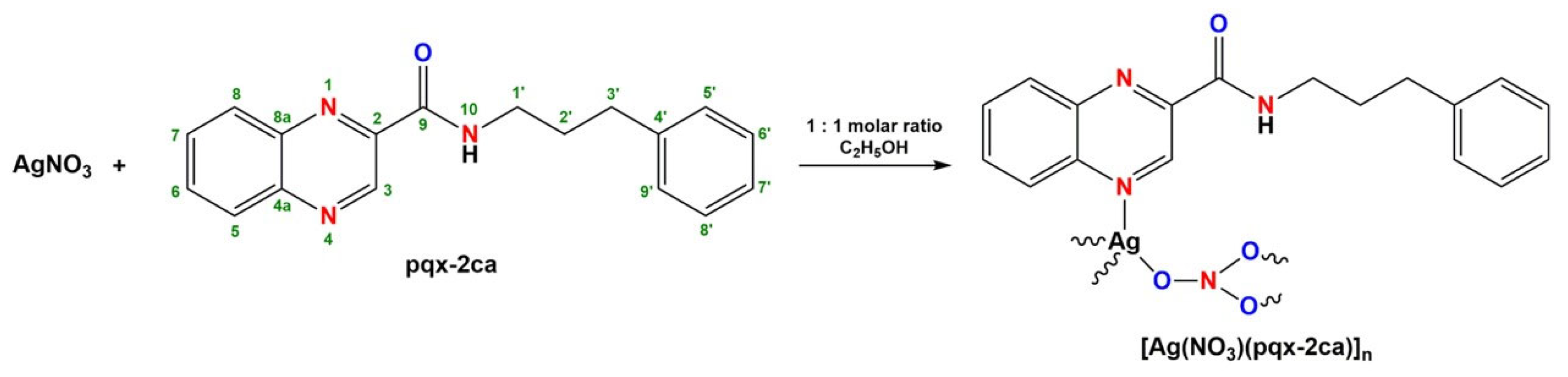
2.1. Synthesis of the Silver(I) Complex
2.2. Solid Studies
2.3. Solution Studies
2.4. BSA Binding Study
2.5. Lipophilicity Assay
2.6. DNA Binding Experiments
2.7. Antimycobacterial Activity of the Silver(I) Complex
2.8. Docking-Based Insights into the Interaction of the Complex with Mycolic Acid Pathway Enzymes
3. Materials and Methods
3.1. Materials and Instruments
3.2. Preparation of N-(3’-phenylpropyl)quinoxaline-2-carboxamide
3.3. Preparation of the Silver(I) Complex
3.4. Crystallographic Data Collection and Refinement of the Structures
3.5. BSA Binding Experiments
3.6. Lipophilicity Assay
3.7. ct-DNA Binding Experiments
3.8. Antimycobacterial Activity
3.8.1. Mycobacterial Strains
3.8.2. Experimental
3.9. Computational Methodology
3.9.1. Theoretical Approach and Spectral Simulation
3.9.2. Silver(I) Complex as Biomolecular Binder: An In Silico Study
4. Conclusions
Supplementary Materials
Author Contributions
Funding
Institutional Review Board Statement
Informed Consent Statement
Data Availability Statement
Conflicts of Interest
References
- McDonnell, G.; Russell, A.D. Antiseptics and disinfectants: Activity, action, and resistance. Clin. Microbiol. Rev. 1999, 12, 147–179. [Google Scholar] [CrossRef]
- Jung, W.K.; Koo, H.C.; Kim, K.W.; Shin, S.; Kim, S.H.; Park, Y.H. Antibacterial activity and mechanism of action of the silver ion in Staphylococcus aureus and Escherichia coli. Appl. Environ. Microbiol. 2008, 74, 2171−2178. [Google Scholar] [CrossRef] [PubMed]
- Atiyeh, B.S.; Costagliola, M.; Hayek, S.N.; Dibo, S.A. Effect of silver on burn wound infection control and healing: Review of the literature. Burns 2007, 33, 139−148. [Google Scholar] [CrossRef] [PubMed]
- Fox, C.L., Jr.; Modak, S.M. Mechanism of silver sulfadiazine action on burn wound infections. Antimicrob. Agents Chemother. 1974, 5, 582−588. [Google Scholar] [CrossRef] [PubMed]
- Nomiya, K.; Tsuda, K.; Sudoh, T.; Oda, M. Ag(I)- N bond-containing compound showing wide spectra in effective antimicrobial activities: Polymeric silver(I) imidazolate. J. Inorg. Biochem. 1974, 68, 39−44. [Google Scholar] [CrossRef]
- Nomiya, K.; Noguchi, R.; Oda, M. Synthesis and crystal structure of coinage metal(I) complexes with tetrazole (Htetz) and triphenylphosphine ligands, and their antimicrobial activities. A helical polymer of silver(I) complex [Ag(tetz)(PPh3)2]n and a monomeric gold(I) complex [Au(tetz)(PPh3)]. Inorg. Chim. Acta 2000, 298, 24−32. [Google Scholar]
- Nawaz, S.; Isab, A.A.; Merz, K.; Vasylyeva, V.; Metzler-Nolte, N.; Saleem, M.; Ahmad, S. Synthesis, characterization and antimicrobial studies of mixed ligand silver(I) complexes of triphenylphosphine and heterocyclic thiones: Crystal structure of bis [{(μ2-diazinane-2-thione)(diazinane-2-thione)(triphenylphosphine) silver(I)-nitrate}]. Polyhedron 2011, 30, 1502−1506. [Google Scholar] [CrossRef]
- Isab, A.A.; Nawaz, S.; Saleem, M.; Altaf, M.; Monim-ul-Mehboob, M.; Ahmad, S.; Evans, H.S. Synthesis, characterization and antimicrobial studies of mixed ligand silver(I) complexes of thioureas and triphenylphosphine; crystal structure of {[Ag (PPh3)(thiourea)(NO3)] 2·[Ag(PPh3)(thiourea)]2(NO3)2}. Polyhedron 2010, 29, 1251−1256. [Google Scholar] [CrossRef]
- Mercs, L.; Albrecht, M. Beyond catalysis: N-heterocyclic carbene complexes as components for medicinal, luminescent, and functional materials applications. Chem. Soc. Rev. 2010, 39, 1903−1912. [Google Scholar] [CrossRef]
- Teyssot, M.L.; Jarrousse, A.S.; Manin, M.; Chevry, A.; Roche, S.; Norre, F.; Beaudoin, C.; Morel, L.; Boyer, D.; Mahiou, R.; et al. Metal-NHC complexes: A survey of anti-cancer properties. Dalton Trans. 2009, 35, 6894−6902. [Google Scholar] [CrossRef]
- Scorpio, A.; Zhang, Y. Mutations in pncA, a gene encoding pyrazinamidase/nicotinamidase, cause resistance to the antituberculous drug pyrazinamide in tubercle bacillus. Nat. Med. 1996, 2, 662−667. [Google Scholar] [CrossRef]
- Watanabe, K.; Oguri, H.; Oikawa, H. Diversification of echinomycin molecular structure by way of chemoenzymatic synthesis and heterologous expression of the engineered echinomycin biosynthetic pathway. Curr. Opin. Chem. Biol. 2009, 13, 189−196. [Google Scholar] [CrossRef] [PubMed]
- Khan, S.A.; Saleem, K.; Khan, Z. Synthesis, characterization and in vitro antibacterial activity of new steroidal thiazolo quinoxalines. Eur. J. Med. Chem. 2007, 42, 103−108. [Google Scholar] [CrossRef] [PubMed]
- Das, P.; Doriya, K.; Dandela, R. Advances in the chemistry and therapeutic potential of [1, 8]-naphthyridines: A review. J. Indian. Chem. Soc. 2025, 102, 102283. [Google Scholar] [CrossRef]
- Reek, J.N.H.; de Bruin, B.; Pullen, S.; Mooibroek, T.J.; Kluwer, A.M.; Caumes, X. Transition metal catalysis controlled by hydrogen bonding in the second coordination sphere. Chem. Rev. 2022, 122, 12308−12369. [Google Scholar] [CrossRef]
- Cao, M.; Liu, X.; Feng, X. Asymmetric catalytic radical reactions enabled by chiral N,N′-dioxide–metal complexes. Acc. Chem. Res. 2025, 58, 2496–2510. [Google Scholar] [CrossRef]
- Melese, A.; Wubet, W.; Hussen, A.; Temesgen, A.; Mulate, K. Review on activation of small molecules (dihydrogen, carbon dioxide, and dinitrogen) by various transition metal complexes. J. Chem. Res. 2025, 49, 17475198251313648. [Google Scholar] [CrossRef]
- Seitz, L.E.; Suling, W.J.; Reynolds, R.C. Synthesis and antimycobacterial activity of pyrazine and quinoxaline derivatives. J. Med. Chem. 2002, 45, 5604−5606. [Google Scholar] [CrossRef]
- Bouz, G.; Bouz, S.; Janďourek, O.; Konečná, K.; Bárta, P.; Vinšová, J.; Doležal, M.; Zitko, J. Synthesis, biological evaluation, and in silico modeling of N-substituted quinoxaline-2-carboxamides. Pharmaceuticals 2021, 14, 768. [Google Scholar] [CrossRef]
- Jena, L.; Kashikar, S.; Kumar, S.; Harinath, B.C. Comparative proteomic analysis of Mycobacterium tuberculosis strain H37Rv versus H37Ra. Int. J. Mycobact. 2013, 2, 220–226. [Google Scholar] [CrossRef]
- Sparks, I.L.; Derbyshire, K.M.; Jacobs, W.R., Jr.; Morita, Y.S. Mycobacterium smegmatis: The vanguard of mycobacterial research. J. Bacteriol. 2023, 205, e00337-22. [Google Scholar] [CrossRef] [PubMed]
- Phelan, J.; Maitra, A.; McNerney, R.; Nair, M.; Gupta, A.; Coll, F.; Pain, A.; Bhakta, S.; Clark, T.G. The draft genome of Mycobacterium aurum, a potential model organism for investigating drugs against Mycobacterium tuberculosis and Mycobacterium leprae. Int. J. Mycobacteriol. 2015, 4, 207–216. [Google Scholar] [CrossRef] [PubMed]
- Bainomugisa, A.; Wampande, E.; Muchwa, C.; Akol, J.; Mubiri, P.; Ssenyungule, H.; Matovu, E.; Ogwang, S.; Joloba, M. Use of real time polymerase chain reaction for detection of M. tuberculosis, M. avium and M. kansasii from clinical specimens. Infect Dis. 2015, 15, 181. [Google Scholar] [CrossRef]
- Soleymani-Babadi, S.; Beheshti, A.; Bahrani-Pour, M.; Mayer, P.; Motamedi, H.; Trzybinski, D.; Wozniak, K. Synthesis, structural characterization, photophysical properties, and antibacterial assessment of silver(I)-thione coordination polymers based on a competition between nitrate anion and coanions CF3SO3−, ClO4−, BF4−, PF6−, and SbF6−. Cryst. Growth Des. 2019, 19, 4934−4948. [Google Scholar] [CrossRef]
- Straiton, A.J.; Parish, J.D.; Smith, J.J.; Lowe, J.P.; Johnson, A.L. Exploration of solid-state vs solution-state structure in contact ion pair systems: Synthesis, characterization, and solution-state dynamics of zinc diphenyl phosphate, [Zn{O2P(OPh)2}2], donor-base-supported complexes. Inorg. Chem. 2023, 62, 4770–4785. [Google Scholar] [CrossRef]
- Kalinowska-Lis, U.; Felczak, A.; Chęcińska, L.; Zawadzka, K.; Patyna, E.; Lisowska, K.; Ochocki, J. Synthesis, characterization and antimicrobial activity of water-soluble silver(I) complexes of metronidazole drug and selected counter-ions. Dalton Trans. 2015, 44, 8178−8189. [Google Scholar] [CrossRef]
- Jiang, Y.; Zhu, C.F.; Zheng, Z.; He, J.B.; Wang, Y. Synthesis, characterization and antibacterial activity of a biocompatible silver complex based on 2, 2′-bipyridine and 5-sulfoisophthalate. Inorg. Chim. Acta 2016, 451, 143−147. [Google Scholar] [CrossRef]
- Ali, I.; Wani, W.A.; Saleem, K. Empirical formulae to molecular structures of metal complexes by molar conductance. Synth. React. Inorg. Met. Org. Chem. 2013, 43, 1162−1170. [Google Scholar] [CrossRef]
- Cardoso, J.M.; Correia, I.; Galvão, A.M.; Marques, F.; Carvalho, M.F.N. Synthesis of Ag(I) camphor sulphonylimine complexes and assessment of their cytotoxic properties against cisplatin-resistant A2780cisR and A2780 cell lines. J. Inorg. Biochem. 2017, 166, 55−63. [Google Scholar] [CrossRef]
- Wu, J.Y.; Pan, Y.L.; Zhang, X.J.; Sun, T.; Tian, Y.P.; Yang, J.X.; Chen, Z.N. Synthesis, photoluminescence and electrochemical properties of a series of carbazole-functionalized ligands and their silver(I) complexes. Inorg. Chim. Acta 2007, 360, 2083−2091. [Google Scholar] [CrossRef]
- Połczyński, P.; Jurczakowski, R.; Grochala, W. Strong and long-lived free-radical oxidizer based on silver(II). Mechanism of Ag(I) electrooxidation in concentrated H2SO4. J. Phys. Chem. C. 2013, 117, 20689−20696. [Google Scholar] [CrossRef]
- Andrejević, T.P.; Milivojevic, D.; Glišić, B.Đ.; Kljun, J.; Stevanović, N.L.; Vojnovic, S.; Medic, S.; Nikodinovic-Runic, J.; Turel, I.; Djuran, M.I. Silver(I) complexes with different pyridine-4,5-dicarboxylate ligands as efficient agents for the control of cow mastitis associated pathogens. Dalton Trans. 2020, 49, 6084–6096. [Google Scholar] [CrossRef]
- Ašanin, D.P.; Skaro Bogojevic, S.; Perdih, F.; Andrejević, T.P.; Milivojevic, D.; Aleksic, I.; Nikodinovic-Runic, J.; Glišić, B.Đ.; Turel, I.; Djuran, M.I. Structural characterization, antimicrobial activity and BSA/DNA binding affinity of new silver(I) complexes with thianthrene and 1, 8-naphthyridine. Molecules 2021, 26, 1871. [Google Scholar] [CrossRef] [PubMed]
- Lakowicz, J.R. Principles of Fluorescence Spectroscopy; Springer: Boston, MA, USA, 2006. [Google Scholar]
- Anbazhagan, V.; Renganathan, R. Study on the binding of 2,3-diazabicyclo[2.2.2]oct-2-ene with bovine serum albumin by fluorescence spectroscopy. J. Lumin. 2008, 128, 1454–1458. [Google Scholar] [CrossRef]
- Shi, J.H.; Pan, D.Q.; Jiang, M.; Liu, T.T.; Wang, Q. In vitro study on binding interaction of quinapril with bovine serum albumin (BSA) using multi-spectroscopic and molecular docking methods. J. Biomol. Struct. Dyn. 2017, 35, 2211−2223. [Google Scholar] [CrossRef] [PubMed]
- Rajendiran, V.; Karthik, R.; Palaniandavar, M.; Stoeckli-Evans, H.; Periasamy, V.S.; Akbarsha, M.A.; Srinag, B.S.; Krishnamurthy, H. Mixed-ligand copper(II)-phenolate complexes: effect of coligand on enhanced DNA and protein binding, DNA cleavage, and anticancer activity. Inorg. Chem. 2007, 46, 8208–8221. [Google Scholar] [CrossRef]
- Smolénski, P.; Pettinari, C.; Marchetti, F.; Guedes da Silva, M.F.C.; Lupidi, G.; Patzmay, G.V.B.; Petrelli, D.; Vitali, L.A.; Pomberio, A.J.L. Syntheses, structures, and antimicrobial activity of new remarkably light-stable and water-soluble tris(pyrazolyl)methanesulfonate silver(I) derivatives of N-methyl-1,3,5-triaza-7-phosphaadamantane salt—[mPTA]BF4. Inorg. Chem. 2015, 54, 434–440. [Google Scholar] [CrossRef]
- Shi, Y.; Guo, C.; Sun, Y.; Liu, Z.; Xu, F.; Zhang, Y.; Wen, Z.; Li, Z. Interaction between DNA and microcystin-LR studied by spectra analysis and atomic force microscopy. Biomacromolecules 2011, 12, 797–803. [Google Scholar] [CrossRef]
- Carter, D.C.; Ho, J.X. Structure of serum albumin. Adv. Protein Chem. 1994, 45, 153–203. [Google Scholar]
- Marjanović, J.S.; Matić, J.D.; Milanović, Ž.; Divac, V.M.; Kosanić, M.M.; Petković, M.R.; Kostić, M.D. Molecular modeling studies, in vitro antioxidant and antimicrobial assay and BSA affinity of novel benzyl-amine derived scaffolds as CYP51B inhibitors. Mol. Divers. 2024, 29, 5499–5521. [Google Scholar] [CrossRef]
- Pantović, B.V.; Ašanin, D.P.; Milanović, Ž.; Perdih, F.; Ilic-Tomic, T.; Radanović, D.D.; Turel, I.; Djuran, M.I.; Glišić, B.Đ. Dinuclear gallium(III) complex with 1,3-propanediamine-N,N′-diacetate: Structural characterization, antimicrobial activity, and DNA/BSA interactions. Bioinorg. Chem. Appl. 2025, 2025, 8097589. [Google Scholar] [CrossRef]
- De Freitas, R.F.; Schapira, M. A Systematic analysis of atomic protein–ligand interactions in the PDB. Medchemcomm 2017, 8, 1970–1981. [Google Scholar] [CrossRef] [PubMed]
- Bissantz, C.; Kuhn, B.; Stahl, M. Corrections to a medicinal chemist’s guide to molecular interactions. J. Med. Chem. 2010, 53, 6241. [Google Scholar] [CrossRef]
- Tsuzuki, S.; Honda, K.; Uchimaru, T.; Mikami, M.; Tanabe, K. Origin of attraction and directionality of the π/π interaction: Model chemistry calculations of benzene dimer interaction. J. Am. Chem. Soc. 2002, 124, 104–112. [Google Scholar] [CrossRef] [PubMed]
- Mahadevi, A.S.; Sastry, G.N. Cation− π interaction: Its role and relevance in chemistry, biology, and material science. Chem. Rev. 2013, 113, 2100–2138. [Google Scholar] [CrossRef]
- Gallivan, J.P.; Dougherty, D.A. Cation-π interactions in structural biology. Proc. Natl. Acad. Sci. USA 1999, 96, 9459–9464. [Google Scholar] [CrossRef]
- Puckett, C.A.; Barton, J.K. Methods to explore cellular uptake of ruthenium complexes. J. Am. Chem. Soc. 2007, 129, 46–47. [Google Scholar] [CrossRef]
- Ghose, A.K.; Viswanadhan, V.N.; Wendoloski, J.J. A knowledge-based approach in designing combinatorial or medicinal chemistry libraries for drug discovery. 1. A qualitative and quantitative characterization of known drug databases. J. Comb. Chem. 1999, 1, 55–68. [Google Scholar] [CrossRef]
- Martinez, R.; Chacon-Garcia, L. The search of DNA-intercalators as antitumoral drugs: What it worked and what did not work. Curr. Med. Chem. 2005, 12, 127–151. [Google Scholar] [CrossRef]
- Turel, I.; Kljun, J. Interactions of metal ions with DNA, its constituents and derivatives, which may be relevant for anticancer research. Curr. Top. Med. Chem. 2011, 11, 2661–2687. [Google Scholar] [CrossRef]
- Mjos, K.D.; Orvig, C. Metallodrugs in medicinal inorganic chemistry. Chem. Rev. 2014, 114, 4540–4563. [Google Scholar] [CrossRef] [PubMed]
- Sarwar, T.; Ishqi, H.M.; Rehman, S.U.; Husain, M.A.; Rahman, Y.; Tabish, M. Caffeic acid binds to the minor groove of calf thymus DNA: A multi-spectroscopic, thermodynamics and molecular modelling study. Int. J. Biol. Macromol. 2017, 98, 319–328. [Google Scholar] [CrossRef] [PubMed]
- Bi, S.; Song, D.; Tian, Y.; Zhou, X.; Liu, Z.; Zhang, H. Molecular spectroscopic study on the interaction of tetracyclines with serum albumins. J. Mol. Struct. 2005, 737, 15–21. [Google Scholar] [CrossRef] [PubMed]
- Scarim, C.B.; de Farias, R.L.; de Godoy Netto, A.V.; Chin, C.M.; Dos Santos, J.L.; Pavan, F.R. Recent advances in drug discovery against Mycobacterium tuberculosis: Metal-based complexes. Eur. J. Med. Chem. 2021, 214, 113166. [Google Scholar] [CrossRef]
- Maldonado, Y.D.; Scalese, G.; Manieri, K.F.; Pavan, F.R.; Méndez, L.D.A.; Gambino, D. New silver(I) phosphino complexes: Evaluation of their potential as prospective agents against Mycobacterium tuberculosis. J. Inorg. Biochem. 2022, 227, 111683. [Google Scholar] [CrossRef]
- Cuin, A.; Massabni, A.C.; Leite, C.Q.F.; Sato, D.N.; Neves, A.; Szpoganicz, B.; Silva, M.S.; Bortoluzzi, A.J. Synthesis, X-ray structure and antimycobacterial activity of silver complexes with α-hydroxycarboxylic acids. J. Inorg. Biochem. 2007, 101, 291−296. [Google Scholar] [CrossRef]
- Sirgel, F.A.; Widd, I.J.F.; Helden, P.D. Measuring Minimum Inhibitory Concentrations in Mycobacteria. In Mycobacteria Protocols; Parish, T., Brown, A., Eds.; Humana Press: Totowa, NJ, USA, 2010; pp. 173–186. [Google Scholar] [CrossRef]
- Savić, N.D.; Milivojevic, D.R.; Glišić, B.Đ.; Ilic-Tomic, T.; Veselinovic, J.; Pavic, A.; Vasiljevic, B.; Nikodinovic-Runic, J.; Djuran, M.I. A comparative antimicrobial and toxicological study of gold(III) and silver(I) complexes with aromatic nitrogen-containing heterocycles: Synergistic activity and improved selectivity index of Au(III)/Ag(I) complexes mixture. RSC Adv. 2016, 6, 13193–13206. [Google Scholar] [CrossRef][Green Version]
- CrysAlis CCD, CrysAlis RED, and CrysAlis Pro, version 1.171.40.68a; data collection and data reduction software; Oxford Diffraction Ltd.: Yarnton, UK, 2008.
- Sheldrick, G.M. SHELXT–Integrated space-group and crystal-structure determination. Acta Cryst. 2015, A71, 3−8. [Google Scholar] [CrossRef]
- Sheldrick, G.M. Crystal-structure refinement with SHELXL. Acta Cryst. Struct. Commun. 2015, C71, 3−8. [Google Scholar]
- Macrae, C.F.; Edgington, P.R.; McCabe, P.; Pidcock, E.; Shields, G.P.; Taylor, R.; Towler, M.; van de Streek, J. Mercury: Visualization and analysis of crystal structures. J. Appl. Crystallogr. 2006, 39, 453−457. [Google Scholar] [CrossRef]
- Wolfe, A.; Shimer, G.H., Jr.; Meehan, T. Polycyclic aromatic hydrocarbons physically intercalate into duplex regions of denatured DNA. Biochemistry 1987, 26, 6392–6396. [Google Scholar] [CrossRef] [PubMed]
- Bera, R.; Sahoo, B.K.; Ghosh, K.S.; Dasgupta, S. Studies on the interaction of isoxazolcurcumin with calf thymus DNA. Int. J. Biol. Macromol. 2008, 42, 14–21. [Google Scholar] [CrossRef] [PubMed]
- Franzblau, S.G.; Witzig, R.S.; McLaughlin, J.C.; Torres, P.; Madico, G.; Hernandez, A.; Degnan, M.T.; Cook, M.B.; Quenzer, V.K.; Ferguson, R.M.; et al. Rapid, Low-technology MIC determination with clinical Mycobacterium tuberculosis isolates by using the microplate alamar blue assay. J. Clin. Microbiol. 1998, 36, 362–366. [Google Scholar] [CrossRef] [PubMed]
- Schön, T.; Werngren, J.; Machado, D.; Borroni, E.; Wijkander, M.; Lina, G.; Mouton, J.; Matuschek, E.; Kahlmeter, G.; Giske, C.; et al. Antimicrobial susceptibility testing of Mycobacterium tuberculosis complex isolates—The EUCAST broth microdilution reference method for MIC determination. Clin. Microbiol. Infect. 2020, 26, 1488–1492. [Google Scholar] [CrossRef]
- Frisch, M.J.; Trucks, G.W.; Schlegel, H.B.; Scuseria, G.E.; Robb, M.A.; Cheeseman, J.R.; Scalmani, G.; Barone, V.; Mennucci, B.; Petersson, G.A.; et al. Uranyl extraction by N, N-dialkylamide ligands studied by static and dynamic DFT simulations. Gaussian 2009, 9, 227. [Google Scholar]
- Becke, A.D.; Johnson, E.R. A density-functional model of the dispersion interaction. J. Chem. Phys. 2005, 123, 154101. [Google Scholar] [CrossRef]
- Marenich, A.V.; Cramer, C.J.; Truhlar, D.G. Universal solvation model based on solute electron density and on a continuum model of the solvent defined by the bulk dielectric constant and atomic surface tensions. J. Phys. Chem. B 2009, 113, 6378–6396. [Google Scholar] [CrossRef]
- Zieliński, R.; Szymusiak, H. Application of DFT B3LYP/GIAO and B3LYP/CSGT methods for interpretation of NMR spectra of flavonoids. Pol. J. Food Nutr. Sci. 2003, 12, 157–162. [Google Scholar]
- Bohmann, J.A.; Weinhold, F.; Farrar, T.C. Natural chemical shielding analysis of nuclear magnetic resonance shielding tensors from gauge-including atomic orbital calculations. J. Chem. Phys. 1997, 107, 1173–1184. [Google Scholar] [CrossRef]
- Bujacz, A. Structures of bovine, equine and leporine serum albumin. Acta Crystallogr. D 2012, 68, 1278–1289. [Google Scholar] [CrossRef]
- Drew, H.R.; Wing, R.M.; Takano, T.; Broka, C.; Tanaka, S.; Itakura, K.; Dickerson, R.E. Structure of a B-DNA dodecamer: Conformation and dynamics. Proc. Natl. Acad. Sci. USA 1981, 78, 2179–2183. [Google Scholar] [CrossRef]
- Canals, A.; Purciolas, M.; Aymamí, J.; Coll, M. The anticancer agent ellipticine unwinds DNA by intercalative binding in an orientation parallel to base pairs. Acta Crystallogr. D 2005, 61, 1009–1012. [Google Scholar] [CrossRef] [PubMed]
- Luckner, S.R.; Liu, N.; am Ende, C.W.; Tonge, P.J.; Kisker, C. A slow, tight binding inhibitor of InhA, the enoyl-acyl carrier protein reductase from Mycobacterium tuberculosis. J. Biol. Chem. 2010, 285, 14330–14337. [Google Scholar] [CrossRef] [PubMed]
- Zhang, B.; Li, J.; Yang, X.; Wu, L.; Zhang, J.; Yang, Y.; Zhao, Y.; Zhang, L.; Yang, X.; Yang, X.; et al. Crystal structures of membrane transporter MmpL3, an anti-TB drug target. Cell 2019, 176, 636–648. [Google Scholar] [CrossRef] [PubMed]
- Dassault Systèmes BIOVIA. Discovery Studio, Version 2024.1; Dassault Systèmes: San Diego, CA, USA, 2024; Available online: https://www.3ds.com/products-services/biovia/ (accessed on 22 December 2025).
- Morris, G.M.; Goodsell, D.S.; Halliday, R.S.; Huey, R.; Hart, W.E.; Belew, R.K.; Olson, A.J. Automated docking using a Lamarckian genetic algorithm and an empirical binding free energy function. J. Comput. Chem. 1998, 19, 1639–1662. [Google Scholar] [CrossRef]
- Fuhrmann, J.; Rurainski, A.; Lenhof, H.P.; Neumann, D. A new Lamarckian genetic algorithm for flexible ligand-receptor docking. J. Comput. Chem. 2010, 31, 1911–1918. [Google Scholar] [CrossRef]



| Reaction | ΔrG (kcal mol–1) | K |
|---|---|---|
| {[Ag(NO3)(pqx-2ca)]2NO3}(aq)¯ ⇌ 2[Ag(NO3)(pqx-2ca)](aq) + NO3(aq)¯ | −0.31 | 1.69 |
| {[Ag(NO3)(pqx-2ca)]2NO3}(DMSO)¯ ⇌ 2[Ag(NO3)(pqx-2ca)](DMSO) + NO3(DMSO)¯ | −0.22 | 1.44 |
| [Ag(NO3)(pqx-2ca)](DMSO) + DMSO ⇌ [Ag(DMSO)(pqx-2ca)]+(DMSO) + NO3(DMSO)¯ | 28.4 | 1.70 × 10⁻²¹ |
| Compound | Experimental λ (nm) | TD-B3LYP-D3BJ/6-311++ G (d,p) | ||
|---|---|---|---|---|
| λ (nm) | Oscillator Strength (f) | Major Transitions | ||
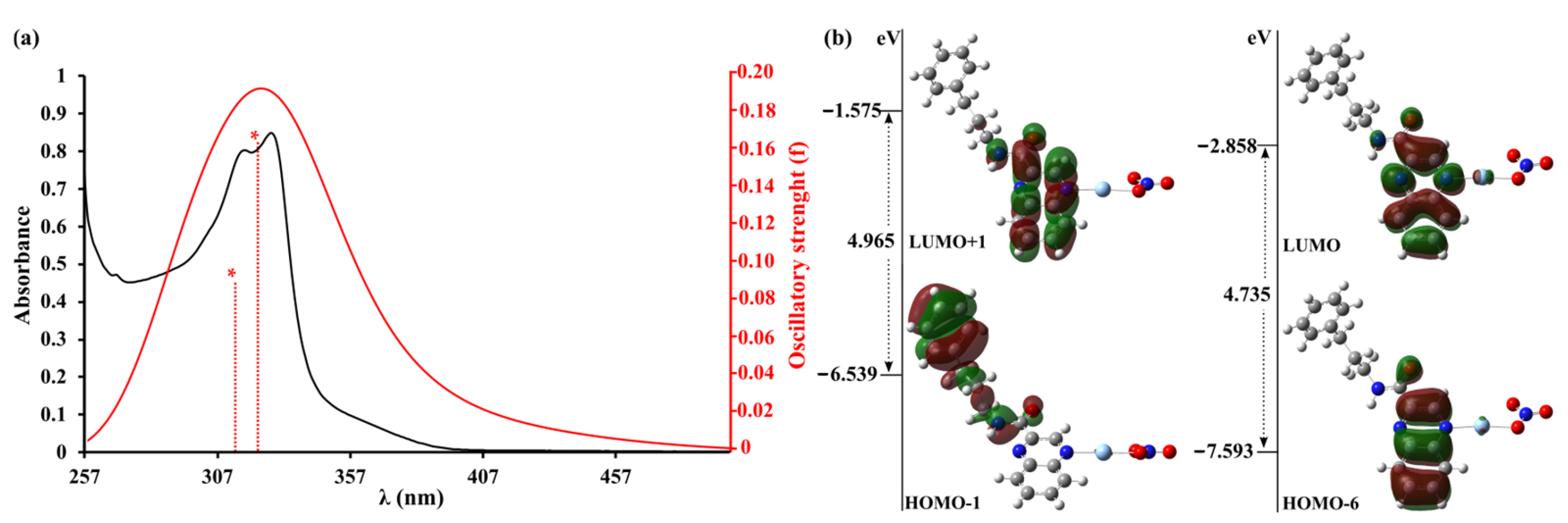
| [Ag(NO3)(pqx-2ca)]n | 316 | 314 | 0.069 | HOMO-1→LUMO+1 (70%) |
| 327 | 320 | 0.190 | HOMO-6→LUMO (64%) | |
| Compound | Ksv (M−1) | Hypochromism (%) | Kq (M−1s−1) | KA (M−1) | n |
|---|---|---|---|---|---|
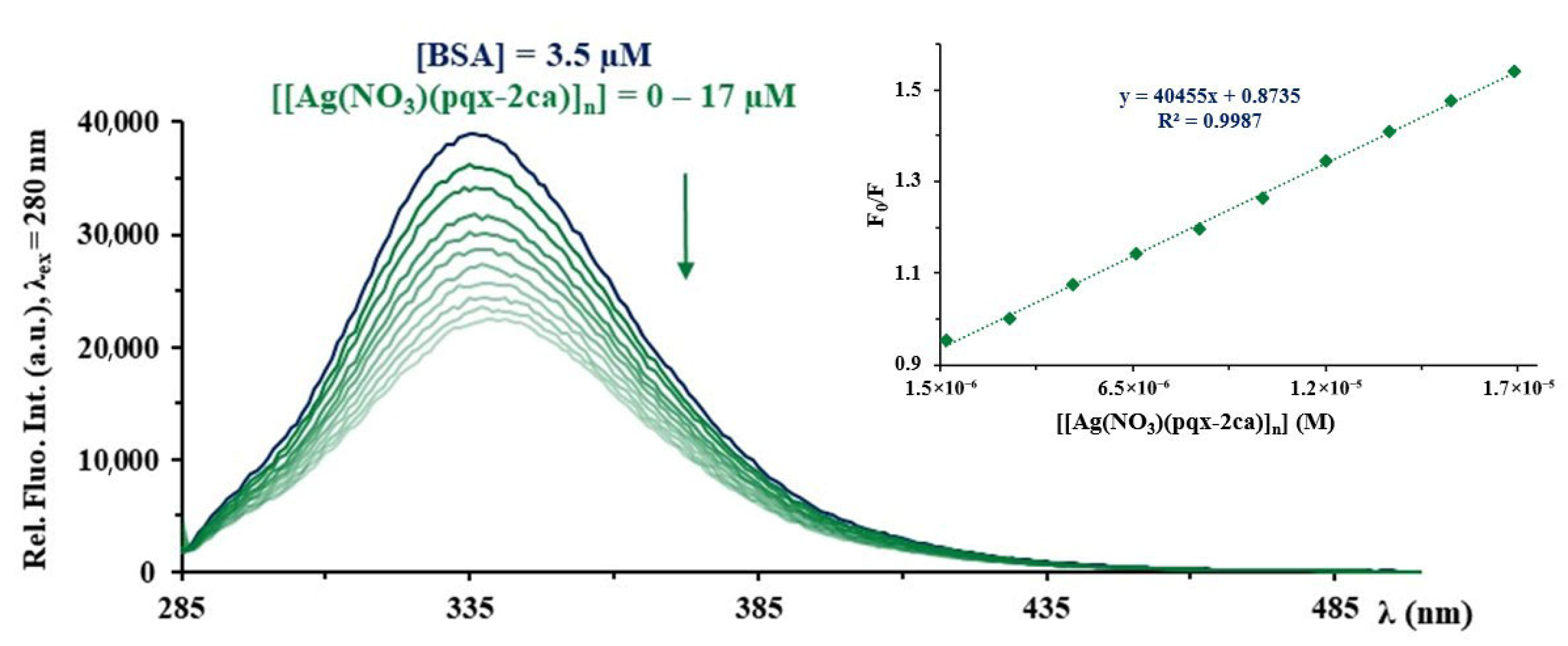
| [Ag(NO3)(pqx-2ca)]n | (4.63 ± 0.01) × 104 | 43.1 | 4.63 × 10¹² | 3.31 × 10⁴ | 0.97 |
| pqx-2ca | (2.83 ± 0.05) × 104 | 31.7 | 2.83 × 10¹² | 3.24 × 10⁴ | 1.01 |
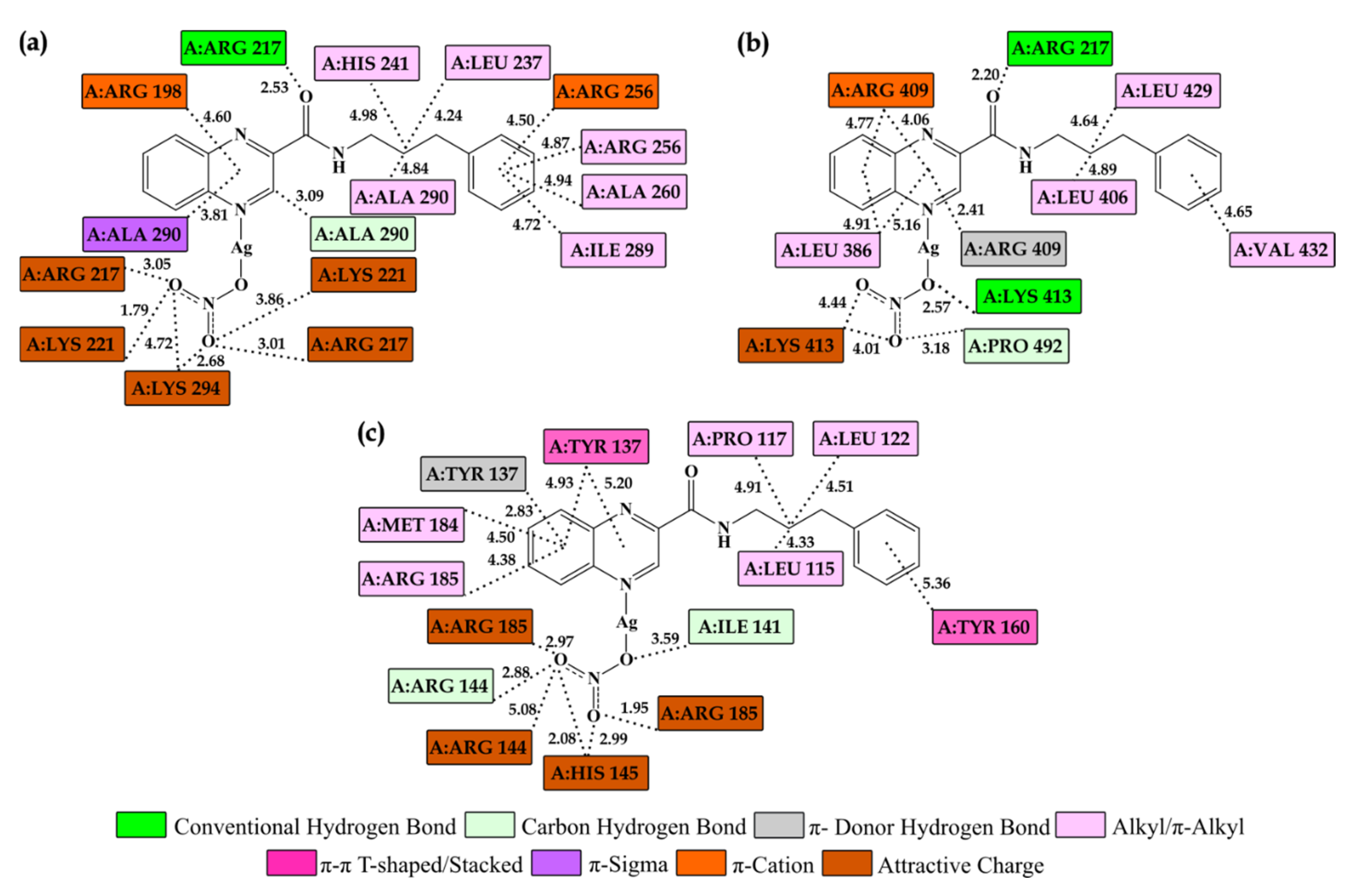
| Conformations | ΔGbind | Ki (µM) | ΔGinter | ΔGvdw+hbond+desolv | ΔGelec | ΔGtotal | ΔGtor | ΔGunb |
|---|---|---|---|---|---|---|---|---|
| [Ag(NO3)(pqx-2ca)] | ||||||||
| BSA-1 | −8.23 | 0.92701 | −10.43 | −8.23 | −2.19 | −0.87 | 2.20 | −0.87 |
| BSA-2 | −8.32 | 0.79149 | −10.52 | −9.70 | −0.82 | −0.69 | 2.20 | −0.69 |
| BSA-3 | −11.74 | 0.00248 | −13.94 | −12.43 | −1.50 | −0.73 | 2.20 | −0.73 |
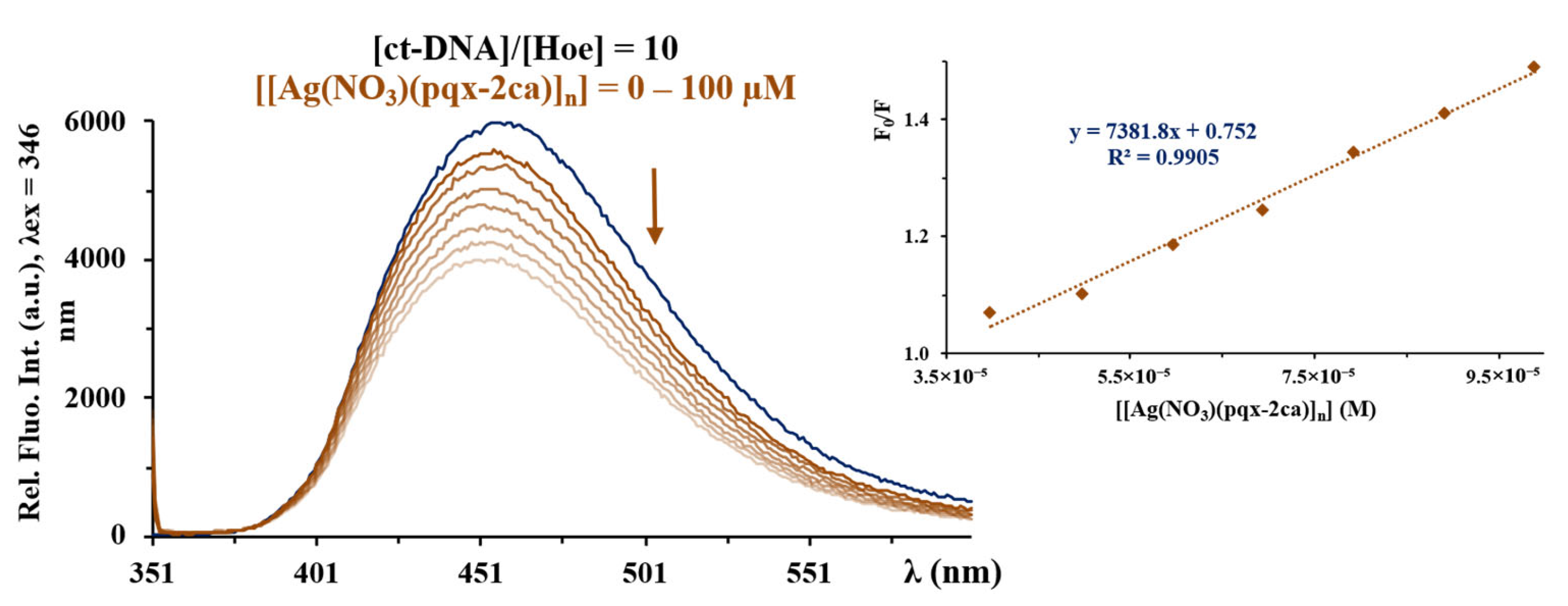
| Compound | Ksv (M−1) | Hypochromism (%) | Kq (M−1s−1) | KA (M−1) | n | |
|---|---|---|---|---|---|---|
| EthBr | [Ag(NO3)(pqx-2ca)]n | (8.72 ± 0.01) × 102 | 8.6 | 8.72 × 10¹⁰ | 1.97 × 10² | 0.83 |
| Hoe | pqx-2ca | (4.38 ± 0.02) × 103 | 21.0 | 4.38 × 10¹¹ | 1.89 × 10⁸ | 2.20 |
| [Ag(NO3)(pqx-2ca)]n | (9.82 ± 0.02) × 103 | 34.0 | 9.82 × 10¹¹ | 6.95 × 10⁷ | 2.00 | |
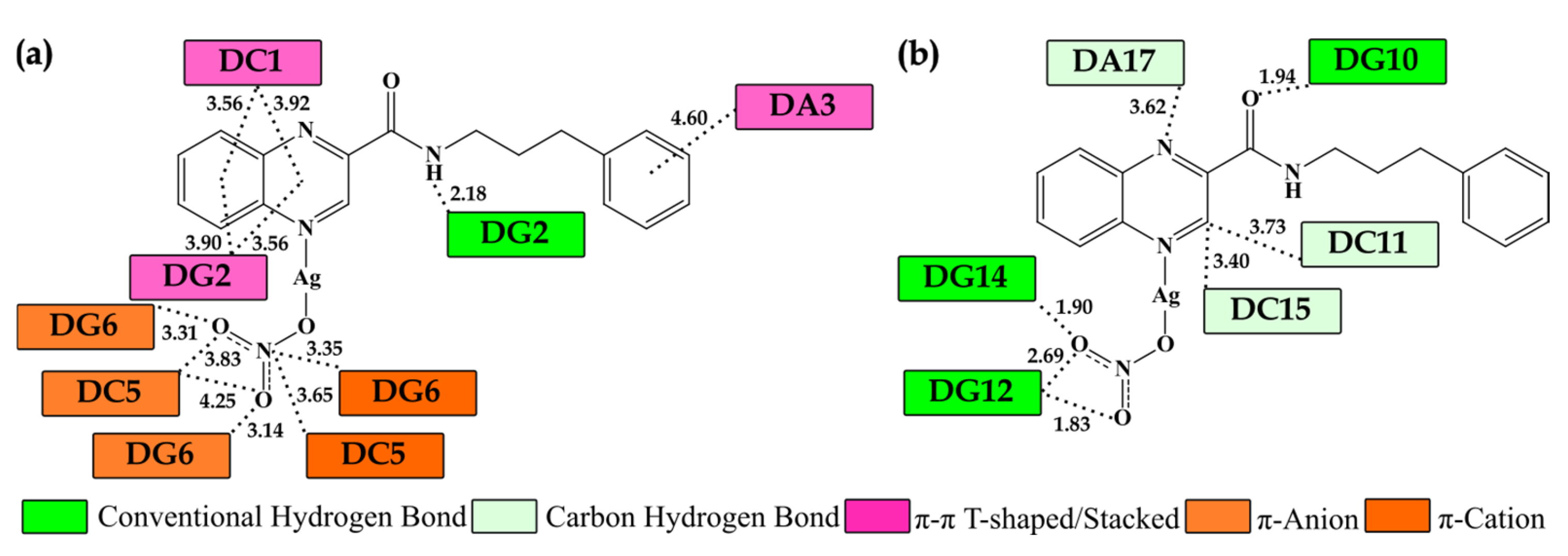
| Complex | ΔGbind | Ki (µM) | ΔGinter | ΔGvdw+hbond+desolv | ΔGelec | ΔGtotal | ΔGtor | ΔGunb |
|---|---|---|---|---|---|---|---|---|
| 1Z3F | ||||||||
| [Ag(NO3)(pqx-2ca)] | −7.29 | 4.54 | −9.48 | −9.42 | −0.07 | −0.48 | 2.20 | −0.48 |
| B-DNA | ||||||||
| [Ag(NO3)(pqx-2ca)] | −7.91 | 1.60 | −10.10 | −8.67 | −1.43 | −1.71 | 2.20 | −1.71 |
| M. tuberculosis H37Ra * | M. smegmatis * | M. aurum * | M. avium * | M. kansasii * | |
|---|---|---|---|---|---|
| pqx-2ca | 15.625 (53.6) | ≥500 | ≥500 | >500 | >500 |
| [Ag(NO3)(pqx-2ca)]n | 15.625 (33.9) | 1.98 (4.3) | 1.98 (4.3) | 7.81 (16.9) | 3.91 (8.5) |
| isoniazid | 0.25 | 1.56 | 3.91 | 1000 | 25 |
| rifampicin | 0.0015625 | 12.5 | 0.39 | 0.125 | 0.025 |
| ciprofloxacin | 0.25 | 0.125 | 0.015625 | 1.56 | 0.25 |
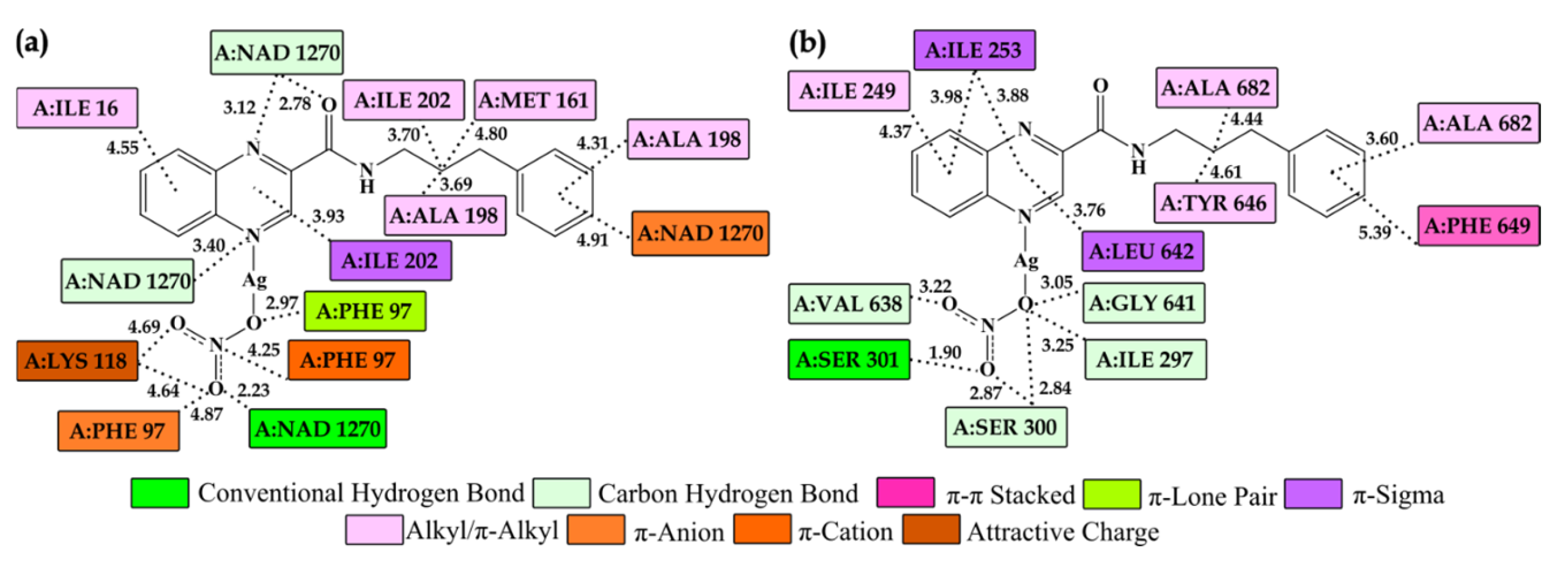
| Compound | ΔGbind | Ki (µm) | ΔGinter | ΔGvdw+hbond+desolv | ΔGelec | ΔGtotal | ΔGtor | ΔGunb |
|---|---|---|---|---|---|---|---|---|
| InhA | ||||||||
| [Ag(NO3)(pqx-2ca)] | −7.95 | 1.48 | −10.15 | −10.23 | 0.08 | −0.57 | 2.20 | −0.57 |
| INH1 | −7.98 | 1.43 | −9.90 | −9.83 | −0.07 | −0.89 | 1.92 | −0.89 |
| MmpL3 | ||||||||
| [Ag(NO3)(pqx-2ca)] | −9.10 | 0.21 | −11.30 | −11.53 | 0.23 | −0.94 | 2.20 | −0.94 |
| INH2 | −10.93 | 0.98 | −13.40 | −11.48 | −1.91 | −0.49 | 2.47 | −0.49 |
Disclaimer/Publisher’s Note: The statements, opinions and data contained in all publications are solely those of the individual author(s) and contributor(s) and not of MDPI and/or the editor(s). MDPI and/or the editor(s) disclaim responsibility for any injury to people or property resulting from any ideas, methods, instructions or products referred to in the content. |
© 2026 by the authors. Licensee MDPI, Basel, Switzerland. This article is an open access article distributed under the terms and conditions of the Creative Commons Attribution (CC BY) license.
Share and Cite
Bouz, G.; Stevanović, N.L.; Počkaj, M.; Andrejević, T.P.; Turel, I.; Jand’ourek, O.; Konečná, K.; Milanović, Ž.; Milisavljević, K.; Glišić, B.Đ. Polynuclear Silver(I)–Quinoxaline Complex: Comprehensive Structural Characterization, Antimycobacterial Properties and DNA/BSA Binding Study. Pharmaceutics 2026, 18, 169. https://doi.org/10.3390/pharmaceutics18020169
Bouz G, Stevanović NL, Počkaj M, Andrejević TP, Turel I, Jand’ourek O, Konečná K, Milanović Ž, Milisavljević K, Glišić BĐ. Polynuclear Silver(I)–Quinoxaline Complex: Comprehensive Structural Characterization, Antimycobacterial Properties and DNA/BSA Binding Study. Pharmaceutics. 2026; 18(2):169. https://doi.org/10.3390/pharmaceutics18020169
Chicago/Turabian StyleBouz, Ghada, Nevena L. Stevanović, Marta Počkaj, Tina P. Andrejević, Iztok Turel, Ondřej Jand’ourek, Klára Konečná, Žiko Milanović, Kristina Milisavljević, and Biljana Đ. Glišić. 2026. "Polynuclear Silver(I)–Quinoxaline Complex: Comprehensive Structural Characterization, Antimycobacterial Properties and DNA/BSA Binding Study" Pharmaceutics 18, no. 2: 169. https://doi.org/10.3390/pharmaceutics18020169
APA StyleBouz, G., Stevanović, N. L., Počkaj, M., Andrejević, T. P., Turel, I., Jand’ourek, O., Konečná, K., Milanović, Ž., Milisavljević, K., & Glišić, B. Đ. (2026). Polynuclear Silver(I)–Quinoxaline Complex: Comprehensive Structural Characterization, Antimycobacterial Properties and DNA/BSA Binding Study. Pharmaceutics, 18(2), 169. https://doi.org/10.3390/pharmaceutics18020169