An Overview of Anticoagulant Drugs Pharmacology, Therapeutic Approaches, Limitations and Perspectives
 , , ,
, , ,  , , , ,
  ,
,  , and
, and
Abstract
1. Introduction

2. The Coagulation Process and the Primary Targets of Anticoagulant Drugs
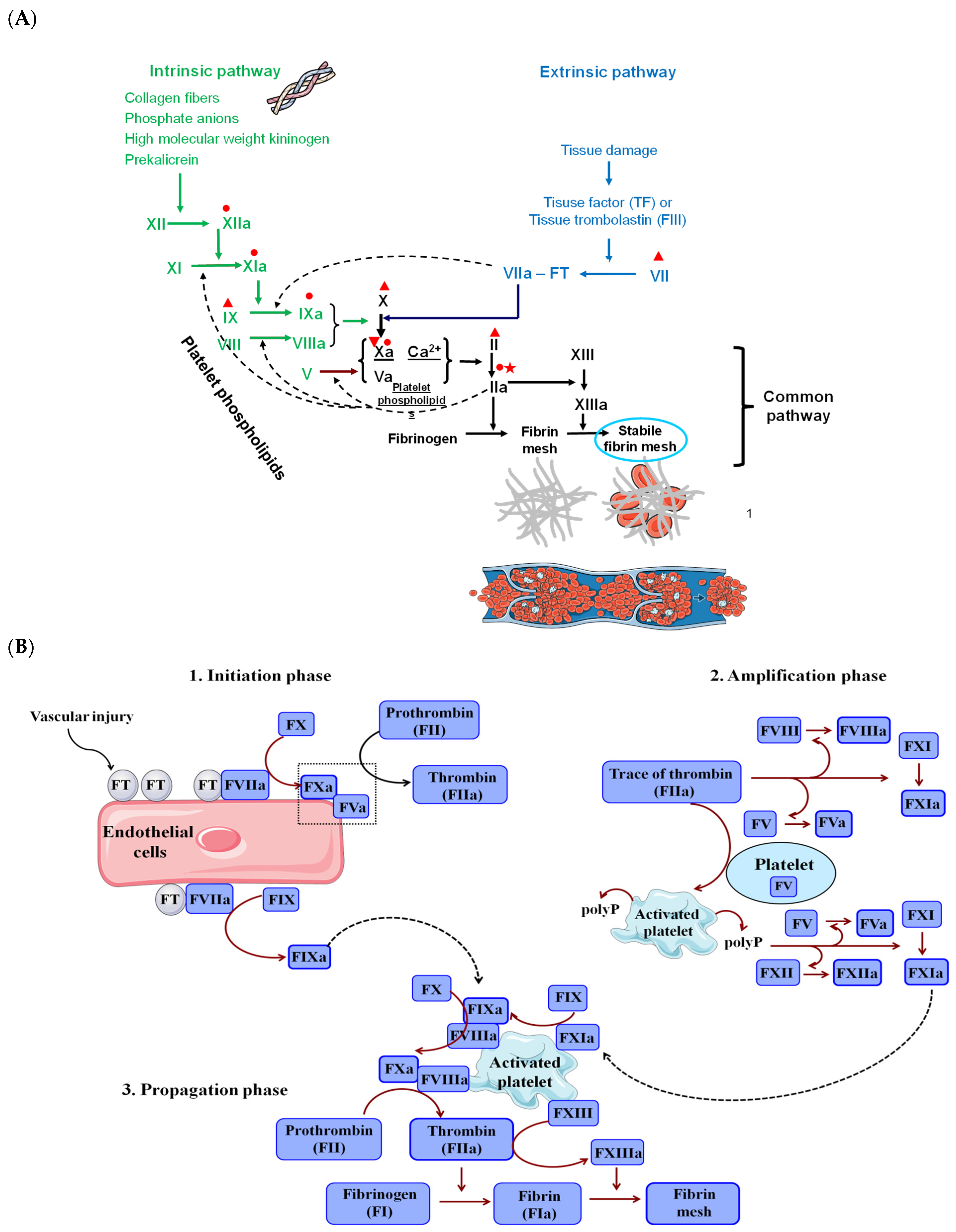
 —UFH;
—UFH;  —vitamin K antagonists (VKAs);
  —LMWHs, ULMWHs, fondaparinux, DOACs; heparinoids (danaparoid);
  —LMWHs, ULMWHs, DOACs, hirudin, parenteral direct inhibitors of clotting factor IIa (ar-gatroban, desirudin, lepirudin, bivalirudin), heparinoids (danaparoid); (B) the three phases of the coagulation process [26,27,28,29,30].
—UFH; —vitamin K antagonists (VKAs); —LMWHs, ULMWHs, fondaparinux, DOACs; heparinoids (danaparoid); —LMWHs, ULMWHs, DOACs, hirudin, parenteral direct inhibitors of clotting factor IIa (ar-gatroban, desirudin, lepirudin, bivalirudin), heparinoids (danaparoid); (B) the three phases of the coagulation process [26,27,28,29,30].
—LMWHs, ULMWHs, DOACs, hirudin, parenteral direct inhibitors of clotting factor IIa (ar-gatroban, desirudin, lepirudin, bivalirudin), heparinoids (danaparoid); (B) the three phases of the coagulation process [26,27,28,29,30].
—UFH; —vitamin K antagonists (VKAs); —LMWHs, ULMWHs, fondaparinux, DOACs; heparinoids (danaparoid); —LMWHs, ULMWHs, DOACs, hirudin, parenteral direct inhibitors of clotting factor IIa (ar-gatroban, desirudin, lepirudin, bivalirudin), heparinoids (danaparoid); (B) the three phases of the coagulation process [26,27,28,29,30].

3. Classification of ACs

| Drug Class | Drugs | Bioavailability | Half-Life | Plasma Protein Binding | CYP Metabolism (Enzymatic Substrate) | Elimination (Primary Route) | Posology and Route of Administration (Most Frequent Administration) | References |
|---|---|---|---|---|---|---|---|---|
| UFH | Heparin | 100% (i.v.), variable (s.c.) | 0.5–1.5 h | >90% | - | reticuloendothelial system, R | Prophylaxis: maximum 15,000 IU BID or TID divided into 2–3 doses/day (prophylaxis) Treatment: i.v. bolus maximum 10,000 IU (50–100 IU/kg) ± maximum 400–600 IU/kg daily in continuous infusion or by 2–4 h i.v. injections * or maximum 250 IU/kg/dose (s.c.) BID | [43,44,45,46] |
| LMWHs | Dalteparin Enoxaparin Nadroparin Reviparin Tinzaparin | >90% | 1.5–6 h | <UFH | - | R | ** dalteparin (s.c., i.v.) 2500–5000 IU QD or BID enoxaparin (s.c., i.v.) 20 mg–200 mg/day (divided in 1 or 2 doses) nadroparin (s.c., i.v.) 1900–8550 IU anti-Xa, OD or BID reviparin (s.c., i.v.) 143 IU anti-Xa/kg divided in 2 doses (maximum 10,307 IU/day) tinzaparin (s.c., i.v.) 175 UI anti-Xa/kg (3500–18,000 anti-Xa units QD) | [7,46,47,48,49,50,51,52,53] |
| ULMWHs | Bemiparin | 96% | 5.3 h | N/A | - | R | s.c. 2500–25,000 IU QD i.v. bolus: 8 units/kg/hr | [43,44,61,62] |
| Indirect inhibitors of clotting factor Xa (parenteral) | Fondaparinux | >97% | 17–21 h | 94% *** | R | 2.5 mg OD (s.c., i.v.) | [27,46,54] | |
| Heparinoids | Danaparoid | 100% | 25 h | N/A | - | R | 750 anti-factor Xa units BID (s.c.) i.v. bolus: 1250–3750 anti-factor Xa units + i.v. infusion in decreased doses starting at 400 units/h | [37,63,64] |
| Pentosan polysulfate | 1% | 24–34 h | N/A | - | R (6%) | p.o. 100 mg TID administered on an empty stomach | [27,65] | |
| Parenteral direct inhibitors of clotting factor IIa | Argatroban | 100% | 39–51 min | 54–55% | CYP3A4/5 | Faeces (65%), R (22%) | 2 mcg/kg/min in continuous i.v. infusion i.v. bolus: 350 mcg/kg starting and maintenance: 15–30 mcg/kg/min (5–6.5 min) | [27,66] |
| Desirudin | 100% | 2 h | **** | - | R (40–50%) | s.c. 15 mg BID | [27,67] | |
| Lepirudin | 100% | 1.3 h | 3% | - | R | i.v. bolus: 0.4 mg/kg, then 0.15 mg/kg/h in continuous infusion | [27,68] | |
| Bivalirudin | 100% | 25 min | ***** | - | R (20%) | i.v. bolus: 0.75 mg/kg + 0.25–1.75 mg/kg/h in i.v. infusion | [27,69] | |
| Direct oral inhibitors of clotting factor IIa | Dabigatran | 3–10 | 12–17 h | 35% | - | Biliary excretion (20%), R (80%) | prophylaxis: 110 mg QD p.o. (starting dose) 220 mg QD p.o. (maintenance dose) | [46,70] |
| Direct oral inhibitors of clotting factor Xa | Rivaroxaban | >80% (↑ by food, if dose ≥ 15 mg) | 5–13 h | >92% | CYP3A4/5, CYP2J2 | R (66%), Faeces (28%) | 2.5 mg BID p.o. + acetylsalicylic acid, clopidogrel, ticlopidine Day 1–21: 15 mg BID p.o. (VTE treatment, secondary prophylaxis); Day 22–180: 20 mg QD p.o. Day 181⟶: 10 or 20 mg QD p.o. >15 mg, tablets should be administered with food | [42,46,59] |
| Apixaban | 50% | 9–14 h | >92% | CYP3A4/5, CYP1A2, CYP2J2, CYP2C8/9/19 | Faeces (<60%), R (~25%) | 2.5–5 mg BID p.o. | [46,60] | |
| Edoxaban | 62% | 10–14 h | ~55% | CYP3A4/5 | R (50%), Biliary excretion (50%) | 60 mg QD p.o. | [46,71] | |
| Betrixaban | 34% (↓ by food) | 19–27 h | 60% | CYP1A1 CYP1A2 CYP2B6 CYP2C9 CYP2C19 CYP2D6 CYP3A4 | Faeces (85%), R (11%) | 160 mg QD p.o. (starting dose) 80 mg QD p.o. (maintenance dose) | [42,72] | |
| VKAs | Warfarin | 100% | 36–42 h | 99% | CYP2C9/8/19 CYP3A4 CYP1A2 | R (80%), Faeces (20%) | 2–15 mg QD p.o. | [55,56,57,58] |
| Acenocumarol | 60% | 8–11 h | >98% | CYP2C9 | R | 2–10 mg QD p.o. | [55,56,57,73,74,75] | |
| Phenprocumon | ~100% | 160 h | 99% | CYP2C9 CYP2C8 CYP3A4 | R | 0.75–9.0 mg QD p.o. | [55,56,57,74] |
3.1. Indirect Inhibitors of Clotting Factor IIa and Xa
3.1.1. Unfractionated Heparin (UFH)
3.1.2. Low and Ultra-Low-Molecular-Weight Heparins
- -
- VTE prophylaxis in orthopaedic, bariatric, or general surgery (e.g., nadroparin, enoxaparin, bemiparin, tinzaparin, certoparin, etc.);
- -
- Prophylaxis of clotting in haemodialysis patients (e.g., nadroparin, dalteparin, tinzaparin, etc.);
- -
- Treatment of deep vein thrombosis (DVT), including cancer-associated thrombosis (e.g., certoparin, nadroparin, enoxaparin, bemiparin, etc.) or treatment of pulmonary embolism (PE) (e.g., enoxaparin, dalteparin, etc.);
- -
- Traumatic conditions such as trauma, burns, spinal injury (e.g., enoxaparin, reviparin, etc.);
- -
- Prophylaxis of ischemic complications in acute coronary syndromes (unstable angina, NSTEMI myocardial infarction) (parnaparin, enoxaparin, etc.);
- -
- Bridge therapy (especially enoxaparin, tinzaparin) prior to starting VKAs in AF, heart valve replacement, history of VTE, etc.
3.1.3. Indirect Inhibitors of Clotting Factor Xa
3.1.4. Heparinoids
3.2. Direct Inhibitors of Clotting Factors IIa and Xa
3.2.1. Parenteral Direct Inhibitors of Thrombin (Clotting Factor IIa)
3.2.2. Direct Oral Anticoagulants (DOACs)
- -
- -
- -
- -
- -
- DOACs and their antidote costs are very high for clinical use [86];
- -
- The risk of gastrointestinal bleeding is higher in elderly patients treated with DOAC [86];
- -
- Betrixaban is not recommended in DVT and PE treatment, prevention of stroke or non-valvular AF, or for DVT prophylaxis in orthopaedic surgery [119];
- -
- There is some evidence that has associated dabigatran with a higher risk of ischemic stroke [120];
- -
3.3. Vitamin K Antagonists
- -
- Patients with AF (for the primary prevention of stroke);
- -
- Patients with DVT and PE (for the prevention of recurrent thromboembolism);
- -
- Patients with valvular heart disease or prosthetic cardiac valves (for the prevention of thrombosis) [128].
4. The Biological Effects of Anticoagulants
4.1. Antithrombotic Activity
4.1.1. Deep Vein Thrombosis
- (i)
- Parenteral treatment (UFH, LMWH, fondaparinux) overlapped with oral VKA, followed by oral therapy with VKA;
- (ii)
- Parenteral treatment (UFH, LMVH, fondaparinux) followed by oral therapy with dabigatran (RECOVER, RECOVER II trials) or edoxaban (HOCUSAI trial);
- (iii)
4.1.2. Pulmonary Embolism
4.1.3. Orthopaedic Surgery
- (a)
- In patients with major orthopaedic surgeries, particularly of the lower limbs or pelvis, there is an increased risk of venous thrombosis (coagulation activation), on the one hand due to the long period of patient immobilisation associated with venous stasis, and on the other hand due to the release of tissue factor (TF) from the bone during surgery. Thus, the following recommendations should be taken into consideration in orthopaedic surgery [130]: LMWH, apixaban, and rivaroxaban are used in case of knee or hip surgeries, and fondaparinux, UFH, and warfarin could be used as second-line therapeutic options when the others are contraindicated or cannot be administered.
- (b)
- LMWH, UFH, and fondaparinux are used for DVT prophylaxis in patients with hip fracture surgery.
4.1.4. Cerebrovascular Diseases
4.1.5. Anticoagulants Used in Heparin-Induced Thrombocytopenia
4.1.6. Anticoagulants in Antiphospholipid Syndrome
4.1.7. Anticoagulant Therapy in Cancer
4.1.8. The Use of Anticoagulants in COVID-19
4.1.9. Particular Situations of Anticoagulant Use
Renal Impairment
Liver Failure
Elderly Patients
Pregnancy and Lactation
4.2. Anti-Inflammatory Effect
4.3. Anticoagulant in Wound Healing
4.4. Anti-Viral Activity
4.5. Heparin Used as Drug–Polymer Conjugate
5. Anticoagulants’ Main Risks
5.1. Haemorrhagic Risk
5.2. Heparin-Induced Thrombocytopenia
5.3. Hypersensitivity Reactions
5.4. Anticoagulant Resistance
5.5. Osteopenia and Osteoporosis
6. Anticoagulants Interactions
6.1. Drug–Drug Interactions
6.2. Drug–Food Interactions
7. Anticoagulant Medication Errors
| Drugs | Type of Error | Consequences | References |
|---|---|---|---|
| VKAs | inadequate prescription | increased risks of bleeding or thrombosis | [128,268] |
| inadequate monitoring | increased risk of bleeding | ||
| poor adherence or inadequate administration | increased risks of bleeding or coagulation due to higher doses, absence of the treatment, or interactions with drugs, plants, food, or dietary supplements | ||
| continuation of treatment with VKA after switching to other ACs | severe adverse reactions (e.g., bruising with hemorrhagic shock, acute renal failure) | ||
| continuation of treatment during surgical interventions or invasive manoeuvres | increased risk of bleeding | ||
| co-administration of acenocoumarol with other drugs (e.g., amiodarone, fluconazole, acetaminophen, acetylsalicylic acid, etc.) | drug–drug interactions which affect the acenocoumarol safety | [269] | |
| DOACs | intermittent drug purchasing due to their high cost by the underinsured or financially unstable patients | increased thrombotic risk | [119] |
| inappropriate choice of drug or dose (e.g., in a patient with non-valvular AF, renal impairment, etc.) | thrombotic or bleeding risksoverdoses lead to increased all-cause mortality suboptimal doses lead to increased cardiovascular hospitalizations | [270,271,272] | |
| concomitant administration with different drug classes (e.g., antiplatelet, nonsteroidal anti-inflammatory drugs) | increased incidence of haemorrhage | [273] | |
| concomitant administration with CYP3A4 inducers (anticonvulsants, rifampicin, St John’s wort, etc.) or inhibitors (macrolides, antivirals, antifungals, verapamil, amiodarone, etc.) | increased risk of adverse events or reduced efficacy due to modifications in DOAC plasma levels | [274] | |
| improper storage (e.g., humidity) or administration of DOACs (e.g., crushing of dabigatran tablets, administration of rivaroxaban 20 mg without food, omission of doses, etc.) | reducing the DOACs’ efficiency and increasing the thrombotic risks | [119,275] | |
| admission or discharge from the hospital, or undergoing surgery | potential or real fatal and serious incidents | [276] | |
| continuation of treatment during surgical interventions or invasive manoeuvres (e.g., neuraxial anaesthesia) or improper restarting of therapy after these interventions | bleeding complications (e.g., spinal or epidural hematoma) or thrombotic risks | [277] | |
| duplicate prescribing, incorrect dispensing, incorrect prescription (frequency, wrong patient, dose, duration) | N/A | [278] | |
| wrong drug or dose (e.g., in patients with impaired renal function), duplicate therapy, missing drug/omission because of the patients’ discharge without anticoagulation, failure to restart DOACs post-procedure, or low adherence | N/A | [279,280] | |
| inappropriately low or high dose | tendency of adverse events (stroke, transitory ischemic accident, embolism, bleeding complications), but not statistically significant | [281] | |
| incorrect dosing (e.g., in patients with impaired renal function, elderly or treated with other drugs such as verapamil), intentional dose reducing because of doctors’ fear of bleeding risk, off-label prescriptions (e.g., bariatric surgery) | reducing drug safety reducing the drug efficacy and increasing the risk of thrombotic events | [282] | |
| the overdosing was reported in the EudraVigilance database with a higher frequency than underdosing | the correct usage of DOACs should be monitored by professionals | [283] | |
| under-dosing in elderly patients or in patients with a higher CHA2DS2-VASc score, over-dosing in elderly patients or in patients with renal failure or a higher bleeding score | higher all-cause mortality (overdoses) frequent hospitalisation for cardiovascular problems, such as stroke (underdoses) | [284,285] | |
| UFH | accidental administration of heparin saline solution rather than heparin | low or lack of efficacy | [286] |
| coexistence of many protocols in the same medical site for the administration of UFH in continuous infusion | N/A | [287] | |
| administrative errors (inaccurate filling of automatic drug-dispensing cabinets), similar sizes of vials or labels, incorrect dosing of factor X, and inaccuracy in label reading | severe conditions in neonates (including death) | [288] | |
| UFH after DOACs therapy | falsely elevated anti-Xa concentrations and incorrect titration based on anti-Xa concentrations in hospitalised patients converted from DOAC to UFH | thrombotic events, death | [289] |
| UFH and LMWHs | prescribing protocol problems | increased risk of incidence | [290] |
| dosing and monitoring confusion, use of abbreviations, dosage calculations, multiple-solution concentrations, use of intravenous delivery pumps | bleeding complications | [265] | |
| LMWHs | incomplete prescriptions, omission errors (the ordered drug is not given), performance deficit of the medical team, and failure to follow protocols and guidelines | reducing the drug’s safety or efficacy | [291] |
| ignoring the patient’s condition. LMWH were inadequately administered in patients with renal failure, history of HIT, and stents after surgery (incorrect post-surgery co-administration of enoxaparin, aspirin, and clopidogrel) | bleeding complications, death platelet count decreased, and the PF4 antibody was positive, cyanosis, reduced oxygen saturation, and death total stenosis of the coronary arteries | [266] | |
| misuse of devices and incorrect programming of infusion devices | overdose and bleeding complications (e.g., bleeding at the administration site) | [266] | |
| mismanagement (enoxaparin) of the route of administration in neonates (i.m. administration, not s.c.) | increased aPTT, high bleeding risk | [292] | |
| dosing errors (dose ordered was not based on weight) or duplicate therapy errors (co-administration of UFH and LMWH) | N/A | [293] | |
| Parenteral direct thrombin inhibitors | prescribing and administration errors, delayed dose adjustment after aPTT determination delayed infusion rate adjustment when clinical pharmacy staff are less available (e.g., evenings, weekends, etc.) | N/A | [294] |
| dispensing of a wrong drug (e.g., tirofiban instead of argatroban) | Lack of efficacy | [294] | |
| administration of argatroban in the wrong patients | N/A | [295] |
8. Reversal Anticoagulant Agents
- -
- aPTT: UFH, LMWHs, dabigatran;
- -
- Prothrombin time/INR (PT/INR): VKAs;
- -
- Ecarin clotting time (ECT): dabigatran;
- -
- Hemoclot thrombin inhibitor assay: dabigatran;
- -
- Thrombin time: dabigatran;
- -
- Anti-factor Xa level: LMWHs, fondaparinux, direct factor Xa inhibitors.
| Reversal Agent | Anticoagulant Drug | Posology |
|---|---|---|
| Protamine sulfate | UFH, LMWHs | 12.5–50 mg i.v. |
| Vitamin K | VKAs | 1–10 mg i.v. or p.o. |
| Idarucizumab | dabigatran | 2 × 2.5 g i.v. |
| Andexanet alfa | direct factor Xa inhibitors LMWHs *, fondaparinux * | 0.4 or 0.8 g i.v. bolus followed by a continuous infusion of 4 mg/min or 8 mg/min for up to 120 min |
| Tranexamic acid | VKAs direct factor Xa inhibitors | 1 g at 8 h |
| FFP | VKAs DOACs *** | 10–15 mL/kg |
| PCC # | VKAs | 25–50 units/kg |
| rFVIIa | VKAs dabigatran *** | 90 µg/kg |
| Activated charcoal | VKAs DOACs argatroban and lepirudin | 50–100 mg/dose |
| Hemodialysis ## | dabigatran | |
| Aripazine (ciraparantag) | UH, LMWHs, fondaparinux, DOACs | 25 mg, 50 mg, 100 mg, 300 mg, and 600 mg i.v. ** |
8.1. Protamine Sulfate
8.2. Vitamin K
8.3. Idarucizumab
8.4. Andexanet Alfa
8.5. Fresh Frozen Plasma
8.6. Prothrombin Complex Concentrate
8.7. Recombinant-Activated Factor VIIa
8.8. Activated Charcoal
8.9. Haemodialysis
8.10. Other Strategies
8.10.1. Tranexamic Acid
8.10.2. Aripazine (Ciraparantag)
9. Originals Versus Biosimilars
10. Laboratory Monitoring of Anticoagulant Drugs
11. Future Perspectives
12. Conclusions
Author Contributions
Funding
Institutional Review Board Statement
Informed Consent Statement
Data Availability Statement
Conflicts of Interest
Abbreviations
| ABCB1 | ATP-binding cassette, subfamily b, member 1 |
| AC | anticoagulant drug |
| ACT | activated clotting time |
| AF | atrial fibrillation |
| APS | antiphospholipid syndrome |
| aPTT | activated partial thromboplastin time |
| ATIII | antithrombin III |
| b.v. | baseline values |
| BID | bis in die (twice a day) |
| CES1 | carboxylesterase 1 |
| CHA2DS2-VASc | congestive heart failure, hypertension, age, diabetes mellitus, prior stroke or transient ischemic attack or thromboembolism, vascular disease, age, sex category (score) |
| CKD | chronic kidney disease |
| CYP | cytochrome P450 |
| DOAC | direct oral anticoagulant drug |
| dRVVT | dilute Rusell viper venom time |
| dTT | dilute thrombin time |
| DVT | deep venous thrombosis |
| ECT | ecarin clotting time |
| FDA | Food & Drug Administration |
| FFP | fresh frozen plasma |
| HIT | heparin induced thrombocytopenia |
| i.m. | intramuscular |
| i.v. | intravenous |
| INR | international normalized ratio |
| IU | Internation Unit |
| k-time | coagulation time |
| LMWH | low-molecular-weight heparin |
| mAb | monoclonal antibody |
| MAPK | mitogen-activated protein kinase |
| MNPT | mean normal PT |
| mRNA | messenger RNA |
| MW | molecular weight |
| N/A | not available |
| NOAC | novel or non-vitamin K antagonist oral anticoagulant |
| NSAIDs | non-steroidal anti-inflammatory drugs |
| NSTEMI | non-ST-elevation myocardial infarction |
| p.o. | per os (oral) |
| PCC | prothrombin complex concentrate |
| PCI | percutaneous coronary intervention |
| PE | pulmonary embolism |
| PiCT | prothrombinase-induced clotting test |
| PIVKA | proteins induced by vitamin K absence |
| PT | prothrombin time |
| QD | quaque die (once a day) |
| R | renal elimination |
| rFVIIa | recombinant-activated factor VIIa |
| ROTEM | rotational thromboelastometry |
| r-time | reaction time |
| s.c. | subcutaneous |
| SDF-1 | stromal cell-derived factor-1α |
| STEMI | ST-elevation myocardial infarction |
| TID | ter in die (three times a day) |
| TSOAC | target-specific oral anticoagulants |
| TT | thrombin time |
| TTR | time in therapeutic range |
| UFH | unfractioned heparin |
| ULMWH | first ultra-low-molecular-weight heparin |
| USD | United States dollar |
| VEGF | vascular endothelial growth factor |
| VKA | vitamin K antagonist |
| VKOR | vitamin K oxide reductase |
| VKORK | vitamin K 2,3-epoxide reductase complex |
| VT | venous thrombosis |
| VTE | venous thromboembolism |
| β2GPI | β2-glycopotein I |
References
- Liebson, P.R. The Early History of Anticoagulants: 1915–1948. Hektoen Int. J. Med. Humanit. 2013, 5. [Google Scholar]
- Milestones in Anticoagulant Drugs. Available online: https://www.hematology.org/about/history/50-years/milestones-anticoagulant-drugs (accessed on 9 May 2022).
- Fields, W.S. The History of Leeching and Hirudin. Pathophysiol. Haemost. Thromb. 1991, 21, 3–10. [Google Scholar] [CrossRef]
- Munshi, Y.; Ara, I.; Rafique, H.; Ahmad, Z. Leeching in the History—A Review. Pak. J. Biol. Sci. 2008, 11, 1650–1653. [Google Scholar] [CrossRef] [PubMed]
- Hsu, E.; Moosavi, L. Biochemistry, Antithrombin III; StatPearls: Treasure Island, FL, USA, 2021. [Google Scholar]
- Brouwers, J.R.B.J.; Roeters van Lennep, J.E.; Beinema, M.J. Biosimilars of Low Molecular Weight Heparins: Relevant Background Information for Your Drug Formulary. Br. J. Clin. Pharmacol. 2019, 85, 2479. [Google Scholar] [CrossRef]
- Clivarin—Summary of the Product Characteristics. Available online: https://www.e-lactancia.org/media/papers/ReviparinClivarin-DS-SmPC2010.pdf (accessed on 29 June 2022).
- Imberti, D.; Marietta, M.; Polo Friz, H.; Cimminiello, C. The Introduction of Biosimilars of Low Molecular Weight Heparins in Europe: A Critical Review and Reappraisal Endorsed by the Italian Society for Haemostasis and Thrombosis (SISET) and the Italian Society for Angiology and Vascular Medicine (SIAPAV). Thromb. J. 2017, 15, 13. [Google Scholar] [CrossRef][Green Version]
- Kataria, B.C.; Mehta, D.S.; Chhaiya, S.B. Drug Lag for Cardiovascular Drug Approvals in India Compared with the US and EU Approvals. Indian Heart J. 2013, 65, 24–29. [Google Scholar] [CrossRef] [PubMed]
- Troein, P.; Newton, M.; Scott, K. The Impact of Biosimilar Competition in Europe. Available online: https://health.ec.europa.eu/system/files/2021-01/biosimilar_competition_en_0.pdf (accessed on 29 June 2022).
- Warkentin, T.E.; Greinacher, A.; Koster, A. Bivalirudin. Thromb. Haemost. 2008, 99, 830–839. [Google Scholar] [CrossRef] [PubMed]
- Enoxaparin—StatPearls. Available online: https://www.ncbi.nlm.nih.gov/books/NBK539865/ (accessed on 29 June 2022).
- Fan, P.; Gao, Y.; Zheng, M.; Xu, T.; Schoenhagen, P.; Jin, Z. Recent Progress and Market Analysis of Anticoagulant Drugs. J. Thorac. Dis. 2018, 10, 2011–2025. [Google Scholar] [CrossRef]
- Abdulrehman, J.; Eikelboom, J.W.; Siegal, D.M. Andexanet Alfa for Reversal of Factor Xa Inhibitors: A Critical Review of the Evidence. Future Cardiol. 2019, 15, 395–404. [Google Scholar] [CrossRef]
- Burness, C.B. Idarucizumab: First Global Approval. Drugs 2015, 75, 2155–2161. [Google Scholar] [CrossRef]
- Favaloro, E.J.; Pasalic, L.; Curnow, J.; Lippi, G. Laboratory Monitoring or Measurement of Direct Oral Anticoagulants (DOACs): Advantages, Limitations and Future Challenges. Curr. Drug Metab. 2017, 18, 598–608. [Google Scholar] [CrossRef]
- Petitou, M.; Casu, B.; Lindahl, U. 1976–1983, a Critical Period in the History of Heparin: The Discovery of the Antithrombin Binding Site. Biochimie 2003, 85, 83–89. [Google Scholar] [CrossRef]
- Montinari, M.R.; Minelli, S.; De Caterina, R. Eighty Years of Oral Anticoagulation: Learning from History. Vasc. Pharmacol. 2021, 141, 106918. [Google Scholar] [CrossRef]
- Bielecki, S.; Lee, D.; Hamad, B. The Market for Oral Anticoagulants. Nat. Rev. Drug Discov. 2018, 17, 617–618. [Google Scholar] [CrossRef] [PubMed]
- Onishi, A.; St Ange, K.; Dordick, J.S.; Linhardt, R.J. Heparin and Anticoagulation. Front. Biosci. (Landmark Ed.) 2016, 21, 1372–1392. [Google Scholar] [CrossRef] [PubMed]
- Global Anticoagulants Market (2021–2026) by Drug Class, Route of Administration, Geography and the Impact of COVID-19 with Ansoff Analysis. Available online: https://www.researchandmarkets.com/reports/5317270/global-anticoagulants-market-2021-2026-by-drug (accessed on 13 June 2022).
- Anticoagulant Reversal Drugs Market Size Report, 2020–2027. Available online: https://www.grandviewresearch.com/industry-analysis/anticoagulant-reversal-drugs-market (accessed on 9 May 2022).
- Cardenas, J.C.; Rein-Smith, C.M.; Church, F.C. Overview of Blood Coagulation and the Pathophysiology of Blood Coagulation Disorders. In Encyclopedia of Cell Biology; Academic Press: Cambridge, MA, USA, 2016; Volume 1, pp. 714–722. [Google Scholar] [CrossRef]
- Versteeg, H.H.; Heemskerk, J.W.M.; Levi, M.; Reitsma, P.H. New Fundamentals in Hemostasis. Physiol. Rev. 2013, 93, 327–358. [Google Scholar] [CrossRef]
- Ashorobi, D.; Ameer, M.A.; Fernandez, R. Thrombosis. StatPearls [Internet]. Available online: https://www.ncbi.nlm.nih.gov/books/NBK538430/ (accessed on 29 June 2022).
- Christos, S.; Naples, R. Anticoagulation Reversal and Treatment Strategies in Major Bleeding: Update 2016. West. J. Emerg. Med. 2016, 17, 264–270, Erratum in West. J. Emerg. Med. 2016, 17, 669–670. https://doi.org/10.5811/westjem.2016.8.32230. [Google Scholar] [CrossRef]
- Günther, A.; Ruppert, C. Anticoagulants. In Encyclopedia of Respiratory Medicine; Academic Press: Cambridge, MA, USA, 2006; Volume 4, pp. 115–128. [Google Scholar] [CrossRef]
- Frederick, R.; Pochet, L.; Charlier, C.; Masereel, B. Modulators of the Coagulation Cascade: Focus and Recent Advances in Inhibitors of Tissue Factor, Factor VIIa and Their Complex. Curr. Med. Chem. 2012, 12, 397–417. [Google Scholar] [CrossRef] [PubMed]
- Becker, R.C. Factor Xa Inhibitors: Critical Considerations for Clinical Development and Testing. J. Thromb. Thrombolysis 2021, 52, 397–402. [Google Scholar] [CrossRef]
- Munlemvo, D.M. The Cell-Based Approach of Hemostasis, Coagulopathy, and the Implications for the Pediatric Cardiac Anesthesiologist. Front. Anesthesiol. 2025, 4, 1454904. [Google Scholar] [CrossRef]
- Mackman, N. New Insights into the Mechanisms of Venous Thrombosis. J. Clin. Investig. 2012, 122, 2331. [Google Scholar] [CrossRef]
- Neves, A.R.; Correia-Da-Silva, M.; Sousa, E.; Pinto, M. Structure–Activity Relationship Studies for Multitarget Antithrombotic Drugs. Future Med. Chem. 2016, 8, 2305–2355. [Google Scholar] [CrossRef]
- Patriota, Y.B.G.; Chaves, L.L.; Gocke, E.H.; Severino, P.; Soares, M.F.R.; Soares-Sobrinho, J.L.; Souto, E.B.; Taglietti, M. Applied Nanotechnologies in Anticoagulant Therapy: From Anticoagulants to Coagulation Test Performance of Drug Delivery Systems. Appl. Nano 2021, 2, 98–117. [Google Scholar] [CrossRef]
- Walenga, J.M. An Overview of the Direct Thrombin Inhibitor Argatroban. Pathophysiol. Haemost. Thromb. 2002, 32, 9–14. [Google Scholar] [CrossRef] [PubMed]
- Acostamadiedo, J.M.; Lyer, U.G.; Owen, J. Danaparoid Sodium. Expert Opin. Pharmacother. 2005, 1, 803–814. [Google Scholar] [CrossRef] [PubMed]
- Wilde, M.I.; Markham, A. Danaparoid. A Review of Its Pharmacology and Clinical Use in the Management of Heparin-Induced Thrombocytopenia. Drugs 1997, 54, 903–924. [Google Scholar] [CrossRef]
- Garcia, D.A.; Baglin, T.P.; Weitz, J.I.; Samama, M.M. Parenteral Anticoagulants: Antithrombotic Therapy and Prevention of Thrombosis, 9th Ed: American College of Chest Physicians Evidence-Based Clinical Practice Guidelines. Chest 2012, 141, e24S–e43S. [Google Scholar] [CrossRef]
- Gray, E.; Mulloy, B.; Barrowcliffe, T.W. Heparin and Low-Molecular-Weight Heparin. Thromb. Haemost. 2008, 99, 807–818. [Google Scholar] [CrossRef]
- Anticoagulation Products (LMWHs, Ultra LMWH, Direct Thrombin Inhibitors). Available online: https://hemonc.medicine.ufl.edu/files/2013/07/AnticoagRx.pdf (accessed on 29 June 2022).
- Thomas, O.; Lybeck, E.; Strandberg, K.; Tynngåd, N.; Schött, U. Monitoring Low Molecular Weight Heparins at Therapeutic Levels: Dose-Responses of, and Correlations and Differences between APTT, Anti-Factor Xa and Thrombin Generation Assays. PLoS ONE 2015, 10, e0116835. [Google Scholar] [CrossRef] [PubMed]
- Smith, S.A.; Travers, R.J.; Morrissey, J.H. How It All Starts: Initiation of the Clotting Cascade. Crit. Rev. Biochem. Mol. Biol. 2015, 50, 326. [Google Scholar] [CrossRef]
- DeWald, T.A.; Washam, J.B.; Becker, R.C. Anticoagulants: Pharmacokinetics, Mechanisms of Action, and Indications. Neurosurg. Clin. N. Am. 2018, 29, 503–515. [Google Scholar] [CrossRef]
- HEPARIN Injectable|MSF Medical Guidelines. Available online: https://medicalguidelines.msf.org/en/viewport/EssDr/english/heparin-injectable-16682769.html (accessed on 30 June 2022).
- Heparin Infusion Guidelines|Anticoagulation Services. Available online: https://depts.washington.edu/anticoag/home/content/heparin-infusion-guidelines (accessed on 30 June 2022).
- Guidelines for Heparin Dosage—Manchester University NHS Foundation Trust. Available online: https://mft.nhs.uk/the-trust/other-departments/laboratory-medicine/haematology/reference-ranges/#heparin (accessed on 30 June 2022).
- Leentjens, J.; Peters, M.; Esselink, A.C.; Smulders, Y.; Kramers, C. Initial Anticoagulation in Patients with Pulmonary Embolism: Thrombolysis, Unfractionated Heparin, LMWH, Fondaparinux, or DOACs? Br. J. Clin. Pharmacol. 2017, 83, 2356. [Google Scholar] [CrossRef] [PubMed]
- Park, J.; Byun, Y. Recent Advances in Anticoagulant Drug Delivery. Expert Opin. Drug Deliv. 2015, 13, 421–434. [Google Scholar] [CrossRef]
- Fragmin—Summary of Product Characteristics. Available online: https://www.medicines.org.uk/emc/product/4241/smpc/print (accessed on 30 June 2022).
- Fraxiparine—Summary of Product Characteristics. Available online: https://www.anm.ro/_/_RCP/rcp_2518_10.05.10.pdf (accessed on 30 June 2022).
- CHMP Lovenox—Summary of Product Characteristics. Available online: https://www.ema.europa.eu/en/documents/referral/lovenox-article-30-referral-annex-iii_en.pdf (accessed on 30 June 2022).
- INNOHEP—Résumé Des Caractéristiques Du Produit. Available online: http://agence-prd.ansm.sante.fr/php/ecodex/rcp/R0287004.htm (accessed on 30 June 2022).
- Geerts, W.H.; Heit, J.A.; Clagett, G.P.; Pineo, G.F.; Colwell, C.W.; Anderson, J.; Wheeler, H.B. Prevention of Venous Thromboembolism. Chest 2001, 119, 132S–175S. [Google Scholar] [CrossRef]
- DVT and Pulmonary Embolism: Part II. Treatment and Prevention. American Family Physician, 15 June 2004. Available online: https://www.aafp.org/pubs/afp/issues/2004/0615/p2841.html (accessed on 30 June 2022).
- CHMP Arixtra—Annex I Summary of Product Characteristics. Available online: https://www.ema.europa.eu/en/documents/product-information/arixtra-epar-product-information_en.pdf (accessed on 30 June 2022).
- Ufer, M. Comparative Pharmacokinetics of Vitamin K Antagonists: Warfarin, Phenprocoumon and Acenocoumarol. Clin. Pharmacokinet. 2005, 44, 1227–1246. [Google Scholar] [CrossRef] [PubMed]
- Haustein, K.O. Pharmacokinetic and Pharmacodynamic Properties of Oral Anticoagulants, Especially Phenprocoumon. Semin. Thromb. Hemost. 1999, 25, 5–12. [Google Scholar] [CrossRef]
- Zirlik, A.; Bode, C. Vitamin K Antagonists: Relative Strengths and Weaknesses vs. Direct Oral Anticoagulants for Stroke Prevention in Patients with Atrial Fibrillation. J. Thromb. Thrombolysis 2017, 43, 365. [Google Scholar] [CrossRef]
- Saha, N. Clinical Pharmacokinetics and Drug Interactions. In Pharmaceutical Medicine and Translational Clinical Research; Academic Press: Cambridge, MA, USA, 2018; pp. 81–106. ISBN 9780128021033. [Google Scholar]
- CHMP Xarelto—Summary of Product Characteristics. Available online: https://www.ema.europa.eu/en/documents/product-information/xarelto-epar-product-information_en.pdf (accessed on 30 June 2022).
- CHMP Eliquis—Summary of Product Characteristics. Available online: https://www.ema.europa.eu/en/documents/product-information/eliquis-epar-product-information_en.pdf (accessed on 30 June 2022).
- Zibor—Summary of Product Characteristics. Available online: https://assets.hpra.ie/products/Human/27479/Licence_PA25279-001-001_10012025162847.pdf (accessed on 30 March 2025).
- Walenga, J.M.; Lyman, G.H. Evolution of Heparin Anticoagulants to Ultra-Low-Molecular-Weight Heparins: A Review of Pharmacologic and Clinical Differences and Applications in Patients with Cancer. Crit. Rev. Oncol. Hematol. 2013, 88, 1–18. [Google Scholar] [CrossRef]
- Danaparoid Sodium 750 Anti-Xa Units/0.6 Ml, Solution for Injection—Summary of Product Characteristics (SmPC)–(Emc). Available online: https://www.medicines.org.uk/emc/product/13201/smpc#gref (accessed on 30 June 2022).
- Ibbotson, T.; Perry, C.M. Danaparoid: A Review of Its Use in Thromboembolic and Coagulation Disorders. Drugs 2002, 62, 2283–2314. [Google Scholar] [CrossRef]
- CHMP Elmiron—Annex I Summary of Product Characteristics. Available online: https://www.ema.europa.eu/en/documents/product-information/elmiron-epar-product-information_en.pdf (accessed on 30 June 2022).
- FDA Argatroban—Highlights of Prescribing Information. Available online: https://www.accessdata.fda.gov/drugsatfda_docs/label/2021/212035s000lbl.pdf (accessed on 30 June 2022).
- FDA Iprivask—Highlights of Prescribing Information. Available online: https://www.accessdata.fda.gov/drugsatfda_docs/label/2014/021271s006lbl.pdf (accessed on 30 June 2022).
- CHMP Refludan—Annex I Summary of Product Characteristics. Available online: https://www.ema.europa.eu/en/documents/product-information/refludan-epar-product-information_en.pdf (accessed on 30 June 2022).
- CHMP Angiox—Annex I Summary of Product Characteristics. Available online: https://www.ema.europa.eu/en/documents/product-information/angiox-epar-product-information_en.pdf (accessed on 30 June 2022).
- Pradaxa—Summary of Product Characteristics I. Available online: https://www.ema.europa.eu/en/documents/product-information/pradaxa-epar-product-information_en.pdf (accessed on 30 June 2022).
- CHMP Roteas—Summary of Product Characteristics. Available online: https://www.ema.europa.eu/en/documents/product-information/roteas-epar-product-information_en.pdf (accessed on 30 June 2022).
- FDA Bevyxxa—Highlights of Prescribing Information. Available online: https://www.accessdata.fda.gov/drugsatfda_docs/label/2017/208383s000lbl.Pdf (accessed on 30 June 2022).
- Ageno, W.; Gallus, A.S.; Wittkowsky, A.; Crowther, M.; Hylek, E.M.; Palareti, G. Oral Anticoagulant Therapy: Antithrombotic Therapy and Prevention of Thrombosis, 9th Ed: American College of Chest Physicians Evidence-Based Clinical Practice Guidelines. Chest 2012, 141, e44S–e88S. [Google Scholar] [CrossRef] [PubMed]
- van Miert, J.H.A.; Veeger, N.J.G.M.; Ten Cate-Hoek, A.J.; Piersma-Wichers, M.; Meijer, K. Effect of Switching from Acenocoumarol to Phenprocoumon on Time in Therapeutic Range and INR Variability: A Cohort Study. PLoS ONE 2020, 15, e0235639. [Google Scholar] [CrossRef]
- Kumar, P.; Kapoor, P. Meenu Acenocoumarol’s Pharmacokinetic: Linear or Not? EXCLI J. 2019, 18, 679. [Google Scholar] [CrossRef]
- Ferri, N.; Colombo, E.; Tenconi, M.; Baldessin, L.; Corsini, A. Drug-Drug Interactions of Direct Oral Anticoagulants (DOACs): From Pharmacological to Clinical Practice. Pharmaceutics 2022, 14, 1120. [Google Scholar] [CrossRef] [PubMed]
- Alquwaizani, M.; Buckley, L.; Adams, C.; Fanikos, J. Anticoagulants: A Review of the Pharmacology, Dosing, and Complications. Curr. Emerg. Hosp. Med. Rep. 2013, 1, 83. [Google Scholar] [CrossRef]
- Torri, G.; Naggi, A. Heparin Centenary—An Ever-Young Life-Saving Drug. Int. J. Cardiol. 2016, 212, S1–S4. [Google Scholar] [CrossRef]
- Santos, G.R.C.; Tovar, A.M.F.; Capillé, N.V.M.; Pereira, M.S.; Pomin, V.H.; Mourão, P.A.S. Structural and Functional Analyses of Bovine and Porcine Intestinal Heparins Confirm They Are Different Drugs. Drug Discov. Today 2014, 19, 1801–1807. [Google Scholar] [CrossRef]
- Stratta, P.; Karvela, E.; Canavese, C.; Quaglia, M.; Lazzarich, E.; Fenoglio, R.; Pergolini, P.; Bellomo, G.; Cena, T.; Magnani, C. Structure-Activity Relationships of Low Molecular Weight Heparins Expose to the Risk of Achieving Inappropriate Targets in Patients with Renal Failure. Curr. Med. Chem. 2009, 16, 3028–3040. [Google Scholar] [CrossRef] [PubMed]
- Weitz, J.I. Low-Molecular-Weight Heparins. N. Engl. J. Med. 1997, 337, 688–698. [Google Scholar] [CrossRef]
- Paolucci, F.; Claviés, M.C.; Donat, F.; Necciari, J. Fondaparinux Sodium Mechanism of Action: Identification of Specific Binding to Purified and Human Plasma-Derived Proteins. Clin. Pharmacokinet. 2002, 41, 11–18. [Google Scholar] [CrossRef] [PubMed]
- Dawes, J. Interactions of Heparins in the Vascular Environment. Pathophysiol. Haemost. Thromb. 1993, 23, 212–219. [Google Scholar] [CrossRef]
- Cassinelli, G.; Naggi, A. Old and New Applications of Non-Anticoagulant Heparin. Int. J. Cardiol. 2016, 212, S14–S21. [Google Scholar] [CrossRef]
- McRae, H.L.; Militello, L.; Refaai, M.A. Updates in Anticoagulation Therapy Monitoring. Biomedicines 2021, 9, 262. [Google Scholar] [CrossRef] [PubMed]
- Dorgalaleh, A.; Beigi, P.; Pakjoo, M.; Eslami, M.; Kiyamehr, P.; Khaseb, S.; Seifpour, S.; Tabibian, S.; Naderi, M.; Dabbagh, A.; et al. Anticoagulation Therapy in Iran. Ann. Blood 2019, 4, 26. [Google Scholar] [CrossRef]
- Li, B.; Zhao, H.; Yu, M. Techniques for Detection of Clinical Used Heparins. Int. J. Anal. Chem. 2021, 2021, 5543460. [Google Scholar] [CrossRef]
- Linkins, L.A.; Dans, A.L.; Moores, L.K.; Bona, R.; Davidson, B.L.; Schulman, S.; Crowther, M. Treatment and Prevention of Heparin-Induced Thrombocytopenia: Antithrombotic Therapy and Prevention of Thrombosis, 9th Ed: American College of Chest Physicians Evidence-Based Clinical Practice Guidelines. Chest 2012, 141, e495S–e530S. [Google Scholar] [CrossRef] [PubMed]
- Galanti, K.; Di Marino, M.; Mansour, D.; Testa, S.; Rossi, D.; Scollo, C.; Magnano, R.; Pezzi, L.; D’Alleva, A.; Forlani, D.; et al. Current Antithrombotic Treatments for Cardiovascular Diseases: A Comprehensive Review. Rev. Cardiovasc. Med. 2024, 25, 281. [Google Scholar] [CrossRef] [PubMed]
- Sanchez-Holgado, M.; Sampedro, M.; Zozaya, C.; Permuy Romero, C.; Alvarez-Garcia, P.; La Banda-Montalvo, L.; Nieto, C.; Pellicer, A. Bemiparin in Neonatal Thrombosis: Therapeutic Dosing and Safety. J. Perinatol. 2024, 45, 224–228. [Google Scholar] [CrossRef]
- Del Bono, R.; Martini, G.; Volpi, R. Update on Low Molecular Weight Heparins at the Beginning of Third Millennium. Focus on Reviparin. Eur. Rev. Med. Pharmacol. Sci. 2011, 15, 950–959. [Google Scholar]
- Piazza, G.; Goldhaber, S.Z. Acute Pulmonary Embolism—Part II: Treatment and Prophylaxis. Circulation 2006, 114, e42–e47. [Google Scholar] [CrossRef]
- Senturk, A.; Ucar, E.Y.; Berk, S.; Ozlu, T.; Altlnsoy, B.; Dabak, G.; Caklr, E.; Kadloglu, E.E.; Sen, H.S.; Ozsu, S. Should Low-Molecular-Weight Heparin Be Preferred Over Unfractionated Heparin After Thrombolysis for Severity Pulmonary Embolism? Clin. Appl. Thromb. 2015, 22, 395–399. [Google Scholar] [CrossRef]
- Lazrak, H.H.; René, É.; Elftouh, N.; Leblanc, M.; Lafrance, J.P. Safety of Low-Molecular-Weight Heparin Compared to Unfractionated Heparin in Hemodialysis: A Systematic Review and Meta-Analysis. BMC Nephrol. 2017, 18, 187. [Google Scholar] [CrossRef]
- Wong, S.S.M.; Lau, W.Y.; Chan, P.K.; Wan, C.K.; Cheng, Y.L. Low-Molecular Weight Heparin Infusion as Anticoagulation for Haemodialysis. Clin. Kidney J. 2016, 9, 630. [Google Scholar] [CrossRef]
- Hao, C.; Sun, M.; Wang, H.; Zhang, L.; Wang, W. Low Molecular Weight Heparins and Their Clinical Applications. Prog. Mol. Biol. Transl. Sci. 2019, 163, 21–39. [Google Scholar] [CrossRef]
- UW Medicine—Low Molecular Weight Heparin Dosing Recommendations. Available online: http://depts.washington.edu/anticoag/home/sites/default/files/LMWH_Dosing_Recommendations_March_2013.pdf (accessed on 30 June 2022).
- Bertoli, E.D.; Barros, M.L.S.; Pasqualotto, E.; Lima, P.L.G.; Camerotte, R.; Nienkötter, T.F.; Souza, M.E.C.; Floriano, I.T.; Kelly, F.A. Enoxaparin Versus Unfractionated Heparin in Acute Coronary Syndrome Without St-Segment Elevation: A Systematic Review and Meta-Analysis. Int. J. Cardiovasc. Sci. 2025, 38, e20240149. [Google Scholar] [CrossRef]
- Hochart, H.; Vincent Jenkins, P.; Smith, O.P.; White, B. Low-Molecular Weight and Unfractionated Heparins Induce a Downregulation of Inflammation: Decreased Levels of Proinflammatory Cytokines and Nuclear Factor-ΚB in LPS-Stimulated Human Monocytes. Br. J. Haematol. 2006, 133, 62–67. [Google Scholar] [CrossRef] [PubMed]
- Mulloy, B.; Hogwood, J.; Gray, E.; Lever, R.; Page, C.P. Pharmacology of Heparin and Related Drugs. Pharmacol. Rev. 2016, 68, 76–141. [Google Scholar] [CrossRef]
- Li, Z.; Li, Z. Development of the Anticoagulant Drug Fondaparinux Sodium. In Medicinal Chemistry and Drug Development; Elsevier: Amsterdam, The Netherlands, 2025; pp. 161–184. [Google Scholar] [CrossRef]
- Bates, S.M.; Weitz, J.I. Emerging Anticoagulant Drugs. Arterioscler. Thromb. Vasc. Biol. 2003, 23, 1491–1500. [Google Scholar] [CrossRef] [PubMed][Green Version]
- Harenberg, J. Idraparinux and Idrabiotaparinux. Expert Rev. Clin. Pharmacol. 2010, 3, 9–16. [Google Scholar] [CrossRef]
- Harenberg, J.; Vukojevic, Y.; Mikus, G.; Joerg, I.; Weiss, C. Long Elimination Half-Life of Idraparinux May Explain Major Bleeding and Recurrent Events of Patients from the van Gogh Trials. J. Thromb. Haemost. 2008, 6, 890–892. [Google Scholar] [CrossRef]
- Song, Y.; Li, X.; Pavithra, S.; Li, D. Idraparinux or Idrabiotaparinux for Long-Term Venous Thromboembolism Treatment: A Systematic Review and Meta-Analysis of Randomized Controlled Trials. PLoS ONE 2013, 8, e78972. [Google Scholar] [CrossRef]
- Büller, H.R. Efficacy and Safety of Once Weekly Subcutaneous Idrabiotaparinux in the Treatment of Patients with Symptomatic Deep Venous Thrombosis. J. Thromb. Haemost. 2011, 9, 92–99. [Google Scholar] [CrossRef]
- Weitz, J.I. Heparan Sulfate: Antithrombotic or Not? J. Clin. Investig. 2003, 111, 952. [Google Scholar] [CrossRef]
- Kim, H.N.; Whitelock, J.M.; Lord, M.S. Structure-Activity Relationships of Bioengineered Heparin/Heparan Sulfates Produced in Different Bioreactors. Molecules 2017, 22, 806. [Google Scholar] [CrossRef]
- Kong, Y.; Chen, H.; Wang, Y.Q.; Meng, L.; Wei, J.F. Direct Thrombin Inhibitors: Patents 2002–2012 (Review). Mol. Med. Rep. 2014, 9, 1506–1514. [Google Scholar] [CrossRef]
- Fareed, J.; Jeske, W.P. Small-Molecule Direct Antithrombins: Argatroban. Best Pract. Res. Clin. Haematol. 2004, 17, 127–138. [Google Scholar] [CrossRef]
- Frame, J.N.; Rice, L.; Bartholomew, J.R.; Whelton, A. Rationale and Design of the PREVENT-HIT Study: A Randomized, Open-Label Pilot Study to Compare Desirudin and Argatroban in Patients with Suspected Heparin-Induced Thrombocytopenia with or without Thrombosis. Clin. Ther. 2010, 32, 626–636. [Google Scholar] [CrossRef] [PubMed]
- Greinacher, A.; Lubenow, N.; Eichler, P. Anaphylactic and Anaphylactoid Reactions Associated with Lepirudin in Patients with Heparin-Induced Thrombocytopenia. Circulation 2003, 108, 2062–2065. [Google Scholar] [CrossRef] [PubMed]
- Bain, J.; Meyer, A. Comparison of Bivalirudin to Lepirudin and Argatroban in Patients with Heparin-Induced Thrombocytopenia. Am. J. Health Syst. Pharm. 2015, 72, S104–S109. [Google Scholar] [CrossRef] [PubMed]
- Schulman, S. Advantages and Limitations of the New Anticoagulants. J. Intern. Med. 2014, 275, 1–11. [Google Scholar] [CrossRef]
- Ruff, C.T.; Giugliano, R.P.; Braunwald, E.; Hoffman, E.B.; Deenadayalu, N.; Ezekowitz, M.D.; Camm, A.J.; Weitz, J.I.; Lewis, B.S.; Parkhomenko, A.; et al. Comparison of the Efficacy and Safety of New Oral Anticoagulants with Warfarin in Patients with Atrial Fibrillation: A Meta-Analysis of Randomised Trials. Lancet 2014, 383, 955–962. [Google Scholar] [CrossRef]
- Robertson, L.; Kesteven, P.; Mccaslin, J.E. Oral Direct Thrombin Inhibitors or Oral Factor Xa Inhibitors for the Treatment of Pulmonary Embolism. Cochrane Database Syst. Rev. 2015, 2015, CD010957. [Google Scholar] [CrossRef] [PubMed]
- Piazza, G.; Bikdeli, B.; Pandey, A.K.; Krishnathasan, D.; Khairani, C.D.; Bejjani, A.; Morrison, R.H.; Hogan, H.; Rashedi, S.; Pfeferman, M.; et al. Apixaban for Extended Treatment of Provoked Venous Thromboembolism. N. Engl. J. Med. 2025, 393, 1166–1176. [Google Scholar] [CrossRef] [PubMed]
- Abdul-Rahman, T.; Roy, P.; Herrera-Calderón, R.E.; Mueller-Gomez, J.L.; Lisbona-Buzali, M.; Ulusan, S.; Awuah, W.A.; Kuchma, N.; Mehta, N.; Agrawal, A.; et al. Rivaroxaban to Reduce the Risk of Major Cardiovascular Events in Patients with Chronic Coronary Artery Disease or Peripheral Artery Disease: A Narrative Review. Expert Opin. Drug Saf. 2025, 24, 261–271. [Google Scholar] [CrossRef] [PubMed]
- Barr, D.; Epps, Q.J. Direct Oral Anticoagulants: A Review of Common Medication Errors. J. Thromb. Thrombolysis 2019, 47, 146–154. [Google Scholar] [CrossRef] [PubMed]
- Reilly, P.A.; Lehr, T.; Haertter, S.; Connolly, S.J.; Yusuf, S.; Eikelboom, J.W.; Ezekowitz, M.D.; Nehmiz, G.; Wang, S.; Wallentin, L. The Effect of Dabigatran Plasma Concentrations and Patient Characteristics on the Frequency of Ischemic Stroke and Major Bleeding in Atrial Fibrillation Patients: The RE-LY Trial (Randomized Evaluation of Long-Term Anticoagulation Therapy). J. Am. Coll. Cardiol. 2014, 63, 321–328. [Google Scholar] [CrossRef]
- Brighton, T.A. The Direct Thrombin Inhibitor Melagatran/Ximelagatran. Med. J. Aust. 2004, 181, 432–437. [Google Scholar] [CrossRef]
- Granger, C.B.; Alexander, J.H.; McMurray, J.J.V.; Lopes, R.D.; Hylek, E.M.; Hanna, M.; Al-Khalidi, H.R.; Ansell, J.; Atar, D.; Avezum, A.; et al. Apixaban versus Warfarin in Patients with Atrial Fibrillation. N. Engl. J. Med. 2011, 365, 981–992. [Google Scholar] [CrossRef]
- Patel, M.R.; Mahaffey, K.W.; Garg, J.; Pan, G.; Singer, D.E.; Hacke, W.; Breithardt, G.; Halperin, J.L.; Hankey, G.J.; Piccini, J.P.; et al. Rivaroxaban versus Warfarin in Nonvalvular Atrial Fibrillation. N. Engl. J. Med. 2011, 365, 883–891. [Google Scholar] [CrossRef]
- Giugliano, R.P.; Ruff, C.T.; Braunwald, E.; Murphy, S.A.; Wiviott, S.D.; Halperin, J.L.; Waldo, A.L.; Ezekowitz, M.D.; Weitz, J.I.; Špinar, J.; et al. Edoxaban versus Warfarin in Patients with Atrial Fibrillation. N. Engl. J. Med. 2013, 369, 2093–2104. [Google Scholar] [CrossRef]
- Warfarin—StatPearls. Available online: https://www.ncbi.nlm.nih.gov/books/NBK470313/ (accessed on 30 June 2022).
- Marietta, M.; Coluccio, V.; Boriani, G.; Luppi, M. Effects of Anti-Vitamin k Oral Anticoagulants on Bone and Cardiovascular Health. Eur. J. Intern. Med. 2020, 79, 1–11. [Google Scholar] [CrossRef]
- Maniscalco, L.; Varello, K.; Zoppi, S.; Abbamonte, G.; Ferrero, M.; Torres, E.; Ostorero, F.; Rossi, F.; Bozzetta, E. Abnormal Prothrombin (Pivka-ii) Expression in Canine Tissues as an Indicator of Anticoagulant Poisoning. Animals 2021, 11, 2612. [Google Scholar] [CrossRef]
- Pengo, V.; Denas, G. Optimizing Quality Care for the Oral Vitamin K Antagonists (VKAs). Hematol. Am. Soc. Hematol. Educ. Program 2018, 2018, 332. [Google Scholar] [CrossRef] [PubMed]
- Kahn, S.R. The Post-Thrombotic Syndrome. Hematol. Am. Soc. Hematol. Educ. Program 2016, 2016, 413. [Google Scholar] [CrossRef] [PubMed]
- Al-Samkari, H.; Connors, J.M. Dual Anticoagulation with Fondaparinux and Dabigatran for Treatment of Cancer-Associated Hypercoagulability. Am. J. Hematol. 2018, 93, E156–E158. [Google Scholar] [CrossRef]
- Shimizu, K.; Sasaki, T.; Tomaru, T.; Noike, H. Extensive Deep Vein Thrombosis Treatment Using Fondaparinux and Edoxaban: A Case Report. Thromb. J. 2016, 14, 15. [Google Scholar] [CrossRef]
- Kruger, P.C.; Eikelboom, J.W.; Douketis, J.D.; Hankey, G.J. Deep Vein Thrombosis: Update on Diagnosis and Management. Med. J. Aust. 2019, 210, 516–524. [Google Scholar] [CrossRef]
- Carroll, B.J.; Piazza, G.; Goldhaber, S.Z. Sulodexide in Venous Disease. J. Thromb. Haemost. 2019, 17, 31–38. [Google Scholar] [CrossRef] [PubMed]
- Kakkos, S.K.; Gohel, M.; Baekgaard, N.; Bauersachs, R.; Bellmunt-Montoya, S.; Black, S.A.; Ten Cate-Hoek, A.J.; Elalamy, I.; Enzmann, F.K.; Geroulakos, G.; et al. Clinical Practice Guideline Document Editor’s Choice-European Society for Vascular Surgery (ESVS) 2021 Clinical Practice Guidelines on the Management of Venous Thrombosis. Eur. J. Vasc. Endovasc. Surg. 2021, 61, 9–82. [Google Scholar] [CrossRef]
- Haiey, P.M. Overview of Venous Thromboembolism. Am. J. Manag. Care 2017, 23, S376–S382. [Google Scholar]
- Alkarithi, G.; Duval, C.; Shi, Y.; Macrae, F.L.; Ariëns, R.A.S. Thrombus Structural Composition in Cardiovascular Disease. Arterioscler. Thromb. Vasc. Biol. 2021, 41, 2370. [Google Scholar] [CrossRef]
- Hepburn-Brown, M.; Darvall, J.; Hammerschlag, G. Acute Pulmonary Embolism: A Concise Review of Diagnosis and Management. Intern. Med. J. 2019, 49, 15–27. [Google Scholar] [CrossRef]
- Yoo, H.H.B.; Nunes-Nogueira, V.S.; Fortes Villas Boas, P.J. Anticoagulant Treatment for Subsegmental Pulmonary Embolism. Cochrane Database Syst. Rev. 2020, 2020, CD010222. [Google Scholar] [CrossRef]
- Shrestha, S.; Coy, S.; Bekelis, K. Oral Antiplatelet and Anticoagulant Agents in the Prevention and Management of Ischemic Stroke. Curr. Pharm. Des. 2017, 23, 1377–1391. [Google Scholar] [CrossRef] [PubMed]
- Proietti, M.; Mairesse, G.H.; Goethals, P.; Scavee, C.; Vijgen, J.; Blankoff, I.; Vandekerckhove, Y.; Lip, G.Y.H. Cerebrovascular Disease, Associated Risk Factors and Antithrombotic Therapy in a Population Screening Cohort: Insights from the Belgian Heart Rhythm Week Programme. Eur. J. Prev. Cardiol. 2017, 24, 328–334. [Google Scholar] [CrossRef] [PubMed]
- Hart, R.G.; Pearce, L.A.; Aguilar, M.I. Meta-Analysis: Antithrombotic Therapy to Prevent Stroke in Patients Who Have Nonvalvular Atrial Fibrillation. Ann. Intern. Med. 2007, 146, 857–867. [Google Scholar] [CrossRef]
- Kapil, N.; Datta, Y.H.; Alakbarova, N.; Bershad, E.; Selim, M.; Liebeskind, D.S.; Bachour, O.; Rao, G.H.R.; Divani, A.A. Antiplatelet and Anticoagulant Therapies for Prevention of Ischemic Stroke. Clin. Appl. Thromb. 2017, 23, 301–318. [Google Scholar] [CrossRef]
- Murthy, S.B.; Gupta, A.; Merkler, A.E.; Navi, B.B.; Mandava, P.; Iadecola, C.; Sheth, K.N.; Hanley, D.F.; Ziai, W.C.; Kamel, H. Restarting Anticoagulant Therapy After Intracranial Hemorrhage: A Systematic Review and Meta-Analysis. Stroke 2017, 48, 1594–1600. [Google Scholar] [CrossRef] [PubMed]
- Kang, M.; Alahmadi, M.; Sawh, S.; Kovacs, M.J.; Lazo-Langner, A. Fondaparinux for the Treatment of Suspected Heparin-Induced Thrombocytopenia: A Propensity Score–Matched Study. Blood 2015, 125, 924–929. [Google Scholar] [CrossRef]
- Szyda, Ł.; Klosinska, M.K.; Poninska, N.P.; Mrozowska-Peruga, E.M.P.; Kasprzak, J.D.K. Dabigatran as First-Line Treatment for Heparin-Induced Thrombocytopenia in the Intensive Cardiac Care Setting. Eur. Heart J. 2021, 42, ehab724.2982. [Google Scholar] [CrossRef]
- Carré, J.; Jourdi, G.; Gendron, N.; Helley, D.; Gaussem, P.; Darnige, L. Recent Advances in Anticoagulant Treatment of Immune Thrombosis: A Focus on Direct Oral Anticoagulants in Heparin-Induced Thrombocytopenia and Anti-Phospholipid Syndrome. Int. J. Mol. Sci. 2022, 23, 93. [Google Scholar] [CrossRef]
- He, Y.; He, H.; Liu, D.; Long, Y.; Su, L.; Cheng, W. Fondaparinux in a Critically Ill Patient with Heparin-Induced Thrombocytopenia: A Case Report. Medicine 2018, 97, e12236. [Google Scholar] [CrossRef]
- Linkins, L.A.; Hu, G.; Warkentin, T.E. Systematic Review of Fondaparinux for Heparin-Induced Thrombocytopenia: When There Are No Randomized Controlled Trials. Res. Pract. Thromb. Haemost. 2018, 2, 678–683. [Google Scholar] [CrossRef] [PubMed]
- Carré, J.; Guérineau, H.; Le Beller, C.; Mauge, L.; Huynh, B.; Nili, R.; Planquette, B.; Clauser, S.; Smadja, D.M.; Helley, D.; et al. Direct Oral Anticoagulants as Successful Treatment of Heparin-Induced Thrombocytopenia: A Parisian Retrospective Case Series. Front. Med. 2021, 8, 1239. [Google Scholar] [CrossRef]
- Cohen, H.; Isenberg, D.A. How I Treat Anticoagulant-Refractory Thrombotic Antiphospholipid Syndrome. Blood 2021, 137, 299–309. [Google Scholar] [CrossRef]
- Streiff, M.B.; Bockenstedt, P.L.; Cataland, S.R.; Chesney, C.; Eby, C.; Fanikos, J.; Fogarty, P.F.; Gao, S.; Garcia-Aguilar, J.; Goldhaber, S.Z.; et al. Venous Thromboembolic Disease. J. Natl. Compr. Cancer Netw. 2011, 9, 714–777. [Google Scholar] [CrossRef] [PubMed]
- Schrag, D.; Uno, H.; Rosovsky, R.; Rutherford, C.; Sanfilippo, K.; Villano, J.L.; Drescher, M.; Jayaram, N.; Holmes, C.; Feldman, L.; et al. Direct Oral Anticoagulants vs Low-Molecular-Weight Heparin and Recurrent VTE in Patients with Cancer: A Randomized Clinical Trial. JAMA 2023, 329, 1924–1933. [Google Scholar] [CrossRef]
- Schlömmer, C.; Brandtner, A.; Bachler, M. Antithrombin and Its Role in Host Defense and Inflammation. Int. J. Mol. Sci. 2021, 22, 4283. [Google Scholar] [CrossRef]
- Rochette, L.; Ghibu, S. Mechanics Insights of Alpha-Lipoic Acid against Cardiovascular Diseases during COVID-19 Infection. Int. J. Mol. Sci. 2021, 22, 7979. [Google Scholar] [CrossRef] [PubMed]
- Thachil, J.; Tang, N.; Gando, S.; Falanga, A.; Cattaneo, M.; Levi, M.; Clark, C.; Iba, T. ISTH Interim Guidance on Recognition and Management of Coagulopathy in COVID-19. J. Thromb. Haemost. 2022, 18, 1023. [Google Scholar] [CrossRef]
- Nab, L.; Visser, C.; van Bussel, B.C.T.; Beishuizen, A.; Bemelmans, R.H.H.; ten Cate, H.; Croles, F.N.; van Guldener, C.; de Jager, C.P.C.; Huisman, M.V.; et al. Assessing Differential Application of Thromboprophylaxis Regimes Related to Risk of Pulmonary Embolism and Mortality in COVID-19 Patients through Instrumental Variable Analysis. Sci. Rep. 2025, 15, 10321. [Google Scholar] [CrossRef] [PubMed]
- Moores, L.K.; Tritschler, T.; Brosnahan, S.; Carrier, M.; Collen, J.F.; Doerschug, K.; Holley, A.B.; Jimenez, D.; Le Gal, G.; Rali, P.; et al. Prevention, Diagnosis, and Treatment of VTE in Patients with Coronavirus Disease 2019: CHEST Guideline and Expert Panel Report. Chest 2020, 158, 1143. [Google Scholar] [CrossRef]
- COVID-19: Hypercoagulability—UpToDate. Available online: https://www.uptodate.com/contents/covid-19-hypercoagulability?search=vtecovid&source=search_result&selectedTitle=1~150&usage_type=default&display_rank=1 (accessed on 11 January 2026).
- Schutgens, R.E. DOAC in COVID-19: Yes or No? HemaSphere 2021, 5, e526. [Google Scholar] [CrossRef]
- Roguljić, H.; Arambašić, J.; Ninčević, V.; Kuna, L.; Šesto, I.; Tabll, A.; Smolić, R.; Včev, A.; Primorac, D.; Wu, G.Y.; et al. The Role of Direct Oral Anticoagulants in the Era of COVID-19: Are Antiviral Therapy and Pharmacogenetics Limiting Factors? Croat. Med. J. 2022, 63, 287. [Google Scholar] [CrossRef]
- Spyropoulos, A.C.; Connors, J.M.; Douketis, J.D.; Goldin, M.; Hunt, B.J.; Kotila, T.R.; Lopes, R.D.; Schulman, S. Good Practice Statements for Antithrombotic Therapy in the Management of COVID-19: Guidance from the SSC of the ISTH. J. Thromb. Haemost. 2022, 20, 2226–2236. [Google Scholar] [CrossRef]
- Aursulesei, V.; Costache, I.I. Anticoagulation in Chronic Kidney Disease: From Guidelines to Clinical Practice. Clin. Cardiol. 2019, 42, 774–782. [Google Scholar] [CrossRef]
- Fanikos, J.; Burnett, A.E.; Mahan, C.E.; Dobesh, P.P. Renal Function and Direct Oral Anticoagulant Treatment for Venous Thromboembolism. Am. J. Med. 2017, 130, 1137–1143. [Google Scholar] [CrossRef]
- Su, X.; Yan, B.; Wang, L.; Lv, J.; Cheng, H.; Chen, Y. Oral Anticoagulant Agents in Patients with Atrial Fibrillation and CKD: A Systematic Review and Pairwise Network Meta-Analysis. Am. J. Kidney Dis. 2021, 78, 678–689.e1. [Google Scholar] [CrossRef]
- Stanton, B.E.; Barasch, N.S.; Tellor, K.B. Comparison of the Safety and Effectiveness of Apixaban versus Warfarin in Patients with Severe Renal Impairment. Pharmacotherapy 2017, 37, 412–419. [Google Scholar] [CrossRef]
- Leung, K.C.W.; MacRae, J.M. Anticoagulation in CKD and ESRD. J. Nephrol. 2019, 32, 719–731. [Google Scholar] [CrossRef]
- Al-Shaer, M.H.; Ibrahim, T. Safety and Efficacy of Fondaparinux in Renal Impairment. J. Pharm. Technol. 2015, 31, 161–166. [Google Scholar] [CrossRef]
- Lisman, T.; Kleiss, S.; Patel, V.C.; Fisher, C.; Adelmeijer, J.; Bos, S.; Singanayagam, A.; Stoy, S.H.; Shawcross, D.L.; Bernal, W. In Vitro Efficacy of Pro- and Anticoagulant Strategies in Compensated and Acutely Ill Patients with Cirrhosis. Liver Int. 2018, 38, 1988. [Google Scholar] [CrossRef]
- Qamar, A.; Vaduganathan, M.; Greenberger, N.J.; Giugliano, R.P. Oral Anticoagulation in Patients with Liver Disease. J. Am. Coll. Cardiol. 2018, 71, 2162–2175. [Google Scholar] [CrossRef]
- Ogresta, D.; Mrzljak, A.; Berkovic, M.C.; Bilic-Curcic, I.; Stojsavljevic-Shapeski, S.; Virovic-Jukic, L. Coagulation and Endothelial Dysfunction Associated with NAFLD: Current Status and Therapeutic Implications. J. Clin. Transl. Hepatol. 2022, 10, 339. [Google Scholar] [CrossRef]
- O’Leary, J.G.; Greenberg, C.S.; Patton, H.M.; Caldwell, S.H. AGA Clinical Practice Update: Coagulation in Cirrhosis. Gastroenterology 2019, 157, 34–43.e1. [Google Scholar] [CrossRef]
- Shah, S.J.; Singer, D.E.; Fang, M.C.; Reynolds, K.; Go, A.S.; Eckman, M.H. Net Clinical Benefit of Oral Anticoagulation among Older Adults with Atrial Fibrillation. Circ. Cardiovasc. Qual. Outcomes 2019, 12, e006212. [Google Scholar] [CrossRef]
- Giustozzi, M.; Castellucci, L.A.; Barnes, G.D. Management of Anticoagulant Treatment and Anticoagulation-Related Complications in Nonagenarians. Hamostaseologie 2020, 40, 292–300. [Google Scholar] [CrossRef]
- Chao, T.F.; Liu, C.J.; Lin, Y.J.; Chang, S.L.; Lo, L.W.; Hu, Y.F.; Tuan, T.C.; Liao, J.N.; Chung, F.P.; Chen, T.J.; et al. Oral Anticoagulation in Very Elderly Patients with Atrial Fibrillation. Circulation 2018, 138, 37–47. [Google Scholar] [CrossRef]
- Rutherford, O.C.W.; Jonasson, C.; Ghanima, W.; Söderdahl, F.; Halvorsen, S. Effectiveness and Safety of Oral Anticoagulants in Elderly Patients with Atrial Fibrillation. Heart 2022, 108, 345–352. [Google Scholar] [CrossRef]
- Toader, D.M. Treating Atrial Fibrillation in Very Old Patients with New Oral Anticoagulation Drugs: Arguments pro and Contra. Eur. J. Cardiol. Pract. 2019, 17, 17. [Google Scholar]
- Yarrington, C.D.; Valente, A.M.; Economy, K.E. Cardiovascular Management in Pregnancy. Circulation 2015, 132, 1354–1364. [Google Scholar] [CrossRef]
- Alshawabkeh, L.; Economy, K.E.; Valente, A.M. Anticoagulation During Pregnancy Evolving Strategies with a Focus on Mechanical Valves. J. Am. Coll. Cardiol. 2016, 68, 1804–1813. [Google Scholar] [CrossRef]
- Liu, T.; Zhang, L.; Joo, D.; Sun, S.C. NF-ΚB Signaling in Inflammation. Signal Transduct. Target. Ther. 2017, 2, 17023. [Google Scholar] [CrossRef]
- Olczyk, P.; Mencner, Ł.; Komosinska-Vassev, K. Diverse Roles of Heparan Sulfate and Heparin in Wound Repair. Biomed. Res. Int. 2015, 2015, 549417. [Google Scholar] [CrossRef]
- Galvan, L. Effects of Heparin on Wound Healing. J. Wound Ostomy Cont. Nurs. 1996, 23, 224–226. [Google Scholar] [CrossRef]
- Vijayakumar, C.; Prabhu, R.; Senthil Velan, M.; Muthu Krishnan, V.; Kalaiarasi, R.; T, S. Role of Heparin Irrigation in the Management of Superficial Burns with Special Reference to Pain Relief and Wound Healing: A Pilot Study. Cureus 2018, 10, e3157. [Google Scholar] [CrossRef]
- Hsu, F.M.; Hu, M.H.; Jiang, Y.S.; Lin, B.Y.; Hu, J.J.; Jan, J.S. Antibacterial Polypeptide/Heparin Composite Hydrogels Carrying Growth Factor for Wound Healing. Mater. Sci. Eng. C. Mater. Biol. Appl. 2020, 112, 110923. [Google Scholar] [CrossRef]
- Manzoor, S.; Khan, F.A.; Muhammad, S.; Qayyum, R.; Muhammad, I.; Nazir, U.; Bashir, M.M. Comparative Study of Conventional and Topical Heparin Treatment in Second Degree Burn Patients for Burn Analgesia and Wound Healing. Burns 2019, 45, 379–386. [Google Scholar] [CrossRef]
- Andrgie, A.T.; Darge, H.F.; Mekonnen, T.W.; Birhan, Y.S.; Hanurry, E.Y.; Chou, H.Y.; Wang, C.F.; Tsai, H.C.; Yang, J.M.; Chang, Y.H. Ibuprofen-Loaded Heparin Modified Thermosensitive Hydrogel for Inhibiting Excessive Inflammation and Promoting Wound Healing. Polymers 2020, 12, 2619. [Google Scholar] [CrossRef]
- Peng, J.; Zhao, H.; Tu, C.; Xu, Z.; Ye, L.; Zhao, L.; Gu, Z.; Zhao, D.; Zhang, J.; Feng, Z. In Situ Hydrogel Dressing Loaded with Heparin and Basic Fibroblast Growth Factor for Accelerating Wound Healing in Rat. Mater. Sci. Eng. C. Mater. Biol. Appl. 2020, 116, 111169. [Google Scholar] [CrossRef]
- Durmaz, C.E.; Ozkan, A.; Senel, B.; Uyar, H.A. Comparison of Effects of Unfractionated Heparin and Low Molecular Weight Heparin on Skin Wound Healing of Rats. Acta Cir. Bras. 2012, 27, 639–644. [Google Scholar] [CrossRef][Green Version]
- Cifuentes, A.; Gómez-Gil, V.; Ortega, M.A.; Asúnsolo, Á.; Coca, S.; Román, J.S.; Álvarez-Mon, M.; Buján, J.; García-Honduvilla, N. Chitosan Hydrogels Functionalized with Either Unfractionated Heparin or Bemiparin Improve Diabetic Wound Healing. Biomed. Pharmacother. 2020, 129, 110498. [Google Scholar] [CrossRef]
- Solak, B. Low-Molecular-Weight Heparins as Immunomodulators in Dermatology Practice. Am. J. Ther. 2016, 23, e1911–e1917. [Google Scholar] [CrossRef]
- Çevirme, D.; Savluk, Ö.F.; Başaran, E.K.; Aksoy, R.; Elibol, A.; Baş, T.; Keser, S.; Adademir, T.; Yilmaz, B. Effects of Anticoagulant Drugs on Wound Healing Process in a Rat Model: A Comparative Study. J. Wound Care 2020, 29, 44–50. [Google Scholar] [CrossRef]
- Kraft, C.T.; Bellile, E.; Baker, S.R.; Kim, J.C.; Moyer, J.S. Anticoagulant Complications in Facial Plastic and Reconstructive Surgery. JAMA Facial Plast. Surg. 2015, 17, 103–107. [Google Scholar] [CrossRef]
- Hippensteel, J.A.; LaRiviere, W.B.; Colbert, J.F.; Langouët-Astrié, C.J.; Schmidt, E.P. Heparin as a Therapy for COVID-19: Current Evidence and Future Possibilities. Am. J. Physiol.—Lung Cell. Mol. Physiol. 2020, 319, L211–L217. [Google Scholar] [CrossRef]
- Chis, A.A.; Arseniu, A.M.; Morgovan, C.; Dobrea, C.M.; Frum, A.; Juncan, A.M.; Butuca, A.; Ghibu, S.; Gligor, F.G.; Rus, L.L. Biopolymeric Prodrug Systems as Potential Antineoplastic Therapy. Pharmaceutics 2022, 14, 1773. [Google Scholar] [CrossRef]
- Li, Q.; Gan, L.; Tao, H.; Wang, Q.; Ye, L.; Zhang, A.; Feng, Z. The Synthesis and Application of Heparin-Based Smart Drug Carrier. Carbohydr. Polym. 2016, 140, 260–268. [Google Scholar] [CrossRef]
- Andrgie, A.T.; Birhan, Y.S.; Mekonnen, T.W.; Hanurry, E.Y.; Darge, H.F.; Lee, R.H.; Chou, H.Y.; Tsai, H.C. Redox-Responsive Heparin–Chlorambucil Conjugate Polymeric Prodrug for Improved Anti-Tumor Activity. Polymers 2019, 12, 43. [Google Scholar] [CrossRef]
- Tong, N.A.N.; Tran, N.Q.; Nguyen, X.T.D.T.; Du Cao, V.; Nguyen, T.P.; Nguyen, C.K. Thermosensitive Heparin-Pluronic® Copolymer as Effective Dual Anticancer Drugs Delivery System for Combination Cancer Therapy. Int. J. Nanotechnol. 2018, 15, 174–187. [Google Scholar] [CrossRef]
- Li, J.; Pan, H.; Qiao, S.; Li, Y.; Wang, J.; Liu, W.; Pan, W. The Utilization of Low Molecular Weight Heparin-Poloxamer Associated Laponite Nanoplatform for Safe and Efficient Tumor Therapy. Int. J. Biol. Macromol. 2019, 134, 63–72. [Google Scholar] [CrossRef]
- Khan, F.; Tritschler, T.; Kimpton, M.; Wells, P.S.; Kearon, C.; Weitz, J.I.; Büller, H.R.; Raskob, G.E.; Ageno, W.; Couturaud, F.; et al. Long-Term Risk for Major Bleeding During Extended Oral Anticoagulant Therapy for First Unprovoked Venous Thromboembolism: A Systematic Review and Meta-Analysis. Ann. Intern. Med. 2021, 174, 1420–1429. [Google Scholar] [CrossRef]
- Burr, N.; Lummis, K.; Sood, R.; Kane, J.S.; Corp, A.; Subramanian, V. Risk of Gastrointestinal Bleeding with Direct Oral Anticoagulants: A Systematic Review and Network Meta-Analysis. Lancet Gastroenterol. Hepatol. 2017, 2, 85–93. [Google Scholar] [CrossRef]
- Xu, W.-W.; Hu, S.-J.; Wu, T. Risk Analysis of New Oral Anticoagulants for Gastrointestinal Bleeding and Intracranial Hemorrhage in Atrial Fibrillation Patients: A Systematic Review and Network Meta-Analysis. J. Zhejiang Univ. Sci. B 2017, 18, 567–576. [Google Scholar] [CrossRef]
- Veltkamp, R.; Rizos, T.; Horstmann, S. Intracerebral Bleeding in Patients on Antithrombotic Agents. Semin. Thromb. Hemost. 2013, 39, 963–971. [Google Scholar] [CrossRef]
- Pallazola, V.A.; Kapoor, R.K.; Kapoor, K.; McEvoy, J.W.; Blumenthal, R.S.; Gluckman, T.J. Anticoagulation Risk Assessment for Patients with Non-Valvular Atrial Fibrillation and Venous Thromboembolism: A Clinical Review. Vasc. Med. 2019, 24, 141–152. [Google Scholar] [CrossRef]
- Parks, A.L.; Fang, M.C. Scoring Systems for Estimating the Risk of Anticoagulant-Associated Bleeding. Semin. Thromb. Hemost. 2017, 43, 514–524. [Google Scholar] [CrossRef]
- Wolfe, Z.; Khan, S.U.; Nasir, F.; Raghu Subramanian, C.; Lash, B. A Systematic Review and Bayesian Network Meta-Analysis of Risk of Intracranial Hemorrhage with Direct Oral Anticoagulants. J. Thromb. Haemost. 2018, 16, 1296–1306. [Google Scholar] [CrossRef]
- Wu, T.; Lv, C.; Wu, L.; Chen, W.; Lv, M.; Jiang, S.; Zhang, J. Risk of Intracranial Hemorrhage with Direct Oral Anticoagulants: A Systematic Review and Meta-Analysis of Randomized Controlled Trials. J. Neurol. 2022, 269, 664–675. [Google Scholar] [CrossRef]
- Crowther, M.; Cuker, A. How Can We Reverse Bleeding in Patients on Direct Oral Anticoagulants? Kardiol. Pol. 2019, 77, 3–11. [Google Scholar] [CrossRef]
- Dhakal, P.; Rayamajhi, S.; Verma, V.; Gundabolu, K.; Bhatt, V.R. Reversal of Anticoagulation and Management of Bleeding in Patients on Anticoagulants. Clin. Appl. Thromb. Hemost. 2017, 23, 410–415. [Google Scholar] [CrossRef]
- Jevtic, S.D.; Morris, A.M.; Warkentin, T.E.; Pai, M. Heparin-Induced Thrombocytopenia. Can. Med. Assoc. J. 2021, 193, E736. [Google Scholar] [CrossRef]
- Ahmed, I.; Majeed, A.; Powell, R. Heparin Induced Thrombocytopenia: Diagnosis and Management Update. Postgrad. Med. J. 2007, 83, 575. [Google Scholar] [CrossRef]
- Bircher, A.J.; Harr, T.; Hohenstein, L.; Tsakiris, D.A. Hypersensitivity Reactions to Anticoagulant Drugs: Diagnosis and Management Options. Allergy 2006, 61, 1432–1440. [Google Scholar] [CrossRef]
- Arepally, G.M.; Cines, D.B. Pathogenesis of Heparin-Induced Thrombocytopenia. Transl. Res. 2020, 225, 131–140. [Google Scholar] [CrossRef]
- Warkentin, T.E. Laboratory Diagnosis of Heparin-Induced Thrombocytopenia. Int. J. Lab. Hematol. 2019, 41, 15–25. [Google Scholar] [CrossRef]
- Nilius, H.; Kaufmann, J.; Cuker, A.; Nagler, M. Comparative Effectiveness and Safety of Anticoagulants for the Treatment of Heparin-Induced Thrombocytopenia. Am. J. Hematol. 2021, 96, 805–815. [Google Scholar] [CrossRef]
- Duewell, B.E.; Briski, M.J.; Feih, J.T.; Rinka, J.R.G.; Tawil, J.N. Argatroban Versus Bivalirudin in the Treatment of Suspected or Confirmed Heparin-Induced Thrombocytopenia. J. Pharm. Pract. 2021, 34, 529–534. [Google Scholar] [CrossRef]
- Warkentin, T.E. High-Dose Intravenous Immunoglobulin for the Treatment and Prevention of Heparin-Induced Thrombocytopenia: A Review. Expert Rev. Hematol. 2019, 12, 685–698. [Google Scholar] [CrossRef]
- Mohanty, E.; Nazir, S.; Sheppard, J.A.I.; Forman, D.A.; Warkentin, T.E. High-Dose Intravenous Immunoglobulin to Treat Spontaneous Heparin-Induced Thrombocytopenia Syndrome. J. Thromb. Haemost. 2019, 17, 841–844. [Google Scholar] [CrossRef]
- Dougherty, J.A.; Yarsley, R.L. Intravenous Immune Globulin (IVIG) for Treatment of Autoimmune Heparin-Induced Thrombocytopenia: A Systematic Review. Ann. Pharmacother. 2021, 55, 198–215. [Google Scholar] [CrossRef]
- Gonzalez-Delgado, P.; Fernandez, J. Hypersensitivity Reactions to Heparins. Curr. Opin. Allergy Clin. Immunol. 2016, 16, 315–322. [Google Scholar] [CrossRef]
- Hofmeier, K.S.; Bircher, A.J. Hypersensitivity Reactions to Modern Antiplatelet and Anticoagulant Drugs. Allergo J. Int. 2015, 24, 58. [Google Scholar] [CrossRef]
- Chan, Y.C.; Valenti, D.; Mansfield, A.O.; Stansby, G. Warfarin Induced Skin Necrosis. Br. J. Surg. 2000, 87, 266–272. [Google Scholar] [CrossRef] [PubMed]
- Nazarian, R.M.; Van Cott, E.M.; Zembowicz, A.; Duncan, L.M. Warfarin-Induced Skin Necrosis. J. Am. Acad. Dermatol. 2009, 61, 325–332. [Google Scholar] [CrossRef]
- Oz, B.S.; Asgun, F.; Oz, K.; Kuralay, E.; Tatar, H. Warfarin-Induced Skin Necrosis after Open Heart Surgery Due to Protein S and C Deficiency. Heart Vessel. 2007, 22, 64–66. [Google Scholar] [CrossRef]
- Chorzempa, A.; Tamis, J.; Simon, C.; Palazzo, A.; Leber, R.; Coven, D.; Hong, M.K. Safety and Feasibility of Intra-Arterial Bivalirudin Bolus Administration during Primary Angioplasty. Coron. Artery Dis. 2013, 24, 419–421. [Google Scholar] [CrossRef]
- Hasija, S.; Talwar, S.; Makhija, N.; Chauhan, S.; Malhotra, P.; Chowdhury, U.K.; Krishna, N.S.; Sharma, G. Randomized Controlled Trial of Heparin Versus Bivalirudin Anticoagulation in Acyanotic Children Undergoing Open Heart Surgery. J. Cardiothorac. Vasc. Anesth. 2018, 32, 2633–2640. [Google Scholar] [CrossRef]
- Carli, G.; Farsi, A.; Chiarini, F.; Lippolis, D.; Cortellini, G. Hypersensitivity Reactions to Non-Vitamin K Oral Anticoagulants—A Review of Literature and Diagnostic Work-up Proposal. Eur. Ann. Allergy Clin. Immunol. 2019, 51, 7–14. [Google Scholar] [CrossRef] [PubMed]
- DeBois, W.J.; Liu, J.; Elmer, B.; Ebrahimi, H.; Voevidko, L.; Lee, L.Y.; Krieger, K.H.; Isom, W.W.; Girardi, L.N. Heparin Sensitivity Test for Patients Requiring Cardiopulmonary Bypass. J. Extracorpor. Technol. 2006, 38, 307. [Google Scholar] [CrossRef]
- Lisman, T.; Thachil, J. Differentiating Biochemical from Clinical Heparin Resistance in COVID-19. J. Thromb. Thrombolysis 2020, 50, 1015–1016. [Google Scholar] [CrossRef]
- Anderson, J.A.M.; Saenko, E.L. Editorial I: Heparin Resistance. Br. J. Anaesth. 2002, 88, 467–469. [Google Scholar] [CrossRef]
- Chen, X.; Liu, Y.; Furukawa, N.; Jin, D.Y.; Paul Savage, G.; Stafford, D.W.; Suhara, Y.; Williams, C.M.; Tie, J.K. A Novel Vitamin K Derived Anticoagulant Tolerant to Genetic Variations of Vitamin K Epoxide Reductase. J. Thromb. Haemost. 2021, 19, 689–700. [Google Scholar] [CrossRef]
- Oldenburg, J.; Müller, C.R.; Rost, S.; Watzka, M.; Bevans, C.G. Comparative Genetics of Warfarin Resistance. Hamostaseologie 2014, 34, 143–159. [Google Scholar] [CrossRef]
- Cîmpan, P.L.; Chira, R.I.; Mocan, M.; Anton, F.P.; Farcaş, A.D. Oral Anticoagulant Therapy-When Art Meets Science. J. Clin. Med. 2019, 8, 1747. [Google Scholar] [CrossRef]
- Orsi, F.A.; Annichino Bizzacchi, J.M.; De Paula, E.V.; Ozelo, M.C.; Langley, M.R.; Weck, K.E. VKORC1 V66M Mutation in African Brazilian Patients Resistant to Oral Anticoagulant Therapy. Thromb. Res. 2010, 126, e206–e210. [Google Scholar] [CrossRef]
- Watzka, M.; Geisen, C.; Bevans, C.G.; Sittinger, K.; Spohn, G.; Rost, S.; Seifried, E.; Müller, C.R.; Oldenburg, J. Thirteen Novel VKORC1 Mutations Associated with Oral Anticoagulant Resistance: Insights into Improved Patient Diagnosis and Treatment. J. Thromb. Haemost. 2011, 9, 109–118. [Google Scholar] [CrossRef] [PubMed]
- Sobh, M.M.; Abdalbary, M.; Elnagar, S.; Nagy, E.; Elshabrawy, N.; Abdelsalam, M.; Asadipooya, K.; El-Husseini, A. Secondary Osteoporosis and Metabolic Bone Diseases. J. Clin. Med. 2022, 11, 2382. [Google Scholar] [CrossRef] [PubMed]
- Márquez-Grant, N.; Baldini, E.; Jeynes, V.; Biehler-Gomez, L.; Aoukhiyad, L.; Passalacqua, N.V.; Giordano, G.; Di Candia, D.; Cattaneo, C. How Do Drugs Affect the Skeleton? Implications for Forensic Anthropology. Biology 2022, 11, 524. [Google Scholar] [CrossRef]
- Signorelli, S.S.; Scuto, S.; Marino, E.; Giusti, M.; Xourafa, A.; Gaudio, A. Anticoagulants and Osteoporosis. Int. J. Mol. Sci. 2019, 20, 5275. [Google Scholar] [CrossRef] [PubMed]
- Butler, A.J.; Eismont, F.J. Effects of Anticoagulant Medication on Bone-Healing. JBJS Rev. 2021, 9, e20.00194. [Google Scholar] [CrossRef]
- Palmirotta, R. Direct Oral Anticoagulants (DOAC): Are We Ready for a Pharmacogenetic Approach? J. Pers. Med. 2022, 12, 17. [Google Scholar] [CrossRef] [PubMed]
- Harder, S.; Thürmann, P. Clinically Important Drug Interactions with Anticoagulants. An Update. Clin. Pharmacokinet. 1996, 30, 416–444. [Google Scholar] [CrossRef]
- Korucu, F.C.; Senyigit, E.; Köstek, O.; Demircan, N.C.; Erdogan, B.; Uzunoglu, S.; Cicin, I. A Retrospective Study on Potential Drug Interactions: A Single Center Experience. J. Oncol. Sci. 2018, 4, 80–84. [Google Scholar] [CrossRef]
- Ollier, C.; Faaij, R.A.; Santoni, A.; Duvauchelle, T.; van Haard, P.M.M.; Schoemaker, R.C.; Cohen, A.F.; de Greef, R.; Burggraaf, J. Absence of Interaction of Fondaparinux Sodium with Aspirin and Piroxicam in Healthy Male Volunteers. Clin. Pharmacokinet. 2002, 41, 31–37. [Google Scholar] [CrossRef]
- Barbieri, M.A.; Cutroneo, P.M.; Baratelli, C.; Cicala, G.; Battaglia, A.; Santoro, V.; Andò, G.; Spina, E. Adverse Drug Reactions with Oral Anticoagulants: Data from Sicilian Spontaneous Reporting System Database. J. Clin. Pharm. Ther. 2021, 46, 1027–1040. [Google Scholar] [CrossRef] [PubMed]
- Mekaj, Y.H.; Mekaj, A.Y.; Duci, S.B.; Miftari, E.I. New Oral Anticoagulants: Their Advantages and Disadvantages Compared with Vitamin K Antagonists in the Prevention and Treatment of Patients with Thromboembolic Events. Ther. Clin. Risk Manag. 2015, 11, 967–977. [Google Scholar] [CrossRef]
- Nutescu, E.; Chuatrisorn, I.; Hellenbart, E. Drug and Dietary Interactions of Warfarin and Novel Oral Anticoagulants: An Update. J. Thromb. Thrombolysis 2011, 31, 326–343. [Google Scholar] [CrossRef]
- Mannheimer, B.; Andersson, M.L.; Järnbert-pettersson, H.; Lindh, J.D. The Effect of Carbamazepine on Warfarin Anticoagulation: A Register-Based Nationwide Cohort Study Involving the Swedish Population. J. Thromb. Haemost. 2016, 14, 765–771. [Google Scholar] [CrossRef] [PubMed]
- Shrader, S.P.; Fermo, J.D.; Dzikowski, A.L. Azithromycin and Warfarin Interaction. Pharmacotherapy 2004, 24, 945–949. [Google Scholar] [CrossRef]
- Wang, M.; Zeraatkar, D.; Obeda, M.; Lee, M.; Garcia, C.; Nguyen, L.; Agarwal, A.; Al-Shalabi, F.; Benipal, H.; Ahmad, A.; et al. Drug-Drug Interactions with Warfarin: A Systematic Review and Meta-Analysis. Br. J. Clin. Pharmacol. 2021, 87, 4051–4100. [Google Scholar] [CrossRef]
- Vazquez, S.R. Drug-Drug Interactions in an Era of Multiple Anticoagulants: A Focus on Clinically Relevant Drug Interactions. Blood 2018, 132, 2230–2239. [Google Scholar] [CrossRef]
- Di Minno, A.; Frigerio, B.; Spadarella, G.; Ravani, A.; Sansaro, D.; Amato, M.; Kitzmiller, J.P.; Pepi, M.; Tremoli, E.; Baldassarre, D. Old and New Oral Anticoagulants: Food, Herbal Medicines and Drug Interactions. Blood Rev. 2017, 31, 193–203. [Google Scholar] [CrossRef]
- Matsumura, Y.; Yokota, M.; Yoshioka, H.; Shibata, S.; Ida, S.; Takiguchi, Y. Acute Effects of Griseofulvin on the Pharmacokinetics and Pharmacodynamics of Warfarin in Rats. J. Int. Med. Res. 1999, 27, 167–175. [Google Scholar] [CrossRef]
- Fahmi, A.M.; Abdelsamad, O.; Elewa, H. Rifampin-Warfarin Interaction in a Mitral Valve Replacement Patient Receiving Rifampin for Infective Endocarditis: A Case Report. Springerplus 2016, 5, 8. [Google Scholar] [CrossRef]
- Ahmed, S.N. Antiepileptic Drugs and Warfarin. Can. Med. Assoc. J. 2008, 178, 65. [Google Scholar] [CrossRef] [PubMed]
- Holbrook, A.M.; Pereira, J.A.; Labiris, R.; McDonald, H.; Douketis, J.D.; Crowther, M.; Wells, P.S. Systematic Overview of Warfarin and Its Drug and Food Interactions. Arch. Intern. Med. 2005, 165, 1095–1106. [Google Scholar] [CrossRef]
- Moore, N.; Pollack, C.; Butkerait, P. Adverse Drug Reactions and Drug– Drug Interactions with over-the-Counter NSAIDs. Ther. Clin. Risk Manag. 2015, 11, 1061–1075. [Google Scholar] [CrossRef]
- Choi, K.H.; Kim, A.J.; Son, I.J.; Kim, K.H.; Kim, K.B.; Ahn, H.; Lee, E.B. Risk Factors of Drug Interaction between Warfarin and Nonsteroidal Anti-Inflammatory Drugs in Practical Setting. J. Korean Med. Sci. 2010, 25, 337. [Google Scholar] [CrossRef] [PubMed]
- Banfield, C.; O’Reilly, R.; Chan, E.; Rowland, M. Phenylbutazone-Warfarin Interaction in Man: Further Stereochemical and Metabolic Considerations. Br. J. Clin. Pharmacol. 1983, 16, 669–675. [Google Scholar] [CrossRef]
- Kaufman, J.M.; Fauver, H.E. Potentiation of Warfarin by Trimethoprim-Sulfamethoxazole. Urology 1980, 16, 601–603. [Google Scholar] [CrossRef] [PubMed]
- Imai, S.; Kadomura, S.; Momo, K.; Kashiwagi, H.; Sato, Y.; Miyai, T.; Sugawara, M.; Takekuma, Y. Comparison of Interactions between Warfarin and Cephalosporins with and without the N-Methyl-Thio-Tetrazole Side Chain. J. Infect. Chemother. 2020, 26, 1224–1228. [Google Scholar] [CrossRef]
- Warfarin Drug Interactions—StatPearls. Available online: https://www.ncbi.nlm.nih.gov/books/NBK441964/ (accessed on 1 August 2022).
- Lin, J.H.; Yamazaki, M. Role of P-Glycoprotein in Pharmacokinetics: Clinical Implications. Clin. Pharmacokinet. 2003, 42, 59–98. [Google Scholar] [CrossRef] [PubMed]
- Tan, C.S.S.; Lee, S.W.H. Warfarin and Food, Herbal or Dietary Supplement Interactions: A Systematic Review. Br. J. Clin. Pharmacol. 2021, 87, 352–374. [Google Scholar] [CrossRef] [PubMed]
- Yu, C.-P.; Yang, M.-S.; Hsu, P.-W.; Lin, S.-P.; Hou, Y.-C. Bidirectional Influences of Cranberry on the Pharmacokinetics and Pharmacodynamics of Warfarin with Mechanism Elucidation. Nutrients 2021, 13, 3219. [Google Scholar] [CrossRef]
- Heghes, S.C.; Vostinaru, O.; Mogosan, C.; Miere, D.; Iuga, C.A.; Filip, L. Safety Profile of Nutraceuticals Rich in Coumarins: An Update. Front. Pharmacol. 2022, 13, 803338. [Google Scholar] [CrossRef]
- Cattanach, A.; Sibindi, S. Warfarin, St John’s Wort and INR. Aust. Prescr. 2016, 39, 32. [Google Scholar] [CrossRef]
- Niccolai, C.S.; Hicks, R.W.; Oertel, L.; Francis, J.L. Unfractionated Heparin: Focus on a High-Alert Drug. Pharmacotherapy 2004, 24, 146S–155S. [Google Scholar] [CrossRef]
- Grissinger, M.C.; Hicks, R.W.; Keroack, M.A.; Marella, W.M.; Vaida, A.J. Harmful Medication Errors Involving Unfractionated and Low-Molecular-Weight Heparin in Three Patient Safety Reporting Programs. Jt. Comm. J. Qual. Patient Saf. 2010, 36, 195–202. [Google Scholar] [CrossRef] [PubMed]
- Vogel, E.A.; Billups, S.J.; Herner, S.J.; Delate, T. Renal Drug Dosing: Effectiveness of Outpatient Pharmacist-Based vs. Prescriber-Based Clinical Decision Support Systems. Appl. Clin. Inform. 2016, 7, 731. [Google Scholar] [CrossRef]
- Egger, F.; Targa, F.; Unterholzner, I.; Grant, R.P.; Herrmann, M.; Wiedermann, C.J. Medication Error When Switching from Warfarin to Rivaroxaban Leading to Spontaneous Large Ecchymosis of the Abdominal and Chest Wall. Clin. Pract. 2016, 6, 873. [Google Scholar] [CrossRef]
- Gschwind, L.; Rollason, V.; Lovis, C.; Boehlen, F.; Bonnabry, P.; Dayer, P.; Desmeules, J.A. Identification and Weighting of the Most Critical “Real-Life” Drug-Drug Interactions with Acenocoumarol in a Tertiary Care Hospital. Eur. J. Clin. Pharmacol. 2013, 69, 617–627. [Google Scholar] [CrossRef]
- Whitworth, M.M.; Haase, K.K.; Fike, D.S.; Bharadwaj, R.M.; Young, R.B.; MacLaughlin, E.J. Utilization and Prescribing Patterns of Direct Oral Anticoagulants. Int. J. Gen. Med. 2017, 10, 87–94. [Google Scholar] [CrossRef]
- Tran, E.; Duckett, A.; Fisher, S.; Bohm, N. Appropriateness of Direct Oral Anticoagulant Dosing for Venous Thromboembolism Treatment. J. Thromb. Thrombolysis 2017, 43, 505–513. [Google Scholar] [CrossRef]
- Steinberg, B.A.; Shrader, P.; Thomas, L.; Ansell, J.; Fonarow, G.C.; Gersh, B.J.; Kowey, P.R.; Mahaffey, K.W.; Naccarelli, G.; Reiffel, J.; et al. Off-Label Dosing of Non-Vitamin K Antagonist Oral Anticoagulants and Adverse Outcomes: The ORBIT-AF II Registry. J. Am. Coll. Cardiol. 2016, 68, 2597–2604. [Google Scholar] [CrossRef]
- Davidson, B.L.; Verheijen, S.; Lensing, A.W.A.; Gebel, M.; Brighton, T.A.; Lyons, R.M.; Rehm, J.; Prins, M.H. Bleeding Risk of Patients with Acute Venous Thromboembolism Taking Nonsteroidal Anti-Inflammatory Drugs or Aspirin. JAMA Intern. Med. 2014, 174, 947–953. [Google Scholar] [CrossRef] [PubMed]
- Fitzgerald, J.L.; Howes, L.G. Drug Interactions of Direct-Acting Oral Anticoagulants. Drug Saf. 2016, 39, 841–845. [Google Scholar] [CrossRef] [PubMed]
- Piran, S.; Schulman, S.; Panju, M.; Pai, M. Oral Anticoagulant Dosing, Administration, and Storage: A Cross-Sectional Survey of Canadian Health Care Providers. J. Thromb. Thrombolysis 2018, 45, 180–185. [Google Scholar] [CrossRef]
- Henriksen, J.N.; Nielsen, L.P.; Hellebek, A.; Poulsen, B.K. Medication Errors Involving Anticoagulants: Data from the Danish Patient Safety Database. Pharmacol. Res. Perspect. 2017, 5, e00307. [Google Scholar] [CrossRef] [PubMed]
- Horlocker, T.T.; Vandermeuelen, E.; Kopp, S.L.; Gogarten, W.; Leffert, L.R.; Benzon, H.T. Regional Anesthesia in the Patient Receiving Antithrombotic or Thrombolytic Therapy: American Society of Regional Anesthesia and Pain Medicine Evidence-Based Guidelines (Fourth Edition). Reg. Anesth. Pain Med. 2018, 43, 566. [Google Scholar] [CrossRef]
- Alrowily, A.; Jalal, Z.; Abutaleb, M.H.; Osman, N.A.; Alammari, M.; Paudyal, V. Medication Errors Associated with Direct-Acting Oral Anticoagulants: Analysis of Data from National Pharmacovigilance and Local Incidents Reporting Databases. J. Pharm. Policy Pract. 2021, 14, 81. [Google Scholar] [CrossRef]
- Haque, H.; Alrowily, A.; Jalal, Z.; Tailor, B.; Efue, V.; Sarwar, A.; Paudyal, V. Direct Oral Anticoagulant-Related Medication Incidents and Pharmacists’ Interventions in Hospital in-Patients: Evaluation Using Reason’s Accident Causation Theory. Int. J. Clin. Pharm. 2021, 43, 1693–1704. [Google Scholar] [CrossRef] [PubMed]
- Cravo, E.N.; Hays, H.L.; Badeti, J.; Spiller, H.A.; Rine, N.I.; Zhu, M.; Smith, G.A. Therapeutic Errors Associated with Antithrombotic Medications Reported to United States Poison Centers. Am. J. Hematol. 2025, 100, 561–574. [Google Scholar] [CrossRef]
- Sugrue, A.; Sanborn, D.; Amin, M.; Farwati, M.; Sridhar, H.; Ahmed, A.; Mehta, R.; Siontis, K.C.; Mulpuru, S.K.; Deshmukh, A.J.; et al. Inappropriate Dosing of Direct Oral Anticoagulants in Patients with Atrial Fibrillation. Am. J. Cardiol. 2021, 144, 52. [Google Scholar] [CrossRef]
- Zhang, Z.X.; van de Garde, E.M.W.; Söhne, M.; Harmsze, A.M.; van den Broek, M.P.H. Quality of Clinical Direct Oral Anticoagulant Prescribing and Identification of Risk Factors for Inappropriate Prescriptions. Br. J. Clin. Pharmacol. 2020, 86, 1567. [Google Scholar] [CrossRef]
- Morgovan, C.; Dobrea, C.M.; Chis, A.A.; Juncan, A.M.; Arseniu, A.M.; Rus, L.L.; Gligor, F.G.; Ardelean, S.A.; Stoicescu, L.; Ghibu, S.; et al. A Descriptive Analysis of Direct Oral Anticoagulant Drugs Dosing Errors Based on Spontaneous Reports from the EudraVigilance Database. Pharmaceuticals 2023, 16, 455. [Google Scholar] [CrossRef]
- Bruneau, A.; Schwab, C.; Anfosso, M.; Fernandez, C.; Hindlet, P. Burden of Inappropriate Prescription of Direct Oral Anticoagulants at Hospital Admission and Discharge in the Elderly: A Prospective Observational Multicenter Study. Drugs Aging 2019, 36, 1047–1055. [Google Scholar] [CrossRef] [PubMed]
- Ferrat, E.; Fabre, J.; Galletout, P.; Boutin, E.; Le Breton, J.; Renard, V.; Frappé, P.; Bastuji-Garin, S. Inappropriate Direct Oral Anticoagulant Prescriptions in Patients with Non-Valvular Atrial Fibrillation: Cross-Sectional Analysis of the French CACAO Cohort Study in Primary Care. Br. J. Gen. Pract. 2021, 71, e134. [Google Scholar] [CrossRef]
- Greenhalgh, D.L.; Thomas, W.A. Blackout during Cardiopulmonary Bypass. Anaesthesia 1990, 45, 175. [Google Scholar] [CrossRef] [PubMed]
- Breniaux, M.; Charpiat, B. Analyse Des Pratiques de Prescription de l’héparine Sodique Au Pousse-Seringue Électrique. Ann. Pharm. Françaises 2022, 80, 943–949. [Google Scholar] [CrossRef]
- Arimura, J.; Poole, R.L.; Jeng, M.; Rhine, W.; Sharek, P. Neonatal Heparin Overdose—A Multidisciplinary Team Approach to Medication Error Prevention. J. Pediatr. Pharmacol. Ther. 2008, 13, 96. [Google Scholar] [CrossRef]
- Levito, M.N.; Coons, J.C.; Verrico, M.M.; Szymkowiak, A.; Legler, B.; Dueweke, E.J.; Kane-Gill, S.L. A Systemwide Approach for Navigating the Dilemma of Oral Factor Xa Inhibitor Interference with Unfractionated Heparin Anti-Factor Xa Concentrations. Ann. Pharmacother. 2021, 55, 618–623. [Google Scholar] [CrossRef]
- Bosma, B.E.; Hunfeld, N.G.M.; Roobol-Meuwese, E.; Dijkstra, T.; Coenradie, S.M.; Blenke, A.; Bult, W.; Melief, P.H.G.J.; Dixhoorn, M.P.V.; van den Bemt, P.M.L.A. Voluntarily Reported Prescribing, Monitoring and Medication Transfer Errors in Intensive Care Units in The Netherlands. Int. J. Clin. Pharm. 2021, 43, 66–76. [Google Scholar] [CrossRef] [PubMed]
- Dreijer, A.R.; Diepstraten, J.; Bukkems, V.E.; Mol, P.G.M.; Leebeek, F.W.G.; Kruip, M.J.H.A.; Van Den Bemt, P.M.L.A. Anticoagulant Medication Errors in Hospitals and Primary Care: A Cross-Sectional Study. Int. J. Qual. Health Care 2019, 31, 346–352. [Google Scholar] [CrossRef] [PubMed]
- Gabriel, M.A.M.; Movilla, R.O.; Labián, C.M.; Mateos, M.F.S.; Salmador, R.S. Enoxaparin Overdose in a Newborn. Arch. Argent. Pediatr. 2018, 116, E762–E764. [Google Scholar] [CrossRef]
- D’Souza, A.; Wu, P.; Jung, L.; Nungaray, K.; Richman, M. Human-Centered Design of a Low Molecular Weight Heparin Order Set to Reduce Medication Errors. J. Healthc. Qual. 2019, 41, E7–E12. [Google Scholar] [CrossRef]
- Cooper, T.; White, C.L.; Taber, D.; Uber, W.E.; Kokko, H.; Mazur, J. Safety and Effectiveness Outcomes of an Inpatient Collaborative Drug Therapy Management Service for Direct Thrombin Inhibitors. Am. J. Health Syst. Pharm. 2012, 69, 1993–1998. [Google Scholar] [CrossRef][Green Version]
- Farnan, J.M. Situational Awareness and Patient Safety. AORN J. 2017, 106, 433–468. [Google Scholar] [CrossRef]
- Ghibu, S.; Juncan, A.M.; Rus, L.L.; Frum, A.; Dobrea, C.M.; Chiş, A.A.; Gligor, F.G.; Morgovan, C. The Particularities of Pharmaceutical Care in Improving Public Health Service during the COVID-19 Pandemic. Int. J. Environ. Res. Public Health 2021, 18, 9776. [Google Scholar] [CrossRef]
- de Lorenzo-Pinto, A.; Ortega-Navarro, C.; Ribed, A.; Giménez-Manzorro, Á.; Ibáñez-García, S.; de Miguel-Guijarro, Á.; Ginel-Feito, M.D.; Herranz, A.; Sanjurjo-Sáez, M. Cancellations of Elective Surgical Procedures Due to Inadequate Management of Chronic Medications. J. Clin. Pharm. Ther. 2019, 44, 561–564. [Google Scholar] [CrossRef]
- Moia, M.; Squizzato, A. Correction to: Reversal Agents for Oral Anticoagulant-Associated Major or Life-Threatening Bleeding. Intern. Emerg. Med. 2020, 15, 737. [Google Scholar] [CrossRef]
- Andexanet Alfa—StatPearls. Available online: https://www.ncbi.nlm.nih.gov/books/NBK519499/ (accessed on 29 July 2022).
- Thomas, S.; Makris, M. The Reversal of Anticoagulation in Clinical Practice. Clin. Med. 2018, 18, 314. [Google Scholar] [CrossRef] [PubMed]
- Protamine—StatPearls. Available online: https://www.ncbi.nlm.nih.gov/books/NBK547753/ (accessed on 1 July 2022).
- Warfarin Toxicity—StatPearls. Available online: https://www.ncbi.nlm.nih.gov/books/NBK431112/ (accessed on 1 July 2022).
- Levy, J.H.; Ageno, W.; Chan, N.C.; Crowther, M.; Verhamme, P.; Weitz, J.I. When and How to Use Antidotes for the Reversal of Direct Oral Anticoagulants: Guidance from the SSC of the ISTH. J. Thromb. Haemost. 2016, 14, 623–627. [Google Scholar] [CrossRef]
- Glund, S.; Stangier, J.; Schmohl, M.; Gansser, D.; Norris, S.; Van Ryn, J.; Lang, B.; Ramael, S.; Moschetti, V.; Gruenenfelder, F.; et al. Safety, Tolerability, and Efficacy of Idarucizumab for the Reversal of the Anticoagulant Effect of Dabigatran in Healthy Male Volunteers: A Randomised, Placebo-Controlled, Double-Blind Phase 1 Trial. Lancet 2015, 386, 680–690. [Google Scholar] [CrossRef]
- Pollack, C.V.; Reilly, P.A.; Eikelboom, J.; Glund, S.; Verhamme, P.; Bernstein, R.A.; Dubiel, R.; Weitz, J.I. Idarucizumab for Dabigatran Reversal. N. Engl. J. Med. 2015, 373, 511–520. [Google Scholar] [CrossRef]
- Jaspers, T.; Shudofsky, K.; Huisman, M.V.; Meijer, K.; Khorsand, N. A Meta-Analysis of Andexanet Alfa and Prothrombin Complex Concentrate in the Treatment of Factor Xa Inhibitor-Related Major Bleeding. Res. Pract. Thromb. Haemost. 2021, 5, e12518. [Google Scholar] [CrossRef]
- Patanwala, A.E.; Acquisto, N.M.; Erstad, B.L. Prothrombin Complex Concentrate for Critical Bleeding. Ann. Pharmacother. 2011, 45, 990–999. [Google Scholar] [CrossRef]
- Sparrow, R.L.; Simpson, R.J.; Greening, D.W. A Protocol for the Preparation of Cryoprecipitate and Cryo-Depleted Plasma for Proteomic Studies. Methods Mol. Biol. 2017, 1619, 23–30. [Google Scholar] [CrossRef] [PubMed]
- Nascimento, B.; Goodnough, L.T.; Levy, J.H. Cryoprecipitate Therapy. Br. J. Anaesth. 2014, 113, 922–934. [Google Scholar] [CrossRef] [PubMed]
- Garcia, D.A.; Crowther, M.A. Reversal of Warfarin: Case-Based Practice Recommendations. Circulation 2012, 125, 2944–2947. [Google Scholar] [CrossRef]
- HaileSelassie, H.; Befkadu, E.; Tayler, B. Tillage Management of Bleeding in Patients Treated with Direct Oral Anticoagulants. US Pharmacop. 2018, 43, 8–14. [Google Scholar]
- Schultz, N.H.; Tran, H.T.T.; Bjørnsen, S.; Henriksson, C.E.; Sandset, P.M.; Holme, P.A. The Reversal Effect of Prothrombin Complex Concentrate (PCC), Activated PCC and Recombinant Activated Factor VII against Anticoagulation of Xa Inhibitor. Thromb. J. 2017, 15, 6. [Google Scholar] [CrossRef]
- Jourdi, G.; Delrue, M.; Stepanian, A.; Valaize, J.; Foulon-Pinto, G.; Demagny, J.; Duchemin, J.; Nedelec-Gac, F.; Darnige, L.; Curis, E.; et al. Potential Usefulness of Activated Charcoal (DOAC Remove®) for DRVVT Testing in Patients Receiving Direct Oral AntiCoagulants. Thromb. Res. 2019, 184, 86–91. [Google Scholar] [CrossRef]
- Exner, T.; Ahuja, M.; Ellwood, L. Effect of an Activated Charcoal Product (DOAC StopTM) Intended for Extracting DOACs on Various Other APTT-Prolonging Anticoagulants. Clin. Chem. Lab. Med. 2019, 57, 690–696. [Google Scholar] [CrossRef] [PubMed]
- Milling, T.J.; Kaatz, S. Preclinical and Clinical Data for Factor Xa and “Universal” Reversal Agents. Am. J. Med. 2016, 129, S80. [Google Scholar] [CrossRef][Green Version]
- Minghetti, P.; Cilurzo, F.; Franzé, S.; Musazzi, U.M.; Itri, M. Low Molecular Weight Heparins Copies: Are They Considered to Be Generics or Biosimilars? Drug Discov. Today 2013, 18, 305–311. [Google Scholar] [CrossRef] [PubMed]
- Drouet, L. Low Molecular Weight Heparin Biosimilars: How Much Similarity for How Much Clinical Benefit? Target. Oncol. 2012, 7, 35–42. [Google Scholar] [CrossRef]
- Gupta, R.; Ponnusamy, M.P. Analysis of Sulfates on Low Molecular Weight Heparin Using Mass Spectrometry: Structural Characterization of Enoxaparin. Expert Rev. Proteom. 2018, 15, 503–513. [Google Scholar] [CrossRef] [PubMed]
- Li, A.; Li, M.K.; Crowther, M.; Vazquez, S.R. Drug-Drug Interactions with Direct Oral Anticoagulants Associated with Adverse Events in the Real World: A Systematic Review. Thromb. Res. 2020, 194, 240–245. [Google Scholar] [CrossRef]
- Bisio, A.; Urso, E.; Guerrini, M.; de Wit, P.; Torri, G.; Naggi, A. Structural Characterization of the Low-Molecular-Weight Heparin Dalteparin by Combining Different Analytical Strategies. Molecules 2017, 22, 1051. [Google Scholar] [CrossRef]
- Martínez González, J.; Monreal, M.; Ayani Almagia, I.; Llaudó Garín, J.; Ochoa Díaz De Monasterioguren, L.; Gutierro Adúriz, I. Bioequivalence of a Biosimilar Enoxaparin Sodium to Clexane ® after Single 100 Mg Subcutaneous Dose: Results of a Randomized, Double-Blind, Crossover Study in Healthy Volunteers. Drug Des. Dev. Ther. 2018, 12, 575–582. [Google Scholar] [CrossRef]
- Kobbi, Z.; Kraiem, H.; Benlasfar, Z.; Marouani, A.; Massoud, T.; Boubaker, S.; Bouhaouala-Zahar, B.; Fenina, N. Comparative Subcutaneous Repeated Toxicity Study of Enoxaparin Products in Rats. Regul. Toxicol. Pharmacol. 2017, 84, 9–17. [Google Scholar] [CrossRef]
- Ramacciotti, E.; Ferreira, U.; Costa, A.J.V.; Raymundo, S.R.O.; Correa, J.A.; Neto, S.G.; Osvaldt, A.B.; Agati, L.; Aguiar, V.C.R.; Davila, R.; et al. Efficacy and Safety of a Biosimilar Versus Branded Enoxaparin in the Prevention of Venous Thromboembolism Following Major Abdominal Surgery: A Randomized, Prospective, Single-Blinded, Multicenter Clinical Trial. Clin. Appl. Thromb. Hemost. 2018, 24, 1208–1215. [Google Scholar] [CrossRef]
- Qneibi, D.; Ramacciotti, E.; Macedo, A.S.; Caffaro, R.A.; Agati, L.B.; Siddiqui, F.; Kouta, A.; Hoppensteadt, D.; Fareed, J.; Carter, C.A. Comparative Studies on the Anticoagulant Profile of Branded Enoxaparin and a New Biosimilar Version. Clin. Appl. Thromb. Hemost. 2020, 26, 1076029620960820. [Google Scholar] [CrossRef]
- Mourier, P.A.J.; Guichard, O.Y.; Herman, F.; Viskov, C. Isolation of a Pure Octadecasaccharide with Antithrombin Activity from an Ultra-Low-Molecular-Weight Heparin. Anal. Biochem. 2014, 453, 7–15. [Google Scholar] [CrossRef]
- Nandurkar, H.; Chong, B.; Salem, H.; Gallus, A.; Ferro, V.; Mckinnon, R. Low-Molecular-Weight Heparin Biosimilars: Potential Implications for Clinical Practice. Australian Low-Molecular-Weight Heparin Biosimilar Working Group (ALBW). Intern. Med. J. 2014, 44, 497–500. [Google Scholar] [CrossRef]
- Heparina Sodica—Rezumatul Caracteristicilor Produsului. Available online: https://www.anm.ro/_/_RCP/RCP_7534_08.04.15.pdf (accessed on 1 July 2022).
- Favaloro, E.J.; Lippi, G.; Koutts, J. Laboratory Testing of Anticoagulants: The Present and the Future. Pathology 2011, 43, 682–692. [Google Scholar] [CrossRef] [PubMed]
- Brisset, A.C.; Ferrández, A.; Krause, M.; Rathbun, S.; Marlar, R.; Korte, W. The PiCT® Test Is a Reliable Alternative to the Activated Partial Thromboplastin Time in Unfractionated Heparin Therapy Management: Results from a Multicenter Study. J. Thromb. Haemost. 2016, 14, 2187–2193. [Google Scholar] [CrossRef]
- Samama, M.M.; Guinet, C. Laboratory Assessment of New Anticoagulants. Clin. Chem. Lab. Med. 2011, 49, 761–772. [Google Scholar] [CrossRef]
- Staley, E.M.; Simmons, S.C.; Feldman, A.Z.; Williams, L.A.; Pham, H.P. Monitoring Fondaparinux in the Setting of Antithrombin Deficiency. Lab. Med. 2019, 50, 208–211. [Google Scholar] [CrossRef] [PubMed]
- Ariano, R.E.; Bhattacharya, S.K.; Moon, M.; Brownell, L.G. Failure of Danaparoid Anticoagulation for Cardiopulmonary Bypass. J. Thorac. Cardiovasc. Surg. 2000, 119, 167–168. [Google Scholar] [CrossRef] [PubMed][Green Version]
- Gitlin, S.D.; Deeb, G.M.; Yann, C.; Schmaier, A.H. Intraoperative Monitoring of Danaparoid Sodium Anticoagulation during Cardiovascular Operations. J. Vasc. Surg. 1998, 27, 568–575. [Google Scholar] [CrossRef]
- Wanat, M.A.; Hart, S.R.; Putney, D.; Liebl, M.G.; Chandler, W. Alternative Monitoring of Argatroban Using Plasma-Diluted Thrombin Time. Ann. Pharmacother. 2013, 47, e18. [Google Scholar] [CrossRef]
- Beiderlinden, M.; Werner, P.; Bahlmann, A.; Kemper, J.; Brezina, T.; Schäfer, M.; Görlinger, K.; Seidel, H.; Kienbaum, P.; Treschan, T.A. Monitoring of Argatroban and Lepirudin Anticoagulation in Critically Ill Patients by Conventional Laboratory Parameters and Rotational Thromboelastometry—A Prospectively Controlled Randomized Double-Blind Clinical Trial. BMC Anesthesiol. 2018, 18, 18. [Google Scholar] [CrossRef]
- Van Cott, E.M.; Roberts, A.J.; Dager, W.E. Laboratory Monitoring of Parenteral Direct Thrombin Inhibitors. Semin. Thromb. Hemost. 2017, 43, 270–276. [Google Scholar] [CrossRef] [PubMed]
- Zhang, L.; Long, Y.; Xiao, H.; Yang, J.; Toulon, P.; Zhang, Z. Use of D-Dimer in Oral Anticoagulation Therapy. Int. J. Lab. Hematol. 2018, 40, 503–507. [Google Scholar] [CrossRef]
- Dias, J.D.; Norem, K.; Doorneweerd, D.D.; Thurer, R.L.; Popovsky, M.A.; Omert, L.A. Use of Thromboelastography (TEG) for Detection of New Oral Anticoagulants. Arch. Pathol. Lab. Med. 2015, 139, 665–673. [Google Scholar] [CrossRef]
- Siddiqui, F.; Hoppensteadt, D.; Jeske, W.; Iqbal, O.; Tafur, A.; Fareed, J. Factor Xa Inhibitory Profile of Apixaban, Betrixaban, Edoxaban, and Rivaroxaban Does Not Fully Reflect Their Biologic Spectrum. Clin. Appl. Thromb. 2019, 25, 1076029619847524. [Google Scholar] [CrossRef]
- Letertre, L.R.; Gudmundsdottir, B.R.; Francis, C.W.; Gosselin, R.C.; Skeppholm, M.; Malmstrom, R.E.; Moll, S.; Hawes, E.; Francart, S.; Onundarson, P.T. A Single Test to Assay Warfarin, Dabigatran, Rivaroxaban, Apixaban, Unfractionated Heparin, and Enoxaparin in Plasma. J. Thromb. Haemost. 2016, 14, 1043–1053. [Google Scholar] [CrossRef] [PubMed][Green Version]
- Flanders, M.M.; Crist, R.; Rodgers, G.M. Comparison of Five Thrombin Time Reagents. Clin. Chem. 2003, 49, 169–172. [Google Scholar] [CrossRef] [PubMed]
- Samuelson, B.T.; Cuker, A.; Siegal, D.M.; Crowther, M.; Garcia, D.A. Laboratory Assessment of the Anticoagulant Activity of Direct Oral Anticoagulants: A Systematic Review. Chest 2017, 151, 127–138. [Google Scholar] [CrossRef]
- Božič-Mijovski, M.; Malmströ, R.E.; Malovrh, P.; Antovic, J.P.; Vene, N.; Šinigoj, P.; Mavri, A. Diluted Thrombin Time Reliably Measures Low to Intermediate Plasma Dabigatran Concentrations. Ann. Clin. Biochem. 2016, 53, 446–451. [Google Scholar] [CrossRef]
- Kluft, C.; Meijer, P.; Kret, R.; Burggraaf, J. Preincubation in the Prothrombinase-Induced Clotting Time Test (PiCT) Is Necessary for in Vitro Evaluation of Fondaparinux and to Be Avoided for the Reversible, Direct Factor Xa Inhibitor, Rivaroxaban. Int. J. Lab. Hematol. 2013, 35, 379–384. [Google Scholar] [CrossRef]
- Hoppensteadt, D.; Walenga, J.M.; Cunanan, J.; Iqbal, O.; Fareed, J. Prothrombinase Induced Clotting Time (PICT) and Commercially Available Diluted Russell’s Viper Venom Times For The Monitoring Of New Oral Anticoagulants. Blood 2013, 122, 3642. [Google Scholar] [CrossRef]
- Pengo, V.; Bison, E.; Banzato, A.; Zoppellaro, G.; Jose, S.P.; Denas, G. Lupus Anticoagulant Testing: Diluted Russell Viper Venom Time (DRVVT). Methods Mol. Biol. 2017, 1646, 169–176. [Google Scholar] [CrossRef]
- Newall, F. Anti-Factor Xa (Anti-Xa) Assay. Methods Mol. Biol. 2013, 992, 265–272. [Google Scholar] [CrossRef] [PubMed]
- Campbell, P.J.; Tirvengadum, M.A.; Pickering, W.; Cohen, H.; Ryan, K.E. HEPTEST: A Suitable Method for Monitoring Heparin during Pregnancy. Clin. Lab. Haematol. 1999, 21, 193–200. [Google Scholar] [CrossRef] [PubMed]
- Horton, S.; Augustin, S. Activated Clotting Time (ACT). Methods Mol. Biol. 2013, 992, 155–167. [Google Scholar] [CrossRef] [PubMed]
- Nowak, G. The Ecarin Clotting Time, a Universal Method to Quantify Direct Thrombin Inhibitors. Pathophysiol. Haemost. Thromb. 2003, 33, 173–183. [Google Scholar] [CrossRef]
- Vig, S.; Chitolie, A.; Bevan, D.; Halliday, A.; Dormandy, J.A. Thromboelastography. Hematology 2022, 6, 205–213. [Google Scholar] [CrossRef]
- Kearon, C.; Akl, E.A.; Ornelas, J.; Blaivas, A.; Jimenez, D.; Bounameaux, H.; Huisman, M.; King, C.S.; Morris, T.A.; Sood, N.; et al. Antithrombotic Therapy for VTE Disease: CHEST Guideline and Expert Panel Report. Chest 2016, 149, 315–352. [Google Scholar] [CrossRef]
- Legnani, C.; Martinelli, I.; Palareti, G.; Ciavarella, A.; Poli, D.; Ageno, W.; Testa, S.; Mastroiacovo, D.; Ciammaichella, M.; Bucherini, E.; et al. D-Dimer Levels during and after Anticoagulation Withdrawal in Patients with Venous Thromboembolism Treated with Non-Vitamin K Anticoagulants. PLoS ONE 2019, 14, e0219751. [Google Scholar] [CrossRef]
- Babin, J.L.; Traylor, K.L.; Witt, D.M. Laboratory Monitoring of Low-Molecular-Weight Heparin and Fondaparinux. Semin. Thromb. Hemost. 2017, 43, 261–269. [Google Scholar] [CrossRef]
- Nguyen, T.D.; Nguyen, T.N.; Nguyen, T.T.T.; Ivanov, I.A.; Nguyen, K.C.; Tran, Q.N.; Hoang, A.N.; Utkin, Y.N. Nanoencapsulation Enhances Anticoagulant Activity of Adenosine and Dipeptide IleTrp. Nanomaterials 2019, 9, 1191. [Google Scholar] [CrossRef]
- Kar, S.; Sanderson, H.; Roy, K.; Benfenati, E.; Leszczynski, J. Green Chemistry in the Synthesis of Pharmaceuticals. Chem. Rev. 2022, 122, 3637–3710. [Google Scholar] [CrossRef]
- Dakshayani, S.S.; Marulasiddeshwara, M.B.; Sharath Kumar, S.K.; Ramesh, G.; Raghavendra Kumar, P.; Devaraja, S.; Hosamani, R. Antimicrobial, Anticoagulant and Antiplatelet Activities of Green Synthesized Silver Nanoparticles Using Selaginella (Sanjeevini) Plant Extract. Int. J. Biol. Macromol. 2019, 131, 787–797. [Google Scholar] [CrossRef] [PubMed]
- Lateef, A.; Folarin, B.I.; Oladejo, S.M.; Akinola, P.O.; Beukes, L.S.; Gueguim-Kana, E.B. Characterization, Antimicrobial, Antioxidant, and Anticoagulant Activities of Silver Nanoparticles Synthesized from Petiveria Alliacea L. Leaf Extract. Prep. Biochem. Biotechnol. 2018, 48, 646–652. [Google Scholar] [CrossRef] [PubMed]
- Kim, H.S.; Jun, S.H.; Koo, Y.K.; Cho, S.; Park, Y. Green Synthesis and Nanotopography of Heparin-Reduced Gold Nanoparticles with Enhanced Anticoagulant Activity. J. Nanosci. Nanotechnol. 2013, 13, 2068–2076. [Google Scholar] [CrossRef]
- Fredenburgh, J.C.; Weitz, J.I. Factor XI as a Target for New Anticoagulants. Hamostaseologie 2021, 41, 104–110. [Google Scholar] [CrossRef]
- Hsu, C.; Hutt, E.; Bloomfield, D.M.; Gailani, D.; Weitz, J.I. Factor XI Inhibition to Uncouple Thrombosis From Hemostasis: JACC Review Topic of the Week. J. Am. Coll. Cardiol. 2021, 78, 625–631. [Google Scholar] [CrossRef] [PubMed]
- Mackman, N.; Bergmeier, W.; Stouffer, G.A.; Weitz, J.I. Therapeutic Strategies for Thrombosis: New Targets and Approaches. Nat. Rev. Drug Discov. 2020, 19, 333–352. [Google Scholar] [CrossRef]
- Liu, T.; Hashizume, K.; Krieg, E.; Chen, H.; Mukaida, Y.; Thelen, K.; Friedrichs, F.; Willmann, S.; Schwers, S.; Solms, A.; et al. Pharmacokinetics, Pharmacodynamics, and Safety of Fesomersen, a Novel Antisense Inhibitor of Factor XI, in Healthy Chinese, Japanese, and Caucasian Volunteers. Clin. Transl. Sci. 2024, 17, e13784. [Google Scholar] [CrossRef]
- Verhamme, P.; Yi, B.A.; Segers, A.; Salter, J.; Bloomfield, D.; Büller, H.R.; Raskob, G.E.; Weitz, J.I. Abelacimab for Prevention of Venous Thromboembolism. N. Engl. J. Med. 2021, 385, 609–617. [Google Scholar] [CrossRef]
- Yi, B.A.; Freedholm, D.; Widener, N.; Wang, X.; Simard, E.; Cullen, C.; Al-Saady, N.M.; Lepor, N.E.; Coulter, S.; Lovern, M.; et al. Pharmacokinetics and Pharmacodynamics of Abelacimab (MAA868), a Novel Dual Inhibitor of Factor XI and Factor XIa. J. Thromb. Haemost. 2022, 20, 307–315. [Google Scholar] [CrossRef]
- Ruff, C.T.; Patel, S.M.; Giugliano, R.P.; Morrow, D.A.; Hug, B.; Kuder, J.F.; Goodrich, E.L.; Chen, S.-A.; Goodman, S.G.; Joung, B.; et al. Abelacimab versus Rivaroxaban in Patients with Atrial Fibrillation. N. Engl. J. Med. 2025, 392, 361–371. [Google Scholar] [CrossRef] [PubMed]
- Ieko, M.; Ohmura, K.; Naito, S.; Yoshida, M.; Kumano, O. Development of New Anticoagulants Targeting Coagulation Factor XI and Prospects for Clinical Use. J. Cardiol. 2025, 85, 473–479. [Google Scholar] [CrossRef]
- Nowotny, B.; Thomas, D.; Schwers, S.; Wiegmann, S.; Prange, W.; Yassen, A.; Boxnick, S. First Randomized Evaluation of Safety, Pharmacodynamics, and Pharmacokinetics of BAY 1831865, an Antibody Targeting Coagulation Factor XI and Factor XIa, in Healthy Men. J. Thromb. Haemost. 2022, 20, 1684–1695. [Google Scholar] [CrossRef]
- Weitz, J.I.; Bauersachs, R.; Becker, B.; Berkowitz, S.D.; Freitas, M.C.S.; Lassen, M.R.; Metzig, C.; Raskob, G.E. Effect of Osocimab in Preventing Venous Thromboembolism Among Patients Undergoing Knee Arthroplasty: The FOXTROT Randomized Clinical Trial. JAMA 2020, 323, 130–139. [Google Scholar] [CrossRef]
- Thomas, D.; Thelen, K.; Kraff, S.; Schwers, S.; Schiffer, S.; Unger, S.; Yassen, A.; Boxnick, S. BAY 1213790, a Fully Human IgG1 Antibody Targeting Coagulation Factor XIa: First Evaluation of Safety, Pharmacodynamics, and Pharmacokinetics. Res. Pract. Thromb. Haemost. 2019, 3, 242–253. [Google Scholar] [CrossRef] [PubMed]
- Lorentz, C.U.; Verbout, N.G.; Wallisch, M.; Hagen, M.W.; Shatzel, J.J.; Olson, S.R.; Puy, C.; Hinds, M.T.; McCarty, O.J.T.; Gailani, D.; et al. Contact Activation Inhibitor and Factor XI Antibody, AB023, Produces Safe, Dose-Dependent Anticoagulation in a Phase 1 First-In-Human Trial. Arterioscler. Thromb. Vasc. Biol. 2019, 39, 799–809. [Google Scholar] [CrossRef]
- Kubitza, D.; Heckmann, M.; Distler, J.; Koechel, A.; Schwers, S.; Kanefendt, F. Pharmacokinetics, Pharmacodynamics and Safety of BAY 2433334, a Novel Activated Factor XI Inhibitor, in Healthy Volunteers: A Randomized Phase 1 Multiple-Dose Study. Br. J. Clin. Pharmacol. 2022, 88, 3447–3462. [Google Scholar] [CrossRef] [PubMed]
- Thomas, D.; Kanefendt, F.; Schwers, S.; Unger, S.; Yassen, A.; Boxnick, S. First Evaluation of the Safety, Pharmacokinetics, and Pharmacodynamics of BAY 2433334, a Small Molecule Targeting Coagulation Factor XIa. J. Thromb. Haemost. 2021, 19, 2407–2416. [Google Scholar] [CrossRef]
- Beale, D.; Dennison, J.; Boyce, M.; Mazzo, F.; Honda, N.; Smith, P.; Bruce, M. ONO-7684 a Novel Oral FXIa Inhibitor: Safety, Tolerability, Pharmacokinetics and Pharmacodynamics in a First-in-Human Study. Br. J. Clin. Pharmacol. 2021, 87, 3177–3189. [Google Scholar] [CrossRef]
- Chen, R.; Guan, X.; Hu, P.; Dong, Y.; Zhu, Y.; Zhang, T.; Zou, J.; Zhang, S. First-In-Human Study to Assess the Safety, Pharmacokinetics, and Pharmacodynamics of SHR2285, a Small-Molecule Factor XIa Inhibitor in Healthy Subjects. Front. Pharmacol. 2022, 13, 821363. [Google Scholar] [CrossRef] [PubMed]
- Dilger, A.K.; Pabbisetty, K.B.; Corte, J.R.; De Lucca, I.; Fang, T.; Yang, W.; Pinto, D.J.P.; Wang, Y.; Zhu, Y.; Mathur, A.; et al. Discovery of Milvexian, a High-Affinity, Orally Bioavailable Inhibitor of Factor XIa in Clinical Studies for Antithrombotic Therapy. J. Med. Chem. 2022, 65, 1770–1785. [Google Scholar] [CrossRef] [PubMed]
- Campello, E.; Simioni, P.; Prandoni, P.; Ferri, N. Clinical Pharmacology of Factor XI Inhibitors: New Therapeutic Approaches for Prevention of Venous and Arterial Thrombotic Disorders. J. Clin. Med. 2022, 11, 6314. [Google Scholar] [CrossRef]
- Ni, S.; Zhuo, Z.; Pan, Y.; Yu, Y.; Li, F.; Liu, J.; Wang, L.; Wu, X.; Li, D.; Wan, Y.; et al. Recent Progress in Aptamer Discoveries and Modifications for Therapeutic Applications. ACS Appl. Mater. Interfaces 2021, 13, 9500–9519. [Google Scholar] [CrossRef]
- Chen, K.; Zhou, J.; Shao, Z.; Liu, J.; Song, J.; Wang, R.; Li, J.; Tan, W. Aptamers as Versatile Molecular Tools for Antibody Production Monitoring and Quality Control. J. Am. Chem. Soc. 2020, 142, 12079–12086. [Google Scholar] [CrossRef]
- Lee, J.O.; So, H.M.; Jeon, E.K.; Chang, H.; Won, K.; Kim, Y.H. Aptamers as Molecular Recognition Elements for Electrical Nanobiosensors. Anal. Bioanal. Chem. 2008, 390, 1023–1032. [Google Scholar] [CrossRef] [PubMed]
- Wakui, K.; Yoshitomi, T.; Yamaguchi, A.; Tsuchida, M.; Saito, S.; Shibukawa, M.; Furusho, H.; Yoshimoto, K. Rapidly Neutralizable and Highly Anticoagulant Thrombin-Binding DNA Aptamer Discovered by MACE SELEX. Mol. Ther. Nucleic Acids 2019, 16, 348–359. [Google Scholar] [CrossRef]
- Troisi, R.; Napolitano, V.; Spiridonova, V.; Krauss, I.R.; Sica, F. Several Structural Motifs Cooperate in Determining the Highly Effective Anti-Thrombin Activity of NU172 Aptamer. Nucleic Acids Res. 2018, 46, 12177. [Google Scholar] [CrossRef]
- De Fenza, M.; Eremeeva, E.; Troisi, R.; Yang, H.; Esposito, A.; Sica, F.; Herdewijn, P.; D’Alonzo, D.; Guaragna, A. Structure–Activity Relationship Study of a Potent α-Thrombin Binding Aptamer Incorporating Hexitol Nucleotides. Chem. Eur. J. 2020, 26, 9589–9597. [Google Scholar] [CrossRef]
- Cassinelli, G.; Torri, G.; Naggi, A. Non-Anticoagulant Heparins as Heparanase Inhibitors. Adv. Exp. Med. Biol. 2020, 1221, 493–522. [Google Scholar] [CrossRef] [PubMed]
- Roy, S.; Lai, H.; Zouaoui, R.; Duffner, J.; Zhou, H.; Jayaraman, L.P.; Zhao, G.; Ganguly, T.; Kishimoto, T.K.; Venkataraman, G. Bioactivity Screening of Partially Desulfated Low-Molecular-Weight Heparins: A Structure/Activity Relationship Study. Glycobiology 2011, 21, 1194–1205. [Google Scholar] [CrossRef] [PubMed]
- Pan, Q.; Zhang, C.; Wu, X.; Chen, Y. Identification of a Heparosan Heptasaccharide as an Effective Anti-Inflammatory Agent by Partial Desulfation of Low Molecular Weight Heparin. Carbohydr. Polym. 2020, 227, 115312. [Google Scholar] [CrossRef] [PubMed]

| Class | Mechanism of Action | Drugs | Observations |
|---|---|---|---|
| 1. Indirect inhibitors of clotting factors IIa and Xa | |||
| Unfractioned heparin (UFH) | indirect inhibition of the clotting factor IIa (thrombin) and Xa, by interaction with ATIII (enhances the affinity of ATIII for both clotting factors Xa and IIa) | Heparin | Mean MW: 15,000 kDa (range, 3000–30,000) |
| Low-molecular-weight heparins (LMWHs) | indirect inhibition of the clotting factors Xa and less IIa (thrombin), by interaction with ATIII (enhances the affinity of ATIII for both clotting factors Xa and IIa) | Ardeparin ** | MW: 5.5–6.5 kDa, anti-Xa/anti IIa: 1.7–2.4 |
| Dalteparin | MW: 6.0 kDa, anti-Xa/anti IIa: 2.5 | ||
| Enoxaparin | MW: 4.5 kDa, anti-Xa/anti IIa: 3.9 | ||
| Nadroparin *** | MW: 4.3 kDa, anti-Xa/anti IIa: 3.3 | ||
| Tinzaparin | MW: 6.5 kDa, anti-Xa/anti IIa: 2.6 | ||
| Reviparin | MW: 4.4 kDa, anti-Xa/anti IIa: 4.2 | ||
| Parnaparin | MW: 5.0 kDa, anti-Xa/anti IIa: 2.3 | ||
| Certoparin | MW: 5.4 kDa, anti-Xa/anti IIa: 2.4 | ||
| Ultra-low-molecular-weight heparins (ULMWHs) | indirect inhibition of the clotting factors Xa and less IIa (thrombin), by interaction with ATIII (enhances the affinity of ATIII for both clotting factors Xa and IIa) | Bemiparin | MW: 3.6 kDa, anti-Xa/anti IIa: 9.7 |
| Semuloparin ** | MW: 2.4 kDa, anti-Xa/anti IIa: 80 | ||
| Deligoparin ** | |||
| Indirect inhibitors of the activity of clotting factor Xa | indirect inhibition of clotting factor Xa (enhances the affinity of ATIII for clotting factor Xa) | Fondaparinux | MW: 1728 gmol, anti-Xa/anti IIa: ∞ |
| Idraparinux ** | |||
| Idrabiotaparinux ** | |||
| Heparinoids | indirect inhibition of the clotting factor Xa (enhances the affinity of ATIII for clotting factor Xa) | Danaparoid | contains heparan sulfate (84%), dermatan sulfate (12%), chondroitin sulfate (4%); MW: 6.0 kDa anti-Xa/anti IIa > 20 |
| Pentosan polysulfate | semisynthetic polysaccharide derived from beech tree bark MW: 6.0 kDa | ||
| 2. Direct inhibitors of clotting factors IIa and Xa | |||
| Parenteral direct thrombin inhibitors | direct inhibition of clotting factor IIa (specific thrombin inhibitor) | Argatroban | MW: 527Da |
| Desirudin | |||
| Lepirudin ** | Recombinant hirudin | ||
| Bivalirudin | Synthetic congener of hirudin | ||
| Direct oral inhibitors of clotting factor IIa (DOAC) | direct inhibition of clotting factor IIa (specific thrombin inhibitor) | Dabigatran etexilate | Prodrug |
| Ximelagatran ** | Prodrug | ||
| Melagatran ** | Active form of ximelagatran | ||
| Direct oral inhibitors of clotting factor Xa (DOAC) | direct inhibition of clotting factor Xa | Rivaroxaban | |
| Apixaban | |||
| Edoxaban | |||
| Betrixaban | |||
| 3. Inhibitors of the hepatic synthesis of clotting factors | |||
| Vitamin K antagonists (VKAs) | Inhibition of hepatic synthesis of some clotting factors by antagonising vitamin K as a cofactor for synthesis cofactor | Warfarin | Racemic (R, S *) |
| Acenocumarol (nicumalone) | Racemic (R *, S) | ||
| Dicumarol | |||
| Phenprocoumon ** | Racemic (R, S *) | ||
| Tioclomarol ** | |||
| Ethyl biscoumacetate ** | |||
| Phenindione | Higher incidence of severe adverse effects | ||
| Anisindione | |||
| Fluindione | Non-chiral | ||
| Drug Class | Monitoring Laboratory Test | Observation | References |
|---|---|---|---|
| 1. Indirect inhibitors of clotting factors IIa and Xa | |||
| UFH | aPTT *, TT, PiCT, ACT (high doses of UFH), Anti-Xa assay, HepTest | aPTT: 1.5–3.5 b.v. Anti-Xa: 0.2–0.6 I.U./mL PiCT: 77–110 s decrease in D-dimer levels Platelet counts are decreased in patients with HIT | [33,327,328,329,330] |
| LMWHs and ULMWHs | Anti-Xa assay *, HepTest, PiCT, aPTT | [40,328] | |
| Fondaparinux | no monitoring required (PiCT **, Anti-Xa assay **, HepTest **, aPTT **) | [40,85,328,331] | |
| Heparinoids | Anti-Xa assay | [332,333] | |
| 2. Direct inhibitors of clotting factors IIa and Xa | |||
| Parenteral direct thrombin inhibitors | ACT *, aPTT *, TT, DTT, ECT, ROTEM (in critically ill patients), chromogenic anti-Iia | aPTT: ×1.5 to 2 b.v. (lepirudin) ×1.5 to 3.0 b.v. (argatroban); ×1.5 to 2.5 b.v. (bivalirudin) | [85,328,334,335,336] |
| Direct oral anticoagulant inhibitors of clotting factor IIa | DTT *, ECT *, Anti-II a assay *, TT (oversensitive), PT/INR (low sensitive), aPTT ***, dRVVT **** | decrease in D-dimer levels | [328,337] |
| Direct oral anticoagulant inhibitors of clotting factor Xa | chromogenic anti-Xa assays *, HepTest ACT, thromboelastography **, ROTEM **, PT ***, aPTT ***, PiCT, dRVVT **** | decrease in D-dimer levels | [328,337,338,339] |
| 3. Inhibitors of the hepatic synthesis of clotting factors | |||
| VKAs | PT/INR *, aPTT | INR: 2.0–3.0 decrease in D-dimer levels | [33,328,337] |
| Compound | Administration Route and Frequency | Observations | Reference |
|---|---|---|---|
| Monoclonal antibodies (mAb) | |||
| Abelacimab (MAA868) | s.c./i.v. once per month | binds the catalytic domain of FXI and prevents its activation (tested in Phase III) | [364,365,366,367] |
| BAY 1831865 | s.c./i.v. once per month | very good tolerance, no signs of bleeding, pronounced, sustained, dose-dependent prolongation of the duration of factor XI inhibition. | [368] |
| Osocimab (BAY 1213790) | s.c./i.v. | favourable safety and tolerability; no bleeding or antibody formation was observed | [367,369,370] |
| AB023 (Xisomab 3G3) | i.v. | a single administration of 1.0 mg/kg compound reduced total platelet aggregation and total fibrin deposition in vascular grafts | [367,371] |
| Small synthetic molecules | |||
| Asundexian (BAY 2433334) | oral | fast onset of action, well tolerated, with a predictable pharmacokinetic/pharmacodynamic profile and no clinically relevant induction or inhibition of CYP3A4 | [367,372,373] |
| ONO-7684 | oral | well tolerated at all tested dose levels, with an overall low incidence of adverse treatment reactions | [374] |
| SHR2285 | Oral | safety, pharmacokinetic, and pharmacodynamic profiles in the 50 mg–400 mg dose range. | [375] |
| Milvexian (JNJ-70033093/BMS-986177) | Oral | direct active-site inhibitor of FXIa; milvexian has been evaluated for the prevention and in vivo treatment of VT. | [367,376] |
| Antisense oligonucleotides | |||
| Fesomersen | s.c. | a dose-dependent reduction in hepatic FXI mRNA expression and prolongation of aPTT | [367,377] |
| (IONIS-FRIRX-LRx/ | s.c. | reduction of hepatic synthesis of FXI | [363] |
Disclaimer/Publisher’s Note: The statements, opinions and data contained in all publications are solely those of the individual author(s) and contributor(s) and not of MDPI and/or the editor(s). MDPI and/or the editor(s) disclaim responsibility for any injury to people or property resulting from any ideas, methods, instructions or products referred to in the content. |
© 2026 by the authors. Licensee MDPI, Basel, Switzerland. This article is an open access article distributed under the terms and conditions of the Creative Commons Attribution (CC BY) license.
Share and Cite
Morgovan, C.; Frum, A.; Stoicescu, L.; Butuca, A.; Dobrea, C.M.; Arseniu, A.M.; Chis, A.A.; Muresan, M.L.; Gligor, F.G.; Popa Ilie, I.R.; et al. An Overview of Anticoagulant Drugs Pharmacology, Therapeutic Approaches, Limitations and Perspectives. Pharmaceutics 2026, 18, 163. https://doi.org/10.3390/pharmaceutics18020163
Morgovan C, Frum A, Stoicescu L, Butuca A, Dobrea CM, Arseniu AM, Chis AA, Muresan ML, Gligor FG, Popa Ilie IR, et al. An Overview of Anticoagulant Drugs Pharmacology, Therapeutic Approaches, Limitations and Perspectives. Pharmaceutics. 2026; 18(2):163. https://doi.org/10.3390/pharmaceutics18020163
Chicago/Turabian StyleMorgovan, Claudiu, Adina Frum, Laurentiu Stoicescu, Anca Butuca, Carmen Maximiliana Dobrea, Anca Maria Arseniu, Adriana Aurelia Chis, Maria Lucia Muresan, Felicia Gabriela Gligor, Ioana Rada Popa Ilie, and et al. 2026. "An Overview of Anticoagulant Drugs Pharmacology, Therapeutic Approaches, Limitations and Perspectives" Pharmaceutics 18, no. 2: 163. https://doi.org/10.3390/pharmaceutics18020163
APA StyleMorgovan, C., Frum, A., Stoicescu, L., Butuca, A., Dobrea, C. M., Arseniu, A. M., Chis, A. A., Muresan, M. L., Gligor, F. G., Popa Ilie, I. R., & Ghibu, S. (2026). An Overview of Anticoagulant Drugs Pharmacology, Therapeutic Approaches, Limitations and Perspectives. Pharmaceutics, 18(2), 163. https://doi.org/10.3390/pharmaceutics18020163