Current Evidence from Animal Models on Molecular Changes Underlying Antidepressant Effects of Psychobiotics
 , , ,
, , ,
Abstract
1. Introduction
2. Methodology of the Review
3. Depressive- and Anxiety-like Behavior
4. HPA Axis
5. Peripheral Inflammation
6. Neuroinflammation
7. Neurotransmission
7.1. Serotonin
7.2. Dopamine
7.3. GABA
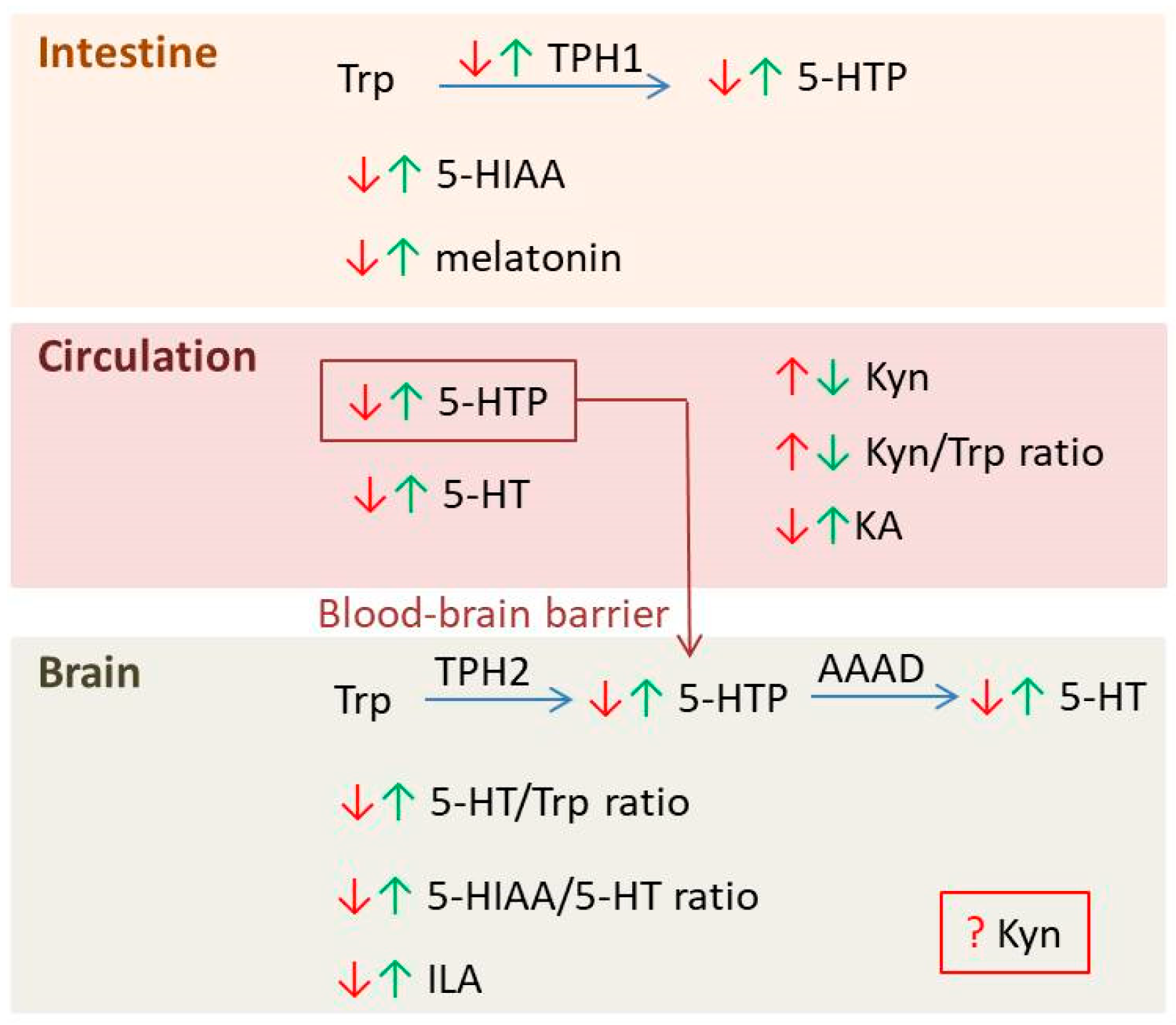
8. Tryptophan Metabolism

| Psychobiotic | Treatment Duration (Weeks) | Animal | Sex (M/F) | Animal Model | Sample | Effect of Psychobiotic on Trp Metabolism in Depression Model | Ref. | |
|---|---|---|---|---|---|---|---|---|
| Genus | Strain | |||||||
| Lactobacillus | Lactiplantibacillus plantarum KLDS | 5 | Mice | M | CUMS | Intestine | ↑ 5-HTP; ↑ indolepyruvate; ↑ melatonin; ↑ 5-HIAA | [34] |
| Lactiplantibacillus plantarum D-9 | 2 | Mice | M | CUMS | Hypothalamus | ↑ 5-HT/Trp ratio; ↑ 5-HIAA/5-HT ratio | [23] | |
| Serum | No effect: Kyn/Trp ratio | |||||||
| Lactiplantibacillus plantarum JYLP-326 | 3 | Mice | M | CUMS | HIPP | ↑ TPH2 | [25] | |
| Lacticaseibacillus rhamnosus KY16 | 7 | Mice | M | CUMS | Serum | ↑ 5-HTP; ↑ 5-HT | [43] | |
| Colon | ↑ 5-HTP; ↑ Tph1 No effect: 5-HT | |||||||
| Cortex | ↑ 5-HTP; ↑ 5-HT | |||||||
| HIPP | ↑ Tph2 | |||||||
| Lactocaseibacillus rhamnosus zz-1 | 4 | Mice | M | CUMS | HIPP | ↑ 5-HT; no effect: Kyn; Trp | [44] | |
| Serum | ↑ 5-HT; ↓ Kyn; ↓ Kyn/Trp ratio | |||||||
| Lactobacillus rhamnosus HN001 | 6 | Rats | M | CUMS | Brain | ↑ 5-HT; ↓ 5-HIAA | [38] | |
| Lactobacillus reuteri ATG-F4 | 4 | Mice | M | CUS | Serum | No effect Trp, 5-HT, 5-HIAA, Kyn, KA; ↑ 5-HTP; ↑ Tryptamine | [89] | |
| Brain | No effect 5-HTP, Kyn, KA; ↓ Trp; ↓ 5-HT; ↓ 5-HIAA; ↓ Tryptamine | |||||||
| Lactococcus | Lactococcus lactis ZFM559 | 5 | Mice | M | CUMS | Brainstem | ↓ 5-HIAA/5-HT ration; ↑ Trp No effect: 5-HT, 5-HTP, Tph2 | [55] |
| Serum | ↑ 5-HTP No effect: 5-HT | |||||||
| Colon | ↑ 5-HT No effect: 5-HTP, Tph1 | |||||||
| Lactococcus lactis WHH2078 | 5 | Mice | M | CUMS | HIPP | ↑ 5-HT; ↑ 5-HTP; no effect TPH2 | [17] | |
| Serum | ↑ 5-HTP | |||||||
| Colon | ↑ 5-HTP; ↑ TPH1 | |||||||
| Bacillus | Bacillus licheniformis | 4 | Rats | M | CUMS | Whole brain | ↓ Kyn; no effect: 5-HT | [60] |
| Bacillus coagulans Unique IS-2 | 6 | Rats | M | MS and CUMS | Plasma | No effect Trp; ↓ Kyn; ↑ KA; ↓ 3-hydroxyanthranilic acid | [19] | |
| F | No effect Trp, KA; ↓ Kyn; ↓ 3-hydroxyanthranilic acid | |||||||
| Bifidobacterium | Bifidobacterium lactis HN019 | 6 | Rats | M | CUMS | Brain | ↑ 5-HT; ↓ 5-HIAA | [38] |
| Lactobacillus, Bifidobacterium | HN001 and HN019 | 6 | Rats | M | CUMS | Brain | ↑ 5-HT; ↓ 5-HIAA | [38] |
| Roseburia, Bacteroides, Eubacterium | Multi-strain probiotic: Roseburia inulinivorans, Bacteroides uniformis, and Eubacterium rectale | 4 | Rats | M | CUMS | Brain | ↑ Kyn; No effect: Trp | [67] |
| Lactobacillus, Bifidobacterium, Bacillus | Multi-strain probiotic: B. coagulans Unique IS-2, L. plantarum UBLP-40, L. rhamnosus UBLR-58, B. lactis UBBLa-70, B. breve UBBr-01, B. infantis UBBI-01 | 6 | Rats | M | MS and CUMS | Plasma | No effect Trp; ↓ Kyn; ↑ KA; ↓ 3-hydroxyanthranilic acid | [20] |
| F | No effect Trp; ↓ Kyn; ↓ KA ↓ 3-hydroxyanthranilic acid | |||||||
9. Linking Preclinical Findings with Human Data
10. Conclusions
11. Future Directions
Supplementary Materials
Author Contributions
Funding
Institutional Review Board Statement
Informed Consent Statement
Data Availability Statement
Conflicts of Interest
Abbreviations
| HPA | Hypothalamic-pituitary adrenal axis |
| CNS | Central nervous system |
| 5-HT | Serotonin |
| GABA | Gamma-aminobutyric acid |
| DA | Dopamine |
| NA | Noradrenaline |
| SCFAs | Short-chain fatty acids |
| MGBA | Microbiota-gut-brain axis |
| Trp | Tryptophan |
| CUMS | Chronic unpredictable mild stress |
| M | Male |
| F | Female |
| IM | Immobilization stress |
| cFM | Cultured fecal microbiota of patients with depression |
| LPS | Lipopolysaccharide |
| CSDS | Chronic social defeat stress |
| ACTH | Adrenocorticotrophic hormone |
| MS | Maternal separation |
| CORT | Corticosterone |
| SD | Sleep deprivation |
| CRS | Chronic restraint stress |
| CUS | Chronic unpredictable stress |
| mALPS | Murine alcohol-lipopolysaccharide model |
| TST | Tail suspension test |
| SPT | Sucrose preference test |
| OFT | Open field test |
| EPM | Elevated plus maze |
| EZM | Elevated zero maze |
| FST | Forced swim test |
| LDB | Light-dark box |
| MBT | Marble burying test |
| SIT | Social interaction test |
| Nr3c1 | Nuclear receptor subfamily 3 group C member 1 |
| CRH | Corticotrophin-releasing hormone |
| HIPP | Hippocampus |
| GR | Glucocorticoid receptor |
| PFC | Prefrontal cortex |
| IL | Interleukin |
| TNF-α | Tumor necrosis factor-alpha |
| INF-γ | Interferon gamma |
| CXCL9 | Chemokine (C-X-C motif) ligand 9 |
| CXCL10 | Chemokine (C-X-C motif) ligand 10 |
| CCL2 | Chemokine (C-C motif) ligand 2 |
| TLR | Toll-like receptor |
| MyD88 | Myeloid differentiation primary response 88 |
| LBP | Lipopolysaccharide binding protein |
| TGF-β1 | Transforming growth factor-β1 |
| NLRP3 | NOD-, LRR- and pyrin domain-containing protein 3 |
| CRP | C-reactive protein |
| QUIN | Quinolinic acid |
| vHIPP | Ventral hippocampus |
| mPFC | Medial prefrontal cortex |
| BLA | Basolateral amygdala |
| D1R | D1 dopamine receptor |
| D2L | D2 dopamine receptors, isoform L |
| D2S | D2 dopamine receptors, isoform S |
| COMT | Catechol-O-methyltransferase |
| MAOA | Monoamine oxidase A |
| GABAARα1 | Gamma-aminobutyric acid type A receptor subunit alpha1 |
| GABAARα2 | Gamma-aminobutyric acid type A receptor subunit alpha2 |
| 5-HT1AR | Serotonin 1A receptor |
| 5-HT1BR | Serotonin 1B receptor |
| NE | Norepinephrine |
| Ach | Acetylcholine |
| Glu | Glutamine |
| Kyn | Kynurenine |
| DOPAC | 3,4-dihydroxyphenylacetic acid |
| 5-HIAA | 5-hydroxyindoleacetic acid |
| HVA | Homovanillic acid |
| KA | Kynrenic acid |
| 3-MT | 3-methoxytyramine |
| 5-HTT | 5-HT- transporter |
| 5-HTP | 5-hydroxytryptophan |
| BBB | Blood–brain barrier |
| TPH1 | Trp hydroxylase 1 |
| PV | Parvalbumin |
| ILA | Indole-3-lactic acid |
| KYNA | Kynurenic acid |
References
- Alemi, F.; Min, H.; Yousefi, M.; Becker, L.K.; Hane, C.A.; Nori, V.S.; Wojtusiak, J. Effectiveness of Common Antidepressants: A Post Market Release Study. eClinicalMedicine 2021, 41, 101171. [Google Scholar] [CrossRef] [PubMed]
- Herrman, H.; Patel, V.; Kieling, C.; Berk, M.; Buchweitz, C.; Cuijpers, P.; Furukawa, T.A.; Kessler, R.C.; Kohrt, B.A.; Maj, M.; et al. Time for United Action on Depression: A Lancet–World Psychiatric Association Commission. Lancet 2022, 399, 957–1022. [Google Scholar] [CrossRef] [PubMed]
- de Zwart, P.L.; Jeronimus, B.F.; de Jonge, P. Empirical Evidence for Definitions of Episode, Remission, Recovery, Relapse and Recurrence in Depression: A Systematic Review. Epidemiol. Psychiatr. Sci. 2019, 28, 544–562. [Google Scholar] [CrossRef] [PubMed]
- Liebherz, S.; Machmutow, K.; Jansen, A.; Meister, R.; Watzke, B.; Härter, M.C.; Kriston, L. Continuation and Maintenance Treatments for Persistent Depressive Disorder. Cochrane Database Syst. Rev. 2017, 2017, CD012855. [Google Scholar] [CrossRef]
- Sheffler, Z.M.; Patel, P.; Abdijadid, S. Antidepressants. Available online: https://www.ncbi.nlm.nih.gov/books/NBK538182/ (accessed on 16 November 2023).
- Todorović Vukotić, N.; Đorđević, J.; Pejić, S.; Đorđević, N.; Pajović, S.B. Antidepressants- and Antipsychotics-Induced Hepatotoxicity. Arch. Toxicol. 2021, 95, 767–789. [Google Scholar] [CrossRef]
- Liu, L.; Wang, H.; Chen, X.; Zhang, Y.; Zhang, H.; Xie, P. Gut Microbiota and Its Metabolites in Depression: From Pathogenesis to Treatment. eBioMedicine 2023, 90, 104527. [Google Scholar] [CrossRef]
- Đokić, J.; Dinić, M.; Bajić, S.S.; Bisenić, A.; Mitrović, H.; Jakovljević, S.; Radojević, D.; Brdarić, E.; Lukić, J. High-Throughput Workflow for Cultivation and Characterization of Gut Microbiota Strains with Anti-Inflammatory Properties and Metabolite Signature Associated with Gut-Brain Communication. Sci. Rep. 2025, 15, 8741. [Google Scholar] [CrossRef]
- Dinić, M.; Đokić, J.; Jakovljević, S.; Brdarić, E.; Mitrović, H.; Bisenić, A.; Radojević, D.; Bajić, S.S.; Tomić, S. Insight into Immunoregulatory and Neuromodulatory Capability of Bacteroides cellulosilyticus and Bacteroides xylanisolvens Human Gut Microbiota Isolates. Sci. Rep. 2025, 15, 38058. [Google Scholar] [CrossRef]
- Radjabzadeh, D.; Bosch, J.A.; Uitterlinden, A.G.; Zwinderman, A.H.; Ikram, M.A.; van Meurs, J.B.J.; Luik, A.I.; Nieuwdorp, M.; Lok, A.; van Duijn, C.M.; et al. Gut Microbiome-Wide Association Study of Depressive Symptoms. Nat. Commun. 2022, 13, 7128. [Google Scholar] [CrossRef]
- Gao, M.; Wang, J.; Liu, P.; Tu, H.; Zhang, R.; Zhang, Y.; Sun, N.; Zhang, K. Gut Microbiota Composition in Depressive Disorder: A Systematic Review, Meta-Analysis, and Meta-Regression. Transl. Psychiatry 2023, 13, 379. [Google Scholar] [CrossRef]
- Akkasheh, G.; Kashani-Poor, Z.; Tajabadi-Ebrahimi, M.; Jafari, P.; Akbari, H.; Taghizadeh, M.; Memarzadeh, M.R.; Asemi, Z.; Esmaillzadeh, A. Clinical and Metabolic Response to Probiotic Administration in Patients with Major Depressive Disorder: A Randomized, Double-Blind, Placebo-Controlled Trial. Nutrition 2016, 32, 315–320. [Google Scholar] [CrossRef] [PubMed]
- Majeed, M.; Nagabhushanam, K.; Arumugam, S.; Majeed, S.; Ali, F. Bacillus coagulans MTCC 5856 for the Management of Major Depression with Irritable Bowel Syndrome: A Randomised, Double-Blind, Placebo Controlled, Multi-Centre, Pilot Clinical Study. Food Nutr. Res. 2018, 62. [Google Scholar] [CrossRef] [PubMed]
- Rahmannia, M.; Poudineh, M.; Mirzaei, R.; Aalipour, M.A.; Shahidi Bonjar, A.H.; Goudarzi, M.; Kheradmand, A.; Aslani, H.R.; Sadeghian, M.; Nasiri, M.J.; et al. Strain-Specific Effects of Probiotics on Depression and Anxiety: A Meta-Analysis. Gut Pathog. 2024, 16, 46. [Google Scholar] [CrossRef] [PubMed]
- Zhao, S.; Liang, S.; Tao, J.; Peng, Y.; Chen, S.; Wai, H.K.F.; Chung, F.Y.; Sin, Z.Y.; Wong, M.K.L.; Haqq, A.M.; et al. Probiotics for Adults with Major Depressive Disorder Compared with Antidepressants: A Systematic Review and Network Meta-Analysis. Nutr. Rev. 2025, 83, 72–82. [Google Scholar] [CrossRef]
- Dinan, T.G.; Stanton, C.; Cryan, J.F. Psychobiotics: A Novel Class of Psychotropic. Biol. Psychiatry 2013, 74, 720–726. [Google Scholar] [CrossRef]
- Gao, K.; Farzi, A.; Ke, X.; Yu, Y.; Chen, C.; Chen, S.; Yu, T.; Wang, H.; Li, Y. Oral Administration of: Lactococcus lactis WHH2078 Alleviates Depressive and Anxiety Symptoms in Mice with Induced Chronic Stress. Food Funct. 2022, 13, 957–969. [Google Scholar] [CrossRef]
- Liu, Y.W.; Liu, W.H.; Wu, C.C.; Juan, Y.C.; Wu, Y.C.; Tsai, H.P.; Wang, S.; Tsai, Y.C. Psychotropic Effects of Lactobacillus plantarum PS128 in Early Life-Stressed and Naïve Adult Mice. Brain Res. 2016, 1631, 1–12. [Google Scholar] [CrossRef]
- Satti, S.; Palepu, M.S.K.; Singh, A.A.; Jaiswal, Y.; Dash, S.P.; Gajula, S.N.R.; Chaganti, S.; Samanthula, G.; Sonti, R.; Dandekar, M.P. Anxiolytic- and Antidepressant-like Effects of Bacillus coagulans Unique IS-2 Mediate via Reshaping of Microbiome Gut-Brain Axis in Rats. Neurochem. Int. 2023, 163, 105483. [Google Scholar] [CrossRef]
- Dandekar, M.P.; Palepu, M.S.K.; Satti, S.; Jaiswal, Y.; Singh, A.A.; Dash, S.P.; Gajula, S.N.R.; Sonti, R. Multi-Strain Probiotic Formulation Reverses Maternal Separation and Chronic Unpredictable Mild Stress-Generated Anxiety- and Depression-like Phenotypes by Modulating Gut Microbiome-Brain Activity in Rats. ACS Chem. Neurosci. 2022, 13, 1948–1965. [Google Scholar] [CrossRef]
- Carlessi, A.S.; Botelho, M.E.M.; Manosso, L.M.; Borba, L.A.; Maciel, L.R.; Andrade, N.M.; Martinello, N.S.; Padilha, A.P.Z.; Generoso, C.M.; Bencke, C.V.; et al. Sex Differences on the Response to Antidepressants and Psychobiotics Following Early Life Stress in Rats. Pharmacol. Biochem. Behav. 2022, 220, 173468. [Google Scholar] [CrossRef]
- Ma, J.; Chen, Y.; Wang, Z.; Wang, R.; Dong, Y. Lactiplantibacillus plantarum CR12 Attenuates Chronic Unforeseeable Mild Stress Induced Anxiety and Depression-like Behaviors by Modulating the Gut Microbiota-Brain Axis. J. Funct. Foods 2023, 107, 105710. [Google Scholar] [CrossRef]
- Jia, L.; Xiao, L.; Fu, Y.; Shao, Z.; Jing, Z.; Yuan, J.; Xie, Y.; Guo, J.; Wang, Y.; Geng, W. Neuroprotective Effects of Probiotics on Anxiety- and Depression-like Disorders in Stressed Mice by Modulating Tryptophan Metabolism and the Gut Microbiota. Food Funct. 2024, 15, 2895–2905. [Google Scholar] [CrossRef] [PubMed]
- Li, W.; Xu, M.; Liu, Y.; Zhang, S.; Wang, J.; Zhang, Z.; Xiao, G.; Wang, R.; Zhang, J.; Xue, H. Lactiplantibacillus plantarum GOLDGUT-HNU082 Alleviates CUMS-Induced Depressive-like Behaviors in Mice by Modulating the Gut Microbiota and Neurotransmitter Levels. Foods 2025, 14, 813. [Google Scholar] [CrossRef] [PubMed]
- Zhu, R.; Zhao, X.; Wu, H.; Zeng, X.; Wei, J.; Chen, T. Psychobiotics Lactiplantibacillus plantarum JYLP-326: Antidepressant-like Effects on CUMS-Induced Depressed Mouse Model and Alleviation of Gut Microbiota Dysbiosis. J. Affect. Disord. 2024, 354, 752–764. [Google Scholar] [CrossRef]
- Baek, J.-S.; Ma, X.; Park, H.-S.; Lee, D.-Y.; Kim, D.-H. Bifidobacterium longum P77 and Lactiplantibacillus plantarum P72 and Their Mix—Live or Heat-Treated—Mitigate Sleeplessness and Depression in Mice: Involvement of Serotonergic and GABAergic Systems. Cells 2025, 14, 1547. [Google Scholar] [CrossRef]
- Zhao, L.; Li, D.; Chitrakar, B.; Li, C.; Zhang, N.; Zhang, S.; Wang, X.; Wang, M.; Tian, H.; Luo, Y. Study on Lactiplantibacillus Plantarum R6-3 from Sayram Ketteki to Prevent Chronic Unpredictable Mild Stress-Induced Depression in Mice Through the Microbiota-Gut-Brain Axis. Food Funct. 2023, 14, 3304–3318. [Google Scholar] [CrossRef]
- He, B.L.; Cui, R.; Hu, T.G.; Wu, H. Lactiplantibacillus plantarum WH021 Alleviates Lipopolysaccharide-Induced Neuroinflammation via Regulating the Intestinal Microenvironment and Protecting the Barrier Integrity. J. Agric. Food Chem. 2025, 73, 14300–14313. [Google Scholar] [CrossRef]
- Liu, Y.W.; Ong, J.S.; Gan, C.Y.; Khoo, B.Y.; Yahaya, S.; Choi, S.B.; Low, W.Y.; Tsai, Y.C.; Liong, M.T. Lactobacillus fermentum PS150 Showed Psychotropic Properties by Altering Serotonergic Pathway During Stress. J. Funct. Foods 2019, 59, 352–361. [Google Scholar] [CrossRef]
- Liang, S.; Wang, T.; Hu, X.; Luo, J.; Li, W.; Wu, X.; Duan, Y.; Jin, F. Administration of Lactobacillus helveticus NS8 Improves Behavioral, Cognitive, and Biochemical Aberrations Caused by Chronic Restraint Stress. Neuroscience 2015, 310, 561–577. [Google Scholar] [CrossRef]
- Stenman, L.K.; Patterson, E.; Meunier, J.; Roman, F.J.; Lehtinen, M.J. Strain Specific Stress-Modulating Effects of Candidate Probiotics: A Systematic Screening in a Mouse Model of Chronic Restraint Stress. Behav. Brain Res. 2020, 379, 112376. [Google Scholar] [CrossRef]
- Wei, C.L.; Wang, S.; Yen, J.T.; Cheng, Y.F.; Liao, C.L.; Hsu, C.C.; Wu, C.C.; Tsai, Y.C. Antidepressant-like Activities of Live and Heat-Killed Lactobacillus paracasei PS23 in Chronic Corticosterone-Treated Mice and Possible Mechanisms. Brain Res. 2019, 1711, 202–213. [Google Scholar] [CrossRef] [PubMed]
- Ma, J.; Wang, J.; Wang, G.; Wan, Y.; Li, N.; Luo, L.; Gou, H.; Gu, J. The Potential Beneficial Effects of Lactobacillus plantarum GM11 on Rats with Chronic Unpredictable Mild Stress-Induced Depression. Nutr. Neurosci. 2024, 27, 413–424. [Google Scholar] [CrossRef] [PubMed]
- Li, Y.; Zhang, G.; Lv, W.; Sun, Y.; Zhang, K.; Li, B.; Ma, C. Lactiplantibacillus plantarum KLDS 1.0386 Alleviates Depression in CUMS Mice Based on Tryptophan Metabolic Pathway. Food Biosci. 2025, 71, 107281. [Google Scholar] [CrossRef]
- Dhaliwal, J.; Singh, D.P.; Singh, S.; Pinnaka, A.K.; Boparai, R.K.; Bishnoi, M.; Kondepudi, K.K.; Chopra, K. Lactobacillus plantarum MTCC 9510 Supplementation Protects from Chronic Unpredictable and Sleep Deprivation-Induced Behaviour, Biochemical and Selected Gut Microbial Aberrations in Mice. J. Appl. Microbiol. 2018, 125, 257–269. [Google Scholar] [CrossRef] [PubMed]
- Sun, X.; Zhang, H.F.; Ma, C.L.; Wei, H.; Li, B.M.; Luo, J. Alleviation of Anxiety/Depressive-Like Behaviors and Improvement of Cognitive Functions by Lactobacillus plantarum WLPL04 in Chronically Stressed Mice. Can. J. Infect. Dis. Med. Microbiol. 2021, 2021, 6613903. [Google Scholar] [CrossRef]
- Işık, M.; Köse, F.; Özbayer, C.; Budak, Ö.; Kaya, R.K.; Erdoğan, D.G.; Demirci, M.A.; Doğanay, S.; Bağcı, C. Promising Antidepressant Potential: The Role of Lactobacillus rhamnosus GG in Mental Health and Stress Response. Probiotics Antimicrob. Proteins 2025, 17, 5235–5265. [Google Scholar] [CrossRef]
- Huang, L.; Lv, X.; Ze, X.; Ma, Z.; Zhang, X.; He, R.; Fan, J.; Zhang, M.; Sun, B.; Wang, F.; et al. Combined Probiotics Attenuate Chronic Unpredictable Mild Stress-Induced Depressive-like and Anxiety-like Behaviors in Rats. Front. Psychiatry 2022, 13, 990465. [Google Scholar] [CrossRef]
- Qiao, Y.; Yu, J.; Zhang, Z.; Hou, Q.; Guo, Z.; Wang, Y. Regulatory Effects of Lactobacillus zhachilii HBUAS52074T on Depression-like Behavior Induced by Chronic Social Defeat Stress in Mice: Modulation of the Gut Microbiota. Food Funct. 2024, 16, 691–706. [Google Scholar] [CrossRef]
- Kang, A.; Eor, J.Y.; Lee, J.; Kwak, M.J.; Lee, D.J.; Seo, E.; Lee, W.J.; Son, S.-h.; Song, M.; Kim, J.M.; et al. Lacticaseibacillus casei IDCC 3451 Alleviates Cognitive and Behavioral Functions by Reshaping the Gut Microbiome and Regulating Intestinal Barrier Integrity in Chronic Stress Animal Models. Curr. Res. Food Sci. 2025, 10, 101051. [Google Scholar] [CrossRef]
- Song, J.G.; Mun, D.; Lee, B.; Song, M.; Oh, S.; Kim, J.M.; Yang, J.; Kim, Y.; Kim, H.W. Protective Effects of Lacticaseibacillus rhamnosus IDCC3201 on Motor Functions and Anxiety Levels in a Chronic Stress Mouse Model. Food Sci. Anim. Resour. 2023, 43, 1044–1054. [Google Scholar] [CrossRef]
- Chudzik, A.; Słowik, T.; Kochalska, K.; Pankowska, A.; Łazorczyk, A.; Andres-mach, M.; Rola, R.; Stanisz, G.J.; Orzyłowska, A. Continuous Ingestion of Lacticaseibacillus rhamnosus JB-1 During Chronic Stress Ensures Neurometabolic and Behavioural Stability in Rats. Int. J. Mol. Sci. 2022, 23, 5173. [Google Scholar] [CrossRef]
- Xie, S.; Wang, C.; Song, J.; Zhang, Y.; Wang, H.; Chen, X.; Suo, H. Lacticaseibacillus rhamnosus KY16 Improves Depression by Promoting Intestinal Secretion of 5-HTP and Altering the Gut Microbiota. J. Agric. Food Chem. 2024, 72, 21560–21573. [Google Scholar] [CrossRef]
- Xu, J.; Tang, M.; Wang, D.; Zhang, X.; Yang, X.; Ma, Y.; Xu, X. Lactocaseibacillus Rhamnosus Zz-1 Supplementation Mitigates Depression-like Symptoms in Chronic Stress-Induced Depressed Mice via the Microbiota-Gut-Brain Axis. ACS Chem. Neurosci. 2023, 14, 1095–1106. [Google Scholar] [CrossRef]
- Todorović Vukotić, N.; Đorđević, N.; Soković Bajić, S.; Mitrović, H.; Brdarić, E.; Tolinački, M.; Đokić, J.; Dinić, M.; Radojević, D.; Bisenić, A.; et al. The Antidepressant Effect of Bifidobacterium Adolescentis NGB329 Postbiotic in Rat Model of Depression. In Proceedings of the FENS Forum 2024, Vienna, Austria, 25–29 June 2024; Available online: https://fens2024.abstractserver.com/program/#/details/presentations/4884 (accessed on 15 September 2025).
- Qian, X.; Li, Q.; Zhu, H.; Chen, Y.; Lin, G.; Zhang, H.; Chen, W.; Wang, G.; Tian, P. Bifidobacteria with Indole-3-Lactic Acid-Producing Capacity Exhibit Psychobiotic Potential via Reducing Neuroinflammation. Cell Rep. Med. 2024, 5, 101798. [Google Scholar] [CrossRef] [PubMed]
- Tian, P.; O’Riordan, K.J.; Lee, Y.; Wang, G.; Zhao, J.; Zhang, H.; Cryan, J.F.; Chen, W. Towards a Psychobiotic Therapy for Depression: Bifidobacterium Breve CCFM1025 Reverses Chronic Stress-Induced Depressive Symptoms and Gut Microbial Abnormalities in Mice. Neurobiol. Stress 2020, 12, 100216. [Google Scholar] [CrossRef] [PubMed]
- Qian, X.; Tian, P.; Guo, M.; Yang, H.; Zhang, H.; Wang, G.; Chen, W. Determining the Emotional Regulation Function of Bifidobacterium Breve: The Role of Gut Metabolite Regulation over Colonization Capability. Food Funct. 2024, 15, 1598–1611. [Google Scholar] [CrossRef] [PubMed]
- Tian, P.; Bastiaanssen, T.F.S.; Song, L.; Jiang, B.; Zhang, X.; Zhao, J.; Zhang, H.; Chen, W.; Cryan, J.F.; Wang, G. Unraveling the Microbial Mechanisms Underlying the Psychobiotic Potential of a Bifidobacterium breve Strain. Mol. Nutr. Food Res. 2021, 65, 2000704. [Google Scholar] [CrossRef]
- Kosuge, A.; Kunisawa, K.; Arai, S.; Sugawara, Y.; Shinohara, K.; Iida, T.; Wulaer, B.; Kawai, T.; Fujigaki, H.; Yamamoto, Y.; et al. Heat-Sterilized Bifidobacterium Breve Prevents Depression-like Behavior and Interleukin-1β Expression in Mice Exposed to Chronic Social Defeat Stress. Brain Behav. Immun. 2021, 96, 200–211. [Google Scholar] [CrossRef]
- Tamayo, M.; Agusti, A.; Molina-Mendoza, G.V.; Rossini, V.; Frances-Cuesta, C.; Tolosa-Enguís, V.; Sanz, Y. Bifidobacterium longum CECT 30763 Improves Depressive- and Anxiety-like Behavior in a Social Defeat Mouse Model Through the Immune and Dopaminergic Systems. Brain Behav. Immun. 2025, 125, 35–57. [Google Scholar] [CrossRef]
- Moya-Pérez, A.; Perez-Villalba, A.; Benítez-Páez, A.; Campillo, I.; Sanz, Y. Bifidobacterium CECT 7765 Modulates Early Stress-Induced Immune, Neuroendocrine and Behavioral Alterations in Mice. Brain Behav. Immun. 2017, 65, 43–56. [Google Scholar] [CrossRef]
- Ramalho, J.B.; Spiazzi, C.C.; Bicca, D.F.; Rodrigues, J.F.; Sehn, C.P.; da Silva, W.P.; Cibin, F.W.S. Beneficial Effects of Lactococcus lactis subsp. cremoris LL95 Treatment in an LPS-Induced Depression-like Model in Mice. Behav. Brain Res 2022, 24, 113847. [Google Scholar] [CrossRef]
- Chen, C.; Zheng, Z.; Gao, K.; Fan, Q.; Li, Y.; Chen, S. Prophylactic Effects of Supplementation of a Combination of Lactobacillus lactis WHH2078 and Saffron on Depressive-like Behaviors in Mice Exposed to Chronic Stress. J. Food Sci. 2024, 89, 5912–5927. [Google Scholar] [CrossRef] [PubMed]
- Han, J.; Hu, S.; Zhao, X.; Ding, L.; Yin, J.; Liu, J.; Li, P.; Gu, Q. High GABA-Producing Lactococcus lactis ZFM559 and Its Derived GABA Alleviate Chronic Unpredictable Mild Stress (CUMS)-Induced Depression via the “Microbiota–Brain” Axis. Food Funct. 2025, 16, 8463–8483. [Google Scholar] [CrossRef] [PubMed]
- Palepu, M.S.K.; Bhalerao, H.A.; Sonti, R.; Dandekar, M.P. Faecalibacterium prausnitzii, FOS and GOS Loaded Synbiotic Reverses Treatment-Resistant Depression in Rats: Restoration of Gut-Brain Crosstalk. Eur. J. Pharmacol. 2024, 983, 176960. [Google Scholar] [CrossRef] [PubMed]
- Hao, Z.; Wang, W.; Guo, R.; Liu, H. Faecalibacterium prausnitzii (ATCC 27766) Has Preventive and Therapeutic Effects on Chronic Unpredictable Mild Stress-Induced Depression-like and Anxiety-like Behavior in Rats. Psychoneuroendocrinology 2019, 104, 132–142. [Google Scholar] [CrossRef]
- Guo, D.; Park, C.; Li, Y.; Li, B.; Yang, Q.; Deng, Y.; Gao, N.L.; Li, R.; Wang, X.; Yi, L.; et al. Akkermansia muciniphila Ameliorates Depressive Disorders in a Murine Alcohol-LPS (MALPS) Model. Food Funct. 2022, 13, 12766–12776. [Google Scholar] [CrossRef]
- Ding, Y.; Bu, F.; Chen, T.; Shi, G.; Yuan, X.; Feng, Z.; Duan, Z.; Wang, R.; Zhang, S.; Wang, Q.; et al. A Next-Generation Probiotic: Akkermansia muciniphila Ameliorates Chronic Stress–Induced Depressive-like Behavior in Mice by Regulating Gut Microbiota and Metabolites. Appl. Microbiol. Biotechnol. 2021, 105, 8411–8426. [Google Scholar] [CrossRef]
- Feng, S.; Meng, C.; Liu, Y.; Yi, Y.; Liang, A.; Zhang, Y.; Hao, Z. Bacillus licheniformis Prevents and Reduces Anxiety-like and Depression-like Behaviours. Appl. Microbiol. Biotechnol. 2023, 107, 4355–4368. [Google Scholar] [CrossRef]
- Sun, J.; Jin, X.; Yang, H.; Qian, X.; Tian, P.; Wang, G.; Zhao, J. Pediococcus acidilactici CCFM1344 Alleviates Chronic Stress-Induced Depression by Mitigating Gut Microbiota Imbalance and Neuroinflammation. Food Biosci. 2025, 63, 105701. [Google Scholar] [CrossRef]
- Sandes, S.; Figueiredo, N.; Pedroso, S.; Sant’Anna, F.; Acurcio, L.; Abatemarco Junior, M.; Barros, P.; Oliveira, F.; Cardoso, V.; Generoso, S.; et al. Weissella paramesenteroides WpK4 Plays an Immunobiotic Role in Gut-Brain Axis, Reducing Gut Permeability, Anxiety-like and Depressive-like Behaviors in Murine Models of Colitis and Chronic Stress. Food Res. Int. 2020, 137, 109741. [Google Scholar] [CrossRef]
- Todorović Vukotić, N.; Đorđević, N.; Soković Bajić, S.; Mitrović, H.; Brdarić, E.; Tolinački, M.; Đokić, J.; Dinić, M.; Živković, M.; Radojević, D.; et al. The Antidepressant Potential of Postbiotic in Rat Model of Depression. J. Med. Biochem. 2024, 43, 768–769. [Google Scholar]
- Işık, M.; Köse, F.; Budak, Ö.; Özbayer, C.; Kaya, R.K.; Aydın, S.; Küçük, A.C.; Demirci, M.A.; Doğanay, S.; Bağcı, C. Probiotic Bactolac Alleviates Depression-like Behaviors by Modulating BDNF, NLRP3 and MC4R Levels, Reducing Neuroinflammation and Promoting Neural Repair in Rat Model. Pflugers Arch. Eur. J. Physiol. 2025, 477, 797–814. [Google Scholar] [CrossRef] [PubMed]
- Daugé, V.; Philippe, C.; Mariadassou, M.; Rué, O.; Martin, J.C.; Rossignol, M.N.; Dourmap, N.; Svilar, L.; Tourniaire, F.; Monnoye, M.; et al. A Probiotic Mixture Induces Anxiolytic- and Antidepressive-like Effects in Fischer and Maternally Deprived Long Evans Rats. Front. Behav. Neurosci. 2020, 14, 581296. [Google Scholar] [CrossRef] [PubMed]
- Westfall, S.; Caracci, F.; Estill, M.; Frolinger, T.; Shen, L.; Pasinetti, G.M. Chronic Stress-Induced Depression and Anxiety Priming Modulated by Gut-Brain-Axis Immunity. Front. Immunol. 2021, 12, 670500. [Google Scholar] [CrossRef]
- Meng, C.; Feng, S.; Hao, Z.; Liu, H. A Combination of Potential Psychobiotics Alleviates Anxiety and Depression Behaviors Induced by Chronic Unpredictable Mild Stress. npj Biofilms Microbiomes 2025, 11, 147. [Google Scholar] [CrossRef]
- Gao, K.; Chen, C.; Zheng, Z.; Fan, Q.; Wang, H.; Li, Y.; Chen, S. Lactococcus Strains with Psychobiotic Properties Improve Cognitive and Mood Alterations in Aged Mice. Front. Nutr. 2024, 11, 1439094. [Google Scholar] [CrossRef]
- Zhang, J.L.; Xian, H.; Zhao, R.; Luo, C.; Xie, R.G.; Tian, T.; Cong, R. Brachial Plexus Avulsion Induced Changes in Gut Microbiota Promotes Pain Related Anxiety-like Behavior in Mice. Front. Neurol. 2023, 14, 1084494. [Google Scholar] [CrossRef]
- Kaur, A.; Chopra, K.; Kaur, I.P.; Rishi, P. Salmonella Strain Specificity Determines Post-Typhoid Central Nervous System Complications: Intervention by Lactiplantibacillus plantarum at Gut-Brain Axis. Front. Microbiol. 2020, 11, 1568. [Google Scholar] [CrossRef]
- Wang, Y.; Wang, B.; Zeng, Z.; Liu, R.; Tang, L.; Meng, X.; Li, W. Bacillus amyloliquefaciens SC06 Attenuated High-Fat Diet Induced Anxiety-like Behavior and Social Withdrawal of Male Mice by Improving Antioxidant Capacity, Intestinal Barrier Function and Modulating Intestinal Dysbiosis. Behav. Brain Res. 2023, 438, 114172. [Google Scholar] [CrossRef]
- Abildgaard, A.; Elfving, B.; Hokland, M.; Wegener, G.; Lund, S. Probiotic Treatment Reduces Depressive-like Behaviour in Rats Independently of Diet. Psychoneuroendocrinology 2017, 79, 40–48. [Google Scholar] [CrossRef]
- Yunes, R.A.; Poluektova, E.U.; Vasileva, E.V.; Odorskaya, M.V.; Marsova, M.V.; Kovalev, G.I.; Danilenko, V.N. A Multi-Strain Potential Probiotic Formulation of GABA-Producing Lactobacillus plantarum 90sk and Bifidobacterium adolescentis 150 with Antidepressant Effects. Probiotics Antimicrob. Proteins 2020, 12, 973–979. [Google Scholar] [CrossRef] [PubMed]
- Zhao, Y.; Kang, Y.; Zhao, Z.; Yang, G.; Gao, Y.; Gao, L.; Wang, C.; Li, S. Lacticaseibacillus rhamnosus TF318 Prevents Depressive Behavior in Rats by Inhibiting HPA-Axis Hyperactivity and Upregulating BDNF Expression. Neurosci. Lett. 2023, 814, 137460. [Google Scholar] [CrossRef] [PubMed]
- Xu, J.; Tang, M.; Wu, X.; Kong, X.; Liu, Y.; Xu, X. Lactobacillus rhamnosus Zz-1 Exerts Preventive Effects on Chronic Unpredictable Mild Stress-Induced Depression in Mice via Regulating the Intestinal Microenvironment. Food Funct. 2022, 13, 4331–4343. [Google Scholar] [CrossRef] [PubMed]
- Tiwari, S.; Paramanik, V. Lactobacillus fermentum ATCC 9338 Supplementation Prevents Depressive-Like Behaviors Through Glucocorticoid Receptor and N-Methyl-D-Aspartate2b in Chronic Unpredictable Mild Stress Mouse Model. Mol. Neurobiol. 2025, 62, 7927–7944. [Google Scholar] [CrossRef]
- Tian, P.; Zou, R.; Song, L.; Zhang, X.; Jiang, B.; Wang, G.; Lee, Y.K.; Zhao, J.; Zhang, H.; Chen, W. Ingestion of: Bifidobacterium longum Subspecies infantis Strain CCFM687 Regulated Emotional Behavior and the Central BDNF Pathway in Chronic Stress-Induced Depressive Mice Through Reshaping the Gut Microbiota. Food Funct. 2019, 10, 7588–7598. [Google Scholar] [CrossRef]
- Frank, M.G.; Fonken, L.K.; Dolzani, S.D.; Annis, J.L.; Siebler, P.H.; Schmidt, D.; Watkins, L.R.; Maier, S.F.; Lowry, C.A. Immunization with Mycobacterium vaccae Induces an Anti-Inflammatory Milieu in the CNS: Attenuation of Stress-Induced Microglial Priming, Alarmins and Anxiety-like Behavior. Brain Behav. Immun. 2018, 73, 352–363. [Google Scholar] [CrossRef]
- Ait-Belgnaoui, A.; Durand, H.; Cartier, C.; Chaumaz, G.; Eutamene, H.; Ferrier, L.; Houdeau, E.; Fioramonti, J.; Bueno, L.; Theodorou, V. Prevention of Gut Leakiness by a Probiotic Treatment Leads to Attenuated HPA Response to an Acute Psychological Stress in Rats. Psychoneuroendocrinology 2012, 37, 1885–1895. [Google Scholar] [CrossRef]
- Warda, A.K.; Rea, K.; Fitzgerald, P.; Hueston, C.; Gonzalez-Tortuero, E.; Dinan, T.G.; Hill, C. Heat-Killed Lactobacilli Alter Both Microbiota Composition and Behaviour. Behav. Brain Res. 2019, 362, 213–223. [Google Scholar] [CrossRef]
- Kronsten, V.T.; Tranah, T.H.; Pariante, C.; Shawcross, D.L. Gut-Derived Systemic Inflammation as a Driver of Depression in Chronic Liver Disease. J. Hepatol. 2022, 76, 665–680. [Google Scholar] [CrossRef]
- Cristofori, F.; Dargenio, V.N.; Dargenio, C.; Miniello, V.L.; Barone, M.; Francavilla, R. Anti-Inflammatory and Immunomodulatory Effects of Probiotics in Gut Inflammation: A Door to the Body. Front. Immunol. 2021, 12, 578386. [Google Scholar] [CrossRef]
- Huang, L.; Ma, Z.; Ze, X.; Zhao, X.; Zhang, M.; Lv, X.; Zheng, Y.; Liu, H. Gut Microbiota Decreased Inflammation Induced by Chronic Unpredictable Mild Stress Through Affecting NLRP3 Inflammasome. Front. Cell. Infect. Microbiol. 2023, 13, 1189008. [Google Scholar] [CrossRef]
- Todorović, N.; Filipović, D. The Antidepressant- and Anxiolytic-like Effects of Fluoxetine and Clozapine in Chronically Isolated Rats Involve Inhibition of Hippocampal TNF-α. Pharmacol. Biochem. Behav. 2017, 163, 57–65. [Google Scholar] [CrossRef]
- Todorović, N.; Filipović, D. Prefrontal Cortical Glutathione-Dependent Defense and Proinflammatory Mediators in Chronically Isolated Rats: Modulation by Fluoxetine or Clozapine. Neuroscience 2017, 355, 49–60. [Google Scholar] [CrossRef] [PubMed]
- Yirmiya, R.; Rimmerman, N.; Reshef, R. Depression as a Microglial Disease. Trends Neurosci. 2015, 38, 637–658. [Google Scholar] [CrossRef] [PubMed]
- Lugo-Huitrón, R.; Ugalde Muñiz, P.; Pineda, B.; Pedraza-Chaverrí, J.; Ríos, C.; Pérez-De La Cruz, V. Quinolinic Acid: An Endogenous Neurotoxin with Multiple Targets. Oxidative Med. Cell. Longev. 2013, 2013, 104024. [Google Scholar] [CrossRef] [PubMed]
- Xia, C.Y.; Guo, Y.X.; Lian, W.W.; Yan, Y.; Ma, B.Z.; Cheng, Y.C.; Xu, J.K.; He, J.; Zhang, W.K. The NLRP3 Inflammasome in Depression: Potential Mechanisms and Therapies. Pharmacol. Res. 2023, 187, 106625. [Google Scholar] [CrossRef]
- Lee, J.; Kim, E.J.; Park, G.S.; Kim, J.; Kim, T.E.; Lee, Y.J.; Park, J.; Kang, J.; Koo, J.W.; Choi, T.Y. Lactobacillus reuteri ATG-F4 Alleviates Chronic Stress-Induced Anhedonia by Modulating the Prefrontal Serotonergic System. Exp. Neurobiol. 2023, 32, 313–327. [Google Scholar] [CrossRef]
- Bremshey, S.; Groß, J.; Renken, K.; Masseck, O.A. The Role of Serotonin in Depression—A Historical Roundup and Future Directions. J. Neurochem. 2024, 168, 1751–1779. [Google Scholar] [CrossRef]
- Wu, L.; Ran, L.; Wu, Y.; Liang, M.; Zeng, J.; Ke, F.; Wang, F.; Yang, J.; Lao, X.; Liu, L.; et al. Oral Administration of 5-Hydroxytryptophan Restores Gut Microbiota Dysbiosis in a Mouse Model of Depression. Front. Microbiol. 2022, 13, 864571. [Google Scholar] [CrossRef]
- Yano, J.; Yu, K.; Donaldson, G.; Shastri, G.; Ann, P.; Ma, L.; Nagler, C.; Ismagilov, R.; Mazmanian, S.; Hsiao, E. Indigenous Bacteria from the Gut Microbiota Regulate Host Serotonin Biosynthesis. Cell 2015, 161, 264–276. [Google Scholar] [CrossRef]
- Gao, X.; Sun, Y.; Yang, Y.; Yang, X.; Liu, Q.; Guo, X.; Wu, L.; Wang, Q. Directed Evolution of Hydroxylase XcP4H for Enhanced 5-HTP Production in Engineered Probiotics to Treat Depression. Int. J. Biol. Macromol. 2025, 307, 142250. [Google Scholar] [CrossRef] [PubMed]
- Baik, J.H. Stress and the Dopaminergic Reward System. Exp. Mol. Med. 2020, 52, 1879–1890. [Google Scholar] [CrossRef] [PubMed]
- Cutler, A.J.; Mattingly, G.W. Understanding the Mechanism of Action and Clinical Effects of Neuroactive Steroids and GABAergic Compounds in Major Depressive Disorder. Transl. Psychiatry 2023, 13, 228. [Google Scholar] [CrossRef] [PubMed]
- Perić, I.; Lješević, M.; Beškoski, V. Metabolomic Profiling Relates Tianeptine Effectiveness with Hippocampal GABA, Myo-Inositol, Cholesterol, and Fatty Acid Metabolism Restoration in Socially Isolated Rats. Psychopharmacology 2022, 239, 2955–2974. [Google Scholar] [CrossRef]
- Todorović, N.; Mićić, B.; Schwirtlich, M.; Stevanović, M.; Filipović, D. Subregion-Specific Protective Effects of Fluoxetine and Clozapine on Parvalbumin Expression in Medial Prefrontal Cortex of Chronically Isolated Rats. Neuroscience 2019, 396, 24–35. [Google Scholar] [CrossRef]
- Perić, I.; Stanisavljević, A.; Gass, P.; Filipović, D. Fluoxetine Exerts Subregion/Layer Specific Effects on Parvalbumin/GAD67 Protein Expression in the Dorsal Hippocampus of Male Rats Showing Social Isolation-Induced Depressive-like Behaviour. Brain Res. Bull. 2021, 173, 174–183. [Google Scholar] [CrossRef]
- Perić, I. Proteomic and Metabolomic Insight into the Biochemical Background of Depression and Antidepressant Action in an Animal Model of Depression. Ph.D. Thesis, Faculty of Chemistry, University of Belgrade, Belgrade, Serbia, 2022. [Google Scholar]
- Perić, I.; Stanisavljević, A.; Inta, D.; Gass, P.; Undine, L.E.; Borgwardt, S.; Filipović, D.; Ivana, P.; Andrijana, S.; Dragos, I.; et al. Tianeptine Antagonizes the Reduction of PV+ and GAD67 Cells Number in Dorsal Hippocampus of Socially Isolated Rats. Prog. Neuro-Psychopharmacol. Biol. Psychiatry 2019, 89, 386–399. [Google Scholar] [CrossRef]
- Mousten, I.V.; Sørensen, N.V.; Christensen, R.H.B.; Benros, M.E. Cerebrospinal Fluid Biomarkers in Patients With Unipolar Depression Compared with Healthy Control Individuals: A Systematic Review and Meta-Analysis. JAMA Psychiatry 2022, 79, 571–581. [Google Scholar] [CrossRef]
- Cohen, L.J. “Yabba-GABA-Doo”: Meet the Microbiome. Sci. Transl. Med. 2019, 11, eaaw0528. [Google Scholar] [CrossRef]
- Liu, M.; Nieuwdorp, M.; de Vos, W.M.; Rampanelli, E. Microbial Tryptophan Metabolism Tunes Host Immunity, Metabolism, and Extraintestinal Disorders. Metabolites 2022, 12, 834. [Google Scholar] [CrossRef]
- Tang, X.; Wang, J.; Sun, J.; Jin, Z.; Qian, X.; Zhao, J.; Chen, W.; Tian, P. Oral Administration of Indole-3-Lactic Acid Alleviates Activity-Based Anorexia in Female Mice. Neuropharmacology 2025, 283, 110746. [Google Scholar] [CrossRef] [PubMed]
- Correia, A.S.; Vale, N. Tryptophan Metabolism in Depression: A Narrative Review with a Focus on Serotonin and Kynurenine Pathways. Int. J. Mol. Sci. 2022, 23, 8493. [Google Scholar] [CrossRef] [PubMed]
- Mosquera, F.E.C.; Lizcano Martinez, S.; Liscano, Y. Effectiveness of Psychobiotics in the Treatment of Psychiatric and Cognitive Disorders: A Systematic Review of Randomized Clinical Trials. Nutrients 2024, 16, 1352. [Google Scholar] [CrossRef] [PubMed]
- Venkataraman, R.; Madempudi, R.S.; Neelamraju, J.; Ahire, J.J.; Vinay, H.R.; Lal, A.; Thomas, G.; Stephen, S. Effect of Multi-Strain Probiotic Formulation on Students Facing Examination Stress: A Double-Blind, Placebo-Controlled Study. Probiotics Antimicrob. Proteins 2021, 13, 12–18. [Google Scholar] [CrossRef]
- Wu, S.I.; Wu, C.C.; Tsai, P.J.; Cheng, L.H.; Hsu, C.C.; Shan, I.K.; Chan, P.Y.; Lin, T.W.; Ko, C.J.; Chen, W.L.; et al. Psychobiotic Supplementation of PS128TM Improves Stress, Anxiety, and Insomnia in Highly Stressed Information Technology Specialists: A Pilot Study. Front. Nutr. 2021, 8, 614105. [Google Scholar] [CrossRef]
- Wu, S.I.; Wu, C.C.; Cheng, L.H.; Noble, S.W.; Liu, C.J.; Lee, Y.H.; Lin, C.J.; Hsu, C.C.; Chen, W.L.; Tsai, P.J.; et al. Psychobiotic Supplementation of HK-PS23 Improves Anxiety in Highly Stressed Clinical Nurses: A Double-Blind Randomized Placebo-Controlled Study. Food Funct. 2022, 13, 8907–8919. [Google Scholar] [CrossRef]
- Lan, Y.; Lu, J.; Qiao, G.; Mao, X.; Zhao, J.; Wang, G.; Tian, P.; Chen, W. Bifidobacterium Breve CCFM1025 Improves Sleep Quality via Regulating the Activity of the HPA Axis: A Randomized Clinical Trial. Nutrients 2023, 15, 4700. [Google Scholar] [CrossRef]
- Allen, A.P.; Hutch, W.; Borre, Y.E.; Kennedy, P.J.; Temko, A.; Boylan, G.; Murphy, E.; Cryan, J.F.; Dinan, T.G.; Clarke, G. Bifidobacterium longum 1714 as a Translational Psychobiotic: Modulation of Stress, Electrophysiology and Neurocognition in Healthy Volunteers. Transl. Psychiatry 2016, 6, e939. [Google Scholar] [CrossRef]
- Chong, H.X.; Yusoff, N.A.A.; Hor, Y.Y.; Lew, L.C.; Jaafar, M.H.; Choi, S.B.; Yusoff, M.S.B.; Wahid, N.; Abdullah, M.F.I.L.; Zakaria, N.; et al. Lactobacillus plantarum DR7 Alleviates Stress and Anxiety in Adults: A Randomised, Double-Blind, Placebo-Controlled Study. Benef. Microbes 2019, 10, 355–373. [Google Scholar] [CrossRef]
- Lew, L.C.; Hor, Y.Y.; Yusoff, N.A.A.; Choi, S.B.; Yusoff, M.S.B.; Roslan, N.S.; Ahmad, A.; Mohammad, J.A.M.; Abdullah, M.F.I.L.; Zakaria, N.; et al. Probiotic Lactobacillus plantarum P8 Alleviated Stress and Anxiety While Enhancing Memory and Cognition in Stressed Adults: A Randomised, Double-Blind, Placebo-Controlled Study. Clin. Nutr. 2019, 38, 2053–2064. [Google Scholar] [CrossRef]
- Lee, H.J.; Hong, J.K.; Kim, J.-K.; Kim, D.-H.; Jang, S.W.; Lee, H.J.; Hong, J.K.; Kim, J.-K.; Kim, D.-H.; Jang, S.W.; et al. Effects of Probiotic NVP-1704 on Mental Health and Sleep in Healthy Adults: An 8-Week Randomized, Double-Blind, Placebo-Controlled Trial. Nutrients 2021, 13, 2660. [Google Scholar]
- Rudzki, L.; Ostrowska, L.; Pawlak, D.; Małus, A.; Pawlak, K.; Waszkiewicz, N.; Szulc, A. Probiotic Lactobacillus plantarum 299v Decreases Kynurenine Concentration and Improves Cognitive Functions in Patients with Major Depression: A Double-Blind, Randomized, Placebo Controlled Study. Psychoneuroendocrinology 2019, 100, 213–222. [Google Scholar] [CrossRef]
- Merkouris, E.; Mavroudi, T.; Miliotas, D.; Tsiptsios, D.; Serdari, A.; Christidi, F.; Doskas, T.K.; Mueller, C.; Tsamakis, K. Probiotics’ Effects in the Treatment of Anxiety and Depression: A Comprehensive Review of 2014–2023 Clinical Trials. Microorganisms 2024, 12, 411. [Google Scholar] [CrossRef]
- Chahwan, B.; Kwan, S.; Isik, A.; van Hemert, S.; Burke, C.; Roberts, L. Gut Feelings: A Randomised, Triple-Blind, Placebo-Controlled Trial of Probiotics for Depressive Symptoms. J. Affect. Disord. 2019, 253, 317–326. [Google Scholar] [CrossRef]
- Mafe, A.N.; Edo, G.I.; Majeed, O.S.; Gaaz, T.S.; Akpoghelie, P.O.; Isoje, E.F.; Igbuku, U.A.; Owheruo, J.O.; Opiti, R.A.; Garba, Y.; et al. A Review on Probiotics and Dietary Bioactives: Insights on Metabolic Well-Being, Gut Microbiota, and Inflammatory Responses. Food Chem. Adv. 2025, 6, 100919. [Google Scholar] [CrossRef]
- Rosas-Sánchez, G.U.; Muñoz-Carrillo, J.L.; Soria-Fregozo, C. Transforming Mental Health: The Future of Personalized Psychobiotics in Anxiety and Depression Therapy. Front. Neurosci. 2025, 19, 1711846. [Google Scholar] [CrossRef]




| Psychobiotic | Treatment Duration (Weeks) | Animal | Sex (M/F) | Animal Model | Antidepressant Effect | Anxiolytic Effect | Ref. | |
|---|---|---|---|---|---|---|---|---|
| Genus | Strain | |||||||
| Lactobacillus | Lactiplantibacillus plantarum CR12 | 3 | Mice | F | CUMS | TST, SPT, FST | [22] | |
| Lactiplantibacillus plantarum D-9 | 2 | Mice | M | CUMS | TST, SPT, FST | OFT, EPM | [23] | |
| Lactiplantibacillus plantarum GOLDGUT-HNU082 | 8 | Mice | M | CUMS | TST, SPT, FST | OFT | [24] | |
| Lactiplantibacillus plantarum JYLP-326 | 3 | Mice | M | CUMS | TST, SPT | OFT | [25] | |
| Lactiplantibacillus plantarum P72 | 1 | Mice | M | IM | TST | OFT, EPM | [26] | |
| Lactiplantibacillus plantarum P72 | cFM | TST | OFT, EPM | |||||
| Lactiplantibacillus plantarum R6-3 | 8 | Mice | M | CUMS | TST, SPT, FST | [27] | ||
| Lactiplantibacillus plantarum WH021 | 4 | Mice | M | LPS-D | SPT | OFT | [28] | |
| Lactobacillus fermentum PS150 | 4 | Rats | M | CUS | FST | EPM | [29] | |
| Lactobacillus helveticus NS8 | 3.6 (25 days) | Rats | M | CRS | SPT | OFT, EPM | [30] | |
| Lactobacillus paracasei Lpc-37 | 5 | Mice | M | CRS | FST | [31] | ||
| Lactobacillus plantarum LP12407 | OFT | |||||||
| Lactobacillus paracasei PS23 | 6 | Mice | M | CORT-D | SPT, FST | OFT | [32] | |
| Lactobacillus plantarum GM11 | 3 | Rats | M | CUMS | SPT, FST | [33] | ||
| Lactobacillus plantarum KLDS1.0386 | 5 | Mice | M | CUMS | TST, SPT, FST | OFT | [34] | |
| Lactobacillus plantarum MTCC 9510 | 4 | Mice | M | CUMS and SD | TST, FST | EZM | [35] | |
| Lactobacillus plantarum PS128 | 4 | Mice | M | MS | SPT, FST | OFT | [18] | |
| Lactobacillus plantarum WLPL04 | 4 | Mice | M | CRS | FST | OFT, EPM | [36] | |
| Lactobacillus rhamnosus GG (ATCC 53103) | 2 | Rats | M | CUMS | FST | [37] | ||
| Lactobacillus rhamnosus HN001 | 6 | Rats | M | CUMS | OFT, EPM | [38] | ||
| Lactobacillus zhachilii HBUAS52074T | 4 | Mice | M | CSDS | TST, SPT, SIT | OFT | [39] | |
| Lacticaseibacillus casei IDCC 3451 | 10 | Mice | M | CUMS | TST, SPT, FST | OFT, EZM | [40] | |
| Lacticaseibacillus rhamnosus IDCC3201 | 9 | Mice | M | CUMS | EPM | [41] | ||
| Lacticaseibacillus rhamnosus JB-1 | 8 | Rats | M | CUMS | EPM | [42] | ||
| Lacticaseibacillus rhamnosus KY16 | 7 | Mice | M | CUMS | SPT, FST | OFT, EPM | [43] | |
| Lactocaseibacillus rhamnosus zz-1 | 4 | Mice | M | CUMS | TST, SPT | EPM | [44] | |
| Bifidobacterium | Bifidobacterium adolescentis NGB329 | 8 | Rats | M | CUMS | SPT | EPM, MBT | [45] |
| Bifidobacterium breve Bre1025 | 4 | Mice | M | CUMS | TST, FST | OFT | [46] | |
| Bifidobacterium breve CCFM1025 | 5 | Mice | M | CUMS | TST, SPT, FST | OFT, EPM | [47] | |
| Bifidobacterium breve CCFM1025 | 5 | Mice | M | CUMS | FST | OFT, EPM, LDB | [48] | |
| Bifidobacterium breve CCFM1025 | 6 | Mice | M | CUMS | TST, FST | OFT, EPM | [49] | |
| Bifidobacterium breve M-16V | 4.7 (33 days) | Mice | M | CSDS | SIT | [50] | ||
| Bifidobacterium infantis | 7 | Rats | M/F | MS | M–/ F-FST | [21] | ||
| Bifidobacterium lactis HN019 | 6 | Rats | M | CUMS | OFT, EPM | [38] | ||
| Bifidobacterium longum CECT 30763 | 6.6 (46 days) | Mice | M | CSDS | SPT, FST | LDB | [51] | |
| Bifidobacterium longum P77 | 1 | Mice | M | IM | TST | OFT, EPM | [26] | |
| Bifidobacterium longum P77 | cFM | TST | OFT, EPM | [26] | ||||
| Bifidobacterium pseudocatenulatum CECT 7765 | 3 | Mice | M | MS | EPM | [52] | ||
| Lactococcus | Lactococcus lactis subsp. cremoris LL95 | 1 | Mice | M | LPS-D | FST | [53] | |
| Lactococcus lactis WHH2078 | 5 | Mice | M | CUMS | TST, SPT, FST | OFT | [17] | |
| Lactococcus lactis WHH2078 | 4 | Mice | M | CRS | TST, SPT, FST | OFT | [54] | |
| Lactococcus lactis ZFM559 | 5 | Mice | M | CUMS | TST, SPT | OFT | [55] | |
| Faecalibacterium | Faecalibacterium prausnitzii ATCC 27766 | 6 | Rats | M | CUMS+ ACTH | SPT, FST | [56] | |
| Faecalibacterium prausnitzii ATCC 27766 | 4 | Rats | M | CUMS | FST | OFT, EPM | [57] | |
| Akkermansia | Akkermansia muciniphila | every 3 days for 2 weeks | Mice | F | mALPS | TST, FST | OFT | [58] |
| Akkermansia muciniphila | 3 | Mice | M | CRS | TST, FST | OFT | [59] | |
| Bacillus | Bacillus coagulans Unique IS-2 | 6 | Rats | M/F | MS and CUMS | SPT, FST | EPM | [19] |
| Bacillus licheniformis | 4 | Rats | M | CUMS | FST | EPM | [60] | |
| Pediococcus | Pediococcus acidilactici CCFM1344 | 4 | Mice | No info. | CUMS | TST | OFT, EPM | [61] |
| Weissella | Weissella paramesenteroides WpK4 | 1.4 (10 days) | Mice | F | CRS | TST | EPM | [62] |
| Phocaeicola | Phocaeicola vulgatus NGB218 | 8 | Rats | M | CUMS | SPT | EPM, MBT | [63] |
| Lactobacillus, Bifidobacterium | Lactobacillus rhamnosus HN001 and Bifidobacterium lactis HN019 | 6 | Rats | M | CUMS | OFT, EPM | [38] | |
| Lactobacillus, Streptococcus | Lactobacillus plantarum NBIMCC 8767 + Streptococcus thermophilus NBIMCC 8258 | 2 | Rats | M | CUMS | SPT, FST | [64] | |
| Bacillus, Lactobacillus, Bifidobacterium | Multi-strain probiotic formulation: Bacillus coagulans Unique IS-2, Lactiplantibacillus plantarum UBLP-40, Lactobacillus rhamnosus UBLR-58, Bifidobacterium lactis UBBLa-70, Bifidobacterium breve UBBr-01, Bifidobacterium infantis UBBI-01 | 6 | Rats | M/F | MS and CUMS | SPT, FST | EPM | [20] |
| Lactobacillus, Bifidobacterium, Lactococcus, Streptococcus | Multi-strain probiotic formulation: Lactobacillus helveticus LA 102, Bifidobacterium longum LA 101, Lactococcus lactis LA 103, Streptococcus thermophilus LA 104 | 5 | Rats | M | MS | FST | OFT, LDB | [65] |
| Lactobacillus, Bifidobacterium | Multi-strain probiotic formulation: Lactobacillus plantarum ATCC 793, Bifidobacterium longum ATCC 15707 | 11 | Mice | M | CUS | FST | OFT | [66] |
| Lactobacillus, Bifidobacterium | P72+P77 | 1 | Mice | M | IM | TST | OFT, EPM | [26] |
| cFM | TST | OFT, EPM | ||||||
| Roseburia, Bacteroides, Eubacterium | Multi-strain probiotic: Roseburia inulinivorans, Bacteroides uniformis, and Eubacterium rectale | 4 | Rats | M | CUMS | FST | OFT, EPM | [67] |
| Psychobiotic | Treatment Duration (Weeks) | Animal | Sex (F/M) | Animal Model | Effect of Psychobiotic on the HPA Axis Parameters in Depression Model | Ref. | |
|---|---|---|---|---|---|---|---|
| Genus | Strain | ||||||
| Lactobacillus | Lactobacillus helveticus NS8 | 3.6 (25 days) | Rats | M | CRS | ↓ plasma CORT; ↓ plasma ACTH | [30] |
| Lactobacillus plantarum MTCC 9510 | 4 | Mice | M | CUMS and SD | CUMS ↓ serum CORT | [35] | |
| SD ↓ serum CORT | |||||||
| Lactiplantibacillus plantarum D-9 | 2 | Mice | M | CUMS | ↓ hypothalamic CRH; ↓ serum CORT | [23] | |
| Lactiplantibacillus plantarum KLDS 1.0386 | 5 | Mice | M | CUMS | ↓ serum CORT; ↓ serum CRH | [34] | |
| Lactiplantibacillus plantarum R6-3 | 8 | Mice | M | CUMS | ↓ serum CORT | [27] | |
| Lactiplantibacillus plantarum WH021 | 4 | Mice | M | LPS-D | ↓ serum CORT | [28] | |
| Lactobacillus plantarum GM11 | 3 | Rats | M | CUMS | ↓ serum CORT; ↓ hippocampal CORT | [33] | |
| Lactobacillus plantarum PS128 | 4 | Mice | M | MS | ↓ serum CORT level | [18] | |
| Lactiplantibacillus plantarum P72 | 1 | Mice | M | IM | ↓ CORT in prefrontal cortex | [26] | |
| Lactiplantibacillus plantarum P72 | cFM | ||||||
| Lactobacillus plantarum LP12407 | 5 | Mice | M | CRS | No effect: plasma CORT and ACTH level | [31] | |
| Lactobacillus plantarum LP12418 | No effect: plasma CORT; ↑ plasma ACTH level | ||||||
| Lactobacillus paracasei Lpc-37 | No effect: plasma CORT and ACTH level | ||||||
| Lacticaseibacillus rhamnosus KY16 | 7 | Mice | M | CUMS | ↓ serum CORT | [43] | |
| Lacticaseibacillus rhamnosus TF318 | 4 | Rats | M | CORT-D | ↓ brain ACTH; ↓ brain CRH; ↓ serum CORT | [74] | |
| Lactobacillus rhamnosus zz-1 | 6 | Mice | M | CUMS | ↓ serum CRH; ↓ serum ACTH; ↓ serum CORT | [75] | |
| Lactobacillus fermentum ATCC 9338 | 4 | Mice | M | CUMS | ↓ expression of GR in the cortex, hippocampus, and medulla | [76] | |
| Lactobacillus fermentum PS150 | 4 | Rats | M | CUS | ↓ plasma CORT; ↓ brain CORT | [29] | |
| Lactobacillus zhachilii HBUAS52074T | 4 | Mice | M | CSDS | ↓ serum CORT | [39] | |
| Bifidobacterium | Bifidobacterium breve CCFM1025 | 5 | Mice | M | CUMS | ↓ serum CORT | [48] |
| Bifidobacterium breve CCFM1025 | 5 | Mice | M | CUMS | ↓ hypothalamic CRH; ↓ serum CORT; | [47] | |
| ↑ hippocampal Nr3c1 | |||||||
| Bifidobacterium longum CCFM687 | 6 | Mice | No info. | CUMS | ↓ hypothalamic CRH; ↓ serum ACTH; ↓ serum CORT | [77] | |
| Bifidobacterium longum CECT 30763 | 6.6 (46 days) | Mice | M | CSDS | No effect: plasma CORT; ↓ adrenal atrophy | [51] | |
| Bifidobacterium longum P77 | 1 | Mice | M | IM | ↓ CORT in prefrontal cortex | [26] | |
| Bifidobacterium longum P77 | cFM | ||||||
| Lactococcus | Lactococcus lactis WHH2078 | 4 | Mice | M | CRS | ↓ plasma CORT | [54] |
| Lactococcus lactis WHH2078 | 5 | Mice | M | CUMS | ↓ serum CORT | [17] | |
| Lactococcus lactis ZFM559 | 5 | Mice | M | CUMS | ↓ serum ACTH No effect: serum CORT, hypothalamic CRH | [55] | |
| Akkermansia | Akkermansia muciniphila | 3 | Mice | M | CRS | ↓ plasma CORT | [59] |
| Faecalibacterium | Faecalibacterium prausnitzii ATCC 27766 | 4 | Rats | M | CUMS | ↓ plasma CORT | [57] |
| Mycobacterium | Mycobacterium vaccae | 2 | Rats | M | Inescapable tail shock | No effect on serum CORT level | [78] |
| Lactobacillus, Bifidobacterium | P72+P77 | 1 | Mice | M | IM | ↓ CORT in prefrontal cortex | [26] |
| P72+P77 | cFM | ||||||
| Roseburia, Bacteroides, Eubacterium | Multi-strain probiotic: Roseburia inulinivorans, Bacteroides uniformis, and Eubacterium rectale | 4 | Rats | M | CUMS | ↓ serum CORT | [67] |
| Psychobiotic | Treatment Duration (Weeks) | Animal | Sex (F/M) | Animal Model | Sample | Effect of Psychobiotic on Inflammation in Depression Model | Ref. | |
|---|---|---|---|---|---|---|---|---|
| Genus | Strain | |||||||
| Lactobacillus | Lactobacillus helveticus NS8 | 3.6 (25 days) | Rats | M | CRS | Plasma | ↑ IL-10; no effect: INF-γ; TNF-α | [30] |
| Lactobacillus plantarum PS128 | 4 | Mice | M | MS | Serum | ↓ IL-6; ↑ IL-10 No effect: TNF-α | [18] | |
| Lactiplantibacillus plantarum D-9 | 2 | Mice | M | CUMS | Serum | ↓ IL-6; ↑ IL-10; no effect: INF-γ | [23] | |
| Lactobacillus plantarum MTCC 9510 | 4 | Mice | M | CUMS/SD | Serum | CUMS: ↓ TNF-α SD: ↓ TNF-α | [35] | |
| Lactobacillus plantarum GM11 | 3 | Rats | M | CUMS | Serum | No effect: IL-1β; TNF-α | [33] | |
| Lactiplantibacillus plantarum GOLDGUT-HNU082 | 8 | Mice | M | CUMS | Serum | ↓ LPS; No effect: TNF-α; IL-1β; IL-6 | [24] | |
| Colon | ↓ TNF-α; ↓ IL-6; No effect: IL-1β; LPS | |||||||
| Lactiplantibacillus plantarum JYLP-326 | 3 | Mice | M | CUMS | Colon | ↓ TNF-α; ↓ IL-1β; ↓ IL-6 ↓ TLR4; ↓ MyD88; ↓ p-p65/p65 | [25] | |
| Lactiplantibacillus plantarum P72 | 1 | Mice | M | IM | Colon | ↓ TNF-α; ↓ IL-1β; ↓ IL-6 | [26] | |
| Lactiplantibacillus plantarum P72 | cFM | Colon | ↓ TNF-α; ↓ IL-1β; ↓ IL-6; ↑ IL-10 | |||||
| Lactiplantibacillus plantarum R6-3 | 8 | Mice | M | CUMS | Serum | ↓ IL-1β; ↓ IL-6; ↑ IL-10 No effect: TNF-α | [27] | |
| Lactiplantibacillus plantarum WH021 | 4 | Mice | M | LPS-D | Serum | ↓ IL-1β; ↑ IL-10 | [28] | |
| Colon | ↓ TNF-α; ↓ IL-1β | |||||||
| Lactobacillus fermentum PS150 | 4 | Rats | M | CUS | Colon | ↓ INF-γ; no effect: TNF-α | [29] | |
| Lacticaseibacillus rhamnosus KY16 | 7 | Mice | M | CUMS | Serum | ↓ TNF-α; ↑ IL-10 | [43] | |
| Lactobacillus rhamnosus HN001 | 6 | Rats | M | CUMS | Serum | ↓ TNF-α; ↓ IL-6 | [38] | |
| Colon | ↓ TNF-α; ↓ IL-1β; ↓ IL-18; ↓ IL-6 | |||||||
| Lactocaseibacillus rhamnosus zz-1 | 4 | Mice | M | CUMS | Serum | ↓ LPS | [44] | |
| Lactobacillus zhachilii HBUAS52074T | 4 | Mice | M | CSDS | Serum | ↓ LBP; ↓ TNF-α; ↓ IL-6; ↓INF-γ No effect: TGF-β1; IL-10 | [39] | |
| Bifidobacterium | Bifidobacterium breve CCFM1025 | 5 | Mice | M | CUMS | Serum | ↓ TNF-α | [47] |
| Bifidobacterium lactis HN019 | 6 | Rats | M | CUMS | Serum | ↓ TNF-α; ↓ IL-6 | [83] | |
| Colon | ↓ TNF-α; ↓ IL-1β; ↓ IL-18; ↓ IL-6 | |||||||
| Bifidobacterium longum CECT 30763 | 6.6 (46 days) | Mice | M | CSDS | Plasma | ↓ CXCL9; ↓ CXCL10; ↓ CCL2; ↓TNF-α; ↓ IL-6 | [51] | |
| Spleen | ↓ CD4 T cells; ↑ Treg cells; ↓ M1 cells | |||||||
| Intestine | ↑ Treg cells; ↓ TLR4 No effect: TLR2 and TLR5 | |||||||
| Bifidobacterium longum P77 | 1 | Mice | M | IM | Colon | ↓ TNF-α; ↓ IL-1β; ↓ IL-6; ↑ IL-10 | [26] | |
| Bifidobacterium longum P77 | cFM | ↓ TNF-α; ↓ IL-1β; ↓ IL-6 | ||||||
| Bifidobacterium pseudocatenulatum CECT 7765 | 3 | Rats | M | MS | Small intestine | ↓ INF-γ No effect: TNF-α, IL-10, IL-18 | [52] | |
| Lactococcus | Lactococcus lactis ZFM559 | 5 | Mice | M | CUMS | Serum | ↑ IL-10; no effect: TNF-α | [55] |
| Colon | ↓ TNF-α; ↓ IL-1β; ↓ IL-6; ↑ IL-10 | |||||||
| Pediococcus | Pediococcus acidilactici CCFM1344 | 4 | Mice | No info. | CUMS | Serum | ↓ LPS | [61] |
| Akkermansia | Akkermansia muciniphila | every 3 days for 2 weeks | Mice | F | mALPS | Serum | ↓ LPS; ↓TNF-α; ↓ IL-6 | [58] |
| Faecalibacterium | Faecalibacterium prausnitzii ATCC 27766 | 4 | Rats | M | CUMS | Plasma | ↓ CRP; ↓ IL-6; ↑ IL-10 | [57] |
| Lactobacillus, Bifidobacterium | HN001 and HN019 | 6 | Rats | M | CUMS | Serum | ↓ TNF-α; ↓ IL-6 | [38] |
| Colon | ↓ TNF-α; ↓ IL-1β; ↓ IL-18; ↓ IL-6 | |||||||
| Lactobacillus, Bifidobacterium, Lactococcus, Streptococcus | L. helveticus LA 102, Bifidobacterium longum LA 101, Lactococcus lactis LA 103, and Streptococcus thermophilus LA 104 | 5 | Rats | M | MS | Colon | No effect: TNF-α; IL-10 | [65] |
| Ileum | No effect: TNF-α; INF-γ; IL-10 | |||||||
| Lactobacillus, Bifidobacterium | Lactobacillus rhamnosus HN001 and Bifidobacterium animalis subsp. lactis HN019 | 6 | Rats | M | CUMS | Colon | ↓ expression of NLRP3 | [83] |
| Lactobacillus, Bifidobacterium | P72+P77 | 1 | Mice | M | IM | Colon | ↓ TNF-α; ↓ IL-1β; ↓ IL-6 | [26] |
| P72+P77 | cFM | ↓ TNF-α; ↓ IL-1β; ↓ IL-6 | ||||||
| Roseburia, Bacteroides, Subacterium | Roseburia inulinivorans, Bacteroides uniformis, and Eubacterium rectale | 4 | Rats | M | CUMS | Serum | ↓ IL-1β; ↓ LPS; no effect: INF-γ | [67] |
| Psychobiotic | Treatment Duration (Weeks) | Animal | Sex (F/M) | Animal Model | Brain Region | Effect of Psychobiotic on Neuroinflammation in Depression Model | Ref. | |
|---|---|---|---|---|---|---|---|---|
| Genus | Strain | |||||||
| Lactobacillus | Lactiplantibacillus plantarum GOLDGUT-HNU082 | 8 | Mice | M | CUMS | Brain | No effect: TNF-α; IL-1β; IL-6 | [24] |
| Lactiplantibacillus plantarum JYLP-326 | 3 | Mice | M | CUMS | HIPP | ↓ number of Iba1 positive cells ↓ TNF-α; ↓ IL-1β; ↓ IL-6; ↓ TLR4; | [25] | |
| Lactiplantibacillus plantarum P72 | 1 | Mice | M | cFM | PFC | ↑ IL-10 | [26] | |
| Lactiplantibacillus plantarum WH021 | 4 | Mice | M | LPS-D | Brain | ↓ IL-1β; ↑ IL-10; ↓ Iba1 reactivity | [28] | |
| Lactiplantibacillus plantrum CR12 | 3 | Mice | F | CUMS | HIPP | ↓ expression of NLRP3 ↓ proportion of M1 microglia ↑ proportion of M2 microglia ↓ IL-6; ↑ IL-4 and IL-10 expression | [22] | |
| Lactobacillus plantarum GM11 | 3 | Rats | M | CUMS | HIPP | ↓ TNF-α No effect: IL-1β | [33] | |
| Lacticaseibacillus rhamnosus KY16 | 7 | Mice | M | CUMS | Cortex | ↓ TNF-α No effect: IL-10 | [43] | |
| Lactobacillus rhamnosus HN001 | 6 | Rats | M | CUMS | Brain | ↓ TNF-α; ↓ IL-1β; ↓ IL-18; ↓ IL-6 | [38] | |
| Lactobacillus zhachilii HBUAS52074T | 4 | Mice | M | CSDS | Brain | ↓ INF-γ; ↑ TGF-β1 | [39] | |
| HIPP | ↓ TLR4; ↓ TNF-α; ↓ INF-γ; ↓ IL-6; ↓ Iba-1 reactivity | |||||||
| PFC | ↓ TNF-α; ↓ INF-γ; ↓ IL-6; ↓ Iba-1 reactivity No effect: TLR4 | |||||||
| Lactocaseibacillus rhamnosus zz-1 | 4 | Mice | M | CUMS | HIPP | ↓ TNF-α; ↓ IL-1β; ↓ IL-6 | [44] | |
| Bifidobacterium | Bifidobacterium breve CCFM1025 | 5 | Mice | M | CUMS | HIPP | ↓ IL-6; No effect: IL-1β; TNF-α; IL-17 | [47] |
| HIPP | ↓ IL-1β; ↓ IL-6; ↑ IL-10; ↑ IL-22; ↓ Iba-1 reactivity | [48] | ||||||
| Bifidobacterium breve M-16V | 4.7 (33 days) | Mice | M | CSDS | PFC | ↓ IL-1β; CCR2; Ym1 No effect: IL-6; TNF-α; CD68; Arg1 and CD206 | [50] | |
| HIPP | ↓ IL-1β; CCR2; Ym1 No effect: IL-6; TNF-α and CD68; Arg1; CD206 | |||||||
| Bifidobacterium lactis HN019 | 6 | Rats | M | CUMS | Brain | ↓ TNF-α; ↓ IL-1β; ↓ IL-18; ↓ IL-6 | [38] | |
| Bifidobacterium longum CECT 30763 | 6.6 (46 days) | Mice | M | CSDS | PFC | ↓ TLR4; ↓ TLR5 No effect: TLR2; CCL2; TNF-α | [51] | |
| HIPP | ↑ TLR2; ↓ TLR4; ↓ TLR5; ↓ CCL2; ↓ TNF-α | |||||||
| Striatum | ↓ TLR2; ↓ TLR4; ↓ TLR5; ↓ CCL2 | |||||||
| Bifidobacterium longum P77 | 1 | Mice | M | IM | PFC | ↓ TNF-α; ↓ IL-6; ↑ IL-10 | [26] | |
| cFM | PFC | ↑ IL-10 | ||||||
| Akkermansia | Akkermansia muciniphila | every 3 days for 2 weeks | Mice | F | mALPS | HIPP | ↓ TNF-α; ↓ IL-1β; ↓ Iba-1 reactivity | [58] |
| Bacillus | Bacillus coagulans Unique IS-2 | 6 | Rats | M/F | MS and CUMS | FC | Male: ↓ TNF-α; no effect CRP; IL-1β Female: no effect TNF-α; CRP; IL-1β | [19] |
| HIPP | Male: no effect TNF-α; CRP Female: no effect TNF-α; CRP | |||||||
| Pediococcus | Pediococcus acidilactici CCFM1344 | 4 | Mice | No info. | CUMS | HIPP | ↓ TLR4; ↓ TNF-α; ↓ IL-1β | [61] |
| Weissella | Weissella paramesenteroides WpK4 | 1.4 (10 days) | Mice | F | CRS | HIPP | ↓ IL-1β; ↓ IL-6 | [62] |
| Lactobacillus, Bifidobacterium, Bacillus | B. coagulans Unique IS-2 L. plantarum UBLP-40, L. rhamnosus UBLR-58, B. lactis UBBLa-70, B. breve UBBr-01, B. infantis UBBI-01 | 6 | Rats | M/F | MS and CUMS | PFC | Male: ↓ TNF-α; no effect CRP Female: no effect TNF-α; CRP | [20] |
| HIPP | Male: ↓ TNF-α; no effect CRP Female: ↓ TNF-α; no effect CRP | |||||||
| Lactobacillus, Bifidobacterium | HN001 and HN019 | 6 | Rats | M | CUMS | Brain | ↓ TNF-α; ↓ IL-1β; ↓ IL-18; ↓ IL-6 | [38] |
| HN001 and HN019 | 6 | Rats | M | CUMS | HIPP | ↓ number of NLRP3 positive cells | [83] | |
| Cortex | ↓ number of NLRP3 positive cells | |||||||
| P72+P77 | 1 | Mice | M | cFM | PFC | ↓ TNF-α; ↑ IL-10 | [26] | |
| Psychobiotic | Treatment Duration (Weeks) | Animal | Sex (F/M) | Animal Model | Sample | Effect of psychobiotic on Neurotransmission in Depression Model | Ref. | |
|---|---|---|---|---|---|---|---|---|
| Genus | Strain | |||||||
| Lactobacillus | Lactobacillus fermentum PS150 | 4 | Rats | M | CUS | Whole brain | ↑ 5-HT; No effect: DA; NE; GABA | [29] |
| Lactobacillus. helveticus NS8 | 3.6 (25 days) | Rats | M | CRS | PFC | No effect: 5-HT; DA; NE | [30] | |
| HIPP | ↑ 5-HT; ↑ NE; No effect: DA | |||||||
| Lactiplantibacillus plantarum GOLDGUT-HNU082 | 8 | Mice | M | CUMS | Serum | ↑ 5-HT; ↑ DA; ↑GABA; ↑ NE No effect: Ach; Glutamate | [24] | |
| Colon | ↑ GABA No effect: 5-HT; DA; NE; Ach, Glutamate | |||||||
| Brain | ↑ 5-HT; ↑ DA; ↑ NE No effect: GABA; Ach; Glutamate | |||||||
| Lactiplantibacillus plantarum JYLP-326 | 3 | Mice | M | CUMS | HIPP | ↑ 5-HT; ↑ 5-HT1AR; ↑ TPH2 | [25] | |
| Lactiplantibacillus plantarum KLDS | 5 | Mice | M | CUMS | Serum | ↑ DA; ↑ NE | [34] | |
| Brain | ↑ 5-HT | |||||||
| Lactiplantibacillus plantarum P72 | 1 | Mice | M | IM | PFC | ↑ GABA; ↑ GABAARα1; ↑ GABAARα2; ↑ 5-HT; ↑ 5-HT1AR; ↑ 5-HT1BR | [26] | |
| Lactiplantibacillus plantarum P72 | cFM | PFC | ↑ GABA; ↑ GABAARα1; ↑ GABAARα2; ↑ 5-HT; ↑ 5-HT1AR; ↑ 5-HT1BR | |||||
| Lactiplantibacillus plantarum R6-3 | 8 | Mice | M | CUMS | Whole brain | ↑ 5-HT; ↑ DA; ↑ NE | [27] | |
| Lactobacillus plantarum GM11 | 3 | Rats | M | CUMS | Serum | ↑ 5-HT | [33] | |
| Lactobacillus plantarum PS128 | 4 | Mice | M | MS | PFC | ↓ 5-HIAA; ↑ DA; No effect: 5-HT; DOPAC; HVA ↓ 5-HIAA:5-HT turnover ratio ↓ DOPAC:DA turnover ratio ↓ HVA:DA turnover ratio | [18] | |
| HIPP | No effect: 5-HT; 5-HIAA; DA; DOPAC; HVA | |||||||
| Striatum | No effect: 5-HT; 5-HIAA; DA; DOPAC; HVA | |||||||
| Lactobacillus. plantarum WLPL04 | 4 | Mice | M | CRS | Serum | No effect: 5-HT | [36] | |
| Lactobacillus paracasei PS23 | 6 | Mice | M | CORT-D | HIPP | ↑ DA; ↑ 5-HT; No effect: DOPAC; 5-HIAA | [32] | |
| PFC | ↑ DA; ↑ 5-HT; No effect: DOPAC; 5-HIAA | |||||||
| Striatum | ↑ DA; ↑ 5-HT; No effect: DOPAC; 5-HIAA | |||||||
| Lacticaseibacillus rhamnosus TF318 | 4 | Rats | M | CORT-D | Whole brain | ↑ 5-HT; ↑ DA; No effect: NE | [74] | |
| Lactobacillus rhamnosus HN001 | 6 | Rats | M | CUMS | Brain | ↑ 5-HT; ↑ DA; ↓ DOPAC; ↑ NE | [38] | |
| Serum | ↑ 5-HT; ↑ DA; ↑ NE | |||||||
| Lactocaseibacillus rhamnosus zz-1 | 4 | Mice | M | CUMS | HIPP | ↑ 5-HT | [44] | |
| Serum | ↑ 5-HT | |||||||
| Lactobacillus reuteri ATG-F4 | 4 | Mice | M | CUS | vHIPP | No effect: Htr1a; Htr1b; Htr2a | [89] | |
| mPFC | ↓ Htr1a; No effect: Htr1b; Htr2a | |||||||
| BLA | No effect: Htr1a; Htr1b; Htr2a | |||||||
| Lactobacillus zhachilii HBUAS52074T | 4 | Mice | M | CSDS | Serum | ↑ 5-HT | [39] | |
| Brain | ↑ 5-HT | |||||||
| Bifidobacterium | Bifidobacterium breve CCFM1025 | 5 | Mice | M | CUMS | serum | ↑ 5-HT | [47] |
| HIPP | ↑ 5-HT | |||||||
| PFC | ↑ 5-HT | |||||||
| Bifidobacterium lactis HN019 | 6 | Rats | M | CUMS | Brain | ↑ 5-HT; ↑ DA; ↓ DOPAC; ↑ NE | [38] | |
| Serum | ↑ 5-HT; ↑ DA; ↑ NE | |||||||
| Bifidobacterium longum CECT 30763 | 6.6 (46 days) | Mice | M | CSDS | Plasma | ↓ DA | [51] | |
| Colon | ↑ D1R; ↑ D2L; ↑ D2S; ↑ COMT No effect: MAOA | |||||||
| Ileum | No effect: D1R; D2L; D2S; COMT; MAOA | |||||||
| PFC | ↑ D2L; ↑ MAOA; No effect: D1R and D2S, COMT | |||||||
| HIPP | ↓ MAOA; No effect: D1R; D2L; D2S, COMT | |||||||
| Striatum | ↑ COMT; No effect: D1R; D2L; D2S; MAOA | |||||||
| Bifidobacterium longum P77 | 1 | Mice | M | IM | PFC | ↑ GABA; ↑ GABAARα2; ↑ 5-HT; ↑ 5-HT1BR | [26] | |
| cFM | PFC | ↑ GABA; ↑ GABAARα1; ↑ GABAARα2; | ||||||
| Lactococcus | Lactococcus lactis WHH2078 | 4 | Mice | M | CRS | HIPP | ↑ 5-HT | [54] |
| Lactococcus lactis WHH2078 | 5 | Mice | M | CUMS | HIPP | ↑ 5-HT | [17] | |
| Akkermansia | Akkermansia muciniphila | every 3 days for 2 weeks | Mice | F | mALPS | HIPP | ↑ 5-HT | [58] |
| Akkermansia muciniphila | 3 | Mice | M | CRS | Serum | No effect: 5-HT; ↑ DA | [59] | |
| Bacillus | Bacillus coagulans Unique IS-2 | 6 | Rats | M/F | MS and CUMS | Frontal cortex | Male—no effect: DA; 5-HT; NE Female—no effect: DA; 5-HT; NE | [19] |
| Bacillus licheniformis | 4 | Rats | M | CUMS | Whole Brain | ↑ DA; ↑ Trp; ↑ GABA; ↓ Kyn; ↓ NE No effect: 5-HT; Glu | [60] | |
| Lactobacillus, Bifidobacterium | HN001 and HN019 | 6 | Rats | M | CUMS | Brain | ↑ 5-HT; ↑ DA; ↓ DOPAC; ↑ NE | [38] |
| Serum | ↑ 5-HT; ↑ DA; ↑ NE | |||||||
| P72+P77 | 1 | Mice | M | IM | Serum | ↑ 5-HT; ↑ DA; ↑ NE | [26] | |
| cFM | PFC | ↑ GABA; ↑ GABAARα1; ↑ GABAARα2; ↑ 5-HT; ↑ 5-HT1BR | ||||||
| Lactobacillus, Bifidobacterium, Bacillus | B. coagulans Unique IS-2 L. plantarum UBLP-40, L. rhamnosus UBLR-58, B. lactis UBBLa-70, B. breve UBBr-01, B. infantis UBBI-01 | 6 | Rats | M/F | MS and CUMS | FC | Male: ↓ Kyn; ↓ KA; No effect: 5-HT; DA; NE; Trp Female: ↓ Kyn; ↓ KA; No effect: 5-HT; DA; NE; Trp | [20] |
| Lactobacillus, Lactococcus, Streptococcus, Bifidobacterium | L. helveticus LA 102, Bifidobacterium longum LA 101, Lactococcus lactis LA 103, and Streptococcus thermophilus LA 104 | 5 | Rats | M | MS | HIPP | No effect: DA; DOPAC; HVA; DOPAC/DA; HVA/DA; 5-HT; 5-HIAA; 5-HIAA/5-HT; NE | [65] |
| Striatum | No effect: DA; 3-MT; HVA; DOPAC/DA; HVA/DA; 3-MT/DA; 5-HT; 5-HIAA; 5-HIAA/5-HT; NE ↑ DOPAC | |||||||
Disclaimer/Publisher’s Note: The statements, opinions and data contained in all publications are solely those of the individual author(s) and contributor(s) and not of MDPI and/or the editor(s). MDPI and/or the editor(s) disclaim responsibility for any injury to people or property resulting from any ideas, methods, instructions or products referred to in the content. |
© 2026 by the authors. Licensee MDPI, Basel, Switzerland. This article is an open access article distributed under the terms and conditions of the Creative Commons Attribution (CC BY) license.
Share and Cite
Todorović Vukotić, N.; Đorđević, N.; Stanisavljević Ilić, A.; Soković Bajić, S.; Perić, I. Current Evidence from Animal Models on Molecular Changes Underlying Antidepressant Effects of Psychobiotics. Pharmaceutics 2026, 18, 140. https://doi.org/10.3390/pharmaceutics18010140
Todorović Vukotić N, Đorđević N, Stanisavljević Ilić A, Soković Bajić S, Perić I. Current Evidence from Animal Models on Molecular Changes Underlying Antidepressant Effects of Psychobiotics. Pharmaceutics. 2026; 18(1):140. https://doi.org/10.3390/pharmaceutics18010140
Chicago/Turabian StyleTodorović Vukotić, Nevena, Neda Đorđević, Andrijana Stanisavljević Ilić, Svetlana Soković Bajić, and Ivana Perić. 2026. "Current Evidence from Animal Models on Molecular Changes Underlying Antidepressant Effects of Psychobiotics" Pharmaceutics 18, no. 1: 140. https://doi.org/10.3390/pharmaceutics18010140
APA StyleTodorović Vukotić, N., Đorđević, N., Stanisavljević Ilić, A., Soković Bajić, S., & Perić, I. (2026). Current Evidence from Animal Models on Molecular Changes Underlying Antidepressant Effects of Psychobiotics. Pharmaceutics, 18(1), 140. https://doi.org/10.3390/pharmaceutics18010140