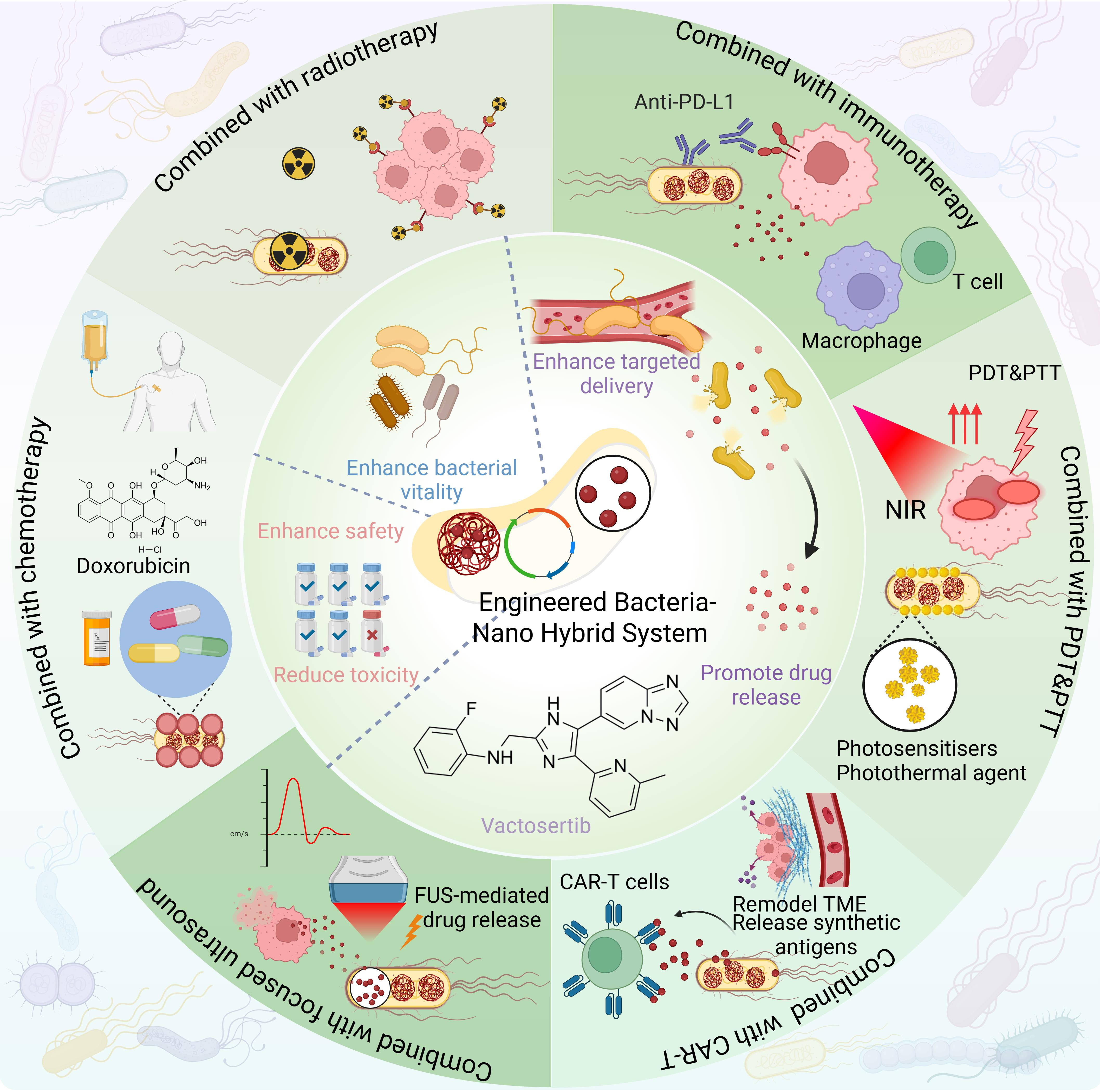
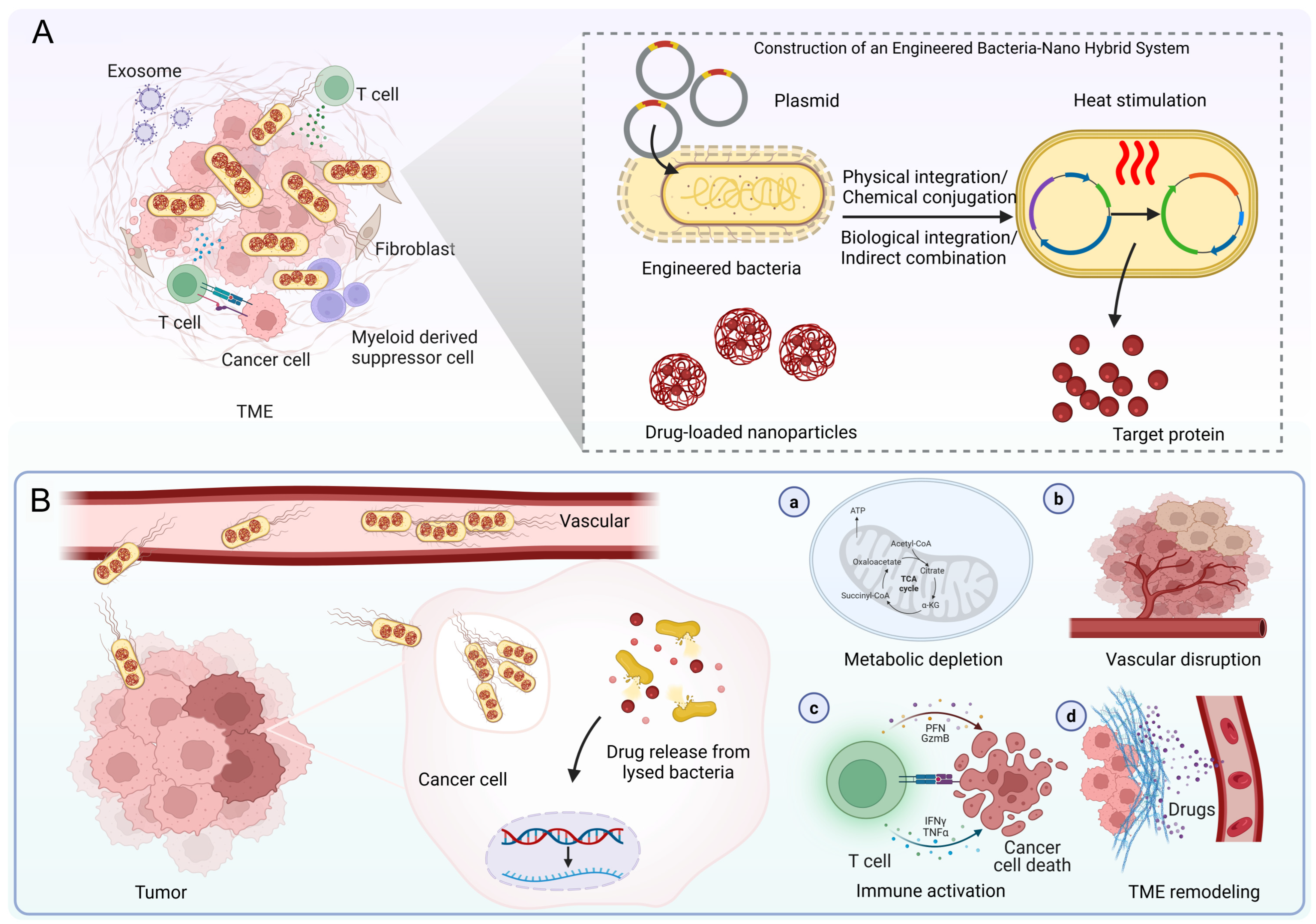
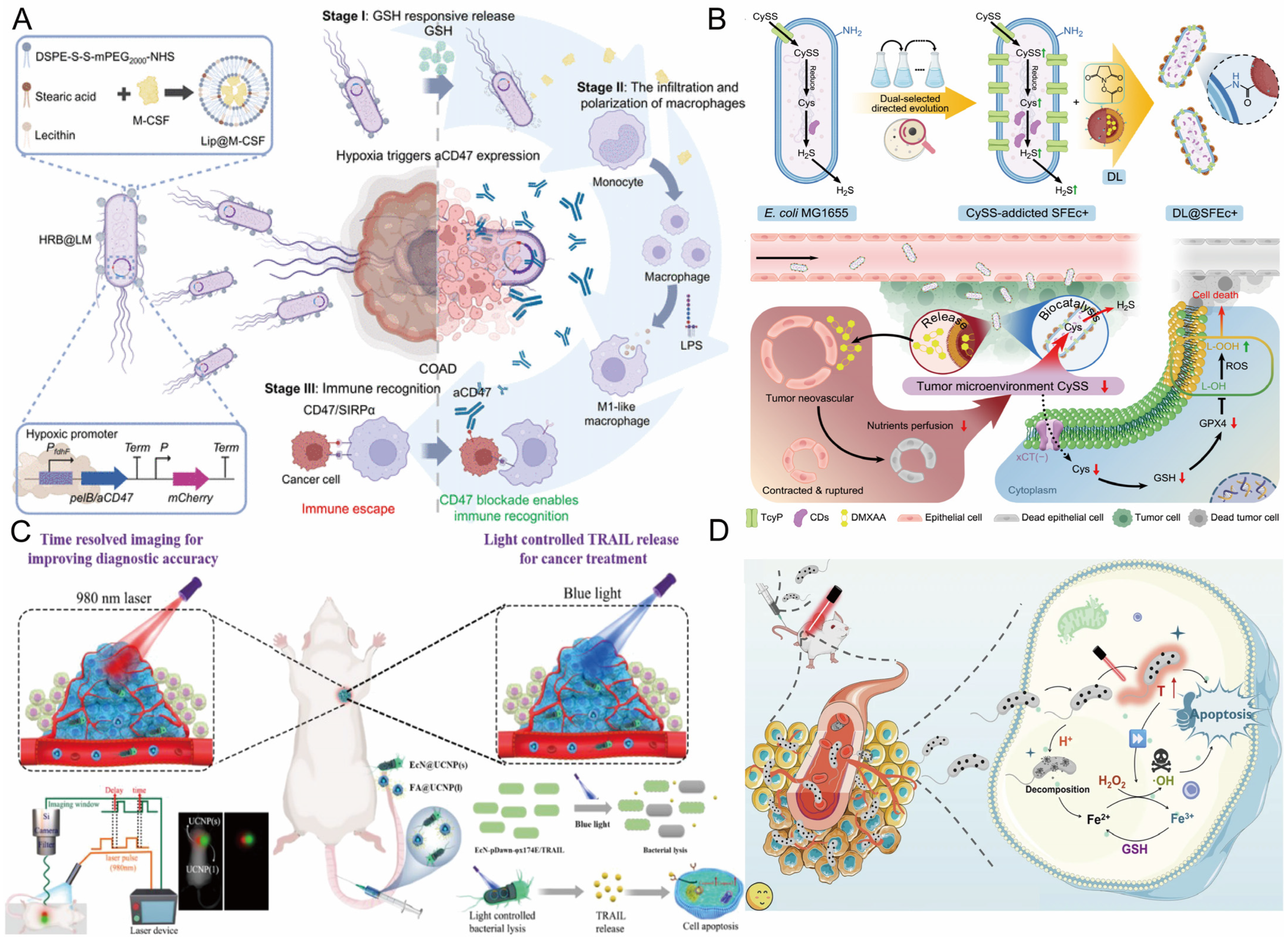
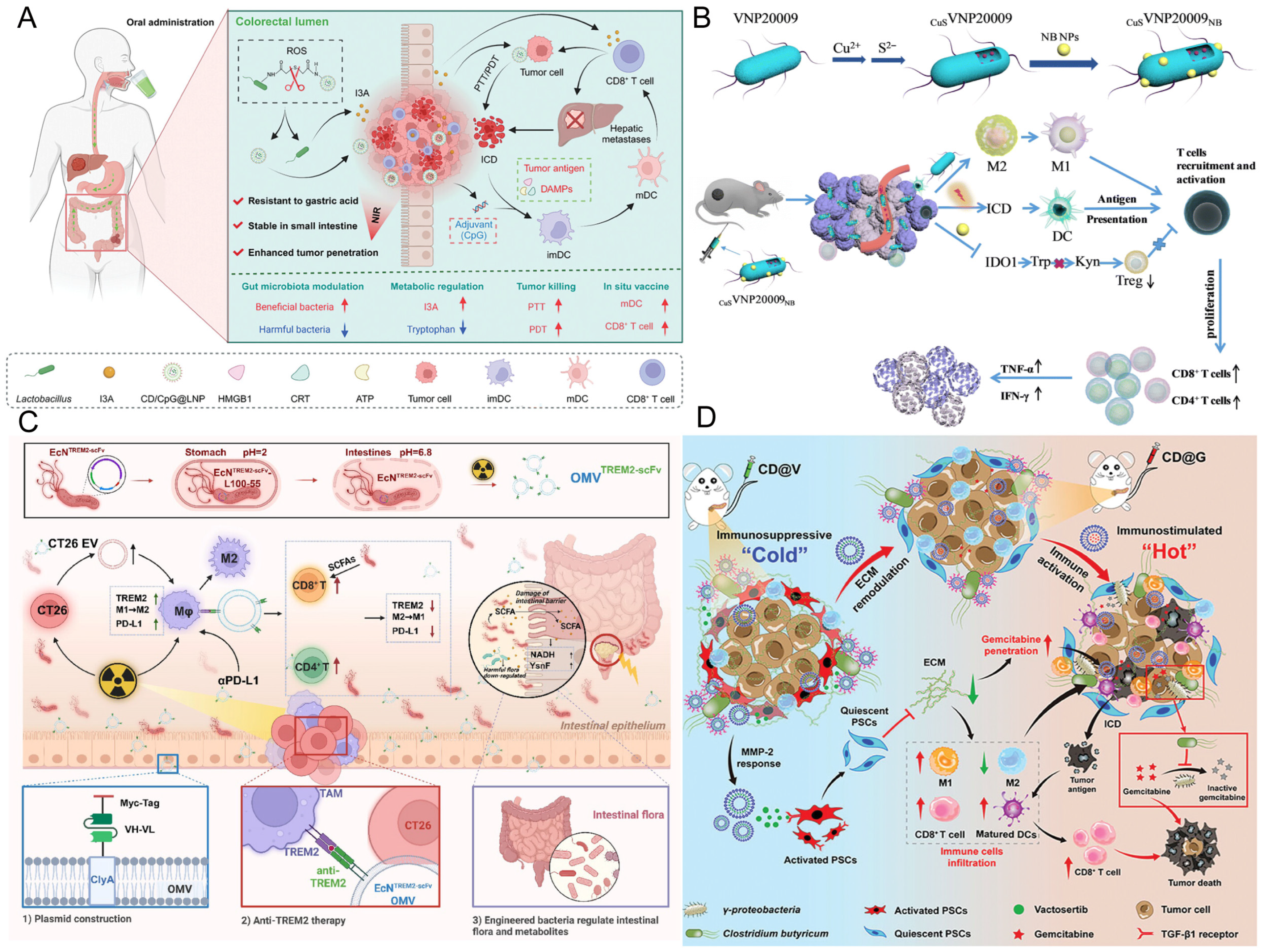
Engineered Bacteria-Nano Hybrid System: The Intelligent Drug Factory for Next-Generation Cancer Immunotherapy

 ,
,
Abstract
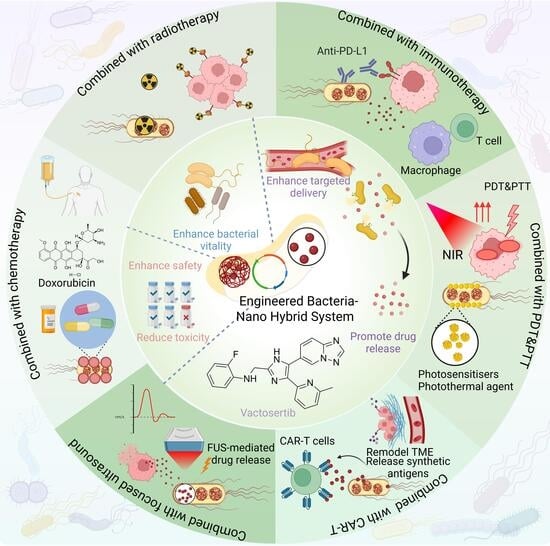
1. Introduction
2. Mechanisms of Engineered Bacteria in Cancer Treatment
2.1. Tumor Targeting
2.2. Tumor Killing
2.2.1. Direct Killing
2.2.2. Targeting the Tumor Vascular System
2.3. Production of Therapeutic Molecules
2.4. Immune Modulation and Activation
2.5. Controlled Release and Spatiotemporal Precision
3. Synthetic Biology-Driven Engineered Bacteria-Nano Systems
3.1. Construction Strategies for Engineered Bacteria-Nano Systems
3.2. Living Factories and Controlled Release

3.3. Mitigating Toxicity and Enhancing Biocompatibility
4. Synergistic Multimodal Therapy
4.1. Combined with Chemotherapy
4.2. Combined with Radiotherapy
4.3. Combined with Immunotherapy
4.4. Combined with Photodynamic Therapy and Photothermal Therapy
4.5. Other Synergistic Strategies
5. Future Directions and Translational Prospects
Author Contributions
Funding
Data Availability Statement
Conflicts of Interest
Abbreviations
| AHL | Acyl-homoserine lactone |
| APCs | Antigen-presenting cells |
| CAR-T | Chimeric antigen receptor T cell |
| ClyA | Cytolysin A |
| DCs | Dendritic cells |
| DOX | Doxorubicin |
| EcN | Escherichia coli Nissle 1917 |
| EPR | Enhanced permeability and retention |
| FlaB | Flagellin B |
| GEM | Gemcitabine |
| HGT | Horizontal gene transfer |
| ICIs | Immune checkpoint inhibitors |
| ICD | Immunogenic cell death |
| LPS | Lipopolysaccharide |
| MDSCs | Myeloid-derived suppressor cells |
| NIR | Near-infrared |
| PAMPs | Pathogen-associated molecular patterns |
| PDT | Photodynamic therapy |
| PTT | Photothermal therapy |
| PS | Photosensitizers |
| QS | Quorum sensing |
| ROS | Reactive oxygen species |
| SLC | Synchronized lysis circuit |
| TME | Tumor microenvironment |
| TLRs | Toll-like receptors |
| Tregs | Regulatory T cells |
References
- Bray, F.; Laversanne, M.; Sung, H.; Ferlay, J.; Siegel, R.L.; Soerjomataram, I.; Jemal, A. Global cancer statistics 2022: GLOBOCAN estimates of incidence and mortality worldwide for 36 cancers in 185 countries. CA A Cancer J. Clin. 2024, 74, 229–263. [Google Scholar] [CrossRef] [PubMed]
- Ribas, A.; Wolchok, J.D. Cancer immunotherapy using checkpoint blockade. Science 2018, 359, 1350–1355. [Google Scholar] [CrossRef]
- Liu, B.; Zhou, H.; Tan, L.; Siu, K.T.H.; Guan, X.-Y. Exploring treatment options in cancer: Tumor treatment strategies. Signal Transduct. Target. Ther. 2024, 9, 175. [Google Scholar] [CrossRef]
- Zhang, X.; Wang, S.; Cheng, G.; Yu, P.; Chang, J. Light-Responsive Nanomaterials for Cancer Therapy. Engineering 2022, 13, 18–30. [Google Scholar] [CrossRef]
- Zhang, L.; Wang, W.; Ou, M.; Huang, X.; Ma, Y.; Tang, J.; Hou, T.; Zhang, S.; Yin, L.; Chen, H.; et al. NIR-II photothermal therapy for effective tumor eradication enhanced by heterogeneous nanorods with dual catalytic activities. Nano Res. 2022, 15, 4310–4319. [Google Scholar] [CrossRef]
- McCarthy, E.F. The toxins of William B. Coley and the treatment of bone and soft-tissue sarcomas. Iowa Orthop. J. 2006, 26, 154–158. [Google Scholar]
- Kang, S.-R.; Nguyen, D.-H.; Yoo, S.W.; Min, J.-J. Bacteria and bacterial derivatives as delivery carriers for immunotherapy. Adv. Drug Deliv. Rev. 2022, 181, 114085. [Google Scholar] [CrossRef]
- Nguyen, D.-H.; Chong, A.; Hong, Y.; Min, J.-J. Bioengineering of bacteria for cancer immunotherapy. Nat. Commun. 2023, 14, 3553. [Google Scholar] [CrossRef]
- Dong, M.; Yang, X.; Zhang, W.; Qiu, Y.; Song, P.; Liu, H.; Yang, Y.; Yang, X.; Wang, Q. Living therapeutics of nonpathogenic bacteria as biosynthesis factory and active carriers for enhancing tumor-targeted therapy. Nat. Commun. 2025, 16, 6532. [Google Scholar] [CrossRef] [PubMed]
- Cao, Y.; Xia, H.; Tan, X.; Shi, C.; Ma, Y.; Meng, D.; Zhou, M.; Lv, Z.; Wang, S.; Jin, Y. Intratumoural microbiota: A new frontier in cancer development and therapy. Signal Transduct. Target. Ther. 2024, 9, 15. [Google Scholar] [CrossRef]
- Low, K.B.; Ittensohn, M.; Le, T.; Platt, J.; Sodi, S.; Amoss, M.; Ash, O.; Carmichael, E.; Chakraborty, A.; Fischer, J.; et al. Lipid A mutant Salmonella with suppressed virulence and TNFα induction retain tumor-targeting in vivo. Nat. Biotechnol. 1999, 17, 37–41. [Google Scholar] [CrossRef]
- Clairmont, C.; Lee, K.C.; Pike, J.; Ittensohn, M.; Low, K.B.; Pawelek, J.; Bermudes, D.; Brecher, S.M.; Margitich, D.; Turnier, J.; et al. Biodistribution and genetic stability of the novel antitumor agent VNP20009, a genetically modified strain of Salmonella typhimurium. J. Infect. Dis. 2000, 181, 1996–2002. [Google Scholar] [CrossRef]
- Zhou, Y.; Li, Q.; Wu, Y.; Zhang, W.; Ding, L.; Ji, C.; Li, P.; Chen, T.; Feng, L.; Tang, B.Z.; et al. Synergistic Brilliance: Engineered Bacteria and Nanomedicine Unite in Cancer Therapy. Adv. Mater. 2024, 36, e2313953. [Google Scholar] [CrossRef]
- Liu, Y.; Zhao, Y.; Chen, X. Bioengineering of Metal-organic Frameworks for Nanomedicine. Theranostics 2019, 9, 3122–3133. [Google Scholar] [CrossRef] [PubMed]
- Hu, H.; Feng, W.; Qian, X.; Yu, L.; Chen, Y.; Li, Y. Emerging Nanomedicine-Enabled/Enhanced Nanodynamic Therapies beyond Traditional Photodynamics. Adv. Mater. 2021, 33, 2005062. [Google Scholar] [CrossRef] [PubMed]
- Lv, H.; Ma, S.; Wang, Z.; Ji, X.; Lv, S.; Ding, C. Glutathione-triggered non-template synthesized porous carbon nanospheres serve as low toxicity targeted delivery system for cancer multi-therapy. Chin. Chem. Lett. 2021, 32, 1765–1769. [Google Scholar] [CrossRef]
- Hong, W.; Wang, A.; Li, L.; Qiu, T.; Li, J.; Jiang, Y.; Zou, G.; Peng, H.; Hou, H.; Ji, X. Bi Dots Confined by Functional Carbon as High-Performance Anode for Lithium Ion Batteries. Adv. Funct. Mater. 2021, 31, 2000756. [Google Scholar] [CrossRef]
- Wang, Y.; Xia, K.; Wang, L.; Wu, M.; Sang, X.; Wan, K.; Zhang, X.; Liu, X.; Wei, G. Peptide-Engineered Fluorescent Nanomaterials: Structure Design, Function Tailoring, and Biomedical Applications. Small 2021, 17, e2005578. [Google Scholar] [CrossRef]
- Zhou, Y.; Chen, Y.; Liu, W.; Fang, H.; Li, X.; Hou, L.; Liu, Y.; Lai, W.; Huang, X.; Xiong, Y. Development of a rapid and sensitive quantum dot nanobead-based double-antigen sandwich lateral flow immunoassay and its clinical performance for the detection of SARS-CoV-2 total antibodies. Sens. Actuators B Chem. 2021, 343, 130139. [Google Scholar] [CrossRef]
- Li, Z.; Wang, C.; Dai, C.; Hu, R.; Ding, L.; Feng, W.; Huang, H.; Wang, Y.; Bai, J.; Chen, Y. Engineering dual catalytic nanomedicine for autophagy-augmented and ferroptosis-involved cancer nanotherapy. Biomaterials 2022, 287, 121668. [Google Scholar] [CrossRef]
- Tan, X.; Letendre, J.H.; Collins, J.J.; Wong, W.W. Synthetic biology in the clinic: Engineering vaccines, diagnostics, and therapeutics. Cell 2021, 184, 881–898. [Google Scholar] [CrossRef]
- Buson, F.; Gao, Y.; Wang, B. Genetic Parts and Enabling Tools for Biocircuit Design. ACS Synth. Biol. 2024, 13, 697–713. [Google Scholar] [CrossRef]
- Chen, Y.Y.; Jensen, M.C.; Smolke, C.D. Genetic control of mammalian T-cell proliferation with synthetic RNA regulatory systems. Proc. Natl. Acad. Sci. USA 2010, 107, 8531–8536. [Google Scholar] [CrossRef] [PubMed]
- Park, S.-H.; Zheng, J.H.; Nguyen, V.H.; Jiang, S.-N.; Kim, D.-Y.; Szardenings, M.; Min, J.H.; Hong, Y.; Choy, H.E.; Min, J.-J. RGD Peptide Cell-Surface Display Enhances the Targeting and Therapeutic Efficacy of Attenuated Salmonella-mediated Cancer Therapy. Theranostics 2016, 6, 1672–1682. [Google Scholar] [CrossRef]
- Zhu, R.; Zhang, F.; Peng, Y.; Xie, T.; Wang, Y.; Lan, Y. Current Progress in Cancer Treatment Using Nanomaterials. Front. Oncol. 2022, 12, 930125. [Google Scholar] [CrossRef] [PubMed]
- Yoon, W.; Park, Y.C.; Kim, J.; Chae, Y.S.; Byeon, J.H.; Min, S.-H.; Park, S.; Yoo, Y.; Park, Y.K.; Kim, B.M. Application of genetically engineered Salmonella typhimurium for interferon-gamma–induced therapy against melanoma. Eur. J. Cancer 2017, 70, 48–61. [Google Scholar] [CrossRef]
- Fan, J.-X.; Li, Z.-H.; Liu, X.-H.; Zheng, D.-W.; Chen, Y.; Zhang, X.-Z. Bacteria-Mediated Tumor Therapy Utilizing Photothermally-Controlled TNF-α Expression via Oral Administration. Nano Lett. 2018, 18, 2373–2380. [Google Scholar] [CrossRef]
- Chowdhury, S.; Castro, S.; Coker, C.; Hinchliffe, T.E.; Arpaia, N.; Danino, T. Programmable bacteria induce durable tumor regression and systemic antitumor immunity. Nat. Med. 2019, 25, 1057–1063. [Google Scholar] [CrossRef] [PubMed]
- Kang, S.R.; Jo, E.J.; Nguyen, V.H.; Zhang, Y.; Yoon, H.S.; Pyo, A.; Kim, D.-Y.; Hong, Y.; Bom, H.-S.; Min, J.-J. Imaging of tumor colonization by Escherichia coli using (18)F-FDS PET. Theranostics 2020, 10, 4958–4966. [Google Scholar] [CrossRef]
- Quispe-Tintaya, W.; Chandra, D.; Jahangir, A.; Harris, M.; Casadevall, A.; Dadachova, E.; Gravekamp, C. Nontoxic radioactive Listeria at is a highly effective therapy against metastatic pancreatic cancer. Proc. Natl. Acad. Sci. USA 2013, 110, 8668–8673. [Google Scholar] [CrossRef]
- Nguyen, V.H.; Kim, H.-S.; Ha, J.-M.; Hong, Y.; Choy, H.E.; Min, J.-J. Genetically engineered Salmonella typhimurium as an imageable therapeutic probe for cancer. Cancer Res. 2010, 70, 18–23. [Google Scholar] [CrossRef]
- Qin, C.; Xiang, Y.; Liu, J.; Zhang, R.; Liu, Z.; Li, T.; Sun, Z.; Ouyang, X.; Zong, Y.; Zhang, H.M.; et al. Precise programming of multigene expression stoichiometry in mammalian cells by a modular and programmable transcriptional system. Nat. Commun. 2023, 14, 1500. [Google Scholar] [CrossRef] [PubMed]
- Liang, K.; Liu, Q.; Li, P.; Luo, H.; Wang, H.; Kong, Q. Genetically engineered Salmonella Typhimurium: Recent advances in cancer therapy. Cancer Lett. 2019, 448, 168–181. [Google Scholar] [CrossRef]
- Zheng, J.H.; Nguyen, V.H.; Jiang, S.-N.; Park, S.-H.; Tan, W.; Hong, S.H.; Shin, M.G.; Chung, I.-J.; Hong, Y.; Bom, H.-S.; et al. Two-step enhanced cancer immunotherapy with engineered Salmonella typhimurium secreting heterologous flagellin. Sci. Transl. Med. 2017, 9, eaak9537. [Google Scholar] [CrossRef]
- Kasinskas, R.W.; Forbes, N.S. Salmonella typhimurium lacking ribose chemoreceptors localize in tumor quiescence and induce apoptosis. Cancer Res. 2007, 67, 3201–3209. [Google Scholar] [CrossRef]
- Jin, M.-Z.; Jin, W.-L. The updated landscape of tumor microenvironment and drug repurposing. Signal Transduct. Target. Ther. 2020, 5, 166. [Google Scholar] [CrossRef] [PubMed]
- Wu, Y.; Li, Q.; Liu, Y.; Li, Y.; Chen, Y.; Wu, X.; Liu, X. Targeting hypoxia for sensitization of tumors to apoptosis enhancement through supramolecular biohybrid bacteria. Int. J. Pharm. 2021, 605, 120817. [Google Scholar] [CrossRef]
- Wang, S.; Brunt, J.; Peck, M.W.; Setlow, P.; Li, Y.-Q. Analysis of the Germination of Individual Clostridium sporogenes Spores with and without Germinant Receptors and Cortex-Lytic Enzymes. Front. Microbiol. 2017, 8, 2047. [Google Scholar] [CrossRef]
- Leventhal, D.S.; Sokolovska, A.; Li, N.; Plescia, C.; Kolodziej, S.A.; Gallant, C.W.; Christmas, R.; Gao, J.-R.; James, M.J.; Abin-Fuentes, A.; et al. Immunotherapy with engineered bacteria by targeting the STING pathway for anti-tumor immunity. Nat. Commun. 2020, 11, 2739. [Google Scholar] [CrossRef]
- Taherkhani, S.; Mohammadi, M.; Daoud, J.; Martel, S.; Tabrizian, M. Covalent binding of nanoliposomes to the surface of magnetotactic bacteria for the synthesis of self-propelled therapeutic agents. ACS Nano 2014, 8, 5049–5060. [Google Scholar] [CrossRef] [PubMed]
- Jiang, M.; Yang, Z.; Dai, J.; Wu, T.; Jiao, Z.; Yu, Y.; Ning, K.; Chen, W.; Yang, A. Intratumor microbiome: Selective colonization in the tumor microenvironment and a vital regulator of tumor biology. Medcomm 2023, 4, e376. [Google Scholar] [CrossRef]
- Zhao, M.; Yang, M.; Li, X.-M.; Jiang, P.; Baranov, E.; Li, S.; Xu, M.; Penman, S.; Hoffman, R.M. Tumor-targeting bacterial therapy with amino acid auxotrophs of GFP-expressing Salmonella typhimurium. Proc. Natl. Acad. Sci. USA 2005, 102, 755–760. [Google Scholar] [CrossRef]
- Liang, K.; Zhang, R.; Luo, H.; Zhang, J.; Tian, Z.; Zhang, X.; Zhang, Y.; Ali, K.; Kong, Q. Optimized Attenuated Salmonella Typhimurium Suppressed Tumor Growth and Improved Survival in Mice. Front. Microbiol. 2021, 12, 774490. [Google Scholar] [CrossRef] [PubMed]
- Gao, T.; Niu, L.; Wu, X.; Dai, D.; Zhou, Y.; Liu, M.; Wu, K.; Yu, Y.; Guan, N.; Ye, H. Sonogenetics-controlled synthetic designer cells for cancer therapy in tumor mouse models. Cell Rep. Med. 2024, 5, 101513. [Google Scholar] [CrossRef] [PubMed]
- Guo, J.; Yang, W.-T.; Mai, F.-Y.; Liang, J.-R.; Luo, J.; Zhou, M.-C.; Yu, D.-D.; Wang, Y.-L.; Li, C.-G. Unravelling oncosis: Morphological and molecular insights into a unique cell death pathway. Front. Immunol. 2024, 15, 1450998. [Google Scholar] [CrossRef] [PubMed]
- Canale, F.P.; Basso, C.; Antonini, G.; Perotti, M.; Li, N.; Sokolovska, A.; Neumann, J.; James, M.J.; Geiger, S.; Jin, W.; et al. Metabolic modulation of tumours with engineered bacteria for immunotherapy. Nature 2021, 598, 662–666. [Google Scholar] [CrossRef] [PubMed]
- Gurbatri, C.R.; Lia, I.; Vincent, R.; Coker, C.; Castro, S.; Treuting, P.M.; Hinchliffe, T.E.; Arpaia, N.; Danino, T. Engineered probiotics for local tumor delivery of checkpoint blockade nanobodies. Sci. Transl. Med. 2020, 12, eaax0876. [Google Scholar] [CrossRef]
- Wei, C.; Xun, A.Y.; Wei, X.X.; Yao, J.; Wang, J.Y.; Shi, R.Y.; Yang, G.H.; Li, Y.X.; Xu, Z.L.; Lai, M.G.; et al. Bifidobacteria Expressing Tumstatin Protein for Antitumor Therapy in Tumor-Bearing Mice. Technol. Cancer Res. Treat. 2016, 15, 498–508. [Google Scholar] [CrossRef]
- Piñero-Lambea, C.; Bodelón, G.; Fernández-Periáñez, R.; Cuesta, A.M.; Álvarez-Vallina, L.; Fernández, L.Á. Programming controlled adhesion of E. coli to target surfaces, cells, and tumors with synthetic adhesins. ACS Synth. Biol. 2015, 4, 463–473. [Google Scholar] [CrossRef]
- Shen, X.; Zhu, C.; Liu, X.; Zheng, H.; Wu, Q.; Xie, J.; Huang, H.; Liao, Z.; Shi, J.; Nan, K.; et al. Engineered bacteria for augmented in situ tumor vaccination. Biomater. Sci. 2023, 11, 1137–1152. [Google Scholar] [CrossRef]
- Jean, A.T.S.; Swofford, C.A.; Panteli, J.T.; Brentzel, Z.J.; Forbes, N.S. Bacterial delivery of Staphylococcus aureus α-hemolysin causes regression and necrosis in murine tumors. Mol. Ther. 2014, 22, 1266–1274. [Google Scholar] [CrossRef]
- Xiao, S.; Mu, M.; Feng, C.; Pan, S.; Chen, N. The application of bacteria-nanomaterial hybrids in antitumor therapy. J. Nanobiotechnol. 2024, 22, 536. [Google Scholar] [CrossRef]
- Flentie, K.; Kocher, B.; Gammon, S.T.; Novack, D.V.; McKinney, J.S.; Piwnica-Worms, D. A bioluminescent transposon reporter-trap identifies tumor-specific microenvironment-induced promoters in Salmonella for conditional bacterial-based tumor therapy. Cancer Discov. 2012, 2, 624–637. [Google Scholar] [CrossRef]
- Yu, B.; Yang, M.; Shi, L.; Yao, Y.; Jiang, Q.; Li, X.; Tang, L.-H.; Zheng, B.-J.; Yuen, K.-Y.; Smith, D.K.; et al. Explicit hypoxia targeting with tumor suppression by creating an obligate anaerobic Salmonella Typhimurium strain. Sci. Rep. 2012, 2, 436. [Google Scholar] [CrossRef]
- McNerney, M.P.; Doiron, K.E.; Ng, T.L.; Chang, T.Z.; Silver, P.A. Theranostic cells: Emerging clinical applications of synthetic biology. Nat. Rev. Genet. 2021, 22, 730–746. [Google Scholar] [CrossRef] [PubMed]
- Xu, X.; Hegazy, W.A.; Guo, L.; Gao, X.; Courtney, A.N.; Kurbanov, S. Effective cancer vaccine platform based on attenuated salmonella and a type III secretion system. Cancer Res. 2014, 74, 6260–6270. [Google Scholar] [CrossRef]
- Leigh, N.D.; Bian, G.; Ding, X.; Liu, H.; Aygun-Sunar, S.; Burdelya, L.G.; Gudkov, A.V.; Cao, X. A flagellin-derived toll-like receptor 5 agonist stimulates cytotoxic lymphocyte-mediated tumor immunity. PLoS ONE 2014, 9, e85587. [Google Scholar] [CrossRef] [PubMed]
- Chandra, D.; Jahangir, A.; Quispe-Tintaya, W.; Einstein, M.H.; Gravekamp, C. Myeloid-derived suppressor cells have a central role in attenuated Listeria monocytogenes-based immunotherapy against metastatic breast cancer in young and old mice. Br. J. Cancer 2013, 108, 2281–2290. [Google Scholar] [CrossRef] [PubMed]
- Prifti, K.; Chabu, C.Y.; Kobayashi, K.S.; Song, J.; Han, A.; de Figueiredo, P. Bacterial Therapeutics: Addressing the Affordability Gap in Cancer Therapy. Cancer Res. 2025, 85, 2558–2560. [Google Scholar] [CrossRef]
- Mukherjee, S.; Bassler, B.L. Bacterial quorum sensing in complex and dynamically changing environments. Nat. Rev. Microbiol. 2019, 17, 371–382. [Google Scholar] [CrossRef]
- Miano, A.; Liao, M.J.; Hasty, J. Inducible cell-to-cell signaling for tunable dynamics in microbial communities. Nat. Commun. 2020, 11, 1193. [Google Scholar] [CrossRef] [PubMed]
- Wu, S.; Liu, J.; Liu, C.; Yang, A.; Qiao, J. Quorum sensing for population-level control of bacteria and potential therapeutic applications. Cell. Mol. Life Sci. 2020, 77, 1319–1343. [Google Scholar] [CrossRef] [PubMed]
- Swofford, C.A.; Van Dessel, N.; Forbes, N.S. Quorum-sensing Salmonella selectively trigger protein expression within tumors. Proc. Natl. Acad. Sci. USA 2015, 112, 3457–3462. [Google Scholar] [CrossRef]
- Din, M.O.; Danino, T.; Prindle, A.; Skalak, M.; Selimkhanov, J.; Allen, K.; Julio, E.; Atolia, E.; Tsimring, L.S.; Bhatia, S.N.; et al. Synchronized cycles of bacterial lysis for in vivo delivery. Nature 2016, 536, 81–85. [Google Scholar] [CrossRef]
- Kim, K.; Min, S.-Y.; Lim, H.-D.; You, S.-H.; Lim, D.; Jeong, J.-H.; Kim, H.-J.; Rhee, J.H.; Park, K.; Shin, M.; et al. Cell mass-dependent expression of an anticancer protein drug by tumor-targeted Salmonella. Oncotarget 2018, 9, 8548–8559. [Google Scholar] [CrossRef][Green Version]
- Savage, T.M.; Vincent, R.L.; Rae, S.S.; Huang, L.H.; Ahn, A.; Pu, K.; Li, F.; Santos-Alexis, K.d.L.; Coker, C.; Danino, T.; et al. Chemokines expressed by engineered bacteria recruit and orchestrate antitumor immunity. Sci. Adv. 2023, 9, eadc9436. [Google Scholar] [CrossRef]
- Ijaz, M.; Hasan, I.; Chaudhry, T.H.; Huang, R.; Zhang, L.; Hu, Z.; Tan, Q.; Guo, B. Bacterial derivatives mediated drug delivery in cancer therapy: A new generation strategy. J. Nanobiotechnol. 2024, 22, 510. [Google Scholar] [CrossRef]
- Gurbatri, C.R.; Radford, G.A.; Vrbanac, L.; Im, J.; Thomas, E.M.; Coker, C.; Taylor, S.R.; Jang, Y.; Sivan, A.; Rhee, K.; et al. Engineering tumor-colonizing E. coli Nissle 1917 for detection and treatment of colorectal neoplasia. Nat. Commun. 2024, 15, 646. [Google Scholar] [CrossRef]
- Zhao, X.; Xie, N.; Zhang, H.; Zhou, W.; Ding, J. Bacterial Drug Delivery Systems for Cancer Therapy: Why and How. Pharmaceutics 2023, 15, 2214. [Google Scholar] [CrossRef]
- Feng, Z.; Wang, Y.; Xu, H.; Guo, Y.; Xia, W.; Zhao, C.; Zhao, X.; Wu, J. Recent advances in bacterial therapeutics based on sense and response. Acta Pharm. Sin. B 2023, 13, 1014–1027. [Google Scholar] [CrossRef] [PubMed]
- Lee, J.; McClure, S.; Weichselbaum, R.R.; Mimee, M. Designing live bacterial therapeutics for cancer. Adv. Drug Deliv. Rev. 2025, 221, 115579. [Google Scholar] [CrossRef]
- Niethammer, A.G.; Lubenau, H.; Mikus, G.; Knebel, P.; Hohmann, N.; Leowardi, C.; Beckhove, P.; Akhisaroglu, M.; Ge, Y.; Springer, M.; et al. Double-blind, placebo-controlled first in human study to investigate an oral vaccine aimed to elicit an immune reaction against the VEGF-Receptor 2 in patients with stage IV and locally advanced pancreatic cancer. BMC Cancer 2012, 12, 361. [Google Scholar] [CrossRef]
- Xie, R.; Fan, D.; Cheng, X.; Yin, Y.; Li, H.; Wegner, S.V.; Chen, F.; Zeng, W. Living therapeutics: Precision diagnosis and therapy with engineered bacteria. Biomaterials 2025, 321, 123342. [Google Scholar] [CrossRef] [PubMed]
- Schmitz-Winnenthal, F.H.; Hohmann, N.; Schmidt, T.; Podola, L.; Friedrich, T.; Lubenau, H.; Springer, M.; Wieckowski, S.; Breiner, K.M.; Mikus, G.; et al. A phase 1 trial extension to assess immunologic efficacy and safety of prime-boost vaccination with VXM01, an oral T cell vaccine against VEGFR2, in patients with advanced pancreatic cancer. OncoImmunology 2018, 7, e1303584. [Google Scholar] [CrossRef] [PubMed]
- Gniadek, T.J.; Augustin, L.; Schottel, J.; Leonard, A.; Saltzman, D.; Greeno, E.; Batist, G. A Phase I, Dose Escalation, Single Dose Trial of Oral Attenuated Salmonella typhimurium Containing Human IL-2 in Patients with Metastatic Gastrointestinal Cancers. J. Immunother. 2020, 43, 217–221. [Google Scholar] [CrossRef]
- Janku, F.; Zhang, H.H.; Pezeshki, A.M.; Goel, S.; Murthy, R.; Wang-Gillam, A.; Shepard, D.R.; Helgason, T.; Masters, T.; Hong, D.S.; et al. Intratumoral Injection of Clostridium novyi-NT Spores in Patients with Treatment-refractory Advanced Solid Tumors. Clin. Cancer Res. 2021, 27, 96–106. [Google Scholar] [CrossRef]
- Nelson, B.E.; Janku, F.; Fu, S.; Dumbrava, E.E.; Hong, D.S.; Karp, D.D.; Naing, A.; Rodon, J.; Tsimberidou, A.M.; Murthy, R. Phase Ib Study of Pembrolizumab in Combination with Intratumoral Injection of Clostridium novyi-NT in Patients with Advanced Solid Tumors. Clin. Cancer Res. 2025, 31, 3864–3875. [Google Scholar] [CrossRef]
- Luke, J.J.; Piha-Paul, S.A.; Medina, T.; Verschraegen, C.F.; Varterasian, M.; Brennan, A.M.; Riese, R.J.; Sokolovska, A.; Strauss, J.F.; Hava, D.L.; et al. Phase I Study of SYNB1891, an Engineered E. coli Nissle Strain Expressing STING Agonist, with and without Atezolizumab in Advanced Malignancies. Clin. Cancer Res. 2023, 29, 2435–2444. [Google Scholar] [CrossRef]
- Le, D.T.; Brockstedt, D.G.; Nir-Paz, R.; Hampl, J.; Mathur, S.; Nemunaitis, J.; Sterman, D.H.; Hassan, R.; Lutz, E.; Moyer, B.; et al. A live-attenuated Listeria vaccine (ANZ-100) and a live-attenuated Listeria vaccine expressing mesothelin (CRS-207) for advanced cancers: Phase I studies of safety and immune induction. Clin. Cancer Res. 2012, 18, 858–868. [Google Scholar] [CrossRef] [PubMed]
- Le, D.T.; Wang-Gillam, A.; Picozzi, V.; Greten, T.F.; Crocenzi, T.; Springett, G.; Morse, M.; Zeh, H.; Cohen, D.; Fine, R.L.; et al. Safety and Survival with GVAX Pancreas Prime and Listeria Monocytogenes–Expressing Mesothelin (CRS-207) Boost Vaccines for Metastatic Pancreatic Cancer. J. Clin. Oncol. 2015, 33, 1325–1333. [Google Scholar] [CrossRef]
- Maciag, P.C.; Radulovic, S.; Rothman, J. The first clinical use of a live-attenuated Listeria monocytogenes vaccine: A Phase I safety study of Lm-LLO-E7 in patients with advanced carcinoma of the cervix. Vaccine 2009, 27, 3975–3983. [Google Scholar] [CrossRef] [PubMed]
- Drake, C.G.; Pachynski, R.K.; Subudhi, S.K.; McNeel, D.G.; Antonarakis, E.S.; Bauer, T.M.; Lauer, P.; Brockstedt, D.; Patricia, D.; Wade, M.; et al. Safety and preliminary immunogenicity of JNJ-64041809, a live-attenuated, double-deleted Listeria monocytogenes-based immunotherapy, in metastatic castration-resistant prostate cancer. Prostate Cancer Prostatic Dis. 2022, 25, 219–228. [Google Scholar] [CrossRef] [PubMed]
- Basu, P.; Mehta, A.; Jain, M.; Gupta, S.; Nagarkar, R.V.; John, S.; Petit, R. A Randomized Phase 2 Study of ADXS11-001 Listeria monocy’togenes-Listeriolysin O Immunotherapy with or Without Cisplatin in Treatment of Advanced Cervical Cancer. Int. J. Gynecol. Cancer 2018, 28, 764–772. [Google Scholar] [CrossRef]
- Eng, C.; Fakih, M.; Amin, M.; Morris, V.; Hochster, H.S.; Boland, P.M.; Uronis, H. A phase II study of axalimogene filolisbac for patients with previously treated, unresectable, persistent/recurrent loco-regional or metastatic anal cancer. Oncotarget 2020, 11, 1334–1343. [Google Scholar] [CrossRef]
- Brahmer, J.R.; Johnson, M.L.; Cobo, M.; Viteri, S.; Sarto, J.C.; Sukari, A.; Awad, M.M.; Salgia, R.; Papadimitrakopoulou, V.A.; Rajan, A.; et al. JNJ-64041757 (JNJ-757), a Live, Attenuated, Double-Deleted Listeria monocytogenes–Based Immunotherapy in Patients with NSCLC: Results From Two Phase 1 Studies. JTO Clin. Res. Rep. 2021, 2, 100103. [Google Scholar] [CrossRef]
- Rentsch, C.A.; Thalmann, G.N.; Lucca, I.; Kwiatkowski, M.; Wirth, G.J.; Strebel, R.T.; Engeler, D.S.; Pedrazzini, A.; Pedrazzini, C.; Schultze-Seemann, W.; et al. A Phase 1/2 Single-arm Clinical Trial of Recombinant Bacillus Calmette-Guérin (BCG) VPM1002BC Immunotherapy in Non-muscle-invasive Bladder Cancer Recurrence After Conventional BCG Therapy: SAKK 06/14. Eur. Urol. Oncol. 2022, 5, 195–202. [Google Scholar] [CrossRef] [PubMed]
- Rentsch, C.A.; Bosshard, P.; Mayor, G.; Rieken, M.; Püschel, H.; Wirth, G.; Cathomas, R.; Parzmair, G.P.; Grode, L.; Eisele, B.; et al. Results of the phase I open label clinical trial SAKK 06/14 assessing safety of intravesical instillation of VPM1002BC, a recombinant mycobacterium Bacillus Calmette Guérin (BCG), in patients with non-muscle invasive bladder cancer and previous failure of conventional BCG therapy. OncoImmunology 2020, 9, 1748981. [Google Scholar] [CrossRef]
- Nemunaitis, J.; Cunningham, C.; Senzer, N.; Kuhn, J.; Cramm, J.; Litz, C.; Cavagnolo, R.; Cahill, A.; Clairmont, C.; Sznol, M. Pilot trial of genetically modified, attenuated Salmonella expressing the E. coli cytosine deaminase gene in refractory cancer patients. Cancer Gene Ther. 2003, 10, 737–744. [Google Scholar] [CrossRef]
- Heimann, D.M.; Rosenberg, S.A. Continuous intravenous administration of live genetically modified salmonella typhimurium in patients with metastatic melanoma. J. Immunother. 2003, 26, 179–180. [Google Scholar] [CrossRef]
- Toso, J.F.; Gill, V.J.; Hwu, P.; Marincola, F.M.; Restifo, N.P.; Schwartzentruber, D.J.; Sherry, R.M.; Topalian, S.L.; Yang, J.C.; Stock, F.; et al. Phase I study of the intravenous administration of attenuated Salmonella typhimurium to patients with metastatic melanoma. J. Clin. Oncol. 2002, 20, 142–152. [Google Scholar] [CrossRef]
- Bondarenko, O.; Mortimer, M.; Kahru, A.; Feliu, N.; Javed, I.; Kakinen, A.; Lin, S.; Xia, T.; Song, Y.; Davis, T.P.; et al. Nanotoxicology and Nanomedicine: The Yin and Yang of Nano-Bio Interactions for the New Decade. Nano Today 2021, 39, 101184. [Google Scholar] [CrossRef]
- Kuang, X.; Liu, Y.; Luo, H.; Li, Q.; Wu, F.; Fan, C.; Liu, J. Triggerable Prodrug Nanocoating Enables On-Demand Activation of Microbial and Small-Molecular Therapeutics for Combination Treatment. J. Am. Chem. Soc. 2023, 145, 26932–26946. [Google Scholar] [CrossRef] [PubMed]
- Ding, S.; Liu, Z.; Huang, C.; Zeng, N.; Jiang, W.; Li, Q. Novel Engineered Bacterium/Black Phosphorus Quantum Dot Hybrid System for Hypoxic Tumor Targeting and Efficient Photodynamic Therapy. ACS Appl. Mater. Interfaces 2021, 13, 10564–10573. [Google Scholar] [CrossRef]
- Xing, D.; Lin, C.C.; Ho, Y.L.; Kamal, A.S.A.; Wang, I.T.; Chen, C.C.; Wen, C.-Y.; Chen, C.-W.; Delaunay, J.-J. Self-Healing Lithographic Patterning of Perovskite Nanocrystals for Large-Area Single-Mode Laser Array. Adv. Funct. Mater. 2021, 31, 2006283. [Google Scholar] [CrossRef]
- Xing, J.; Yin, T.; Li, S.; Xu, T.; Ma, A.; Chen, Z.; Luo, Y.; Lai, Z.; Lv, Y.; Pan, H.; et al. Sequential Magneto-Actuated and Optics-Triggered Biomicrorobots for Targeted Cancer Therapy. Adv. Funct. Mater. 2021, 31, 2008262. [Google Scholar] [CrossRef]
- Zhao, M.; Geller, J.; Ma, H.; Yang, M.; Penman, S.; Hoffman, R.M. Monotherapy with a tumor-targeting mutant of Salmonella typhimurium cures orthotopic metastatic mouse models of human prostate cancer. Proc. Natl. Acad. Sci. USA 2007, 104, 10170–10174. [Google Scholar] [CrossRef]
- Chen, Q.; Liu, X.; Fan, J.; Peng, S.; Wang, J.; Wang, X.; Zhang, C.; Liu, C.; Zhang, X. Self-Mineralized Photothermal Bacteria Hybridizing with Mitochondria-Targeted Metal–Organic Frameworks for Augmenting Photothermal Tumor Therapy. Adv. Funct. Mater. 2020, 30, 1909806. [Google Scholar] [CrossRef]
- Mostaghaci, B.; Yasa, O.; Zhuang, J.; Sitti, M. Bioadhesive Bacterial Microswimmers for Targeted Drug Delivery in the Urinary and Gastrointestinal Tracts. Adv. Sci. 2017, 4, 1700058. [Google Scholar] [CrossRef]
- Suh, S.; Jo, A.; Traore, M.A.; Zhan, Y.; Coutermarsh-Ott, S.L.; Ringel-Scaia, V.M.; Allen, I.C.; Davis, R.M.; Behkam, B. Nanoscale Bacteria-Enabled Autonomous Drug Delivery System (NanoBEADS) Enhances Intratumoral Transport of Nanomedicine. Adv. Sci. 2019, 6, 1801309. [Google Scholar] [CrossRef]
- Liu, X.; Wu, M.; Wang, M.; Duan, Y.; Phan, C.; Qi, G.; Tang, G.; Liu, B. Metabolically engineered bacteria as light-controlled living therapeutics for anti-angiogenesis tumor therapy. Mater. Horizons 2021, 8, 1454–1460. [Google Scholar] [CrossRef] [PubMed]
- Chen, Q.; Wang, J.; Wang, X.; Fan, J.; Liu, X.; Li, B.; Han, Z.; Cheng, S.; Zhang, X. Inhibition of Tumor Progression through the Coupling of Bacterial Respiration with Tumor Metabolism. Angew. Chem. Int. Ed. Engl. 2020, 59, 21562–21570. [Google Scholar] [CrossRef] [PubMed]
- Yan, S.; Zeng, X.; Wang, Y.; Liu, B. Biomineralization of Bacteria by a Metal–Organic Framework for Therapeutic Delivery. Adv. Healthc. Mater. 2020, 9, e2000046. [Google Scholar] [CrossRef]
- Li, Y.; Tang, S.; Cong, Z.; Lu, D.; Yang, Q.; Chen, Q.; Zhang, X.; Wu, S. Biohybrid bacterial microswimmers with metal-organic framework exoskeletons enable cytoprotection and active drug delivery in a harsh environment. Mater. Today Chem. 2022, 23, 100609. [Google Scholar] [CrossRef]
- Felfoul, O.; Mohammadi, M.; Taherkhani, S.; De Lanauze, D.; Xu, Y.Z.; Loghin, D.; Essa, S.; Jancik, S.; Houle, D.; LaFleur, M.; et al. Magneto-aerotactic bacteria deliver drug-containing nanoliposomes to tumour hypoxic regions. Nat. Nanotechnol. 2016, 11, 941–947. [Google Scholar] [CrossRef]
- Liu, S.-C.; Ahn, G.-O.; Kioi, M.; Dorie, M.-J.; Patterson, A.V.; Brown, J.M. Optimized Clostridium-directed enzyme prodrug therapy improves the antitumor activity of the novel DNA cross-linking agent PR-104. Cancer Res. 2008, 68, 7995–8003. [Google Scholar] [CrossRef]
- Wang, M.; Song, X.; Liu, X.; Ma, C.; Ma, J.; Shi, L. Engineered oncolytic bacteria for malignant solid tumor treatment. Interdiscip. Med. 2024, 2, e20240005. [Google Scholar] [CrossRef]
- Zhang, S.; Yang, J.; Luo, J.; Zhang, J.; Huang, M.; Tan, K.; Chen, G.; Xing, Q.; Kwok, H.F.; Dai, Z.; et al. Intracellular Polymerization Induced Self-Assembly and Gold Nanocomposite Synthesis in Living Bacteria. Angew. Chem. Int. Ed. Engl. 2025, 64, e202504936. [Google Scholar] [CrossRef]
- Xie, X.-T.; Guan, M.; Cheng, K.; Li, Y.; Zhang, B.; Zhou, Y.-T.; Tan, L.-F.; Dong, P.-S.; Chen, S.; Liu, B.; et al. Programmable engineered bacteria as sustained-releasing antibody factory in situ for enhancing tumor immune checkpoint therapy. Sci. Adv. 2025, 11, eadt7298. [Google Scholar] [CrossRef]
- Wang, Y.-Z.; Chen, W.-H.; Han, Z.-Y.; Zhang, S.-M.; Ji, P.; Zhang, C.; Liang, J.-L.; Zhang, X.-Z. Targeted tumor therapy with L-cyst(e)ine-addicted bacteria-nanodrug biohybrids. Cell Metab. 2025, 37, 1277–1293. [Google Scholar] [CrossRef]
- Fan, Y.; Ye, J.; Kang, Y.; Niu, G.; Shi, J.; Yuan, X.; Li, R.; Han, J.; Ji, X. Biomimetic piezoelectric nanomaterial-modified oral microrobots for targeted catalytic and immunotherapy of colorectal cancer. Sci. Adv. 2024, 10, eadm9561. [Google Scholar] [CrossRef] [PubMed]
- Li, F.; Zhu, P.; Zheng, B.; Lu, Z.; Fang, C.; Fu, Y.; Li, X. A Customized Biohybrid Presenting Cascade Responses to Tumor Microenvironment. Adv. Mater. 2024, 36, e2404901. [Google Scholar] [CrossRef] [PubMed]
- Song, P.; Han, X.; Li, X.; Cong, Y.; Wu, Y.; Yan, J.; Wang, Y.; Wang, X.; Mu, Z.; Wang, L.; et al. Bacteria engineered with intracellular and extracellular nanomaterials for hierarchical modulation of antitumor immune responses. Mater. Horizons 2023, 10, 2927–2935. [Google Scholar] [CrossRef]
- Yuan, S.; Yang, X.; Bremmer, A.M.; Wang, Y.; Li, S.; Chen, Y.; You, Y.; Hu, Q. Programmable immunoprobiotics orchestrate antitumor immune response with Pin1 inhibition for pancreatic cancer treatment. Proc. Natl. Acad. Sci. USA 2025, 122, e2507711122. [Google Scholar] [CrossRef]
- Deng, X.; Yang, W.; Shao, Z.; Zhao, Y. Genetically modified bacteria for targeted phototherapy of tumor. Biomaterials 2021, 272, 120809. [Google Scholar] [CrossRef]
- Sun, T.; Wang, M.; Zhang, L.; Gong, M.; Xie, Q.; Yang, X.; Xiao, S.; Zhang, W.; Liu, X.; Zhao, Y.; et al. Engineered Bacterial Biohybrid-Mediated CD47-SIRPα Blockade and HSP90 Inhibition for Enhanced Immuno-Photothermal Therapy. ACS Appl. Mater. Interfaces 2025, 17, 29183–29197. [Google Scholar] [CrossRef]
- Liu, L.; He, H.; Luo, Z.; Zhou, H.; Liang, R.; Pan, H.; Ma, Y.; Cai, L. In Situ Photocatalyzed Oxygen Generation with Photosynthetic Bacteria to Enable Robust Immunogenic Photodynamic Therapy in Triple-Negative Breast Cancer. Adv. Funct. Mater. 2020, 30, 1910176. [Google Scholar] [CrossRef]
- Khan, R.U.; Shao, J.; Liao, J.-Y.; Qian, L. pH-triggered cancer-targeting polymers: From extracellular accumulation to intracellular release. Nano Res. 2023, 16, 5155–5168. [Google Scholar] [CrossRef]
- Qin, W.; Xu, W.; Wang, L.; Ren, D.; Cheng, Y.; Song, W.; Jiang, T.; Ma, L.; Zhang, C. Bacteria-Elicited Specific Thrombosis Utilizing Acid-Induced Cytolysin A Expression to Enable Potent Tumor Therapy. Adv. Sci. 2022, 9, e2105086. [Google Scholar] [CrossRef]
- Zhang, Y.; Xue, X.; Fang, M.; Pang, G.; Xing, Y.; Zhang, X.; Li, L.; Chen, Q.; Wang, Y.; Chang, J.; et al. Upconversion Optogenetic Engineered Bacteria System for Time-Resolved Imaging Diagnosis and Light-Controlled Cancer Therapy. ACS Appl. Mater. Interfaces 2022, 14, 46351–46361. [Google Scholar] [CrossRef] [PubMed]
- Qiao, L.; Niu, L.; Wang, Z.; Deng, Z.; Di, D.; Ma, X.; Zhou, Y.; Kong, D.; Wang, Q.; Yin, J.; et al. Engineered bacteria for near-infrared light-inducible expression of cancer therapeutics. Nat. Cancer 2025, 6, 612–628. [Google Scholar] [CrossRef] [PubMed]
- Li, L.; Pan, H.; Pang, G.; Lang, H.; Shen, Y.; Sun, T.; Zhang, Y.; Liu, J.; Chang, J.; Kang, J.; et al. Precise Thermal Regulation of Engineered Bacteria Secretion for Breast Cancer Treatment In Vivo. ACS Synth. Biol. 2022, 11, 1167–1177. [Google Scholar] [CrossRef]
- Fan, J.X.; Peng, M.Y.; Wang, H.; Zheng, H.R.; Liu, Z.L.; Li, C.X.; Wang, X.-N.; Liu, X.-H.; Cheng, S.-X.; Zhang, X.Z. Engineered Bacterial Bioreactor for Tumor Therapy via Fenton-Like Reaction with Localized H2O2 Generation. Adv. Mater. 2019, 31, e1808278. [Google Scholar] [CrossRef]
- Xu, H.; Wang, Y.; Liu, G.; Zhu, Z.; Shahbazi, M.; Reis, R.L.; Kundu, S.C.; Shi, X.; Zu, M.; Xiao, B. Nano-Armed Limosilactobacillus reuteri for Enhanced Photo-Immunotherapy and Microbiota Tryptophan Metabolism against Colorectal Cancer. Adv. Sci. 2025, 12, e2410011. [Google Scholar] [CrossRef] [PubMed]
- Chen, Q.-W.; Zhang, Y.; Bao, P.; Zhang, X.-Z. Sialidase-Chimeric Bioengineered Bacteria for Tumor-Sialoglycan-Triggered Solid Tumor Therapy. Nano Lett. 2024, 24, 10362–10371. [Google Scholar] [CrossRef] [PubMed]
- Wang, Y.; Dong, A.; Man, J.; Chen, H.; Shen, W.; Wang, L.; Yang, H.; Hu, L.; Yang, K. TREM2 scFv-Engineering Escherichia coli Displaying Modulation of Macrophages to Boost Cancer Radio-Immunotherapy. Adv. Mater. 2025, 37, e2417920. [Google Scholar] [CrossRef] [PubMed]
- Qiao, C.; Wang, L.; Huang, C.; Jia, Q.; Bao, W.; Guo, P.; Tan, D.; Chen, Z.; Shi, C.; Rao, Z.; et al. Engineered Bacteria Manipulate Cysteine Metabolism to Boost Ferroptosis-Based Pancreatic Ductal Adenocarcinoma Therapy. Adv. Mater. 2025, 37, e2412982. [Google Scholar] [CrossRef]
- Yao, W.; Song, W.; Deng, X.; Lin, Y.; Meng, R.; Wang, J.; Chen, W.; Zhang, X. Harnessing the Engineered Probiotic-Nanosystem to Remodulate Tumor Extracellular Matrix and Regulate Tumor-Colonizing Bacteria for Improving Pancreatic Cancer Chemo-Immunotherapy. Small 2024, 21, e2406837. [Google Scholar] [CrossRef]
- Zhou, Q.; Jiao, L.; Li, W.; Hu, Z.; Li, Y.; Zhang, H.; Yang, M.; Xu, L.; Yan, Y. A Novel Cre/lox-Based Genetic Tool for Repeated, Targeted and Markerless Gene Integration in Yarrowia lipolytica. Int. J. Mol. Sci. 2021, 22, 10739. [Google Scholar] [CrossRef]
- Khodak, Y.A.; Shaifutdinov, R.R.; Khasanov, D.S.; Orlova, N.A.; Vorobiev, I.I. Location and Orientation of the Genetic Toxin–Antitoxin Element hok/sok in the Plasmid Affect Expression of Pharmaceutically Significant Proteins in Bacterial Cells. Biochemistry 2023, 88, 1326–1337. [Google Scholar] [CrossRef]
- Kusumawardhani, H.; Hosseini, R.; Verschoor, J.A.; de Winde, J.H. Erratum: Comparative analysis reveals the modular functional structure of conjugative megaplasmid pTTS12 of Pseudomonas putida S12: A paradigm for transferable traits, plasmid stability, and inheritance? Front. Microbiol. 2023, 14, 1176489. [Google Scholar]
- Legnini, I.; Emmenegger, L.; Zappulo, A.; Rybak-Wolf, A.; Wurmus, R.; Martinez, A.O.; Jara, C.C.; Boltengagen, A.; Hessler, T.; Mastrobuoni, G.; et al. Spatiotemporal, optogenetic control of gene expression in organoids. Nat. Methods 2023, 20, 1544–1552. [Google Scholar] [CrossRef] [PubMed]
- Cooper, R.M.; Wright, J.A.; Ng, J.Q.; Goyne, J.M.; Suzuki, N.; Lee, Y.K.; Ichinose, M.; Radford, G.; Ryan, F.J.; Kumar, S.; et al. Engineered bacteria detect tumor DNA. Science 2023, 381, 682–686. [Google Scholar] [CrossRef] [PubMed]
- Asin-Garcia, E.; Batianis, C.; Li, Y.; Fawcett, J.D.; de Jong, I.; dos Santos, V.A.P.M. Phosphite synthetic auxotrophy as an effective biocontainment strategy for the industrial chassis Pseudomonas putida. Microb. Cell Factories 2022, 21, 156. [Google Scholar] [CrossRef]
- Gómez-Tatay, L.; Hernández-Andreu, J.M. Xenobiology for the Biocontainment of Synthetic Organisms: Opportunities and Challenges. Life 2024, 14, 996. [Google Scholar] [CrossRef]
- Brockstedt, D.G.; Giedlin, M.A.; Leong, M.L.; Bahjat, K.S.; Gao, Y.; Luckett, W.; Liu, W.; Cook, D.N.; Portnoy, D.A.; Dubensky, T.W. Listeria-based cancer vaccines that segregate immunogenicity from toxicity. Proc. Natl. Acad. Sci. USA 2004, 101, 13832–13837. [Google Scholar] [CrossRef]
- Zhang, Y.; Fleur, A.S.; Feng, H. The development of live biotherapeutics against Clostridioides difficile infection towards reconstituting gut microbiota. Gut Microbes 2022, 14, 2052698. [Google Scholar] [CrossRef]
- Nyerges, A.; Vinke, S.; Flynn, R.; Owen, S.V.; Rand, E.A.; Budnik, B.; Keen, E.; Narasimhan, K.; Marchand, J.A.; Baas-Thomas, M.; et al. A swapped genetic code prevents viral infections and gene transfer. Nature 2023, 615, 720–727. [Google Scholar] [CrossRef]
- Wang, D.; Liu, C.; You, S.; Zhang, K.; Li, M.; Cao, Y.; Wang, C.; Dong, H.; Zhang, X. Bacterial Vesicle-Cancer Cell Hybrid Membrane-Coated Nanoparticles for Tumor Specific Immune Activation and Photothermal Therapy. ACS Appl. Mater. Interfaces 2020, 12, 41138–41147. [Google Scholar] [CrossRef]
- Ho, C.L.; Tan, H.Q.; Chua, K.J.; Kang, A.; Lim, K.H.; Ling, K.L.; Yew, W.S.; Lee, Y.S.; Thiery, J.P.; Chang, M.W. Author Correction: Engineered commensal microbes for diet-mediated colorectal-cancer chemoprevention. Nat. Biomed. Eng. 2020, 4, 754–755. [Google Scholar] [CrossRef]
- Abedi, M.H.; Yao, M.S.; Mittelstein, D.R.; Bar-Zion, A.; Swift, M.B.; Lee-Gosselin, A.; Barturen-Larrea, P.; Buss, M.T.; Shapiro, M.G. Ultrasound-controllable engineered bacteria for cancer immunotherapy. Nat. Commun. 2022, 13, 1585. [Google Scholar] [CrossRef] [PubMed]
- Kreitz, J.; Yang, V.; Friedrich, M.J.; Pham, J.; Macrae, R.K.; Zhang, F. Targeted delivery of diverse biomolecules with engineered bacterial nanosyringes. Nat. Biotechnol. 2025; preprint. [Google Scholar] [CrossRef]
- Dong, P.-S.; Zhou, Y.-T.; Yu, W.-L.; Zou, J.-H.; Yao, T.; Fan, J.-X.; Zheng, D.-W.; Zhao, Y.-D. Engineered bacteria for cancer therapy: Synergistic innovations in synthetic biology and materials science. Sci. China Mater. 2025, 68, 2670–2687. [Google Scholar] [CrossRef]
- Huang, A.; Pressnall, M.M.; Lu, R.; Huayamares, S.G.; Griffin, J.D.; Groer, C.; DeKosky, B.J.; Forrest, M.L.; Berkland, C.J. Human intratumoral therapy: Linking drug properties and tumor transport of drugs in clinical trials. J. Control. Release 2020, 326, 203–221. [Google Scholar] [CrossRef]
- Xiao, S.; Shi, H.; Zhang, Y.; Fan, Y.; Wang, L.; Xiang, L.; Liu, Y.; Zhao, L.; Fu, S. Bacteria-driven hypoxia targeting delivery of chemotherapeutic drug proving outcome of breast cancer. J. Nanobiotechnol. 2022, 20, 178. [Google Scholar] [CrossRef] [PubMed]
- Yang, M.; Conceição, M.; Chen, W.; Yang, F.; Zhao, B.; Wood, M.J.; Qiu, L.; Chen, J. Engineered bacteria combined with doxorubicin nanoparticles suppress angiogenesis and metastasis in murine melanoma models. Acta Biomater. 2023, 158, 734–746. [Google Scholar] [CrossRef] [PubMed]
- Xie, S.; Zhang, P.; Zhang, Z.; Liu, Y.; Chen, M.; Li, S.; Li, X. Bacterial navigation for tumor targeting and photothermally-triggered bacterial ghost transformation for spatiotemporal drug release. Acta Biomater. 2021, 131, 172–184. [Google Scholar] [CrossRef]
- Zoaby, N.; Shainsky-Roitman, J.; Badarneh, S.; Abumanhal, H.; Leshansky, A.; Yaron, S.; Schroeder, A. Autonomous bacterial nanoswimmers target cancer. J. Control. Release 2017, 257, 68–75. [Google Scholar] [CrossRef]
- Du Nguyen, V.; Han, J.-W.; Choi, Y.J.; Cho, S.; Zheng, S.; Ko, S.Y.; Park, J.-O.; Park, S. Active tumor-therapeutic liposomal bacteriobot combining a drug (paclitaxel)-encapsulated liposome with targeting bacteria (Salmonella Typhimurium). Sens. Actuators B Chem. 2016, 224, 217–224. [Google Scholar] [CrossRef]
- Ektate, K.; Munteanu, M.C.; Ashar, H.; Malayer, J.; Ranjan, A. Chemo-immunotherapy of colon cancer with focused ultrasound and Salmonella-laden temperature sensitive liposomes (thermobots). Sci. Rep. 2018, 8, 13062. [Google Scholar] [CrossRef]
- Yano, S.; Zhang, Y.; Zhao, M.; Hiroshima, Y.; Miwa, S.; Uehara, F.; Kishimoto, H.; Tazawa, H.; Bouvet, M.; Fujiwara, T.; et al. Tumor-targeting Salmonella typhimurium A1-R decoys quiescent cancer cells to cycle as visualized by FUCCI imaging and become sensitive to chemotherapy. Cell Cycle 2014, 13, 3958–3963. [Google Scholar] [CrossRef]
- Shen, H.; Zhang, C.; Li, S.; Liang, Y.; Lee, L.T.; Aggarwal, N.; Wun, K.S.; Liu, J.; Nadarajan, S.P.; Weng, C.; et al. Prodrug-conjugated tumor-seeking commensals for targeted cancer therapy. Nat. Commun. 2024, 15, 4343. [Google Scholar] [CrossRef]
- Zheng, D.-W.; Dong, X.; Pan, P.; Chen, K.-W.; Fan, J.-X.; Cheng, S.-X.; Zhang, X.-Z. Phage-guided modulation of the gut microbiota of mouse models of colorectal cancer augments their responses to chemotherapy. Nat. Biomed. Eng. 2019, 3, 717–728. [Google Scholar] [CrossRef]
- Charpentier, M.; Spada, S.; Van Nest, S.J.; Demaria, S. Radiation therapy-induced remodeling of the tumor immune microenvironment. Semin. Cancer Biol. 2022, 86, 737–747. [Google Scholar] [CrossRef]
- Chandra, R.A.; Keane, F.K.; Voncken, F.E.M.; Thomas, C.R. Contemporary radiotherapy: Present and future. Lancet 2021, 398, 171–184. [Google Scholar] [CrossRef]
- Duo, Y.; Chen, Z.; Li, Z.; Li, X.; Yao, Y.; Xu, T.; Gao, G.; Luo, G. Combination of bacterial-targeted delivery of gold-based AIEgen radiosensitizer for fluorescence-image-guided enhanced radio-immunotherapy against advanced cancer. Bioact. Mater. 2023, 30, 200–213. [Google Scholar] [CrossRef] [PubMed]
- Pei, P.; Zhang, Y.; Jiang, Y.; Shen, W.; Chen, H.; Yang, S.; Zhang, Y.; Yi, X.; Yang, K. Pleiotropic Immunomodulatory Functions of Radioactive Inactivated Bacterial Vectors for Enhanced Cancer Radio-immunotherapy. ACS Nano 2022, 16, 11325–11337. [Google Scholar] [CrossRef] [PubMed]
- Zhang, Y.; Pei, P.; Zhou, H.; Xie, Y.; Yang, S.; Shen, W.; Hu, L.; Zhang, Y.; Liu, T.; Yang, K. Nattokinase-Mediated Regulation of Tumor Physical Microenvironment to Enhance Chemotherapy, Radiotherapy, and CAR-T Therapy of Solid Tumor. ACS Nano 2023, 17, 7475–7486. [Google Scholar] [CrossRef]
- Zhang, Y.; Liu, Y.; Li, T.; Yang, X.; Lang, S.; Pei, P.; Pei, H.; Chang, L.; Hu, L.; Liu, T.; et al. Engineered bacteria breach tumor physical barriers to enhance radio-immunotherapy. J. Control. Release 2024, 373, 867–878. [Google Scholar] [CrossRef] [PubMed]
- Zhang, Y.; Huang, R.; Jiang, Y.; Shen, W.; Pei, H.; Wang, G.; Pei, P.; Yang, K. The role of bacteria and its derived biomaterials in cancer radiotherapy. Acta Pharm. Sin. B 2023, 13, 4149–4171. [Google Scholar] [CrossRef]
- Deng, W.; Lira, V.; Hudson, T.E.; Lemmens, E.E.; Hanson, W.G.; Flores, R.; Barajas, G.; Katibah, G.E.; Desbien, A.L.; Lauer, P.; et al. Recombinant Listeria promotes tumor rejection by CD8 + T cell-dependent remodeling of the tumor microenvironment. Proc. Natl. Acad. Sci. USA 2018, 115, 8179–8184. [Google Scholar] [CrossRef]
- Wang, W.; Xu, H.; Ye, Q.; Tao, F.; Wheeldon, I.; Yuan, A.; Hu, Y.; Wu, J. Systemic immune responses to irradiated tumours via the transport of antigens to the tumour periphery by injected flagellate bacteria. Nat. Biomed. Eng. 2022, 6, 44–53. [Google Scholar] [CrossRef] [PubMed]
- Zhang, Y.; Tan, W.; Sultonova, R.D.; Nguyen, D.-H.; Zheng, J.H.; You, S.-H.; Rhee, J.H.; Kim, S.-Y.; Khim, K.; Hong, Y.; et al. Synergistic cancer immunotherapy utilizing programmed Salmonella typhimurium secreting heterologous flagellin B conjugated to interleukin-15 proteins. Biomaterials 2023, 298, 122135. [Google Scholar] [CrossRef]
- Nie, X.; Li, Q.; He, Y.; Xu, Y.; Qiao, S.; Wang, X.; Meng, F.; Xie, J.; Nie, S. Engineered bacterial extracellular vesicles for gastrointestinal diseases. J. Control. Release 2025, 385, 113972. [Google Scholar] [CrossRef]
- Wang, L.; Cao, Z.; Zhang, M.; Lin, S.; Liu, J. Spatiotemporally Controllable Distribution of Combination Therapeutics in Solid Tumors by Dually Modified Bacteria. Adv. Mater. 2022, 34, 2106669. [Google Scholar] [CrossRef] [PubMed]
- Fu, Z.; Lin, S.; Chen, H.; Guo, H.; Li, J.; Chen, Y.; Lu, Y.; Liu, J.; Huang, W.; Pang, Y. Generating Self-Adjuvated Nanofiber Vaccines by Coating Bacterial Flagella with Antigens. Adv. Mater. 2025, 37, e2415887. [Google Scholar] [CrossRef]
- Chang, Z.; Guo, X.; Li, X.; Wang, Y.; Zang, Z.; Pei, S.; Lu, W.; Li, Y.; Huang, J.-D.; Xiao, Y.; et al. Bacterial immunotherapy leveraging IL-10R hysteresis for both phagocytosis evasion and tumor immunity revitalization. Cell 2025, 188, 1842–1857.e20. [Google Scholar] [CrossRef]
- Li, Y.; Lei, X.; Zhang, X.; Zhang, B.; Hu, Y.; Guan, M.; Cheng, K.; Chen, W.; Liu, B.; Fan, J.; et al. Self-Initiated Nano-Micelles Mediated Covalent Modification of mRNA for Labeling and Treatment of Tumors. Angew. Chem. Int. Ed. Engl. 2024, 63, e202411598. [Google Scholar] [CrossRef]
- Wu, M.; Wu, W.; Duan, Y.; Li, X.; Qi, G.; Liu, B. Photosensitizer-Bacteria Biohybrids Promote Photodynamic Cancer Cell Ablation and Intracellular Protein Delivery. Chem. Mater. 2019, 31, 7212–7220. [Google Scholar] [CrossRef]
- Chen, J.; Li, X.; Liu, Y.; Su, T.; Lin, C.; Shao, L.; Li, L.; Li, W.; Niu, G.; Yu, J.; et al. Engineering a probiotic strain of Escherichia coli to induce the regression of colorectal cancer through production of 5-aminolevulinic acid. Microb. Biotechnol. 2021, 14, 2130–2139. [Google Scholar] [CrossRef]
- Yin, C.; Wang, Z.; Dai, C.; Yang, B.; Wang, W.; Yang, E.; Guo, F.; Fan, C.; Zhang, P.; Sun, J.; et al. Light-triggered photosynthetic engineered bacteria for enhanced-photodynamic therapy by relieving tumor hypoxic microenvironment. Theranostics 2023, 13, 1632–1648. [Google Scholar] [CrossRef] [PubMed]
- Yang, Z.; Zhu, Y.; Dong, Z.; Hao, Y.; Wang, C.; Li, Q.; Wu, Y.; Feng, L.; Liu, Z. Engineering bioluminescent bacteria to boost photodynamic therapy and systemic anti-tumor immunity for synergistic cancer treatment. Biomaterials 2022, 281, 121332. [Google Scholar] [CrossRef] [PubMed]
- Yi, X.; Zhou, H.; Chao, Y.; Xiong, S.; Zhong, J.; Chai, Z.; Yang, K.; Liu, Z. Bacteria-triggered tumor-specific thrombosis to enable potent photothermal immunotherapy of cancer. Sci. Adv. 2020, 6, eaba3546. [Google Scholar] [CrossRef]
- Zheng, P.; Fan, M.; Liu, H.; Zhang, Y.; Dai, X.; Li, H.; Zhou, X.; Hu, S.; Yang, X.; Jin, Y.; et al. Self-Propelled and Near-Infrared-Phototaxic Photosynthetic Bacteria as Photothermal Agents for Hypoxia-Targeted Cancer Therapy. ACS Nano 2021, 15, 1100–1110. [Google Scholar] [CrossRef]
- Chen, F.; Zang, Z.; Chen, Z.; Cui, L.; Chang, Z.; Ma, A.; Yin, T.; Liang, R.; Han, Y.; Wu, Z.; et al. Nanophotosensitizer-engineered Salmonella bacteria with hypoxia targeting and photothermal-assisted mutual bioaccumulation for solid tumor therapy. Biomaterials 2019, 214, 119226. [Google Scholar] [CrossRef]
- Zhao, J.; Huang, H.; Zhao, J.; Xiong, X.; Zheng, S.; Wei, X.; Zhou, S. A hybrid bacterium with tumor-associated macrophage polarization for enhanced photothermal-immunotherapy. Acta Pharm. Sin. B 2022, 12, 2683–2694. [Google Scholar] [CrossRef]
- Wang, S.; Liu, X.; Li, B.; Fan, J.; Ye, J.; Cheng, H.; Zhang, X. Bacteria-Assisted Selective Photothermal Therapy for Precise Tumor Inhibition. Adv. Funct. Mater. 2019, 29, 1904093. [Google Scholar] [CrossRef]
- Guo, H.; Cao, Z.; Li, J.; Fu, Z.; Lin, S.; Wang, L.; Liu, J. Integrating Bacteria with a Ternary Combination of Photosensitizers for Monochromatic Irradiation-Mediated Photoacoustic Imaging-Guided Synergistic Photothermal Therapy. ACS Nano 2023, 17, 5059–5071. [Google Scholar] [CrossRef]
- Xu, K.-F.; Wu, S.-Y.; Wang, Z.; Guo, Y.; Zhu, Y.-X.; Li, C.; Shan, B.-H.; Zhang, X.; Liu, X.; Wu, F.-G. Hyperbaric oxygen enhances tumor penetration and accumulation of engineered bacteria for synergistic photothermal immunotherapy. Nat. Commun. 2024, 15, 5147. [Google Scholar] [CrossRef]
- Wang, J.; Xing, Y.; Ngatio, M.; Bies, P.; Xu, L.L.; Xing, L.; Zarea, A.; Makela, A.V.; Contag, C.H.; Li, J. Engineering Magnetotactic Bacteria as Medical Microrobots. Adv. Mater. 2025, 37, e2416966. [Google Scholar] [CrossRef]
- Vincent, R.L.; Gurbatri, C.R.; Li, F.; Vardoshvili, A.; Coker, C.; Im, J.; Ballister, E.R.; Rouanne, M.; Savage, T.; Santos-Alexis, K.d.L.; et al. Probiotic-guided CAR-T cells for solid tumor targeting. Science 2023, 382, 211–218. [Google Scholar] [CrossRef] [PubMed]
- Sun, R.; Liu, M.; Lu, J.; Chu, B.; Yang, Y.; Song, B.; Wang, H.; He, Y. Bacteria loaded with glucose polymer and photosensitive ICG silicon-nanoparticles for glioblastoma photothermal immunotherapy. Nat. Commun. 2022, 13, 5127. [Google Scholar] [CrossRef] [PubMed]
- Liu, Y.; Zhang, M.; Wang, X.; Yang, F.; Cao, Z.; Wang, L.; Liu, J. Dressing Bacteria with a Hybrid Immunoactive Nanosurface to Elicit Dual Anticancer and Antiviral Immunity. Adv. Mater. 2023, 35, e2210949. [Google Scholar] [CrossRef]
- Mi, Z.; Chen, J.; Zhang, Z.; Liu, J.; Lei, Y.; Tan, H.; Li, W.; Chen, X.; Rong, P. Synthetic biology–driven induction of mature TLS formation enhances antitumor immunity in colorectal cancer. Sci. Transl. Med. 2025, 17, eado8395. [Google Scholar] [CrossRef] [PubMed]
- Gontero, P.; Bohle, A.; Malmstrom, P.-U.; O’donnell, M.A.; Oderda, M.; Sylvester, R.; Witjes, F. The role of bacillus Calmette-Guérin in the treatment of non–muscle-invasive bladder cancer. Eur. Urol. 2010, 57, 410–429. [Google Scholar] [CrossRef] [PubMed]



| Bacteria | Code | Cancer Type | Number | Phase | Treatment | Outcome | Limitations | Ref. |
|---|---|---|---|---|---|---|---|---|
| Clostridium novyi | novyi-NT | Solid tumor | 24 | I | Single IT injection, dose escalation (104–3 × 10⁶ spores) | MTD: 1 × 10⁶ spores. Tumor lysis in 42% (10/24). DLTs in patients with large tumors (>8 cm). | DLTs: Grade 4 sepsis (n = 2), gas gangrene (n = 1). | [76] |
| Clostridium novyi | novyi-NT | Breast cancer; melanoma | 16 | Ib | IT + IV Pembrolizumab | Confirmed ORR: 25% (4/16). DCR: 69%. MTD: 1 × 10⁶ spores. | Grade 3 DLT (abscess); AEs: fever (19%), leukopenia (13%). | [77] |
| Escherichia coli | SYNB1891 | Metastatic solid neoplasm | 32 | I | IT, mono or combo with atezolizumab | Well-tolerated. STING pathway activation confirmed. No bacteremia. | CRS (n = 5), one of which met the criteria for DLT. | [78] |
| Listeria | ANZ-100 | Metastatic liver cancer | 9 | I | IV, single dose escalation | MTD: 1 × 10⁹ CFU. DLT: CRS at 1 × 10¹⁰ CFU. | Transient flu-like symptoms; limited immune persistence. | [79] |
| Listeria | CRS-207 | Solid tumors expressing mesothelin | 17 | I | IV, multiple doses | 37% of subjects survived ≥15 months. | Transient lymphopenia, hypophosphatemia, fever; CRS risk. | [79] |
| Listeria | CRS-207 | Metastatic pancreatic cancer | 93 | II | IV infusion (1 × 10⁹ CFU) | mOS > 3.9 months. Manageable toxicity (fever, lymphopenia). | AEs included transient fever, lymphopenia, elevated liver enzymes. | [80] |
| Listeria | Lm-LLO-E7 | Cervical cancer | 15 | I | IV, second dose after 3 weeks | DLT (hypotension) at highest dose (10 × 109 CFU). Lower doses well-tolerated. | DLT in 3 patients (hypotension); transient flu-like symptoms. | [81] |
| Listeria | JNJ-809 | Metastatic castration-resistant prostate cancer | 26 | I | IV, two dose groups | RP2D: 1 × 10⁹ CFU. Limited antigen-specific T-cell response noted. | Grade 1–2 AEs: chills (92%), fever (81%), fatigue (62%). | [82] |
| Listeria | ADXS11-001 | Advanced cervical cancer | 109 | I | IV, mono or combo with Cisplatin | 12-month OS rate: 34.9%. 18-month OS rate: 24.8%. Potential long-tail benefit. | Most frequent drug-related AEs: chills and fever. | [83] |
| Listeria | ADXS11-001 | Squamous cell carcinoma of the anorectal canal | 36 | II | IV, q3w | mOS: 12.6 month. mPFS: 2.0 months. Grade 3 AEs: 27.8%. | Grade 3 CRS (n = 3); grade 4 respiratory failure (n = 1). | [84] |
| Listeria | JNJ-757 | Non–small cell lung cancer | 30 | I | IV, mono or combo with Nivolumab | RP2D: 1 × 10⁹ CFU. | Pneumonitis risk (2 fatal cases); low T cell response. | [85] |
| Mycobacterium bovis | VPM1002BC | Bladder cancer | 40 | I/II | Intravesical | 1-year RFS: 49.3%. | Genitourinary infections (33.3%); risk of undetected metastases. | [86] |
| Mycobacterium bovis | VPM1002BC | Bladder cancer | 6 | I | Intravesical | Well-tolerated. No DLTs. Most AEs were Grade 1–2 UTI or asymptomatic bacteriuria. | Asymptomatic UTI (n = 4); prostatitis (n = 1). | [87] |
| Salmonella typhimurium | VNP20009 | Head and neck cancer; oesophageal cancer | 3 | I | TAPET-CD (CEA-directed) infusion | Persistent tumor colonization (≥15 days) & 5-FC to 5-FU conversion in 2 patients. | No MTD reached; no objective tumor regression. | [88] |
| Salmonella typhimurium | VNP20009 | Metastatic melanoma | 4 | I | IV infusion (4-hr) | Well-tolerated; one patient disease-free at 3 months. | Transient hypoxia, hypophosphatemia, hyperuricemia. | [89] |
| Salmonella typhimurium | VNP20009 | Metastatic melanoma; metastatic renal cell carcinoma | 24 | I | IV bolus (30-min), escalation | MTD: 3 × 10⁸ CFU/m2. DLTs at 1 × 10⁹ CFU/m2 (CRS). | Dose-dependent thrombocytopenia (≥1 × 10⁹ CFU/m2); persistent bacteremia. | [90] |
| Salmonella typhimurium | VXM01 | Advanced pancreatic cancer | 27 | I/II | Oral, two dose groups | Enhanced VEGFR2-specific T-cell response (≥3 × in 8/16 patients), stronger in high-dose group. | Lymphocyte decrease (27.8%), neutrophil increase (16.7%), diarrhea (22.2%). | [74] |
| Salmonella typhimurium | Saltikva | Metastatic gastrointestinal cancers | 22 | I | Oral, single dose escalation | MTD: 1 × 10¹⁰ CFU. No DLTs or drug-related SAEs. No bacteremia. | No evidence of partial or complete response. | [75] |
| Hybrid System | Engineered Bacteria | Nanomaterial | Loaded Agent | Cancer Type | Key Mechanisms | Key Outcomes | Primary Advantage | Ref. |
|---|---|---|---|---|---|---|---|---|
| FeS@SRB | Sulfate-reducing bacteria (SRB) | FeS nanoparticles | None (self-releases Fe2+) | Breast cancer and melanoma mouse models | FeS releases Fe2+ in acidic TME, generates ROS (●OH) via Fenton reaction | Significant tumor growth inhibition and extended survival; high tumor accumulation rate (approx. 50.5%) | Serves as both biosynthetic factory and active carrier | [9] |
| HRB@LM | Attenuated Escherichia coli MG1655 | LM | M-CSF | Colon, lung, pancreatic cancer mouse orthotopic and metastasis models | LM releases M-CSF in reductive TME, recruits and promotes macrophage polarization towards M1 type | Inhibition of primary and distant tumors and metastasis; increased intratumoral M1 macrophages and CD8+ T cells | In situ continuous production of therapeutic protein, reducing systemic exposure and toxicity | [108] |
| DL@SFEc+ | Engineered Escherichia coli with high CySS uptake and decomposition capability | DMXAA-loaded liposome | DMXAA (vascular disrupting agent) | Spontaneous intestinal adenocarcinoma and pancreatic cancer mouse models | DMXAA disrupts tumor neovasculature, blocks nutrient supply; engineered bacteria consume CySS, disrupting intracellular redox homeostasis, inducing lipid peroxidation and ferroptosis | Near-total tumor regression; no significant weight loss or major organ toxicity | Synergistic strategy of vascular disruption and metabolic exhaustion, enhancing antitumor efficacy | [109] |
| VASAM@BTO | Veillonella atypica (VA) | SAM-coated BaTiO3 piezoelectric nanocubes (BTO) | BTO (piezoelectric material) | Colorectal cancer mouse model | Ultrasound activates BTO to generate ROS (O2−, OH), produce CO, deplete GSH, and oxidize lactate | Significant tumor growth inhibition (up to approx. 90%) and extended survival | Piezocatalytic and microbial metabolic synergy depletes lactate and produces multiple cytotoxic stress products (ROS/CO) for direct tumor killing and immune activation | [110] |
| PP3244@FeZT | Low-pathogenicity Escherichia coli DH5α | Fe-doped metal-organic framework nanoparticles (Fe-ZT) | Tirapazamine (TPZ, hypoxia-activated chemotherapeutic agent) | Breast cancer mouse model | Fe-ZT exhibits peroxidase-like activity, converting H2O2 to ●OH; TPZ is reductively activated under hypoxia/acidosis to produce cytotoxic products | Significant tumor growth inhibition, with tumors nearly disappearing by day 6 | Couples genetic engineering and materials engineering to form an amplified therapeutic chain within the TME | [111] |
| CuSVNP20009NB | Attenuated Salmonella typhimurium VNP20009 | Albumin nanoparticles (NB NPs) | NLG919 (IDO-1 inhibitor) | Melanoma mouse model | NB NPs release NLG919 in high GSH TME, inhibiting IDO-1 pathway, alleviating immune suppression | Increased intratumoral CD4+/CD8+ T cell infiltration; elevated IFN-γ, TNF-α levels | Multimodal synergistic regulation of TME (targeting, macrophage reprogramming, ICD induction, IDO inhibition) | [112] |
| EcN@NbsNP@API-1 | Escherichia coli Nissle 1917 | pH-sensitive dextran-based nanoparticle | API-1 (Pin1 inhibitor) | Pancreatic cancer mouse model | Pin1 inhibition reduces CAF and collagen deposition, upregulates PD-L1 expression, promotes CD8+ T cell infiltration | Significantly reduced tumor burden, extended median survival from 32 days to 48 days | Remodels immunosuppressive TME and performs immune checkpoint blockade | [113] |
| E. Coli (p)/pDA/Ce6 | Escherichia coli DH5α (non-pathogenic) | Polydopamine-coated Ce6 (pDA/Ce6) | Catalase gene plasmid + photosensitizer Ce6 | Mouse osteosarcoma model | Catalase expression generates O2, enhancing PDT; simultaneous PTT (pDA) and PDT (Ce6) synergistically kill tumor cells | Tumor inhibition rate > 95%; no significant histopathological or biochemical toxicity observed | Bacterial targeting and enrichment with endogenous oxygen generation, significantly enhancing PDT/PTT synergistic efficacy | [114] |
| eVNP@AuNFs | Attenuated Salmonella typhimurium VNP20009 | Polydopamine-coated gold nanoflowers (AuNFs) | CD47 shRNA plasmid + HSP90 shRNA plasmid (genetic drugs) | Breast cancer mouse | NIR-II PTT induces ICD; CD47 and HSP90 gene silencing enhances phagocytosis and antitumor immunity | Near-complete tumor growth inhibition, induced necrosis/apoptosis, reduced recurrence, and generated immune memory | Bacterially delivered genetic drugs and photothermal materials synergistically enhance innate and adaptive immunity | [115] |
| S/HSA/ICG | Photosynthetic cyanobacterium Synechococcus elongatus | HAS nanoparticles loaded with indocyanine green (ICG) | ICG (photosensitizer) | Triple-negative breast cancer mouse | Bacterial photosynthesis produces O2, alleviating tumor hypoxia; O2 enhances ICG-mediated PDT, inducing strong ICD and activating antitumor immunity | Significant inhibition of primary tumor growth and reduced lung metastasis; enhanced tumor-infiltrating T cells | Photosynthetic continuous O2 supply enhances PDT, effectively overcoming the limitations of hypoxic TME | [116] |
Disclaimer/Publisher’s Note: The statements, opinions and data contained in all publications are solely those of the individual author(s) and contributor(s) and not of MDPI and/or the editor(s). MDPI and/or the editor(s) disclaim responsibility for any injury to people or property resulting from any ideas, methods, instructions or products referred to in the content. |
© 2025 by the authors. Licensee MDPI, Basel, Switzerland. This article is an open access article distributed under the terms and conditions of the Creative Commons Attribution (CC BY) license (https://creativecommons.org/licenses/by/4.0/).
Share and Cite
Zi, G.; Zhou, W.; Zhou, L.; Wang, L.; Zheng, P.; Wei, S. Engineered Bacteria-Nano Hybrid System: The Intelligent Drug Factory for Next-Generation Cancer Immunotherapy. Pharmaceutics 2025, 17, 1349. https://doi.org/10.3390/pharmaceutics17101349
Zi G, Zhou W, Zhou L, Wang L, Zheng P, Wei S. Engineered Bacteria-Nano Hybrid System: The Intelligent Drug Factory for Next-Generation Cancer Immunotherapy. Pharmaceutics. 2025; 17(10):1349. https://doi.org/10.3390/pharmaceutics17101349
Chicago/Turabian StyleZi, Guisha, Wei Zhou, Ling Zhou, Lingling Wang, Pengdou Zheng, and Shuang Wei. 2025. "Engineered Bacteria-Nano Hybrid System: The Intelligent Drug Factory for Next-Generation Cancer Immunotherapy" Pharmaceutics 17, no. 10: 1349. https://doi.org/10.3390/pharmaceutics17101349
APA StyleZi, G., Zhou, W., Zhou, L., Wang, L., Zheng, P., & Wei, S. (2025). Engineered Bacteria-Nano Hybrid System: The Intelligent Drug Factory for Next-Generation Cancer Immunotherapy. Pharmaceutics, 17(10), 1349. https://doi.org/10.3390/pharmaceutics17101349