Article

Optimization of Multimodal Nanoparticles Internalization Process in Mesenchymal Stem Cells for Cell Therapy Studies


by
Mariana P. Nucci
1,2,†,
Javier B. Mamani
1,†,
Fernando A. Oliveira
1,
Igor S. Filgueiras
1,
Arielly H. Alves
1,
Matheus H. Theinel
1,
Luiz D. Rodrigues
3,
Luciana Marti
1 and
Lionel F. Gamarra
1,*
1
Hospital Israelita Albert Einstein, São Paulo 05652-000, Brazil
2
LIM44—Hospital das Clínicas da Faculdade Medicina da Universidade de São Paulo, São Paulo 05403-000, Brazil
3
Faculdade de Medicina Veterinária e Zootecnia da Universidade de São Paulo, São Paulo 05508-270, Brazil
*
Author to whom correspondence should be addressed.
These authors contributed equally to this work.
Pharmaceutics 2022, 14(6), 1249; https://doi.org/10.3390/pharmaceutics14061249

Submission received: 22 May 2022 / Revised: 6 June 2022 / Accepted: 9 June 2022 / Published: 12 June 2022
(This article belongs to the Special Issue Magnetic Nanoparticles for Therapy and Diagnosis in Nanomedicine)

Abstract

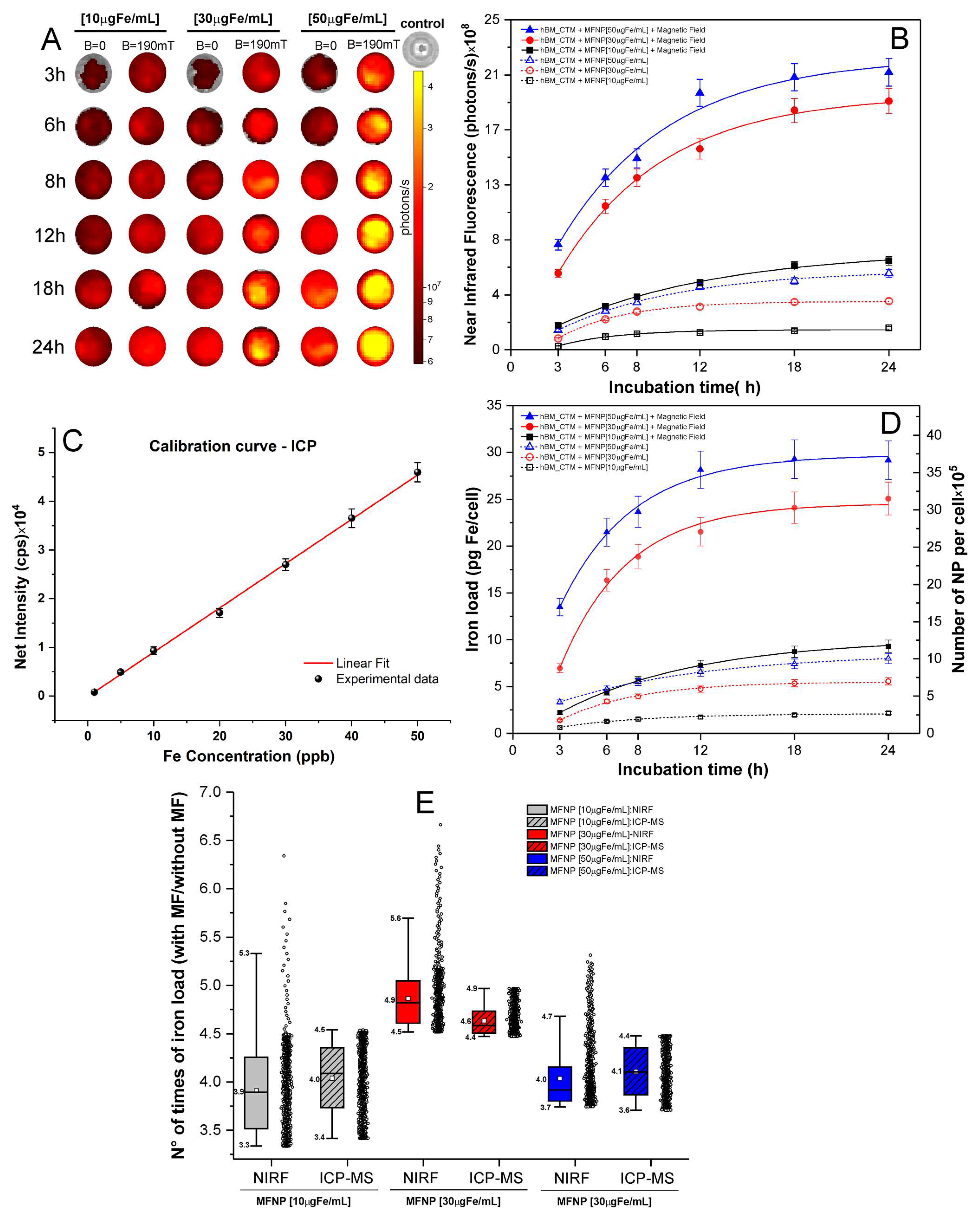
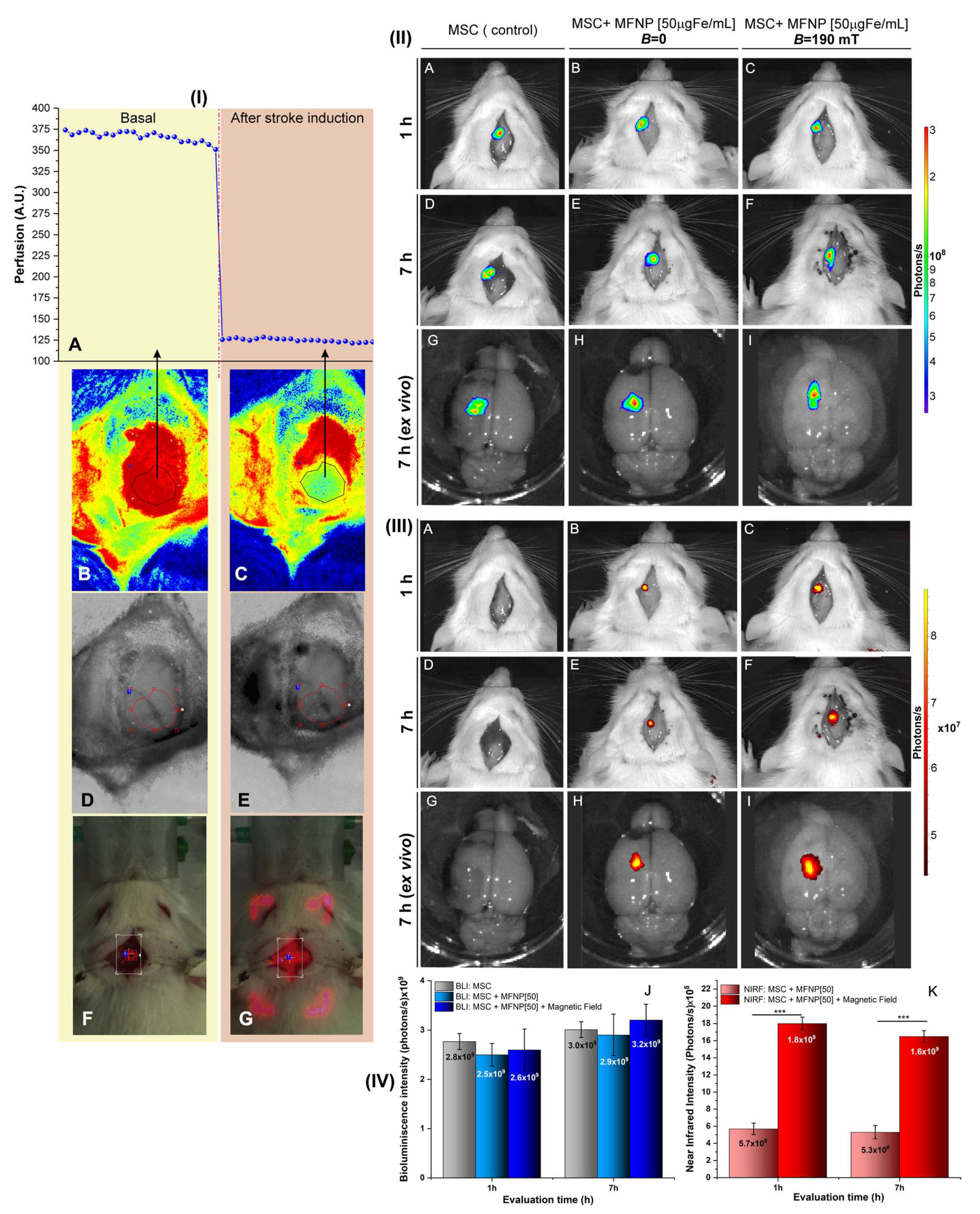
Considering there are several difficulties and limitations in labeling stem cells using multifunctional nanoparticles (MFNP), the purpose of this study was to determine the optimal conditions for labeling human bone marrow mesenchymal stem cells (hBM-MSC), aiming to monitor these cells in vivo. Thus, this study provides information on hBM-MSC direct labeling using multimodal nanoparticles in terms of concentration, magnetic field, and period of incubation while maintaining these cells’ viability and the homing ability for in vivo experiments. The cell labeling process was assessed using 10, 30, and 50 µg Fe/mL of MFNP, with periods of incubation ranging from 4 to 24 h, with or without a magnetic field, using optical microscopy, near-infrared fluorescence (NIRF), and inductively coupled plasma mass spectrometry (ICP-MS). After the determination of optimal labeling conditions, these cells were applied in vivo 24 h after stroke induction, intending to evaluate cell homing and improve NIRF signal detection. In the presence of a magnetic field and utilizing the maximal concentration of MFNP during cell labeling, the iron load assessed by NIRF and ICP-MS was four times higher than what was achieved before. In addition, considering cell viability higher than 98%, the recommended incubation time was 9 h, which corresponded to a 25.4 pg Fe/cell iron load (86% of the iron load internalized in 24 h). The optimization of cellular labeling for application in the in vivo study promoted an increase in the NIRF signal by 215% at 1 h and 201% at 7 h due to the use of a magnetized field during the cellular labeling process. In the case of BLI, the signal does not depend on cell labeling showing no significant differences between unlabeled or labeled cells (with or without a magnetic field). Therefore, the in vitro cellular optimized labeling process using magnetic fields resulted in a shorter period of incubation with efficient iron load internalization using higher MFNP concentration (50 μgFe/mL), leading to significant improvement in cell detection by NIRF technique without compromising cellular viability in the stroke model.
Keywords: multimodal nanoparticle; labeling; magnetic field; incubation time; mesenchymal stem cell; cell therapy; stroke; near-infrared fluorescence image; bioluminescence; ICP-MS multimodal nanoparticle; labeling; magnetic field; incubation time; mesenchymal stem cell; cell therapy; stroke; near-infrared fluorescence image; bioluminescence; ICP-MS