Article

Understanding the Multidimensional Effects of Polymorphism, Particle Size and Processing for D-Mannitol Powders

1
Institute of Pharmaceutical Technology and Biopharmaceutics, Technische Universität Braunschweig, 38106 Braunschweig, Germany
2
Department of Pharmaceutical Technologies, Merck KGaA, 64293 Darmstadt, Germany
*
Author to whom correspondence should be addressed.
Pharmaceutics 2022, 14(10), 2128; https://doi.org/10.3390/pharmaceutics14102128

Submission received: 21 September 2022 / Revised: 3 October 2022 / Accepted: 4 October 2022 / Published: 7 October 2022
(This article belongs to the Special Issue Advanced Pharmaceutical Science and Technology in Germany)

Abstract

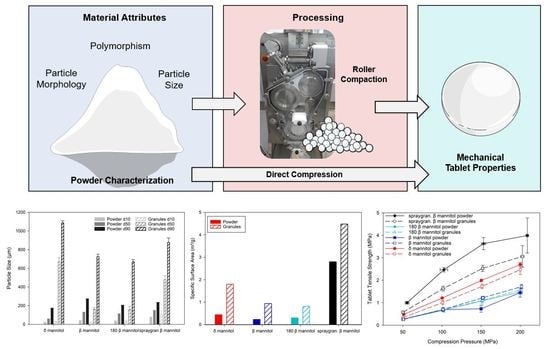
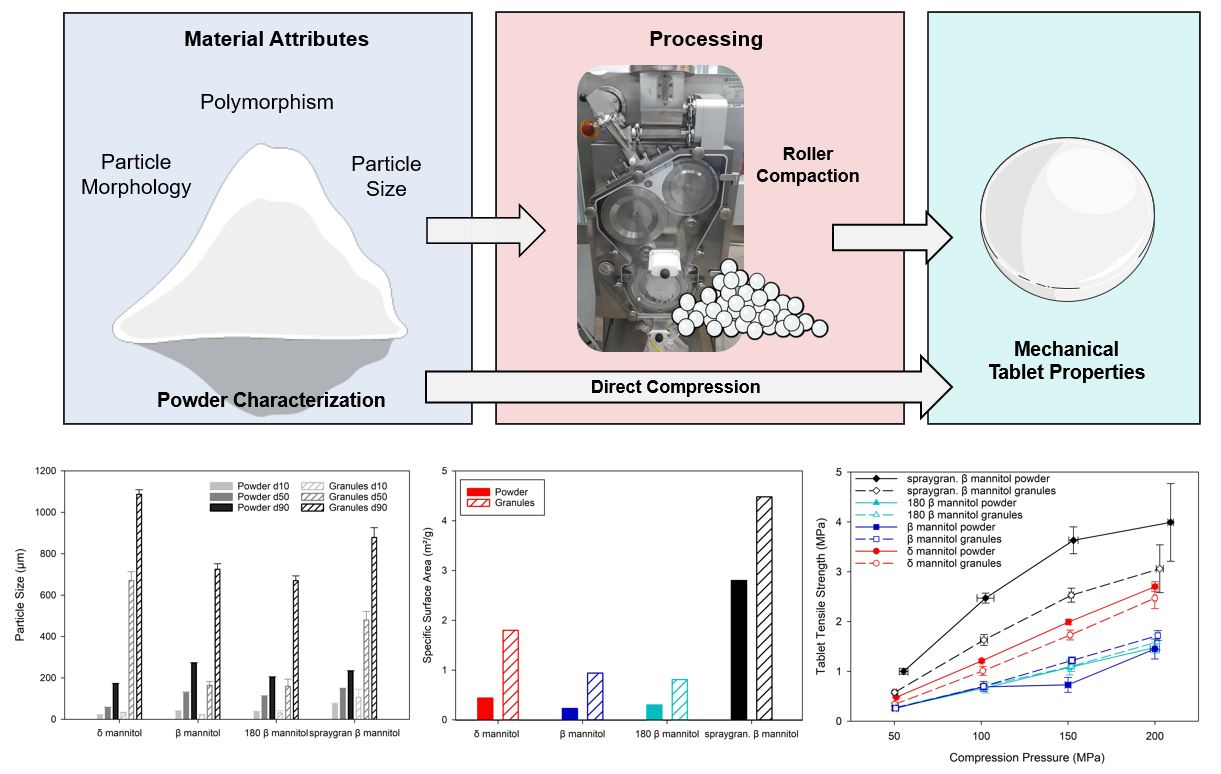
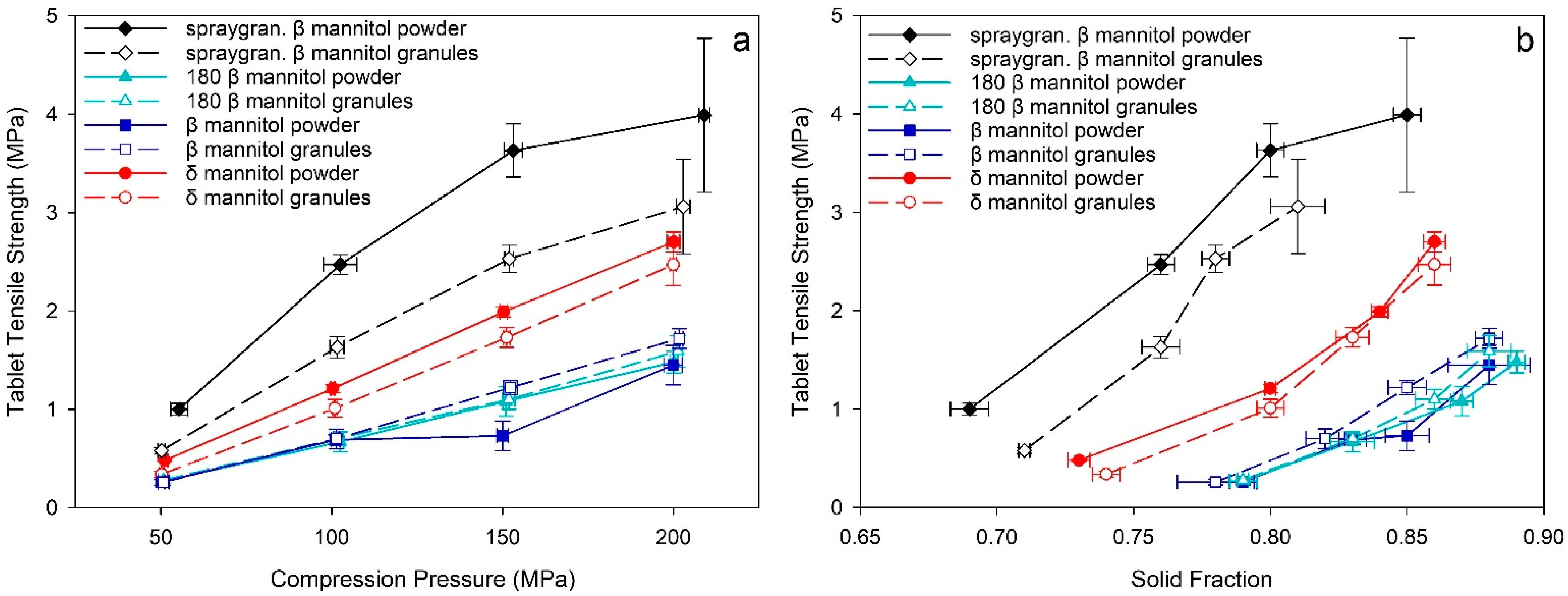
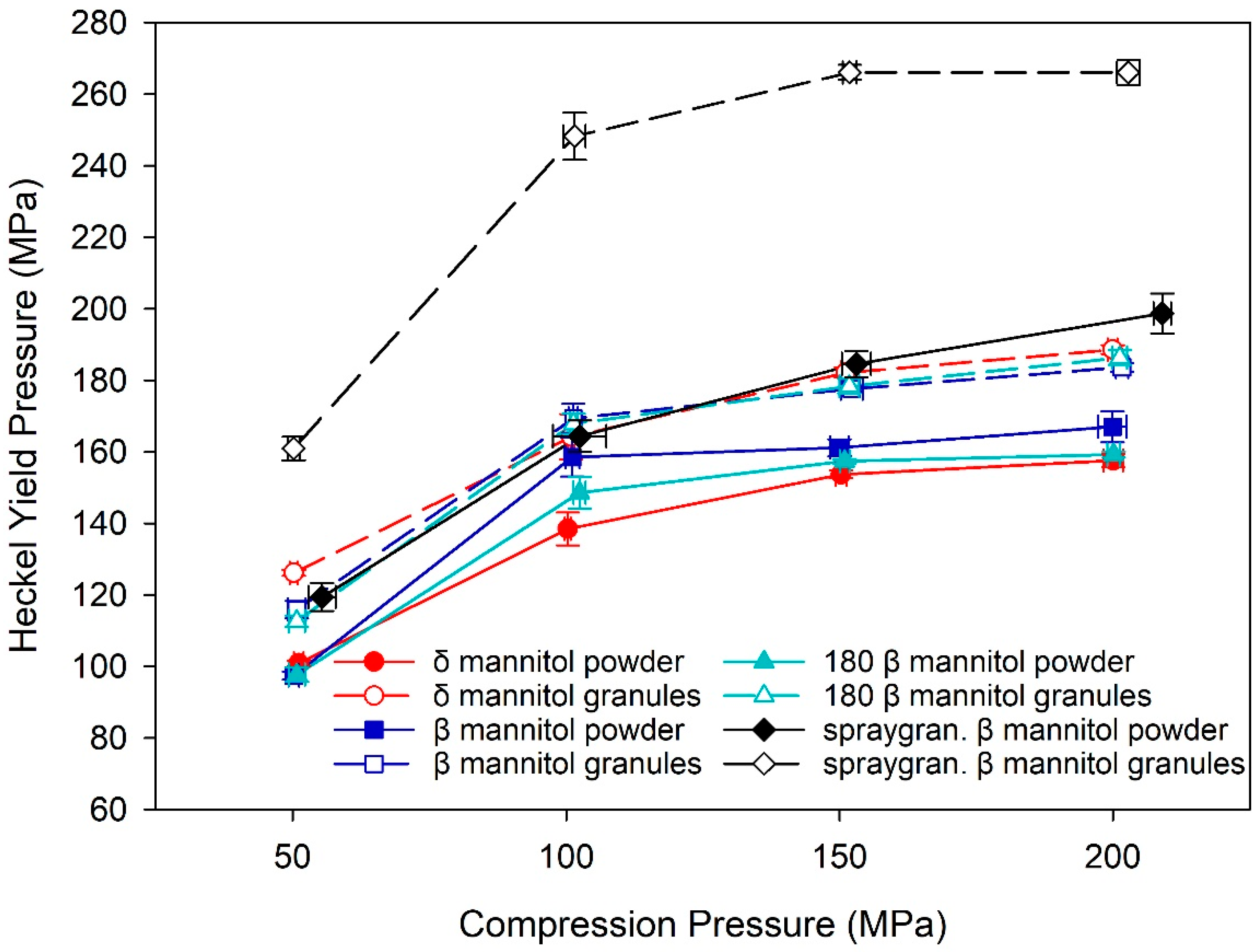
The relevance of the polymorphic form, particle size, and processing of mannitol for the mechanical properties of solid oral dosage forms was examined. Thus, particle and powder properties of spray granulated β D-mannitol, β D-mannitol, and δ D-mannitol were assessed in this study with regards to their manufacturability. D-mannitol is a commonly used excipient in pharmaceutical formulations, especially in oral solid dosage forms, and can be crystallized as three polymorphic forms, of which β is the thermodynamically most stable form and δ is a kinetically stabilized polymorph. A systematic analysis of the powders as starting materials and their respective roller compacted granules is presented to elucidate the multidimensional effects of powder and granules characteristics such as polymorphic form, particle size, and preprocessing on the resulting tablets’ mechanical properties. In direct compression and after roller compaction, δ polymorph displayed superior tableting properties over β mannitol, but was outperformed by spray granulated β mannitol. This could be primarily correlated to the higher specific surface area, leading to higher bonding area and more interparticle bonds within the tablet. Hence, it was shown that surface characteristics and preprocessing can prevail over the impact of polymorphism on manufacturability for oral solid dosage forms.
Keywords: mannitol; polymorphism; roller compaction; direct compression; powder characterization; surface area; processability; tabletability mannitol; polymorphism; roller compaction; direct compression; powder characterization; surface area; processability; tabletability
Graphical Abstract