Global Patterns of Geographic Distribution, Temporal Trends, Host Spectrum, and Molecular Variation of H9N2 Avian Influenza Virus, 1966–2023

Abstract
1. Introduction
2. Materials and Methods
2.1. Data Source and Virus Strain Collection
2.2. Global Spatiotemporal Distribution Analysis
2.3. Host and Environmental Source Analysis
2.4. Sequence Alignment and Analysis of Key Amino Acid Sites
2.5. Statistical Analysis
3. Results
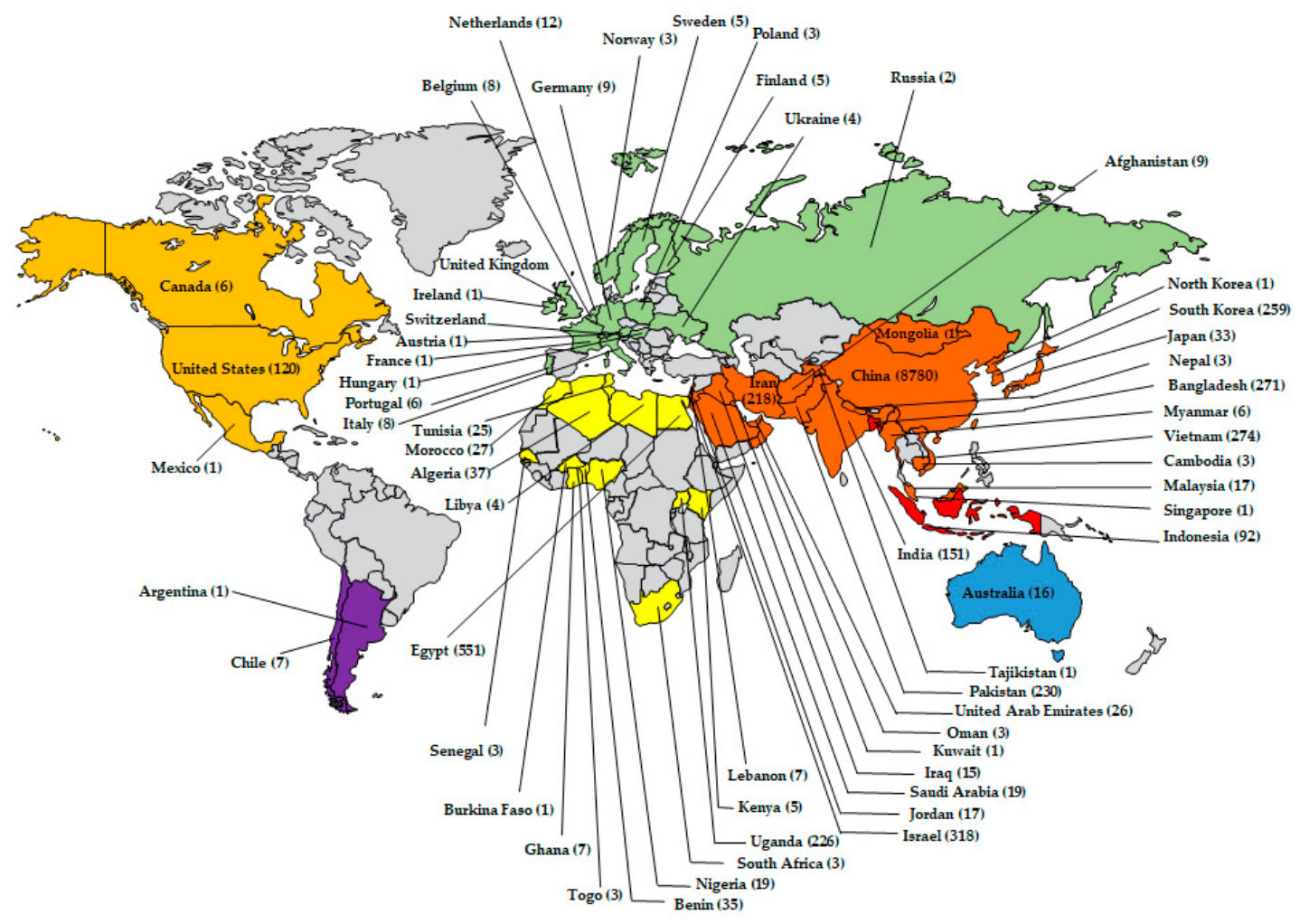
3.1. Geographical Distribution Characteristics
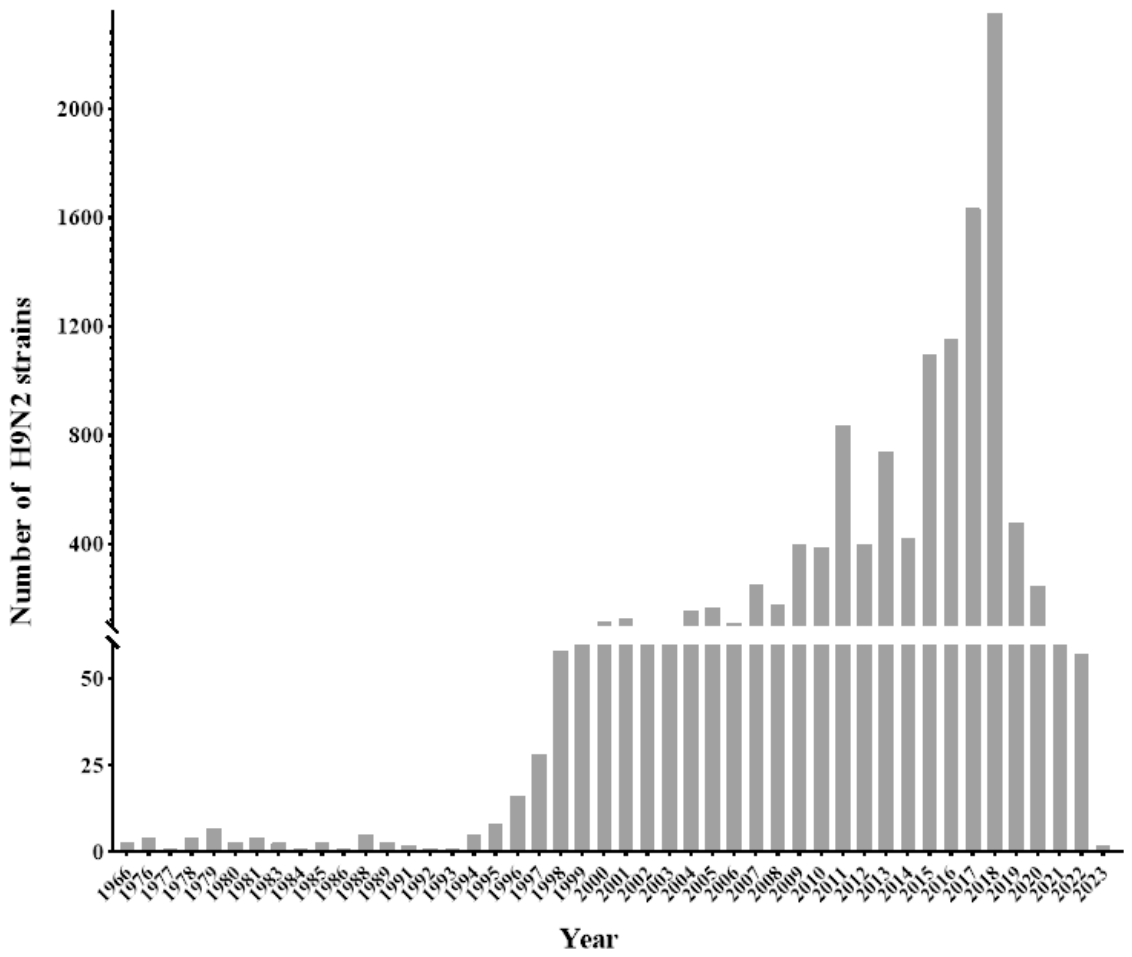
3.2. Temporal Distribution Characteristics
3.3. Host and Environmental Source Characteristics
3.4. Distribution of Functional Amino Acid Variants in H9N2 AIV
4. Discussion
5. Conclusions
Supplementary Materials
Author Contributions
Funding
Institutional Review Board Statement
Informed Consent Statement
Data Availability Statement
Conflicts of Interest
References
- Homme, P.J.; Easterday, B.C. Avian influenza virus infections. I. Characteristics of influenza A-turkey-Wisconsin-1966 virus. Avian Dis. 1970, 14, 66–74. [Google Scholar] [CrossRef] [Scilit]
- Brown, I.H.; Banks, J.; Manvell, R.J.; Essen, S.C.; Shell, W.; Slomka, M.; Londt, B.; Alexander, D.J. Recent epidemiology and ecology of influenza A viruses in avian species in Europe and the Middle East. Dev. Biol. 2006, 124, 45–50. [Google Scholar]
- Xiao, Y.; Yang, F.; Liu, F.; Yao, H.; Wu, N.; Wu, H. Antigen-capture ELISA and immunochromatographic test strip to detect the H9N2 subtype avian influenza virus rapidly based on monoclonal antibodies. Virol. J. 2021, 18, 198. [Google Scholar] [CrossRef] [Scilit]
- Zhang, C.; Xuan, Y.; Shan, H.; Yang, H.; Wang, J.; Wang, K.; Li, G.; Qiao, J. Avian influenza virus H9N2 infections in farmed minks. Virol. J. 2015, 12, 180. [Google Scholar] [CrossRef] [Scilit]
- El Mellouli, F.; Mouahid, M.; Fusaro, A.; Zecchin, B.; Zekhnini, H.; El Khantour, A.; Giussani, E.; Palumbo, E.; Rguibi Idrissi, H.; Monne, I.; et al. Spatiotemporal Dynamics, Evolutionary History and Zoonotic Potential of Moroccan H9N2 Avian Influenza Viruses from 2016 to 2021. Viruses 2022, 14, 509. [Google Scholar] [CrossRef] [Scilit]
- Horm, S.V.; Tarantola, A.; Rith, S.; Ly, S.; Gambaretti, J.; Duong, V.Y.P.; Sorn, S.; Holl, D.; Allal, L.; Kalpravidh, W.; et al. Intense circulation of A/H5N1 and other avian influenza viruses in Cambodian live-bird markets with serological evidence of sub-clinical human infections. Emerg. Microbes Infect. 2016, 5, e70. [Google Scholar] [CrossRef] [Scilit]
- Carnaccini, S.; Perez, D.R. H9 Influenza Viruses: An Emerging Challenge. Cold Spring Harb. Perspect. Med. 2020, 10, a038588. [Google Scholar] [CrossRef] [Scilit]
- Guan, Y.; Shortridge, K.F.; Krauss, S.; Webster, R.G. Molecular characterization of H9N2 influenza viruses: Were they the donors of the “internal” genes of H5N1 viruses in Hong Kong? Proc. Natl. Acad. Sci. USA 1999, 96, 9363–9367. [Google Scholar] [CrossRef] [Scilit]
- Ye, G.; Liang, C.H.; Hua, D.G.; Song, L.Y.; Xiang, Y.G.; Guang, C.; Lan, C.H.; Ping, H.Y. Phylogenetic Analysis and Pathogenicity Assessment of Two Strains of Avian Influenza Virus Subtype H9N2 Isolated from Migratory Birds: High Homology of Internal Genes with Human H10N8 Virus. Front. Microbiol. 2016, 7, 57. [Google Scholar] [CrossRef] [Scilit]
- Bhat, S.; James, J.; Sadeyen, J.R.; Mahmood, S.; Everest, H.J.; Chang, P.; Walsh, S.K.; Byrne, A.M.P.; Mollett, B.; Lean, F.; et al. Coinfection of Chickens with H9N2 and H7N9 Avian Influenza Viruses Leads to Emergence of Reassortant H9N9 Virus with Increased Fitness for Poultry and a Zoonotic Potential. J. Virol. 2022, 96, e0185621. [Google Scholar] [CrossRef] [Scilit]
- Yehia, N.; Ibrahim, M.; Shady, R.M.; Mohamed, A.A.E.; Said, D.; Taha, M.E.; Arafa, A.; Eid, S.; Shalaby, M.A.; Truyen, U.; et al. Concurrent circulation of avian influenza viruses H5N1 and H9N2 enhances the genetic evolution of reassortant viruses in Egyptian poultry populations. PLoS ONE 2026, 21, e0348609. [Google Scholar] [CrossRef] [Scilit]
- Peacock, T.H.P.; James, J.; Sealy, J.E.; Iqbal, M. A global perspective on H9N2 avian influenza virus. Viruses 2019, 11, 620. [Google Scholar] [CrossRef] [Scilit]
- Zhang, W.; Sun, L.; Wang, Q.; Xia, C.; Zhao, Y. Molecular characterization and pathogenicity of H9N2 avian influenza viruses in poultry in Shandong Province, China, 2021–2023. Poult. Sci. 2026, 105, 106936. [Google Scholar] [CrossRef] [Scilit]
- Islam, A.; Amin, E.; Khan, M.A.; Islam, M.; Gupta, S.D.; Abedin, J.; Rahman, M.Z.; Forwood, J.K.; Hosaain, M.E.; Shirin, T. Epidemiology and evolutionary dynamics of H9N2 avian influenza virus in Bangladesh. Emerg. Microbes Infect. 2025, 14, 2498574. [Google Scholar] [CrossRef] [Scilit]
- Sun, X.; Belser, J.A.; Maines, T.R. Adaptation of H9N2 Influenza Viruses to Mammalian Hosts: A Review of Molecular Markers. Viruses 2020, 12, 541. [Google Scholar] [CrossRef] [Scilit]
- Dong, J.; Zhou, Y.; Pu, J.; Liu, L. Status and Challenges for Vaccination against Avian H9N2 Influenza Virus in China. Life 2022, 12, 1326. [Google Scholar] [CrossRef] [Scilit]
- Dong, G.; Peng, C.; Luo, J.; Wang, C.; Han, L.; Wu, B.; Ji, G.; He, H. Adamantane-resistant influenza A viruses in the world (1902–2013): Frequency and distribution of M2 gene mutations. PLoS ONE 2015, 10, e0119115. [Google Scholar] [CrossRef] [Scilit]
- Kumar, S.; Stecher, G.; Tamura, K. MEGA7: Molecular Evolutionary Genetics Analysis Version 7.0 for Bigger Datasets. Mol. Biol. Evol. 2016, 33, 1870–1874. [Google Scholar] [CrossRef] [Scilit]
- Zhang, J.; Su, R.; Jian, X.; An, H.; Jiang, R.; Mok, C.K.P. The D253N Mutation in the Polymerase Basic 2 Gene in Avian Influenza (H9N2) Virus Contributes to the Pathogenesis of the Virus in Mammalian Hosts. Virol. Sin. 2018, 33, 531–537. [Google Scholar] [CrossRef] [Scilit]
- Liu, Q.; Huang, J.; Chen, Y.; Chen, H.; Li, Q.; He, L.; Hao, X.; Liu, J.; Gu, M.; Hu, J.; et al. Virulence determinants in the PB2 gene of a mouse-adapted H9N2 virus. J. Virol. 2015, 89, 877–882. [Google Scholar] [CrossRef] [Scilit]
- Wang, C.; Lee, H.H.Y.; Yang, Z.F.; Mok, C.K.P.; Zhang, Z. PB2-Q591K mutation determines the pathogenicity of avian H9N2 influenza viruses for mammalian species. PLoS ONE 2016, 11, e0162163. [Google Scholar] [CrossRef] [Scilit]
- Sediri, H.; Thiele, S.; Schwalm, F.; Gabriel, G.; Klenk, H.D. PB2 subunit of avian influenza virus subtype H9N2: A pandemic risk factor. J. Gen. Virol. 2016, 97, 39–48. [Google Scholar] [CrossRef] [Scilit]
- Gao, W.; Zu, Z.; Liu, J.; Song, J.; Wang, X.; Wang, C.; Liu, L.; Tong, Q.; Wang, M.; Sun, H.; et al. Prevailing I292VPB2 mutation in avian influenza H9N2 virus increases viral polymerase function and attenuates IFN-β induction in human cells. J. Gen. Virol. 2019, 100, 19. [Google Scholar] [CrossRef] [Scilit]
- Kamiki, H.; Matsugo, H.; Kobayashi, T.; Ishida, H.; Takenaka-Uema, A.; Murakami, S.; Horimoto, T. A PB1-K577E mutation in H9N2 influenza virus increases polymerase activity and pathogenicity in mice. Viruses 2018, 10, 653. [Google Scholar] [CrossRef] [Scilit]
- Ma, L.; Zheng, H.; Ke, X.; Gui, R.; Yao, Z.; Xiong, J.; Chen, Q. Mutual antagonism of mouse-adaptation mutations in HA and PA proteins on H9N2 virus replication. Virol. Sin. 2024, 39, 56–70. [Google Scholar] [CrossRef] [Scilit]
- Xu, G.; Zhang, X.; Gao, W.; Wang, C.; Wang, J.; Sun, H.; Sun, Y.; Guo, L.; Zhang, R.; Chang, K.C.; et al. Prevailing PA mutation K356R in avian influenza H9N2 virus increases mammalian replication and pathogenicity. J. Virol. 2016, 90, 8105–8114. [Google Scholar] [CrossRef] [Scilit]
- Sang, X.; Wang, A.; Ding, J.; Kong, H.; Gao, X.; Li, L.; Chai, T.; Li, Y.; Zhang, K.; Wang, C.; et al. Adaptation of H9N2 AIV in guinea pigs enables efficient transmission by direct contact and inefficient transmission by respiratory droplets. Sci. Rep. 2015, 5, 15928. [Google Scholar] [CrossRef] [Scilit]
- Wang, C.; Qu, R.; Zong, Y.; Qin, C.; Liu, L.; Gao, X.; Sun, H.; Sun, Y.; Chang, K.C.; Zhang, R.; et al. Enhanced stability of M1 protein mediated by a phospho-resistant mutation promotes the replication of prevailing avian influenza virus in mammals. PLoS Pathog. 2022, 18, e1010645. [Google Scholar] [CrossRef] [Scilit]
- Schnell, J.R.; Chou, J.J. Structure and mechanism of the M2 proton channel of influenza A virus. Nature 2008, 451, 591–595. [Google Scholar] [CrossRef] [Scilit]
- Ma, W.; Ren, C.; Shi, L.; Meng, B.; Feng, Y.; Zhang, Y. Isoleucine at position 137 of haemagglutinin acts as a mammalian adaptation marker of H9N2 avian influenza virus. Emerg. Microbes Infect. 2025, 14, 2455597. [Google Scholar] [CrossRef] [Scilit]
- Guo, Y.; Bai, X.; Liu, Z.; Liang, B.; Zheng, Y.; Dankar, S.; Ping, J. Exploring the alternative virulence determinants PB2 S155N and PA S49Y/D347G that promote mammalian adaptation of the H9N2 avian influenza virus in mice. Vet. Res. 2023, 54, 97. [Google Scholar] [CrossRef] [Scilit]
- Jin, F.; Dong, X.; Wan, Z.; Ren, D.; Liu, M.; Geng, T.; Zhang, J.; Gao, W.; Shao, H.; Qin, A.; et al. A Single Mutation N166D in Hemagglutinin Affects Antigenicity and Pathogenesis of H9N2 Avian Influenza Virus. Viruses 2019, 11, 709. [Google Scholar] [CrossRef] [Scilit]
- Teng, Q.; Xu, D.; Shen, W.; Liu, Q.; Rong, G.; Li, X.; Yan, L.; Yang, J.; Chen, H.; Yu, H.; et al. A Single Mutation at Position 190 in Hemagglutinin Enhances Binding Affinity for Human Type Sialic Acid Receptor and Replication of H9N2 Avian Influenza Virus in Mice. J. Virol. 2016, 90, 9806–9825. [Google Scholar] [CrossRef] [Scilit]
- Wan, H.; Perez, D.R. Amino acid 226 in hemagglutinin of H9N2 influenza viruses determines cell tropism and replication in human airway epithelial cells. J. Virol. 2007, 81, 5181–5191. [Google Scholar] [CrossRef] [Scilit]
- Liu, Y.; Zeng, Q.; Hu, X.; Xu, Z.; Pan, C.; Liu, Q.; Yu, J.; Wu, S.; Sun, M.; Liao, M. Natural variant R246K in hemagglutinin increased zoonotic characteristics and renal inflammation in mice infected with H9N2 influenza virus. Vet. Microbiol. 2023, 279, 109667. [Google Scholar] [CrossRef] [Scilit]
- Liu, Y.; Li, S.; Sun, H.; Pan, L.; Cui, X.; Zhu, X.; Feng, Y.; Li, M.; Yu, Y.; Wu, M.; et al. Variation and Molecular Basis for Enhancement of Receptor Binding of H9N2 Avian Influenza Viruses in China Isolates. Front. Microbiol. 2020, 11, 602124. [Google Scholar] [CrossRef] [Scilit]
- Zheng, Y.; Guo, Y.; Li, Y.; Liang, B.; Sun, X.; Li, S.; Xia, H.; Ping, J. The molecular determinants of antigenic drift in a novel avian influenza A (H9N2) variant virus. Virol. J. 2022, 19, 26. [Google Scholar] [CrossRef] [Scilit]
- Kode, S.S.; Pawar, S.D.; Cherian, S.S.; Tare, D.S.; Bhoye, D.; Keng, S.S.; Mullick, J. Selection of avian influenza A (H9N2) virus with reduced susceptibility to neuraminidase inhibitors oseltamivir and zanamivir. Virus Res. 2019, 265, 122–126. [Google Scholar] [CrossRef] [Scilit]
- Cao, Y.; Liu, H.; Liu, D.; Liu, W.; Luo, T.; Li, J. Hemagglutinin Gene Variation Rate of H9N2 Avian Influenza Virus by Vaccine Intervention in China. Viruses 2022, 14, 1043. [Google Scholar] [CrossRef] [Scilit]
- Yang, J.; Müller, N.F.; Bouckaert, R.; Xu, B.; Drummond, A.J. Bayesian phylodynamics of avian influenza A virus H9N2 in Asia with time-dependent predictors of migration. PLoS Comput. Biol. 2019, 15, e1007189. [Google Scholar] [CrossRef] [Scilit]
- Youk, S.S.; Lee, D.H.; Jeong, J.H.; Pantin-Jackwood, M.J.; Song, C.S.; Swayne, D.E. Live bird markets as evolutionary epicentres of H9N2 low pathogenicity avian influenza viruses in Korea. Emerg. Microbes Infect. 2020, 9, 616–627. [Google Scholar] [CrossRef] [Scilit]
- Fusaro, A.; Monne, I.; Salviato, A.; Valastro, V.; Schivo, A.; Amarin, N.M.; Gonzalez, C.; Ismail, M.M.; Al-Ankari, A.R.; Al-Blowi, M.H.; et al. Phylogeography and evolutionary history of reassortant H9N2 viruses with potential human health implications. J. Virol. 2011, 85, 8413–8421. [Google Scholar] [CrossRef] [Scilit]
- Machalaba, C.C.; Elwood, S.E.; Forcella, S.; Smith, K.M.; Hamilton, K.; Jebara, K.B.; Swayne, D.E.; Webby, R.J.; Mumford, E.; Mazet, J.A.; et al. Global avian influenza surveillance in wild birds: A strategy to capture viral diversity. Emerg. Infect. Dis. 2015, 21, e1–e7. [Google Scholar] [CrossRef] [Scilit]
- Hoye, B.J.; Munster, V.J.; Nishiura, H.; Klaassen, M.; Fouchier, R.A. Surveillance of wild birds for avian influenza virus. Emerg. Infect. Dis. 2010, 16, 1827–1834. [Google Scholar] [CrossRef] [Scilit]
- Murakami, J.; Shibata, A.; Neumann, G.; Imai, M.; Watanabe, T.; Kawaoka, Y. Characterization of H9N2 Avian Influenza Viruses Isolated from Poultry Products in a Mouse Model. Viruses 2022, 14, 728. [Google Scholar] [CrossRef] [Scilit]
- Kale, S.D.; Mishra, A.C.; Pawar, S.D. Suitability of specimen types for isolation of avian influenza viruses from poultry. Indian J. Virol. 2013, 24, 391–393. [Google Scholar] [CrossRef] [Scilit]
- Qi, Y.; Guo, W.; Liu, C.; Li, W.; Gu, Y.; Li, S.; Chen, X. Seroprevalence of influenza A (H9N2) virus infection among humans in China: A meta-analysis. Microb. Pathog. 2021, 155, 104881. [Google Scholar] [CrossRef] [Scilit]
- Wang, Q.; Xu, K.; Xie, W.; Yang, L.; Chen, H.; Shi, N.; Bao, C.; Huang, H.; Zhang, X.; Liao, Y.; et al. Seroprevalence of H7N9 infection among humans: A systematic review and meta-analysis. Influenza Other Respir. Viruses 2020, 14, 587–595. [Google Scholar] [CrossRef] [Scilit]
- Sun, W.; Cheng, S.S.M.; Lam, K.N.T.; Kwan, T.C.; Wong, R.W.K.; Lau, L.H.K.; Liu, G.Y.Z.; Luk, L.L.H.; Li, J.K.C.; Gu, H.; et al. Natural Reassortment of Eurasian Avian-Like Swine H1N1 and Avian H9N2 Influenza Viruses in Pigs, China. Emerg. Infect. Dis. 2022, 28, 1509–1512. [Google Scholar] [CrossRef] [Scilit]
- Peiris, M.; Yuen, K.Y.; Leung, C.W.; Chan, K.H.; Ip, P.L.; Lai, R.W.; Orr, W.K.; Shortridge, K.F. Human infection with influenza H9N2. Lancet 1999, 354, 916–917. [Google Scholar] [CrossRef] [Scilit]
- Sun, Y.; Pu, J.; Fan, L.; Sun, H.; Wang, J.; Zhang, Y.; Liu, L.; Liu, J. Evaluation of the protective efficacy of a commercial vaccine against different antigenic groups of H9N2 influenza viruses in chickens. Vet. Microbiol. 2012, 156, 193–199. [Google Scholar] [CrossRef] [Scilit]
- Hussein, A.F.A.; Cheng, H.; Tundup, S.; Antanasijevic, A.; Varhegyi, E.; Perez, J.; AbdulRahman, E.M.; Elenany, M.G.; Helal, S.; Caffrey, M.; et al. Identification of entry inhibitors with 4-aminopiperidine scaffold targeting group 1 influenza A virus. Antivir. Res. 2020, 177, 104782. [Google Scholar] [CrossRef] [Scilit]
- Yang, J.; Xie, D.; Nie, Z.; Xu, B.; Drummond, A.J. Inferring host roles in Bayesian phylodynamics of global avian influenza A virus H9N2. Virology 2019, 538, 86–96. [Google Scholar] [CrossRef] [Scilit]


| Category | Total Number of Strains | Detailed Sources and Numbers |
|---|---|---|
| Avian hosts | 11,356 | Accipiter gentilis schvedowi (1); African stonechat (1); American black duck (2); American oystercatcher (1); American wigeon (1); Mallard (84); Goose (57); Grey goose (1); Cackling goose (1); Emperor goose (1); Pink-footed goose (1); White-fronted goose (10); Snow goose (2); Bean goose (7); Demoiselle crane (2); Little owl (1); Chestnut teal (1); Bewick’s swan (2); Black swan (1); Chestnut teal (3); Chicken (9592); Red junglefowl (8); Guinea fowl (2); Chinese hwamei (1); Chinese francolin (1); House crow (1); Mute swan (Cygnus olor) (3); Duck (766); Eurasian teal (27); Muscovy duck (27); Spot-billed duck (7); Mandarin duck (1); Eurasian wigeon (2); Falcated duck (2); Common kestrel (2); Flamingo (2); Quail (171); Northern pintail (10); Northern shoveler (8); Sparrow (13); Peacock (4); Pheasant (48); Pigeon (273); Ruddy turnstone (19); Striated heron (1); Baikal teal (1); Black-winged stilt (1); Black-billed magpie (3); Brambling (1); Cattle egret (3); Coot (2); Carrion crow (1); Gadwall duck (3); Garganey (1); Grey-headed gull (1); Laughing gull (1); Great bustard (1); Green peafowl (2); Grey teal (1); Houbara bustard (1); Common myna (1); Ostrich (10); Parakeet (2); Partridge (37); Rosy-billed pochard (1); Ruddy shelduck (1); Sanderling (2); Silver pheasant (1); Stone curlew (2); Thick-billed murre (2); Turkey (98); White-bellied bustard (5) |
| Mammalian hosts | 114 | Asian badger (2); Bat (2); Mink (15); Swine (51); Dog (1); Human (29); Horse (2); Ferret (1); Red fox (1); Masked palm civet (2); Pika (1); Raccoon dog (7) |
| Environmental strains | 286 | Environment (260); Cage swab (5); Environmental air (4); Feces (10); Pigeon feces (1); Wild bird feces (6) |
| Protein | Mutation Site | Biological Significance | Amino Acid Distribution | High-Frequency Variants |
|---|---|---|---|---|
| PB2 | D253N | Enhances polymerase activity and replication capacity in human cells, without increasing pathogenicity in mice [19] | D (4417); N (5) | No |
| F404L | Enhances polymerase activity and increases pathogenicity of multiple influenza subtypes in mice [20] | F (4738); L (1) | No | |
| Q591K | Enhances replication in human bronchial epithelial cells; weaker than E627K; partially compensates for E627K loss with genetic background dependency [21] | Q (4661); K (51) | No | |
| E627K | Increase polymerase activity, in vitro replication, and mouse pathogenicity [22] | E (4503); K (26) | No | |
| D701N | Increase polymerase activity, in vitro replication, and mouse pathogenicity [22] | D (4753); N (16) | No | |
| S714R | Increase polymerase activity, in vitro replication, and mouse pathogenicity [22] | S (4610); R (0) | No | |
| I292V | Increases polymerase activity, suppresses IFN-β response, and enhances replication and pathogenicity in mice [23] | I (1733); V (2509) | Yes | |
| PB1 | K577E | Enhances polymerase activity, in-creases replication in mouse nasal turbinates, and causes 100% mortality in infected mice [24] | K (4411); E (3) | No |
| PA | T97I | Enhance polymerase activity in mammalian cells and promote viral replication in vitro and in vivo [25] | T (4355); I (3) | No |
| I545V | Enhance polymerase activity in mammalian cells and promote viral replication in vitro and in vivo [25] | I (4532); V (267) | No | |
| S594G | Enhance polymerase activity in mammalian cells and promote viral replication in vitro and in vivo [25] | S (4760); G (5) | No | |
| K356R | Enhances polymerase activity and increases mouse pathogenicity [26] | K (2720); R (2142) | No | |
| NP | E434K | Enhances polymerase activity [27] | E (4554); K (1) | No |
| M1 | T37A | Increases viral replication and virulence in human cells and mice [28] | T (1677); A (3173) | Yes |
| M2 | S31N | Alters M2 ion channel conformation and confers resistance to adamantane antivirals [29] | S (1688); N (3355) | Yes |
| HA | T137I | Enhances viral replication and guinea pig transmission, and increases affinity for human α2,6-linked sialic acid receptors [30] | T (1495); I (1) | No |
| I155T | Confers preferential binding to human α2,6-linked sialic acid receptors [31] | I (7); T (11,592) | Yes | |
| N166D | Alters antigenicity, reduces mouse pathogenicity, and weakens hemagglutination inhibition antibody response in chickens [32] | N (8658); D (2120) | No | |
| A190V | Enhances binding affinity to mouse and human lung tissues and A549 cells without changing specificity for α2,6-linked sialic acid receptors [33] | A (4644); V (1178) | No | |
| Q226L | Alters cell tropism, favoring infection of non-ciliated human airway cells and supporting respiratory droplet transmission in ferrets [34] | Q (1108); L (10,562) | Yes | |
| R246K | Enhances replication in human lung epithelial cells, increases early oropharyngeal shedding in chickens, and increases mouse pathogenicity [35] | R (5279); K (6408) | Yes | |
| Q227M | Enhance binding to both avian α2,3 and human α2,6-linked sialic acid receptors [36] | Q (3099); M (6710) | Yes | |
| D145G/N | Enhance binding to both avian α2,3 and human α2,6-linked sialic acid receptors [36] | D (6116); G (4352); N (1056) | No | |
| S119R | Enhance binding to both avian α2,3 and human α2,6-linked sialic acid receptors [36] | S (3891); R (7241) | Yes | |
| R246K | Enhance binding to both avian α2,3 and human α2,6-linked sialic acid receptors [36] | R (5279); K (6408) | Yes | |
| A160D/N | Enhance binding to human α2,6-linked sialic acid receptors [36] | A (4109); D (1312); N (3005) | No | |
| Q156R | Enhance binding to human α2,6-linked sialic acid receptors [36] | Q (6756); R (4256) | No | |
| T205A | Enhance binding to human α2,6-linked sialic acid receptors [36] | T (2827); A (8853) | Yes | |
| Q226L | Enhance binding to human α2,6-linked sialic acid receptors [36] | Q (1108); L (10,562) | Yes | |
| V245I | Enhance binding to human α2,6-linked sialic acid receptors [36] | V (3350); I (8362) | Yes | |
| V216L | Enhance binding to human α2,6-linked sialic acid receptors [36] | V (915); L (10,569) | Yes | |
| D208E | Enhance binding to human α2,6-linked sialic acid receptors [36] | D (1855); E (8082) | Yes | |
| T212I | Enhance binding to human α2,6-linked sialic acid receptors [36] | T (5388); I (5665) | Yes | |
| R172Q | Enhance binding to human α2,6-linked sialic acid receptors [36] | R (3137); Q (7857) | Yes | |
| S175N | Enhance binding to human α2,6-linked sialic acid receptors [36] | S (681); N (9099) | Yes | |
| D127S | Alter antigenic properties of H9N2 strains [37] | D (4321); S (5132) | No | |
| G135D | Alter antigenic properties of H9N2 strains [37] | G (4352); D (6116) | Yes | |
| N145T | Alter antigenic properties of H9N2 strains [37] | N (50); T (11,592) | Yes | |
| R146Q | Alter antigenic properties of H9N2 strains [37] | R (4256); Q (6756) | Yes | |
| D179T | Alter antigenic properties of H9N2 strains [37] | D (2454); T (8709) | Yes | |
| R182T | Alter antigenic properties of H9N2 strains [37] | R (4060); T (6938) | Yes | |
| T183N | Alter antigenic properties of H9N2 strains [37] | T (114); N (8314) | Yes | |
| NA | E119D | Confers resistance to zanamivir [38] | E (5805); D (3) | No |
| R292K | Confers resistance to oseltamivir [38] | R (5854); K (0) | No |
Disclaimer/Publisher’s Note: The statements, opinions and data contained in all publications are solely those of the individual author(s) and contributor(s) and not of MDPI and/or the editor(s). MDPI and/or the editor(s) disclaim responsibility for any injury to people or property resulting from any ideas, methods, instructions or products referred to in the content. |
© 2026 by the authors. Licensee MDPI, Basel, Switzerland. This article is an open access article distributed under the terms and conditions of the Creative Commons Attribution (CC BY) license.
Share and Cite
Chang, L.; Ren, X.; Han, L.; Xia, C.; Zhao, Y. Global Patterns of Geographic Distribution, Temporal Trends, Host Spectrum, and Molecular Variation of H9N2 Avian Influenza Virus, 1966–2023. Viruses 2026, 18, 977. https://doi.org/10.3390/v18090977
Chang L, Ren X, Han L, Xia C, Zhao Y. Global Patterns of Geographic Distribution, Temporal Trends, Host Spectrum, and Molecular Variation of H9N2 Avian Influenza Virus, 1966–2023. Viruses. 2026; 18(9):977. https://doi.org/10.3390/v18090977
Chicago/Turabian StyleChang, Lei, Xiangyan Ren, Lebin Han, Chenlu Xia, and Yuzhong Zhao. 2026. "Global Patterns of Geographic Distribution, Temporal Trends, Host Spectrum, and Molecular Variation of H9N2 Avian Influenza Virus, 1966–2023" Viruses 18, no. 9: 977. https://doi.org/10.3390/v18090977
APA StyleChang, L., Ren, X., Han, L., Xia, C., & Zhao, Y. (2026). Global Patterns of Geographic Distribution, Temporal Trends, Host Spectrum, and Molecular Variation of H9N2 Avian Influenza Virus, 1966–2023. Viruses, 18(9), 977. https://doi.org/10.3390/v18090977