Co-Circulation of Divergent Strains Supports Vector-Mediated Transmission of Rodent Hepacivirus J (Orthohepacivirus glareoli)
Abstract
1. Introduction
2. Materials and Methods
2.1. Bank Vole Collection in Switzerland
2.2. RNA Extraction and RT-PCR Analyses
2.3. Genetic Divergence and Isolation-by-Distance Analyses
2.4. Phylogenetic Reconstruction
2.5. Spatially Explicit Simulations of Viral Evolution
2.6. Sampling of the Simulated Data and Phylogenetic Analyses
3. Results
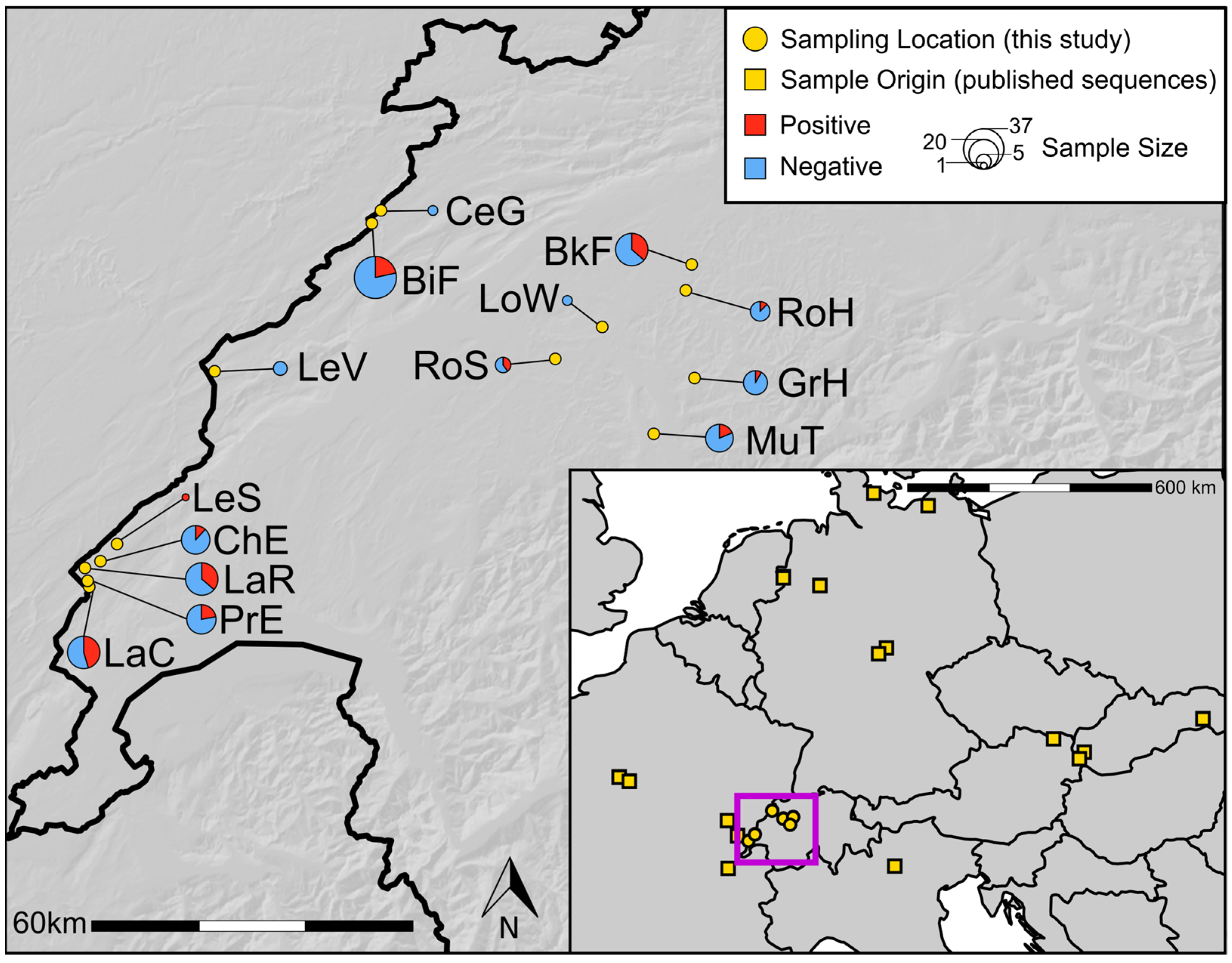
3.1. Detection of RHVJ in Switzerland
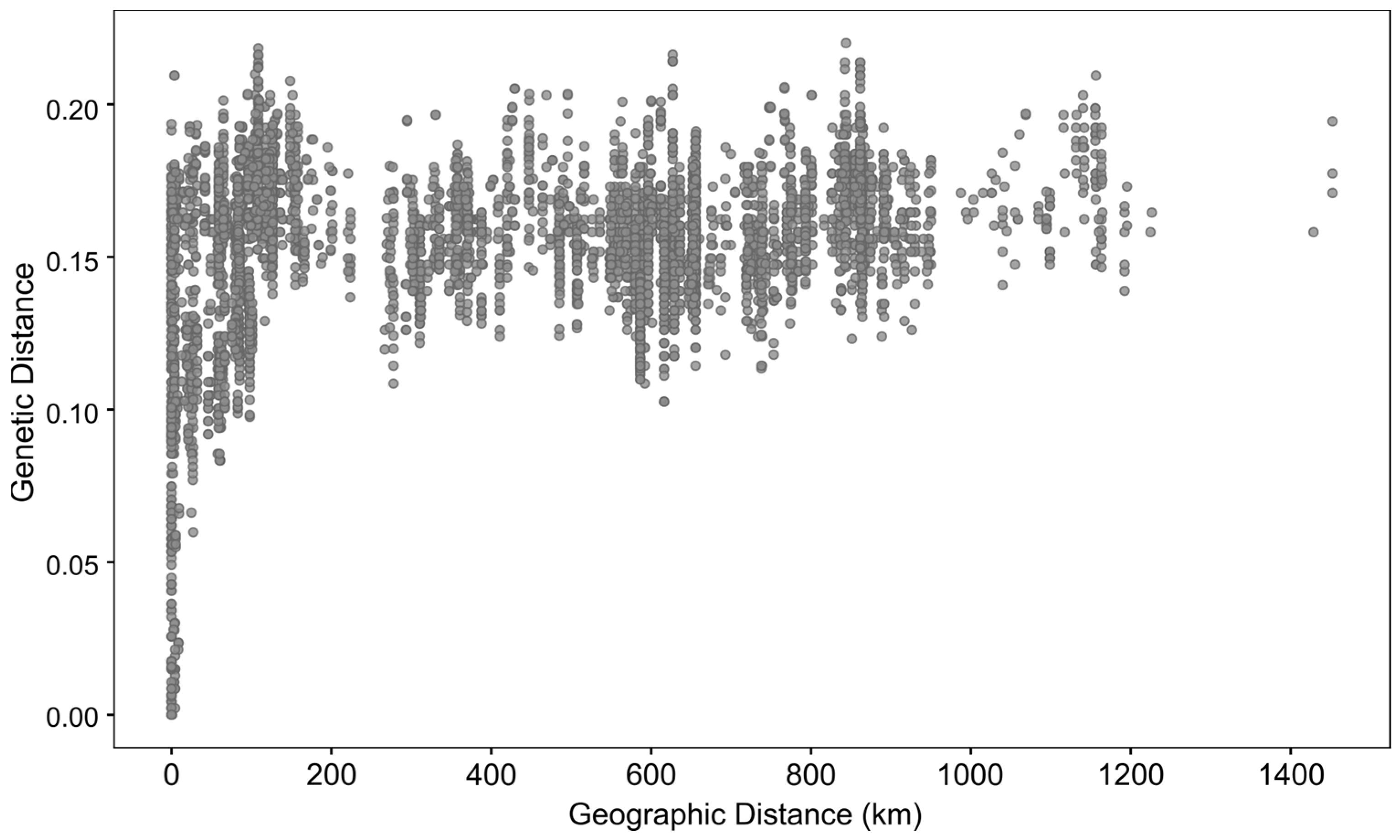
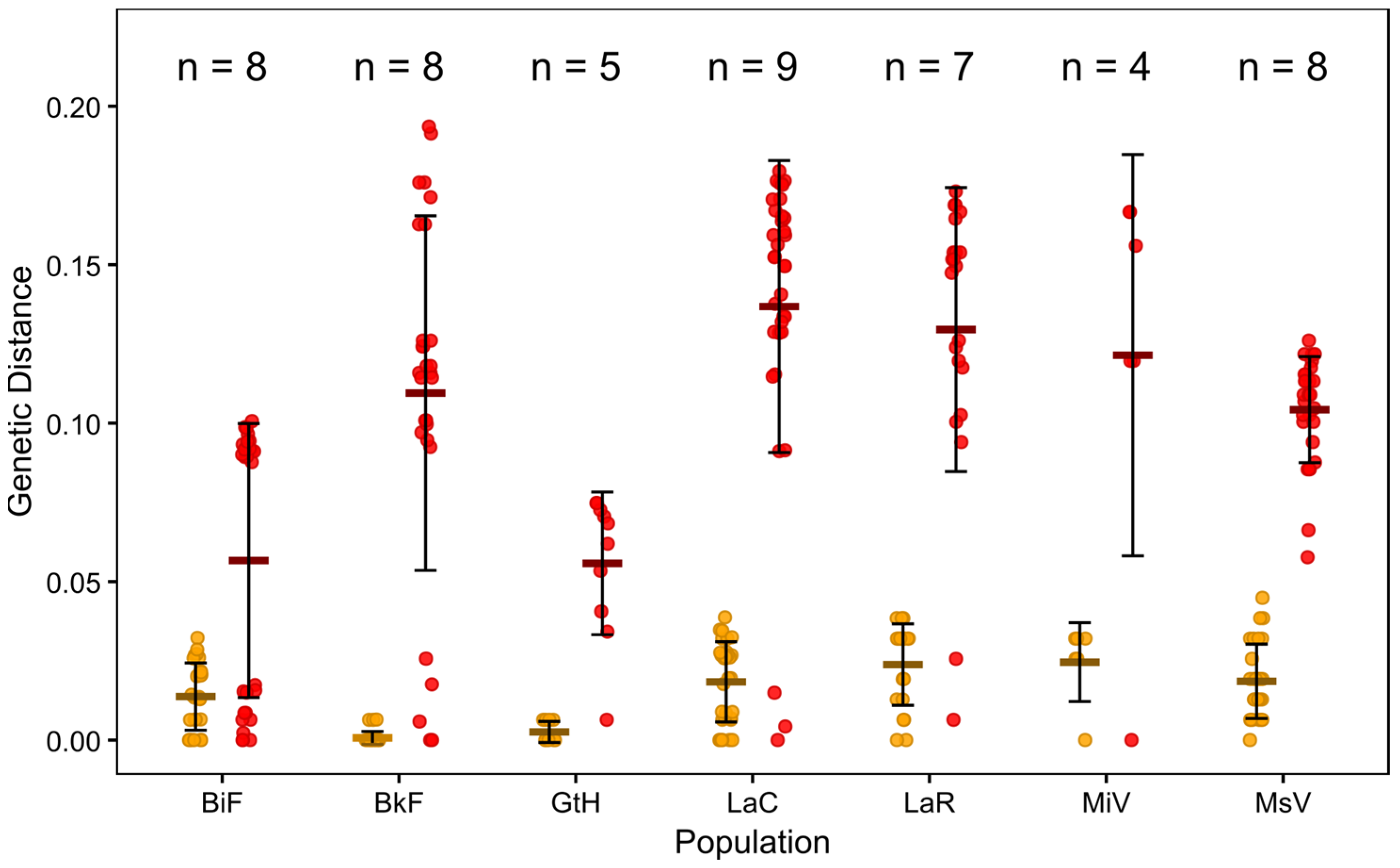
3.2. Spatial Patterns of Genetic Variability
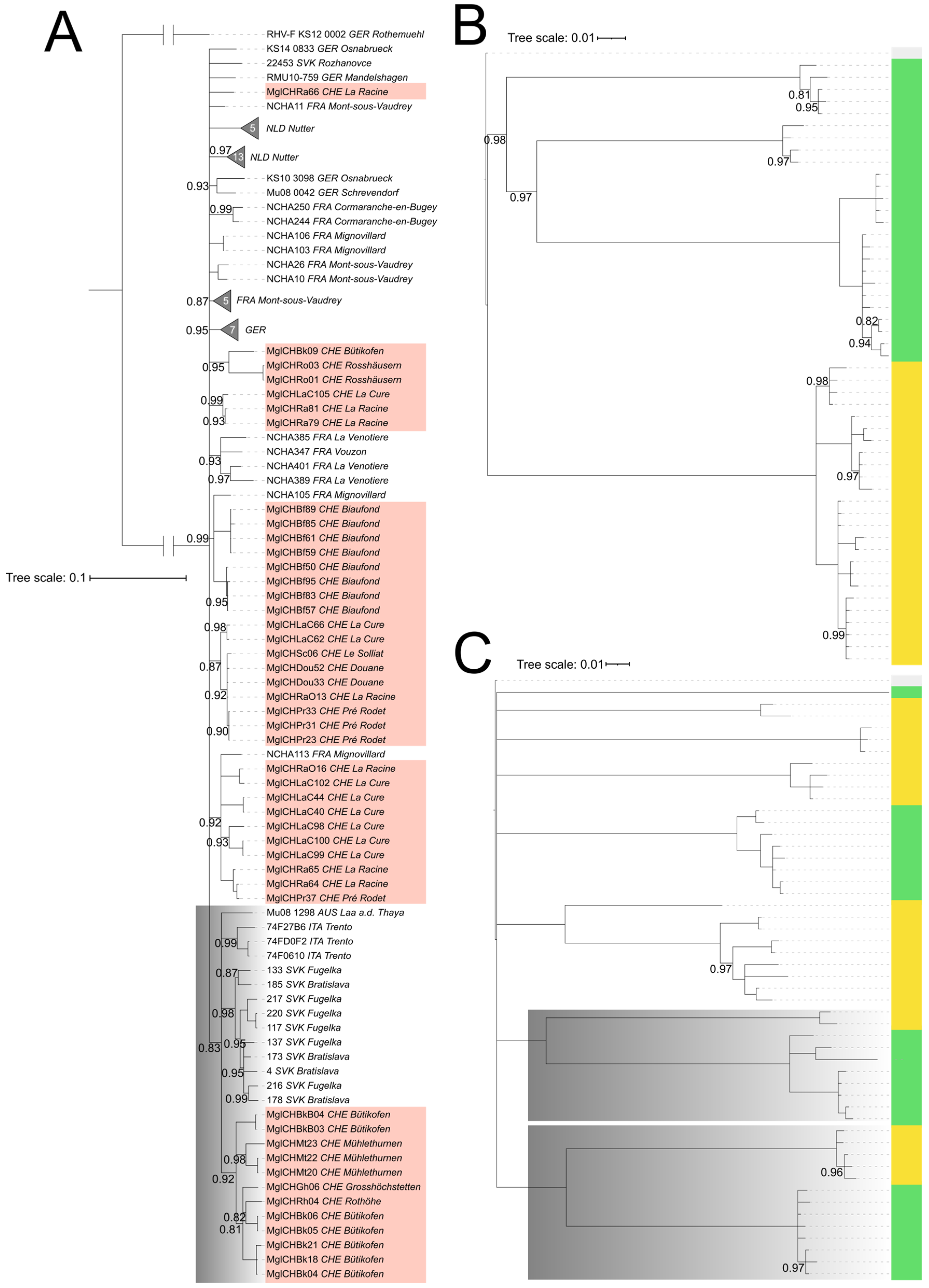
3.3. Evolutionary Relationships in RHVJ Strains
3.4. Phylogenetic Consequences of Simulated Short and Long-Distance Transmission
4. Discussion
5. Conclusions
Supplementary Materials
Author Contributions
Funding
Institutional Review Board Statement
Data Availability Statement
Acknowledgments
Conflicts of Interest
References
- Schoch, C.L.; Ciufo, S.; Domrachev, M.; Hotton, C.L.; Kannan, S.; Khovanskaya, R.; Leipe, D.; Mcveigh, R.; O’Neill, K.; Robbertse, B.; et al. NCBI Taxonomy: A comprehensive update on curation, resources and tools. Database J. Biol. Databases Curation 2020, 2020, baaa062. [Google Scholar] [CrossRef] [PubMed]
- Hartlage, A.S.; Cullen, J.M.; Kapoor, A. The Strange, Expanding World of Animal Hepaciviruses. Annu. Rev. Virol. 2016, 3, 53–75. [Google Scholar] [CrossRef]
- Hoofnagle, J.H. Course and outcome of hepatitis C. Hepatology 2002, 36, S21–S29. [Google Scholar] [CrossRef]
- Smith, D.B.; Becher, P.; Bukh, J.; Gould, E.A.; Meyers, G.; Monath, T.; Muerhoff, A.S.; Pletnev, A.; Rico-Hesse, R.; Stapleton, J.T.; et al. Proposed update to the taxonomy of the genera Hepacivirus and Pegivirus within the Flaviviridae family. J. Gen. Virol. 2016, 97, 2894–2907. [Google Scholar] [CrossRef]
- Kotlík, P.; Marková, S.; Horníková, M.; Escalante, M.A.; Searle, J.B. The Bank Vole (Clethrionomys glareolus) as a Model System for Adaptive Phylogeography in the European Theater. Front. Ecol. Evol. 2022, 10, 866605. [Google Scholar] [CrossRef]
- Bernshtein, A.D.; Apekina, N.S.; Mikhailova, T.V.; Myasnikov, Y.A.; Khlyap, L.A.; Korotkov, Y.S.; Gavrilovskaya, I.N. Dynamics of Puumala hantavirus infection in naturally infected bank voles (Clethrinomys glareolus). Arch. Virol. 1999, 144, 2415–2428. [Google Scholar] [CrossRef]
- Braun, M.; Dieterlen, F. (Eds.) Die Säugetiere Baden-Württembergs Band 2: Insektenfresser (Insectivora), Hasentiere (Lagomorpha), Nagetiere (Rodentia), Raubtiere (Carnivora), Paarhufer (Artiodactyla); Ulmer: Stuttgart, Germany, 2005; Volume Band 2. [Google Scholar]
- Zöldi, V.; Papp, T.; Reiczigel, J.; Egyed, L. Bank voles show high seropositivity rates in a natural TBEV focus in Hungary. Infect. Dis. 2015, 47, 178–181. [Google Scholar] [CrossRef]
- Drexler, J.F.; Corman, V.M.; Müller, M.A.; Lukashev, A.N.; Gmyl, A.; Coutard, B.; Adam, A.; Ritz, D.; Leijten, L.M.; van Riel, D.; et al. Evidence for novel hepaciviruses in rodents. PLoS Pathog. 2013, 9, e1003438. [Google Scholar] [CrossRef] [PubMed]
- ICTV Taxonomy. Available online: https://ictv.global/taxonomy (accessed on 28 April 2026).
- Schneider, J.; Hoffmann, B.; Fevola, C.; Schmidt, M.L.; Imholt, C.; Fischer, S.; Ecke, F.; Hörnfeldt, B.; Magnusson, M.; Olsson, G.E.; et al. Geographical Distribution and Genetic Diversity of Bank Vole Hepaciviruses in Europe. Viruses 2021, 13, 1258. [Google Scholar] [CrossRef]
- Röhrs, S.; Begeman, L.; Straub, B.K.; Boadella, M.; Hanke, D.; Wernike, K.; Drewes, S.; Hoffmann, B.; Keller, M.; Drexler, J.F.; et al. The Bank Vole (Clethrionomys glareolus)-Small Animal Model for Hepacivirus Infection. Viruses 2021, 13, 2421. [Google Scholar] [CrossRef] [PubMed]
- Frisch, V.; Ramsauer, A.S.; Preining, I.; Unterköfler, M.S.; Fuehrer, H.-P.; Hofer, M.; Lyrakis, M.; Bouhsira, E.; Liénard, E.; Cavalleri, J.-M.V. First detection of equine hepacivirus RNA in Stomoxys calcitrans (Diptera, Muscidae) in eastern Austria. BMC Vet. Res. 2025, 21, 474. [Google Scholar] [CrossRef]
- Harvey, E.; Rose, K.; Eden, J.-S.; Lo, N.; Abeyasuriya, T.; Shi, M.; Doggett, S.L.; Holmes, E.C. Extensive Diversity of RNA Viruses in Australian Ticks. J. Virol. 2019, 93, 10-1128. [Google Scholar] [CrossRef]
- Shao, J.-W.; Guo, L.-Y.; Yuan, Y.-X.; Ma, J.; Chen, J.-M.; Liu, Q. A Novel Subtype of Bovine Hepacivirus Identified in Ticks Reveals the Genetic Diversity and Evolution of Bovine Hepacivirus. Viruses 2021, 13, 2206. [Google Scholar] [CrossRef]
- Saxenhofer, M.; Weber de Melo, V.; Ulrich, R.G.; Heckel, G. Revised time scales of RNA virus evolution based on spatial information. Proc. R. Soc. B Biol. Sci. 2017, 284, 20170857. [Google Scholar] [CrossRef]
- Schmidt, S.; Saxenhofer, M.; Drewes, S.; Schlegel, M.; Wanka, K.M.; Frank, R.; Klimpel, S.; von Blanckenhagen, F.; Maaz, D.; Herden, C.; et al. High genetic structuring of Tula hantavirus. Arch. Virol. 2016, 161, 1135–1149. [Google Scholar] [CrossRef] [PubMed]
- Weber de Melo, V.; Sheikh Ali, H.; Freise, J.; Kühnert, D.; Essbauer, S.; Mertens, M.; Wanka, K.M.; Drewes, S.; Ulrich, R.G.; Heckel, G. Spatiotemporal dynamics of Puumala hantavirus associated with its rodent host, Myodes glareolus. Evol. Appl. 2015, 8, 545–559. [Google Scholar] [CrossRef]
- Mertens, M.; Kindler, E.; Emmerich, P.; Esser, J.; Wagner-Wiening, C.; Wölfel, R.; Petraityte-Burneikiene, R.; Schmidt-Chanasit, J.; Zvirbliene, A.; Groschup, M.H.; et al. Phylogenetic analysis of Puumala virus subtype Bavaria, characterization and diagnostic use of its recombinant nucleocapsid protein. Virus Genes 2011, 43, 177–191. [Google Scholar] [CrossRef]
- Saxenhofer, M.; Schmidt, S.; Ulrich, R.G.; Heckel, G. Secondary contact between diverged host lineages entails ecological speciation in a European hantavirus. PLoS Biol. 2019, 17, e3000142. [Google Scholar] [CrossRef]
- Schmidt, S.; Reil, D.; Jeske, K.; Drewes, S.; Rosenfeld, U.M.; Fischer, S.; Spierling, N.G.; Labutin, A.; Heckel, G.; Jacob, J.; et al. Spatial and Temporal Dynamics and Molecular Evolution of Tula orthohantavirus in German Vole Populations. Viruses 2021, 13, 1132. [Google Scholar] [CrossRef]
- Lemey, P.; Rambaut, A.; Bedford, T.; Faria, N.; Bielejec, F.; Baele, G.; Russell, C.A.; Smith, D.J.; Pybus, O.G.; Brockmann, D.; et al. Unifying viral genetics and human transportation data to predict the global transmission dynamics of human influenza H3N2. PLoS Pathog. 2014, 10, e1003932. [Google Scholar] [CrossRef]
- Dong, R.; Pei, S.; Yin, C.; He, R.L.; Yau, S.S.-T. Analysis of the Hosts and Transmission Paths of SARS-CoV-2 in the COVID-19 Outbreak. Genes 2020, 11, 637. [Google Scholar] [CrossRef]
- Pang, P.S.; Jankowsky, E.; Planet, P.J.; Pyle, A.M. The hepatitis C viral NS3 protein is a processive DNA helicase with cofactor enhanced RNA unwinding. EMBO J. 2002, 21, 1168–1176. [Google Scholar] [CrossRef] [PubMed]
- Raney, K.D.; Sharma, S.D.; Moustafa, I.M.; Cameron, C.E. Hepatitis C virus non-structural protein 3 (HCV NS3): A multifunctional antiviral target. J. Biol. Chem. 2010, 285, 22725–22731. [Google Scholar] [CrossRef]
- Altschul, S.F.; Gish, W.; Miller, W.; Myers, E.W.; Lipman, D.J. Basic local alignment search tool. J. Mol. Biol. 1990, 215, 403–410. [Google Scholar] [CrossRef]
- Rozas, J.; Ferrer-Mata, A.; Sánchez-DelBarrio, J.C.; Guirao-Rico, S.; Librado, P.; Ramos-Onsins, S.E.; Sánchez-Gracia, A. DnaSP 6: DNA Sequence Polymorphism Analysis of Large Data Sets. Mol. Biol. Evol. 2017, 34, 3299–3302. [Google Scholar] [CrossRef] [PubMed]
- Paradis, E.; Schliep, K. ape 5.0: An environment for modern phylogenetics and evolutionary analyses in R. Bioinformatics 2019, 35, 526–528. [Google Scholar] [CrossRef]
- Koné, S. R Core Team R: A Language and Environment for Statistical Computing; R Foundation for Statistical Computing: Vienna, Austria, 2024. [Google Scholar]
- Wickham, H. ggplot2: Elegant Graphics for Data Analysis; Springer: New York, NY, USA, 2016; ISBN 978-3-319-24277-4. [Google Scholar]
- Oksanen, J.; Simpson, G.L.; Blanchet, F.G.; Kindt, R.; Legendre, P.; Minchin, P.R.; O’Hara, R.B.; Solymos, P.; Stevens, M.H.H.; Szoecs, E.; et al. vegan: Community Ecology Package. 2025. Available online: https://cran.r-project.org/web/packages/vegan/index.html (accessed on 1 May 2026).
- Padgham, M.; Sumner, M.D. geodist: Fast, Dependency-Free Geodesic Distance Calculations. 2026. Available online: https://cran.r-project.org/web/packages/geodist/index.html (accessed on 1 May 2026).
- Martin, D.P.; Varsani, A.; Roumagnac, P.; Botha, G.; Maslamoney, S.; Schwab, T.; Kelz, Z.; Kumar, V.; Murrell, B. RDP5: A computer program for analyzing recombination in, and removing signals of recombination from, nucleotide sequence datasets. Virus Evol. 2021, 7, veaa087. [Google Scholar] [CrossRef] [PubMed]
- Jukes, T.H.; Cantor, C.R. Evolution of Protein Molecules. In Mammalian Protein Metabolism; Elsevier: Amsterdam, The Netherlands, 1969; pp. 21–132. [Google Scholar]
- Hall, T.A. BioEdit: A User-Friendly Biological Sequence Alignment Editor and Analysis Program for Windows 95/98/NT systems. Am. J. Plant Sci. 1999, 41, 95–98. [Google Scholar]
- Ronquist, F.; Teslenko, M.; van der Mark, P.; Ayres, D.L.; Darling, A.; Höhna, S.; Larget, B.; Liu, L.; Suchard, M.A.; Huelsenbeck, J.P. MrBayes 3.2: Efficient Bayesian phylogenetic inference and model choice across a large model space. Syst. Biol. 2012, 61, 539–542. [Google Scholar] [CrossRef]
- Kalyaanamoorthy, S.; Minh, B.Q.; Wong, T.K.F.; von Haeseler, A.; Jermiin, L.S. ModelFinder: Fast model selection for accurate phylogenetic estimates. Nat. Methods 2017, 14, 587–589. [Google Scholar] [CrossRef]
- Letunic, I.; Bork, P. Interactive Tree of Life (iTOL) v6: Recent updates to the phylogenetic tree display and annotation tool. Nucleic Acids Res. 2024, 52, W78–W82. [Google Scholar] [CrossRef]
- Ogata, N.; Alter, H.J.; Miller, R.H.; Purcell, R.H. Nucleotide sequence and mutation rate of the H strain of hepatitis C virus. Proc. Natl. Acad. Sci. USA 1991, 88, 3392–3396. [Google Scholar] [CrossRef]
- Charif, D.; Clerc, O.; Frank, C.; Lobry, J.R.; Necşulea, A.; Palmeira, L.; Penel, S.; Perrière, G. seqinr: Biological Sequences Retrieval and Analysis. 2023. Available online: https://cran.r-project.org/web/packages/seqinr/index.html (accessed on 1 May 2025).
- Vo-Quang, E.; Pawlotsky, J.-M. “Unusual” HCV genotype subtypes: Origin, distribution, sensitivity to direct-acting antiviral drugs and behaviour on antiviral treatment and retreatment. Gut 2024, 73, 1570–1582. [Google Scholar] [CrossRef] [PubMed]
- Jackson, B.C.; Campos, J.L.; Zeng, K. The effects of purifying selection on patterns of genetic differentiation between Drosophila melanogaster populations. Heredity 2015, 114, 163–174. [Google Scholar] [CrossRef]
- Hiltbrunner, M.; Heckel, G. Assessing Genome-Wide Diversity in European Hantaviruses through Sequence Capture from Natural Host Samples. Viruses 2020, 12, 749. [Google Scholar] [CrossRef]
- Chen, J.; Glémin, S.; Lascoux, M. Genetic Diversity and the Efficacy of Purifying Selection across Plant and Animal Species. Mol. Biol. Evol. 2017, 34, 1417–1428. [Google Scholar] [CrossRef]
- Labutin, A.; Heckel, G. Genome-wide support for incipient Tula hantavirus species within a single rodent host lineage. Virus Evol. 2024, 10, veae002. [Google Scholar] [CrossRef] [PubMed]
- Saxenhofer, M.; Labutin, A.; White, T.A.; Heckel, G. Host genetic factors associated with the range limit of a European hantavirus. Mol. Ecol. 2022, 31, 252–265. [Google Scholar] [CrossRef]
- Kauer, L.; Imholt, C.; Jacob, J.; Kuehn, R. Assessing the effects of land-use intensity on small mammal community composition and genetic variation in Myodes glareolus and Microtus arvalis across grassland and forest habitats. Landsc. Ecol. 2025, 40, 1. [Google Scholar] [CrossRef]
- Ciota, A.T.; Kramer, L.D. Vector-virus interactions and transmission dynamics of West Nile virus. Viruses 2013, 5, 3021–3047. [Google Scholar] [CrossRef]
- Carpi, G.; Cagnacci, F.; Neteler, M.; Rizzoli, A. Tick infestation on roe deer in relation to geographic and remotely sensed climatic variables in a tick-borne encephalitis endemic area. Epidemiol. Infect. 2008, 136, 1416–1424. [Google Scholar] [CrossRef]
- Rakotobe Harimanana, R.; Sebbane, F.; Rasolofo, V.; Girod, R.; Harimalala, M. Bioecology of fleas with a focus on the plague vector Xenopsylla brasiliensis in Mandritsara district, Northern Madagascar. Sci. Rep. 2025, 15, 24297. [Google Scholar] [CrossRef]
- Geiger, A.; Ponton, F.; Simo, G. Adult blood-feeding tsetse flies, trypanosomes, microbiota and the fluctuating environment in sub-Saharan Africa. ISME J. 2015, 9, 1496–1507. [Google Scholar] [CrossRef]
- Jemeršić, L.; Dežđek, D.; Brnić, D.; Prpić, J.; Janicki, Z.; Keros, T.; Roić, B.; Slavica, A.; Terzić, S.; Konjević, D.; et al. Detection and genetic characterization of tick-borne encephalitis virus (TBEV) derived from ticks removed from red foxes (Vulpes vulpes) and isolated from spleen samples of red deer (Cervus elaphus) in Croatia. Ticks Tick-Borne Dis. 2014, 5, 7–13. [Google Scholar] [CrossRef] [PubMed]
- Michelitsch, A.; Tews, B.A.; Klaus, C.; Bestehorn-Willmann, M.; Dobler, G.; Beer, M.; Wernike, K. In Vivo Characterization of Tick-Borne Encephalitis Virus in Bank Voles (Myodes glareolus). Viruses 2019, 11, 1069. [Google Scholar] [CrossRef] [PubMed]
- Michelitsch, A.; Wernike, K.; Klaus, C.; Dobler, G.; Beer, M. Exploring the Reservoir Hosts of Tick-Borne Encephalitis Virus. Viruses 2019, 11, 669. [Google Scholar] [CrossRef]
- Deviatkin, A.A.; Kholodilov, I.S.; Belova, O.A.; Bugmyrin, S.V.; Bespyatova, L.A.; Ivannikova, A.Y.; Vakulenko, Y.A.; Lukashev, A.N.; Karganova, G.G. Baltic Group Tick-Borne Encephalitis Virus Phylogeography: Systemic Inconsistency Pattern between Genetic and Geographic Distances. Microorganisms 2020, 8, 1589. [Google Scholar] [CrossRef]
- Sidorenko, M.; Radzijevskaja, J.; Mickevičius, S.; Bratchikov, M.; Mardosaitė-Busaitienė, D.; Sakalauskas, P.; Paulauskas, A. Phylogenetic characterisation of tick-borne encephalitis virus from Lithuania. PLoS ONE 2024, 19, e0296472. [Google Scholar] [CrossRef]
- Bourdin, A.; Dokhelar, T.; Bord, S.; van Halder, I.; Stemmelen, A.; Scherer-Lorenzen, M.; Jactel, H. Forests harbor more ticks than other habitats: A meta-analysis. For. Ecol. Manag. 2023, 541, 121081. [Google Scholar] [CrossRef]
- Porter, A.F.; Pettersson, J.H.-O.; Chang, W.-S.; Harvey, E.; Rose, K.; Shi, M.; Eden, J.-S.; Buchmann, J.; Moritz, C.; Holmes, E.C. Novel hepaci- and pegi-like viruses in native Australian wildlife and non-human primates. Virus Evol. 2020, 6, veaa064. [Google Scholar] [CrossRef]
- Waldenström, J.; Lundkvist, A.; Falk, K.I.; Garpmo, U.; Bergström, S.; Lindegren, G.; Sjöstedt, A.; Mejlon, H.; Fransson, T.; Haemig, P.D.; et al. Migrating birds and tickborne encephalitis virus. Emerg. Infect. Dis. 2007, 13, 1215–1218. [Google Scholar] [CrossRef]
- Wilhelmsson, P.; Jaenson, T.G.T.; Olsen, B.; Waldenström, J.; Lindgren, P.-E. Migratory birds as disseminators of ticks and the tick-borne pathogens Borrelia bacteria and tick-borne encephalitis (TBE) virus: A seasonal study at Ottenby Bird Observatory in South-eastern Sweden. Parasites Vectors 2020, 13, 607. [Google Scholar] [CrossRef]
- Pybus, O.G.; Thézé, J. Hepacivirus cross-species transmission and the origins of the hepatitis C virus. Curr. Opin. Virol. 2016, 16, 1–7. [Google Scholar] [CrossRef] [PubMed]
- Antonovics, J.; Wilson, A.J.; Forbes, M.R.; Hauffe, H.C.; Kallio, E.R.; Leggett, H.C.; Longdon, B.; Okamura, B.; Sait, S.M.; Webster, J.P. The evolution of transmission mode. In Philosophical Transactions of the Royal Society of London; Series B, Biological sciences; The Royal Society: London, UK, 2017; Volume 372. [Google Scholar] [CrossRef]
- Pybus, O.G.; Cochrane, A.; Holmes, E.C.; Simmonds, P. The hepatitis C virus epidemic among injecting drug users. Infect. Genet. Evol. 2005, 5, 131–139. [Google Scholar] [CrossRef]
- Pybus, O.G.; Markov, P.V.; Wu, A.; Tatem, A.J. Investigating the endemic transmission of the hepatitis C virus. Int. J. Parasitol. 2007, 37, 839–849. [Google Scholar] [CrossRef] [PubMed]



| ID | Location | Sampling Years | Bank Voles Positive/Tested | Number of RHVJ Sequences |
|---|---|---|---|---|
| BiF | Biaufond | 2015–2017 | 8/37 | 8 |
| BkF | Bütikofen | 2015, 2016, 2018 | 8/22 | 8 |
| CeG | Cerneux-Godat | 2015 | 0/2 | 0 |
| ChE | Chalet des Esserts | 2020–2023 | 2/17 | 2 |
| GrH | Grosshöchstetten | 2019 | 1/12 | 1 |
| LaC | La Cure | 2020–2023 | 10/22 | 9 * |
| LaR | La Racine | 2020, 2021 | 8/22 | 7 * |
| LeS | Le Solliat | 2017 | 1/1 | 1 |
| LeV | Les Verrières | 2018, 2019 | 0/4 | 0 |
| LoW | Löhrwald | 2016 | 0/2 | 0 |
| MuT | Mühlethurnen | 2018, 2019 | 3/16 | 3 |
| PrE | Pré Rodet | 2021 | 4/18 | 4 |
| RoH | Rothöhe | 2015 | 1/8 | 1 |
| RoS | Rosshäusern | 2016 | 2/5 | 2 |
| Total | 48/188 | 46 |
Disclaimer/Publisher’s Note: The statements, opinions and data contained in all publications are solely those of the individual author(s) and contributor(s) and not of MDPI and/or the editor(s). MDPI and/or the editor(s) disclaim responsibility for any injury to people or property resulting from any ideas, methods, instructions or products referred to in the content. |
© 2026 by the authors. Licensee MDPI, Basel, Switzerland. This article is an open access article distributed under the terms and conditions of the Creative Commons Attribution (CC BY) license.
Share and Cite
Marmorosch, S.; von Graffenried, T.A.; Ulrich, R.G.; Heckel, G. Co-Circulation of Divergent Strains Supports Vector-Mediated Transmission of Rodent Hepacivirus J (Orthohepacivirus glareoli). Viruses 2026, 18, 651. https://doi.org/10.3390/v18060651
Marmorosch S, von Graffenried TA, Ulrich RG, Heckel G. Co-Circulation of Divergent Strains Supports Vector-Mediated Transmission of Rodent Hepacivirus J (Orthohepacivirus glareoli). Viruses. 2026; 18(6):651. https://doi.org/10.3390/v18060651
Chicago/Turabian StyleMarmorosch, Sarah, Thomas Anton von Graffenried, Rainer G. Ulrich, and Gerald Heckel. 2026. "Co-Circulation of Divergent Strains Supports Vector-Mediated Transmission of Rodent Hepacivirus J (Orthohepacivirus glareoli)" Viruses 18, no. 6: 651. https://doi.org/10.3390/v18060651
APA StyleMarmorosch, S., von Graffenried, T. A., Ulrich, R. G., & Heckel, G. (2026). Co-Circulation of Divergent Strains Supports Vector-Mediated Transmission of Rodent Hepacivirus J (Orthohepacivirus glareoli). Viruses, 18(6), 651. https://doi.org/10.3390/v18060651