Broad Neutralizing Antibodies Against SARS-CoV-2: Current Progress and Engineering Strategies


Abstract
1. Introduction
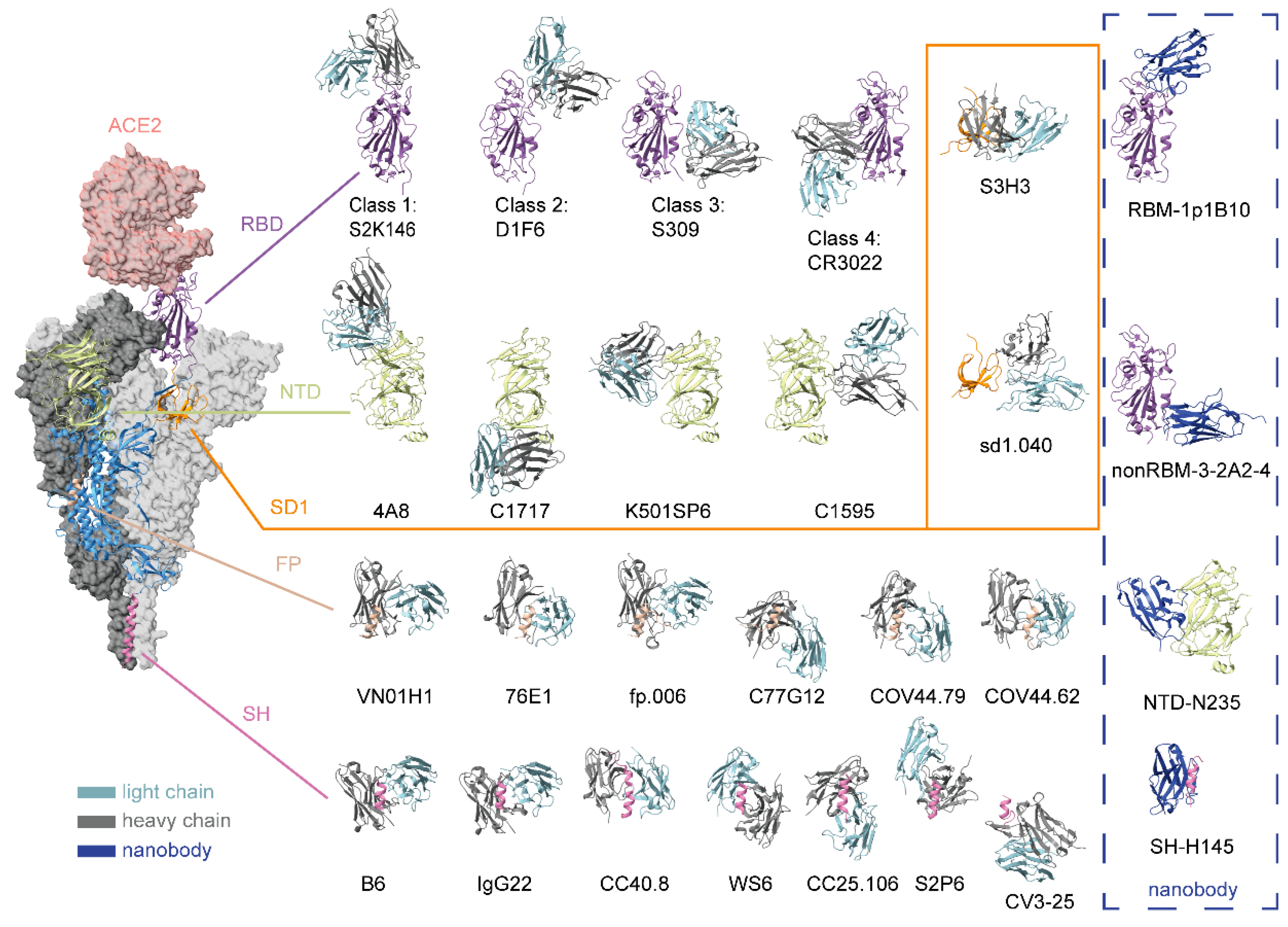
2. Broadly Neutralizing Antibodies
2.1. Broadly nAbs Target RBD
2.2. Broadly nAbs Target NTD
2.3. Broadly nAbs Target SD1
2.4. Broadly nAbs Target FP
2.5. Broadly nAbs Target SH
2.6. Other nAbs Target S2
3. Nanobodies
4. Antibody Cocktails
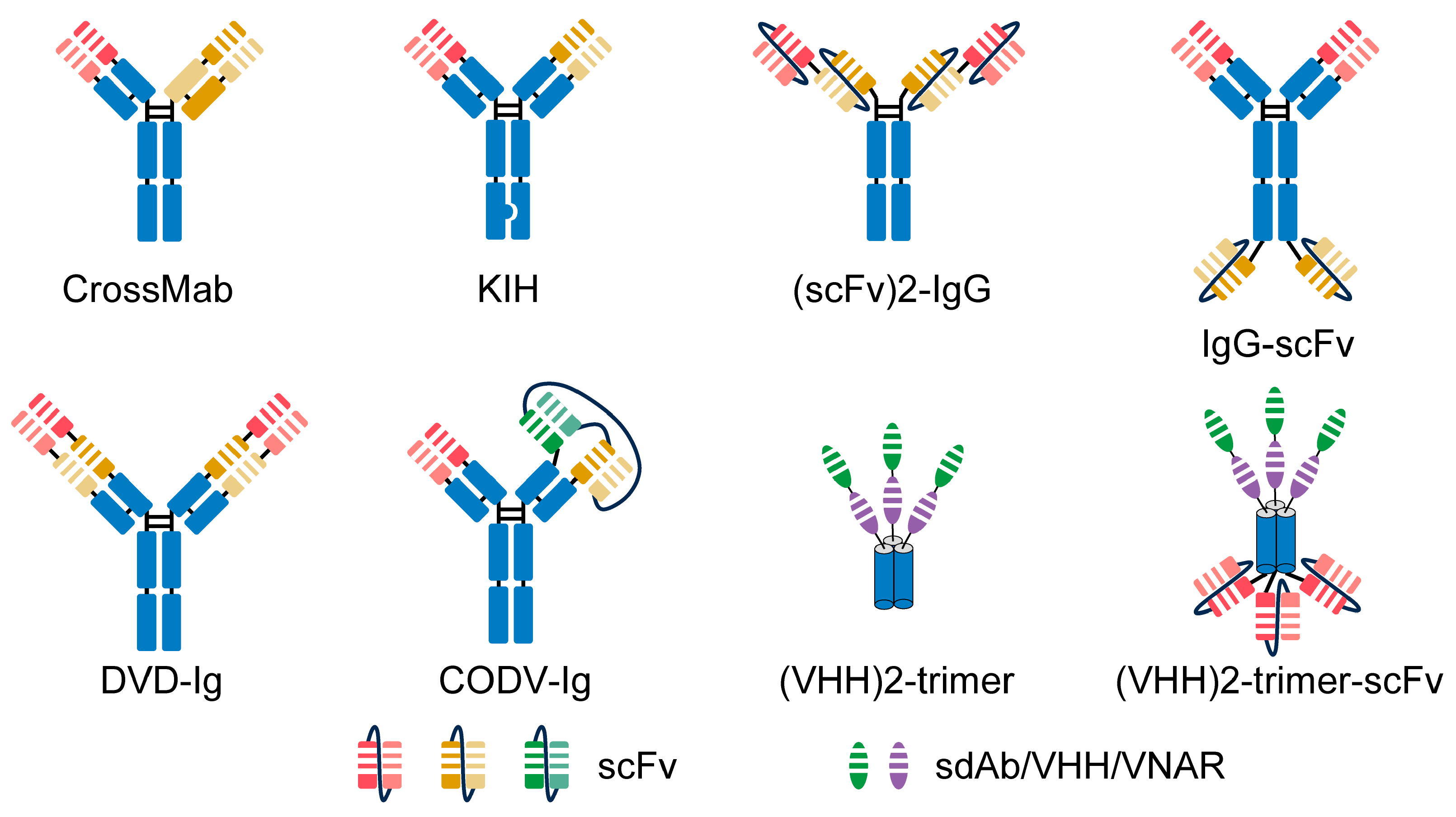
5. Bi-/Multi-Specific Antibodies
6. Antibody Class Switching and Multivalent Modification
7. Fc Modification
8. Artificial Intelligence-Based Design and Optimization
9. Conclusions
Author Contributions
Funding
Institutional Review Board Statement
Informed Consent Statement
Data Availability Statement
Conflicts of Interest
Abbreviations
| mAb | Monoclonal antibody |
| nAb | Neutralizing antibody |
| RBD | Receptor-binding domain |
| NTD | N-terminal domain |
| SD1 | Subdomain 1 |
| FP | Fusion peptide |
| SH | Stem helix |
| TMPRSS2 | Transmembrane serine protease 2 |
| AI | Artificial intelligence |
Appendix A

| Name | Target | Neutralizing Activity Against Omicron Sublineages (IC50) |
|---|---|---|
| BA7535 [11] | RBD class 1 | BA.1, BA.1.1, BA.2, BA.2.12.1, BA.2.13, BA.2.38.1, BA.2.74, BA.2.75, BA.2.76, BA.2.77, BA.2.79, BA.2.80, BA.3, BA.4/5, BA.4.6, BA.4.7, BA.5.5.1, BF.7, BQ.1, BQ.1.1, XBB.1, XBB.1.5, XBB.1.9.1, CH.1.1, EG.5 (0.3789–274.4 ng/mL) |
| 17T2 [12] | RBD class 1 | BA.1, BA.2, BA.4/5, BQ.1.1, XBB.1.5, XBB.1.16, EG.5.1, BA.2.86 (3.2–1180 ng/mL) |
| 87G7 [13] | RBD class 1 | BA.1, BA.2 (6.7–10.2 ng/mL) |
| 10-5B [14] | RBD class 1 | BA.1, BA.2, BA.2.12.1, BA.2.75, BN.1, BA.3, XD (4–16 ng/mL) |
| AZD3152 [15] | RBD class 1 | BA.1, BA.1.1, BA.2, BA.2.12.1, BA.4/5, BA.2.75, BA.4.6, BA.4.7, BA.5.9, BA.2.75.2, BF.7, BQ.1, BQ.1.1, XBB, XBB.1, XBB.1.5, XBB.1.16, BA.2.86, JN.1, XBB.1.5.10, EG.5.1, HV.1, HK.3 (3.2–2286.2 ng/mL) |
| S2K146 [17,18,19,20] | RBD class 1 | BA.1, BA.1.1, BA.2, BA.3, BA.2.13, BA.2.12.1, BA.4/5, XBB.1.5, EG.5.1, HK.3 (11–4147 ng/mL) |
| GAR05 [21] | RBD class 1 | BA.1, BA.2, BA.5 (71.31–337.6 ng/mL) |
| ZCP3B4 [22] | RBD class 1 | BA.1, BA.2, BA.2.12.1, BA.2.75, BA.4/5, BF.7, BE.1.1, BQ.1.1, XBB, XBB.1, XBB.1.5, HK.3, HV.1, EG.5.1, BA.2.86, JN.1, KP.2 (2.7–9.8 ng/mL) |
| P2-1B1 [23] | RBD class 1 | BA.1, BA.2, BA.2.12.1, BA.2.75, BA.3, BA.4/5 (7.6–1619.2 ng/mL) |
| P4J15 [24] | RBD class 1 | BA.1, BA.4/5, BA.2.75.2, BQ.1, BQ.1.1, XBB.1, XBB.1.5, CH.1.1, XBB.1.16, XBB.1.16.1, XBB.2.3, EG.1, EG.5.1 (2–18 ng/mL) |
| KXD03 [25] | RBD class 1 | BA.1, BA.2, BA.3, BA.4/5, BA.2.75, BF.7, BQ.1, XBB, XBB.1, XBB.1.5, XBB.1.16, EG.5, EG.5.1, FL.1.5, FL.1.5.1, HK.3 (22–489 ng/mL) |
| VIR-7229 [26] | RBD class 1 | BA.1, BA.2, BA.2.3, BA.2.75.2, BA.5, BQ.1.1, XBB.1.5, CH.1.1, XBB.2.3, EG.5, EG.5.1, XBB.1.16, XBB.1.16.1, XBB.1.16.6, FL.1.5.1, HV.1, XBB.1.5.70, HK.3, JD.1.1, BA.2.86, JN.1, JN.1.16, JN.1.18, BA.2.87.1 (1.34–434.5 ng/mL) |
| BD55-1205 [27] | RBD class 1 | BA.1, BA.2, BA.5, BQ.1.1, XBB.1.5, HK.3.1, JN.1, KP.3 (3–12 ng/mL) |
| P5-1C8 [23,28] | RBD class 1 | BA.1, BA.2, BA.2.12.1, BA.2.75, BA.3, BA.4/5, JN.1 (7.7–21 ng/mL) |
| P5S-2A9 [23] | RBD class 2 | BA.1, BA.2, BA.2.12.1, BA.2.75, BA.3, BA.4/5 (13.4–1102.4 ng/mL) |
| D1F6 [29] | RBD class 2 | BA.1, BA.1.1, BA.2, BA.2.12.1, BA.2.13, BA.3, BA.4/5, BQ.1.1, XBB.1.5 (15–5038 ng/mL) |
| A19-46.1 [8] | RBD class 2 | BA.1 (223 ng/mL) |
| COV2-2196 [8,30] | RBD class 2 | BA.1, BA.1.1, BA.2, BA.2.12.1 (361–704 ng/mL) |
| S309 [20,32] | RBD class 3 | BA.1, BA.1.1, BA.2, BA.2.12.1, BA.2.75, BA.4/5, BF.7, BQ.1, BQ.1.1, XBB, XBB.1.5, EG.5.1, HK.3, BA.2.86, JN.1 (252.7–11,742 ng/mL) |
| SP1-77 [33] | RBD class 3 | BA.1, BA.2, BA.3, BA.4/5, BA.2.12.1 (6.5–33 ng/mL) |
| SW186 [34] | RBD class 3 | BA.1 (332 ng/mL) |
| LY-CoV1404 [20,35,130] | RBD class 3 | BA.1, BA.2, BA.4/5, BQ.1.1 (0.4–27 ng/mL) |
| BA7208 [36] | RBD class 3 | BA.1, BA.2, BA.2.12.1, BA.2.13, BA.3, BA.4/5 (1.24–5.52 ng/mL) |
| S2X324 [37] | RBD class 3 | BA.1, BA.2, BA.4-V3G, BA.5, BA.2.12.1 (49.8–2650.7 ng/mL) |
| P2S-2E9 [23] | RBD class 3 | BA.1, BA.2, BA.2.12.1, BA.2.75, BA.3, BA.4/5 (8.1–3129.2 ng/mL) |
| 6-2C [14] | RBD class 3 | BA.1, BA.2, BA.2.12.1, BA.2.75, BA.2.75.2, BN.1, BA.3, BA.4, BA.4.6, BA.5, BF.7, BQ.1, BQ.1.1, XD, XBB, XBB.1.5 (194–3584 ng/mL) |
| 1G1 [32] | RBD class 3 | BA.1, BA.1.1, BA.2, BA.2.12.1, BA.2.75, BA.4/5 (1.2–19.6 ng/mL) |
| ADG20 [14,30,42] | RBD class 4 | BA.1, BA.1.1, XD (181–1203 ng/mL) |
| DH1047 [30,44] | RBD class 4 | BA.1, BA.1.1 (4322–5723 ng/mL) |
| AB2-122 [46] | RBD class 4 | BA.1, BA.2, BA.3, BA.5, BQ.1.1, XBB.1.5, BA.2.86, JN.1, KP.2, KP.3, KP.3.1.1, LP.8.1.1, MC.10.1, NB.1.8.1, XFG (20–1170 ng/mL) |
| S2H97 [20,47,49] | RBD others | BA.1, BA.2, BA.5, BQ.1.1, XBB.1.5, EG.5.1, HK.3, BA.2.86, JN.1 (224–1539 ng/mL) |
| C68.61 [49,67] | RBD others | BA.1, BA.2, BA.2.12.1, XBB, XBB.4, XBB.1.5, BA.4/5, BQ.1.1, EG.5.1, JN.1 (120–850 ng/mL) |
| GAR12 [21] | RBD others | BA.1, BA.2, BA.5 (16.17–62.59 ng/mL) |
| ION_300 [20,50] | RBD others | BA.2, XBB.1.5, EG.5.1, HK.3, BA.2.86, JN.1 (343–3838 ng/mL) |
| 5–7 [54] | NTD supersite | BA.1, BA.1.1, BA.3 (100–1000 ng/mL, Inferred from the neutralization curve) |
| C1717 [55] | NTD supersite | BA.1 (507 ng/mL) |
| C1520 [55] | NTD supersite | BA.1 (31 ng/mL) |
| C1791 [55] | NTD supersite | BA.1 (167 ng/mL) |
| BD58-0706 [56] | NTD N1/N2 loops | BA.2, BA.2.75, BA.5, BQ.1.1, XBB, XBB.1, XBB.1.5, EG.5.1, HK.3.1 (1–35 ng/mL) |
| K501SP6 [57] | NTD close to SD1 | BA.1, BA.2, BA.5, BQ.1.1.20, XBB.1, BA.2.86, JN.1 (3.06–25.9 μg/mL) |
| C1596 [58] | quaternary epitope containing the NTD, RBD and SD1 | BA.1, BA.4/5, XBB.1.5, EG.5.1, BA.2.86, JN.1 (57–4450 ng/mL) |
| S3H3 [59,60,61,62,63] | SD1 | BA.1, BA.2, XBB.1, XBB.1.5, EG.5.1, HK.3 (24–41 ng/mL) |
| SD1-1 [64] | SD1 | BA.1, BA.1.1, BA.2, BA.2.12.1, BA.2.75, BA.4/5, BA.4.6, BA.2.75.2, BA.2.3.20, BA.2.10.4, BQ.1, BQ.1.1, BS.1, BF.7, BJ.1, BN.1, CH.1.1, CA.3.1, XBB, XBB.1, XBB.1.5, XBB.1.5.10, XBB.1.5.70 (12–66 ng/mL) |
| P008_60 [65] | SD1 | BA.1 (10–100 μg/mL, Inferred from the neutralization curve) |
| Sd1.040 [66] | SD1 | BA.1, BA.2, BA.2.75, BA.2.75.2, BA.4/5 (1004–4486 ng/mL) |
| C68.59 [67] | SD1 | BA.1, BA.2, BA.2.12.1, XBB, XBB.4, XBB.1.5, BA.4/5, BQ.1.1 (34–156 ng/mL) |
| MO11 [68] | SD1 | BA.1, BA.2, BA.2.75, BA.5, BQ.1.1, XBB.1, XBB.1.5, XBB.1.16, EG.5.1 (110.3–467.6 ng/mL) |
| 76E1 [70] | FP | BA.1 (100 ng/mL, Inferred from the neutralization curve) |
| C20.119 [71] | FP | BA.1, BA.2, BA.5, BQ.1.1, XBB, XBB.1.5 (19–59 μg/mL) |
| COV44-62 [72] | FP | BA.1, BA.2, BA.4/5 (10.38–51.89 μg/mL) |
| COV44-79 [72] | FP | BA.1, BA.2, BA.4/5 (33.02–55.44 μg/mL) |
| VN01H1 [73] | FP | BA.1, BA.2 (12.5–19.7 μg/mL) |
| VP12E7 [73] | FP | NA |
| C77G12 [73] | FP | BA.1, BA.2 (2.9–5.4 μg/mL) |
| fp.007 [66] | FP | BA.1, BA.2, BA.2.75, BA.2.75.2, BA.4/5 (1889–14,469 ng/mL) |
| S2P6 [66,74] | SH | BA.1, BA.2, BA.2.75, BA.2.75.2, BA.4/5 (29,351–68,964 ng/mL) |
| CV3-25 [66,75,76] | SH | BA.1, BA.2, BA.2.75, BA.2.75.2, BA.4/5 (571.9–2469 ng/mL) |
| CC40.8 [79,85] | SH | NA |
| WS6 [81] | SH | BA.1 (3.43 μg/mL) |
| 1249A8 [83] | SH | NA |
| hr2.016 [66] | SH | BA.1, BA.2, BA.2.75, BA.2.75.2, BA.4/5 (453.6–1082 ng/mL) |
| CC99.103 [85] | SH | BA.1, BA.2, XBB, BA.2.12.1, BA.2.75, BA.2.75.2, BA.4/5, BA.4.6, BQ.1.1 (1.4–20 μg/mL) |
References
- Essalmani, R.; Jain, J.; Susan-Resiga, D.; Andréo, U.; Evagelidis, A.; Derbali, R.M.; Huynh, D.N.; Dallaire, F.; Laporte, M.; Delpal, A.; et al. Distinctive Roles of Furin and TMPRSS2 in SARS-CoV-2 Infectivity. J. Virol. 2022, 96, e0012822. [Google Scholar] [CrossRef]
- Akıl, C.; Xu, J.; Shen, J.; Zhang, P. Unveiling the structural spectrum of SARS-CoV-2 fusion by in situ cryo-ET. Nat. Commun. 2025, 16, 5150. [Google Scholar] [CrossRef] [PubMed]
- Grunst, M.W.; Qin, Z.; Dodero-Rojas, E.; Ding, S.; Prévost, J.; Chen, Y.; Hu, Y.; Pazgier, M.; Wu, S.; Xie, X.; et al. Structure and inhibition of SARS-CoV-2 spike refolding in membranes. Science 2024, 385, 757–765. [Google Scholar] [CrossRef] [PubMed]
- Chen, B.; Farzan, M.; Choe, H. SARS-CoV-2 spike protein: Structure, viral entry and variants. Nat. Rev. Microbiol. 2025, 23, 455–468. [Google Scholar] [CrossRef] [PubMed]
- Shi, W.; Cai, Y.; Zhu, H.; Peng, H.; Voyer, J.; Rits-Volloch, S.; Cao, H.; Mayer, M.L.; Song, K.; Xu, C.; et al. Cryo-EM structure of SARS-CoV-2 postfusion spike in membrane. Nature 2023, 619, 403–409. [Google Scholar] [CrossRef]
- Wrapp, D.; Wang, N.; Corbett, K.S.; Goldsmith, J.A.; Hsieh, C.L.; Abiona, O.; Graham, B.S.; McLellan, J.S. Cryo-EM structure of the 2019-nCoV spike in the prefusion conformation. Science 2020, 367, 1260–1263. [Google Scholar] [CrossRef]
- Cai, Y.; Zhang, J.; Xiao, T.; Peng, H.; Sterling, S.M.; Walsh, R.M.; Rawson, S.; Rits-Volloch, S.; Chen, B. Distinct conformational states of SARS-CoV-2 spike protein. Science 2020, 369, 1586–1592. [Google Scholar] [CrossRef]
- Zhou, T.; Wang, L.; Misasi, J.; Pegu, A.; Zhang, Y.; Harris, D.R.; Olia, A.S.; Talana, C.A.; Yang, E.S.; Chen, M.; et al. Structural basis for potent antibody neutralization of SARS-CoV-2 variants including B.1.1.529. Science 2022, 376, eabn8897. [Google Scholar] [CrossRef]
- Ji, Y.; Zhang, Q.; Cheng, L.; Ge, J.; Wang, R.; Fang, M.; Mucker, E.M.; Chen, P.; Ma, J.; Zhang, R.; et al. Preclinical characterization of amubarvimab and romlusevimab, a pair of non-competing neutralizing monoclonal antibody cocktail, against SARS-CoV-2. Front. Immunol. 2022, 13, 980435. [Google Scholar] [CrossRef]
- Barnes, C.O.; Jette, C.A.; Abernathy, M.E.; Dam, K.-M.A.; Esswein, S.R.; Gristick, H.B.; Malyutin, A.G.; Sharaf, N.G.; Huey-Tubman, K.E.; Lee, Y.E.; et al. SARS-CoV-2 neutralizing antibody structures inform therapeutic strategies. Nature 2020, 588, 682–687. [Google Scholar] [CrossRef] [PubMed]
- Wang, Y.; Yan, A.; Song, D.; Duan, M.; Dong, C.; Chen, J.; Jiang, Z.; Gao, Y.; Rao, M.; Feng, J.; et al. Identification of a highly conserved neutralizing epitope within the RBD region of diverse SARS-CoV-2 variants. Nat. Commun. 2024, 15, 842. [Google Scholar] [CrossRef]
- de Campos-Mata, L.; Trinité, B.; Modrego, A.; Tejedor Vaquero, S.; Pradenas, E.; Pons-Grífols, A.; Rodrigo Melero, N.; Carlero, D.; Marfil, S.; Santiago, C.; et al. A monoclonal antibody targeting a large surface of the receptor binding motif shows pan-neutralizing SARS-CoV-2 activity. Nat. Commun. 2024, 15, 1051. [Google Scholar] [CrossRef]
- Du, W.; Hurdiss, D.L.; Drabek, D.; Mykytyn, A.Z.; Kaiser, F.K.; González-Hernández, M.; Muñoz-Santos, D.; Lamers, M.M.; van Haperen, R.; Li, W.; et al. An ACE2-blocking antibody confers broad neutralization and protection against Omicron and other SARS-CoV-2 variants of concern. Sci. Immunol. 2022, 7, eabp9312. [Google Scholar] [CrossRef] [PubMed]
- Liu, Y.; Wang, Z.; Zhuang, X.; Zhang, S.; Chen, Z.; Zou, Y.; Sheng, J.; Li, T.; Tai, W.; Yu, J.; et al. Inactivated vaccine-elicited potent antibodies can broadly neutralize SARS-CoV-2 circulating variants. Nat. Commun. 2023, 14, 2179. [Google Scholar] [CrossRef]
- Cai, Y.; Diallo, S.; Rosenthal, K.; Ren, K.; Flores, D.J.; Dippel, A.; Oganesyan, V.; van Dyk, N.; Chen, X.; Cantu, E.; et al. AZD3152 neutralizes SARS-CoV-2 historical and contemporary variants and is protective in hamsters and well tolerated in adults. Sci. Transl. Med. 2024, 16, eado2817. [Google Scholar] [CrossRef] [PubMed]
- AstraZeneca. Sipavibart EMA Regulatory Submission Accepted Under Accelerated Assessment for COVID-19 Prevention. Available online: https://www.astrazeneca.com/media-centre/press-releases/2024/sipavibart-ema-regulatory-submission-accepted-under-accelerated-assessment-for-covid-19-prevention.html (accessed on 28 May 2026).
- Park, Y.J.; De Marco, A.; Starr, T.N.; Liu, Z.; Pinto, D.; Walls, A.C.; Zatta, F.; Zepeda, S.K.; Bowen, J.E.; Sprouse, K.R.; et al. Antibody-mediated broad sarbecovirus neutralization through ACE2 molecular mimicry. Science 2022, 375, 449–454. [Google Scholar] [CrossRef]
- Cao, Y.; Yisimayi, A.; Jian, F.; Song, W.; Xiao, T.; Wang, L.; Du, S.; Wang, J.; Li, Q.; Chen, X.; et al. BA.2.12.1, BA.4 and BA.5 escape antibodies elicited by Omicron infection. Nature 2022, 608, 593–602. [Google Scholar] [CrossRef]
- Cameroni, E.; Bowen, J.E.; Rosen, L.E.; Saliba, C.; Zepeda, S.K.; Culap, K.; Pinto, D.; VanBlargan, L.A.; De Marco, A.; di Iulio, J.; et al. Broadly neutralizing antibodies overcome SARS-CoV-2 Omicron antigenic shift. Nature 2022, 602, 664–670. [Google Scholar] [CrossRef]
- Yang, H.; Guo, H.; Wang, A.; Cao, L.; Fan, Q.; Jiang, J.; Wang, M.; Lin, L.; Ge, X.; Wang, H.; et al. Structural basis for the evolution and antibody evasion of SARS-CoV-2 BA.2.86 and JN.1 subvariants. Nat. Commun. 2024, 15, 7715. [Google Scholar] [CrossRef]
- Rouet, R.; Henry, J.Y.; Johansen, M.D.; Sobti, M.; Balachandran, H.; Langley, D.B.; Walker, G.J.; Lenthall, H.; Jackson, J.; Ubiparipovic, S.; et al. Broadly neutralizing SARS-CoV-2 antibodies through epitope-based selection from convalescent patients. Nat. Commun. 2023, 14, 687. [Google Scholar] [CrossRef] [PubMed]
- Luo, M.; Zhou, R.; Tang, B.; Liu, H.; Chen, B.; Liu, N.; Mo, Y.; Zhang, P.; Lee, Y.L.; Ip, J.D.; et al. Ultrapotent class I neutralizing antibodies post Omicron breakthrough infection overcome broad SARS-CoV-2 escape variants. eBioMedicine 2024, 108, 105354. [Google Scholar] [CrossRef]
- Ju, B.; Zhang, Q.; Wang, Z.; Aw, Z.Q.; Chen, P.; Zhou, B.; Wang, R.; Ge, X.; Lv, Q.; Cheng, L.; et al. Infection with wild-type SARS-CoV-2 elicits broadly neutralizing and protective antibodies against omicron subvariants. Nat. Immunol. 2023, 24, 690–699. [Google Scholar] [CrossRef]
- Fenwick, C.; Turelli, P.; Duhoo, Y.; Lau, K.; Herate, C.; Marlin, R.; Lamrayah, M.; Campos, J.; Esteves-Leuenberger, L.; Farina, A.; et al. Broadly potent anti-SARS-CoV-2 antibody shares 93% of epitope with ACE2 and provides full protection in monkeys. J. Infect. 2023, 87, 524–537. [Google Scholar] [CrossRef]
- Li, L.; Chen, X.; Wang, Z.; Li, Y.; Wang, C.; Jiang, L.; Zuo, T. Breakthrough infection elicits hypermutated IGHV3-53/3-66 public antibodies with broad and potent neutralizing activity against SARS-CoV-2 variants including the emerging EG.5 lineages. PLoS Pathog. 2023, 19, e1011856. [Google Scholar] [CrossRef]
- Rosen, L.E.; Tortorici, M.A.; De Marco, A.; Pinto, D.; Foreman, W.B.; Taylor, A.L.; Park, Y.-J.; Bohan, D.; Rietz, T.; Errico, J.M.; et al. A potent pan-sarbecovirus neutralizing antibody resilient to epitope diversification. Cell 2024, 187, 7196–7213.e7126. [Google Scholar] [CrossRef]
- Jian, F.; Wec, A.Z.; Feng, L.; Yu, Y.; Wang, L.; Wang, P.; Yu, L.; Wang, J.; Hou, J.; Berrueta, D.M.; et al. Viral evolution prediction identifies broadly neutralizing antibodies to existing and prospective SARS-CoV-2 variants. Nat. Microbiol. 2025, 10, 2003–2017. [Google Scholar] [CrossRef]
- Lv, N.; Chen, P.; Dai, X.; Xu, H.; Li, Z.; Shan, Z.; Li, J.; Guo, F.; Chen, Y.; Li, J.; et al. IgG-Bridging-Seeded Synergistic Aggregation of SARS-CoV-2 Spikes Underlies Potent Neutralization by a Low-Affinity Antibody. Adv. Sci. 2026, 13, e17192. [Google Scholar] [CrossRef] [PubMed]
- Liu, B.; Niu, X.; Deng, Y.; Zhang, Z.; Wang, Y.; Gao, X.; Liang, H.; Li, Z.; Wang, Q.; Cheng, Y.; et al. An unconventional VH1-2 antibody tolerates escape mutations and shows an antigenic hotspot on SARS-CoV-2 spike. Cell Rep. 2024, 43, 114265. [Google Scholar] [CrossRef] [PubMed]
- Wang, Q.; Guo, Y.; Iketani, S.; Nair, M.S.; Li, Z.; Mohri, H.; Wang, M.; Yu, J.; Bowen, A.D.; Chang, J.Y.; et al. Antibody evasion by SARS-CoV-2 Omicron subvariants BA.2.12.1, BA.4 and BA.5. Nature 2022, 608, 603–608. [Google Scholar] [CrossRef] [PubMed]
- Pinto, D.; Park, Y.J.; Beltramello, M.; Walls, A.C.; Tortorici, M.A.; Bianchi, S.; Jaconi, S.; Culap, K.; Zatta, F.; De Marco, A.; et al. Cross-neutralization of SARS-CoV-2 by a human monoclonal SARS-CoV antibody. Nature 2020, 583, 290–295. [Google Scholar] [CrossRef]
- Sun, H.; Wang, Y.; Chen, X.; Jiang, Y.; Wang, S.; Huang, Y.; Liu, L.; Li, Y.; Lan, M.; Guo, H.; et al. Structural basis for broad neutralization of human antibody against Omicron sublineages and evasion by XBB variant. J. Virol. 2023, 97, e01137-23. [Google Scholar] [CrossRef] [PubMed]
- Luo, S.; Zhang, J.; Kreutzberger, A.J.B.; Eaton, A.; Edwards, R.J.; Jing, C.; Dai, H.-Q.; Sempowski, G.D.; Cronin, K.; Parks, R.; et al. An antibody from single human VH-rearranging mouse neutralizes all SARS-CoV-2 variants through BA.5 by inhibiting membrane fusion. Sci. Immunol. 2022, 7, eadd5446. [Google Scholar] [CrossRef] [PubMed]
- Fang, Y.; Sun, P.; Xie, X.; Du, M.; Du, F.; Ye, J.; Kalveram, B.K.; Plante, J.A.; Plante, K.S.; Li, B.; et al. An antibody that neutralizes SARS-CoV-1 and SARS-CoV-2 by binding to a conserved spike epitope outside the receptor binding motif. Sci. Immunol. 2022, 7, eabp9962. [Google Scholar] [CrossRef]
- Westendorf, K.; Žentelis, S.; Wang, L.; Foster, D.; Vaillancourt, P.; Wiggin, M.; Lovett, E.; van der Lee, R.; Hendle, J.; Pustilnik, A.; et al. LY-CoV1404 (bebtelovimab) potently neutralizes SARS-CoV-2 variants. Cell Rep. 2022, 39, 110812. [Google Scholar] [CrossRef]
- Wang, Y.; Yan, A.; Song, D.; Dong, C.; Rao, M.; Gao, Y.; Qi, R.; Ma, X.; Wang, Q.; Xu, H.; et al. Biparatopic antibody BA7208/7125 effectively neutralizes SARS-CoV-2 variants including Omicron BA.1-BA.5. Cell Discov. 2023, 9, 3. [Google Scholar] [CrossRef]
- Park, Y.J.; Pinto, D.; Walls, A.C.; Liu, Z.; De Marco, A.; Benigni, F.; Zatta, F.; Silacci-Fregni, C.; Bassi, J.; Sprouse, K.R.; et al. Imprinted antibody responses against SARS-CoV-2 Omicron sublineages. Science 2022, 378, 619–627. [Google Scholar] [CrossRef] [PubMed]
- U.S. Food and Drug Administration. Frequently Asked Questions on the Emergency Use Authorization of Sotrovimab. Available online: https://www.fda.gov/media/149535/download (accessed on 28 May 2026).
- U.S. Food and Drug Administration. Frequently Asked Questions on the Emergency Use Authorization of Bebtelovimab for the Treatment of COVID-19. Available online: https://www.fda.gov/media/156154/download (accessed on 28 May 2026).
- Yuan, M.; Wu, N.C.; Zhu, X.; Lee, C.D.; So, R.T.Y.; Lv, H.; Mok, C.K.P.; Wilson, I.A. A highly conserved cryptic epitope in the receptor binding domains of SARS-CoV-2 and SARS-CoV. Science 2020, 368, 630–633. [Google Scholar] [CrossRef]
- Huo, J.; Zhao, Y.; Ren, J.; Zhou, D.; Duyvesteyn, H.M.E.; Ginn, H.M.; Carrique, L.; Malinauskas, T.; Ruza, R.R.; Shah, P.N.M.; et al. Neutralization of SARS-CoV-2 by Destruction of the Prefusion Spike. Cell Host Microbe 2020, 28, 445–454.e446. [Google Scholar] [CrossRef]
- Yuan, M.; Zhu, X.; He, W.T.; Zhou, P.; Kaku, C.I.; Capozzola, T.; Zhu, C.Y.; Yu, X.; Liu, H.; Yu, W.; et al. A broad and potent neutralization epitope in SARS-related coronaviruses. Proc. Natl. Acad. Sci. USA 2022, 119, e2205784119. [Google Scholar] [CrossRef]
- Sankhala, R.S.; Dussupt, V.; Chen, W.-H.; Bai, H.; Martinez, E.J.; Jensen, J.L.; Rees, P.A.; Hajduczki, A.; Chang, W.C.; Choe, M.; et al. Antibody targeting of conserved sites of vulnerability on the SARS-CoV-2 spike receptor-binding domain. Structure 2024, 32, 131–147.e137. [Google Scholar] [CrossRef]
- Martinez, D.R.; Schäfer, A.; Gobeil, S.; Li, D.; De la Cruz, G.; Parks, R.; Lu, X.; Barr, M.; Stalls, V.; Janowska, K.; et al. A broadly cross-reactive antibody neutralizes and protects against sarbecovirus challenge in mice. Sci. Transl. Med. 2022, 14, eabj7125. [Google Scholar] [CrossRef] [PubMed]
- ClinicalTrials. Evaluation of ADG20 for the Prevention of COVID-19 (EVADE). Available online: https://clinicaltrials.gov/study/NCT04859517?intr=ADG20&viewType=Card&rank=1 (accessed on 28 May 2026).
- Batra, H.; Luo, S.; Saunders, K.O.; Higgins, J.S.; Jian, F.; Zhang, J.; Kibria, M.G.; Jonaid, G.M.; Zhou, Q.J.; Eaton, A.; et al. Recurrent SARS-CoV-2 Omicron broadly neutralizing humanized antibodies in different single human VH1-2-rearranging mouse models. Proc. Natl. Acad. Sci. USA 2026, 123, e2537053123. [Google Scholar] [CrossRef]
- Starr, T.N.; Czudnochowski, N.; Liu, Z.; Zatta, F.; Park, Y.J.; Addetia, A.; Pinto, D.; Beltramello, M.; Hernandez, P.; Greaney, A.J.; et al. SARS-CoV-2 RBD antibodies that maximize breadth and resistance to escape. Nature 2021, 597, 97–102. [Google Scholar] [CrossRef]
- Wang, S.; Sun, H.; Zhang, Y.; Yuan, L.; Wang, Y.; Zhang, T.; Wang, S.; Zhang, J.; Yu, H.; Xiong, H.; et al. Three SARS-CoV-2 antibodies provide broad and synergistic neutralization against variants of concern, including Omicron. Cell Rep. 2022, 39, 110862. [Google Scholar] [CrossRef]
- Ruiz, F.; Foreman, W.B.; Lilly, M.; Baharani, V.A.; Depierreux, D.M.; Chohan, V.; Taylor, A.L.; Guenthoer, J.; Ralph, D.; Matsen Iv, F.A.; et al. Delineating the functional activity of antibodies with cross-reactivity to SARS-CoV-2, SARS-CoV-1 and related sarbecoviruses. PLoS Pathog. 2024, 20, e1012650. [Google Scholar] [CrossRef]
- Bullen, G.; Galson, J.D.; Hall, G.; Villar, P.; Moreels, L.; Ledsgaard, L.; Mattiuzzo, G.; Bentley, E.M.; Masters, E.W.; Tang, D.; et al. Cross-Reactive SARS-CoV-2 Neutralizing Antibodies From Deep Mining of Early Patient Responses. Front. Immunol. 2021, 12, 678570. [Google Scholar] [CrossRef]
- Cerutti, G.; Guo, Y.; Zhou, T.; Gorman, J.; Lee, M.; Rapp, M.; Reddem, E.R.; Yu, J.; Bahna, F.; Bimela, J.; et al. Potent SARS-CoV-2 neutralizing antibodies directed against spike N-terminal domain target a single supersite. Cell Host Microbe 2021, 29, 819–833.e817. [Google Scholar] [CrossRef]
- Lok, S.M. An NTD supersite of attack. Cell Host Microbe 2021, 29, 744–746. [Google Scholar] [CrossRef] [PubMed]
- Cerutti, G.; Guo, Y.; Wang, P.; Nair, M.S.; Wang, M.; Huang, Y.; Yu, J.; Liu, L.; Katsamba, P.S.; Bahna, F.; et al. Neutralizing antibody 5-7 defines a distinct site of vulnerability in SARS-CoV-2 spike N-terminal domain. Cell Rep. 2021, 37, 109928. [Google Scholar] [CrossRef] [PubMed]
- Ai, J.; Wang, X.; He, X.; Zhao, X.; Zhang, Y.; Jiang, Y.; Li, M.; Cui, Y.; Chen, Y.; Qiao, R.; et al. Antibody evasion of SARS-CoV-2 Omicron BA.1, BA.1.1, BA.2, and BA.3 sub-lineages. Cell Host Microbe 2022, 30, 1077–1083.e1074. [Google Scholar] [CrossRef]
- Wang, Z.; Muecksch, F.; Cho, A.; Gaebler, C.; Hoffmann, H.H.; Ramos, V.; Zong, S.; Cipolla, M.; Johnson, B.; Schmidt, F.; et al. Analysis of memory B cells identifies conserved neutralizing epitopes on the N-terminal domain of variant SARS-CoV-2 spike proteins. Immunity 2022, 55, 998–1012.e1018. [Google Scholar] [CrossRef] [PubMed]
- Niu, X.; Li, Z.; Wang, J.; Jian, F.; Yu, Y.; Song, W.; Yisimayi, A.; Du, S.; Zhang, Z.; Wang, Q.; et al. Omicron-specific ultra-potent SARS-CoV-2 neutralizing antibodies targeting the N1/N2 loop of Spike N-terminal domain. Emerg. Microbes Infect. 2024, 13, 2412990. [Google Scholar] [CrossRef]
- Walker, M.R.; Underwood, A.; Björnsson, K.H.; Raghavan, S.S.R.; Bassi, M.R.; Binderup, A.; Pham, L.V.; Ramirez, S.; Pinholt, M.; Dagil, R.; et al. Broadly potent spike-specific human monoclonal antibodies inhibit SARS-CoV-2 Omicron sub-lineages. Commun. Biol. 2024, 7, 1239. [Google Scholar] [CrossRef] [PubMed]
- Rubio, A.A.; Baharani, V.A.; Dadonaite, B.; Parada, M.; Abernathy, M.E.; Wang, Z.; Lee, Y.E.; Eso, M.R.; Phung, J.; Ramos, I.; et al. Bispecific antibodies targeting the N-terminal and receptor binding domains potently neutralize SARS-CoV-2 variants of concern. Sci. Transl. Med. 2025, 17, eadq5720. [Google Scholar] [CrossRef]
- Hong, Q.; Han, W.; Li, J.; Xu, S.; Wang, Y.; Xu, C.; Li, Z.; Wang, Y.; Zhang, C.; Huang, Z.; et al. Molecular basis of receptor binding and antibody neutralization of Omicron. Nature 2022, 604, 546–552. [Google Scholar] [CrossRef]
- Xu, S.; Wang, Y.; Wang, Y.; Zhang, C.; Hong, Q.; Gu, C.; Xu, R.; Wang, T.; Yang, Y.; Zang, J.; et al. Mapping cross-variant neutralizing sites on the SARS-CoV-2 spike protein. Emerg. Microbes Infect. 2022, 11, 351–367. [Google Scholar] [CrossRef] [PubMed]
- Jian, F.; Feng, L.; Yang, S.; Yu, Y.; Wang, L.; Song, W.; Yisimayi, A.; Chen, X.; Xu, Y.; Wang, P.; et al. Convergent evolution of SARS-CoV-2 XBB lineages on receptor-binding domain 455–456 synergistically enhances antibody evasion and ACE2 binding. PLoS Pathog. 2023, 19, e1011868. [Google Scholar] [CrossRef]
- Liu, Y.; Zhao, X.; Shi, J.; Wang, Y.; Liu, H.; Hu, Y.F.; Hu, B.; Shuai, H.; Yuen, T.T.; Chai, Y.; et al. Lineage-specific pathogenicity, immune evasion, and virological features of SARS-CoV-2 BA.2.86/JN.1 and EG.5.1/HK.3. Nat. Commun. 2024, 15, 8728. [Google Scholar] [CrossRef]
- Yang, S.; Yu, Y.; Jian, F.; Song, W.; Yisimayi, A.; Chen, X.; Xu, Y.; Wang, P.; Wang, J.; Yu, L.; et al. Antigenicity and infectivity characterisation of SARS-CoV-2 BA.2.86. Lancet Infect. Dis. 2023, 23, e457–e459. [Google Scholar] [CrossRef]
- Zhou, D.; Supasa, P.; Liu, C.; Dijokaite-Guraliuc, A.; Duyvesteyn, H.M.E.; Selvaraj, M.; Mentzer, A.J.; Das, R.; Dejnirattisai, W.; Temperton, N.; et al. The SARS-CoV-2 neutralizing antibody response to SD1 and its evasion by BA.2.86. Nat. Commun. 2024, 15, 2734. [Google Scholar] [CrossRef]
- Seow, J.; Khan, H.; Rosa, A.; Calvaresi, V.; Graham, C.; Pickering, S.; Pye, V.E.; Cronin, N.B.; Huettner, I.; Malim, M.H.; et al. A neutralizing epitope on the SD1 domain of SARS-CoV-2 spike targeted following infection and vaccination. Cell Rep. 2022, 40, 111276. [Google Scholar] [CrossRef]
- Bianchini, F.; Crivelli, V.; Abernathy, M.E.; Guerra, C.; Palus, M.; Muri, J.; Marcotte, H.; Piralla, A.; Pedotti, M.; De Gasparo, R.; et al. Human neutralizing antibodies to cold linear epitopes and subdomain 1 of the SARS-CoV-2 spike glycoprotein. Sci. Immunol. 2023, 8, eade0958. [Google Scholar] [CrossRef]
- Guenthoer, J.; Lilly, M.; Starr, T.N.; Dadonaite, B.; Lovendahl, K.N.; Croft, J.T.; Stoddard, C.I.; Chohan, V.; Ding, S.; Ruiz, F.; et al. Identification of broad, potent antibodies to functionally constrained regions of SARS-CoV-2 spike following a breakthrough infection. Proc. Natl. Acad. Sci. USA 2023, 120, e2220948120. [Google Scholar] [CrossRef] [PubMed]
- Ishimaru, H.; Nishimura, M.; Shigematsu, H.; Marini, M.I.; Hasegawa, N.; Takamiya, R.; Iwata, S.; Mori, Y. Epitopes of an antibody that neutralizes a wide range of SARS-CoV-2 variants in a conserved subdomain 1 of the spike protein. J. Virol. 2024, 98, e0041624. [Google Scholar] [CrossRef] [PubMed]
- Guo, L.; Lin, S.; Chen, Z.; Cao, Y.; He, B.; Lu, G. Targetable elements in SARS-CoV-2 S2 subunit for the design of pan-coronavirus fusion inhibitors and vaccines. Signal Transduct. Target. Ther. 2023, 8, 197. [Google Scholar] [CrossRef] [PubMed]
- Sun, X.; Yi, C.; Zhu, Y.; Ding, L.; Xia, S.; Chen, X.; Liu, M.; Gu, C.; Lu, X.; Fu, Y.; et al. Neutralization mechanism of a human antibody with pan-coronavirus reactivity including SARS-CoV-2. Nat. Microbiol. 2022, 7, 1063–1074. [Google Scholar] [CrossRef]
- Guenthoer, J.; Garrett, M.E.; Lilly, M.; Depierreux, D.M.; Ruiz, F.; Chi, M.; Stoddard, C.I.; Chohan, V.; Yaffe, Z.A.; Sung, K.; et al. The S2 subunit of spike encodes diverse targets for functional antibody responses to SARS-CoV-2. PLoS Pathog. 2024, 20, e1012383. [Google Scholar] [CrossRef]
- Dacon, C.; Tucker, C.; Peng, L.; Lee, C.D.; Lin, T.H.; Yuan, M.; Cong, Y.; Wang, L.; Purser, L.; Williams, J.K.; et al. Broadly neutralizing antibodies target the coronavirus fusion peptide. Science 2022, 377, 728–735. [Google Scholar] [CrossRef]
- Low, J.S.; Jerak, J.; Tortorici, M.A.; McCallum, M.; Pinto, D.; Cassotta, A.; Foglierini, M.; Mele, F.; Abdelnabi, R.; Weynand, B.; et al. ACE2-binding exposes the SARS-CoV-2 fusion peptide to broadly neutralizing coronavirus antibodies. Science 2022, 377, 735–742. [Google Scholar] [CrossRef]
- Pinto, D.; Sauer, M.M.; Czudnochowski, N.; Low, J.S.; Tortorici, M.A.; Housley, M.P.; Noack, J.; Walls, A.C.; Bowen, J.E.; Guarino, B.; et al. Broad betacoronavirus neutralization by a stem helix-specific human antibody. Science 2021, 373, 1109–1116. [Google Scholar] [CrossRef]
- Hurlburt, N.K.; Homad, L.J.; Sinha, I.; Jennewein, M.F.; MacCamy, A.J.; Wan, Y.H.; Boonyaratanakornkit, J.; Sholukh, A.M.; Jackson, A.M.; Zhou, P.; et al. Structural definition of a pan-sarbecovirus neutralizing epitope on the spike S2 subunit. Commun. Biol. 2022, 5, 342. [Google Scholar] [CrossRef] [PubMed]
- Jennewein, M.F.; MacCamy, A.J.; Akins, N.R.; Feng, J.; Homad, L.J.; Hurlburt, N.K.; Seydoux, E.; Wan, Y.H.; Stuart, A.B.; Edara, V.V.; et al. Isolation and characterization of cross-neutralizing coronavirus antibodies from COVID-19+ subjects. Cell Rep. 2021, 36, 109353. [Google Scholar] [CrossRef] [PubMed]
- Li, W.; Chen, Y.; Prévost, J.; Ullah, I.; Lu, M.; Gong, S.Y.; Tauzin, A.; Gasser, R.; Vézina, D.; Anand, S.P.; et al. Structural basis and mode of action for two broadly neutralizing antibodies against SARS-CoV-2 emerging variants of concern. Cell Rep. 2022, 38, 110210. [Google Scholar] [CrossRef]
- Song, G.; He, W.-T.; Callaghan, S.; Anzanello, F.; Huang, D.; Ricketts, J.; Torres, J.L.; Beutler, N.; Peng, L.; Vargas, S.; et al. Cross-reactive serum and memory B-cell responses to spike protein in SARS-CoV-2 and endemic coronavirus infection. Nat. Commun. 2021, 12, 2938. [Google Scholar] [CrossRef]
- Zhou, P.; Yuan, M.; Song, G.; Beutler, N.; Shaabani, N.; Huang, D.; He, W.-T.; Zhu, X.; Callaghan, S.; Yong, P.; et al. A human antibody reveals a conserved site on beta-coronavirus spike proteins and confers protection against SARS-CoV-2 infection. Sci. Transl. Med. 2022, 14, eabi9215. [Google Scholar] [CrossRef]
- Li, C.J.; Chao, T.L.; Chang, T.Y.; Hsiao, C.C.; Lu, D.C.; Chiang, Y.W.; Lai, G.C.; Tsai, Y.M.; Fang, J.T.; Ieong, S.; et al. Neutralizing Monoclonal Antibodies Inhibit SARS-CoV-2 Infection through Blocking Membrane Fusion. Microbiol. Spectr. 2022, 10, e0181421. [Google Scholar] [CrossRef]
- Shi, W.; Wang, L.; Zhou, T.; Sastry, M.; Yang, E.S.; Zhang, Y.; Chen, M.; Chen, X.; Choe, M.; Creanga, A.; et al. Vaccine-elicited murine antibody WS6 neutralizes diverse beta-coronaviruses by recognizing a helical stem supersite of vulnerability. Structure 2022, 30, 1233–1244.e1237. [Google Scholar] [CrossRef]
- Tan, S.S.E.; Tam, E.H.; Lai, K.M.; Wu, Y.; Xiao, T.; Tan, Y.J. Characterization of the Binding and Inhibition Mechanisms of a Novel Neutralizing Monoclonal Antibody Targeting the Stem Helix Region in the S2 Subunit of the Spike Protein of SARS-CoV-2. Vaccines 2025, 13, 688. [Google Scholar] [CrossRef] [PubMed]
- Piepenbrink, M.S.; Park, J.G.; Deshpande, A.; Loos, A.; Ye, C.; Basu, M.; Sarkar, S.; Khalil, A.M.; Chauvin, D.; Woo, J.; et al. Potent universal beta-coronavirus therapeutic activity mediated by direct respiratory administration of a Spike S2 domain-specific human neutralizing monoclonal antibody. PLoS Pathog. 2022, 18, e1010691. [Google Scholar] [CrossRef]
- Deshpande, A.; Schormann, N.; Piepenbrink, M.S.; Martinez Sobrido, L.; Kobie, J.J.; Walter, M.R. Structure and epitope of a neutralizing monoclonal antibody that targets the stem helix of β coronaviruses. FEBS J. 2023, 290, 3422–3435. [Google Scholar] [CrossRef]
- Zhou, P.; Song, G.; Liu, H.; Yuan, M.; He, W.T.; Beutler, N.; Zhu, X.; Tse, L.V.; Martinez, D.R.; Schäfer, A.; et al. Broadly neutralizing anti-S2 antibodies protect against all three human betacoronaviruses that cause deadly disease. Immunity 2023, 56, 669–686.e667. [Google Scholar] [CrossRef]
- Dacon, C.; Peng, L.; Lin, T.H.; Tucker, C.; Lee, C.D.; Cong, Y.; Wang, L.; Purser, L.; Cooper, A.J.R.; Williams, J.K.; et al. Rare, convergent antibodies targeting the stem helix broadly neutralize diverse betacoronaviruses. Cell Host Microbe 2023, 31, 97–111.e112. [Google Scholar] [CrossRef]
- Wang, C.; van Haperen, R.; Gutiérrez-Álvarez, J.; Li, W.; Okba, N.M.A.; Albulescu, I.; Widjaja, I.; van Dieren, B.; Fernandez-Delgado, R.; Sola, I.; et al. A conserved immunogenic and vulnerable site on the coronavirus spike protein delineated by cross-reactive monoclonal antibodies. Nat. Commun. 2021, 12, 1715. [Google Scholar] [CrossRef]
- Sauer, M.M.; Tortorici, M.A.; Park, Y.-J.; Walls, A.C.; Homad, L.; Acton, O.J.; Bowen, J.E.; Wang, C.; Xiong, X.; de van der Schueren, W.; et al. Structural basis for broad coronavirus neutralization. Nat. Struct. Mol. Biol. 2021, 28, 478–486. [Google Scholar] [CrossRef]
- Hsieh, C.-L.; Werner, A.P.; Leist, S.R.; Stevens, L.J.; Falconer, E.; Goldsmith, J.A.; Chou, C.-W.; Abiona, O.M.; West, A.; Westendorf, K.; et al. Stabilized coronavirus spike stem elicits a broadly protective antibody. Cell Rep. 2021, 37, 109929. [Google Scholar] [CrossRef]
- Yan, L.; Wang, F.; Hill, M.; Brun, J.; Liang, Z.; Shi, X.; Zhang, L.; He, X.; Li, Y.; Huang, Q.; et al. A broadly neutralizing antibody recognizes a unique epitope with a signature motif common across coronaviruses. Nat. Commun. 2025, 16, 7580. [Google Scholar] [CrossRef] [PubMed]
- Silva, R.P.; Huang, Y.; Nguyen, A.W.; Hsieh, C.-L.; Olaluwoye, O.S.; Kaoud, T.S.; Wilen, R.E.; Qerqez, A.N.; Park, J.-G.; Khalil, A.M.; et al. Identification of a conserved S2 epitope present on spike proteins from all highly pathogenic coronaviruses. eLife 2023, 12, e83710. [Google Scholar] [CrossRef] [PubMed]
- Wu, W.L.; Chiang, C.Y.; Lai, S.C.; Yu, C.Y.; Huang, Y.L.; Liao, H.C.; Liao, C.L.; Chen, H.W.; Liu, S.J. Monoclonal antibody targeting the conserved region of the SARS-CoV-2 spike protein to overcome viral variants. JCI Insight 2022, 7, e157597. [Google Scholar] [CrossRef]
- Muyldermans, S. Nanobodies: Natural single-domain antibodies. Annu. Rev. Biochem. 2013, 82, 775–797. [Google Scholar] [CrossRef] [PubMed]
- Steeland, S.; Vandenbroucke, R.E.; Libert, C. Nanobodies as therapeutics: Big opportunities for small antibodies. Drug Discov. Today 2016, 21, 1076–1113. [Google Scholar] [CrossRef]
- Ye, G.; Bu, F.; Saxena, D.; Turner-Hubbard, H.; Herbst, M.; Spiller, B.; Wadzinski, B.E.; Du, L.; Liu, B.; Zheng, J.; et al. Discovery of Nanosota-9 as anti-Omicron nanobody therapeutic candidate. PLoS Pathog. 2024, 20, e1012726. [Google Scholar] [CrossRef]
- Aksu, M.; Kumar, P.; Güttler, T.; Taxer, W.; Gregor, K.; Mußil, B.; Rymarenko, O.; Stegmann, K.M.; Dickmanns, A.; Gerber, S.; et al. Nanobodies to multiple spike variants and inhalation of nanobody-containing aerosols neutralize SARS-CoV-2 in cell culture and hamsters. Antivir. Res. 2024, 221, 105778. [Google Scholar] [CrossRef]
- Shcheblyakov, D.V.; Favorskaya, I.A.; Dolzhikova, I.V.; Korobkova, A.I.; Alekseeva, I.A.; Esmagambetov, I.B.; Voronina, O.L.; Tukhvatulin, A.I.; Zubkova, O.V.; Derkaev, A.A.; et al. Ultra-potent RBM-specific single-domain antibody broadly neutralizes multiple SARS-CoV-2 variants with picomolar activity. Int. J. Biol. Macromol. 2025, 319, 145386. [Google Scholar] [CrossRef]
- Dong, H.; Zhou, R.; Chen, J.; Wei, J.; Wei, Z.; Yang, Z.; Zhu, K.; Yang, Y.; Yang, Q.; Liu, N.; et al. Super broad and protective nanobodies against Sarbecoviruses including SARS-CoV-1 and the divergent SARS-CoV-2 subvariant KP.3.1.1. PLoS Pathog. 2024, 20, e1012625. [Google Scholar] [CrossRef]
- He, L.; Wu, Q.; Zhang, Z.; Chen, L.; Yu, K.; Li, L.; Jia, Q.; Wang, Y.; Ni, J.; Wang, C.; et al. Development of Broad-Spectrum Nanobodies for the Therapy and Diagnosis of SARS-CoV-2 and Its Multiple Variants. Mol. Pharm. 2024, 21, 3866–3879. [Google Scholar] [CrossRef]
- Modhiran, N.; Lauer, S.M.; Amarilla, A.A.; Hewins, P.; Lopes van den Broek, S.I.; Low, Y.S.; Thakur, N.; Liang, B.; Nieto, G.V.; Jung, J.; et al. A nanobody recognizes a unique conserved epitope and potently neutralizes SARS-CoV-2 omicron variants. iScience 2023, 26, 107085. [Google Scholar] [CrossRef]
- Yao, H.; Wang, H.; Zhang, Z.; Lu, Y.; Zhang, Z.; Zhang, Y.; Xiong, X.; Wang, Y.; Wang, Z.; Yang, H.; et al. A potent and broad-spectrum neutralizing nanobody for SARS-CoV-2 viruses, including all major Omicron strains. MedComm 2023, 4, e397. [Google Scholar] [CrossRef] [PubMed]
- Li, M.; Ren, Y.; Aw, Z.Q.; Chen, B.; Yang, Z.; Lei, Y.; Cheng, L.; Liang, Q.; Hong, J.; Yang, Y.; et al. Broadly neutralizing and protective nanobodies against SARS-CoV-2 Omicron subvariants BA.1, BA.2, and BA.4/5 and diverse sarbecoviruses. Nat. Commun. 2022, 13, 7957. [Google Scholar] [CrossRef] [PubMed]
- Zhao, D.; Liu, L.; Liu, X.; Zhang, J.; Yin, Y.; Luan, L.; Jiang, D.; Yang, X.; Li, L.; Xiong, H.; et al. A potent synthetic nanobody with broad-spectrum activity neutralizes SARS-CoV-2 virus and the Omicron variant BA.1 through a unique binding mode. J. Nanobiotechnol. 2022, 20, 411. [Google Scholar] [CrossRef] [PubMed]
- Yang, Y.; Zhang, J.; Zhang, S.; Zhang, C.; Shen, C.; Song, S.; Wang, Y.; Peng, Y.; Gong, X.; Dai, J.; et al. A novel nanobody broadly neutralizes SARS-CoV-2 via induction of spike trimer dimers conformation. Exploration 2024, 4, 20230086. [Google Scholar] [CrossRef]
- Liu, B.; Liu, H.; Han, P.; Wang, X.; Wang, C.; Yan, X.; Lei, W.; Xu, K.; Zhou, J.; Qi, J.; et al. Enhanced potency of an IgM-like nanobody targeting conserved epitope in SARS-CoV-2 spike N-terminal domain. Signal Transduct. Target. Ther. 2024, 9, 131. [Google Scholar] [CrossRef]
- Guo, L.; Chen, Z.; Lin, S.; Yang, F.; Yang, J.; Wang, L.; Zhang, X.; Yuan, X.; He, B.; Cao, Y.; et al. Structural basis and mode of action for two broadly neutralizing nanobodies targeting the highly conserved spike stem-helix of sarbecoviruses including SARS-CoV-2 and its variants. PLoS Pathog. 2025, 21, e1013034. [Google Scholar] [CrossRef]
- De Cae, S.; Van Molle, I.; van Schie, L.; Shoemaker, S.R.; Deckers, J.; Debeuf, N.; Lameire, S.; Nerinckx, W.; Roose, K.; Fijalkowska, D.; et al. Ultrapotent SARS coronavirus-neutralizing single-domain antibodies that clamp the spike at its base. Nat. Commun. 2025, 16, 5040. [Google Scholar] [CrossRef] [PubMed]
- Feng, B.; Li, C.; Zhang, Z.; Huang, Y.; Liu, B.; Zhang, Z.; Luo, J.; Wang, Q.; Yin, L.; Chen, S.; et al. A shark-derived broadly neutralizing nanobody targeting a highly conserved epitope on the S2 domain of sarbecoviruses. J. Nanobiotechnol. 2025, 23, 110. [Google Scholar] [CrossRef]
- Buffington, J.; Duan, Z.; Kwon, H.J.; Hong, J.; Li, D.; Feng, M.; Xie, H.; Ho, M. Identification of nurse shark V(NAR) single-domain antibodies targeting the spike S2 subunit of SARS-CoV-2. FASEB J. 2023, 37, e22973. [Google Scholar] [CrossRef]
- Korobkova, A.I.; Favorskaya, I.A.; Shuliakova, I.V.; Iliukhina, A.A.; Grousova, D.M.; Alekseeva, I.A.; Ryabova, E.I.; Derkaev, A.A.; Azizyan, V.V.; Zorkov, I.D.; et al. Broadly neutralizing single-domain antibody targeting the spike NTD displays therapeutic efficacy against diverse SARS-CoV-2 variants. Front. Immunol. 2026, 17, 1799333. [Google Scholar] [CrossRef]
- Clarke, J.; Jones, L.; Buckle, I.; Sharma, P.; Park, E.; Kipar, A.; Kirby, A.; Mega, D.; Ramadurai, S.; Karmakar, A.; et al. Nanobodies against the S2 region of the spike protein potently neutralize SARS-CoV-2 viruses and show resistance to virus escape. bioRxiv 2026, 2026.2001.2008.698330. [Google Scholar] [CrossRef]
- Moutinho, I.; Marimon, R.; Silva, R.D.M.; Fernandes, C.; Gano, L.; Correia, J.D.G.; Gonçalves, J.; Tavares, L.; Aires-da-Silva, F. A rabbit-derived single-domain antibody fused to the Streptococcus zooepidemicus Zag protein engineered for SARS-CoV-2 neutralization and extended half-life. Biologics 2026, 6, 10. [Google Scholar] [CrossRef]
- Iacobucci, G. COVID-19: FDA removes US authorisation for antibody drug Evusheld. BMJ 2023, 380, 264. [Google Scholar] [CrossRef] [PubMed]
- Nikitin, P.A.; DiMuzio, J.M.; Dowling, J.P.; Patel, N.B.; Bingaman-Steele, J.L.; Heimbach, B.C.; Henriquez, N.; Nicolescu, C.; Polley, A.; Sikorski, E.L.; et al. IMM-BCP-01, a patient-derived anti-SARS-CoV-2 antibody cocktail, is active across variants of concern including Omicron BA.1 and BA.2. Sci. Immunol. 2022, 7, eabl9943. [Google Scholar] [CrossRef]
- Jiang, W.; Jiang, Y.; Sun, H.; Deng, T.; Yu, K.; Fang, Q.; Ge, H.; Lan, M.; Lin, Y.; Fang, Z.; et al. Structural insight into broadening SARS-CoV-2 neutralization by an antibody cocktail harbouring both NTD and RBD potent antibodies. Emerg. Microbes Infect. 2024, 13, 2406300. [Google Scholar] [CrossRef] [PubMed]
- ClinicalTrials. IMM-BCP-01 in Mild to Moderate COVID-19. Available online: https://clinicaltrials.gov/study/NCT05429021?intr=IMM-BCP-01&viewType=Card&rank=1 (accessed on 28 May 2026).
- Sun, Y.; Wang, L.; Feng, R.; Wang, N.; Wang, Y.; Zhu, D.; Xing, X.; Yang, P.; Zhang, Y.; Li, W.; et al. Structure-based development of three- and four-antibody cocktails against SARS-CoV-2 via multiple mechanisms. Cell Res. 2021, 31, 597–600. [Google Scholar] [CrossRef]
- Baum, A.; Fulton, B.O.; Wloga, E.; Copin, R.; Pascal, K.E.; Russo, V.; Giordano, S.; Lanza, K.; Negron, N.; Ni, M.; et al. Antibody cocktail to SARS-CoV-2 spike protein prevents rapid mutational escape seen with individual antibodies. Science 2020, 369, 1014–1018. [Google Scholar] [CrossRef]
- Cao, Y.; Jian, F.; Zhang, Z.; Yisimayi, A.; Hao, X.; Bao, L.; Yuan, F.; Yu, Y.; Du, S.; Wang, J.; et al. Rational identification of potent and broad sarbecovirus-neutralizing antibody cocktails from SARS convalescents. Cell Rep. 2022, 41, 111845. [Google Scholar] [CrossRef]
- Ma, H.; Zong, H.F.; Liu, J.J.; Yue, Y.L.; Ke, Y.; Liao, Y.J.; Tang, H.N.; Wang, L.; Wang, S.S.; Yuan, Y.S.; et al. Long-term passaging of pseudo-typed SARS-CoV-2 reveals the breadth of monoclonal and bispecific antibody cocktails. Acta Pharmacol. Sin. 2023, 44, 1455–1463. [Google Scholar] [CrossRef] [PubMed]
- U.S. Food and Drug Administration. FDA Authorizes REGEN-COV Monoclonal Antibody Therapy for Post-Exposure Prophylaxis (Prevention) for COVID-19. Available online: https://www.fda.gov/drugs/drug-alerts-and-statements/fda-authorizes-regen-cov-monoclonal-antibody-therapy-post-exposure-prophylaxis-prevention-covid-19 (accessed on 28 May 2026).
- ClinicalTrials. SA55 Injection Phase II Study in the Treatment of Mild/Moderate COVID-19 Patients. Available online: https://clinicaltrials.gov/study/NCT06042764?intr=SA55&viewType=Card&rank=1 (accessed on 28 May 2026).
- Ullah, I.; Prévost, J.; Ladinsky, M.S.; Stone, H.; Lu, M.; Anand, S.P.; Beaudoin-Bussières, G.; Symmes, K.; Benlarbi, M.; Ding, S.; et al. Live imaging of SARS-CoV-2 infection in mice reveals that neutralizing antibodies require Fc function for optimal efficacy. Immunity 2021, 54, 2143–2158.e2115. [Google Scholar] [CrossRef]
- Dussupt, V.; Sankhala, R.S.; Mendez-Rivera, L.; Townsley, S.M.; Schmidt, F.; Wieczorek, L.; Lal, K.G.; Donofrio, G.C.; Tran, U.; Jackson, N.D.; et al. Low-dose in vivo protection and neutralization across SARS-CoV-2 variants by monoclonal antibody combinations. Nat. Immunol. 2021, 22, 1503–1514. [Google Scholar] [CrossRef]
- Beaudoin-Bussières, G.; Chen, Y.; Ullah, I.; Prévost, J.; Tolbert, W.D.; Symmes, K.; Ding, S.; Benlarbi, M.; Gong, S.Y.; Tauzin, A.; et al. A Fc-enhanced NTD-binding non-neutralizing antibody delays virus spread and synergizes with a nAb to protect mice from lethal SARS-CoV-2 infection. Cell Rep. 2022, 38, 110368. [Google Scholar] [CrossRef] [PubMed]
- Roodink, I.; van Erp, M.; Li, A.; Potter, S.; van Duijnhoven, S.M.J.; Smits, M.; Kuipers, A.J.; Kazemier, B.; Berkeveld, B.; van Geffen, E.; et al. Broad Epitope Coverage of Therapeutic Multi-Antibody Combinations Targeting SARS-CoV-2 Boosts In Vivo Protection and Neutralization Potency to Corner an Immune-Evading Virus. Biomedicines 2024, 12, 642. [Google Scholar] [CrossRef]
- Wang, Y.; Liu, M.; Shen, Y.; Ma, Y.; Li, X.; Zhang, Y.; Liu, M.; Yang, X.L.; Chen, J.; Yan, R.; et al. Novel sarbecovirus bispecific neutralizing antibodies with exceptional breadth and potency against currently circulating SARS-CoV-2 variants and sarbecoviruses. Cell Discov. 2022, 8, 36. [Google Scholar] [CrossRef]
- Inoue, T.; Yamamoto, Y.; Sato, K.; Okemoto-Nakamura, Y.; Shimizu, Y.; Ogawa, M.; Onodera, T.; Takahashi, Y.; Wakita, T.; Kaneko, M.K.; et al. Overcoming antibody-resistant SARS-CoV-2 variants with bispecific antibodies constructed using non-neutralizing antibodies. iScience 2024, 27, 109363. [Google Scholar] [CrossRef]
- De Gasparo, R.; Pedotti, M.; Simonelli, L.; Nickl, P.; Muecksch, F.; Cassaniti, I.; Percivalle, E.; Lorenzi, J.C.C.; Mazzola, F.; Magrì, D.; et al. Bispecific IgG neutralizes SARS-CoV-2 variants and prevents escape in mice. Nature 2021, 593, 424–428. [Google Scholar] [CrossRef]
- Guerra, D.; Radić, L.; Brinkkemper, M.; Poniman, M.; van der Maas, L.; Torres, J.L.; Ward, A.B.; Sliepen, K.; Schinkel, J.; Sanders, R.W.; et al. Broadening sarbecovirus neutralization with bispecific antibodies combining distinct conserved targets on the receptor binding domain. Hum. Vaccines Immunother. 2024, 20, 2388344. [Google Scholar] [CrossRef]
- Chang, F.; Wu, Q.; Hu, Y.; Pan, Z.; Liu, Y.C.; Li, Y.Z.; Bostina, M.; Liu, W.; Zhao, P.; Qu, X.; et al. Engineered bispecific antibodies with enhanced breadth and potency against SARS-CoV-2 variants and SARS-related coronaviruses. Med. Microbiol. Immunol. 2024, 213, 24. [Google Scholar] [CrossRef]
- Lim, S.A.; Gramespacher, J.A.; Pance, K.; Rettko, N.J.; Solomon, P.; Jin, J.; Lui, I.; Elledge, S.K.; Liu, J.; Bracken, C.J.; et al. Bispecific VH/Fab antibodies targeting neutralizing and non-neutralizing Spike epitopes demonstrate enhanced potency against SARS-CoV-2. mAbs 2021, 13, 1893426. [Google Scholar] [CrossRef] [PubMed]
- Qiao, R.; Liu, Y.; Mao, Q.; Li, J.; Lu, Y.; Shi, J.; Li, C.; Yu, J.; Gong, J.; Wang, X.; et al. Novel Trispecific Neutralizing Antibodies with Enhanced Potency and Breadth Against Pan-Sarbecoviruses. MedComm 2025, 6, e70191. [Google Scholar] [CrossRef] [PubMed]
- Li, C.; Zhan, W.; Yang, Z.; Tu, C.; Hu, G.; Zhang, X.; Song, W.; Du, S.; Zhu, Y.; Huang, K.; et al. Broad neutralization of SARS-CoV-2 variants by an inhalable bispecific single-domain antibody. Cell 2022, 185, 1389–1401.e1318. [Google Scholar] [CrossRef] [PubMed]
- Hollingsworth, S.A.; Noland, C.L.; Vroom, K.; Saha, A.; Sam, M.; Gao, Q.; Zhou, H.; Grandy, D.U.; Singh, S.; Wen, Z.; et al. Discovery and multimerization of cross-reactive single-domain antibodies against SARS-like viruses to enhance potency and address emerging SARS-CoV-2 variants. Sci. Rep. 2023, 13, 13668. [Google Scholar] [CrossRef]
- Yuan, M.; Zhu, Y.; Liu, G.; Wang, Y.; Wang, G.; Zhang, G.; Ye, L.; Qian, Z.; Liu, P. An RBD bispecific antibody effectively neutralizes a SARS-CoV-2 Omicron variant. One Health Adv. 2023, 1, 12. [Google Scholar] [CrossRef]
- Sun, H.; Xia, L.; Li, J.; Zhang, Y.; Zhang, G.; Huang, P.; Wang, X.; Cui, Y.; Fang, T.; Fan, P.; et al. A novel bispecific antibody targeting two overlapping epitopes in RBD improves neutralizing potency and breadth against SARS-CoV-2. Emerg. Microbes Infect. 2024, 13, 2373307. [Google Scholar] [CrossRef]
- Chi, X.; Zhang, X.; Pan, S.; Yu, Y.; Shi, Y.; Lin, T.; Duan, H.; Liu, X.; Chen, W.; Yang, X.; et al. An ultrapotent RBD-targeted biparatopic nanobody neutralizes broad SARS-CoV-2 variants. Signal Transduct. Target. Ther. 2022, 7, 44. [Google Scholar] [CrossRef]
- Dong, J.; Huang, B.; Wang, B.; Titong, A.; Gallolu Kankanamalage, S.; Jia, Z.; Wright, M.; Parthasarathy, P.; Liu, Y. Development of humanized tri-specific nanobodies with potent neutralization for SARS-CoV-2. Sci. Rep. 2020, 10, 17806. [Google Scholar] [CrossRef]
- Li, Z.; Li, S.; Zhang, G.; Peng, W.; Chang, Z.; Zhang, X.; Fan, Z.; Chai, Y.; Wang, F.; Zhao, X.; et al. An engineered bispecific human monoclonal antibody against SARS-CoV-2. Nat. Immunol. 2022, 23, 423–430. [Google Scholar] [CrossRef]
- Li, M.; Zhao, C.; Shi, J.; Wang, X.; Liu, Y.; Zhao, X.; Cai, G.; Chu, H.; Wang, P. Bispecific antibodies provide broad neutralization of emerging beta-coronaviruses by targeting ACE2 and viral spikes. Emerg. Microbes Infect. 2024, 13, 2404166. [Google Scholar] [CrossRef]
- ClinicalTrials. A Phase Ia Clinical Study to Evaluate the Safety, Tolerability, PK and Immunogenicity of YBSW015 in Healthy Subjects. Available online: https://clinicaltrials.gov/study/NCT05369754?intr=YBSW015&viewType=Card&rank=1 (accessed on 28 May 2026).
- Chen, W.H.; Hajduczki, A.; Martinez, E.J.; Bai, H.; Matz, H.; Hill, T.M.; Lewitus, E.; Chang, W.C.; Dawit, L.; Peterson, C.E.; et al. Shark nanobodies with potent SARS-CoV-2 neutralizing activity and broad sarbecovirus reactivity. Nat. Commun. 2023, 14, 580. [Google Scholar] [CrossRef] [PubMed]
- Shi, Z.; Li, X.; Wang, L.; Sun, Z.; Zhang, H.; Chen, X.; Cui, Q.; Qiao, H.; Lan, Z.; Zhang, X.; et al. Structural basis of nanobodies neutralizing SARS-CoV-2 variants. Structure 2022, 30, 707–720.e705. [Google Scholar] [CrossRef] [PubMed]
- Wang, Y.; Hao, A.; Ji, P.; Ma, Y.; Zhang, Z.; Chen, J.; Mao, Q.; Xiong, X.; Rehati, P.; Wang, Y.; et al. A bispecific antibody exhibits broad neutralization against SARS-CoV-2 Omicron variants XBB.1.16, BQ.1.1 and sarbecoviruses. Nat. Commun. 2024, 15, 5127. [Google Scholar] [CrossRef] [PubMed]
- Yuan, M.; Chen, X.; Zhu, Y.; Dong, X.; Liu, Y.; Qian, Z.; Ye, L.; Liu, P. A Bispecific Antibody Targeting RBD and S2 Potently Neutralizes SARS-CoV-2 Omicron and Other Variants of Concern. J. Virol. 2022, 96, e0077522. [Google Scholar] [CrossRef]
- Feng, H.; Wang, Z.; Li, L.; Li, Y.; Lu, M.; Chen, X.; Hu, L.; Sun, Y.; Du, R.; Qin, R.; et al. Discovery of Synergistic Broadly Neutralizing Antibodies Targeting Non-Dominant Epitopes on SARS-CoV-2 RBD and NTD. Vaccines 2025, 13, 592. [Google Scholar] [CrossRef]
- Misasi, J.; Wei, R.R.; Wang, L.; Pegu, A.; Wei, C.J.; Oloniniyi, O.K.; Zhou, T.; Moliva, J.I.; Zhao, B.; Choe, M.; et al. A multispecific antibody against SARS-CoV-2 prevents immune escape in vitro and confers prophylactic protection in vivo. Sci. Transl. Med. 2024, 16, eado9026. [Google Scholar] [CrossRef]
- Cho, H.; Gonzales-Wartz, K.K.; Huang, D.; Yuan, M.; Peterson, M.; Liang, J.; Beutler, N.; Torres, J.L.; Cong, Y.; Postnikova, E.; et al. Bispecific antibodies targeting distinct regions of the spike protein potently neutralize SARS-CoV-2 variants of concern. Sci. Transl. Med. 2021, 13, eabj5413. [Google Scholar] [CrossRef] [PubMed]
- Wang, Y.; Zhang, X.; Ma, Y.; Wang, Y.; Zhan, W.; Zheng, Q.; Zhang, M.; Ji, P.; Liu, M.; Liu, Q.; et al. Combating the SARS-CoV-2 Omicron (BA.1) and BA.2 with potent bispecific antibodies engineered from non-Omicron neutralizing antibodies. Cell Discov. 2022, 8, 104. [Google Scholar] [CrossRef]
- Ku, Z.; Xie, X.; Lin, J.; Gao, P.; Wu, B.; El Sahili, A.; Su, H.; Liu, Y.; Ye, X.; Tan, E.Y.; et al. Engineering SARS-CoV-2 specific cocktail antibodies into a bispecific format improves neutralizing potency and breadth. Nat. Commun. 2022, 13, 5552. [Google Scholar] [CrossRef]
- Walter, J.D.; Scherer, M.; Hutter, C.A.J.; Garaeva, A.A.; Zimmermann, I.; Wyss, M.; Rheinberger, J.; Ruedin, Y.; Earp, J.C.; Egloff, P.; et al. Biparatopic sybodies neutralize SARS-CoV-2 variants of concern and mitigate drug resistance. EMBO Rep. 2022, 23, e54199. [Google Scholar] [CrossRef]
- Lázaro-Gorines, R.; Pérez, P.; Heras-Murillo, I.; Adán-Barrientos, I.; Albericio, G.; Astorgano, D.; Flores, S.; Luczkowiak, J.; Labiod, N.; Harwood, S.L.; et al. Dendritic Cell-Mediated Cross-Priming by a Bispecific Neutralizing Antibody Boosts Cytotoxic T Cell Responses and Protects Mice against SARS-CoV-2. Adv. Sci. 2023, 10, e2304818. [Google Scholar] [CrossRef]
- Ma, Y.; Liu, Q.; Rehati, P.; Zhang, Z.; Wang, Y.; Liu, Z.; Chen, J.; Bai, X.; Hao, A.; Wang, Y.; et al. Structure-guided bispecific antibody engineering confers broad protection against KP.3.1.1 and sarbecoviruses. iScience 2025, 28, 113175. [Google Scholar] [CrossRef]
- Huang, Y.; Lin, Z.; Guo, X.; Zhang, F.; Wang, Y.; Zhang, Z.; Chen, J.; Liu, L.; Zhu, M.; Li, Y.; et al. Development of broadly neutralizing antibodies against Omicron variants from existing neutralizing antibodies in clinical trials. Virol. J. 2025, 22, 358. [Google Scholar] [CrossRef] [PubMed]
- Wang, Z.; Lorenzi, J.C.C.; Muecksch, F.; Finkin, S.; Viant, C.; Gaebler, C.; Cipolla, M.; Hoffmann, H.H.; Oliveira, T.Y.; Oren, D.A.; et al. Enhanced SARS-CoV-2 neutralization by dimeric IgA. Sci. Transl. Med. 2021, 13, eabf1555. [Google Scholar] [CrossRef]
- Marcotte, H.; Cao, Y.; Zuo, F.; Simonelli, L.; Sammartino, J.C.; Pedotti, M.; Sun, R.; Cassaniti, I.; Hagbom, M.; Piralla, A.; et al. Conversion of monoclonal IgG to dimeric and secretory IgA restores neutralizing ability and prevents infection of Omicron lineages. Proc. Natl. Acad. Sci. USA 2024, 121, e2315354120. [Google Scholar] [CrossRef]
- Planchais, C.; Fernández, I.; Bruel, T.; de Melo, G.D.; Prot, M.; Beretta, M.; Guardado-Calvo, P.; Dufloo, J.; Molinos-Albert, L.M.; Backovic, M.; et al. Potent human broadly SARS-CoV-2-neutralizing IgA and IgG antibodies effective against Omicron BA.1 and BA.2. J. Exp. Med. 2022, 219, e20220638. [Google Scholar] [CrossRef] [PubMed]
- Ejemel, M.; Li, Q.; Hou, S.; Schiller, Z.A.; Tree, J.A.; Wallace, A.; Amcheslavsky, A.; Kurt Yilmaz, N.; Buttigieg, K.R.; Elmore, M.J.; et al. A cross-reactive human IgA monoclonal antibody blocks SARS-CoV-2 spike-ACE2 interaction. Nat. Commun. 2020, 11, 4198. [Google Scholar] [CrossRef]
- Zhang, G.; Huang, P.; Yuan, H.; Li, E.; Chi, X.; Sun, H.; Han, J.; Fang, T.; Dong, Y.; Li, J.; et al. Nasal delivery of secretory IgA confers enhanced neutralizing activity against Omicron variants compared to its IgG counterpart. Mol. Ther. 2025, 33, 1687–1700. [Google Scholar] [CrossRef]
- Sun, L.; Kallolimath, S.; Palt, R.; Stiasny, K.; Mayrhofer, P.; Maresch, D.; Eidenberger, L.; Steinkellner, H. Increased in vitro neutralizing activity of SARS-CoV-2 IgA1 dimers compared to monomers and IgG. Proc. Natl. Acad. Sci. USA 2021, 118, e2107148118. [Google Scholar] [CrossRef]
- Zuo, F.; Cao, Y.; Sun, R.; Wang, Q.; Simonelli, L.; Du, L.; Bertoglio, F.; Schubert, M.; Guerra, C.; Cavalli, A.; et al. Ultrapotent IgA dimeric antibodies neutralize emerging Omicron variants. J. Virol. 2025, 99, e01740-24. [Google Scholar] [CrossRef] [PubMed]
- Zeng, W.; Jia, X.; Chi, X.; Zhang, X.; Li, E.; Wu, Y.; Liu, Y.; Han, J.; Ni, K.; Ye, X.; et al. An engineered bispecific nanobody in tetrameric secretory IgA format confers broad neutralization against SARS-CoV-1&2 and most variants. Int. J. Biol. Macromol. 2023, 253, 126817. [Google Scholar] [CrossRef] [PubMed]
- Bolton, M.J.; Santos, J.J.S.; Arevalo, C.P.; Griesman, T.; Watson, M.; Li, S.H.; Bates, P.; Ramage, H.; Wilson, P.C.; Hensley, S.E. IgG3 subclass antibodies recognize antigenically drifted influenza viruses and SARS-CoV-2 variants through efficient bivalent binding. Proc. Natl. Acad. Sci. USA 2023, 120, e2216521120. [Google Scholar] [CrossRef]
- Ku, Z.; Xie, X.; Hinton, P.R.; Liu, X.; Ye, X.; Muruato, A.E.; Ng, D.C.; Biswas, S.; Zou, J.; Liu, Y.; et al. Nasal delivery of an IgM offers broad protection from SARS-CoV-2 variants. Nature 2021, 595, 718–723. [Google Scholar] [CrossRef] [PubMed]
- Liu, H.; Wu, L.; Liu, B.; Xu, K.; Lei, W.; Deng, J.; Rong, X.; Du, P.; Wang, L.; Wang, D.; et al. Two pan-SARS-CoV-2 nanobodies and their multivalent derivatives effectively prevent Omicron infections in mice. Cell Rep. Med. 2023, 4, 100918. [Google Scholar] [CrossRef]
- Jiang, X.; Qin, Q.; Zhu, H.; Qian, J.; Huang, Q. Structure-guided design of a trivalent nanobody cluster targeting SARS-CoV-2 spike protein. Int. J. Biol. Macromol. 2024, 256, 128191. [Google Scholar] [CrossRef]
- Weinstein, J.B.; Bates, T.A.; Leier, H.C.; McBride, S.K.; Barklis, E.; Tafesse, F.G. A potent alpaca-derived nanobody that neutralizes SARS-CoV-2 variants. iScience 2022, 25, 103960. [Google Scholar] [CrossRef]
- Swart, I.C.; Debski-Antoniak, O.J.; Zegar, A.; de Bouter, T.; Chatziandreou, M.; van den Berg, M.; Drulyte, I.; Pyrć, K.; de Haan, C.A.M.; Hurdiss, D.L.; et al. A bivalent spike-targeting nanobody with anti-sarbecovirus activity. J. Nanobiotechnol. 2025, 23, 196. [Google Scholar] [CrossRef]
- Xu, J.; Xu, K.; Jung, S.; Conte, A.; Lieberman, J.; Muecksch, F.; Lorenzi, J.C.C.; Park, S.; Schmidt, F.; Wang, Z.; et al. Nanobodies from camelid mice and llamas neutralize SARS-CoV-2 variants. Nature 2021, 595, 278–282. [Google Scholar] [CrossRef]
- Sun, H.; Jiang, Y.; Lan, M.; Zhou, M.; Yi, G.; Shen, J.; Deng, T.; Liu, L.; Huang, Y.; Li, Y.; et al. Engineering a multivalent antibody nanoparticle to overcome SARS-CoV-2 Omicron immune evasion. PLoS Pathog. 2025, 21, e1013744. [Google Scholar] [CrossRef]
- Wang, Y.; Song, F.; Wang, S.; Lan, M.; Li, T.; Guo, H.; Zhang, Y.; Ge, S.; Zheng, Z.; Xia, N. Nanoparticle-based multivalent human antibodies offer potent and broad neutralization against Omicron sublineages. Signal Transduct. Target. Ther. 2023, 8, 284. [Google Scholar] [CrossRef]
- Lu, Y.; Li, Q.; Fan, H.; Liao, C.; Zhang, J.; Hu, H.; Yi, H.; Peng, Y.; Lu, J.; Chen, Z. A Multivalent and Thermostable Nanobody Neutralizing SARS-CoV-2 Omicron (B.1.1.529). Int. J. Nanomed. 2023, 18, 353–367. [Google Scholar] [CrossRef]
- Izadi, A.; Nordenfelt, P. Protective non-neutralizing SARS-CoV-2 monoclonal antibodies. Trends Immunol. 2024, 45, 609–624. [Google Scholar] [CrossRef]
- Bahnan, W.; Wrighton, S.; Sundwall, M.; Bläckberg, A.; Larsson, O.; Höglund, U.; Khakzad, H.; Godzwon, M.; Walle, M.; Elder, E.; et al. Spike-dependent opsonization indicates both dose-dependent inhibition of phagocytosis and that non-neutralizing antibodies can confer protection to SARS-CoV-2. Front. Immunol. 2021, 12, 808932. [Google Scholar] [CrossRef] [PubMed]
- Pierre, C.N.; Adams, L.E.; Higgins, J.S.; Anasti, K.; Goodman, D.; Mielke, D.; Stanfield-Oakley, S.; Powers, J.M.; Li, D.; Rountree, W.; et al. Non-neutralizing SARS-CoV-2 N-terminal domain antibodies protect mice against severe disease using Fc-mediated effector functions. PLoS Pathog. 2024, 20, e1011569. [Google Scholar] [CrossRef] [PubMed]
- Tan, T.J.C.; Verma, A.K.; Odle, A.; Lei, R.; Meyerholz, D.K.; Matreyek, K.A.; Perlman, S.; Wong, L.R.; Wu, N.C. Evidence of antigenic drift in the fusion machinery core of SARS-CoV-2 spike. Proc. Natl. Acad. Sci. USA 2024, 121, e2317222121. [Google Scholar] [CrossRef]
- Yamin, R.; Jones, A.T.; Hoffmann, H.H.; Schäfer, A.; Kao, K.S.; Francis, R.L.; Sheahan, T.P.; Baric, R.S.; Rice, C.M.; Ravetch, J.V.; et al. Fc-engineered antibody therapeutics with improved anti-SARS-CoV-2 efficacy. Nature 2021, 599, 465–470. [Google Scholar] [CrossRef] [PubMed]
- Izadi, A.; Hailu, A.; Godzwon, M.; Wrighton, S.; Olofsson, B.; Schmidt, T.; Söderlund-Strand, A.; Elder, E.; Appelberg, S.; Valsjö, M.; et al. Subclass-switched anti-spike IgG3 oligoclonal cocktails strongly enhance Fc-mediated opsonization. Proc. Natl. Acad. Sci. USA 2023, 120, e2217590120. [Google Scholar] [CrossRef]
- Johnson, N.V.; Wall, S.C.; Kramer, K.J.; Holt, C.M.; Periasamy, S.; Richardson, S.I.; Manamela, N.P.; Suryadevara, N.; Andreano, E.; Paciello, I.; et al. Discovery and characterization of a pan-betacoronavirus S2-binding antibody. Structure 2024, 32, 1893–1909.e1811. [Google Scholar] [CrossRef] [PubMed]
- Loo, Y.-M.; McTamney, P.M.; Arends, R.H.; Abram, M.E.; Aksyuk, A.A.; Diallo, S.; Flores, D.J.; Kelly, E.J.; Ren, K.; Roque, R.; et al. The SARS-CoV-2 monoclonal antibody combination, AZD7442, is protective in nonhuman primates and has an extended half-life in humans. Sci. Transl. Med. 2022, 14, eabl8124. [Google Scholar] [CrossRef] [PubMed]
- Wang, Y.; Hu, Y.; Ku, Z.; Yeung, J.; Zou, J.; Woodson, M.; Prokhorov, N.S.; Knyazhanskaya, E.S.; Zhao, H.; Sherman, M.B.; et al. Neutralization of SARS-CoV-2 by IgM-14 via engagement of two distinct spike epitopes. PLoS Pathog. 2026, 22, e1014071. [Google Scholar] [CrossRef] [PubMed]
- Golonka, R.M.; Intravaia, L.E.; Shaqra, A.M.; Li, Q.; Chen, Y.; Humphries, F.; Kurt-Yilmaz, N.; Fitzgerald, K.A.; Schiffer, C.A.; Wang, Y.; et al. Engineered IgA-Fc fusion protein with bioactive nanobody neutralizes SARS-CoV-2 variants with mucosal delivery potential. J. Biol. Chem. 2026, 302, 111210. [Google Scholar] [CrossRef]
- Cerdán, L.; Silva, K.; Rodríguez-Martín, D.; Pérez, P.; Noriega, M.A.; Esteban Martín, A.; Gutiérrez-Adán, A.; Margolles, Y.; Corbera, J.A.; Martín-Acebes, M.A.; et al. Integrating immune library probing with structure-based computational design to develop potent neutralizing nanobodies against emerging SARS-CoV-2 variants. mAbs 2025, 17, 2499595. [Google Scholar] [CrossRef]
- Wasdin, P.T.; Johnson, N.V.; Janke, A.K.; Held, S.; Marinov, T.M.; Jordaan, G.; Gillespie, R.A.; Vandenabeele, L.; Pantouli, F.; Powers, O.C.; et al. Generation of antigen-specific paired-chain antibodies using large language models. Cell 2025, 188, 7206–7221.e7216. [Google Scholar] [CrossRef]
- Desautels, T.A.; Arrildt, K.T.; Zemla, A.T.; Lau, E.Y.; Zhu, F.; Ricci, D.; Cronin, S.; Zost, S.J.; Binshtein, E.; Scheaffer, S.M.; et al. Computationally restoring the potency of a clinical antibody against Omicron. Nature 2024, 629, 878–885. [Google Scholar] [CrossRef]
- Swanson, K.; Wu, W.; Bulaong, N.L.; Pak, J.E.; Zou, J. The Virtual Lab of AI agents designs new SARS-CoV-2 nanobodies. Nature 2025, 646, 716–723. [Google Scholar] [CrossRef]


| Name | Origin | Target | Affinity | Neutralizing Activity Against Omicron Sublineages (IC50) | Neutralization Mechanism |
|---|---|---|---|---|---|
| Tnb04-1 [98] | Isolated from immunized alpacas | RBD, no competition with ACE2 | WT RBD (KD 0.648 nM) | BA.1, BA.2, BA.4/5, BA.5.2, BF.7, BQ.1, BQ.1.1, XBB, XBB.1, XBB.1.5, XBB.1.16, CH.1.1, EG.5, EG.5.1, BA.2.86, HK3, HV.1, JD.1.1, JN.1, KP.3, KP.3.1.1 (0.007–0.03 μg/mL) | Bound a conserved hydrophobic pocket in the RBD, disrupting formation of the proteinase K-resistant core required for viral-cell fusion. |
| Nb1 and Nb2 [99] | Phage library from immunized alpacas | RBD | Variants S1s (KD 178–503 pM) | BA.1, BA.2, BA.3, BA.5, BA.2.75, BF.7, BQ.1, EG.5.1, XBB.1.5, JN.1 (2.82–799.3 ng/mL) | Directly interfered with RBD-ACE2 interaction. |
| Ma16B06, etc. [96] | Phage library from immunized alpacas | RBD | Variants RBDs (KD 10–250 pM) | BA.1, BA.2.75, BA.5, BQ.1, BJ.1, XBB.1 (50–250 pM) | Occupied all three spike RBDs in both the up and down states. |
| W25 [100] | Isolated from immunized alpacas | RBD | Variants spikes (KD 0.001–11.4 nM) | BA.1, BA.2 (1.45–2.07 nM) | Triggered premature fusogenic conformational changes in spike, leading to viral inactivation before cellular engagement. |
| Nb4 [101] | Synthetic nanobody phage library | RBD | BA.1 RBD (KD 7.4 nM) | BA.1.1, BA.2 (1.5–20 μg/mL) | Competed with ACE2. |
| C5G2 [103] | Synthetic nanobody phage library | RBD | WT RBD (KD 1.62 nM) | BA.1 (0.3 nM) | Steric hindrance from the FR2 of C5G2 inhibited ACE2-RBD binding. |
| 3-2A2-4 [102] | Yeast library from immunized alpacas | RBD | NA | BA.1, BA.2, BA.2.12.1, BA.4/5 (0.032–0.17 μg/mL) | Suppressed the RBD transition from the down to the up state, thereby inhibiting ACE2 binding and viral entry. |
| 1p1B10 [97] | Phage library from immunized Bactrian camel | RBM | XBB.1 RBD (KD 0.73 nM) | BA.1, BA.2, BA.5, XBB.1, XBB.1.5, XBB.1.9.1, XBB.1.16, EG.5.1, JN.1, KS.1 (0.06–5.34 pM) | Competed with ACE2. |
| Nanosota-9 [95] | Phage library from immunized alpacas | RBD | BA.5, XBB.1.5, JN.1 spikes (KD 0.06–29.4 nM) | BA.5, XBB.1.5, JN.1, BA.2.75, BQ.1, EG.5, KP.2 (1–15 ng/mL) | Two Nanosota-9 molecules crosslinked two spike RBDs. |
| IBT-CoV144 [104] | Isolated from immunized alpacas | RBD class 4 | BA.2, BA.2.75, BA.4/5, BF.7, BQ.1.1 RBDs (22.3–52.9 nM) | BA.1, BA.2, BA.2.75, BA.4/5, BF.7, BQ.1.1 (331.4–722 ng/mL) | Crosslinked two spikes, inducing spike aggregation. |
| N235 [105] | Phage library from immunized alpacas | NTD | Variants spikes (KD < 0.3 nM) | BA.1, BA.1.1, BA.2, BA.2.12.1, BA.2.3.20, BA.2.75, BA.3, BA.4/5, BQ.1.1, BF.7, XBB, XBB.1.5, XBB.1.16, CH.1.1, EG.5, EG.5.1, BA.2.86, JN.1 (0.3–7.2 μg/mL) | Interfered with neighboring RBDs and induced S1 shedding from the trimeric spike. |
| H17 and H145 [106] | Phage library from immunized alpacas | SH (1139–1152) | WT spike (KD 11.3–17.9 nM) | BA.1, BA.2, BA.4/5, BA.2.12.1, BF.7, BA.2.75, XBB.1.5, XBB.1.16, JN.1, KP.3 (0.18–1.82 μg/mL) | Bound the unexposed inner face of SH, disrupting the S2 fusion machinery. |
| 79C11 [108] | Phage library from immunized sharks | HR1 (916–935) | Variants spikes (KD 20.3–35.0 nM) | BA.1, BA.2, BA.4, BF.7, BQ.1.1, XBB.1, XBB.1.5, XBB.1.16.1, EG.5, BA.2.86, JN.1, KP.2 (0.341–0.794 μg/mL) | Obstructed HR1-HR2 interaction and 6HB formation, thereby inhibiting virus–host membrane fusion. |
| S2A9 [109] | Phage library from immunized sharks | S2 | WT S2 (KD 590 nM) | BA.1, BA.2, BA.4/5 (2143–3733 ng/mL) | Interfered with S2-mediated viral-cell membrane fusion. |
| 1p2B5 [110] | Phage library from immunized camel | NTD | XBB.1 NTD (KD 0.44 nM) | XBB.1.9.1, EG.5.1, XBB.1.16, JN.1, KS.1 (0.17–1.23 nM) | Inhibited membrane fusion rather than blocking S-ACE2 binding. |
| R3DC23 [107] | Phage library from immunized llama | HR2 | WT S-2P (KD 0.17 nM) | BA.1, BA.2, BA.2.75, BA.5, BA.4.6, BQ.1.1, XBB, BA.2.86, EG.5.1, KP.3, KP.2.3, KP.1.1, LB.1, XEC (close to or below 1 ng/mL) | Clamped the prefusion HR2 coiled-coil and blocked 6HB formation. |
| BA.1-C2 and BA.1-D3 [111] | Phage library from immunized llama | HR2 | BA.1 S2 (0.176 nM) | BA.1, EG.5.1, JN.1, XBB.1.5 (0.018–2.09 nM) | Clamped the prefusion HR2 coiled-coil and blocked 6HB formation. |
| B3 [112] | VL sdAb library from immunized rabbit | RBD, competition with ACE2 | NA | BA.1 (5.3 μM) | Competed with ACE2. |
| Name | Type | Components | Epitopes | Neutralizing Activity Against Omicron Sublineages (IC50) | In Vitro Synergistic Effects (Binding, Neutralization, ADCC) | In Vivo Synergistic Effects (Animal Models) |
|---|---|---|---|---|---|---|
| 9E12+10D4+2G1 [120] | 3-antibodies cocktail | 9E12 | RBD group 1 | BA.1 (4258 ng/mL) | The cocktail remained resistant to viral escape after 30 passages and exhibited mutation tolerance far greater than either antibody alone. | NA |
| 10D4 | RBD group 2 | |||||
| 2G1 | RBD group 3 | |||||
| 7B9-9D11+2G1 [120] | bispecific + antibody cocktail | 7B9-9D11 | RBD group 2/1 | BA.1 (1138 ng/mL) | Exhibited complementary neutralization spectra. | NA |
| 2G1 | RBD | |||||
| XMA01+XMA04+XMA09 [48] | 3-antibodies cocktail | XMA01 | RBD class 1 | BA.1 (15.6 ng/mL) | Exhibited synergistically enhanced neutralizing activity against Omicron. | The XMA01/XMA04 dual-antibody cocktail exhibited synergistically enhanced in vivo protective efficacy (Syrian golden hamsters). |
| XMA04 | RBD class 2/3 | |||||
| XMA09 | RBD class 5 | |||||
| IMM-BCP-01 [114] | 3-antibodies cocktail | IMM20184 | RBD | BA.1 (62.89 nM) | Exhibited synergistically enhanced neutralizing activity against early VOCs and Omicron BA.1/BA.2, and synergistically enhanced ADCC, ADCP, and CP. | Exhibited synergistically enhanced in vivo prophylactic and therapeutic efficacy against Omicron BA.1 (Syrian golden hamsters). |
| IMM20190 | RBD | |||||
| IMM20253 | RBD | |||||
| B1-182.1+A19-46.1 [8] | 2-antibodies cocktail | B1-182.1 | RBD class 1 | BA.1 (28.3 ng/mL) | Exhibited synergistically enhanced neutralizing activity against Omicron. | - |
| A19-46.1 | RBD class 2 | |||||
| H014+HB27+P17+FC05 [117] | 3/4-antibodies cocktail | H014 | RBD | NA | Exhibited synergistically enhanced spike binding. | NA |
| HB27 alternate | RBD | |||||
| P17 | RBD | |||||
| FC05 | NTD | |||||
| WRAIR-2125+WRAIR-2039 [124] | 2-antibodies cocktail | WRAIR-2125 | RBD class 1 | NA | Exhibited complementary neutralization spectra and increased the genetic barrier to viral escape. | Showed significant in vivo prophylactic and therapeutic synergy (K18-hACE2 transgenic mice). |
| WRAIR-2039 | NTD antigenic supersite | |||||
| EGH [115] | 3-antibodies cocktail | 13H7 | NTD | BA.1, BA.2, BA.2.12.1, BA.5 (270–1091 ng/mL) | Exhibited complementary neutralization spectra. | NA |
| 9G11 | RBD | |||||
| 3E2 | RBD | |||||
| 76E1+(ACE2/CB6/P2C-1F11/28-8L) [70] | 2-antibodies cocktail | 76E1 | FP | NA | Exhibited synergistically enhanced neutralizing activity against SARS-CoV-2. | NA |
| ACE2/CB6/P2C-1F11/28-8L | RBD class 1 | |||||
| S2E12+C77G12 [73] | 2-antibodies cocktail | C77G12/VN01H1 | FP | NA | Exhibited synergistically enhanced neutralizing activity against SARS-CoV-2. | NA |
| S2E12 | RBD | |||||
| 1249A8+1213H7 [83] | 2-antibodies cocktail | 1249A8 | SH | BA.1 (25.8–1338 ng/mL) | Exhibited synergistically enhanced neutralizing activity against Omicron. | Showed in vivo prophylactic synergy in mice against Beta and Omicron, and therapeutic synergy in hamsters against Delta and SARS-CoV (K18 hACE2 transgenic mice, syrian golden hamster). |
| 1213H7 | RBD | |||||
| CV3-1+CV3-25 [123] | 2-antibodies cocktail | CV3-1 | RBD | NA | Did not exhibit synergistic enhancement of in vitro neutralizing activity or Fc effector functions. | Did not exhibit synergistic enhancement in the prophylactic regimen (K18 hACE2 transgenic mice). |
| CV3-25 | SH | |||||
| TATX-03b′ [126] | 4-antibodies cocktail | 23-H7 | RBD | BA.1, BA.1.1, BA.2, BA.4/5, BA.2.12.1, BA.2.75 (20–8020 ng/mL) | Exhibited synergistically enhanced neutralizing activity against Omicron BA.4/BA.5, and synergistically enhanced in vitro ADCC and ADCP. | Exhibited synergistically enhanced in vivo viral clearance and alleviated lung pathology (Syrian golden hamster). |
| 21-F2(N92Q) | RBD | |||||
| 22-F7 | CT1 | |||||
| 2-A6 | S2 | |||||
| SA55+SA58 [18] | 2-antibodies cocktail | SA55 | RBD | BA.1, BA.1.1, BA.2, BA.3, BA.2.13, BA.2.12.1, BA.4/5 (3.2–7.8 ng/mL) | Exhibited synergistically enhanced neutralizing activity against Omicron. | NA |
| SA58 | RBD |
| Name | Format | Parent Antibodies | Epitope | Neutralizing Activity Against Omicron Sublineages (IC50) | Enhanced Characteristics |
|---|---|---|---|---|---|
| FD01 [150] | (scFv)2-IgG | GW01 | RBD class 4 | BA.1, BA.1.1, BA.2 (69.6–1285 ng/mL) | Exhibited significantly greater binding activity, neutralizing activity, and mutation tolerance than parental antibodies and cocktails. |
| 16L9 | RBM | ||||
| G9 [127] | (scFv)2-IgG | GW01 | RBM | BA.1 (1257 ng/mL) | Exhibited significantly greater neutralizing activity than parental antibodies. |
| REGN10989 | RBD, ACE2 non-competing | ||||
| G7-Fc [145,154] | (scFv)2-IgG | GW01 | RBD, ACE2 non-competing | BA.1, BA.2, BA.2.12.1, BA.2.75, BL.1, BA.2.75.2, BA.2.75.4, BN.2.1, CA.1, BA.2.87.1, BA.2.86, BR.1, CH.1.1, XBB, XBB.1.5, XBB.1.16, XBB.1.16.1, BA.5, BR.1, BF.7, BA.4.6, BA.5.1.12, BA.5.6.2, BU.1, BQ.1.1, EG.5, JN.1, KP.2 (0.0191–4.3 nM) | Exhibited significantly greater neutralizing activity and in vivo prophylactic and therapeutic efficacy than parental antibodies and cocktails. |
| 7F3 | RBD class 2 | ||||
| Bi-Nab [136] | (scFv)2-IgG | 35B5 | RBD class 3 | BA.1, BA.2 (31.6–399.2 ng/mL) | Bi-Nabs exhibited stronger binding and neutralizing activity against early VOCs than parental antibodies and cocktails, and markedly greater neutralizing activity against Omicron BA.1 and BA.2. |
| 32C7 | RBD class 3 | ||||
| Bi-Nab [146] | (scFv)2-IgG | 35B5 | RBD class 3 | BA.1, BA.2 (0.15–0.67 nM) | Exhibited greater RBD binding but lower S2 binding than parental antibodies, while showing broader neutralization breadth and greater neutralizing potency than parental antibodies and cocktails. |
| 47D10 | S2 | ||||
| bn03 [134] | tandem link (sdAb)2 | n3130v | RBD, ACE2 non-competing | BA.1 (100 ng/mL, Inferred from the neutralization curve) | Exhibited significantly greater neutralizing activity than parental antibodies and cocktails. |
| n3113v | RBD, ACE2 non-competing | ||||
| bsAb15 [140] | IgG-scFv | B38 | RBD (around K417, N460) | NA | Exhibited significantly greater neutralizing activity, mutation tolerance, and in vivo prophylactic and therapeutic efficacy than parental antibodies and cocktails. |
| H4 | RBD (around E484) | ||||
| CoV-X2 [129] | CrossMAb | C121 | RBD (around E484) | NA | Exhibited complementary neutralization spectra and significantly greater neutralizing activity than parental antibodies. |
| C135 | RBD (around R346) | ||||
| 14-H-06 [151] | IgG-scFv | CoV2-14 | RBD class 2 | BA.1 (1110 ng/mL) | 14-H-06 exhibited significantly greater binding activity, neutralizing potency, neutralization breadth, and in vivo therapeutic efficacy than parental antibody cocktails and 14crs-06. |
| CoV2-06 | RBD class 1 | ||||
| Bis4 [132] | VH/Fab IgG KIH | VH B01 | RBD B site | NA | Exhibited significantly greater neutralizing potency than parental antibodies and cocktails. |
| Fab D01 | RBD D site | ||||
| CV1206_521_GS [149] | DVD-Ig | CV1206 | RBD, ACE2 competing | NA | Exhibited significantly greater neutralizing activity than parental antibodies and cocktails. |
| CV521 | NTD supersite | ||||
| CoV2-biRN5 [58] | (scFv)2-IgG | C1596 | NTD not supersite | BA.1, BA.2, BA.4/5, XBB.1.5, XBB.1.16, EG.5.1, HV.1, BA.2.86, JN.1 (1–5 ng/mL) | CoV2-biRN5 exhibited markedly greater neutralizing activity against the tested viral strains than parental antibodies, cocktails, CrossMab, and DVD-Ig-format bispecific antibodies. |
| C952 | RBD class 3 | ||||
| KXD-BsAb02 [147] | IgG-scFv | KXD643 | RBD-8 | BA.1, BA.4/5, BA.2.75, BQ.1, XBB.1.5, EG.5.1, HK.3, BA.2.86, JN.1, KP.2, KP.3 (30–145 ng/mL) | Exhibited significantly greater neutralizing activity than parental antibodies and cocktails. |
| KXD686 | NTD site iv | ||||
| bsAb1 [137] | IgG-scFv | H4B6 | RBD | BA.1, BA.2, BA.2.75, BA.2.76, BA.4/5, BA.4.6, BF.7, XBB.1.5, XBB.1.16, XBB.2.3, BA.2.86, JN.1 (2–17 ng/mL) | Exhibited significantly greater binding activity, neutralization breadth, and neutralizing potency than parental antibodies and cocktails. |
| H4D12 | RBD | ||||
| 61.1/46.1–182.1 [148] | CODV-Ig | A19-61.1 | RBD class 3 | BA.1.1, BA.2, BA.2.12.1, BA.4/5 (26.2–1053 pM) | Exhibited significantly greater neutralizing activity than parental antibodies and significantly greater mutation tolerance than parental antibodies and cocktails. |
| A19-46.1 | RBD class 2 | ||||
| B1-182.1 | RBD class 1 | ||||
| H11B11_m336 [141] | IgG-scFv | H11B11 | ACE2 | BA.2, BA.5, XBB.1.5 (251–424 ng/mL) | Simultaneously neutralized SARS-CoV, SARS-CoV-2, and MERS-CoV, and exhibited significantly greater neutralizing activity than parental antibodies and cocktails. |
| m336 | MERS-CoV S | ||||
| Bis3 [128] | IgG-scFv | CvMab-6 | RBD | BA.1 (13.1 nM) | Exhibited significantly greater neutralizing activity than parental antibodies and cocktails. |
| CvMab-62 | S2 (1123–1148) | ||||
| COVA2-02+LY-CoV1404 [130] | cFAE | COVA2-02 | RBD unique epitope | BA.4/5, BQ.1.1, XBB.1 (2–13,600 ng/mL) | Exhibited greater neutralizing activity than parental antibodies against some viruses, but variable performance relative to cocktails. |
| LY-CoV1404 | RBD class 3 | ||||
| BA7208+BA7125 [36] | scFv/Fab IgG KIH | BA7208 | RBD class 3 | BA.1, BA.2, BA.2.12.1, BA.2.13, BA.3, BA.4/5 (31.98–92.81 ng/mL) | Exhibited complementary neutralizing activities and synergistically enhanced binding to the RBDs of Mu and Omicron BA.1. |
| BA7125 | RBD class 1 | ||||
| BI-2C5B [14] | IgG-scFv | 6-2C | RBD class 3 | BA.1, BA.2, BA.2.12.1, BA.2.75, BA.2.75.2, BN.1, BA.3, BA.4, BA.4.6, BA.5, BF.7, BQ.1, BQ.1.1, XD, XBB, XBB.1.5 (6–97 ng/mL) | Exhibited neutralizing activity comparable to or greater than that of parental antibodies, effectively neutralized variants partially resistant to parental antibodies, and provided superior in vivo prophylactic protection at lower doses than parental antibodies and cocktails. |
| 10-5B | RBD class 1 | ||||
| 5-HI [131] | DVD-Ig | SCM 13–65 | S1 | BA.1, BA.2, BA.3, BA.5, BA.2.75, BQ.1, BF.7, XBB.1.5, EG.5.1, JN.1 (0.008–12.74 nM) | Exhibited significantly greater binding activity, neutralization breadth, and neutralizing potency than parental antibodies and cocktails. |
| SCM 15–45 | S1 | ||||
| CoV-X4042 [66] | CrossMab | sd1.040 | SD1 | BA.1, BA.2, BA.2.75, BA.2.75.2, BA.4/5 (1000 ng/mL, inferred from the neutralization curve) | Exhibited greater neutralizing activity than parental antibodies and cocktails. |
| rbd.042 | RBD | ||||
| ShAb01H02K [143] | VNAR-IgG KIH | ShAb01 | RBD class 4 | BA.1, BA.5 (391–524 ng/mL) | Exhibited significantly greater binding activity, neutralization breadth, and neutralizing potency than parental antibodies. |
| ShAb02 | RBD class 3 | ||||
| 7A9-19B8-S3_29 [135] | tandem link (VHH)3 | 7A9 | RBD 353–364 | NA | Exhibited significantly greater neutralizing activity than parental antibodies and cocktails. |
| 19B8 | NTD | ||||
| S3_29 | apex of S2 | ||||
| TNᵀDNGR-1 [153] | (VHH)2-trimer-scFv | E | RBD | NA | TNᵀ and TNᵀDNGR-1 exhibited significantly greater neutralizing activity against Omicron BA.1 than TN; whereas parental antibodies (TN and TNᵀ) failed to protect against lethal infection, in vivo protection improved from ineffective to complete. |
| V | RBD | ||||
| 7H11 | DNGR-1 | ||||
| Tripod-GS4r [152] | sybody1-sybody2-trimer | Sb#15 | RBD, ACE2 competing | NA | Exhibited significantly greater neutralizing activity than parental antibodies and cocktails. |
| Sb#68 | RBD, ACE2 non-competing | ||||
| NB1A7+NB1B11 [144] | (VHH)2-IgG, etc. | NB1A7 | RBD, ACE2 non-competing | NA | Exhibited significantly greater neutralizing activity than parental antibodies. |
| NB1B11 | RBD, ACE2 competing | ||||
| Nb1-Nb2-Fc [138] | (VHH)2-IgG | Nb1 | RBD, ACE2 non-competing | BA.1, (0.0017 nM) | Exhibited significantly greater neutralizing activity than parental antibodies and cocktails. |
| Nb2 | RBD, ACE2 competing | ||||
| 3F-1B-2A [139] | (VHH)3-IgG | 3F | RBD, ACE2 non-competing | NA | Exhibited significantly greater binding activity and neutralizing activity than parental antibodies and cocktails. |
| 1B | RBD, ACE2 competing | ||||
| 2A | RBD, ACE2 competing | ||||
| Tri-1 [133] | KIH + CrossMab + IgG-scFv | PW5-570 | RBM | BA.1, XBB.1, EG.5.1, JN.1, JN.1.7, KP.2, KP.3.1.1 (0.034–19.08 nM) | Tri-1/Tri-2 exhibited higher binding affinity, greater neutralizing potency, broader sarbecovirus coverage, and lower viral escape risk than parental mAbs and cocktails. |
| PW5-5 | RBD | ||||
| PW5-535 | RBD nearby SD1 | ||||
| N-14-44-scFv [155] | scFv-Fab-IgG | P14-44 | RBD, noRBM | BA.1 (2.02 ng/mL) | N-14-44-scFv exhibits the highest neutralization potency, broadest activity against Omicron sublineages and superior in vivo protection compared with other bsAb formats, parental antibodies, and the cocktail. |
| P5-22 | RBM |
| Name | Original Antibody Type | Target | Format | Engineering Advantages | Neutralizing Activity Against Omicron Sublineages (IC50) |
|---|---|---|---|---|---|
| W25-Fc [100] | VHH from alpacas | RBD | human IgG Fc | W25-Fc exhibited greater neutralizing activity than W25, particularly by simultaneously engaging two up-state RBDs. | BA.1, BA.2 (1.45–2.07 nM) |
| S2A9-hFc [109] | VNAR from sharks | S2 | human IgG1 Fc | S2A9-hFc exhibited greater neutralizing activity than its monomeric form due to bivalent effects. | BA.1, BA.2, BA.4/5 (976–1854 nM) |
| MR14 [166] | VHH from alpacas | RBD | huIgG1, trivalent tandem nanobody, human IgM | These variants exhibited higher RBD affinity, greater neutralizing activity against Omicron sublineages, and improved in vivo protective efficacy; they also induced spike aggregation. | BA.1, BA.2, BA.2.12.1, BA.2.75, BA.3, BA.4/5 (0.16–18.7 ng/mL) |
| 79C11-Fc/79C11-Dimer/79C11-Trimer [108] | VNAR from sharks | HR1 (916–935) | bivalent huIgG1 Fc/bivalent/trivalent tandem nanobody | Multivalent effects significantly enhanced binding affinity and neutralizing activity. | BA.1, XBB.1.5, BA.2.86, JN.1 (0.011–0.075 μg/mL) |
| Bi-saRBD-1/Fc-saRBD-1 [168] | VHH from alpacas | RBD class 1 | (VHH)2, human IgG Fc | Exhibited greater RBD affinity due to multivalent effects. | NA |
| 7F-7F/7F-Fc [169] | VHH from llamas | RBD class 4 | (VHH)2, human IgG Fc | Exhibited greater neutralizing potency and broader neutralization breadth due to multivalent effects. | BA.2, BA.5 (0.31–0.95 μM) |
| Nb19 trimer, etc. [170] | VHH from alpacas/nanomice | RBD | (VHH)3-human IgG1 Fc | Multimers exhibited greater binding avidity and neutralizing potency, compensating for mutation-induced affinity loss, and simultaneously cross-linked multiple spikes. | NA |
| Nb4-16t [101] | Synthetic nanobody | RBD | trivalent tandem nanobody | Exhibited greater RBD affinity, enhanced neutralizing activity, broader neutralization breadth, and improved in vivo protective efficacy. | BA.1.1, BA.2 (0.4–1.9 μg/mL) |
| DXP-604 mIgA1/dIgA1/sIgA1, etc. [157] | human IgG | RBD class 1 | monomeric/dimeric/secretory IgA1 | The longer hinge of IgA1 conferred greater flexibility, and the multivalent effect of dimeric IgA significantly enhanced neutralizing activity. | BA.1, BA.2, BA.5 (0.03–3.43 nM) |
| H4-IgA1-m, H4-IgA1-d, etc. [161] | human IgG1 | spike | monomeric/dimeric IgA1 | The long hinge region and multivalency of dimeric IgA enhanced viral spike cross-linking. | NA |
| ZW2G10 (sIgA1) [160] | human IgG1 | RBD, no competition with ACE2 | human IgG1/mIgA1/dIgA1/sIgA1/mIgA2/dIgA2/sIgA2 | The IgA form exhibited greater binding affinity, enhanced neutralizing activity, and improved in vivo protective efficacy due to its longer flexible hinge, multivalent binding, and mucosal adaptation. | BA.2.75, BA.2.76, BA.4/5 (3.513–61.97 ng/mL) |
| REGN10933 IgG3 [164] | human IgG1 | RBD class 1 | human IgG3 | The IgG3 form exhibited greater binding avidity and neutralizing potency owing to its long flexible hinge. | BA.1 (0.34 nM) |
| IgM-14 [165] | human IgG | RBD | human IgM | IgM-14 exhibited greater neutralizing potency, broader neutralization breadth, and improved in vivo protective efficacy due to multivalent effects and mucosal adaptation. | NA |
| MN235 [105] | VHH from alpacas | NTD | human IgM | MN235 exhibited enhanced neutralizing activity and superior in vivo protective efficacy owing to its ability to cross-link virions. | BA.1, BA.1.1, BA.2, BA.4, BA.5, BF.7, XBB, EG.5.1 (0.012–0.941 μg/mL) |
| Nb6 tribody [167] | VHH from camelid | RBD | tribody | Tribody exhibited greater binding avidity and neutralizing potency due to multivalent effects. | NA |
| mi3-1C4 [171] | Mouse IgG | RBD class 3 | mi3 nanoparticle by SpyTag/SpyCatcher | Exhibited greater binding affinity, enhanced neutralizing activity, broader neutralization breadth, and improved in vivo protective efficacy due to multivalent effects that promoted spike aggregation. | BA.1, BA.1.1, BA.2, BA.2.12.1, BA.2.3.20, BA.2.75, BA.3, BA.4/5, BQ.1.1, BF.7, XBB, XBB.1.5, XBB.1.16, CH.1.1, EG.5, EG.5.1, BA.2.86, JN.1 (0.003–1.85 μg/mL) |
| XMA04-mi3 [172] | Mouse IgG | RBD class 2/3 | mi3 nanoparticle by SpyTag/SpyCatcher | Exhibited greater binding affinity, enhanced neutralizing activity, broader neutralization breadth, and enhanced ADCC due to multivalent effects that promoted spike aggregation. | BA.1, BA.1.1, BA.2, BA.2.12.1, BA.2.75, BA.4/5, XBB (2.6–6.3 ng/mL) |
| LS-B-B2 [173] | VHH from alpacas | RBD | AsLS nanoparticle by SpyTag/SpyCatcher | Exhibited enhanced neutralizing activity and improved thermal stability due to multivalent effects and nanoparticulation. | BA.1 (0.653 μg/mL) |
| SA55-IgA [162] | Human IgG | RBD | Human mono/dimer/secretory-IgA1 | IgA formats markedly enhanced or restored neutralization against IgG-resistant mutants. | BA.1, BA.2, BA.4/5, BA.2.75, BF.7, CH.1.1, BQ.1.1, XBB.1, XBB.1.5, XBB.1.16, XBB.1.16.1, EG.5.1, BA.2.86, JN.1, JN.1 FLiRT, BA.2.87.1 (0.0009–0.1900 nM) |
| IgM-14 [182] | Human IgG | RBD | Human IgM | IgM-14 exhibited greater neutralizing potency, broader neutralization breadth, and a higher resistance barrier than parental IgG-14. | BA.1, BA.2, BA.3 (0.54–23.9 μg/mL) |
| 2D4-IgA [183] | VHH from alpacas | RBD | Human IgA1 | 2D4-IgA exhibited greater and broader neutralizing activity, extended half-life, and effective mucosal delivery. | BA.1, BA.4, BA.5, XBB (21.3–313.1 ng/mL) |
| Nb4×3 [184] | VHH from dromedaries | RBD | Tandem trimer | Nb4×3 exhibited greater neutralizing potency and broader activity against SARS-CoV-2 variants, especially escape sublineages. | BA.1, BA.5, BQ.1.1 (0.05–4.32 nM) |
Disclaimer/Publisher’s Note: The statements, opinions and data contained in all publications are solely those of the individual author(s) and contributor(s) and not of MDPI and/or the editor(s). MDPI and/or the editor(s) disclaim responsibility for any injury to people or property resulting from any ideas, methods, instructions or products referred to in the content. |
© 2026 by the authors. Licensee MDPI, Basel, Switzerland. This article is an open access article distributed under the terms and conditions of the Creative Commons Attribution (CC BY) license.
Share and Cite
Jia, T.; Huang, Z.; Xia, N.; Yuan, Q. Broad Neutralizing Antibodies Against SARS-CoV-2: Current Progress and Engineering Strategies. Viruses 2026, 18, 642. https://doi.org/10.3390/v18060642
Jia T, Huang Z, Xia N, Yuan Q. Broad Neutralizing Antibodies Against SARS-CoV-2: Current Progress and Engineering Strategies. Viruses. 2026; 18(6):642. https://doi.org/10.3390/v18060642
Chicago/Turabian StyleJia, Tianrong, Zehong Huang, Ningshao Xia, and Quan Yuan. 2026. "Broad Neutralizing Antibodies Against SARS-CoV-2: Current Progress and Engineering Strategies" Viruses 18, no. 6: 642. https://doi.org/10.3390/v18060642
APA StyleJia, T., Huang, Z., Xia, N., & Yuan, Q. (2026). Broad Neutralizing Antibodies Against SARS-CoV-2: Current Progress and Engineering Strategies. Viruses, 18(6), 642. https://doi.org/10.3390/v18060642