SARS-CoV-2 Infection and COVID-19 Vaccination Associated with Post-Acute Alopecia: Prevalence, Clinical Patterns, and Determinants Among Saudi Adults

 , , , , , , , and
Abstract
1. Introduction
2. Materials and Methods
2.1. Study Design and Setting
2.2. Study Population and Sampling
2.3. Data Collection Tools
2.3.1. Questionnaire Structure
2.3.2. Classification of Alopecia Subtypes
2.3.3. Outcome Definition
2.3.4. Temporal Definitions
2.4. Data Collection Process
2.5. Data Analysis
2.6. Ethical Approval
2.7. Use of Generative Artificial Intelligence
3. Results
3.1. Baseline Characteristics
3.2. COVID-19 Exposure and Vaccination
3.3. Prevalence and Patterns of Self-Reported Hair Loss
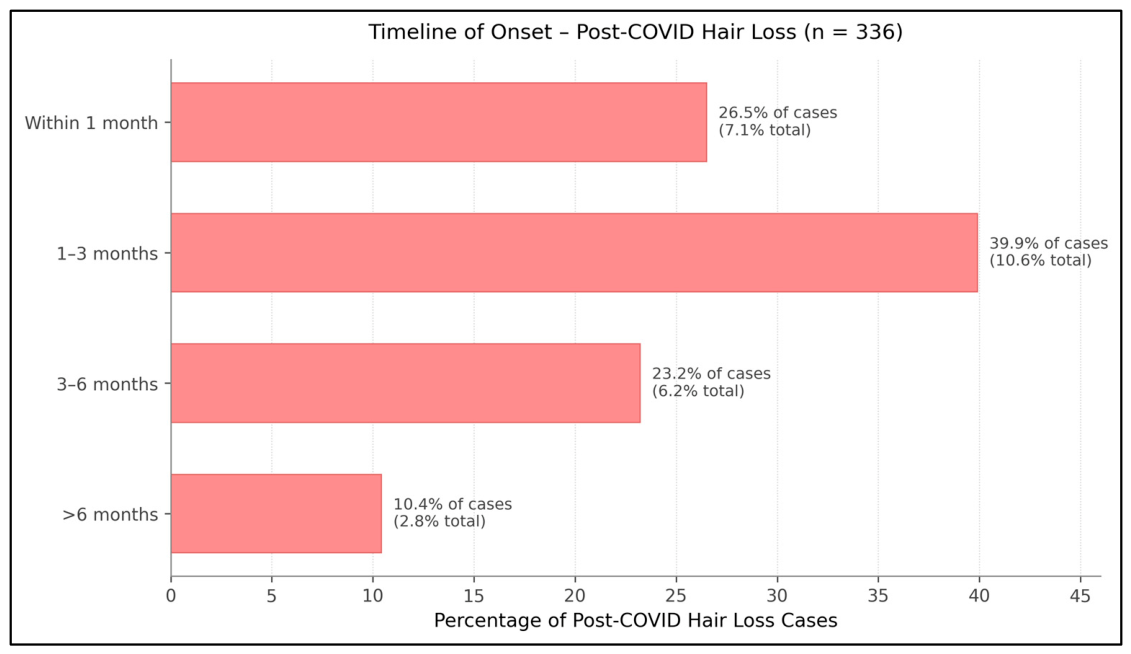
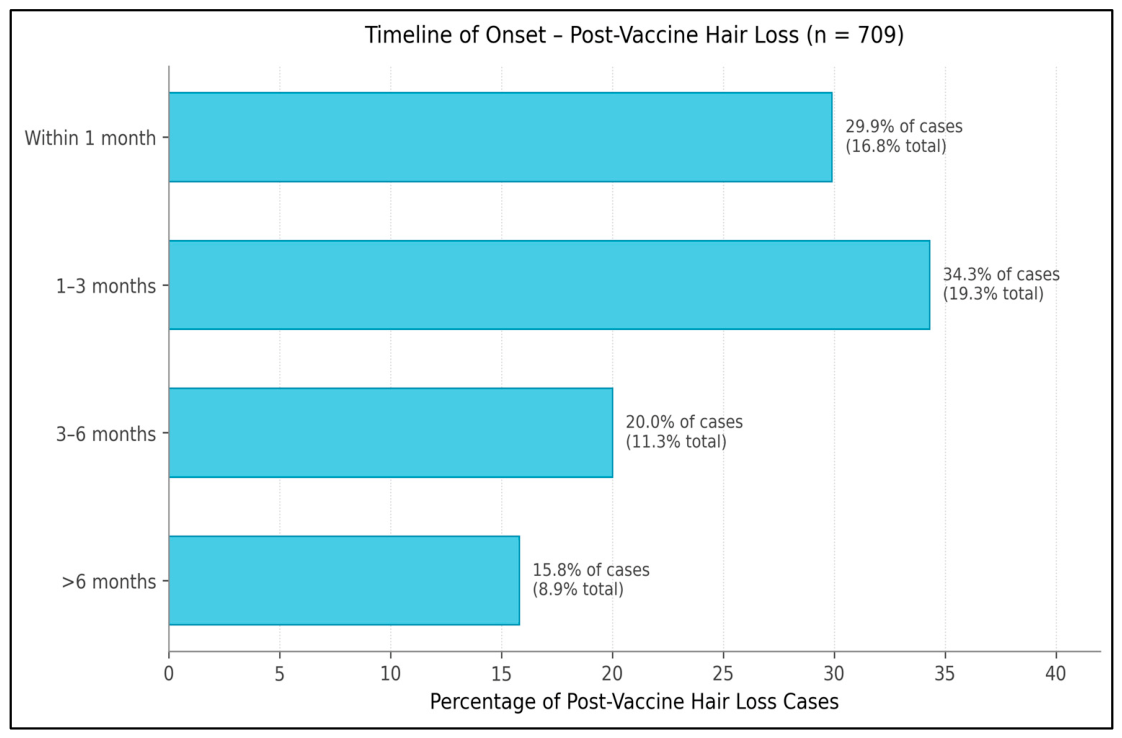
3.4. Onset and Timing of Hair Loss
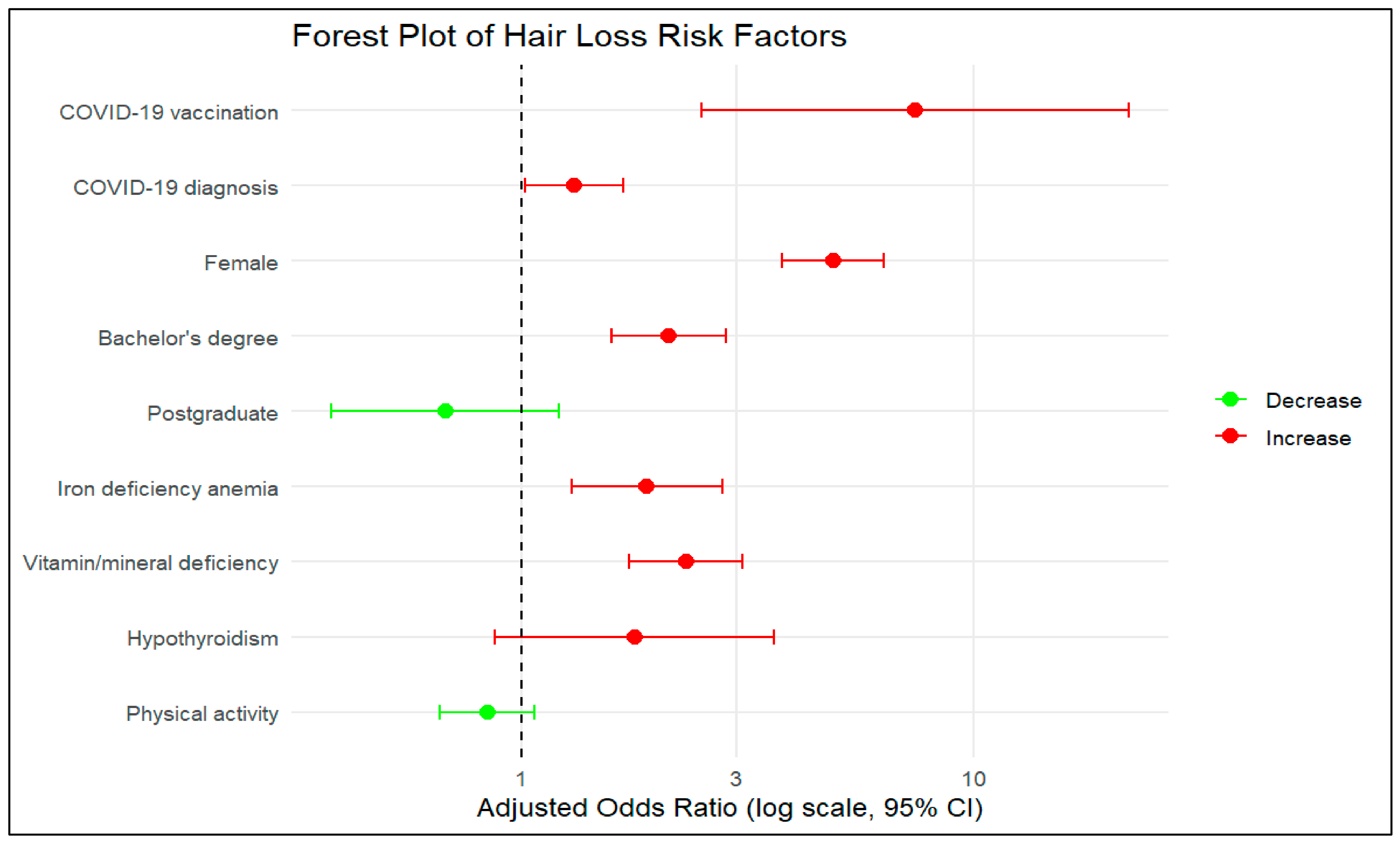
3.5. Factors Associated with Hair Loss
4. Discussion
4.1. Key Findings
4.2. Prevalence in Context
4.3. Comparative Risk: Vaccination, Infection, and the Broader Evidence
4.4. Predominant Pattern and Proposed Mechanisms
4.5. Comorbidities and Lifestyle
4.6. Modifiable Determinants: Female Sex and Nutritional Status
4.7. Clinical Implications
4.8. Strengths and Limitations
5. Conclusions
Author Contributions
Funding
Institutional Review Board Statement
Informed Consent Statement
Data Availability Statement
Acknowledgments
Conflicts of Interest
Abbreviations
| AA | Alopecia Areata |
| COVID-19 | Coronavirus Disease 2019 |
| SALT | Severity of Alopecia Tool |
| aOR | Adjusted Odds Ratio |
| TE | Telogen Effluvium |
References
- Subaiea, G.M.; Alkhateeb, N.; Sahman, F.; Alsudayri, A.; Almudayni, A.M.; Alrashidi, H.; Alshammari, A.M.; Alamri, A.; Almuntashiri, S.; Hussain, A.; et al. Charting the COVID-19 vaccination journey in Saudi Arabia: Insights into post-vaccination adverse effects and immunization dynamics. Front. Pharmacol. 2025, 16, 1561410. [Google Scholar] [CrossRef] [PubMed] [PubMed Central]
- Villasante Fricke, A.C.; Miteva, M. Epidemiology and burden of alopecia areata: A systematic review. Clin. Cosmet. Investig. Dermatol. 2015, 8, 397–403. [Google Scholar] [CrossRef] [PubMed]
- Alharbi, M. Telogen effluvium after COVID-19 vaccination among public in Saudi Arabia. J. Fam. Med. Prim. Care 2022, 11, 6056–6060. [Google Scholar] [CrossRef] [PubMed]
- Ammar, A.M.; Ibrahim, I.S.; Mohamed, A.N.; Elsaie, M.L. Dermoscopy-assisted prevalence of hair loss after COVID-19 vaccination among Egyptian population. Ir. J. Med. Sci. 2024, 193, 755–760. [Google Scholar] [CrossRef] [PubMed]
- Birkett, L.; Singh, P.; Mosahebi, A.; Dhar, S. Possible associations between alopecia areata and COVID-19 vaccination and infection. Aesthetic Surg. J. 2022, 42, NP699–NP702. [Google Scholar] [CrossRef] [PubMed]
- Hadshiew, I.M.; Foitzik, K.; Arck, P.C.; Paus, R. Burden of hair loss: Stress and the underestimated psychosocial impact of telogen effluvium and androgenetic alopecia. J. Investig. Dermatol. 2004, 123, 455–457. [Google Scholar] [CrossRef] [PubMed]
- Abedini, R.; Hallaji, Z.; Lajevardi, V.; Nasimi, M.; Khaledi, M.K.; Tohidinik, H.R. Quality of life in mild and severe alopecia areata patients. Int. J. Women’s Dermatol. 2017, 4, 91–94. [Google Scholar] [CrossRef] [PubMed]
- Alzoabi, N.M.; Alsharif, H.M.; Alawami, A.M.; Habarah, H.H.; Alhawaj, H.A.; Rubaian, N.B.; Alqahtani, J.M. Assessing the impact of alopecia on quality of life, depression, and self-esteem in Saudi Arabia. Cureus 2023, 15, e49864. [Google Scholar] [CrossRef]
- Hernández-Arroyo, J.; Izquierdo-Condoy, J.S.; Ortiz-Prado, E. A case series and literature review of telogen effluvium and alopecia universalis after administration of a heterologous COVID-19 vaccine scheme. Vaccines 2023, 11, 444. [Google Scholar] [CrossRef]
- Zhu, Y.; Ouyang, X.; Zhang, D.; Wang, X.; Wu, L.; Yu, S.; Tan, Y.; Li, W.; Li, C. Alopecia areata following COVID-19 vaccine: A systematic review. Eur. J. Med. Res. 2024, 29, 356. [Google Scholar] [CrossRef]
- Setia, M.S. Methodology series module 3: Cross-sectional studies. Indian J. Dermatol. 2016, 61, 261–264. [Google Scholar] [CrossRef] [PubMed] [PubMed Central]
- Bukhari, A.E.; AlDosari, D.A.; AlDosari, M.A.; Muqrin, R.F.; Moazin, O.M.; Almutlq, M.M.; Altalhab, S.M.; Alharithy, R.S.; Alkhalifah, A.I. COVID-19-induced hair shedding and related risk factors: A Saudi perspective. J. Fam. Med. Prim. Care 2023, 12, 3304–3311. [Google Scholar] [CrossRef] [PubMed] [PubMed Central]
- Yousif, M.; Al-Jumeily, D.; Al-Amran, F.; Sadeq, A.; Rawaf, S. Effect of COVID-19 Vaccines on Hair Loss. Health Educ. Health Promot. 2023, 11, 1001–1005. [Google Scholar]
- Santoro, C. New Study Suggests Alopecia After COVID-19 Vaccine Rare but Possible. The American Journal of Managed Care, 18 July 2024. Available online: https://www.ajmc.com/view/new-study-suggests-alopecia-after-covid-vaccine-rare-but-possible (accessed on 15 March 2026).
- Cho, Y.; Lim, J.W.; Yoon, Y.N.; Kim, C.Y.; Lee, Y.W.; Choe, Y.B.; Yu, D.A. New Onset of Hair Loss Disorders During the Coronavirus Disease 2019 Pandemic: A Korean Nationwide Population-Based Study. Ann. Dermatol. 2025, 37, 250–258. [Google Scholar] [CrossRef] [PubMed] [PubMed Central]
- Gallo, G.; Mastorino, L.; Tonella, L.; Ribero, S.; Quaglino, P. Alopecia areata after COVID-19 vaccination. Clin. Exp. Vaccine Res. 2022, 11, 129–132. [Google Scholar] [CrossRef] [PubMed] [PubMed Central]
- Seyfi, S.; Alijanpour, R.; Aryanian, Z.; Ezoji, K.; Mahmoudi, M. Prevalence of telogen effluvium hair loss in COVID-19 patients and its relationship with disease severity. J. Med. Life 2022, 15, 631–634. [Google Scholar] [CrossRef] [PubMed] [PubMed Central]



| Characteristic | n (%) |
|---|---|
| Demographics | |
| Gender | |
| Male | 478 (37.9%) |
| Female | 783 (62.1%) |
| Age, mean ± SD (years) | 28.0 ± 9.6 |
| Nationality | |
| Saudi | 1153 (91.4%) |
| Non-Saudi | 108 (8.6%) |
| Residence | |
| Urban | 942 (74.7%) |
| Rural | 319 (25.3%) |
| Education | |
| High school or less | 261 (20.7%) |
| Bachelor’s degree | 928 (73.6%) |
| Postgraduate | 72 (5.7%) |
| Occupation | |
| Student | 653 (51.8%) |
| Employed | 516 (40.9%) |
| Unemployed | 92 (7.3%) |
| Region | |
| Southern | 738 (58.5%) |
| Central | 284 (22.5%) |
| Western | 151 (12.0%) |
| Eastern | 88 (7.0%) |
| Health Status | |
| Iron deficiency anemia | 225 (17.8%) |
| Vitamin/mineral deficiency | 433 (34.3%) |
| Diabetes mellitus | 87 (6.9%) |
| Hypertension | 67 (5.3%) |
| Hypothyroidism | 55 (4.4%) |
| Lifestyle Factors | |
| Physical activity | 555 (44.0%) |
| Current smoking | 206 (16.3%) |
| Ex-smoking | 74 (5.9%) |
| Characteristic | n (%) |
|---|---|
| COVID-19 Diagnosis | |
| Yes | 676 (53.6%) |
| No | 585 (46.4%) |
| COVID-19 Vaccination Status | |
| Vaccinated | 1232 (97.7%) |
| Unvaccinated | 29 (2.3%) |
| Vaccination Schedule (among vaccinated, n = 1232) | |
| One dose | 101 (8.2%) |
| Two doses | 415 (33.7%) |
| Three doses | 716 (58.1%) |
| First Dose Vaccine Type (n = 1232) | |
| Pfizer-BioNTech | 936 (76.0%) |
| Moderna | 189 (15.3%) |
| AstraZeneca | 95 (7.7%) |
| Johnson & Johnson | 12 (1.0%) |
| Vaccine Type Pattern (n = 1232) | |
| Single vaccine type | 787 (63.9%) |
| Combination of vaccines | 445 (36.1%) |
| Hair Loss Category | n (%) |
|---|---|
| Overall Hair Loss Status | |
| Hair loss | 787 (62.4%) |
| No hair loss | 474 (37.6%) |
| Hair Loss by Exposure Status | |
| Hair loss reported after COVID-19 infection: | |
| Among COVID-positive participants (n = 676) | 336 (49.7%) |
| Among COVID-negative participants (n = 585) | 0 (0%) |
| Hair loss reported after vaccination: | |
| Among vaccinated participants (n = 1232) | 709 (57.5%) |
| Among unvaccinated participants (n = 29) | 0 (0%) |
| Hair Loss Patterns (among those with hair loss, n = 787) | |
| Telogen effluvium | 443 (56.3% of cases; 35.1% of total) |
| Androgenetic alopecia | 309 (39.3% of cases; 24.5% of total) |
| Alopecia areata | 21 (2.7% of cases; 1.7% of total) |
| Other/unspecified | 14 (1.8% of cases; 1.1% of total) |
| Associated Factors | |
| Stress-related hair loss | 434 (34.4% of total sample) |
| Diet-related hair loss | 193 (15.3% of total sample) |
| No identifiable trigger | 634 (50.3% of total sample) |
| Variable | Category | No Hair Loss | Hair Loss | OR (95% CI) | p-Value |
|---|---|---|---|---|---|
| n = 474 (%) | n = 787 (%) | ||||
| Demographics | |||||
| Gender | Male | 297 (62.1%) | 181 (37.9%) | 1.00 (ref) | - |
| Female | 177 (22.6%) | 606 (77.4%) | 5.63 (4.50–7.04) | <0.001 | |
| Age (years) | Mean ± SD | 27.0 ± 9.2 | 28.3 ± 9.8 | 1.01 (1.00–1.03) | 0.015 |
| Nationality | Saudi | 428 (37.1%) | 725 (62.9%) | 1.00 (ref) | - |
| Non-Saudi | 46 (42.6%) | 62 (57.4%) | 0.80 (0.53–1.20) | 0.279 | |
| Education | High school or less | 139 (53.3%) | 122 (46.7%) | 1.00 (ref) | - |
| Bachelor’s degree | 289 (31.1%) | 639 (68.9%) | 2.52 (1.94–3.27) | <0.001 | |
| Postgraduate | 46 (63.9%) | 26 (36.1%) | 0.64 (0.37–1.12) | 0.119 | |
| COVID-19 Related Exposures | |||||
| COVID-19 diagnosis | No | 260 (44.4%) | 325 (55.6%) | 1.00 (ref) | - |
| Yes | 214 (31.7%) | 462 (68.3%) | 1.73 (1.39–2.15) | <0.001 | |
| COVID-19 vaccination | No | 25 (86.2%) | 4 (13.8%) | 1.00 (ref) | - |
| Yes | 449 (36.4%) | 783 (63.6%) | 10.89 (3.78–31.42) | <0.001 | |
| Clinical Conditions | |||||
| Diabetes mellitus | No | 451 (38.4%) | 723 (61.6%) | 1.00 (ref) | - |
| Yes | 23 (26.4%) | 64 (73.6%) | 1.73 (1.06–2.84) | 0.029 | |
| Hypertension | No | 456 (38.2%) | 738 (61.8%) | 1.00 (ref) | - |
| Yes | 18 (26.9%) | 49 (73.1%) | 1.68 (0.96–2.95) | 0.068 | |
| Iron deficiency anemia | No | 425 (41.0%) | 611 (59.0%) | 1.00 (ref) | - |
| Yes | 49 (21.8%) | 176 (78.2%) | 2.50 (1.77–3.52) | <0.001 | |
| Vitamin/mineral deficiency | No | 379 (45.8%) | 449 (54.2%) | 1.00 (ref) | - |
| Yes | 95 (21.9%) | 338 (78.1%) | 3.00 (2.31–3.90) | <0.001 | |
| Hypothyroidism | No | 463 (38.4%) | 743 (61.6%) | 1.00 (ref) | - |
| Yes | 11 (20.0%) | 44 (80.0%) | 2.49 (1.27–4.89) | 0.007 | |
| Lifestyle Factors | |||||
| Physical activity | No | 244 (34.6%) | 462 (65.4%) | 1.00 (ref) | - |
| Yes | 230 (41.4%) | 325 (58.6%) | 0.75 (0.59–0.94) | 0.012 | |
| Smoking status | Non-smoker | 378 (38.5%) | 603 (61.5%) | 1.00 (ref) | - |
| Ex-smoker | 32 (43.2%) | 42 (56.8%) | 0.82 (0.51–1.33) | 0.426 | |
| Current smoker | 64 (31.1%) | 142 (68.9%) | 1.39 (1.01–1.91) | 0.044 |
| Variable | Category | Adjusted OR | 95% CI | p-Value |
|---|---|---|---|---|
| COVID-19 Related Factors | ||||
| COVID-19 diagnosis | No | 1.00 (ref) | - | - |
| Yes | 1.31 | 1.02–1.68 | 0.033 | |
| COVID-19 vaccination * | No | 1.00 (ref) | - | - |
| Yes | 7.45 | 2.51–22.12 | <0.001 | |
| Demographics | ||||
| Gender | Male | 1.00 (ref) | - | - |
| Female | 4.89 | 3.78–6.32 | <0.001 | |
| Age (years) | - | 1.01 | 0.99–1.03 | 0.142 |
| Education | High school or less | 1.00 (ref) | - | - |
| Bachelor’s degree | 2.12 | 1.58–2.84 | <0.001 | |
| Postgraduate | 0.68 | 0.38–1.21 | 0.189 | |
| Clinical Conditions | ||||
| Iron deficiency anemia | No | 1.00 (ref) | - | - |
| Yes | 1.89 | 1.29–2.78 | 0.001 | |
| Vitamin/mineral deficiency | No | 1.00 (ref) | - | - |
| Yes | 2.31 | 1.73–3.09 | <0.001 | |
| Hypothyroidism | No | 1.00 (ref) | - | - |
| Yes | 1.78 | 0.87–3.63 | 0.114 | |
| Lifestyle Factors | ||||
| Physical activity | No | 1.00 (ref) | - | - |
| Yes | 0.84 | 0.66–1.07 | 0.158 |
Disclaimer/Publisher’s Note: The statements, opinions and data contained in all publications are solely those of the individual author(s) and contributor(s) and not of MDPI and/or the editor(s). MDPI and/or the editor(s) disclaim responsibility for any injury to people or property resulting from any ideas, methods, instructions or products referred to in the content. |
© 2026 by the authors. Licensee MDPI, Basel, Switzerland. This article is an open access article distributed under the terms and conditions of the Creative Commons Attribution (CC BY) license.
Share and Cite
Jareebi, M.A.; Abutaleb, R.A.; Qassadi, N.M.; Akoor, A.A.; Mobarki, O.A.; Alenezi, S.S.; Alsyrwan, J.M.; Hakami, A.H.; Oraybi, R.A.; Solan, T.Y.; et al. SARS-CoV-2 Infection and COVID-19 Vaccination Associated with Post-Acute Alopecia: Prevalence, Clinical Patterns, and Determinants Among Saudi Adults. Viruses 2026, 18, 613. https://doi.org/10.3390/v18060613
Jareebi MA, Abutaleb RA, Qassadi NM, Akoor AA, Mobarki OA, Alenezi SS, Alsyrwan JM, Hakami AH, Oraybi RA, Solan TY, et al. SARS-CoV-2 Infection and COVID-19 Vaccination Associated with Post-Acute Alopecia: Prevalence, Clinical Patterns, and Determinants Among Saudi Adults. Viruses. 2026; 18(6):613. https://doi.org/10.3390/v18060613
Chicago/Turabian StyleJareebi, Mohammad A., Radwan A. Abutaleb, Norah M. Qassadi, Atheer A. Akoor, Osama A. Mobarki, Shaden S. Alenezi, Jana M. Alsyrwan, Ahlam H. Hakami, Rayim A. Oraybi, Taif Y. Solan, and et al. 2026. "SARS-CoV-2 Infection and COVID-19 Vaccination Associated with Post-Acute Alopecia: Prevalence, Clinical Patterns, and Determinants Among Saudi Adults" Viruses 18, no. 6: 613. https://doi.org/10.3390/v18060613
APA StyleJareebi, M. A., Abutaleb, R. A., Qassadi, N. M., Akoor, A. A., Mobarki, O. A., Alenezi, S. S., Alsyrwan, J. M., Hakami, A. H., Oraybi, R. A., Solan, T. Y., Darbashi, S. A., Almutairi, A. J., Almutairi, S. J., Algahtani, F. H., & Al Jowf, G. I. (2026). SARS-CoV-2 Infection and COVID-19 Vaccination Associated with Post-Acute Alopecia: Prevalence, Clinical Patterns, and Determinants Among Saudi Adults. Viruses, 18(6), 613. https://doi.org/10.3390/v18060613