The Inevitable Relationship Between Viruses and RNA Modifications Revealed Through Adenovirus Research



Abstract
1. Introduction
2. Modifications of Adenovirus Early mRNA and Their Interplay in the Virus Life Cycle
2.1. The Importance of Capturing the Full Picture of mRNA and Pre-mRNA Modifications in a Single Experiment
2.2. Information Related to Virus Proliferation Is Possessed by Polyribosomes and Cap Structures
3. Occurrence of Internal m6A in Viral mRNA, Viral Genomic RNA and Non-Coding RNA in Normal and Transformed Cells
3.1. Early and Late Adenoviral mRNAs
3.2. SV40
3.3. Kaposi’s Sarcoma-Associated Herpesvirus (KSHV)
3.4. Non-Segmented Negative-Sense RNA Viruses (NNS RNA Viruses)
3.5. Occurrence of m6A in ncRNAs
4. Regulation of Viral Gene Expression by Small RNAs and ncRNAs
5. Alternative Splicing (AS) Has Been Observed in mRNA Derived from the Adenovirus Oncogene E1
5.1. The Transcription Start Site (TSS) of Adenovirus Early mRNA Is Extremely Complex
5.2. E1a-E1b Cotranscripts Are Candidates for Alternative Splicing of mRNA and Are Found in mRNAs Transcribed from the E1 Region of Adenovirus Type 2, 5, 7, 12, and 40
5.3. HAdV-F40: HAdV-F40 Propagation Is Enhanced Through the Synthesis of mRNA with Alternative Splicing in E1 Region
5.4. E4 Region: Another Adenovirus Oncogene
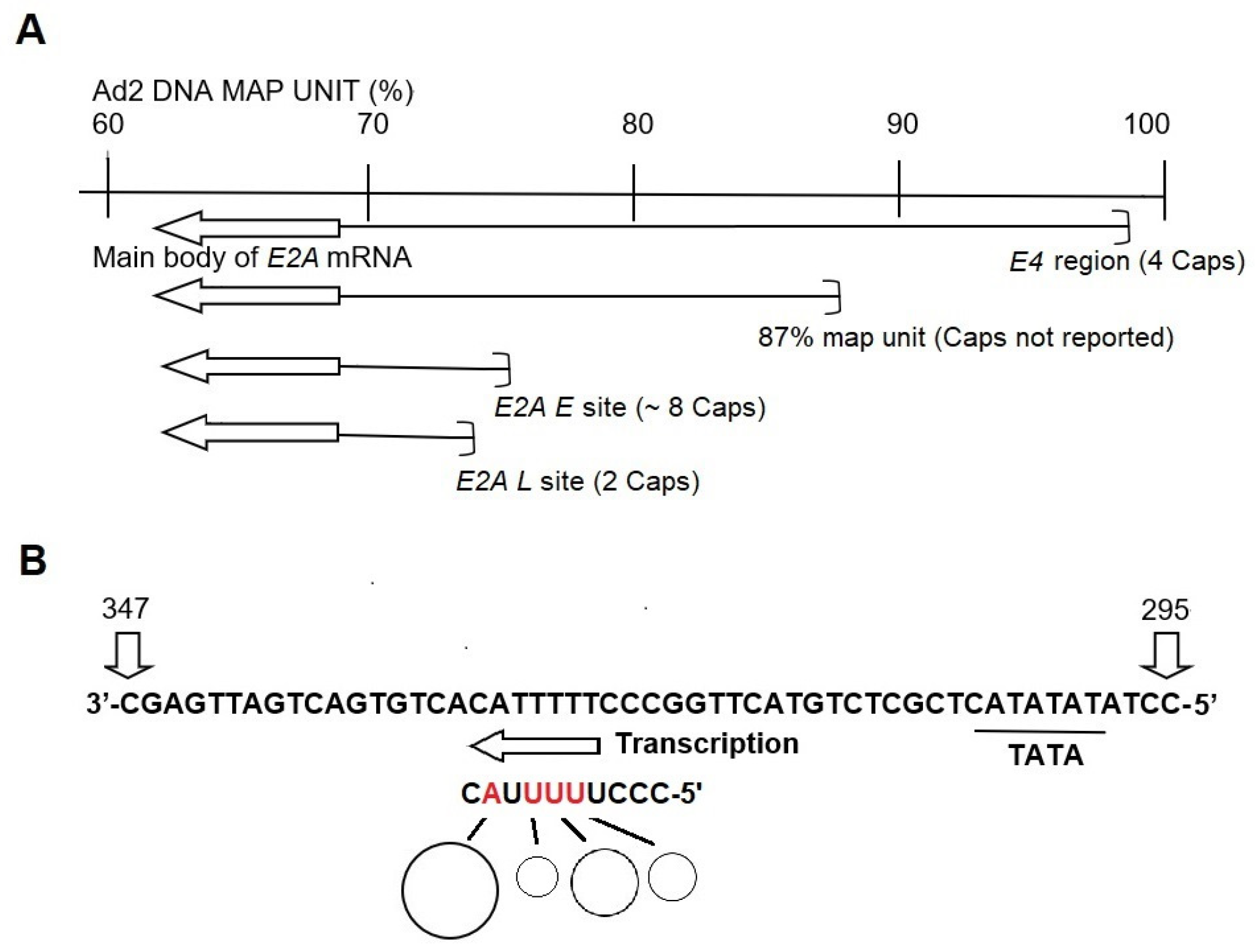
5.5. Advantages of Promoter Sharing Between E4 mRNA and E2 mRNA
6. Concluding Remarks
Author Contributions
Funding
Institutional Review Board Statement
Informed Consent Statement
Data Availability Statement
Acknowledgments
Conflicts of Interest
References
- Furuichi, Y.; Miura, K.I. A blocked structure at the 5′-terminus of mRNA from cytoplasmic polyhedrosis virus. Nature 1975, 253, 374–375. [Google Scholar] [CrossRef]
- Furuichi, Y.; Morgan, M.; Muthukrishnan, S.; Shatkin, A.J. Reovirus messenger RNA contains a methylated blocked 5′-terminal structure m-7G(5′)ppp(5′)G-MPCp-. Proc. Natl. Acad. Sci. USA 1975, 72, 362–366. [Google Scholar] [CrossRef]
- Moyer, S.A.; Abraham, G.; Adler, R.; Banerjee, A.K. Methylated and blocked 5′ termini in vesicular stomatitis virus in vivo mRNAs. Cell 1975, 5, 59–67. [Google Scholar] [CrossRef]
- Bondurant, M.; Hashimoto, S.; Green, M. Methylated pattern of genomic RNA from Moloney murine leukemia virus. J. Virol. 1976, 19, 998–1005. [Google Scholar] [CrossRef]
- Furuichi, Y.; Shatkin, A.J.; Stavnezer, E.; Bishop, J.M. Blocked methylated 5′-terminal sequences in avian sarcoma virus RNA. Nature 1975, 257, 618–620. [Google Scholar] [CrossRef]
- Keith, J.; Frankel-Conrat, H. Identification of the 5′ end of Rous sarcoma virus RNA. Proc. Natl. Acad. Sci. USA 1975, 72, 3347–3350. [Google Scholar] [CrossRef]
- Wei, C.M.; Moss, B. Methylated nucleotides block 5′-terminus of vaccinia virus messenger RNA. Proc. Natl. Acad. Sci. USA 1975, 72, 318–322. [Google Scholar] [CrossRef] [PubMed]
- Aloni, Y. Methylated SV40 mRNAs. FEBS Lett. 1975, 54, 363–367. [Google Scholar] [CrossRef] [PubMed]
- Fernandez, S.M.; Raskas, H.J. Methylation of cytoplasmic adenovirus RNA synthesized early and late in productive infection. Biochem. Biophys. Res. Commun. 1975, 66, 67–74. [Google Scholar] [CrossRef] [PubMed]
- Moss, B.; Koczot, F. Sequence of methylated nucleotides at the 5′-terminus of adenovirus specific RNA. J. Virol. 1976, 17, 385–392. [Google Scholar] [CrossRef]
- Wold, W.S.M.; Green, M.; Munns, T.W. Methylation of late adenovirus 2 nuclear and messenger RNA. Biochem. Biophys. Res. Commun. 1976, 68, 643–649. [Google Scholar] [CrossRef]
- Thomas, D.C.; Green, M. Biochemical studies on adenovirus multiplication XV. Transcription of adenovirus type 2 genome during productive infection. Virology 1969, 39, 205–210. [Google Scholar] [CrossRef]
- Parsons, J.T.; Green, M. Biochemical studies on adenovirus multiplication. 18. Resolution of early virus-specific RNA species in Ad 2 infected and transformed cells. Virology 1971, 45, 154–162. [Google Scholar] [CrossRef]
- Berget, S.M.; Moore, C.; Sharp, P.A. Spliced segments at the 5′terminus adenovirus 2 late mRNA. Proc. Natl. Acad. Sci. USA 1977, 74, 3171–3175. [Google Scholar] [CrossRef]
- Chow, L.T.; Gelinas, R.E.; Broker, T.R.; Roberts, R.J. An amazing sequence arrangement at the 5′ ends of adenovirus 2 messenger RNA. Cell 1977, 12, 1–8. [Google Scholar] [CrossRef] [PubMed]
- Zhang, Y.; Qian, J.; Gu, C.; Yang, Y. Alternative splicing and cancer: A systemic review. Signal Transduct. Target. Ther. 2021, 6, 78. [Google Scholar] [CrossRef] [PubMed]
- Cole, C.N. Polyomavirinae: The Viruses and Their Replication. In Fields Virology, 3rd ed.; Fields, B.N., Knipe, D.M., Howley, P.M., Eds.; Lippincott-Rave: Philadelphia, NY, USA, 1996; Volume 2, pp. 1997–2025. [Google Scholar]
- Howley, P.M. Papillomavirinae: The Viruses and Their Replication. In Fields Virology, 3rd ed.; Fields, B.N., Knipe, P.M., Howley, P.M., Eds.; Lippincott–Laven: Philadelphia, NY, USA, 1996; Volume 2, pp. 2045–2074. [Google Scholar]
- Munger, K.; White, E.A. What are the essential determinants of human papillomavirus carcinogenesis? mBio 2024, 5, e0046224. [Google Scholar] [CrossRef] [PubMed]
- Motorin, Y.; Helm, M. General principles and limitations for detection of RNA modifications by sequencing. Acc. Chem. Res. 2024, 57, 275–288. [Google Scholar] [CrossRef]
- Sağlam, B.; Akgül, B. An overview of current detection methods for RNA methylation. Int. J. Mol. Sci. 2024, 25, 3098. [Google Scholar] [CrossRef]
- Shi, H.; Wei, J.; He, C. Where, When, and How; Context-dependent functions of RNA methylation writers, readers, and erasers. Mol. Cell 2019, 74, 640–650. [Google Scholar] [CrossRef]
- Wu, F.; Cheng, W.; Zhao, F.; Tang, M.; Diao, Y.; Xu, R. Association of N6-methyadenosine with viruses and related diseases. Virol. J. 2019, 16, 133. [Google Scholar] [CrossRef]
- Barbieri, I.; Kouzarides, T. Role of RNA modifications in cancer. Nat. Rev. Cancer 2020, 20, 303–322. [Google Scholar] [CrossRef]
- Wang, S.; Lv, W.; Li, T.; Zhang, S.; Wang, H.; Li, X.; Wang, L.; Ma, D.; Zang, Y.; Shen, J.; et al. Dynamic regulation and functions of mRNA m6A modification. Cancer Cell Int. 2022, 22, 48. [Google Scholar] [CrossRef]
- Wei, G. RNA m6A modification, signals for degradation or stability? Biochem. Soc. Trans. 2024, 52, 707–717. [Google Scholar] [CrossRef]
- Büttner, W.; Veres-Molnar, Z.; Green, M. Isolation of DNA strand-specific early messenger RNA species in cell infected by human adenovirus 2 infected cells. Proc. Natl. Acad. Sci. USA 1974, 71, 2951–2955. [Google Scholar] [CrossRef] [PubMed]
- Büttner, W.; Veres-Molnár, Z.; Green, M. Preparative isolation and mapping of adenovirus 2 early messenger RNA species. J. Mol. Biol. 1976, 107, 93–114. [Google Scholar] [CrossRef]
- Hashimoto, S.; Green, M. Multiple methylated cap sequences in adenovirus type 2 early mRNA. J. Virol. 1976, 20, 425–435. [Google Scholar] [CrossRef] [PubMed]
- Xu, N.; Segerman, B.; Zhou, X.; Akusjärvi, G. Adenovirus virus-associated RNAII- derived small RNAs are efficiently incorporated into the RNA-induced silencing complex and associate with polyribosomes. J. Virol. 2007, 81, 10540–10549. [Google Scholar] [CrossRef]
- Cech, T.R.; Steitz, J.A. The noncoding RNA revolution-trashing old rules to new ones. Cell 2014, 157, 77–94. [Google Scholar] [CrossRef]
- Hashimoto, S.; Green, M. Methylated 5′-terminal caps of adenovirus type 2 early mRNA: Evidence for at least six 5′-termini. Virology 1979, 94, 254–272. [Google Scholar] [CrossRef] [PubMed]
- Zhou, K.I.; Pecot, C.V.; Holley, C.L. 2′-O-methylation (Nm) in RNA: Progress, challenges, and future directions. RNA 2024, 30, 570–582. [Google Scholar] [CrossRef]
- Kim, J.; Krichevsky, A.; Grad, Y.; Hayes, G.D.; Kosik, K.S.; Church, G.M.; Ravkun, G. Identification of many microRNAs that copurify with polyribosomes in mammalian neurons. Proc. Natl. Acad. Sci. USA 2004, 101, 360–365. [Google Scholar] [CrossRef]
- Ramanathan, A.; Robb, G.B.; Chan, S.-H. mRNA capping: Biological functions and applications. Nucleic Acids Res. 2016, 44, 7511–7526. [Google Scholar] [CrossRef] [PubMed]
- Inagaki, M.; Abe, N.; Li, Z.; Nakashima, Y.; Acharyya, S.; Ogawa, K.; Kawaguchi, D.; Hiraoka, H.; Banno, A.; Meng, Z.; et al. Cap analogs with a hydrophobic photocleavable tag enable facile purification of fully capped mRNA with various cap structures. Nat. Commun. 2023, 14, 2657. [Google Scholar] [CrossRef] [PubMed]
- Despic, V.; Jaffrey, S.R. mRNA ageing shapes the Cap2 methylome in mammalian mRNA. Nature 2023, 614, 358–366. [Google Scholar] [CrossRef] [PubMed]
- Kariko, K.; Buckstein, M.; Ni, H.; Weissman, D. Suppression of RNA recognition by Toll-like receptors: The impact of nucleoside modification and the evolutionary origin of RNA. Immunity 2005, 23, 165–175. [Google Scholar] [CrossRef]
- Sommer, S.; Salditt-Georgieff, M.; Bachenheimer, S.; Darnell, J.E.; Furuichi, Y.; Morgan, M.; Shatkin, A.J. The methylation of adenovirus-specific nuclear and cytoplasmic RNA. Nucleic Acids Res. 1976, 3, 749–765. [Google Scholar] [CrossRef]
- Price, A.M.; Hayer, K.E.; McIntyre, A.B.R.; Gokhale, N.S.; Abebe, J.S.; Della Fera, A.N.; Mason, C.E.; Horner, S.M.; Wilson, A.C.; Depledge, D.P.; et al. Direct RNA sequencing reveals m(6)A modifications on adenovirus RNA are necessary for efficient splicing. Nat. Commun. 2020, 11, 6016. [Google Scholar] [CrossRef]
- Tan, B.; Gao, S.J. The RNA Epitrascriptome of DNA Viruses. J. Virol. 2018, 92, e00696–18. [Google Scholar] [CrossRef]
- Tsai, K.; Courtney, D.G.; Cullen, B.R. Addition of m6A to SV40 structural gene expression and replication. PLoS Patholog. 2018, 14, e1006919. [Google Scholar]
- Macveigh-Fierro, D.; Cicerchia, A.; Cadorette, A.; Sharma, V.; Muller, M. The m6A reader YTHDC2 is essential for escape from KSHV SOX-induced RNA decay. Proc. Natl. Acad. Sci. USA 2022, 119, e2116662119. [Google Scholar] [CrossRef]
- Lu, M.; Xue, M.; Wang, H.-T.; Kairis, E.L.; Ahmad, S.; Wei, J.; Zhang, Z.; Liu, Q.; Zhang, Y.; Gao, Y.; et al. Nonsegmental negative-sense RNA viruses utilize N6-methyladenosine (m6A) as a common strategy to evade host innate immunity. J. Virol. 2021, 95, e01939-20. [Google Scholar] [CrossRef] [PubMed]
- Luo, L.; Zhen, Y.; Peng, D.; Wei, C.; Zhang, X.; Liu, X.; Han, L.; Zhang, Z. The role of N6-methyladenosine-modified non-coding RNAs in the pathological process of human cancer. Cell Death Discov. 2022, 8, 325. [Google Scholar] [CrossRef] [PubMed]
- Duan, Y.; Sun, L.; Li, Q. Herpes Simplex Virus 1 MicroRNAs: An Update. Intervirology 2023, 66, 97–110. [Google Scholar] [CrossRef]
- Sullivan, C.S.; Grundhoff, A.T.; Tevethia, S.; Pipas, J.M.; Ganem, D. SV40-encoded microRNAs regulate viral gene expression and reduce susceptibility to cytotoxic T cells. Nature 2005, 435, 682–686. [Google Scholar] [CrossRef]
- Jopling, C.L.; Yi, M.; Lancaster, A.M.; Lemon, S.M.; Sarnow, P. Modulation of hepatitis C virus RNA abundance by a liver-specific MicroRNA. Science 2005, 309, 1577–1581. [Google Scholar] [CrossRef] [PubMed]
- Triboulet, R.; Mari, B.; Lin, Y.-L.; Chable-Bessia, C.; Bennasser, Y.; Lebrigand, K.; Cardinaud, B.; Maurin, T.; Barbry, P.; Baillat, V.; et al. Suppression of microRNA-silencing pathway by HIV-1 during virus replication. Science 2007, 315, 1579–1582. [Google Scholar] [CrossRef]
- Lecellier, C.-H.; Dunoyer, P.; Arar, K.; Lehmann-Che, J.; Eyquem, S.; Himber, C.; Saib, A.; Voinnet, O. A cellular microRNA mediates antiviral defense in human cells. Science 2005, 308, 557–560. [Google Scholar] [CrossRef]
- Otsuka, M.; Jing, Q.; Georgel, P.; New, L.; Chen, J.; Mols, J.; Kang, Y.J.; Jiang, Z.; Du, X.; Cook, R.; et al. Hypersusceptibility to vesicular stomatitis virus infection in Dicer1-deficient mice is due to impaired miR24 and miR93 expression. Immunity 2007, 27, 123–134. [Google Scholar] [CrossRef]
- Reich, P.R.; Forget, B.G.; Weissman, S.M. RNA of low molecular weight in KB cells infected with adenovirus type 2. J. Mol. Biol. 1966, 17, 428–439. [Google Scholar] [CrossRef]
- Shenk, T. Adenoviridae: The Viruses and Their Replication. In Fields Virology, 3rd ed.; Fields, B.N., Knipe, P.M., Howley, P.M., Eds.; Lippincott-Rave: Philadelphia, NY, USA, 1996; Volume 2, pp. 2111–2148. [Google Scholar]
- Sano, M.; Kato, Y.; Taira, K. Sequence-specific interference by small RNAs derived from adenovirus VAI RNA. FEBS Lett. 2006, 580, 1553–1564. [Google Scholar] [CrossRef] [PubMed]
- Aparicio, O.; Razquin, N.; Zaratiegui, M.; Narvaiza, I.; Fortes, P. Adenovirus associated RNA is processed to functional interfering RNAs involved in virus production. J. Virol. 2006, 80, 1376–1384. [Google Scholar] [CrossRef] [PubMed]
- Punga, T.; Darweesh, M.; Akusjärvi, G. Synthesis, Structure, and Function of Human Adenovirus Small Non-Coding RNAs. Viruses 2020, 12, 1182. [Google Scholar] [CrossRef]
- Kamel, W.; Akusjärvi, G. An Ago2-associated capped transcriptional start site small RNA suppresses adenovirus DNA replication. RNA 2017, 23, 1700–1711. [Google Scholar] [CrossRef]
- Crisostomo, L.; Soriano, A.M.; Mendez, M.; Graves, D.; Pelka, P. Temporal dynamics of adenovirus 5 gene expression in normal human cells. PLoS ONE 2019, 14, e0211192. [Google Scholar] [CrossRef]
- Hashimoto, S.; Sakakibara, N.; Kumai, H.; Nakai, M.; Sakuma, S.; Chiba, S.; Fujinaga, K. Fastidious human adenovirus type 40 can propagate efficiently and produce plaques on a human cell line, A549, derived from lung carcinoma. J. Virol. 1991, 65, 2429–2435. [Google Scholar] [CrossRef] [PubMed]
- Steinthorsdottir, V.; Mautner, V. Enteric adenovirus type 40: E1B transcription map and identification of novel E1A-E1B cotranscripts in lytically infected cells. Virology 1991, 181, 139–149. [Google Scholar] [CrossRef]
- Ishida, S.; Fujinaga, Y.; Fujinaga, K.; Sakamoto, N.; Hashimoto, S. Unusual splice sites in the E1A-E1B cotranscripts synthesized in adenovirus type 40-infected A549 cells. Arch. Virol. 1994, 139, 389–402. [Google Scholar] [CrossRef]
- Clark, D.P.; Pazdernik, N.J. Polymerase Chain Reaction: In Molecular Biology, 2nd ed.; Clark, D.P., Pazdernik, N.J., Eds.; Elsevier: Amsterdam, The Netherlands, 2013; pp. e55–e65. [Google Scholar]
- Adiconis, X.; Harber, A.; Simmons, S.K.; Moonshine, A.L.; Ji, Z.; Busby, M.A.; Shi, X.; Jacques, J.; Lancaster, M.A.; Pan, J.Q.; et al. Comprehensive comparative analysis of 5′-end RNA-sequencing methods. Nat. Methods 2018, 15, 505–511. [Google Scholar] [CrossRef]
- Berk, A.J.; Sharp, P.A. Structure of the adenovirus 2 early mRNAs. Cell 1978, 14, 695–711. [Google Scholar] [CrossRef]
- Chow, L.T.; Broker, T.R.; Lewis, J.B. Complex splicing patterns of RNAs from the early regions of adenovirus-2. J. Mol. Biol. 1979, 134, 265–303. [Google Scholar] [CrossRef]
- Mathis, D.J.; Elkaim, R.; Kédinger, C.; Sassone-Corsi, P.; Chambon, P. Specific in vitro initiation of transcription on the adenovirus type 2 early and late EII transcription units. Proc. Natl. Acad. Sci. USA 1981, 78, 7383–7387. [Google Scholar] [CrossRef] [PubMed]
- Kitani-Yasuda, T.; Yasuda, N.; Hashimoto, S. Activation of the adenovirus-2 E2a late promoter during inhibition of protein synthesis by cycloheximide. Gene 1988, 69, 165–169. [Google Scholar] [CrossRef]
- Hashimoto, S.; Pursley, M.H.; Wold, W.S.; Green, M. Characterization of distinct 5′- terminal cap structures of adenovirus type 2 early messenger ribonucleic acid and KB cell messenger ribonucleic acid. Biochemistry 1980, 19, 294–300. [Google Scholar] [CrossRef]
- Hashimoto, S.; Green, M. Adenovirus 2 early messenger RNA-genome mapping of 5′-terminal RNase T1 oligonucleotides and heterogeneity of 5′-termini. J. Biol. Chem. 1980, 255, 6780–6788. [Google Scholar] [CrossRef]
- Brownlee, G.G.; Sanger, F. Chromatography of 32P-labelled oligonucleotides on thin layers of DEAE-cellulose. Eur. J. Biochem. 1969, 11, 395–399. [Google Scholar] [CrossRef]
- Branch, A.D.; Benenfeld, B.J.; Robertson, H.D. RNA fingerprinting. In Methods in Enzymology; Academic Press: Cambridge, MA, USA, 1989; Volume 180, pp. 130–154. [Google Scholar]
- Hashimoto, S.; Pursley, M.H.; Green, M. Nucleotide sequences and mapping of novel heterogenous 5′-termini of adenovirus 2 early region 4 mRNA. Nucleic Acids Res. 1981, 9, 1675–1689. [Google Scholar] [CrossRef] [PubMed]
- Hashimoto, S.; Green, M. Unusual heterogeneity of the 5′-termini of human adenovirus type 2 early region E2 mRNA. Nucleic Acids Res. 1984, 12, 9067–9082. [Google Scholar] [CrossRef]
- Hashimoto, S.; Wold, W.S.; Brackmann, K.H.; Green, M. Nucleotide sequences of 5′ termini of adenovirus 2 early transforming region E1a and E1b messenger ribonucleic acids. Biochemistry 1981, 20, 6640–6647. [Google Scholar] [CrossRef]
- Hashimoto, S.; Symington, J.; Matsuo, T. Cell-free translation of adenovirus 2 E1a- and E1b-specific mRNAs and evidence that E1a-related polypeptides are produced from E1a-E1b overlapping mRNA. J. Biol. Chem. 1984, 259, 7016–7023. [Google Scholar] [CrossRef] [PubMed]
- Chinnadurai, G.; Rho, H.M.; Horton, R.B.; Green, M. mRNA from the transforming segment of the adenovirus 2 genome in productively infected and transformed cells. J. Virol. 1976, 20, 255–263. [Google Scholar] [CrossRef] [PubMed]
- Yoshida, K.; Fujinaga, K. Unique species of mRNA from adenovirus type 7 early region 1 in cells transformed by adenovirus type 7 DNA fragment. J. Virol. 1980, 36, 337–352. [Google Scholar] [CrossRef]
- Sawada, Y.; Fujinaga, K. Mapping of adenovirus 12 mRNA’s transcribed from the transforming region. J. Virol. 1980, 36, 639–651. [Google Scholar] [CrossRef]
- Saito, I.; Shiroki, K.; Shimojo, H. mRNA species and proteins of adenovirus type 12 transforming regions: Identification of proteins translated from multiple coding stretches in 2.2 kb region 1B mRNA in vitro and in vivo. Virology 1983, 127, 272–289. [Google Scholar] [CrossRef]
- Maxfield, L.F.; Spector, D.J. Readthrough activation of early adenovirus E1b gene transcription. J. Virol. 1997, 71, 8321–8329. [Google Scholar] [CrossRef] [PubMed]
- Price, A.M.; Steinbock, R.T.; Lauman, R.; Charman, M.; Hayer, K.E.; Kumar, N.; Halko, E.; Lum, K.K.; Wei, M.; Wilson, A.C.; et al. Novel viral splicing events and open reading frames revealed by long-read direct RNA sequencing of adenovirus transcripts. PLoS Pathog. 2022, 18, e1010797. [Google Scholar] [CrossRef]
- Hashimoto, S.; Ishii, A.; Yonehara, S. The E1b oncogene of adenovirus confers cellular resistance to cytotoxicity of tumor necrosis factor and monoclonal anti-Fas antibody. Int. Immunol. 1991, 3, 343–351. [Google Scholar] [CrossRef]
- Zhao, H.; Chen, M.; Pettersson, U. A new look at adenovirus splicing. Virology 2014, 456–457, 329–341. [Google Scholar] [CrossRef]
- Donovan-Banfield, I.; Turnell, A.S.; Hiscox, J.A.; Leppard, K.N.; Matthews, D.A. Deep splicing plasticity of the human adenovirus type 5 transcriptome drives virus evolution. Commun. Biol. 2020, 3, 124. [Google Scholar] [CrossRef]
- Westergren Jakobsson, A.; Segerman, B.; Wallerman, O.; Bergström Lind, S.; Zhao, H.; Rubin, C.-J.; Pettersson, U.; Akusjärvi, G. The human adenovirus 2 transcriptome: An amazing complexity of alternatively spliced mRNAs. J. Virol. 2021, 95, e01869-20. [Google Scholar] [CrossRef] [PubMed]
- Mak, S.; Mak, I. Oncogenic transformation by human adenoviruses and their DNA. In Adenovirus DNA, the Viral Genome and Its Expression; Doerfler, D., Ed.; Springer: New York, NY, USA, 1986; pp. 367–468. [Google Scholar]
- Kanopka, A.; Mühlemann, O.; Petersen-Mahrt, S.; Estmer, C.; Ohrmalm, C.; Akusjärvi, G. Regulation of adenovirus alternative RNA splicing by dephosphorylation of SR proteins. Nature 1998, 393, 185–187. [Google Scholar] [CrossRef]
- Biasiotto, R.; Akusjärvi, G. Regulation of human adenovirus alternative RNA splicing by the adenoviral L4-33K and L4-22K proteins. Int. J. Mol. Sci. 2015, 16, 2893–2912. [Google Scholar] [CrossRef] [PubMed]
- Mühlemann, O.; Yue, B.G.; Petersen-Mahrt, S.; Akusjärvi, G. A novel type of splicing enhancer regulating adenovirus pre-mRNA splicing. Mol. Cell. Biol. 2000, 20, 2317–2325. [Google Scholar] [CrossRef] [PubMed]
- Sehrawat, S.; Garcia-Blanco, M.A. RNA virus infections and their effect on host alternative splicing. Antivir. Res. 2023, 210, 105503. [Google Scholar] [CrossRef] [PubMed]
- Srivastava, R.; Daulatabad, S.V.; Srivastava, M.; Janga, S.C. Role of SARS-CoV-2 in altering the RNA-binding protein and mRNA-directed post-transcriptional regulatory networks in human. Int. J. Mol. Sci. 2020, 21, 7090. [Google Scholar] [CrossRef]
- Matsuo, T.; Hashimoto, S.; Wold, W.S.M.; Symington, J.; Rnakin, A.; Green, M. Identification of adenovirus 2 early region 4 polypeptides by in vitro translation and tryptic peptide map analysis. J. Virol. 1982, 41, 334–339. [Google Scholar] [CrossRef]
- Shinagawa, M.; Padmanabhan, R.V.; Padmanabhan, R. The nucleotide sequence of the right-hand terminal SmaI-K fragment of adenovirus type 2 DNA. Gene 1980, 9, 99–114. [Google Scholar] [CrossRef]
- Gingeras, T.R.; Sciaky, D.; Gelinas, R.E.; Bing-Dong, J.; Yen, C.E.; Kelly, M.M.; Bullock, P.A.; Parsons, B.L.; O’Neiil, K.E.; Roberts, R.J. Nucleotide sequences from the adenovirus-2 genome. J. Biol. Chem. 1982, 257, 13475–13491. [Google Scholar] [CrossRef]
- Brackmann, K.H.; Green, M.; Wold, W.S.; Cartas, M.; Matsuo, T.; Hashimoto, S. Identification and peptide mapping of human adenovirus type 2-induced early polypeptides isolated by two-dimensional gel electrophoresis and immunoprecipitation. J. Biol. Chem. 1980, 255, 6772–6779. [Google Scholar] [CrossRef]
- Nevels, M.; Täuber, B.; Spruss, T.; Wolf, H.; Dobner, T. “Hit-and-run” transformation by adenovirus oncogenes. J. Virol. 2001, 75, 3089–3094. [Google Scholar] [CrossRef]
- Kumai, H.; Takemori, N.; Hashimoto, S. Role of adenovirus type 2 early rejoin 1B 19K protein stability in expression on the cyt and deg phenotypes. J. Gen. Virol. 1989, 70, 1975–1986. [Google Scholar] [CrossRef] [PubMed]
- Pei, P.; Berk, A.J. Multiple transcription factor binding sites mediate adenovirus E1A transcription. J. Virol. 1989, 63, 3499–3506. [Google Scholar] [CrossRef] [PubMed]
- Leong, K.; Berk, A.J. Adenovirus early region 1A protein increases the number of template molecules transcribed in cell-free extracts. Proc. Natl. Acad. Sci. USA 1986, 83, 5844–5848. [Google Scholar] [CrossRef] [PubMed]
- Baker, C.C.; Ziff, E.B. Promoters and heterogeneous 5′-termini of the messenger RNAs of adenovirus serotype 2. J. Mol. Biol. 1981, 149, 189–221. [Google Scholar] [CrossRef]


| mono | di | tri | cap1 | cap2 | ||
| Ribonucleotides | −2 | −3 | −4 | −5 | −6 | Chain Length (nt) |
| mRNA [29,32] | ||||||
| poly (A)+mRNA | 99.55 | - | - | 0.2 | 0.25 | 1250 |
| poly (A)−mRNA | 99.2 | 0.11 | 0.13 | 0.27 | 0.3 | 960 |
| pre-mRNA * | ||||||
| poly (A)+pre-mRNA | 99.63 | 0.26 | 0.02 | 0.07 | 0.02 | 5300 |
| poly (A)−pre-mRNA | 99.33 | 0.46 | 0.03 | 0.15 | 0.03 | 2900 |
| Spot Numbers of the 5′-Terminal Fragments | mRNA Hybridized with | |||
|---|---|---|---|---|
| E1a (0–4.5%) | E1b (4.5–8.0%) | 8.0–10.7% | ||
| 1 | 32P(m6)AmC(m)UCUUGp (Cap sequence of E1a mRNA) | + | + | + |
| 2 | 32P(m6)AmC(m)AUCUGp (Cap sequence of E1b mRNA) | - | + | + |
| a | 32P(m6) Am(2A, 2U) or (2C, 2U) or (A, C, 2U)Gp | + | + | + |
| b | 32P(m6) Am(4A, 2U) or (3A, C, 2U) or (2A, 2C, 2U) or (A, 3C, 2U) or (4C, 2U)Gp | - | - | + |
| c | 32P(m6) Am(2A, U) or (A, C, U) or (2C, U)Gp | - | - | + |
| d | 32P(m6) Am(3A, U) or (2A, C, U) or (A, 2C, U) or (3C, U)Gp | + | + | + |
Disclaimer/Publisher’s Note: The statements, opinions and data contained in all publications are solely those of the individual author(s) and contributor(s) and not of MDPI and/or the editor(s). MDPI and/or the editor(s) disclaim responsibility for any injury to people or property resulting from any ideas, methods, instructions or products referred to in the content. |
© 2026 by the authors. Licensee MDPI, Basel, Switzerland. This article is an open access article distributed under the terms and conditions of the Creative Commons Attribution (CC BY) license.
Share and Cite
Hashimoto, S.; Uchiumi, F.; Furuya, H.; Padmanabhan, R. The Inevitable Relationship Between Viruses and RNA Modifications Revealed Through Adenovirus Research. Viruses 2026, 18, 243. https://doi.org/10.3390/v18020243
Hashimoto S, Uchiumi F, Furuya H, Padmanabhan R. The Inevitable Relationship Between Viruses and RNA Modifications Revealed Through Adenovirus Research. Viruses. 2026; 18(2):243. https://doi.org/10.3390/v18020243
Chicago/Turabian StyleHashimoto, Shuichi, Fumiaki Uchiumi, Hideaki Furuya, and Radhakrishnan Padmanabhan. 2026. "The Inevitable Relationship Between Viruses and RNA Modifications Revealed Through Adenovirus Research" Viruses 18, no. 2: 243. https://doi.org/10.3390/v18020243
APA StyleHashimoto, S., Uchiumi, F., Furuya, H., & Padmanabhan, R. (2026). The Inevitable Relationship Between Viruses and RNA Modifications Revealed Through Adenovirus Research. Viruses, 18(2), 243. https://doi.org/10.3390/v18020243