Social Determinants and Outbreak Dynamics of the 2025 Measles Epidemic in Mexico: A Nationwide Analysis of Linked Surveillance Data

 , , , ,
Abstract
1. Introduction
2. Materials and Methods
2.1. Study Design and Setting
2.2. Data Sources
2.2.1. Primary Data Source: Epidemiological Surveillance
2.2.2. Hospital Discharge Data
2.2.3. Sociodemographic and Marginalization Data
2.2.4. Agricultural Census Data
2.2.5. Vaccination Coverage Data
2.2.6. Molecular Surveillance Data
2.2.7. Population Denominators
2.3. Data Linkage
2.4. Statistical Analysis
2.4.1. Descriptive Analysis
2.4.2. Transmission Dynamics
2.4.3. Spatial Analysis
2.4.4. Social Determinants and Introduction Mechanism
2.4.5. Vaccination and Case Incidence
2.4.6. Complications and Risk Factors for Severity
2.4.7. Molecular Epidemiology
2.4.8. Software and Reproducibility
3. Results
3.1. Descriptive Analysis
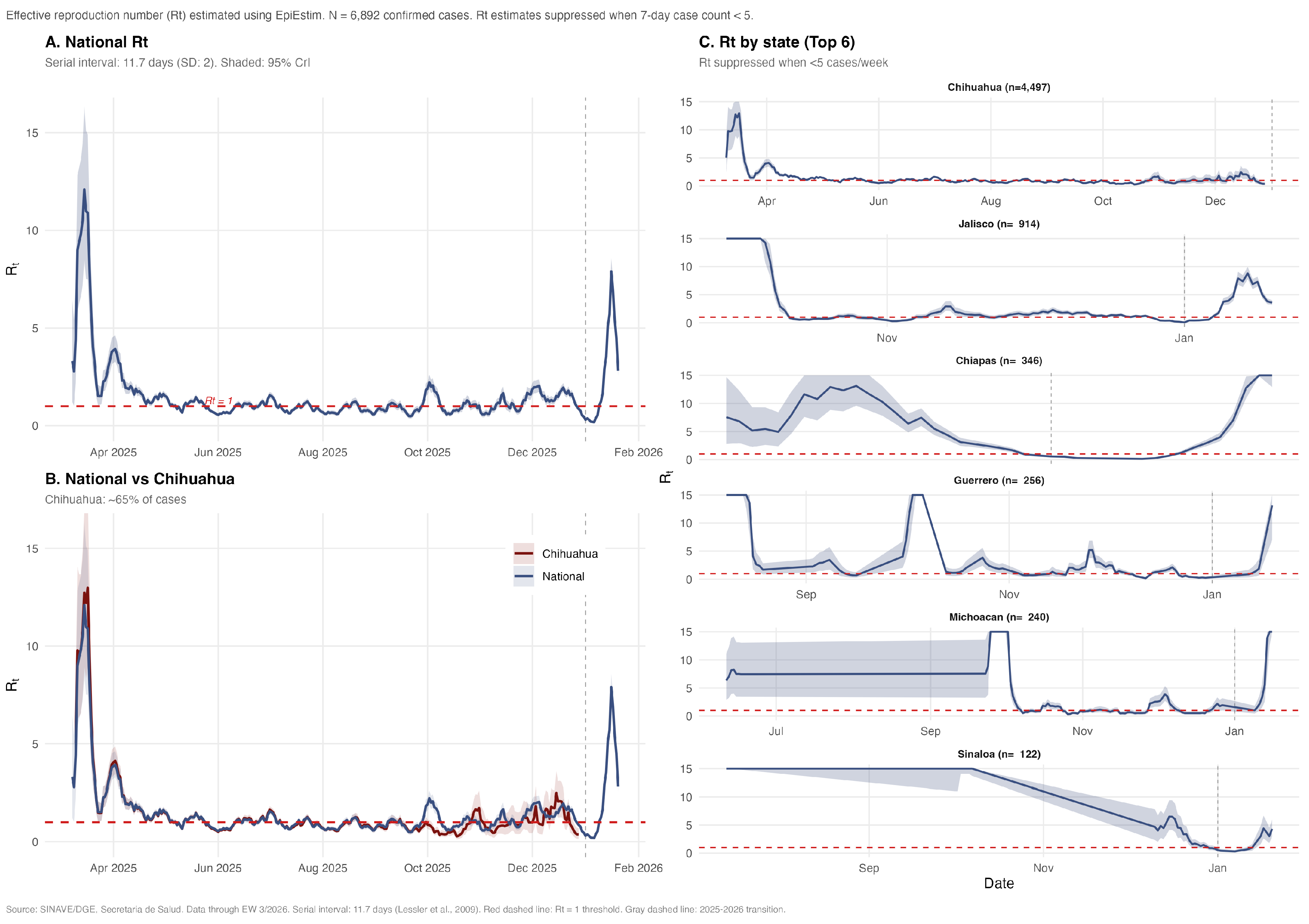
3.2. Transmission Dynamics
3.3. Spatial Analysis
3.4. Social Determinants and Introduction Mechanism
3.5. Vaccination and Vaccine Effectiveness (VE)
3.6. Complications and Risk Factors for Severity
Hospital Discharge Analysis
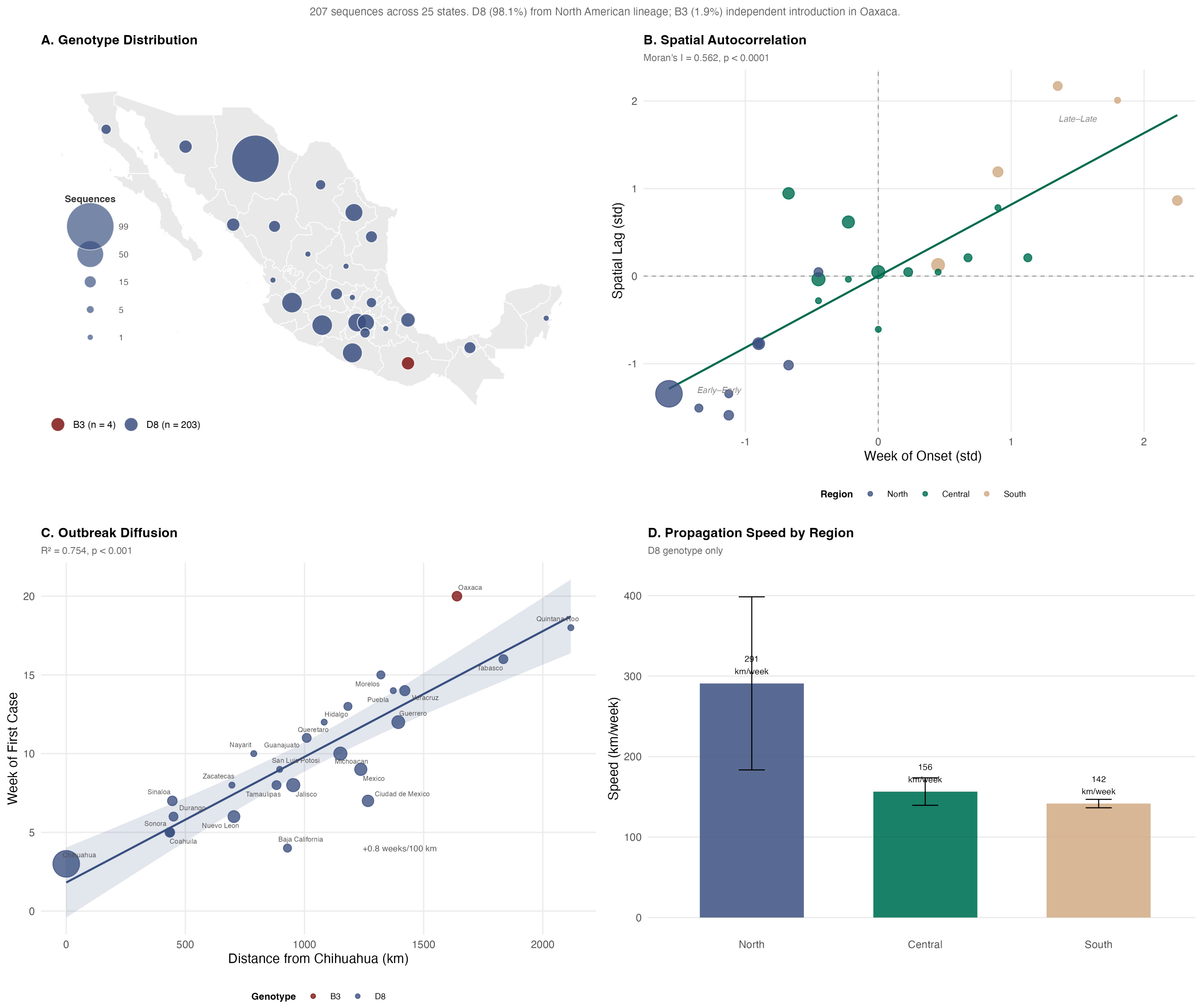
3.7. Molecular Epidemiology
4. Discussion
5. Conclusions
Supplementary Materials
Author Contributions
Funding
Institutional Review Board Statement
Informed Consent Statement
Data Availability Statement
Conflicts of Interest
Abbreviations
| aOR | Adjusted odds ratio |
| AIC | Akaike information criterion |
| CFR | Case fatality rate |
| CENSIA | Centro Nacional para la Salud de la Infancia y la Adolescencia (National Center for Child and Adolescent Health) |
| CI | Confidence interval |
| CONAPO | Consejo Nacional de Población (National Population Council) |
| CONEVAL | Consejo Nacional de Evaluación de la Pol√≠tica de Desarrollo Social (National Council for the Evaluation of Social Development Policy) |
| CrI | Credible Interval |
| DALYs | Disability-adjusted life years |
| DGE | Dirección General de Epidemiología (General Directorate of Epidemiology) |
| DGIS | Dirección General de Informacion en Salud (General Directorate of Health Information) |
| EFEs | Sistema Especial de Vigilancia Epidemiológica de Enfermedades Febriles Exantematicas (Special Surveillance System for Febrile Exanthematous Diseases) |
| ICD-10 | International Classification of Diseases 10th Revision |
| IgM | Immunoglobulin M |
| INEGI | Instituto Nacional de Estadística y Geografía (National Institute of Statistics and Geography) |
| IQR | Interquartile range |
| IRR | Incidence rate ratio |
| LISA | Local indicators of spatial association |
| LOESS | Locally estimated scatterplot smoothing |
| MCV1 | Measles-containing vaccine first dose |
| MMR | Measles-mumps-rubella vaccine |
| NCBI | National Center for Biotechnology Information |
| NOM | Norma Oficial Mexicana (Mexican Official Standard) |
| OR | Odds ratio |
| PAF | Population attributable fraction |
| PAHO | Pan American Health Organization |
| PCV | Proportion of cases vaccinated |
| PPV | Population proportion vaccinated |
| R0 | Basic reproduction number |
| RR | Relative risk |
| RT-PCR | Reverse transcription polymerase chain reaction |
| Rt | Effective reproduction number |
| SAEH | Subsistema Automatizado de Egresos Hospitalarios (Automated Hospital Discharge Subsystem) |
| SD | Standard deviation |
| SE | Semana epidemiologica (epidemiological week) |
| SINAVE | Sistema Nacional de Vigilancia Epidemiológica (National Epidemiological Surveillance System) |
| VE | Vaccine effectiveness |
| VIF | Variance inflation factor |
| WHO | World Health Organization |
References
- Do, L.A.H.; Mulholland, K. Measles 2025. N. Engl. J. Med. 2025, 393, 2447–2458. [Google Scholar] [CrossRef] [PubMed]
- Stoneman, E.K. Measles. JAMA 2025, 334, 1665–1666. [Google Scholar] [CrossRef] [PubMed]
- Hübschen, J.M.; Gouandjika-Vasilache, I.; Dina, J. Measles. Lancet 2022, 399, 678–690. [Google Scholar] [CrossRef] [PubMed]
- Bester, J.C. Measles and Measles Vaccination: A Review. JAMA Pediatr. 2016, 170, 1209–1215. [Google Scholar] [CrossRef]
- Chen, W.; Du, M.; Deng, J.; Liu, M.; Liu, J. Global, Regional, and National Trends of Measles Burden and Its Vaccination Coverage among Children under 5 Years Old: An Updated Systematic Analysis from the Global Burden of Disease Study 2021. Int. J. Infect. Dis. 2025, 156, 107908. [Google Scholar] [CrossRef]
- Peltola, H. The History of Measles and Vaccine Development. Acta Paediatr. 2025. [Google Scholar] [CrossRef]
- Laksono, B.M.; de Vries, R.D.; Verburgh, R.J.; Visser, E.G.; de Jong, A.; Fraaij, P.L.A.; Ruijs, W.L.M.; Nieuwenhuijse, D.F.; van den Ham, H.-J.; Koopmans, M.P.G.; et al. Studies into the Mechanism of Measles-Associated Immune Suppression during a Measles Outbreak in the Netherlands. Nat. Commun. 2018, 9, 4944. [Google Scholar] [CrossRef]
- Mina, M.J.; Kula, T.; Leng, Y.; Li, M.; de Vries, R.D.; Knip, M.; Siljander, H.; Rewers, M.; Choy, D.F.; Wilson, M.S.; et al. Measles Virus Infection Diminishes Preexisting Antibodies That Offer Protection from Other Pathogens. Science 2019, 366, 599–606. [Google Scholar] [CrossRef]
- Gastañaduy, P.A.; Goodson, J.L.; Panagiotakopoulos, L.; Rota, P.A.; Orenstein, W.A.; Patel, M. Measles in the 21st Century: Progress Toward Achieving and Sustaining Elimination. J. Infect. Dis. 2021, 224, S420–S428. [Google Scholar] [CrossRef]
- Mattingly, T.J. Penny Wise, Pound Foolish: The Cost of Reduced Support for Measles Prevention. Vaccine 2025, 65, 127830. [Google Scholar] [CrossRef]
- Local Burden of Disease Vaccine Coverage Collaborators. Mapping Routine Measles Vaccination in Low- and Middle-Income Countries. Nature 2021, 589, 415–419. [CrossRef]
- Masresha, B.G.; Hatcher, C.; Lebo, E.; Tanifum, P.; Bwaka, A.M.; Minta, A.A.; Antoni, S.; Grant, G.B.; Perry, R.T.; O’Connor, P. Progress Toward Measles Elimination—African Region, 2017–2021. MMWR. Morb. Mortal. Wkly. Rep. 2023, 72, 985–991. [Google Scholar] [CrossRef]
- Guerra, F.M.; Bolotin, S.; Lim, G.; Heffernan, J.; Deeks, S.L.; Li, Y.; Crowcroft, N.S. The Basic Reproduction Number (R0) of Measles: A Systematic Review. Lancet Infect. Dis. 2017, 17, e420–e428. [Google Scholar] [CrossRef]
- Jones, C.E.; Danovaro-Holliday, M.C.; Mwinnyaa, G.; Gacic-Dobo, M.; Francis, L.; Grevendonk, J.; Nedelec, Y.; Wallace, A.; Sodha, S.V.; Sugerman, C. Routine Vaccination Coverage—Worldwide, 2023. MMWR. Morb. Mortal. Wkly. Rep. 2024, 73, 978–984. [Google Scholar] [CrossRef]
- Marziano, V.; Bella, A.; Menegale, F.; Del Manso, M.; Petrone, D.; Palamara, A.T.; Pezzotti, P.; Merler, S.; Filia, A.; Poletti, P. Estimating Measles Susceptibility and Transmission Patterns in Italy: An Epidemiological Assessment. Lancet Infect. Dis. 2025, 25, 1303–1313. [Google Scholar] [CrossRef]
- Filia, A.; Del Manso, M.; Petrone, D.; Magurano, F.; Gioacchini, S.; Pezzotti, P.; Palamara, A.T.; Bella, A. Surge in Measles Cases in Italy from August 2023 to January 2025: Characteristics of Cases and Public Health Relevance. Vaccines 2025, 13, 663. [Google Scholar] [CrossRef] [PubMed]
- González-Parra, G.; Vestrand, A.; Mujynya, R. Modeling and Characterizing the Growth of the Texas–New Mexico Measles Outbreak of 2025. Epidemiologia 2025, 6, 60. [Google Scholar] [CrossRef]
- Rey-Benito, G.; Pastor, D.; Whittembury, A.; Durón, R.; Pacis-Tirso, C.; Bravo-Alcántara, P.; Ortiz, C.; Andrus, J. Sustaining the Elimination of Measles, Rubella and Congenital Rubella Syndrome in the Americas, 2019-2023: From Challenges to Opportunities. Vaccines 2024, 12, 690. [Google Scholar] [CrossRef] [PubMed]
- Carnalla, M.; Gaspar-Castillo, C.; Dimas-González, J.; Aparicio-Antonio, R.; Justo-Berrueta, P.S.; López-Martínez, I.; Shamah-Levy, T.; Lazcano-Ponce, E.; Barrientos-Gutiérrez, T.; Alpuche-Aranda, C.M.; et al. A Population-Based Measles Serosurvey in Mexico: Implications for Re-Emergence. Vaccine 2025, 51, 126886. [Google Scholar] [CrossRef] [PubMed]
- Hersh, B.S.; Tambini, G.; Nogueira, A.C.; Carrasco, P.; de Quadros, C.A. Review of Regional Measles Surveillance Data in the Americas, 1996–1999. Lancet 2000, 355, 1943–1948. [Google Scholar] [CrossRef]
- Santos, J.I.; Nakamura, M.A.; Godoy, M.V.; Kuri, P.; Lucas, C.A.; Conyer, R.T. Measles in Mexico, 1941–2001: Interruption of Endemic Transmission and Lessons Learned. J. Infect. Dis. 2004, 189, S243–S250. [Google Scholar] [CrossRef]
- Rivadeneira, M.F.; Bassanesi, S.L.; Fuchs, S.C. Socioeconomic Inequalities and Measles Immunization Coverage in Ecuador: A Spatial Analysis. Vaccine 2018, 36, 5251–5257. [Google Scholar] [CrossRef]
- Fene, F.; Johri, M.; Michel, M.E.; Reyes-Morales, H.; Pelcastre-Villafuerte, B.E. Multiple Deprivations as Drivers of Suboptimal Basic Child Vaccination in Latin America and the Caribbean: Cross-Sectional Analysis of Household Survey Data for 18,136 Children across 211 Regions in 15 Countries. Int. J. Equity Health 2025, 24, 184. [Google Scholar] [CrossRef] [PubMed]
- Masters, N.B.; Eisenberg, M.C.; Delamater, P.L.; Kay, M.; Boulton, M.L.; Zelner, J. Fine-Scale Spatial Clustering of Measles Nonvaccination That Increases Outbreak Potential Is Obscured by Aggregated Reporting Data. Proc. Natl. Acad. Sci. USA 2020, 117, 28506–28514. [Google Scholar] [CrossRef]
- Robert, A.; Kucharski, A.J.; Funk, S. The Impact of Local Vaccine Coverage and Recent Incidence on Measles Transmission in France between 2009 and 2018. BMC Med. 2022, 20, 77. [Google Scholar] [CrossRef] [PubMed]
- Secretaria de Salud (Mexico); Direccion General de Epidemiologia. Datos Abiertos: Bases Historicas de Enfermedades Febriles Exantematicas. Gobierno de Mexico. Available online: https://www.gob.mx/salud/documentos/datos-abiertos-bases-historicas-de-enfermedades-febriles-exantematicas (accessed on 23 January 2026).
- Diario Oficial de la Federacion (DOF). Norma Oficial Mexicana NOM-017-SSA2-2012, para la Vigilancia Epidemiologica; Secretaria de Salud: Mexico City, Mexico, 2013. Available online: https://dof.gob.mx/nota_detalle.php?codigo=5288225&fecha=19/02/2013 (accessed on 23 January 2026).
- Instituto de Diagnostico y Referencia Epidemiologicos (InDRE); Red Nacional de Laboratorios de Salud Publica (RNLSP). Lineamientos para la Vigilancia por Laboratorio de la Enfermedad Febril Exantematica (EFE) (LVL_EFE_4T). Version 1. Mexico. Available online: https://www.gob.mx/cms/uploads/attachment/file/487585/LVL_EFE_4T.pdf (accessed on 23 January 2026).
- Secretaria de Salud (Mexico); Direccion General de Informacion en Salud (DGIS). Egresos Hospitalarios: Cubos Dinamicos (SAEH). Available online: http://dgis.salud.gob.mx/contenidos/basesdedatos/bdc_egresoshosp_gobmx.html (accessed on 23 January 2026).
- Índices de Marginación—Base de Datos—Datos.Gob.Mx. Available online: https://datos.gob.mx/dataset/indices_marginacion (accessed on 28 December 2025).
- Índice Rezago Social 2020. Available online: https://www.coneval.org.mx/Medicion/IRS/Paginas/Indice_Rezago_Social_2020.aspx (accessed on 28 December 2025).
- Consejo Nacional de Poblacion (CONAPO). Indices de Intensidad Migratoria Mexico-Estados Unidos 2020. Gobierno de Mexico. Available online: https://www.gob.mx/conapo/documentos/indices-de-intensidad-migratoria-mexico-estados-unidos-2020 (accessed on 23 January 2026).
- Geografía(INEGI), I.N. de E. y Censo Agropecuario (CA) 2022. Available online: https://www.inegi.org.mx/programas/ca/2022/#datos_abiertos (accessed on 28 December 2025).
- Catálogo Nacional de Indicadores. Available online: https://www.snieg.mx/cni/escenario.aspx?idOrden=1.4&ind=6300000008&gen=143&d=n (accessed on 28 December 2025).
- GenBank Overview. Available online: https://www.ncbi.nlm.nih.gov/genbank/ (accessed on 28 December 2025).
- Secretaria de Salud (Mexico); Direccion General de Epidemiologia (DGE). Boletin Epidemiologico: Sistema Nacional de Vigilancia Epidemiologica (SINAVE)/Sistema Unico de Informacion (SUAVE). Available online: https://www.gob.mx/salud/documentos/boletinepidemiologico-sistema-nacional-de-vigilancia-epidemiologica-sistema-unico-de-informacion (accessed on 23 January 2026).
- Secretaria General del Consejo Nacional de Poblacion (CONAPO). Proyecciones de Poblacion: Indicadores Demograficos Especiales para los Municipios de Mexico, Desde 1990 a 2040 (Dataset). Datos.gob.mx (Gobierno de Mexico Open Data Portal). Available online: https://www.datos.gob.mx/dataset/proyecciones-de-poblacion/resource/99b28bb6-8e31-48e1-b162-85a7e4deafc3 (accessed on 23 January 2026).
- Lessler, J.; Reich, N.G.; Brookmeyer, R.; Perl, T.M.; Nelson, K.E.; Cummings, D.A.T. Incubation Periods of Acute Respiratory Viral Infections: A Systematic Review. Lancet Infect. Dis. 2009, 9, 291–300. [Google Scholar] [CrossRef]
- Cori, A.; Ferguson, N.M.; Fraser, C.; Cauchemez, S. A New Framework and Software to Estimate Time-Varying Reproduction Numbers During Epidemics. Am. J. Epidemiol. 2013, 178, 1505–1512. [Google Scholar] [CrossRef] [PubMed]
- Thompson, R.N.; Stockwin, J.E.; van Gaalen, R.D.; Polonsky, J.A.; Kamvar, Z.N.; Demarsh, P.A.; Dahlqwist, E.; Li, S.; Miguel, E.; Jombart, T.; et al. Improved Inference of Time-Varying Reproduction Numbers during Infectious Disease Outbreaks. Epidemics 2019, 29, 100356. [Google Scholar] [CrossRef]
- Moran, P.A.P. Notes on Continuous Stochastic Phenomena. Biometrika 1950, 37, 17–23. [Google Scholar] [CrossRef]
- Anselin, L. Local Indicators of Spatial Association—LISA. Geogr. Anal. 1995, 27, 93–115. [Google Scholar] [CrossRef]
- Pebesma, E. Simple Features for R: Standardized Support for Spatial Vector Data. R J. 2018, 10, 439–446. [Google Scholar] [CrossRef]
- Bivand, R.S.; Wong, D.W.S. Comparing Implementations of Global and Local Indicators of Spatial Association. TEST 2018, 27, 716–748. [Google Scholar] [CrossRef]
- Farrington, C.P. Estimation of Vaccine Effectiveness Using the Screening Method. Int. J. Epidemiol. 1993, 22, 742–746. [Google Scholar] [CrossRef] [PubMed]
- Orenstein, W.A.; Bernier, R.H.; Dondero, T.J.; Hinman, A.R.; Marks, J.S.; Bart, K.J.; Sirotkin, B. Field Evaluation of Vaccine Efficacy. Bull. World Health Organ. 1985, 63, 1055–1068. [Google Scholar] [PubMed]
- Orenstein, W.A.; Bernier, R.H.; Hinman, A.R. Assessing Vaccine Efficacy in the Field: Further Observations. Epidemiol. Rev. 1988, 10, 212–241. [Google Scholar] [CrossRef]
- Zucker, J.R.; Rosen, J.B.; Iwamoto, M.; Arciuolo, R.J.; Langdon-Embry, M.; Vora, N.M.; Rakeman, J.L.; Isaac, B.M.; Jean, A.; Asfaw, M.; et al. Consequences of Undervaccination—Measles Outbreak, New York City, 2018–2019. N. Engl. J. Med. 2020, 382, 1009–1017. [Google Scholar] [CrossRef]
- Manisha Patel, M.D.; Adria, D.; Lee, M.; Nakia, S.C.; Lemmons, M.P.H.; Redd, S.B.; Poser, S.; Debra Blog, M.D.; Jane, R.; Zucker, M.D.; et al. National Update on Measles Cases and Outbreaks—United States, January 1–October 1, 2019. MMWR. Morb. Mortal. Wkly. Rep. 2019, 68, 893–896. [Google Scholar] [CrossRef] [PubMed]
- Hall, V. Measles Outbreak—Minnesota April–May 2017. MMWR. Morb. Mortal. Wkly. Rep. 2017, 66, 713–717. [Google Scholar] [CrossRef]
- Prevention of Measles, Rubella, Congenital Rubella Syndrome, and Mumps, 2013. Available online: https://www.cdc.gov/mmwr/preview/mmwrhtml/rr6204a1.htm (accessed on 3 February 2026).
- Bursac, Z.; Gauss, C.H.; Williams, D.K.; Hosmer, D.W. Purposeful Selection of Variables in Logistic Regression. Source Code Biol. Med. 2008, 3, 17. [Google Scholar] [CrossRef]
- Hosmer, D.W., Jr. Model-Building Strategies and Methods for Logistic Regression. In Applied Logistic Regression; John Wiley & Sons, Ltd.: Hoboken, NJ, USA, 2013; pp. 89–151. ISBN 978-1-118-54838-7. [Google Scholar]
- Measles—Region of the Americas. Available online: https://www.who.int/emergencies/disease-outbreak-news/item/2025-DON565 (accessed on 2 February 2026).
- Pasadyn, F.; Mamo, N.; Caplan, A. Battling Measles: Shifting Strategies to Meet Emerging Challenges and Inequities. Ethics Med. Public Health 2025, 33, 101047. [Google Scholar] [CrossRef]
- Mathis, A.D. Measles Update—United States, January 1–April 17, 2025. MMWR. Morb. Mortal. Wkly. 2025, 74, 232–238. [Google Scholar] [CrossRef] [PubMed]
- Hewitt, G.-L.; Obeid, A.; Fischer, P.R. Measles Outbreaks in the United States in 2025: Practice, Policy, and the Canary in the Coalmine. New Microbes New Infect. 2025, 65, 101591. [Google Scholar] [CrossRef]
- CDC Measles Cases and Outbreaks. Available online: https://www.cdc.gov/measles/data-research/index.html (accessed on 2 February 2026).
- Measles Outbreak—August 12, 2025|Texas DSHS. Available online: https://www.dshs.texas.gov/news-alerts/measles-outbreak-2025?utm_source=chatgpt.com (accessed on 11 January 2026).
- Pan American Health Organization (PAHO)/World Health Organization (WHO). PAHO Calls for Regional Action as the Americas Lose Measles Elimination Status. 10 November 2025. Available online: https://www.paho.org/en/news/10-11-2025-paho-calls-regional-action-americas-lose-measles-elimination-status (accessed on 23 January 2026).
- Pan American Health Organization (PAHO)/World Health Organization (WHO). Measles Elimination Status in the United States and Mexico. 16 January 2026. Available online: https://www.paho.org/en/news/16-1-2026-measles-elimination-status-united-states-and-mexico (accessed on 2 February 2026).
- Grenfell, B.T.; Bjørnstad, O.N.; Kappey, J. Travelling Waves and Spatial Hierarchies in Measles Epidemics. Nature 2001, 414, 716–723. [Google Scholar] [CrossRef] [PubMed]
- Pan American Health Organization (PAHO)/World Health Organization (WHO). Ten Countries in the Americas Report Measles Outbreaks in 2025. 15 August 2025. Available online: https://www.paho.org/en/news/15-8-2025-ten-countries-americas-report-measles-outbreaks-2025 (accessed on 2 February 2026).
- Lanke, R.; Chimurkar, V. Measles Outbreak in Socioeconomically Diverse Sections: A Review. Cureus 2024, 16, e62879. [Google Scholar] [CrossRef] [PubMed]




| Characteristic | Chihuahua n = 4497 1 | Other States n = 2395 1 | Total n = 6892 1 | p-Value 2 |
|---|---|---|---|---|
| Age, years | 20 (4–31) | 12 (4–24) | 17 (4–29) | <0.001 |
| Age group | <0.001 | |||
| <1 year | 490 (10.9%) | 200 (8.4%) | 690 (10.0%) | |
| 1–4 years | 643 (14.3%) | 408 (17.0%) | 1051 (15.2%) | |
| 5–9 years | 381 (8.5%) | 416 (17.4%) | 797 (11.6%) | |
| 10–19 years | 685 (15.2%) | 567 (23.7%) | 1252 (18.2%) | |
| 20–39 years | 1866 (41.5%) | 666 (27.8%) | 2532 (36.7%) | |
| ≥40 years | 432 (9.6%) | 138 (5.8%) | 570 (8.3%) | |
| Sex | 0.022 | |||
| Female | 2161 (48.1%) | 1221 (51.0%) | 3382 (49.1%) | |
| Male | 2336 (51.9%) | 1174 (49.0%) | 3510 (50.9%) | |
| Vaccination status | <0.001 | |||
| Unvaccinated | 3911 (87.0%) | 1984 (82.8%) | 5895 (85.5%) | |
| Vaccinated | 586 (13.0%) | 411 (17.2%) | 997 (14.5%) | |
| Indigenous status | 1247 (27.7%) | 756 (31.6%) | 2003 (29.1%) | <0.001 |
| Case origin | <0.001 | |||
| Import related | 3515 (78.2%) | 478 (20.0%) | 3993 (57.9%) | |
| Imported | 9 (0.2%) | 246 (10.3%) | 255 (3.7%) | |
| Unknown source | 973 (21.6%) | 1671 (69.8%) | 2644 (38.4%) | |
| Complications | 860 (19.1%) | 209 (8.7%) | 1069 (15.5%) | <0.001 |
| Death | 23 (0.5%) | 2 (0.1%) | 25 (0.4%) | 0.009 |
| Municipality Status | ||||
|---|---|---|---|---|
| Variable | Overall n = 2469 1 | Without Cases n = 2203 1 | With Cases n = 266 1 | p-Value 2 |
| Population (2025 projection) | 13,981.0 (4702.0–36,621.0) | 12,253.0 (4228.0–31,010.0) | 43,463.5 (20,021.0–162,318.0) | <0.001 |
| Marginalization index (0–100) | 0.9 (0.8–0.9) | 0.8 (0.8–0.9) | 0.9 (0.8–0.9) | <0.001 |
| Marginalization degree | <0.001 | |||
| Very low | 655 (26.5) | 521 (23.6) | 134 (50.4) | |
| Low | 530 (21.5) | 486 (22.1) | 44 (16.5) | |
| Medium | 494 (20.0) | 467 (21.2) | 27 (10.2) | |
| High | 586 (23.7) | 561 (25.5) | 25 (9.4) | |
| Very high | 204 (8.3) | 168 (7.6) | 36 (13.5) | |
| Illiteracy rate | 8.2 (4.4–13.8) | 8.4 (4.7–13.9) | 5.4 (2.7–11.2) | <0.001 |
| No basic education | 46.3 (35.7–55.9) | 46.9 (36.4–55.9) | 41.6 (27.3– 54.9) | <0.001 |
| Income < 2 min wages | 84.6 (74.6–91.6) | 85.5 (76.5–91.9) | 74.1 (63.8–84.8) | <0.001 |
| No drainage | 1.4 (0.7–3.3) | 1.5 (0.7–3.4) | 0.9 (0.3–2.5) | <0.001 |
| No electricity | 0.8 (0.4–1.7) | 0.9 (0.4–1.7) | 0.5 (0.2–1.3) | <0.001 |
| No piped water | 2.5 (0.9–7.3) | 2.6 (0.9–7.4) | 1.6 (0.6–6.3) | <0.001 |
| Dirt floor | 4.7 (1.7–11.0) | 4.9 (1.8–11.2) | 2.4 (1.0–8.3) | <0.001 |
| No health insurance | 22.6 (16.2–30.6) | 22.7 (16.2–30.7) | 22.5 (16.3–29.8) | 0.929 |
| Social lag index | −0.2 (−0.8–0.5) | −0.2 (−0.7–0.5) | −0.7 (−1.1–0.0) | <0.001 |
| Social lag degree | <0.001 | |||
| Very low | 677 (27.4) | 546 (24.8) | 131 (49.2) | |
| Low | 893 (36.2) | 822 (37.3) | 71 (26.7) | |
| Medium | 504 (20.4) | 484 (22.0) | 20 (7.5) | |
| High | 243 (9.8) | 229 (10.4) | 14 (5.3) | |
| Very high | 152 (6.2) | 122 (5.5) | 30 (11.3) | |
| Rural population | 100.0 (40.1–100.0) | 100.0 (43.4–100.0) | 44.0 (14.9–77.9) | <0.001 |
| Overcrowding | 25.0 (18.7–32.8) | 25.4 (19.3–32.9) | 20.5 (14.5–30.9) | <0.001 |
| Households with remittances | 5.8 (2.6–12.9) | 5.9 (2.6–13.5) | 5.1 (2.0–10.5) | 0.009 |
| Migration intensity index | 63.9 (62.2–64.7) | 63.8 (62.1–64.7) | 64.0 (62.8–64.8) | 0.026 |
| Migration intensity degree | 0.002 | |||
| None | 12 (0.5) | 12 (0.5) | 0 (0.0) | |
| Very low | 861 (34.9) | 764 (34.7) | 97 (36.5) | |
| Low | 686 (27.8) | 599 (27.2) | 87 (32.7) | |
| Medium | 432 (17.5) | 379 (17.2) | 53 (19.9) | |
| High | 341 (13.8) | 315 (14.3) | 26 (9.8) | |
| Very high | 137 (5.5) | 134 (6.1) | 3 (1.1) | |
| Agricultural units with day laborers | 47.7 (36.4–59.3) | 48.0 (36.9–60.0) | 42.8 (33.1–54.2) | <0.001 |
| Day laborers tertile | <0.001 | |||
| T1 (Low) | 818 (33.3) | 709 (32.3) | 109 (42.6) | |
| T2 (Medium) | 818 (33.3) | 731 (33.3) | 87 (34.0) | |
| T3 (High) | 818 (33.3) | 758 (34.5) | 60 (23.4) | |
| Outbreak Phase (Relative Weeks per State) | ||||||||
|---|---|---|---|---|---|---|---|---|
| Variable | Overall n = 6892 1 | Introduction (Rel Wk 1–4) n = 274 1 | Growth (Rel Wk 5–11) n = 1621 1 | Peak (Rel Wk 12–14) n = 981 1 | Decline (Rel Wk 15–24) n = 2195 1 | Late (Rel Wk 25+) n = 1080 1 | Resurgence (Wave 2) n = 741 1 | p-Value 2 |
| Age (years) | 17.0 (4.0–29.0) | 10.0 (3.0–21.0) | 22.0 (8.0–31.0) | 22.0 (7.0–32.0) | 15.0 (3.0–28.0) | 11.0 (2.0–23.0) | 15.0 (6.0–28.0) | <0.001 |
| Sex | 0.182 | |||||||
| Female | 3510 (51%) | 132 (48%) | 842 (52%) | 528 (54%) | 1116 (51%) | 528 (49%) | 364 (49%) | |
| Male | 3382 (49%) | 142 (52%) | 779 (48%) | 453 (46%) | 1079 (49%) | 552 (51%) | 377 (51%) | |
| Unvaccinated | 5895 (86%) | 234 (85%) | 1393 (86%) | 810 (83%) | 1918 (87%) | 928 (86%) | 612 (83%) | 0.002 |
| Indigenous | 2003 (29%) | 49 (18%) | 94 (5.8%) | 129 (13%) | 902 (41%) | 711 (66%) | 118 (16%) | <0.001 |
| Complications | 1069 (16%) | 28 (10%) | 146 (9.0%) | 96 (9.8%) | 486 (22%) | 250 (23%) | 63 (8.5%) | <0.001 |
| Death | 25 (0.4%) | 0 (0%) | 5 (0.3%) | 1 (0.1%) | 10 (0.5%) | 9 (0.8%) | 0 (0%) | 0.025 |
| Marginalization index (0–100) * | 0.9 (0.9–0.9) | 0.9 (0.9–0.9) | 0.9 (0.9–0.9) | 0.9 (0.9–0.9) | 0.9 (0.9–0.9) | 0.9 (0.9–0.9) | 0.9 (0.9–0.9) | <0.001 |
| Marginalization degree * | <0.001 | |||||||
| Very low | 5138 (75%) | 218 (80%) | 1505 (93%) | 859 (88%) | 1398 (64%) | 646 (60%) | 512 (69%) | |
| Low | 750 (11%) | 33 (12%) | 83 (5.1%) | 46 (4.7%) | 311 (14%) | 131 (12%) | 146 (20%) | |
| Medium | 124 (1.8%) | 13 (4.8%) | 7 (0.4%) | 3 (0.3%) | 17 (0.8%) | 65 (6.0%) | 19 (2.6%) | |
| High | 211 (3.1%) | 3 (1.1%) | 11 (0.7%) | 25 (2.5%) | 98 (4.5%) | 47 (4.4%) | 27 (3.6%) | |
| Very high | 666 (9.7%) | 4 (1.5%) | 15 (0.9%) | 48 (4.9%) | 371 (17%) | 191 (18%) | 37 (5.0%) | |
| Illiteracy rate (%) * | 2.1 (1.8–5.8) | 3.0 (1.8, 6.4) | 1.8 (1.8–3.0) | 1.8 (1.7–2.6) | 2.6 (1.8–9.1) | 3.0 (1.9–9.7) | 2.3 (1.9–7.9) | <0.001 |
| No basic education (%) * | 35.3 (24.3–46.2) | 37.5 (32.3–45.6) | 35.3 (28.5–39.5) | 35.3 (24.0–39.5) | 35.3 (26.9–55.1) | 35.8 (24.2–58.0) | 26.9 (23.4–38.4) | <0.001 |
| Income < 2 min wages (%) * | 62.9 (51.3–77.0) | 66.0 (55.0–76.1) | 51.3 (51.3–66.0) | 51.3 (51.3–69.3) | 68.9 (51.3–81.6) | 70.3 (59.8–81.9) | 59.1 (49.6–74.6) | <0.001 |
| No drainage (%) * | 0.2 (0.1–0.7) | 0.6 (0.2–0.9) | 0.2 (0.2–0.4) | 0.2 (0.1–0.3) | 0.2 (0.1–1.7) | 0.5 (0.2–3.3) | 0.1 (0.0–0.5) | <0.001 |
| No electricity (%) * | 0.2 (0.1–0.4) | 0.3 (0.2–0.4) | 0.1 (0.1–0.3) | 0.1 (0.1–0.2) | 0.2 (0.1–1.0) | 0.3 (0.1–2.0) | 0.1 (0.1–0.4) | <0.001 |
| No piped water (%) * | 0.6 (0.4–1.0) | 0.9 (0.4–1.3) | 0.4 (0.4–0.9) | 0.5 (0.4–0.9) | 0.6 (0.4–3.4) | 0.9 (0.3–3.4) | 0.6 (0.5–4.9) | <0.001 |
| Dirt floor (%) * | 0.6 (0.3–2.3) | 0.7 (0.6–1.9) | 0.5 (0.3–0.6) | 0.5 (0.3–1.3) | 0.6 (0.4–5.1) | 0.7 (0.4–7.0) | 2.3 (1.5–6.3) | <0.001 |
| No health insurance (%) * | 15.4 (13.1–23.0) | 19.8 (13.1–39.9) | 13.1 (13.1–17.8) | 13.1 (13.1–19.0) | 15.4 (13.1–19.7) | 14.1 (10.9–18.3) | 29.7 (27.5–35.4) | <0.001 |
| Social lag index * | −1.1 (−1.2–−0.6) | −0.9 (−1.1–−0.6) | −1.1 (−1.2–−0.9) | −1.1 (−1.2–−1.0) | −1.1 (−1.2–−0.2) | −1.0 (−1.3–−0.2) | −1.2 (−1.2–−0.5) | <0.001 |
| Social lag degree * | <0.001 | |||||||
| Very low | 4982 (72%) | 202 (75%) | 1442 (89%) | 839 (86%) | 1373 (63%) | 628 (58%) | 498 (67%) | |
| Low | 1022 (15%) | 62 (23%) | 151 (9.3%) | 69 (7.0%) | 351 (16%) | 213 (20%) | 176 (24%) | |
| Medium | 193 (2.8%) | 3 (1.1%) | 13 (0.8%) | 25 (2.5%) | 84 (3.8%) | 48 (4.4%) | 20 (2.7%) | |
| High | 53 (0.8%) | 0 (0%) | 0 (0%) | 0 (0%) | 38 (1.7%) | 0 (0%) | 15 (2.0%) | |
| Very high | 639 (9.3%) | 4 (1.5%) | 15 (0.9%) | 48 (4.9%) | 349 (16%) | 191 (18%) | 32 (4.3%) | |
| Rural population < 5000 (%) * | 19.3 (5.6–38.0) | 26.0 (19.3–49.7) | 19.3 (7.0–20.2) | 19.3 (3.3–19.3) | 19.3 (5.6–54.2) | 19.1 (10.3–63.8) | 6.4 (1.6–18.9) | <0.001 |
| Migration intensity index * | 63.7 (63.4–64.2) | 63.9 (63.3–64.3) | 63.4 (63.4–63.7) | 63.4 (63.4–63.7) | 63.7 (63.4–64.3) | 63.7 (63.2–64.1) | 64.4 (64.1–64.8) | <0.001 |
| Migration intensity degree * | <0.001 | |||||||
| None | 0 (0%) | 0 (0%) | 0 (0%) | 0 (0%) | 0 (0%) | 0 (0%) | 0 (0%) | |
| Very low | 1193 (17%) | 53 (20%) | 91 (5.6%) | 75 (7.6%) | 461 (21%) | 141 (13%) | 372 (50%) | |
| Low | 4545 (66%) | 151 (56%) | 1306 (81%) | 707 (72%) | 1397 (64%) | 693 (64%) | 291 (39%) | |
| Medium | 993 (14%) | 42 (15%) | 189 (12%) | 165 (17%) | 312 (14%) | 235 (22%) | 50 (6.7%) | |
| High | 151 (2.2%) | 23 (8.5%) | 33 (2.0%) | 34 (3.5%) | 24 (1.1%) | 11 (1.0%) | 26 (3.5%) | |
| Very high | 7 (0.1%) | 2 (0.7%) | 2 (0.1%) | 0 (0%) | 1 (<0.1%) | 0 (0%) | 2 (0.3%) | |
| Agricultural day laborers (%) * | 32.2 (31.3–42.1) | 45.8 (32.2–53.6) | 32.2 (32.2–34.4) | 32.2 (31.3–33.7) | 32.2 (31.2–39.9) | 33.3 (31.3–51.5) | 48.4 (31.3–51.5) | <0.001 |
| High day laborer municipality (>50%) * | 1170 (17%) | 109 (40%) | 185 (12%) | 68 (7.1%) | 294 (14%) | 323 (30%) | 191 (29%) | <0.001 |
| Variable | Complications n/N (%) | aOR (95% CI) | p-Value |
|---|---|---|---|
| Age group | |||
| 5–19 years (ref) | 281/2048 (13.7%) | 1.00 (ref) | - |
| <1 year | 244/690 (35.4%) | 3.36 (2.72–4.15) | <0.001 |
| 1–4 years | 306/1051 (29.1%) | 2.58 (2.14–3.13) | <0.001 |
| ≥20 years | 238/3100 (7.7%) | 0.64 (0.53–0.77) | <0.001 |
| Indigenous | |||
| No (ref) | 521/4886 (10.7%) | 1.00 (ref) | - |
| Yes | 548/2003 (27.4%) | 1.89 (1.61–2.22) | <0.001 |
| Vaccination status | |||
| Vaccinated (ref) | 81/997 (8.1%) | 1.00 (ref) | - |
| Unvaccinated | 988/5892 (16.8%) | 1.96 (1.53–2.51) | <0.001 |
| Outbreak phase | |||
| Early, weeks 1–14 (ref) | 333/3614 (9.2%) | 1.00 (ref) | - |
| Late, weeks ≥ 15 | 736/3275 (22.5%) | 1.68 (1.42–2.00) | <0.001 |
| Municipality type | |||
| Urban (ref) | 668/5429 (12.3%) | 1.00 (ref) | - |
| Rural (>50% in localities < 5000) | 401/1460 (27.5%) | 1.73 (1.48–2.03) | <0.001 |
| Epidemic wave | |||
| Wave 1, 2025 (ref) | 1006/6148 (16.4%) | 1.00 (ref) | - |
| Resurgence, January 2026 | 63/741 (8.5%) | 0.81 (0.60–1.09) | 0.164 |
Disclaimer/Publisher’s Note: The statements, opinions and data contained in all publications are solely those of the individual author(s) and contributor(s) and not of MDPI and/or the editor(s). MDPI and/or the editor(s) disclaim responsibility for any injury to people or property resulting from any ideas, methods, instructions or products referred to in the content. |
© 2026 by the authors. Licensee MDPI, Basel, Switzerland. This article is an open access article distributed under the terms and conditions of the Creative Commons Attribution (CC BY) license.
Share and Cite
De Arcos-Jiménez, J.C.; Martínez-Ayala, P.; Fernández-Diaz, O.F.; Sánchez-Enríquez, S.; Vargas-Becerra, P.N.; López-Yáñez, A.M.; Damian-Negrete, R.; Gutierrez-Perez, S.; Briseno-Ramírez, J. Social Determinants and Outbreak Dynamics of the 2025 Measles Epidemic in Mexico: A Nationwide Analysis of Linked Surveillance Data. Viruses 2026, 18, 219. https://doi.org/10.3390/v18020219
De Arcos-Jiménez JC, Martínez-Ayala P, Fernández-Diaz OF, Sánchez-Enríquez S, Vargas-Becerra PN, López-Yáñez AM, Damian-Negrete R, Gutierrez-Perez S, Briseno-Ramírez J. Social Determinants and Outbreak Dynamics of the 2025 Measles Epidemic in Mexico: A Nationwide Analysis of Linked Surveillance Data. Viruses. 2026; 18(2):219. https://doi.org/10.3390/v18020219
Chicago/Turabian StyleDe Arcos-Jiménez, Judith Carolina, Pedro Martínez-Ayala, Oscar Francisco Fernández-Diaz, Sergio Sánchez-Enríquez, Patricia Noemi Vargas-Becerra, Ana María López-Yáñez, Roberto Damian-Negrete, Sofía Gutierrez-Perez, and Jaime Briseno-Ramírez. 2026. "Social Determinants and Outbreak Dynamics of the 2025 Measles Epidemic in Mexico: A Nationwide Analysis of Linked Surveillance Data" Viruses 18, no. 2: 219. https://doi.org/10.3390/v18020219
APA StyleDe Arcos-Jiménez, J. C., Martínez-Ayala, P., Fernández-Diaz, O. F., Sánchez-Enríquez, S., Vargas-Becerra, P. N., López-Yáñez, A. M., Damian-Negrete, R., Gutierrez-Perez, S., & Briseno-Ramírez, J. (2026). Social Determinants and Outbreak Dynamics of the 2025 Measles Epidemic in Mexico: A Nationwide Analysis of Linked Surveillance Data. Viruses, 18(2), 219. https://doi.org/10.3390/v18020219