Advances in Plant Antiviral RNAi: From Host DCLs/RDRs to Diversified Viral Counteracting Strategies


Abstract
1. Introduction
2. The RNAi Core Machinery: From DCL Cleavage to RDR Amplification in Antiviral Pathways
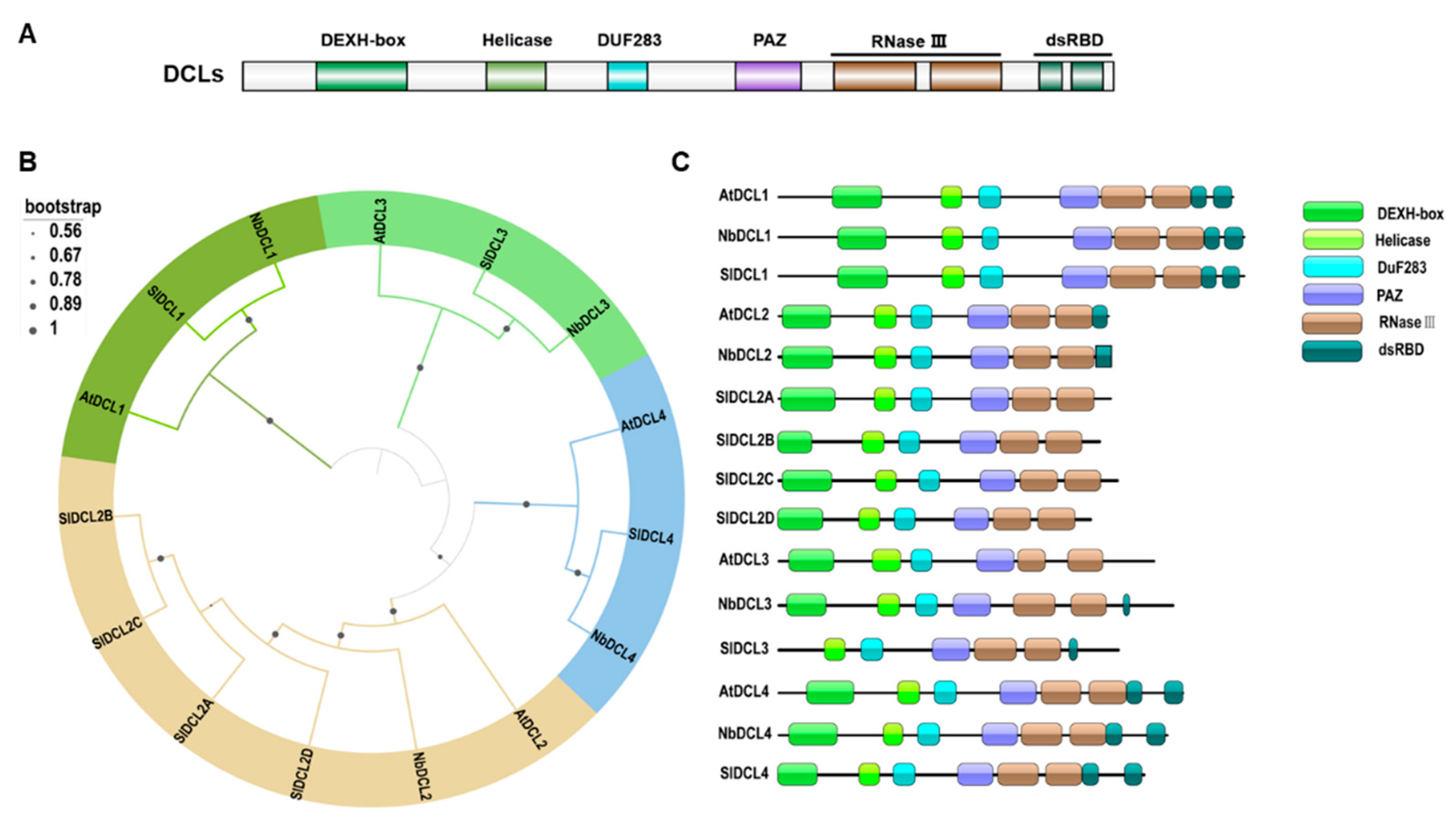
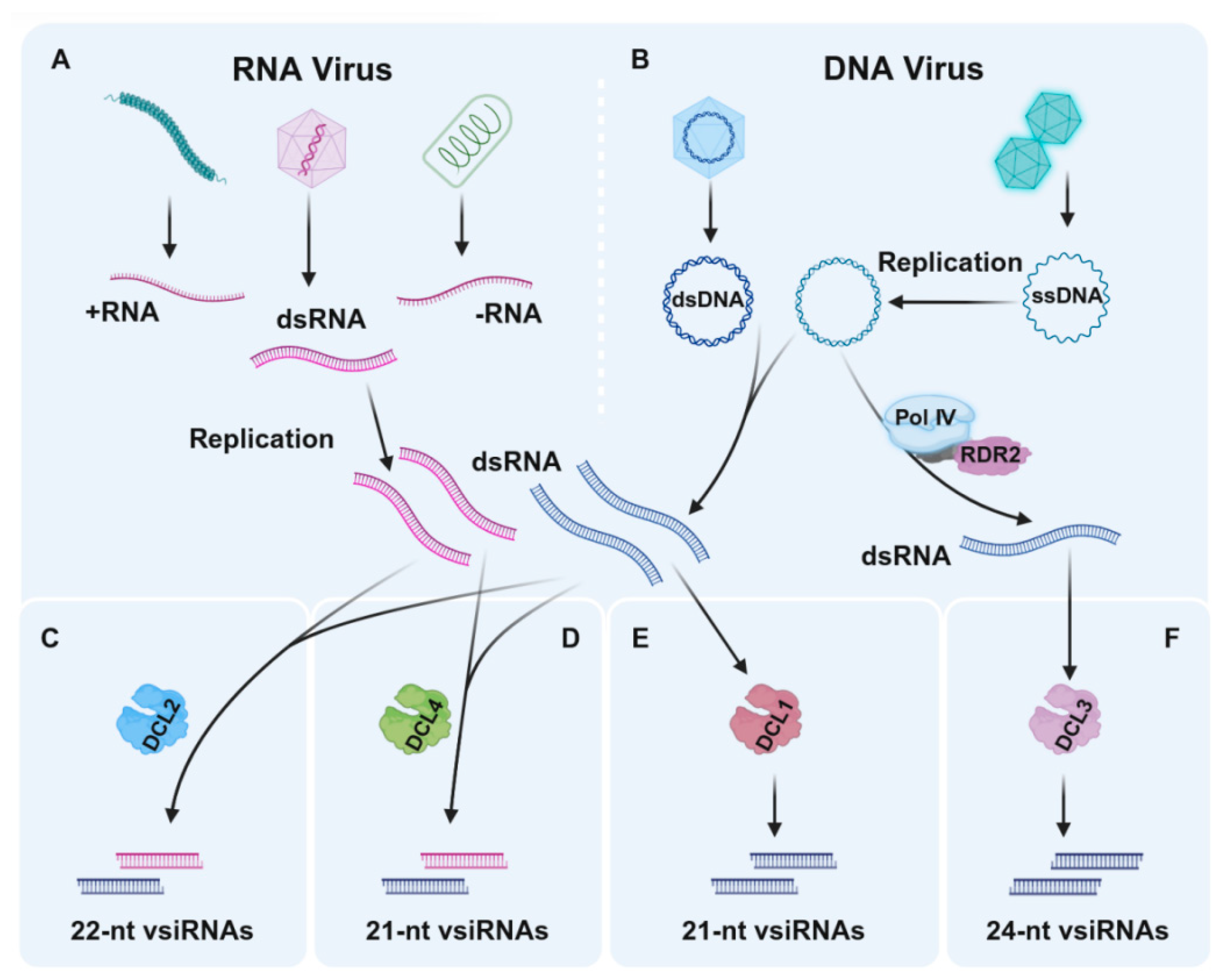
2.1. Core Antiviral RNAi Effectors: DCLs

| DCL/ RTL | Virus | Host | Main Functions | Reference |
|---|---|---|---|---|
| DCL1 | TCV | At | DCL1 down-regulates the expression of DCL4 and DCL3, to negatively affect antiviral RNAi | [15] |
| CaLCuV | DCL1 generates 21-nt vsiRNAs of DNA viruses (DCL1 mainly functions in the biogenesis of miRNAs) | [25,39] | ||
| CaMV | ||||
| DCL2 | TRV | At | DCL2 is required for the biosynthesis of 22-nt vsiRNAs, and mediates antiviral RNAi (DCL2 usually functions when DCL4 is suppressed or in the absence of virus RNA silencing suppression) | [11,12] |
| TuMV | [14] | |||
| CMV | [8] | |||
| CaLCuV | [25,28,39] | |||
| CaMV | ||||
| ORMV | ||||
| PVX | DCL2 contributes to the suppression of viral systemic infection | [21] | ||
| PVX | Sl | DCL2 contributes to tolerance to virus infection | [30] | |
| PVY | ||||
| ToMV | DCL2 affects the biosynthesis of 22-nt miRNAs, thus regulating host defense genes to affect virus immunity | [32] | ||
| DCL3 | CaLCuV | At | DCL3 is the enzyme most associated with methylation-mediated defense through generating 24-nt vsiRNAs | [29] |
| BCTV | ||||
| CaLCuV | At | DCL3 affects the biosynthesis of 24-nt vsiRNAs (DCL3 mainly functions in the plant–DNA virus interaction, and shows a weak activity in the dicing 24-nt vsiRNAs of plant RNA viruses) | [28] | |
| CaLCuV | [25,39] | |||
| CaMV | ||||
| ORMV | ||||
| TRV | [12] | |||
| DCL4 | CMV | At | DCL4 is required for the biosynthesis of 21-nt vsiRNAs, and mediates antiviral RNAi defense (DCL4 is the primary DCL component of antiviral defense against RNA viruses) | [26] |
| TRV | [11,12] | |||
| CaLCuV | [25,39] | |||
| CaMV | ||||
| ORMV | ||||
| TuMV | [14] | |||
| PVX | At Nb | DCL4 contributes to the suppression of viral replication and systemic infection | [21] | |
| PVX | Sl | DCL4 contributes to tolerance to virus infection | [30] | |
| PVY | ||||
| RTL1 | TCV | At | RTL1 prevents siRNA production by cleaving dsRNA prior to DCL2-, DCL3-, and DCL4-processing | [37] |
| TVCV | ||||
| CMV | ||||
| TYMV |
2.2. AGOs: Effectors of Small RNA–Guided Silencing
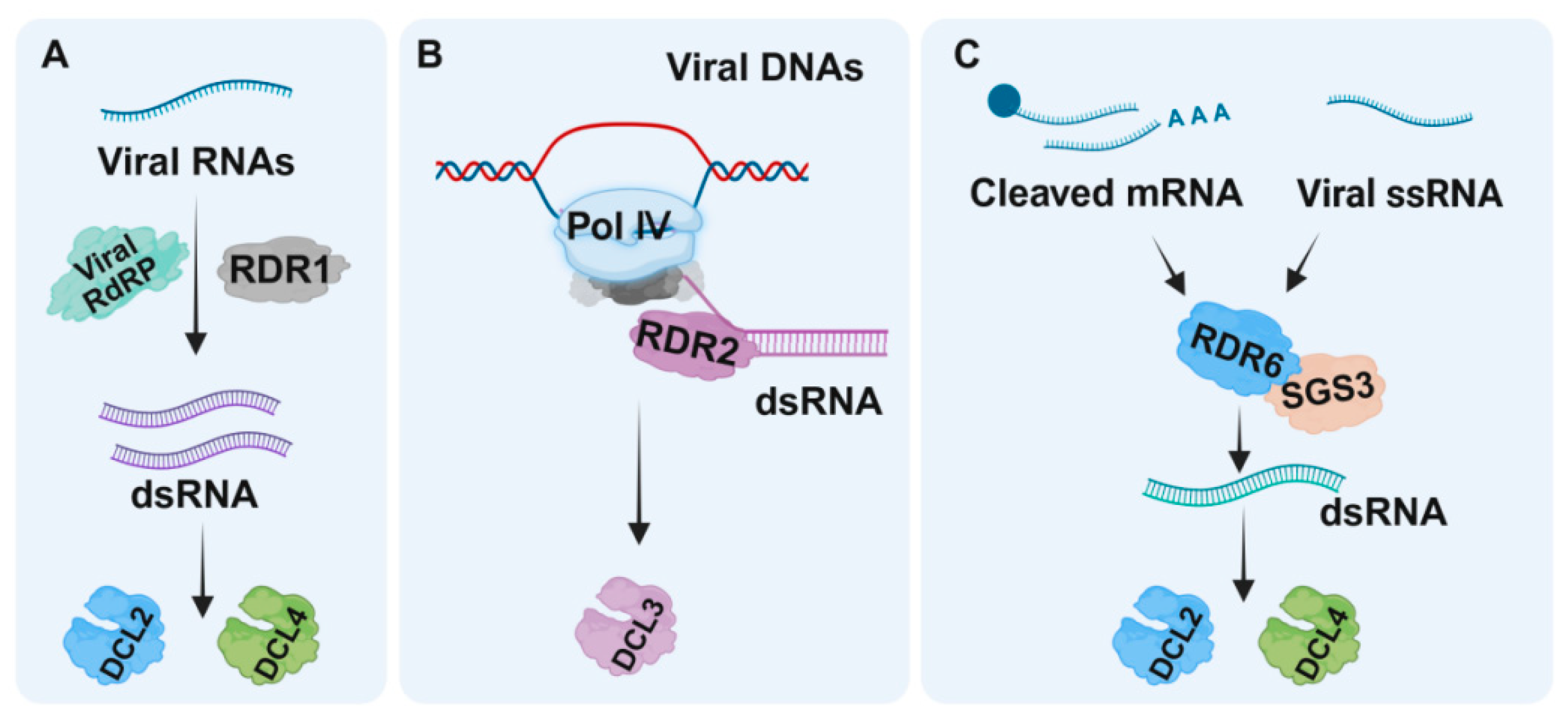
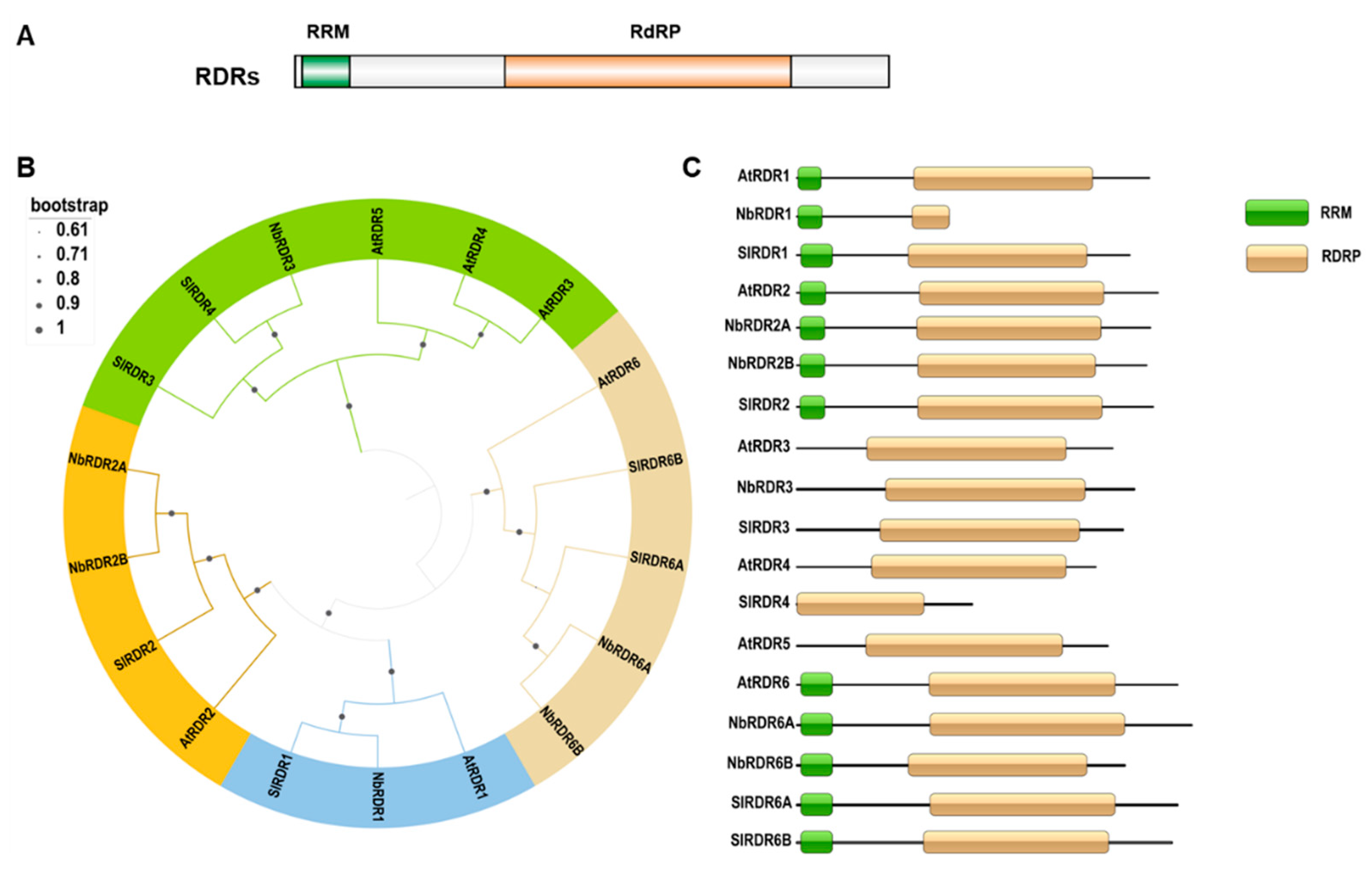
2.3. Core Antiviral RNAi Effectors: RDRs and Their Helper Proteins
| RDR/ SGS3 | Virus | Host | Main Functions | Reference |
|---|---|---|---|---|
| RDR1 (RDRα) | TRV | At | RDR1 restricts viral infection by generating secondary vsiRNAs in a cooperative manner with other RDRs | [12] |
| TMV | [70] | |||
| CMV | [9] | |||
| TuMV | At | RDR1 inhibits viral infection by an unknown mechanism in a cooperative manner with other RDRs | [14] | |
| PSTVd | Nb Sl | RDR1 is involved in SA-mediated defense and restricts viral early systemic invasion | [71] | |
| RDR2 (RDRα) | TRV | At | RDR1 restricts viral infection by generating vsiRNAs in a cooperative manner with other RDRs | [12] |
| TuMV | [14] | |||
| RDR6 (RDRα) | TRV | At | RDR6 restricts viral infection by generating secondary vsiRNAs in a cooperative manner with other RDRs | [12] |
| TMV | [70] | |||
| TuMV | [14] | |||
| CMV | [8,9] | |||
| TuMV | At | RDR6 restricts viral systemic infection via an unclear mechanism | [14] | |
| RSV | Os | [49] | ||
| TYLCCNV/ TYLCCNB | Nb At | [47] | ||
| RDV | Os | [48] | ||
| TbCSV | Nb | [67] | ||
| TLCYnV | ||||
| PSTVd | [72] | |||
| RDR3-5 (RDRγ) | - | - | - | - |
| Ty-1/3 (RDRγ) | TYLCV | Sl | Ty-1/3 encodes an RDR belonging to the RDRγ family that inhibits virus infection by transcriptional gene silencing | [54,55] |
| SGS3 | CMV | At | SGS3 restricts virus infection by enhancing the production of vsiRNAs | [8,44] |
| TYLCCNV/ | Nb | SGS3 limits viral systemic infection via an unclear mechanism | [66] | |
| TYLCCNB | ||||
| TbCSV | ||||
| TLCYnV | ||||
| PVA | [73] | |||
| TZSV | [74] |
3. Positive and Negative Modulators of Antiviral RNAi
3.1. Viral RNA Silencing Suppressors: Newly Identified Mechanisms (and Host Counter-Defense Strategies)
3.2. Endogenous RNA Silencing Suppressors
4. Translational Opportunities for Antiviral RNAi in Crop Protection
4.1. Breeding Strategies Exploiting Natural Variation in RNAi Components
4.2. RNAi-Based Biotechnological Tools
4.3. RNA-Based Antiviral Applications
5. Conclusions
Author Contributions
Funding
Institutional Review Board Statement
Informed Consent Statement
Data Availability Statement
Acknowledgments
Conflicts of Interest
References
- Ding, S.W. Transgene silencing, RNA interference, and the antiviral defense mechanism directed by small interfering RNAs. Phytopathology 2023, 113, 616–625. [Google Scholar] [CrossRef]
- Ding, S.W.; Voinnet, O. Antiviral immunity directed by small RNAs. Cell 2007, 130, 413–426. [Google Scholar] [CrossRef]
- Llave, C. Virus-derived small interfering RNAs at the core of plant-virus interactions. Trends Plant Sci. 2010, 15, 701–707. [Google Scholar] [CrossRef] [PubMed]
- Jin, L.; Chen, M.; Xiang, M.; Guo, Z. RNAi-based antiviral innate immunity in plants. Viruses 2022, 14, 432. [Google Scholar] [CrossRef] [PubMed]
- Ghildiyal, M.; Zamore, P.D. Small silencing RNAs: An expanding universe. Nat. Rev. Genet. 2009, 10, 94–108. [Google Scholar] [CrossRef]
- Tang, Z.; Shi, S.; Du, X.; Xu, G. Plant defense strategies: The dual armor of disease resistance and tolerance. New Plant Prot. 2025, 2, e70022. [Google Scholar] [CrossRef]
- Ge, L.; Zhou, X.; Li, F. Plant-virus arms race beyond RNA interference. Trends Plant Sci. 2024, 29, 16–19. [Google Scholar] [CrossRef]
- Wang, X.B.; Jovel, J.; Udomporn, P.; Wang, Y.; Wu, Q.; Li, W.X.; Gasciolli, V.; Vaucheret, H.; Ding, S.W. The 21-nucleotide, but not 22-nucleotide, viral secondary small interfering RNAs direct potent antiviral defense by two cooperative argonautes in Arabidopsis thaliana. Plant Cell 2011, 23, 1625–1638. [Google Scholar] [CrossRef]
- Wang, X.B.; Wu, Q.; Ito, T.; Cillo, F.; Li, W.X.; Chen, X.; Yu, J.L.; Ding, S.W. RNAi-mediated viral immunity requires amplification of virus-derived siRNAs in Arabidopsis thaliana. Proc. Natl. Acad. Sci. USA 2010, 107, 484–489. [Google Scholar] [CrossRef]
- Carbonell, A.; Carrington, J.C. Antiviral roles of plant ARGONAUTES. Curr. Opin. Plant Biol. 2015, 27, 111–117. [Google Scholar] [CrossRef]
- Deleris, A.; Gallego-Bartolome, J.; Bao, J.; Kasschau, K.D.; Carrington, J.C.; Voinnet, O. Hierarchical action and inhibition of plant Dicer-like proteins in antiviral defense. Science 2006, 313, 68–71. [Google Scholar] [CrossRef]
- Donaire, L.; Barajas, D.; Martínez-García, B.; Martínez-Priego, L.; Pagán, I.; Llave, C. Structural and genetic requirements for the biogenesis of tobacco rattle virus-derived small interfering RNAs. J. Virol. 2008, 82, 5167–5177. [Google Scholar] [CrossRef] [PubMed]
- Garcia-Ruiz, H.; Carbonell, A.; Hoyer, J.S.; Fahlgren, N.; Gilbert, K.B.; Takeda, A.; Giampetruzzi, A.; Garcia Ruiz, M.T.; McGinn, M.G.; Lowery, N.; et al. Roles and programming of Arabidopsis ARGONAUTE proteins during Turnip mosaic virus infection. PLoS Pathog. 2015, 11, e1004755. [Google Scholar] [CrossRef]
- Garcia-Ruiz, H.; Takeda, A.; Chapman, E.J.; Sullivan, C.M.; Fahlgren, N.; Brempelis, K.J.; Carrington, J.C. Arabidopsis RNA-dependent RNA polymerases and dicer-like proteins in antiviral defense and small interfering RNA biogenesis during Turnip Mosaic Virus infection. Plant Cell 2010, 22, 481–496. [Google Scholar] [CrossRef] [PubMed]
- Qu, F.; Ye, X.; Morris, T.J. Arabidopsis DRB4, AGO1, AGO7, and RDR6 participate in a DCL4-initiated antiviral RNA silencing pathway negatively regulated by DCL1. Proc. Natl. Acad. Sci. USA 2008, 105, 14732–14737. [Google Scholar] [CrossRef] [PubMed]
- Bai, M.; Yang, G.S.; Chen, W.T.; Mao, Z.C.; Kang, H.X.; Chen, G.H.; Yang, Y.H.; Xie, B.Y. Genome-wide identification of Dicer-like, Argonaute and RNA-dependent RNA polymerase gene families and their expression analyses in response to viral infection and abiotic stresses in Solanum lycopersicum. Gene 2012, 501, 52–62. [Google Scholar] [CrossRef]
- Liu, X.; Lu, T.; Dou, Y.; Yu, B.; Zhang, C. Identification of RNA silencing components in soybean and sorghum. BMC Bioinform. 2014, 15, 4. [Google Scholar] [CrossRef]
- Mosharaf, M.P.; Rahman, H.; Ahsan, M.A.; Akond, Z.; Ahmed, F.F.; Islam, M.M.; Moni, M.A.; Mollah, M.N.H. In silico identification and characterization of AGO, DCL and RDR gene families and their associated regulatory elements in sweet orange (Citrus sinensis L.). PLoS ONE 2020, 15, e0228233. [Google Scholar] [CrossRef]
- Wei, X.; Ke, H.; Wen, A.; Gao, B.; Shi, J.; Feng, Y. Structural basis of microRNA processing by Dicer-like 1. Nat. Plants 2021, 7, 1389–1396. [Google Scholar] [CrossRef]
- Nakasugi, K.; Crowhurst, R.N.; Bally, J.; Wood, C.C.; Hellens, R.P.; Waterhouse, P.M. De novo transcriptome sequence assembly and analysis of RNA silencing genes of Nicotiana benthamiana. PLoS ONE 2013, 8, e59534. [Google Scholar] [CrossRef]
- Andika, I.B.; Maruyama, K.; Sun, L.; Kondo, H.; Tamada, T.; Suzuki, N. Differential contributions of plant Dicer-like proteins to antiviral defences against potato virus X in leaves and roots. Plant J. 2015, 81, 781–793. [Google Scholar] [CrossRef]
- Pérez-Cañamás, M.; Hevia, E.; Katsarou, K.; Hernández, C. Genetic evidence for the involvement of Dicer-like 2 and 4 as well as Argonaute 2 in the Nicotiana benthamiana response against Pelargonium line pattern virus. J. Gen. Virol. 2021, 102, 001656. [Google Scholar] [CrossRef] [PubMed]
- Wang, Y.; Gong, Q.; Wu, Y.; Huang, F.; Ismayil, A.; Zhang, D.; Li, H.; Gu, H.; Ludman, M.; Fátyol, K.; et al. A calmodulin-binding transcription factor links calcium signaling to antiviral RNAi defense in plants. Cell Host Microbe 2021, 29, 1393–1406.e7. [Google Scholar] [CrossRef]
- Wang, Z.; Gao, X.; Zhong, S.; Li, Y.; Shi, M.; Zhang, B.; Zhang, S.; Shen, H.; Liu, X. Host-induced gene silencing of PcCesA3 and PcOSBP1 confers resistance to Phytophthora capsici in Nicotiana benthamiana through NbDCL3 and NbDCL4 processed small interfering RNAs. Int. J. Biol. Macromol. 2022, 222, 1665–1675. [Google Scholar] [CrossRef]
- Blevins, T.; Rajeswaran, R.; Shivaprasad, P.V.; Beknazariants, D.; Si-Ammour, A.; Park, H.S.; Vazquez, F.; Robertson, D.; Meins, F., Jr.; Hohn, T.; et al. Four plant Dicers mediate viral small RNA biogenesis and DNA virus induced silencing. Nucleic Acids Res. 2006, 34, 6233–6246. [Google Scholar] [CrossRef]
- Bouché, N.; Lauressergues, D.; Gasciolli, V.; Vaucheret, H. An antagonistic function for Arabidopsis DCL2 in development and a new function for DCL4 in generating viral siRNAs. EMBO J. 2006, 25, 3347–3356. [Google Scholar] [CrossRef]
- Malpica-López, N.; Rajeswaran, R.; Beknazariants, D.; Seguin, J.; Golyaev, V.; Farinelli, L.; Pooggin, M.M. Revisiting the roles of Tobamovirus replicase complex proteins in viral replication and silencing suppression. Mol. Plant Microbe Interact. 2018, 31, 125–144. [Google Scholar] [CrossRef] [PubMed]
- Akbergenov, R.; Si-Ammour, A.; Blevins, T.; Amin, I.; Kutter, C.; Vanderschuren, H.; Zhang, P.; Gruissem, W.; Meins, F., Jr.; Hohn, T.; et al. Molecular characterization of geminivirus-derived small RNAs in different plant species. Nucleic Acids Res. 2006, 34, 462–471. [Google Scholar] [CrossRef] [PubMed]
- Raja, P.; Jackel, J.N.; Li, S.; Heard, I.M.; Bisaro, D.M. Arabidopsis double-stranded RNA binding protein DRB3 participates in methylation-mediated defense against geminiviruses. J. Virol. 2014, 88, 2611–2622. [Google Scholar] [CrossRef]
- Kwon, J.; Kasai, A.; Maoka, T.; Masuta, C.; Sano, T.; Nakahara, K.S. RNA silencing-related genes contribute to tolerance of infection with potato virus X and Y in a susceptible tomato plant. Virol. J. 2020, 17, 149. [Google Scholar] [CrossRef]
- Xie, D.; Chen, M.; Niu, J.; Wang, L.; Li, Y.; Fang, X.; Li, P.; Qi, Y. Phase separation of SERRATE drives dicing body assembly and promotes miRNA processing in Arabidopsis. Nat. Cell Biol. 2021, 23, 32–39. [Google Scholar] [CrossRef]
- Wang, T.; Deng, Z.; Zhang, X.; Wang, H.; Wang, Y.; Liu, X.; Liu, S.; Xu, F.; Li, T.; Fu, D.; et al. Tomato DCL2b is required for the biosynthesis of 22-nt small RNAs, the resulting secondary siRNAs, and the host defense against ToMV. Hortic. Res. 2018, 5, 62. [Google Scholar] [CrossRef]
- Kravchik, M.; Damodharan, S.; Stav, R.; Arazi, T. Generation and characterization of a tomato DCL3-silencing mutant. Plant Sci. 2014, 221–222, 81–89. [Google Scholar] [CrossRef]
- Kravchik, M.; Sunkar, R.; Damodharan, S.; Stav, R.; Zohar, M.; Isaacson, T.; Arazi, T. Global and local perturbation of the tomato microRNA pathway by a trans-activated DICER-LIKE 1 mutant. J. Exp. Bot. 2014, 65, 725–739. [Google Scholar] [CrossRef]
- Wang, Z.; Hardcastle, T.J.; Canto Pastor, A.; Yip, W.H.; Tang, S.; Baulcombe, D.C. A novel DCL2-dependent miRNA pathway in tomato affects susceptibility to RNA viruses. Genes Dev. 2018, 32, 1155–1160. [Google Scholar] [CrossRef]
- Yifhar, T.; Pekker, I.; Peled, D.; Friedlander, G.; Pistunov, A.; Sabban, M.; Wachsman, G.; Alvarez, J.P.; Amsellem, Z.; Eshed, Y. Failure of the tomato trans-acting short interfering RNA program to regulate AUXIN RESPONSE FACTOR3 and ARF4 underlies the wiry leaf syndrome. Plant Cell 2012, 24, 3575–3589. [Google Scholar] [CrossRef]
- Shamandi, N.; Zytnicki, M.; Charbonnel, C.; Elvira-Matelot, E.; Bochnakian, A.; Comella, P.; Mallory, A.C.; Lepère, G.; Sáez-Vásquez, J.; Vaucheret, H. Plants encode a general siRNA suppressor that is induced and suppressed by viruses. PLoS Biol. 2015, 13, e1002326. [Google Scholar] [CrossRef] [PubMed]
- Ye, R.; Chen, Z.; Lian, B.; Rowley, M.J.; Xia, N.; Chai, J.; Li, Y.; He, X.J.; Wierzbicki, A.T.; Qi, Y. A Dicer-independent route for biogenesis of siRNAs that direct DNA methylation in Arabidopsis. Mol. Cell 2016, 61, 222–235. [Google Scholar] [CrossRef]
- Blevins, T.; Rajeswaran, R.; Aregger, M.; Borah, B.K.; Schepetilnikov, M.; Baerlocher, L.; Farinelli, L.; Meins, F., Jr.; Hohn, T.; Pooggin, M.M. Massive production of small RNAs from a non-coding region of Cauliflower mosaic virus in plant defense and viral counter-defense. Nucleic Acids Res. 2011, 39, 5003–5014. [Google Scholar] [CrossRef] [PubMed]
- Duan, C.G.; Zhang, H.; Tang, K.; Zhu, X.; Qian, W.; Hou, Y.J.; Wang, B.; Lang, Z.; Zhao, Y.; Wang, X.; et al. Specific but interdependent functions for Arabidopsis AGO4 and AGO6 in RNA-directed DNA methylation. EMBO J. 2015, 34, 581–592. [Google Scholar] [CrossRef] [PubMed]
- Brosseau, C.; Bolaji, A.; Roussin-Léveillée, C.; Zhao, Z.; Biga, S.; Moffett, P. Natural variation in the Arabidopsis AGO2 gene is associated with susceptibility to potato virus X. New Phytol. 2020, 226, 866–878. [Google Scholar] [CrossRef]
- Alazem, M.; He, M.H.; Moffett, P.; Lin, N.S. Abscisic acid induces resistance against Bamboo Mosaic Virus through Argonaute2 and 3. Plant Physiol. 2017, 174, 339–355. [Google Scholar] [CrossRef] [PubMed]
- Yang, Z.; Li, Y. Dissection of RNAi-based antiviral immunity in plants. Curr. Opin. Virol. 2018, 32, 88–99. [Google Scholar] [CrossRef] [PubMed]
- Mourrain, P.; Béclin, C.; Elmayan, T.; Feuerbach, F.; Godon, C.; Morel, J.B.; Jouette, D.; Lacombe, A.M.; Nikic, S.; Picault, N.; et al. Arabidopsis SGS2 and SGS3 genes are required for posttranscriptional gene silencing and natural virus resistance. Cell 2000, 101, 533–542. [Google Scholar] [CrossRef]
- Qu, F.; Ye, X.; Hou, G.; Sato, S.; Clemente, T.E.; Morris, T.J. RDR6 has a broad-spectrum but temperature-dependent antiviral defense role in Nicotiana benthamiana. J. Virol. 2005, 79, 15209–15217. [Google Scholar] [CrossRef]
- Yang, S.J.; Carter, S.A.; Cole, A.B.; Cheng, N.H.; Nelson, R.S. A natural variant of a host RNA-dependent RNA polymerase is associated with increased susceptibility to viruses by Nicotiana benthamiana. Proc. Natl. Acad. Sci. USA 2004, 101, 6297–6302. [Google Scholar] [CrossRef]
- Li, F.; Huang, C.; Li, Z.; Zhou, X. Suppression of RNA silencing by a plant DNA virus satellite requires a host calmodulin-like protein to repress RDR6 expression. PLoS Pathog. 2014, 10, e1003921. [Google Scholar] [CrossRef]
- Hong, W.; Qian, D.; Sun, R.; Jiang, L.; Wang, Y.; Wei, C.; Zhang, Z.; Li, Y. OsRDR6 plays role in host defense against double-stranded RNA virus, Rice Dwarf Phytoreovirus. Sci. Rep. 2015, 5, 11324. [Google Scholar] [CrossRef]
- Jiang, L.; Qian, D.; Zheng, H.; Meng, L.Y.; Chen, J.; Le, W.J.; Zhou, T.; Zhou, Y.J.; Wei, C.H.; Li, Y. RNA-dependent RNA polymerase 6 of rice (Oryza sativa) plays role in host defense against negative-strand RNA virus, Rice stripe virus. Virus Res. 2012, 163, 512–519. [Google Scholar] [CrossRef]
- Cao, M.; Du, P.; Wang, X.; Yu, Y.Q.; Qiu, Y.H.; Li, W.; Gal-On, A.; Zhou, C.; Li, Y.; Ding, S.W. Virus infection triggers widespread silencing of host genes by a distinct class of endogenous siRNAs in Arabidopsis. Proc. Natl. Acad. Sci. USA 2014, 111, 14613–14618. [Google Scholar] [CrossRef] [PubMed]
- Zhang, M.; Gong, P.; Ge, L.; Chang, Z.; Cheng, X.; Zhou, X.; Wang, A.; Li, F. Nuclear exportin 1 facilitates turnip mosaic virus infection by exporting the sumoylated viral replicase and by repressing plant immunity. New Phytol. 2021, 232, 1382–1398. [Google Scholar] [CrossRef] [PubMed]
- Incarbone, M.; Bradamante, G.; Pruckner, F.; Wegscheider, T.; Rozhon, W.; Nguyen, V.; Gutzat, R.; Mérai, Z.; Lendl, T.; MacFarlane, S.; et al. Salicylic acid and RNA interference mediate antiviral immunity of plant stem cells. Proc. Natl. Acad. Sci. USA 2023, 120, e2302069120. [Google Scholar] [CrossRef] [PubMed]
- Li, F.; Li, X.; Zhao, S.; Pan, F.; Li, Z.; Hao, Y.; He, J.; Wang, A.; Kormelink, R.; Zhou, X. Antiviral RNA interference in plants: Increasing complexity and integration with other biological processes. Plant Commun. 2025, 6, 101490. [Google Scholar] [CrossRef] [PubMed]
- Verlaan, M.G.; Hutton, S.F.; Ibrahem, R.M.; Kormelink, R.; Visser, R.G.; Scott, J.W.; Edwards, J.D.; Bai, Y. The Tomato Yellow Leaf Curl Virus resistance genes Ty-1 and Ty-3 are allelic and code for DFDGD-class RNA-dependent RNA polymerases. PLoS Genet. 2013, 9, e1003399. [Google Scholar] [CrossRef]
- Butterbach, P.; Verlaan, M.G.; Dullemans, A.; Lohuis, D.; Visser, R.G.; Bai, Y.; Kormelink, R. Tomato yellow leaf curl virus resistance by Ty-1 involves increased cytosine methylation of viral genomes and is compromised by cucumber mosaic virus infection. Proc. Natl. Acad. Sci. USA 2014, 111, 12942–12947. [Google Scholar] [CrossRef]
- Voorburg, C.M.; Yan, Z.; Bergua-Vidal, M.; Wolters, A.A.; Bai, Y.; Kormelink, R. Ty-1, a universal resistance gene against geminiviruses that is compromised by co-replication of a betasatellite. Mol. Plant Pathol. 2020, 21, 160–172. [Google Scholar] [CrossRef]
- Li, X.; Zhou, X.; Li, F. Pelota: A double-edged sword in virus infection. PLoS Pathog. 2025, 21, e1013328. [Google Scholar] [CrossRef]
- Voorburg, C.M.; Bai, Y.; Kormelink, R. Small RNA profiling of susceptible and resistant Ty-1 encoding tomato plants upon tomato yellow leaf curl virus infection. Front. Plant Sci. 2021, 12, 757165. [Google Scholar] [CrossRef]
- Peragine, A.; Yoshikawa, M.; Wu, G.; Albrecht, H.L.; Poethig, R.S. SGS3 and SGS2/SDE1/RDR6 are required for juvenile development and the production of trans-acting siRNAs in Arabidopsis. Genes. Dev. 2004, 18, 2368–2379. [Google Scholar] [CrossRef]
- Fukunaga, R.; Doudna, J.A. dsRNA with 5′ overhangs contributes to endogenous and antiviral RNA silencing pathways in plants. EMBO J. 2009, 28, 545–555. [Google Scholar] [CrossRef]
- Dalmay, T.; Hamilton, A.; Rudd, S.; Angell, S.; Baulcombe, D.C. An RNA-dependent RNA polymerase gene in Arabidopsis is required for posttranscriptional gene silencing mediated by a transgene but not by a virus. Cell 2000, 101, 543–553. [Google Scholar] [CrossRef]
- Yoshikawa, M.; Han, Y.W.; Fujii, H.; Aizawa, S.; Nishino, T.; Ishikawa, M. Cooperative recruitment of RDR6 by SGS3 and SDE5 during small interfering RNA amplification in Arabidopsis. Proc. Natl. Acad. Sci. USA 2021, 118, e2102885118. [Google Scholar] [CrossRef]
- Yoshikawa, M.; Iki, T.; Tsutsui, Y.; Miyashita, K.; Poethig, R.S.; Habu, Y.; Ishikawa, M. 3′ fragment of miR173-programmed RISC-cleaved RNA is protected from degradation in a complex with RISC and SGS3. Proc. Natl. Acad. Sci. USA 2013, 110, 4117–4122. [Google Scholar] [CrossRef] [PubMed]
- Elmayan, T.; Adenot, X.; Gissot, L.; Lauressergues, D.; Gy, I.; Vaucheret, H. A neomorphic sgs3 allele stabilizing miRNA cleavage products reveals that SGS3 acts as a homodimer. FEBS J. 2009, 276, 835–844. [Google Scholar] [CrossRef] [PubMed]
- Muangsan, N.; Beclin, C.; Vaucheret, H.; Robertson, D. Geminivirus VIGS of endogenous genes requires SGS2/SDE1 and SGS3 and defines a new branch in the genetic pathway for silencing in plants. Plant J. 2004, 38, 1004–1014. [Google Scholar] [CrossRef] [PubMed]
- Li, F.; Wang, Y.; Zhou, X. SGS3 cooperates with RDR6 in triggering geminivirus-induced gene silencing and in suppressing geminivirus infection in Nicotiana benthamiana. Viruses 2017, 9, 247. [Google Scholar] [CrossRef]
- Li, F.; Zhao, N.; Li, Z.; Xu, X.; Wang, Y.; Yang, X.; Liu, S.S.; Wang, A.; Zhou, X. A calmodulin-like protein suppresses RNA silencing and promotes geminivirus infection by degrading SGS3 via the autophagy pathway in Nicotiana benthamiana. PLoS Pathog. 2017, 13, e1006213. [Google Scholar] [CrossRef]
- Li, F.; Ge, L.; Lozano-Durán, R.; Zhou, X. Antiviral RNAi drives host adaptation to viral infection. Trends Microbiol. 2022, 30, 915–917. [Google Scholar] [CrossRef]
- Chen, Q.; Wang, J.; Hou, M.; Liu, S.; Huang, J.; Cai, L. BnSGS3 has differential effects on the accumulation of CMV, ORMV and TuMV in Oilseed Rape. Viruses 2015, 7, 4169–4185. [Google Scholar] [CrossRef]
- Qi, X.; Bao, F.S.; Xie, Z. Small RNA deep sequencing reveals role for Arabidopsis thaliana RNA-dependent RNA polymerases in viral siRNA biogenesis. PLoS ONE 2009, 4, e4971. [Google Scholar] [CrossRef]
- Li, S.; Zhang, Z.; Zhou, C.; Li, S. RNA-dependent RNA polymerase 1 delays the accumulation of viroids in infected plants. Mol. Plant Pathol. 2021, 22, 1195–1208. [Google Scholar] [CrossRef]
- Adkar-Purushothama, C.R.; Perreault, J.P. Suppression of RNA-dependent RNA polymerase 6 favors the accumulation of potato spindle tuber viroid in Nicotiana benthamiana. Viruses 2019, 11, 345. [Google Scholar] [CrossRef]
- Rajamäki, M.L.; Streng, J.; Valkonen, J.P. Silencing suppressor protein VPg of a potyvirus interacts with the plant silencing-related protein SGS3. Mol. Plant Microbe Interact. 2014, 27, 1199–1210. [Google Scholar] [CrossRef]
- Chen, J.; Zheng, L.; Shi, X.; Zhang, S.; Tan, X.; Zhao, X.; Lu, B.; Ye, Q.; Miao, S.; Liu, Y.; et al. The nonstructural protein NSs encoded by tomato zonate spot virus suppresses RNA silencing by interacting with NbSGS3. Mol. Plant Pathol. 2022, 23, 707–719. [Google Scholar] [CrossRef]
- Liu, J.; Gong, P.; Lu, R.; Lozano-Durán, R.; Zhou, X.; Li, F. Chloroplast immunity: A cornerstone of plant defense. Mol. Plant 2024, 17, 686–688. [Google Scholar] [CrossRef]
- Chen, Y.; Ge, L.; Li, Z.; Wang, A.; Zhou, X.; Li, F. Targeting of viral RNAs by nonsense-mediated decay is compromised by virus-plant interactions. New Plant Prot. 2024, 1, e8. [Google Scholar] [CrossRef]
- Baulcombe, D.C. The role of viruses in identifying and analyzing RNA silencing. Annu. Rev. Virol. 2022, 9, 353–373. [Google Scholar] [CrossRef] [PubMed]
- Lopez-Gomollon, S.; Baulcombe, D.C. Roles of RNA silencing in viral and non-viral plant immunity and in the crosstalk between disease resistance systems. Nat. Rev. Mol. Cell Biol. 2022, 23, 645–662. [Google Scholar] [CrossRef]
- Liu, S.; Han, Y.; Li, W.X.; Ding, S.W. Infection defects of RNA and DNA viruses induced by antiviral RNA interference. Microbiol. Mol. Biol. Rev. 2023, 87, e0003522. [Google Scholar] [CrossRef] [PubMed]
- Liu, S.; Ding, S.W. Antiviral RNA interference inhibits virus vertical transmission in plants. Cell Host Microbe 2024, 32, 1691–1704.e4. [Google Scholar] [CrossRef] [PubMed]
- Liu, S.; Chen, M.; Li, R.; Li, W.X.; Gal-On, A.; Jia, Z.; Ding, S.W. Identification of positive and negative regulators of antiviral RNA interference in Arabidopsis thaliana. Nat. Commun. 2022, 13, 2994. [Google Scholar] [CrossRef]
- Guo, Z.; Li, Y.; Ding, S.W. Small RNA-based antimicrobial immunity. Nat. Rev. Immunol. 2019, 19, 31–44. [Google Scholar] [CrossRef] [PubMed]
- Li, F.; Liu, W.; Zhou, X. Pivoting plant immunity from theory to the field. Sci. China Life Sci. 2019, 62, 1539–1542. [Google Scholar] [CrossRef]
- Li, F.; Wang, A. RNA-targeted antiviral immunity: More than just RNA silencing. Trends Microbiol. 2019, 27, 792–805. [Google Scholar] [CrossRef] [PubMed]
- Chen, Z.Q.; Zhao, J.H.; Chen, Q.; Zhang, Z.H.; Li, J.; Guo, Z.X.; Xie, Q.; Ding, S.W.; Guo, H.S. DNA geminivirus infection induces an imprinted E3 ligase gene to epigenetically activate viral gene transcription. Plant Cell 2020, 32, 3256–3272. [Google Scholar] [CrossRef]
- Zhou, X. Hijack to escape: A geminivirus seizes a host imprinted E3 ligase to escape epigenetic repression. Sci. China Life Sci. 2021, 64, 323–325. [Google Scholar] [CrossRef]
- Rosas-Diaz, T.; Zhang, D.; Fan, P.; Wang, L.; Ding, X.; Jiang, Y.; Jimenez-Gongora, T.; Medina-Puche, L.; Zhao, X.; Feng, Z.; et al. A virus-targeted plant receptor-like kinase promotes cell-to-cell spread of RNAi. Proc. Natl. Acad. Sci. USA 2018, 115, 1388–1393. [Google Scholar] [CrossRef]
- Fan, P.; Aguilar, E.; Bradai, M.; Xue, H.; Wang, H.; Rosas-Diaz, T.; Tang, W.; Wolf, S.; Zhang, H.; Xu, L.; et al. The receptor-like kinases BAM1 and BAM2 are required for root xylem patterning. Proc. Natl. Acad. Sci. USA 2021, 118, e2022547118. [Google Scholar] [CrossRef]
- Gong, P.; Tan, H.; Zhao, S.; Li, H.; Liu, H.; Ma, Y.; Zhang, X.; Rong, J.; Fu, X.; Lozano-Durán, R.; et al. Geminiviruses encode additional small proteins with specific subcellular localizations and virulence function. Nat. Commun. 2021, 12, 4278. [Google Scholar] [CrossRef] [PubMed]
- Gong, P.; Shen, Q.; Zhang, M.; Qiao, R.; Jiang, J.; Su, L.; Zhao, S.; Fu, S.; Ma, Y.; Ge, L.; et al. Plant and animal positive-sense single-stranded RNA viruses encode small proteins important for viral infection in their negative-sense strand. Mol. Plant 2023, 16, 1794–1810. [Google Scholar] [CrossRef]
- Zhao, S.; Gong, P.; Ren, Y.; Liu, H.; Li, H.; Li, F.; Zhou, X. The novel C5 protein from tomato yellow leaf curl virus is a virulence factor and suppressor of gene silencing. Stress Biol. 2022, 2, 19. [Google Scholar] [CrossRef]
- Zhao, S.; Gong, P.; Liu, J.; Liu, H.; Lozano-Durán, R.; Zhou, X.; Li, F. Geminivirus C5 proteins mediate formation of virus complexes at plasmodesmata for viral intercellular movement. Plant Physiol. 2023, 193, 322–338. [Google Scholar] [CrossRef]
- Gong, P.; Zhao, S.; Liu, H.; Chang, Z.; Li, F.; Zhou, X. Tomato yellow leaf curl virus V3 protein traffics along microfilaments to plasmodesmata to promote virus cell-to-cell movement. Sci. China Life Sci. 2022, 65, 1046–1049. [Google Scholar] [CrossRef]
- Incarbone, M.; Zimmermann, A.; Hammann, P.; Erhardt, M.; Michel, F.; Dunoyer, P. Neutralization of mobile antiviral small RNA through peroxisomal import. Nat. Plants 2017, 3, 17094. [Google Scholar] [CrossRef]
- Zhang, K.; Gu, T.; Xu, X.; Gan, H.; Qin, L.; Feng, C.; He, Z. Sugarcane streak mosaic virus P1 protein inhibits unfolded protein response through direct suppression of bZIP60U splicing. PLoS Pathog. 2023, 19, e1011738. [Google Scholar] [CrossRef]
- Gupta, A.K.; Tatineni, S. RNA silencing suppression mechanisms of Triticum mosaic virus P1: dsRNA binding property and mapping functional motifs. Virus Res. 2019, 269, 197640. [Google Scholar] [CrossRef]
- Flobinus, A.; Chevigny, N.; Charley, P.A.; Seissler, T.; Klein, E.; Bleykasten-Grosshans, C.; Ratti, C.; Bouzoubaa, S.; Wilusz, J.; Gilmer, D. Beet necrotic yellow vein virus noncoding RNA production depends on a 5′ → 3′ Xrn exoribonuclease activity. Viruses 2018, 10, 137. [Google Scholar] [CrossRef] [PubMed]
- Flobinus, A.; Hleibieh, K.; Klein, E.; Ratti, C.; Bouzoubaa, S.; Gilmer, D. A viral noncoding RNA complements a weakened viral RNA silencing suppressor and promotes efficient systemic host infection. Viruses 2016, 8, 272. [Google Scholar] [CrossRef]
- Iwakawa, H.O.; Mizumoto, H.; Nagano, H.; Imoto, Y.; Takigawa, K.; Sarawaneeyaruk, S.; Kaido, M.; Mise, K.; Okuno, T. A viral noncoding RNA generated by cis-element-mediated protection against 5′ -> 3′ RNA decay represses both cap-independent and cap-dependent translation. J. Virol. 2008, 82, 10162–10174. [Google Scholar] [CrossRef] [PubMed]
- Gunawardene, C.D.; Newburn, L.R.; White, K.A. A 212-nt long RNA structure in the Tobacco necrosis virus-D RNA genome is resistant to Xrn degradation. Nucleic Acids Res. 2019, 47, 9329–9342. [Google Scholar] [CrossRef] [PubMed]
- Miller, W.A.; Shen, R.; Staplin, W.; Kanodia, P. Noncoding RNAs of plant viruses and viroids: Sponges of host translation and RNA interference machinery. Mol. Plant Microbe Interact. 2016, 29, 156–164. [Google Scholar] [CrossRef]
- Dilweg, I.W.; Peer, J.; Olsthoorn, R.C.L. Xrn1-resistant RNA motifs are disseminated throughout the RNA virome and are able to block scanning ribosomes. Sci. Rep. 2023, 13, 15987. [Google Scholar] [CrossRef]
- Dilweg, I.W.; Gultyaev, A.P.; Olsthoorn, R.C. Structural features of an Xrn1-resistant plant virus RNA. RNA Biol. 2019, 16, 838–845. [Google Scholar] [CrossRef]
- Schnettler, E.; Sterken, M.G.; Leung, J.Y.; Metz, S.W.; Geertsema, C.; Goldbach, R.W.; Vlak, J.M.; Kohl, A.; Khromykh, A.A.; Pijlman, G.P. Noncoding flavivirus RNA displays RNA interference suppressor activity in insect and Mammalian cells. J. Virol. 2012, 86, 13486–13500. [Google Scholar] [CrossRef]
- Campbell, A.J.; Anderson, J.R.; Wilusz, J. A plant-infecting subviral RNA associated with poleroviruses produces a subgenomic RNA which resists exonuclease XRN1 in vitro. Virology 2022, 566, 1–8. [Google Scholar] [CrossRef]
- Shen, M.; Wang, Y.; Chen, Y.; Peng, J.; Wu, G.; Rao, S.; Wu, J.; Zheng, H.; Chen, J.; Yan, F.; et al. Potato type I protease inhibitor mediates host defence against Potato Virus X infection by interacting with a viral RNA silencing suppressor. Mol. Plant Pathol. 2025, 26, e70073. [Google Scholar] [CrossRef] [PubMed]
- Xu, T.; Zhan, B.; Zhang, Z.; Fan, L.; Gao, D.; Dong, Z.; Li, S.; Wang, H. FaNDUFB9 attenuates strawberry mottle virus infection by inhibiting the activity of the viral gene silencing suppressor, Pro2Glu. Mol. Plant Pathol. 2025, 26, e70061. [Google Scholar] [CrossRef] [PubMed]
- Xie, Y.S.; Zeng, Q.; Huang, W.T.; Wang, J.Y.; Li, H.W.; Yu, S.Z.; Liu, C.; Zhang, X.Q.; Feng, C.L.; Zhang, W.H.; et al. A novel RAV transcription factor from pear interacts with viral RNA-silencing suppressors to inhibit viral infection. Plant J. 2024, 120, 1079–1093. [Google Scholar] [CrossRef] [PubMed]
- Anandalakshmi, R.; Marathe, R.; Ge, X.; Herr, J.M., Jr.; Mau, C.; Mallory, A.; Pruss, G.; Bowman, L.; Vance, V.B. A calmodulin-related protein that suppresses posttranscriptional gene silencing in plants. Science 2000, 290, 142–144. [Google Scholar] [CrossRef]
- Yong Chung, H.; Lacatus, G.; Sunter, G. Geminivirus AL2 protein induces expression of, and interacts with, a calmodulin-like gene, an endogenous regulator of gene silencing. Virology 2014, 460–461, 108–118. [Google Scholar] [CrossRef]
- Nakahara, K.S.; Masuta, C.; Yamada, S.; Shimura, H.; Kashihara, Y.; Wada, T.S.; Meguro, A.; Goto, K.; Tadamura, K.; Sueda, K.; et al. Tobacco calmodulin-like protein provides secondary defense by binding to and directing degradation of virus RNA silencing suppressors. Proc. Natl. Acad. Sci. USA 2012, 109, 10113–10118. [Google Scholar] [CrossRef] [PubMed]
- Liu, D.; Yang, Q. Expression patterns of NbrgsCaM family genes in Nicotiana benthamiana and their potential roles in development and stress responses. Sci. Rep. 2020, 10, 9652. [Google Scholar] [CrossRef] [PubMed]
- Ghorbani Faal, P.; Farsi, M.; Seifi, A.; Mirshamsi Kakhki, A. Virus-induced CRISPR-Cas9 system improved resistance against tomato yellow leaf curl virus. Mol. Biol. Rep. 2020, 47, 3369–3376. [Google Scholar] [CrossRef]
- Sun, D.; Nandety, R.S.; Zhang, Y.; Reid, M.S.; Niu, L.; Jiang, C.Z. A petunia ethylene-responsive element binding factor, PhERF2, plays an important role in antiviral RNA silencing. J. Exp. Bot. 2016, 67, 3353–3365. [Google Scholar] [CrossRef]
- García, A.; Aragonés, V.; Gioiosa, S.; Herraiz, F.J.; Ortiz-García, P.; Prohens, J.; Daròs, J.A.; Pasin, F. Comparative genomics-driven design of virus-delivered short RNA inserts triggering robust gene silencing. Plant Biotechnol. J. 2025, 23, 4930–4932. [Google Scholar] [CrossRef]
- Mitter, N.; Worrall, E.A.; Robinson, K.E.; Li, P.; Jain, R.G.; Taochy, C.; Fletcher, S.J.; Carroll, B.J.; Lu, G.Q.; Xu, Z.P. Clay nanosheets for topical delivery of RNAi for sustained protection against plant viruses. Nat. Plants 2017, 3, 16207. [Google Scholar] [CrossRef] [PubMed]
- Niehl, A.; Wyrsch, I.; Boller, T.; Heinlein, M. Double-stranded RNAs induce a pattern-triggered immune signaling pathway in plants. New Phytol. 2016, 211, 1008–1019. [Google Scholar] [CrossRef]
- Necira, K.; Contreras, L.; Kamargiakis, E.; Kamoun, M.S.; Canto, T.; Tenllado, F. Comparative analysis of RNA interference and pattern-triggered immunity induced by dsRNA reveals different efficiencies in the antiviral response to potato virus X. Mol. Plant Pathol. 2024, 25, e70008. [Google Scholar] [CrossRef]
- Tabein, S.; Jansen, M.; Noris, E.; Vaira, A.M.; Marian, D.; Behjatnia, S.A.A.; Accotto, G.P.; Miozzi, L. The induction of an effective dsRNA-mediated resistance against tomato spotted wilt virus by exogenous application of double-stranded RNA largely depends on the selection of the viral RNA target region. Front. Plant Sci. 2020, 11, 533338. [Google Scholar] [CrossRef]
- Delgado-Martín, J.; Ruiz, L.; Janssen, D.; Velasco, L. Exogenous application of dsRNA for the control of viruses in Cucurbits. Front. Plant Sci. 2022, 13, 895953. [Google Scholar] [CrossRef]



| RSS | Virus | Virus Family/Genus | Primary Target(s) in RNAi Pathway | Mode of Action | Reference |
|---|---|---|---|---|---|
| HC-Pro | TEV | Potyviridae/Potyvirus | siRNAs, AGO1 | Sequestration of siRNAs; inhibition of RISC activity | [77,78] |
| 2b | CMV | Bromoviridae/Cucumovirus | AGO1, AGO4; siRNAs | Direct AGO binding; inhibition of PTGS and RdDM | [10,43,82] |
| p19 | TBSV | Tombusviridae/Tombusvirus | siRNAs | Size-selective binding and sequestration of 21–22 nt siRNAs | [77,82] |
| P38 | TCV | Tombusviridae/Carmovirus | AGO1 | Direct interaction with AGO1, blocking slicer activity | [78,83] |
| C2/C3 (indirect) | BSCTV | Geminiviridae/Curtovirus | RdDM machinery | Indirect suppression of RdDM via host factor induction (VIM5-mediated degradation of MET1/CMT3) | [85,86] |
| C4 | TYLCV | Geminiviridae/Begomovirus | Cell-to-cell RNAi spread | Targeting BAM1/BAM2 to inhibit systemic RNA silencing | [87,88] |
| V3, C5 | TYLCV | Geminiviridae/Begomovirus | PTGS and TGS pathways | Suppression of both PTGS and TGS; modulation of intracellular trafficking | [91,92,93] |
| βC1 | TYLCCNV | Geminiviridae/Begomovirus | RDR6 and SGS3 | Suppression of RDR6 and SGS3-dependent PTGS | [47,67] |
| p15 | PCV | Virgaviridae/Pecluvirus | siRNAs | Sequestration of siRNAs and relocalization to peroxisomes, impairing systemic RNAi | [94] |
| P1 | SCSMV | Potyviridae/Poacevirus | dsRNA; UPR-related pathways | dsRNA binding; inhibition of UPR signaling and induction of cell death | [95,96] |
| 8S RNA | CaMV | Caulimoviridae/Caulimovirus | DCL processing | RNA-based decoy that saturates DCL activity | [39] |
| ncRNA3 | BNYVV | Benyviridae/Benyvirus | RNAi components (putative) | XRN-resistant ncRNA; synergizes with p14 RSS to enhance viral accumulation | [97,98] |
| SR1f RNA | RCNMV | Tombusviridae/Dianthovirus | Translation/RNA stability | XRN-resistant ncRNA; suppresses cap-dependent and independent translation | [99] |
| svRNA (212 nt) | TNV-D | Tombusviridae/Tombusvirus | RNAi factors (putative) | XRN-resistant structured RNA; deletion attenuates infection | [100] |
Disclaimer/Publisher’s Note: The statements, opinions and data contained in all publications are solely those of the individual author(s) and contributor(s) and not of MDPI and/or the editor(s). MDPI and/or the editor(s) disclaim responsibility for any injury to people or property resulting from any ideas, methods, instructions or products referred to in the content. |
© 2026 by the authors. Licensee MDPI, Basel, Switzerland. This article is an open access article distributed under the terms and conditions of the Creative Commons Attribution (CC BY) license.
Share and Cite
Li, X.; Pan, F.; Zhou, X.; Wang, A.; Kormelink, R.; Li, F. Advances in Plant Antiviral RNAi: From Host DCLs/RDRs to Diversified Viral Counteracting Strategies. Viruses 2026, 18, 184. https://doi.org/10.3390/v18020184
Li X, Pan F, Zhou X, Wang A, Kormelink R, Li F. Advances in Plant Antiviral RNAi: From Host DCLs/RDRs to Diversified Viral Counteracting Strategies. Viruses. 2026; 18(2):184. https://doi.org/10.3390/v18020184
Chicago/Turabian StyleLi, Xue, Fuan Pan, Xueping Zhou, Aiming Wang, Richard Kormelink, and Fangfang Li. 2026. "Advances in Plant Antiviral RNAi: From Host DCLs/RDRs to Diversified Viral Counteracting Strategies" Viruses 18, no. 2: 184. https://doi.org/10.3390/v18020184
APA StyleLi, X., Pan, F., Zhou, X., Wang, A., Kormelink, R., & Li, F. (2026). Advances in Plant Antiviral RNAi: From Host DCLs/RDRs to Diversified Viral Counteracting Strategies. Viruses, 18(2), 184. https://doi.org/10.3390/v18020184