The Interaction Between Orientin and the Spike of SARS-CoV-2: An In Silico and Experimental Approach

 ,
,  , and
, and
Abstract
1. Introduction
2. Materials and Methods
2.1. Computational Methodology
2.1.1. Ligand and Protein Preparation
2.1.2. Molecular Docking
2.2. Experimental Methodology
2.2.1. Fluorescence Quenching
2.2.2. Cell, Compound, and Virus
2.2.3. Cell Culture
2.2.4. Cell Viability Assay
2.2.5. Antiviral Activity
2.2.6. Virucidal Activity
3. Results
3.1. Molecular Docking Reveals That Orientin Interacts with RBM
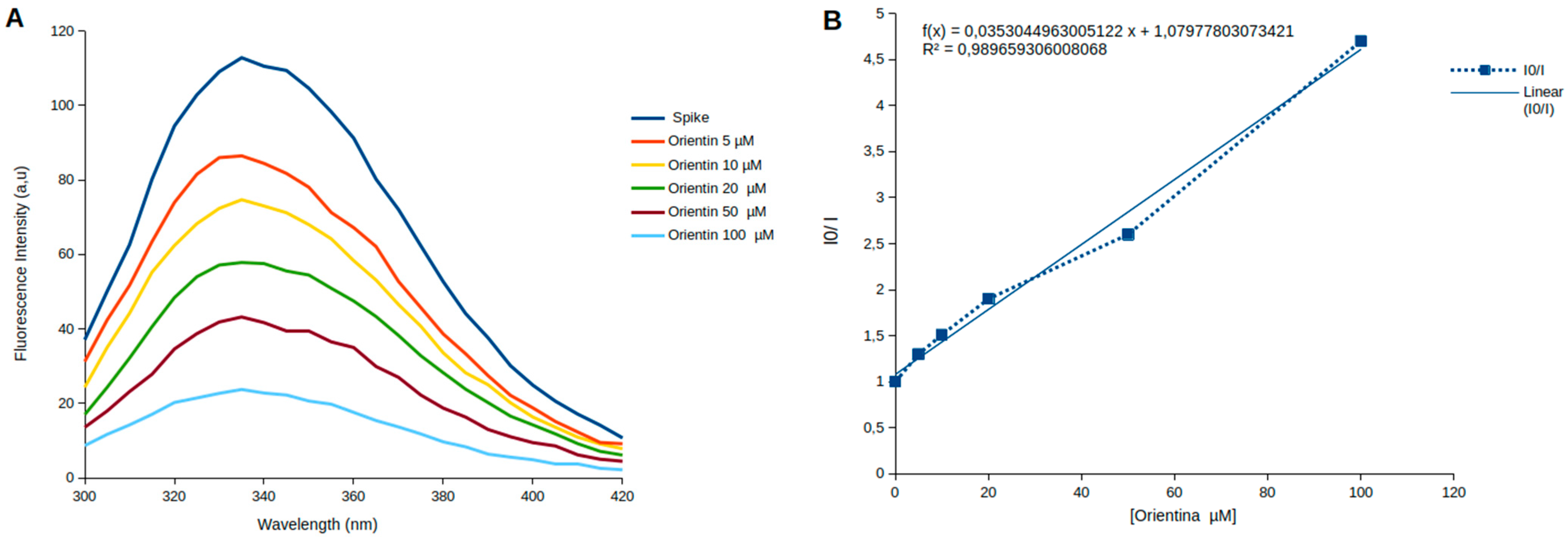
3.2. The Decrease in the Intrinsic Fluorescence of the Spike Protein Suggests an Interaction with Orientin
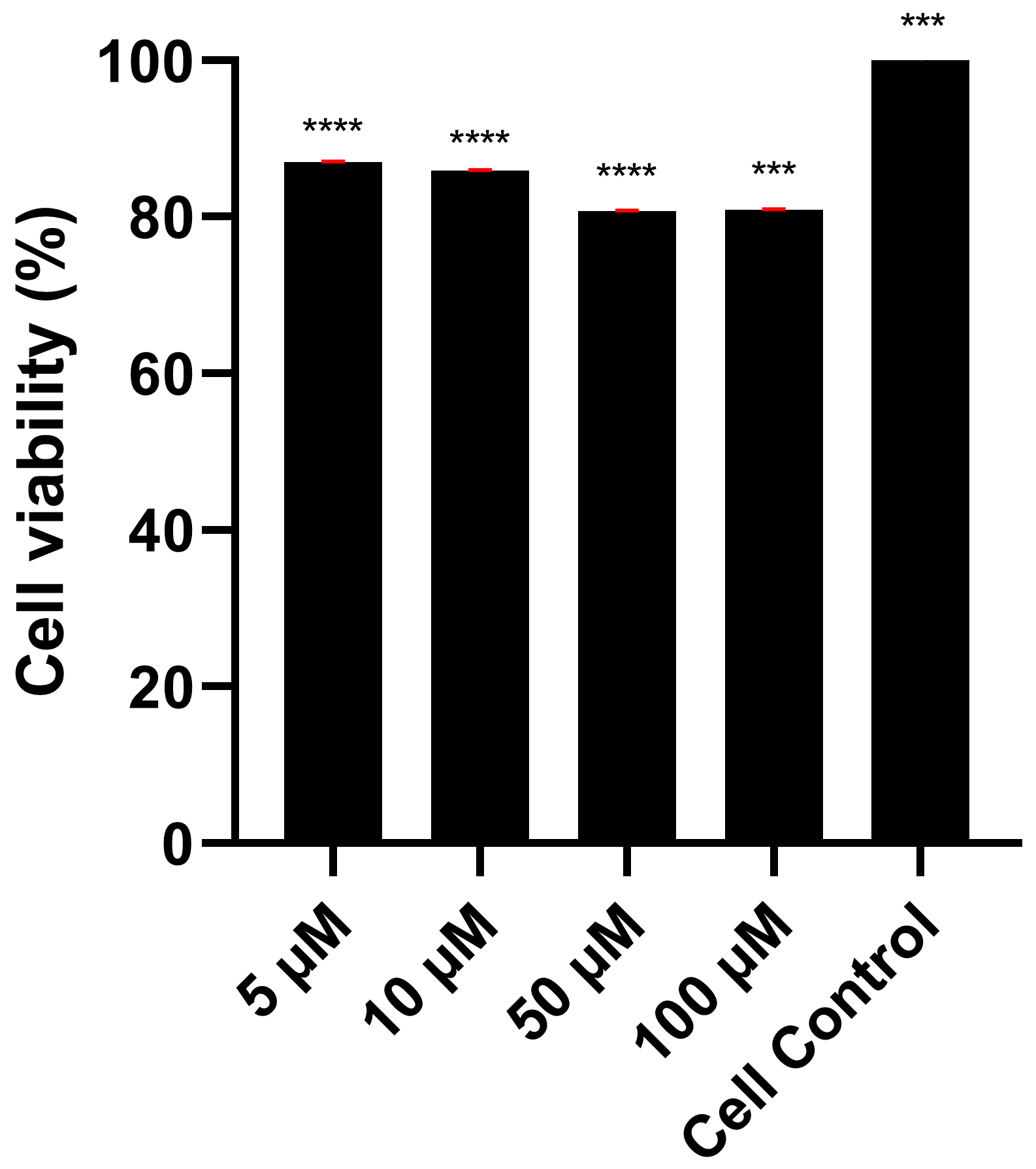
3.3. Orientin Reduces SARS-CoV-2 Replication in Vero Cells
4. Discussion
5. Conclusions
Supplementary Materials
Author Contributions
Funding
Institutional Review Board Statement
Informed Consent Statement
Data Availability Statement
Acknowledgments
Conflicts of Interest
Abbreviations
| ACE2 | Angiotensin-converting enzyme 2 |
| Ala | Alanine |
| Arg | Arginine |
| Asp | Aspartate |
| COVID-19 | Coronavirus Disease 19 |
| CoVs | Coronaviruses |
| DMEM | Dulbecco’s Modified Eagle’s Medium |
| FBS | Fetal Bovine Serum |
| Glu | Glutamate |
| Gln | Glutamine |
| Gly | Glycine |
| HCoV | Human Coronaviruses |
| Ile | Isoleucine |
| Kcal/mol | Kilocalorie per mol |
| Kq | Biomolecular quenching constant |
| Ksv | Stern–Volmer constant |
| Leu | Leucine |
| Lys | Lysine |
| MTS | 3-(4,5-dimetiltiazol-2-il)-5-(3-carboximetilfenil)-2-(4-sulfofenil)-2H-tetrazólio |
| NIH | National Institute of Health |
| Phe | Phenylalanine |
| PMS | Phenazine methosulfate |
| RBD | Receptor-binding domain |
| RBM | Receptor-binding motif |
| RNA | Ribonucleic acid |
| SARS-CoV | Severe acute respiratory syndrome coronavirus |
| SARS-CoV-2 | Severe acute respiratory syndrome coronavirus 2 |
| SDF | Structure data file |
| Ser | Serine |
| Thr | Threonine |
| Trp | Tryptophan |
| Tyr | Tyrosine |
| Vdw | Van der Waals |
| WHO | World Health Organization |
References
- Millet, J.K.; Jaimes, J.A.; Whittaker, G.R. Molecular Diversity of Coronavirus Host Cell Entry Receptors. FEMS Microbiol. Rev. 2020, 45, fuaa057. [Google Scholar] [CrossRef] [PubMed]
- Hulswit, R.J.; de Haan, C.A.; Bosch, B.J. Chapter Two—Coronavirus Spike Protein and Tropism Changes. In Advances in Virus Research; Ziebuhr, J., Ed.; Academic Press: Cambridge, MA, USA, 2016; Volume 96, pp. 29–57. [Google Scholar] [CrossRef]
- Su, S.; Wong, G.; Shi, W.; Liu, J.; Lai, A.C.K.; Zhou, J.; Liu, W.; Bi, Y.; Gao, G.F. Epidemiology, Genetic Recombination, and Pathogenesis of Coronaviruses. Trends Microbiol. 2016, 24, 490–502. [Google Scholar] [CrossRef] [PubMed]
- Ning, T.; Liu, S.; Xu, J.; Yang, Y.; Zhang, N.; Xie, S.; Min, L.; Zhang, S.; Zhu, S.; Wang, Y. Potential Intestinal Infection and Faecal-oral Transmission of Human Coronaviruses. Rev. Med. Virol. 2022, 32, e2363. [Google Scholar] [CrossRef]
- Corrêa, T.D.; Matos, G.F.J.; Bravim, B.A.; Cordioli, R.L.; Garrido, A.D.P.G.; Assunção, M.S.C.; Barbas, C.S.V.; Timenetsky, K.T.; Rodrigues, R.D.R.; Guimarães, H.P.; et al. Intensive Support Recommendations for Critically-Ill Patients with Suspected or Confirmed COVID-19 Infection. Einstein 2020, 18, eAE5793. [Google Scholar] [CrossRef]
- Ohannessian, R.; Duong, T.A.; Odone, A. Global Telemedicine Implementation and Integration Within Health Systems to Fight the COVID-19 Pandemic: A Call to Action. JMIR Public Health Surveill. 2020, 6, e18810. [Google Scholar] [CrossRef]
- COVID-19 Cases|WHO COVID-19 Dashboard. Datadot. Available online: https://data.who.int/dashboards/covid19/cases (accessed on 5 May 2025).
- Naqvi, A.A.T.; Fatima, K.; Mohammad, T.; Fatima, U.; Singh, I.K.; Singh, A.; Atif, S.M.; Hariprasad, G.; Hasan, G.M.; Hassan, M.I. Insights into SARS-CoV-2 genome, structure, evolution, pathogenesis and therapies: Structural genomics approach. Biochim. Biophys. Acta Mol. Basis Dis. 2020, 1866, 165878. [Google Scholar] [CrossRef]
- Caldas, L.A.; Carneiro, F.A.; Monteiro, F.L.; Augusto, I.; Higa, L.M.; Miranda, K.; Tanuri, A.; de Souza, W. Intracellular Host Cell Membrane Remodelling Induced by SARS-CoV-2 Infection in Vitro. Biol. Cell 2021, 113, 281–293. [Google Scholar] [CrossRef]
- Sheikhi, A.; Hojjat, F.M. An Immunotherapeutic Method for COVID-19 Patients: A Soluble ACE2-Anti-CD16 VHH to Block SARS-CoV-2 Spike Protein. Hum. Vaccines Immunother. 2021, 17, 92–97. [Google Scholar] [CrossRef] [PubMed]
- Rebelo, B.A.; Folgado, A.; Ferreira, A.C.; Abranches, R. Production of the SARS-CoV-2 Spike Protein and Its Receptor Binding Domain in Plant Cell Suspension Cultures. Front. Plant Sci. 2022, 13, 995429. [Google Scholar] [CrossRef]
- Kung, Y.A.; Lee, K.M.; Chiang, H.J.; Huang, S.Y.; Wu, C.J.; Shih, S.R. Molecular Virology of SARS-CoV-2 and Related Coronaviruses. Microbiol. Mol. Biol. Rev. 2022, 86, e00026-21. [Google Scholar] [CrossRef]
- Du, L.; He, Y.; Zhou, Y.; Liu, S.; Zheng, B.J.; Jiang, S. The Spike Protein of SARS-CoV—A Target for Vaccine and Therapeutic Development. Nat. Rev. Microbiol. 2009, 7, 226–236. [Google Scholar] [CrossRef]
- Hillary, V.E.; Ceasar, S.A. An Update on COVID-19: SARS-CoV-2 Variants, Antiviral Drugs, and Vaccines. Heliyon 2023, 9, e13952. [Google Scholar] [CrossRef]
- Padasas, B.T.; Españo, E.; Kim, S.H.; Song, Y.; Lee, C.K.; Kim, J.K. COVID-19 Therapeutics: An Update on Effective Treatments Against Infection with SARS-CoV-2 Variants. Immune Netw. 2023, 23, e13. [Google Scholar] [CrossRef]
- Abdelhamid, M.H.M.; Almsellati, I.A.; Annajar, B.B.; Abdulhamid, A.; Alemam, H.; Etikar, M. Hospitalization among vaccines for SARS-CoV-2 breakthrough infection after dose sparing strategies in Libya: A cohort study. PLoS ONE 2022, 17, e0276425. [Google Scholar] [CrossRef]
- Meo, S.A.; Fahad Al-Jassir, F.; Al-Qahtani, S.; Albarrak, R.; Usmani, A.M.; Klonoff, D.C. Effect of Pfizer/BioNTech and Oxford/AstraZeneca Vaccines against COVID-19 Morbidity and Mortality in Real-World Settings at Countrywide Vaccination Campaign in Saudi Arabia. Eur. Rev. Med. Pharmacol. Sci. 2021, 25, 7185–7191. [Google Scholar] [CrossRef]
- Flanagan, K.L.; Best, E.; Crawford, N.W.; Giles, M.; Koirala, A.; Macartney, K.; Russell, F.; The, B.W.; Wen, S.C. Progress and Pitfalls in the Quest for Effective SARS-CoV-2 (COVID-19) Vaccines. Front. Immunol. 2020, 11, 579250. [Google Scholar] [CrossRef] [PubMed]
- Peng, P.; Feng, C.; Hu, J.; He, C.; Deng, H.; Fan, Q.; Xiang, J.; Tang, G.; Jiang, M.L.; Hu, F.; et al. Extensive Neutralization against SARS-CoV-2 Variants Elicited by Omicron-Specific Subunit Vaccine as a Heterologous Booster. iScience 2022, 25, 105465. [Google Scholar] [CrossRef]
- Campos, G.R.F.; Almeida, N.B.F.; Filgueiras, S.; Corsini, C.A.; Gomes, S.V.C.; de Miranda, D.A.P.; de Assis, J.V.; Silva, T.B.S.; Alves, A.; Fernandes, G.D.R.; et al. Second Booster Dose Improves Antibody Neutralization against BA.1, BA.5 and BQ.1.1 in Individuals Previously Immunized with CoronaVac plus BNT162B2 Booster Protocol. Front. Cell. Infect. Microbiol. 2024, 14, 1371695. [Google Scholar] [CrossRef] [PubMed]
- Atmar, R.L.; Lyke, E.; Deming, M.E.; Jackson, L.A.; Branche, A.R.; El Sahly, H.M.; Rostad, C.A. Homologous and Heterologous COVID-19 Booster Vaccinations. N. Engl. J. Med. 2022, 386, 1046–1057. [Google Scholar] [CrossRef] [PubMed]
- Seidel, A.; Zanoni, M.; Groß, R.; Krnavek, D.; Erdemci-Evin, S.; von Maltitz, P.; Albers, D.P.J.; Conzelmann, C.; Liu, S.; Weil, T.; et al. BNT162b2 Booster after Heterologous Prime-Boost Vaccination Induces Potent Neutralizing Antibodies and T Cell Reactivity against SARS-CoV-2 Omicron BA.1 in Young Adults. Front. Immunol. 2022, 13, 882918. [Google Scholar] [CrossRef]
- He, X.; He, C.; Hong, W.; Yang, J.; Wei, X. Research Progress in Spike Mutations of SARS-CoV-2 Variants and Vaccine Development. Med. Res. Rev. 2023, 43, 932–971. [Google Scholar] [CrossRef]
- Koeppen, B.H.; Roux, D.G. C-Glycosylflavonoids. The Chemistry of Orientin and Iso-Orientin. Biochem. J. 1965, 97, 444–448. [Google Scholar] [CrossRef]
- Lam, K.Y.; Ling, A.P.; Koh, R.Y.; Wong, Y.P.; Say, Y.H. A Review on Medicinal Properties of Orientin. Adv. Pharmacol. Sci. 2016, 2016, 4104595. [Google Scholar] [CrossRef]
- Li, Y.L.; Ma, S.C.; Yang, Y.T.; Ye, S.M.; But, P.P. Antiviral Activities of Flavonoids and Organic Acid from Trollius Chinensis Bunge. J. Ethnopharmacol. 2002, 79, 365–368. [Google Scholar] [CrossRef]
- Da Fonseca, J.M.; Reis, A.C.C.; Pereira, G.R.; de Moura, H.M.M.; Souza Filho, J.D.; Silva, B.M.; Brandão, G.C. Chromatographic Profile of Xanthones and Flavonoids in the Anti-Dengue Extracts of Fridericia samydoides (Cham.) L.G. Lohmann (Bignoniaceae). Braz. J. Pharm. Sci. 2022, 58, e18802. [Google Scholar] [CrossRef]
- Bhowmik, A.; Biswas, S.; Hajra, S.; Saha, P. In Silico Validation of Potent Phytochemical Orientin as Inhibitor of SARS-CoV-2 Spike and Host Cell Receptor GRP78 Binding. Heliyon 2021, 7, e05923. [Google Scholar] [CrossRef]
- Alagu Lakshmi, S.; Shafreen, R.M.B.; Priya, A.; Shunmugiah, K.P. Ethnomedicines of Indian Origin for Combating COVID-19 Infection by Hampering the Viral Replication: Using Structure-Based Drug Discovery Approach. J. Biomol. Struct. Dyn. 2021, 39, 4594–4609. [Google Scholar] [CrossRef] [PubMed]
- Toigo, L.; Dos Santos Teodoro, E.I.; Guidi, A.C.; Gancedo, N.C.; Petruco, M.V.; Melo, E.B.; Tonin, F.S.; Fernandez-Llimos, F.; Chierrito, D.; de Mello, J.C.P.; et al. Flavonoid as Possible Therapeutic Targets against COVID-19: A Scoping Review of in Silico Studies. DARU J. Pharm. Sci. 2023, 31, 51–68. [Google Scholar] [CrossRef]
- Alanzi, A.R.; Parvez, M.K.; Al-Dosari, M.S. Structure-Based Virtual Identification of Natural Inhibitors of SARS-CoV-2 and Its Delta and Omicron Variant Proteins. Future Virol. 2023, 18, 421–438. [Google Scholar] [CrossRef] [PubMed]
- Kim, S.; Chen, J.; Cheng, T.; Gindulyte, A.; He, J.; He, S.; Li, Q.; Shoemaker, B.A.; Thiessen, A.; Yu, B.; et al. PubChem 2023 Update. Nucleic Acids Res. 2023, 51, D1373–D1380. [Google Scholar] [CrossRef] [PubMed]
- Sastry, G.M.; Adzhigirey, M.; Day, T.; Annabhimoju, R.; Sherman, W. Protein and Ligand Preparation: Parameters, Protocols, and Influence on Virtual Screening Enrichments. J. Comput.-Aided Mol. Des. 2013, 27, 221–234. [Google Scholar] [CrossRef] [PubMed]
- Shelley, J.C.; Cholleti, A.; Frye, L.L.; Greenwood, J.R.; Timlin, M.R.; Uchimaya, M. Epik: A Software Program for pK a Prediction and Protonation State Generation for Drug-like Molecules. J. Comput.-Aided Mol. Des. 2007, 21, 681–691. [Google Scholar] [CrossRef] [PubMed]
- Guedes, I.A.; Costa, L.S.C.; Dos Santos, K.B.; Karl, A.L.M.; Rocha, G.K.; Teixeira, I.M.; Galheigo, M.M.; Medeiros, V.; Krempser, E.; Custódio, F.L.; et al. Drug Design and Repurposing with DockThor-VS Web Server Focusing on SARS-CoV-2 Therapeutic Targets and Their Non-Synonym Variants. Sci. Rep. 2021, 11, 5543. [Google Scholar] [CrossRef] [PubMed]
- Olsson, M.H.; Søndergaard, C.R.; Rostkowski, M.; Jensen, J.H. PROPKA3: Consistent Treatment of Internal and Surface Residues in Empirical p Ka Predictions. J. Chem. Theory Comput. 2011, 7, 525–537. [Google Scholar] [CrossRef]
- Santos, K.B.; Guedes, I.A.; Karl, A.L.M.; Dardenne, L.E. Highly Flexible Ligand Docking: Benchmarking of the DockThor Program on the LEADS-PEP Protein–Peptide Data Set. J. Chem. Inf. Model. 2020, 60, 667–683. [Google Scholar] [CrossRef]
- De Magalhães, C.S.; Almeida, D.M.; Dardenne, L.E. A Dynamic Niching Genetic Algorithm Strategy for Docking Highly Flexible Ligands. Inf. Sci. 2014, 289, 206–224. [Google Scholar] [CrossRef]
- Lan, J.; Ge, J.; Yu, J.; Shan, S.; Zhou, H.; Fan, S.; Zhang, Q.; Shi, X.; Wang, Q.; Zhang, L.; et al. Structure of the SARS-CoV-2 Spike Receptor-Binding Domain Bound to the ACE2 Receptor. Nature 2020, 581, 215–220. [Google Scholar] [CrossRef]
- Wu, Y.; Wang, F.; Shen, C.; Peng, W.; Li, D.; Zhao, C.; Li, Z.; Li, S.; Bi, Y.; Yang, Y.; et al. A Noncompeting Pair of Human Neutralizing Antibodies Block COVID-19 Virus Binding to Its Receptor ACE2. Science 2020, 368, 1274–1278. [Google Scholar] [CrossRef]
- Pawar, S.S.; Rohane, S.H. Review on Discovery Studio: An Important Tool for Molecular Docking. Asian J. Res. Chem. 2021, 14, 1–3. [Google Scholar] [CrossRef]
- DeLano, W.L. The PyMOL Molecular Graphics System, Version 3.0; Schrödinger, LLC: New York, NY, USA, 2020.
- Rodrigues, F.H.S.; Delgado, G.G.; da Costa, T.S.; Tasic, L. Applications of Fluorescence Spectroscopy in Protein Conformational Changes and Intermolecular Contacts. Biochim. Biophys. Acta Adv. 2023, 3, 100091. [Google Scholar] [CrossRef]
- Wrapp, D.; Wang, N.; Corbett, K.; Goldsmith, J.A.; Hsieh, C.-L.; Abiona, O.; Graham, B.S.; Mclellan, J.S. Cryo-EM Structure of the 2019-nCoV Spike in the Prefusion Conformation. Science 2020, 367, 1260–1263. [Google Scholar] [CrossRef]
- Lakowicz, J.R.; Gregorio, W. Quenching of Fluorescence by Oxygen. Probe for Structural Fluctuations in Macromolecules. Biochemistry 1973, 12, 4161–4170. [Google Scholar] [CrossRef] [PubMed]
- Reed, L.J.; Muench, H. A Simple Method of Estimating Fifty Per Cent Endpoints. Am. J. Epidemiol. 1938, 3, 493–497. [Google Scholar] [CrossRef]
- Jiang, J.; Zhang, Z.; Zhao, J.; Liu, Y. The effect of non-covalent interaction of chlorogenic acid with whey protein and casein on physicochemical and radical-scavenging activity of in vitro protein digests. Food Chem. 2018, 268, 334–341. [Google Scholar] [CrossRef]
- Dai, S.; Lian, Z.; Qi, W.; Chen, Y.; Tong, X.; Tian, T.; Lyu, B.; Wang, M.; Wang, H.; Jiang, L. Non-Covalent Interaction of Soy Protein Isolate and Catechin: Mechanism and Effects on Protein Conformation. Food Chem. 2022, 384, 132507. [Google Scholar] [CrossRef]
- Lakowicz, J.R. Principles of Fluorescence Spectroscopy, 3rd ed.; Correct at 4. Printing; Springer: Berlin/Heidelberg, Germany, 2010. [Google Scholar]
- Al Adem, K.; Shanti, A.; Stefanni, C.; Lee, S. Inhibition of SARS-CoV-2 Entry Into Host Cells Using Small Molecule. Pharmaceuticals 2020, 13, 447. [Google Scholar] [CrossRef] [PubMed]
- Yin, W.; Xu, Y.; Xu, P.; Cao, X.; Wu, C.; Gu, C.; He, X.; Wang, X.; Huang, S.; Yuan, Q.; et al. Structures Of The Omicron Spike Trimer With ACE2 And An Anti-Omicron Antibody. Science 2022, 375, 1048–1053. [Google Scholar] [CrossRef]
- Nelson, D.L.; Cox, M.M. Lehninger Principles of Biochemistry, 7th ed.; W.H. Freeman: New York, NY, USA, 2017; 80p. [Google Scholar]
- Ware, W.R. Oxygen quenching of fluorescence in solution: An experimental study of the diffusion process. J. Phys. Chem. 1962, 66, 455–458. [Google Scholar] [CrossRef]
- Hu, Y.-J.; Liu, Y.; Zhang, L.-X.; Zhao, R.-M.; Qu, S.-S. Studies of Interaction between Colchicine and Bovine Serum Albumin by Fluorescence Quenching Method. J. Mol. Struct. 2005, 750, 174–178. [Google Scholar] [CrossRef]
- Bi, S.; Song, D.; Tian, Y.; Zhou, X.; Liu, Z.; Zhang, H. Molecular Spectroscopic Study on the Interaction of Tetracyclines with Serum Albumins. Spectrochim. Acta Part A Mol. Biomol. Spectrosc. 2005, 61, 629–636. [Google Scholar] [CrossRef]
- Wang, Y.Q.; Zhang, H.M.; Zhang, G.C.; Tao, W.H.; Tang, S.H. Interaction of the Flavonoid Hesperidin with Bovine Serum Albumin: A Fluorescence Quenching Study. J. Lumin. 2007, 126, 211–218. [Google Scholar] [CrossRef]
- Xu, P.-W.; Yue, X.-J.; Yuan, X.-F.; Zhao, B. Non-Covalent Interaction between Hemp Seed Globulin and Two Hemp Seed Phenolic Compounds: Mechanism and Effects on Protein Structure, Bioactivity, and in Vitro Simulated Digestion. Int. J. Biol. Macromol. 2024, 255, 28077. [Google Scholar] [CrossRef] [PubMed]
- Biancatelli, R.M.L.C.; Berrill, M.; Catravas, J.D.; Marik, E. Quercetin and Vitamin C: An Experimental, Synergistic Therapy for the Prevention and Treatment of SARS-CoV-2 Related Disease (COVID-19). Front. Immunol. 2020, 11, 1451. [Google Scholar] [CrossRef]
- Jo, S.; Kim, S.; Shin, D.H.; Kim, M.S. Inhibition of SARS-CoV 3CL Protease by Flavonoids. J. Enzym. Inhib. Med. Chem. 2020, 35, 145–151. [Google Scholar] [CrossRef]
- Ohashi, H.; Watashi, K.; Saso, W.; Shionoya, K.; Iwanami, S.; Hirokawa, T.; Shirai, T.; Kanaya, S.; Ito, Y.; Kim, K.S. Potential Anti-COVID-19 Agents, Cepharanthine and Nelfinavir, and Their Usage for Combination Treatment. iScience 2021, 24, 102367. [Google Scholar] [CrossRef] [PubMed]
- Chen, C.Z.; Xu, M.; Pradhan, M.; Gorshkov, K.; Petersen, J.D.; Straus, M.R.; Zhu, W.; Shinn, P.; Guo, H.; Shen, M. Identifying SARS-CoV-2 Entry Inhibitors through Drug Repurposing Screens of SARS-S and MERS-S Pseudotyped Particles. ACS Pharmacol. Transl. Sci. 2020, 3, 1165–1175. [Google Scholar] [CrossRef] [PubMed]
- Meng, J.R.; Liu, J.; Fu, L.; Shu, T.; Yang, L.; Zhang, X.; Jiang, Z.H.; Bai, L.P. Anti-Entry Activity of Natural Flavonoids against SARS-CoV-2 by Targeting Spike RBD. Viruses 2023, 15, 160. [Google Scholar] [CrossRef]



| PDB File | Binding Mode Number | Binding Free Energy (kcal/mol) | Total Energy (kcal/mol) | van der Waals Energy (vdW) (kcal/mol) | Electrostatic Energy (kcal/mol) |
|---|---|---|---|---|---|
| 2 | −6.75 | 53.42 | −0.92 | −40.23 | |
| 6M0J (without ACE2) | 7 | −6.95 | 53.71 | −0.36 | −40.85 |
| 23 | −6.56 | 54.22 | 6.74 | −44.47 | |
| 15 | −7.00 | 48.60 | −0.70 | −42.96 | |
| 7BZ5 | 6 | −6.51 | 51.43 | 3.34 | −47.79 |
| 23 | −6.78 | 51.64 | 0.75 | −43.30 | |
| 4 | −7.44 | 46.46 | −9.85 | −42.00 | |
| 6M0J (with ACE2) | 3 | −6.86 | 47.75 | 0.44 | −51.02 |
| 15 | −6.87 | 51.87 | −6.29 | −36.00 |
| Treatment Condition | EC50 (TCID50/mL) | Log10 Reduction |
|---|---|---|
| Infected Control (no drug) | 7.05 × 10⁶ ± 0.025 | — |
| Orientin 5 µM | 2.09 × 10⁵ ± 0.06 | ~1.5 log |
| Orientin 10 µM | 1.00 × 10⁵ ± 0.07 | ~1.8 log |
| Orientin 20 µM | 7.92 × 10⁴ ± 0.011 | ~2.0 log |
| Treatment Condition | Virucidal (TCID50/mL) | Log10 Reduction |
|---|---|---|
| Infected Control (no drug) | 7.05 × 10⁶ ± 0.08 | — |
| Orientin 5 µM | 1.10 × 10⁵ ± 0.013 | ~1.8 log |
| Orientin 10 µM | 2.34 × 10⁵ ± 0.015 | ~1.6 log |
| Orientin 20 µM | 2.10 × 10⁴ ± 0.013 | ~2.5 log |
Disclaimer/Publisher’s Note: The statements, opinions and data contained in all publications are solely those of the individual author(s) and contributor(s) and not of MDPI and/or the editor(s). MDPI and/or the editor(s) disclaim responsibility for any injury to people or property resulting from any ideas, methods, instructions or products referred to in the content. |
© 2025 by the authors. Licensee MDPI, Basel, Switzerland. This article is an open access article distributed under the terms and conditions of the Creative Commons Attribution (CC BY) license.
Share and Cite
Pacheco, G.C.; Ribeiro, M.d.S.; de Magalhães, C.S.; Carneiro, F.A. The Interaction Between Orientin and the Spike of SARS-CoV-2: An In Silico and Experimental Approach. Viruses 2026, 18, 61. https://doi.org/10.3390/v18010061
Pacheco GC, Ribeiro MdS, de Magalhães CS, Carneiro FA. The Interaction Between Orientin and the Spike of SARS-CoV-2: An In Silico and Experimental Approach. Viruses. 2026; 18(1):61. https://doi.org/10.3390/v18010061
Chicago/Turabian StylePacheco, Gabriel Cavalcante, Michele de Sá Ribeiro, Camila Silva de Magalhães, and Fabiana Avila Carneiro. 2026. "The Interaction Between Orientin and the Spike of SARS-CoV-2: An In Silico and Experimental Approach" Viruses 18, no. 1: 61. https://doi.org/10.3390/v18010061
APA StylePacheco, G. C., Ribeiro, M. d. S., de Magalhães, C. S., & Carneiro, F. A. (2026). The Interaction Between Orientin and the Spike of SARS-CoV-2: An In Silico and Experimental Approach. Viruses, 18(1), 61. https://doi.org/10.3390/v18010061