Effects of Orthonairovirus hazaraense Nucleoprotein on Gene Expression Profiles in Infected Cells


Abstract
1. Introduction
2. Materials and Methods
2.1. Cells and Virus
2.2. Antibodies and Reagent
2.3. Microarray Analysis
2.4. Plaque Assay
2.5. Quantitative Real-Time Reverse Transcription PCR (RT-qPCR)
2.6. Immunoblot Assay
3. Results
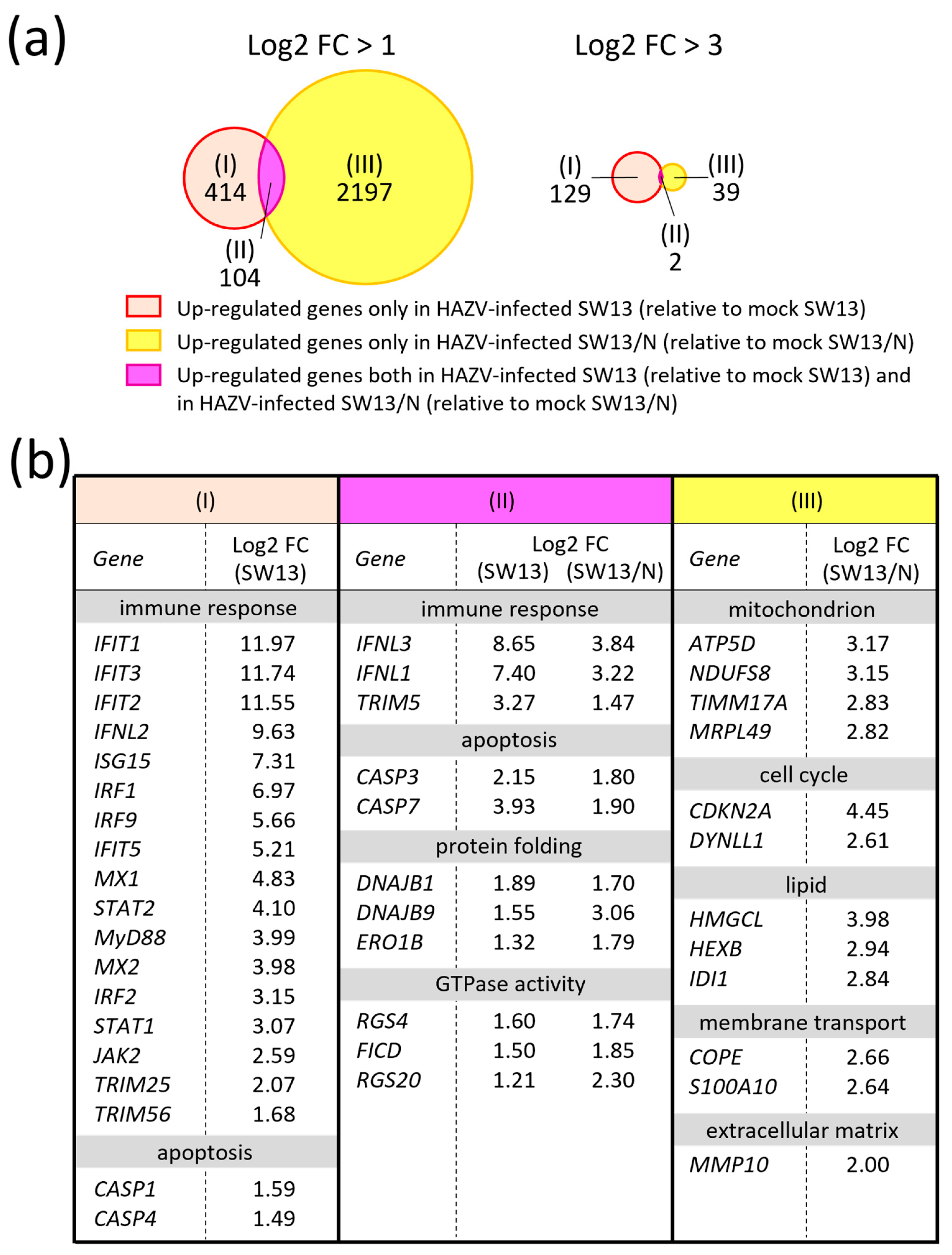
3.1. HAZV Infection Up-Regulated Many Immune-Response-Related Genes
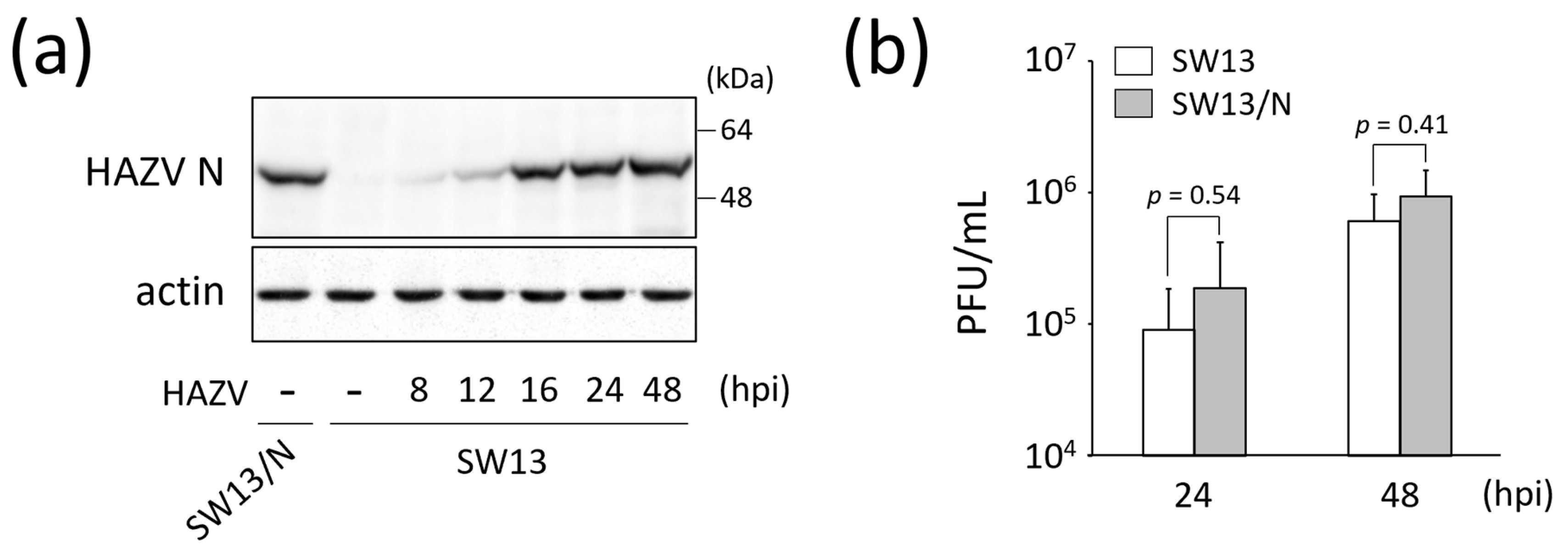
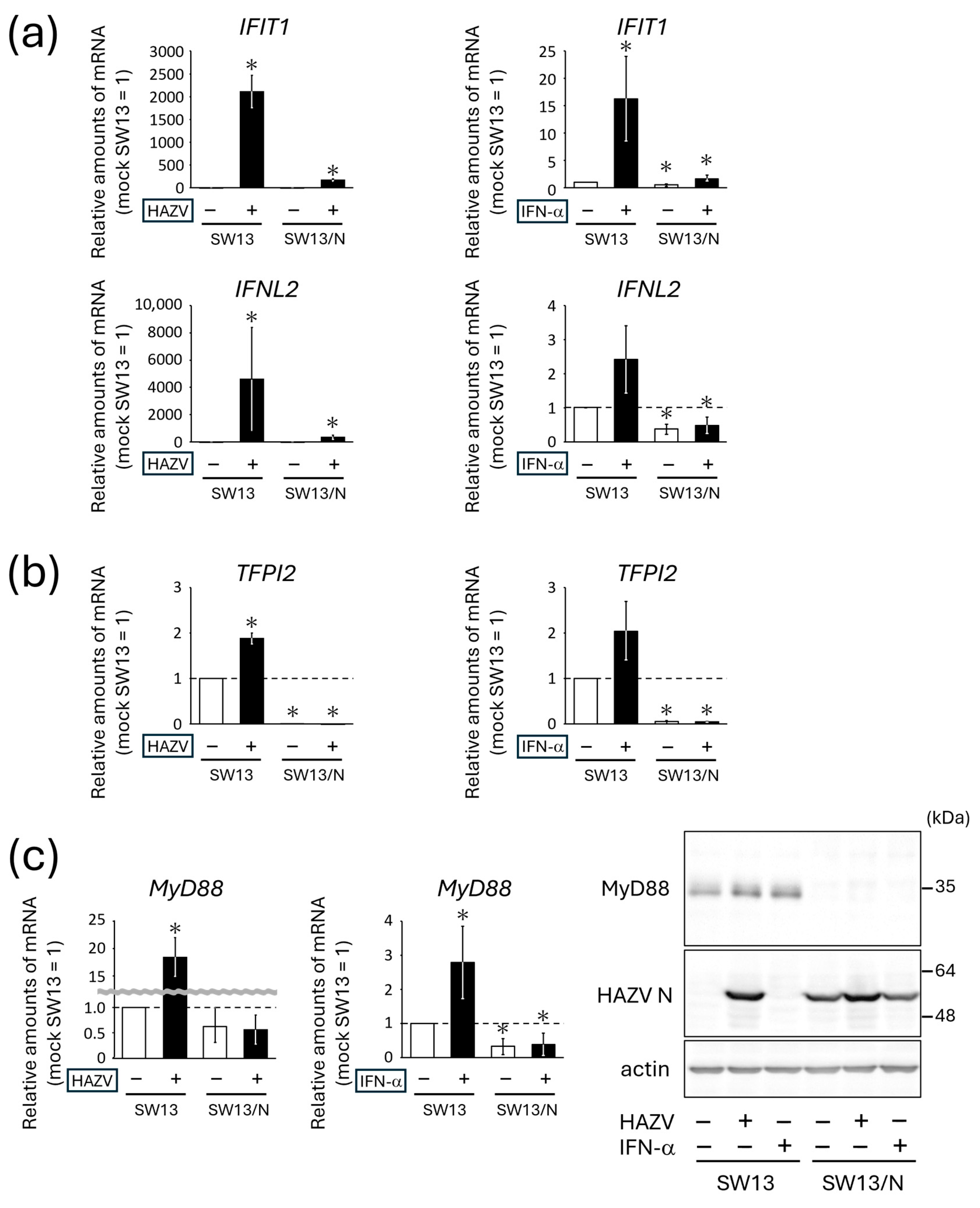
3.2. HAZV N Protein Blocks Expression of Immune-Response-Related Genes
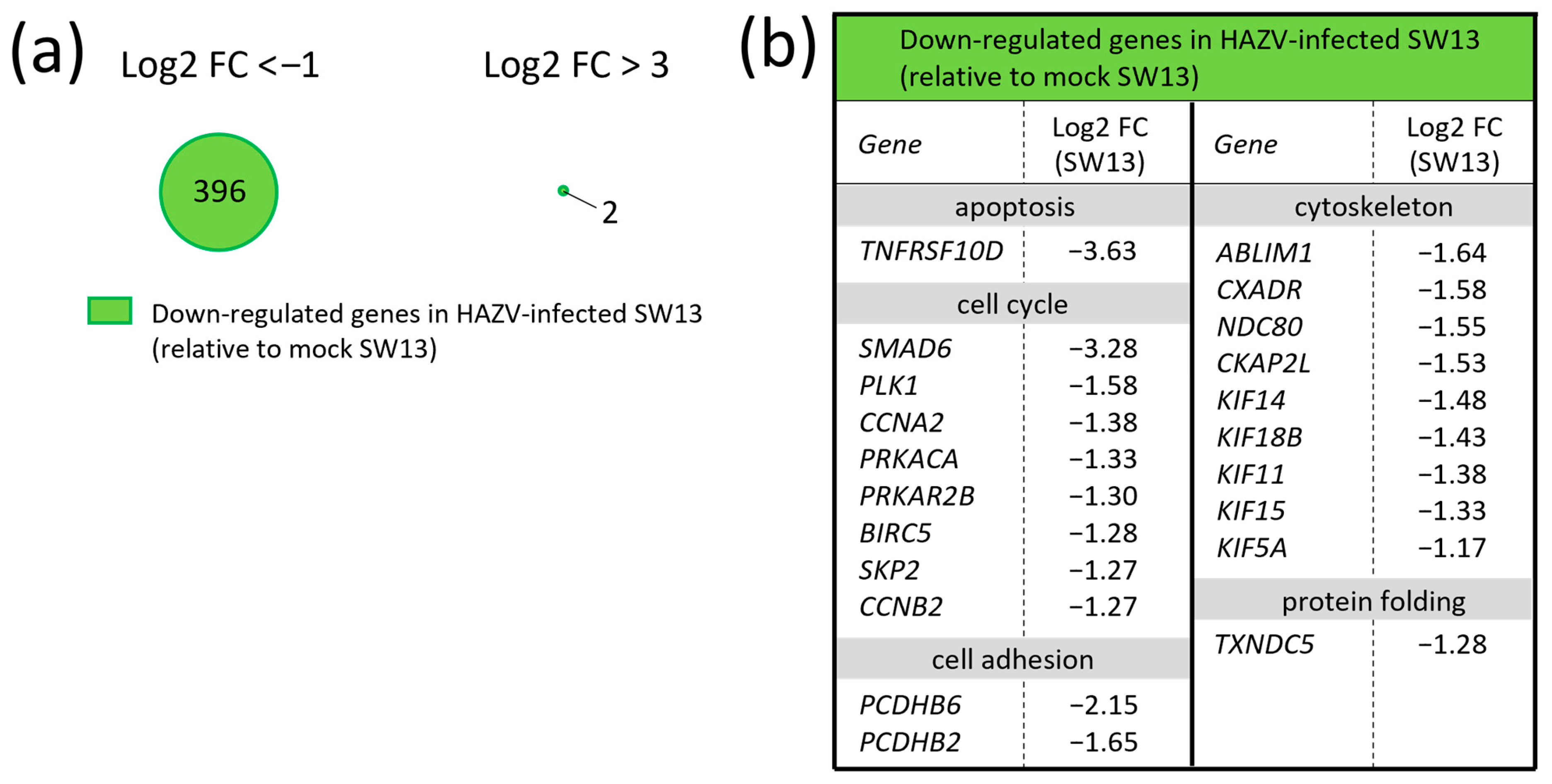
3.3. HAZV Infection Down-Regulates Cell-Cycle- and Cytoskeleton-Related Genes
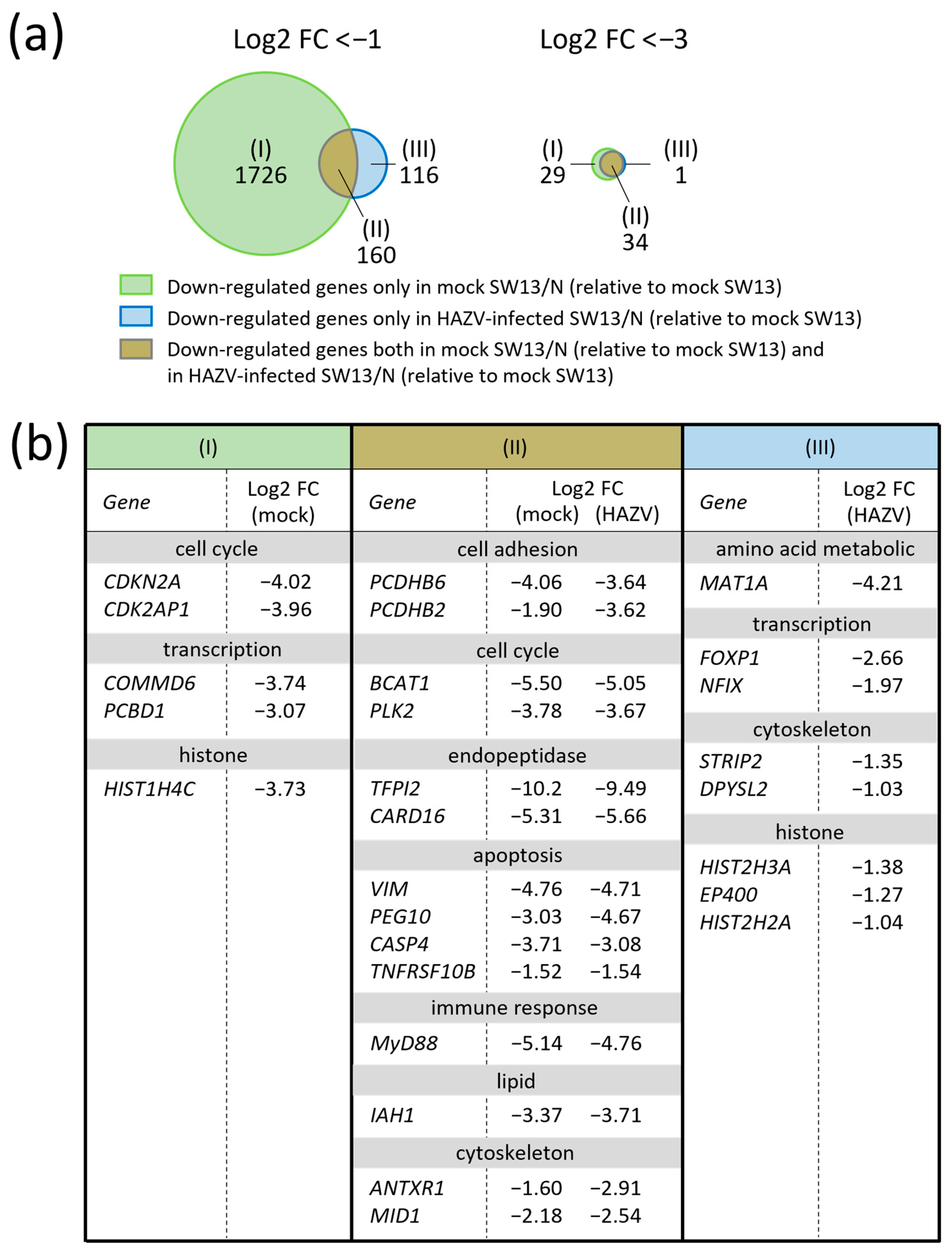
3.4. Various Genes Are Strongly Down-Regulated Both in Mock SW13/N and in HAZV-Infected SW13/N to a Similar Extent
3.5. N Protein Down-Regulates MyD88 Expression at Protein Level
4. Discussion
5. Conclusions
Author Contributions
Funding
Institutional Review Board Statement
Informed Consent Statement
Data Availability Statement
Acknowledgments
Conflicts of Interest
Abbreviations
| N | nucleoprotein |
| HAZV | Orthonairovirus hazaraense |
| MyD88 | myeloid differentiation factor 88 |
| CCHFV | Crimean-Congo hemorrhagic fever virus |
| BSL | biosafety level |
| RdRp | RNA-dependent RNA polymerase |
| TRIM25 | tripartite motif-containing protein 25 |
| FC | fold change |
| GO | gene ontology |
| RT-qPCR | quantitative real-time reverse transcription PCR |
| IFIT | IFN-induced proteins with tetratricopeptide repeat |
| IFNL | IFN lambda |
| TFPI2 | tissue factor pathway inhibitor 2 |
| GAPDH | glyceraldehyde-3-phosphate dehydrogenase |
| hpi | hours post-infection |
| IRF | IFN regulatory factor |
| STAT | signal transducer and activator of transcription |
| CASP | caspase |
| DNAJB9 | DnaJ (Hsp40) homolog subfamily B member 9 |
| RGS | regulator of G-protein signaling |
| ERO1B | endoplasmic reticulum oxidoreductase beta |
| FICD | FIC domain containing |
| ATP5D | ATP synthase, H+ transporting, mitochondrial F1 complex delta subunit |
| NDUFS8 | NADH:ubiquinone oxidoreductase core subunit S8 |
| TNFRSF10D | tumor necrosis factor receptor superfamily member 10d |
| SMAD6 | SMAD family member 6 |
| BCAT1 | Branched chain amino acid transaminase 1 |
| PLK2 | polo-like kinase 2 |
| IAH1 | isoamyl-acetate hydrolyzing esterase 1 |
| ISG | IFN-stimulated gene |
| Mx1 | myxovirus resistance 1 |
| JAK | Janus kinase |
| MMP | matrix metallopeptidase |
| PCDHB2 | protocadherin beta 2 |
| PEG10 | paternally expressed gene 10 |
| ANTXR1 | anthrax toxin receptor 1 |
| VIM | vimentin |
| BRM | brahma |
| BRG1 | brahma related gene 1 |
| BAF | BRG1/BRM-associated factor |
| MID1 | midline 1 |
| DPYSL2 | dihydropyrimidinase-like 2 |
References
- Weidmann, M.; Avsic-Zupanc, T.; Bino, S.; Bouloy, M.; Burt, F.; Chinikar, S.; Christova, I.; Dedushaj, I.; El-Sanousi, A.; Elaldi, N.; et al. Biosafety standards for working with Crimean-Congo hemorrhagic fever virus. J. Gen. Virol. 2016, 97, 2799–2808. [Google Scholar] [CrossRef] [PubMed]
- Bereczky, S.; Lindegren, G.; Karlberg, H.; Akerström, S.; Klingström, J.; Mirazimi, A. Crimean-Congo hemorrhagic fever virus infection is lethal for adult type I interferon receptor-knockout mice. J. Gen. Virol. 2010, 91, 1473–1477. [Google Scholar] [CrossRef] [PubMed]
- Dowall, S.D.; Findlay-Wilson, S.; Rayner, E.; Pearson, G.; Pickersgill, J.; Rule, A.; Merredew, N.; Smith, H.; Chamberlain, J.; Hewson, R. Hazara virus infection is lethal for adult type I interferon receptor-knockout mice and may act as a surrogate for infection with the human-pathogenic Crimean-Congo hemorrhagic fever virus. J. Gen. Virol. 2012, 93, 560–564. [Google Scholar] [CrossRef] [PubMed]
- Appelberg, S.; John, L.; Pardi, N.; Végvári, Á.; Bereczky, S.; Ahlén, G.; Monteil, V.; Abdurahman, S.; Mikaeloff, F.; Beattie, M.; et al. Nucleoside-modified mRNA vaccines protect IFNAR-/- mice against Crimean-Congo hemorrhagic fever virus infection. J. Virol. 2022, 96, e0156821. [Google Scholar] [CrossRef]
- Xia, H.; Zhao, J.; Li, Y.; Yin, S.; Tang, S.; Zhang, Z.; Yu, J.; Kou, Z.; Fan, Z.; Li, T. Infection and propagation of Crimean-Congo hemorrhagic fever virus in embryonated chicken eggs. Virus Res. 2013, 173, 344–349. [Google Scholar] [CrossRef]
- Matsumoto, Y.; Ohta, K.; Nishio, M. Lethal infection of embryonated chicken eggs by Hazara virus, a model for Crimean-Congo hemorrhagic fever virus. Arch. Virol. 2018, 163, 219–222. [Google Scholar] [CrossRef]
- Barr, J.N.; Weber, F.; Schmaljohn, C.S. Bunyavirales. In Fields Virology, 7th ed.; Howley, P.M., Knipe, D.M., Whelan, S.P.J., Eds.; Lippincott Williams & Wilkins: Philadelphia, PA, USA, 2020; pp. 706–749. [Google Scholar]
- Surtees, R.; Ariza, A.; Punch, E.K.; Trinh, C.H.; Dowall, S.D.; Hewson, R.; Hiscox, J.A.; Barr, J.N.; Edwards, T.A. The crystal structure of the Hazara virus nucleocapsid protein. BMC Struct. Biol. 2015, 15, 24. [Google Scholar] [CrossRef]
- Wang, W.; Liu, X.; Wang, X.; Dong, H.; Ma, C.; Wang, J.; Liu, B.; Mao, Y.; Wang, Y.; Li, T.; et al. Structural and functional diversity of nairovirus-encoded nucleoproteins. J. Virol. 2015, 89, 11740–11749. [Google Scholar] [CrossRef]
- Ohta, K.; Saka, N.; Nishio, M. Identification of critical residues for RNA binding of nairovirus nucleoprotein. J. Virol. 2024, 98, e0144624. [Google Scholar] [CrossRef]
- Surtees, R.; Dowall, S.D.; Shaw, A.; Armstrong, S.; Hewson, R.; Carroll, M.W.; Mankouri, J.; Edwards, T.A.; Hiscox, J.A.; Barr, J.N. Heat shock protein 70 family members interact with Crimean-Congo hemorrhagic fever virus and Hazara virus nucleocapsid proteins and perform a functional role in the nairovirus replication cycle. J. Virol. 2016, 90, 9305–9316. [Google Scholar] [CrossRef]
- Tampere, M.; Pettke, A.; Salata, C.; Wallner, O.; Koolmeister, T.; Cazares-Körner, A.; Visnes, T.; Hesselman, M.C.; Kunold, E.; Wiita, E.; et al. Novel broad-spectrum antiviral inhibitors targeting host factors essential for replication of pathogenic RNA viruses. Viruses 2020, 12, 1423. [Google Scholar] [CrossRef]
- Molinas, A.; Turkina, M.V.; Magnusson, K.E.; Mirazimi, A.; Vikström, E. Perturbation of wound healing, cytoskeletal organization and cellular protein networks during Hazara virus infection. Front. Cell Dev. Biol. 2017, 5, 98. [Google Scholar] [CrossRef]
- Ohta, K.; Saka, N.; Nishio, M. Hazara orthonairovirus nucleoprotein antagonizes type I interferon production by inhibition of RIG-I ubiquitination. Viruses 2022, 14, 1965. [Google Scholar] [CrossRef] [PubMed]
- Ohta, K.; Saka, N.; Fukasawa, M.; Nishio, M. Hazara orthonairovirus nucleoprotein facilitates viral cell-to-cell spread by modulating tight junction protein, claudin-1. Front. Microbiol. 2023, 14, 1192956. [Google Scholar] [CrossRef] [PubMed]
- Arnold, C.E.; Shoemaker, C.J.; Smith, D.R.; Douglas, C.E.; Blancett, C.D.; Graham, A.S.; Minogue, T.D. Host response transcriptomic analysis of Crimean-Congo hemorrhagic fever pathogenesis in the cynomolgus macaque model. Sci. Rep. 2021, 11, 19807. [Google Scholar] [CrossRef] [PubMed]
- Neogi, U.; Elaldi, N.; Appelberg, S.; Ambikan, A.; Kennedy, E.; Dowall, S.; Bagci, B.K.; Gupta, S.; Rodriguez, J.E.; Svensson-Akusjärvi, S.; et al. Multi-omics insights into host-viral response and pathogenesis in Crimean-Congo hemorrhagic fever viruses for novel therapeutic target. eLife 2022, 11, e76071. [Google Scholar] [CrossRef]
- Mo, Q.; Feng, K.; Dai, S.; Wu, Q.; Zhang, Z.; Ali, A.; Deng, F.; Wang, H.; Ning, Y.J. Transcriptome profiling highlights regulated biological processes and type III interferon antiviral responses upon Crimean-Congo hemorrhagic fever virus infection. Virol. Sin. 2023, 38, 34–46. [Google Scholar] [CrossRef]
- Matsumoto, Y.; Nouchi, T.; Ohta, K.; Nishio, M. Regulation of Hazara virus growth through apoptosis inhibition by viral nucleoprotein. Arch. Virol. 2019, 164, 1597–1607. [Google Scholar] [CrossRef]
- Begum, F.; Wisseman, C.L., Jr.; Casals, J. Tick-borne viruses of West Pakistan. II. Hazara virus, a new agent isolated from Ixodes redikorzevi ticks from the Kaghan Valley, W. Pakistan. Am. J. Epidemiol. 1970, 92, 192–194. [Google Scholar] [CrossRef]
- Ohta, K.; Saka, N.; Nishi, Y.; Nishio, M. Nairovirus polymerase mutations associated with the establishment of persistent infection in human cells. J. Virol. 2024, 98, e0169823. [Google Scholar] [CrossRef]
- Bagga, S.; Bouchard, M.J. Cell cycle regulation during viral infection. Methods Mol. Biol. 2014, 1170, 165–227. [Google Scholar] [CrossRef] [PubMed]
- Walsh, D.; Naghavi, M.H. Exploitation of cytoskeletal networks during early viral infection. Trends Microbiol. 2019, 27, 39–50. [Google Scholar] [CrossRef] [PubMed]
- Gao, X.; Chen, X.; Yu, L.; Zhao, S.; Jiu, Y. Host cytoskeleton and membrane network remodeling in the regulation of viral replication. Biophys. Rep. 2025, 11, 34–45. [Google Scholar] [CrossRef] [PubMed]
- van Lint, A.L.; Murawski, M.R.; Goodbody, R.E.; Severa, M.; Fitzgerald, K.A.; Finberg, R.W.; Knipe, D.M.; Kurt-Jones, E.A. Herpes simplex virus immediate-early ICP0 protein inhibits Toll-like receptor 2-dependent inflammatory responses and NF-kappaB signaling. J. Virol. 2010, 84, 10802–10811. [Google Scholar] [CrossRef]
- Zhao, Q.; Liang, D.; Sun, R.; Jia, B.; Xia, T.; Xiao, H.; Lan, K. Kaposi’s sarcoma-associated herpesvirus-encoded replication and transcription activator impairs innate immunity via ubiquitin-mediated degradation of myeloid differentiation factor 88. J. Virol. 2015, 89, 415–427. [Google Scholar] [CrossRef]
- Shahnazaryan, D.; Khalil, R.; Wynne, C.; Jefferies, C.A.; Ní Gabhann-Dromgoole, J.; Murphy, C.C. Herpes simplex virus 1 targets IRF7 via ICP0 to limit type I IFN induction. Sci. Rep. 2020, 10, 22216. [Google Scholar] [CrossRef]
- Yan, W.; Han, Q.; Gong, L.; Zhan, X.; Li, W.; Guo, Z.; Zhao, J.; Li, T.; Bai, Z.; Wu, J.; et al. MBD3 promotes hepatocellular carcinoma progression and metastasis through negative regulation of tumour suppressor TFPI2. Br. J. Cancer 2022, 127, 612–623. [Google Scholar] [CrossRef]
- Sarria, A.J.; Lieber, J.G.; Nordeen, S.K.; Evans, R.M. The presence or absence of a vimentin-type intermediate filament network affects the shape of the nucleus in human SW-13 cells. J. Cell Sci. 1994, 107, 1593–1607. [Google Scholar] [CrossRef]
- Davis, M.R.; Daggett, J.J.; Pascual, A.S.; Lam, J.M.; Leyva, K.J.; Cooper, K.E.; Hull, E.E. Epigenetically maintained SW13+ and SW13- subtypes have different oncogenic potential and convert with HDAC1 inhibition. BMC Cancer 2016, 16, 316. [Google Scholar] [CrossRef]
- Dunaief, J.L.; Strober, B.E.; Guha, S.; Khavari, P.A.; Alin, K.; Luban, J.; Begemann, M.; Crabtree, G.R.; Goff, S.P. The retinoblastoma protein and BRG1 form a complex and cooperate to induce cell cycle arrest. Cell 1994, 79, 119–130. [Google Scholar] [CrossRef]
- Wang, W.; Côté, J.; Xue, Y.; Zhou, S.; Khavari, P.A.; Biggar, S.R.; Muchardt, C.; Kalpana, G.V.; Goff, S.P.; Yaniv, M.; et al. Purification and biochemical heterogeneity of the mammalian SWI-SNF complex. EMBO J. 1996, 15, 5370–5382. [Google Scholar] [CrossRef] [PubMed]
- Cui, K.; Tailor, P.; Liu, H.; Chen, X.; Ozato, K.; Zhao, K. The chromatin-remodeling BAF complex mediates cellular antiviral activities by promoter priming. Mol. Cell. Biol. 2004, 24, 4476–4486. [Google Scholar] [CrossRef] [PubMed]
- Letimier, F.A.; Passini, N.; Gasparian, S.; Bianchi, E.; Rogge, L. Chromatin remodeling by the SWI/SNF-like BAF complex and STAT4 activation synergistically induce IL-12Rbeta2 expression during human Th1 cell differentiation. EMBO J. 2007, 26, 1292–1302. [Google Scholar] [CrossRef] [PubMed]
- Yamamichi-Nishina, M.; Ito, T.; Mizutani, T.; Yamamichi, N.; Watanabe, H.; Iba, H. SW13 cells can transition between two distinct subtypes by switching expression of BRG1 and Brm genes at the post-transcriptional level. J. Biol. Chem. 2003, 278, 7422–7430. [Google Scholar] [CrossRef]
- Mateo, M.; Generous, A.; Sinn, P.L.; Cattaneo, R. Connections matter—How viruses use cell-cell adhesion components. J. Cell Sci. 2015, 128, 431–439. [Google Scholar] [CrossRef]
- Ivanov, A.I.; Lechuga, S.; Marino-Melendez, A.; Naydenov, N.G. Unique and redundant functions of cytoplasmic actins and nonmuscle myosin II isoforms at epithelial junctions. Ann. N. Y. Acad. Sci. 2022, 1515, 61–74. [Google Scholar] [CrossRef]
- Jia, Y.; Yang, Y.; Brock, M.V.; Cao, B.; Zhan, Q.; Li, Y.; Yu, Y.; Herman, J.G.; Guo, M. Methylation of TFPI-2 is an early event of esophageal carcinogenesis. Epigenomics 2012, 4, 135–146. [Google Scholar] [CrossRef]
- Salvati, M.V.; Salaris, C.; Monteil, V.; Del Vecchio, C.; Palù, G.; Parolin, C.; Calistri, A.; Bell-Sakyi, L.; Mirazimi, A.; Salata, C. Virus-derived DNA forms mediate the persistent infection of tick cells by Hazara virus and Crimean-Congo hemorrhagic fever virus. J. Virol. 2021, 95, e0163821. [Google Scholar] [CrossRef]



| GO Analysis | |||
|---|---|---|---|
| Category | Term | Gene Counts (*) | p Value |
| biological process | immune system process | 69 | 8.12 × 10⁻³³ |
| cell proliferation | 19 | 8.51 × 10⁻³ | |
| cellular component | nucleus | 248 | 4.61 × 10⁻¹⁴ |
| nucleoplasm | 132 | 2.76 × 10⁻¹¹ | |
| intracellular | 52 | 4.16 × 10⁻¹¹ | |
| cytosol | 152 | 4.59 × 10⁻¹⁰ | |
| nucleolus | 43 | 4.62 × 10⁻⁴ | |
| nuclear chromosome | 6 | 8.61 × 10⁻³ | |
| molecular function | DNA binding | 100 | 4.36 × 10⁻⁴ |
| transcription factor binding | 21 | 1.33 × 10⁻³ | |
| helicase activity | 12 | 1.96 × 10⁻³ | |
| RNA binding | 42 | 2.33 × 10⁻³ | |
| unfolded protein binding | 8 | 1.24 × 10⁻² | |
| enzyme binding | 18 | 2.32 × 10⁻² | |
| nuclease activity | 8 | 3.14 × 10⁻² | |
| ligase activity | 20 | 3.69 × 10⁻² | |
| nucleotidyltransferase activity | 6 | 4.60 × 10⁻² | |
| Pathway analysis | |||
| Pathways (**) | Gene Counts (*) | p value | |
| IFN signaling | 57 | 9.43 × 10⁻³⁵ | |
| cytokine signaling in immune system | 93 | 1.26 × 10⁻³⁰ | |
| IFN alpha/beta signaling | 36 | 3.72 × 10⁻²⁹ | |
| immune system | 144 | 2.82 × 10⁻²³ | |
| IFN gamma signaling | 29 | 5.40 × 10⁻¹⁹ | |
| GO Analysis | |||
|---|---|---|---|
| Category | Term | Gene Counts (*) | p Value |
| biological process | translation | 128 | 8.08 × 10⁻²¹ |
| biosynthetic process | 8 | 2.02 × 10⁻²⁰ | |
| small molecule metabolic process | 333 | 2.31 × 10⁻¹⁵ | |
| protein folding | 62 | 2.08 × 10⁻⁹ | |
| cellular nitrogen compound | 57 | 8.32 × 10⁻⁷ | |
| metabolic process | 2.61 × 10⁻² | ||
| vesicle-mediated transport | 63 | 2.92 × 10⁻⁵ | |
| ribosome biogenesis | 31 | 6.11 × 10⁻⁵ | |
| membrane organization | 51 | 1.51 × 10⁻³ | |
| cell cycle | 118 | 1.76 × 10⁻³ | |
| mitosis | 59 | 2.86 × 10⁻³ | |
| mRNA processing | 63 | 7.96 × 10⁻³ | |
| cell division | 70 | 1.04 × 10⁻² | |
| vacuolar transport | 6 | 1.96 × 10⁻² | |
| mitochondrion organization | 20 | 2.17 × 10⁻² | |
| cellular component | intracellular | 185 | 1.77 × 10−75 |
| cytoplasm | 955 | 1.07 × 10−72 | |
| mitochondrion | 473 | 8.30 × 10−59 | |
| cell | 16 | 1.65 × 10⁻¹⁹ | |
| cytosol | 594 | 6.00 × 10⁻¹⁹ | |
| ribosome | 90 | 1.22 × 10⁻¹⁶ | |
| nucleoplasm | 470 | 7.19 × 10⁻¹⁵ | |
| nucleus | 915 | 3.08 × 10⁻¹⁴ | |
| nucleolus | 186 | 1.96 × 10⁻¹¹ | |
| endoplasmic reticulum | 251 | 3.87 × 10⁻⁸ | |
| lysosome | 70 | 6.75 × 10⁻⁵ | |
| vacuole | 5 | 6.90 × 10⁻⁵ | |
| peroxisome | 30 | 7.68 × 10⁻⁴ | |
| endosome | 91 | 1.26 × 10⁻² | |
| molecular function | structural constituent of ribosome RNA binding unfolded protein binding structural molecule activity oxidoreductase activity isomerase activity rRNA binding ligase activity GTPase activity | 75 160 39 9 109 32 14 72 48 | 3.50 × 10⁻¹⁷ 9.48 × 10⁻¹⁰ 4.21 × 10⁻⁹ 3.48 × 10⁻⁵ 9.98 × 10⁻⁵ 4.01 × 10⁻⁴ 1.37 × 10⁻³ 1.67 × 10⁻³ 3.07 × 10⁻³ |
| Pathway analysis | |||
| Pathways (**) | Gene Counts (*) | p value | |
| metabolism | 430 | 7.90 × 10⁻¹⁹ | |
| citric acid cycle and | 73 | 5.45 × 10⁻¹⁶ | |
| respiratory electron transport | |||
| respiratory electron transport, ATP synthesis | 61 | 1.01 × 10⁻¹⁵ | |
| by chemiosmotic coupling, and heat production | |||
| by uncoupling proteins | |||
| metabolism of proteins | 330 | 1.96 × 10⁻¹⁵ | |
| mitochondrial translation | 53 | 3.39 × 10⁻¹⁵ | |
| GO Analysis | |||
|---|---|---|---|
| Category | Term | Gene Counts (*) | p Value |
| biological process | mitosis | 33 | 2.31 × 10⁻¹³ |
| cell cycle | 46 | 3.32 × 10⁻¹³ | |
| cell division | 35 | 1.04 × 10⁻¹¹ | |
| cell proliferation | 23 | 3.03 × 10⁻⁵ | |
| chromosome segregation | 9 | 1.79 × 10⁻⁴ | |
| small molecule metabolic process | 50 | 2.45 × 10⁻² | |
| cytoskeleton-dependent intracellular transport | 2 | 4.17 × 10⁻² | |
| DNA metabolic process | 3 | 4.37 × 10⁻² | |
| cellular component | chromosome | 35 | 6.08 × 10⁻¹³ |
| cytoskeleton | 49 | 5.50 × 10⁻⁶ | |
| nuclear chromosome | 8 | 6.03 × 10⁻⁵ | |
| protein complex | 21 | 5.25 × 10⁻⁴ | |
| intracellular | 26 | 8.30 × 10⁻³ | |
| cytosol | 85 | 3.51 × 10⁻² | |
| peroxisome | 6 | 3.82 × 10⁻² | |
| molecular function | ATPase activity | 13 9 17 3 | 4.47 × 10⁻⁴ 7.55 × 10⁻⁴ 5.85 × 10⁻⁴ 1.10 × 10⁻² |
| histone binding | |||
| enzyme binding | |||
| hydrolase activity, acting on | |||
| carbon-nitrogen (but not peptide) bonds | |||
| Pathway analysis | |||
| Pathways (**) | Gene Counts (*) | p value | |
| cell cycle, mitotic | 44 | 5.98 × 10⁻¹⁴ | |
| cell cycle | 47 | 5.17 × 10⁻¹³ | |
| Rho GTPase effectors | 29 | 6.60 × 10⁻¹¹ | |
| aurora B signaling | 13 | 7.14 × 10⁻¹¹ | |
| M phase | 29 | 1.89 × 10⁻¹⁰ | |
| GO Analysis | |||
|---|---|---|---|
| Category | Term | Gene Counts (*) | p Value |
| biological process | translation | 133 | 3.30 × 10⁻³⁰ |
| biosynthetic process | 6 | 4.05 × 10⁻²⁹ | |
| small molecule metabolic process | 286 | 1.54 × 10⁻¹⁵ | |
| cellular nitrogen compound | 58 | 6.82 × 10⁻¹⁰ | |
| metabolic process | |||
| ribosome biogenesis | 29 | 9.73 × 10⁻⁶ | |
| protein folding | 43 | 2.25 × 10⁻⁵ | |
| mRNA processing | 53 | 8.60 × 10⁻³ | |
| cell division | 59 | 1.09 × 10⁻² | |
| vacuolar transport | 5 | 2.89 × 10⁻² | |
| mitosis | 45 | 3.13 × 10⁻² | |
| cell cycle | 90 | 3.96 × 10⁻² | |
| cellular component | intracellular | 165 | 3.20 × 10−50 |
| mitochondrion | 381 | 1.13 × 10−47 | |
| cytoplasm | 736 | 1.88 × 10−46 | |
| ribosome | 94 | 5.93 × 10⁻²⁴ | |
| nucleus | 768 | 3.76 × 10⁻¹⁵ | |
| nucleolus | 170 | 1.32 × 10⁻¹⁴ | |
| nucleoplasm | 380 | 5.35 × 10⁻¹² | |
| cell | 19 | 1.25 × 10⁻¹¹ | |
| endoplasmic reticulum | 193 | 3.40 × 10⁻⁵ | |
| peroxisome | 24 | 2.87 × 10⁻³ | |
| vacuole | 4 | 2.72 × 10⁻² | |
| lysosome | 47 | 2.96 × 10⁻² | |
| nuclear envelope | 25 | 3.56 × 10⁻² | |
| molecular function | structural constituent of ribosome | 89 | 1.31 × 10⁻³⁰ |
| RNA binding | 147 | 1.31 × 10⁻¹³ | |
| structural molecule activity | 7 | 6.97 × 10⁻¹³ | |
| unfolded protein binding | 27 | 6.58 × 10⁻⁶ | |
| oxidoreductase activity | 92 | 5.39 × 10⁻⁵ | |
| isomerase activity | 28 | 2.49 × 10⁻⁴ | |
| rRNA binding | 12 | 1.57 × 10⁻³ | |
| Pathway analysis | |||
| Pathways (**) | Gene Counts (*) | p value | |
| ribosome | 72 | 1.29 × 10⁻²³ | |
| metabolism | 374 | 1.40 × 10⁻²¹ | |
| metabolism of amino acids and derivatives | 110 | 1.89 × 10⁻¹⁹ | |
| translation | 69 | 1.06 × 10⁻¹⁸ | |
| gene expression | 316 | 2.24 × 10⁻¹⁸ | |
| GO Analysis | |||
|---|---|---|---|
| Category | Term | Gene Counts (*) | p Value |
| biological process | cell adhesion | 19 | 2.67 × 10⁻³ |
| cell cycle | 19 | 3.43 × 10⁻³ | |
| cytoskeleton organization | 5 | 4.34 × 10⁻² | |
| cellular component | chromosome | 19 | 3.33 × 10⁻⁶ |
| nucleoplasm | 56 | 4.77 × 10⁻³ | |
| proteinaceous extracellular matrix | 11 | 1.79 × 10⁻² | |
| molecular function | DNA binding | 56 | 1.77 × 10⁻⁴ |
| helicase activity | 6 | 2.11 × 10⁻² | |
| histone binding | 5 | 3.11 × 10⁻² | |
| Pathway analysis | |||
| Pathways (**) | Gene Counts (*) | p value | |
| DNA strand elongation | 8 | 2.26 × 10⁻⁷ | |
| telomere maintenance | 11 | 2.39 × 10⁻⁷ | |
| chromosome maintenance | 12 | 4.69 × 10⁻⁷ | |
| cell cycle, mitotic | 26 | 4.88 × 10⁻⁷ | |
| G1/S transition | 12 | 1.59 × 10⁻⁶ | |
Disclaimer/Publisher’s Note: The statements, opinions and data contained in all publications are solely those of the individual author(s) and contributor(s) and not of MDPI and/or the editor(s). MDPI and/or the editor(s) disclaim responsibility for any injury to people or property resulting from any ideas, methods, instructions or products referred to in the content. |
© 2025 by the authors. Licensee MDPI, Basel, Switzerland. This article is an open access article distributed under the terms and conditions of the Creative Commons Attribution (CC BY) license.
Share and Cite
Ohta, K.; Nishio, M. Effects of Orthonairovirus hazaraense Nucleoprotein on Gene Expression Profiles in Infected Cells. Viruses 2026, 18, 25. https://doi.org/10.3390/v18010025
Ohta K, Nishio M. Effects of Orthonairovirus hazaraense Nucleoprotein on Gene Expression Profiles in Infected Cells. Viruses. 2026; 18(1):25. https://doi.org/10.3390/v18010025
Chicago/Turabian StyleOhta, Keisuke, and Machiko Nishio. 2026. "Effects of Orthonairovirus hazaraense Nucleoprotein on Gene Expression Profiles in Infected Cells" Viruses 18, no. 1: 25. https://doi.org/10.3390/v18010025
APA StyleOhta, K., & Nishio, M. (2026). Effects of Orthonairovirus hazaraense Nucleoprotein on Gene Expression Profiles in Infected Cells. Viruses, 18(1), 25. https://doi.org/10.3390/v18010025