You are currently viewing a new version of our website. To view the old version click .
Viruses
  • Review
  • Open Access

8 December 2025

Mycoviruses in Entomopathogenic Fungi

,
,
,
,
,
,
,
,
and
1
Programa de Pós-Graduação em Biologia Celular e Molecular, Centro de Biotecnologia, Universidade Federal do Rio Grande do Sul, Porto Alegre 91501-970, RS, Brazil
2
Department of Life Sciences, Imperial College London, London SW7 2AZ, UK
3
Laboratory of Virology, Wageningen University & Research, 6708 PB Wageningen, The Netherlands
4
Departamento de Genética, Escola Superior de Agricultura Luiz de Queiros, Universidade de São Paulo, Piracicaba 13418, SP, Brazil
This article belongs to the Special Issue 15-Year Anniversary of Viruses

Abstract

Mycoviruses are widely distributed among different groups of filamentous fungi. An awareness of infections caused by mycoviruses was highlighted in the 1980s and 1990s, when the impact of these agents on phenotypes of agriculturally and medically important fungi was reported. However, for entomopathogenic fungi, mycovirus research has only expanded significantly in the last 15 years. Due to the agricultural importance of these fungi, reflected in their use at the forefront of biological control strategies, recent studies have extensively described novel viruses and their effects on their hosts in terms of altered morphological, phenotypical, and ecological characteristics. To summarise the historical progress of mycovirology and recent discoveries, here we describe the state of the art in the study of mycoviruses associated with entomopathogenic fungi. We have limited the review to the occurrence of mycoviruses in fungi of the genera Beauveria, Cordyceps, Entomophthora, Metarhizium, and Trichoderma and have compiled an inventory of the viruses reported to infect these entomopathogenic genera, as well as a comprehensive review of the biological effects described with respect to infection by mycoviruses in fungi that are relevant to the biological control of insects. Finally, we have outlined possible research scenarios in the light of recent discoveries in the field of mycovirology, such as the use of mycoviruses as virulence modulating factors: the main character sought in biological pest control.

1. Introduction

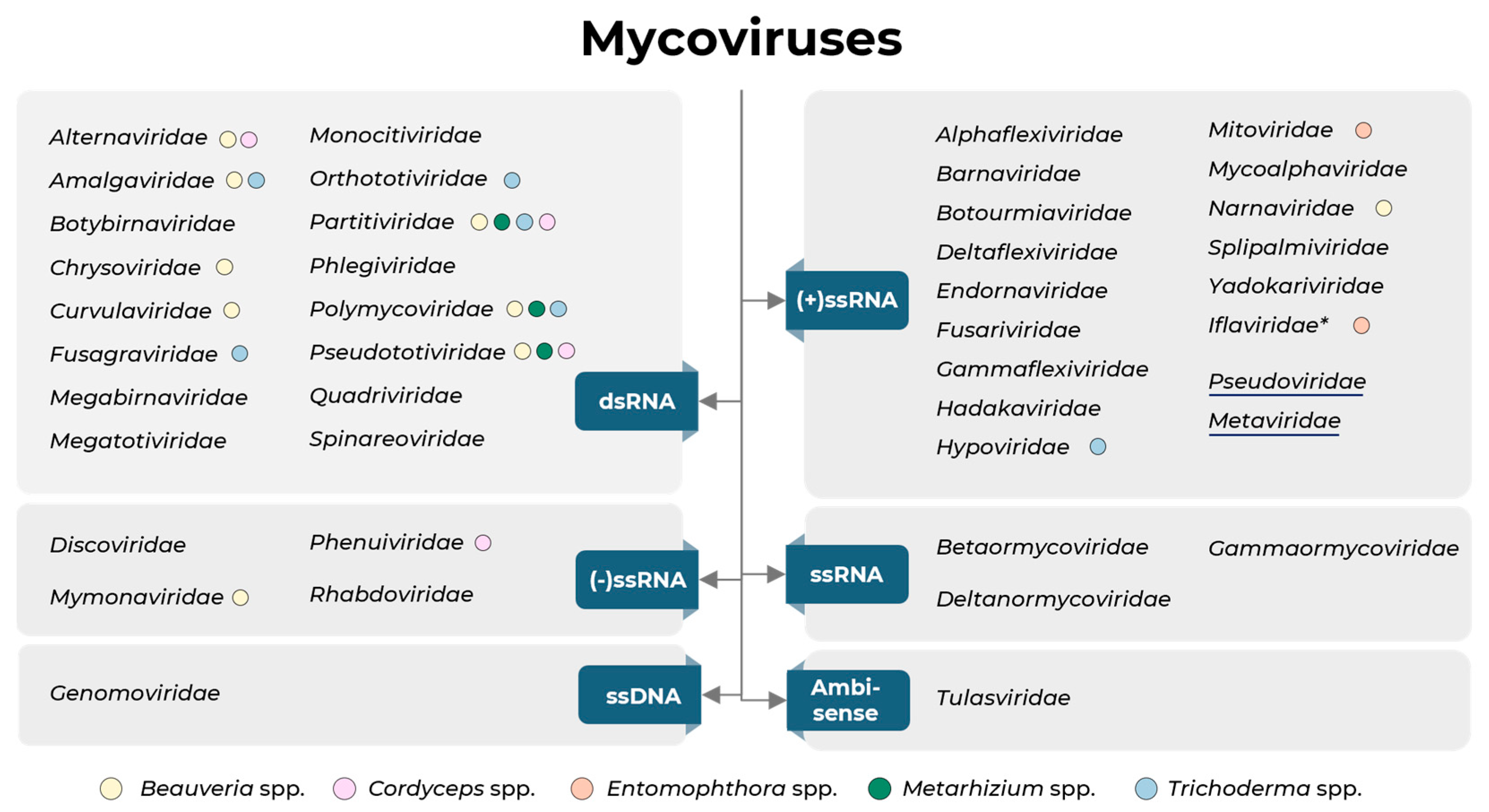
Mycoviruses were first described more than 60 years ago in the edible basidiomycete Agaricus bisporus [1], marking the beginning of a new field in fungal biology. In the following decades, particularly during the ‘golden era’ of mycovirology, research efforts intensified toward the discovery and characterisation of viral elements infecting phytopathogenic fungi. This period established the foundation for understanding virus–fungus interactions, their genomic diversity, and their potential influence on fungal physiology. One of the most emblematic cases was that of Cryphonectria hypovirus 1 (CHV1) infecting the chestnut blight fungus Cryphonectria parasitica. The introduction of CHV1 into wild fungal populations successfully induced a hypovirulent phenotype, preventing the development of a devastating chestnut blight epidemic across the continent of Europe’s forests, representing one of the earliest and most successful examples of biological control mediated by a mycovirus [2]. In the last decade, along with advances in sequencing techniques and the expansion of the mycovirus field, several new and unclassified viruses were discovered and already established families were expanded, with novel members possessing different characteristics. Viral taxonomy has advanced to such an extent that several reorganisations were made in taxonomic groups to better accommodate the new taxa. According to the International Committee on Taxonomy of Viruses (ICTV; ictv.global/vmr; accessed in July 2025) and a recent update of taxonomy changes from the ICTV Fungal and Protist Viruses Subcommittee [3], there are currently 41 families accommodating viruses infecting fungi (Figure 1).
Figure 1. Current organisation of mycoviruses taxonomy based on their genomes. Most families are characterised by dsRNA and (+)ssRNA genomes, including the underlined reverse transcribing families. Four (–)ssRNA, one circular ssDNA, and one ambisense coding families are also recognised. The ssRNA group includes recently established mycoviruses (ourmycoviruses) whose genome polarity could not be defined according to standard criteria. Yellow, lilac, salmon, green, and light blue circles indicate the presence of specific viral families in Beauveria, Cordyceps Entomophthora, Metarhizium, and Trichoderma, respectively. Taxonomic data retrieved from ICTV-Virus Metadata Resource tables (ICTV; ictv.global/vmr; accessed in July 2025). * The family Iflaviridae, although not currently classified as a mycovirus family by the ICTV, was included due to its occurrence in Entomophthora.
Currently, the most widely described mycoviruses are those with positive-sense single-stranded RNA ((+)ssRNA) genomes, which comprise 16 families (including the reverse-transcribing families Pseudoviridae and Metaviridae). Equally abundant are the double-stranded RNA (dsRNA) viruses, which are also distributed across 16 families (Figure 1). Mycoviruses with negative-sense single-stranded RNA ((–)ssRNA) genomes are organised into four families. Ormycoviruses, a group of ssRNA viruses, were also recognised in the year of 2025 by the ICTV Fungal and Protist Viruses Subcommittee. To date, only one single-stranded DNA (ssDNA) family, Genomoviridae, has been reported to infect fungi. Finally, the Tulasviridae family possesses both positive- and negative-sense strands for RNA translation and is therefore classified as ambisense (Figure 1).
Recently, changes were made to the order Ghabrivirales, which includes mycoviruses with dsRNA genomes [4]. The order, which previously included the families Chrysoviridae, Megabirnaviridae, Quadriviridae, and Totiviridae, now has a new taxonomic layer at suborder level, subdivided into Alpha-, Beta-, and Gammatotivirineae. To accommodate the fungal viruses previously classified in the Totivirus and Victorivirus genera, the Orthototiviridae and Pseudototiviridae families were created in the Alphatotivirineae suborder. A new family, Monocitoviridae, was created to accommodate the virus Ustilago maydis virus H1, previously belonging to the genus Totivirus. Previously proposed families have now been recognised, each including a single genus: family Botybirnaviridae and genus Botybirnavirus; family Fusagraviridae and genus Fusagravirus; family Megatotiviridae and genus Megatotivirus; and, finally, family Phlegiviridae and genus Phlegivirus [4,5].
In addition to the description of new virus taxonomic groups, genomes, and their molecular characteristics, aspects associated with mycovirus infection, such as phenotypic changes, are of scientific, agricultural, industrial, and medical interest. Effects on virulence, for example, play important roles in host fitness and are, therefore, widely studied. Among the earliest and most successful biotechnological applications of mycoviruses are the dsRNA viruses in Saccharomyces cerevisiae that confer the ‘killer yeast’ phenotype. These viruses enable their fungal hosts to secrete toxins that kill competing yeast strains, a trait that has been effectively utilised in industrial fermentation processes, including wine production, beer brewing, and bread making, to prevent contamination by wild yeast strains [6]. Hypovirulence has been mainly observed and used to human benefit in plant-pathogenic fungi [7,8,9]. As mentioned above, C. parasitica, the ascomycete responsible for chestnut blight, has been successfully controlled through mycovirus-based treatment, which is considered a model in forest disease management [10]. Conversely, mycovirus infections in Aspergillus are widely investigated as molecular tools to alter the virulence of species responsible for aspergillosis, with recent reports indicating that they may either reduce or increase pathogenicity in mammalian hosts [11,12].
The modulation of fungal virulence and fitness observed in medically and agriculturally relevant genera such as Aspergillus and Cryphonectria [13,14] has increased interest in other fungal groups of agricultural importance. Among these, entomopathogenic fungi (EPF) have gained attention for their potential to exhibit similar virus-induced phenotypic alterations. Considering the recognised role of EPF in sustainable pest management, particular interest lies in the ability of mycoviruses to induce hypervirulent phenotypes that may enhance biological control effectiveness. In this context, exploring mycoviruses as modulators of EPF virulence aligns with the growing global demand for sustainable pest control strategies. Over the past three decades, these fungi have attracted attention as an alternative to reduce the environmental impact of traditional chemical pest control strategies [15]. Emerging environmental and health management strategies, such as the One-Health approach, emphasise the urgent need for pest control strategies that minimise the environmental impact while ensuring effective and robust crop protection [16]. Notably, integrated pest management utilising biological control agents has demonstrated promising outcomes, achieving damage reductions of over 73% across a variety of crops and targeting 43 different invertebrate pests [17]. Amongst several organisms commercially employed as biological control agents, EPF are at the forefront of research interest due to their effectiveness [18,19,20,21]. Mycoinsecticides, biological control products based on EPF, represent 60% of the total of 82 products registered and marketed in Brazil as biological controllers. Of these 82, Metarhizium and Beauveria lead the list, with 24 and 13 products, respectively [21].
The first investigations of mycoviruses within EPF were carried out in the 1990s and revealed dsRNA elements and viral particles related to mycovirus infections. Given the agricultural importance of EPF, these studies mainly sought to understand how mycoviruses impacted aspects such as sporulation and virulence in arthropods. Complete genome sequences of these mycoviruses only became available in the 2010s, coinciding with a significant increase in the number of new mycoviruses for different genera of EPF. In view of this, this review aims to present the current genomic and functional description of mycoviruses and their relationship with their fungal hosts. The review is focused on EPF genera that are widely used as biological control agents in integrated pest management systems, including Beauveria, Cordyceps, Metarhizium, and Trichoderma, as well as the genus Entomophthora, which stands out for its obligate association with arthropod hosts and its ecological importance in natural pest regulation.

2. Incidence of Mycoviruses in Entomopathogenic Fungi

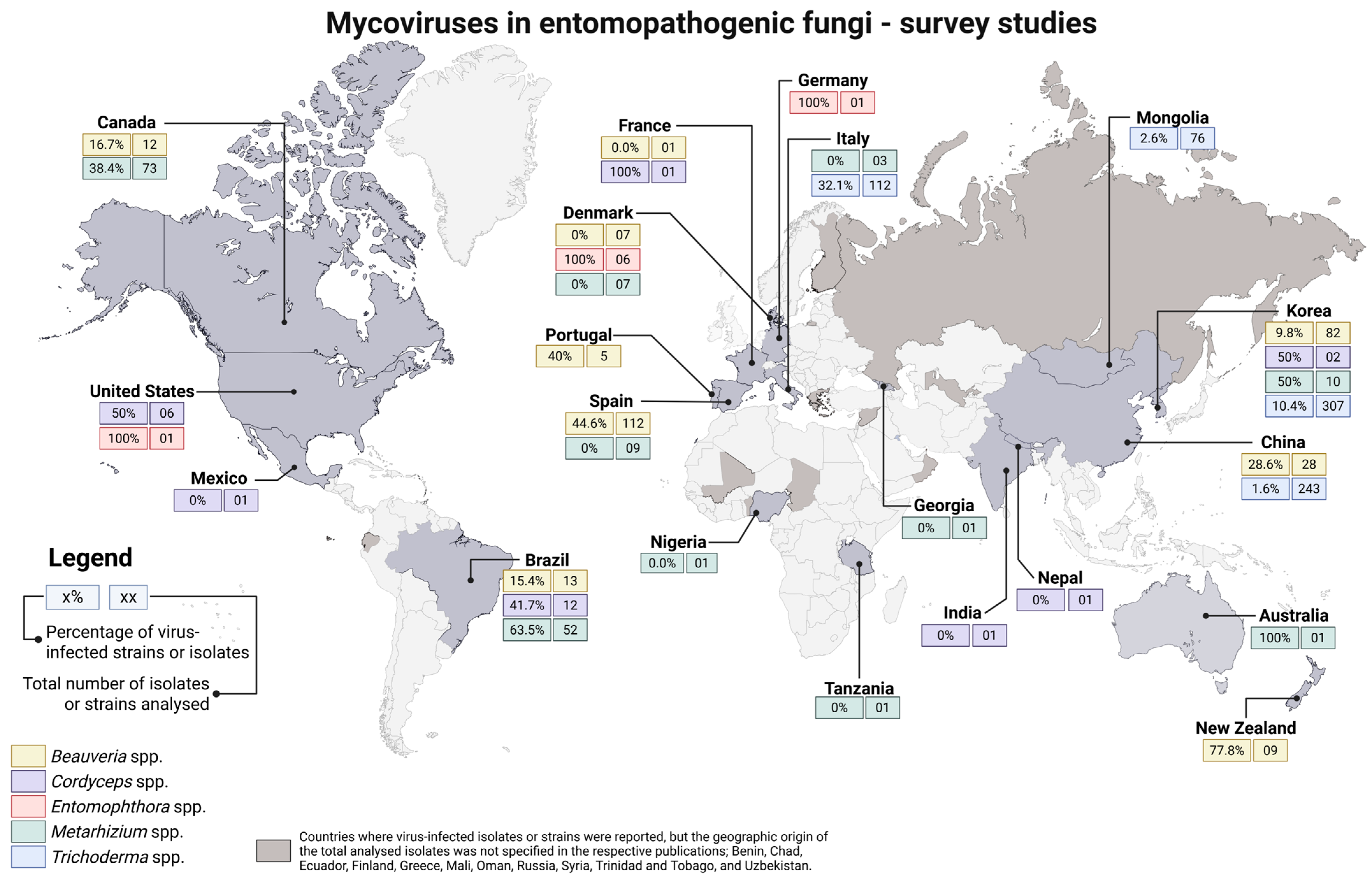
Initial studies on mycoviruses infecting EPF focused on screening for dsRNA elements and virus-like particles (VLPs) [22,23]. Prior to sequencing, viral families were characterised and taxonomically inferred by electrophoretic RNA patterns, transmission electron microscopy (TEM), and protein purification followed by SDS-polyacrylamide gel electrophoresis (PAGE) [24]. A comprehensive survey of studies aimed at analysing the incidence of mycoviruses in entomopathogenic fungal populations across different countries is summarised in Figure 2 and detailed at species level in Table S1.
Figure 2. Global map illustrating mycovirus infection rates and distribution in entomopathogenic fungi isolates/strains worldwide. For countries where rate calculation was possible, text boxes indicate the quantitative data used, presented in the following format: [percentage of infected isolates/strains] and [total number of isolates/strains analysed]. Countries shaded in grey represent locations where mycovirus presence in entomopathogenic fungi isolates/strains has been reported in the literature, but the origin of total number of isolates tested in those studies was not specified. Created in BioRender. Camargo, M. (2025) https://BioRender.com/tlpj9ma (accessed on 2 December 2025).
The screening strategy of strains and isolates infected with mycoviruses, despite providing a general overview of the distribution of viral RNA elements in a group of samples, is limited and has a strong bias towards dsRNA virus infections, specifically. The methodologies employed, based on the nature of dsRNA resistant to S1 nuclease and DNase I treatments, cannot indicate the presence of ssRNA viruses, whether in a positive or negative sense, since the occurrence of ds versions of these viruses are scarce. Therefore, the incidence of viruses in isolates and strains may be underestimated, given the possibility that virus-free strains might carry ssRNA viruses exclusively.
While these pioneer studies were conducted in the late 1990s, the field of mycovirology concerning EPF advanced dramatically over the last 15 years. Notably, the first completely sequenced viral genomes for the entomopathogenic genera Beauveria, Cordyceps, Trichoderma, Entomophthora, and Metarhizium were reported in the years 2012 [25], 2017 [26], 2017 [27], 2019 [28], and 2020 [29], respectively.
In this section we will discuss the distribution of putative viral dsRNA segments that have already been identified in different species of five genera of EPF in different parts of the world.

2.1. Cordycipitaceae: Beauveria and Cordyceps

The genus Beauveria belongs to the order Hypocreales and the family Cordycipitaceae [30]. This genus is considered a cosmopolitan genus and a facultative parasite, capable of completing its reproductive cycle either as a pathogen or in free form, as a saprophyte or endophyte [31]. The broad spectrum of hosts highlights the potential of Beauveria bassiana as a control agent for various target pests [32], infecting a wide range of arthropods, some of which have agricultural importance [33], including the sweet potato whitefly (Bemisia tabaci), the banana weevil (Cosmopolites sordidus), the corn leafhopper (Dalbulus maidis), and the two-spotted spider mite (Tetranychus urticae) [21,33]. B. bassiana has 707 insect host species, comprising 521 genera and 149 families from 15 orders. Within crop pests, B. bassiana is usually reported as infecting insects of the order Lepidoptera and Coleoptera [33].
In a foundational study, Melzer and Bidochka (1998) investigated EPF from Canadian soils, including 12 isolates of B. bassiana. Of these, dsRNA elements were detected in two isolates (16.7%), using cellulose chromatography followed by agarose gel electrophoresis [34]. Dalzoto et al. (2006) examined 13 B. bassiana strains by RNA patterns in electrophoresis and reported that two of the thirteen strains (15.4%) yielded extra dsRNA bands (~4.0–0.7 kbp) [35]. TEM of one infected strain revealed 28–30 nm isometric virus-like particles, consistent with a Totiviridae-like virus. In this early study, no sequence data were reported, so the viral family assignment was based on particle size and genome structure.
Subsequently, Herrero et al. (2012) performed a larger survey of Iberian Beauveria [25]. They analysed 73 B. bassiana isolates (from Spain and Portugal, obtained from insects, plants, and soil) by agarose electrophoresis of extracted dsRNA. Several dsRNA elements were found in 54.8% of isolates (40 of 73 strains). The detected dsRNA segments ranged in size from 0.7 to 6 kbp and each infected isolate carried between one and five dsRNA bands. Mixed infections (multiple dsRNA viruses per strain) were common. Notably, no clear association was seen between particular dsRNA profiles and the geographical origin or ecological source of the isolates, likely reflecting the wide dispersal of B. bassiana spores [25]. One of the most abundant dsRNA types was fully sequenced and shown to encode a ~5.2 kbp genome of a novel Totiviridae member, provisionally named Beauveria bassiana RNA virus 1 (BbRV1) [25].
In a separate investigation, Yie et al. (2014) screened nine Beauveria isolates collected in New Zealand and detected dsRNA elements in seven of them, corresponding to a remarkably high infection rate of 77.8% [36]. This analysis, based on dsRNA extraction and gel electrophoresis, revealed the presence of dsRNA viral elements in a non-B. bassiana isolate, specifically Beauveria caledonica, highlighting that mycovirus infections may extend beyond the commonly studied B. bassiana [36].
Later surveys expanded the scope to global isolate collections and new detection methods. Kotta-Loizou and Coutts (2017) examined a “well-characterised panel” of 75 B. bassiana isolates from worldwide sources (including Brazil, Ecuador, Greece, Portugal, Russia, Spain, Syria, and Uzbekistan) [37]. Using dsRNA extraction with DNase/RNase treatments and agarose gels, they found that 16 of the 75 strains (21.3%) harboured dsRNA elements. TEM analyses revealed isometric particles ~50 nm in diameter (typical of totiviruses and partitiviruses). Sequencing of the dsRNAs identified viruses related to three known families: Partitiviridae (encapsidated multi-segmented dsRNA viruses), Totiviridae (encapsidated non-segmented dsRNA viruses), and Narnaviridae (capsidless ssRNA non-segmented viruses). In fact, this study reported several novel viruses: two partitiviruses, Beauveria bassiana partitivirus (BbPV) 1 and 2; one totivirus, Beauveria bassiana victorivirus 1 (BbVV1); and an unusually small narnavirus-like element. It also discovered the first Beauveria bassiana polymycovirus (BbPmV1), an unencapsidated multi-segmented dsRNA virus, belonging to the family Polymycoviridae, formerly “Tetramycoviridae”. Interestingly, 11 of the 16 dsRNA-positive isolates came from arthropod hosts; no particular host or region was consistently associated with infection [37].
Filippou et al. (2018) conducted a population-level screen of European EPF (primarily Spanish and some Danish isolates) [38]. The study focused on testing a large panel of 151 isolates, covering several genera, including Beauveria, and used dsRNA gel profiles to identify infected isolates, followed by reverse transcription polymerase chain reaction (RT-PCR) and sequencing to classify the viruses. This study found that 12 of the Spanish B. bassiana isolates carried dsRNA viruses. All viruses detected belonged to three known taxa: the previously described BbVV1, BbPV2, and BbPmV1. Some isolates harboured up to three of these viruses simultaneously. No novel families were reported in this survey [38].
More recent work has both confirmed and extended these patterns. Ning et al. (2022) showed experimentally that dsRNA viruses are ubiquitous across Beauveria spp. and readily transmitted between species [39]. Although this was not a survey of field isolates per se, it implies that other Beauveria species (e.g., B. amorpha, B. aranearum) also commonly carry dsRNA viruses, and that interspecific spread is efficient. Finally, Shi et al. (2024) surveyed 28 B. bassiana strains from the Guniujiang Nature Preserve in Anhui, China. Electrophoretic profiling revealed dsRNA in 8 of 28 isolates (28.6%) [40]. By combining dsRNA gel profile analysis, metatranscriptomic sequencing and RT-PCR, they identified six distinct virus species infecting these strains, including two novel viruses: Beauveria bassiana victorivirus 2 (BbVV2, a new totivirus) and Beauveria bassiana bipartite mycovirus 2 (BbBMV2, a new partitivirus). Four additional viruses matched previously described types, including Beauveria bassiana polymycovirus 4 (BbPmV4), etc. [40]. EPF collected in South Korea were also investigated by Hwang et al. (2023) [41]. The incidence of putative mycoviruses was evaluated in 94 isolates, including 82 isolates of Beauveria. dsRNA was detected in 14 out of 94 strains overall (14.9%), and in 8 out of the 82 Beauveria isolates (9.8%), specifically [41]. Detection was based on dsRNA profiling via cellulose chromatography and electrophoresis. Although no TEM or sequencing was performed, the authors inferred likely viral families based on the number and size of dsRNA segments: partitivirus-like profiles (two segments of ~1.5–2.2 kbp) were observed in some strains, while single ~5–7 kbp segments suggested the presence of totiviruses. Other isolates, such as B. bassiana 261, harboured up to 12 dsRNA segments, suggestive of multipartite viruses like polymycoviruses or chrysoviruses [41].
Within the Cordyciptaceae family, the genus Cordyceps now includes the former genus Isaria and species previously described in the Paecilomyces genus, such as Cordyceps farinosa, C. fumosorosea, and C. javanica [42,43]. Cordyceps comprises more than 700 species usually isolated from tropical forests and humid climates [44]. Many species are recognised due to their medical and biotechnological relevance [45]; however, the genus is recognised as a typical feature of the entomopathogenic lifestyle. C. farinosa and fungi within the C. fumosorosea complex are the main species in the genus recognised as biological controllers and exhibit a cosmopolitan distribution. These fungi have been identified across multiple continents, including North and South America, Europe, Africa, Asia, and Australia. The host range of Cordyceps spp. is notably broad, encompassing arthropods from multiple orders including Acari, Coleoptera, Diptera, Hemiptera, Hymenoptera, Lepidoptera, and Thysanoptera [42]. C. fumosorosea, for example, has demonstrated high efficacy against whiteflies (Bemisia tabaci), aphids (Aphis spp.), and thrips (Frankliniella occidentalis), which are major pests in vegetable and ornamental crops [42,46,47,48].
Studies on the incidence of viral dsRNA or viral particles in fungi belonging to the Cordyceps-Isaria-Paecilomyces cluster are relatively scarce. The first studies were performed simultaneously with the Metarhizium surveys detailed earlier. A 52.6% (10/19) incidence of dsRNAs was observed in a group of Cordyceps spp. (formerly Paecilomyces spp.) culture collection strains from Brazil, France, and the USA, including P. fumosoroseus, P. amoenoroseus, and P. farinosus [49]. Two other studies showed an incidence of viral dsRNA in 25% (3/12) and 50% (1/2) of the C. fumosorosea strains from different parts of the world [41,50]. Recently, an unpublished study in China revealed that out of 36 randomly selected strains of C. chanhua from the RCEF library, 33.3% contained dsRNA segments after extraction using cellulose CF-11. Notably, there is no trend in the occurrence of infected strains among the different countries reported.

2.2. Clavicipitaceae: Metarhizium

The genus Metarhizium belongs to the order Hypocreales and the family Clavicipitaceae [51,52]. Among the different species in the genus, Metarhizium anisopliae stands out as one of the most well studied and widely applied [53,54]. M. anisopliae has been isolated from >200 species of arthropods and comprises 33.9% of microbial pesticides based on EPF [55]. M. anisopliae strains are considered to be host generalists and therefore are effective against a wide range of arthropod pests belonging to the orders Lepidoptera, Hemiptera, Coleoptera, and Diptera [55]. In addition to generalist species, the genus Metarhizium harbours insect host order-specialist species, such as M. acridum and M. album, which are, respectively, infecting arthropods of the orders Orthoptera and Hemiptera [56]. In Brazil, an important producer of global crops, M. anisopliae is used on a large scale to control a complex of leafhoppers, including Mahanarva fimbriolata and Mahanarva posticata in sugar cane crops, and Mahanarva fimbriolata, Deois flavopicta, and Notozulia entreriana in pastures [21].
The incidence of mycoviruses in Metarhizium spp. was first reported by Leal et al. (1994) in M. anisopliae [23]. Among 41 strains obtained from different parts of the world, dsRNA segments were detected in only 2 (ca. 4.8%) Brazilian M. anisopliae strains by electrophoretic patterns of RNA extracts. The two strains, V215 and V291, harboured 13 and 9 dsRNA segments ranging from 0.9 to 3.5 kbp in size, respectively, which were associated with isometric VLPs ca. 33 nm in diameter, as observed by TEM. It was suggested by the authors that both strains were probably infected with members of the family Partitiviridae, as inferred from the VLP profile; however, due to the atypical pattern of bands, no conclusions were made regarding taxonomic placement [23]. In 1996, Bogo et al. [22] also observed particles ca. 35 nm in diameter in a Brazilian M. anisopliae strain harbouring dsRNA bands varying from 0.9 to 3.1 kbp in size, with a similar electrophoretic banding profile pattern. In this investigation, three out of seven strains (42.9%) contained dsRNA. Additional experiments with Canadian strains reported higher incidences of 38.3% of dsRNA segments and highlighted the presence of a doublet of segments of 2.0 and 1.8 kbp, further indicating the presence of partitiviruses in North American M. anisopliae [34,57].
In complementary studies, Bogo et al. (1996) reported the first description of a virus from the then Totiviridae family [22]. The presence of a single dsRNA band ca. 4 kbp in size in M. anisopliae strain M5 was also noted in this early investigation. However, the virus particle profile and characterisation of viral proteins were not described in detail until 2002, when Giménez-Pecci et al. [24] reported the presence of icosahedral particles 35 and 43 nm in diameter which were associated with an abundant protein ca. 80 kDa in size: these features were consistent with this virus being a member of the Totiviridae family [24].
Perinotto et al., in 2014, reported a high incidence of dsRNA segments in Brazilian strains of M. anisopliae [58]. The study revealed the presence of viral infections in four out of five (80%) strains [58]. Similarly, Santos et al. (2017) observed dsRNA segments in 22 (62.8%) out of 35 M. anisopliae Brazilian strains [59]. In contrast, in 2018, Filippou et al. failed to detect any dsRNA bands in a large collection of European strains, including M. anisopliae [38].
Other species of Metarhizium, including M. flavoviride, M. robertsii, M. brunneum, M. guizhouense, and M. majus, were also investigated by Filippou et al. However, no dsRNA bands were observed in any of these strains [38]. In comparison, a separate study conducted in Korea detected dsRNA bands in three species: M. pemphigi, M. pinghaense, and M. rileyi [41].
Globally, a distinct pattern in the distribution of infected and virus-free Metarhizium spp. strains is evident. A higher incidence of dsRNA segments is consistently observed in American strains as compared to European strains. Among studies that specify the locality of isolates, Brazilian strains exhibit an incidence of ca. 61.7% (n = 47), followed by 38.3% (n = 73) observed in Canadian strains. Conversely, surveys of European strains, which included a total of 20 isolates from various Metarhizium species, have reported no detection of dsRNAs.

2.3. Hypocreaceae: Trichoderma

The genus Trichoderma stands out as a versatile biocontrol agent, with applications in formulations as both a mycopesticide and an insecticide [60]. Studies have highlighted its high efficacy against various arthropods, with mortality rates reaching up to 100% in some cases, such as against the red flour beetle (Tribolium castaneum) and the red spider mite (Tetranychus urticae) [61]. Additionally, Trichoderma has been shown to induce sublethal effects, which are also crucial for mitigating crop damage [60].
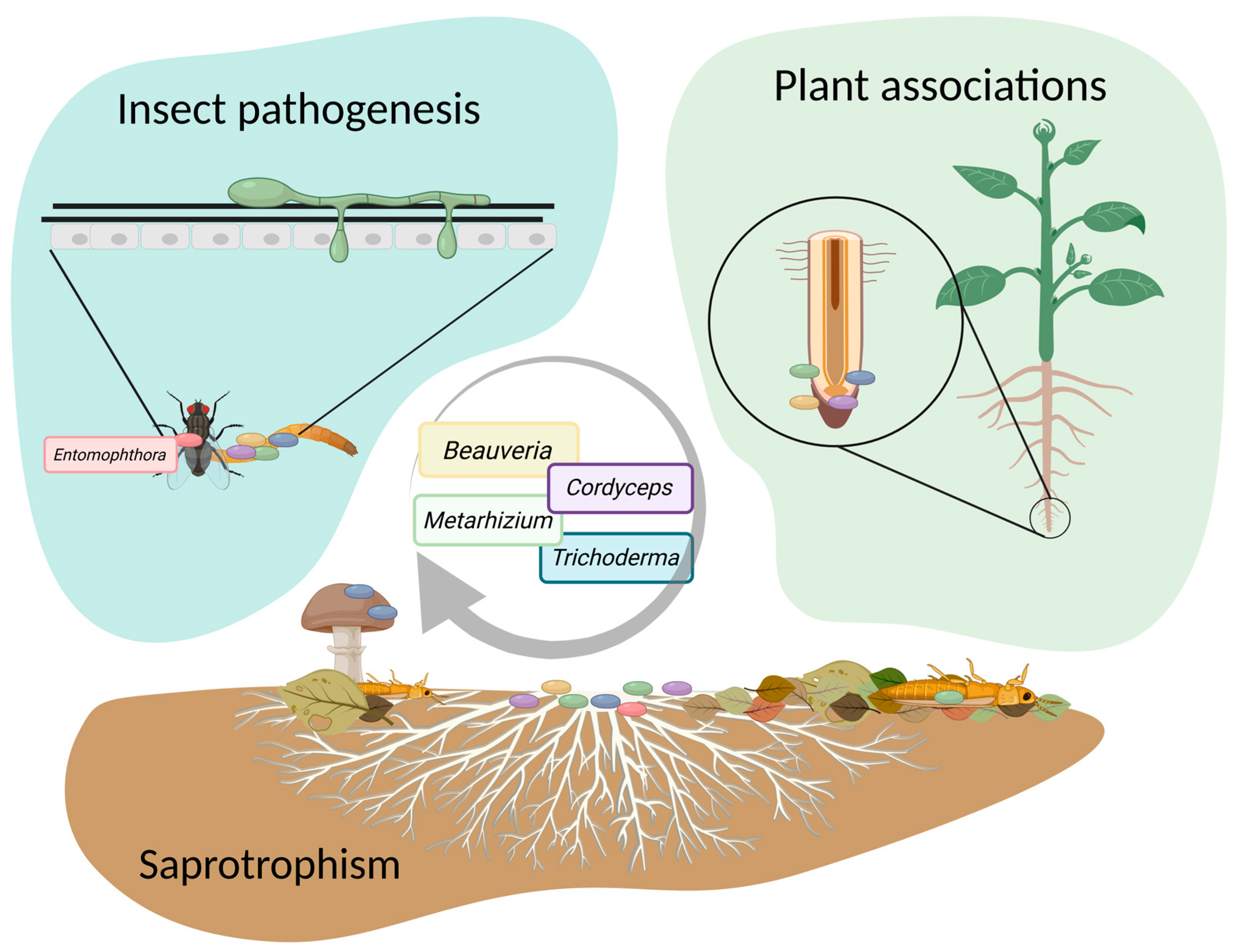
Belonging to the order Hypocreales and family Hypocreaceae, Trichoderma has two very distinct parasitism styles that are of significant biotechnological interest [60]. Several studies demonstrate the entomopathogenic potential of Trichoderma against insects of considerable agricultural significance, including species from the orders Hemiptera, Coleoptera, and Lepidoptera [60,61]. In relation to the parasitism of other fungi (known as mycoparasitism), Trichoderma spp. is widely used due to its ability to rapidly colonise the rhizosphere, which helps to suppress invading pathogens when biocontrol fungi are applied to seeds or roots [62,63,64]. In direct antibiosis, the secondary metabolites or enzymes secreted by Trichoderma inhibit the growth or germination of the pathogen [65]. Commercially, Trichoderma is widely used as a biopesticide in pest control strategies and consists of 50–60% of commercial biofungicides in the global market [66]. In Brazil, Trichoderma represents the third most used mycopesticide registered [21].
Most strains studied for the presence of dsRNA viruses in Trichoderma are Asian. In 623 Trichoderma spp. strains derived from surveys in different countries, including China, Mongolia, and Korea, only 35 (5.6%) were found to contain dsRNAs. A subsequent study conducted in Italy, however, revealed a higher incidence of dsRNAs in certain species—49.7% (19/39) in T. harzianum, 24.1% (7/29) in T. gamsii, and 66.7% (6/9) in T. hamatum—despite the low sample size. Other species analysed had a low incidence (<5%) or the sample number was less than five.

2.4. Entomophthoraceae: Entomophthora

The genus Entomophthora belongs to the order Entomophthorales, family Entomophthoraceae in the phylum Zoopagomycota [67,68]. Together with Mucormycota, Blastocladiomycota, and Chytridiomyctota, Zoopagomycota belong to the early-diverging fungal lineages outside Dikarya (Ascomycota and Basidiomycota). As such, species in the genus Entomophthora are distantly related to the previously mentioned ascomycete EPFs [31], which is also exemplified in their biology.
Fungi in the genus Entomophthora are fungal pathogens on a variety of insects: in particular, Diptera and Hemiptera, but also Plecoptera, Thysanoptera, and Raphidioptera [69]. These fungi are obligatory insect pathogens that only grow actively inside insects and often exclusively rely on host-to-host transmission or in temperate regions overwinters as dormant resting spores. Nearly all Entomophthora fungi follow a common life cycle consisting of host infection and proliferation in the living host. As the nutritional resources inside the host dwindle, the fungus eventually kills the host, grows out from the inside, and releases conidia that needs to reach a new host. Certain fungi in this genus, such as, for example, E. muscae, are famous for altering the behaviour of their host to position the host ideally for spore dispersal [70]. In contrast to ascomycete EPF’s, fungi in the genus Entomophthora are true host specialists, often only infecting a single or very few host species [71,72,73]. Because of this host specificity, these fungi have often been suggested as being ideal for biological control of insect pests in agriculture, such as the spotted-wing Drosophila [74], but unsuccessful efforts to mass-produce conidia have so far hindered their use in classical biological control. Significantly more success has been achieved using conservational biological control methods, exemplified with the related Entomophaga maimaiga against the gypsy moth (Lymantria dispar) in the eastern USA [75].
Although the study of viruses in the Entomophthoraceae is still in its infancy, transcriptome-mining analyses are revealing that the Zoopamycota phylum has one of the highest prevalences (up to ca. 55%) and diversity of RNA viruses across the Fungal Kingdom [76,77]. These viruses are related to seven known families: Benyviridae (encapsidated non-segmented (+)ssRNA viruses), Iflaviridae (encapsidated non-segmented (+)ssRNA viruses), Mitoviridae (capsidless (+)ssRNA non-segmented viruses), Narnaviridae, Virgaviridae (encapsidated segmented or non-segmented (genus dependent) (+)ssRNA viruses), Rhabdoviridae (encapsidated non-segmented (−)ssRNA viruses), and Partitiviridae. Of these, only the Iflaviridae and Mitoviridae have been studied more deeply, showing ubiquitous associations with Entomophthora muscae across all known isolates, bar one for Iflaviridae [28,78,79]. As most molecular studies on Entomophthora have been transcriptomic, only RNA viruses have been identified to date, leaving opportunities open for identifying DNA viruses in future studies.

3. The EPF Virome

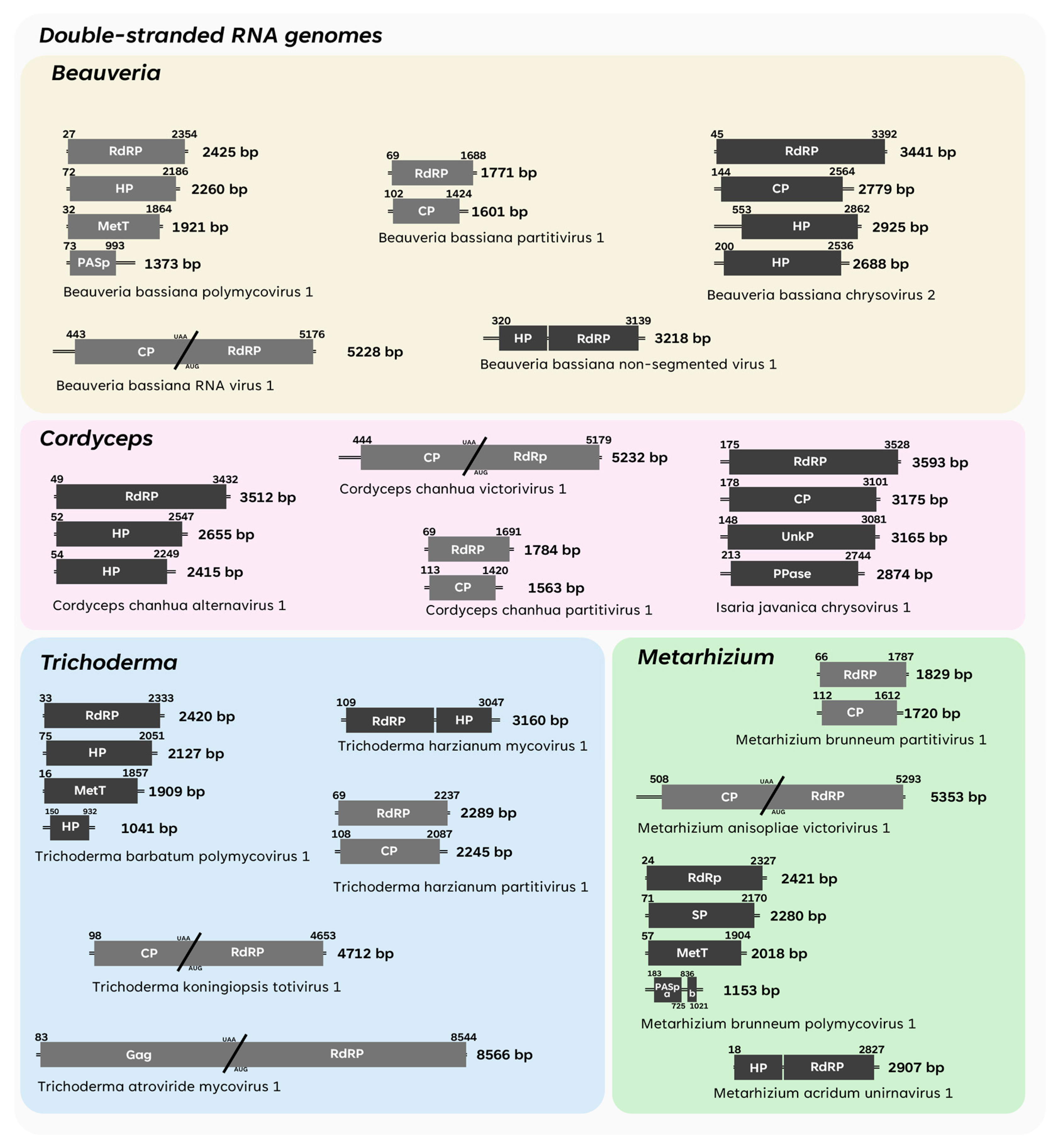
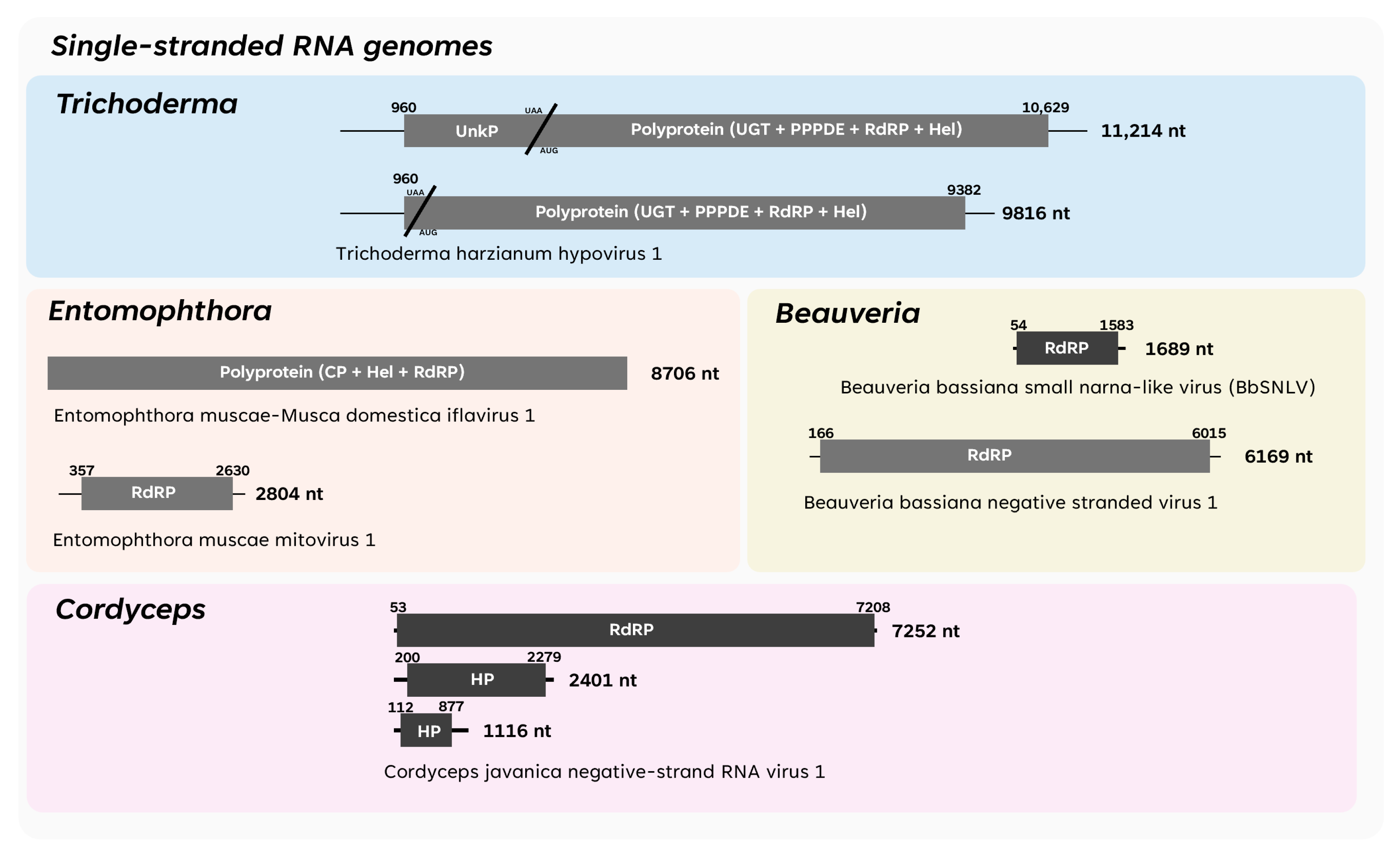
The following section presents the history of mycoviruses identified in EPF. The first characterised viruses for each fungal genus are mentioned, and the complete list of fully described viruses is shown in Tables S2–S6. Additionally, two schematic figures are provided to visually summarise all the representative dsRNA (Figure 3) and ssRNA (Figure 4) viral genomes described to date in Beauveria, Cordyceps, Entomophthora, Metarhizium, and Trichoderma, with each fungal genus being distinguished by a specific colour-coded box.
Figure 3. Genome architecture of representative dsRNA mycoviruses described in Beauveria, Cordyceps, Entomophthora, Metarhizium, and Trichoderma. Only one representative virus is shown per viral taxon. Viral genomes are grouped by fungal host genus, each highlighted within coloured boxes: Beauveria (yellow), Cordyceps (lilac), Entomophthora (salmon); Metarhizium (green), and Trichoderma (blue). RdRP: RNA-dependent RNA polymerase; CP: coat protein/capsid; HP: hypothetical protein; Hel: helicase; MetT: Methyltransferase; PASrp: proline-alanine-serine-rich protein; UnkP: protein of an unknown function; PPase: putative protease; and Gag: putative structural/gag protein.
Figure 4. Genome architecture of representative ssRNA mycoviruses described in Beauveria, Cordyceps, Entomophthora, and Trichoderma. Only one representative virus is shown per viral taxon. Viral genomes are grouped by fungal host genus, each highlighted within coloured boxes: Beauveria (yellow), Cordyceps (lilac), Entomophthora (salmon), and Trichoderma (blue). RdRP: RNA-dependent RNA polymerase; CP: coat protein/capsid; HP: hypothetical protein; Hel: helicase; UGT: UDP-glucose/sterol glucosyltransferase domain; and PPPDE: putative domain of permuted papain fold peptidases.

3.1. dsRNA Viruses

3.1.1. Pseudototiviridae and Orthototiviridae

The former family Totiviridae, which included the Totivirus and Victorivirus genera, was reorganised into three new suborders within the Ghabrivirales order. In the Alphatotivirinae suborder (Chrymotiviricetes, Ghabrivirales), both the Orthototiviridae and Pseudototiviridae families were accommodated and now comprise the Totivirus and Victorivirus genera, respectively. Both genera are characterised by their ability to infect fungi, the possession of isometric virions ca. 40 nm in diameter and a monosegmented dsRNA genome, ranging from 4.6 to 6.7 kbp. The genome encodes both an RdRP and a CP, with expression typically occurring via ribosomal frameshifting.
The first member of the genus Victorivirus found infecting B. bassiana was named Beauveria bassiana victorivirus 1 (BbVV1). The virus was reported as a single dsRNA band of ca. 6 kbp with isometric particles of ca. 50 nm in diameter. Following complete genome sequencing, the 5327 bp dsRNA was found to have two overlapping open reading frames (ORFs) encoding, respectively, a CP and an RdRP [36]. Recently, C. chanhua was found to be coinfected with Cordyceps chanhua alternavirus 1 (CcAV1) and Cordyceps chanhua victorivirus 1 (CcV1). The virus has two ORFs: ORF1 encodes a putative CP of 742 amino acids, and ORF2 encodes a putative RdRP of 836 amino acids. The termination codon of the CP ORF overlaps with the initiation codon of the RdRP ORF at the sequence AUGA [80].
A second genome of the genus Victorivirus, 5353 bp in length, was also identified in M. anisopliae and named Metarhizium anisopliae victorivirus 1 (MaVV1). The genome comprises two ORFs encoding a CP and an RdRP, respectively. Overlapping both ORFs, the presence of an octanucleotide (AUGAGUAA) as a frameshifting site was observed [81].
In Trichoderma, notably, a virus from the Totivirus genus has been fully described as Trichoderma koningiopsis totivirus 1 (TkTV1). Despite being in another genus and recently accommodated in another family, the general characteristics of TkTV1 resemble the victoriviruses described in Beauveria and Metarhizium, such as the presence of two overlapping ORFs responsible for encoding CP and RdRP, a genome ca. 5 kbp in size and viral particles ca. 40 nm in diameter [82].

3.1.2. Amalgaviridae

Amalgaviridae (class Duplopiviricetes, order Durnavirales) is a family of dsRNA viruses originally known from plants but now also encompassing mycoviruses infecting fungi. Members of this family have non-segmented genomes (ca. 3–3.5 kbp) with two not-obligated overlapping ORFs encoding an RNA-dependent RNA polymerase (RdRP) and a smaller protein of an unknown function. The family was recently updated and now includes three distinct genera: Amalgavirus, Unirnavirus, and Zybavirus. The genus Unirnavirus includes exclusively non-segmented dsRNA mycoviruses with their occurrence restricted to filamentous fungi. These fungal viruses share a characteristic genome organisation with two ORFs arranged in different reading frames, requiring a ribosomal frameshift for expression of the two proteins. In contrast to many dsRNA viruses, no true virion particles have been observed for unirnaviruses. For instance, Beauveria bassiana non-segmented virus 1 (BbNV1) was the first unirnavirus described from B. bassiana: the BbNV1 genome is 3218 bp in length and encodes two proteins, including an HP with no predicted function (315 aa) and an RdRP (585 aa) [83]. A similar virus was identified in M. acridum (Metarhizium acridum unirnavirus 1), which is 2907 bp in size and encodes a HP and an RdRP of 317 aa and 609 aa, respectively [84]. In T. harzianum, Trichoderma harzianum mycovirus 1 (ThMV1) displays a slightly distinct genomic arrangement. Its genome is 3160 bp in length and contains two major ORFs on the negative strand: ORF-A encodes an RdRP of 582 aa, while ORF-B encodes a HP of 379 aa. Additionally, a third ORF (ORF-C) is located on the positive strand and encodes a hypothetical 94 aa protein, with a poly(A) structure at the 3′ terminus [85].

3.1.3. Fusagraviridae

The family Fusagraviridae, accommodated into the new suborder Alphatotivirinae (Chrymotiviricetes, Ghabrivirales—ICTV release 2023), was first proposed in 2016 to include Fusarium-related mycoviruses [86] and harbours a unique genus, Fusagravirus. This family is characterised by non-segmented dsRNA genomes ca. 11 kbp in size, with two ORFs encoding a protein with RdRP domains and a structural protein with potential capsid function (yet some studies have suggested a capsidless nature for fusagraviruses) [87,88]. Similarly to alphatotiviruses, fusagraviruses possess isometric VLPs ca. 40 nm in diameter [89] and a ribosomal frameshift system between both ORFs. Moreover, although fusagraviruses are mainly described as infecting filamentous fungi, the host range expands to include plants and oomycetes [86].
A unique fusagravirus, Trichoderma atroviride mycovirus 1 (TaMV1) has been identified in T. atroviride. True virions of TaMV1 are encapsidated in icosahedral particles ca. 40 nm in diameter and possess a monosegmented dsRNA genome of 9584 bp, encoding both a structural/Gag protein and an RdRP [90].

3.1.4. Partitiviridae

The family Partitiviridae (Duplopiviricetes, Durnavirales) includes five genera, three of which—Alpha-, Beta-, and Gammapartitivirus—are primarily found in fungal hosts [91]. Characteristically, viruses in this family possess small, bisegmented dsRNA genomes ranging in size from 3.0 to 4.8 kbp in total [92]. Each segment is separately packaged into non-enveloped, isometric virions ranging from 25 to 43 nm in diameter [93].
As mentioned above, partitiviruses mark the beginning of the description of putative mycoviruses in EPF. However, the first complete genome belonging to a member of the Partitiviridae family found infecting an EPF was only reported in 2017. Beauveria bassiana partitivirus 1 (BbPV1) was identified infecting B. bassiana and was shown to possess a bi-segmented dsRNA genome 1771 bp and 1601 bp in length, encoding an RNA-dependent RNA polymerase (RdRP) and a coat protein (CP), respectively. Phylogenetic analyses placed the virus in the genus Gammapartitivirus [37].
With the advent of sequencing and next-generation sequencing (NGS) platforms, recent studies have accelerated, defining the incidence and genome sequences of partitiviruses in EPF. Trichoderma harzianum partitivirus 1 (ThPV1), a member of genus Betapartitivirus, was described in T. harzianum, consisting of two dsRNA segments, 2289 bp and 2245 bp in length, that encode an RdRP and CP, respectively [94]. In Metarhizium, the first complete genome of a mycovirus published in the genus was identified infecting M. brunneum and described as a bipartite genome of 1829 bp and 1720 bp, encoding RdRP and CP separately [29].
In Cordyceps, recent research has expanded the classification of partitiviruses, unveiling novel members in this genus. Cordyceps militaris partitivirus 1 (CmPV1) was discovered in C. militaris, identified as a new member of the Betapartitivirus genus, with two dsRNA segments encoding RdRp and CP. Notably, dsRNA1 has the highest similarity to that of Bipolaris maydis partitivirus 2 (BmPV2), whereas dsRNA2 shows the highest similarity to human blood-associated partitivirus (HuBPV) [95]. This finding holds significant evolutionary implications, since there is a similarity with mycovirus infecting distant hosts (phytopathogenic/entomopathogenic fungi ↔ humans). Meanwhile, Cordyceps chanhua partitivirus 1 (CchPV1) was documented in C. chanhua, classified within the Gammapartitivirus genus [96].
Finally, underpinned by numerous previous studies that have extensively described the genomic and taxonomic characteristics of the Partitiviridae family, the most recent descriptions of partitiviruses infecting EPF detail the incidence of a Gammapartitivirus [97], an Alphapartitivirus [98], a Betapartitivirus [94], and a proposed “Epsilonpartitivirus” [29] genera, indicating significant genome diversity.

3.1.5. Curvulaviridae

The Curvulaviridae family belong to the order Durnavirales (class Duplopiviricetes), which was first described in a strain of Curvularia protuberata. Genomes of the Curvulaviridae family are bisegmented and consist of two dsRNA segments: dsRNA1, ca. 2.0–2.4 kbp in size, and dsRNA2, ranging in size from 1.7 to 2.0 kbp. The larger segment (dsRNA1) encodes a putative RdRP, while the smaller segment (dsRNA2) encodes one or two proteins of unknown functions. Curvulaviruses were found to be encapsidated in spherical virions measuring 26–29 nm in diameter, and exemplars occur in fungi exclusively (ICTV taxonomic details available at the following: Taxon Details | ICTV). In B. bassiana, the dsRNA genome of a virus from the genus Orthocurvulavirus was described as containing two segments, comprising one ORF each. The first segment is 6169 bp long and possesses an ORF coding for an RdRP. The second is 1765 bp long and encodes a CP [99].

3.1.6. Chrysoviridae

The family Chrysoviridae (Ghabrivirales, Alphatotivirineae) is characterised by multisegmented dsRNA-based genomes. The virus particles are isometric, small (35–40 nm in diameter), and non-enveloped [100]. Typically, chrysoviruses possess four genomic dsRNA segments, with a total genome size ranging from 8.9 to 16.0 kbp, which are encapsidated individually in separate particles [101]. The host distribution includes ascomycetous and basidiomycetous fungi, plants, and possibly insects [101]. The family is divided into two genera: Alphachrysovirus, with 20 species, and Betachrysovirus, with 11 species (https://talk.ictvonline.org/taxonomy/, accessed on 7 January 2025).
The first associations of the presence of chrysoviruses in EPF were reported by Herrero et al. (2012) in B. bassiana [25], where the presence of groups of bands formed by four segments between 2.4 and 3.6 kbp was detected [25]. The first complete genome sequence, however, was reported as infecting a strain of Isaria javanica (Cordycipitaceae). Isaria javanica chrysovirus 1 (IjCV1), phylogenetically related to the alphachrysovirus Aspergillus fumigatus chrysovirus (AfuCV), contains four dsRNA segments of 3.7, 3.2, 3.1, and 2.8 kbp, encoding RdRP, CP, and two hypothetical proteins, HP1 and HP2, respectively [26]. Similar chrysoviruses are also described as infecting B. bassiana, Beauveria bassiana chrysovirus (BbCV) 1 and 2, which belong to the genus Alpha- and Betachrysovirus, respectively [102,103].

3.1.7. Alternaviridae

The Alternaviridae family belongs to the order Ghabrivirales (suborder Gammatotivirineae) and is characterised by a genome ranging in size from 8.4 to 10.7 kbp in total, divided into 3–4 dsRNA segments. The largest segment (dsRNA1) contains a single ORF encoding the RdRP. The dsRNA2 encodes a conserved protein of an unknown function, while dsRNA3 encodes a CP. When present, the fourth segment (dsRNA4) contains an ORF for a non-conserved protein with an unknown function, often lacking homology among other alternaviruses. Morphologically, alternaviruses are isometric virions ca. 33 nm in diameter.
To date, alternaviruses have been found exclusively in ascomycetes. In C. chanhua, Cordyceps chanhua alternavirus 1 (CcAV1) was described as containing three dsRNA segments, the first being 3512 bp long and encoding an RdRP, and the second and third encoding hypothetical proteins (HP) of 2655 and 2415 bp in length [104].

3.1.8. Polymycoviridae

The first member of the family Polymycoviridae (unclassified viruses within the realm Riboviria) was reported in 2015 and named Aspergillus fumigatus tetramycovirus 1. This family consists of a single genus, Polymycovirus, and is characterised by multisegmented dsRNA genomes, ranging from 7.5 kbp to 12.5 kb with four to eight segments. These viruses, in their majority, are non-conventionally encapsidated, and fungi and oomycetes serve as their natural hosts [105]. Typically, polymycoviruses’ genomes include segments that encode a RdRP, a methyltransferase (MetT), and a proline-alanine-serine-rich protein (PASrp). The other segments encode proteins of an unknown function.
In EPF, the first description of a polymycovirus, Beauveria bassiana polymycovirus 1 (BbPmV1) was reported in B. bassiana [37]. The observation of genomic dynamics in terms of the number of segments and sequence homology with previously described viruses led to the need to create a new family called Polymycoviridae. BbPmV1 consists of four dsRNA segments, which were 2425 bp, 2260 bp, 1921 bp, and 1373 bp in length, respectively. The segments encode an RdRP, a protein of an unknown function containing a cysteine-rich zinc finger-like motif, a MeT, and a PASrp, respectively. For BbPmV1, neither structural proteins were observed nor true virions by TEM [37]
In Metarhizium, two polymycoviruses were fully described, Metarhizium brunneum polymycovirus 1 (MbPmV1) and Metarhizium anisopliae polymycovirus 1 (MaPmV1), which both contain four dsRNA segments coding for an RdRP, a MetT, a protein of an unknown function, and a PASrp, respectively [106,107]. A similar pattern is found in Trichoderma barbatum polymycovirus 1 (TbPMV1), which contains four segments: RdRP, hypothetical protein 1 (HP1), MetT, and HP2 [108].

3.2. ssRNA Viruses

The occurrence of ssRNA viruses in EPF is still rare. As a consequence of the methods used to assess the occurrence of mycoviruses in fungal strains and isolates, based on the treatment of total RNA with S1 nucleases, the availability and quantity of ssRNA material can be limited for detection and sequencing techniques.
The first and smallest ssRNA virus described so far in EPF is Beauveria bassiana’s small narna-like virus (BbSNLV), which consists of a single (+)ssRNA segment, 1689 nt long, coding an RdRP. BbSNLV is a member of family Narnaviridae and order Wolframvirales, typically comprising a capsidless single segment of (+)ssRNA, up to 3 kbp in length, coding for an RdRP. Other features of viruses in the Narnaviridae family include their broad host range, encompassing fungi, algae, protozoans, and invertebrates, as well as their ability to replicate within organelles such as mitochondria, a characteristic observed exclusively in mitoviruses (family Mitoviridae) [109].
Similarly, possession of a single genome segment is a characteristic of Beauveria bassiana negative-strand RNA virus 1 (BbNSV1), which consists of a single negative-sense ssRNA strand of 6169 nt, phylogenetically placed in a clade close to viruses of the Mymonaviridae family (order Mononegavirales). The genomes of mymonaviruses contain a single ca. 10,000 nt long (−)ssRNA, potentially encoding up to six proteins [110,111]. Most of the previously described mymonaviruses encode an RdRP, a nucleocapsid (NC) protein, an HP, and several proteins of an unknown function. Mymonaviruses are enveloped filamentous virions, measuring 25–50 nm in diameter and ca. 1000 nm in length [112]. Mymonavirids usually infect filamentous fungi, and they have also been reported in oomycetes, plants, and insects following metagenomic studies [111]. A second (−)ssRNA virus was isolated from C. javanica and was named Cordyceps javanica negative-strand RNA virus 1 (CjNRSV1). The virus belongs to the little studied genus Laulavirus in family Phenuiviridae (order Hareavirales). The genome of CjNRSV1 is tri-segmented and consists of RNAs 1, 2, and 3, which are 7252, 2401 and 1117 nt in length, respectively. RNA1 encodes an RdRP; RNA2 encodes a non-structural HP, which resembles the movement protein (MP) found in plant viruses; and RNA3 encodes the NC protein [113]. Although the function of RNA2 is still unclear, some studies have reported this ORF as encoding a non-structural protein resembling the movement protein (MP) (ICTV, release 2023). The host range of laulaviruses remains unclear, as current evidence is limited to metagenomic analysis of plant-associated fungi [114] and pools of tick specimens [115]. Therefore, it is proposed that these viruses may be either specific to fungi or ticks.
In Trichoderma, the only ssRNA viruses described thus far belong to the Hypoviridae family (order Durnavirales). This family comprises capsidless viruses with (+)ssRNA genomes, ranging from ca. 7.3 to 18.3 kb in length. Hypoviruses lack true virions; their RNA genomes are encapsulated within vesicles derived from the host’s Golgi apparatus. This unique feature distinguishes them from other mycoviruses. The host range of hypoviruses is limited to fungi.
Trichoderma harzianum hypovirus 1 (ThHV1) is characterised by a (+)ssRNA strand of 11,214 nt, containing two overlapping ORFs. ThHV1 ORF1 has been reported as a polypeptide of an unknown function, while ORF2 presents a polypeptide containing a UDP-glucose/sterol glucosyltransferase domain, a putative domain of permuted papain fold peptidases, an RdRP, and an RNA helicase domain. A defective RNA of 9816 nt was also observed and added to the characterisation of the genomic dynamics of ThHV1. This RNA presents the full ORF2 and its respective domains, but ORF1 is reduced in size [116].
In Entomophthora, only viruses in the families Iflaviridae (class Pisoniviricetes, order Picornavirales) and Mitoviridae (class Howeltoviricetes, order Cryppavirales) have received attention. The presence of viruses from the Iflaviridae family are arguably the most fascinating discovery from the transcriptomic datasets of E. muscae [78,79,117]. Iflaviruses are encapsidated monosegmented viruses with (+)ssRNA genomes ranging from ca. 8.8 to 10.1 kb in length that encompass two long overlapping ORFs that encode structural (CPs) and non-structural (helicase, protease, and RdRP) proteins. The Iflaviridiae are known to mostly infect insects, suggesting that in Entomophthora, the virus has shifted from insects during co-infections inside a dipteran host [78,79]. The names of these iflaviruses have not yet been established by the ICTV community, and since the organism these iflaviruses replicate in is not yet known, the name “Entomophthovirus” or names according to E. muscae and its original insect host (e.g., E. muscaeM. domestica iflavirus 1) have been suggested. Although studies point at these iflaviruses being able to survive in in vitro liquid fungal cultures, further research is required to show whether they are novel mycoviruses from the Iflaviridae or opportunistically transmitting to insects via phoresis with E. muscae conidia. The E. muscae iflaviruses show high-sequence homology with the Twyford virus, a D. melanogaster-associated iflavirus that was originally described from wild-caught D. melanogaster [118], which has since been shown to also have been infected with E. muscae [78,79]. To date, only a single E. muscae isolate has been reported without an Iflavirus, with some isolates harbouring two different species [78,79], suggesting the iflaviruses to be widely and obligately associated with E. muscae. Phylogenetic analyses showed that these E. muscae iflaviruses form a single clade, divergent from recognised insect-infecting Iflaviridae [78,79], but co-phylogenetic analyses did not support fungus–virus co-speciation [117]. The frequent co-infection of fungi and viruses has led to instances of transmission from the insect host to EPF [119]. Thus, the insect-acquired virus could evolve the ability to replicate in the new fungal host, as has been found in the deformed wing virus, an iflavirus infecting honey bees, which have phylogenetically diverged from the insect-infecting species and evolved the ability to infect and replicate in the fungal pathogen Ascosphaera apis, which causes honey bee chalkbrood disease [120]. Given the protoplast growth of E. muscae, the transition from being an insect-infecting virus to a fungal-associated virus could further be facilitated in E. muscae. However, further studies into other Entomophthora species would be critical to understand this cross-kingdom evolutionary history of fungal–viral symbiosis.
The Mitoviridae family comprises capsidless non-segmented viruses with (+)ssRNA genomes ranging from ca. 2 to 5 kb in length that encompass a single long ORF that encodes an RdRP. Mitoviruses lack true virions and replicate in the mitochondria of host fungi and plants. E. muscae was the first and most phylogenetically basal fungus found to harbour mitoviruses [28]. Indeed, every E. muscae isolate has been found to harbour one to eight mitoviruses, forming phylogenetically distinct clades. These mitoviruses have been named Entomophthora muscae mitovirus 1 through 8 (EnmuMV1–EnmuMV8). All E. muscae isolates are from the Musca-infecting (house fly) lineage harbour seven mitoviruses. Interestingly, an E. muscae isolate from the Drosophila-infecting lineage shared all seven mitoviruses, but also harboured an eighth mitovirus, as opposed to the E. muscae isolate from the Delia-infecting lineage (cabbage fly), which only had one mitovirus (EnmuMV3), suggesting Entomophthora lineage-specific mitovirus associations [28].
For the genus Metarhizium, no ssRNA viruses have been described to date.

4. Effects of Mycoviruses on the Fungal Host

Historically, the investigation of genomes, genes, proteins, and metabolites in entomopathogenic fungi has primarily focused on elucidating their pathogenic interactions with arthropods [121]. This interest stems from early observations of fungal spores on insect cadavers, referred to as white and green muscardine diseases, caused by Beauveria and Metarhizium, respectively, and the potential use of EPF. Several studies have focused on the search for strains with broader phenotypic characteristics in terms of their spectrum of action (e.g., at different temperatures, humidity, pH, and other abiotic factors) [122,123,124,125,126]. Others, with advances in molecular biology, have enabled precise manipulation of cellular processes to enhance the efficacy of these fungi as biological control agents. Approaches such as heterologous expression of proteins, gene editing, silencing, and overexpression have been employed to modify key molecular traits, especially those associated with virulence, metabolic efficiency, and stress tolerance [127,128,129,130].
The pioneer studies on the discovery of mycoviruses in phytopathogenic fungi and their impacts on host biology prompted the exploration of these viruses in EPF [131]. In view of the possibility that mycoviruses may actively participate in phenotypic changes in their fungal hosts, these studies aim to elucidate the biological roles of mycoviruses and their potential influence on fungal fitness, pathogenicity, and host interactions [132].
The description of the biological effects caused by the presence of mycoviruses in their hosts initially involves an essential step: obtaining isogenic strains. Early studies used strategies based on the biology of the fungi studied and the probability of obtaining ‘virus-free’ strains through conidiogenesis and isolation of single-spore cultures [34]. Obtaining isogenic strains can be observed spontaneously. After successive passages in laboratory culture media, studies observed an effect called sectorisation in strains of M. anisopliae, where the presence of viruses was altered in relation to the original colony [23,24]. Moreover, forced transmission techniques, such as heterokaryosis and anastomosis, also offered the possibility for obtaining an infected strain. For this, a virus-free strain is used as a recipient and, after interaction with a donor strain, spores are selected and analysed for the presence of viral genetic material. Successful transmission attempts were achieved by Martins et al. (1999) between strains of M. flavoviride from two different continents [133]. Finally, the use of molecules aiming at inhibiting protein synthesis and RNA replication has gained prominence in mycovirology, due to their high cure rates in different fungal groups. Drugs such as cycloheximide, a protein synthesis inhibitor that targets the translocation step translation, and ribavirin, a base analogue of either adenine or guanine, inducing mutations in RNA-dependent replication in RNA viruses, have been widely used [134]. Once potentially virus-free colonies are obtained, confirmation of curing is necessary. Classical methods such as the precipitation of dsRNA with lithium chloride or elution from CF-11 columns have been widely used in the past and are still useful for initial screening. However, nowadays, specific primers are used to amplify conserved regions, such as those present in RdRP, for confirmation by RT-PCR, bringing greater reliability, since the observation of bands on agarose gels can be biassed due to the inefficient extraction process or even by the detection limit of the technique itself. The main obstacle is that many mycoviral infections are latent and therefore do not have a specific or obvious phenotype, making it difficult to observe potential isogenic strains and increasing labour time.
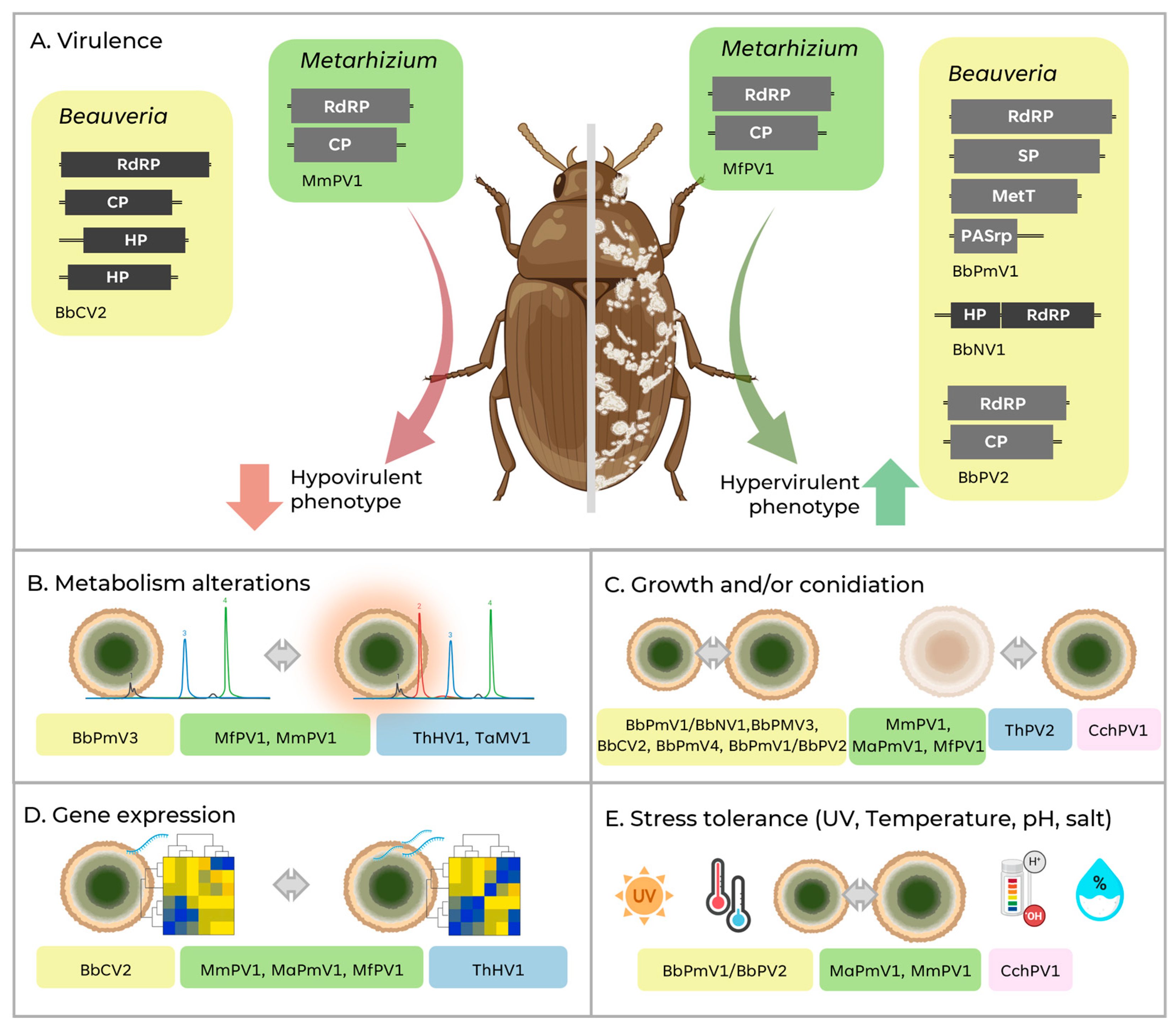
Among the most widely investigated phenotypic factors regarding the presence or absence of mycoviruses in EPF, virulence, sporulation, and mycelial growth under different conditions are highlighted, due to their close relationship with EPF application as commercial products. Moreover, although hypervirulence is the desired factor through the transfer or expression of a virus, or part of it, in EPF, the hypovirulence phenotype may also indicate the possibility of increasing virulence by curing the viral elements responsible for this phenomenon. The next subheadings elucidate the biological effects triggered by mycoviruses in EPF and main phenotypes are summarised in Figure 5.
Figure 5. Overview of the biological impacts exerted by mycoviruses on entomopathogenic fungi. Colour coding refers to the fungal host genus: Beauveria (yellow), Cordyceps (lilac), Metarhizium (green), and Trichoderma (blue). Panel A illustrates the modulation of virulence by mycoviruses described in Beauveria and Metarhizium, with representative genome diagrams shown within colour-coded boxes according to their fungal host. Panels B–E summarise additional phenotypic effects (e.g., on sporulation, growth, thermotolerance, etc.), where virus acronyms appear in host-coloured boxes indicating the EPF genus in which the effect was observed. The full names of all viruses referred to by acronyms are listed in Supplementary Tables S2–S6. Created in BioRender. Camargo, M. (2025) https://BioRender.com/b0x8y5v (accessed on 2 December 2025).

4.1. Beauveria spp. and Cordyceps spp. Biological Effects

The first evidence that mycoviruses could alter the Beauveria phenotype was reported in 2006 by Dalzoto et al. The authors showed that dsRNA elements in B. bassiana were directly responsible for hypovirulence, significantly reducing the fungal host’s ability of infecting insects. Isogenic fungal lines cured of the dsRNA elements demonstrated significant enhanced virulence against the brown stink bug (Euschistus heros) compared to its virus-infected counterparts [35]. Subsequent field surveys in China have linked mycoviruses to a hypovirulent phenotype of wild B. bassiana strains [135]. For instance, Beauveria bassiana chrysovirus 2 (BbCV2) was found as a prevalent “core” virus in many field isolates. BbCV2-infected strains showed reduced virulence against larvae of the corn borer (Ostrinia furnacalis), as compared to their virus-free counterparts [135]. Transcriptomic analysis of hypovirulent strains revealed a mechanistic basis, with a lowered expression of genes encoding cuticle-degrading enzymes and toxins, consistent with the observed drop in insect pathogenicity [135]. Conversely, some mycoviruses were found to enhance virulence on Beauveria. Kotta-Loizou and Coutts (2017) first reported a case of mild hypervirulence in B. bassiana in the Spanish EABb 92/11-Dm isolate harbouring two novel dsRNA viruses Beauveria bassiana polymycovirus 1 (BbPmV1) and Beauveria bassiana non-segmented virus (BbNV1), showing slightly faster growth and causing higher mortality in Galleria mellonella greater wax moth larvae as compared to a virus-cured isogenic line [37]. This initial discovery has since been followed by more dramatic examples of mycovirus-induced hypervirulence. A recent study by Rueda-Maíllo et al. (2025) showed that the Spanish B. bassiana strain EABb 01/126-Su, naturally coinfected with BbPmV1 and BbPV2, became significantly more virulent against G. mellonella larvae than a virus-free derivative [136]. Another report from China noted that BbPmV4, while reducing the fungus spore production, increased its virulence against O. furnacalis larvae [137].
In many hypervirulent cases, virus presence correlates with increased sporulation. For example, polymycovirus infection can dramatically elevate conidia yields: an unpublished study observed virus-infected B. bassiana isolates producing up to 96% more conidia than their virus-free isogenic lines [107]. Filippou et al. (2021) reported that two different polymycoviruses (BbPmV1 and BbPmV3) in B. bassiana strains EABb 92/11-Dm and ATHUM 4946 both led to significantly enhanced conidiation on standard Czapek-Dox agar (with sucrose/nitrate) [138]. This enhancement was reproducible across rich and minimal media, indicating that virus infection often boosts the fungus capacity to form conidia under a range of nutrient conditions. Moreover, the sporulation shift can depend on the intake of nutrients. Filippou et al., in 2021, also noted that when the carbon or nitrogen source was altered, the virus-mediated effect could be diminished or even reversed [138]. Conversely, some mycoviruses can suppress sporulation. As an example, B. bassiana infected with BbPmV4 exhibits noticeably lower conidial yields relative to virus-free controls [137].
Beauveria isolates harbouring polymycoviruses often display significantly increased radial growth on agar media. In the work of Filippou et al. (2021) [138], the colony diameter and biomass of virus-infected lines outpaced that of virus-free isogenic lines, sometimes substantially so, under standard culture conditions. Similarly, Kotta-Loizou and Coutts (2017) observed a mild growth advantage in a B. bassiana isolate containing dsRNA viruses, relative to its cured counterpart [37]. These findings align with a general pattern that certain mycoviruses (notably Polymycoviridae and some Chrysoviridae) elicit increased fungal growth in their hosts. At minimum, removing deleterious viruses can restore more robust growth. For example, Dalzoto et al. (2006) reported that curing B. bassiana of dsRNA not only restored insect pathogenicity but also the overall growth capacity of the fungus, suggesting that the virus had imposed some growth burden [35].
Rueda-Maíllo et al. (2025) provided striking evidence where the hypervirulent B. bassiana strain EABb 01/126-Su, carrying BbPmV1 and BbPV2, exhibited broad-spectrum stress resistance as compared to virus-free lines [136]. The mycovirus-containing strain could germinate and grow across an expanded temperature range and showed increased tolerance to osmotic stress, water stress (desiccation), and ultraviolet (UV)-B radiation. Interestingly, the same virus-infected strain also displayed enhanced antagonistic ability against T. harzianum [136]. In addition to fungal antagonism, some mycoviruses appear to shift the ecological role of Beauveria strains toward improved plant interactions. Zhang et al. (2024) demonstrated that B. bassiana infected with BbCV2, a hypovirulence-associated chrysovirus, exhibited significantly enhanced antagonism against phytopathogens including Botrytis cinerea and Sclerotinia sclerotiorum [139]. Moreover, the virus-infected strains showed improved root colonisation and plant growth promotion traits, alongside an upregulated expression of genes associated with antimicrobial secondary metabolites [139]. These findings suggest that certain mycoviruses can attenuate insect virulence while simultaneously increasing the strain’s potential utility as a biocontrol agent against plant pathogens.
In Cordyceps, recent studies have begun to elucidate the effects of partitiviruses on their fungal hosts. For instance, CchPV1, a member of the Gammapartitivirus genus, was found to alter fungal development and stress tolerance in Cordyceps chanhua. CchPV1 infection was shown to slow the host’s growth rate while increasing conidiation and the formation of fruiting bodies. However, the infection also weakened the host’s multi-stress tolerance, indicating that partitiviruses can have complex and multifaceted effects on their Cordyceps hosts [96].

4.2. Metarhizium spp. Biological Effects

In M. anisopliae V291, an isogenic strain obtained through successive subcultures on solid medium (V291C), no difference in virulence against the aphid Myzus persicae was observed when compared with its virus-infected counterpart (V291B). Both clones displayed similar pathogenicity levels, with aphid mortalities of 95.2 ± 16.9% and 88.2 ± 3.4%, respectively, despite the presence of virus-like particles and dsRNA segments being detected only in V291B [23]. Conversely, alterations in colony morphology and increased conidial production were reported in a virus-free spontaneous mutant strain (RJd), compared to the parent strain (RJc) of M. anisopliae [24]. For the same species, a virus-free strain (STA2-1c2) was obtained through monosporic cultures, which, compared to the virus-infected strain, showed a slight increase in colony size and spore production on potato dextrose agar (PDA) medium amended with dodine and notably, a significant reduction in virulence against crickets (Gryllus domesticus) [34].
In M. acridum, several treatments were attempted in an effort to cure M. acridum CG291. However, single-conidium subculture, elevated incubation temperature, and cycloheximide treatment were all unsuccessful in virus eradication. Hyphal anastomosis between the auxotrophic mutants CG291-arg and CG442-met was successfully conducted. Analysis comparing the original CG291 strain and its infected version showed no difference in virulence against the grasshopper Rhammatocerus schistocercoides [133]. Subsequent studies conducted on the same isogenic strains found no significant difference in the activity of the pathogenesis-related-protein 1 (PR-1L), a protein with enzymatic activity of importance for the fungal infection cycle. However, changes were observed in conidia production, which was greater for CG442-met (−dsRNA) than for CG442-met7 and CG442-met8 (+dsRNA) [50].
Studies aimed at eliminating dsRNA viruses from Metarhizium spp. strains revealed that cycloheximide was ineffective in eradicating dsRNA segments. By contrast, hyphal tip subculturing resulted in the loss of some dsRNA segments in M. anisopliae ESALQ 26. Complete elimination of dsRNA was achieved in strains ESALQ 866, ESALQ 1256, and ESALQ 1595 through either monoconidial or hyphal tip subculturing. Fungal variants free from or harbouring dsRNA exhibited comparable tolerance to heat and UV stress, indicating limited evidence to suggest that these mycoviruses have a negative impact on the biological traits of their fungal host [59].
In M. majus, horizontal transmission of Metarhizium majus partitivirus 1 (MmPV1) was achieved, following the co-culture of the MmPV1-infected strain RCEF0578 with the MmPV1-free strain RCEF0577. Transmission occurred through mycelial fusion at the colony margin, followed by subculturing on a solid medium until sporulation and the isolation of single spores from the recipient strain. Inter-simple sequence repeat PCR (ISSR-PCR) was employed to distinguish the two strains prior to repeated co-cultivation. Isogenic MmPV1-infected single-spore isolates exhibited reduced conidiation, decreased tolerance to heat shock and UV-B irradiation, and downregulation of the genes associated with these traits. MmPV1 infection also impaired fungal virulence, affecting hydrophobicity, adhesion, and cuticular penetration. Secondary metabolite production was altered, with decreases in triterpenoids and metarhizins A and B and increases in nitrogen- and phosphorus-containing compounds. Notably, when individual MmPV1 proteins (RdRP and CP) were expressed, no alterations in phenotype were observed [140].
As in MmPV1, isogenic virus-infected lines exhibited significant alterations in biological traits as compared to their virus-free counterparts in Metarhizium anisopliae polymycovirus 1 (MaPmV1) [107]. Isogenic lines derived from single spore cultures were obtained by vortex-mixing conidial suspensions in Tween-80 and filtering through sterile non-woven fabric. In MaPmV1-infected strains, biological comparisons revealed enhanced growth rates and increased conidiation, supported by the upregulation of genes related to these traits. However, MaPmV1 also increased the host’s sensitivity to UV-B irradiation, correlating with the downregulation of DNA damage repair genes. Unlike MmPV1, MaPmV1 did not significantly affect M. anisopliae virulence. Despite these observations, overexpression of individual MaPmV1 proteins failed to induce any notable phenotypic changes [107].
Another successful example of viral transfection between fungal strains highlighted the potential of Metarhizium flavoviride partitivirus 1 (MfPV1) to enhance the fungal performance as a biocontrol agent. PEG-mediated protoplast transfection of commercial strains of M. anisopliae and M. pingshaense with MfPV1 significantly increased their virulence against two major lepidopteran pests, the diamondback moth (Plutella xylostella) and the fall armyworm (Spodoptera frugiperda). MfPV1-infected strains also exhibited enhanced conidial production and upregulated PR genes, including those encoding an adhesin-like protein, hydrolytic enzymes, and destruxin synthetase [141].

4.3. Trichoderma spp. Biological Effects

Since the genus Trichoderma has different characteristics from the previous genera, such as the ability to mycoparasitise, there are different approaches and findings regarding the presence or absence of mycoviruses in their fungal hosts. One of the main characteristics investigated, along with conidiation and growth in Trichoderma, is the interaction with other microorganisms, including species of economic and food importance, such as the basidiomycete Pleurotus, and phytopathogenic species including Fusarium and Botrytis spp. The approaches, although outside the scope of insect pest control, include an extra factor of interest for evaluation in phenotypes of Beauveria and Metarhizium, since both also participate in fungus–plant associations and can interact with invading phytopathogenic fungi.
An initial study on Trichoderma evaluated the presence of viruses in different strains and found patterns compatible with viruses from the Hypoviridae family in the T. harzianum M2 strain. Through selection of single-spore colonies, 2 out of 30 showed absence of the viral elements initially observed [142]. No changes were observed in development and conidiation patterns. In addition, the elimination of TaMV1 from a T. atroviride strain was also achieved through single-spore selection. As observed in the previous study, no effects on morphological parameters, such as pigmentation, sporulation, and growth rate, were observed in the virus-free/containing comparison [27].
In T. harzianum, transmission by anastomosis was used to transfer ThPV1, and the infected strains were compared to their virus-free counterparts. The inhibition level against the oyster mushroom, P. ostreatus, and the phytopathogen Rhizoctonia solani was increased when filtrates were prepared from T. harzianum cultures infected with ThPV1. More profoundly, a significant increase in the activity of the antifungal enzyme of β-1,3-glucanase was observed in the ThPV1-infected strain, an important enzymatic factor for the mycoparasitic activity of T. harzianum [94]. Conversely, the alphapartitivirus TaPV1 had no significant impact on virus-free strains of T. atroviride obtained by single-spore selection followed by hyphal tipping [98].
Another study of isogenic strains obtained by viral transmission revealed the biological role of ThHV1 and ThHV1S (a defective RNA of ThHV1). Firstly, the specific role of ThHV1-S was observed, as it negatively interfered with the mycelial growth of strain T70-D, as well as decreasing the inhibitory potential against the phytopathogen Botrytis cinerea. These phenotypes were also observed in the T. harzianum isolates T-68 and T. koningiopsis isolate T-51 transfected with ThHV1 and/or ThHV1S [116]. Subsequent analyses indicated patterns of transcriptomics and metabolomics related to the effect previously observed using filtrates from infected strain T-51-13, indicating mechanisms behind the phenotype of the increased inhibition of phytopathogenic fungal infection [143].
Virus elimination in Trichoderma was also achieved using ribavirin and protoplasting/regeneration. Slight differences in mycelial growth were observed when comparing T. harzianum strain 525 and its respective counterpart 525-F on specific media. Moreover, the absence of TaMV1 was implied by decreased biomass production by the host and lower antagonistic activity against the pathogen F. oxysporum in planta [85]. Conversely, the infection caused by TaPV2 was related to the slightly increased but significant capacity of T. harzianum to inhibit growth of F. oxysporum [144].
An important result was observed in isogenic T. atroviride strains obtained by selecting single-spore colonies. The impact observed for the presence of TaMV1-NFCF377 (related to the Fusagraviridae family) is associated with enhanced antifungal efficacy against the phytopathogen R. solani, but not for the edible mushroom P. ostreatus. Despite this, no immediate effects such as growth or sporulation have been reported [90].

4.4. Entomophthora spp. Biological Effects

Although a high diversity and prevalence of viruses have been identified in the Entomophthora [76,77], the understanding of the biological effects they have on the fungus or the insect host is almost entirely lacking. To date, only insights into the symbiosis with the divergent Iflaviridae species have been reported [78,79,117]. Iflavirus reads are found in E. muscae from RNA sequenced in both in vivo and in vitro cultures, showing that the virus is capable of survival in liquid fungal in vitro cultures [78,79]. In infected Drosophila melanogaster, an increase in reads mapping to iflaviral genomes in late stages of infection have been observed [78].
Because E. muscae consistently harbours iflaviruses and also behaviourally manipulates infected fly hosts, the idea that the virus could be involved in behaviourally manipulating the host insects is not excluded [78,79]. For example, DNA viruses in the Baculoviridae family are known to induce comparable summiting phenotypes before death in lepidopteran larvae [145]. Furthermore, an Iflaviridae species has previously been shown to induce behavioural change in an insect [146], showing that these genomically simple iflaviruses could be manipulating the behaviour of Entomophthora-infected insects. To identify the role of E. muscae iflaviruses, one main hurdle presents itself: finding a virus-free isolate in wild-caught flies or obtaining a virus-free isolate in in vitro cultures. As E. muscae is cultured in liquid media where it does not sporulate, the only feasible option available to obtaining a virus-free culture is to isolate single conidium from sporulating cadavers, which can then be cultured in liquid medium. Given the usually slow and temperamental growth in vitro (2–6 weeks with millions of conidia), obtaining a virus-free culture will likely be long and tedious, but essential to uncovering the interaction of the near-ubiquitous E. muscae iflaviral symbiont.
Overall, considering the viral groups with the highest number of reported phenotypic descriptions in EPF, partitiviruses and polymycoviruses display distinct levels and patterns of impact on their fungal hosts (Tables S2–S6). Partitiviruses, on one hand, show no clear trend, as they can either increase or reduce virulence, growth, and sporulation, depending on the specific virus–host combination. These effects suggest a broader modulation of host metabolism and resource allocation, variably influencing developmental processes, stress tolerance, and pathogenicity. Polymycoviruses, on the other hand, tend to produce more consistent outcomes, frequently associated with enhanced virulence, mycelial growth, and conidiation, although are sometimes accompanied by reduced stress tolerance or sporulation. Collectively, these patterns indicate that both groups modulate host physiology in distinct ways. Partitiviruses seem to induce variable, context-dependent effects that can either favour or impair host performance, whereas polymycoviruses are more frequently linked to enhanced growth and virulence, suggesting a tendency to boost the overall fitness of entomopathogenic fungi under certain conditions. Nevertheless, we emphasise that the number of described viruses, even within these families, remains limited. Broader analyses involving these and other viral taxa are still required to establish a clearer correlation between the viral family and the phenotypic effects observed in their fungal hosts.

5. Knowledge Gaps and Future Perspectives in EPF Mycovirology

5.1. Molecular Advances on Mycovirology

Mycoviruses are seminal as tools for inducing phenotypic changes in their fungal hosts. Since their discovery, significant advances have been made, from the observation of their effects during the golden age of mycovirology to the successful biocontrol of C. parasitica in chestnut trees [2].
Promising advances in the description of new viruses are also based on the development of new sequencing techniques. In addition to NGS platforms with greater genomic coverage and sequencing depth, innovations aimed at sequencing and describing dsRNA sequences have attracted much attention. Fragmented primer-linked double-stranded RNA sequencing (FLDS) is a technology that facilitates the detection of mycovirus genomes in a homology-independent manner [147]. The method, described by Urayama et al. (2016), makes it possible to sequence viral genetic material in a circular form, with no ends and therefore no need for subsequent sequence descriptions, such as RNA ligase-mediated rapid amplification of cDNA ends (RLM-RACE) [147]. The reduction in the number of steps makes it possible to discover new viral taxa more quickly.
Other bioinformatics tools have also enabled the in-depth discovery of unconventional segments of known viruses. Previous techniques are being seen as limited because the scope of the databases is insufficient, given the commonly used parameters. By using strict parameters, sequences with little similarity to those already deposited may not be recognised as viral material. In this sense, by using more comprehensive parameters and smaller sequences, such as those that are well conserved and present in untranslated regions (UTRs), viral sequences can be captured from large databases as genome-mining, even if the ORFs present in them do not have much similarity to those that are already deposited. Tools such as iUTR have recently been applied to the yet-unrecognised genus “Jivivirus” and have revealed up to seven new segments for a viroid hitherto considered to be tri-segmented [148,149].
Moreover, aiming at the use of mycovirus sequences as molecular tools and the clarification of molecular basis behind phenotypic alterations, research is increasingly focused on identifying the specific viral and fungal components responsible for phenotypical alterations observed in the viruses’ hosts. In Aspergillus, a widely described fungus with a diverse incidence of mycoviruses and their respective biological effects, the RNA silencing mechanism proved to be important for the process of cause and effect in phenotypic alterations. In this context, mycoviruses can be both triggers and targets, as well as suppressors of RNA silencing. As for the defence mechanisms of mycoviruses against host silencing systems, the processes of protection of viral genetic material, inhibition of Dicer and Argonaute proteins, or high turnover of vsiRNAs are reported. Effects relating to the process of virus-RNAi system interaction are observed mainly at the level of transcriptomic alteration, as reviewed by Battersby et al. (2024) [14].
Finally, experiments expressing individual viral proteins or combinations of proteins are helping to elucidate the molecular mechanisms of virus–host interactions. Techniques such as heterologous expression, using basic plasmid systems and cloning by Agrobacterium tumefaciens, make it possible to express single viral proteins and understand the specific roles of each virus sequence in their hosts. In M. majus, although effects were observed when the virus was transferred in its entirety, no significant changes were seen after expression of the individual MmPV1 proteins [140].

5.2. Environmental Implications on Mycoviruses Transmission

Despite the advancements in mycovirus genomic descriptions, there are still significant gaps in the understanding of the mechanisms behind viral transmission and their implications for the evolution and distribution of viral families in fungal taxa.
The known existence of viruses in different components of the environments in which EPF are found (Figure 6) raises even more questions about the potential for viral transfer in these environments. Beauveria (along with the Cordyceps complex), Metarhizium, and Trichoderma have different life cycles: acting as saprophytic fungi—degrading organic compounds in the soil; endophytic—participating in mycorrhizal interactions or endosymbionts in plants; and entomopathogenic—capable of suppressing the defence barrier of arthropods and using insects as a way of dispersing and controlling populations [150,151,152].
Figure 6. Lifecycle of Beauveria, Cordyceps, Entomophthora, Metarhizium, and Trichoderma, highlighting potential sources and pathways for mycovirus infections. The diagram illustrates the various stages in the lifecycle of EPF where mycoviruses could potentially be transmitted or acquired, underscoring the ecological interactions that facilitate virus infection within different environmental and host contexts. Created in BioRender. Camargo, M. (2025) https://BioRender.com/e5dnahg (accessed on 2 December 2025).
Viral transfer is an essential mechanism for virus dispersal and has been used for biological control strategies in the past [2,153]. In laboratory research, as well as enabling the development of isogenic strains by horizontal transmission, viral transfer can also explain how these viruses are distributed naturally. Previous studies have reported the similarity of viral nucleotide and amino acid sequences of more than 90% in Sclerotinia homoeocarpa and Ophiostoma novo-ulmi [154]. Other studies have also revealed the ability of viruses described in Entoleuca (Entoleuca hypovirus 1—EnHV1) to infect a strain of Rosellinia necatrix [155] and, for the Botrytis porri RNA virus 1, the co-occurrence in S. sclerotiorum [156].
In Trichoderma, the presence of viruses capable of replicating in another fungal genus has already been observed [82], revealing a scarcely explored potential for mycovirus dispersal beyond species-specific levels. Furthermore, extrapolating to the environmental context of fungi, recent studies have demonstrated the influence of microenvironments on the induction of viral transfer. By recreating conditions such as a high concentration of proline, it was possible to observe in vitro processes that were previously observed in planta. Viral transfer was even increased to strains considered incompatible, changing the perspective regarding the possibility of natural dispersal of mycoviruses [157]. Finally, studies have shown that the inter-kingdom relationships, including mycoviruses, can cross over the fungus–fungus interaction. Nerva et al. (2017) reported the replicative capacity in plant cells of two virus species belonging to the Partitiviridae and the former Totiviridae families, with no indication of adaptation to the host or alteration of nucleotide sequences [158]. In addition, a DNA virus identified in the phytopathogenic fungus S. sclerotiorum was reported as being capable of infecting a mycophagous insect when the larvae fed on virus-infected fungi. Notably, viruliferous adults could transmit the mycovirus by transovarial transmission and potentially play a part as mycovirus vectors [159]. This finding points to the ecological potential of viral transmission between fungal species and provides a basis for the development of new biocontrol strategies, such as the dissemination of hypervirulence-inducing viruses in populations of EPF, mirroring the success observed in C. parasitica.
Regarding the viral classification in terms of cross-kingdom distribution, despite the Ghabrivirales order, which mainly comprises mycoviruses-obligatory dsRNA viruses, the Mononegavirales, Reovirales, and Martellivirales orders, which comprise (+) or (−) ssRNA viruses, have a wide dispersion, including fungi, animals, and plants [153].
Moreover, the fungal–insect interactions should not be examined solely from an EPF perspective. Within the tripartite plant–insect–fungi system, research has demonstrated that fungi manipulate insect behaviour through volatile organic compounds (VOCs) to enhance phytopathogenic fungal dispersal [160,161]. Indeed, mycoviruses can suppress fungal secondary metabolite biosynthesis, consequently altering insect attraction to mycovirus-infected fungi targeting insect-born dissemination [161]. The wide occurrence of mycovirus in several pathosystems add an additional level of complexity to the multitrophic interactions. These observations highlight how mycovirus and chemical ecology studies can illuminate novel biocontrol strategies for complex field interactions.
As previously discussed, ThMV1 exhibits dual effects in T. harzianum—enhancing plant growth promotion while reducing its biocontrol efficacy. This suggests viral-mediated modulation of fungal secondary metabolites involved in plant growth regulation. Such tripartite symbioses (the hot springs panic grass (Dichanthelium lanuginosum)-Curvularia protuberata-Curvularia thermal tolerance virus (CThTV)) have also been implicated in thermal tolerance [162]. These mutualistic interactions align with the ‘Russian doll’ model proposed by Lerer and Shlezinger (2022), wherein mycoviruses fine-tune host virulence and ecological adaptability [132]. In this context, the mycovirus-induced phenotypic alterations in fungi position host–virus interactions as a crucial research area in modern virology, where these interactions offer promising applications as novel biocontrol agents and bioinputs to sustainable agriculture, bioindustrial tools for fermentation and bioprocessing and alternative therapeutic strategies to address antifungal resistance crises.
Finally, a major experimental challenge lies in validating the practical application of virus-mediated phenotypic changes. Data on the dissemination of mycoviruses intentionally introduced into fungal strains prepared in the laboratory in environmental or agricultural conditions remains scarce, leaving crucial questions unanswered about the stability and scalability of producing mycovirus-infected EPF strains for large-scale spore application in crop protection. The central challenge now is to turn mycoviruses into tools, rather than just subjects of study, in the EPF mycovirology scenario.

Supplementary Materials

The following supporting information can be downloaded at: https://www.mdpi.com/article/10.3390/v17121593/s1. Table S1: Incidence of mycoviruses in entomopathogenic fungi. Table S2: Mycoviruses characterised in Beauveria and their properties. Table S3: Mycoviruses characterised in Cordyceps and their properties. Table S4: Mycoviruses characterised in Entomophthora and their properties. Table S5: Mycoviruses characterised in Metarhizium and their properties. Table S6: Mycoviruses characterised in Trichoderma and their properties. Refs. [163,164,165,166,167,168,169,170,171,172,173] are cited in Supplementary Materials.

Author Contributions

Conceptualization, M.d.S.C. and I.K.-L.; formal analysis, M.d.S.C.; investigation, M.C.S.-F., S.E. and M.O.H.; resources, I.K.-L.; data curation, M.d.S.C. and I.K.-L.; writing—original draft preparation, M.d.S.C.; writing—review and editing, M.d.S.C., S.E., M.O.H., U.S., T.Y.S., B.H., H.H.D.F.L., M.C.S.-F., A.S., R.H.A.C. and I.K.-L.; visualisation, M.d.S.C.; supervision, I.K.-L.; project administration, I.K.-L. All authors have read and agreed to the published version of the manuscript.

Funding

This work was supported by the Fundação de Amparo à Pesquisa do Estado do Rio Grande do Sul (FAPERGS), grant no 41172.541.29362.15072019, and scholarship support by Conselho Nacional de Desenvolvimento Científico e Tecnológico (CNPq) and Coordenação de Aperfeiçoamento de Pessoal de Nível Superior (CAPES).

Conflicts of Interest

The authors declare no conflicts of interest.

References

  1. Hollings, M. Viruses associated with a die-back disease of cultivated mushroom. Nature 1962, 196, 962–965. [Google Scholar] [CrossRef]
  2. Choi, G.H.; Nuss, D.L. Hypovirulence of chestnut blight fungus conferred by an infectious viral cDNA. Science 1992, 257, 800–803. [Google Scholar] [CrossRef]
  3. Sabanadzovic, S.; Abergel, C.; Ayllón, M.A.; Botella, L.; Canuti, M.; Chiba, Y.; Claverie, J.; Coutts, R.H.A.; Daghino, S.; Donaire, L.; et al. Summary of taxonomy changes ratified by the International Committee on Taxonomy of Viruses (ICTV) from the Fungal and Protist Viruses Subcommittee, 2025. J. Gen. Virol. 2025, 106, 002115. [Google Scholar] [CrossRef] [PubMed]
  4. Sato, Y.; Castón, J.R.; Hillman, B.I.; Kim, D.-H.; Kondo, H.; Nibert, M.L.; Lanza, D.; Sabanadzovic, S.; Stenger, D.; Wu, M.; et al. Reorganize the Order Ghabrivirales to Create Three New Suborders, 15 New Families, 12 New Genera, and 176 New Species. 2023. Available online: https://ictv.global/ictv/proposals/2023.015F.Ghabrivirales_reorg.zip (accessed on 11 August 2025).
  5. Simmonds, P.; Adriaenssens, E.M.; Lefkowitz, E.J.; Oksanen, H.M.; Siddell, S.G.; Zerbini, F.M.; Alfenas-Zerbini, P.; Aylward, F.O.; Dempsey, D.M.; Dutilh, B.E.; et al. Changes to Virus Taxonomy and the ICTV Statutes Ratified by the International Committee on Taxonomy of Viruses (2024). Arch. Virol. 2024, 169, 236. [Google Scholar] [CrossRef] [PubMed]
  6. Billerbeck, S.; Walker, R.S.K.; Pretorius, I.S. Killer Yeasts: Expanding Frontiers in the Age of Synthetic Biology. Trends Biotechnol. 2024, 42, 1081–1096. [Google Scholar] [CrossRef]
  7. Lee, K.M.; Yu, J.; Son, M.; Lee, Y.W.; Kim, K.H. Transmission of Fusarium boothii Mycovirus via Protoplast Fusion Causes Hypovirulence in Other Phytopathogenic Fungi. PLoS ONE 2011, 6, e21629. [Google Scholar] [CrossRef] [PubMed]
  8. Xiao, X.; Cheng, J.; Tang, J.; Fu, Y.; Jiang, D.; Baker, T.S.; Ghabrial, S.A.; Xie, J. A Novel Partitivirus That Confers Hypovirulence on Plant Pathogenic Fungi. J. Virol. 2014, 88, 10120–10133. [Google Scholar] [CrossRef]
  9. Zhong, J.; Chen, D.; Zhu, H.J.; Gao, B.D.; Zhou, Q. Hypovirulence of Sclerotium rolfsii Caused by Associated RNA Mycovirus. Front. Microbiol. 2016, 7, 1798. [Google Scholar] [CrossRef]
  10. Muñoz-Adalia, E.J.; Fernández, M.M.; Diez, J.J. The Use of Mycoviruses in the Control of Forest Diseases. Biocontrol Sci. Technol. 2016, 26, 577–604. [Google Scholar] [CrossRef]
  11. van de Sande, W.W.J.; Vonk, A.G. Mycovirus Therapy for Invasive Pulmonary Aspergillosis? Med. Mycol. 2019, 57, S179–S188. [Google Scholar] [CrossRef]
  12. Rocha, M.C.; Lerer, V.; Adeoye, J.; Hayby, H.; Fabre, M.L.; Barber, A.E.; Shlezinger, N. Aspergillus fumigatus DsRNA Virus Promotes Fungal Fitness and Pathogenicity in the Mammalian Host. Nat. Microbiol. 2025, 10, 2179–2193. [Google Scholar] [CrossRef] [PubMed]
  13. Kotta-Loizou, I.; Coutts, R.H.A. Mycoviruses in Aspergilli: A Comprehensive Review. Front. Microbiol. 2017, 8, 1699. [Google Scholar] [CrossRef] [PubMed]
  14. Battersby, J.L.; Stevens, D.A.; Coutts, R.H.A.; Havlíček, V.; Hsu, J.L.; Sass, G.; Kotta-Loizou, I. The Expanding Mycovirome of Aspergilli. J. Fungi 2024, 10, 585. [Google Scholar] [CrossRef]
  15. Kvakkestad, V.; Sundbye, A.; Gwynn, R.; Klingen, I. Authorization of Microbial Plant Protection Products in the Scandinavian Countries: A Comparative Analysis. Environ. Sci. Policy 2020, 106, 115–124. [Google Scholar] [CrossRef]
  16. Schaffner, U.; Heimpel, G.E.; Mills, N.J.; Muriithi, B.W.; Thomas, M.B.; Gc, Y.D.; Wyckhuys, K.A.G. Biological Control for One Health. Sci. Total Environ. 2024, 951, 175800. [Google Scholar] [CrossRef]
  17. Wyckhuys, K.A.G.; Lu, Y.; Zhou, W.; Cock, M.J.W.; Naranjo, S.E.; Fereti, A.; Williams, F.E.; Furlong, M.J. Ecological Pest Control Fortifies Agricultural Growth in Asia–Pacific Economies. Nat. Ecol. Evol. 2020, 4, 1522–1530. [Google Scholar] [CrossRef]
  18. de Faria, M.R.; Wraight, S.P. Mycoinsecticides and Mycoacaricides: A Comprehensive List with Worldwide Coverage and International Classification of Formulation Types. Biol. Control 2007, 43, 237–256. [Google Scholar] [CrossRef]
  19. Olson, S. An Analysis of the Biopesticide Market Now and Where It Is Going. Outlooks Pest Manag. 2015, 26, 203–206. [Google Scholar] [CrossRef]
  20. Muñiz-Paredes, F.; Miranda-Hernández, F.; Loera, O. Production of Conidia by Entomopathogenic Fungi: From Inoculants to Final Quality Tests. World J. Microbiol. Biotechnol. 2017, 33, 57. [Google Scholar] [CrossRef]
  21. Mascarin, G.M.; Lopes, R.B.; Delalibera, Í.; Fernandes, É.K.K.; Luz, C.; Faria, M. Current Status and Perspectives of Fungal Entomopathogens Used for Microbial Control of Arthropod Pests in Brazil. J. Invertebr. Pathol. 2018, 165, 46–53. [Google Scholar] [CrossRef] [PubMed]
  22. Bogo, M.R.; Queiroz, M.V.; Silva, D.M.; Giménez, M.P.; Azevedo, J.L.; Schrank, A. Double-Stranded RNA and Isometric Virus-like Particles in the Entomopathogenic Fungus Metarhizium anisopliae. Mycol. Res. 1996, 100, 1468–1472. [Google Scholar] [CrossRef]
  23. Leal, S.C.M.; Bertioli, D.J.; Ball, B.V.; Butt, T.M. Presence of Double-stranded RNAs and Virus-like Particles in the Entomopathogenic Fungus Metarhizium anisopliae. Biocontrol Sci. Technol. 1994, 4, 89–94. [Google Scholar] [CrossRef]
  24. de la Paz Giménez-Pecci, M.; Bogo, M.R.; Santi, L.; de Moraes, C.K.; Corrêa, C.T.; Henning Vainstein, M.; Schrank, A. Characterization of Mycoviruses and Analyses of Chitinase Secretion in the Biocontrol Fungus Metarhizium anisopliae. Curr. Microbiol. 2002, 45, 334–339. [Google Scholar] [CrossRef]
  25. Herrero, N.; Dueñas, E.; Quesada-Moraga, E.; Zabalgogeazcoa, I. Prevalence and Diversity of Viruses in the Entomopathogenic Fungus Beauveria bassiana. Appl. Environ. Microbiol. 2012, 78, 8523–8530. [Google Scholar] [CrossRef]
  26. Herrero, N. Identification and Sequence Determination of a New Chrysovirus Infecting the Entomopathogenic Fungus Isaria javanica. Arch. Virol. 2017, 162, 1113–1117. [Google Scholar] [CrossRef]
  27. Lee, S.H.; Yun, S.-H.; Chun, J.; Kim, D.-H. Characterization of a Novel DsRNA Mycovirus of Trichoderma atroviride NFCF028. Arch. Virol. 2017, 162, 1073–1077. [Google Scholar] [CrossRef]
  28. Nibert, M.; Debat, H.; Manny, A.; Grigoriev, I.; De Fine Licht, H. Mitovirus and Mitochondrial Coding Sequences from Basal Fungus Entomophthora muscae. Viruses 2019, 11, 351. [Google Scholar] [CrossRef] [PubMed]
  29. Wang, P.; Yang, G.; Shi, N.; Huang, B. Molecular Characterization of a New Partitivirus, MbPV1, Isolated from the Entomopathogenic Fungus Metarhizium brunneum in China. Arch. Virol. 2020, 165, 765–769. [Google Scholar] [CrossRef]
  30. Rehner, S.A.; Minnis, A.M.; Sung, G.H.; Luangsa-ard, J.J.; Devotto, L.; Humber, R.A. Phylogeny and Systematics of the Anamorphic, Entomopathogenic Genus Beauveria. Mycologia 2011, 103, 1055–1073. [Google Scholar] [CrossRef] [PubMed]
  31. Boomsma, J.J.; Jensen, A.B.; Meyling, N.V.; Eilenberg, J. Evolutionary Interaction Networks of Insect Pathogenic Fungi. Annu. Rev. Entomol. 2014, 59, 467–485. [Google Scholar] [CrossRef]
  32. Rohrlich, C.; Merle, I.; Hassani, I.M.; Verger, M.; Zuin, M.; Besse, S.; Robène, I.; Nibouche, S.; Costet, L. Variation in Physiological Host Range in Three Strains of Two Species of the Entomopathogenic Fungus Beauveria. PLoS ONE 2018, 13, e0199199. [Google Scholar] [CrossRef] [PubMed]
  33. Zimmermann, G. Review on Safety of the Entomopathogenic Fungi Beauveria bassiana and Beauveria brongniartii. Biocontrol Sci. Technol. 2007, 17, 553–596. [Google Scholar] [CrossRef]
  34. Melzer, M.J.; Bidochka, M.J. Diversity of Double-Stranded RNA Viruses within Populations of Entomopathogenic Fungi and Potential Implications for Fungal Growth and Virulence. Mycologia 1998, 90, 586. [Google Scholar] [CrossRef]
  35. Dalzoto, P.R.; Glienke-Blanco, C.; Kava-Cordeiro, V.; Ribeiro, J.Z.; Kitajima, E.W.; Azevedo, J.L. Horizontal Transfer and Hypovirulence Associated with Double-Stranded RNA in Beauveria bassiana. Mycol. Res. 2006, 110, 1475–1481. [Google Scholar] [CrossRef]
  36. Yie, S.W.; Khalifa, M.E.; Hahn, T.; Pearson, M.N. Molecular Characterization of a Novel Victorivirus from the Entomopathogenic Fungus Beauveria bassiana. Arch. Virol. 2014, 159, 1321–1327. [Google Scholar] [CrossRef]
  37. Kotta-Loizou, I.; Coutts, R.H.A. Studies on the Virome of the Entomopathogenic Fungus Beauveria bassiana Reveal Novel dsRNA Elements and Mild Hypervirulence. PLoS Pathog. 2017, 13, e1006183. [Google Scholar] [CrossRef]
  38. Filippou, C.; Garrido-Jurado, I.; Meyling, N.V.; Quesada-Moraga, E.; Coutts, R.H.A.; Kotta-Loizou, I. Mycoviral Population Dynamics in Spanish Isolates of the Entomopathogenic Fungus Beauveria bassiana. Viruses 2018, 10, 665. [Google Scholar] [CrossRef]
  39. Ning, S.; Kang, Q.; Liu, H.; Lu, Y.; Sui, L.; Xu, W.; Shi, W.; Li, Q.; Zhang, Z. Interspecific Spread of dsRNA Mycoviruses in Entomogenous Fungi Beauveria spp. Virus Res. 2022, 322, 198933. [Google Scholar] [CrossRef] [PubMed]
  40. Shi, N.; Zhu, Q.; Yang, G.; Wang, P.; Huang, B. Prevalence and Species Diversity of DsRNA Mycoviruses from Beauveria bassiana Strains in the China’s Guniujiang Nature. Heliyon 2024, 10, e30186. [Google Scholar] [CrossRef] [PubMed]
  41. Hwang, D.Y.; Kim, S.; Woo, S.D.; Shin, T.Y.; Coutts, R.H.A.; Kotta-Loizou, I. Incidence of Putative RNA Mycoviruses in Entomopathogenic Fungi in Korea. Arch. Virol. 2023, 168, 145. [Google Scholar] [CrossRef]
  42. Zimmermann, G. The Entomopathogenic Fungi Isaria farinosa (Formerly Paecilomyces farinosus) and the Isaria fumosorosea Species Complex (Formerly Paecilomyces fumosoroseus): Biology, Ecology and Use in Biological Control. Biocontrol. Sci. Technol. 2008, 18, 865–901. [Google Scholar] [CrossRef]
  43. Kepler, R.M.; Luangsa-ard, J.J.; Hywel-Jones, N.L.; Quandt, C.A.; Sung, G.-H.; Rehner, S.A.; Aime, M.C.; Henkel, T.W.; Sanjuan, T.; Zare, R.; et al. A Phylogenetically-Based Nomenclature for Cordycipitaceae (Hypocreales). IMA Fungus 2017, 8, 335–353. [Google Scholar] [CrossRef]
  44. Olatunji, O.J.; Tang, J.; Tola, A.; Auberon, F.; Oluwaniyi, O.; Ouyang, Z. The Genus Cordyceps: An Extensive Review of Its Traditional Uses, Phytochemistry and Pharmacology. Fitoterapia 2018, 129, 293–316. [Google Scholar] [CrossRef]
  45. Das, G.; Shin, H.-S.; Leyva-Gómez, G.; Del Prado-Audelo, M.L.; Cortes, H.; Singh, Y.D.; Panda, M.K.; Mishra, A.P.; Nigam, M.; Saklani, S.; et al. Cordyceps spp.: A Review on Its Immune-Stimulatory and Other Biological Potentials. Front. Pharmacol. 2021, 11, 602364. [Google Scholar] [CrossRef] [PubMed]
  46. Kumar, K.K.; Sridhar, J.; Murali-Baskaran, R.K.; Senthil-Nathan, S.; Kaushal, P.; Dara, S.K.; Arthurs, S. Microbial Biopesticides for Insect Pest Management in India: Current Status and Future Prospects. J. Invertebr. Pathol. 2019, 165, 74–81. [Google Scholar] [CrossRef]
  47. Sani, I.; Ismail, S.I.; Abdullah, S.; Jalinas, J.; Jamian, S.; Saad, N. A Review of the Biology and Control of Whitefly, Bemisia babaci (Hemiptera: Aleyrodidae), with Special Reference to Biological Control Using Entomopathogenic Fungi. Insects 2020, 11, 619. [Google Scholar] [CrossRef] [PubMed]
  48. Wraight, S.P.; Carruthers, R.I.; Jaronski, S.T.; Bradley, C.A.; Garza, C.J.; Galaini-Wraight, S. Evaluation of the Entomopathogenic Fungi Beauveria bassiana and Paecilomyces fumosoroseus for Microbial Control of the Silverleaf Whitefly, Bemisia argentifolii. Biol. Control 2000, 17, 203–217. [Google Scholar] [CrossRef]
  49. Inglis, P.W.; Valadares-Inglis, M.C. Rapid Isolation of Double-Stranded RNAs from Entomopathogenic Species of the Fungus Paecilomyces Using a Commercial Minicolumn System. J. Virol. Methods 1997, 67, 113–116. [Google Scholar] [CrossRef] [PubMed]
  50. Tiago, P.V.; Fungaro, M.H.P.; De Faria, M.R.; Furlaneto, M.C. Effects of Double-Stranded RNA in Metarhizium anisopliae var. acridum and Paecilomyces fumosoroseus on Protease Activities, Conidia Production, and Virulence. Can. J. Microbiol. 2004, 50, 335–339. [Google Scholar] [CrossRef]
  51. Bischoff, J.F.; Rehner, S.A.; Humber, R.A. A Multilocus Phylogeny of the Metarhizium anisopliae Lineage. Mycologia 2009, 101, 512–530. [Google Scholar] [CrossRef]
  52. Kepler, R.M.; Humber, R.A.; Bischoff, J.F.; Rehner, S.A. Clarification of Generic and Species Boundaries for Metarhizium and Related Fungi through Multigene Phylogenetics. Mycologia 2014, 106, 811–829. [Google Scholar] [CrossRef]
  53. Iwanicki, N.S.; Pereira, A.A.; Botelho, A.B.R.Z.; Rezende, J.M.; Moral, R.d.A.; Zucchi, M.I.; Delalibera Júnior, I. Monitoring of the Field Application of Metarhizium anisopliae in Brazil Revealed High Molecular Diversity of Metarhizium spp. in Insects, Soil and Sugarcane Roots. Sci. Rep. 2019, 9, 4443. [Google Scholar] [CrossRef] [PubMed]
  54. Tiago, P.V.; de Oliveira, N.T.; Lima, E.Á.d.L.A. Biological Insect Control Using Metarhizium anisopliae: Morphological, Molecular, and Ecological Aspects. Ciência Rural 2014, 44, 645–651. [Google Scholar] [CrossRef]
  55. Zimmermann, G. Review on Safety of the Entomopathogenic Fungus Metarhizium anisopliae. Biocontrol. Sci. Technol. 2007, 17, 879–920. [Google Scholar] [CrossRef]
  56. Hu, X.; Xiao, G.; Zheng, P.; Shang, Y.; Su, Y.; Zhang, X.; Liu, X.; Zhan, S.; St Leger, R.J.; Wang, C.; et al. Trajectory and Genomic Determinants of Fungal-Pathogen Speciation and Host Adaptation. Proc. Natl. Acad. Sci. USA 2014, 111, 16796–16801. [Google Scholar] [CrossRef]
  57. Bidochka, M.J.; Melzer, M.V.; Lavender, T.M.; Kamp, A.M. Genetically Related Isolates of the Entomopathogenic Fungus Metarhizium anisopliae Harbour Homologous DsRNA Viruses. Mycol. Res. 2000, 104, 1094–1097. [Google Scholar] [CrossRef]
  58. Perinotto, W.M.S.; Golo, P.S.; Coutinho Rodrigues, C.J.B.; Sá, F.A.; Santi, L.; Beys da Silva, W.O.; Junges, A.; Vainstein, M.H.; Schrank, A.; Salles, C.M.C.; et al. Enzymatic Activities and Effects of Mycovirus Infection on the Virulence of Metarhizium anisopliae in Rhipicephalus microplus. Vet. Parasitol. 2014, 203, 189–196. [Google Scholar] [CrossRef]
  59. Santos, V.; Mascarin, G.M.; da Silva Lopes, M.; Alves, M.C.D.F.; Rezende, J.M.; Gatti, M.S.V.; Dunlap, C.A.; Delalibera Júnior, Í. Identification of Double-Stranded RNA Viruses in Brazilian Strains of Metarhizium anisopliae and Their Effects on Fungal Biology and Virulence. Plant Gene 2017, 11, 49–58. [Google Scholar] [CrossRef]
  60. Poveda, J. Trichoderma as Biocontrol Agent against Pests: New Uses for a Mycoparasite. Biol. Control 2021, 159, 104634. [Google Scholar] [CrossRef]
  61. Dwisandi, R.F.; Miranti, M.; Prismantoro, D.; Alizadeh, M.; Mispan, M.S.; Hermawan, W.; Mohamed, Z.; Doni, F.; Joshi, R.C. Trichoderma for Managing Lepidopteran Insect Pests: Current Understanding and Future Directions. Biol. Control 2024, 197, 105604. [Google Scholar] [CrossRef]
  62. Mukherjee, P.K.; Mendoza-Mendoza, A.; Zeilinger, S.; Horwitz, B.A. Mycoparasitism as a Mechanism of Trichoderma-Mediated Suppression of Plant Diseases. Fungal Biol. Rev. 2022, 39, 15–33. [Google Scholar] [CrossRef]
  63. Basińska-Barczak, A.; Błaszczyk, L.; Szentner, K. Plant Cell Wall Changes in Common Wheat Roots as a Result of Their Interaction with Beneficial Fungi of Trichoderma. Cells 2020, 9, 2319. [Google Scholar] [CrossRef]
  64. Oszust, K.; Cybulska, J.; Frąc, M. How Do Trichoderma Genus Fungi Win a Nutritional Competition Battle against Soft Fruit Pathogens? A Report on Niche Overlap Nutritional Potentiates. Int. J. Mol. Sci. 2020, 21, 4235. [Google Scholar] [CrossRef]
  65. Błaszczyk, L.; Siwulski, M.; Sobieralski, K.; Lisiecka, J.; Jędryczka, M. Trichoderma spp.—Application and Prospects for Use in Organic Farming and Industry. J. Plant Prot. Res. 2014, 54, 309–317. [Google Scholar] [CrossRef]
  66. Rush, T.A.; Shrestha, H.K.; Gopalakrishnan Meena, M.; Spangler, M.K.; Ellis, J.C.; Labbé, J.L.; Abraham, P.E. Bioprospecting Trichoderma: A Systematic Roadmap to Screen Genomes and Natural Products for Biocontrol Applications. Front. Fungal Biol. 2021, 2, 716511. [Google Scholar] [CrossRef]
  67. Li, Y.; Steenwyk, J.L.; Chang, Y.; Wang, Y.; James, T.Y.; Stajich, J.E.; Spatafora, J.W.; Groenewald, M.; Dunn, C.W.; Hittinger, C.T.; et al. A Genome-Scale Phylogeny of the Kingdom Fungi. Curr. Biol. 2021, 31, 1653–1665.e5. [Google Scholar] [CrossRef]
  68. Spatafora, J.W.; Chang, Y.; Benny, G.L.; Lazarus, K.; Smith, M.E.; Berbee, M.L.; Bonito, G.; Corradi, N.; Grigoriev, I.; Gryganskyi, A.; et al. A Phylum-Level Phylogenetic Classification of Zygomycete Fungi Based on Genome-Scale Data. Mycologia 2016, 108, 1028–1046. [Google Scholar] [CrossRef] [PubMed]
  69. Elya, C.; De Fine Licht, H.H. The Genus Entomophthora: Bringing the Insect Destroyers into the Twenty-First Century. IMA Fungus 2021, 12, 34. [Google Scholar] [CrossRef] [PubMed]
  70. de Bekker, C.; Beckerson, W.C.; Elya, C. Mechanisms behind the Madness: How Do Zombie-Making Fungal Entomopathogens Affect Host Behavior To Increase Transmission? mBio 2021, 12, e0187221. [Google Scholar] [CrossRef]
  71. Gryganskyi, A.P.; Humber, R.A.; Stajich, J.E.; Mullens, B.; Anishchenko, I.M.; Vilgalys, R. Sequential Utilization of Hosts from Different Fly Families by Genetically Distinct, Sympatric Populations within the Entomophthora muscae Species Complex. PLoS ONE 2013, 8, e71168. [Google Scholar] [CrossRef] [PubMed]
  72. Licht, H.H.D.F.; Edwards, S.; Elya, C. Evolutionary Ecology of an Obligate and Behaviorally Manipulating Insect- Pathogenic Fungus, Entomophthora muscae. Authorea, 2023. [Google Scholar] [CrossRef]
  73. Stajich, J.E.; Lovett, B.; Lee, E.; Macias, A.M.; Hajek, A.E.; de Bivort, B.L.; Kasson, M.T.; De Fine Licht, H.H.; Elya, C. Signatures of Transposon-Mediated Genome Inflation, Host Specialization, and Photoentrainment in Entomophthora muscae and Allied Entomophthoralean Fungi. Elife 2024, 12, RP92863. [Google Scholar] [CrossRef] [PubMed]
  74. Becher, P.G.; Jensen, R.E.; Natsopoulou, M.E.; Verschut, V.; De Fine Licht, H.H. Infection of Drosophila suzukii with the Obligate Insect-Pathogenic Fungus Entomophthora muscae. J. Pest Sci. 2018, 91, 781–787. [Google Scholar] [CrossRef]
  75. Tobin, P.C.; Hajek, A.E. Release, Establishment, and Initial Spread of the Fungal Pathogen Entomophaga maimaiga in Island Populations of Lymantria dispar. Biol. Control 2012, 63, 31–39. [Google Scholar] [CrossRef]
  76. Myers, J.M.; Bonds, A.E.; Clemons, R.A.; Thapa, N.A.; Simmons, D.R.; Carter-House, D.; Ortanez, J.; Liu, P.; Miralles-Durán, A.; Desirò, A.; et al. Survey of Early-Diverging Lineages of Fungi Reveals Abundant and Diverse Mycoviruses. mBio 2020, 11, e02027-20. [Google Scholar] [CrossRef]
  77. Jo, Y.; Choi, H.; Chu, H.; Cho, W.K. Unveiling Mycoviromes Using Fungal Transcriptomes. Int. J. Mol. Sci. 2022, 23, 10926. [Google Scholar] [CrossRef]
  78. Coyle, M.C.; Elya, C.N.; Bronski, M.J.; Eisen, M.B. Entomophthovirus: An Insect-Derived Iflavirus That Infects a Behavior-Manipulating Fungal Pathogen of Dipterans. G3 Genes Genomes Genet. 2024, 14, jkae198. [Google Scholar] [CrossRef]
  79. Edwards, S.; Nielsen, K.N.; Will, I.; de Bekker, C.; Kotta-Loizou, I.; De Fine Licht, H.H. Pathogenic Fungus Expresses Effector Proteins in Combination with a Symbiotic Virus to Behaviourally Manipulate Housefly Hosts. Evol. Biol. 2024. [Google Scholar]
  80. Zhu, Q.; Shi, N.; Zhang, Y.; Peng, F.; Yang, G.; Huang, B. Complete Genome Sequence of a Novel Victorivirus Infecting Cicada Flower (Cordyceps chanhua). Arch. Virol. 2023, 168, 4. [Google Scholar] [CrossRef] [PubMed]
  81. da Silva Camargo, M.; Geremia, F.; Sbaraini, N.; Staats, C.C.; Filho, M.S.; Schrank, A. Molecular Characterization of a Novel Victorivirus (Order Ghabrivirales, Family Totiviridae) Infecting Metarhizium anisopliae. Arch. Virol. 2023, 168, 83. [Google Scholar] [CrossRef] [PubMed]
  82. Khalifa, M.E.; MacDiarmid, R.M. A Novel Totivirus Naturally Occurring in Two Different Fungal Genera. Front. Microbiol. 2019, 10, 2318. [Google Scholar] [CrossRef]
  83. Kotta-Loizou, I.; Sipkova, J.; Coutts, R.H.A. Identification and Sequence Determination of a Novel Double-Stranded RNA Mycovirus from the Entomopathogenic Fungus Beauveria bassiana. Arch. Virol. 2015, 160, 873–875. [Google Scholar] [CrossRef]
  84. da Silva Camargo, M.; Wisnieswski, L.; Lasch, Í.; Gonçalves, E.P.; Kotta-Loizou, I.; Schrank, A. Genomic Characterisation of a Novel Unirnavirus Isolated from the Entomopathogenic Fungus Metarhizium acridum. Arch. Virol. 2025, 170, 218. [Google Scholar] [CrossRef]
  85. Liu, C.; Li, M.; Redda, E.T.; Mei, J.; Zhang, J.; Wu, B.; Jiang, X. A Novel Double-Stranded RNA Mycovirus Isolated from Trichoderma harzianum. Virol. J. 2019, 16, 113. [Google Scholar] [CrossRef] [PubMed]
  86. Wang, L.; Zhang, J.; Zhang, H.; Qiu, D.; Guo, L. Two Novel Relative Double-Stranded RNA Mycoviruses Infecting Fusarium poae Strain SX63. Int. J. Mol. Sci. 2016, 17, 641. [Google Scholar] [CrossRef]
  87. Liu, H.; Fu, Y.; Xie, J.; Cheng, J.; Ghabrial, S.A.; Li, G.; Peng, Y.; Yi, X.; Jiang, D. Evolutionary Genomics of Mycovirus-Related DsRNA Viruses Reveals Cross-Family Horizontal Gene Transfer and Evolution of Diverse Viral Lineages. BMC Evol. Biol. 2012, 12, 91. [Google Scholar] [CrossRef] [PubMed]
  88. Kozlakidis, Z.; Hacker, C.V.; Bradley, D.; Jamal, A.; Phoon, X.; Webber, J.; Brasier, C.M.; Buck, K.W.; Coutts, R.H.A. Molecular Characterisation of Two Novel Double-Stranded RNA Elements from Phlebiopsis gigantea. Virus Genes 2009, 39, 132–136. [Google Scholar] [CrossRef] [PubMed]
  89. Das, S.; Hisano, S.; Eusebio-Cope, A.; Kondo, H.; Suzuki, N. A Transfectable Fusagravirus from a Japanese Strain of Cryphonectria carpinicola with Spherical Particles. Viruses 2022, 14, 1722. [Google Scholar] [CrossRef]
  90. Chun, J.; Na, B.; Kim, D.-H. Characterization of a Novel DsRNA Mycovirus of Trichoderma atroviride NFCF377 Reveals a Member of “Fusagraviridae” with Changes in Antifungal Activity of the Host Fungus. J. Microbiol. 2020, 58, 1046–1053. [Google Scholar] [CrossRef]
  91. Ghabrial, S.A.; Castón, J.R.; Jiang, D.; Nibert, M.L.; Suzuki, N. 50-plus Years of Fungal Viruses. Virology 2015, 479–480, 356–368. [Google Scholar] [CrossRef]
  92. Vainio, E.J.; Chiba, S.; Ghabrial, S.A.; Maiss, E.; Roossinck, M.; Sabanadzovic, S.; Suzuki, N.; Xie, J.; Nibert, M. ICTV Virus Taxonomy Profile: Partitiviridae. J. Gen. Virol. 2018, 99, 17–18. [Google Scholar] [CrossRef]
  93. Nibert, M.L.; Ghabrial, S.A.; Maiss, E.; Lesker, T.; Vainio, E.J.; Jiang, D.; Suzuki, N. Taxonomic Reorganization of Family Partitiviridae and Other Recent Progress in Partitivirus Research. Virus Res. 2014, 188, 128–141. [Google Scholar] [CrossRef]
  94. Chun, J.; Yang, H.-E.; Kim, D.-H. Identification of a Novel Partitivirus of Trichoderma harzianum NFCF319 and Evidence for the Related Antifungal Activity. Front. Plant Sci. 2018, 9, 1699. [Google Scholar] [CrossRef] [PubMed]
  95. Lu, H.; Wang, P.; Sun, J.; Yin, Y.; Yang, G.; Huang, B. A Novel Betapartitivirus Isolated from Cordyceps militaris, an Edible-Medicinal Mushroom. Arch. Virol. 2024, 169, 159. [Google Scholar] [CrossRef]
  96. Zhu, Q.; Shi, N.; Wang, P.; Zhang, Y.; Peng, F.; Yang, G.; Huang, B. A Novel Gammapartitivirus That Causes Changes in Fungal Development and Multi-Stress Tolerance to Important Medicinal Fungus Cordyceps chanhua. J. Fungi 2022, 8, 1309. [Google Scholar] [CrossRef]
  97. Wang, P.; Yang, G.; Shi, N.; Huang, B. A Novel Gammapartitivirus from the Entomopathogenic Fungus Metarhizium brunneum. Arch. Virol. 2021, 166, 977–981. [Google Scholar] [CrossRef]
  98. Chun, J.; Yang, H.-E.; Kim, D.-H. Identification and Molecular Characterization of a Novel Partitivirus from Trichoderma atroviride NFCF394. Viruses 2018, 10, 578. [Google Scholar] [CrossRef]
  99. Xu, M.; Liu, H.; Jia, X.; Zou, X.; Lu, Y.; Sui, L.; Li, Q.; Zhang, Z.; Liu, J. The Complete Genome Sequences of a Negative Single-Stranded RNA Virus and a Double-Stranded RNA Virus Coinfecting the Entomopathogenic Fungus Beauveria bassiana Vuillemin. Arch. Virol. 2024, 169, 42. [Google Scholar] [CrossRef] [PubMed]
  100. Ghabrial, S.A. Chrysoviruses. In Encyclopedia of Virology; Elsevier: Amsterdam, The Netherlands, 2008; pp. 503–513. [Google Scholar]
  101. Kotta-Loizou, I.; Castón, J.R.; Coutts, R.H.A.; Hillman, B.I.; Jiang, D.; Kim, D.-H.; Moriyama, H.; Suzuki, N. ICTV Virus Taxonomy Profile: Chrysoviridae. J. Gen. Virol. 2020, 101, 143–144. [Google Scholar] [CrossRef]
  102. Gilbert, K.B.; Holcomb, E.E.; Allscheid, R.L.; Carrington, J.C. Hiding in Plain Sight: New Virus Genomes Discovered via a Systematic Analysis of Fungal Public Transcriptomes. PLoS ONE 2019, 14, e0219207. [Google Scholar] [CrossRef] [PubMed]
  103. Li, L.; Kang, Q.; Zhang, S.; Hai, D.; Lu, Y.; Sui, L.; Zhang, Z.; Li, Q. The Complete Genome Sequence of a Novel Chrysovirus from the Entomopathogenic Fungus Beauveria bassiana Vuillemin. Arch. Virol. 2021, 166, 3443–3447. [Google Scholar] [CrossRef]
  104. Zhang, Y.; Shi, N.; Wang, P.; Zhu, Q.; Yang, G.; Huang, B. Molecular Characterization of a Novel Alternavirus Infecting the Entomopathogenic Fungus Cordyceps chanhua. Arch. Virol. 2022, 167, 1467–1470. [Google Scholar] [CrossRef]
  105. Kotta-Loizou, I.; Coutts, R.H.A. ICTV Virus Taxonomy Profile: Polymycoviridae 2022. J. Gen. Virol. 2022, 103, 001747. [Google Scholar] [CrossRef]
  106. He, L.; Wang, P.; Yang, G.; Chen, X.; Huang, B. A Novel Polymycovirus Infecting the Entomopathogenic Fungus Metarhizium brunneum. Arch. Virol. 2023, 168, 6. [Google Scholar] [CrossRef] [PubMed]
  107. Wang, P.; Yang, G.; Lu, H.; Huang, B. Infection with a Novel Polymycovirus Enhances Growth, Conidiation and Sensitivity to UV-B Irradiation of the Entomopathogenic Fungus Metarhizium anisopliae. Front. Microbiol. 2023, 14, 1214133. [Google Scholar] [CrossRef] [PubMed]
  108. Liu, C.; Jiang, X.; Tan, Z.; Wang, R.; Shang, Q.; Li, H.; Xu, S.; Aranda, M.A.; Wu, B. An Outstandingly Rare Occurrence of Mycoviruses in Soil Strains of the Plant-Beneficial Fungi from the Genus Trichoderma and a Novel Polymycoviridae Isolate. Microbiol. Spectr. 2023, 11, e0522822. [Google Scholar] [CrossRef]
  109. Hillman, B.I.; Cai, G. The Family Narnaviridae: Simplest of RNA Viruses. Adv. Virus Res. 2013, 86, 149–176. [Google Scholar]
  110. Wang, J.; Li, C.; Song, P.; Qiu, R.; Song, R.; Li, X.; Ni, Y.; Zhao, H.; Liu, H.; Li, S. Molecular and Biological Characterization of the First Mymonavirus Identified in Fusarium oxysporum. Front. Microbiol. 2022, 13, 870204. [Google Scholar] [CrossRef]
  111. Jiāng, D.; Ayllón, M.A.; Marzano, S.-Y.L.; Kondō, H.; Turina, M. ICTV Virus Taxonomy Profile: Mymonaviridae 2022. J. Gen. Virol. 2022, 103, 001787. [Google Scholar] [CrossRef] [PubMed]
  112. Liu, L.; Xie, J.; Cheng, J.; Fu, Y.; Li, G.; Yi, X.; Jiang, D. Fungal Negative-Stranded RNA Virus That Is Related to Bornaviruses and Nyaviruses. Proc. Natl. Acad. Sci. USA 2014, 111, 12205–12210. [Google Scholar] [CrossRef]
  113. Cao, X.; Liu, B.; Wang, Z.; Pang, T.; Sun, L.; Kondo, H.; Li, J.; Andika, I.B.; Chi, S. Identification of a Novel Member of the Genus Laulavirus (Family Phenuiviridae) from the Entomopathogenic Ascomycete Fungus Cordyceps javanica. Arch. Virol. 2024, 169, 166. [Google Scholar] [CrossRef] [PubMed]
  114. Bertazzon, N.; Chitarra, W.; Angelini, E.; Nerva, L. Two New Putative Plant Viruses from Wood Metagenomics Analysis of an Esca Diseased Vineyard. Plants 2020, 9, 835. [Google Scholar] [CrossRef] [PubMed]
  115. Tokarz, R.; Sameroff, S.; Tagliafierro, T.; Jain, K.; Williams, S.H.; Cucura, D.M.; Rochlin, I.; Monzon, J.; Carpi, G.; Tufts, D.; et al. Identification of Novel Viruses in Amblyomma americanum, Dermacentor variabilis, and Ixodes scapularis Ticks. mSphere 2018, 3, e00614-17. [Google Scholar] [CrossRef]
  116. You, J.; Zhou, K.; Liu, X.; Wu, M.; Yang, L.; Zhang, J.; Chen, W.; Li, G. Defective RNA of a Novel Mycovirus with High Transmissibility Detrimental to Biocontrol Properties of Trichoderma spp. Microorganisms 2019, 7, 507. [Google Scholar] [CrossRef]
  117. Edwards, S.; Naundrup, A.; Becher, P.G.; De Fine Licht, H.H. Patterns of Genotype-Specific Interactions in an Obligate Host-Specific Insect Pathogenic Fungus. J. Evol. Biol. 2025, 38, 225–239. [Google Scholar] [CrossRef]
  118. Webster, C.L.; Waldron, F.M.; Robertson, S.; Crowson, D.; Ferrari, G.; Quintana, J.F.; Brouqui, J.-M.; Bayne, E.H.; Longdon, B.; Buck, A.H.; et al. The Discovery, Distribution, and Evolution of Viruses Associated with Drosophila melanogaster. PLoS Biol. 2015, 13, e1002210. [Google Scholar] [CrossRef]
  119. Andika, I.B.; Cao, X.; Kondo, H.; Sun, L. The Intriguing Phenomenon of Cross-Kingdom Infections of Plant and Insect Viruses to Fungi: Can Other Animal Viruses Also Cross-Infect Fungi? PLoS Pathog. 2023, 19, e1011726. [Google Scholar] [CrossRef]
  120. Li, Z.; Su, S.; Hamilton, M.; Yan, L.; Chen, Y. The Ability to Cause Infection in a Pathogenic Fungus Uncovers a New Biological Feature of Honey Bee Viruses. J. Invertebr. Pathol. 2014, 120, 18–22. [Google Scholar] [CrossRef]
  121. Samal, I.; Bhoi, T.K.; Mahanta, D.K.; Komal, J. Molecular Basis of Entomopathogenesis and the Way Forward. In Entomopathogenic Fungi; Springer Nature: Singapore, 2024; pp. 481–505. [Google Scholar]
  122. Wu, S.; Toews, M.D.; Oliveira-Hofman, C.; Behle, R.W.; Simmons, A.M.; Shapiro-Ilan, D.I. Environmental Tolerance of Entomopathogenic Fungi: A New Strain of Cordyceps javanica Isolated from a Whitefly Epizootic versus Commercial Fungal Strains. Insects 2020, 11, 711. [Google Scholar] [CrossRef]
  123. Zaki, O.; Weekers, F.; Thonart, P.; Tesch, E.; Kuenemann, P.; Jacques, P. Limiting Factors of Mycopesticide Development. Biol. Control 2020, 144, 104220. [Google Scholar] [CrossRef]
  124. Qayyum, M.A.; Saeed, S.; Wakil, W.; Nawaz, A.; Iqbal, N.; Yasin, M.; Chaurdhry, M.A.; Bashir, M.A.; Ahmed, N.; Riaz, H.; et al. Diversity and Correlation of Entomopathogenic and Associated Fungi with Soil Factors. J. King Saud Univ. Sci. 2021, 33, 101520. [Google Scholar] [CrossRef]
  125. Fernandes, É.K.K.; Rangel, D.E.N.; Moraes, Á.M.L.; Bittencourt, V.R.E.P.; Roberts, D.W. Cold Activity of Beauveria and Metarhizium, and Thermotolerance of Beauveria. J. Invertebr. Pathol. 2008, 98, 69–78. [Google Scholar] [CrossRef]
  126. Fernandes, É.K.K.; Rangel, D.E.N.; Braga, G.U.L.; Roberts, D.W. Tolerance of Entomopathogenic Fungi to Ultraviolet Radiation: A Review on Screening of Strains and Their Formulation. Curr. Genet. 2015, 61, 427–440. [Google Scholar] [CrossRef]
  127. Sbaraini, N.; Junges, Â.; de Oliveira, E.S.; Webster, A.; Vainstein, M.H.; Staats, C.C.; Schrank, A. The Deletion of ChiMaD1, a Horizontally Acquired Chitinase of Metarhizium anisopliae, Led to Higher Virulence towards the Cattle Tick (Rhipicephalus microplus). FEMS Microbiol. Lett. 2021, 368, fnab066. [Google Scholar] [CrossRef]
  128. Wang, W.; Wang, Y.; Dong, G.; Chen, F. Development of Cordyceps javanica BE01 with Enhanced Virulence against Hyphantria cunea Using Polyethylene Glycol-Mediated Protoplast Transformation. Front. Microbiol. 2022, 13, 972425. [Google Scholar] [CrossRef]
  129. Hu, Y.; Wu, Y.; Song, J.; Ma, M.; Xiao, Y.; Zeng, B. Advancing Cordyceps militaris Industry: Gene Manipulation and Sustainable Biotechnological Strategies. Bioengineering 2024, 11, 783. [Google Scholar] [CrossRef]
  130. Wang, C.; St Leger, R.J. A Scorpion Neurotoxin Increases the Potency of a Fungal Insecticide. Nat. Biotechnol. 2007, 25, 1455–1456. [Google Scholar] [CrossRef]
  131. McCabe, P.M.; Pfeiffer, P.; Van Alfen, N.K. The Influence of dsRNA Viruses on the Biology of Plant Pathogenic Fungi. Trends Microbiol. 1999, 7, 377–381. [Google Scholar] [CrossRef] [PubMed]
  132. Lerer, V.; Shlezinger, N. Inseparable Companions: Fungal Viruses as Regulators of Fungal Fitness and Host Adaptation. Front. Cell. Infect. Microbiol. 2022, 12, 1020608. [Google Scholar] [CrossRef] [PubMed]
  133. Martins, M.K.; Furlaneto, M.C.; Sosa-Gomez, D.R.; Faria, M.R.; Pelegrinelli Fungaro, M.H. Double-Stranded RNA in the Entomopathogenic Fungus Metarhizium flavoviride. Curr. Genet. 1999, 36, 94–97. [Google Scholar] [CrossRef] [PubMed]
  134. Khan, H.A.; Baig, D.I.; Bhatti, M.F. An Overview of Mycoviral Curing Strategies Used in Evaluating Fungal Host Fitness. Mol. Biotechnol. 2023, 65, 1547–1564. [Google Scholar] [CrossRef]
  135. Zhang, Z.; Guo, W.; Lu, Y.; Kang, Q.; Sui, L.; Liu, H.; Zhao, Y.; Zou, X.; Li, Q. Hypovirulence-Associated Mycovirus Epidemics Cause Pathogenicity Degeneration of Beauveria bassiana in the Field. Virol. J. 2023, 20, 255. [Google Scholar] [CrossRef]
  136. Rueda-Maíllo, F.; Garrido-Jurado, I.; Kotta-Loizou, I.; Quesada-Moraga, E. A Mycoviral Infection Drives Virulence and Ecological Fitness of the Entomopathogenic Fungus Beauveria bassiana. J. Invertebr. Pathol. 2025, 209, 108251. [Google Scholar] [CrossRef]
  137. Kang, Q.; Ning, S.; Sui, L.; Lu, Y.; Zhao, Y.; Shi, W.; Li, Q.; Zhang, Z. Transcriptomic Analysis of Entomopathogenic Fungus Beauveria bassiana Infected by a Hypervirulent Polymycovirus BbPmV-4. Fungal Biol. 2023, 127, 958–967. [Google Scholar] [CrossRef]
  138. Filippou, C.; Diss, R.M.; Daudu, J.O.; Coutts, R.H.A.; Kotta-Loizou, I. The Polymycovirus-Mediated Growth Enhancement of the Entomopathogenic Fungus Beauveria bassiana Is Dependent on Carbon and Nitrogen Metabolism. Front. Microbiol. 2021, 12, 606366. [Google Scholar] [CrossRef] [PubMed]
  139. Sui, L.; Lu, Y.; Xu, M.; Liu, J.; Zhao, Y.; Li, Q.; Zhang, Z. Insect Hypovirulence-Associated Mycovirus Confers Entomopathogenic Fungi with Enhanced Resistance against Phytopathogens. Virulence 2024, 15, 2401978. [Google Scholar] [CrossRef] [PubMed]
  140. Wang, P.; Yang, G.; Shi, N.; Zhao, C.; Hu, F.; Coutts, R.H.A.; Kotta-Loizou, I.; Huang, B. A Novel Partitivirus Orchestrates Conidiation, Stress Response, Pathogenicity, and Secondary Metabolism of the Entomopathogenic Fungus Metarhizium majus. PLoS Pathog. 2023, 19, e1011397. [Google Scholar] [CrossRef]
  141. Guo, J.; Zhang, P.; Wu, N.; Liu, W.; Liu, Y.; Jin, H.; Francis, F.; Wang, X. Transfection of Entomopathogenic Metarhizium Species with a Mycovirus Confers Hypervirulence against Two Lepidopteran Pests. Proc. Natl. Acad. Sci. USA 2024, 121, e2320572121. [Google Scholar] [CrossRef] [PubMed]
  142. Yun, S.-H.; Lee, S.H.; So, K.-K.; Kim, J.-M.; Kim, D.-H. Incidence of Diverse DsRNA Mycoviruses in Trichoderma spp. Causing Green Mold Disease of Shiitake Lentinula Edodes. FEMS Microbiol. Lett. 2016, 363, fnw220. [Google Scholar] [CrossRef]
  143. You, J.; Hu, Z.; Li, C.; Yang, H.; Zhu, L.; Cao, B.; Song, R.; Gu, W. The Effect of Trichoderma harzianum hypovirus 1 (ThHV1) and Its Defective RNA ThHV1-S on the Antifungal Activity and Metabolome of Trichoderma koningiopsis T-51. J. Fungi 2023, 9, 175. [Google Scholar] [CrossRef]
  144. Wang, R.; Liu, C.; Jiang, X.; Tan, Z.; Li, H.; Xu, S.; Zhang, S.; Shang, Q.; Deising, H.B.; Behrens, S.-E.; et al. The Newly Identified Trichoderma harzianum partitivirus (ThPV2) Does Not Diminish Spore Production and Biocontrol Activity of Its Host. Viruses 2022, 14, 1532. [Google Scholar] [CrossRef] [PubMed]
  145. Ros, V.I.D.; van Houte, S.; Hemerik, L.; van Oers, M.M. Baculovirus-induced Tree-top Disease: How Extended Is the Role of Egt as a Gene for the Extended Phenotype? Mol. Ecol. 2015, 24, 249–258. [Google Scholar] [CrossRef]
  146. Dheilly, N.M.; Maure, F.; Ravallec, M.; Galinier, R.; Doyon, J.; Duval, D.; Leger, L.; Volkoff, A.-N.; Missé, D.; Nidelet, S.; et al. Who Is the Puppet Master? Replication of a Parasitic Wasp-Associated Virus Correlates with Host Behaviour Manipulation. Proc. R. Soc. B Biol. Sci. 2015, 282, 20142773. [Google Scholar] [CrossRef]
  147. Urayama, S.; Takaki, Y.; Nunoura, T. FLDS: A Comprehensive dsRNA Sequencing Method for Intracellular RNA Virus Surveillance. Microbes Environ. 2016, 31, 33–40. [Google Scholar] [CrossRef]
  148. Candresse, T.; Svanella-Dumas, L.; Marais, A.; Depasse, F.; Faure, C.; Lefebvre, M. Identification of Seven Additional Genome Segments of Grapevine-Associated Jivivirus 1. Viruses 2022, 15, 39. [Google Scholar] [CrossRef]
  149. Zhang, S.; Yang, C.; Qiu, Y.; Liao, R.; Xuan, Z.; Ren, F.; Dong, Y.; Xie, X.; Han, Y.; Wu, D.; et al. Conserved Untranslated Regions of Multipartite Viruses: Natural Markers of Novel Viral Genomic Components and Tags of Viral Evolution. Virus Evol. 2024, 10, veae004. [Google Scholar] [CrossRef]
  150. Stone, L.B.L.; Bidochka, M.J. The Multifunctional Lifestyles of Metarhizium: Evolution and Applications. Appl. Microbiol. Biotechnol. 2020, 104, 9935–9945. [Google Scholar] [CrossRef]
  151. Ortiz-Urquiza, A. The Split Personality of Beauveria bassiana: Understanding the Molecular Basis of Fungal Parasitism and Mutualism. mSystems 2021, 6, e0076621. [Google Scholar] [CrossRef] [PubMed]
  152. Macías-Rodríguez, L.; Contreras-Cornejo, H.A.; Adame-Garnica, S.G.; del-Val, E.; Larsen, J. The Interactions of Trichoderma at Multiple Trophic Levels: Inter-Kingdom Communication. Microbiol. Res. 2020, 240, 126552. [Google Scholar] [CrossRef]
  153. Myers, J.M.; James, T.Y. Mycoviruses. Curr. Biol. 2022, 32, R150–R155. [Google Scholar] [CrossRef] [PubMed]
  154. Deng, F.; Xu, R.; Boland, G.J. Hypovirulence-Associated Double-Stranded RNA from Sclerotinia homoeocarpa Is Conspecific with Ophiostoma novo-ulmi mitovirus 3a-Ld. Phytopathology 2003, 93, 1407–1414. [Google Scholar] [CrossRef] [PubMed]
  155. Velasco, L.; Arjona-Girona, I.; Ariza-Fernández, M.T.; Cretazzo, E.; López-Herrera, C. A Novel Hypovirus Species From Xylariaceae Fungi Infecting Avocado. Front. Microbiol. 2018, 9, 778. [Google Scholar] [CrossRef]
  156. Mu, F.; Xie, J.; Cheng, S.; You, M.P.; Barbetti, M.J.; Jia, J.; Wang, Q.; Cheng, J.; Fu, Y.; Chen, T.; et al. Virome Characterization of a Collection of S. sclerotiorum from Australia. Front. Microbiol. 2018, 8, 2540. [Google Scholar] [CrossRef]
  157. Hai, D.; Li, J.; Jiang, D.; Cheng, J.; Fu, Y.; Xiao, X.; Yin, H.; Lin, Y.; Chen, T.; Li, B.; et al. Plants Interfere with Non-Self Recognition of a Phytopathogenic Fungus via Proline Accumulation to Facilitate Mycovirus Transmission. Nat. Commun. 2024, 15, 4748. [Google Scholar] [CrossRef]
  158. Nerva, L.; Varese, G.C.; Falk, B.W.; Turina, M. Mycoviruses of an Endophytic Fungus Can Replicate in Plant Cells: Evolutionary Implications. Sci. Rep. 2017, 7, 1908. [Google Scholar] [CrossRef]
  159. Liu, S.; Xie, J.; Cheng, J.; Li, B.; Chen, T.; Fu, Y.; Li, G.; Wang, M.; Jin, H.; Wan, H.; et al. Fungal DNA Virus Infects a Mycophagous Insect and Utilizes It as a Transmission Vector. Proc. Natl. Acad. Sci. USA 2016, 113, 12803–12808. [Google Scholar] [CrossRef]
  160. Franco, F.P.; Túler, A.C.; Gallan, D.Z.; Gonçalves, F.G.; Favaris, A.P.; Peñaflor, M.F.G.V.; Leal, W.S.; Moura, D.S.; Bento, J.M.S.; Silva-Filho, M.C. Fungal Phytopathogen Modulates Plant and Insect Responses to Promote Its Dissemination. ISME J. 2021, 15, 3522–3533. [Google Scholar] [CrossRef]
  161. Gallan, D.Z.; Penteriche, A.B.; Henrique, M.O.; Silva-Filho, M.C. Sugarcane Multitrophic Interactions: Integrating Belowground and Aboveground Organisms. Genet. Mol. Biol. 2023, 46, e20220163. [Google Scholar] [CrossRef]
  162. Márquez, L.M.; Redman, R.S.; Rodriguez, R.J.; Roossinck, M.J. A Virus in a Fungus in a Plant: Three-Way Symbiosis Required for Thermal Tolerance. Science 2007, 315, 513–515. [Google Scholar] [CrossRef] [PubMed]
  163. Jom-in, S.; Akarapisan, A. Characterization of Double-Stranded RNA in Trichoderma spp. Isolates in Chiang Mai Province. J. Agric. Technol. 2009, 5, 261–270. [Google Scholar]
  164. Pagnoni, S.; Oufensou, S.; Balmas, V.; Bulgari, D.; Gobbi, E.; Forgia, M.; Migheli, Q.; Turina, M. A Collection of Trichoderma Isolates from Natural Environments in Sardinia Reveals a Complex Virome That Includes Negative-Sense Fungal Viruses with Unprecedented Genome Organizations. Virus Evol. 2023, 9, vead042. [Google Scholar] [CrossRef]
  165. Azevedo, A.C.S.; Sosa-Gómez, D.R.; Faria, M.R.; Fungaro, M.H.P. Effects of Double-Stranded RNA on Virulence of Paecilomyces fumosoroseus (Deuteromycotina: Hyphomycetes) against the Silverleaf Whitefly, Bemisia tabaci Strain B (Homoptera: Aleyrodidae). Genet. Mol. Biol. 2000, 23, 61–63. [Google Scholar] [CrossRef]
  166. Shi, N.; Yang, G.; Wang, P.; Wang, Y.; Yu, D.; Huang, B. Complete Genome Sequence of a Novel Partitivirus from the Entomogenous Fungus Beauveria bassiana in China. Arch. Virol. 2019, 164, 3141–3144. [Google Scholar] [CrossRef]
  167. Kang, Q.; Li, L.; Li, J.; Zhang, S.; Xie, J.; Li, Q.; Zhang, Z. A Novel Polymycovirus with Defective RNA Isolated from the Entomopathogenic Fungus Beauveria bassiana Vuillemin. Arch. Virol. 2021, 166, 3487–3492. [Google Scholar] [CrossRef] [PubMed]
  168. Shi, N.; Hu, F.; Wang, P.; Zhang, Y.; Zhu, Q.; Yang, G.; Huang, B. Molecular Characterization of Two DsRNAs That Could Correspond to the Genome of a New Mycovirus That Infects the Entomopathogenic Fungus Beauveria bassiana. Arch. Virol. 2021, 166, 3233–3237. [Google Scholar] [CrossRef]
  169. Wang, P.; Yang, G.; Shi, N.; Huang, B. Molecular Characterization of a Novel Double-Stranded RNA Virus Infecting the Entomopathogenic Fungus Metarhizium brunneum. Arch. Microbiol. 2022, 204, 606. [Google Scholar] [CrossRef]
  170. Oliveira, C.N.; de Sousa Santos, Y.; de Rezende, R.R.; Alfenas-Zerbini, P. Identification of a Novel Polymycovirus Infecting the Entomopathogenic Fungus Metarhizium robertsii. Arch. Virol. 2025, 170, 58. [Google Scholar] [CrossRef]
  171. Zhang, T.; Zeng, X.; Cai, X.; Liu, H.; Zeng, Z. Molecular Characterization of a Novel Double-Stranded RNA Mycovirus of Trichoderma asperellum Strain JLM45-3. Arch. Virol. 2018, 163, 3433–3437. [Google Scholar] [CrossRef] [PubMed]
  172. Liu, C.; Li, M.; Redda, E.T.; Mei, J.; Zhang, J.; Elena, S.F.; Wu, B.; Jiang, X. Complete Nucleotide Sequence of a Novel Mycovirus from Trichoderma harzianum in China. Arch. Virol. 2019, 164, 1213–1216. [Google Scholar] [CrossRef] [PubMed]
  173. Chun, J.; So, K.-K.; Ko, Y.-H.; Kim, D.-H. Molecular Characteristics of a Novel Hypovirus from Trichoderma harzianum. Arch. Virol. 2022, 167, 233–238. [Google Scholar] [CrossRef]
Disclaimer/Publisher’s Note: The statements, opinions and data contained in all publications are solely those of the individual author(s) and contributor(s) and not of MDPI and/or the editor(s). MDPI and/or the editor(s) disclaim responsibility for any injury to people or property resulting from any ideas, methods, instructions or products referred to in the content.

Article Metrics

Citations

Article Access Statistics

Multiple requests from the same IP address are counted as one view.