Article

Infection-Induced Telomere Length Variation: Insights into Pathogenesis of Koala Retrovirus
by
Hiu Ming Cheung
,
Sze Wing Jamie Lin
,
Hanh Thi Hong Nguyen
,
Tamsyn Stephenson
,
Natasha Speight
and
Farhid Hemmatzadeh
*
School of Animal and Veterinary Sciences, The University of Adelaide, Roseworthy Campus, Roseworthy, SA 5371, Australia
*
Author to whom correspondence should be addressed.
These authors contributed equally to this work.
Viruses 2025, 17(11), 1510; https://doi.org/10.3390/v17111510
Submission received: 19 September 2025 / Revised: 14 November 2025 / Accepted: 14 November 2025 / Published: 17 November 2025
(This article belongs to the Section Animal Viruses)

Abstract

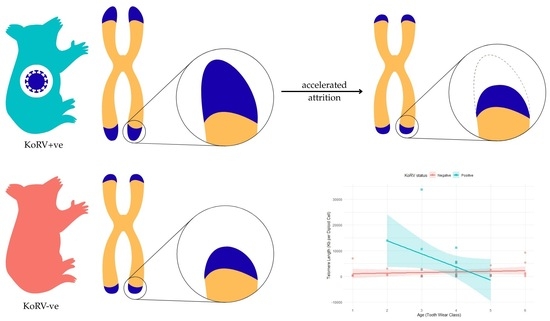
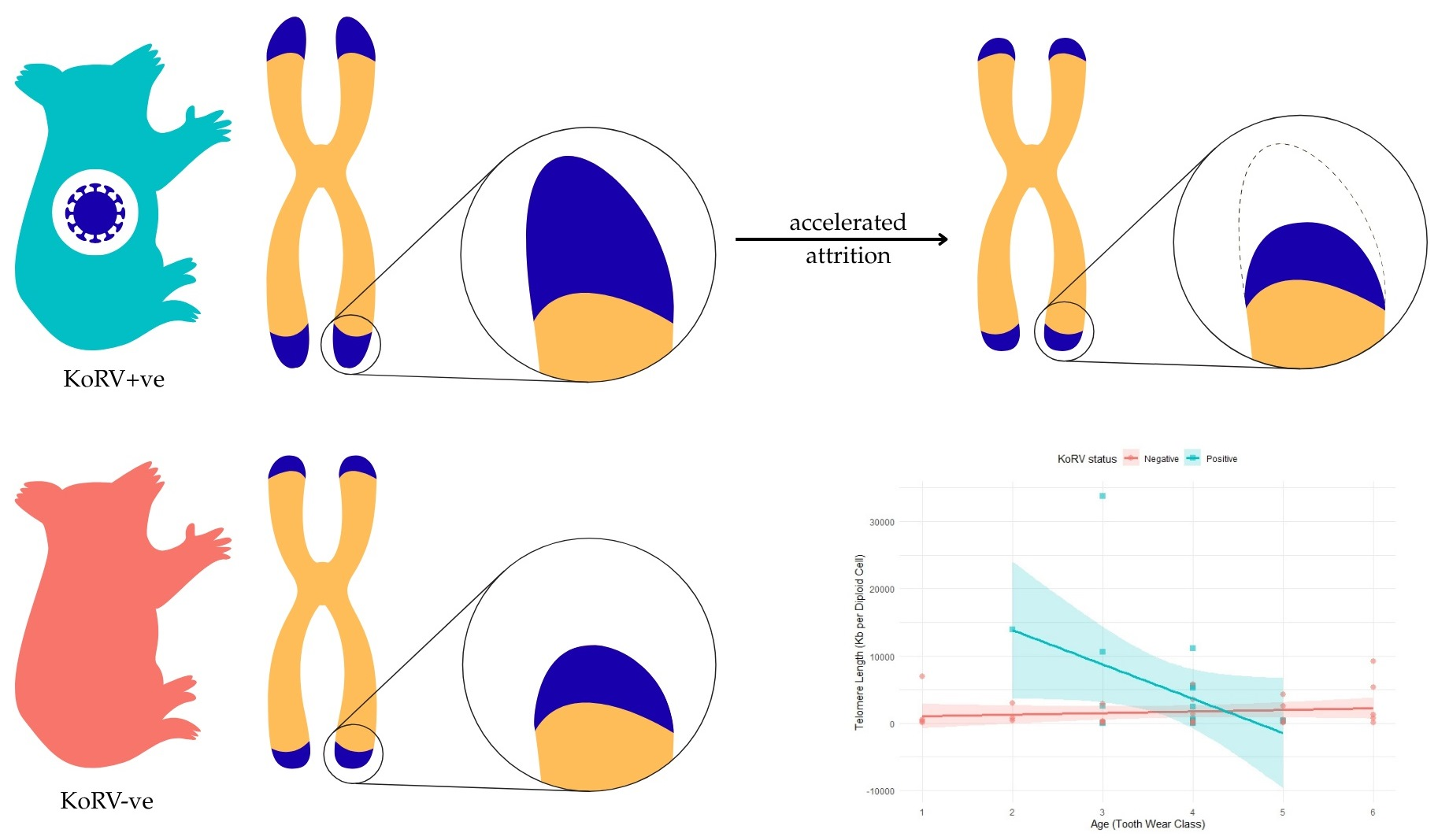
The pathogenesis of koala retrovirus (KoRV) has been explored in various contexts, yet its role in tumorigenesis remains incompletely understood. Unlike acute transforming retroviruses, KoRV lacks a viral oncogene but may contribute to oncogenesis via indirect mechanisms. However, the relationship between KoRV and telomere length, as a potential indicator of telomerase activity, has not been examined. This study investigates the effect of KoRV infection on telomere length in 47 samples from Southern Australian koalas in a novel telomere length quantification method. Telomere lengths of 30 KoRV-negative samples were compared to those of 17 KoRV-positive samples using the Absolute Human Telomere Length Quantification qPCR kit (ScienCell Research Laboratories, California, USA). The telomere length in KoRV-infected WBCs was significantly longer than the uninfected ones (t = −2.059, p-value = 0.045). In line with this, telomere length correlated positively with proviral load (r = 0.421, p-value = 0.003), further linking viral burden to telomere elongation. Furthermore, the effect of age on telomere length differed by infection status (β = −5329.7, p-value = 0.0038); KoRV-positive individuals exhibited longer telomeres at a younger age but experienced more rapid telomere attrition over time compared to KoRV-negative individuals. These results suggest KoRV promotes telomerase elongation ability and modulates age-related telomere dynamics, potentially contributing to subsequent cellular immortality and oncogenesis. These pathways may overlap with other retroviruses, where telomerase dysregulation contributes to their oncogenic potential. This study provides new insights into KoRV pathogenesis and DNA quantification methodology, which could be valuable for future research by identifying predictive markers for tumour progression and potential therapeutic targets in affected koalas.

Graphical Abstract

1. Introduction

Koala retrovirus (KoRV) is a critical pathogen threatening the survival of koalas (Phascolarctos cinereus), an iconic Australian marsupial now classified as endangered by the Australian government due to habitat loss, climate crisis, and diseases. KoRV is believed to be an important contributor to certain cancers, including leukemia, lymphoma, and may also exacerbate clinical chlamydiosis in koalas through immunosuppression [1]. KoRV infection rates differ across regions, with 100% prevalence in the Northern Australian population (Queensland and New South Wales) and a lower prevalence in the Southern population (48% in South Australia and 30% in Victoria) [2,3].
Koalas exhibit a strikingly higher rate of neoplasms than humans [4]. This heightened susceptibility has been positively correlated with the presence of KoRV and its proviral DNA [1]. Koala retrovirus belongs to the Retroviridae family that is known to induce oncogenic transformation via various mechanisms. One of these is where proviral integration directly activates proto-oncogenes; Retroviruses lacking oncogenes can alter the expression of host genes through insertional mutagenesis, providing new transcriptional regulatory sequences. While KoRV is not known to contain a viral oncogene, recent studies found that the integration sites of KoRV cluster near known cancer genes, and the mutational burden of endogenization increases the frequency of neoplasia [4]. Upregulation of several oncogenes was also discovered when a human cell line was infected with KoRV [5]. The establishment of the Koala Genome Consortium and the publication of the first fully assembled koala genome will also provide further deeper understanding of KoRV genetics, including viral subtypes, recombinants, and preferences for viral integration [6].
In other species, it has been found that retroviral oncogenic potential was linked to telomerase activity dysregulation. For example, bovine leukemia virus (BLV), human immunodeficiency virus (HIV-1), human T-lymphotropic viruses (HTLV-I and HTLV-II), and avian leukosis virus subgroup J (ALV-J) have all been shown to alter telomerase activities and to cause cancers [7,8,9]. Human Immunodeficiency Virus (HIV-1) infection is known to decrease telomerase activity in CD4+ T cells. This decrease in telomerase activity was thought to limit the proliferation of this immune cell and to contribute to the immunodeficiency observed in infected individuals [10]. Human T-lymphotropic viruses (HTLV-I and HTLV-II) are two closely related retroviruses that cause T-cell leukemia/lymphoma in humans. In HTLV-I, the transactivator protein (Tax) induces telomere reverse transcriptase gene expression via the NF-κB signaling pathway, leading to increased telomerase activity [11]. HTLV-II, on the other hand, increases telomerase activity in uninfected CD34+ progenitor cells through a synergistic interaction with Bcl-2 [12]. Avian Leukosis Virus Subgroup J (ALV-J) infection has been shown to cause lymphomas in chickens through concurrent dysregulation of c-Myc and telomerase, which functionally cooperate to promote malignant transformation [8]. Bovine Leukemia Virus (BLV) infection has been associated with increased telomerase activity in infected lymphocytes and contributes to the development of leukemia in infected animals [7]. Therefore, the ability to control telomerase activity could be a common characteristic of many retroviruses, despite their diverse mechanisms of cancer induction. This telomere dysregulation contributes to the development of various diseases and serves as an alternative pathway in oncogenesis.
Cells have built-in limits to how often they can divide. This is because telomeres, the protective cap at the ends of chromosomes, shorten in each cell cycle due to incomplete DNA replication. Different species have varying rates of telomere shortening [13]. Eventually, critically short telomeres will trigger apoptosis [13,14]. Telomerase enzyme counteracts this erosion by adding sequences of TTAGGGG telomeric repeats back to the telomeres, mostly by its catalytic subunit telomerase reverse transcriptase (TERT) using an internal RNA template known as telomerase RNA component (TERC), thereby extending cell lifespan [14,15,16]. Telomerase is active primarily in lymphocytes, stem cells, and germ cells. However, cancer cells often exhibit upregulated telomerase activity, which allows them to divide indefinitely and attain immortality [16,17,18]. It can be used as a hallmark of cancer detection as it is present in 90% of human tumours [19,20]. Furthermore, another study analysed 31 different cancers in the Cancer Genome Atlas patients’ cohort and found that 73% of the cases had increased telomerase expression and activities, which were associated with point mutation, rearrangement, and amplification in the TERT promoter [21]. In an experimental trial in mice, the TERT mutant promoter not only produced poorly differentiated thyroid tumours, but also overactivated cytokines and chemokines signalling pathways, which is not normally seen in those tumours lacking the TERT mutant [22].
Therefore, telomerase dysregulation of both retroviral-infected cells and cancers raises the question of whether koala retrovirus also similarly disrupts telomerase activity as an oncogenic mechanism. Despite the current advances in understanding of pathogenesis in koala retrovirus, this potential mechanism has not yet been fully investigated until now.
Our study evaluates the telomere length in KoRV-positive and -negative samples, accounting for age as a covariate, with the hypothesis that an increased telomere length would be found in infected koalas. If so, elevated telomerase activity in retrovirus-infected cells may serve as a predictive marker for tumour progression and therapeutic targets [23,24]. Additionally, this investigation may lead to further studies of telomerase activities in other tumour-inducing retroviruses in animals and humans.

2. Materials and Methods

2.1. Samples

KoRV-positive and -negative koala samples were sourced from a previous study of KoRV in the population of Mount Lofty Ranges, South Australia [25]. All koalas were euthanised by veterinarians on welfare grounds and received a full necropsy at the Veterinary Diagnostic Laboratory, Roseworthy Campus, University of Adelaide. Blood samples were taken at euthanasia and were stored in EDTA at −20 °C prior to DNA analysis. DNA was extracted from whole blood using the QIAMP DNeasy Minikit (Qiagen, Hilgen, Germany) and stored at −20 °C. After the collection of blood, leukocyte counts were available for 9 of the samples (range from 0.232 to 7.19 109/L).
KoRV status of the samples was determined based on the presence or absence of the following genes, namely gag 2, pol, env 1, and env 2, via conventional PCR. Samples were classified as positive if all four genes were detected and negative if pol and the other genes were not detected. This method is consistent with previously described approaches used to distinguish intact exogenous “pol-positive” KoRV infection from fragmented KoRV sequences that are present in southern koalas [26]. The proviral load was quantified by qPCR targeting the KoRV pol gene.
A total of 52 DNA samples were available, comprising 18 KoRV-positive and 34 KoRV-negative koalas, ranging in age between tooth wear classes I to VI [27]. There were no instances of neoplasia or lymphoma detected in any of the koalas, based on necropsy findings, lymph node histology, and leukocyte counts [25].
The sampling was approved by the University of Adelaide Animal Ethics committee (Approval number: S-2016-169) and SA Government Department of Environment, Water and Natural Resources (Scientific Purpose Permit Y26054) and conducted in accordance with the guidelines set out in the ‘Australian Code for the care and use of animals for scientific purposes 8th edition (2013)’ by National Health and Medical Research Council, Canberra.

2.2. Quantitative PCR for Telomere Length Quantification

All extracted DNA was quantified using a NanoDrop spectrophotometer (Thermo Fisher Scientific Inc., Wilmington, DE, USA) and stored at −20 °C. The Absolute Human Telomere Length Quantification (AHTLQ) qPCR Assay Kit (ScienCell Research Laboratories, Carlsbad, CA, USA) was used to directly measure the cycle threshold (Ct) values, reflecting the average telomere length in white blood cells. The TEL primer set was used to recognise and amplify the telomere sequences. The SCR primer set was used to recognise and amplify a 100 bp-long region on human chromosome 17 and serves as a reference for data normalization. 200 µL of nuclease-free water was added to each primer set to make the TEL primer stock solution and SCR primer stock solution. Human genomic DNA with a telomere length of 1.23 ± 0.09 Mb per diploid cell was used as the reference genomic DNA sample. The 7 μL qPCR reactions were dispensed using an epMotion 5075 liquid handler (Eppendorf, Hamburg, Germany). There were 2 reactions per DNA sample using 2 different primer sets. Each reaction consisted of 0.35 μL reference genomic DNA sample or collected DNA sample, 0.7 μL of TEL or SCR primer stock solution, 3.5 μL of 2X GoldNStart TaqGreen qPCR master mix, and 2.45 μL of nuclease-free water. All reactions were run in three replicates.
The qPCR plate was centrifuged at 1500× g for 15 s and run in QuantStudioTM Real-Time PCR System (Thermo Fisher Scientific Inc., Wilmington, DE, USA). The temperature and timing of the qPCR reactions were initial denaturation at 95 °C for 10 min; 32 cycles of denaturation at 95 °C for 20 s; annealing at 52 °C for 20 s; and extension at 72 °C for 45 s.
The qPCR data were recorded and analysed in QuantStudioTM Real-Time PCR Software v1.7.2 (Thermo Fisher Scientific Inc., Wilmington, DE, USA). The obtained Ct values were used to calculate the telomere length of the sample, where the sample telomere length in Mb equals 2 ^ ( ( differences   in   C t   values   between   Δ TEL   and   Δ SCR ) ) × 1.23 ) 32 , as per the manufacturer’s instructions. ΔTEL and ΔSCR refer to the difference in Ct values between the samples and the human reference of primer TEL and SCR, respectively. The number of chromosomes in a koala diploid cell is 32. This Ct [2−ΔΔCt] comparative method was used to calculate the relative expression levels of each amplicon.

2.3. Statistical Analysis

To compare the telomere length between infection-positive and -negative groups, an independent t-test was performed. The association between proviral load and telomere length was assessed using both Pearson’s correlation and simple linear regression. Pearson’s correlation was used to test the direction and strength of the association (reported as the r and the p-value). Simple linear regression was used to visualise the trend, estimate the regression line with a 95% confidence interval, and determine the R-squared value. To control for the potential confounding effect of age, telomere length was considered as an age-related factor in relation to KoRV infection status. An interaction term was included in a linear model to test whether the association between infection and telomere length varied with age. Other factors, including DNA concentration and leukocyte count, were also taken into account in the data analysis. Descriptive statistics, group comparisons, and Pearson’s correlation were performed using the SPSS Statistics software v26 (IBM, NY, USA). Linear modelling, including simple linear regression of proviral load versus telomere length, and the interaction term between age and KoRV status, was conducted in R statistical software (Version 4.4.2, R Core Team, Vienna, Austria). The level of statistical significance was set at p-Value = 0.05.

3. Results

3.1. Average Telomere Length

A total of 52 blood samples were available from wild koalas in the previous study (18 KoRV-positive and 34 KoRV-negative). Due to the DNA quality and quantity, 47 DNA samples were included in this analysis (Table 1). Five samples (1 KoRV-positive and 4 KoRV-negative, 9.6%) were eliminated from the study; two KoRV-negative samples due to DNA degradation, two Ct values were greater than 28 and considered as false positives according to the manufacturer’s instructions, and one outlier in KoRV-positive samples due to exceeding plausible biological ranges of DNA length (179,602 Kb; Ct(SCR) 27.628).
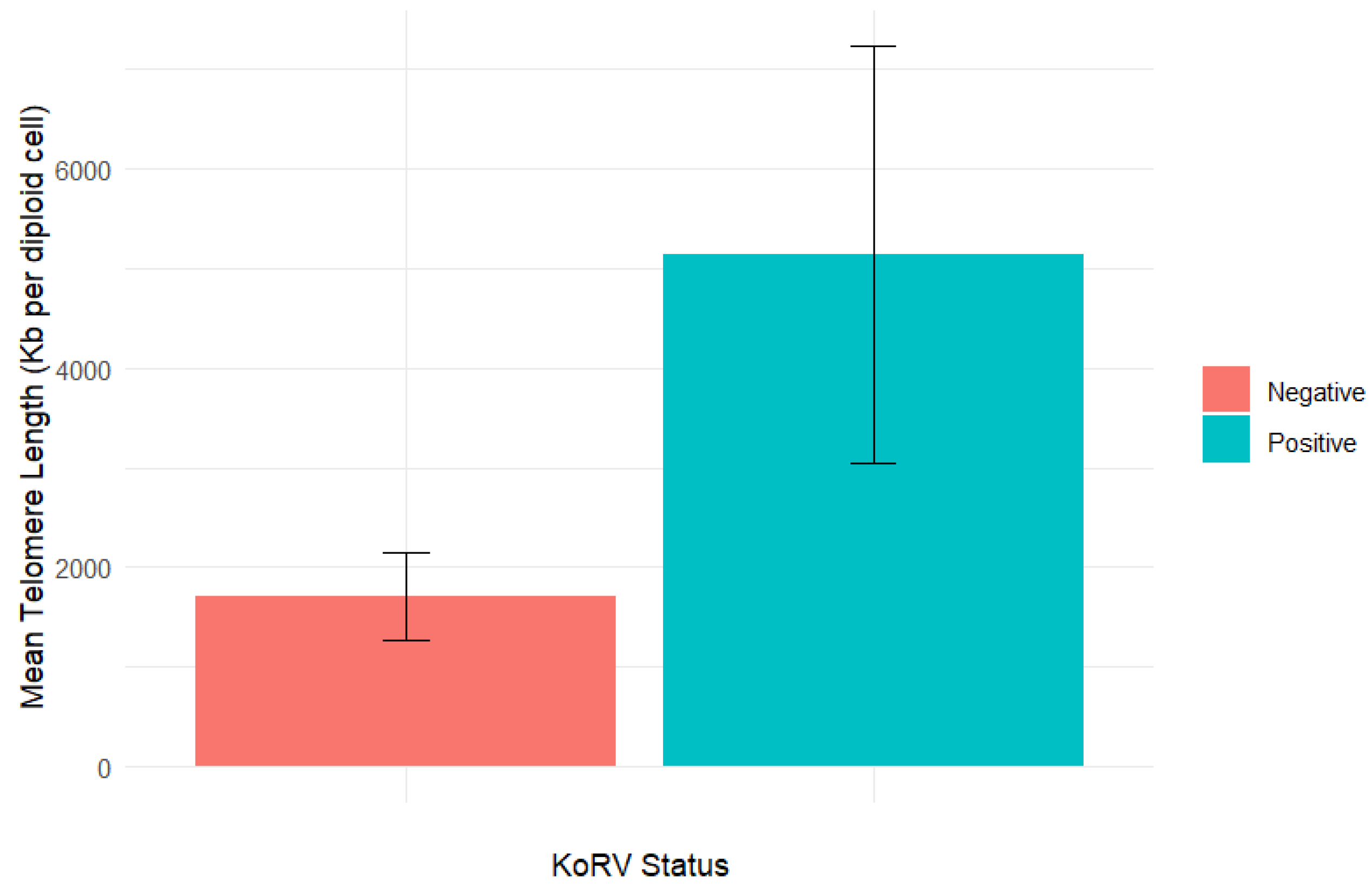
The koala samples showed a typical, clean, sigmoidal qPCR amplification curve (Figures S1 and S2). Overall, infected koalas showed significantly higher telomere length (Mean+/-SD = 5140 ± 8622 vs. 1707 ± 2399; t = −2.059, p-Value = 0.045) compared to KoRV-negative counterparts (Figure 1).

3.2. Proviral-Load Analysis

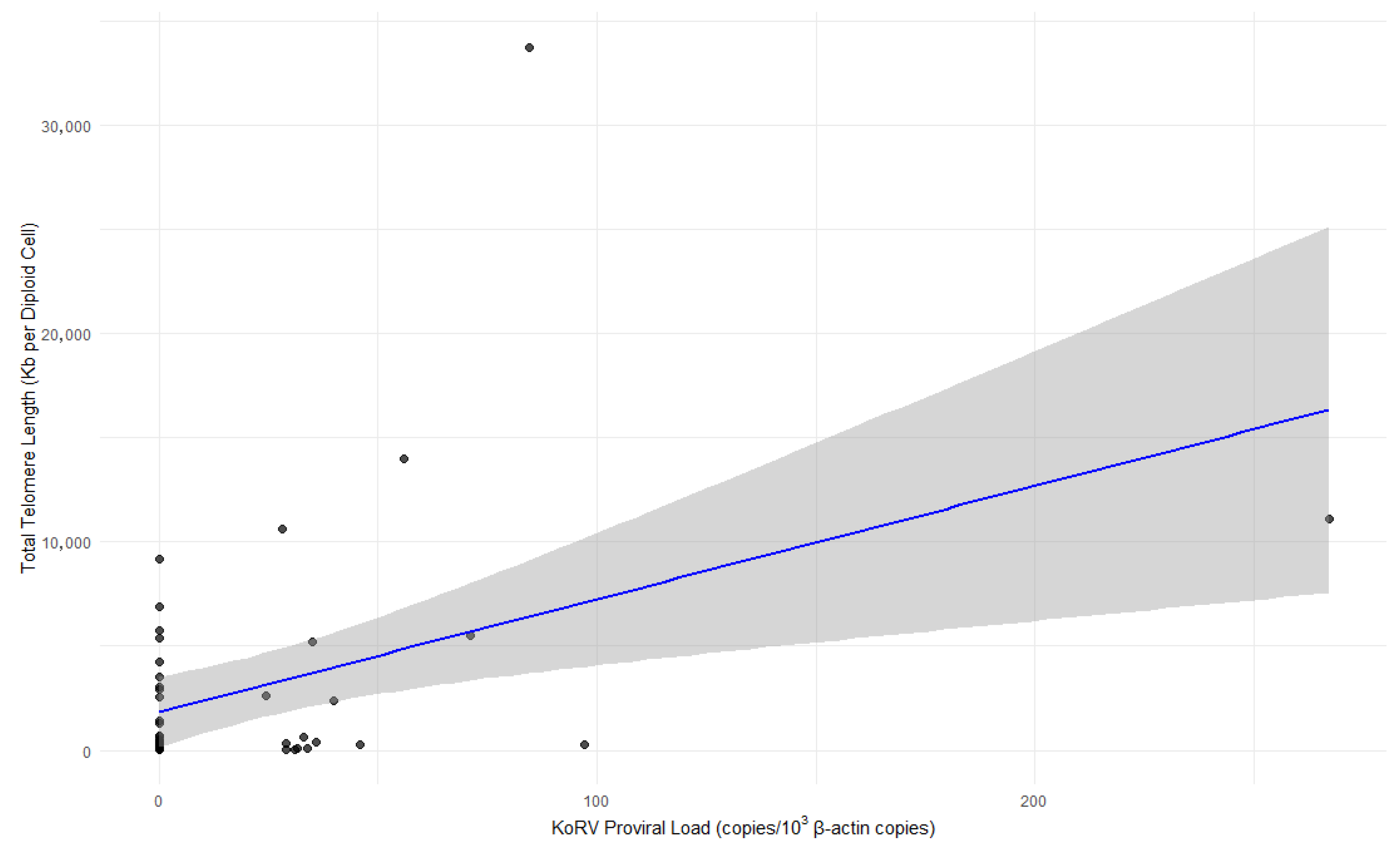
Samples (n = 47) were also analysed for their relationship between proviral load and telomere lengths. A significant positive correlation was found (r = 0.421, p-value = 0.003), suggesting that higher proviral load is associated with longer telomere lengths (Figure 2). The linear regression yielded an R-squared value of 0.178.

3.3. Interaction Analysis of Age and Infection Status

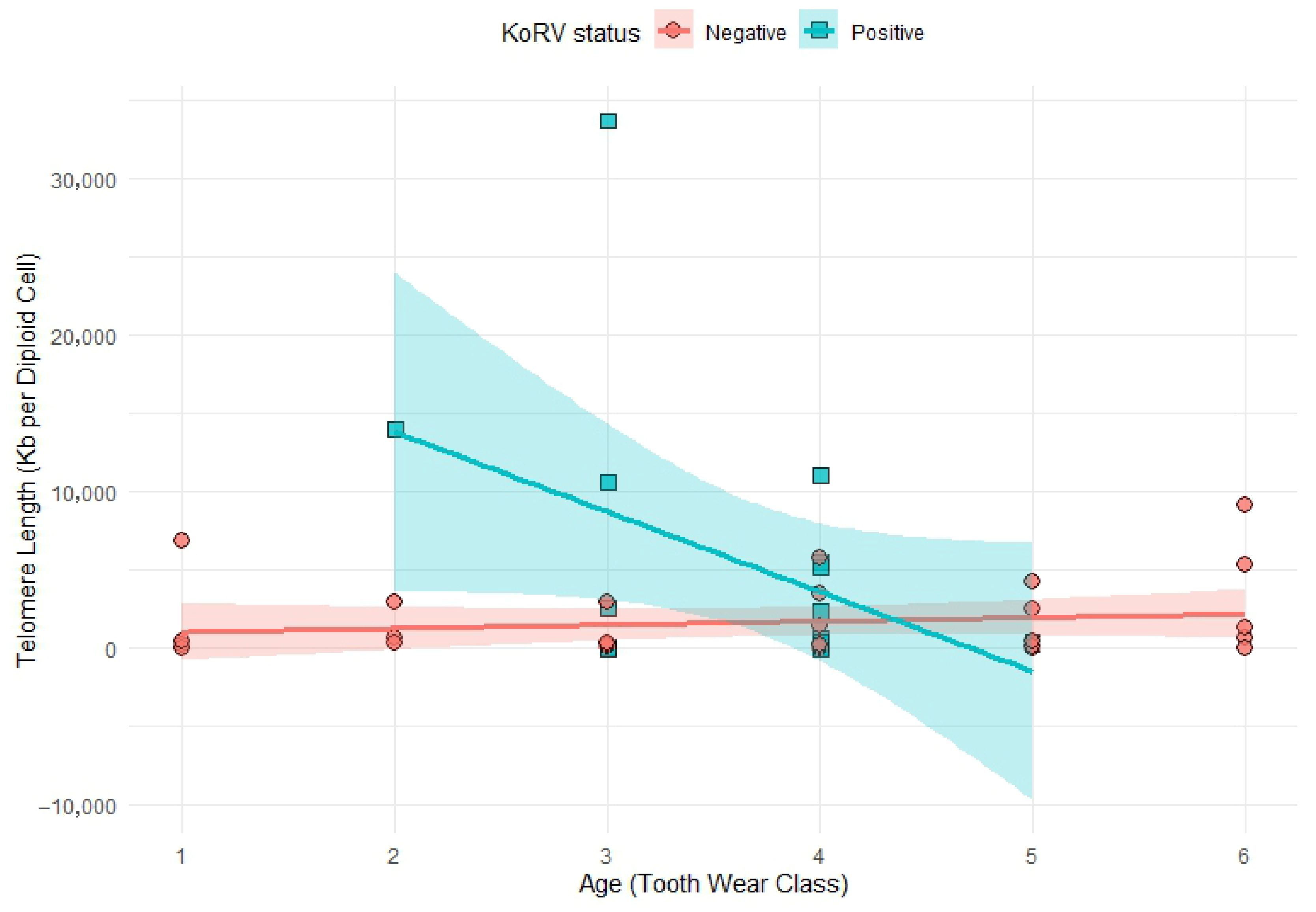
To investigate the impact of age on telomere length, we fitted a linear model with an interaction term between age (Tooth Wear Class) and KoRV status. The interaction was statistically significant (β = −5329.7, p-value = 0.0038), indicating the effect of age on telomere length differs between KoRV-positive and KoRV-negative individuals. Telomere length declined more rapidly with age in KoRV-positive individuals, while it remained relatively stable or slightly increasing in KoRV-negative individuals (Figure 3). Notably, KoRV-positive animals tended to have longer telomeres at a younger age, but this difference diminished with increasing age, with a trend toward longer telomeres in KoRV-negative individuals in older age classes. However, the interpretation of this early-life pattern is limited by a small sample size (n = 1) of young KoRV-positive individuals.

4. Discussion

The pathogenesis and clinical features of KoRV are still being investigated. However, existing research suggests that KoRV can cause neoplastic conditions, such as lymphoma and leukemia, as well as immunosuppression and predisposition to chlamydiosis [1,2,28,29]. Increased proviral loads have also been found in koalas with neoplasia [30]. Given these associations, it is noteworthy that our current study found both a significantly higher telomere length in KoRV-infected koalas compared with those that were KoRV-negative and a significant positive correlation between proviral load and telomere length. The mechanisms may be similar to other retroviral infections in vertebrate species [31]. For example, BLV-associated neoplasia has been attributed to viral interaction with telomerase, which inhibits telomere shortening [7]. Therefore, it was hypothesised that telomerase activity may play an important role in KoRV tumorigenesis. Although no studies have investigated the relationship between KoRV and telomerase dysregulation, the observed association between higher proviral load and longer telomeres suggests a potential mechanistic link.
Telomere shortening is a natural process that occurs in somatic cells and contributes to cell senescence and cell death by limiting cell proliferation [14]. Cellular senescence can also be triggered by other stressors such as oxidative damage, DNA damage, chromatin changes, and overexpression of oncogenes [32]. However, the induction of cell senescence can be counteracted through carcinogen- or virus-mediated transformation [14]. This is because, although cancer cells have been shown to have shorter telomeres than their surrounding non-transformed cells [18,23], activation of telomerases is involved in tumorigenesis by synthesising telomeric repeat DNA at the end of chromosomes to stabilise the telomeres [18]. Therefore, with the help of telomerases, unlimited and uncontrolled cell proliferation can be achieved in cancer cells, leading to cell immortality [33,34,35]. Hence, observations of elevated values of telomerase activity in both human tumour cell lines and BLV-infected cattle support the hypothesis that telomerase is responsible for cell proliferation and retroviral oncogenesis [23].
Recent studies have provided novel insights into the oncogenesis of KoRV. Hub genes involved in regulating the cell cycle were found to be more highly expressed in healthy koalas compared to those infected with KoRV [36]. Additionally, transcriptional dysregulation in cancer and viral carcinogenesis pathways were found to be upregulated in infected individuals [5,36]. In human cells experimentally infected with KoRV, multiple oncogenes were upregulated, while miRNAs involved in immune response and apoptosis were downregulated [5]. Further studies have identified specific oncogenic mechanisms associated with KoRV infection, including preferential integration near known host oncogenes such as Bcl-2 and myc, suggesting that insertional mutagenesis may contribute to their dysregulation [4]. In KoRV-infected koalas with neoplasia, Bcl-2 expression was significantly upregulated, particularly in those infected with multiple KoRV subtypes [37]. Similarly, myc was a frequent target of KoRV proviral insertion [4] and found to be upregulated in tumour-bearing as well as subclinically infected animals [37]. These findings suggest that early dysregulation of myc may precede neoplastic transformation, and that cooperative mechanisms such as concurrent Bcl-2 upregulation may be required for full malignant transformation [37].
Also, genes associated with telomere organisation were found to be upregulated in KoRV-infected cells [5], suggesting KoRV may interrupt telomere maintenance alongside oncogene activation. Taken together with our findings, these studies support a model in which oncogene regulation and telomerase activity jointly contribute to tumorigenesis in KoRV-infected koalas. The primary hallmarks of tumour cells include uncontrolled growth, dysplasia, and anaplasia, leading to cellular immortality and malignancy [38]. Both oncogene activation and telomerase expression are essential drivers of tumour development [38]. Oncogenes promote uncontrolled cell proliferation by overriding the normal growth-regulatory mechanism, while telomerase prevents and bypasses cell senescence, thereby sustaining proliferation without aberrant growth control [32,34,38]. These mechanisms closely resemble those described in other retroviruses, such as HTLV-II and ALV-J, where synergistic activation of telomerase, anti-apoptotic pathways, and proliferative oncogenes drives malignant transformation [8,12]. While there are still many details yet to be discovered and understood, these findings provide a foundation for further mechanistic studies into KoRV oncogenic potential, particularly in the context of pathways shared with other retroviruses.
In this study, telomere length exhibited considerable inter-individual variability, which is expected in wild populations where multiple biological and environmental factors influence telomere dynamics, including age, antigenic stimulation of the resting lymphocytes, different organ sampling sites, and genetic variations [7,39]. To account for this natural variation, we analysed the effects of age together with KoRV infection status by using an interaction term in the linear model, which tested whether telomere attrition with age differs according to KoRV infection status. The significant interaction observed supports that KoRV infection modulates telomere dynamics across the lifespan. KoRV-positive individuals had longer telomeres at a younger age, consistent with our hypothesis and previous reports of elevated telomerase activities in early life, including in other retroviral infections such as BLV [7,16,24]. However, telomere length in KoRV-positive individuals declined more rapidly with age than in uninfected counterparts. This suggests that KoRV infection may accelerate age-related telomere attrition, potentially reflecting virus-induced cellular aging, cumulative immune activation, or immune exhaustion. We also observed residual within-group variation, particularly among KoRV-negative koalas. This may reflect individual differences in the factors mentioned above, such as genetic background or exposure to other infectious stressors [7,39], or technical or biological factors specific to koala telomere architecture. For instance, koalas possess discontinuous telomeric repeats [40], which may increase variability in qPCR-based telomere estimates. Nevertheless, all reactions displayed clean amplification profiles with consistent efficiency across samples, suggesting minimal technical error.
Given the influence of age on telomere dynamics, the within-group variation found in this study may reflect age-dependent changes in telomere maintenance mechanisms. As telomeres shorten in each cell division, older individuals have shorter telomeres and fewer cell divisions than younger individuals [41,42]. Loss of telomeres not only induces antiproliferative signals leading to cellular senescence, but also contributes to the decline in tissue function, integrity, performance, and reserve capacity, which are hallmarks of ageing [32,42]. As organisms age, senescent cells accumulate, promoting growth and neoplastic progression of mutant cells, and also reducing immune function due to restructuring processes [42,43]. For koalas that are horizontally infected early in life, the presence of viral sequence may modulate telomerase activity during the immunologically naïve stage, before significant telomere erosion has progressed. This could temporarily delay attrition initially and create an early-life telomere advantage. However, this initial advantage may come at a cost, with accelerated shortening later in life due to cumulative stress and immune activation. Therefore, this dual-phase pattern, initial elongation followed by accelerated decline, suggests that the impact of retroviral infection on telomere dynamics may be age-dependent. Our findings highlight the importance of considering age when interpreting telomere length in KoRV-affected populations, and may reflect differential effects on cellular senescence or immune activation at different life stages.
Telomere length represents a combined outcome of cumulative proliferation history, telomerase activity, and clonal selection [14,44], which are themselves shaped by organism-level factors such as age, genetic background, and antigenic stimulation. Consequently, telomerase upregulation may not instantaneously correspond to an increased mean telomere length [7,39]. Comparable studies in other retroviral systems (e.g., BLV) have reported an elevated telomerase activity in hosts while telomere length differences remained variable or non-significant [23], reflecting the complexity of telomere regulation in vivo. Our findings of increased mean telomere length in KoRV-positive koala blood cells, together with a positive association with proviral load, are consistent with KoRV-associated modulation of telomere dynamics, potentially through effects on lymphocytic proliferation or telomerase activation. Thus, while telomere length reflects a cumulative record of telomerase activity rather than an instantaneous measure, it provides a biologically meaningful, population-level indicator of altered telomere maintenance.
The mechanisms of KoRV infection are likely to be complex. While transcriptomic studies have revealed upregulation of genes involved in telomere organisation, no specific candidate gene has yet been identified that directly links telomerase activity and the infection process. It remains worthwhile to explore whether key telomere-regulating genes, including those modulating telomerase expression, and telomeric binding proteins, are differentially expressed and functionally altered in these individuals. Genes of interest, such as Myc, Bcl-2, Myb, and Flt3, are implicated in the oncogenic processes of other retroviruses [8,12,45,46] and warrant further investigation. This may provide valuable insights into the molecular interplay between KoRV and telomere maintenance pathways, as several of these genes are known to influence telomerase activity [47,48,49]. In parallel, direct telomerase assays could help determine whether KoRV infection leads to functional upregulation of telomerase, complementing transcriptomic and gene expression findings. Moreover, since the target cells of KoRV are lymphocytes [50], a cell type known to exhibit telomerase activity similar to that observed in tumour cells [51], targeted lymph node expression studies could be a promising area for further research in understanding the virus’s role in immunosuppression and neoplasia induction. While the number of koala samples were sufficient in this study, larger sample sizes may be needed to validate the statistical significance of the observed associations and to more precisely characterise the individual-level variation in telomere dynamics. Future studies may benefit from targeted sampling of KoRV-positive individuals in Northern populations where infection prevalence is higher, to better characterise telomere dynamics across the full age spectrum. Additionally, captive populations with a known family history of neoplasia may serve as ideal cohorts for serial blood collection or longitudinal studies tracking telomere length and expression of candidate genes in both KoRV-positive and KoRV-negative individuals. Such studies may help identify early predictive markers of tumourigenesis and determine whether early telomere advantage predicts future tumour risks.

5. Conclusions

This study found a significant increase in telomere length in KoRV-positive koalas, resulting from telomerase activity upregulation. These findings could provide valuable insights into an alternative pathogenic pathway of KoRV. Not only could this help in understanding how the virus contributes to neoplasia development through the interaction with telomerase activity and cell proliferation, but it also raises the possibility of using telomerase inhibition therapy, known for its effectiveness in treating tumours [42]. Novel use of a human AHTLQ test kit in koalas was successful, despite their unusual telomere structure [40]. This also suggests the assay’s cross-species applicability and offers an alternative approach for telomere studies in other non-human species. Overall, further investigation is still required to unravel all the remaining unanswered questions about KoRV.

Supplementary Materials

The following supporting information can be downloaded at: https://www.mdpi.com/article/10.3390/v17111510/s1. Figure S1: Amplification plot showing successful qPCR amplification upon TEL and SCR primers in the first batch of the experiment containing 12 samples, including positive and negative controls; Figure S2: amplification plot showing successful qPCR amplification upon TEL and SCR primers in the second batch of the experiment containing 50 samples, including positive and negative controls.

Author Contributions

Conceptualization, F.H., T.S. and N.S.; methodology, H.M.C., S.W.J.L., H.T.H.N.; software, H.M.C., S.W.J.L., H.T.H.N.; validation, H.T.H.N., F.H., T.S. and N.S.; formal analysis, H.M.C., S.W.J.L., H.T.H.N.; investigation, F.H., T.S. and N.S.; resources, F.H., T.S. and N.S.; data curation, H.T.H.N.; writing—original draft preparation, H.M.C., S.W.J.L.; writing—review and editing, F.H., T.S., H.T.H.N. and N.S.; visualization, H.M.C., S.W.J.L., H.T.H.N.; supervision, F.H., N.S.; project administration, F.H.; funding acquisition, F.H. All authors have read and agreed to the published version of the manuscript.

Funding

This research was funded by THE UNIVERSITY OF ADELAIDE, grant number 122-13107182.

Institutional Review Board Statement

The study was conducted in accordance with the Declaration of Helsinki, and approved by the University of Adelaide Ethics Committee (Approval number: S-2016-169) and SA Government Department of Environment, Water and Natural Resources (Scientific Purpose Permit Y26054).

Data Availability Statement

The original contributions presented in this study are included in the article/Supplementary Material. Further inquiries can be directed to the corresponding author(s).

Acknowledgments

The authors want to give thanks to Mansoureh Foruzandehshahraky for providing invaluable statistical support throughout this study and the University of Adelaide for providing the funding for DVM clinical research projects.

Conflicts of Interest

The authors declare no conflicts of interest.

References

  1. Tarlinton, R.; Meers, J.; Hanger, J.; Young, P. Real-time reverse transcriptase PCR for the endogenous koala retrovirus reveals an association between plasma viral load and neoplastic disease in koalas. J. General. Virol. 2005, 86, 783–787. [Google Scholar] [CrossRef] [PubMed]
  2. Quigley, B.L.; Ong, V.A.; Hanger, J.; Timms, P. Molecular dynamics and mode of transmission of koala retrovirus as it invades and spreads through a wild Queensland koala population. J. Virol. 2018, 92, e01871-17. [Google Scholar] [CrossRef]
  3. Fabijan, J.; Miller, D.; Olagoke, O.; Woolford, L.; Boardman, W.; Timms, P.; Polkinghorne, A.; Simmons, G.; Hemmatzadeh, F.; Trott, D.J.; et al. Prevalence and clinical significance of koala retrovirus in two South Australian koala (Phascolarctos cinereus) populations. J. Med. Microbiol. 2019, 68, 1072–1080. [Google Scholar] [CrossRef]
  4. McEwen, G.K.; Alquezar-Planas, D.E.; Dayaram, A.; Gillett, A.; Tarlinton, R.; Mongan, N.; Chappell, K.J.; Henning, J.; Tan, M.; Timms, P.; et al. Retroviral integrations contribute to elevated host cancer rates during germline invasion. Nat. Commun. 2021, 12, 1316. [Google Scholar] [CrossRef] [PubMed]
  5. Sarker, N.; Tarlinton, R.; Owen, H.; Emes, R.D.; Seddon, J.; Simmons, G.; Meers, J. Novel insights into viral infection and oncogenesis from koala retrovirus (KoRV) infection of HEK293T cells. Gene 2020, 733, 144366. [Google Scholar] [CrossRef]
  6. Johnson, R.N.; O’Meally, D.; Chen, Z.; Etherington, G.J.; Ho, S.Y.W.; Nash, W.J.; Grueber, C.E.; Cheng, Y.; Whittington, C.M.; Dennison, S.; et al. Adaptation and conservation insights from the koala genome. Nat. Genet. 2018, 50, 1102–1111. [Google Scholar] [CrossRef] [PubMed]
  7. Hemmatzadeh, F.; Keyvanfar, H.; Hasan, N.H.; Niap, F.; Bani Hassan, E.; Hematzade, A.; Ebrahimie, E.; McWhorter, A.; Ignjatovic, J. Interaction between Bovine leukemia virus (BLV) infection and age on telomerase misregulation. Vet. Res. Commun. 2015, 39, 97–103. [Google Scholar] [CrossRef]
  8. Xiang, Y.; Liang, C.; Li, Q.; Chen, Q.; Zhou, Y.; Zheng, X.; Zhou, D.; Wang, Z.; Wang, G.; Cao, W. Chicken telomerase reverse transcriptase promotes the tumorigenicity of avian leukosis virus subgroup J by regulating the Wnt/beta-catenin signaling pathway. Vet. Res. 2022, 53, 100. [Google Scholar] [CrossRef]
  9. Salimi-Jeda, A.; Badrzadeh, F.; Esghaei, M.; Abdoli, A. The role of telomerase and viruses interaction in cancer development, and telomerase-dependent therapeutic approaches. Cancer Treat. Res. Commun. 2021, 27, 100323. [Google Scholar] [CrossRef]
  10. Franzese, O.; Adamo, R.; Pollicita, M.; Comandini, A.; Laudisi, A.; Perno, C.F.; Aquaro, S.; Bonmassar, E. Telomerase activity, hTERT expression, and phosphorylation are downregulated in CD4+ T lymphocytes infected with human immunodeficiency virus type 1 (HIV-1). J. Med. Virol. 2007, 79, 639–646. [Google Scholar] [CrossRef]
  11. Hara, T.; Matsumura-Arioka, Y.; Ohtani, K.; Nakamura, M. Role of human T-cell leukemia virus type I Tax in expression of the human telomerase reverse transcriptase (hTERT) gene in human T-cells. Cancer Sci. 2008, 99, 1155–1163. [Google Scholar] [CrossRef]
  12. Re, M.C.; Monari, P.; Gibellini, D.; Ciancianaini, P.; Dall’Aglio, P.P.; Vignoli, M.; Furlini, G.; Ramazzotti, E.; Bertazzoni, U.; Casoli, C. Human T cell leukemia virus type II increases telomerase activity in uninfected CD34 hematopoietic progenitor cells. J. Hematotherapy Stem Cell Res. 2000, 9, 481–487. [Google Scholar] [CrossRef]
  13. Smogorzewska, A.; de Lange, T. Regulation of telomerase by telomeric proteins. Annu. Rev. Biochem. 2004, 73, 177–208. [Google Scholar] [CrossRef]
  14. Counter, C.M.; Avilion, A.A.; LeFeuvre, C.E.; Stewart, N.G.; Greider, C.W.; Harley, C.B.; Bacchetti, S. Telomere shortening associated with chromosome instability is arrested in immortal cells which express telomerase activity. EMBO J. 1992, 11, 1921–1929. [Google Scholar] [CrossRef] [PubMed]
  15. Deng, Y.; Chan, S.S.; Chang, S. Telomere dysfunction and tumour suppression: The senescence connection. Nat. Rev. Cancer 2008, 8, 450–458. [Google Scholar] [CrossRef]
  16. Fali, T.; Papagno, L.; Bayard, C.; Mouloud, Y.; Boddaert, J.; Sauce, D.; Appay, V. New insights into lymphocyte differentiation and aging from telomere length and telomerase activity measurements. J. Immunol. 2019, 202, 1962–1969. [Google Scholar] [CrossRef] [PubMed]
  17. Shay, J.W.; Bacchetti, S. A survey of telomerase activity in human cancer. Eur. J. Cancer 1997, 33, 787–791. [Google Scholar] [CrossRef] [PubMed]
  18. Counter, C.M.; Gupta, J.; Harley, C.B.; Leber, B.; Bacchetti, S. Telomerase activity in normal leukocytes and in hematologic malignancies. Blood 1995, 85, 2315–2320. [Google Scholar] [CrossRef]
  19. Kim, N.W.; Piatyszek, M.A.; Prowse, K.R.; Harley, C.B.; West, M.D.; Peter, L.C.H.; Coviello, G.M.; Wright, W.E.; Weinrich, S.L.; Shay, J.W. Specific Association of Human Telomerase Activity with Immortal Cells and Cancer. Science 1994, 266, 2011–2015. [Google Scholar] [CrossRef]
  20. Hanahan, D.; Weinberg, R.A. Hallmarks of Cancer: The Next Generation. Cell 2011, 144, 646–674. [Google Scholar] [CrossRef]
  21. Barthel, F.P.; Wei, W.; Tang, M.; Martinez-Ledesma, E.; Hu, X.; Amin, S.B.; Akdemir, K.C.; Seth, S.; Song, X.; Wang, Q.; et al. Systematic analysis of telomere length and somatic alterations in 31 cancer types. Nat. Genet. 2017, 49, 349–357. [Google Scholar] [CrossRef] [PubMed]
  22. Landa, I.; Thornton, C.E.M.; Xu, B.; Haase, J.; Krishnamoorthy, G.P.; Hao, J.; Knauf, J.A.; Herbert, Z.T.; Martínez, P.; Blasco, M.A.; et al. Telomerase upregulation induces progression of mouse BrafV600E-Driven thyroid cancers and triggers nontelomeric effects. Mol. Cancer Res. 2023, 21, 1163–1175. [Google Scholar] [CrossRef]
  23. Szczotka, M.; Kocki, J.; Iwan, E.; Pluta, A. Determination of telomere length and telomerase activity in cattle infected with bovine leukaemia virus (BLV). Pol. J. Vet. Sci. 2019, 22, 391–403. [Google Scholar] [CrossRef]
  24. Suzuki, K.; Shuto, S.; Miura, Y.; Sentsui, H. Measurement of telomerase activity in bovine leukaemia virus infected cows. Vet. Microbiol. 2008, 127, 142–146. [Google Scholar] [CrossRef] [PubMed]
  25. Stephenson, T.; Speight, N.; Low, W.Y.; Woolford, L.; Tearle, R.; Hemmatzadeh, F. Molecular Diagnosis of Koala Retrovirus (KoRV) in South Australian Koalas (Phascolarctos cinereus). Animals 2021, 11, 1477. [Google Scholar] [CrossRef]
  26. Blyton, M.D.J.; Young, P.R.; Moore, B.D.; Chappell, K.J. Geographic patterns of koala retrovirus genetic diversity, endogenization, and subtype distributions. Proc. Natl. Acad. Sci. USA 2022, 119, e2122680119. [Google Scholar] [CrossRef]
  27. Martin, R. Age-specific fertility in three populations of the koala, Phascolarctos cinereus Goldfuss, in Victoria. Wildl. Res. 1981, 8, 275–283. [Google Scholar] [CrossRef]
  28. Kayesh, M.E.H.; Hashem, M.A.; Tsukiyama-Kohara, K. Koala retrovirus epidemiology, transmission mode, pathogenesis, and host immune response in koalas (Phascolarctos cinereus): A review. Arch. Virol. 2020, 165, 2409–2417. [Google Scholar] [CrossRef]
  29. Quigley, B.L.; Timms, P. Helping koalas battle disease—Recent advances in Chlamydia and koala retrovirus (KoRV) disease understanding and treatment in koalas. FEMS Microbiol. Rev. 2020, 44, 583–605. [Google Scholar] [CrossRef] [PubMed]
  30. Sarker, N.; Fabijan, J.; Owen, H.; Seddon, J.; Simmons, G.; Speight, N.; Kaler, J.; Woolford, L.; Emes, R.D.; Hemmatzadeh, F.; et al. Koala retrovirus viral load and disease burden in distinct northern and southern koala populations. Sci. Rep. 2020, 10, 263. [Google Scholar] [CrossRef]
  31. Sarker, N.; Fabijan, J.; Emes, R.D.; Hemmatzadeh, F.; Meers, J.; Moreton, J.; Owen, H.; Seddon, J.M.; Simmons, G.; Speight, N.; et al. Identification of stable reference genes for quantitative PCR in koalas. Sci. Rep. 2018, 8, 3364. [Google Scholar] [CrossRef] [PubMed]
  32. Shay, J.W.; Wright, W.E. Hallmarks of telomeres in ageing research. J. Pathol. 2007, 211, 114–123. [Google Scholar] [CrossRef] [PubMed]
  33. Counter, C.M.; Botelho, F.M.; Wang, P.; Harley, C.B.; Bacchetti, S. Stabilization of short telomeres and telomerase activity accompany immortalization of Epstein-Barr virus-transformed human B lymphocytes. J. Virol. 1994, 68, 3410–3414. [Google Scholar] [CrossRef] [PubMed]
  34. Horikawa, I.; Barrett, J.C. Transcriptional regulation of the telomerase hTERT gene as a target for cellular and viral oncogenic mechanisms. Carcinogenesis 2003, 24, 1167–1176. [Google Scholar] [CrossRef]
  35. Plentz, R.R.; Caselitz, M.; Bleck, J.S.; Gebel, M.; Flemming, P.; Kubicka, S.; Manns, M.P.; Rudolph, K.L. Hepatocellular telomere shortening correlates with chromosomal instability and the development of human hepatoma. Hepatology 2004, 40, 80–86. [Google Scholar] [CrossRef]
  36. Akter, L.; Hashem, M.A.; Kayesh, M.E.H.; Hossain, M.A.; Maetani, F.; Akhter, R.; Hossain, K.A.; Rashid, M.H.O.; Sakurai, H.; Asai, T.; et al. A preliminary study of gene expression changes in Koalas Infected with Koala Retrovirus (KoRV) and identification of potential biomarkers for KoRV pathogenesis. BMC Vet. Res. 2024, 20, 496. [Google Scholar] [CrossRef]
  37. Akter, L.; Hashem, M.A.; Kayesh, M.E.H.; Rakib, T.M.; Rashid, M.H.O.; Maetani, F.; Kohara, K.-T. Elevated oncogene expressions in koala infected with multiple koala retrovirus subtypes: A preliminary study. Virus Genes 2025, 61, 629–633. [Google Scholar] [CrossRef]
  38. Harley, C.B. Telomerase is not an oncogene. Oncogene 2002, 21, 494–502. [Google Scholar] [CrossRef]
  39. Tilesi, F.; Domenico, E.G.D.; Pariset, L.; Bosco, L.; Willems, D.; Valentini, A.; Ascenzioni, F. Telomere length diversity in cattle breeds. Diversity 2010, 2, 1118–1129. [Google Scholar] [CrossRef]
  40. Gomes, N.M.V.; Ryder, O.A.; Houck, M.L.; Charter, S.J.; Walker, W.; Forsyth, N.R.; Austad, S.N.; Venditti, C.; Pagel, M.; Shay, J.W.; et al. Comparative biology of mammalian telomeres: Hypotheses on ancestral states and the roles of telomeres in longevity determination. Aging Cell 2011, 10, 761–768. [Google Scholar] [CrossRef]
  41. Granger, M.P.; Wright, W.E.; Shay, J.W. Telomerase in cancer and aging. Crit. Rev. Oncol. Hematol. 2002, 41, 29–40. [Google Scholar] [CrossRef]
  42. Campisi, J.; Kim, S.H.; Lim, C.S.; Rubio, M. Cellular senescence, cancer and aging: The telomere connection. Exp. Gerontol. 2001, 36, 1619–1637. [Google Scholar] [CrossRef]
  43. Globerson, A.; Effros, R.B. Ageing of lymphocytes and lymphocytes in the aged. Immunol. Today 2000, 21, 515–521. [Google Scholar] [CrossRef]
  44. Weng, N. Interplay between Telomere Length and Telomerase in Human Leukocyte Differentiation and Aging. J. Leukoc. Biol. 2001, 70, 861–867. [Google Scholar] [CrossRef] [PubMed]
  45. Hanlon, L.; Barr, N.I.; Blyth, K.; Stewart, M.; Haviernik, P.; Wolff, L.; Weston, K.; Cameron, E.R.; Neil, J.C. Long-Range Effects of Retroviral Insertion on c-myb: Overexpression May Be Obscured by Silencing during Tumor Growth In Vitro. J. Virol. 2003, 77, 1059–1068. [Google Scholar] [CrossRef]
  46. Johnson, R.M.; Papp, E.; Grandal, I.; Kowalski, P.E.; Nutter, L.; Wong, R.C.C.; Joseph-George, A.M.; Danska, J.S.; Guidos, C.J. MuLV-related endogenous retroviral elements and Flt3 participate in aberrant end-joining events that promote B-cell leukemogenesis. Genes Dev. 2014, 28, 1179–1190. [Google Scholar] [CrossRef]
  47. Wu, K.-J.; Grandori, C.; Amacker, M.; Simon-Vermot, N.; Polack, A.; Lingner, J.; Dalla-Favera, R. Direct activation of TERT transcription by c-MYC. Nat. Genet. 1999, 21, 220–224. [Google Scholar] [CrossRef] [PubMed]
  48. Mandal, M.; Kumar, R. Bcl-2 Modulates Telomerase Activity. J. Biol. Chem. 1997, 272, 14183–14187. [Google Scholar] [CrossRef] [PubMed]
  49. Zhang, X.; Li, B.; Yu, J.; Dahlström, J.; Tran, A.N.; Björkhom, M.; Xu, D. MYC-dependent downregulation of telomerase by FLT3 inhibitors is required for their therapeutic efficacy on acute myeloid leukemia. Ann. Hematol. 2018, 97, 63–72. [Google Scholar] [CrossRef]
  50. Fabijan, J.; Sarker, N.; Speight, N.; Owen, H.; Meers, J.; Simmons, G.; Seddon, J.; Emes, R.D.; Tarlinton, R.; Hemmatzadeh, F.; et al. Pathological findings in koala retrovirus-positive koalas (Phascolarctos cinereus) from Northern and Southern Australia. J. Comp. Pathol. 2020, 176, 50–66. [Google Scholar] [CrossRef]
  51. Effros, R.B. Replicative senescence in the immune system: Impact of the Hayflick limit on T-cell function in the elderly. Am. J. Hum. Genet. 1998, 62, 1003–1007. [Google Scholar] [CrossRef] [PubMed]
Figure 1. Comparison of telomere length in KoRV-infected (n = 17) and non-infected (n = 30) koalas. Infected animals showed a significantly higher telomere length based on the independent t-test (t = −2.059; p-value = 0.045). Error bars represent standard errors.
Viruses 17 01510 g001
Figure 2. Scatter plot showing the relationship between KoRV proviral load (copies per 103 β-actin copies) and total telomere length (Kb per diploid cell). Each point represents an individual sample. The solid line represents the regression estimate, and the shaded area represents the 95% confidence interval (CI) for the mean regression line (R2 = 0.178). A significant positive correlation between the two variables was also detected by Pearson’s correlation analysis (r = 0.421, p-value = 0.003).
Viruses 17 01510 g002
Figure 3. Scatter plot showing the relationship between age and total telomere length (Kb per diploid cell) with different KoRV infection status. Each point represents an individual sample. The solid lines represent the regression estimate, and the shaded areas represent the 95% confidence interval (CI) for the mean regression line. Negative values are shown as a result of the regression model’s extrapolation, due to sparse sampling at age extremes.
Viruses 17 01510 g003
Table 1. Telomere length based on KoRV infection status and tooth wear class of koalas.
KoRV PositiveKoRV Negative
Tooth Wear
Class
Ct (SCR)Ct (TEL)Telomere Length (Kb)Tooth Wear
Class
Ct (SCR)Ct (TEL)Telomere Length (Kb)
I19.76911.61972
I20.60810.508278
I21.15210.201501
I26.38211.6456906
II27.42811.67513,963II21.00411.249370
II22.03611.515724
II25.05910.1883020
III17.54811.38718III19.04710.46097
III19.80911.24995III20.88810.93252
III24.33411.0072599III20.79010.467324
III24.9949.63910,595III23.06510.1882919
III25.8109.40333,723
IV17.60111.64516IV17.82711.47521
IV19.68110.873113IV19.52010.807106
IV21.95311.730302IV18.1569.558150
IV21.09510.583369IV20.67911.097194
IV22.13510.797655IV20.41410.427257
IV24.49911.2802411IV20.72310.599282
IV27.21212.8745236IV23.39410.9501409
IV26.67012.2595508IV25.40411.6313540
IV25.91711.11511,086IV23.1359.2815746
V21.31211.060308V19.32311.54656
V22.13911.604375V18.82510.119106
V21.50810.640472
V24.27510.9812540
V25.42811.3864267
VI18.41710.47362
VI22.56411.131699
VI23.35711.0311298
VI26.77312.3985371
VI27.13311.9869174
Disclaimer/Publisher’s Note: The statements, opinions and data contained in all publications are solely those of the individual author(s) and contributor(s) and not of MDPI and/or the editor(s). MDPI and/or the editor(s) disclaim responsibility for any injury to people or property resulting from any ideas, methods, instructions or products referred to in the content.