


Different Types of Vaccines against Pestiviral Infections: “Barriers” for “Pestis”

 ,
,  and
and
Abstract
1. Introduction
2. Advances in Vaccine Approaches against Pestiviral Infections
2.1. LAVs against CSF
2.2. E2-Based CSF Subunit Vaccines
2.3. Engineered Marker CSF Vaccines Using Reverse Genetics
2.4. Other Experimental Vaccines against CSF
2.5. LAVs and Inactivated Vaccines against BVD
2.6. Other Experimental Vaccines against BVD
2.7. Cross-Protection against Different Subgenotypes Conferred by Pestivirus Vaccines
3. Development of Multivalent Vaccines Based on Pestiviruses
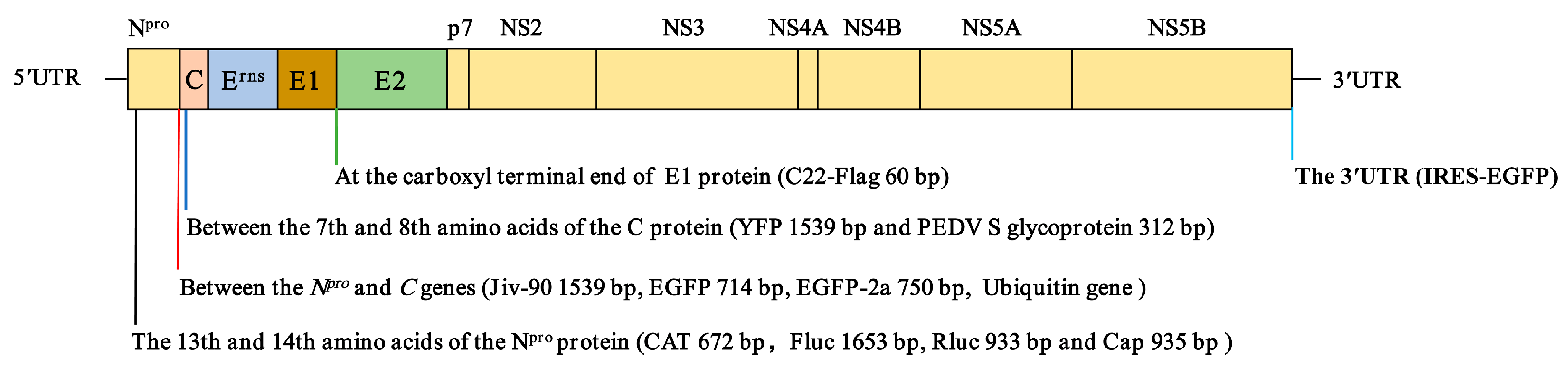
3.1. The Sites Suitable for the Insertion of Foreign Genes
3.2. The Size and Genetic Stability of the Inserted Foreign Genes
3.3. The Expression Levels of Foreign Genes in the Pestiviruses
4. The Limitations and Prospects of Pestivirus Vaccines
Author Contributions
Funding
Institutional Review Board Statement
Informed Consent Statement
Conflicts of Interest
References
- Hause, B.; Collin, E.A.; Peddireddi, L.; Yuan, F.; Chen, Z.; Hesse, R.A.; Gauger, P.C.; Clement, T.; Fang, Y.; Anderson, G. Discovery of a novel putative atypical porcine pestivirus in pigs in the United States. J. Gen. Virol. 2015, 96, 2994–2998. [Google Scholar] [CrossRef] [PubMed]
- Postel, A.; Smith, D.B.; Becher, P. Proposed update to the taxonomy of pestiviruses: Eight additional species within the genus Pestivirus, Family Flaviviridae. Viruses 2021, 13, 1542. [Google Scholar] [CrossRef] [PubMed]
- Ridpath, J.F.; Bolin, S.R. The genomic sequence of a virulent bovine viral diarrhea virus (BVDV) from the type 2 genotype: Detection of a large genomic insertion in a noncytopathic BVDV. Virology 1995, 212, 39–46. [Google Scholar] [CrossRef] [PubMed]
- Ruggli, N.; Tratschin, J.D.; Mittelholzer, C.; Hofmann, M.A. Nucleotide sequence of classical swine fever virus strain Alfort/187 and transcription of infectious RNA from stably cloned full-length cDNA. J. Virol. 1996, 70, 3478–3487. [Google Scholar] [CrossRef] [PubMed]
- Becher, P.; Shannon, A.D.; Tautz, N.; Thiel, H.J. Molecular characterization of border disease virus, a pestivirus from sheep. Virology 1994, 198, 542–551. [Google Scholar] [CrossRef] [PubMed]
- Becher, P.; Orlich, M.; Kosmidou, A.; König, M.; Baroth, M.; Thiel, H.J. Genetic diversity of pestiviruses: Identification of novel groups and implications for classification. Virology 1999, 262, 64–71. [Google Scholar] [CrossRef]
- Schirrmeier, H.; Strebelow, G.; Depner, K.; Hoffmann, B.; Beer, M. Genetic and antigenic characterization of an atypical pestivirus isolate, a putative member of a novel pestivirus species. J. Gen. Virol. 2004, 85, 3647–3652. [Google Scholar] [CrossRef]
- Kirkland, P.D.; Frost, M.J.; Finlaison, D.S.; King, K.R.; Ridpath, J.F.; Gu, X. Identification of a novel virus in pigs--Bungowannah virus: A possible new species of pestivirus. Virus Res. 2007, 129, 26–34. [Google Scholar] [CrossRef]
- Lamp, B.; Schwarz, L.; Högler, S.; Riedel, C.; Sinn, L.; Rebel-Bauder, B.; Weissenböck, H.; Ladinig, A.; Rümenapf, T. Novel pestivirus species in pigs, Austria, 2015. Emerg. Infect. Dis. 2017, 23, 1176–1179. [Google Scholar] [CrossRef]
- Moennig, V. The hog cholera virus. Comp. Immunol. Microbiol. Infect. Dis. 1992, 15, 189–201. [Google Scholar] [CrossRef]
- Collett, M.S.; Larson, R.; Gold, C.; Strick, D.; Anderson, D.K.; Purchio, A.F. Molecular cloning and nucleotide sequence of the pestivirus bovine viral diarrhea virus. Virology 1988, 165, 191–199. [Google Scholar] [CrossRef]
- Renard, A.; Guiot, C.; Schmetz, D.; Dagenais, L.; Pastoret, P.P.; Dina, D.; Martial, J.A. Molecular cloning of bovine viral diarrhea viral sequences. DNA 1985, 4, 429–438. [Google Scholar] [CrossRef]
- Collett, M.S.; Moennig, V.; Horzinek, M.C. Recent advances in pestivirus research. J. Gen. Virol. 1989, 70, 253–266. [Google Scholar] [CrossRef]
- Thiel, H.J.; Stark, R.; Weiland, E.; Rümenapf, T.; Meyers, G. Hog cholera virus: Molecular composition of virions from a pestivirus. J. Virol. 1991, 65, 4705–4712. [Google Scholar] [CrossRef]
- Becher, P.; Thiel, H.J.; Collins, M.; Brownlie, J.; Orlich, M. Cellular sequences in pestivirus genomes encoding gamma-aminobutyric acid (A) receptor-associated protein and Golgi-associated ATPase enhancer of 16 kilodaltons. J. Virol. 2002, 76, 13069–13076. [Google Scholar] [CrossRef]
- Stark, R.; Meyers, G.; Rümenapf, T.; Thiel, H.J. Processing of pestivirus polyprotein: Cleavage site between autoprotease and nucleocapsid protein of classical swine fever virus. J. Virol. 1993, 67, 7088–7095. [Google Scholar] [CrossRef]
- Rümenapf, T.; Unger, G.; Strauss, J.H.; Thiel, H.J. Processing of the envelope glycoproteins of pestiviruses. J. Virol. 1993, 67, 3288–3294. [Google Scholar] [CrossRef]
- Pinior, B.; Firth, C.L.; Richter, V.; Lebl, K.; Trauffler, M.; Dzieciol, M.; Hutter, S.E.; Burgstaller, J.; Obritzhauser, W.; Winter, P.; et al. A systematic review of financial and economic assessments of bovine viral diarrhea virus (BVDV) prevention and mitigation activities worldwide. Prev. Vet. Med. 2017, 137, 77–92. [Google Scholar] [CrossRef]
- Evans, C.A.; Pinior, B.; Larska, M.; Graham, D.; Schweizer, M.; Guidarini, C.; Decaro, N.; Ridpath, J.; Gates, M.C. Global knowledge gaps in the prevention and control of bovine viral diarrhoea (BVD) virus. Transbound. Emerg. Dis. 2019, 66, 640–652. [Google Scholar] [CrossRef]
- Ridpath, J.F.; Neill, J.D. Pestiviruses: Old enemies and new challenges. Anim. Health Res. Rev. 2015, 16, 1–3. [Google Scholar] [CrossRef][Green Version]
- van Oirschot, J.T. DIVA vaccines that reduce virus transmission. J. Biotechnol. 1999, 73, 195–205. [Google Scholar] [CrossRef] [PubMed]
- Dong, X.N.; Chen, Y.H. Marker vaccine strategies and candidate CSFV marker vaccines. Vaccine 2007, 25, 205–230. [Google Scholar] [CrossRef] [PubMed]
- Cabezón, O.; Muñoz-González, S.; Colom-Cadena, A.; Pérez-Simó, M.; Rosell, R.; Lavín, S.; Marco, I.; Fraile, L.; de la Riva, P.M.; Rodríguez, F.; et al. African swine fever virus infection in classical swine fever subclinically infected wild boars. BMC Vet. Res. 2017, 13, 227. [Google Scholar] [CrossRef] [PubMed]
- Chen, N.; Huang, Y.; Ye, M.; Li, S.; Xiao, Y.; Cui, B.; Zhu, J. Co-infection status of classical swine fever virus (CSFV), porcine reproductive and respiratory syndrome virus (PRRSV) and porcine circoviruses (PCV2 and PCV3) in eight regions of China from 2016 to 2018. Infect. Genet. Evol. 2019, 68, 127–135. [Google Scholar] [CrossRef] [PubMed]
- Zhou, H.; Pan, Y.; Liu, M.; Han, Z. Prevalence of porcine pseudorabies virus and its co-infection rate in Heilongjiang province in China from 2013 to 2018. Viral Immunol. 2020, 33, 550–554. [Google Scholar] [CrossRef]
- Ma, Z.; Liu, M.; Liu, Z.; Meng, F.; Wang, H.; Cao, L.; Li, Y.; Jiao, Q.; Han, Z.; Liu, S. Epidemiological investigation of porcine circovirus type 2 and its co-infection rate in Shandong province in China from 2015 to 2018. BMC Vet. Res. 2021, 17, 17. [Google Scholar] [CrossRef]
- Casciari, C.; Sozzi, E.; Bazzucchi, M.; Moreno Martin, A.M.; Gaffuri, A.; Giammarioli, M.; Lavazza, A.; De Mia, G.M. Serological relationship between a novel ovine pestivirus and classical swine fever virus. Transbound. Emerg. Dis. 2020, 67, 1406–1410. [Google Scholar] [CrossRef]
- Toplu, N.; Oguzoglu, T.C.; Albayrak, H. Dual infection of fetal and neonatal small ruminants with border disease virus and peste des petits ruminants virus (PPRV): Neuronal tropism of PPRV as a novel finding. J. Comp. Pathol. 2012, 146, 289–297. [Google Scholar] [CrossRef]
- Blome, S.; Moß, C.; Reimann, I.; König, P.; Beer, M. Classical swine fever vaccines-state-of-the-art. Vet. Microbiol. 2017, 206, 10–20. [Google Scholar] [CrossRef]
- Griebel, P.J. BVDV vaccination in North America: Risks versus benefits. Anim. Health Res. Rev. 2015, 16, 27–32. [Google Scholar] [CrossRef]
- Al-Kubati, A.A.G.; Hussen, J.; Kandeel, M.; Al-Mubarak, A.I.A.; Hemida, M.G. Recent advances on the bovine viral diarrhea virus molecular pathogenesis, immune response, and vaccines development. Front. Vet. Sci. 2021, 8, 665128. [Google Scholar] [CrossRef]
- Wei, Q.; Liu, Y.; Zhang, G. Research progress and challenges in vaccine development against classical swine fever virus. Viruses 2021, 13, 445. [Google Scholar] [CrossRef]
- Tong, C.; Liu, H.; Wang, J.; Sun, Y.; Chen, N. Safety, efficacy, and DIVA feasibility on a novel live attenuated classical swine fever marker vaccine candidate. Vaccine 2022, 40, 7219–7229. [Google Scholar] [CrossRef]
- Fulton, R.W. Impact of species and subgenotypes of bovine viral diarrhea virus on control by vaccination. Anim. Health Res. Rev. 2015, 16, 40–54. [Google Scholar] [CrossRef]
- Qiu, H.J.; Tong, G.Z.; Shen, R.X. The lapinized Chinese strain of classical swine fever virus: A retrospective review spanning half a century. J. Integr. Agr. 2005, 38, 1675–1685. [Google Scholar] [CrossRef]
- Gong, W.; Li, J.; Wang, Z.; Sun, J.; Mi, S.; Xu, J.; Cao, J.; Hou, Y.; Wang, D.; Huo, X.; et al. Commercial E2 subunit vaccine provides full protection to pigs against lethal challenge with 4 strains of classical swine fever virus genotype 2. Vet. Microbiol. 2019, 237, 108403. [Google Scholar] [CrossRef]
- Eblé, P.L.; Quak, S.; Geurts, Y.; Moonen-Leusen, H.W.; Loeffen, W.L. Efficacy of CSF vaccine CP7_E2alf in piglets with maternally derived antibodies. Vet. Microbiol. 2014, 174, 27–38. [Google Scholar] [CrossRef]
- Renson, P.; Le Dimna, M.; Keranflech, A.; Cariolet, R.; Koenen, F.; Le Potier, M.F. CP7_E2alf oral vaccination confers partial protection against early classical swine fever virus challenge and interferes with pathogeny-related cytokine responses. Vet. Res. 2013, 44, 9. [Google Scholar] [CrossRef]
- Beer, M.; Hehnen, H.R.; Wolfmeyer, A.; Poll, G.; Kaaden, O.R.; Wolf, G. A new inactivated BVDV genotype I and II vaccine. An immunisation and challenge study with BVDV genotype I. Vet. Microbiol. 2000, 77, 195–208. [Google Scholar] [CrossRef]
- Abd, E.l.; Fadeel, M.R.; El-Dakhly, A.T.; Allam, A.M.; Farag, T.K.; El-Kholy, A.A. Preparation and efficacy of freeze-dried inactivated vaccine against bovine viral diarrhea virus genotypes 1 and 2, bovine herpes virus type 1.1, bovine parainfluenza-3 virus, and bovine respiratory syncytial virus. Clin. Exp. Vaccine Res. 2020, 9, 119–125. [Google Scholar]
- Makoschey, B.; Janssen, M.; Vrijenhoek, M.P.; Korsten, J.H.; Marel, P. An inactivated bovine virus diarrhoea virus (BVDV) type 1 vaccine affords clinical protection against BVDV type 2. Vaccine 2001, 19, 3261–3268. [Google Scholar] [CrossRef] [PubMed]
- Fairbanks, K.; Schnakel, J.; Chase, C.C. Evaluation of a modified live virus type-l a bovine viral diarrhea virus vaccine (Singer strain) against a type-2 (strain 890) challenge. Vet. Ther. 2003, 4, 24–34. [Google Scholar] [PubMed]
- Zhou, W.; Gao, S.; Podgórska, K.; Stadejek, T.; Qiu, H.J.; Yin, H.; Drew, T.; Liu, L. Rovac is the possible ancestor of the Russian lapinized vaccines LK-VNIVViM and CS strains but not the Chinese strain (C-strain) vaccine against classical swine fever. Vaccine 2014, 32, 6639–6642. [Google Scholar] [CrossRef] [PubMed]
- van Oirschot, J.T. Vaccinology of classical swine fever: From lab to field. Vet. Microbiol. 2003, 96, 367–384. [Google Scholar] [CrossRef] [PubMed]
- Björklund, H.V.; Stadejek, T.; Vilcek, S.; Belák, S. Molecular characterization of the 3′ noncoding region of classical swine fever virus vaccine strains. Virus Genes 1998, 16, 307–312. [Google Scholar] [CrossRef]
- Oláh, P.; Palatka, Z. Immunobiological study of lapinized Hog cholera virus strains. Acta Vet. Acad. Sci. Hung. 1967, 17, 239–247. [Google Scholar]
- Corthier, G.; Aynaud, J.M. Comparison of the immune response in serum and bucco-pharyngeal secretions following immunization by different routes with a live hog cholera virus vaccine (Thiverval strain). Ann. Rech. Vet. 1977, 8, 159–165. [Google Scholar]
- Lamothe-Reyes, Y.; Bohórquez, J.A.; Wang, M.; Alberch, M.; Pérez-Simó, M.; Rosell, R.; Ganges, L. Early and solid protection afforded by the Thiverval vaccine provides novel vaccination alternatives against classical swine fever virus. Vaccines 2021, 9, 464. [Google Scholar] [CrossRef]
- Terpstra, C.; Wensvoort, G. The protective value of vaccine-induced neutralising antibody titers in swine fever. Vet. Microbiol. 1988, 16, 123–128. [Google Scholar] [CrossRef]
- McCarthy, R.R.; Everett, H.E.; Graham, S.P.; Steinbach, F.; Crooke, H.R. Head start immunity: Characterizing the early protection of C-strain vaccine against subsequent classical swine fever virus infection. Front. Immunol. 2019, 10, 1584. [Google Scholar] [CrossRef]
- Tamura, T.; Sakoda, Y.; Yoshino, F.; Nomura, T.; Yamamoto, N.; Sato, Y.; Okamatsu, M.; Ruggli, N.; Kida, H. Selection of classical swine fever virus with enhanced pathogenicity reveals synergistic virulence determinants in E2 and NS4B. J. Virol. 2012, 86, 8602–8613. [Google Scholar] [CrossRef] [PubMed]
- Luo, Y.; Ji, S.; Lei, J.L.; Xiang, G.T.; Liu, Y.; Gao, Y.; Meng, X.Y.; Zheng, G.; Zhang, E.Y.; Wang, Y.; et al. Efficacy evaluation of the C-strain-based vaccines against the subgenotype 2.1d classical swine fever virus emerging in China. Vet. Microbiol. 2017, 201, 154–161. [Google Scholar] [CrossRef] [PubMed]
- Kosmidou, A.; Ahl, R.; Thiel, H.J.; Weiland, E. Differentiation of classical swine fever virus (CSFV) strains using monoclonal antibodies against structural glycoproteins. Vet. Microbiol. 1995, 47, 111–118. [Google Scholar] [CrossRef] [PubMed]
- van Gennip, H.G.; van Rijn, P.A.; Widjojoatmodjo, M.N.; de Smit, A.J.; Moormann, R.J. Chimeric classical swine fever viruses containing envelope protein Erns or E2 of bovine viral diarrhoea virus protect pigs against challenge with CSFV and induce a distinguishable antibody response. Vaccine 2000, 19, 447–459. [Google Scholar] [CrossRef] [PubMed]
- Madera, R.; Gong, W.; Wang, L.; Burakova, Y.; Lleellish, K.; Galliher-Beckley, A.; Nietfeld, J.; Henningson, J.; Jia, K.; Li, P.; et al. Pigs immunized with a novel E2 subunit vaccine are protected from subgenotype heterologous classical swine fever virus challenge. BMC Vet. Res. 2016, 12, 197. [Google Scholar] [CrossRef]
- Lin, M.; Trottier, E.; Pasick, J. Antibody responses of pigs to defined Erns fragments after infection with classical swine fever virus. Clin. Diagn. Lab. Immunol. 2005, 12, 180–186. [Google Scholar]
- Zhang, H.; Li, X.; Peng, G.; Tang, C.; Zhu, S.; Qian, S.; Xu, J.; Qian, P. Glycoprotein E2 of classical swine fever virus expressed by baculovirus induces the protective immune responses in rabbits. Vaccine 2014, 32, 6607–6613. [Google Scholar] [CrossRef]
- Suárez-Pedroso, M.; Sordo-Puga, Y.; Sosa-Teste, I.; Rodriguez-Molto, M.P.; Naranjo-Valdés, P.; Sardina-González, T.; Santana-Rodríguez, E.; Montero-Espinosa, C.; Frías-Laporeaux, M.T.; Fuentes-Rodríguez, Y.; et al. Novel chimeric E2-CD154 subunit vaccine is safe and confers long lasting protection against classical swine fever virus. Vet. Immunol. Immunopathol. 2021, 234, 110222. [Google Scholar] [CrossRef]
- Xu, H.; Wang, Y.; Han, G.; Fang, W.; He, F. Identification of E2 with improved secretion and immunogenicity against CSFV in piglets. BMC Microbiol. 2020, 20, 26. [Google Scholar] [CrossRef]
- Suárez, M.; Sordo, Y.; Prieto, Y.; Rodríguez, M.P.; Méndez, L.; Rodríguez, E.M.; Rodríguez-Mallon, A.; Lorenzo, E.; Santana, E.; González, N.; et al. A single dose of the novel chimeric subunit vaccine E2-CD154 confers early full protection against classical swine fever virus. Vaccine 2017, 35, 4437–4443. [Google Scholar] [CrossRef]
- Muñoz-González, S.; Sordo, Y.; Pérez-Simó, M.; Suárez, M.; Canturri, A.; Rodriguez, M.P.; Frías-Lepoureau, M.T.; Domingo, M.; Estrada, M.P.; Ganges, L. Efficacy of E2 glycoprotein fused to porcine CD154 as a novel chimeric subunit vaccine to prevent classical swine fever virus vertical transmission in pregnant sows. Vet. Microbiol. 2017, 205, 110–116. [Google Scholar] [CrossRef]
- Sun, Y.; Li, H.Y.; Zhang, X.J.; Chang, T.M.; He, F.; Wang, X.P.; Liu, D.F.; Qiu, H.J. Comparison of the protective efficacy of recombinant adenoviruses against classical swine fever. Immunol. Lett. 2011, 135, 43–49. [Google Scholar] [CrossRef]
- Xia, S.L.; Lei, J.L.; Du, M.; Wang, Y.; Cong, X.; Xiang, G.T.; Li, L.F.; Yu, S.; Du, E.; Liu, S.; et al. Enhanced protective immunity of the chimeric vector-based vaccine rAdV-SFV-E2 against classical swine fever in pigs by a salmonella bacterial ghost adjuvant. Vet. Res. 2016, 47, 64. [Google Scholar] [CrossRef]
- Laughlin, R.C.; Madera, R.; Peres, Y.; Berquist, B.R.; Wang, L.; Buist, S.; Burakova, Y.; Palle, S.; Chung, C.J.; Rasmussen, M.V.; et al. Plant-made E2 glycoprotein single-dose vaccine protects pigs against classical swine fever. Plant Biotechnol. J. 2019, 17, 410–420. [Google Scholar] [CrossRef]
- Ganges, L.; Barrera, M.; Núñez, J.I.; Blanco, I.; Frias, M.T.; Rodríguez, F.; Sobrino, F. A DNA vaccine expressing the E2 protein of classical swine fever virus elicits T cell responses that can prime for rapid antibody production and confer total protection upon viral challenge. Vaccine 2005, 23, 3741–3752. [Google Scholar] [CrossRef]
- Postel, A.; Becher, P. Genetically distinct pestiviruses pave the way to improved classical swine fever marker vaccine candidates based on the chimeric pestivirus concept. Emerg. Microbes Infect. 2020, 9, 2180–2189. [Google Scholar] [CrossRef]
- de Smit, A.J.; Bouma, A.; van Gennip, H.G.; de Kluijver, E.P.; Moormann, R.J. Chimeric (marker) C-strain viruses induce clinical protection against virulent classical swine fever virus (CSFV) and reduce transmission of CSFV between vaccinated pigs. Vaccine 2001, 19, 1467–1476. [Google Scholar] [CrossRef]
- Reimann, I.; Depner, K.; Trapp, S.; Beer, M. An avirulent chimeric pestivirus with altered cell tropism protects pigs against lethal infection with classical swine fever virus. Virology 2004, 322, 143–157. [Google Scholar] [CrossRef]
- Reimann, I.; Depner, K.; Utke, K.; Leifer, I.; Lange, E.; Beer, M. Characterization of a new chimeric marker vaccine candidate with a mutated antigenic E2 epitope. Vet. Microbiol. 2010, 142, 45–50. [Google Scholar] [CrossRef] [PubMed]
- Luo, Y.; Yuan, Y.; Ankenbauer, R.G.; Nelson, L.D.; Witte, S.B.; Jackson, J.A.; Welch, S.K. construction of chimeric bovine viral diarrhea viruses containing glycoprotein Erns of heterologous pestiviruses and evaluation of the chimeras as potential marker vaccines against BVDV. Vaccine 2012, 30, 3843–3848. [Google Scholar] [CrossRef] [PubMed]
- Henke, J.; Carlson, J.; Zani, L.; Leidenberger, S.; Schwaiger, T.; Schlottau, K.; Teifke, J.P.; Schröder, C.; Beer, M.; Blome, S. Protection against transplacental transmission of moderately virulent classical swine fever virus using live marker vaccine “CP7-E2alf”. Vaccine 2018, 36, 4181–4187. [Google Scholar] [CrossRef] [PubMed]
- Widjojoatmodjo, M.N.; van Gennip, H.G.; Bouma, A.; van Rijn, P.A.; Moormann, R.J. Classical swine fever virus Erns deletion mutants: Trans-complementation and potential use as non-transmissible, modified, live-attenuated marker vaccines. J. Virol. 2000, 74, 2973–2980. [Google Scholar] [CrossRef] [PubMed][Green Version]
- van Gennip, H.G.; Bouma, A.; van Rijn, P.A.; Widjojoatmodjo, M.N.; Moormann, R.J. Experimental non-transmissible marker vaccines for classical swine fever (CSF) by trans-complementation of Erns or E2 of CSFV. Vaccine 2002, 20, 1544–1556. [Google Scholar] [CrossRef] [PubMed]
- Lim, S.I.; Choe, S.; Kim, K.S.; Jeoung, H.Y.; Cha, R.M.; Park, G.S.; Shin, J.; Park, G.N.; Cho, I.S.; Song, J.Y.; et al. Assessment of the efficacy of an attenuated live marker classical swine fever vaccine (Flc-LOM-BErns) in pregnant sows. Vaccine 2019, 37, 3598–3604. [Google Scholar] [CrossRef] [PubMed]
- Han, Y.; Xie, L.; Yuan, M.; Ma, Y.; Sun, H.; Sun, Y.; Li, Y.; Qiu, H.J. Development of a marker vaccine candidate against classical swine fever based on the live attenuated vaccine C-strain. Vet. Microbiol. 2020, 247, 108741. [Google Scholar] [CrossRef]
- Kim, T.; Huynh, L.T.; Hirose, S.; Igarashi, M.; Hiono, T.; Isoda, N.; Sakoda, Y. Characteristics of classical swine fever virus variants derived from live attenuated GPE− vaccine seed. Viruses 2021, 13, 1672. [Google Scholar] [CrossRef]
- Beer, M.; Reimann, I.; Hoffmann, B.; Depner, K. Novel marker vaccines against classical swine fever. Vaccine 2007, 25, 5665–5670. [Google Scholar] [CrossRef]
- Holinka, L.G.; Fernandez-Sainz, I.; O'Donnell, V.; Prarat, M.V.; Gladue, D.P.; Lu, Z.; Risatti, G.R.; Borca, M.V. Development of a live attenuated antigenic marker classical swine fever vaccine. Virology 2009, 384, 106–113. [Google Scholar] [CrossRef]
- Kortekaas, J.; Vloet, R.P.; Weerdmeester, K.; Ketelaar, J.; van Eijk, M.; Loeffen, W.L. Rational design of a classical swine fever C-strain vaccine virus that enables the differentiation between infected and vaccinated animals. J. Virol. Methods 2010, 163, 175–185. [Google Scholar] [CrossRef]
- Li, Y.; Zhu, Y.; Chen, S.; Li, W.; Yin, X.; Li, S.; Xiao, P.; Han, J.; Li, X.; Sun, L.; et al. Generation of an attenuated Tiantan vaccinia virus strain by deletion of multiple genes. Front. Cell. Infect. Microbiol. 2017, 7, 462. [Google Scholar] [CrossRef]
- Makoschey, B.; Sonnemans, D.; Bielsa, J.M.; Franken, P.; Mars, M.; Santos, L.; Alvarez, M. Evaluation of the induction of NS3 specific BVDV antibodies using a commercial inactivated BVDV vaccine in immunization and challenge trials. Vaccine 2007, 25, 6140–6145. [Google Scholar] [CrossRef]
- Meyer, D.; Fritsche, S.; Luo, Y.; Engemann, C.; Blome, S.; Beyerbach, M.; Chang, C.Y.; Qiu, H.J.; Becher, P.; Postel, A. The double-antigen ELISA concept for early detection of Erns-specific classical swine fever virus antibodies and application as an accompanying test for differentiation of infected from marker vaccinated animals. Transbound. Emerg. Dis. 2017, 64, 2013–2022. [Google Scholar] [CrossRef]
- Sun, Y.; Tian, D.Y.; Li, S.; Meng, Q.L. Comprehensive evaluation of the adenovirus/alphavirus-replicon chimeric vector-based vaccine rAdV-SFV-E2 against classical swine fever. Vaccine 2013, 31, 538–544. [Google Scholar] [CrossRef]
- Bohórquez, J.A.; Defaus, S.; Muñoz-González, S.; Perez-Simó, M.; Rosell, R.; Fraile, L.; Sobrino, F.; Andreu, D.; Ganges, L. A bivalent dendrimeric peptide bearing a T-cell epitope from foot-and-mouth disease virus protein 3A improves humoral response against classical swine fever virus. Virus Res. 2017, 238, 8–12. [Google Scholar] [CrossRef]
- Ding, Y.; Luo, L.; Luo, Y.; Zhao, D.; Mi, S.; Yu, X.; Zheng, J.; Tu, C.; Yu, X. A novel combined vaccine against classical swine fever and porcine epidemic diarrhea viruses elicits a significant Th2-favored humoral response in mice. Vaccine 2021, 39, 4573–4576. [Google Scholar] [CrossRef]
- Carlson, J.; Kammerer, R.; Teifke, J.P.; Sehl-Ewert, J.; Pfarrer, C.; Meyers, G. A double deletion prevents replication of the pestivirus bovine viral diarrhea virus in the placenta of pregnant heifers. PLoS Pathog. 2021, 17, e1010107. [Google Scholar] [CrossRef]
- Hansen, T.R.; Smirnova, N.P.; Van Campen, H.; Shoemaker, M.L.; Ptitsyn, A.A.; Bielefeldt-Ohmann, H. Maternal and fetal response to fetal persistent infection with bovine viral diarrhea virus. Am. J. Reprod. Immunol. 2010, 64, 295–306. [Google Scholar] [CrossRef]
- Fairbanks, K.K.; Rinehart, C.L.; Ohnesorge, W.C.; Loughin, M.M.; Chase, C.C. Evaluation of fetal protection against experimental infection with type 1 and type 2 bovine viral diarrhea virus after vaccination of the dam with a bivalent modified-live virus vaccine. J. Am. Vet. Med. Assoc. 2004, 225, 1898–1904. [Google Scholar] [CrossRef]
- Kovács, F.; Magyar, T.; Rinehart, C.; Elbers, K.; Schlesinger, K.; Ohnesorge, W.C. The live attenuated bovine viral diarrhea virus components of a multi-valent vaccine confer protection against fetal infection. Vet. Microbiol. 2003, 96, 117–131. [Google Scholar] [CrossRef]
- Ridpath, J.F. Practical significance of heterogeneity among BVDV strains: Impact of biotype and genotype on U.S. control programs. Prev. Vet. Med. 2005, 72, 215–219. [Google Scholar] [CrossRef]
- Bolin, S.R. Control of bovine viral diarrhea infection by use of vaccination. Vet. Clin. N. Am. Food Anim. Pract. 1995, 11, 615–625. [Google Scholar] [CrossRef] [PubMed]
- Endsley, J.J.; Roth, J.A.; Ridpath, J.; Neill, J. Maternal antibody blocks humoral but not T cell responses to BVDV. Biologicals 2003, 31, 123–125. [Google Scholar] [CrossRef] [PubMed]
- González, A.M.; Arnaiz, I.; Yus, E.; Eiras, C.; Sanjuán, M.; Diéguez, F.J. Evaluation of long-term antibody responses to two inactivated bovine viral diarrhoea virus (BVDV) vaccines. Vet. J. 2014, 199, 424–428. [Google Scholar] [CrossRef] [PubMed]
- Howard, C.J.; Clarke, M.C.; Sopp, P.; Brownlie, J. Systemic vaccination with inactivated bovine virus diarrhoea virus protects against respiratory challenge. Vet. Microbiol. 1994, 42, 171–179. [Google Scholar] [CrossRef] [PubMed]
- Dean, H.J.; Leyh, R. Cross-protective efficacy of a bovine viral diarrhea virus (BVDV) type 1 vaccine against BVDV type 2 challenge. Vaccine 1999, 17, 1117–1124. [Google Scholar] [CrossRef]
- Potgieter, L.N. Immunology of bovine viral diarrhea virus. Vet. Clin. N. Am. Food Anim. Pract. 1995, 11, 501–520. [Google Scholar] [CrossRef]
- Fulton, R.W.; Ridpath, J.F.; Saliki, J.T.; Briggs, R.E.; Confer, A.W.; Burge, L.J.; Purdy, C.W.; Loan, R.W.; Duff, G.C.; Payton, M.E. bovine viral diarrhea virus (BVDV) 1b: Predominant BVDV subtype in calves with respiratory disease. Can. J. Vet. Res. 2002, 66, 181–190. [Google Scholar]
- Meyers, G.; Tautz, N.; Becher, P. Recovery of cytopathogenic and noncytopathogenic bovine viral diarrhea viruses from cDNA constructs. J. Virol. 1996, 70, 8606–8613. [Google Scholar] [CrossRef]
- Makoschey, B.; Becher, P.; Janssen, M.G. Bovine viral diarrhea virus with deletions in the 5′-nontranslated region: Reduction of replication in calves and induction of protective immunity. Vaccine 2004, 22, 3285–3294. [Google Scholar] [CrossRef]
- Blome, S.; Gabriel, C.; Schmeiser, S.; Meyer, D.; Meindl-Bohmer, A.; Koenen, F.; Beer, M. Efficacy of marker vaccine candidate CP7_E2alf against challenge with classical swine fever virus isolates of different genotypes. Vet. Microbiol. 2014, 169, 8–17. [Google Scholar] [CrossRef]
- Koethe, S.; König, P.; Wernike, K.; Schulz, J.; Reimann, I.; Beer, M. Bungowannah pestivirus chimeras as novel double marker vaccine strategy against bovine viral diarrhea virus. Vaccines 2022, 10, 88. [Google Scholar] [CrossRef]
- Bellido, D.; Baztarrica, J.; Rocha, L.; Pecora, A.; Acosta, M.; Escribano, J.M.; Parreño, V.; Wigdorovitz, A. A novel MHC-II targeted BVDV subunit vaccine induces a neutralizing immunological response in guinea pigs and cattle. Transbound. Emerg. Dis. 2021, 68, 3474–3481. [Google Scholar] [CrossRef]
- Paton, D.J.; McGoldrick, A.; Greiser-Wilke, I.; Parchariyanon, S.; Song, J.Y.; Liou, P.P.; Stadejek, T.; Lowings, J.P.; Björklund, H.; Belák, S. Genetic typing of classical swine fever virus. Vet. Microbiol. 2000, 73, 137–157. [Google Scholar] [CrossRef]
- Vandeputte, J.; Too, H.L.; Ng, F.K.; Chen, C.; Chai, K.K.; Liao, G.A. Adsorption of colostral antibodies against classical swine fever, persistence of maternal antibodies, and effect on response to vaccination in baby pigs. Am. J. Vet. Res. 2001, 62, 1805–1811. [Google Scholar] [CrossRef]
- Tu, C.; Lu, Z.; Li, H.; Yu, X.; Liu, X.; Li, Y.; Zhang, H.; Yin, Z. Phylogenetic comparison of classical swine fever virus in China. Virus Res. 2001, 81, 29–37. [Google Scholar] [CrossRef]
- König, P.; Lange, E.; Reimann, I.; Beer, M. CP7_E2alf: A safe and efficient marker vaccine strain for oral immunisation of wild boar against classical swine fever virus (CSFV). Vaccine 2007, 25, 3391–3399. [Google Scholar] [CrossRef]
- Deng, M.; Ji, S.; Fei, W.; Raza, S.; He, C.; Chen, Y.; Chen, H.; Guo, A. Prevalence study and genetic typing of bovine viral diarrhea virus (BVDV) in four bovine species in China. PLoS ONE 2015, 10, e0121718. [Google Scholar] [CrossRef]
- Kelling, C.L. Evolution of bovine viral diarrhea virus vaccines. Vet. Clin. N. Am. Food Anim. Pract. 2004, 20, 115–129. [Google Scholar] [CrossRef]
- Xue, W.; Mattick, D.; Smith, L. Protection from persistent infection with a bovine viral diarrhea virus (BVDV) type 1b strain by a modified-live vaccine containing BVDV types 1a and 2, infectious bovine rhinotracheitis virus, parainfluenza 3 virus and bovine respiratory syncytial virus. Vaccine 2011, 29, 4657–4662. [Google Scholar] [CrossRef]
- Nardelli, S.; Decaro, N.; Belfanti, I.; Lucente, M.S.; Giammarioli, M.; Mion, M.; Lucchese, L.; Martini, M.; Cecchinato, M.; Schiavo, M.; et al. Do modified live virus vaccines against bovine viral diarrhea induce fetal cross-protection against HoBi-like pestivirus? Vet. Microbiol. 2021, 260, 109178. [Google Scholar] [CrossRef]
- Wang, W.; Shi, X.; Wu, Y.; Li, X.; Ji, Y.; Meng, Q.; Zhang, S.; Wu, H. Immunogenicity of an inactivated Chinese bovine viral diarrhea virus 1a (BVDV 1a) vaccine cross protects from BVDV 1b infection in young calves. Vet. Immunol. Immunopathol. 2014, 160, 288–292. [Google Scholar] [CrossRef] [PubMed]
- Hamers, C.; Couvreur, B.; Dehan, P.; Letellier, C.; Fischer, L.; Brun, A.J.; Lewalle, P.; Michaux, C.; Pastoret, P.P.; Kerkhofs, P. Assessment of the clinical and virological protection provided by a commercial inactivated bovine viral diarrhoea virus genotype 1 vaccine against a BVDV genotype 2 challenge. Vet. Rec. 2003, 153, 236–240. [Google Scholar] [CrossRef] [PubMed]
- van Rijn, P.A. A common neutralizing epitope on envelope glycoprotein E2 of different pestiviruses: Implications for improvement of vaccines and diagnostics for classical swine fever (CSF)? Vet. Microbiol. 2007, 125, 150–156. [Google Scholar] [CrossRef] [PubMed]
- Moser, C.; Tratschin, J.D.; Hofmann, M.A. A recombinant classical swine fever virus stably expresses a marker gene. J. Virol. 1998, 72, 5318–5322. [Google Scholar] [CrossRef] [PubMed]
- Li, Y.; Shen, L.; Sun, Y.; Yuan, J.; Huang, J.; Li, C.; Li, S.; Luo, Y.; Qiu, H.J. Simplified serum neutralization test based on enhanced green fluorescent protein-tagged classical swine fever virus. J. Clin. Microbiol. 2013, 51, 2710–2712. [Google Scholar] [CrossRef]
- Zhu, F.C.; Wurie, A.H.; Hou, L.H.; Liang, Q.; Li, Y.H.; Russell, J.B.; Wu, S.P.; Li, J.X.; Hu, Y.M.; Guo, Q.; et al. Safety and immunogenicity of a recombinant adenovirus type-5 vector-based Ebola vaccine in healthy adults in Sierra Leone: A single-centre, randomised, double-blind, placebo-controlled, phase 2 trial. Lancet 2017, 389, 621–628. [Google Scholar] [CrossRef]
- Humphreys, I.R.; Sebastian, S. Novel viral vectors in infectious diseases. Immunology 2018, 153, 1–9. [Google Scholar] [CrossRef]
- Shirley, J.L.; de Jong, Y.P.; Terhorst, C.; Herzog, R.W. Immune responses to viral gene therapy vectors. Mol. Ther. 2020, 28, 709–722. [Google Scholar] [CrossRef]
- Okahira, S.; Nishikawa, F.; Nishikawa, S.; Akazawa, T.; Seya, T.; Matsumoto, M. Interferon-beta induction through toll-like receptor 3 depends on double-stranded RNA structure. DNA Cell Biol. 2005, 24, 614–623. [Google Scholar] [CrossRef]
- Kawai, T.; Akira, S. The role of pattern-recognition receptors in innate immunity: Update on Toll-like receptors. Nat. Immunol. 2010, 11, 373–384. [Google Scholar] [CrossRef]
- Si, L.; Bai, H.; Oh, C.Y.; Jiang, A.; Hong, F.; Zhang, T.; Ye, Y.; Jordan, T.X.; Logue, J.; McGrath, M.; et al. Self-assembling short immunostimulatory duplex RNAs with broad-spectrum antiviral activity. Mol. Ther. Nucleic Acids 2022, 29, 923–940. [Google Scholar] [CrossRef]
- Zhang, L.; Li, Y.; Xie, L.; Wang, X.; Gao, X.; Sun, Y.; Qiu, H.J. Secreted expression of the Cap gene of porcine circovirus type 2 in classical swine fever virus C-strain: Potential of C-strain used as a vaccine vector. Viruses 2017, 9, 298. [Google Scholar] [CrossRef]
- Tratschin, J.D.; Moser, C.; Ruggli, N.; Hofmann, M.A. classical swine fever virus leader proteinase Npro is not required for viral replication in cell culture. J. Virol. 1998, 72, 7681–7684. [Google Scholar] [CrossRef]
- Ruggli, N.; Tratschin, J.D.; Schweizer, M.; McCullough, K.C.; Hofmann, M.A.; Summerfield, A. Classical swine fever virus interferes with cellular antiviral defense: Evidence for a novel function of Npro. J. Virol. 2003, 77, 7645–7654. [Google Scholar] [CrossRef]
- Mayer, D.; Hofmann, M.A.; Tratschin, J.D. Attenuation of classical swine fever virus by deletion of the viral Npro gene. Vaccine 2004, 22, 317–328. [Google Scholar] [CrossRef]
- Riedel, C.; Lamp, B.; Heimann, M.; König, M.; Blome, S.; Moennig, V.; Schüttler, C.; Thiel, H.J.; Rümenapf, T. The core protein of classical swine fever virus is dispensable for virus propagation in vitro. PLoS Pathog. 2012, 8, e1002598. [Google Scholar] [CrossRef]
- Fan, Z.C.; Dennis, J.C.; Bird, R.C. Bovine viral diarrhea virus is a suitable viral vector for stable expression of heterologous gene when inserted in between N pro and C genes. Virus Res. 2008, 138, 97–104. [Google Scholar] [CrossRef]
- Tao, J.; Li, B.; Shi, Y.; Chen, J.; Zhu, G.; Shen, X.; Liu, H. Attenuated porcine-derived type 2 bovine viral diarrhea virus as vector stably expressing viral gene. J. Virol. Methods 2020, 279, 113842. [Google Scholar] [CrossRef]
- Shen, L.; Li, Y.; Chen, J.; Li, C.; Huang, J.; Luo, Y.; Sun, Y.; Li, S.; Qiu, H.J. Generation of a recombinant classical swine fever virus stably expressing the firefly luciferase gene for quantitative antiviral assay. Antiviral Res. 2014, 109, 15–21. [Google Scholar] [CrossRef]
- Wang, X.; Li, Y.; Li, L.; Shen, L.; Zhang, L.; Yu, J.; Luo, Y.; Sun, Y.; Li, S.; Qiu, H.J. RNA interference screening of interferon-stimulated genes with antiviral activities against classical swine fever virus using a reporter virus. Antiviral Res. 2016, 128, 49–56. [Google Scholar] [CrossRef]
- Gallei, A.; Blome, S.; Gilgenbach, S.; Tautz, N.; Moennig, V.; Becher, P. Cytopathogenicity of classical swine fever virus correlates with attenuation in the natural host. J. Virol. 2008, 82, 9717–9729. [Google Scholar] [CrossRef] [PubMed][Green Version]
- Hulst, M.M.; van Gennip, H.G.; Moormann, R.J. Passage of classical swine fever virus in cultured swine kidney cells selects virus variants that bind to heparin sulfate due to a single amino acid change in envelope protein Erns. J. Virol. 2000, 74, 9553–9561. [Google Scholar] [CrossRef] [PubMed]
- Silva, J.G.; Coimbra, E.C.; Jesus, A.L. Secretory expression of porcine circovirus type 2 capsid protein in Pichia pastoris. J. Virol. Methods 2014, 207, 226–231. [Google Scholar] [CrossRef] [PubMed]
- Arenhart, S.; Silva, J.V.; Flores, E.F.; Weiblen, R.; Gil, L.H. Use of homologous recombination in yeast to create chimeric bovine viral diarrhea virus cDNA clones. Braz. J. Microbiol. 2016, 47, 993–999. [Google Scholar] [CrossRef] [PubMed][Green Version]
- Moser, C.; Stettler, P.; Tratschin, J.D.; Hofmann, M.A. Cytopathogenic and noncytopathogenic RNA replicons of classical swine fever virus. J. Virol. 1999, 73, 7787–7794. [Google Scholar] [CrossRef]
- Risager, P.C.; Fahnøe, U.; Gullberg, M.; Rasmussen, T.B.; Belsham, G.J. Analysis of classical swine fever virus RNA replication determinants using replicons. J. Gen. Virol. 2013, 94, 1739–1748. [Google Scholar] [CrossRef]
- Yang, Z.; Wu, R.; Li, R.W.; Li, L.; Xiong, Z.; Zhao, H.; Guo, D.; Pan, Z. Chimeric classical swine fever (CSF) Japanese encephalitis (JE) viral replicon as anon-transmissible vaccine candidate against CSF and JE infections. Virus Res. 2012, 165, 61–70. [Google Scholar] [CrossRef]
- Oura, C.A.; Denyer, M.S.; Takamatsu, H.; Parkhouse, R.M. In vivo depletion of CD8+ T lymphocytes abrogates protective immunity to African swine fever virus. J. Gen. Virol. 2005, 86, 2445–2450. [Google Scholar] [CrossRef]
- Denyer, M.S.; Wileman, T.E.; Stirling, C.M.A.; Zuber, B.; Takamatsu, H.H. Perforin expression can define CD8+ lymphocyte subsets in pigs allowing phenotypic and functional analysis of natural killer, cytotoxic T, natural killer T and MHC un-restricted cytotoxic T-cells. Vet. Immunol. Immunopathol. 2006, 110, 279–292. [Google Scholar] [CrossRef]
- Maurer, R.; Stettler, P.; Ruggli, N.; Hofmann, M.A.; Tratschin, J.D. Oronasal vaccination with classical swine fever virus (CSFV) replicon particles with either partial or complete deletion of the E2 gene induces partial protection against lethal challenge with highly virulent CSFV. Vaccine 2005, 23, 3318–3328. [Google Scholar] [CrossRef]
- Kaden, V.; Lange, B. Oral immunisation against classical swine fever (CSF): Onset and duration of immunity. Vet. Microbiol. 2001, 82, 301–310. [Google Scholar] [CrossRef]
- Kaden, V.; Schurig, U.; Steyer, H. Oral immunization of pigs against classical swine fever. Course of the disease and virus transmission after simultaneous vaccination and infection. Acta Virol. 2001, 45, 23–29. [Google Scholar]
- Kaden, V.; Heyne, H.; Kiupel, H.; Letz, W.; Kern, B.; Lemmer, U.; Gossger, K.; Rothe, A.; Böhme, H.; Tyrpe, P. Oral immunisation of wild boar against classical swine fever: Concluding analysis of the recent field trials in Germany. Berl. Munch Tierarztl. Wochenschr. 2002, 115, 179–185. [Google Scholar]
- Kaden, V.; Lange, E.; Müller, T.; Teuffert, J.; Teifke, J.P.; Riebe, R. Protection of gruntlings against classical swine fever virus-infection after oral vaccination of sows with C-strain vaccine. J. Vet. Med. B Infect. Dis. Vet. Public Health 2006, 53, 455–460. [Google Scholar] [CrossRef]
- Zhang, Y.; Zhang, W.; Cheng, J.; Liu, X.; Miao, S.; Tan, W.S.; Zhao, L. Designing a novel E2-IFN-γ fusion protein against CSFV by immunoinformatics and structural vaccinology approaches. Appl. Microbiol. Biotechnol. 2022, 106, 3611–3623. [Google Scholar] [CrossRef]
- Liu, Z.H.; Xu, H.L.; Han, G.W.; Tao, L.N.; Lu, Y.; Zheng, S.Y.; Fang, W.H.; He, F. Self-assembling nanovaccine enhances protective efficacy against CSFV in pigs. Front. Immunol. 2021, 12, 689187. [Google Scholar] [CrossRef]
- Xu, Q.; Sun, Y.; Yang, J.; Ma, F.; Wang, Y.; Zhang, S.; Li, X.; Qu, X.; Bai, Y.; Jia, R.; et al. An improved immunochromatographic strip based on plant-derived E2 for detection of antibodies against classical swine fever virus. Microbiol. Spectr. 2022, 10, e0105022. [Google Scholar] [CrossRef]
- Huang, Y.L.; Deng, M.C.; Wang, F.I.; Huang, C.C.; Chang, C.Y. The challenges of classical swine fever control: Modified live and E2 subunit vaccines. Virus Res. 2014, 179, 1–11. [Google Scholar] [CrossRef]
- Lin, G.J.; Deng, M.C.; Chen, Z.W.; Liu, T.Y.; Wu, C.W.; Cheng, C.Y.; Chien, M.S.; Huang, C. Yeast expressed classical swine fever E2 subunit vaccine candidate provides complete protection against lethal challenge infection and prevents horizontal virus transmission. Vaccine 2012, 30, 2336–2341. [Google Scholar] [CrossRef]
- Blome, S.; Wernike, K.; Reimann, I.; König, P.; Moß, C.; Beer, M. A decade of research into classical swine fever marker vaccine CP7_E2alf (Suvaxyn® CSF Marker): A review of vaccine properties. Vet. Res. 2017, 48, 51. [Google Scholar] [CrossRef]

| Vaccines | Development Strategies | Advantages | Disadvantages | References |
|---|---|---|---|---|
| C-strain | Hundreds of passages of a highly virulent classical swine fever virus (CSFV) in rabbits | Safety, rapid-onset protection (3 to 5 days post-vaccination), long-lasting protection (six months) | No DIVA, maternal antibody interference | [35] |
| CSFV E2 | Baculovirus-expressed E2 | Safety, DIVA | No complete prevention from vertical transmission, a relatively long period of time required to induce a protective response, and the need for a booster immunization to achieve a full protection. | [36] |
| CP7-E2alf | BVDV harboring the E2 gene of the CSFV Alfort/187 strain | DIVA, partial protection against early CSFV challenge | The neutralizing antibodies (NAbs) produced are lower than those of C-strain | [37,38] |
| BVDV inactivated vaccine | Upgraded by processes such as concentration and purification, and emulsified biphasic oil emulsion adjuvant | Higher protection, longer duration of immunity | No DIVA | [39,40,41] |
| BVDV LAVs | Isolation of naturally attenuated strains, more than 60 passages of a highly virulent strain in the MDBK cells, or gene-deletion attenuated strains | High-level NAbs | Safety risk, no DIVA | [42] |
| Marker Strains | Development Strategies | References |
|---|---|---|
| Fl22 | Deletion of 66 amino acids in Erns | [72] |
| Fl23 | Deletion of 215 amino acids in Erns | |
| Flc9 | Replacement of the N-terminal half of E2 of C-strain by that of BVDV | [67] |
| Flc11 | Replacement of the Erns gene of C-strain by that of BVDV | |
| Flc4 | Deletion of the B/C region of E2 (aa 693 to 746) | [73] |
| Flc47 | Deletion of the whole E2 gene (aa 689~1062) | |
| Flc48 | Deletion of the A region (aa 800 to 864) of E2 | |
| Flc-LOM-BErns | Replacement of the CSFV Erns gene and the 3′-end (52 bp) of the CSFV C gene with the corresponding BVDV genes | [74] |
| rHCLV-E2P122A | Mutation of the epitopes in E2 | [75] |
| vGPE− | Ten amino acids of substitutions were recognized, compared with the original GPE− vaccine | [76] |
Disclaimer/Publisher’s Note: The statements, opinions and data contained in all publications are solely those of the individual author(s) and contributor(s) and not of MDPI and/or the editor(s). MDPI and/or the editor(s) disclaim responsibility for any injury to people or property resulting from any ideas, methods, instructions or products referred to in the content. |
© 2022 by the authors. Licensee MDPI, Basel, Switzerland. This article is an open access article distributed under the terms and conditions of the Creative Commons Attribution (CC BY) license (https://creativecommons.org/licenses/by/4.0/).
Share and Cite
Yuan, M.; Yang, X.; Zhang, X.; Zhao, X.; Abid, M.; Qiu, H.-J.; Li, Y. Different Types of Vaccines against Pestiviral Infections: “Barriers” for “Pestis”. Viruses 2023, 15, 2. https://doi.org/10.3390/v15010002
Yuan M, Yang X, Zhang X, Zhao X, Abid M, Qiu H-J, Li Y. Different Types of Vaccines against Pestiviral Infections: “Barriers” for “Pestis”. Viruses. 2023; 15(1):2. https://doi.org/10.3390/v15010002
Chicago/Turabian StyleYuan, Mengqi, Xiaoke Yang, Xin Zhang, Xiaotian Zhao, Muhammad Abid, Hua-Ji Qiu, and Yongfeng Li. 2023. "Different Types of Vaccines against Pestiviral Infections: “Barriers” for “Pestis”" Viruses 15, no. 1: 2. https://doi.org/10.3390/v15010002
APA StyleYuan, M., Yang, X., Zhang, X., Zhao, X., Abid, M., Qiu, H.-J., & Li, Y. (2023). Different Types of Vaccines against Pestiviral Infections: “Barriers” for “Pestis”. Viruses, 15(1), 2. https://doi.org/10.3390/v15010002

