Cellular miR-6741-5p as a Prognostic Biomarker Predicting Length of Hospital Stay among COVID-19 Patients


 , and
, and
Abstract
1. Introduction
2. Materials and Methods
2.1. Human Participants and Samples
2.2. Study Design and Approval
2.3. Whole Transcriptome Assay
2.4. Dual-Luciferase Reporter Assay
2.5. Prognosis Evaluation
2.6. Statistics
3. Results
3.1. Differential Expression of Circulating miRNAs in COVID-19 Patients Treated with Dexamethasone
3.2. miR-6741-5p May Serve as a Predictor of Poor Prognosis
3.3. miR-6741-5p Targets APOBEC3H
4. Discussion
5. Limitations
6. Conclusions
Supplementary Materials
Author Contributions
Funding
Institutional Review Board Statement
Informed Consent Statement
Data Availability Statement
Acknowledgments
Conflicts of Interest
References
- Feng, W.; Zong, W.; Wang, F.; Ju, S. Severe acute respiratory syndrome coronavirus 2 (SARS-CoV-2): A review. Mol. Cancer 2020, 19, 100. [Google Scholar] [CrossRef] [Scilit] [PubMed]
- Maher, M.C.; Bartha, I.; Weaver, S.; di Iulio, J.; Ferri, E.; Soriaga, L.; Lempp, F.A.; Hie, B.L.; Bryson, B.; Berger, B.; et al. Predicting the mutational drivers of future SARS-CoV-2 variants of concern. Sci. Transl. Med. 2022, 14, eabk3445. [Google Scholar] [CrossRef] [Scilit] [PubMed]
- Passarelli, P.C.; Lopez, M.A.; Mastandrea Bonaviri, G.N.; Garcia-Godoy, F.; D’Addona, A. Taste and smell as chemosensory dysfunctions in COVID-19 infection. Am. J. Dent. 2020, 33, 135–137. [Google Scholar] [PubMed]
- Meo, S.A.; Alhowikan, A.M.; Al-Khlaiwi, T.; Meo, I.M.; Halepoto, D.M.; Iqbal, M.; Usmani, A.M.; Hajjar, W.; Ahmed, N. Novel coronavirus 2019-nCoV: Prevalence, biological and clinical characteristics comparison with SARS-CoV and MERS-CoV. Eur. Rev. Med. Pharmacol. Sci. 2020, 24, 2012–2019. [Google Scholar] [PubMed]
- Li, Y.C.; Bai, W.Z.; Hashikawa, T. The neuroinvasive potential of SARS-CoV2 may play a role in the respiratory failure of COVID-19 patients. J. Med. Virol. 2020, 92, 552–555. [Google Scholar] [CrossRef] [Scilit]
- Yong, S.J. Long COVID or post-COVID-19 syndrome: Putative pathophysiology, risk factors, and treatments. Infect. Dis. 2021, 53, 737–754. [Google Scholar] [CrossRef] [Scilit]
- Bellanti, J.A. The long COVID syndrome: A conundrum for the allergist/immunologist. Allergy Asthma Proc. 2022, 43, 368–374. [Google Scholar] [CrossRef] [Scilit]
- Mumtaz, A.; Sheikh, A.A.E.; Khan, A.M.; Khalid, S.N.; Khan, J.; Nasrullah, A.; Sagheer, S.; Sheikh, A.B. COVID-19 Vaccine and Long COVID: A Scoping Review. Life 2022, 12, 1066. [Google Scholar] [CrossRef] [Scilit]
- Raveendran, A.V.; Jayadevan, R.; Sashidharan, S. Long COVID: An overview. Diabetes Metab. Syndr. 2021, 15, 869–875. [Google Scholar] [CrossRef] [Scilit]
- Sudre, C.H.; Murray, B.; Varsavsky, T.; Graham, M.S.; Penfold, R.S.; Bowyer, R.C.; Pujol, J.C.; Klaser, K.; Antonelli, M.; Canas, L.S.; et al. Attributes and predictors of long COVID. Nat. Med. 2021, 27, 626–631. [Google Scholar] [CrossRef] [Scilit]
- Khetpal, V.; Berkowitz, J.; Vijayakumar, S.; Choudhary, G.; Mukand, J.A.; Rudolph, J.L.; Wu, W.C.; Erqou, S. Long-term Cardiovascular Manifestations and Complications of COVID-19: Spectrum and Approach to Diagnosis and Management. R. I. Med. J. 2022, 105, 16–22. [Google Scholar]
- Sommer, N.; Schmeck, B. Pulmonary manifestations in long COVID. Inn. Med. 2022, 63, 819–829. [Google Scholar]
- Magdy, R.; Elmazny, A.; Soliman, S.H.; Elsebaie, E.H.; Ali, S.H.; Abdel Fattah, A.M.; Hassan, M.; Yassien, A.; Mahfouz, N.A.; Elsayed, R.M.; et al. Post-COVID-19 neuropsychiatric manifestations among COVID-19 survivors suffering from migraine: A case-control study. J. Headache Pain 2022, 23, 101. [Google Scholar] [CrossRef] [Scilit]
- Meringer, H.; Mehandru, S. Gastrointestinal post-acute COVID-19 syndrome. Nat. Rev. Gastroenterol. Hepatol. 2022, 19, 345–346. [Google Scholar] [CrossRef] [Scilit]
- Copur, S.; Berkkan, M.; Basile, C.; Tuttle, K.; Kanbay, M. Post-acute COVID-19 syndrome and kidney diseases: What do we know? J. Nephrol. 2022, 35, 795–805. [Google Scholar] [CrossRef] [Scilit]
- Zhu, M.; Chen, D.; Zhu, Y.; Xiong, X.; Ding, Y.; Guo, F.; Zhu, M.; Zhou, J. Long-term sero-positivity for IgG, sequelae of respiratory symptoms, and abundance of malformed sperms in a patient recovered from severe COVID-19. Eur. J. Clin. Microbiol. Infect. Dis. 2021, 40, 1559–1567. [Google Scholar] [CrossRef] [Scilit]
- Esteller, M. Non-coding RNAs in human disease. Nat. Rev. Genet. 2011, 12, 861–874. [Google Scholar] [CrossRef] [Scilit]
- Adams, B.D.; Kasinski, A.L.; Slack, F.J. Aberrant regulation and function of microRNAs in cancer. Curr. Biol. 2014, 24, R762–R776. [Google Scholar] [CrossRef] [Scilit]
- Kloosterman, W.P.; Plasterk, R.H. The diverse functions of microRNAs in animal development and disease. Dev. Cell 2006, 11, 441–450. [Google Scholar] [CrossRef] [Scilit]
- Zhang, S.; Amahong, K.; Sun, X.; Lian, X.; Liu, J.; Sun, H.; Lou, Y.; Zhu, F.; Qiu, Y. The miRNA: A small but powerful RNA for COVID-19. Brief. Bioinform. 2021, 22, 1137–1149. [Google Scholar] [CrossRef] [Scilit]
- Kosaka, N.; Iguchi, H.; Yoshioka, Y.; Takeshita, F.; Matsuki, Y.; Ochiya, T. Secretory mechanisms and intercellular transfer of microRNAs in living cells. J. Biol. Chem. 2010, 285, 17442–17452. [Google Scholar] [CrossRef] [Scilit] [PubMed]
- Rees, E.M.; Nightingale, E.S.; Jafari, Y.; Waterlow, N.R.; Clifford, S.; CA, B.P.; Group, C.W.; Jombart, T.; Procter, S.R.; Knight, G.M. COVID-19 length of hospital stay: A systematic review and data synthesis. BMC Med. 2020, 18, 270. [Google Scholar] [CrossRef] [Scilit] [PubMed]
- Huang, N.; Lee, K.J.; Stark, M.S. Current Trends in Circulating Biomarkers for Melanoma Detection. Front. Med. 2022, 9, 873728. [Google Scholar] [CrossRef] [Scilit] [PubMed]
- Akula, S.M.; Bolin, P.; Cook, P.P. Cellular miR-150-5p may have a crucial role to play in the biology of SARS-CoV-2 infection by regulating nsp10 gene. RNA Biol. 2022, 19, 1–11. [Google Scholar] [CrossRef] [Scilit]
- Hashimoto, Y.; Akiyama, Y.; Yuasa, Y. Multiple-to-multiple relationships between microRNAs and target genes in gastric cancer. PLoS ONE 2013, 8, e62589. [Google Scholar] [CrossRef] [Scilit]
- Agarwal, V.; Bell, G.W.; Nam, J.W.; Bartel, D.P. Predicting effective microRNA target sites in mammalian mRNAs. Elife 2015, 4, e05005. [Google Scholar] [CrossRef] [Scilit]
- Chen, Y.; Wang, X. miRDB: An online database for prediction of functional microRNA targets. Nucleic Acids Res. 2020, 48, D127–D131. [Google Scholar] [CrossRef] [Scilit]
- Liu, W.; Wang, X. Prediction of functional microRNA targets by integrative modeling of microRNA binding and target expression data. Genome Biol. 2019, 20, 18. [Google Scholar] [CrossRef] [Scilit]
- Betel, D.; Koppal, A.; Agius, P.; Sander, C.; Leslie, C. Comprehensive modeling of microRNA targets predicts functional non-conserved and non-canonical sites. Genome Biol. 2010, 11, R90. [Google Scholar] [CrossRef] [Scilit]
- Kuhn, D.E.; Martin, M.M.; Feldman, D.S.; Terry, A.V., Jr.; Nuovo, G.J.; Elton, T.S. Experimental validation of miRNA targets. Methods 2008, 44, 47–54. [Google Scholar] [CrossRef] [Scilit]
- Gustafson, D.; Ngai, M.; Wu, R.; Hou, H.; Schoffel, A.C.; Erice, C.; Mandla, S.; Billia, F.; Wilson, M.D.; Radisic, M.; et al. Cardiovascular signatures of COVID-19 predict mortality and identify barrier stabilizing therapies. EBioMedicine 2022, 78, 103982. [Google Scholar] [CrossRef] [Scilit]
- Sell, S.L.; Widen, S.G.; Prough, D.S.; Hellmich, H.L. Principal component analysis of blood microRNA datasets facilitates diagnosis of diverse diseases. PLoS ONE 2020, 15, e0234185. [Google Scholar] [CrossRef] [Scilit]
- Jolliffe, I.T.; Cadima, J. Principal component analysis: A review and recent developments. Philos. Trans. A Math Phys. Eng. Sci. 2016, 374, 20150202. [Google Scholar] [CrossRef] [Scilit]
- Guerra-Urzola, R.; Van Deun, K.; Vera, J.C.; Sijtsma, K. A Guide for Sparse PCA: Model Comparison and Applications. Psychometrika 2021, 86, 893–919. [Google Scholar] [CrossRef] [Scilit]
- Huang, I.; Pranata, R.; Lim, M.A.; Oehadian, A.; Alisjahbana, B. C-reactive protein, procalcitonin, D-dimer, and ferritin in severe coronavirus disease-2019: A meta-analysis. Ther. Adv. Respir. Dis. 2020, 14, 1–14. [Google Scholar] [CrossRef] [Scilit]
- Barrett, B.; Pamphile, S.; Yang, F.; Naeem, F.; Kim, J.; Annam, J.; Borczuk, R.; Yellin, S.; Bass, C.; Fowler, S.; et al. Inflammatory markers are poorly predictive of clinical outcomes among hospitalized patients with COVID-19. Am. J. Emerg. Med. 2020, 46, 595–598. [Google Scholar] [CrossRef] [Scilit]
- Shimada, A.; Ohnaka, S.; Kubo, K.; Nakashima, M.; Nagai, A. COVID-19-Associated Pulmonary Aspergillosis in a Patient Treated with Remdesivir, Dexamethasone, and Baricitinib: A Case Report. Cureus 2022, 14, e23755. [Google Scholar] [CrossRef] [Scilit]
- Jiang, G.; Gong, M.; Song, H.; Sun, W.; Zhao, W.; Wang, L. Tob2 Inhibits TLR-Induced Inflammatory Responses by Association with TRAF6 and MyD88. J. Immunol. 2020, 205, 981–986. [Google Scholar] [CrossRef] [Scilit]
- Leonard, B.; Starrett, G.J.; Maurer, M.J.; Oberg, A.L.; Van Bockstal, M.; Van Dorpe, J.; De Wever, O.; Helleman, J.; Sieuwerts, A.M.; Berns, E.M.; et al. APOBEC3G Expression Correlates with T-Cell Infiltration and Improved Clinical Outcomes in High-grade Serous Ovarian Carcinoma. Clin. Cancer Res. 2016, 22, 4746–4755. [Google Scholar] [CrossRef] [Scilit]
- Liu, D.; Zhou, G.; Shi, H.; Chen, B.; Sun, X.; Zhang, X. Downregulation of Transmembrane protein 40 by miR-138-5p Suppresses Cell Proliferation and Mobility in Clear Cell Renal Cell Carcinoma. Iran J. Biotechnol. 2020, 18, e2270. [Google Scholar]
- Mazzocca, A.; Carloni, V.; Sciammetta, S.; Cordella, C.; Pantaleo, P.; Caldini, A.; Gentilini, P.; Pinzani, M. Expression of transmembrane 4 superfamily (TM4SF) proteins and their role in hepatic stellate cell motility and wound healing migration. J. Hepatol. 2002, 37, 322–330. [Google Scholar] [CrossRef] [Scilit] [PubMed]
- Meissner, M.E.; Willkomm, N.A.; Lucas, J.; Arndt, W.G.; Aitken, S.F.; Julik, E.J.; Baliga, S.; Mansky, L.M. Differential Activity of APOBEC3F, APOBEC3G, and APOBEC3H in the Restriction of HIV-2. J. Mol. Biol. 2022, 434, 167355. [Google Scholar] [CrossRef] [Scilit] [PubMed]
- Mondal, A.; Appu, A.P.; Sadhukhan, T.; Bagh, M.B.; Previde, R.M.; Sadhukhan, S.; Stojilkovic, S.; Liu, A.; Mukherjee, A.B. Ppt1-deficiency dysregulates lysosomal Ca (++) homeostasis contributing to pathogenesis in a mouse model of CLN1 disease. J. Inherit. Metab. Dis. 2022, 45, 635–656. [Google Scholar] [CrossRef] [Scilit] [PubMed]
- Nair, S.; Bora-Singhal, N.; Perumal, D.; Chellappan, S. Nicotine-mediated invasion and migration of non-small cell lung carcinoma cells by modulating STMN3 and GSPT1 genes in an ID1-dependent manner. Mol. Cancer 2014, 13, 173. [Google Scholar] [CrossRef] [Scilit]
- Tartey, S.; Gurung, P.; Dasari, T.K.; Burton, A.; Kanneganti, T.D. ASK1/2 signaling promotes inflammation in a mouse model of neutrophilic dermatosis. J. Clin. Investig. 2018, 128, 2042–2047. [Google Scholar] [CrossRef] [Scilit]
- Yu, L.; Liu, J.; Zhang, T.D.; Zheng, X.F.; Luo, D.L.; Zhu, W.L.; Qiu, X.W.; Guo, L.L. Decreased TMEM40 expression is associated with malignant behavior of cutaneous squamous cell carcinoma and inhibits tumor progression. Oncol. Lett. 2021, 22, 606. [Google Scholar] [CrossRef] [Scilit]
- Alberts, B.; Hunt, T.; Johnson, A.; Lewis, J.; Morgan, D.; Raff, M.C.; Roberts, K.; Walter, P.; Wilson, J.H.; Alberts, B.; et al. Molecular Biology of the Cell, 6th ed.; Garland Science, Taylor and Francis Group: New York, NY, USA, 2015; p. xxxiv, 1342, 34, 53, 1 pages: Illustrations (chiefly color). [Google Scholar]
- Conticello, S.G. The AID/APOBEC family of nucleic acid mutators. Genome Biol. 2008, 9, 229. [Google Scholar] [CrossRef] [Scilit]
- Shaban, N.M.; Shi, K.; Lauer, K.V.; Carpenter, M.A.; Richards, C.M.; Salamango, D.; Wang, J.; Lopresti, M.W.; Banerjee, S.; Levin-Klein, R.; et al. The Antiviral and Cancer Genomic DNA Deaminase APOBEC3H Is Regulated by an RNA-Mediated Dimerization Mechanism. Mol. Cell 2018, 69, 75–86. [Google Scholar] [CrossRef] [Scilit]
- Ratcliff, J.; Simmonds, P. Potential APOBEC-mediated RNA editing of the genomes of SARS-CoV-2 and other coronaviruses and its impact on their longer term evolution. Virology 2021, 556, 62–72. [Google Scholar] [CrossRef] [Scilit]
- Tan, L.; Sarkis, P.T.; Wang, T.; Tian, C.; Yu, X.F. Sole copy of Z2-type human cytidine deaminase APOBEC3H has inhibitory activity against retrotransposons and HIV-1. FASEB J. 2009, 23, 279–287. [Google Scholar] [CrossRef] [Scilit]
- Todorov, P.V.; Gyori, B.M.; Bachman, J.A.; Sorger, P.K. INDRA-IPM: Interactive pathway modeling using natural language with automated assembly. Bioinformatics 2019, 35, 4501–4503. [Google Scholar] [CrossRef] [Scilit]
- Cotroneo, C.E.; Mangano, N.; Dragani, T.A.; Colombo, F. Lung expression of genes putatively involved in SARS-CoV-2 infection is modulated in cis by germline variants. Eur. J. Hum. Genet. 2021, 29, 1019–1026. [Google Scholar] [CrossRef] [Scilit]
- Refsland, E.W.; Hultquist, J.F.; Luengas, E.M.; Ikeda, T.; Shaban, N.M.; Law, E.K.; Brown, W.L.; Reilly, C.; Emerman, M.; Harris, R.S. Natural polymorphisms in human APOBEC3H and HIV-1 Vif combine in primary T lymphocytes to affect viral G-to-A mutation levels and infectivity. PLoS Genet. 2014, 10, e1004761. [Google Scholar] [CrossRef] [Scilit]
- Bohn, J.A.; DaSilva, J.; Kharytonchyk, S.; Mercedes, M.; Vosters, J.; Telesnitsky, A.; Hatziioannou, T.; Smith, J.L. Flexibility in Nucleic Acid Binding Is Central to APOBEC3H Antiviral Activity. J. Virol. 2019, 93, e01275-19. [Google Scholar] [CrossRef] [Scilit]



| Log2 CPM | |||||||
|---|---|---|---|---|---|---|---|
| Patient ID | Age | Treatment Received | Co-Morbidities | Day 0 | Day 02 | Prediction-Based on CPM Values | LOS |
| A | 75 | Remdesivir + dexamethasone | HTN, paraplegia | 9.5 | 11.5 |  | Discharged on day 4 |
| B | 73 | Remdesivir + dexamethasone | HTN, DM, obesity | 10.4 | 11.5 | | Discharged on day 4 |
| C | 68 | Remdesivir + dexamethasone | HTN, asthma, DM, obesity | 8.9 | 10.7 | | Discharged on day 5 |
| D | 77 | Remdesivir + dexamethasone | DM | 11.4 | 13.2 | X | Dead on day 16 |
| E | 49 | Remdesivir + dexamethasone | Renal transplant, HTN, DM | 11.0 | 13.4 | X | Discharged alive; died 3 days later |
| F | 71 | Remdesivir + dexamethasone | HTN, DM, prostate cancer | 12.1 | 13.8 | X | Discharged on day 23 |
| G | 56 | Remdesivir + dexamethasone | ESRD, HTN, DM | 8.2 | 9.9 | | Discharged on day 12 |
| H | 73 | Remdesivir + dexamethasone | HTN, COPD | 11.2 | 13.4 | X | Dead on day 9 |
| I | 45 | Remdesivir + dexamethasone | DM, obesity | 8.5 | 10.2 | | Discharged on day 5 |
| J | 72 | Remdesivir + dexamethasone | HTN, COPD, paraplegia | 9.7 | 12.2 | X | Dead on day 15 |
| K | 77 | Remdesivir + dexamethasone | HTN, CHF, cirrhosis | 8.6 | 12.6 | X | Dead on day 8 |
| L | 67 | Remdesivir + dexamethasone | HTN, DM, obesity | 11.2 | 12.9 | X | Dead on day 26 |
| M | 66 | Dexamethasone + baricitinib | HTN | 11.0 | 11.3 | | Discharged on day 6 |
| N | 66 | Dexamethasone + baricitinib | DM, obesity, sickle cell trait | 13.2 | 13.8 | X | Discharged on day 57 |
| O | 68 | Dexamethasone + baricitinib | HTN, DM, obesity | 13.0 | 15.3 | X | Died on day 16 |
| P | 75 | Dexamethasone + baricitinib | No comorbid conditions | 12.0 | 12.8 | X | Discharged on day 15 |
| Q | 57 | Dexamethasone + baricitinib | HTN, DM, obesity | 13.1 | 14.8 | X | Discharged on day 21 |
| R | 64 | Dexamethasone + baricitinib | CHF, CAD | 9.0 | 10.1 | | Discharged on day 5 |
| Parameters | COVID-19 Patients (n = 12) | Healthy Volunteers (n = 8) |
|---|---|---|
| Age, y, mean (SD) | 66.6 (18) | 46 (7.3) |
| Sex, n (%) | ||
| Male | 8 (44.4%) | 3 (37.5%) |
| Female | 10 (55.5%) | 5 (62.5%) |
| Sample collected | Blood (plasma) | Blood (plasma) |
| Tests of Between-Subjects Effects | ||||||
| Dependent Variable: Log2 CPM | ||||||
| Source | Type III Sum of Squares | df | Mean Square | F | Sig. | |
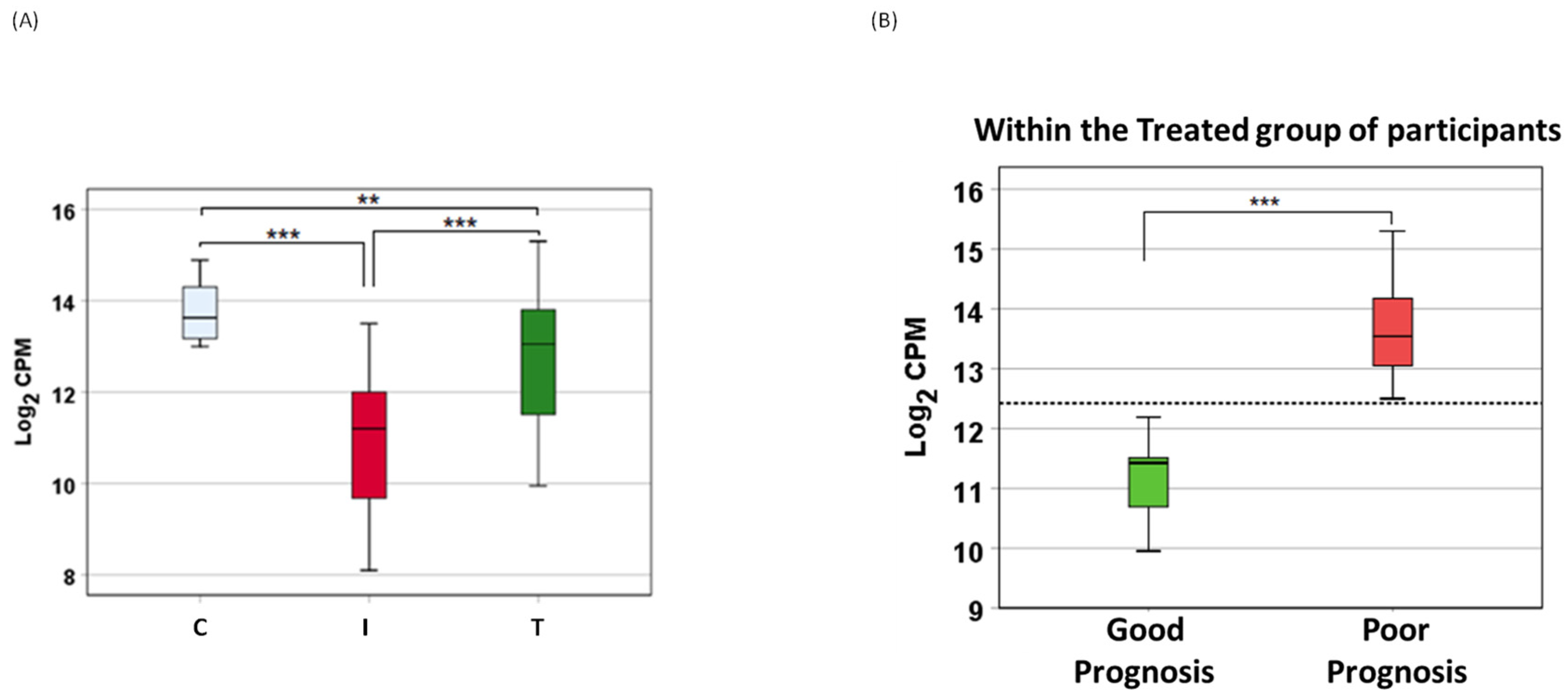
| Model | 19,528.148 a | 3 | 6509.383 | 3593.522 | 7.96 × 10−122 | |
| Group | 19,528.148 | 3 | 6509.383 | 3593.522 | 7.96 × 10−122 | |
| Error | 228.239 | 126 | 1.811 | |||
| Total | 19,756.387 | 129 | ||||
| Parameter | B | Robust Std. Error | t | Sig. | 95% Confidence Interval | |
| Lower Bound | Upper Bound | |||||
| Control (C) | 13.733 | 0.129 | 106.593 | 2.40 × 10−125 | 13.478 | 13.988 |
| Infected (I) | 10.936 | 0.214 | 51.009 | 5.33 × 10−86 | 10.512 | 11.361 |
| Infected + Treated (T) | 12.839 | 0.193 | 66.556 | 4.91 × 10−100 | 12.457 | 13.221 |
| Source | Type III Sum of Squares | df | Mean Square | F | Sig. | |
| Model | 8977.149 | 2 | 4488.575 | 8020.432 | 1.75 × 10−65 | |
| Good prognosis | 8977.149 | 2 | 4488.575 | 8020.432 | 1.75 × 10−65 | |
| Error | 29.101 | 52 | 0.560 | |||
| Total | 9006.251 | 54 | ||||
| Parameter | B | Robust Std. Error | t | Sig. | 95% Confidence Interval | |
| Lower Bound | Upper Bound | |||||
| Poor prognosis | 13.675 | 0.130 | 104.989 | 3.20 | 13.414 | 13.936 |
| Good prognosis | 11.168 | 0.170 | 65.825 | 9.21 × 10−52 | 10.827 | 11.508 |
Publisher’s Note: MDPI stays neutral with regard to jurisdictional claims in published maps and institutional affiliations. |
© 2022 by the authors. Licensee MDPI, Basel, Switzerland. This article is an open access article distributed under the terms and conditions of the Creative Commons Attribution (CC BY) license (https://creativecommons.org/licenses/by/4.0/).
Share and Cite
Akula, S.M.; Williams, J.F.; Pokhrel, L.R.; Bauer, A.N.; Rajput, S.; Cook, P.P. Cellular miR-6741-5p as a Prognostic Biomarker Predicting Length of Hospital Stay among COVID-19 Patients. Viruses 2022, 14, 2681. https://doi.org/10.3390/v14122681
Akula SM, Williams JF, Pokhrel LR, Bauer AN, Rajput S, Cook PP. Cellular miR-6741-5p as a Prognostic Biomarker Predicting Length of Hospital Stay among COVID-19 Patients. Viruses. 2022; 14(12):2681. https://doi.org/10.3390/v14122681
Chicago/Turabian StyleAkula, Shaw M., John F. Williams, Lok R. Pokhrel, Anais N. Bauer, Smit Rajput, and Paul P. Cook. 2022. "Cellular miR-6741-5p as a Prognostic Biomarker Predicting Length of Hospital Stay among COVID-19 Patients" Viruses 14, no. 12: 2681. https://doi.org/10.3390/v14122681
APA StyleAkula, S. M., Williams, J. F., Pokhrel, L. R., Bauer, A. N., Rajput, S., & Cook, P. P. (2022). Cellular miR-6741-5p as a Prognostic Biomarker Predicting Length of Hospital Stay among COVID-19 Patients. Viruses, 14(12), 2681. https://doi.org/10.3390/v14122681