Article

Serological Evidence of Widespread Zika Transmission across the Philippines
by
Joseph R. Biggs
1,*,
Ava Kristy Sy
2,3,
Oliver J. Brady
4,5,
Adam J. Kucharski
4,5,
Sebastian Funk
4,5,
Yun-Hung Tu
6,
Mary Anne Joy Reyes
2,3,
Mary Ann Quinones
2,3,
William Jones-Warner
1,
James Ashall
1,
Ferchito L. Avelino
7,
Nemia L. Sucaldito
7,
Amado O. Tandoc
2,
Eva Cutiongco-de la Paz
8,9,
Maria Rosario Z. Capeding
3,8,
Carmencita D. Padilla
8,9,
Martin L. Hibberd
1,8,9,† and
Julius Clemence R. Hafalla
1,†
1
Department of Infection Biology, Faculty of Infectious and Tropical Diseases, London School of Hygiene and Tropical Medicine, London WC1E 7HT, UK
2
Department of Virology, Research Institute for Tropical Medicine, Manila 1781, Philippines
3
Dengue Study Group, Research Institute for Tropical Medicine, Manila 1781, Philippines
4
Department of Infectious Disease Epidemiology, Faculty of Epidemiology and Population Health, London School of Hygiene and Tropical Medicine, London WC1E 7HT, UK
5
Centre for the Mathematical Modelling of Infectious Diseases, London School of Hygiene and Tropical Medicine, London WC1E 7HT, UK
6
Department of Molecular Parasitology and Tropical Diseases, Graduate Institute of Medical Sciences, Taipei Medical University, Taipei 11031, Taiwan
7
Department of Health, Philippine Epidemiology Bureau, Manila 1003, Philippines
8
Institute of Human Genetics, University of the Philippines, Manila 1000, Philippines
9
Philippine Genome Centre, University of the Philippines, Manila 1101, Philippines
*
Author to whom correspondence should be addressed.
These authors contributed to this work equally.
Viruses 2021, 13(8), 1441; https://doi.org/10.3390/v13081441
Submission received: 29 June 2021 / Revised: 15 July 2021 / Accepted: 20 July 2021 / Published: 23 July 2021
(This article belongs to the Special Issue Emerging RNA Viruses)

Abstract

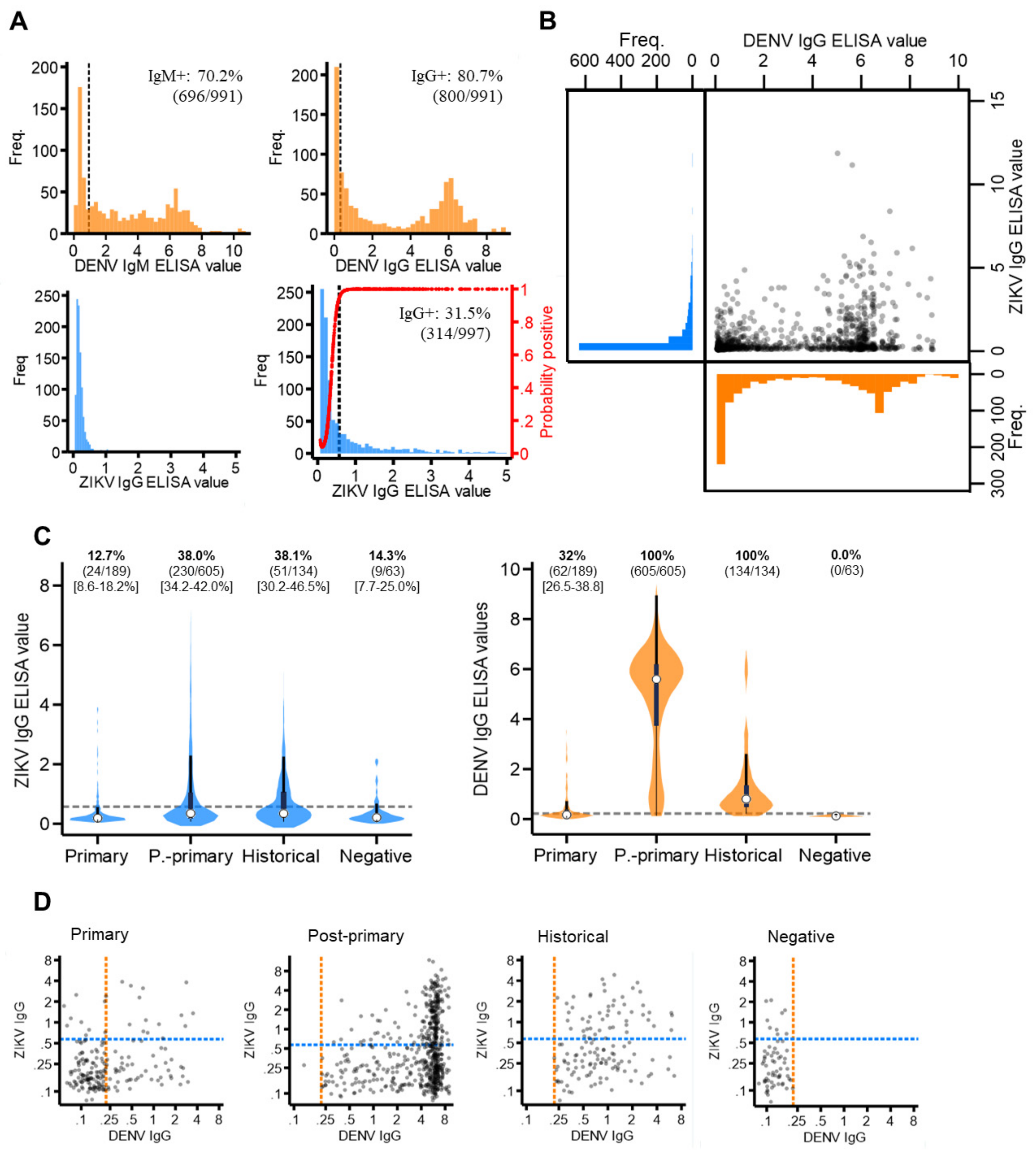
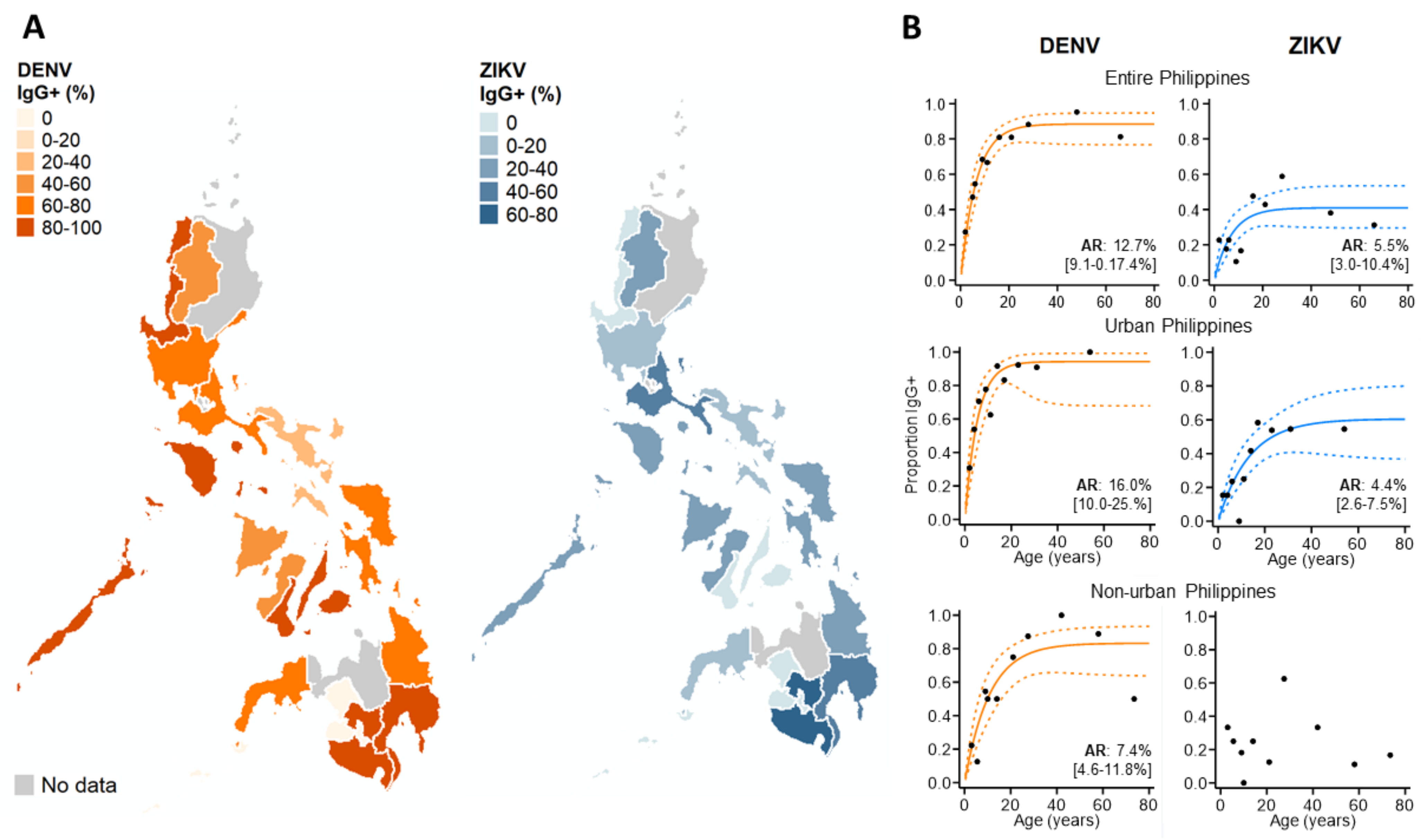
Zika virus (ZIKV) exposure across flavivirus-endemic countries, including the Philippines, remains largely unknown despite sporadic case reporting and environmental suitability for transmission. Using laboratory surveillance data from 2016, 997 serum samples were randomly selected from suspected dengue (DENV) case reports across the Philippines and assayed for serological markers of short-term (IgM) and long-term (IgG) ZIKV exposure. Using mixture models, we re-evaluated ZIKV IgM/G seroprevalence thresholds and used catalytic models to quantify the force of infection (attack rate, AR) from age-accumulated ZIKV exposure. While we observed extensive ZIKV/DENV IgG cross-reactivity, not all individuals with active DENV presented with elevated ZIKV IgG, and a proportion of dengue-negative cases (DENV IgG-) were ZIKV IgG-positive (14.3%, 9/63). We identified evidence of long-term, yet not short-term, ZIKV exposure across Philippine regions (ZIKV IgG+: 31.5%, 314/997) which was geographically uncorrelated with DENV exposure. In contrast to the DENV AR (12.7% (95%CI: 9.1–17.4%)), the ZIKV AR was lower (5.7% (95%CI: 3–11%)) across the country. Our results provide evidence of widespread ZIKV exposure across the Philippines and suggest the need for studies to identify ZIKV infection risk factors over time to better prepare for potential future outbreaks.
Keywords: Zika; dengue; serology; diagnostics; force of infection; Philippines Zika; dengue; serology; diagnostics; force of infection; Philippines