Next Article in Journal
Breeding for Virus Resistance and Its Effects on Deformed Wing Virus Infection Patterns in Honey Bee Queens
Previous Article in Journal
Porcine Lymphotropic Herpesviruses (PLHVs) and Xenotranplantation
 
 
Correction published on 30 September 2025, see Viruses 2025, 17(10), 1328.
Article

Full-Genome Sequences of Alphacoronaviruses and Astroviruses from Myotis and Pipistrelle Bats in Denmark

by
Christina M. Lazov
1,
Graham J. Belsham
2,
Anette Bøtner
2 and
Thomas Bruun Rasmussen
3,*
1
Department of Biotechnology and Biomedicine, Technical University of Denmark, 2800 Kongens Lyngby, Denmark
2
Department of Veterinary and Animal Sciences, University of Copenhagen, 1870 Frederiksberg, Denmark
3
Department of Virus and Microbiological Special Diagnostics, Statens Serum Institut, 2300 Copenhagen, Denmark
*
Author to whom correspondence should be addressed.
Viruses 2021, 13(6), 1073; https://doi.org/10.3390/v13061073
Submission received: 27 April 2021 / Revised: 28 May 2021 / Accepted: 2 June 2021 / Published: 4 June 2021 / Corrected: 30 September 2025
(This article belongs to the Section General Virology)

Abstract

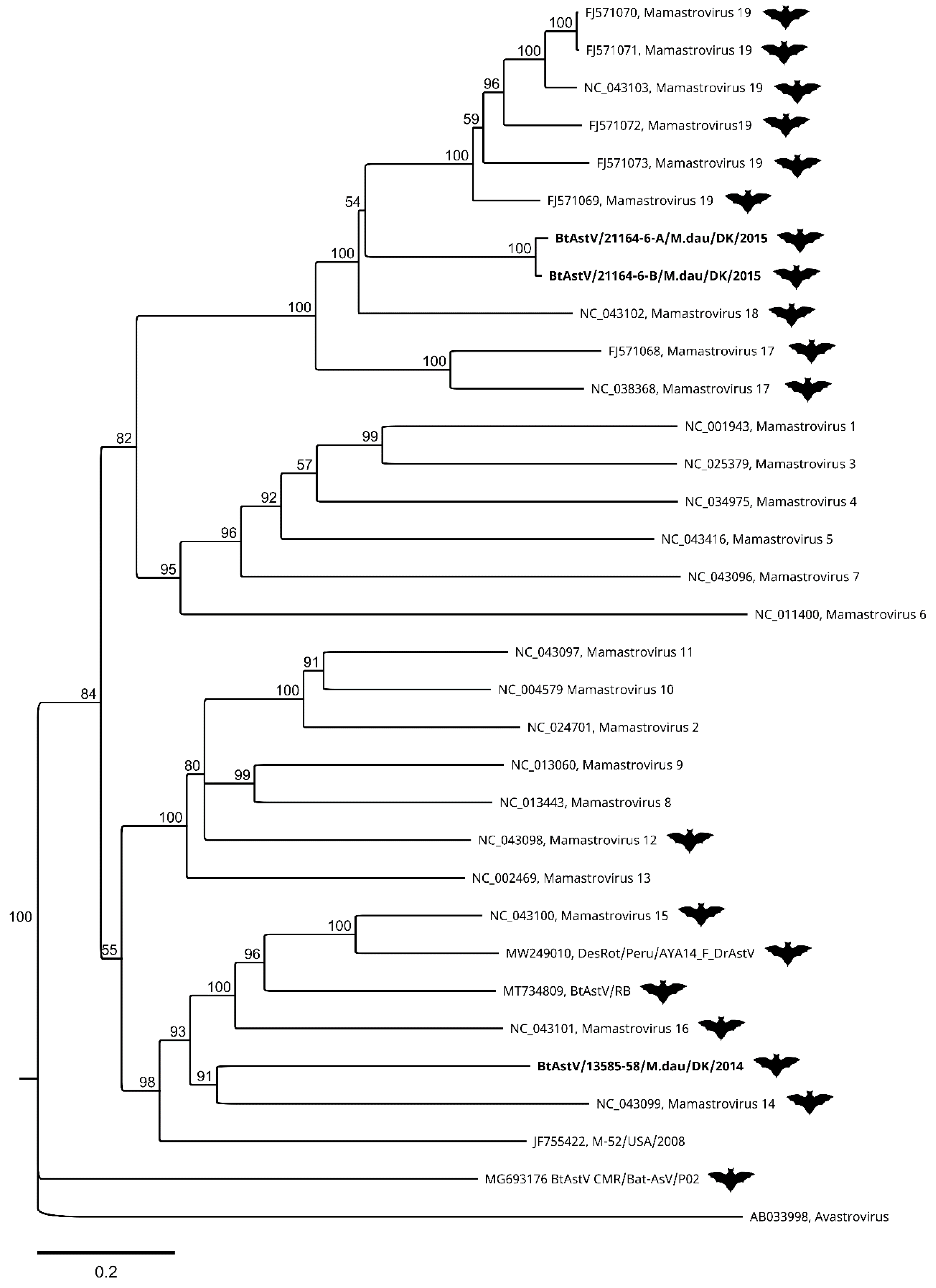
Bat species worldwide are receiving increased attention for the discovery of emerging viruses, cross-species transmission, and zoonoses, as well as for characterizing virus infections specific to bats. In a previous study, we investigated the presence of coronaviruses in faecal samples from bats at different locations in Denmark, and made phylogenies based on short, partial ORF1b sequences. In this study, selected samples containing bat coronaviruses from three different bat species were analysed, using a non-targeted approach of next-generation sequencing. From the resulting metagenomics data, we assembled full-genome sequences of seven distinct alphacoronaviruses, three astroviruses, and a polyomavirus, as well as partial genome sequences of rotavirus H and caliciviruses, from the different bat species. Comparisons to published sequences indicate that the bat alphacoronaviruses belong to three different subgenera—i.e., Pedacovirus, Nyctacovirus, and Myotacovirus—that the astroviruses may be new species in the genus Mamastrovirus, and that the polyomavirus could also be a new species, but unassigned to a genus. Furthermore, several viruses of invertebrates—including two Rhopalosiphum padi (aphid) viruses and a Kadipiro virus—present in the faecal material were assembled. Interestingly, this is the first detection in Europe of a Kadipiro virus.
Keywords: virus excretion; RNA viruses; insect viruses; virus taxonomy virus excretion; RNA viruses; insect viruses; virus taxonomy