Significantly Improved Recovery of Recombinant Sonchus Yellow Net Rhabdovirus by Expressing the Negative-Strand Genomic RNA


Abstract
1. Introduction
2. Materials and Methods
2.1. Construction of Plasmids
2.2. Agrobacterium Infiltration
2.3. Immunoblotting
2.4. Fluorescence Imaging
2.5. Transmission Electron Microscopy and Immunogold Labeling
3. Results
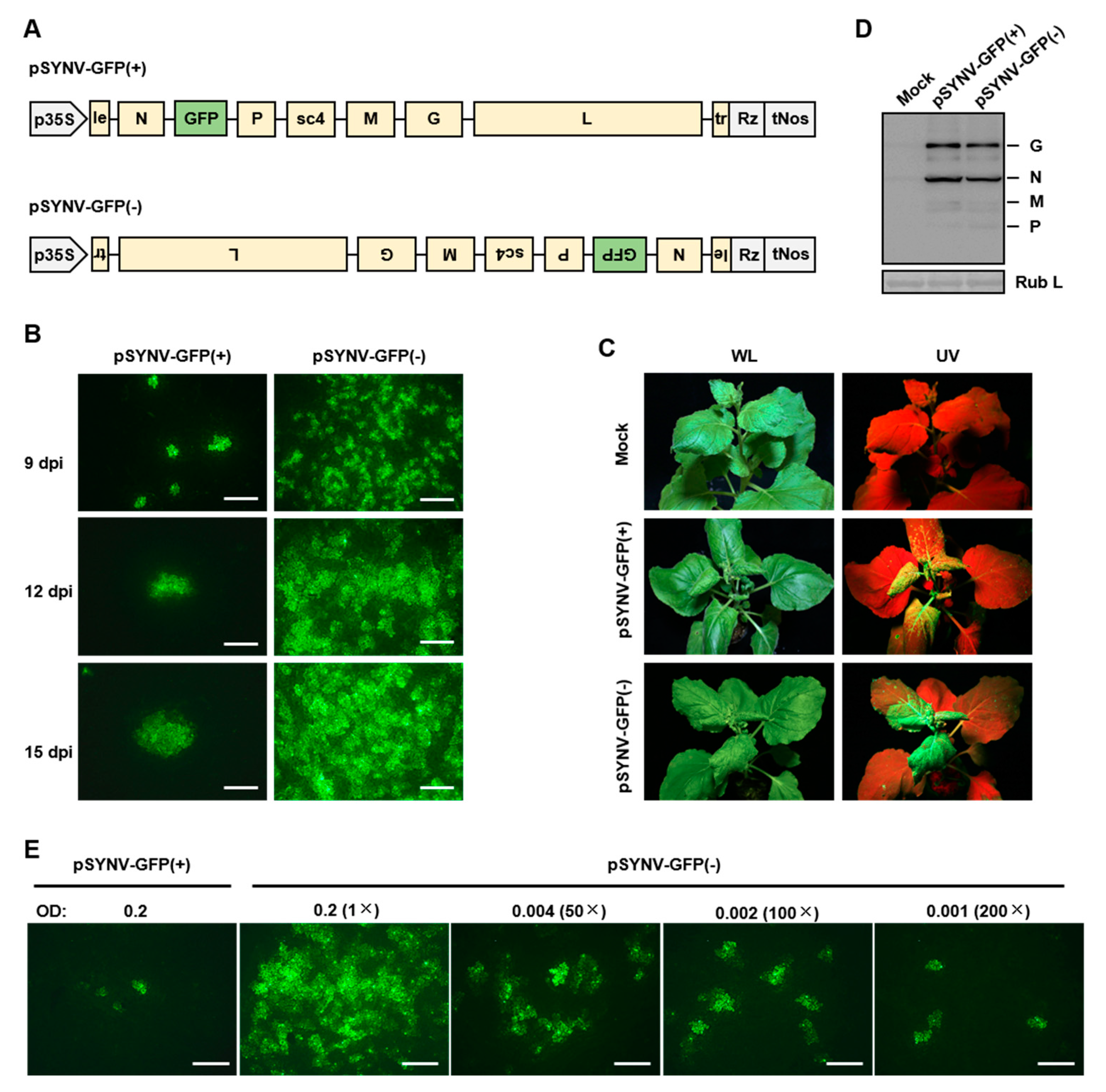
3.1. Use of Genome-Sense RNA Template Improves SYNV Rescue Efficiency by Two Orders of Magnitude
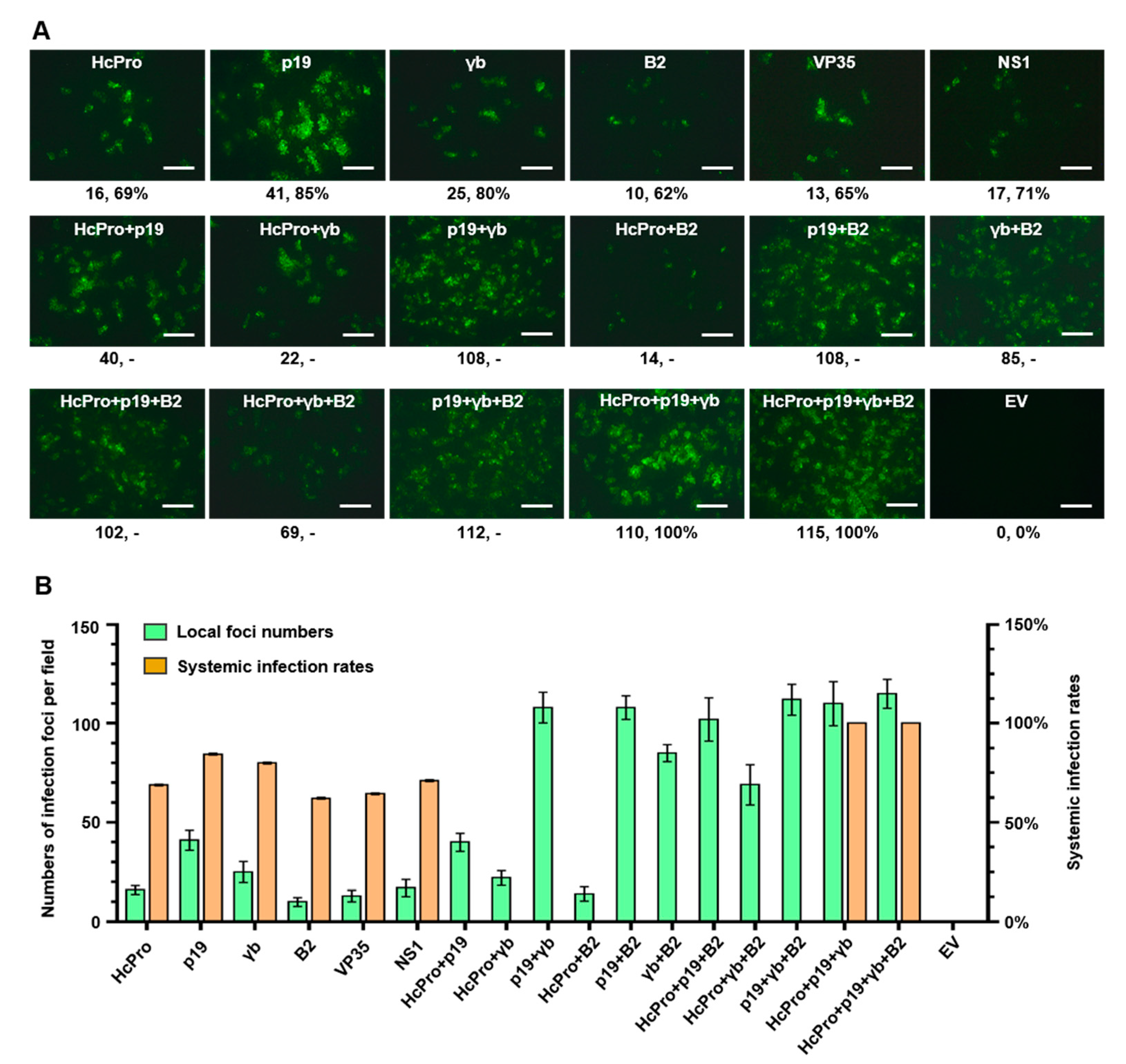
3.2. RNAi Suppression Is Essential for SYNV Recovery Using the gRNA Approach
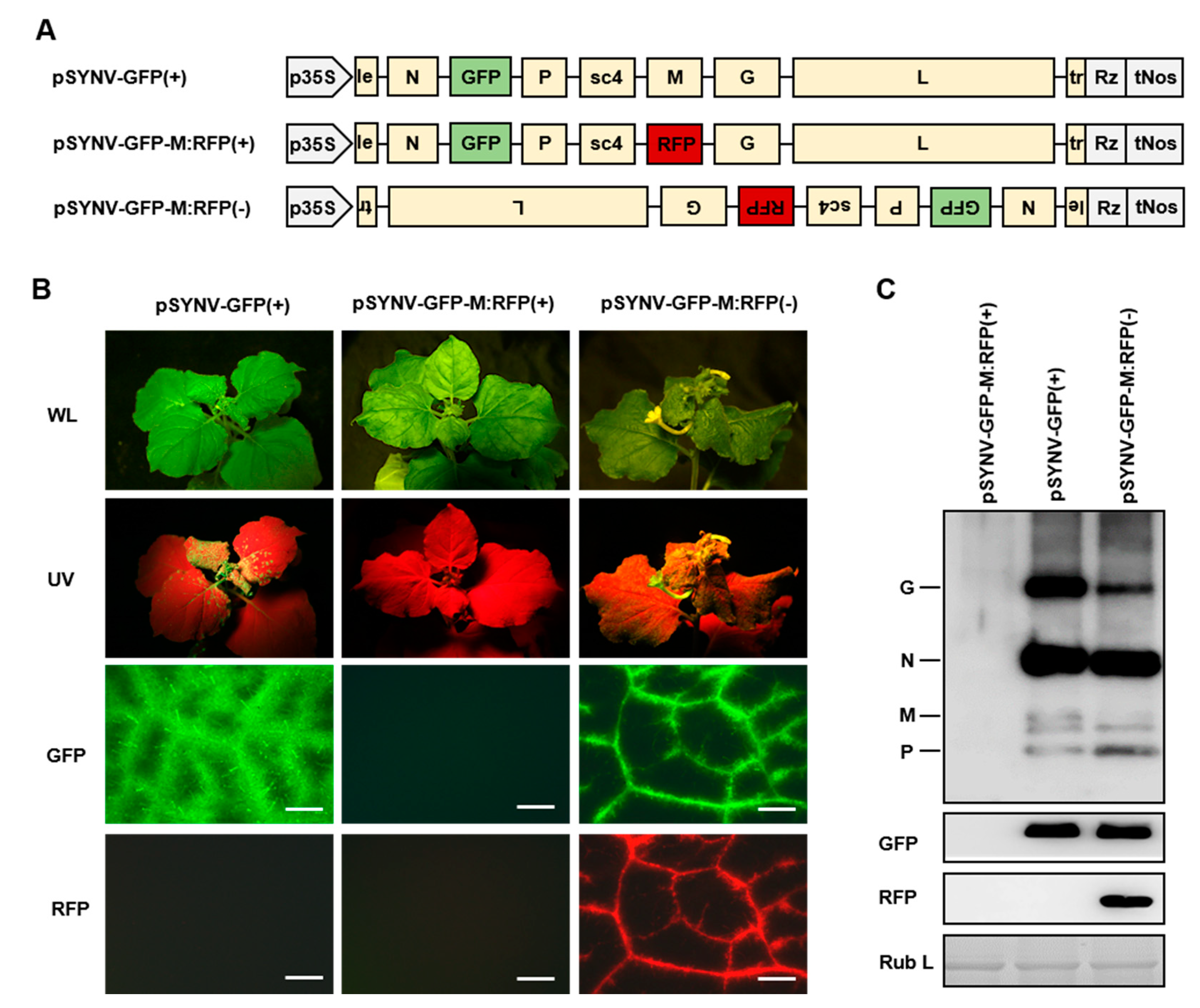
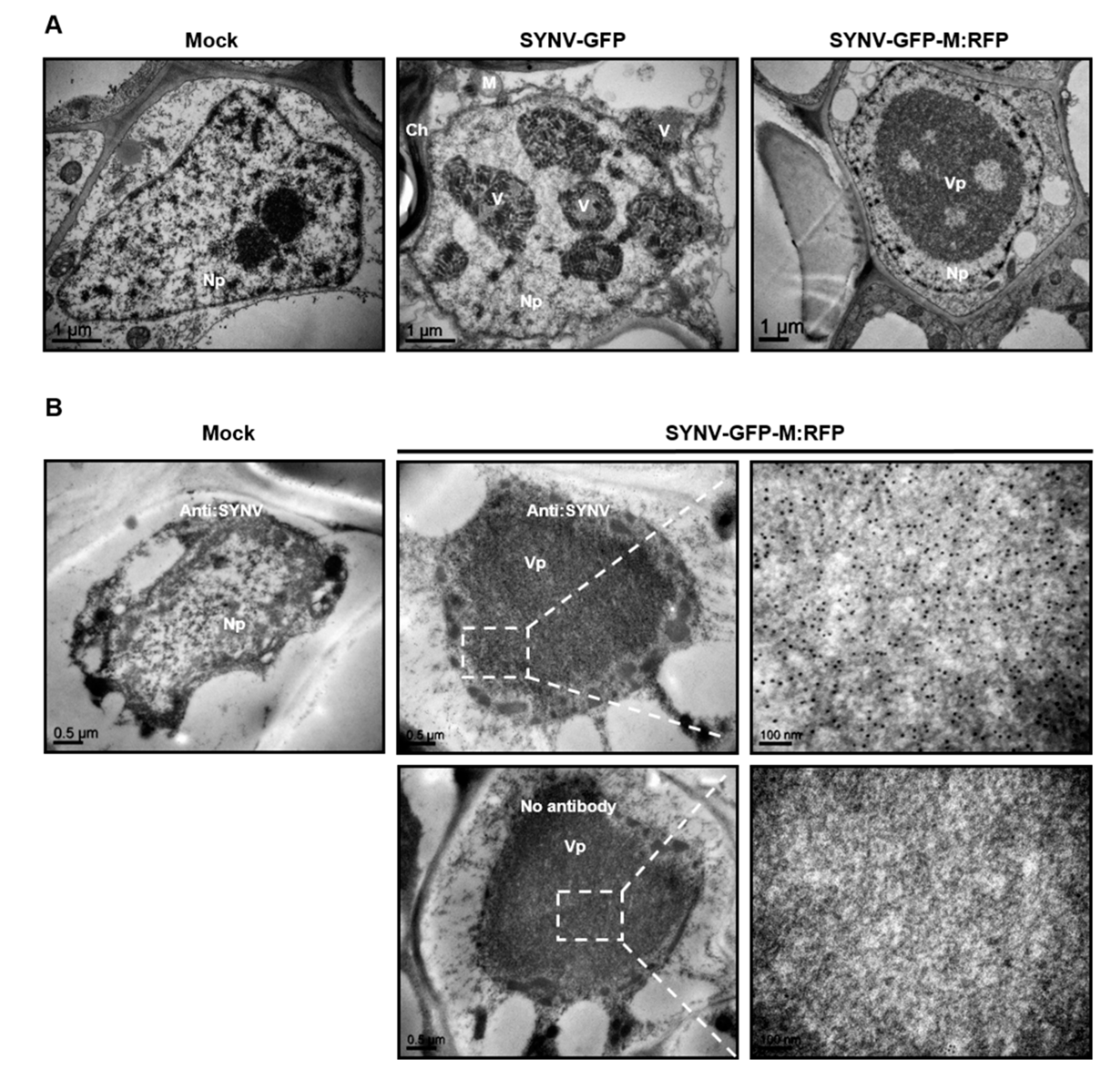
3.3. Improved Rescue System Permits Recovery of a Highly Attenuated SYNV Mutant Virus
4. Discussion
Author Contributions
Funding
Acknowledgments
Conflicts of Interest
References
- Biology of Negative Strand RNA Viruses: The Power of Reverse Genetics; Springer Science and Business Media LLC: Berlin/Heidelberg, Germany, 2004; Volume 283, p. 350.
- Knipe, D.M.; Howley, P.M. Fields Virology, 6th ed.; Lippincott Williams & Wilkins: Philadelphia, PA, USA, 2013; pp. 118–121. [Google Scholar]
- Lawson, N.D.; Stillman, E.A.; Whitt, M.A.; Rose, J.K. Recombinant vesicular stomatitis viruses from DNA. Proc. Natl. Acad. Sci. USA 1995, 92, 4477–4481. [Google Scholar] [CrossRef]
- Whelan, S.P.; Ball, L.A.; Barr, J.N.; Wertz, G.T. Efficient recovery of infectious vesicular stomatitis virus entirely from cDNA clones. Proc. Natl. Acad. Sci. USA 1995, 92, 8388–8392. [Google Scholar] [CrossRef]
- Radecke, F.; Spielhofer, P.; Schneider, H.; Kaelin, K.; Huber, M.; Dötsch, C.; Christiansen, G.; Billeter, M.A. Rescue of measles viruses from cloned DNA. EMBO J. 1995, 14, 5773–5784. [Google Scholar] [CrossRef]
- Roberts, A.; Rose, J.K. Recovery of Negative-Strand RNA Viruses from Plasmid DNAs: A Positive Approach Revitalizes a Negative Field. Virology 1998, 247, 1–6. [Google Scholar] [CrossRef]
- Schnell, M.; Mebatsion, T.; Conzelmann, K. Infectious rabies viruses from cloned cDNA. EMBO J. 1994, 13, 4195–4203. [Google Scholar] [CrossRef]
- Conzelmann, K.K. Reverse Genetics of Mononegavirales. Curr. Top. Microbiol. Immunol. 2004, 283, 1–41. [Google Scholar] [CrossRef]
- Rose, J.K. Positive strands to the rescue again: A segmented negative-strand RNA virus derived from cloned cDNAs. Proc. Natl. Acad. Sci. USA 1996, 93, 14998–15000. [Google Scholar] [CrossRef]
- Hur, S. Double-Stranded RNA Sensors and Modulators in Innate Immunity. Annu. Rev. Immunol. 2019, 37, 349–375. [Google Scholar] [CrossRef]
- Ding, S.-W. RNA-based antiviral immunity. Nat. Rev. Immunol. 2010, 10, 632–644. [Google Scholar] [CrossRef]
- Collins, P.L.; Mink, M.A.; Stec, D.S. Rescue of synthetic analogs of respiratory syncytial virus genomic RNA and effect of truncations and mutations on the expression of a foreign reporter gene. Proc. Natl. Acad. Sci. USA 1991, 88, 9663–9667. [Google Scholar] [CrossRef]
- Garcin, D.; Pelet, T.; Calain, P.; Roux, L.; Curran, J.; Kolakofsky, D. A highly recombinogenic system for the recovery of infectious Sendai paramyxovirus from cDNA: Generation of a novel copy-back nondefective interfering virus. EMBO J. 1995, 14, 6087–6094. [Google Scholar] [CrossRef]
- Hoffman, M.A.; Banerjee, A.K. An infectious clone of human parainfluenza virus type 3. J. Virol. 1997, 71, 4272–4277. [Google Scholar] [CrossRef]
- Durbin, A.P.; Hall, S.L.; Siew, J.W.; Whitehead, S.; Collins, P.L.; Murphy, B.R. Recovery of Infectious Human Parainfluenza Virus Type 3 from cDNA. Virology 1997, 235, 323–332. [Google Scholar] [CrossRef]
- Volchkov, V.E.; Volchkova, V.A.; Mühlberger, E.; Kolesnikova, L.V.; Weik, M.; Dolnik, O.; Klenk, H.-D. Recovery of Infectious Ebola Virus from Complementary DNA: RNA Editing of the GP Gene and Viral Cytotoxicity. Science 2001, 291, 1965–1969. [Google Scholar] [CrossRef]
- Schneider, U.; Schwemmle, M.; Staeheli, P. Genome trimming: A unique strategy for replication control employed by Borna disease virus. Proc. Natl. Acad. Sci. USA 2005, 102, 3441–3446. [Google Scholar] [CrossRef]
- Sanchez, A.B.; de la Torre, J.C. Rescue of the prototypic Arenavirus LCMV entirely from plasmid. Virology 2006, 350, 370–380. [Google Scholar] [CrossRef]
- Bridgen, A.; Elliott, R.M. Rescue of a segmented negative-strand RNA virus entirely from cloned complementary DNAs. Proc. Natl. Acad. Sci. USA 1996, 93, 15400–15404. [Google Scholar] [CrossRef]
- Blakqori, G.; Weber, F. Efficient cDNA-based rescue of La Crosse bunyaviruses expressing or lacking the nonstructural protein NSs. J. Virol. 2005, 79, 10420–10428. [Google Scholar] [CrossRef]
- Lowen, A.C.; Noonan, C.; McLees, A.; Elliott, R.M. Efficient bunyavirus rescue from cloned cDNA. Virology 2004, 330, 493–500. [Google Scholar] [CrossRef][Green Version]
- Billecocq, A.; Gauliard, N.; Le May, N.; Elliott, R.M.; Flick, R.; Bouloy, M. RNA polymerase I-mediated expression of viral RNA for the rescue of infectious virulent and avirulent Rift Valley fever viruses. Virology 2008, 378, 377–384. [Google Scholar] [CrossRef]
- Habjan, M.; Penski, N.; Spiegel, M.; Weber, F. T7 RNA polymerase-dependent and -independent systems for cDNA-based rescue of Rift Valley fever virus. J. Gen. Virol. 2008, 89, 2157–2166. [Google Scholar] [CrossRef]
- Ikegami, T.; Won, S.; Peters, C.J.; Makino, S. Rescue of Infectious Rift Valley Fever Virus Entirely from cDNA, Analysis of Virus Lacking the NSs Gene, and Expression of a Foreign Gene. J. Virol. 2006, 80, 2933–2940. [Google Scholar] [CrossRef]
- Kato, A.; Sakai, Y.; Shioda, T.; Kondo, T.; Nakanishi, M.; Nagai, Y. Initiation of Sendai virus multiplication from transfected cDNA or RNA with negative or positive sense. Genes Cells 1996, 1, 569–579. [Google Scholar] [CrossRef]
- Jackson, A.O.; Li, Z. Developments in Plant Negative-Strand RNA Virus Reverse Genetics. Annu. Rev. Phytopathol. 2016, 54, 469–498. [Google Scholar] [CrossRef]
- Wang, Q.; Ma, X.; Qian, S.; Zhou, X.; Sun, K.; Chen, X.; Zhou, X.; Jackson, A.O.; Li, Z. Rescue of a Plant Negative-Strand RNA Virus from Cloned cDNA: Insights into Enveloped Plant Virus Movement and Morphogenesis. PLoS Pathog. 2015, 11, e1005223. [Google Scholar] [CrossRef]
- Gao, Q.; Xu, W.; Yan, T.; Fang, X.; Cao, Q.; Zhang, Z.; Ding, Z.; Wang, Y.; Wang, X.-B. Rescue of a plant cytorhabdovirus as versatile expression platforms for planthopper and cereal genomic studies. New Phytol. 2019, 223, 2120–2133. [Google Scholar] [CrossRef]
- Feng, M.; Cheng, R.; Chen, M.; Guo, R.; Li, L.; Feng, Z.; Wu, J.; Xie, L.; Hong, J.; Zhang, Z.; et al. Rescue of tomato spotted wilt virus entirely from complementary DNA clones. Proc. Natl. Acad. Sci. USA 2019, 117, 1181–1190. [Google Scholar] [CrossRef]
- Verchot, J.; Herath, V.; Urrutia, C.D.; Gayral, M.; Lyle, K.; Shires, M.K.; Ong, K.; Byrne, D. Development of a reverse genetic system for studying rose rosette vrus in whole plants. Mol. Plant-Microbe Interact. 2020, 33, 1209–1221. [Google Scholar] [CrossRef]
- Ganesan, U.; Bragg, J.N.; Deng, M.; Marr, S.; Lee, M.Y.; Qian, S.; Shi, M.; Kappel, J.; Peters, C.; Lee, Y.; et al. Construction of a Sonchus Yellow Net Virus Minireplicon: A Step toward Reverse Genetic Analysis of Plant Negative-Strand RNA Viruses. J. Virol. 2013, 87, 10598–10611. [Google Scholar] [CrossRef]
- Goodin, M.M.; Dietzgen, R.G.; Schichnes, D.; Ruzin, S.; Jackson, A.O. pGD vectors: Versatile tools for the expression of green and red fluorescent protein fusions in agroinfiltrated plant leaves. Plant J. 2002, 31, 375–383. [Google Scholar] [CrossRef]
- Jackson, A.; Christie, S. Purification and some physicochemical properties of sonchus yellow net virus. Virology 1977, 77, 344–355. [Google Scholar] [CrossRef]
- Li, W.X. Induction and Suppression of RNA Silencing by an Animal Virus. Science 2002, 296, 1319–1321. [Google Scholar] [CrossRef]
- Prins, K.C.; Delpeut, S.; Leung, D.W.; Reynard, O.; Volchkova, V.A.; Reid, S.P.; Ramanan, P.; Cárdenas, W.B.; Amarasinghe, G.K.; Volchkov, V.E.; et al. Mutations Abrogating VP35 Interaction with Double-Stranded RNA Render Ebola Virus Avirulent in Guinea Pigs. J. Virol. 2010, 84, 3004–3015. [Google Scholar] [CrossRef]
- Garcia-Sarstre, A.; Egorov, A.; Matassova, D.; Brandtbc, S.; Levy, D.E.; Durbin, J.E.; Palese, P.; Musterbc, T. Influenza A Virus Lacking the NS1 Gene Replicates in Interferon-Deficient Systems. Virology 1998, 252, 324–330. [Google Scholar] [CrossRef]
- Okumura, A.; Harty, R.N. Rabies Virus Assembly and Budding. Adv. Clin. Chem. 2011, 79, 23–32. [Google Scholar] [CrossRef]
- Fire, A.; Xu, S.; Montgomery, M.K.; Kostas, S.A.; Driver, S.E.; Mello, C.C. Potent and specific genetic interference by double-stranded RNA in Caenorhabditis elegans. Nature 1998, 391, 806–811. [Google Scholar] [CrossRef]
- Lafforgue, G.; Tromas, N.; Elena, S.F.; Zwart, M.P. Dynamics of the Establishment of Systemic Potyvirus Infection: Independent yet Cumulative Action of Primary Infection Sites. J. Virol. 2012, 86, 12912–12922. [Google Scholar] [CrossRef]
- Rodrigo, G.; Zwart, M.P.; Elena, S.F. Onset of virus systemic infection in plants is determined by speed of cell-to-cell movement and number of primary infection foci. J. R. Soc. Interface 2014, 11, 20140555. [Google Scholar] [CrossRef]
- Saxena, P.; Hsieh, Y.-C.; Moreau, M.; Sainsbury, F.; Saunders, K.; Lomonossoff, G.P.; Scholthof, H.B. Improved foreign gene expression in plants using a virus-encoded suppressor of RNA silencing modified to be developmentally harmless. Plant Biotechnol. J. 2010, 9, 703–712. [Google Scholar] [CrossRef]
- Kasschau, K.D.; Carrington, J.C. Long-Distance Movement and Replication Maintenance Functions Correlate with Silencing Suppression Activity of Potyviral HC-Pro. Virology 2001, 285, 71–81. [Google Scholar] [CrossRef]
- Qu, F.; Morris, T.J. Efficient Infection of Nicotiana benthamiana by Tomato bushy stunt virus Is Facilitated by the Coat Protein and Maintained by p19 Through Suppression of Gene Silencing. Mol. Plant-Microbe Interact. 2002, 15, 193–202. [Google Scholar] [CrossRef]
- Mebatsion, T.; Weiland, F.; Conzelmann, K.K. Matrix Protein of Rabies Virus Is Responsible for the Assembly and Budding of Bullet-Shaped Particles and Interacts with the Transmembrane Spike Glycoprotein G. J. Virol. 1999, 73, 242–250. [Google Scholar] [CrossRef]
- Jackson, A.O.; Dietzgen, R.G.; Goodin, M.; Bragg, J.N.; Deng, M. Biology of Plant Rhabdoviruses. Annu. Rev. Phytopathol. 2005, 43, 623–660. [Google Scholar] [CrossRef]
- Zhou, X.; Sun, K.; Zhou, X.; Jackson, A.O.; Li, Z. The Matrix Protein of a Plant Rhabdovirus Mediates Superinfection Exclusion by Inhibiting Viral Transcription. J. Virol. 2019, 93, 00680-19. [Google Scholar] [CrossRef]
- Sun, K.; Zhou, X.; Lin, W.; Zhou, X.; Jackson, A.O.; Li, Z. Matrix-glycoprotein interactions required for budding of a plant nucleorhabdovirus and induction of inner nuclear membrane invagination. Mol. Plant Pathol. 2018, 19, 2288–2301. [Google Scholar] [CrossRef]
- Cullen, B.R.; Cherry, S.; Tenoever, B.R. Is RNA Interference a Physiologically Relevant Innate Antiviral Immune Response in Mammals? Cell Host Microbe 2013, 14, 374–378. [Google Scholar] [CrossRef]
- Tenoever, B.R. The Evolution of Antiviral Defense Systems. Cell Host Microbe 2016, 19, 142–149. [Google Scholar] [CrossRef]
- Bucher, E.; Hemmes, H.; de Haan, P.; Goldbach, R.; Prins, M. The influenza A virus NS1 protein binds small interfering RNAs and suppresses RNA silencing in plants. J. Gen. Virol. 2004, 85, 983–991. [Google Scholar] [CrossRef]
- Haasnoot, J.; de Vries, W.; Geutjes, E.-J.; Prins, M.; de Haan, P.; Berkhout, B. The Ebola Virus VP35 Protein Is a Suppressor of RNA Silencing. PLoS Pathog. 2007, 3, e86. [Google Scholar] [CrossRef]
- Qian, S.; Chen, X.; Sun, K.; Zhang, Y.; Li, Z. Capped antigenomic RNA transcript facilitates rescue of a plant rhabdovirus. Virol. J. 2017, 14, 1–12. [Google Scholar] [CrossRef]



| Binary Plasmid a | OD600 | Foci No. b | Systemic Infection c |
|---|---|---|---|
| pSYNV-GFP(+) | 0.2 | 4.3 | 3/45 (6.7%) |
| pSYNV-GFP(-) | 0.2 | >100 | 45/45 (100%) |
| pSYNV-GFP(-) | 0.004 | 32.0 | 5/45 (11.1%) |
| pSYNV-GFP(-) | 0.002 | 18.3 | 4/45 (8.8%) |
| pSYNV-GFP(-) | 0.001 | 5.3 | 1/45 (2.2%) |
| pSYNV-GFP-M:GFP(+) | 0.2 | 3.7 | 0/45 (0%) |
| pSYNV-GFP-M:GFP(-) | 0.2 | 83.0 | 4/45 (8.8%) |
Publisher’s Note: MDPI stays neutral with regard to jurisdictional claims in published maps and institutional affiliations. |
© 2020 by the authors. Licensee MDPI, Basel, Switzerland. This article is an open access article distributed under the terms and conditions of the Creative Commons Attribution (CC BY) license (http://creativecommons.org/licenses/by/4.0/).
Share and Cite
Ma, X.; Li, Z. Significantly Improved Recovery of Recombinant Sonchus Yellow Net Rhabdovirus by Expressing the Negative-Strand Genomic RNA. Viruses 2020, 12, 1459. https://doi.org/10.3390/v12121459
Ma X, Li Z. Significantly Improved Recovery of Recombinant Sonchus Yellow Net Rhabdovirus by Expressing the Negative-Strand Genomic RNA. Viruses. 2020; 12(12):1459. https://doi.org/10.3390/v12121459
Chicago/Turabian StyleMa, Xiaonan, and Zhenghe Li. 2020. "Significantly Improved Recovery of Recombinant Sonchus Yellow Net Rhabdovirus by Expressing the Negative-Strand Genomic RNA" Viruses 12, no. 12: 1459. https://doi.org/10.3390/v12121459
APA StyleMa, X., & Li, Z. (2020). Significantly Improved Recovery of Recombinant Sonchus Yellow Net Rhabdovirus by Expressing the Negative-Strand Genomic RNA. Viruses, 12(12), 1459. https://doi.org/10.3390/v12121459