Article

Development of a Whole-Virus ELISA for Serological Evaluation of Domestic Livestock as Possible Hosts of Human Coronavirus NL63


1
Department of Clinical Microbiology, Kwame Nkrumah University of Science and Technology, PMB, UPO, Kumasi 00233, Ghana
2
Kumasi Centre for Collaborative Research in Tropical Medicine, PMB, UPO, KNUST, Kumasi 00233, Ghana
3
Previous Institution: Institute of Virology, University of Bonn Medical Centre, 53127 Bonn, Germany
4
Department of Theoretical and Applied Biology, Kwame Nkrumah University of Science and Technology, PMB, UPO, Kumasi 00233, Ghana
5
Department of Medical Laboratory Technology, Kwame Nkrumah University of Science and Technology, PMB, UPO, Kumasi 00233, Ghana
6
Institute of Virology, Charite, Universitätsmedizin Berlin, 10117 Berlin, Germany
7
Department of Animal Science, Kwame Nkrumah University of Science and Technology, PMB, UPO, Kumasi 00233, Ghana
8
School of Veterinary Medicine, Kwame Nkrumah University of Science and Technology, PMB, UPO, Kumasi 00233, Ghana
9
Department of Agroforestry, Kwame Nkrumah University of Science and Technology, PMB, UPO, Kumasi 00233, Ghana
10
Department of Wildlife and Range Management, Kwame Nkrumah University of Science and Technology, PMB, UPO, Kumasi 00233, Ghana
*
Author to whom correspondence should be addressed.
Viruses 2019, 11(1), 43; https://doi.org/10.3390/v11010043
Submission received: 27 September 2018 / Revised: 31 December 2018 / Accepted: 5 January 2019 / Published: 9 January 2019
(This article belongs to the Section Animal Viruses)

Abstract

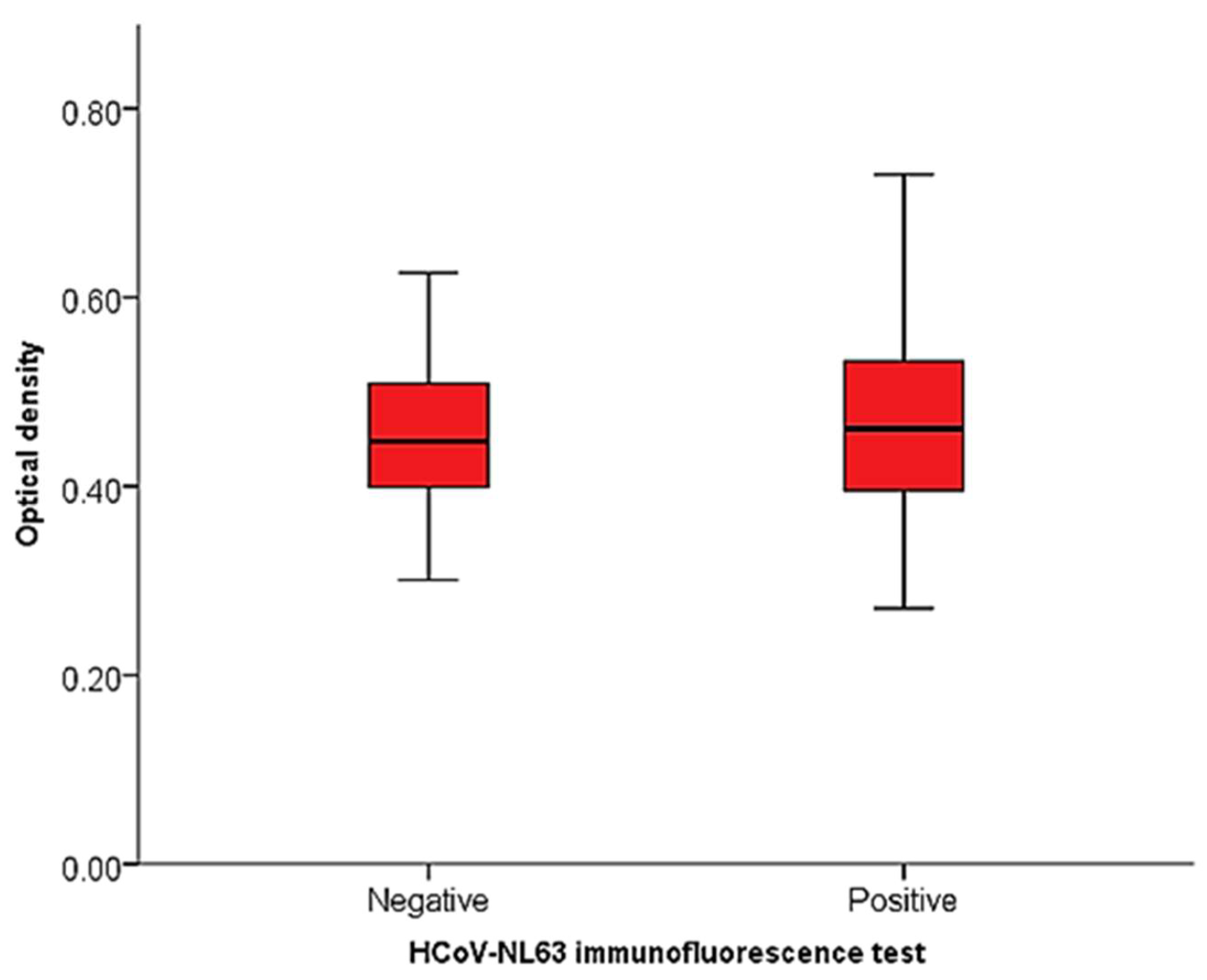
Known human coronaviruses are believed to have originated in animals and made use of intermediate hosts for transmission to humans. The intermediate hosts of most of the human coronaviruses are known, but not for HCoV-NL63. This study aims to assess the possible role of some major domestic livestock species as intermediate hosts of HCoV-NL63. We developed a testing algorithm for high throughput screening of livestock sera with ELISA and confirmation with recombinant immunofluorescence assay testing for antibodies against HCoV-NL63 in livestock. Optimization of the ELISA showed a capability of the assay to significantly distinguish HCoV-NL63 from HCoV-229E (U = 27.50, p < 0.001) and HCoV-OC43 (U = 55.50, p < 0.001) in coronavirus-characterized sera. Evaluation of the assay with collected human samples showed no significant difference in mean optical density values of immunofluorescence-classified HCoV-NL63-positive and HCoV-NL63-negative samples (F (1, 215) = 0.437, p = 0.509). All the top 5% (n = 8) most reactive human samples tested by ELISA were HCoV-NL63 positive by immunofluorescence testing. In comparison, only a proportion (84%, n = 42) of the top 25% were positive by immunofluorescence testing, indicating an increased probability of the highly ELISA reactive samples testing positive by the immunofluorescence assay. None of the top 5% most ELISA reactive livestock samples were positive for HCoV-NL63-related viruses by immunofluorescence confirmation. Ghanaian domestic livestock are not likely intermediate hosts of HCoV-NL63-related coronaviruses.
Keywords: Coronavirus; ELISA; livestock; intermediate host; immunofluorescence Coronavirus; ELISA; livestock; intermediate host; immunofluorescence